
Shevlin Sebastian's Blog, page 18
April 1, 2022
The Governor's gift

This is flash fiction: a short, short story
By Shevlin Sebastian
It was a white bungalow. There were pink bougainvillaea flowers growing along the walls. Outside, near the imposing black gate, two police officers in khaki uniforms stood guard. They had pistols attached to their belts.
This was the house of the governor of the state.
The governor was a woman. She studied and got into the Indian Police Service. She became a successful police officer. She then took an early retirement. Now, she supported a political party who came to power at the national level. They believed in the supremacy of one community only. All the rest were second-class citizens.
The government appointed her as governor.
But she had a secret.
She had a lover who belonged to another community.
This was anathema for the party. Her career would be damaged if the government came to know.
But it would be difficult for the government to know. He was her personal security guard. So, he accompanied her everywhere. At night, he stood guard outside her bedroom door. Occasionally, he would go in and make love to her. Nobody knew. He was the only security guard.
The governor had never married, much to the disappointment of her parents. She had focused on her career. But now in her mid-fifties, time had run out — to marry, have children and enjoy a family life. Plus, she was not keen to be bogged down. She wanted freedom above everything else.
This arrangement worked fine. The security guard was also not interested in anything permanent. The governor, at 52, was 20 years older.
He had no intention at the beginning. But working so closely next to her, one thing led to another. When she undressed, he discovered she had a supple body.
She gave no hint because she wore loose-fitting shirts and trousers. She wore no make-up or any form of jewellery. People thought she had no sexuality at all. But that was not true. In bed, she was an active participant. And she gave as generously as she took. So, the security guard enjoyed his time with her.
This arrangement continued for a few years, with both parties satisfied with their roles.
Then the governor resigned. She decided to stand for elections in the party's name.
The party offered her money and resources. She campaigned from morning to evening. She went in and out of houses, up dusty lanes and down tarred roads. She rode in a cart, a car, an auto-rickshaw, a truck, a tractor, and a minivan to show she was in touch with the common man. The security guard remained by her side all the time. But it was too risky to share her bed because they were staying in unknown houses and hotels.
Despite the enthusiasm shown to her by the people in the constituency, she lost. But the governor was not disappointed. It was her first time. In politics, it is difficult for a newcomer to win.
But it disappointed the party she had lost. They had pinned their hopes on her winning the seat. She was well-known and appeared in the media a lot.
‘Now what?’ she thought.
‘Now what?’ thought the security guard.
She went to her home in New Delhi. From her own resources, she began paying the security guard. He stood outside. When nobody was around, he stepped inside and served her.
The arrangement continued.
But pressure was growing on the security guard to get married.
So he did.
He had a charming wife who grew up in a village. He enjoyed his conjugal relations with her.
The governor requested he continue with the ‘private arrangement’ with her.
He thought about it for a couple of days. His mind told him, ‘Why not?’ His wife would not know. If they remained cautious, like he and the governor had always been, things could continue.
And they did.
Three years later, the security guard became the father of twin boys. The marriage continued. He was a devoted husband and father. He also looked after his parents. He celebrated Id, Holi, Christmas, Diwali and the New Year.
As for the governor, she had joined an NGO that helped rehabilitate sex workers.
The pay was good. She was happy with her job. She was no longer in the limelight. Unlike most people, she did not miss the spotlight. She felt she lived a more authentic life now.
One afternoon, the governor had a heart attack.
The security guard rushed her to the hospital in an ambulance, sirens blaring.
But it was too late.
The hospital pronounced her dead on arrival.
The security guard shed tears at the crematorium. They had a beautiful relationship of mutual respect and love. The governor was only 64 when she passed away.
Life went on.
Two months later, a lawyer contacted the security guard. He told him the governor had given him a flat worth Rs 1 crore in New Delhi and Rs 20 lakh in cash.
The security guard almost fainted in shock.
He asked the lawyer why.
“In the will, it is written, ‘For services rendered’,” said the lawyer.
“Thank you,” said the security guard, joining his hands together in a namaste.
(Published in Twist and Twain)


March 26, 2022
What goes around comes around

By Shevlin Sebastian
Photo: Many Anglo-Indians live in Bow Barracks, Kolkata. This is a representational image
Steve Smith, 54, and his 50-year-old wife Virginia stay in an old-style bungalow. A few such bungalows still exist in Calcutta. Many of them have been torn down. In its place, high-rise buildings have sprung up.
The house is an inheritance for Steve. His father Paul worked in the railways and rose to a prominent position. Later, Paul bought the house from a Britisher who was departing India following Independence. Steve resisted the temptation to sell it. He was not strapped for money, anyway. Steve worked as a pilot at the port of Calcutta. His income was decent. His wife worked as a secretary to the managing director of a multinational firm. She earned well too.
Steve has kept the house in pristine condition. The rooms are large: there is a main hall, and on either side are bedrooms with attached bathrooms. From the hall, it leads to the dining room. Everywhere, there is wooden furniture. On the right is the kitchen. There is a garden at the back. Virginia grows potatoes, tomatoes and cabbages. There is a large shed on one side where Steve parks his car. The roof has red tiles.
Virginia and Steve are now experiencing empty nest syndrome. Both their children, Robert, 24, and Karen, 22, live and work in Melbourne. All Steve’s brothers and sisters are in Australia. They arranged for Steve’s children to come across.
Both Steve and Virginia are aware the Anglo-Indian community is dwindling. The second generation is marrying other Indians. There are not enough eligible men and women anymore. Steve knew there would come a time when they would have to move in their old age. It could be to Australia to be with their children. Or they might have to stay at an old age home.
But he would ensure he sold the house to an individual rather than a builder, so that the house could be preserved. A nation becomes impoverished when its inhabitants raze their historical buildings. All you get are these impersonal concrete buildings with no personality.
While Virginia had a day job, Steve sometimes did the night shift. Ships could come in at any time of the day and night. It’s like the Suez Canal where ships plied through the canal 24 hours a day, 365 days a year.
But Steve liked his job. He enjoyed being in the water. He liked the different moods of the sea — stormy, calm, angry, or moody.
On a recent Sunday afternoon, both had finished lunch and washed the dishes and placed them on a washing rack to dry.
Steve smoked a pipe with quick puffs. He was wearing a T-shirt and shorts. Virginia was also in a T-shirt and shorts. They sat in low armchairs and watched a Netflix film. The living room, painted in a pale yellow, was cool because of the high ceilings. His friends stayed in concrete apartments and always complained of the heat.
Their house remained cool thanks to the clever construction by British architects.
As Steve saw a murder on the screen, it triggered a memory.
This happened many years ago when Steve was in his late twenties. He had been a Catholic priest. On most Sundays, he would travel to a convent to say Mass. Steve was attracted to a nun, Sr. Jude. She was an Anglo-Indian like him. They began a discreet affair. They met in parishes, where priest friends of Steve would set aside a room. They would make love. Sr. Jude would tell the convent authorities she was planning to meet a relative in Bandel, 54 kms from Calcutta.
Indeed, she had an old aunt Mabel who lived in a two-bedroom apartment. She had a maid, Rupali, who looked after her.
One early morning, when Steve had come to the convent, he could not resist kissing and hugging Sr. Jude. They were alone in the kitchen. A few minutes later, a novice nun, Mary, came into the kitchen and caught them red-handed. She put an arm across her mouth and stifled a cry of surprise. Steve and Sr. Jude realised Mary had caught them in an embarrassing position.
What followed was a scene from a fast-paced crime thriller. Sr. Jude said, “We have to silence her.”
“But how?” whispered Steve.
They thought for a few seconds. It seemed like several minutes to both of them.
Sr. Jude jerked her head forward and said, “I have an idea.”
Steve and Sr. Jude headed to her room, although the priest was not supposed to enter the nuns’ private quarters. She took out cotton and a bottle of chloroform. The other nuns were getting ready.
Nobody was in the corridor. They proceeded to Mary’s room. Sr. Jude knocked softly. Mary opened the door. Both Steve and Sr. Jude barged in and pinned her to the ground while Steve pressed his hand over her mouth. Sr. Jude drenched the cotton in chloroform and placed it under Mary’s nose. She passed out within minutes. The nun put the remaining pad of cotton and the bottle in the pocket of her habit.
She looked out of the corridor. Nobody was there. While Steve held the shoulders, Sr. Jude held the legs.
They took the body down the corridor, down the stairs, through the kitchen and to the back. There was a well some distance away.
Since it was a winter’s morning, a week before Christmas, there was fog and mist. They seemed like ghostly figures. Both prayed that nobody was looking out of the window. They reached the edge of the well and laid Mary on the edge.
Steve held Sr. Mary’s legs and pushed the body downwards. He reached down as far as he could without losing his balance, so that the plop sound was not too loud. Then he loosened his grip. The body fell with a splash, but both were not sure whether the nuns in the convent could hear it. With bent heads and breaths coming out in short bursts of white vapour, they headed back.
Steve walked to the chapel. Sr. Jude hurried to her room. She emptied the chloroform liquid into the washbasin. Then she removed the ‘chloroform’ label and tore it up. She washed the bottle, inside and outside, at the tap.
She also threw the remaining cotton into the wastepaper bucket.
Near the chapel, there was a toilet. Steve washed his hands with soap and splashed water on his face. He dried himself with a white towel placed on the rack. He returned to the chapel, wore the vestments and got ready for Mass.
Ten minutes later, the nuns trooped in.
Nobody missed Mary.
After mass was over, Steve usually had breakfast, but this time he made his excuses and left. In his room at the parish, he found that his heart was still racing. It took him almost half an hour to relax.
Two hours later, a maid, Shonali, had gone to the well to draw water to wash the breakfast plates and dishes. When she looked down, she saw the floating body of Mary and screamed.
The nuns came running. Shonali pointed at the well. They looked down and gasped. Mary had to be pulled up immediately. They called the police. The police brought a man who cleaned wells.
Using a long ladder, he climbed down and reached the surface of the water. He checked the wrist and realised there was no movement.
He picked up Mary and put her on his back. He came up, leaning forward, using his left hand to hold her at the back and the right arm held on to the ladder. It was an incredible feat of strength.
The man laid the body on the ground.
“Sir,” the man said, looking up at a group of cops. “The girl has died.”
The police rushed her to the hospital. But it was too late. The doctors declared Mary dead on arrival.
The police began an investigation.
All the nuns had to appear before a detective, who sat at a small desk in the parlour.
They answered the questions as best as they could.
Mary had joined the convent only four months ago. Nobody knew much about her.
In the end, the officer concluded that she had committed suicide.
Mary’s parents were poor. They protested to the Mother Superior that Mary had sounded happy. They had only spoken to her on the phone a couple of days earlier. She had always wanted to be a nun. Now she was close to fulfilling her dream. The Mother Superior said, “Nobody can say for sure what was going on in Mary’s mind? The police said it was a case of suicide. We have to accept the findings.”
In the end, to calm down Mary’s parents, the convent gave them a sum of Rs 1 lakh through a crossed cheque.
The convent authorities sighed in relief. If it had been a murder, there would have been plenty of negative media coverage.
Steve and Sr. Jude had a close shave. But the incident proved to be a shock. They stopped their affair. It was too dangerous now.
After a year, Steve opted out of the priesthood.
Because he loved the sea, he trained to be a river pilot and secured the job.
He had been a river pilot for the past 24 years. He met Virginia at a New Year’s Eve ball, at the Dalhousie Institute, fell in love and got married.
Sometimes, he thought of Mary. But he immediately stifled the thought. Sr. Jude travelled abroad on assignments. He had not seen her in years, and they did not remain in touch. This was a secret they would carry to their graves. Sometimes Steve thought, ‘Was it necessary to do what we did?’ But Sr Jude was one who had become so frightened of Mary leaking the affair to the superiors. She felt this would ruin her career. Steve had agreed too quickly to her plan, which snuffed out the life of a young woman.
In the end, Steve and Sr. Jude had committed a flawless murder.
Steve returned to the present. The film continued.
His mood plummeted. A pleasant mood was now tinged with sadness and regret. He had never confided in anybody, not even when he went to church for confession. It would be too explosive a secret to recount. Steve was not sure whether the priest would keep the secret to himself or inform the police.
There was a rush of feet inside the room. Steve and Virginia turned to look at the door. Two men had barged in. They were wearing cloth masks, with slits for the eyes. They grabbed Steve, and before he could respond, one of them slit his neck. A shocked Virginia opened her mouth in shock, but no scream came out. They grabbed her and tied a handkerchief around her face. Then they pushed her to the floor, tied her hands and legs with thick twine.
The duo ransacked the entire house. They were looking for a pouch of diamonds.
In prison, their fellow inmate, Gavin Xavier, had told them about this pouch of diamonds. “Kill Steve first,” said Gavin. “He is strong and can fight back.”
The thieves could not locate the pouch. There was no safe. Inside the wooden almirah, there was hardly any money or gold, let alone diamonds. Time was running out. They returned to Virginia, removed the handkerchief, pressed a knife to her neck, and asked her about the diamonds.
This time, Virginia found her voice. “There are no diamonds,” she said in a firm voice. “Somebody has given you wrong information. Even if you kill me, you will not find any diamonds.”
The thieves looked at each other.
They realised Virginia was telling the truth.
“That bastard was telling lies to us,” one thief said to the other.
“We’ll kill him when he comes out,” said the other.
The thieves took Steve’s wallet, which was lying on a mantelpiece, and ran out of the house.
In the evening, Rachel, Virginia’s cousin, and her husband Frank dropped in for a visit. They immediately realised they had stepped into a tragedy.
Steve was long dead.
Virginia’s body shook with the shock of what happened.
Two days later, the post-mortem of Steve took place. Thereafter, with the help of her son, Robert, Virginia filed a First Information report at the local police station.
Steve’s funeral took place at the Lower Circular Road cemetery. His siblings had flown down from Melbourne.
The burial was a low-key affair.
People kept quiet and shed tears.
The priest gave a eulogy about the upstanding qualities of Steve.
He went six feet under.
Nobody knows what Sr. Jude thought about all this. It had appeared in all the newspapers and on TV.
As for Mary, floating about somewhere in the universe, she might have enjoyed a quiet smile of satisfaction.
When we come to think about it, what goes around does come around.
(Published in 'Active Muse' literary magazine, Pune)
A Malayali in Haiti
.jpg)
.jpg)
Following a job opportunity, Jerome Geevarghese went to Haiti in 2004. He married a local woman and has two children. After a few years, he took his family back to Kerala, settled them there, and returned to Haiti
By Shevlin Sebastian
In 2004, Jerome Geevarghese’s brother-in-law Pradeep Mohan, who runs a placement firm, called him from Tirunelveli in South India.
“Hi Jerome, how’s it going in Kochi?” said Pradeep.
“Fine,” said Jerome. “I am preparing for my civil service examinations.”
Pradeep said, “Oh okay, no problem. I called you for a reason. There is an opening in Haiti.”
Jerome said, “Where is this place?”
Pradeep replied, “I don’t know. Check it out on the net.”
Later, Jerome looked up Haiti on the net. A Caribbean island, with an area of 27,750 sq. kms, and a population of 11 million, it is near Bahamas, Cuba and Jamaica. Haiti shares a border with the Dominican Republic.
The job was at Haiti’s capital, Port-au-Prince. It required managing a 10,000 sq ft. scrapyard of a company called Laguna Azul, owned by an Indian, Sudhir Khare. The company bought metal, copper, aluminium, and lead scrap. This was fabricated, loaded in containers and shipped to countries like Taiwan, South Korea, and Thailand. Jerome decided to take the plunge.
On December 14, 2004, Jerome flew to Haiti from Kochi.
As the plane approached Port-au-Prince, Jerome looked out of the window and noticed there were a lot of mountains. He also realised there were fewer houses and a lot of greenery. “It is a beautiful country,” said Jerome. “It reminded me of Kerala, with its many coconut trees. There was a lot of banana cultivation too.”
The city was well maintained, but it was much better than the older parts of Haiti. For the next several weeks, Jerome was on a discovery tour of the country.
As for the food, the people eat a lot of rice. “Nearly everybody is a non-vegetarian,” said Jerome. For breakfast, they like to eat eggs and bananas or spaghetti with hot dogs along with cornflour shake. For lunch and dinner, it is rice, beans and meat. “Unlike Indian food, there is very little spice in the cuisine,” said Jerome. “Most of the vegetables are boiled. The cuisine is healthy.”
The currency is called the gourde. One gourde is equal to $0.15. The language is Creole. It has French roots. The official language is French. “But in the day-to-day interactions, everybody uses Creole,” said Jerome, who is fluent in the language. He learnt it by speaking it daily.
The people are friendly. Around 90 percent are blacks. Apart from Arabs there are Poles, Spanish, French, Indians, Jews and Italians. Most of them are wealthy entrepreneurs.
The Haitians are fun-loving people. “They enjoy parties,” said Jerome. “They work hard from Monday to Friday and enjoy themselves on the weekend. They go to the beaches like Labadee and Kokoye to relax.”
When Jerome said he was from India, people were aware of the country, as many had travelled all over the world. “The people also watch a lot of Hindi serials and films, through French subtitles,” said Jerome. “They love the stories.” A few also knew about Kerala because they had come for a vacation to the popular tourist state.
But some locals thought Jerome had Native American ancestry. “They called me one of the original inhabitants of Haiti,” said Jerome. “So, I had to explain that I am a different type of Indian.”
He befriended a family: the Bonhommes. The head of the family was from the UK, while the wife was from Haiti. “My in-laws had a love marriage,” said Jerome. “This is common. In Haiti, unlike India, there are no arranged marriages.”
Before Jerome started working for the company, the Bonhomme daughters had done secretarial training at the firm. “So, the Indian employees were close to the family,” said Jerome. “When I arrived in Haiti, my colleagues introduced me to them.”
The Bonhomme family often came to the complex where the Indians lived to celebrate festivals like Diwali, Id, Christmas and New Year’s Eve.
Falling in love
Jerome first met Emmanuelle Bonhomme on December 25, 2004, when the family invited Jerome and the other Indians for lunch. He realised Emmanuelle was young. Jerome was 26 while Emanuelle was 20. “I found her very charming,” said Jerome. It was a shock for him to see a white girl in a predominantly black country.
Both Jerome and Emmanuelle did not fall in love immediately. It happened over a period of several months. Jerome had come to Haiti with the typical Indian attitude. He would work hard for a few years, save up money, go back, get married to a girl from Kerala, and settle down.
But it did not work out as he had planned. In 2006, Jerome went on dates with Emmanuelle. But her family accompanied her.
Sometime in 2007, after three years working in the scrapyard, he told the family he was planning to start his own scrap business. Emmanuelle encouraged Jerome to go ahead. Emmanuelle’s father, Henry George, said it would be helpful for his business to start a firm in Florida. So, Jerome bought a house and set up a business base in Coral Springs. Now, Jerome divides his time between Haiti and Florida. Jerome’s clients are in the US, Canada, India, Thailand, Taiwan and the United Arab Emirates.
It was at this point that Jerome felt he needed a life partner. He proposed to Emmanuelle. She accepted. “Later, Emmanuelle told me she liked tall men with long hair,” said Jerome, 6’2” and long-haired, while she stood at 5’2”. Jerome told the Bonhomme’s about his desire to marry their daughter. They accepted his proposal.
As for his parents, he felt it was prudent to tell his two sisters to inform them. When they did so, his parents became upset. “They wanted me to marry a Malayali girl,” he said. “They also thought I was getting married to a black girl.”
In the end, they said yes.
By this time, Emmanuelle had become pregnant. “We were planning to go to India to get married,” said Jerome. “But my parents told me that since she is pregnant, it is better to get married there. Otherwise, tongues will wag in our conservative hometown.”
The marriage took place on January 5, 2008, at the Methodist church in Port-au-Prince. Over one hundred people attended the Mass, reception and sit-down dinner.
The couple flew to Kerala in March, 2008. There was a small function at the church. This took place after the Sunday Mass.
During the trip, Emmanuelle found it difficult to adjust to the food. “She did not like the fish curry and spicy dishes,” said Jerome. He had to buy KFC (Kentucky Fried Chicken) or pizza from the nearby towns.
Jerome’s early life
Jerome was born in a village called Nariyapuram in Kerala. But since his father worked as an accountant in a private firm in Hyderabad (760 kms away), he spent his early years there. But Jerome moved back to his village when he was in Class 5. He has two older sisters, Glory and Jerry. His mother, a homemaker, looked after them. Jerome studied in St. Paul’s Higher Secondary School in Nariyapuram village. His father would come home once a year.
Most people in the village worked in countries like the United Arab Emirates, Qatar and Saudi Arabia.
After graduation in mathematics from Mahatma Gandhi University, Jerome got a job in a credit card company in Bangalore. The owner was a relative of Jerome’s. He worked there for one-and-a-half years. At the end of 2002, Jerome moved to Kochi. He had joined a training course so he could sit for the civil service examinations. But the institute fell into trouble over some legal issues. So, he could not complete the course. So, he joined a private company as a salesperson. He spent two years there before moving to Port-au-Prince.
Move to Kerala
In 2011, Jerome made a momentous decision. He convinced Emanuelle and his two children Sayra, 14, and Rayas, 13, to settle in his village. He wanted his children to get a good education. This was not a surprise for Emmanuelle. Jerome had told her about this plan before the marriage. And she had agreed.
Asked the reasons for this move, Jerome said, “I wanted my family to imbibe the Kerala culture. When they grow up, my children can come to Kerala and feel a connection to their roots. I have seen too many children of my friends who don’t want to go to India at all.”
Only Jerome’s mother was at home. His father, who had been suffering from multiple myeloma, passed away on July 20, 2011, at the age of 74.
Jerome comes once a year in December and stays till March.
As for the impact of the move on Emmanuelle, Jerome said, “She has become a typical Malayali. She speaks Malayalam fluently and wears saris. Sometimes, I feel Emmannuelle is like my mother. My children know how to read and write in Malayalam.”
As to whether Jerome has made the right decision, he said he would know only when the children have grown up and settled into careers of their own. Incidentally, both his children are US citizens. “There is a strong possibility they will settle in America,” he said.
Regarding his cross-cultural marriage, Jerome said he was very lucky. “We had fewer problems because Emmanuelle made a lot of adjustments,” said Jerome. “Hence, it was very easy for me. I have to thank her. She learned to love everything about Kerala.”
Asked about his plans, Jerome said, “I want to start a recycling furnace for melting scrap. This will create 500 jobs. I also have plans to export food items like meat and fish. I have to wait and see what happens.”
Box:
Haiti History
Explorer Christopher Columbus was the first European to arrive on the island on December 5, 1492, mistakenly thinking that it was India or China. Later, the island became part of the Spanish Empire. Then the French took control in 1697. They set up sugarcane plantations on which many slaves from Africa did the labour. The colony became one of the richest in the world.
Inspired by the French Revolution (1789–99), the local people had their own Haitian Revolution (1791–1804). It was led by the first black general of the French Army, Toussaint Louverture. For 12 years there was a war with the army of Napoleon Bonaparte. Eventually, Louverture’s successor, Jean Jacques Dessalines, defeated the French. Haiti became independent on January 1, 1804. And it became the first independent nation in Latin America and the Caribbean.
March 5, 2022
Making Dogs Experts


23 dogs had a passing-out parade at the Dog Training School of the Kerala Police Academy at Thrissur recently. A look at how the animals are taught to detect drugs, and explosives, clues at the scene of a crime and do search-and-rescue missions
Photos: Dogs at the parade; handlers with the dogs; Lissy Dog
By Shevlin Sebastian
It was a sunny morning on February 10 at the Kerala Police Training Academy. As the band played a tune, 23 dogs, along with their 46 handlers, went on a march past during the passing-out parade. The chief guest was State Police Chief Anil Kant. All the dogs had a red covering over their bodies with the words ‘K9 Police’ on it.
After nine months of training, the police will send these dogs to the K9 dog squads in different districts of Kerala. The group comprised 16 Belgian Malinois, four German Shepherds and one Labrador, Golden Retriever and Doberman.
The majority received training to detect explosives. The trainers taught the others to look for drugs, cadavers, and evidence from crime sites.
Asked how the dogs are bought, K. Sethuraman, Inspector General of Police (Training), Kerala Police Academy (KEPA), said that there is a procurement committee. Sometimes, puppies are bought locally and paid for by well-wishers. The Kerala Police bought the Belgian Malinois from the Punjab Home Guards Canine Training and Breeding Institute at Ludhiana. On an average, a Malinois puppy costs about Rs 40,000.
To select the best dogs, they have to undergo a Behavioural Attitude Test. “We test the dog’s short-term memory. We observe whether he can follow orders. Is he afraid of noise? If put in a strange environment, is the dog able to behave in a friendly manner?” said Sethuraman. “Following that, we do the selection.”
Usually, the training begins when the puppy is three months old. “We teach them various socialisation techniques,” said Sethuraman. For example, the Belgian Malinois are hyperactive dogs. If they are not taught how to socialise from a young age, when they are taken to a public space, there is every chance they might attack the people. “We teach them to mingle with people,” said Sethuraman. “Bystanders are allowed to pat them on the back.”
Sometimes, dogs are afraid of heights. “So, we put them in a higher place and feed them,” said Sethuraman. “Eventually, they will lose their fear of heights.”
Training is imparted through disciplined play. “During play, concentration is high,” said Salomon L, Assistant Director (Outdoor), KEPA. “When we play a badminton match, we find we have heightened levels of concentration. So, we impart training through a mix of discipline and play.”
For example, the handler will throw the ball. He will run along with the dog to get it first. This creates a sense of competition and excitement for the dog. By doing this, it also increases the concentration powers of the dog.
Thereafter, specific training is imparted. “So, if we want to train a dog to detect clues at a murder scene, we will teach it to detect and follow human scent,” said Salomon. “To detect explosives, the trainer will put a shoe, a book, explosive material, and an apple on the ground. The dog will smell everything. But when it smells the explosive, the trainer will pat him on the back and say, ‘Very good' or ‘Shabash’. Or he will give the dog a food titbit. Soon, the dog realises that we reward him whenever he detects an explosive. This training has to be done over several months before the scent of an explosive is embedded in the dog’s brain.”
Then there are dogs which are trained only for narcotics detection. So, they will smell marijuana, heroin, cocaine, ganja, hashish and ecstasy tablets.
The police will train another group to detect the scent of a murderer at the scene of a crime. “You may not know this, but in one minute, 40,000 dead skin cells fall from a human’s body to the ground,” said Salomon. “So, at the crime scene, despite all the precautions a murderer takes, he still leaves his dead cells behind. And the dog will smell that and follow the scent.”
Salomon recounted a story. In the corridor of a shopping complex, at Kottayam, one morning an elderly woman was found murdered. A brick which had been used to hammer her head lay nearby.
On one side of the brick, there were bloodstains. The handler, Premjimon, made the dog smell the other side, which the murderer would have held with his hand. The dog immediately set out, tracing the scent. About 350 metres away, the dog jumped into a culvert. That was when Premjimon realised the animal may have made a mistake. Nevertheless, Premjimon followed. A man was sleeping at a distance on the side. The dog stopped there. The police grabbed the man and took him for interrogation. Subsequently, the man confessed. He was a drug addict. Desperate for a fix, he had killed the woman to steal some money from her.
“But if the man had taken a vehicle, or crossed a river or taken a train, then the scent would come to a stop,” said Salomon. “Then the killer can escape. After that, only a human investigation can solve the case.”
Nowadays, because of increasing natural calamities, the dogs are also trained to do search and rescue. “So, if somebody is trapped under a building following its collapse, the dog is trained to detect the location of the person,” said Sub Inspector P Ramesh, who has been associated with the State Dog Training School for the past 15 years. When a person speaks or moves, the dog will detect it. When the dog barks at a particular spot, the rescue workers will remove the slabs and bricks and rescue the person.
There are limitations, though. The dog should arrive within an hour of the building collapse. That is when the trapped people are moving about. “If the dog comes many hours later, the trapped people may have died or become weak and immobile,” said Ramesh.
Meanwhile, the handlers have their duties, too. They have to groom the dog, take it for ablutions, provide them with food, and give it a bath. The food is given based on a diet provided by the veterinary doctor. Most of the time, the diet includes mutton and pumpkin.
“The handlers are also taught the basic characteristics of the dog,” said Ramesh. “The different medicines to be given, how to groom it, the maintenance of the kennel and the principles of training.”
If the dogs keep good health, they can function at a high level for eight to 10 years.
Contrary to what we think, a dog has many more attributes than a human being. “Their sight is far better than a man’s, especially at night,” said Salomon. “The smelling detection area in a dog’s brain is far larger than ours. Even their hearing is sharper. And they can run at faster speeds than a human being. Their drawbacks are they do not have an analytical brain and cannot stand on two feet.”
Asked whether there is a need for dogs in the face of so much advanced technology, especially at airports, Ramesh said, “Human beings are the ones who use the technology. Not necessarily all are honest. Under financial inducements, they might purposely not detect something. But a dog is always honest.”
The dog is also much faster. It can check 100 bags within 15 minutes. “If a man has to do that, it will take two hours,” said Ramesh. “Otherwise, the bags have to be taken to where the technology is. To check a train, a police squad will take a few hours. A dog can do it much quicker.”
Now, there is an attempt to train dogs to detect diseases like cancer and COVID-19.
As to whether dogs are better than human beings, Ramesh laughed and said, “Yes, they are. They are very dependable and honest. They have unconditional love. If you shout at your dog today, the next morning, he or she will run towards you and embrace you. It bears no malice. Do remember the proverb, ‘Don’t call a man a dog because it is an insult to dogs’.”
Regarding the pleasures of the work, Ramesh said, “Training dogs is my passion. So, I enjoy every moment. You should not do a job to earn a livelihood. You should do it because you have a passion for it. Then only the work becomes worthwhile. When the dogs perform well, it brings me a great deal of satisfaction. That means they have detected explosives and drugs and caught murderers. They have made a substantial contribution to the safety of society.”
In 2017, through the mating of two Labrador dogs, the school got 16 puppies. After training, the police allotted them to the Narcotics Division. One of the dogs was Lissy. In two years, Lissy detected 33 items of narcotics in Alappuzha district. “Near many schools, there are small shops which sell drugs,” said Salomon. “Lissy can enter a shop and immediately detect where the drugs are stored. Lissy has detected ganja hidden under mud and in the backyard of a house. I have to commend the handlers who knew how best to use Lissy’s abilities.”
As to whether dogs are happy by nature, Ramesh said it depended on the human partner. “If the man or woman is a happy person, then the dog will be happy,” said Ramesh. “If the person is sad, the dog will also be sad.”
(Published in news9live.com)
March 1, 2022
Crossing the Rubicon

SHORT STORY
Photo: The River Rubicon in Italy
By Shevlin Sebastian
A woman is standing in an elevator in her stiletto heels and knee-length black skirt. Her legs look flawless except for a dark brown scar on her right shin. This happened when she had gone on a holiday to a farm outside Mumbai when she was a child. She tried to climb a fence with barbed wire and her leg grazed against a sharp edge. Blood flowed. She cried. Her parents took her to a local nursing home where they stitched the wound. But a permanent scar – a wobbly line -- remained.
Poonam Sharma, 32, is the Vice President of Public Relations of the ‘Get High’ liquor company. Its premium rums, brandies, and whiskeys are doing well. Their biggest markets are in Mumbai, Delhi, Chennai, Bangalore, Hyderabad and Chandigarh.
Poonam has spearheaded the publicity campaign to remarkable success. Makarand Patel, the CEO, has been happy with her performance. They travelled together to different cities to attend liquor launches and to spread the message of ‘Get High’.
Makarand, at 42, is married to Kalpana, who is 35. They have two teenage children, a boy and a girl. Fifteen years of marriage have led to a stagnation in their marital relations. They had conjugal relations once a fortnight. Kalpana, an English teacher, was busy looking after the children and running the household.
At some point in time, Makarand and Poonam became lovers. They always booked adjacent rooms in hotels. It was Poonam who would slip in at night and spend the night with Makarand. It was a comfortable relationship. Both were looking for sexual release, nothing more. Poonam was focused on her career. She was not sure whether she wanted to marry or have children. She had seen too many of her friends in unhappy marriages. ‘What was the point of it all?’ she thought. ‘Might as well stay single. It is less stressful. Society can think what they want.’
But Kalpana had become suspicious. It was a woman’s intuition. The sex routine with her husband declined even more. He did not seem interested at all. So, she hired a detective at Rs 1 lakh a month, with a time limit of two months to get the dirt out.
Ravinash Pandey, a reed-thin man with protruding eyes, always wore a white suit and red tie. He has been in the husband snooping business for twenty years. So, when Kalpana approached him, he stifled a yawn. It seems like the story was repeating itself all the time. Makarand was careless. He never imagined Kalpana would come up with this plan.
It did not take long for Ravinash to realise he was having an affair with his colleague. Once, when they travelled to Hyderabad, Ravinash followed. He went to the hotel, paid a large amount to the receptionist who gave him the key to Makarand’s room. When Makarand stepped out, Ravinash went in and installed a tiny camera that looked onto the bed.
That night, he got the expected evidence and their conversations. He also took some photographs, using a remote. Ravinash got this evidence within two weeks of getting the commission. But he sat on it for a month so that he would be paid the fees for the second.
When Ravinash showed the video to Kalpana, she gasped and drops of tears rolled down her face. She paid the money, took the pen drive, and went home. She kept it hidden under her sarees in the almirah. Then she lay down and cried into her pillow for a long time. Nobody was at home. She had taken the day off. Only the maid was in the kitchen. After a while, she got up and washed her face in the bathroom. She wondered what to do. Should she remain in the marriage or walk out?
A few days later, she decided to take on a lover so that she could enjoy some release. In case Makarand caught her, she could show the pen drive and shut him up. Now, where to find a younger man who would be good in bed?
Deepak Bhargava was a 28-year-old model. He had gelled hair, and good biceps and muscular legs. He worked hard on his body. The modelling gigs took place now and then. But he was too lazy to do a regular job. So, he became a gigolo. One lady recommended him to another lady. Discretion was the name of the game. Many of them were super rich, with their husbands too busy to spare time for them. Most of the time, they were travelling abroad on business. They had no qualms of tasting the pleasures of the flesh at night in their five-star hotels.
The money was good for Deepak. He got Rs 10,000 for two to three hours of sex and companionship. That was all that these women wanted. They wanted to remain married because they liked the luxurious life and the spending allowance in the lakhs their husbands gave them.
Deepak earned well. He felt he was an excellent lover. Most of the women said they experienced orgasms when they were with him. He did not know how true this was, but he nodded and took the money.
On days he was idle, Deepak wandered around the Taj Hotel near the Gateway of India. Most of the couplings took place in these expensive joints.
But on this afternoon, he did not meet anybody. He did not need to do this. He had his regular contacts, but he also yearned for new flesh, whether young or middle-aged. Sex had become like an addiction, but he would get tired of the same body after a while.
As he wandered around, he accidentally bumped into a woman. Her purse fell to the floor. The contents fell out. These included a lipstick, a mobile, some coins, and a handkerchief. He apologised as he bent to pick up the items and placed them back in the purse.
“Thank you,” said Kalpana, as she took the purse. She was wearing a pink chiffon saree and a blouse with a provocative cleavage.
Their eyes met. Deepak knew immediately she was not wealthy. Middle class, he thought. A bit on the plump side. Fading looks. There was a hint of a double chin.
He was about to step away when she said, “What is your name?”
He stopped, stared at her, and said, “Deepak.”
“Hi Deepak,” she said, stretching out her hand. “I am Kalpana. Care for a coffee?”
An invitation to a semi-date, he thought.
But he had time to kill. So, he agreed.
They stepped into the coffee shop of the Taj.
Kalpana had stepped out to do some shopping. She felt it would be a distraction. By chance, she saw a young man with an impressive physique. Even though he would be looking out for somebody younger, she felt reckless enough to ask him out for coffee. So far, so good.
As they sat opposite each other, at a corner table, Kalpana inhaled his perfume. She knew it was expensive, but Kalpana could not identify the brand. For 15 years, perfume was the last thing on her mind. ‘Those wasted years, being a loyal wife,’ she thought. ‘Got nothing in return. Not even good sex. Makarand was such a selfish lover.’
“What do you do?” she asked.
He looked at her and seemed to think about what to say. Deepak knew if he said gigolo, she might not even understand the term. Even if Kalpana did, she would be shocked. So, he said, “I am a model.”
“Ooh,” said Kalpana. “Good.”
Kalpana looked up to see the tent-like ceiling with paintings of fans.
“What would you like to have?” said Deepak.
“Cappuccino and a pastry would be fine,” said Kalpana. She knew she was supposed to lose weight. But now was not the time to opt for weight control.
Deepak gave the order.
He could see a rising flush on Kalpana’s cheeks and neck, which showed excitement within her. He could go in for the kill, but should he do it for free? Or ask her for some cash? Unconsciously, he tapped the glass in front of him, which was filled with clear water.
“What do you do?” he said.
“I am a teacher,” said Kalpana.
“Noble profession,” Deepak said with a smile.
Kalpana was wondering what to do. Should he sleep with Deepak today or opt for another time? But a thought arose: ‘I am done waiting. I waited too many years. Time to make a move’.
The cappuccino and pastry arrive. Kalpana took a spoon and ate a part of the cake. Deepak had a cup of filter coffee.
“Are you married?” she said.
Deepak shook his head and smiled.
“You are, isn’t it?” he said.
She nodded, and said, “Mother of two kids.”
Deepak smiled at her candour.
“Happy marriage?” he asked, looking straight into her eyes, urging her to be honest.
Kalpana held his gaze, and after a few seconds, looked away. She took a sip of the coffee and wondered what to say.
Finally, she looked at Deepak and said, “So-so.”
Deepak immediately smiled and said, “Good answer. It’s honest.”
Deepak looked at Kalpana and realised she had an attractive personality. It was rare for most Indian women to admit to a stranger, that too, a man, that her marriage was not going well. He thought her husband had not looked at his wife or understood her. ‘Like all husbands,’ he thought. ‘All these wives are so unhappy.”
He took another sip of the coffee and said, “Would you like to have sex with me right now?”
Kalpana was chewing the cake when her mouth shut. She could feel the cake touching her tongue. Her breath stopped. There was a stillness inside her body. She was not sure whether her heart continued beating or it had stopped. She gazed at Deepak. The young man gave a challenging look. It seemed as if a wave of electricity passed between them. Time seemed to have slowed down. For some reason, which she did not understand, she pressed her legs together.
Finally, she blinked, resumed her chewing and said, “That was very bold of you.”
“Indeed,” he replied.
She liked his lack of embarrassment. Deepak was comfortable in his skin. She visualised her palm rubbing his hair. It seemed to her that her mind and body were telling her to go ahead.
She finished her cappuccino and said in a calm voice, “Yes.”
Deepak gave a broad grin, even as he allowed her to pay the bill.
They set out for his bachelor’s pad in Colaba in his car.
As soon as she slid the seat belt into the socket, Kalpana’s eyes began moving to the left and the right and at the passengers in the other cars. If anybody she knew saw her, she would have to do some explaining. Yet so far, the ride had been fine, with nobody she knew being spotted.
She liked the calm and confident way Deepak drove the car. He did not blow the horn incessantly, as most drivers did. Within 15 minutes, they reached his apartment, a one-room space on the terrace of a building. He had kept it neat, she noticed. A jute carpet on the floor; low maroon sofas, and a mattress on the floor near a wall. On one side, there was a dining table. In the middle, there was a money plant which grew out of a glass bottle.
Kalpana felt calm. She liked Deepak’s taste and his innate respect for women.
After a few more minutes of chitchat, he led her to the mattress, undressed her, and got down to making love to her.
She closed her eyes and let out a small gasp when he sucked on a nipple.
Time passed. It was very silent. The tick tock of a wall clock could be heard. This was interrupted by Kalpana’s sighs and Deepak’s exhalations of breath.
Overall, it was a satisfactory experience for her. Kalpana realised Deepak was keen that she received satisfaction. This was so unlike Makarand, who just mounted her and had his orgasm. Then he rolled over and went to sleep. It was too mechanical. Kalpana also liked Deepak’s body odour. It was masculine and all pervasive. It invaded her nostrils, and she felt a rush in her brain.
Later, he used a pink dildo, a first time for her, and it seemed as if her brain had a series of explosions. This was turning out to be the most satisfying experience of her life.
After an hour, Kalpana left in a taxi.
Under the shower, in her home, she could feel her entire body singing, and an involuntary smile broke on her face.
With this encounter, Kalpana crossed the Rubicon.
Makarand had crossed it earlier.
Poonam also crossed it by having a relationship with a married man.
All three knew, in their subconscious minds, that things would never be the same again.
Or as Julius Caeser said, when he crossed the River Rubicon with his army in January 49 BC, “Aalea iacta est (the die is cast).”
(Published in Twist and Twain)
February 22, 2022
Memories of KPAC Lalitha


Pics: KPAC Lalitha; The actor (fourth from left) in a scene from ‘Su.. Su... Sudhi Vathmeekam’
The Malayalam character actress KPAC Lalitha passed away on February 22, at the age of 74.
Here are some reminiscences of her by people in Mollywood. This has been culled from articles I had written earlier for the New Indian Express:
By Shevlin Sebastian
On the morning of September 13, 2015, director Ranjith Sankar was going through moments of agony. The next day was the last one of the shoot of ‘Su.. Su... Sudhi Vathmeekam’ at a house in Alathur. But a crisis had cropped up. A day earlier, Sidharth Bharatan, the son of veteran actor KPAC Lalitha, had been injured in a car accident. He was admitted to the Medical Trust Hospital in Kochi. Lalitha was now at the hospital.
The last day’s shoot consisted of an engagement scene. It was between Jayasurya’s character, Sudhi Vathmeekan, and Sshivada Nair’s Kalyani. As Jayasurya’s mother, in the film, Lalitha had to be present.
The shoot could not be extended, as Jayasurya, and the others, like Aju Varghese and Sunil Sukhada, had other commitments.
“I did not know what to do,” says Ranjith. “I could not imagine calling Lalitha Maam on the phone.”
So, Ranjith had a discussion with his team. He asked whether the shooting could be done without Lalitha's presence. “We could say that the mother was not well, and hence could not come for the ceremony,” says Ranjith. “But, somehow, we felt that the audience would not be convinced. We concluded that it would not make sense without the presence of Lalitha Maam.”
However, at night, on September 13, Ranjith got a call. It was from Lalitha. She said that she would come for the shoot the next day. “I immediately said there was no need, especially at such a moment of crisis,” says Ranjith.
But Lalitha said that Sidharth was in the intensive care unit. And she was sitting outside. “There is nothing I can do,” she said. “I know my presence is very necessary in this scene. My only request is if you can send me back soon.”
The next day, Lalitha arrived in the morning.
When Jayasurya and Ssivada put rings on each other's second finger, a poignant Lalitha said, “During Sidharth's engagement, he did the same thing.”
Ranjith was moved, as were the other actors and the crew. “No matter the tragedy that had taken place, Lalitha Maam was calm and retained her presence of mind,” he says. “For me, this is professionalism of a high standard. That is why she is a legend. And has lasted so long.”
But there were happy moments, too. During Jayasurya’s birthday celebration, on August 30, at Alathur, the crew had gathered around. Among them were Jayasurya’s wife, Saritha, and children Adwaith and Veda, as well as Ranjith’s wife Smitha, and their children Tara and Tarun. “There was a lucky dip,” says Ranjith. “And of all the prizes, the one which Lalitha Maam won was a case of beer.”
The crew had a big laugh, and shared the cans, but not before Lalitha shared a can.
“In the end, by the grace of God, everything turned out so well,” says Ranjith. “Sidharth recovered, and my film did well at the box office.”
Photographer Momi:
The shoot for the film 'Veendum Chila Veettukaryangal' (1999) took place at Ottapalam. This was soon after the death of director Bharathan, on July 30, 1998. Bharathan's wife KPAC Lalitha had a major role. But nobody was sure whether she would be able to perform.
She and Nedumudi Venu were supposed to shoot a scene together. “In real life, Bharathan and Lalitha were very close to Venu and his family,” says Momi. “Following Bharathan's passing, Lalitha had not seen Venu.”
But when Lalitha met Venu, she lost control and began crying. She did not stop for a long time. Venu tried to console her but to no avail. “The director cancelled the shoot,” says Momi. “But after a couple of days, Lalitha managed to regain her composure and resumed work.”
Actor/scriptwriter Murali Gopy:
Murali Gopy has pleasant memories of the shoot for 'Pava'. This is the short form for 'Paappanekkurichum Varkeyekkurichum'. Murali played Devassy Paappan, an 80-year-old Christian patriarch. Anoop Menon did the role of Varkeyekkurichum. But, in an interesting twist, Paappan's younger sister was played by KPAC Lalitha.
Lalitha had played the lead, with Murali's father, the legendary Bharat Gopy, in 'Kodiyettam' (1978), while in 'Ormakkayi' (1982), she acted as the sister to Gopy. “Lalitha Aunty would always tell me on-set anecdotes about my father,” says Murali. “She has so much to share about the old days.”
So, it came as no surprise that Murali had a great feeling, when he had to act, as her older brother, during the shoot, at Bharananganam, in December, 2015.
During their first shot together, Lalitha, who was wearing a chatta and mundu, delivered her line: “Paappa, don't cry.” Paappan then mumbled an indecipherable reply. After the shot had been canned, they smiled at each other, knowing that it had been a special experience.
February 17, 2022
Today is my Dad’s first death anniversary. The accompanying piece contains remembrances of the day last year and some reflections

When the sheltering tree fell
By Shevlin Sebastian
At 10 p.m. on February 18, 2021, I went downstairs to see my bed-ridden father, Joseph (‘Appachen’) Sebastian, at our home in Kochi. This was a daily routine. On this night, my dad looked fresh as ever. At 94+ years, he had an unlined face, a smooth forehead, black hair among the grey (what an exceptional genetic gift) and was clean-shaven. At 6 p.m., the caregiver Shafi (name changed) had given him a bath, put powder on his face and body and jasmine oil on his hair. My dad was clad in a blue shirt and a white dhoti.
He was breathing through his mouth. His eyes remained closed. He may have been sleeping. I sat next to his bed and stared at him. Shafi sat on the other side. He told me things didn’t look too good. My dad was sleeping most of the time. His appetite had gone down. His kidneys had started to malfunction. We opted for palliative care at this late stage, rather than rush him to an ICU and ply him with medicines.
Shafi said, “Why don’t you give Appachan some water? Since Appachan is breathing through his mouth, he must be thirsty.”
So, I took a small plastic bottle, removed the cap, but found that my hands trembled. I couldn’t pour without some of it falling outside.
Shafi said, “Use the cap.”
So, I did so.
Dad drank the water.
I did so three times.
Then I placed the bottle on the table and caressed my father’s forehead a few times. Then I stroked his chest.
“Daddy,” I said. “It’s me, Shevlin.”
He heard me, and his eyelids quivered. But he could not open his eyes.
A few minutes later, I told Shafi, “I am going up.”
He nodded.
I walked up the stairs with a heavy heart and opened the door.
My mobile rang.
It was Shafi.
He said, “Appachan has passed away.”
My wife, children, and I ran down the stairs. As soon as we reached the bed, I noticed he was not breathing.
“How can you be sure?” my wife asked Shafi.
We called our neighbour, Dr Hari, who arrived with his stethoscope. He checked all the vital signs, looked up, and said, “He has passed away.”
Shafi later told me, “Dad took one deep breath, and he was gone.”
Immediately, we informed all our relatives. Many people, including my uncle Babu, aunts Rani and Sessy, cousins Reena and Anitha, arrived at the house.
Anitha’s husband, Vinoo Devasia, a successful entrepreneur, took control of matters. There was a need for a COVID negative certificate. We took the body in an ambulance to the Lisie Hospital, where the nurse performed the test. Since he was brought dead, the police had to be informed. We had to go to the police station. Negotiations took place. They came to the hospital to certify it was a normal death.
It was a ceaseless round of activity. But thanks to the efficiency of Vinoo, the hospital released the body the next day, at 7 a.m., with all the permissions.
The burial took place in the afternoon, at 4 p.m., at Changanacherry, my dad’s hometown, 100 kms away. Earlier, the body had been placed in the ancestral home, where people came and paid their respects. Nuns sang hymns, and the Archbishop came and said prayers. Relatives and friends offered their condolences.
It was at the graveside that something strange happened to me. My defences collapsed, and I began crying. Soon, my body was wracked with sobs. Wave after wave of sorrow passed through me. I could not believe this was happening. I had never cried in public before. My eyes were closed. My wife held me by the shoulders and whispered in my ears, “It’s alright. Let it out.”
And as I watched the coffin go down, another bout of convulsions hit me. It seemed to be that the sorrow was unending. Perhaps it was the stress of the past several months, or I had loved my father without realising it. Later, in the car, I continued to cry. My son put a conciliatory arm across my shoulders. The journey back to Kochi passed in a blur of tears.
It has been a slow recovery ever since. Now and then, I think of him and I can feel the tears rise behind my eyelids. In the beginning, the tears rolled down my cheeks. Once, when my uncle called me from Chicago, I spoke calmly for a while, then I burst out crying. It was hard to accept that he would no longer be physically present any more.
A few weeks later, my wife and I donated all his clothes and other accessories to an old age home for poor men. I am sure my father would have been happy we had given his clothes to help others.
I called my childhood friend. My father had been a mentor to him. He began weeping.
When I thanked a cousin, he said, “You don’t understand. Your father was like a father to me. He helped me so much.” Another relative, in his mid-seventies, said, “You don’t know it, but your dad was a great man.”
He helped start many careers by getting them jobs. Many thrived; they went up the ladder. They bought cars and houses, married well, and provided an excellent education for their children. Through careful savings, they built a tidy nest egg for retirement.
A few were grateful to my father.
Down the road, where we lived, was a person called Elias (name changed) who lived in Kolkata. Occasionally, my parents would have conversations with Elias. His wife had died of cancer and now he lived all alone, as his two sons lived abroad.
One day, he told me he would be forever grateful to my father. When he went to Kolkata for the first time, it was my father who helped him to settle down and got him his first job. When I told my father this, he could not recall this.
A day after my father passed away, I got a WhatsApp message. A school classmate’s sister passed a message from her mother. ‘Very sorry to hear that Appachan had passed away. He was like an elder brother to us. Always ready to help.’
I am so proud of his legacy and his impact.
The backstory
In August, last year, my father had a series of minor strokes. It did not paralyse him, but his brain got damaged. His memory became spotty. Sometimes, the words that he spoke couldn’t be understood. Sometimes, he would struggle to say a word. But the word no longer existed in his brain. He shook his head and felt puzzled.
I would watch him with a feeling of alarm within me.
Since my father suffered from an early stage of dementia, he could see people in spirit form. The doctor said it was hallucinations, but I believe science does not have all the answers. Many spirits came to visit him. He stared at the ceiling, sometimes at the corners of the walls, and he could see these people. Once, he told Shafi, his parents met him. His brother-in-law, who died in a bike accident when he was 24, came once. Then it was his business partner, TB Viswanathan. Sometimes, he expressed his inability to recognise who they were. He conveyed all this during his rare moments of clarity. Shafi said this was a common occurrence.
Once, when I was sitting on a chair near his head, I saw his eyes bulge as he stared at the ceiling. Then he whispered, “Wonderful.” I wondered what he saw. But it was something that gave him pleasure.
But steadily, my father’s body was breaking down. How this happens has been described brilliantly in the book, ‘How We Die’ by Sherwin Newland, an American surgeon who passed away in 2014. It was an international bestseller. I read this book several years ago. I told my sister about this book. So I bought it online and gave it to her.
Now and then we put up photos of him in family WhatsApp groups so that they could know what was happening. Many live in America and couldn’t visit because of the pandemic. In reply, we got emojis with hands joined in prayer, a flower bouquet, hearts or thumbs up. Those who live nearby came, smiled, touched him and said sweet things. My dad smiled when he was awake.
Otherwise, if he was sleeping, they stared at him, talking in a low voice to us.
My dad’s caregiver, Shafi, came to us by accident. A Hindu client had called the agency where he worked. But when they discovered he was a Muslim, they rejected him. (Oh God, will this bigotry ever end?)
And so he came to us.
Shafi looked after my father well. He bathed him twice a day (this was my dad’s practice for decades), shaved him, brushed his teeth and put oil on his head. Sometimes, he massaged my dad’s head. And dad almost went off to sleep.
Shafi, even though he is only 34, has looked after over 20 end-of-life patients. He told me the end can be terrifying for onlookers and loved ones. He had seen patients whose heads had enlarged. Some patients shouted and screamed throughout the day and night. Others no longer had control over their bowel movements. The transition to the other world can be painful and horrifying. In the end, he said, wives and children have no option but to pray that the man of the house passes away. Love gets burned up in the agony of seeing their father/husband suffer.
But not all are physically present. There are many cases where the children are abroad. The father is alone with a caregiver. The mother has passed away. There are cameras in the rooms and the children are trying to monitor the activities from 8000 kms away. But there is nobody to say soothing words to the old man, caress his face, and talk to him lovingly. There is silence, the bored instructions of the caregiver, and emptiness.
Dynamic Dad
I had never seen my father lying on a bed. During his several decades in Kolkata, where we grew up, he got up early and moved about like a dynamo throughout the day. In 94 years, he would not have spent more than a month in a hospital. God blessed him with great health: no sugar, no diabetes, no blood pressure, and no cardiac problems.
What helped was a loving attitude towards people. He was always ready to help. He was a progressive long before the word came into fashion. At home, my father assisted my mother in the kitchen. He loved to iron clothes. Dad took out all the bed sheets and pillowcases and replaced them with freshly ironed ones. He made the morning cup of tea, and our breakfast, since my mother, a teacher, left by 8 a.m. I had my shoes polished by him. He edited a magazine and did an enormous amount of social work in the slums of Kolkata. Many visitors from Kerala stayed with us whenever they came to Calcutta.
My father had a business that did well. But he worked in an unusual manner. While he devoted the first half of the day to business, the second half was for social work.
My father was a liberal. He loved and respected people of all religions and castes. As a liberal parent, he never interfered with my life. He allowed me to listen to my inner voice. And I could discover my calling as a writer. Because of this, I have enjoyed every moment of my life. Rarely do I feel depressed about anything. Yes, owing to the pricks and pains of life, I felt negative now and then, against people and destiny, but the mood does not last for long. Overall, it has been a happy life. All because my father gave me the freedom to be myself.
Now what?
I do not know.
Friends, whose parents have passed away, told me this is a lifelong wound. The pain will lessen, but it will always be there. My uncle told me, “You will meet your father, but only in your dreams.” Another friend said that when he goes through hard times, he prays to his parents for help. “Things get solved,” he said. “They are there to guide you.”
I stare at the room where he had spent so many months. The hospital bed has been dismantled and taken away. There is an emptiness. I remember when my father was lucid, he would always say, with a smile, when I stood next to the bed, “Please sit down.”
I look at his photo, his watch, his razor, his spectacles, and the medicine box, which has slots for tablets for morning, noon and night. On Sunday evenings, I would fill the box with the different tablets for the coming week.
The memories come.
And tears rise in my eyes.
But here is a happy memory. When my father was about to be taken in for an MRI scan in the hospital, a day after his stroke, he was lying on a gurney. My sister stood next to him. I came in a few minutes later.
My sister said, “Daddy, Shevlin has come.”
My father opened his eyes, gave such a beautiful smile, my sister couldn’t help but exclaim, “Oh, Daddy is so happy to see you.”
February 14, 2022
A cross-country love story

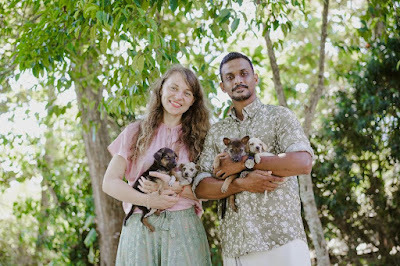

Kristina Semaskaite is probably the first Lithuanian to fall in love with a Malayali, Johnson Varghese. She plans to marry him
Photos: The happy couple; the singer Monika Linkyte
By Shevlin Sebastian
When friends of Kristina Semaskaite met, a few of them spoke about the beauty of Kerala. They told her it was a place she had to visit. So, when she planned a trip to India in January 2020, she added Kerala to her itinerary. In early February, she came to a homestay, run by a man called Sagar Raja, on the beach in Alappuzha (53 kms from Kochi).
Her first impressions confirmed what her friends had said. “It was so green,” she said. “Compared to other states in India, it was much cleaner. There was less chaos on the streets. The people were friendly, and helpful.”
What surprised Kristina was to see so many churches. “I did not know there were so many Christians,” said Kristina, who belongs to a country that is Catholic. “I didn’t notice so many churches in other parts of India. I liked the intermingling of the faiths, with the church, mosque and temple side by side.”
Within a day of her arrival, Kristina, 33, met Johnson Varghese, 34, who was also living in the homestay. He runs a cafe where he sells tea and snacks and also manages a guesthouse for tourists. They were introduced to each other and started chatting. Soon, they got on the wrong foot when Johnson asked Kristina about her plans for the future.
She said, “I would like to settle down, get married and have children.”
Johnson scoffed and said, “A European backpacker like you wants to have a family. I don’t believe you.”
Kristina said, “Yeah, yeah. Who are you to judge me?”
However, over the next few days, they realised they had some things in common. Both believed in doing social work and helping others. Both had worked on different projects. Johnson is a joint secretary of the Democratic Youth Federation of India (Alappuzha unit).
Johnson told Kristina about his charity work during the calamitous floods that hit Kerala in 2018. Many families fell into difficulty. He also protected animals. “That got me interested in him as a person,” she said. “I realised he cared for others. He has moral values.”
Kristina developed a liking for Johnson. It was the same for him. At the end of March, as Covid became even more rampant, Kristina left India on the very last flight. “We were only friends at that point,” she said.
They remained in telephonic contact. “We kept talking a lot,” she said. “I had plenty of free time because we were in a lockdown in Lithuania.” But Johnson was very busy, as he was providing much-needed rations to poor people.
At some point, both felt the need to meet again and find out whether their relationship could work. But they had to wait for several months.
In March, 2021, Nepal opened the doors for foreigners to visit the country. Kristina went there to do social work. She asked Johnson to come. He took a train and arrived soon after.
The project was to restore a dilapidated building of the Big Buddha National Academy. Popular Lithuanian singer Monika Linkyte was the spearhead. She received funds from donors in Europe, including Lithuania. “We painted walls and repaired floors,” said Kristina. “We got to know each other better. I could see how hard-working he was. I appreciated how respectful he was to the older people and the children, even though he could not speak the local language. Little by little, I fell in love.”
The turning point came on May 16, the last evening of the project. There was a barbecue on the terrace. Music was being played. The volunteers were chatting with each other.
At this moment, Johnson presented a ring to Kristina, who was sitting on the floor, and proposed.
In the event's video, Kristina burst out crying. Johnson, who was wearing a multi-coloured shirt and white dhoti, hugged her. He presented a small bouquet of daffodils. A volunteer played a guitar, while Monica sang her hit song, ‘Silkas’ (‘You are my silk’). Then Kristina hugged Johnson. Then she cried again. Johnson tried to soothe her by caressing her face. Finally, she said yes and hugged him. The onlookers clapped and shouted their approval. It was a silver ring with stones. “I liked it, because I am not fond of diamonds or gold,” she said.
She knows it will be a challenge to live in Kerala. “There is a language barrier,” she said. “In the area where I stay, in Alappuzha, few people know how to speak English. Sometimes I feel lonely.”
Of course, Kerala differs greatly from Lithuania. “Our country also has a lot of greenery, but our trees are different,” she said. “We have pines, birches, oaks and elms. There are many forests. But during the winter all the greenery is under a blanket of snow.”
The climate is different, too. In February, it is cold in Lithuania, while Kristina is perspiring in the heat and humidity of Kerala. “In Lithuania, winter ends in March,” she said. “There are four seasons of three months each: spring, summer, autumn and winter.”
Kristina finds the weather in Kerala hot in the middle of the day. “I love the mornings and the evenings, especially after sunset,” she said. “But in the afternoon, I feel lethargic. That usually never happens to me when I am back at home. I am very active and move around a lot.”
In a surprise, Kristina said she likes the spicy food of Kerala and enjoys fish curries. “I go to the local restaurants in Alappuzha and have no problems at all,” she said.
The traditional food in Lithuania comprises potatoes and meat. The national dish is the Cepelinai. It consists of grated potatoes, stuffed with meat, cheese or mushrooms. “During the long winter, vegetables were scarce,” said Kristina. “As a result, we would rely on potatoes as they last a long time. Pork and chicken make up the meat. The meat provided energy in the cold months. But things have changed in recent times. Plenty of international food is now available throughout the year in the supermarkets.”
The date for the wedding has not been set. They have applied for a civil marriage. The waiting period is from one to three months. “As for the ceremony in the church, we will wait till our parents and relatives will be able to travel to India,” she said.
Kristina’s father, Jouzas Semaskaa and mother Roma are both agricultural scientists. She has one younger brother, Paulius, who works in a German electronics company. Kristina belongs to a small town called Akademija, which is 160 kms from the capital of Vilnius.
Asked whether her parents had any problems about her impending marriage, Kristina said, “My parents are tolerant people. They felt that since I have travelled around the world, I might meet somebody with whom I would fall in love. My mom worried only about the cultural differences, and how it would pan out in the future. But other than that, my parents were very accepting.”
Unlike her parents Kristina is not inclined towards an academic career. She is passionate about travelling. She would work a bit and save the money to spend on travelling. So far, she has journeyed to over 80 countries on all the five continents. In most places, she did volunteer work, especially with children.
She says that people are the same all over. “Everybody wants to be happy, to love each other, and to have families,” she said. “The only difference is economic. The children in African countries have limited opportunities, while compared to youngsters in places like the USA and Europe. That is the singular difference.”
She has learnt not to discriminate against human beings based on their religion, culture, colour or dietary habits. “There are only good or bad people,” she said.
She has had a few unpleasant experiences like her luggage getting stolen or people trying to cheat her. But now she has developed an antenna to watch out for those who want to take advantage of her.
In Delhi, she went to a travel agency. They tried to sell a ticket, but when she checked the price on an app on her mobile, she realised they were charging ten times the actual amount.
As for the attitude of Johnson’s family towards her, Kristina said that when she met them for the first time at their home in Kottayam a month ago they were very welcoming. “They showed me a lot of love and kindness,” she said. “Since I don’t know how to speak Malayalam, Johnson helped with the translation.”
Kristina admits she may be the first Lithuanian who is planning to wed a Malayali. “I know of Lithuanians who have got married to Indians from other states,” she said. “I am sure there are Europeans who have married Malayalis.”
Kristina is keen to take Johnson to Lithuania so that he can understand her background. “It will help increase our understanding of each other,” she said.
(Published in news9live.com)
https://www.news9live.com/.../lithuania-to-kerala-a-cross...
February 12, 2022
Setting a fast pace


K Hari Kumar, at 33, has already published four books and written scripts for film and web series. His fifth, a horror novel, ‘Dakhma’ has just been published
By Shevlin Sebastian
In December, 2018, author K Hari Kumar travelled to Mumbai to do research on the 50 most haunted places in India. This later became the book, ‘India’s Most Haunted’. He went to Malabar Hill in South Mumbai. According to news reports, there have been 20 suicide cases at The Grand Paradi Towers since 1998. The eighth floor is the most haunted. Hari stood outside the building and looked up.
Then he crossed the street and stood on the road that led into the 54-acre forest area that houses the Parsi Tower of Silence. This is also called the Dakhma (Parsi for funerary tower). “It is a completely different world,” said Hari. “Because of the canopy formed by the trees, there is no direct sunlight hitting you. In the pin-drop silence, you can hear the birds chirping.”
While walking around, the idea for his horror novel, ‘Dakhma’ came to his mind. Later, Hari read about the disappearing vulture population. It affected the disposal of the bodies of the Parsis. In the community’s custom, the bodies are kept in the open for the vultures to peck at, till only the bones remain.
As for the female character Anahita, who has mental issues, in ‘Dakhma’, this happened to a close friend of his. He used a lot of what he saw first-hand to build up the fictional heroine.
The novel is about Anahita’s mental trials. She slips into hallucinations and recalls the trauma of her early childhood. She has a fraught relationship with her husband Varun Anand, a political strategist. He is busy trying to boost the public image of Abhinav, the nephew of Dayanand Deshmukh, the founder of the Maharashtra Nationalist Party.
Hari has a tight style. While the first half is a bit slow, it picks up pace in the second half. There are a lot of twists and turns, and it careens at high speed towards the climax. You can finish the book in two days’ flat.
This is his fifth book. Shristi Publishers brought out the first three, ‘When Strangers Meet’, ‘That Frequent Visitor’, and ‘The Other Side of Her’. “‘Strangers’ remains the highest selling book in my career so far,” said the 33-year-old.
Asked about the horror books that influenced him the most, Hari said it was Ira Levin’s ‘Rosemary’s Baby’. Hari paid tribute by naming one character in ‘Dakhma’ as Rosemary. An elderly lady, she lives next door to Anahita in flat 7D in Paradise Heights. He also likes ‘The Shining’ by Stephen King. “But Rosemary’s Baby is the Bible for me,” he said.
He is also a scriptwriter. He wrote the script of the film, ‘E’ (2017), and the web series ‘Bhram’ (2019).
Hari has his own creative process. “Before I begin a story, I need to know two things. Where do I start and how do I end it? Once I know that, I innovate as I move into the book.” But whenever he writes for a film or a web series, he relies on plotting from beginning to end. That’s because every episode needs to end with a cliff-hanger.
All his writing is done at night. He sits at his desk at 10 p.m and works till 2 or 3 a.m. It took him a year to write ‘Dakhma’. Since he was writing about the Parsis and their customs, he had to do accurate research. “The character Varun is based on a political strategist,” he said. “So I would study videos of people like them, and read about their strategies and campaigns. Nowadays, you get everything on the internet.”
The book was supposed to come out in October, 2020. However, Covid happened. The publisher released it on Halloween, 2021. But Hari took it as a God-send. He revised the manuscript at least 10 times in the interval. “[Film Director] Sangeet Sivan gave me this advice,” said Hari.
Sanjoy Nag, a national award-winning director, has picked up the film rights.
Hari got interested in the horror genre thanks to his grandmothers. Once a year, during the summer vacation, the family would travel from Delhi to his father’s home in Vellangallur, in Thrissur district in Kerala. While there, his grandmother Thankamani would tell him stories about ghosts and demons.
Hari’s mother belongs to Mangalore. So, his grandmother Sharada would tell ghost stories from that region. “These stories fired my imagination,” said Hari. His Tulu ancestors migrated to Kerala for better economic opportunities.
He is that rare specimen: a full-time writer. Hari said that because his books are being brought out by leading publishers and he has projects in Bollywood, it is not so difficult to survive. To be near Bollywood, Hari now stays in Pune with his engineer-wife Pooja.
And people have appreciated his work. During the shoot of the web series, ‘Bhram’, in July, 2019, before the lockdown, the main lead was Kalki Koechlin. The location was in Shimla. It was a daytime shoot in a forest.
As Kalki was discussing an upcoming scene with the director, she turned to Hari and said, “This is a very nice script.”
It was a moment of elation for Hari, since Kalki was someone whom he had idolised when he was in college. “She had been careful in choosing her roles,” he said. “Kalki wasn’t a mass actress. I always wanted to work with her.”
Asked about the influence of social media on the book reading culture, Hari said,
“There are many genuine reviewers on blogs and social media platforms like ‘Medium’ and ‘Quora’ that help new books reach a wider audience.”
But like everything on the net, there is a dark side.
Many poorly-written books are praised through paid reviews. Fake followers promote the book online. When ‘Dakhma’ got published, many reviewers got in touch with Hari. They said they would put up a review, which he should write, on their blog or website, for Rs 150. “This is happening all the time,” said Hari. “Many well-off corporates will pay Rs 15,000 for 100 reviews. They don’t care about the money. But when you check, the reviews are the same. It is a matter of copying and pasting.”
Some books on e-commerce sites have reached the bestseller lists through dubious means. “The readers might not realise it is a substandard book because of its bestseller tag,” said Hari. “Only perceptive readers will know the difference. But they are few in number.”
Meanwhile, Hari bemoaned the lack of interest in the horror genre in India today. “We need more readers,” he said. “Horror has got a bad name because people feel it is only about ghosts and demons.”
But Hari is breaking the mould. His ‘India’s Most Haunted’ is being published in Malayalam and will hit the shelves in March.
There was a moment of sadness for Hari recently when he heard that Amazon had closed down Westland Books. “I felt bad for the lesser-known writers, like the late rationalist Narendra Dabholkar,” he said. “My current book is based on my research on his works. Now his physical books won’t be available after March. The mid-list will go out of circulation. Authors will have one less publisher to submit their manuscripts.”
(Published in News9live.com)
February 5, 2022
In the twilight zone
Former journalist Sooraj D Singh had a car accident. It rendered him mute and paralysed. On the 9th anniversary, his mother, Devi J.S., talks about her experiences as a care-giverPhotos: Sooraj D. Singh in his prime; with his mother Devi J.S.
By Shevlin Sebastian
One of the first things that Malayalam writer Devi J.S. does on waking up is to take an artery forceps and put cotton between the blades. Thereafter, she will dip it in a small steel bowl which contains mouthwash. Following that, she rubs the cotton all over the teeth of her paralysed son, Sooraj. Because of a lack of use, the lower teeth have fallen to a horizontal position.
At 6 a.m., she gives Ensure protein powder in liquid form through a plastic tube; this runs through the nose into the stomach. She gives nine feeds at two-hour intervals. The food items include oats, ragi, fruit juice, Complan, boiled rice, and vegetable soup. He is fed 300 ml each time.
At 8.30 a.m., the home nurse Annie and the physiotherapist Dinesh arrive. Dinesh massages all the areas of the body, turns Sooraj around, and thumps him on the back. Thereafter, Dinesh, with Devi and Annie in attendance, gives Sooraj a sponge bath using soap and water. After that, Dinesh rubs moisturisers and oil into the body. “We have to do this to prevent bedsores,” said Devi.
As a former colleague comes to visit, Devi said, “Sooraj, look who has come?”
All Sooraj can do is blink his eyes, but there is no recognition.
“To be honest, we don’t know what he feels,” said Devi. “He does not express anything. But the doctor says it may be possible that in some part of his mind, there could be consciousness.”
There have been many instances when Sooraj has not recognised his mother. “He won’t smile at me,” he said. “Before the accident, he was a friendly boy. We were so close to each other.”
But Sooraj reacts to physical pain. This happens whenever a health technician inserts a needle in the tip of his finger to take out blood for a test. Then he looks away from the needle.
Sooraj was a journalist. He had worked in The Week magazine, as well as the Times of India. His luck ran out on January 5, 2013.
At 8.45 p.m., Sooraj was crossing the road on National Highway 47, at Edappally, where he had gone to meet a friend, when a car hit him. An 85-year-old man, a retired college professor, Thomas, was the driver. By mistake, he pressed the accelerator instead of the brake. The car skidded and hit Sooraj at high speed. The 6’ tall Sooraj went up in the air, landed on the bonnet and shattered the windscreen. From there, Sooraj fell to the ground. He was profusely bleeding from bruises on his head. Blood also poured out from the nose and the ears.
Thankfully, Thomas did not flee. He took Sooraj in his car to the nearby KIMS Hospital. He spent three months in the hospital. To get expert treatment, Devi, her daughter Resmi and son-in-law Sajai took him to the Christian Medical College in Vellore. Sooraj remained there for five months, but there was no change. The doctor’s prognosis: Sooraj had suffered severe brain damage and became paralysed. The family brought him back to KIMS Hospital. “When the doctors examined him, they said there was nothing more to do,” said Devi. “But they also said a miracle could happen at any time.”
Since Thomas had insurance, the company had to pay the compensation. “My son-in-law Sajai and I had to go every day to the court,” said Devi. “It was a big strain for me. They would offer Rs 25 lakhs. We would say no and this bargaining for Sooraj’s life went on and on.”
Finally, after five years, they received suitable compensation. Professor Thomas never came to see Sooraj after the accident. Nor did he offer any personal compensation even though his sons lived in the US. “He said he did not want to bother his sons,” said Devi. “But he promised to pray for Sooraj. However, I thought, ‘Prayers won’t pay my son’s bills’.”
The monthly expenses come to Rs 70,000. “Whenever there is a lack of money, it comes from somewhere,” said Devi. "It could be a relative or one of Sooraj’s friends who would send money. God is looking after me.”
Sooraj had health issues earlier. On September 13, 2004, Sooraj, who was 33 at that time, had an aneurysm (this is a bursting of an artery which results in internal bleeding in the brain). At Amrita Hospital, Sooraj underwent a craniotomy. This involved opening the skull and clipping the artery. After that, the skull and the skin are stitched back. Thankfully, he made a full recovery.
Earlier, in 2001, he had an arranged marriage, and the couple had a son Anand. But problems soon cropped between husband and wife. When Sooraj was in the Amrita hospital, his wife returned to her parents’ home with her two-year-old son, Anand. She never returned. In 2010, the court granted an ex-parte divorce. Anand has never met his father for the past 17 years.
For Devi, the breakdown of Sooraj’s marriage was a painful experience. Because, like Sooraj, she, too, lost her husband. She had to fend for herself and her children. Thankfully, she had a job as a section officer at Mahatma Gandhi University in Kottayam. Her parents also supported her and so she could raise her children comfortably.
Nowadays, Devi advises girls that whatever situation arises in life, they should never resign from their jobs. All girls should have a job before they get married. “I tell this because anything can happen to a husband,” she said. “He might fall ill, he might die in an accident, or he might want a divorce. So, it is better to have your own income. Then you can support the family.”
Devi also had her share of health problems. At 38, Devi suffered from the early stages of ovarian cancer. But prompt chemotherapy nipped it in the bud. But when she was 56, the cancer returned. Again, chemotherapy could stop it.
It has been nine years since Devi began looking after her son full time. They live in a sixth-floor apartment in Kochi. On the second floor lives Resmi with Sajai and their two children. Near the house is the well-known Toc-H Public School. You can hear the announcements and the singing of the National Anthem over the public address system.
Asked how she copes with the situation, she said, “I am positive minded. Whenever I am in front of Sooraj or anyone else I have a smile on my face. I don’t blame God for what has happened. I believe that one day Sooraj will sit up and talk to me.”
But Devi also admits that sometimes she loses her tranquillity. There are nights she cannot sleep because of one overriding thought. ‘What will happen when I die?’ she thinks, as she is 71. ‘Who will look after Sooraj? It will be a burden for my daughter.’
She will pace the floor of her bedroom, up and down, drink several glasses of water, but sleep does not come. She remains awake the entire night.
On days she feels low, Devi distracts herself by watching films on Netflix or Amazon Prime at her daughter’s flat. Or she reads books by young Malayalam writers. When she gets into the mood, she writes something. She has published 14 novels and collections of short stories. Devi is also a columnist.
When asked about his qualities as a person, his former male colleague, who did not wish to be named, said, “Sooraj was ebullient and fun-loving. He liked to have a good time. He had a wonderful laugh. Women liked him a lot. I remember once he brought a stunning woman, dressed in a black top and trousers, to the office. There was an easy camaraderie between them. Later, he told us she was a model.”
Devi added, “When Sooraj worked in The Week in Kochi, he travelled every day from our home in Kottayam. Sometimes, at night, the train would be late. Worried parents would tell their daughters to ask Sooraj to drop them home.”
A thought arises: can Sooraj access his memories? Or has he lost his sense of self?
“Nobody can answer that question,” said Devi, with a sad shake of her head.
(Published in News9Live.com)


