Allan Hudson's Blog, page 23
August 22, 2021
Branching Out with Author Anna Dowdall of Montreal, QC.

I was given the opportunity to read and review Anna’s latest novel – April on Paris Street. I’m glad I did. It is a compelling and entertaining story. Read my review HERE.
When I visited Anna’s eye-catching web site - Anna Dowdall – Anna Dowdall - I discovered it is full of fun facts about Anna and great reviews for her writing and lots of positive comments from her fans.
It is an absolute delight to have such an accomplished author as our guest this week. She has kindly agreed to a Branching Out Interview and an excerpt from April on Paris Street.
Let’s chat with Anna.
Allan: Thank you for taking the time to be our guest, Anna. Before we discuss your novels and writing, can you please share some personal details with our readers? Where you reside, family & friends or pets.
Anna: Hi Allan! Just as Ashley Smeeton must travel to the mysterious east end of Montreal, there to make all manner of discoveries, I’ve chosen to live a fully francophone life in east end Montreal. I share a 115-year-old renovated coach house on one of the city’s picturesque green lanes with my part-time editor and full-time cat, Charlie.

Allan: Your website has a neat review – A Lush, Gripping and Satisfying read. – Iona Whishaw. It doesn’t get much better than that. Tell our readers what to expect when they pick up their copy of April on Paris Street.
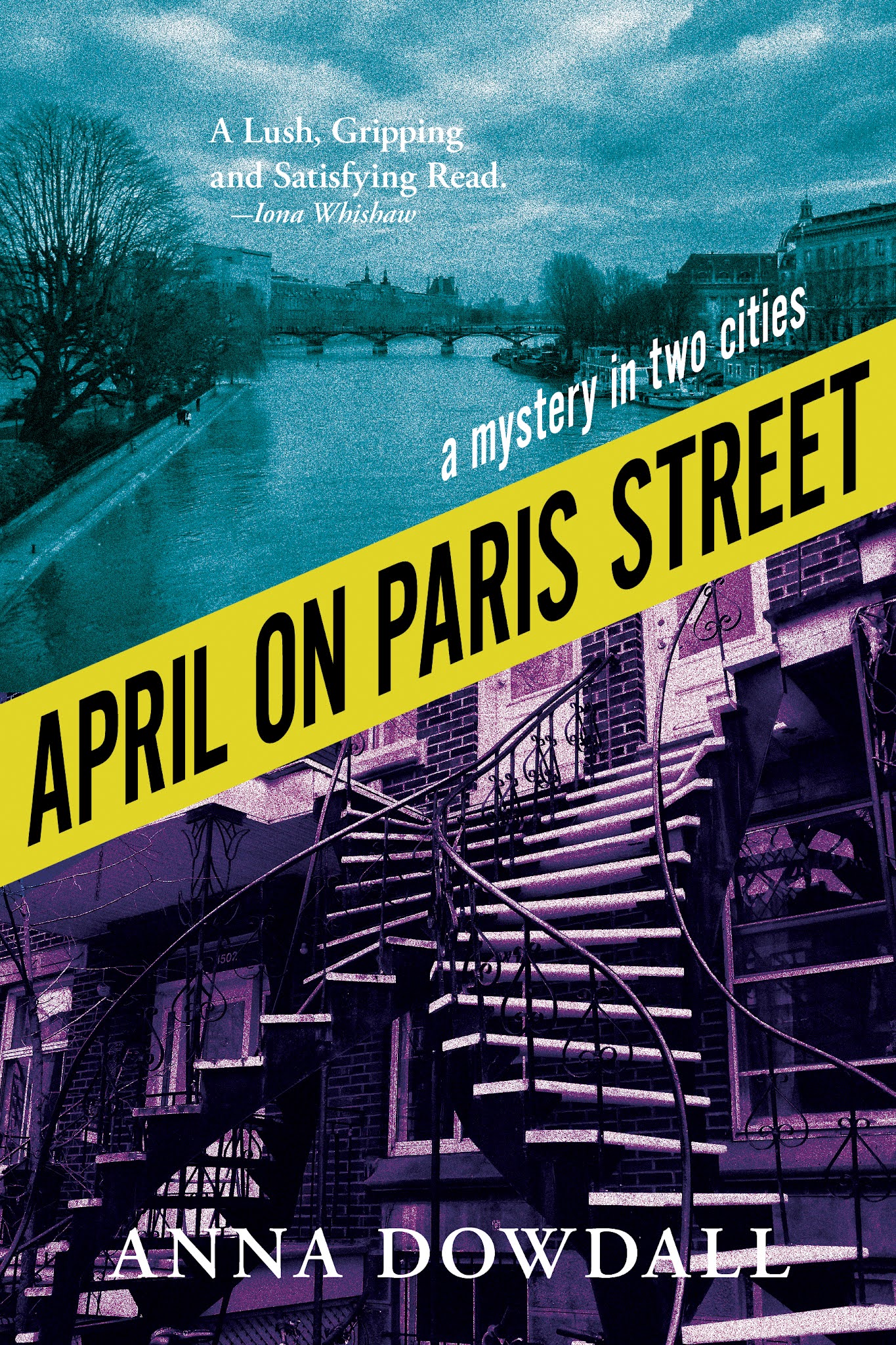
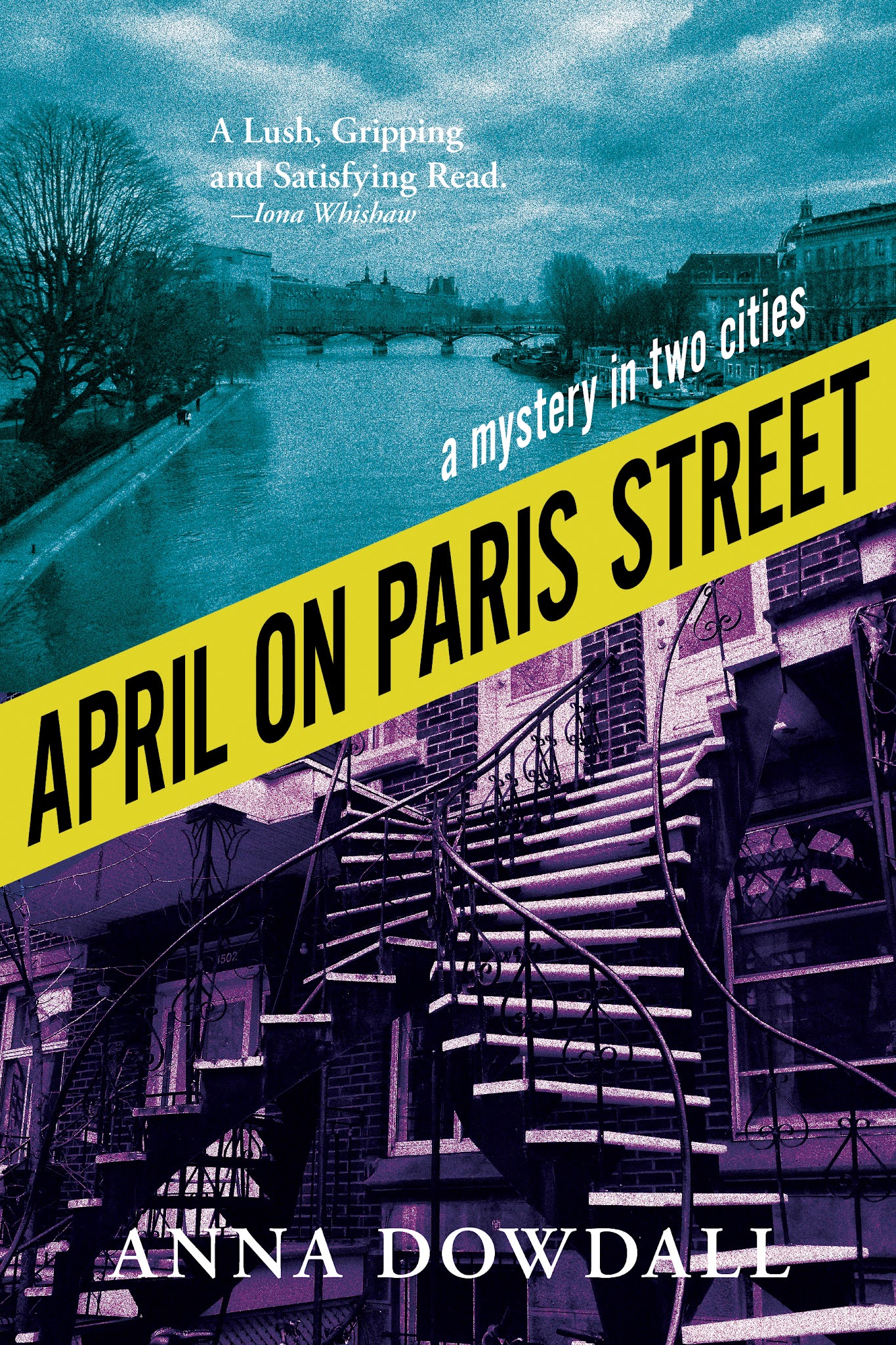
Anna: I wanted April on Paris Streetto be a suspenseful detective story, first of all, with a relatable PI, but it’s also a mystery that operates on other levels. It’s a sometimes humorous Thelma and Louise “romp,” a sensory experience involving two cities I love, a narrative that invites the reader to contemplate sturdily alternate forms of family, and a revenge fable. But wait, there’s more. It’s a compendium of every form of doubling, fracturing, splitting and replication I was able to think of, suitably encompassed within labyrinthine twin cities. This dédoublement is intended to be decorative, and also intersects with the themes of social fractures, social disguise and competing truths. In a playful but slightly uneasy way, it invites the reader to consider Mirabel’s question, the snowy night when Mireille shows up at their door: how many Miras (or Belles) would in fact be too many?
Allan: When was the defining moment you decided to write stories and seek to be a published author?
Anna: When my mother read me all of Andrew Lang’s fairy tales. The Pink Fairy Book, unless it was The Violet Fairy Book, was like a two by four on the side of my little head.
Allan: The Au Pair is your second novel but the first in which we meet your MC Ashley Smeeton as an adult and a private investigator. It has garnered many positive reviews. What can our readers expect?

Anna: The Au Pair was my effort to write a Canadian “classic mystery,” with a mixture of cozy and noir elements and strong female characters. It has my signature obsession with setting and atmosphere. The reader will find in it elements of the Gothic, but without the claustrophobia and fainting heroines. Gothic conventions are subsumed into a parable of a dysfunctional family’s multi-generational suffering, but the book offers a sense of resolution. All three of my books, in fact, bring the reader to the sunny side of the street. Female victimhood is a chimera, a misdirection of the mystery plot: the resolution reveals underestimated and misunderstood women playing a long game.
Allan: Where did the inspiration come from for your series and your MC?
Anna: My first book, After the Winter,is vintage-flavoured romantic suspense with that subtle feminist twist I like. It’s a tribute to a midcentury genre not much read anymore but with some fabulous neglected books. The Au Pair, with its Laurentian version of an English country house filled with privileged people, probably owes quite a bit to what is called Golden Age fiction, e.g., Agatha Christie. April on Paris Streethas those influences, but also others: in my piling on of meaning around the doubles, there’s a playful invocation of high literature, everything from A Tale of Two Cities to Two Solitudes.

Ashley has been dear to my heart, as she evolves throughout. She is a pigtailed nine-year-old in After the Winter, a secondary character who somehow insinuates her way into the protagonist role in books 2 and 3. For my PI I wanted a working class heroine, a young woman of the people, quintessentially Canadian in her multiple identities, and with an oddness about her that sets her apart. My background is neither middle class nor unicultural, and I’m sure there is something of me in her.
Allan: Please share a childhood memory or anecdote.
Anna: One summer I wrote a “book” on some waste paper my dad brought home from the paper mill where he worked. The heroines were called Gwendolyn and Marigold. They had eyes like twin sapphire pools and, like Thelma and Louise, they were preoccupied with breaking free. Their exotic adventures came to an abrupt conclusion when I went back to school in September.

Allan: From reading your bio - Bio – Anna Dowdall - you’ve lived an interesting life (even as a Maritimer while teaching at Dalhousie University) and have returned to Montreal to write full time. How much of your past adventures find their way into your stories? How many of Anna’s personality is evidenced in your characters?
Anna: I am in all of my characters, I swear! Even, really, the awful ones. As for the first part of your question—yes, adventure is the key word. Why shouldn’t women have adventures? Unlike Ashley, however, I’ve avoided tripping over dead bodies—or so I will maintain.
Living in and travelling to different parts of this beautiful country of ours should be more common. It’s been my privilege to visit many different parts of Canada. I’ll never forget driving across the country, from Halifax to the Yukon. Among many captivating places, for some reason the Qu’Appelle River Valley and the Saint John River Valley stick in my mind.

In New Brunswick, we were driving along some narrow road at dusk and began to follow this river. I wasn’t sure where we were, and then I saw the sign, St. John River. It had been pouring all day but now there was a yellow light in the west, lighting up the surface of the water. It was one of those moments in time. I’ll save emoting about the Qu’Appelle Valley for another Q&A. I grew up on the shores of the mighty Saint Lawrence and clearly, I have a thing for rivers.
Allan: Favorite authors? Books? Movie? Dessert?
Anna: Writers: Constance Beresford-Howe, Rebecca West, Mervyn Peake, Ursula Curtiss, Lucy Maud Montgomery. But I love many more.
Movie: Moscow Doesn’t Believe in Tears
Dessert: homemade apple pie, made from scratch with Canadian fall apples

Allan: Anything else you’d like to share with us?
Anna: Your questions are an ingenious mix of friendly and probing. I think I’ve said more than enough.
An Excerpt from April on Paris Street.
(Copyright is held by the author. Used with permission)
…This experience set Ashley to walking again. Without thinking about it, she headed in an easterly direction, away from the winter tourists and chi-chi shoppers. Soon she entered another type of district. It had the omnipresent five- and six-storey Second Empire buildings, here interspersed with different ones, of ochre brick with striking dark red accents. She could have been in some European mystery city. There were small unassuming parks and the shops were of the kind the lower middle class everywhere frequented: modest chains, local businesses and neighbourhood restaurants. This must be where the average Parisian lived, if there was such a thing. The streets were narrow but sidewalks were moderately busy, with neatly-dressed women carrying shopping bags, delivery men darting in and out of buildings, the odd lycée student or flâneur. She had no idea where she was.
Under a bright sun, the area might have felt different. But the iron-grey day had robbed the quiet scene of any low-key charm it might have possessed. It was not without its own mood, however. In the thick cold air the edges of things were slightly blurred, and this gave the streets a dreamlike feel. Were they getting near the Seine, she wondered. It looked like mist—but mist on so cold a day? A single large snowflake pirouetted lazily before her eyes.
She had come to a building on the far side of the street, whose Art Deco doors framed in pale green tile were like nothing else in the neighbourhood. A woman was exiting just then, a chic woman in a deep red coat that leapt out against the tile background. As she continued to look, a dreadful coldness seized Ashley’s heart. She recognized the woman: far from les Halles, and looking unlike herself yet unmistakable, Mirabel Saint Cyr was tripping along the sidewalk, her ankle boots making a tap-tapping sound on the pavement. Ashley stared open-mouthed. The street, rue des Capucins, was especially narrow here and she could see Mirabel clearly in every detail. The coat was a belted style, and the collar was up. On her coiffed fair hair, a pale green velvet cap was tilted at an angle. It had a veil that dropped down over the top part of Mirabel’s face —until Ashley realized she was in fact looking at clever Carnaval makeup to resemble a lace veil. Mirabel looked like she’d stepped out of some old movie; but as she stopped with a familiar look of mild annoyance to adjust one two-toned boot, she fairly burned with three-dimensional life.
Ashley was paralyzed. What on earth would Mirabel be doing here? She had just exited this anonymous apartment building. What business could she possibly have in this neighbourhood? But even more disturbing, how could Mirabel even be here? It made no sense. It was in fact impossible. Mirabel had just texted Ashley, saying she and Mireille were at les Halles, staked out in a coffee shop of a bookstore—she even named it, Au Bonheur des Livres—and awaiting Raymond.
“Mirabel!” Ashley yelled as loudly as she could. Across the street, the woman turned—and gave Ashley an empty look. If this was Mirabel Saint Cyr, then it was Mirabel in a trance or a dream. The gaze was that of an indifferent stranger passing over Ashley. She took a step off the sidewalk, and provoked a blare of sound from an oncoming delivery truck. It swept by inches away, amid gesticulations of the driver. And was followed immediately by another truck that hit the brakes with massive inconvenience right in front of her. Ashley could now see nothing.
She ran along the sidewalk, as the truck aggravatingly kept pace, and it was long moments before her view cleared. She was just able to catch sight of the flame-bright coat, the little bobbing hat, disappearing around a corner. Provoking more driver ire, she dodged among cars—how had the traffic become so busy?—and made it to the other sidewalk. She raced to the corner and looked down rue de la Charette, one of those dim alley-like sidestreets, where Mirabel had turned. The air was filled suddenly with snow. In the white blur of tumbling snowflakes, there wasn’t a soul to be seen…

Thank you, Anna, for taking the time to share your thoughts and your amusing answers. And for being our special guest this week. Wishing you continued success with your stories.

For all you fantastic visitors wanting to discover more about Anna and her writing and where to buy her novels, please follow these links:
https://www.guernicaeditions.com/title/9781771836234
https://www.facebook.com/anna.dowdall
https://www.goodreads.com/author/show/17057032.Anna_Dowdall
https://www.instagram.com/annahayesdowdall/
https://www.chapters.indigo.ca/en-ca/books/contributor/author/anna-dowdall/


August 14, 2021
Guest Author Jane Risdon of United Kingdom
I met Jane Risdon through a mutual author friend and invited her to be our guest this week. She has kindly agreed to tell us the good news of her latest novel, as well as sharing her bio and where you can find more information on her and her writing.
Thank you, Jane. Over to you.
Allan, thanks so much for inviting me to visit your wonderful blog and for enabling me to chat about my next novel. I really appreciate it and I hope your readers enjoy finding out about Ms. Lavinia Birdsong who is the star of my next novel.
Ms. Birdsong former Intelligence Officer, MI5
By Jane Risdon
Ms. Lavinia Birdsong is a former MI5 Intelligence Officer who has spent 20 years of her life working her way up the hierarchy in MI5, her eye firmly on the goal of becoming the third only, female Director General of the Security Services.
All that went out of the window when her last assignment, Operation Matryoshka, went horribly wrong and she and her MI6 partner, Michael Dante, were summoned back to London.
Lavinia Birdsong is invited to take ‘voluntary’ retirement or face losing her Pension, following the disputed — by Lavinia — botched joint MI5/MI6 operation in Moscow. Michael Dante is spared and returns to Moscow to carry on with the complex mission involving Russian Mafia people traffickers, and Ukrainian gun and drug traffickers.
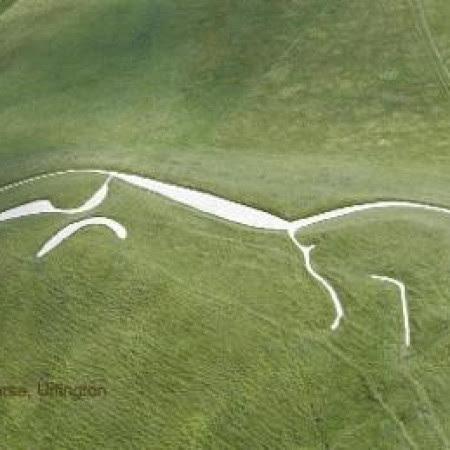
The former MI5 officer decides to move to a village in rural Oxfordshire, in the Vale of the White Horse, so she can concentrate on devising a way to inveigle herself back into the Security Services. No way is she going to accept her fate.
Joining MI5 from university Lavinia garnered a wealth of experience over her 20 year career. She is fluent in several languages, including Russian and Mandarin, and is a martial arts black belt and a crack shot with most firearms; not someone to mess with.
Her work as an Intelligence Officer has taken her all over the world, and she has also spent time at the various ‘desks’ within MI5, such as being a Training Desk officer in Moscow, working in Counter-Espionage, based in London, being placed on secondment to the Metropolitan Police, again in London, and later working as an Agent Runner on the Organised Crime desk also based in London at Thames House, home of MI5.

She’s worked as an Agent Runner in Counter-terrorism, and as a Counter-Espionage Desk officer, also based in Thames House. She has been a Northern Ireland Desk officer and a Northern Ireland Section leader/Agent runner. Later she worked as a Moscow Section leader/Agent runner and a Middle Eastern desk leader/Agent runner.
At the time of her ‘retirement’ she was on secondment to MI6 – working on Operation Matryoshka which involved the investigation of links between certain Organised Crime gangs known as Bratva, and the Kremlin.
My novel, Ms. Birdsong Investigates: Murder in Ampney Parva, has been inspired by my various posts working for the British Government before my marriage to a professional musician, and prior to our career in the international music business, taking over my life.
So far there are three books in the series.
I spent some years working in Germany for the Ministry of Defence, on an Army base which had been in operation since the end of WW2, mostly employing German civilians overseen by MoD (Ministry of Defence) personnel. The building used by the Officer’s Mess was one where Herman Goering used to deliver many of his Nazi speeches.
From there I was posted to the Foreign and Commonwealth Office in London, where my office was situated in what was once the New Scotland Yard building on the Victoria embankment. When New Scotland Yard moved out, the FCO moved into what was known as the Curtis Green Building. In 2016 when they moved back, the building was once again the HQ for New Scotland Yard. I had a fabulous view of the Houses of Parliament from my office when I worked in the Curtis Green building.

My time spent in the FCO was to light an already smouldering flame of ambition to become a crime/mystery author one day. I was there at the height of The Cold War, the ‘troubles,’ with the IRA, and an ever present, growing threat from terrorists and activists around the world, resulting in various hijackings and kidnappings. Groups included Black December, Al Qaeda, various Palestinian Terrorists, the Japanese Red Army, The Baader Meinhof (Red Army faction) Group, plus many others. Our Security Services and Secret Intelligence Services had their work cut out.
Our (British) Ambassador to Montevideo, Uruguay, Geoffrey Jackson, was kidnapped by the Tupamaros Guerrillas, in 1970. He endured 9 months in captivity before Prime Minister, Edward Heath, negotiated a payment of £42,000 for his release. It was an exciting time to work at the FCO.
Whilst I worked there our government expelled 100 Soviet diplomats, accused of being spies, and in retaliation the Russians expelled a similar number of British diplomats from Moscow. Suspicion and intrigue was everywhere.
Before I was accepted by the FCO I was positively vetted (P.V) which means that I was investigated thoroughly for my suitability to work with sensitive, classified, and possibly secret material. Not only was I investigated, but my family, going back generations was vetted as well as friends, teachers and anyone else who knew me or them. My then boyfriend — now husband — was not too happy to discover he and his family were also being vetted, not to mention his band members.
Once I started working at the FCO I was regularly vetted – they keep an eye on you – and had to meet with a Commander from Special Branch for these little ‘chats.’ He was fascinating to talk with. He was instrumental in bringing an end to the activities of the Portland Spy Ring – a ring of Soviet spies operating in Britain in the early 1960s. He was responsible for arresting the husband-and-wife Soviet spies, known as Helen and Peter Kroger — Americans by birth, whose real names were Morris and Lona Cohen. I loved our chats and of course, as a writer in the making, I couldn’t get enough from him; all subject to the Official Secrets Act of course.
I later went on to work for other government departments whilst my husband’s band progressed and until he decided to ‘retire,’ many years later when we went into the international music business managing recording artists, singer songwriters, and record producers and we facilitated the placement of music on to movie and television soundtracks, all over the world.

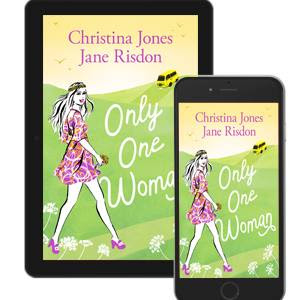
All this time I was storing my experiences away inside my head, waiting for the day when I would have time to do what I always wanted to do; write. In 2012, I got my chance when I was published in several anthologies, as well as being traditionally published — not with a crime novel, but a women’s fiction novel initially — Only One Woman, co-written with a lifelong friend, Christina Jones, who had once been fan-club secretary to my husband’s band.
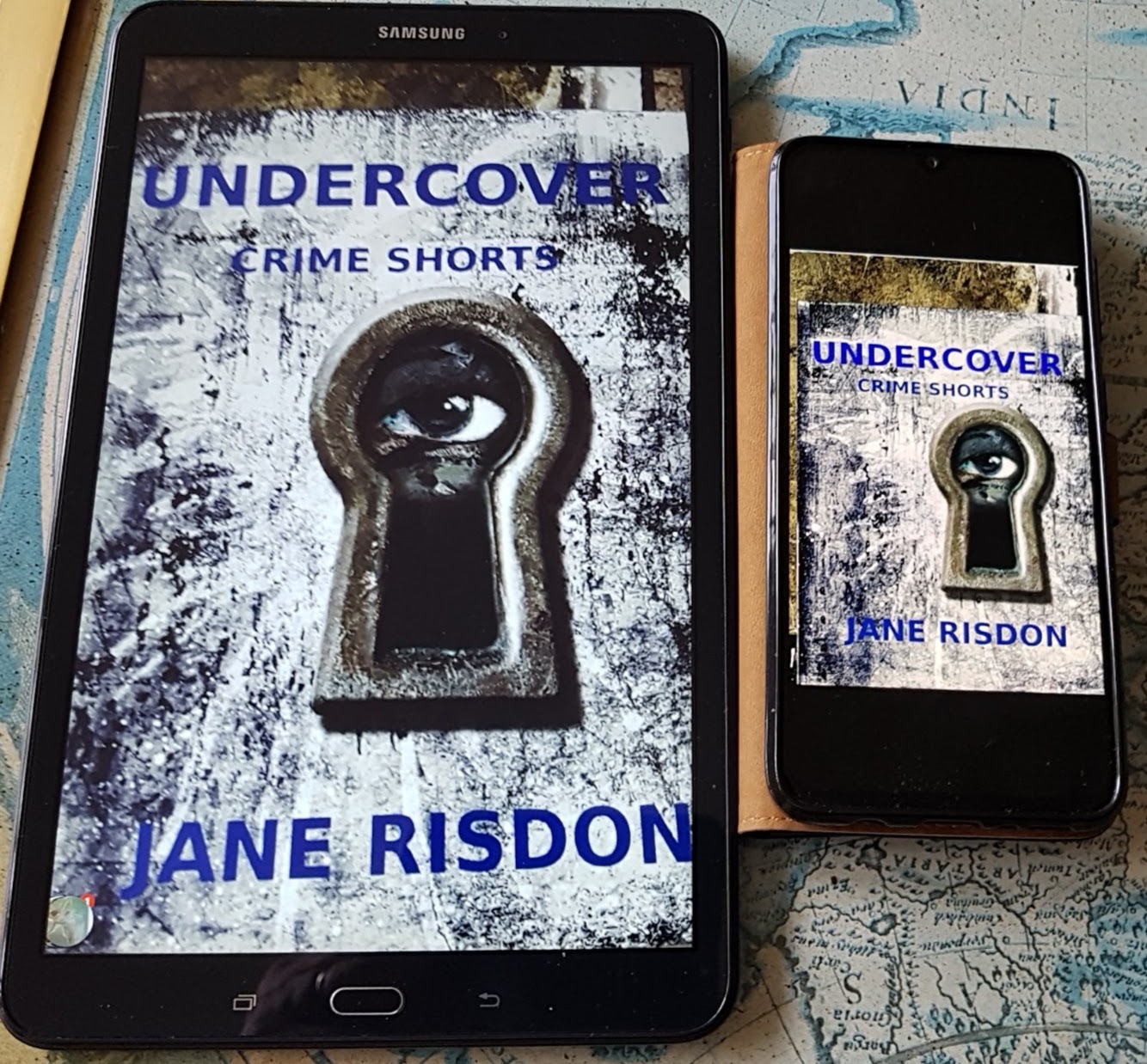
I later published Undercover: Crime Shorts.
Now, my agent is looking for a suitable home for my series, Ms. Birdsong Investigates, about the former MI5 Intelligence Officer, seeking her way back into the Security Services.
In Ms. Birdsong Investigates: Murder in Ampney Parva, she is finding her feet after ‘retirement,’ and when a local woman goes missing, she sees her chance to investigate her disappearance and perhaps find a way back to MI5. Little did she know, she would soon find herself in familiar territory.
So many readers are interested in Lavinia’s progress to her new publishers, they have joined her private Facebook Group —Ms. Birdsong Investigates — where she has photos, articles, and lots of information about her and her career — no spoilers, of course. Come and join her.
I look forward to sharing Lavinia Birdsong and her investigations with the world very soon.
Bio:
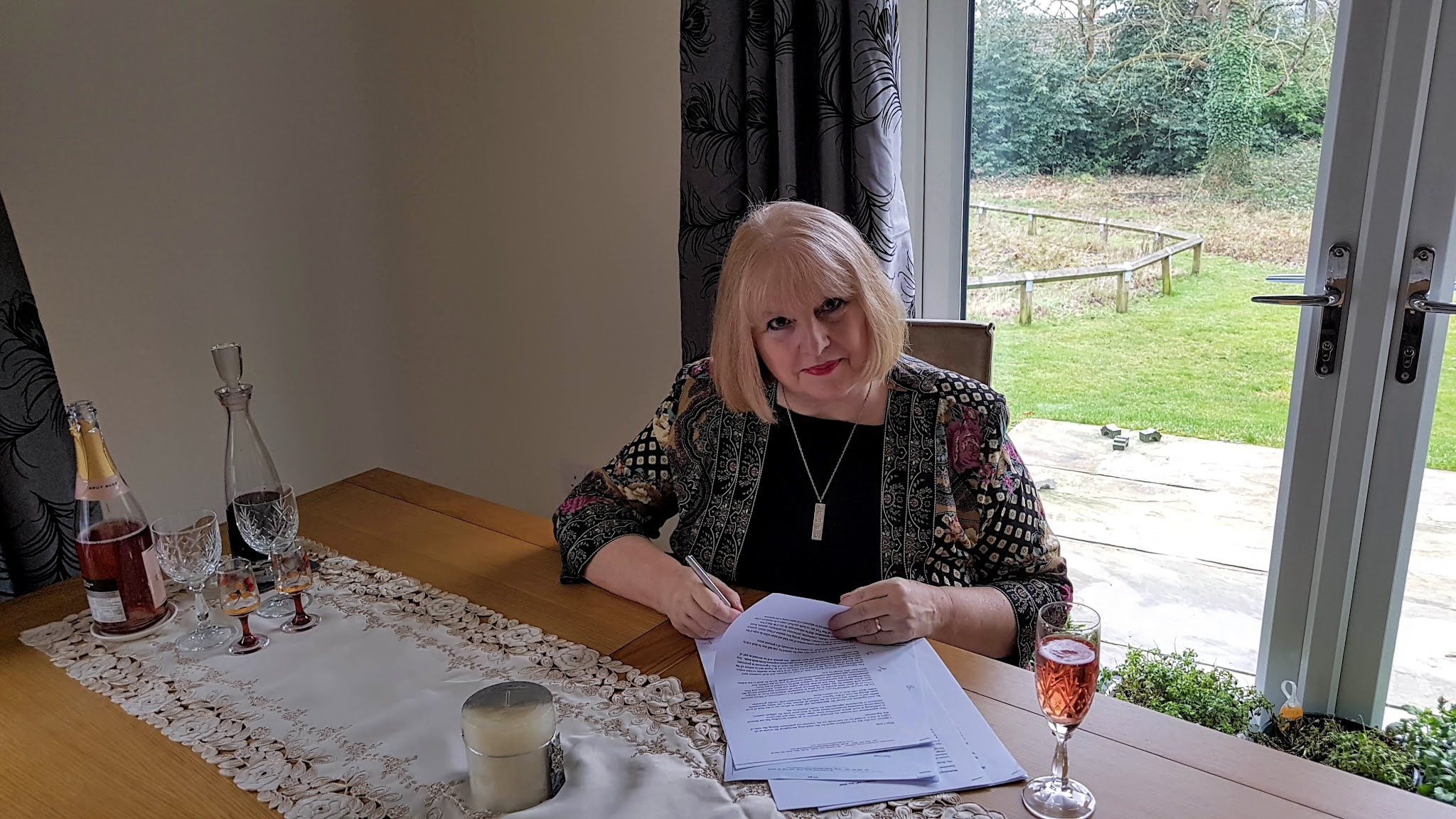
Jane Risdon is the co-author of ‘Only One Woman,’ with Christina Jones (Headline Accent) and ‘Undercover: Crime Shorts,’ (Plaisted Publishing), as well as having many short stories published in numerous anthologies. She writes for several online and print magazines such as Writing Magazine, and The Writers’ and Readers’ Magazine.
Undercover: Crime Shorts was the February Free Book of the Month on the virtual library and festival site, MYVLF.com, and her live video interview features in their theatre. She is a regular guest on international internet radio shows such as theauthorsshow.com, chatandspinradio.com and The Brian Hammer Jackson Radio Show.
Before turning her hand to writing Jane worked in the International Music Business alongside her musician husband, working with musicians, singer/songwriters, and record producers. They also facilitated the placement of music in movies and television series. Her earlier career was spent working in various British Government departments.
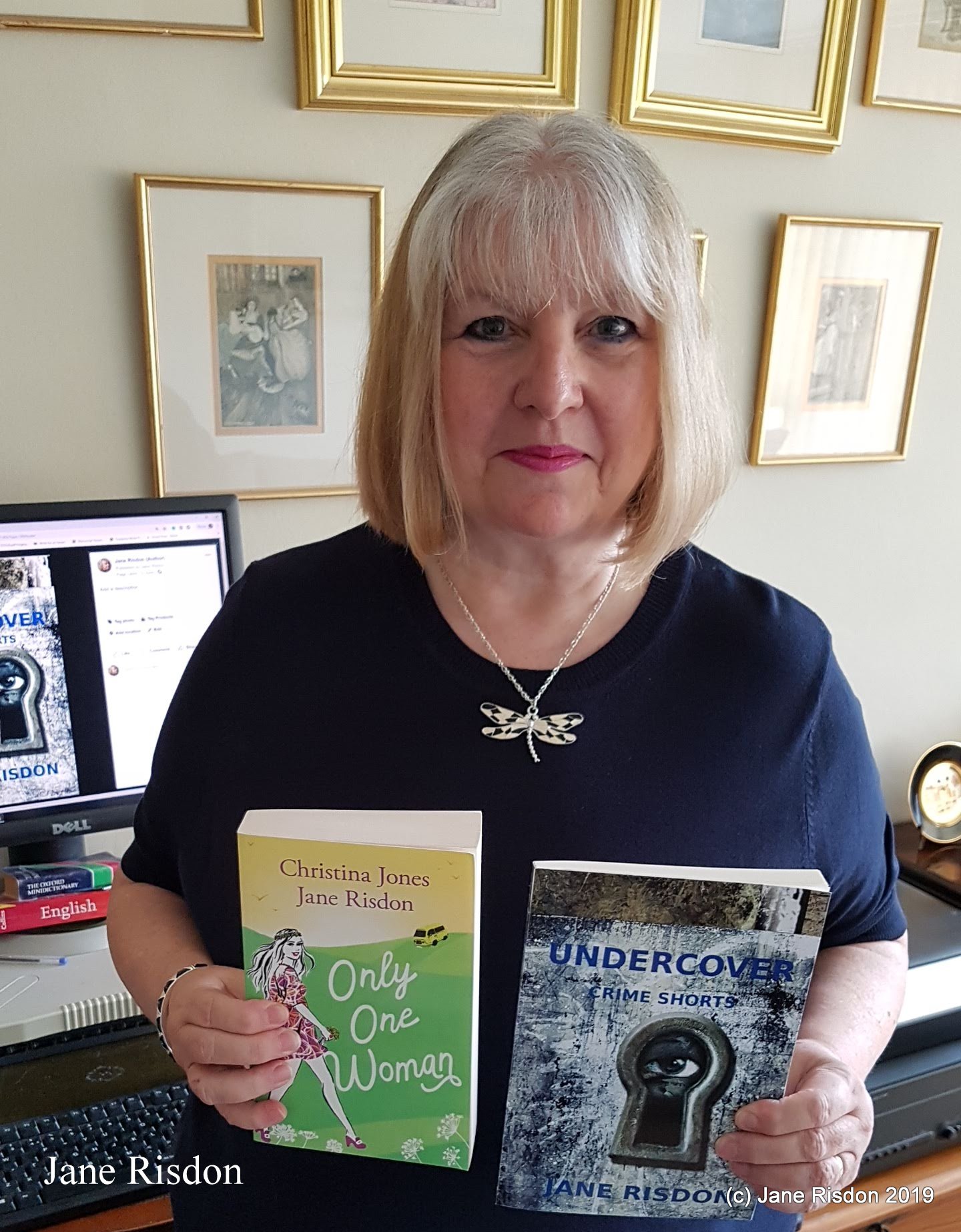
***All photo copyrights belong to Jane Risdon.
Jane’s Links:
You can find her on:
https://www.amazon.co.uk/Jane-Risdon/e/B00I3GJ2Y8
https://www.facebook.com/JaneRisdon2/
https://www.instagram.com/janerisdonwriter/
https://www.pinterest.co.uk/janerisdon2/
https://www.goodreads.com/author/show/5831801.Jane_Risdon
https://www.bookbub.com/authors/jane-risdon
https://twitter.com/Jane_Risdon
Ms. Birdsong Investigates: https://www.facebook.com/groups/msbirdsonginvestigates
Universal buy links:
Undercover: Crime Shorts
books2read.com/u/4jD0wo
Only One Woman
books2read.com/u/mlegkPAll Jane’s publications:
https://www.amazon.co.uk/Jane-Risdon/e/B00I3GJ2Y8
Jane’s News:
In December 2020 Jane signed with Linda Langton of Langton’s International Literary Agency in New York City, New York USA. You can contact Jane via Linda at: www.langtonsinternational.com
August 7, 2021
Branching out with Author C S O’Cinneide of Guelph, Ontario.

I had the good fortune of being asked to review O’Cinneide’s novel - Starr Sign - by The Miramichi Reader. I truly enjoyed the story and you can see my review HERE.
Praise for the Candace Starr series.
“A cold and gripping crime novel” – The Globe & Mail.
James Fisher of TMR was kind enough to introduce us and Carole has graciously accepted an invitation to be this week’s guest.
You can read her bio HERE.
Let’s have a chat with Carole.
Allan: Thank you so much for being our featured guest this week, Carole. Before we chat about your novels and writing, perhaps you can tell us a bit about yourself, hometown, family or whatever you want to share.
Carole: Wow, that’s an open-ended question if ever I heard one. Let’s see, I’m a former IT analyst who had the crazy idea that she could write books. One day, I left my lucrative career to follow a dream and my bank account and pride suffered accordingly. Luckily, I’m married to an Irish ex-pat with his own bank account and more belief in me than sense. We live in Guelph, Ontario, with only a dog and a cat, as our four children have moved on to pursue their own dreams.

Allan: You choose to write under the pseudonym of C S O’Cinneide (oh-kin-ay-da). Can you tell us more about the name and why you chose it?
Carole: O’Cinneide is “Kennedy” in Irish. It is the original spelling and pronunciation of the surname before it was anglicized. So, it’s my name, but also not my name. I chose to use it because there seemed to be a lot of Carole Kennedy’s writing books out there and I wanted to differentiate myself. Which I believe I have, since I am now known at the bookstore as that author that nobody can pronounce.
Allan: Candace Starr is one sharp lady. Where did the inspiration for this character come from?

Carole: Candace is a full-blown avatar for any woman who has ever wanted to throw a bad guy up against a slushie machine at the 7-11. She’s mouthy and smart and violent and basically says and does all the cool things I’d like to say and do if I wasn’t such a scaredy-cat. Candace is also the kind of hard-boiled female character I’ve always longed to see in crime fiction --- not a femme fatale or an ingenue, but a fully developed anti-hero with flaws and depth and a keen interest in eyebrow threading.
Allan: Please share a childhood memory or anecdote.
Carole: Hmm. When I was a child my friends and I used to have a fake band called the Mrs. Monkees. We were each married to one of the boys from the TV reruns we watched showcasing that group (a fake band themselves, but at least they had real guitars and drums and not push brooms and overturned garbage cans like we did). I was married to Peter Tork because he was the dumb one and that attracted me for some reason. This anecdote has absolutely nothing to do with writing or my work, but possibly exposes me as an early appreciator of mimbos. Luckily, I grew out of that.
Allan: Please tell our readers what to expect when they pick up their first Candace Starr story. The Starr Sting Scale and Starr Sign.

Carole: My description above of how badass Candace Starr is should give you a pretty good idea of what you can expect. These books definitely do not come with a PG-13 rating. But beyond that they are very witty and clever and provide a venue for me to discuss some fairly serious issues despite being “murderous fun” (Publisher’s Weekly).
In The Starr Sting Scale, Candace, a former hitwoman must help the cops solve a murder she just might have committed herself. She is teamed with an ambitious woman officer, Detective Chien-Shiung Malone and the two develop an unlikely friendship. Malone and Candace also work together a bit in the next novel, Starr Sign, but in that book, Candace is joined by a British hacker named Deep and a thirteen-year-old sister. With them, she attempts to infiltrate the Detroit mafia in search of her wayward mother.
Allan: Your debut novel – Petra’s Ghost – looks intriguing and I’ve added it to my TBR list. What can you tell us about this novel?

Carole: I’m so pleased to hear it is on your TBR! But prepare yourself, because in comparison to the Candace Starr crime series, Petra’s Ghost is on the whole other side of the library.
I wrote Petra’s Ghost after walking the Camino de Santiago, an 800 km pilgrimage across northern Spain. It took me a month to walk it and was one of the defining experiences of my life. But when I came back to Canada, I found you couldn’t swing a cat without hitting a Camino memoir. Once again, I needed a way to differentiate myself. I decided to write a dark thriller set on the Camino. I didn’t think that had been done before, and I was right.
In Petra’s Ghost, a woman has just gone missing while walking the pilgrimage when we meet Daniel, a grieving Irish ex-pat who is hiking the trail after the death of his beloved wife, Petra. He meets Ginny, another pilgrim and unfortunate things start to happen to them. The book has been described as part evocative travelogue and part psychological thriller. I’d throw in part memoir, as so many of the landscapes, art and culture described in the book are from my own experience. And a woman did disappear when I was walking the trail.
My publisher marketed the book as literary, but it was a semi-finalist for the Goodreads Choice Awards for Horror in 2019 (maybe because the word “ghost” is in the title). I lost that award to Stephen King, which to date is the coolest thing that’s ever happened to me.
Allan: favorite authors? Novels?
Carole: East of Eden – John Steinbeck
The Help – Kathryn Stockett
We Have Always Lived in the Castle – Shirley Jackson
The Stand – Stephen King
The Handmaid’s Tale – Margaret Atwood
How to be a Woman – Caitlin Moran
Any book by Denise Mina, the Queen of Tartan Noir
Allan: Tell us about your writing habits?
Carole: When I am writing a novel, I force myself to sit in my writing chair on pain of death every weekday morning at 9 AM whether I feel inspired or not. I set a timer for one hour and only take breaks when it goes off. I do this until I hit my word count or tear all my hair out, whichever comes first.

I am plotter not a pantser, which means I develop a plot outline before I begin writing the book. I tried to write “by the seat of my pants” once but found with no outline I practically wet them. I tell you this because so many authors make writing sound like a fairy tale where they are so in love with the process, and ideas float out of them like puffy unicorns that dance across the page. I try not to despise these people. Writing is hard work. At least it is for me.
Allan: Is there anything else you’d like to tell us about? Maybe what’s next?
Carole: I have a book coming out next year entitled “Eve’s Rib.” It’s about mothers and daughters and possibly the devil. The style is more in line with Petra’s Ghost, as it is another literary thriller, but this one is set in Canada and there isn’t a Spanish monastery in every other scene. Here’s some rough cover copy:
After Abbey’s younger brother dies in a fall, Eve fears the worst about her daughter. Her husband, Richard doesn’t understand. He doesn’t know the truth about Abbey. And besides, he has secrets of his own to keep.
But when terrible things begin to happen to those who get in Abbey’s way, Eve must overcome her own pain and loss and find the strength to deal with the threat she fears the most --- a teenage daughter she can no longer control and a past that could come back to haunt her in the most monstrous of ways.
Sound good? I hope so. Because this one will knock your socks off with the twist at the end. Which most of my books do, but this one was particularly fun!
****Sounds very good, Carole.
An Excerpt from STARR SIGN.
(Copyright is held by the author. Used with permission.)
IT IS NEVER A GOOD PLAN TO WAKE UP AND not know
where you are. I know I’m not at home when I first hear
the birds chirping outside the window. In the one-room
apartment above the E-Zee Market where I’ve lived the
last few years, there are only shit-disturbing pigeons to
annoy you in the morning. They don’t chirp, just coo
and warble until you become convinced there’s a Jersey
girl on the roof faking her first orgasm.
But when you’re a woman who has made a career out
of binge drinking, waking up in places you don’t expect
is an occupational hazard. Don’t get the wrong impression. I’m not an alcoholic
in the traditional sense. Alcoholism is when your
drinking gets in the way of your job or personal life. I
don’t have a job, and my personal life suits me just fine.
Mostly because I am my own best company. My greatest
source of entertainment. You learn to rely only on yourself
when you spend the first half of your life growing
up with a hitman for a father, and the other half following
in his footsteps. I’ve been out of the game a few
years now, ever since I got out of prison and my dad
got whacked, but I make no excuses for the life I led
before that. It paid the rent. It fed my dog when I had
one. It kept me in copious bottles of Jägermeister in my
twenties. But you make a number of enemies and rack
up some pretty bad karma as a professional assassin. My
daily drinking is just a means to an end. I’m not sure
what that end is, but I intend not to be sober when I
meet it.

Thank you, Carole, for sharing your thoughts with us. Wishing you continued success with your stories.
For all you fantastic readers wanting to discover more about Carole and her stories, please follow these links:
https://www.shekillslit.com/
Twitter @SheKillsLit
Insta @ocinneide1
Facebook https://www.facebook.com/OcinneideCS/

July 31, 2021
Branching Out with Author Stephanie LaVigne of Florida.
Stephanie is represented by the publicity firm of Creative Edge and is a welcome addition to the ongoing series of author appearances on the Scribbler.
When I visited Stephanie’s eye-catching website - Stephanie LaVigne • Author – I was greeted by the following:
…things here are whimsical, witty and uplifting …with an occasional side of mystery & mayhem.
It is an absolute delight to have such an accomplished author as our guest this week. She has kindly agreed to a Branching Out Interview, so…
Let’s chat with Stephanie.
Allan: Thank you for taking the time to be our guest, Stephanie. Before we discuss your novels and writing, can you please share some personal details with our readers? Where you reside, family & friends or pets.
Stephanie: Thank you so much for having me, Allan!
I live back in my hometown of Fort Lauderdale, Florida. The same place I dismissed as being awful at eighteen, only to find many years later that I love its bizarre, beautiful, beachy small-city feel. Now, not only do I love it here, but it’s the setting for many of my upcoming books!
I am lucky enough to live close to my family which is amazingly nice. Especially considering I have three young children who are never short on energy or imagination. I’m also married to a wonderful guy who lives in the madhouse alongside me. We live about a mile from the beach, but don’t nearly go as often as we should. I do make a point to drive by it a lot. Simply knowing that it’s there always makes me feel better.
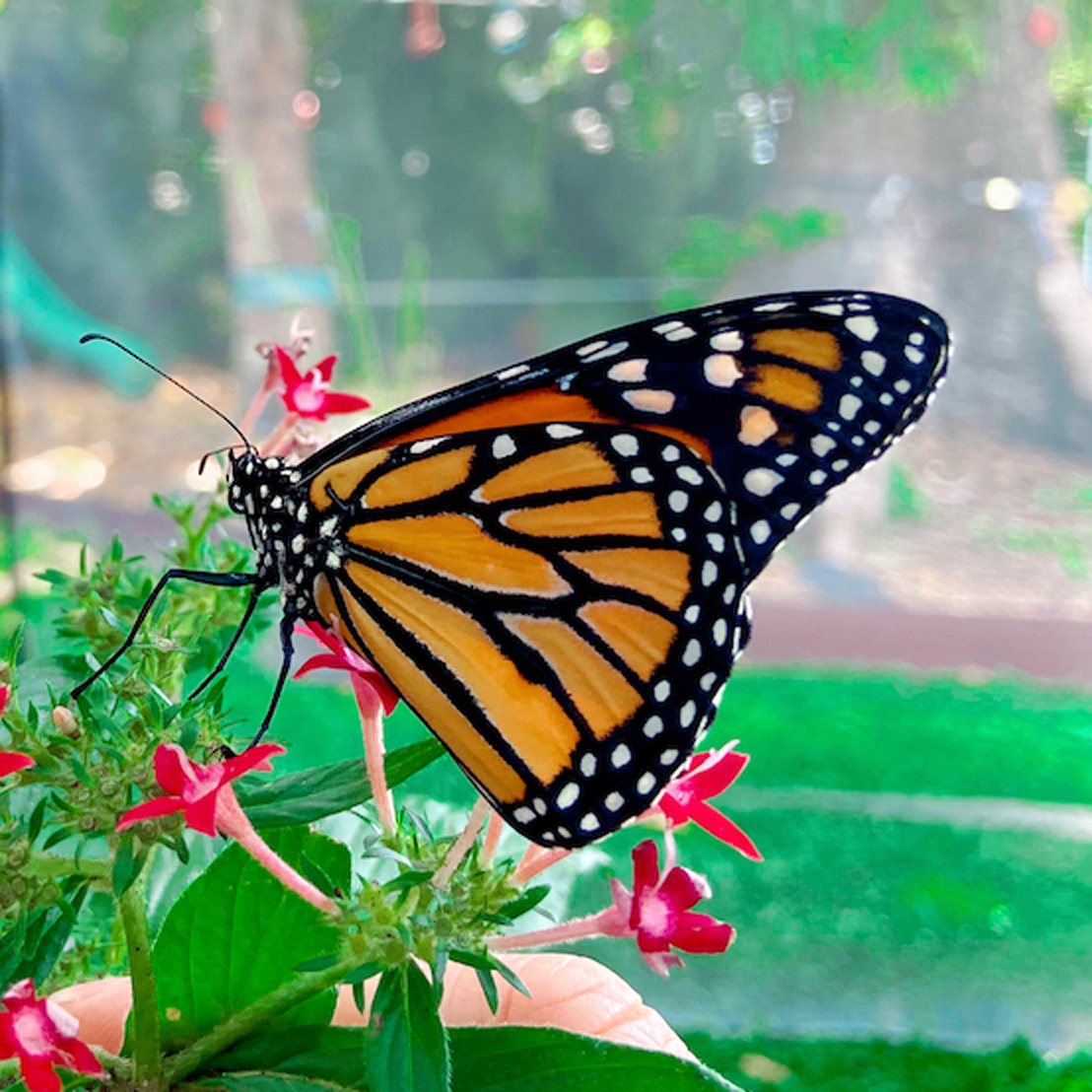
We currently have a butterfly garden that has taken over our backyard. I always tell our kids that their youngest sibling is the family pet, but they aren’t convinced that’s sufficient. Thankfully they like the butterflies and caterpillars lately, so it’s serving as a placeholder.
Allan: You write both Mystery and Romance. Is it a separation of the genres or do you combine both in your stories? Which do you find easiest or the most fun?
Stephanie: The most recent book I did was a crossover with both romance and mystery. The story is a mystery at the root of it, with a little sweet romance thrown in.
My romances, in general, don’t tend to have a mystery angle. They are feel-good fare with more of a focus on family, friend, and romantic dynamics alongside the personal journey of the main characters. My mysteries include those emotional aspects, but the driving force of those stories are still centralized around the whodunnit.
I don’t know which genre is easier. I want to say romance, but I’ve also been writing them longer. Romance takes less intensive plotting. With a mystery, I have to reverse-engineer the mystery or crime so that I know what I’m doing and making sure the book leads up to where it needs to be. I try to plot and outline both, but the stories inevitably change to some degree during the writing process as the characters develop into more fully formed personalities.

Allan: When was the defining moment you decided to write stories and seek to be a published author?
Stephanie: I had two defining moments. The first one was when I decided to leave the film industry and let myself go back to the drawing board to figure out what I wanted to do with my life. I realized then that I definitely wanted to be a writer. I was not sure yet what that would look like, whether it would be writing for magazines, or TV, or novels. I didn’t know anyone who was a professional writer and the information available wasn’t quite what it is today. I sat down and had a blast writing a novel in a month. It was messy and unstructured, but the story was there. Mind you, I had never really thought too much about writing a full-length fiction book before. Previous to that, I had written things like screenplays and short stories. As soon as I confirmed what my life path should be, I immediately changed course and decided to become a photographer.
This leads to the second defining moment that I knew I wanted to be a writer! I was lucky enough to have a career in photography and design for several years, but I always knew deep down that I wasn’t on the right track for me. After I had my first child, the stress of having a newborn and being out on photo shoots, then coming home to do marathon hours of editing, was really breaking me. And the deep-down voice within me knew that I should get out. The photos I took were pretty cool, but still something didn’t feel right. Finally, I looked at my life and said, “it is time to start trying to be a writer, whatever that means.” At that point I knew what it was like to start from scratch in a new business, so that part had become less daunting. I knew that I just needed to be brave enough to put myself out there and be willing to be vulnerable. I was never really scared of doing that in photography, but I was secretly terrified to fail as a writer.

So I started on my writer’s journey in secret and didn’t tell anyone other than one of my closest girlfriends what I was doing. Six months in, I finally admitted it to my husband and I think it was nearly four years before I sat down and told my dad what I was doing. Now everyone knows and even on the stressful days I feel content like I am on the right path. I’m also proud of myself for finally being willing to try the thing I was most afraid of.
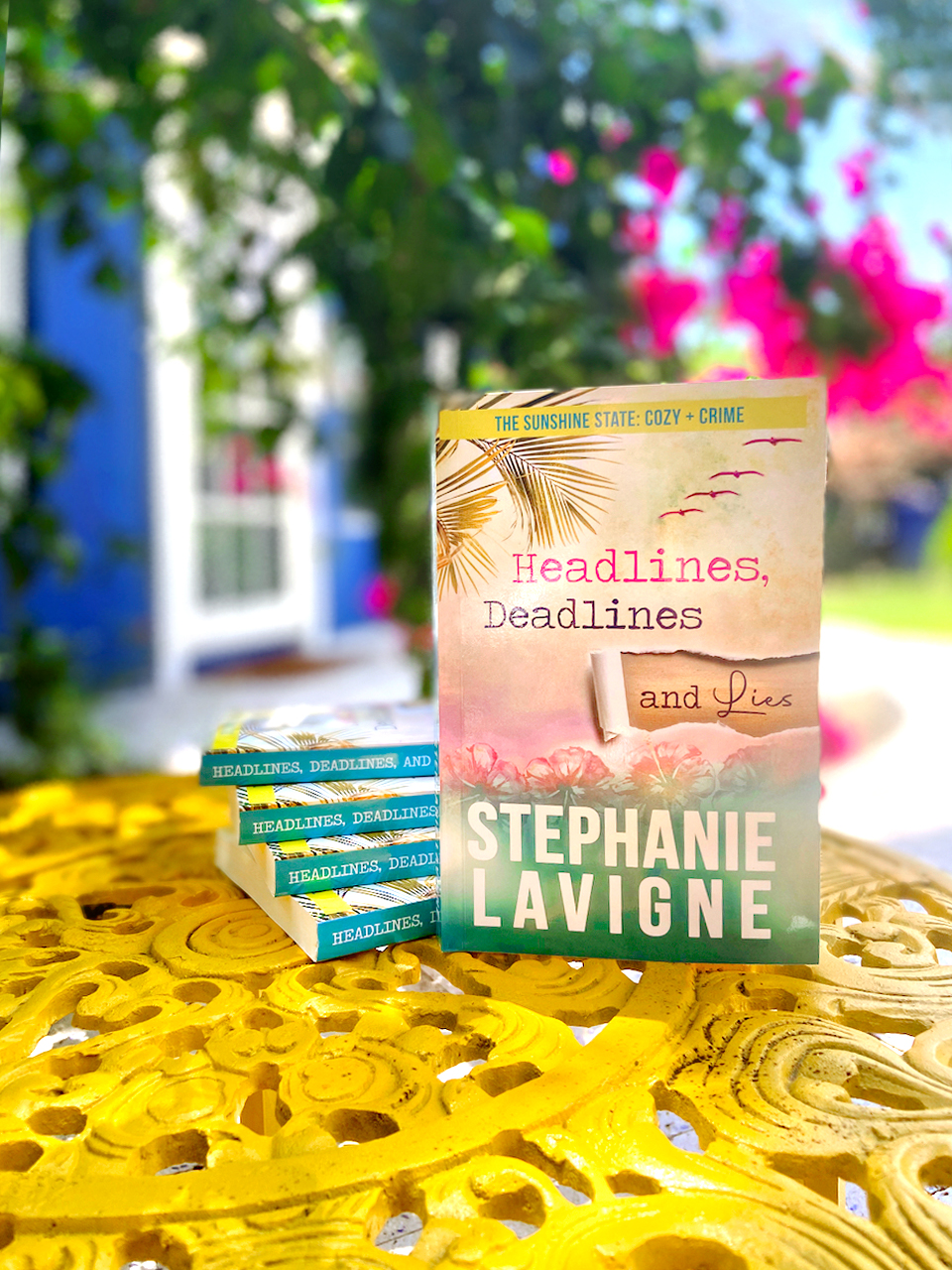
Allan: Headlines, Deadlines and Lies from The Sunshine State: Cozy + Crime Series is on pre-order. Please tell us about this story.
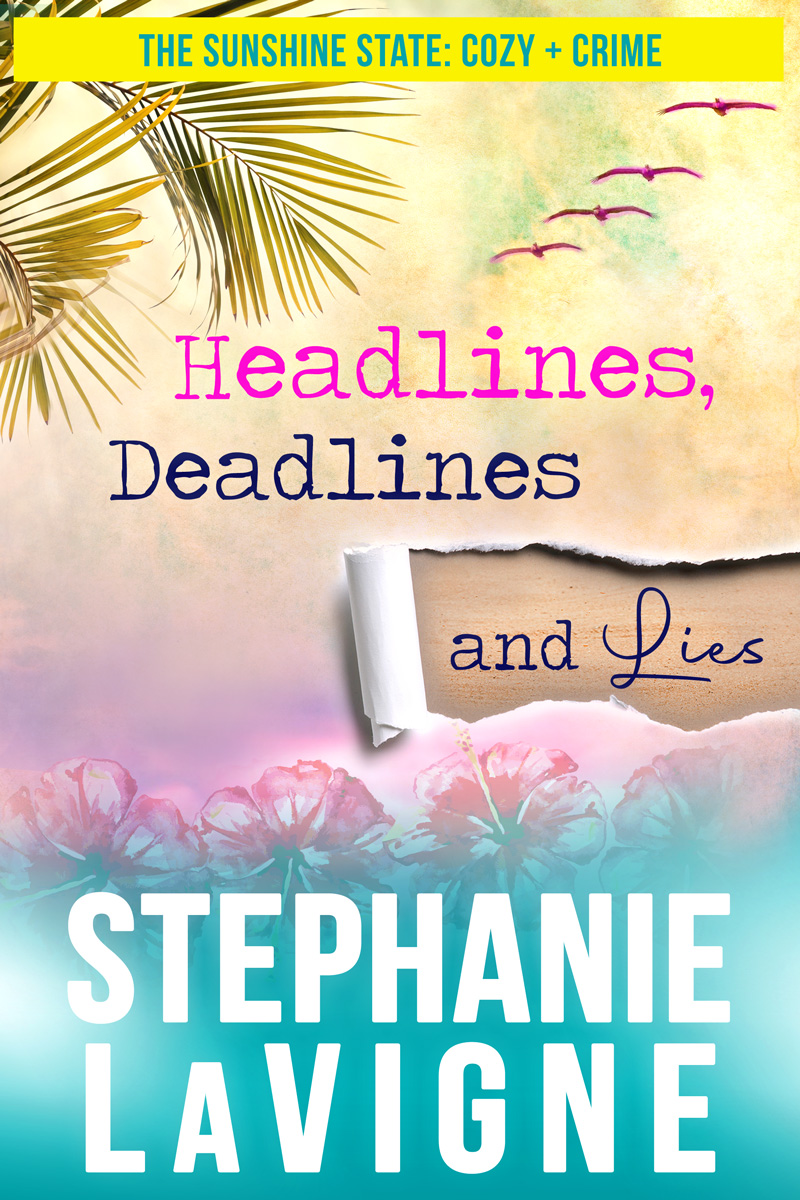
Stephanie: It’s live now! This was a Cozy Mystery-Sweet Romance crossover akin to the Hallmark Channel Mystery TV Shows. It is a genealogical mystery where the main character, Piper, has to uncover some incontinuities in her best friend’s family tree. She’s trying to learn more about her best friend’s long-lost dad, who died as a young man in the Navy, but she quickly finds that things aren’t adding up.
I wrote it when the world was feeling very intense and heavy. I wanted to see if I could write a compelling mystery without centering it around a murder or other cataclysmic event. So it makes for a very uplifting read! I tell people that so that they recognize that it is a little bit different from a traditional mystery, or cozy mystery even, because you come to expect that central crime or calamity. If you’re in the right mindset and looking for something to make you feel a little smiley- and then maybe end up scrutinizing your own family history a little more closely- you’ll have a great time with this book!
Allan: The Homecoming is the newest addition to your Fox Hill Southern Mystery Series. What can our readers expect when they pick up their copy?

Stephanie: This story was put on the back-burner for a lot longer than I intended. I had considered ending the series at book three, but it always felt incomplete. The final book brings some unsolved backstories from the other books full circle and makes Caitlyn, Kurt, Reba, and the rest of the Fox Hill gang’s story feel complete. It’s a touching yet fairly wild, hijinky ride to the end! Hopefully readers will enjoy it!
Allan: Please share a childhood memory or anecdote.
Stephanie: I am going to tell you the first one that pops into my mind. Once when I was somewhere around 12 or 13, my parents and I were on a bike ride in our Florida neighborhood. I was obviously at an age where I was a perfectly competent bike rider, and at some point, we were riding on the sidewalk spread out in a single file line when I noticed the large cement electrical line poles strewn down the block. There was one about twenty feet ahead of me. As I’m riding, I’m kind of in the zone and randomly think to myself, “imagine how awful it would be to run into one of those.” Which I thought was a ridiculous notion because the pole was not even on the actual sidewalk, simply butting up against it in the grass.

My thoughts went from wondering if people ever run into it, to fixating on not running into it by saying over and over, “don’t hit the pole.” Now mind you, I had plenty of clearance, I was a skinny 12 or 13-year-old on a 5-foot-wide sidewalk. But as I mentally repeated the mantra to not run into that giant cement pole, I slammed right into it and got thrown wildly off my bike.
Every once in a while, I think of that when I apply my adult knowledge that if you focus on the wrong thing, you will put all your energy toward that thing and lead yourself right to it. Don’t focus on the things you’re afraid of, focus on the road ahead or the positive goal you do want to achieve. Because I will tell you, slamming into the thing you wanted to avoid and being thrown to the ground is not that fun.
Allan: From reading your bio - About — Stephanie LaVigne • Author – you’ve lived an exciting life and have settled in Southern Florida to write full time. How much of your past adventures find their way into your stories? How many of Stephanie LaVigne’s personality is evidenced in your characters?
Stephanie: Many of my stories have absolutely no basis in my real life. For example, I’ve never faked my own death or had to save the family ranch alongside my four siblings. Though I’m sure every one of my books still has elements of me or my experiences woven in. Recently, I’ve been having fun with a new character because she embodies the sarcastic, confident yet playful “tough girl” side of me that doesn’t get to come out as much because I’m always home with my kids and husband. When I’m writing, she often gets to act and respond in ways that feel very organic to me. Often though, I’ll channel relationships with different people I’ve had or seen and try to get into the heads of my characters when I’m writing. Even though I’m making it up, I’m sure it’s easier when the personality type isn’t completely foreign to me.
I’ve had so many different experiences that it makes it easy to pull bits of familiarity into my stories through that, which I do like to do. I assume that even when I’m writing about something that is purely fiction, it still has some elements of me, even if simply in the fact that it’s a location or premise that piques my interest. I’ve never lived in the mountains, but I’ve always had a fascination with cowgirls for example.

So when I’m working on a contemporary Western romance, there is still that fascination with mountain life that I have, and I’ll pull from some of my memories of visiting those areas. I don’t tend to write about things that aren’t interesting to me.
Allan: Favorite authors? Books? Movie? Dessert?
Stephanie: It’s funny because I don’t have favorites, generally speaking. Especially when it comes to books. I love too many books and I cannot choose.
For movies, I lean toward comedy, action adventure or heist films. A lot of the movies I consider “my favorite” are kind of ridiculous. For example, many years ago I realized I had copies of pretty much every Burt Reynolds movie. Add in Dom DeLuise and Sally Fields, I am going to call it a classic. So from Cannonball Run to all three Smokey and the Bandits, I own them and truly love them. Back to the Beach with Frankie Avalon and Annette Funicello, which was made in the 80’s, is also part of my coveted movie collection. I really enjoy movies where the actors work together a lot because they are truly friends. Something about that shines through to me. I also like how Burt Reynolds always randomly breaks the third wall in every movie he’s in and either winks, or cocks an eyebrow and smirks. It simply makes me smile.
As for dessert, I tend to be a decadent chocolate dessert person. If you give me a fruit-based dessert, I will gladly eat it, but I will consider it breakfast.
Allan: Anything else you’d like to share with us?
Stephanie: I will just leave whoever is reading this with the reminder that you are never alone in this big ol’ world. Sometimes all of us feel alienated or alone, full of self-doubt, overly critical, or scared to take a chance on trying to live a life that we think would make us happier. But now more than ever, there are ways to find people who will believe in you, support you, love you, and support you through the ups and downs of life. Maybe you will find that in a good book, in an online group, even in a pet, or just one good friend you can call. But sometimes that is more than enough. Know and believe that you are wonderful in your own unique way, and know that I am here championing for you to live your own incredible life.

***That's a beautiful thought Stephanie.
Thank you, Stephanie, for taking the time to share your thoughts and for being our guest this week. Wishing you continued success with your stories.

For all you fantastic visitors wanting to discover more about Stephanie and her writing and where to buy her novels, please follow these links:

https://www.facebook.com/thestephanielavigne
https://www.instagram.com/thestephanielavigne
https://www.amazon.com/Stephanie-LaVigne/e/B014DUTKOY
https://www.bookbub.com/authors/stephanie-lavigne?follow=true
https://www.goodreads.com/author/show/14291865.Stephanie_LaVigne
July 25, 2021
The Troubled Waters by Allan Hudson
I’d like to share one of my short stories with you this week.
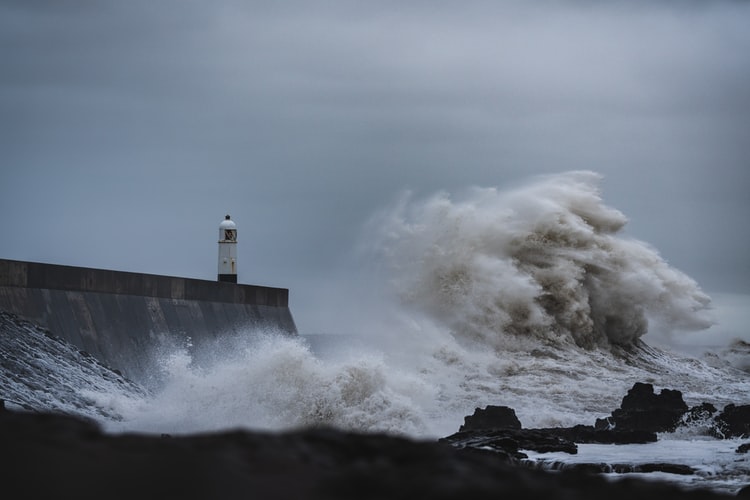 Photo by Marcus Woodbridge/Unsplash Images.
The Troubled Waters
The waves are relentless at battering the coastal cliffs. Water, soft as taffeta, reduces the shoreline to chunks of broken rock and diminished stature. Nathan Hall ponders the damage to the edge of his property and curses the wind and the rain. He raises his fist at the breakers that are bashing their heads against the bluff marking the peripheral of his land.
“Damn you Mother Nature! Will you continue to steal the very sod my ancestors gave to me?”
Over a hundred years have passed since Nathan’s great grandfather fished from the very waters destined to destroy his only legacy. Chewing up on the edges, little by little, the earth gives way to the authority of the sea. He built a home on ground solid enough to withstand the ferocity of northern gales, the sun’s hottest days, winter’s temper. The sea though, is a different story. Nathan will be the last of the Halls to inhabit the property of his ancestors.
The rain pelts the wrinkled skin of the man, plastering his hair upon his forehead. It does nothing however to soften his features as he holds his face up in defiance. Nor does it wash away the torment he carries. Like the diminishing shore, his spirit has eroded with the pounding of the years. Between his body and his left arm, he clutches a photo album. Tears escape across his cheeks, impossible to distinguish from the raindrops, except for the salt of his sorrow. He drops to his knees, his head hanging. As the album falls to the damp ground on its spine, the wind flips the cardboard edges until it rests open with pictures tinting the wet verdancy with a square of black and white.
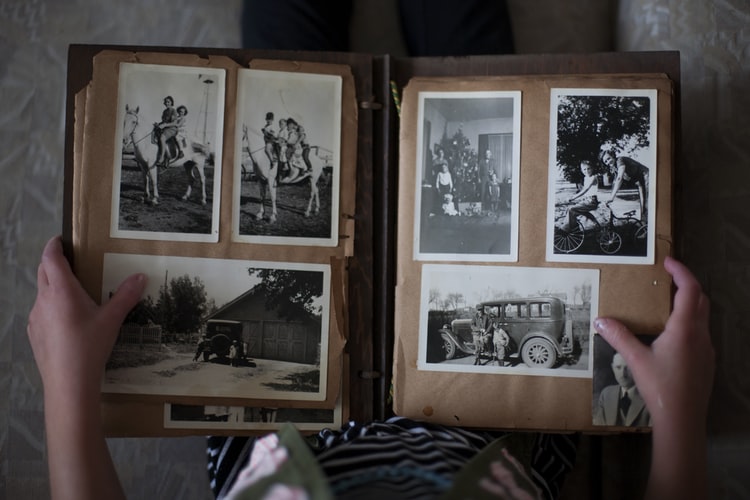 Photo by Laura Fuhrman/Unsplash Images.
As if to taunt him, the album falls to images of his son, his only child. Blurry eyed, he ignores them until the photos become indistinguishable. He doesn’t want to see them anymore. Not enough years have gone by for him to forget the haunting memory of an anguished sea claiming his son’s body and his future. Ripping the photos out one by one he throws them into the wind. They tumble, and flitter like birds as they drift out to sea. He yells into the storm.
“Take them you selfish whores. The same as you took my Davey forty years ago. Like you took my Helen.”
Frustrated with anger at not being able to get them out fast enough, he begins tearing whole pages out, flipping them into the air, watching them twirl and spiral away. When he starts to tear out the last page, the wind suddenly dies. The rain stops. Fierce clouds, warriors of the sky, split apart to reveal a brilliant ray of gold that sweeps across the waves, as if admonishing them to calm down. The immediate stillness astonishes Nathan. He’s stunned into inaction as he watches the seascape change dramatically from rage to pacifist. He’s never witnessed such a phenomenon.
He wipes the moisture from his face, pushes the hood covering his head onto his shoulders and fingers the unruly locks from his forehead. Gaping at the whitecaps on the horizon as they dissolve, he rises and steps closer to the precipice. As he gazes down the rocky incline, he almost slips and steps back, unsure of the soft ground. The shredded album hangs by his side. It slips from his wet fingers and lands at his feet, pulling his attention away from the vista. Only one picture was left pasted on the last page. An eight by ten of him, his wife and baby David. On the other side are four photos. All of Helen.
Despite his anger to rid himself of all reminders, his shoulders sag at the thought of losing these last few images. Tearing the page from the binder, he hurls the empty album into the air and without the wind, it plunges into the sand at the base of the cliff. Hugging the last page to his chest, he studies the skyline, his features at rest, a calm after the storm. The troubled clouds have had enough of each other and break up into meaningless clumps. The morning sun sprinkles its warming glow where it can. A warm zephyr whispers to the water close to shore causing small ripples to lick the sand. Feeling somewhat weightless and tired, he looks for a spot to sit.
An old tree trunk lies close to the cliff edge. Once mighty and tall, it now lies dead and fading into the future one splinter at a time. He doesn’t care that it’s wet. He rests his butt on a smooth patch and flips the page over to the four pictures of Helen. The top left is one of her at a dance when she was a teenager. Her and her sister Martha are jiving together, their skirts flying and their ponytails swinging, glee evident in their large smiles. It was the night he met her. He can still recall the pink sweater and navy skirt, the enthusiasm in her eyes and how easily she blushed. It was the last dance of the night, a waltz and a lady’s tag. It had been the first dance he’d attended. He was thirteen. Too shy to venture onto the floor or ask someone to dance, he’d been a wallflower all night. He can still feel how his heart began beating faster when he watched her approach. Part of him wanted her to keep on walking, not center him out. Another side wanted to hear her voice. It was soft, melodic, like the last song.
“Would you like to dance with me?”
 Photo by Alexandra Gorn/Unsplash Images.
The second photo on the top is her walking away from the photographer. Her head is down exploring the beach she strolls on, always looking for washed up glass pieces. The shoreline curves to the left to go around a bend, the water to her right. Her legs are bare to the knees where they meet rolled-up denim shorts. A short sleeveless blouse, with frills around the neck and the bottom show off her slim waist. A broad smile crosses Nathan’s face. He was the photographer.
Gazing off into the sky, his vison blurs. A memory so vivid, it could’ve happened a few days ago. They were exploring the cliffs at the edge of the property. She loved the beach. The surf and ice had carved shallow caves from the sandstone and left a carpet of fine granular sand, soft as a kitten’s fur. Along with his camera, he carried a picnic basket and a blanket. They cuddled into the larger hollow, scrutinizing the sun rays dancing on the surface of the wavelets. The blanket bore witness to the union of their souls and the tiny drops of blood could never be washed out.
Nathan looks out at the water where they caves would’ve been all those years ago. Only a few large slabs of stone are all that’s left. During high tide, they disappear. He takes a deep breath, smelling the heady scent of wet earth and brine. Pausing, he uses all his will power not to blink. He’s cried enough. His attention turns to the bottom left photo.
 Photo by Jacalyn Beales/Unsplash Images.
It’s a close up of Helen when she graduated from Beauty School. It would’ve been in the school’s year book. Nathan touches the photo, his finger tracing her full lips, so red they look dark gray on the photo. Her light brown hair ends at her shoulders with a casual flip all around, a style popular in the seventies. The eyes. Nathan shakes his head with a smirk, reminding himself he could always read her looks. The eyes told him everything. When she was angry, her eyes said stay away. Or if she was excited, they said follow me. Or when she hugged him, they said I love you. Sliding the photo from its protective holder, he puts it in his coat pocket.
The fourth photo was taken the week before she died. She’s lying on the grass where she had been staring up at the clouds. Full of mirth, she was poking fun at the formations and how they reminded her of Donald Duck or Mickey Mouse or Bullwinkle the moose. He took the picture. He had to stand over her to get her photo and he remembers her gazing at the lens and him telling her how beautiful she was. When she turned her head to the side, cheeks rosy, he snapped the shot.
Even now, he feels the same way. Her beauty hasn’t dwindled in his mind. Several loose strands of hair fall on her cheek: her T-shirt off shoulder and her breasts like plump oranges, her navel showing and just the top section of her jeans. A lump in his throat makes him look away with pursed lips and a sad luster in his eyes. The memories so fierce. He removes this photo as well and adds it to the same pocket. Shoving it in deeper, he disturbs the letter he has in there. He removes it and places it on the log beside him, ignoring it while he flips the page of photos over to the eight by ten.
Davey was only a month old when the picture was taken. A professional image from Robertson’s Studio. He thinks the owner’s name was Ben or something like that, he can’t remember for sure. Silly enough, he recalls the man’s easy laughter and how he fussed over them to get the best light. The black and white photo has been colored by hand. The faces all have the same blush of rouge on their cheeks. The clothing has a soft tinge as if you’re looking at it through gauze. The jumper his mother gave them for the baby is an appropriate blue. Nathan’s suit, dark brown. Helen’s blouse a shy pink. He had a moustache then. Long twirly ends to make handlebars. Helen thought it quite dashing, called him her pirate. He laughs out loud at the absurdity of it now and almost falls off the log. The moment he falters and reaches to catch himself, the page of photos shoots in the air. Gasping at what happened, without thinking he lunges for it. His next step will take him over the cliff.
 Photo by David Solce/Unsplash Images.
He catches himself right at the edge, his toes in thin air, the balls of his feet on firm rock, his heels an inch off the ground. He arches his back trying to arrest his fall forward. Arms start propelling to pull himself back as he totters on an edge like the tip of a knife. Glancing down at the jagged rock twenty feet below, a torrent of wounds flash through his head, with death close behind. Heart pounding, frightened, his back impossibly arched, he twirls his arms faster now, until he starts to regain his balance. Tipping back toward land, he falls on his side, panting and holding his chest. A tide of relief overwhelms him. He turns on his back and rests his forearm across his eyes. The sun is directly overhead and blazes with a gratifying warmth. He lies still for many moments before his heart becomes still and his breathing regular.
A wandering cloud, grey and spiteful on the bottom, pure fluff on the top, stirs in an upper wind and blots out the sun for a moment. During its snail’s pace, it mutates into a face-like shape, its features becoming distinct. With a long snout, a floppy ear, tongue hanging out, it looks like a dog. It reminds him of Helen in the grass seeing cartoon characters and it makes him think of Pluto, the dog. The laugh starts with a titter, then a hearty chuckle and a second later, full belly-holding guffaws. He’s laughing at the stupid dog and he’s laughing in reaction to coming close to dying. It goes on until his stomach hurts and he’s gasping for breath. Curled up in the damp grass, he realises how good it felt to laugh out loud. It seems like forever since anything’s been so amusing. He opens his eyes to the cloud now shaped like nothing recognizable, just an ordinary cloud. The sun flicks its edge around the sky wanderer and catches him in the eye.
Blinking, he shuffles backwards on his rump and palms until his back is against the log. Concentrating on the water, as motionless as the pictures he lost, he takes a deep breath, rethinking his original intentions at tearing into the storm. The strain on his brow makes him look like a man that has to choose between right or left, right or wrong. Looking out to where the land stretches away from him, only a ribbon of his land remains. It’s divided from his neighbour by a rusty wire fence with grey-faced poles, older than Nathan by many years. The erosion will soon be a problem for the couple next door.
In the other direction, the fence follows a bend to the right, where a half an acre of land still remains. A handsome house, needing fresh paint, sits only a few feet from the cliff’s edge. It may be one or two winters before the old wooden home meets its executioner. The motion of looking back at the house disturbs the letter he set there earlier. It falls to his side. He finds the underside is wrinkled and damp when he picks it up. The seal around the bottom of the V is starting to curl. The face is blank. No address. He’d meant to put it in plastic, tightly wrapped so it wouldn’t get wet but in his rage he forgot.
It doesn’t matter now. Tomorrow when the sun comes up, he’s going to start packing.
The End
Thanks to all you wonderful readers for visiting the Scribbler. I hope you enjoyed the story. Please feel free to leave a comment below.
Next week you will meet Author Stephanie LaVigne of Florida.
Watch for the next Drake Alexander Adventure - Vigilantes.
Cover Reveal August 1/2021

July 17, 2021
Authors Anita Dawes & Jaye Marie of Southern England.
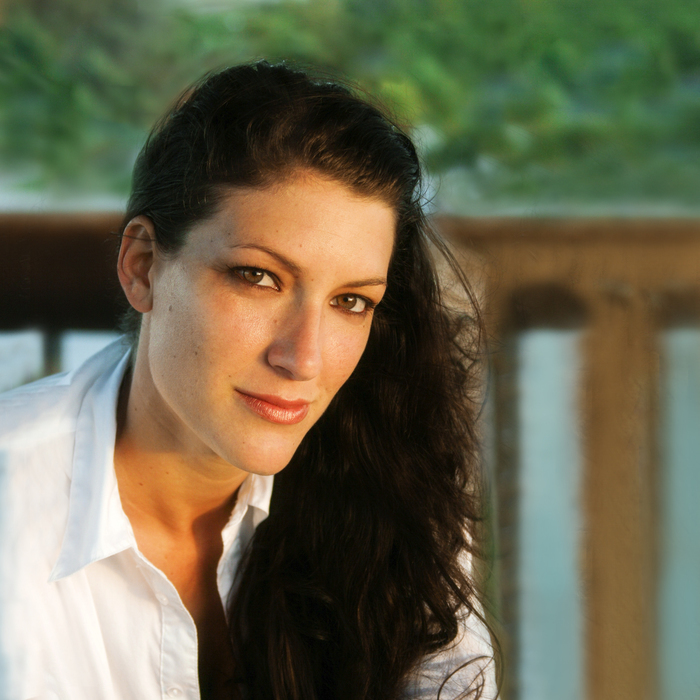
 Anita
Anita
 Jaye Marie
This week, the Scribbler welcomes sisters Anita Dawes & Jaye Marie. Two accomplished authors who share many things – a popular website, a passion for writing, a love of detective thrillers, supporting authors and having fun.
It’s a pleasure to have them as guests this week. Read on to discover more.
Take it away, Ladies.
When Allan asked us to write a post for his website, we thought we could tell you how we began…
8 years ago, when we first started hearing about indie publishing, we never thought for a moment that it could be something we could do, as the thought of anything complicated to do with a computer, apart from playing solitaire, that is, filled us with dread.
I had been writing for years and submitted my work to most of the mainstream publishers. Very nearly made it too, but as they say, a miss is as good as a mile! Which was a shame, for many people liked what I wrote.
It didn’t take long for the idea of doing it ourselves to take root in our imagination and became something we were determined to do. So, I enlisted the help of my sister, Jaye, as she is far more computer literate than I and much more stubborn too!
What Jaye had to learn was incredible, and unbelievably hard. I tried to keep up with her, but there were days when she was pulling her hair out. Some of it was easy, which tended to lull us into a false sense of achievement, but we persevered.
Eventually, we learned how to upload manuscripts to Amazon, and I was finally a published author (well, sort of).
Then something strange happened. Jaye began to write too. She had always been content with her many hobbies and to edit my work, but writing gets into your blood. Different characters started talking to her and before we knew what was happening, there were two writers in the family!
Learning how to do all of that was a nightmare, but soon, our books were on Amazon, and we were like a couple of Cheshire cats. We soon discovered that this was only half of the battle. Apparently, we needed a platform, a reader friendly website to promote our books or they would remain in limbo. Well, we managed to create a passable website and over the years we have established a presence on the internet, and we have met so many lovely people along the way. Not that this is the end of the story, there is no way you can rest on your laurels (that’s if you even have some!)
Now, we are learning all about marketing, and this might be the straw that breaks both our backs!
Even if nothing monumental comes from all our efforts, we know we have tried our hardest. But whatever happens (or doesn’t!) we won’t stop writing, that’s the fun part!
Anita's Biography

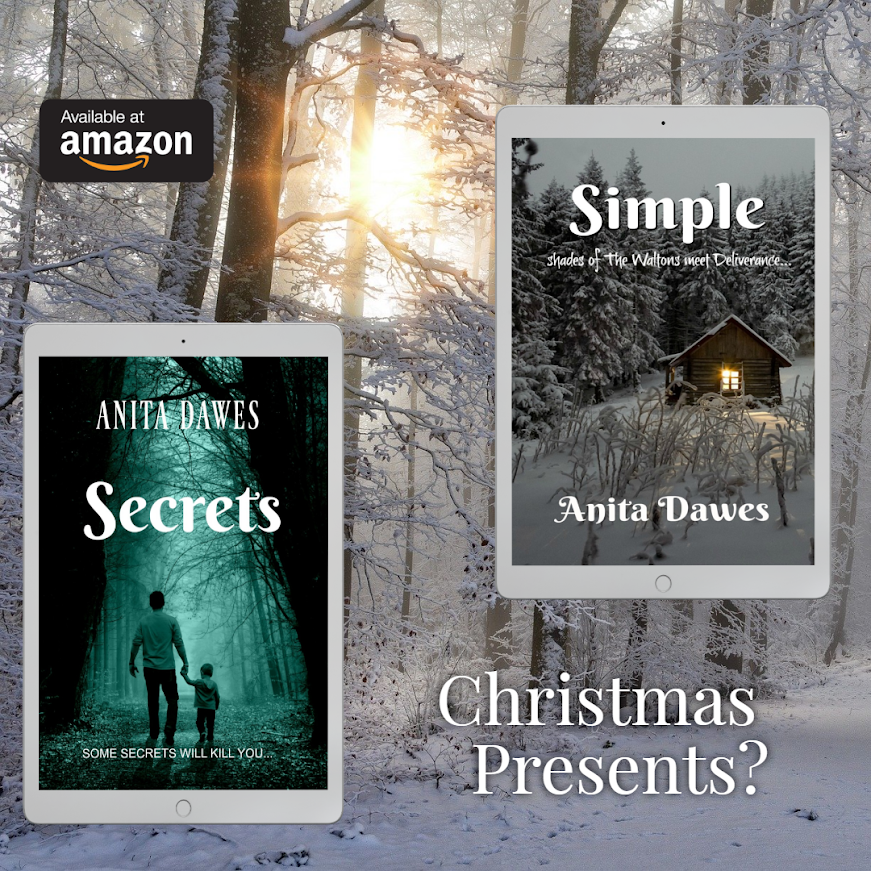
She has written six fiction novels in various genres, Bad Moon, Simple, Secrets, The Scarlet Ribbon; Let it Go and Not My Life. Presently working on a sequel to her popular supernatural romance, The Scarlet Ribbon.
Anita has recently rediscovered her childhood love of poetry and often writes and posts them online, which is how this book came about.
Once owned by an egocentric black and white cat called Merlin, named after her favourite hero, Anita hates computers with a passion and prefers to write longhand, sharing the website Books & Bonsai with Jaye Marie, who transcribes and edits her work...
Jaye’s Biography
She enjoys reading many different genres, so was surprised to discover a passion for writing detective thrillers. Four of them to date, with more to follow.
For all you wonderful readers and visitors wanting to discover more about Anita & Jaye, please follow these links:
Email: jenanita01@btinternet.com
Website: https://jenanita01.com
Twitter: https://twitter.com/jaydawes2
Facebook: https://anita.dawes.37
Facebook: https://www.facebook.com/doubletrouble44/
Goodreads: https://goodreads.com/author/show/6586480.anita_dawes
Amazon Author page: https://www.amazon.co.uk/Anita-Dawes/e/B0034NUE10
Pinterest: https://www.pinterest.com/anitajaydawes
Bloglovin: https://www.bloglovin.com/v2/own_profile
Thank you ladies for being our guests. Wishing you continued success with your stories.

Authors Anita Dawes & Jaye Marie.
Anita
Jaye Marie
This week, the Scribbler welcomes sisters Anita Dawes & Jaye Marie. Two accomplished authors who share many things – a popular website, a passion for writing, a love of detective thrillers, supporting authors and having fun.
It’s a pleasure to have them as guests this week. Read on to discover more.
Take it away, Ladies.
When Allan asked us to write a post for his website, we thought we could tell you how we began…
8 years ago, when we first started hearing about indie publishing, we never thought for a moment that it could be something we could do, as the thought of anything complicated to do with a computer, apart from playing solitaire, that is, filled us with dread.
I had been writing for years and submitted my work to most of the mainstream publishers. Very nearly made it too, but as they say, a miss is as good as a mile! Which was a shame, for many people liked what I wrote.
It didn’t take long for the idea of doing it ourselves to take root in our imagination and became something we were determined to do. So, I enlisted the help of my sister, Jaye, as she is far more computer literate than I and much more stubborn too!
What Jaye had to learn was incredible, and unbelievably hard. I tried to keep up with her, but there were days when she was pulling her hair out. Some of it was easy, which tended to lull us into a false sense of achievement, but we persevered.
Eventually, we learned how to upload manuscripts to Amazon, and I was finally a published author (well, sort of).
Then something strange happened. Jaye began to write too. She had always been content with her many hobbies and to edit my work, but writing gets into your blood. Different characters started talking to her and before we knew what was happening, there were two writers in the family!
Learning how to do all of that was a nightmare, but soon, our books were on Amazon, and we were like a couple of Cheshire cats. We soon discovered that this was only half of the battle. Apparently, we needed a platform, a reader friendly website to promote our books or they would remain in limbo. Well, we managed to create a passable website and over the years we have established a presence on the internet, and we have met so many lovely people along the way. Not that this is the end of the story, there is no way you can rest on your laurels (that’s if you even have some!)
Now, we are learning all about marketing, and this might be the straw that breaks both our backs!
Even if nothing monumental comes from all our efforts, we know we have tried our hardest. But whatever happens (or doesn’t!) we won’t stop writing, that’s the fun part!
Anita's Biography
She has written six fiction novels in various genres, Bad Moon, Simple, Secrets, The Scarlet Ribbon; Let it Go and Not My Life. Presently working on a sequel to her popular supernatural romance, The Scarlet Ribbon.
Anita has recently rediscovered her childhood love of poetry and often writes and posts them online, which is how this book came about.
Once owned by an egocentric black and white cat called Merlin, named after her favourite hero, Anita hates computers with a passion and prefers to write longhand, sharing the website Books & Bonsai with Jaye Marie, who transcribes and edits her work...
Jaye’s Biography
She enjoys reading many different genres, so was surprised to discover a passion for writing detective thrillers. Four of them to date, with more to follow.
For all you wonderful readers and visitors wanting to discover more about Anita & Jaye, please follow these links:
Email: jenanita01@btinternet.com
Website: https://jenanita01.com
Twitter: https://twitter.com/jaydawes2
Facebook: https://anita.dawes.37
Facebook: https://www.facebook.com/doubletrouble44/
Goodreads: https://goodreads.com/author/show/6586480.anita_dawes
Amazon Author page: https://www.amazon.co.uk/Anita-Dawes/e/B0034NUE10
Pinterest: https://www.pinterest.com/anitajaydawes
Bloglovin: https://www.bloglovin.com/v2/own_profile
Thank you ladies for being our guests. Wishing you continued success with your stories.
July 10, 2021
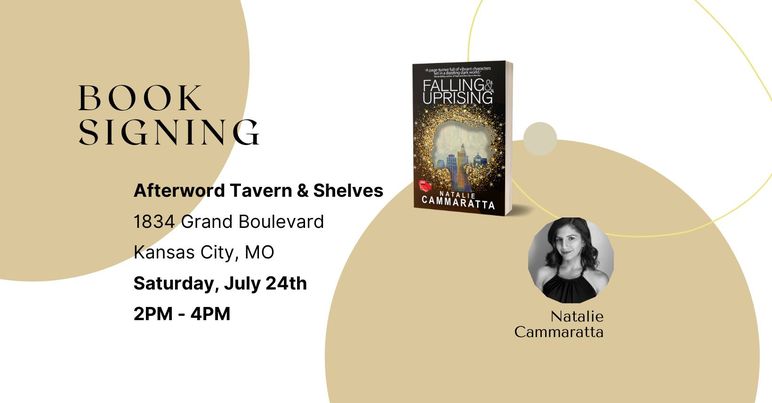
Branching Out with Natalie Camaratta of Kansas City.

Natalie’s debut novel – Falling & Uprising – is coming off the presses on July 21st with great anticipation.
“A page-turner full of vibrant characters set in a dazzling dark world”
Nicole Bailey, author of Faye and the City in the Sea.
I was intrigued by Natalie’s enthusiasm and followed her on Twitter. Remembering my own debut novel, I can appreciate her eagerness to tell everyone about her novel. Anyone that has written and published a novel knows how she feels.
The novel has already garnered tremendous
reviews. You can check them out here.
She has graciously accepted an invitation to a Branching Out Interview and is offering an excerpt from the book.
Let’s chat with Natalie.
Allan: Thank you for being our guest this week Natalie. It’s an exciting time in your writing career. The book hits the streets in less than two weeks. Before we chat about your novel, please tell our reads a bit about yourself.
Natalie: Thank you for having me, Allan. The first thing people are usually surprised by is that I learned Spanish before English. My Cuban grandmother took care of me when I was a baby, so I understood that first. Since my dad doesn’t speak Spanish, we spoke English at home, and of course at school, so I lost it a bit. I don’t consider myself fluent, but I can get by.
I grew up in South Florida and went to college in Orlando where I majored in Hospitality Management. I worked in theme parks and hotels until I got married and had my first son. Leaving Florida was never in the plan, but about a month before my second son was born, we moved to Tucson, Arizona. After a couple of years enjoying mountains and the desert, we moved to the Kansas City area where I hope to stay forever!

Allan: When did you start writing?
Natalie: I’m new to it. I started Falling & Uprising in February 2020. My boys were old enough for me to have more reading time, and that spurred finally getting to a book of my own. I had wanted to write a book forever, but never had a story idea. Of course, now that I’m busy with this series I think of new stories all the time.
Allan: Tell our readers what to expect when they pick up their copy of Falling & Uprising?
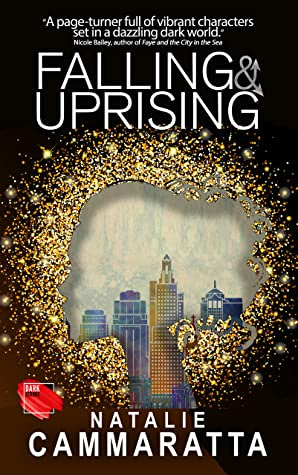
Natalie: Falling & Uprising is a character driven YA story. Strong voices, lots of dialogue, sarcasm, and banter. The two main characters are opposites in every way: Serenity is a celebrity-socialite always in the spotlight, and Bram is essentially invisible. When they end up in a revolution together, the way they deal with each other is fun to watch. It shows the disparity between the ‘haves’ and ‘have-nots,’ but they find their similarities as well.
Allan: What inspired this particular story?
Natalie: It started with a quintessential dystopian: The Hunger Games. I read the books and re-watched the movies, and kept thinking about the characters from the Capital. We knew why some of the rebels from the Capital joined the revolution, but I found the idea fascinating. Why would a character who lives in the utopian part of society want to overthrow everything? It changed and grew a lot from there, but early readers have enjoyed this flip on the perspective of this kind of story.
Allan:Please share a childhood memory or anecdote.
Natalie: I was a singer growing up. When I was maybe eleven years old, I sang the Star-Spangled Banner at a Major League Baseball game. At the time, the Florida Marlins played in the stadium where the Miami Dolphins played, which means it was larger than a normal ballpark.

The echoin the sound system was a lot to deal with, so I kept waiting for my echo to catch up with me after each line. It was, perhaps, the longest rendition of the National Anthem ever sang. My father glanced up at the jumbo-tron where the lyrics were scrolling and I was at a different point in the song, so he thought I messed up the words. It was an amazing and terrifying experience!
Allan: Do you have a mentor? Who or what else has influenced you to write?
Natalie: I don’t have a mentor, but I’ve had so much assistance and guidance through this. I expected writing to be a solitary process, however, I came to find that being friends with other writers is not only fun, but a much-needed lifeline to get through it. Having someone read parts of the book as I was going, made for exceptional motivation to finish. Now that I’ve started, I can’t imagine ever not writing. Stories pop into my head all the time. But having a supportive community helps get the stories done.

Allan: Is there any characteristics of your own in any of your characters? Have you modeled any of the characters after people you know?
Natalie: There are bits and pieces of me and my friends/family in a lot of my characters. None of them are wholly a person from my life, though. My sarcasm passed on to many of my characters. (Which I got from my father, so thanks, Dad.) Serenity’s high expectations of herself is certainly close to home, too. Frankly, I didn’t realize how much I have in common with her until after I wrote it. At the time, it didn’t occur to me that struggling with how she’s perceived versus what she’s really got going on inside is something I do all the time. Writing turned out to be therapy and a way to discover my own issues.
 Natalie's Dad.
Allan:Favorite authors? Novels?
Natalie: Choosing favorites is so hard! I’m a pretty omnivorous reader, but obviously I love the genre I write in so Hunger Games, Divergent, and Red Queen series are huge for me. I devoured the Red Rising series by Pierce Brown last year (and will absolutely drop everything as soon as the sixth book comes out). I’ve had the pleasure of discovering a lot of incredibly talented indie authors since I got into writing. Nicole Bailey’s Faye and the Ether series is a favorite of mine, and Bloodlet, the first book of T.S. Howard’s The Growing Veil series, ensured that I will read everything that man writes.
Allan: Is there a follow-up to the novel planned? Will it be a series or stand alone? Otherwise, what’s next for Natalie Camaratta, the author?
Natalie: This is a trilogy. The second book is being finalized and I’m drafting the third and final book. The ending of Falling and Uprising tends to leave people wanting more, though it’s not actually a cliffhanger.
After this series, I’ve already started a Fantasy novel which will likely be a series as well. It is my plan to keep writing as long as I live.
Allan: Anything else you’d like to tell us about?
Natalie: In addition to the literary release of Falling and Uprising, the audiobook is being produced by Tantor Media. We are in the early stages with that, but I’ll have more news on that on my social media and newsletter when I have a release date.
An Excerpt from Falling & Uprising.
(Copyright is held by the author. Used with permission)
“I’m not here to force you into anything you are uncomfortable with,” Sophos says. “There is a way out for you.”
I could go back to the world I knew two days ago—the happy, uncomplicated world. I wouldn’t have to lie to anyone. I could speak to my family and friends without feeling an insurmountable chasm between us. I could look out at the sea without feeling like I’ll collapse.
But it wouldn’t be real. I wouldn’t know that I guess, but when ignorance was forced on me, that was one thing. Can I choose to be so ignorant? I’d be taking the guilt on myself when it belongs to the people who decided to lie to me all my life. They are guilty. And I don’t want to forget that. Even if I have to be alone.
“No,” I say. “I know it now. There is no going back.”
“Thank you for being brave enough to make that choice.” Sophos’ smile is triumphant.
I’ve never been described as brave before.
“And besides,” Bram says, “everyone is going to find out soon enough. At least this way, you understand it before all hell breaks loose, pup.”
“Pup?” Do I even want to know?
“You are basically a puppy.”
“How might that be?”
“You’re fed and pampered and primped, and when you get angry, you try to look aggressive, but you’re too cute to pull it off, so it ends up being funny.”
How dare you! “Puppies have sharp teeth.” My own teeth are clenched, and my blood boils. “Anyway, I’m sure my cuteness will wear off. Apparently, knowing the truth of how the world works can have the side effect of making a person a prick.”
This is new territory for me. I’ve never been this blatantly confrontational. Generally, slights are far more subtle, but I’ve never had to deal with anyone as hostile as Bram before. He shoots me an arrogant smile. It would be a great smile if it wasn’t being used to taunt me.
Sophos tries to smooth over our clash. “Now, now. Can we please recall we are on the same team?”
“Fine.” I take a breath and look back at Sophos. “Now what?”
“We’ll continue with your sanctioned education and our plans tomorrow. You can’t make it a habit to be at work too long. That looks suspicious with the work ethic around here. For now, you’ll make yourself appear perfect, as you have done your whole life, only now you’ll have secrets to hide underneath it. Can you do that?”
“Yes.”
It looks like Millie’s instruction will come in handy in the real world after all. Having to use those lessons to mask myself from my closest confidants will be new, though. The little reprieve I ever have from who I must be in public will be gone. That perfect version of me will be the only version of me.
For you folks in the Kansas City area

Thank you, Natalie for being our guest this week. Wishing you continued success with your writing.

For all you wonderful readers wanting to discover more about Natalie and her stories, please follow these links:
https://www.goodreads.com/author/show/21441191.Natalie_Cammaratta
https://www.amazon.com/Natalie-Cammaratta/e/B093LFMN9Z
https://www.tiktok.com/@nataliecammarattawrites
https://www.instagram.com/nataliecammarattawrites/
https://www.facebook.com/NatalieCammaratta/
https://twitter.com/bynataliecamm
https://www.bookbub.com/profile/natalie-cammaratta

July 3, 2021
Branching out with Author John Leister of Vancouver, BC.

I had the good fortune of being introduced to John by a fellow author, Bobby Nash, who has been a regular guest on the Scribbler. Bobby kindly did a call out for the Scribbler, offering fellow authors an opportunity to reach a new audience and John was quick to reply.
John Leister has over 50 novels to his credit and is writing up a storm. He has agreed to a Branching Out Interview and is offering an Excerpt from The Treehouse Avengers.
Let’s have a chat with John.
Allan.Welcome to the Scribbler, John. Tell our readers a bit about yourself.
John: I’m fifty-five and I live in Vancouver, British Columbia, Canada. About two years ago, I hit emotional-bottom and reached out to God. Since then, I’ve been pursuing my dream
of becoming a professional writer of creative fiction with more passion than ever before.
For me, at least. Now, I have twenty-eight books on Draft2Digital and other platforms.

Allan:Having read another interview where you were featured, you mentioned of all your writing, your favorite is The Treehouse Avengers. Can you tell us why? Give us a brief synopsis.
John: Because that book is the closest to my heart. Here is a synopsis:
Vancouver, British Columbia, Canada.
1975.
Ten-year old comic-book fan Clint Wager is abused at home and bullied at school.
His not-quite-yet-friend, Billy West, is the leader of a nerdy group called the Treehouse Avengers.
Clint will do almost anything to be a Treehouse Avenger. Billy knows this and puts Clint to the test.
In Clint’s own words, “Boy, does he ever!”
Allan:Please share a childhood memory and/or anecdote.
John: My dad was a good man, but he had a terrible temper. One morning, he lost his mind when my mom used his skin-cream. That scene is recreated in The Treehouse Avengers.
Allan: Are any of your writing part of a series. If not, do you prefer stand-alone novels?
John: All of my characters exist in the same time-line. I call it the “Johnny-verse.”
For example, Frank’s brother, Phil, from my Training Montages series, (SPOILER WARNING!) becomes Mayor of Vancouver and see himself as the first global leader of a world-government.
His vision comes to fruition in my Red Star series.
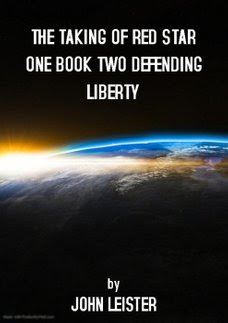
Allan: Do you see John Leister in any of your characters?
John: Yes, Clint Wagner. I was an insecure, eager-to-please comic-book nerd who was an attractive target for bullies. Lee Hacklyn is an idealized version of myself. Kind, good-natured, but a heck of a lot braver!

Allan: When you were a boy, did writing stories ever enter your mind? Did you read a lot back then?
John: Yes, I was an avid comic-book reader. Mostly Marvel and DC. I also read the Hardy Boys series. As I got older and more into novels, my favorite writers were Stephen King and Robert B. Parker. His Spenser series was a major influence in the creation of Lee Hacklyn.
Allan: What project(s) are you working on at present?
John: Lee Hacklyn 1970s Private Investigator in Life Row.
Lee has one day to prevent an innocent man from being executed by the state.
An Excerpt from 1975 Queens, New York City.
(Copyright is held by the author. Used with permission.)
CHAPTER ONE
Have you ever wanted something so badly, you would do just about anything to get it? When I was ten, I wanted to be a Tree-House Avenger. Now. What in the world is a Tree-House Avenger? Well, let’s start with the tree-house. Billy West’s dad was a carpenter. Mr. West built Billy the most amazing tree-house ever. Or so I’d heard. In order to actually enter the tree-house, you had to be a Tree-House Avenger.
Billy loved comic books. He had the world’s biggest collection, or so he claimed to anyone who would listen. My Mom and Dad wouldn’t allow me to have comics. I had three issues of the Unknown Detective stashed between my mattresses. I must have read each one about a hundred times. God, I loved comic books. There was a spinner rack at the 8-12 near my house in Queens. Every day after school, I’d go there and look at each title. One time, I tried to read an entire issue of the New York Knight, and Sam, the old man who managed the store, threw me out. “This is not a library,” he roared, scaring me half to death. The next time I went there, he pointed at me, then the door. I showed him my one-dollar bill, which was my weekly allowance, and he nodded. Curtly. Back then, comics were twenty-five cents a pop. Can you imagine? As much as I wanted to buy some, I was nervous enough about my Mom finding the ones I had. So I bought a root beer Pop-Fizz and a strawberry ice cream Mouth-Blaster.
Boy, was I ever addicted to sugar. At ten, I weighed around one-hundred and fifty pounds. Fat? You bet. Self-conscious about it? Leaning towards “yes.” Lousy at sports? Uh-huh. Shy, insecure, fearful? Check all the boxes. I was as stereotypical a comic book nerd as they come, and I don’t mean to play the world’s smallest violin, but I had no friends, none.
Once the tree-house was finished, Billy announced to all the other kids at school that he was starting a club called the Tree-House Avengers. He pointed at his best friends, Dave, Louie and Scott, who all nodded and beamed with pride.
We were in the school-yard, just before gym class, in our school t-shirts and shorts, waiting for Mr. Ryan, our gym teacher to warm us up for our weekly run. God, I hated running. I hated exercise of any kind, other than walking to the 8-12 to check out the new comics. On top of everything else, I had the biggest boobs of all the other kids, including the girls. Dan Brent, a jock and a bully, was forever grabbing my boobs and squeezing them. “Are you sure you’re a guy, Wagner?”
That’s my name. Clint Wagner.
Wally Whale would have been more fitting. Clint Coward? Frank Friendless? Carl Comic Book fan?
Anyway, back to that fateful day at the school-yard. Fateful for me, because suddenly my life had gained new meaning. I wanted to be a Tree-House Avenger. Boy, did I ever. More than anything.
Billy continued to talk as we all shivered in our gym wear. “Dave, Louie
Thank you, John, for being our guest this week. Wishing you continued success with your writing.

For all you wonderful visitors wanting to know more about John and his stories, please follow these links:
john leister: 69 Books available | chapters.indigo.ca
Google Indigo Books and search John Leister. You can view my works there.
June 26, 2021
Branching Out with Author Shane Wilson of North Carolina.

Shane Wilson is represented by Creative Edge of Saskatchewan and joining us this week as part of the Creative Edge series of artists/authors.
When you visit Shane’s website, you are greeted by the following: Shane Wilson: Realistic Fantasy with a Sharp Edge and a Big Heart.
The sentence certainly makes me curious.
A further note tells us, …as he writes stories – with an emphasis on the magic of human experience.
Shane has kindly agreed to a Branching Out Interview and is sharing an excerpt from The Smoke in His Eyes.
Let’s have a chat with Shane.
Allan: Thanks for joining us this week, Shane. Before we chat about writing stuff, please tell our readers a bit about yourself, especially what we might not find in your bio. Born in Alabama and raised in Georgia, you now reside in North Carolina. Sounds like a story right there.

Shane: I don’t know how much of a story there is to the moving around. My folks were born and raised in Alabama. They got together and after a lot of trying, they popped out a little Shane Wilson. Sometime around my second or third birthday, my dad got a job at a papermill in Georgia, and we set sail for those greener pastures. I bounced around the state a bit for college and work before falling in love with a woman and moving to North Carolina. That particularrelationship didn’t quite pan out, but I’m still thankful for all of it. North Carolina really feels like home now.
Allan: To quote a line from your website, which I mentioned above - with an emphasis on the magic of human experience. Perhaps you could expound on this.

Shane: I believe that the act of being human is a truly magical act. I mean, none of it makes any sense, and people have been trying to MAKE it make sense as long as they had the cognitive ability for reason. They invented stories and myths and gods forever all in the name of making sense of the chaos of life—love, loss, death, birth. It all feels like magic because at the root of it all, there is no explicit rhyme or reason to any of it. Artists are the people who make it their lives’ work to find the rhyme or the reason. Artists attempt to demystify in their explorations of the human condition. This curiosity that arises out of the magic—or chaos—of human experience is, at least, what drives my work.
Allan: Your debut novel – A Year Since the Rain – has garnished lots of great reviews. Tell our readers what to expect when they pick up their copy.

Shane: A Year Since the Rain is a story about dealing with unexpected loss. The protagonist, Alan, unexpectedly loses his father. He projects this grief onto the people around him and he isolates himself from the people who care for him. He’s stubborn, though, and refuses to deal with his grief. Meanwhile, a sinkhole has opened up and threatens to swallow his entire town. This narrative device forces Alan’s hand, right? He either has to move forward or be swallowed up—by his grief, in a figurative sense, or by the literal ground.
Allan: Please share a childhood memory or anecdote.
Shane: Because I’m starting to work on my first horror project, I’ve been thinking a lot about times when I experienced genuine fear. I keep coming back to this moment when I was a very young kid—maybe in first or second grade. I was pushing my bike up the big hill near my parents’ place and this big dog started barking. The people who owned this dog had an unkempt yard, and it was hard to even see the dog most of the time, but on this day, the dog came out of the brush and stood between me and home. He just snarled and barked.

I threw my bike in the ditch and cut through the neighbors’ yard to get home. I was terrified. I even wrote a story about it for school. I’ve also been wondering if Stephen King went through something similar. Maybe that’s where Cujo came from?
Allan: Again, back to your website, where we discover your second novel – The Smoke in his Eyes. Tell us about the story, but first, is this part of a series?

Shane: The Smoke in His Eyes is not a part of a traditional series. Instead, I’ve set these novels in the same shared universe governed by a shared mythology. This series is called the World of Muses, and so far, it is home to the two novels, A Year Since the Rain and The Smoke in His Eyes as well as a stage play called The Boy Who Kissed the Rain.
As for The Smoke in His Eyes—this is a story about art and creativity. The main character here, TJ, is a guitarist who is plagued by overwhelming visions as a result of trauma from his childhood. He meets a woman, a visual artist named Muna, who helps him find the song in those visions—essentially teaching him how to create art from trauma. The novel explores the different reasons why people choose to create and share their art.
Allan: Your short story – The Boy Who Kissed the Rain – won the 2017 Rilla Askew Short Fiction Prize. Congratulations Shane. It’s a wonderful feeling to be recognized for your writing. Tell us a bit about the story and how it feels to be an award-winning author.

Shane: Awards are kind of cool, I guess. It’s always nice to think that someone believes that your work is worth celebrating. “The Boy Who Kissed the Rain” is a short story that operates as a sort of spiritual prequel to A Year Since the Rain. It’s set in the same town, but several generations earlier. It’s a sentimental and romantic story. It’s easily the most saccharine thing I’ve ever written, but I think it’s a beautiful take on a classic Romeo and Juliet/ forbidden love kind of story. I also adapted this story into a full-length/ two-act stage play.
Allan: Favorite authors? Novels?
Shane: I always point to Salman Rushdie as a big influence. I read a ton of his work in college and wrote my Master’s thesis about his novels, Fury and Midnight’s Children. I think reading Rushdie is a major reason why I write in contemporary fantasy, which is a cousin to magical realism. My favorite novel of the last little bit has been Station Eleven by Emily St. John Mandel.
Allan: Do you still teach or write fulltime?
Shane: I do still teach. I teach composition, literature, and creative writing full-time at a community college here in North Carolina. I love teaching. I can’t imagine a life where I’m not in the classroom at least some of the time.

Allan: You are also a musician and songwriter with a two-person band called Sequoia Rising. What can you tell us about this?
Shane: Sequoia Rising really only exists because of The Smoke in His Eyes. I taught myself guitar while I was writing that novel because I wanted the story to feel legitimate, and I thought that having experience with the instrument that the protagonist played would help me add that extra texture to the narrative. I learned a few songs off the radio, and I was hooked on the act of making music. I got together with a friend who plays percussion, and we started playing shows and writing music. Think: story songs in the vein of Springsteen and Jason Isbell. We just released our first record of acoustic narrative-driven songs. The album is called Of All the Things I’ve Ever Said, I Mean This the Most, and it’s streaming anywhere music streams.
Allan: Anything else you’d like to tell us about?
Shane: Honestly, I just hope people check out the stories and the music and find something they can enjoy. I’m all over the social medias at @ThatShaneWilson. Follow me and stay tuned for my next novel, which is due out in Spring 2022.
An Excerpt from The Smoke in His Eyes.
(Copyright is held by the author. Used with permission.)
Munira was removing her winter clothes and hanging them up in a closet by the front door. “I did.” He looked toward her. She was in a tank and jeans, and he noticed how far the tattoos ran up her arms for the first time. She always had on long sleeves when he saw her, but here, with the skin of her arms exposed, he could see the intricate lines and images that populated her flesh. He turned back to the painting. There were figures there, but they were hard to make out. It was abstract, but the colors were bright.
“Do you like it?” she asked.
“I think so,” he said.
“That's an interesting answer.”
“I'm not very good at art,” he said. “I don't get abstract stuff.”
“That's no big deal. Here,” she took his hand and lead him to the sofa. “Let me show you something.” She pulled out a sketchpad and handed it to him. “Flip through that.”
Inside, the sketch pad was filled with pages and pages of drawings that were of clear and specific things—not abstractions. There were dragons and other fantastic characters. There were portraits. There were landscapes. “Some people hate abstract art,” she said, “because they think that people make abstract art when they can't make other more traditional types of art. They are wrong, usually, but whatever.”
“These are really good,” he said, still flipping through the book.
“Isn't that interesting,” she said, “that you look at these drawings and you know they are good, but when you look at the abstract pieces, you don't 'get' art? What makes these good?“ she indicated the book of drawings. “The fact that they look like something that you've seen before?” She paused and took his face in her hands, moving his gaze to the large painting against the wall. “What makes that bad? Because it doesn't look like anything?”
“I didn't say—”
“Shhh. I know. But maybe abstract art is about something else—maybe it's not about looking like it's supposed to look. Maybe it's about looking like it's supposed to feel. You make music. You should be able to appreciate that there are other ways to experience the world—other than with your sight. But if we could see some of the things that we can just feel. What would that be like? What if you could see your music instead of just feel it or hear it. That's abstract. And it's beautiful.” Her face was very close to his, and her hands had dropped from his face and fallen onto his leg. “And your music is beautiful,” she said.
He didn't know what to say.
She started again. “Earlier tonight, when Gill came up, you were saying something about your music. You seem to be frustrated or angry or hurting—your vibe is all messed up.” She moved to the kitchen and poured him a whiskey over ice. “You do drink this straight when you’re not hiding it at the bar, right?” He nodded. She poured herself a double shot of vodka and a gin and tonic. She was playing some version of catch-up, but she couldn’t catch up with TJ—not on that night. “Talk to me about your art.”
“I don’t know, Munira—”
She interrupted him again, “Please, TJ—call me Muna. Everyone in my life that I’m closest to calls me Muna. I want you to be one of them.” She looked long into his eyes, and he could feel his heart pounding in his ears. She made him nervous, but a lot of women did. Now—you were telling me about how you didn’t know about your art.” She smiled and leaned back into the corner of the sofa against the arm and drank her gin and tonic.
“I can’t write.” This confession snuck out of his mouth. He was used to hearing the words bounce around in his head whenever he was trying to write, but he wasn’t accustomed to hearing them out loud.
“What do you mean?”
“I sit down with paper and pen and guitar, and I try to write every day, but everything that comes out is shit. It’s worse than what I played tonight.” And he explained the way he used to write, and he told her about Lila’s directions and how she pushed him in a positive way, but it ended up making him doubt his abilities. “I know I have enough talent, and I know that I know enough to write good music, but I don’t know how to unlock it—I don’t know how to put it together in a way that sounds natural. I don’t want people to feel like they are listening to a song. I want them to experience the song.” He could have thanked Lila for this evolution in his craft, but he wasn’t thinking about it in those terms quite yet.
“Exactly,” she said. He had clearly said something by accident, and she must have read the expression on his face. “You need to get out of your head,” she started. “Think about what you said—‘I know, know, know.’ When you sit down and try to write, you’re thinking about what makes a good song—just like you did with the sketches in that book. A song is only good if it sounds like something you’ve heard before. But you know better than that. You want your audience to experiencethe song—you have to get out of your own way. You need to find something to write about instead of finding something to write.”
“You’re right.” What she was saying made sense to him. She was so passionate when she discussed art, and he was drawn to her. Her brown eyes got big, her voice got louder, and she leaned forward, gesturing with her hands, and touching his leg. She finished her drink and put the glass on the floor. She looked at him. He wanted to kiss her, but he remembered being rejected by Lila all those weeks earlier.
“Of course, I’m right,” she said.
“I think I want to kiss you,” he said.
“Then you should,” she said, moving her face even closer to his. His hand moved to cover hers, and as he tightened his fingers around the flesh of her hand, he leaned in toward her face to feel the skin of her lips brush against the skin of his—just for a moment—before he fell into the kiss—his eyes closed and mouth open. He moved his hands over her little body and found all the creases of her that he could find through the fabric of her clothes. And she kissed him back and pushed her body against his and worked to find his creases as well.

Thank you for being our guest, Shane. Wishing you continued success with your writing.
And thanks to all you fantastic visitors and if you want to discover more about Shane and his writing, please follow these links:
http://www.shanewilsonauthor.com
http://www.facebook.com/thatshanewilson