Allan Hudson's Blog, page 20
March 19, 2022
The Story Behind the Story with Award winning Author Patrick Parker of Texas, USA.

Meet Patrick Parker.
All the way from Texas.
I’ve been following Pat on Twitter for some time. His novels have garnered numerous 4 and 5 star reviews. They’ve won awards.
Here’s a note from his website:
“My goal is to entertain you. I want you to be thrilled and on the edge of your seat all the time, wondering what is going to happen next.”
I’m happy to tell you I have a copy of the book Pat is telling us about this week. I’m anxious to dig in.
Patrick has agreed to share the Story Behind the Story with us.
Hi Allan! Thank you for the opportunity to be a guest on the Scribbler.
Patrick Parker received his bachelor’s degree in management and his master’s degree in international relations. He joined the US Army and spent five years in Italy and one in Germany. After retiring from the military, Parker spent an additional fifteen years in the defense industry. Now retired again, Parker enjoys writing, going to the range, and astronomy. He lives in Texas.
Parker is the author of Six Minutes Early, War Merchant, and Treasures of the Fourth Reich. All are available through Amazon.com (http://amzn.to/1izsnBH).
Title: Treasures of the Fourth Reich
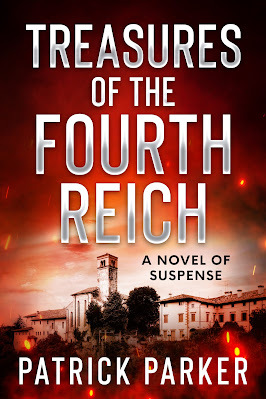
Synopsis: Treasures of the Fourth Reich is based on actual events.
The story begins in September 1944 in the Alps where SS Major Fabian is planning to abscond with a large portion of loot the Nazis planned to use to fund the Fourth Reich. As the officer in charge of security for the mine in which some of the art works are stored, he has an excellent opportunity for some sleight-of-hand that will keep him in riches for decades. The art disappears, a body is found and identified as Fabian’s, and no one is the wiser.
In 1993 Maria Connor, an art expert from Panama and her husband, retired Lieutenant Colonel Dix Connor, are quietly pursuing their careers in Italy when Maria becomes fascinated with the tales of lost Nazi plunder. Maria stumbles across several valuable art pieces she believes were lost during the war. She begins a clandestine and unofficial investigation when she is shown a panel from the Amber Room which was originally in the Summer Palace of Peter the Great and stolen by the Germans when they invaded Russia during the war.
Maria’s sleuthing leads to Fabian’s journal which documents everything he stole from the Nazis—a staggering fortune of art treasures—and the locations spread around the Tirol. During her investigation, Maria gets kidnapped in order to protect the stolen art from discovery. Dix then enlists the help of friends with military intelligence connections to help find Maria. They learn that OSS Officer Robert Hamilton, responsible for the official repatriation and restitution of the Nazi loot stored away in the Bavarian salt mines, took advantage of his unique situation and formed a secret organization with a German farmer. Pegasus, as their organization was called, possessed the only record of Fabian’s fortune.

Dix and his friend exchange the journal for Maria, then flee for their lives. Along the way they learn that certain secret files from the end of the war, thought destroyed, were going to be turned over to the G-7 during a meeting in Munich. These files would expose Pegasus and Hamilton as the leader. During the meeting, Pegasus planned to assassinate the Russian President and destroy the files. Pegasus kills those that get in the way or are no longer of use to the organization. Dix and Maria became an obstacle to Pegasus and must be eliminated.
Armed with the only evidence against Hamilton, narrowly escaping his last trap, they race against the clock to the Munich meeting of the G-7 to stop an assassination, avoid arrest by the authorities, death by Pegasus, and bring down the deadly organization trafficking in stolen treasures.
The Story Behind the Story: When I was in the Army I lived and traveled in Europe for six years and was intrigued with European history. I toured and visited museums, churches and castles in Italy, Germany, Hungary, Switzerland and Austria. Some were used by the Nazis to store loot, while others concealed hiding places for the treasures. I read a lot of history about the Nazi pillage. After reading one story about the Nazi stashes in the Bavarian salt mines, it occurred to me how it could have played out. So, I took a “what if” approach to history and wrote the story.
Website: http://bit.ly/1ZEoYGu

A question before you go, Pat.
What have been the most enjoyable and the least enjoyable about publishing?
I think the most enjoyable aspects of writing and publishing is when you receive a review stating how much the reader enjoyed the story. Often, I am asked, “What parts are real and what parts are fiction?” I always try to makes it realistic and leave the reader asking that question.
I think the least enjoyable is that it takes a long time, and writing is a solitary venture.
My other books:
War Merchant
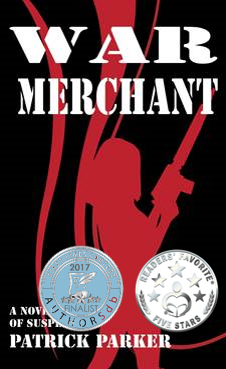
In a world of espionage, deception, betrayal, terrorism, and murder, Dydre uses the next assignment Zsigmond gives her—the deliverance of new technology to terrorists—to escape his merciless grip.
Dydre, a single mother, is caught up in a world she doesn’t want. Her boss Clayborne Zsigmond—a black market arms dealer—uses her six-year-old son as a pawn to keep her in line. Visitation is a reward for her obedient behavior.
Forced to deal with the worst terrorists and dictators around the world, she uses disguises and a deadly poison to give her an edge in dealing with those that want to kill her. To stay alive, she has honed her skills that few could defeat.
When an opportunity occurs to break free from Zsigmond, she moves fast but the risks she takes puts her on the firing line when her plan goes deadly wrong, and success looks bleak. Those she thought she could trust betray her. Not only is her life in jeopardy but also her son's as she finds herself pitted against Zsigmond, his mercenaries, a double-crossing businessman, terrorists, the FBI, and a man from the Department of Defense.
Six Minutes Early
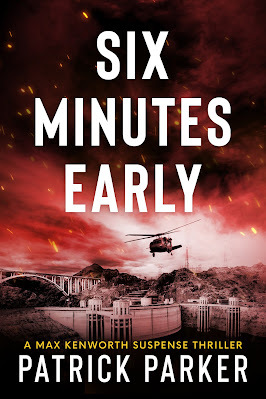
Former Delta Force commander Max Kenworth is comfortable living life far from the front lines. But when terrorists raid a classified installation containing formidable portable devices, Kenworth returns to the fray to hunt down the dangerously equipped enemy. And with a disgraced Special Forces officer leading the attack, Kenworth fears the U.S. is doomed to face mass destruction.
Bombarded by bureaucratic incompetence, political corruption, and holes in national security, Kenworth struggles to locate the operatives and their plundered nukes. But as the elusive traitor reaches American soil, Kenworth must work fast to protect millions of innocent lives from radioactive devastation.
Can Kenworth outsmart the merciless rebels and prevent a nation-wide catastrophe?
Broken Arrow: Acts of Treason (anticipated release is Spring 2022)
"Broken Arrow" is the code word used by the military and NATO to describe a lost or stolen nuclear weapon.
During the attempted coup d’état in Turkey in 2016, former Green Beret, turned traitor, teams with terrorists and steals six nuclear weapons from the US Air Base in Incirlik, Turkey.
Max Kenworth and his team chase the terrorists across the Middle East and South America, capturing four of the nukes. One disappears somewhere in the Middle East and the other one is discovered in Manhattan, NY.
The traitor sets a trap for Max and takes him prisoner. Does Max get free and disarm the nuke or does he meet his fate along with Manhattan? No spoilers here. I hope you will preorder a copy of this thriller when the release is announced.
Thank you again, Allan, for having me as a guest on the Scribbler!

It’s my pleasure to have you as a guest, Patrick. Thank you for taking the time to tell our visitors about Treasures of the Fourth Reich. I wish you continued success with your novels.
Thank you dear readers & visitors. Don't forget to leave a comment.


March 12, 2022
The Story Behind the Story with Author Suzanne Casey of Moncton, New Brunswick.

Fun Times!
The Scribbler is happy to welcome back Author Suzanne Casey. With novel #2 published, her stories are receiving great reviews and lots of notice. She is going to share the Story Behind the Story with her latest work.
I had the pleasure to read Suzanne’s novel. Read my review HERE.
She has been a guest on the Scribbler before and it you missed her interview, please go HERE.
Tell us about yourself, Suzanne.
Writing has been in my blood since childhood. My father secretly restocked his office supplies on a regular basis to feed my art. My stories matured with age. I had more to tell, but had less time to write once I became a mother. But life events and experiences tucked themselves away in my head so that one day they might end up on paper.
The passing of my parents made me realize that life was fleeting. I had to chase my dream of writing a novel. Having it published was beyond my expectations. And now, I have two!
Being outdoors and spending time with loved ones fuels me, but so does sitting in front of a blank piece of paper creating new characters or stories. Yes, I write (and draw) on paper, first. Ideas come out too fast for me to type them up.
Working Title: The Quilting Bee (and the kaleidoscope of men who loved her)
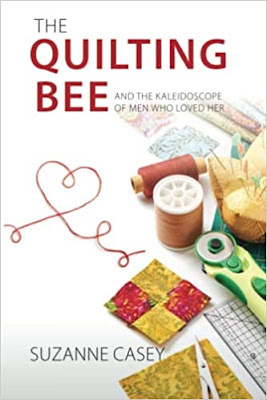
Synopsis:
Cathy West felt unwanted as a child. To soothe her loneliness, she sought the friendship of others, some of which weren't always positive. The inability to love herself became her downfall, making rash decisions to please others. However, two trustworthy people never let her down.
Aunt Mary showed her love, kindness, friendship, and the art of quilting. This craft will make Cathy prosperous. It will also give her peace.
The other person, she will suffer decades of heartache before she realizes his role in her life.
The Story Behind The Story:
Life experiences bring me snippets of a story. A scene, a sentence, a character. My mother was a talented quilter, giving her blankets as wedding gifts or for our own use. Occasionally, she'd pass me a needle to join her. I wanted to honour her art as a background to this story.
I always start my stories by developing the protagonist's emotional side. I know my characters' souls before their looks. At around Page 50 of my first draft, I realized she was one of the minor characters from my first novel Danny And MJ. I reread that book, and ended up having to change her name and hair colour in this manuscript. I suppose the two books could be considered a series.

And like it or not, we writers dig into ourselves to create. Experiences, places we've been, etc. It's why I've used my hometown as background, although with a fictitious name. I also used some of my own personal experiences, wanting to make the story more relatable to my readers. But be assured, The Quilting Bee is not autobiographical.

A question for you, Suzanne, before you go.
What have been the most enjoyable and the least enjoyable about publishing?
The most enjoyable part about publishing is discovering and befriending fellow authors. The source of information we carry and share with one another is indispensable. I cherish every single one.
And in fear of sounding vain, I'm in awe of my fan base. They fire me up, feed my soul, and are always asking for more. I'm happy to oblige.

The least enjoyable...Editing. Researching. Writing a book is like painting a room. It's lovely to choose a colour and see the end results. But you can't just slap paint on a wall and call it done. There's preparations to be done. The same with writing. We authors are perfectionists to a fault. Researching and editing never ends. We just have to call it done, at one point.
Thank you Allan for the exposure. Greatly appreciated.
The pleasure is all mine, Suzanne. Happy to have you as a guest and I wish you continued success in your writing journey.

Thank you for visiting the Scribbler. Don’t forget to leave a comment.
March 5, 2022
The Story Behind the Story with award-winning Author Christiane Banks of Milton, ON.

The Scribbler would like to thank Sharon Beddoes for introducing us to this week’s guest. It is a pleasure to have Christiane with us. When you pop over to her website, you will be greeted by the following:
Striving for excellence one word at a time.
Sounds like a winning formula to me.
Let’s meet Christiane
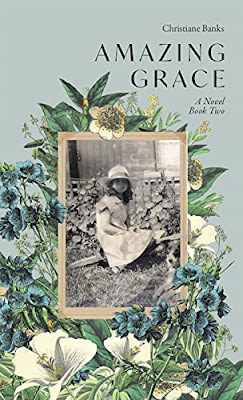
Christiane Banks, author of the award-winning historical family saga, Amelia’s Prayer, is delighted to return with the sequel Amazing Grace. Christiane was born in England around the Magnificent rugged Northeast coastline near the City of Newcastle upon Tyne. Raised after World War II, she began working at 13 years old as an apprentice shampoo girl. At this job, she was privileged to meet many women who lived during the world wars and was inspired by the vivid stories of those periods.
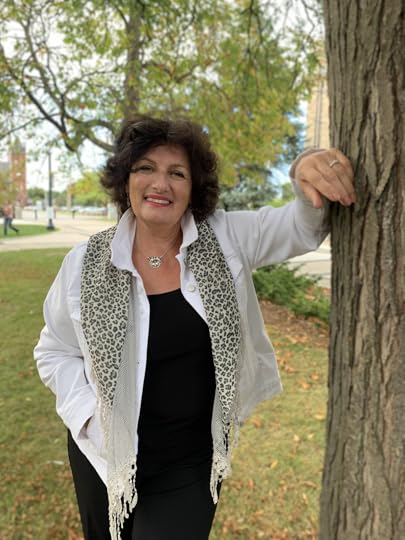
Banks, a Storyteller herself, was inspired by these accounts, which lead her to become an author and ultimately become part of the stories of Amelia’s Prayer and Amazing Grace. She would like to take this opportunity to thank all her family friends and readers who have been a constant source of support and encouragement through the years as she wrote both Amelia’s Prayer and Amazing Grace, bringing them to fruition. Christiane lives in Milton, Ontario, with her husband Gary she has starts book three, which will be a prequel to Amelia’s Prayer and Amazing Grace.
Working Title: Amelia’s Prayer
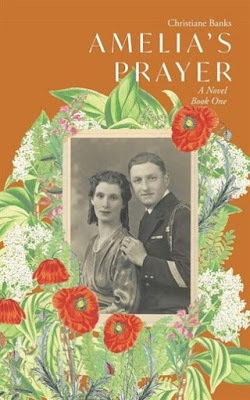
Synopsis:
Sebastian Lavalle is just fifteen when he leaves home in 1934 to join the Navy. Seven years later, Sebastian, unfortunately, knows all too well about the horrors of World War II and what it is like to fear the unknown. When repairs force his ship to the rugged shore of Newcastle, the young French naval officer is invited to a tea dance. He seizes the opportunity hoping to find comfort and a small taste of home.
Amelia Sullivan, the daughter of Irish immigrant parents, is thrilled to be attending the tea dance. When Sebastian’s eyes find her in the crowd, he drinks in her exotic beauty. Moments later, as he draws her into his arms for a dance, there is no doubt in his mind that he has just met the woman of his dreams. Days later, Sebastian professes his love and marries her, sending them both on an unforgettable journey through betrayal, survival, and forgiveness. Their soul searching journey not only will take the reader from England’s coast to the French Riviera, but also Tennessee. Their journey explores the many facets and depths of love leading to the realization of what true happiness means.
The Story Behind the Story:
What inspired me to write Amelia’s Prayer is really quite difficult to pinpoint. Storytelling has always been a part of me—like the colour of my eyes or hair, part of my DNA. I cannot remember a time when I did not tell stories! As a child I was nicknamed chatterbox, I would wander out of the house, up the street, knocking on people’s doors asking if they would come out to play. We could sit on the wall and tell stories. It was not unusual for strangers to bring me home!
Most of my life I have thought about creating stories, poems, and sometimes plays – not always capable of executing the ideas that were formed within my mind for various reasons; however, I was always able to tell the story. Amelia’s Prayer is a true work of love and passion. I have been fortunate enough to meet some amazing human beings throughout my lifetime, either through life’s journey, my work, or within my own family, extended family, and friends. I have had the privilege and the honour to listen to many voices, both young and old and wise over the years, often triggering myriad of ideas through my mind in various different forms, family members and my husband encouraging me to write a book.
Several years ago I was fortunate enough to be introduced to an author by the name of Joyce Holmes, who writes detective stories. I told Joyce of my interest in writing a book, and how I felt rather inexperienced. Joyce inspired me and helped me to understand that I was more than capable. We spent a lovely lazy afternoon on the balcony of her beautiful home in the mountains in Provence. I shall always be grateful to Joyce for validating my abilities. That afternoon she sent me away, waving goodbye and believing that I could indeed write a novel. As she waved to me her message was, “I shall see you at the book launch!”
Simplicity is the essence to a reader connecting to a story something we can all reach out to and identify with Amelia’s Prayer is a compilation of all of that life, love, family, betrayal, forgiveness, and ultimately unconditional love!
Please visit Christiane at: https://christianebanks.com
A question for you, Christiane, before you go.
What’s your favorite and least favorite part of publishing?
Christiane:
My favourite part of publishing is the journey of walking the books into the marketplace, and meeting people at book events, book clubs, and other fundraising events. I am inspired at every event by the terrific people I meet, both young and old. They all motivate me to keep growing, improving, and developing as an author.

My least favourite part is the administrative side which includes, social media and working with the publishing company. The parts that have nothing to do with writing and gobble up a tremendous amount of my creative time.
Thank you for being our guest this week, Christiane. Wishing you continued success on your writing journey.

And thank you to all you visitors and readers. Don’t forget to leave a comment.
February 26, 2022
The Story Behind the Story with Novelist Catherine Meyrick of Australia.
Catherine is no stranger to the Scribbler. Let’s welcome her back!
She writes historical fiction and she does it well. Her writing has won awards and the 4 & 5 star reviews are numerous.
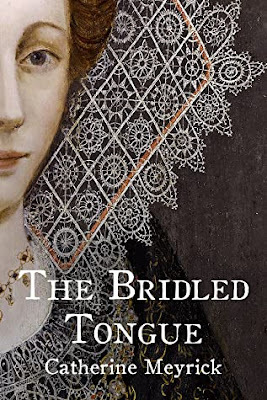
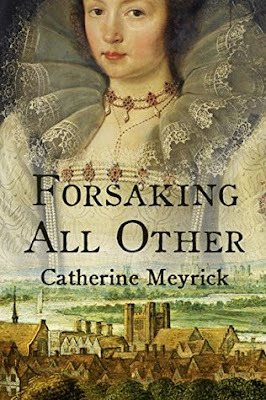
I’ve had the pleasure of reading her novels – The Bridled Tongue & Forsaking All Other. Terrific stories. Read my review HERE.
She has been a guest previously with an interview on the Scribbler and you can read it HERE.
This week Catherine shares what’s next in her writing journey.
Catherine Meyrick is an Australian writer of romantic historical fiction. She grew up in Ballarat, a regional city steeped in history, but has lived all her adult life in Melbourne. Until recently she worked as a customer service librarian at her local library. She has a Master of Arts in history and is an obsessive genealogist.
Title: Cold Blows the Wind
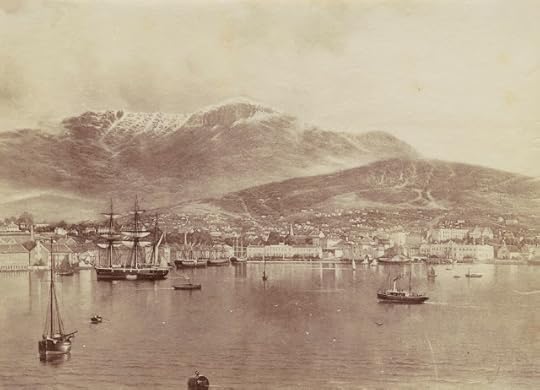 'Hobart by the Bay' by JW Beattie courtesy of the State Library of Victoria.
Synopsis:
Hobart Town 1878 – a vibrant town drawing people from every corner of the earth where, with confidence and a flair for storytelling, a person can be whoever he or she wants. Almost.
Ellen Thompson is young, vivacious and unmarried, with a six-month-old baby. Despite her fierce attachment to her family, boisterous and unashamed of their convict origins, Ellen dreams of marriage and disappearing into the ranks of the respectable. Then she meets Harry Woods.
Harry, newly arrived in Hobart from Western Australia, has come to help his aging father, ‘the Old Man of the Mountain’ who for more than twenty years has guided climbers on Mt Wellington. Harry sees in Ellen a chance to remake his life.
But, in Hobart Town, the past is never far away. When it reaches out, Ellen faces everything in life a woman fears most.
Based on a period in the lives of the author’s great-great-grandparents, Sarah Ellen Thompson and Henry Watkins Woods, Cold Blows the Wind is not a romance but it is a story of love – a mother’s love for her children, a woman’s love for her family and, those most troublesome loves of all, for the men in her life. It is a story of the enduring strength of the human spirit.
The Story Behind the Story:
Cold Blows the Wind grew out of my genealogical research. Both my parents were interested in their family histories and began researching in the 1960s. Mum’s work was painstaking and meticulous, Dad had not quite the same level of perseverance. When I inherited his papers, I discovered that he wasn’t particularly interested in the female lines. Even with someone as recent as his maternal grandmother, Elizabeth Woods, he had names for her parents but with question marks beside them. So I decided I needed to start from scratch and work my way back from Dad, as any good genealogist should. In Dad’s defence, I should say that genealogy was much more difficult then, in the days before the internet and digitization. And a holiday in Ireland or the United Kingdom to do a bit of digging in archives was not something that a working man with a young family could even dream of.
Family research is never finished—there is always more to discover but as it now stands, I have traced all but one of my great-great grandparents, and seven great-great-greats, back to where they came from in Ireland and Britain. In my father’s case, I have discovered seven convict ancestors transported to New South Wales and Van Diemen’s Land. In the process, I have uncovered stories which even as recently as twenty years ago were lost to memory.
Which brings us back to Elizabeth Woods. As well as her parents, I discovered her grandparents who were absolute characters themselves – Henry Woods whose thieving spree, at eighteen, along the streets of Cheltenham, collecting up everything from three shillings and sixpence in copper to six pounds of bacon, two flutes and a spade, brought him to New South Wales in 1822 and, later, on to Van Diemen’s Land via Swan River; William Thompson a man with a great sense of humour, transported at twenty-one from Stoke upon Trent and interviewed about his convict experiences in 1899, who regarded nearly everything that had happened to him as a ‘fair cop’; and William’s wife, Elizabeth Miller from around the border between England and Scotland, who even in her sixties was appearing in court charged with obscene language and being drunk and disorderly. I knew the whats and wheres of the lives of Elizabeth’s parents, Harry Woods the younger and Ellen Thompson, but I did not truly know the whys. Cold Blows the Wind is my attempt to make some sense of what happened.
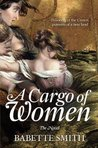
Some years ago, I read A Cargo of Women: The Novel, a tight and gripping novel by Babette Smith, based on the life of her great-great grandmother Suzanna Watson who was transported to New South Wales in 1829 having stolen to feed her children. From early in my genealogical research, I wanted to write something about one of my female forebears and felt that the story of Ellen and Harry lent itself to fiction having definite a narrative arc. I cannot say much about what happened because it would give too much away but my novel sets out possible motivations and reasons for the tumults in their lives. At least 80% of what happens in the novel is based on documented events but the reasons for what happened are my speculation. Where there are gaps, I have had to fill them in, provide lives for people who disappeared, imagine how Harry and Ellen felt and expressed themselves, what their hopes were. The people of my novel do not always have use for the middle-class morality we now see as ‘Victorian’ and sometimes they speak in the language of the streets, some of it uncovered through court records and most of which would not make an average Australian today blush.
Cold Blows the Wind is probably the hardest thing I have ever written, possibly will ever write. I was always deeply aware that I was writing about real people and that I needed to do them justice, not treat them as literary pawns to be moved around on the page. The research into the conditions of those at the bottom of society was heartbreaking—the poor living conditions, low pay, precariousness of life where illness or an accident could tip a family into poverty, the censoriousness and judgement of those who had never known want, the cruelty of those without conscience. But the novel is not just about what was done to these people, it is about how they rose above it. They may not have ended their lives with grand houses, vast estates or money in the bank, but they left behind families, the most enduring of all legacies.
The novel only covers a period of seven years but they were tumultuous years for Ellen Thompson. Between the ages of nineteen and twenty-six she faced every single thing, short of her own death, that women fear most in life. Hers is the story of the resilience of the human spirit, the story of so many ordinary women of the past. I hope I have done her justice.
Cold Blows the Wind will be released at the end of April 2022.
Website: www.catherinemyerick.com
A question before you go, Catherine.
What inspires you to write historical fiction and how rewarding has the journey been?
Catherine: I came from a family where the past was very much alive. As well as their family histories, my parents were interested in history in general and they were both great readers. My father read historical fiction and my mother historical biographies so when I was old enough to start raiding their bookshelves most of the reading matter there was historical. As we got older Mum shared interesting snippets from the books she was reading. And everyone told stories, particularly in the evenings in the years before we got a television, or when we went on holidays to Mum’s parents. To a child or someone in their early teens all stories are historical whether they take place a hundred years before their birth or merely ten. We heard stories about their lives, other family members and their travels, tales about smoking bark rolled in newspaper down by the New Town Rivulet and only being caught out later because you had singed your eyelashes (Dad), or of being taken for a joyride in a small plane and seeing Bass Straight above your head at night (Mum), or of losing your father’s best bridle when you tried to use it to take a ride on the back of an old man koala (Grandfather)*. We saw all these as historical, set in another time and place and far more interesting than our ordinary lives plodding off to school, the high point of the week the First Aid classes where we got to cover very interesting plastic wounds with gauze and bandages. Even items around our house—vases, photographs, items of jewellery, the box the linen was stored in—had histories. History was fascinating.
Other than the short stories I wrote when I was first starting out, it seemed natural to write stories set in the past. And I am much more interested in the lives of ordinary people than the big names. While the big names had the money and influence, it is the ordinary people who made their visions possible. The canals and later the railways would never have been possible without the thousands upon thousands of navvies who worked constructing them.
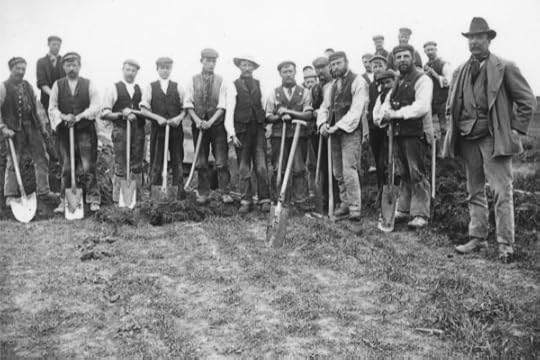
Ordinary people working together can bring about change, though it may be slow and difficult, such as the halting steps over many many years that brought us universal suffrage. The lives of ordinary people are every bit as interesting and inspiring as those of despotic old kings’ wives. One thing we have learnt over the last couple of years is how much we depend for our general well-being on people working in not particularly well-paid and often unregarded jobs such as supermarket cashiers, shelf-stackers and delivery workers. The stories of the ordinary people who came before us are worth telling. And I want to give a sense of what their lives were like, the struggles and the limitations. Apart from a good story, I want the past to come alive for those who read my novels and for them to see that those who came before us were real people. While they may have held some attitudes that we now find objectionable, at their core they were just like we are today. They wanted shelter and warmth, freedom from illness and want, love and security, a space to hope and dream, and a better future for their children.
There is satisfaction in seeing a project to its end, holding in your hands a printed copy with a beautiful cover of the story you have worked on for several years. Although the final product has never achieved my initial vision for the story, I suppose if I were to achieve something that I thought was perfect, I would be too terrified to write anything else.
The greatest satisfaction of all is knowing that ordinary readers have enjoyed my stories. One of the first comments on The Bridled Tongue, under the heading ’A wonderful book’ was ‘I usually skip through portions of a book when I read but read every page of this one!’ What more could an author ask for?
*The follow up to this story: My great-grandfather came home from work the same evening, puzzled and rather pleased with himself. He had managed to get a bridle off a large koala. It was in good condition so he said it would do as a second-best bridle. But, come Sunday, when he went to saddle the horse for the trip to church, he found his best bridle was missing. The truth came out and the story ended as so many of my grandfather’s stories did, ‘And I ended up with a tanned backside.’
Thank you for being our guest this week, Catherine. Wishing you continued success with your stories.
Thank you to all the wonderful readers and visitors. Please share your thoughts with us and leave a comment below.
February 19, 2022
The Story Behind the Story with novelist Anne Smith-Nochasak of Nova Scotia, Canada.
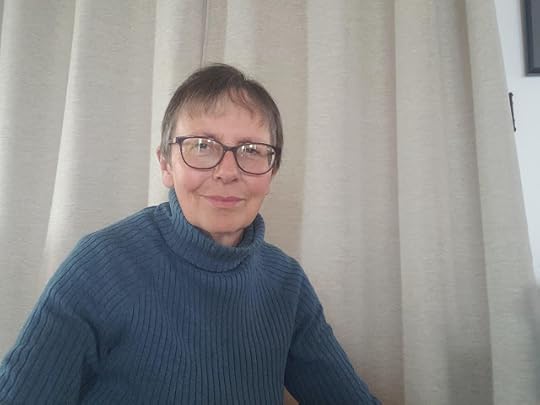
I had the opportunity to read the review of Anne’s novel – A Canoer of Shorelines - on The Miramichi Reader. See it HERE. The title alone piqued my interest and I decided to follow Anne on Twitter, hoping to discover more about her and her writing.
I’ve since invited her to share the Story Behind the Story and she has graciously accepted.
Let’s meet Anne.
I grew up in rural Nova Scotia and did many things before turning to teaching. For most of my teaching years, I worked in northern and Indigenous communities, places of joy and learning for me. I now live full-time in Nova Scotia. A Canoer of Shorelines is my first novel, written summers at my shoreline retreat and revised winters over several years. My WIP is a fictional story of incompatible youthful love that is recreated in maturity, in the North and elsewhere.
Title: A Canoer of Shorelines
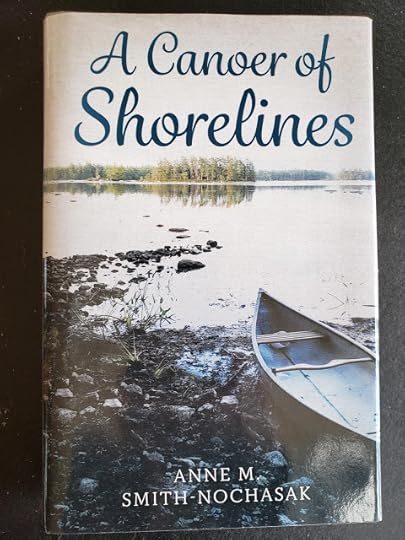
Synopsis:
How will you know when you have arrived if your life keeps going in so many directions?A Canoer of Shorelines weaves together the stories of Julie Martin and Rachel Hardy, who both have a childhood attachment to Meadowbrook Acres and try to reinvent their lives there as adults. When Rachel fails to recreate her home and come to terms with her family there, she flees to her cabin to make sense of her life through her journal. Julie in the present narrative has dreams for her cherished landmark but learns that more than paint and mowing will be required. Dreams come to dominate Julie's time at Meadowbrook Acres; she is touched by her landlord’s past and begins to dream a sweet and sentimental world for him. The dreams darken, though, and overlap at times with the stories and thoughts of Rachel. The house itself is not the dream home they sought; it becomes instead a “dream house” swollen with stories that haunt them both. These stories take on new meanings as they stumble to find their place in the world.
Both struggle with family relationships: There are moments of light and of darkness in Rachel’s journal as she journeys through the world of her mother, Rose. For Julie, her own quest is linked to her parents’ struggle for self-realization. For both, there is the guiding wisdom of Laila.

The pivotal experiences take place at the old farm, but along the shoreline the key lessons are learned. To be a “canoer of shorelines” one does not need skill or gear or even paddles; one needs only an appreciation of the beauty of the moment.
The Story Behind the Story:
I grew up in a creaking old farmhouse where unexplained sounds and lights were part of the character of the house. My mother lived there alone in her senior years while her health gradually declined. Brooding over my past one summer afternoon, I decided that this could be a thriller: a solitary protagonist struggling for survival in a haunted farmhouse…... However, as I began to write, the characters would not allow this. Through them, I came to realize that this was a story of forgiveness, love, and acceptance. Through them, I came to understand my own roots better, and to learn that I, too, had a place in the world, there among those who “hold you in their hearts whether they understand you or not.” The characters are fictional, but they are inspired by flashes of memory and feeling; through them, I have tried to affirm and bless the people of home.
Website: www.acanoerofshorelines.com

A question before you go, Anne.
What’s been the most enjoyable and the least enjoyable about your writing journey?
Anne:
The most enjoyable parts of the writing journey have been entering the world of my characters and sharing that world with others. I looked forward to summer afternoons immersed in the lives of Rachel and Julie; editing on winter afternoons was also a delightful retreat. A story is, however, also shaped by its audience. As I connected with readers at a personal level, I came to understand my story better. Their questions, reflections, and ideas have been a gift.
The hardest part for me was facing promotions. Like the character Julie, I am not comfortable out there. I could generate paperwork, but I was terrified of encountering its recipients. In the local markets, I discovered a world that was kind and supportive. The online writing community has been wonderful. Bookstores and libraries welcome authors of all walks of life; genuine reviewers and readers encourage you and participate in your journey. There really are “friends from all walks of life to see you strong.”
A note from Anne:
When I lived summers on a lake near Kejimkujuk Park, I rose each morning to see the sun rising across the water. As "wasaya" is an Ojibway-Cree term meaning "beautiful sunrise", my cove became Wasaya to me. I shared it with the character Rachel, because it seemed to suit her.
Thank you, Anne, for sharing your thoughts with our readers. Wishing you continued success in your writing journey.

Thank you also to my devoted visitors and readers. Please take a moment and leave a comment. Would love to hear from you.
February 12, 2022
The Story Behind the Story with Pierre Arseneault of Moncton, NB, Canada.

Let’s welcome Pierre back.
It has and it has not been a long time since Pierre has been a guest. Most recently Pierre and I and seven other authors have collaborated on an anthology which has been well received and garnishing great reviews. More HERE.
Otherwise, Pierre was featured in a series of New Brunswick authors in 2015. See HERE.
It’s a pleasure to have him back and he is telling us about what’s new.
Pierre C. Arseneault is an author living in New Brunswick, Canada. So far, he’s written both solo and in collaboration in many genres including suspense, thrillers, crime, horror, drama and even a dark comedy.
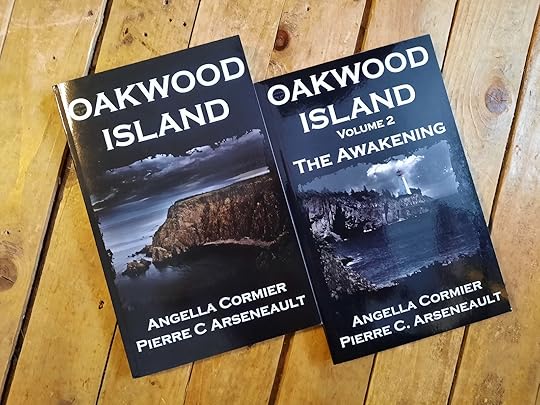
Pierre is working on multiple projects at the moment. He’s written a new drama set in Carlton which is a sequel to some of the content in the anthology, Sleepless Nights. He’s currently writing a crime thriller and also working on Oakwood Island volume 3 with collaborator, Angella Cormier. His next solo horror novel titled Maple Springs is set for release in October 2022.
Working Title:
The current working title is Oakwood Island volume 3; with its actual title to be revealed at a later date.
Synopsis:
Oakwood Island volume 3 is the final installment in a trilogy based on a blend of supernatural, curses, monsters and the earie but true existence of a parasitic fungus which causes what some call zombie ants. And while the books are not about the ants, I assure you said fungus and ants are real and have be found in the amazon rainforest. With that said, volume 3 will see revelations, conclusions and explanations of the strange happenings on Oakwood Island.
The Story Behind the Story:
As a writer, I’ve written both short stories and novels. I’ve also written solo and also in collaboration as well, which often boggles the minds of writers who’ve never collaborated. And as I’ve told many in the past, collaborating is fascinating to me as when discussing the story idea and feeding off each other’s input, this will lead us down storylines that we would have never gone down alone.
When Oakwood Island began, it was because of a conversation we had had about creating a setting and telling short stories set in this setting. So alone and over the span of about a month, Angella Cormier wrote three short stories set on her creation of Oakwood Island. I can tell you that I loved these stories, the setting and characters and the way she had interlinked them all together fascinated me. This left me wanting more.

And at this point, I need to point out that we had begun collaborating and together we had written the short story titled Henry and were already working on a few more which would end up being published in the book, Dark Tales for Dark Nights.
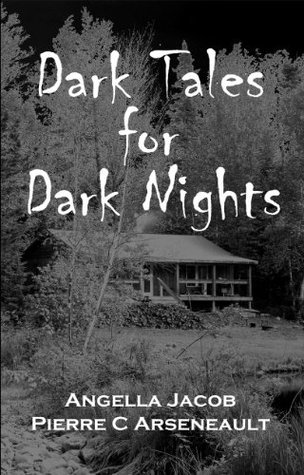
But discussions about her trio of short stories evolved into where these stories could possibly lead, something that had yet to be thought out. And feeling these were simply too good not to develop, this lead to us working together to eventually turn this into a trilogy.
With that said, the original stories had nothing to do with an amazon fungus and zombie ants. Those were the results of an overactive imagination and needing to explain some events that had not been fully developed yet. So, book one was the result of us expanding on the original three stories (which are in book one), developing them and adding back stories and just having a lot of fun. Book two was us steering the tale into a direction to further develop and expand some of the storyline. Book three will be filled with revelations, conclusions and explanations of the strange happenings on Oakwood Island.
Website: http://www.mysteriousink.ca/books.html
A question before you go, Pierre.
What have been the most enjoyable and the least enjoyable about writing?
Pierre: My favorite part about writing is the empty page at the very beginning of a new work and the possibilities it represents. You can be anywhere and be anyone as the possibilities are endless. My least favorite is probably the pressure I put on myself, forgetting to just breath and enjoy it. That comes with having ideas come easy with not enough time to write them all. So, I have to keep reminding myself that it’s one sentence at a time.
Your new novel sounds intriguing, Pierre. Thanks for being our guest this week and sharing your thoughts. Wishing you continued success with your writing journey.
Pierre will also be a guest in the near future on the popular page – Shorts – Stories from Around the World. He is contributing a delightful tale titled – Lucky.

And a BIGthank you to our visitors and readers. Please share your thoughts and leave a comment below. We would love to hear from you.

February 6, 2022
Autumn Paths. The Reviews are in! The journey continues! Book Tour! Teasers!
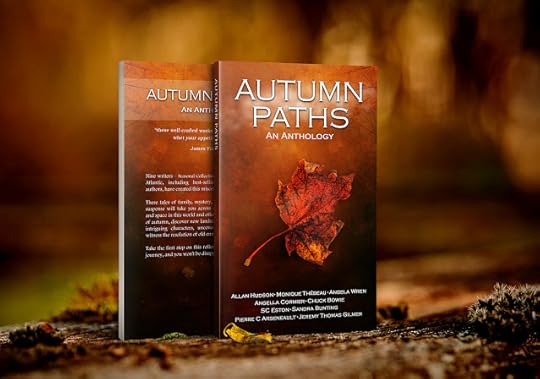
Autumn Paths
You visitors are in for a treat this week.
Lots of exciting news for the Anthology. Read about the book tour below.
Follow the rest of this post to read the beginning of each story - Teasers
The reviews are in.
**** “The authors did a wonderful job creating engaging and thought provoking stories around the central theme.” Author Sally Cronin.
**** “Each story is short enough to read during lunch break or for a quick read before turning in for the night. Author Joan Hall.
**** “Don’t let the title Autumn Paths mislead you! These snappy, well-written tales are sure to delight no matter the season.” Author MJ LaBeff.
**** “Original, entertaining and a darned good read, Autumn Paths, An Anthology, is a great collection of stories well told, by nine very memorable authors.” Eden Monroe.
Autumn Paths is going on a tour. Thanks to Author Angela Wren who worked diligently to bring this all together. Thanks to the participating websites for helping us share the news, reviews, excerpts & more!
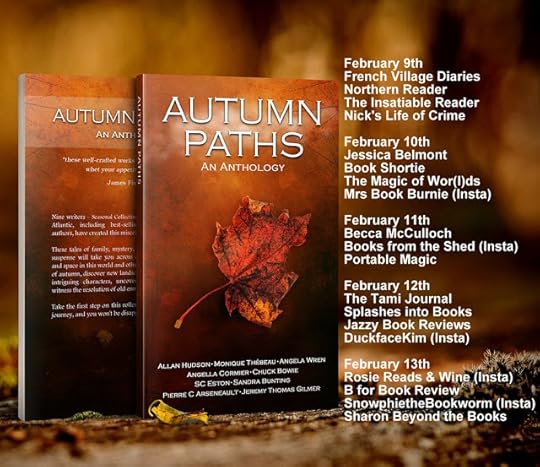
See below for URLS

A FEW PEWS UP THE HAT BOUNCED, turned from side to side and ruffled slightly in the breeze that swept in from the open doors at the back. Aurèle couldn’t take his eyes off it. Some niece or other from Montreal he thought. A face was not visible, only the wisps of feathers adorning the headpiece. Others were no doubt taking in the flowers, looking at relatives from out of town in their sophisticated dress, or glancing impatiently at the door where the wedding party would soon start up the aisle. But Aurèle, with a wistful smile on his face, was fixated on the hat. It was a stunning blend of natural tan and black, at times coloured a deep purple by the church’s stained glass windows. It wasn’t that Aurèle was a follower of fashion. Not at all! With the feathers he was transported back to the woods during partridge hunting.
THE PATH MYLES BARTLETT had worn into the old beige patterned linoleum flooring, bothered him. He couldn’t help it. He hadn’t noticed it until it was too late. His sneakers had collected gravel from outside. And he had done something he wasn’t supposed to do; he had worn the sneakers in the house. His overbearing aunt whom he had to live with after his parents passed away, had engrained this into him at the tender age of eleven. At twelve, the insurance money from her sister’s passing was released and Roberta, his aunt had had new linoleum put in. From then on, wearing shoes in the house became an even greater offense. He couldn’t help think the scratches like he had now worn into it would have earned him a severe punishment. Probably the strap. Roberta, his childless aunt reserved the physical punishments for severe infractions only. Most times he would be sent to bed without supper or made to stand in the corner while she went about her business, ignoring the child she took reluctantly into her care. He didn’t have to wonder about her distaste for him as she said it to her friends on the very first day he came to live with her.
By Chuck Bowie
I’m writing a series about a thief for hire, and I’m a fan of Allan Hudson’s Drake Alexander series, about a vigilante who rights wrongs. I thought it would be fun to have the protagonists meet and interact in a short story. Would they conflict, or would they collaborate?
DRAKE ALEXANDER FOLLOWED THE PATHfrom his estate to the Cocagne Bay shoreline, the marram grass swishing against the legs of his jeans. Shorts and bathing suits weather had passed, and the fall foliage offered a clear indication that summer would not return for another year. The lyrics of a JJ Cale song refused to leave his head: ‘Crazy Mama, where you been so long,’ but a smile, as well, refused to part. He’d gotten closer with someone—Beth Stone—and a three-year adventure, a quest, really, had been concluded with success. He could now forever put to rest his life as a soldier, and focus on thoughts of marriage.
Crossing over the last, tiny dune before hitting the beach, he noted with approval the neap tide; neither so high nor low as normal tides, thanks to the combined forces of the sun and the moon. The sun sat just above the horizon and he hoped to enjoy a few moments of solitude before spending the evening alone. The previous month had been a roller coaster of events, filled with danger, but he was home, and wanted to rest. A pair of binoculars, a gift from his friend Williston, bounced gently against his deeply tanned chest, and he carried a bottle of Orin Swift Palermo and a pair of Riedel fat-bowl wine glasses.
By S. C. Eston
“Family means nobody gets left behind or forgotten.”
- David Ogden Stiers
. Segment ASOMETHING IS WRONG WITH HER.Something about her mind and her thoughts. Something… about herself.
Eltaya opens her eyes, hoping that the sight of her lodge will ground her back into reality. But it doesn’t. The shiny white walls and floor feel alien. The cushioned grey chair on which she sits is stiff, rejecting her. The oval terminal balancing on a pole in front of her is blank and cold. She can’t ignore the feeling that the place belongs to someone else.
She wishes her parents and brother were here, visiting. She wishes she could visit them. More than anything, Eltaya misses the sound of her mother’s voice, a voice she hasn’t heard in over sixteen years. Her family has now been absent from her life longer than it has been in it.
At least, there is the tree.
It stands in a corner of the room, to her right, its trunk bending as it climbs along the wall and then the ceiling, until it looks down upon her. Her mother kept one like it in her apartment, although Eltaya doesn’t remember it being this tall.
The Bookseller's Secret Octavo
By Angela Wren
September, 1981, the village of Beauregard, France
ALICE TOMLINSON STOPPED AT THE WOODEN BENCH across the road from the bar. Her suitcase neatly tucked in at her feet, she sat and lifted her face to enjoy the last vestiges of warmth from the late afternoon sun. The walk from the station, just like the interminable journey by train from Calais, had been difficult. Alice was tired and irritable, and she felt sure the pain in her left heel was a substantial blister. She quietly cursed her choice of footwear.
She glanced at her watch. “Well, twenty past three on a Friday afternoon means you’ll be in the bar, Dad.” She stood and took a firm grip of her case. “And if not, I’m sure someone will know where to find you.” Alice tossed her dark red hair back and stepped into the road. Straightening her shoulders, she adopted the determined look she always wore when negotiating a seller’s price down to the absolute minimum - she usually achieved her goal. Pausing at the open wooden door of the bar, she took a breath. The interior glass door fitted badly, and she had to give it a hefty shove to gain access.
FOURTEEN-YEAR-OLD JACOB ABBEY was born in captivity, in a manner of speaking. Not in a prison, but far worse. A fair number of people knew about it – uncles, aunts, grandparents, even teachers, for God’s sake, but it was fifty-two-year-old janitor, Lesley Longfellow, who took it upon himself to set him free. Lesley was easy to spot in the school, rising above the crowded hallways like a cattle-god watching over his pasture, his balding head a beacon of light even on cloudy days. It was the day after Victoria Day, and exactly two months after Jacob had lost his mother to ovarian cancer. Lesley had taken the day off and driven, with the stamina and determination of his younger self, to the Heartland Farms on the outskirts of town. His mission was simple. Take Jacob away from his narcissist and alcoholic father.
WE STOOD, WE TWO, UP ON TOP OF THE GAIN, the hill that overlooked the rough cut of the bay below us, and we watched the sparrows hook and meander on those cold winds, and I thought of what those winds would bring. Devlin was a few winters older than me, how many neither of us knew, but a few at least. He wore those years like he wore the sash around his shoulder, the hard blue of it marking him as a man of our tribe, a watcher and a protector. We watched the sparrows swoop and we marvelled at their speed and freedom, their rightful claim to that air over our heads, lost to us, leaving us on the hard ground to fend for ourselves.
Dev took his eyes from those flyers, and I watched him as he looked to the horizon, the grey blue meeting the blue grey. He squinted into it and the paint across his temples disappeared in the wrinkles. A few of our people’s teaches lay down in the low ground, the thatched roofs looked so fragile from way up here. They were so warm and dark at night, quieting the world outside to the sound of wind off the ocean. My coat was only just fighting off this wind and I wished for the warm glow and slow fire that night would bring. Dev clicked his tongue, and we were off, down the gain.
By Allan Hudson
EVERYBODY CALLS HIM FRECKLES. Can’t be helped. His face is cheerfully covered with them. Tiny spots of Irish blood spread across his upper cheeks and splattered on his nose. With the red hair and green eyes, the girls at school say he’s cute. To an eleven-year-old boy, being classified as cute in front of his friends is not a compliment. The boys tease him. Call him Cutie. At least until they tire of it. Mary Ellen doesn’t tease him. She’s not a boy, but she’s one of the boys, and with her short hair, is often mistaken for a boy. She doesn’t care, and he tries to be like her and not let things bother him. The only other one who doesn’t call him Cutie is Ducker, their leader.
Right now, Ducker is standing on the side of the road, near a brook that gurgles under the wide culvert they are gathered on. It’s a dirt road, rutted from the rain last week but now as dry as the Gobi and just as dusty. The brown trim around the bottom of their jeans and covering their sneakers shows how parched the ground is. A path, narrow and cupped from years of meandering feet, follows the brook.
A BIRD CHIRPED SEVERAL HIGH-PITCHED BURSTS AS A WARNING CALL. The female was sounding off to the predators who came too close to her nest. The hatchlings had been startled. It was an animal's nature to be fully in the present, ever aware of the dangers that could appear at any moment. The pair in the woods, their assumed predators, had been identified and warned as soon as they came too close.
Humans are a completely different kind of species. They don't always live fully in the moment. The pain that can bring runs much, much deeper than any predatory threat or attack. The lucky few learn that sometimes, the past is best left alone.

Get you copy HERE.
I am humbled to be part of this clever collaboration with authors I respect and admire.
Watch for Winter Paths – coming late 2022.
Thank you for visiting.

URLS for Book Tour
Autumn Paths - Blog Tour Feb 9th - 13th
Date
Blog/Website
Review/Excerpt/Q&A
Authors
February 9th
http://www.frenchvillagediaries.com/
Review e-copy
https://northernreader.wordpress.com/
Review hardcopy sent by post
http://insatiablereaders.blogspot.com/
Spotlight Excerpt
Sandra
https://nickislifeofcrime.blogspot.com/
Review e-copy
10th
Review e-copy
https://bookshortie.wordpress.com/
Review hardcopy sent by post
https://themagicofworlds.wordpress.com/
Spotlight Excerpt
Chuck
https://www.instagram.com/mrsbookburnee/
Review hardcopy sent by post
11th
https://medium.com/@authorbeccamcculloch
Review e-copy
https://www.instagram.com/books_from_...
Review e-copy
Spotlight Excerpt
Angella
12th
https://thetamijournal.wordpress.com/
Review hardcopy sent by post
https://splashesintobooks.wordpress.com/
Review e-copy
https://www.jazzybookreviews.com/
Spotlight Excerpt
Jeremy
https://www.instagram.com/duckfacekim09/
Review hardcopy sent by post
Autumn Paths - Blog Tour Feb 9th - 13th
Date
Blog/Website
Review/Excerpt/Q&A
Authors
13th
https://www.instagram.com/rozierreads...
Review e-copy
https://bforbookreview.wordpress.com/
Q&A
PCA SCE AH MT AEW
https://www.instagram.com/snowphiethe...
Review e-copy
https://sharonbeyondthebooks.wordpres...
Review e-copy
Feel free to leave a comment.
January 29, 2022
The Story Behind the Story with Author Janet Sanford of Moncton, NB, Canada.
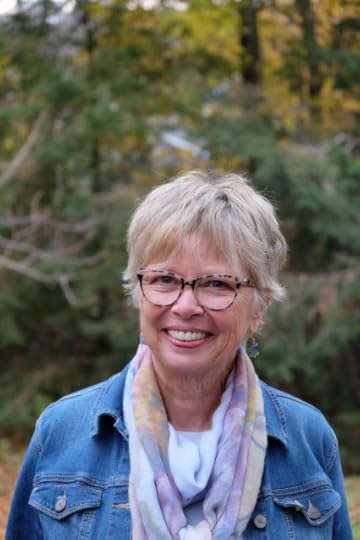
The Scribbler welcomes a new author to its pages. I was introduced to Janet by a mutual friend, Gracia Williston, who is an avid reader and wonderful supporter of my own writing.
Janet’s book is unique and on my To Be Read list. I know you will enjoy meeting her and hearing about the Story Behind the Story.
Let’s meet Janet.
I am a retired high school English teacher and a long-time Monctonian. I love the Maritimes and can’t imagine living anywhere else. Like many Maritimers, my husband John and I enjoy a bit of travel, but family and friends are most important. I am an avid reader, a dog lover and a painfully slow writer.
Book Title: Memories on the Bounty
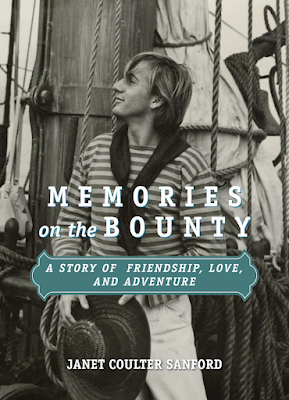
Synopsis: Memories on the Bounty recounts Maritime and seafaring history, but primarily it is a human story. The book recalls one golden year in the life of Roy Boutilier. At 19-years old, Roy was suddenly given the opportunity to sail on the replica ship Bounty from Lunenburg, NS on its maiden voyage to Tahiti in 1960. Roy and 24 other Nova Scotians spent a year on the film set of Mutiny on the Bounty, starring Marlon Brando. It was a grand and life-changing adventure.
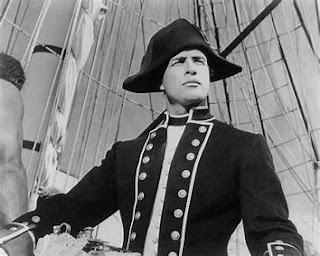
Roy was diagnosed with Alzheimer’s disease in 2017. And so began a series of Monday morning meetings as I embarked on a race against time. In the end, Memories on the Bounty goes far beyond retelling Roy’s story; it looks at the hard truth of memory loss and the importance of friendships and stories in our lives.
The Story Behind the Story: My husband and I were friends with Roy and his wife for 40 years. Over the years, I heard many of Roy’s Bounty stories and loved them. People often told Roy he should write a book about his adventures, and he always agreed it was a great idea.
After Roy’s diagnosis, I realized his marvellous story was about to be lost – unless maybe, just maybe, I could save it. I originally intended to write a little booklet about Roy’s adventure that he could pass on to family and friends. But once I got started, I found there was much more to tell than I had ever imagined!

I researched the history of the original mutiny on the Bounty in 1789 – what a story! I delved into the 1960 building of the replica ship Bounty, commissioned by MGM Studios – more fascinating history! I tracked down the only two other remaining crew members, who delighted me with their recollections of life aboard the Bounty and working on the film set of Mutiny on the Bounty. The more I found out, the more I realized this was much bigger than just Roy’s story.
During the time I worked with Roy I witnessed many changes as his memory slowly faded. Eventually the time came when I realized I knew more of Roy’s story than he did. I had become the keeper of the story. That strengthened my resolve to write this book and ensure Roy’s memories of Bounty, Tahiti and his shipmates would live on. I’m happy to say the result is Memories on the Bounty – a story of friendship, love and adventure.
Website: www.janetcoultersanford.ca
A question for you, Janet:
What is your favourite and least favourite part about published?

My favourite part of publishing is getting published! Not much in my life compares with the thrill I got when I received an offer to publish from Nimbus. As an unpublished writer, I knew that submitting an unsolicited manuscript was a huge long shot. Although I believed in my book, I honestly had no idea if a publisher would be interested. I am very grateful to Nimbus editors Whitney Moran and Angela Mombourquette for reading my work and believing in it.
My least favourite part about publishing is figuring out what comes next. I have never been part of a community of writers so I have been feeling my way along. I am new to social media and starting to realize its impact. I’m happy to have connected with Allan Hudson, who knows his way around the book world and gave me this opportunity to let readers know about this book.
I am at work on another book – fiction this time. But as I said, I am a painfully slow writer. Memories on the Bounty was three years in the making - and it’s short! So, it’s going to take awhile. In the meantime, there is no shortage of great new books to discover.
Thank you for being our guest this week, Janet. Wishing you continued success with your writing journey.

Do you have a question for Janet? Leave it in the comment section below and thank you Dear readers for visiting.
January 22, 2022
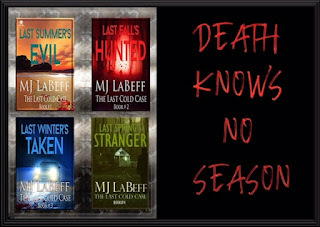
The Story Behind the Story with MJ LaBeff of Arizona.

One of our most popular guests is back for The Story Behind the Story.
MJ LaBeff writes terrific thrillers and I’m a big fan of her work. If you missed her previous visits, check them out HERE.
Hi Allan! Thank you for inviting me back as a guest on the Scribbler. It’s always fun to share what I’m working on- even if a release date isn’t anywhere in sight!
***It’s always a pleasure to have you as a guest, MJ. Thanks for taking the time to tell us about your newest work.
Bio: MJ LaBeff is an American author best described as the girl-next-door with a dark side. MJ grew up in northeastern Ohio but traded snow for sunshine and moved to southern Arizona where she lives with her husband and two dogs. She’s drawn to writing suspense novels, featuring complicated characters and twisted plot lines that will keep readers turning page after page. When she’s not writing or plotting her next novel, MJ enjoys reading, running, lifting weights, and volunteering for the American Cancer Society.

Working Title: Murdered Last Summer (book 6 of the Last Cold Case series)
Synopsis: I’m not invisible…
Someone is killing Snug Harbor, Ohio’s most vulnerable residents. A serial killer prowls the streets in search of drug addicts. There are three victims in one week—a drug addiction specialist, a down-on-her-luck former teacher, a recovering drug addict. Unlike the overdoses plaguing the city, this time the killer removes the victims’ eyes. Does the signature have meaning? That’s what homicide detective Rachel Hood, a psychic empath and FBI agent Nick Draven, an occult crimes specialist need to find out before more people die.
You look…
The killer sends a string of messages. An envelope addressed HOOD contains a photo of two boys. An undercover detective goes silent. Another woman is murdered.
But you don’t see me…
This victim haunts homicide detective Rachel Hood. The woman’s spirit seeks forgiveness but all she conveys to Rachel are these two words: see me. Rachel suffers through this unidentified woman’s pain putting her through the rigors of the addict’s hell on earth.
The story behind the story:
There are two that inspired this story. The first one came from a friend many years ago about a child who had brought drug paraphernalia to school for show and tell, and the second from a news story I caught one morning about a child who had gone to school and told a teacher about the parents drug use.
I couldn’t stop myself from thinking about how irresponsible the parents were and the tragic conditions they were raising their children. However, I also started to think about the possibility that these parents’ could’ve been decent, hard-working people who fell victims to drugs, maybe through no fault of their own.
Next came the: what ifs? What if a child brought drugs to school and confided in a teacher for help. What if that teacher had drug problems? What if the teacher became the parent’s newest customer? What if the parent’s weren’t as decent as I imagined? What if there was a toddler in the home that died as a result of living in a place where drugs were carelessly left out? What if the children felt let down by the teacher and the police? After all, these were people they had counted on for help. How would that affect them in later years?
Before I knew it a story began to develop about two boys who relied on each other but as young adults were on very different paths.

This common theme arose: what happens when the people you think you can trust the most are the ones you learn to trust the least. I thought about the people I was told to trust as a kid if I needed help or was in trouble. What if all of them had failed me in my eyes?
As I started writing about halfway through I started to think about the boy’s mom. What was she like? What did she do? Did she care for her children? What happened to their father? That was easy. I incarcerated him. A death in the home led to his conviction and sentence. I don’t want to spoil the surprise so that’s all I’ll say about it.
Now, you might be thinking you know who the serial killer is, but do you? Nope. You wanna know why? I haven’t even decided who has gone on this killing spree. There are so many wonderful characters with so many reasons to commit murder, and if you’ve read any of my other books you know how much I love to create clouds of suspicion around everyone being investigated.
A Question for you, MJ, before you go.
What is your most favorite part and least favorite part about publishing?
MJ: My favorite part about self-publishing is the control I maintain when it comes to deadlines and release dates. My least favorite part about self-publishing is the control I maintain, LOL! Seriously, the one thing about self-publishing that I don’t enjoy is that I’m responsible for setting several deadlines, assembling a team responsible for editing, formatting, and designing cover art and then I’m the one releasing the book via Draft2Digital and Kindle Direct Publishing (KDP).

Now, I’m the one driving the schedule. I’ve always taken my writing seriously so meeting deadlines has never been an issue I’m highly self-motivated and full of determination. The writing is the fun part. I do miss having a publisher who set the deadlines and provided the team of professionals. At my core, I’m a writer and if I’m being honest I don’t have any interest in learning how to format a manuscript, and I’m definitely not an artist so designing a book cover is a hard no. When it comes to editing I find it much harder to edit my own writing so I’ll trust that to someone else, too. For what it’s worth, my manuscripts are pretty clean but as writing goes there’s always something!
Website: www.mjlabeff.com

Thanks again, Allan, I always have so much fun chatting it up with you on Scribbler! I’m also a fan of your books and especially enjoy the Jo Naylor detective series and your short story collections. You’ve inspired me to give writing a short story a try, but I don’t have the time just yet.

***Your kind words and support is very much appreciated. Wishing you continued success with your writing. When you get around to the short story, I know it will be good! Thanks again for being here.

Do you, my wonderful readers, like thrillers? What is your favorite genre?
January 15, 2022
The Story Behind the Story with Zuzanne Belec of the Czech Republic.

Hello to all our fantastic readers and visitors.
This week the Scribbler is pleased to have our first guest from the Czech Republic. We met on Twitter and discovered we both have an affinity for short stories.
Let’s welcome Zuzanne.
Who is Zuzanne Belec?
Zuzanne was lucky enough to grow up in the school of life that is the stunning South Africa. She has two wonderful daughters and now lives a peaceful life near Prague, Czech Republic, with her supportive partner. She worked as a translator and interpreter for many years. Then she discovered writing… Zuzanne also enjoys travelling, languages, and learning from other cultures (and trying out their interesting dishes!).

Title:
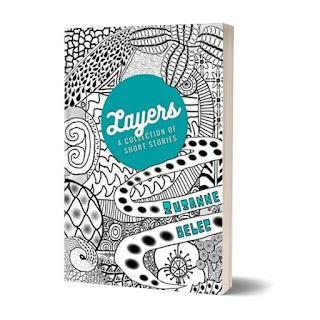
Layers: A Collection of Short Stories
Synopsis:
Eight short stories on the power of the human spirit around the world.
Layers is a collection of original and imaginative short stories celebrating life and the human spirit despite the ever-present spectre of melancholy in our lives today. With their distinctive blend of wit and humour, they light up any underlying darkness and will leave a lingering impression long after the pages have been read.
From the Americas to India, from Africa to Europe, and through a range of genres, voices and styles, layers are unraveled, revealing the textures and contrasts of old and new in the environments and cultures of today's fast-paced world.
The Story Behind the Story:
I confess that I did not read a lot. And until recently, the idea of creative writing never occurred to me. I was too busy trying to take care of my girls, get through university, and maintain some semblance of home for myself and my family.
Then I discovered creativity! It was in my late forties, after winding down on the doctor’s orders. And I was bowled over!
I began reading again. I immersed myself in the beautiful, surreal world of writing–learning and practicing the craft for several years. It came as a shock when two of my short stories were then accepted by traditional publishers (two Canadian literary magazines), because I’d always thought that publishing was only for the gods. Once I realized (thanks also to Stephen King’s On Writing: A Memoir of the Craft) that even regular folk can become good writers if they’re passionate enough about it and willing to practice hard, I knew that I will one day publish a book of my own–which I did about a year later. Publishing Layers: A Collection of Short Stories was both exciting, and scary, but with the support of my friends and family, I overcame the challenges (especially on the tech side, or learning about and hopping on the social media train–something I’d avoided like the plague till then).

Why do I write short stories in particular? Because life is short. Because I believe that when our time comes, we won’t go remembering the entire length of one’s life, or its long narratives, but what will impact us more are the deeper, key nuances of our lives. And it is that depth–that essence–which I enjoy capturing through my stories. I write short stories also for practical reasons because, as a late bloomer, I might not have those ‘10 000 hours of writing needed to master the craft properly.’ So while the short form sure is difficult, learning and practicing it goes a longer way for me. Oh, and the short attention span might also have something to do with my choice too…
I am grateful for the trials and tribulations of life, for the lessons learnt from Mother Nature, for the opportunities to travel, to all the interesting people I’ve met, and for the support of the writing community–thank you all for the motivation and for inspiring my stories. A big thank you too, Allan, for inviting me onto your blog.
*** You are most welcome Zuzanne. It's a pleasure to have you as a guest.
So, remember: it’s never too late! There is still much to learn and do, but there’s no stopping us now that we’ve found our passion in life, right? If you’ll excuse me now though, I have some dire catching up to do … ;o)
Website: https://zuzannebelec.com
A question before you go, Zuzanne.
What is your most favorite part and least favorite part about publishing?
Zuzanne: This may sound somewhat clichéd, but what I enjoy most about self-publishing is being in charge of my own publishing process.
As interesting and exciting as self-publishing is, the time it takes to try plan out one’s own marketing is just darn frustrating. It takes up way too much of my writing time. This paradox is my least favourite part, for sure. But it’s a compromise an author starting out has to accept, I suppose, if one wants to take the self-publishing route. It is a constant and distracting battle to find a balance between the two, but it’s part of the learning curve, I suppose...

Thank you, Zuzanne, for being our guest this week. Wishing you continued success with your stories.

And a special thank you to all my visitors. The Scribbler would love to hear your comments.Don’t be shy. What is YOUR favorite book?