
Elizabeth Fitzgerald's Blog: Earl Grey Editing, page 54
October 15, 2014
Dewey’s Read-a-thon preparation
With Conflux now well and truly over, I’ve been preparing for the next event on my calendar: Dewey’s 24-hour read-a-thon. I mentioned this event in my September signal boosts, but wanted to give it a bit more attention now that it is drawing closer. The read-a-thon is one of the few things that keeps Mt TBR in check (my willpower being as weak as it is when it comes to books). It runs twice a year, in April and October. The next one takes place this weekend and will be starting around 11 PM on Saturday 18 October for most of the east coast of Australia (10pm for Queensland).
I won’t be participating for the full 24 hours. The organisers always emphasise the event is intended to be fun and are happy for people to participate in whatever way works best. Since I don’t function well without sleep, I’ll be snoozing away the first seven or eight hours. I also have a family commitment in the morning, but the rest of my time will be devoted to reading as much as possible. And maybe hanging out on Twitter, where I’ll be updating regularly using the the hashtags #Dewey and #readathon.
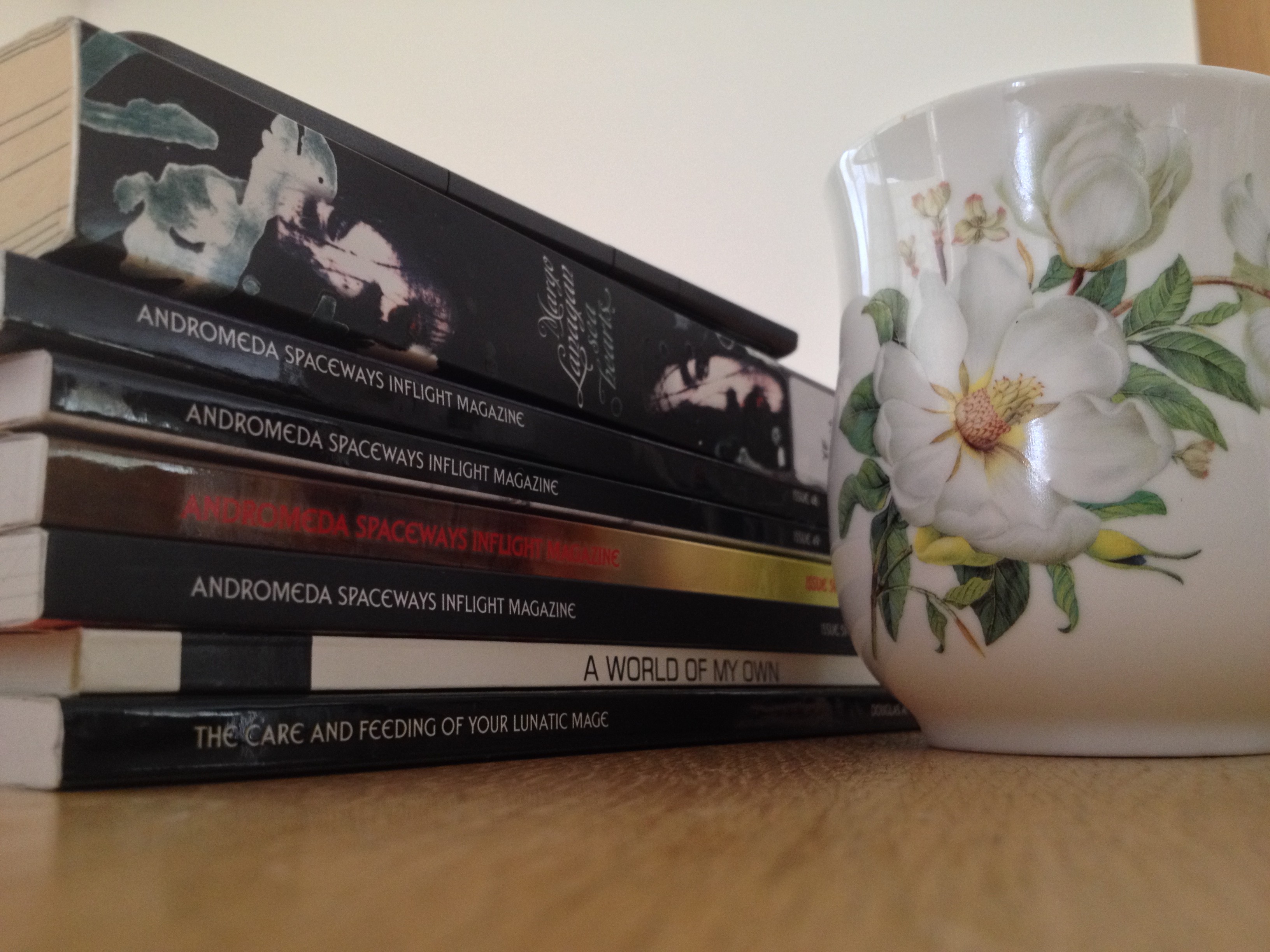
You can see my mini Mt TBR in the photo at the top of the post. I don’t expect to get through all of it but I hope to make a bit of a dent. At the top of the pile (you might be able to make out my Kindle up there) is an electronic copy of Phantazein edited by Tehani Wessely. I’m already partway through it, so will concentrate on finishing it first. Next on the list is Sea Hearts by Margo Lanagan (known as The Brides of Rollrock Island in other parts of the world). This ordinarily wouldn’t make it onto my read-a-thon pile, as I find Margo’s work to be very emotionally draining. However, the book is due back at the library soon.
After that, I shall see how I’m faring. If I’m not completely traumatised by the end of Sea Hearts, I’ve got an e-book of a related short story called Flower and Weed. Otherwise, I have plenty of back issues of Andromeda Spaceways Inflight Magazine to catch up on. I’m way behind and I find ASIM perfect for read-a-thons because the stories are short and varied. The further into the day I get, the more I need that.
Read-a-thoners love to discuss their snacks but I never really prepare any. My one requirement is to make sure there’s plenty of tea on hand… which is not that difficult around here. I tend to gravitate more towards green tea than black during a read-a-thon unless I’m in dire need of some caffeine.
If you need to tame your own Mt TBR or are looking to connect with a great community of book bloggers, it’s not too late to join! You can sign up, follow on Twitter, join the Goodreads group or any combination of the three. The read-a-thon website will be running warm-up posts containing great advice for beginners all the way up until the event. If you’ve already signed up, I’d love you to leave me a comment about what you’ll be reading.


October 13, 2014
Convention report: Conflux 10
 Earl Grey Editing took a bit of a break over the last week so I could recover from attending Conflux 10. As I have mentioned before, Conflux is a speculative fiction convention and this year it ran from Friday 3 October until Monday 6 October.
While not exclusively aimed at authors, it does have a heavy focus on writing. This was particularly evident on the Friday, with most of the programming devoted to workshops. I ran one on working with editors. It examined the difference between freelance and in-house editors, and offered some tips on the best ways of working with each. I received some positive feedback from participants and may consider running it again in the future.
After an all-too-brief lunch break, I attended a workshop by Karen Miller on character development. Karen’s background in theatre was strongly evident. She urged participants to fine-tune their ear for dialogue by reading scripts and pointed out that good-quality director’s commentaries can make great writing master classes. Karen was very generous with her time and attention, inviting us to email her with any of those belated questions that might pop up after we’d had a chance to process the workshop. She also raffled off several copies of her newest book The Falcon Throne. I didn’t come away with one of the books, but I did end up with some thoughts on my Work In Progress.
The pace picked up on Saturday with the arrival of those attendees who’d had work commitments the previous day. A highlight for me was Margo Lanagan’s Guest of Honour interview. She talked about the journey her writing career had taken from poetry through teenage romance, children’s fantasy, gritty realist YA and then to speculative fiction. She was even kind enough to share some of her early poetry, at one point laughing too hard to finish reading. What I appreciated most was hearing about how much she struggled with her writing, in particular moving from the critically acclaimed short story Singing My Sister Down and into novels. In the end, she tricked herself into it by writing Tender Morsels as a series of linked short stories.
The panel on editing anthologies was an obvious choice for me to attend. Between the panellists, there was an impressive range of experience. It was especially interesting to hear Jack Dann speak about the changes in the publishing industry. For most of his career, publishing an anthology relied on getting big names and being accepted by big publishing houses. He was of the opinion that the rise of e-publishing has made the industry more flexible (at least in some areas) and allowed more of a place for small press. Tehani Wessely of FableCroft Publishing provided an excellent example. Her anthology of fairytales, Phantazein, was launched that afternoon. At the panel, Tehani spoke of how the stories for Phantazein had been submitted for an unthemed anthology she was editing called Insert Title Here (which is to be launched next year). She had loved the stories but felt that having them all together in an unthemed anthology would unbalance the book, so she decided to create a new anthology just for the fairytales.
Book launches are a key part of Conflux. In fact, I think I attended as many launches on Saturday as I did panels. As well as the Phantazein launch, I also attended launches for Shatterwing by Donna Maree Hanson and Bound by Alan Baxter. Sunday was the launch of Langue [dot] doc 1305 by Gillian Polack. I still missed launches for Jubilee by Jack Dann, Difficult Second Album by Simon Petrie and The Shadow Master by Craig Cormack. I know I wasn’t the only one wishing for a Time Turner that weekend.
Sunday highlights for me included Alisa Krasnostein’s Guest of Honour interview. Alisa came across as very practical and business-minded, somewhat of a contrasting voice at the convention. Her interview covered the history of Twelfth Planet Press and the evolution of Kaleidoscope, an anthology funded through Kickstarter featuring protagonists from diverse backgrounds. She hopes to do a sequel sometime in the future.
Another panel of particular interest to me was about reviewing. It had me considering my approach to reviewing on this blog and I plan to post some more detailed thoughts on this at a later date.
Having attended the banquet on Sunday evening (where guests were taught some basic Bollywood dance moves), my energy was well and truly flagging by Monday. However, I managed to make it in early to see the panel on gender and diversity, where Ancillary Justice by Ann Leckie got some excellent press and convinced me to put it on my list of books to acquire (yep, I’m a little late to the party on this one).
In the afternoon, Gillian Polack gave a talk on the differences in perspective brought to history by writers and historians. Writers tend to make generalisations too broad to be accurate or be asking questions so specific they can’t be answered by historians. The level of accuracy a story needs depends on the genre. Gillian suggested picking a historical time and place to research and then use genre to determine the telling detail.
With many attendees already on their way to the airport, the closing ceremony was somewhat more subdued than the opening ceremony had been. I was delighted my story Deathwisher was a runner up in the short story competition, losing out to Death Watch by Rob Porteous and Stripped by Nicole Murphy (you can tell from the titles we’re a cheerful lot). The E. G. Harvey Award for Australian SF Art was awarded to K.J. Bishop for her gorgeous brass sculptures (which I’d drooled over at the art show).
Overall, I had a wonderful time and I’m definitely planning to return next year.


October 2, 2014
Mt TBR report: September 2014
A few years ago, I made an optimistic New Year’s resolution to finish the year with a smaller Mt TBR. If the overall total was less than it had been on 1 January–even if it was only by one book–I’d count myself successful. It’s a goal I’ve never managed to achieve, but I continue to live in hope. In pursuing this lofty ideal, I’ve learned to carefully track both Mt TBR and what I’ve read using a variety of spreadsheets (including one adapted from Fyrefly). This helps me make sure multiple copies of the same book don’t bloat Mt TBR. It also helps me gather data on what I’ve read, for instance: ratio of male and female authors; ratio of Australian and international authors; genre; and ratings. At the end of every month, I check on what I’ve read and acquired. I also check on the overall height of Mt TBR (which usually brings on a strong need for a cup of tea).
I thought I would share these reports here. This is not out of a misguided notion that creating public accountability will help me achieve my goal–I have no delusions on that front. If anything, starting this blog will make things worse. However, I love to poke through other people’s book lists; it’s always fascinating to see what they are reading or want to read. I’m sure I’m not the only one. While I’m on Goodreads, it’s not really the space for this sort of report. I also hope that sharing them here might start some additional conversations (you may have noticed that I like to talk about books).
So, without further ado, here is this month’s report.
Mt TBR status
Mt TBR @ 1 January: 191
Mt TBR @ 31 August: 217
Mt TBR @ 30 September: 215
While September’s month’s total is down on August, I’m pretty sure I can farewell any chance of getting back down to January’s total. Especially with Conflux starting today.
Books read
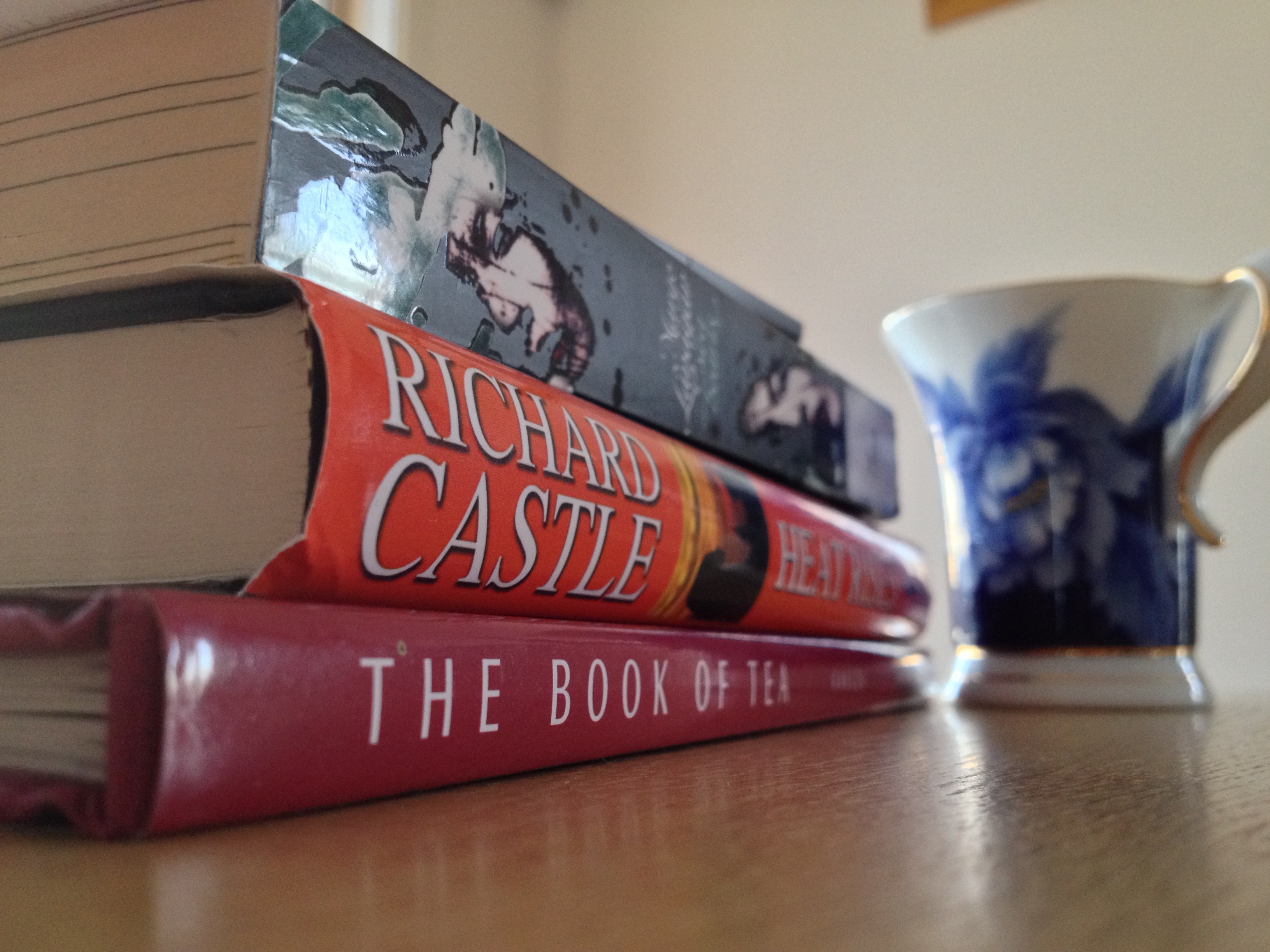
39. Heat Rises by Richard Castle: The third book in the ghostwritten Nikki Heat series tied in to the TV show Castle. Entertaining enough for fans but probably not of much interest otherwise. The tone and characterisation seem to vary a bit from book to book, indicating each book was ghostwritten by someone new. It makes for a rather uneven series and this wasn’t one of the better books.
40. The Passage of Pearl by Lynn O’Connacht: A fantasy novelette about a university student who discovers an extraordinary book. It tends more towards slice-of-life than adventure, featuring some nicely understated species dysmorphia.
41. The Interrogation of Ashala Wolf by Ambelin Kwaymullina: Reviewed here.
42. Lavender Blue and Other Poems by Elizabeth Conall: A comprehensive collection of Conall’s poems from 2013. As with most anthologies and collections, the quality is a bit uneven. However, it shows an impressive command of poetic form and fantastic diversity of characters.
43. The Book of Tea by Okakura Kakuzo: Considered by some to be a sacred text, this is an examination of the history and philosophy of tea preparation in China and Japan. The book pays particular attention to the Japanese tea ceremony and its links to Taoism and Zen. A fascinating read for dedicated tea lovers.
Books acquired
(3/9) The Interrogation of Ashala Wolf by Ambelin Kwaymullina
(25/9) Sea Hearts by Margo Lanagan
(27/9) Phantazein edited by Tehani Wessely
Online Reading
This gets its own section because the immediacy of online reading tends to short-circuit any attempts to record it as part of Mt TBR.
Xxxholic Vol. 1 by Ohkawa Ageha: A manga with a very misleading title. A boy able to see spirits and magical forces agrees to work in an occult shop in exchange for the owner ridding him of his undesired ability. It wasn’t quite enough to hook me in.
Boundary Lines by Elizabeth Barrette: A poem in an ongoing series about Brenda, a badass Private Investigator who happens to use a wheelchair. The poem examines some of the boundary violations Brenda experiences as well as illustrating more respectful behaviour.
Skip Beat Ch. 215 by Nakamura Yoshiki: A shojo manga. When a young girl is dumped by her rockstar boyfriend, she vows never to love again. Determined to ruin his career, she enters show business to get her revenge and discovers a talent for acting. Light-hearted fun.
The Court of Five Thrones, Ch 6
and Strange Sights, Ch 12 & 13 by Pia Foxhall: These are at completely the opposite end of the spectrum from Skip Beat. Both of Foxhall’s stories are classified as m/m erotica, are explicit and come with some heavy trigger warnings–particularly the latter. They’re both set in the same vibrant fantasy world and feature wonderfully faceted characters. Definitely NSFW.


September 29, 2014
Review: To Spin A Darker Stair edited by Tehani Wessely
To Spin A Darker Stair is a short chapbook that pairs two fairytale reworkings: A Delicate Architecture by Catherynne M Valente and The Oracle’s Tower by Faith Mudge. Valente’s story is a reprint, picked specifically to complement the story by Mudge.
Thematically, the stories are well-matched. Both carry a strong fairytale atmosphere and give the reader a sense that anything is possible. Both have a similar angle on their protagonist.
However, this similarity is a double-edged sword. A Delicate Architecture is a wonderfully deft tale, full of rich detail. Pairing it with The Oracle’s Tower serves to highlight the flaws in the latter–flaws that may have been overlooked if paired with a more contrasting story.
For example, A Delicate Architecture simply launches into the tale, drawing the reader along with a strikingly unique situation. The Oracle’s Tower, in contrast, follows a worn path wherein the narrator urges the reader to listen to her tale in a somewhat clumsy attempt to impart a sense of wisdom and urgency. This approach always tends to backfire a little for me; I rarely like being told what to do. The ending was framed likewise, setting out a possible conclusion to the story without being at all satisfying. It came across as a writer’s frantic attempt to wrap up the tale before the word count blew out.
The illustrations and cover art by Kathleen Jennings deserve a special mention. They tie the stories together beautifully and help strengthen the fairytale atmosphere.
Having said that, I thoroughly enjoyed the book. Being only 51 pages, it is the perfect travel book and I devoured the whole lot in a single bus trip. With Fablecroft Publishing scheduled to launch the anthology Phantazein at Conflux 10, it seems certain we can expect more along the same theme from them–especially with Mudge and Jennings making reappearances. However, I also hope that FableCroft will produce more of these chapbooks in the future to help enliven future commutes.


September 25, 2014
September signal boosting
There are a lot of great events happening in the next few weeks. Below are a few I’m keeping on my radar.
Dewey’s Read-a-thon
As I’m sure you’ve gathered by now, I love books and may in fact be a bit of an addict. One of the very few things that stops my Mount To-Be-Read from reaching the atmosphere is Dewey’s 24 hour read-a-thon.
Don’t let the name fool you. Reading for the full 24 hours is not in any way mandatory, though you certainly can if you wish. I simply use it as an excuse to cram as much reading as I can into my waking hours.
The read-a-thon runs twice a year (in April and October). For the east coast of Australia, this read-a-thon should be starting around 11 PM on Saturday, 18 October (though I make no promises as to the accuracy of this calculation).
If you are looking to connect with fellow book bloggers, or are simply trying to get Mt TBR back under control, please feel free to join in the fun by signing up or by following #Dewey and #Readathon on Twitter. I’ll be participating, so you can expect to see me report in here about how I go or you can catch me on Twitter.
Hachette’s Next Big Thing
If you’re more interested in writing, and in Young Adult fiction in particular, Hachette Australia wants to hear from you.
Hachette Australia wants your manuscript!Hachette Australia is proud to publish amazing YA authors from Australia and around the world, including Jessica Shirvington, John Marsden, Rainbow Rowell, Laini Taylor, Ally Carter and James Phelan – and we’d love to add your name to that list. Throughout October, we will be accepting submissions of YA novels in all genres. If we fall in love with your manuscript, you will receive editorial feedback, and you may be offered a contract for publication.
We love stories that keep us hooked, new worlds we can disappear into, and characters that can become our new friends. If that sounds like your manuscript, we can’t wait to read it!
Be sure to read the guidelines carefully before submitting.
Conflux Workshops
Perhaps you don’t have a completed manuscript lying around or you don’t feel it’s ready to submit to a publisher. There are a number of workshops being held at Conflux that might help. I’ve already mentioned I’ll be discussing how to make the most of working with an editor. Some fellow members of the Canberra Speculative Fiction Guild will also be on hand. If you already have a completed manuscript, Nicole Murphy and Russell Kirkpatrick will be running Countdown Six, an epic six-hour workshop that will help you prepare a synopsis, query letter and the first chapter of your story for publication.
Writers who are still in the process of drafting may be more interested in Chris Andrews‘ workshop on structuring a novel. Chris ran the CSFG’s novel writing circle before stepping down this year and is now offering his experience to a broader audience. This will be the only workshop to run on Monday 6 October.
All other workshops will be running on Friday 3 October. Registration is required, so please visit Conflux to sign up.
Anime for Cancer Research
Cancer has hit the Australian SF community hard in recent years. Anime reviewer John Samuel has come up with his own unique way of contributing to the battle against this disease: once a month, he auctions off his review copies.
The Rules
Once a month I’ll post a list of titles for the monthly donations.
Australian residents can then leave a comment indicating how much they are prepared to donate to a cancer charity to win a particular disc (don’t forget to tell me which disc you want).
The minimum pledge is 1/3 retail price
The highest pledge will win the disc
I will close the comments after about two weeks with a final comment identifying the winners.
Winners will forward a receipt for their donations to me.
I will then privately email the winners to obtain snail mail details (again within Australia only), and send them the disc(s).
I will pay for the postage.
I will match all winning pledges up to 2x retail per disc.
My default charity is the Australian Cancer Research Foundation, but I will match the cancer research charity of the winner’s choice.
I am willing to re-open bids on titles offered in previous months. Leave a comment and I’ll add them to the list.
The current auction closes in just a few days, so if you are an Australian anime fan please check out the offerings for September and make a bid.


September 22, 2014
Review: The Interrogation of Ashala Wolf

Ashala Wolf is an Illegal: a human being with a special power in a world where such powers are outlawed. She is also leader of the Tribe, a group of runaway children who are likewise gifted. When one of them betrays her into the hands of a sadistic government official, she must fight with everything she has to protect the rest of the Tribe.
I read this book as part of the Diverse Universe reading challenge and I feel it was a great choice. Diversity is very much at the heart of this story. Ashala Wolf is of Aboriginal ancestry, as is the author. However, Kwaymullina chooses not to focus too strongly on this and instead presents a world where race no longer holds relevance. In the wake of the apocalypse, humanity had more to worry about than skin colour, and there are characters of varying heritages living alongside each other without regard for race. Rather than erasing people of colour, Kwaymullina shows a world where they have equality.
This world is not without its own issues. People are now divided into different categories. In the three hundred years since the apocalypse, humanity’s remnants have focused on maintaining a nebulous Balance. People with powers considered strong enough to disrupt the Balance are deemed Illegals and confined to detention camps. The language (Illegals, Citizens, detention camps) clearly connects the story to current Australian issues of race and human rights. Creating a new minority instead of focusing directly on existing ones allows these issues to be presented in a way that is less confronting and more accessible to a young adult market.
As is the fashion with most YA, the novel is told from a first person point-of-view. Ashala Wolf is an engaging but not entirely reliable narrator. I appreciated seeing both her defiant strength and the way she wears her heart on her sleeve. These qualities make her an excellent leader and create an uneasy relationship between Ashala and her guard Connor that strongly reminded me of Juliet Marillier’s Shadowfell (a book I adore). This ultimately made it a little predictable for me, but I found I didn’t mind.
The Tribe members were quite distinct, with very individual flaws. Most of the adult characters lacked nuance in comparison. Since The Interrogation of Ashala Wolf is a debut novel and the first book in a series, I hope this shortcoming might be rectified later.
Kwaymullina uses an unusual story structure that probably won’t appeal to everyone and it causes an otherwise fast-paced novel to flag a little in the middle. However, I felt this was a necessary change of pace that fit in well with the plot. It was the last confrontation of the novel that left me somewhat unsatisfied, as it lacked enough weight and foreshadowing for it to seem like more than simply a plot device.
Overall, I found The Interrogation of Ashala Wolf to be an excellent read, making me glad I participated in the Diverse Universe reading challenge. I will definitely hunt down the next book in the series.
If you’re interested in reading more reviews connected to the Diverse Universe reading challenge, you can find them collected at BookLust.





![[image error]](http://earlgreyediting.com.au/wp-content/uploads/13543666.jpg)