Elizabeth Fitzgerald's Blog: Earl Grey Editing, page 46
August 6, 2015
Mt TBR report: July 2015
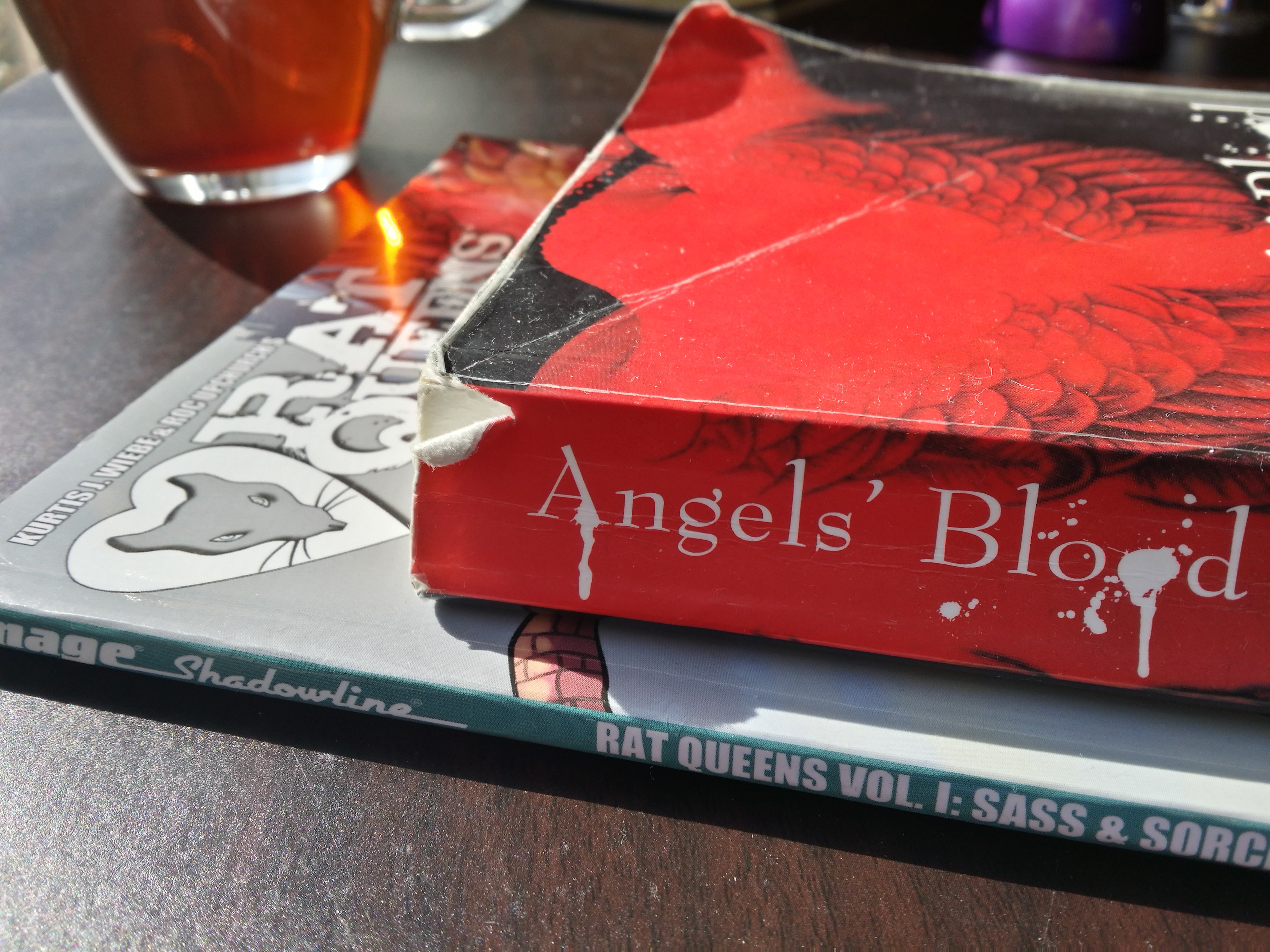
I’m going to have to start reading more paper books, just so I can have something to photograph! I acquired a few books this month but am very pleased that Mt TBR has not really grown.
Mt TBR status
Mt TBR @ 1 January 2015: 202
Mt TBR @ 30 June 2015: 215
Mt TBR @ 31 July 2015: 214
Books read
33. Dark Rebel by Becca Lusher. Reviewed here.
34. Rat Queens: Sass and Sorcery by Kurtis Wiebe. Reviewed here.
35. Checkers’ Asylum by Jarrod Elvin. Checkers may be insane, but he’s also the only one who can stop the serial killer Mutano before it is too late. A graphic novel with a strong visual style and some carefully stylised violence.
36. Angel’s Blood by Nalini Singh. Review forthcoming.
37. Microscope by Ben Robbins. An unusual RPG involving no GM and no dice. Players work together to create a wide-spanning history, beginning with the big picture, then drilling down to roleplay key scenes. Takes a bit of getting used to, but good fun.
38. Aurora: Centralis by Amanda Bridgeman. Reviewed here.
39. A Case of Possession by KJ Charles. The second in the A Charm of Magpies series and just as charming to read as the first. An absolute delight.
Books acquired
Rat Queens: Sass and Sorcery by Kurtis Wiebe
Angel’s Blood by Nalini Singh
A Case of Possession by KJ Charles
Liesmith by Alis Franklin
Microscope by Ben Robbins
In Heaven and Earth by Amy Rae Durreson
Online reading
The Court of Five Thrones Ch 49- 53 by Pia Foxhall. The story is careening to an end. Early on in this section there’s a suitably big battle between the Unseelie and Seelie courts. It uses some fantastic language and has a wonderfully desperate atmosphere. I just want to huggle Augus (but am glad he’s letting Ash do it).
Without Fear or Favor by Branch. An well-considered piece of Naruto fanfiction that plugs some holes in the original story that I hadn’t considered. It deals with how the Uchiha clan permit Hatake Kakashi to keep a closely-guarded clan secret, despite not being of the clan. Based on the quality of this piece, I’m looking forward to reading the rest of the series.
What have you read this month?


August 4, 2015
Aurora: Centralis by Amanda Bridgeman
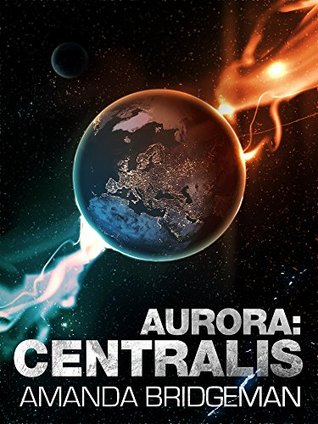
Published: March 2015 by Momentum
Format reviewed: E-book (mobi)
Series: Aurora #4
Genres: Science fiction, space opera
Source: NetGalley
Reading Challenges: Australian Women Writers Challenge 2015
Available: Momentum ~ Amazon ~ Kobo
Disclaimer: I was provided with a free copy of this book in exchange for an honest review. This review contains spoilers for previous books.
After the dramatic events of the past few missions, Captain Saul Harris and Corporal Carrie Welles have found themselves on a path they never expected to be on. Carrie, more vulnerable than she’s ever been, is placed under immense pressure as she becomes the most valuable asset to the UNF. Meanwhile, Harris works with the Aurora crew to keep the UNF at bay and shield her from their nemesis, Sharley, who wants her now more than anything. As events unfold, Carrie comes face to face with the truth of her father’s past, while Harris is forced to confront the truth of his ancestor’s. The revelations leave them reeling in shock, but not as much as when the explosive truth behind UNFASP is finally revealed.
Harris and Carrie struggle with the difficult decisions they have to make, while the Aurora team endures their toughest challenge yet. Once again they come face to face with their enemies in a showdown that will rock them to their very core and change them all forever.
For the Aurora team, Centralis, is the beginning, and end, of everything …
At the end of Aurora: Meridian, Corporal Carrie Welles discovered she had been unknowingly impregnated with fraternal twins by an evil scientist. I admit I was a bit sceptical about how this would play out, feeling it was beginning to veer a bit into the territory of melodrama. However, I feel Aurora: Centralis handles its material deftly.
Centralis marks the halfway point for the Aurora series, being the fourth of eight expected books. As such, it is a transitional book and suffers a little bit from middle book sag. It’s a bit of slow, with lots of waiting around. Those expecting a lot of action will be disappointed. While there is some, the focus is mostly on the characters as they deal with their changing lives and relationships. I found this gave it a stronger space-opera feel. Centralis widens the scope of the series; more time passes than throughout the other books and we begin to see the bigger picture, the bigger threat. The stakes become higher.
Prior to this book, the plot threads involving the private lives of Captain Harris and Corporal Welles remained fairly separate; now, they begin to weave together. I enjoyed seeing this convergence. Until now, their intimacy has been more one of soldiers risking their lives for each other while nevertheless maintaining the appropriate distance as soldier and commander. In Centralis, they begin to see each other more as human beings… though perhaps not quite yet as friends.
I did have a couple of issues with the story, though these are difficult to discuss without giving too much away. I was rather disappointed in the treatment of Lieutenant McKinley. I felt his attitude was treated as misguided and something that must inevitably change. Only one person actually respected his wishes and that person had no power over the situation.
There were also some messages regarding children and parenthood I’m not entirely sure I was comfortable with.
On the whole, I found it an interesting set-up to the second half of the series. The ending packed quite an emotional punch and I’m keen to see how things play out from here.


August 2, 2015
Changing Times
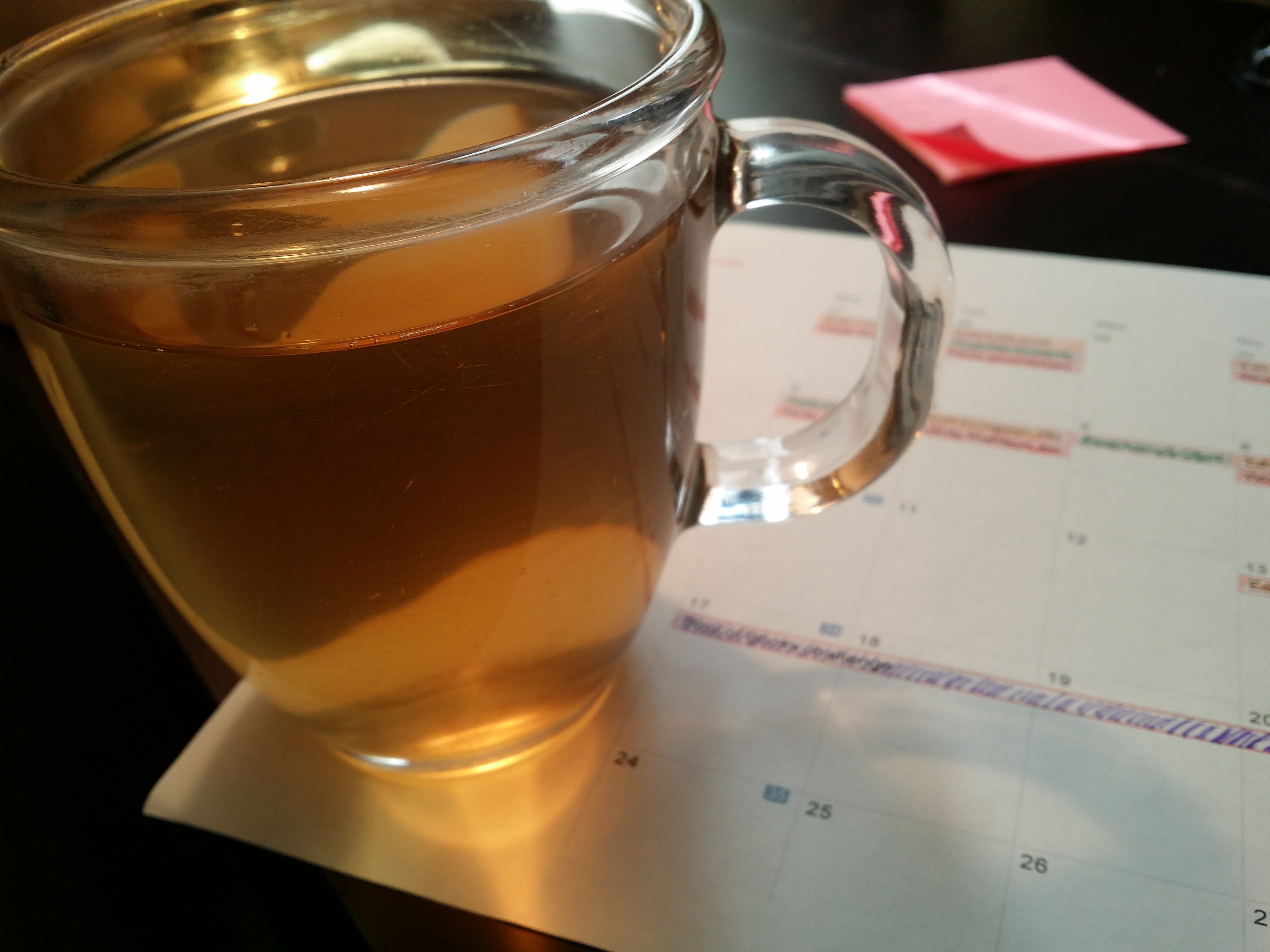
I’m very much a creature of habit. As I have mentioned before, I like to make plans and I’m usually good about sticking to them. Almost from the very beginning, blog posts have gone up here at Earl Grey Editing on Tuesdays and Thursdays (Australian time) like clockwork. But sometimes things need to change.
Recently, I sat down to take a look over the schedule for the remainder of 2015. It was already looking pretty full and I needed to make space for a particular post in August. Try as I might, I couldn’t squeeze it in. There’s a lot of interesting things happening this month. The only way to fit it all in was to start posting three times a week.
So, for the duration of August, posts will be going up on Mondays, Wednesdays and Fridays (Australian time). This won’t be a permanent change. Having said that, there are some weeks when I’d like to be able to post a little more often. Once August is over, posts will remain on Mondays and Fridays, with the occasional Wednesday post when things get busy.
I’ll admit I have no idea how this little experiment is going to go, but I hope you’ll join me in finding out.


July 30, 2015
Loose-leaf Links for July
 Loose-leaf Links is a feature where I gather together the interesting bits and pieces I’ve come across in the last month and share them with you over tea. Unsurprisingly, Earl Grey is my favourite kind of tea. This little tin of Whittard Earl Grey comes all the way from England as a souvenir.
Follow Up
Bias and reviewing is something I’ve pondered before, so I was pleased to see this excellent article on ethics and reviewing up on Uncanny Magazine. I continue to strive for transparency in my reviews.
Awards News
Sofie Laguna has won the Miles Franklin Award for her novel The Eye of the Sheep. Laguna is the 12th female winner of the award and the fourth in four years. Perhaps this is further evidence that instituting the Stella Prize is having an effect on the gender balance of the Miles Franklin Award, particularly given The Eye of the Sheep was shortlisted for the former.
Entries for the Norma K. Hemming Award are now open and will remain so until 11 December. The award is for Australian speculative fiction novels, novellas, graphic novels and plays that display excellence in the exploration of themes of race, gender, sexuality, class and disability.
Entries are also open for the 2015 Aurealis Awards.
The finalists for the 2015 British Fantasy Awards have been announced.
The 2015 World Fantasy Awards finalists have also been announced. I’m especially pleased to see Australia represented by Kaaron Warren, Angela Slatter and Janeen Webb.
Lastly, the winners of the 2015 Locus Awards have also been announced.
On Diversity
Chinelo Onwualu points out that speculative fiction doesn’t just belong to the West and looks at the very different shape of African speculative fiction. I found it a fascinating article that is going to wreak havoc on Mt TBR.
Over on BookRiot, Kelly Jensen discusses combating fat phobia in YA lit.
In her column over on Strange Horizons, Renay of Ladybusiness speaks about the pressure speculative fiction fans are under to be familiar with the genre’s predominantly white, male canon.
This led to a fantastic response from Nina Allan.
For Writers
Applications are now open for Tiptree Fellowships. The fellowship offers $500 to two creators every year.
The Tiptree Fellows might be writers, artists, scholars, media makers, remix artists, performers, musicians, or something else entirely. If you are doing work that is changing the way we think about gender through speculative narrative – maybe in a form we would recognize as the science fiction or fantasy genre, maybe in some other way – you will be eligible for a Fellowship. You won’t have to be a professional or have an institutional affiliation, as we hope to support emerging creators who don’t already have institutional support for their work.
Over on Writer Unboxed, Donald Maass discusses whether story beginnings are meant to intrigue or engage.
Alan Baxter speaks about rejection and shares some of his figures.
One of the most common pieces of advice given to writers is “write every day”. Graeme Simsion, author of the Rosie Project, speaks about how this approach doesn’t work for him. It’s nice to see someone acknowledge that one size does not fit all.
For Readers
Books galore this month! Twelfth Planet Press have announced their first non-fiction release will be coming out in August. Letters to Tiptree is an anthology celebrating the 100th birthday of Alice Sheldon, better known as James Tiptree, Jr.
TPP are following it up in September with the launch of Something New Can Come Into This World, a collection of essays by Grant Watson on the production of famous films.
Ticonderoga have just released a steampunk thriller called The Emerald Key by Christine Daigle and Stewart Sternberg
Accessing the Future, a disability-themed anthology of speculative fiction edited by Kathryn Allan and Djibril al-Ayad was also launch this month.
Lynn O’Connacht has released her science-fiction novella Courage is the Price, featuring space ghosts and a protagonist with anxiety. The novella is available on its own or as part of a book bundle of Lynn’s work.
The second part of Becca Lusher’s Dark Rebellion series is out now. Following on from The Dark Rebel (reviewed here), you’ll no doubt hear more from me soon on The Rebel Returns.
If short fiction is more your jam, Tiny Owl Workshop has released the second instalment of stories for their series The Lane of Unusual Traders.
Still looking for more to read? Try this list of feminist, bad-ass romance recommendations from Kerry McHugh. My wishlist just got a little longer.
Over on Kill Your Darlings, Danielle Binks calls for readers to show more love for Australian YA, after only two Australian authors appeared on the Australian Library and Information Association’s list of most borrowed YA books for the first quarter of 2015.
If that’s something you’d like to do but aren’t sure where to start, I’d recommend joining the Aussie Bloggers Book Club being started by Michelle of The Unfinished Bookshelf and Nicola of My Book Burrow.
Memory of In the Forest of Stories shares some thoughts on spoilers. For the record, I am strictly anti-spoiler and try to keep my reviews spoiler-free.
Lastly, I recently had the great delight of appearing on the Amateur Hour podcast. To celebrate the launch of Harper Lee’s Go Set A Watchman, Nicky Rowlands and I were invited to talk books–and, of course, I never pass up an opportunity to talk books!


July 27, 2015
Review: Rat Queens Vol. 1: Sass and Sorcery by Kurtis Wiebe & Roc Upchurch
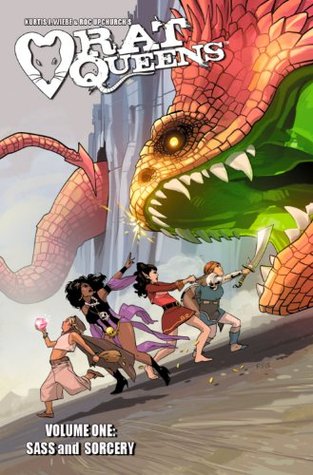
Published: March 2014 by Image Comics
Format reviewed: Paperback, 128 pages
Series: Rat Queens
Genres: Graphic novel, fantasy
Source: Borrowed from the library
Available: Abbey’s ~ Amazon ~ Book Depository ~ Booktopia ~ ComiXology ~ Dymocks ~ Kobo ~ Smashwords
Who are the Rat Queens?
A pack of booze-guzzling, death-dealing battle maidens-for-hire, and they’re in the business of killing all god’s creatures for profit.
It’s also a darkly comedic sass-and-sorcery series starring Hannah the Rockabilly Elven Mage, Violet the Hipster Dwarven Fighter, Dee the Atheist Human Cleric and Betty the Hippy Smidgen Thief. This modern spin on an old school genre is a violent monster-killing epic that is like Buffy meets Tank Girl in a Lord of the Rings world on crack!
I’m not sure that I’ve mentioned it on this blog before, but I am a tabletop RPG geek. I’ve been playing for about 15 years and it is only in the last year or two that I’ve not been the only female player at the table. So it was refreshing to see an all-female adventuring group. An all-female, ass-kicking adventuring group.
The Rat Queens are one of several adventuring bands that make their home in the village of Palisade. The adventurers keep the villagers safe… at least from the monsters. Their frequent, drunken revels and short tempers have caused a significant amount of trouble and property damage. The captain of the guard, Sawyer, has gone a little easier on them than he should have, perhaps on account of his ill-advised relationship with one of the Rat Queens, Hannah. However, after yet another night in jail, the adventuring bands are offered a choice: accept a mission from the village council or remain in jail. A pretty easy choice for the adventuring parties, especially since the missions are also pretty easy.
A little too easy.
The gamer in me found many moments of recognition in this comic: the parties that get out of hand, the mission that doesn’t quite go to plan, the attempts (both failed and successful) at quippy one-liners and the fighting tactics. Betty’s Holmesian investigation of the merchant guild and subsequent exit made me smile.
The Rat Queens’ loyalty to each other was also pitch-perfect. They might squabble amongst themselves (especially when Betty packs only candy and drugs as adventuring rations for the group), but they have each other’s back. Sometimes that means jumping into a fray and sometimes that means giving someone else space. When Violet’s twin brother comes to pressure her to return home, the other Rat Queens recognise that she is handling the situation herself but are ready to jump in, should she give the word. It was awesome to see that sort of respect.
The diversity in Rat Queens was also pretty awesome. There are important characters with a variety of skin colours–and I don’t just mean green (looking at you, Guardians of the Galaxy movie). Even leaving aside Rat Queen Dee, Sawyer, an African-American, is both the captain of the guard and the hottest guy in town. Betty’s crush is an Asian woman.
I loved that we learn a little of each Rat Queen’s background. A couple of these backstories have already fed into the main plot and I’m looking forward to seeing that built upon as we get to better know the Rat Queens.
Perhaps unsurprisingly, I find myself drawing comparisons with Saga. There’s less complexity to Rat Queens, fewer factions and layers of intrigue (so far, at least). However, I also feel like that gave me more time with the characters.
On the whole, I found it a lot of fun and, as a gamer, it was right up my alley. I’ll definitely be checking out the next volume from the library.


July 23, 2015
Brewing Community with Helen Stubbs

Photo by Chris Fitzgerald. Used with permission.
Brewing Community is a series of guest posts in which readers, writers, artists and fans are invited to share their experiences of community. Whether online or in person, these groups bring a great deal of support and sometimes stress to their members. The aim of this series is to share the joy and find ways to brew stronger communities. If you have some experiences you’d like to share, please let me know.
Today I’m joined by Helen Stubbs. Helen and I first met when I edited her story The Stormchilds in Winds of Change and we quickly became firm friends. She’s currently working on a very exciting project centred around brewing community, so I’ve invited her to share it with us.
Dear Readers,
Writing communities are wonderful, and helping to build them is satisfying work. I first discovered writing communities through Authonomy, Write That Book – a course supported by my local council, Vision Writers and the Australian speculative fiction community (through attending Aussiecon in 2010).
These communities certainly have taught me about writing and provided opportunities for publication but more importantly they’ve introduced me to writers with whom I share deep friendships sprung from a love of literature and a special weirdness writers seem to have!
As a result, when I come across the opportunity to develop local writing communities, I pounce on it. My current project, supported by Gold Coast City Council, is called Writers Activation.
I started planning Writers Activation when the council put out a call for applicants for the Found Mentorship program. They asked for creative projects that would enliven Southport.
My initial idea was to create a short story project, and collect short stories onto a website while also spreading them through the city through words on walls or public artwork and products such as napkins, as Tiny Owl Workshop did with Napkin Stories.
As an artist and cultural producer, I know that projects change! You develop a definite vision of what you want to do, and then respond to new opportunities, restrictions and whatever resources are available. When I had been shortlisted and was preparing for my interview, my prospective mentor asked me to show how this project could work within a defined space – a shop or a room.
This naturally transformed the project in my mind from something spanning a suburb or more to something that could happen within a space that belonged to writers.
When I began to ask my network what writers wanted from a dedicated space, the response was overwhelming – they want everything! The Gold Coast is yearning for a writing space. So that is what Writers Activation is becoming, within the parameters of limited resources and timeframe.
While I’m still working out exactly what can happen with that space, (it looks like it will be a shop in a shopping centre), our local writing community is jumping with ideas and enthusiasm.
The space we’re looking at would work well as a hub where writers can meet and chat. We might also host writers in residencies, workshops, talks and book launches. As a pop-up project, it might only be for a very brief period of time – possibly just two months. However, if the project grows legs and leaps off into a gallop, it could lead to a permanent writers’ space in the city.
The Gold Coast is really growing culturally. It always has had a vibrant creative culture, though when I moved here thirteen years ago I found it hard to find. Maybe it was harder to connect because our city is a sprawl along the coast.
It seems like the network’s connections are growing rapidly now, thanks to the development of social media and also the momentum for growth the upcoming Commonwealth Games is creating.
Writers Activation should be up and running quite soon. I’ll drop by again for an update.
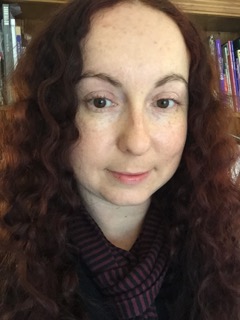
HELEN STUBBS writes stories that are dark with pointy edges. Some have been published in venues such as Winds of Change, Next, Midnight Echo, Subtropical Suspense and Mirror Dance. She recently won a Ditmar Award and is currently curating Writers Activation on the Gold Coast. Helen is on the committee for Contact 2016 in Brisbane. She interviews speculative fiction writers for Galactic Chat and tweets as @superleni.


July 20, 2015
Review: Dark Rebel by Becca Lusher
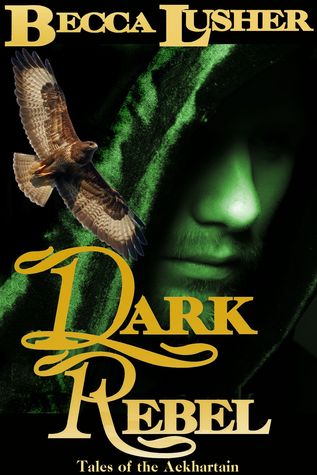
Published: March 2015
Format reviewed: E-book (mobi)
Series: Tales of the Aekhartain (Dark Rebellion #1)
Genres: Historical fantasy
Source: Smashwords
Available: Amazon ~ Kobo ~ Smashwords
Disclaimer: The author is a friend. I have done my best to give an unbiased review.
A shadow lies over the marshes of Dumnonia.
A man moves in the darkness. He is a whisper, a legend. He is the Dark Dumnonii… and he’s looking for revenge.
In the year 814 AD Egbert, King of Wessex, ravaged and conquered Dumnonia, but there were some who resisted. Eleven years on and the Britons refuse to be subdued. Now the king has returned and the rebels are waiting.
Amongst them is Caligo, a man of darkness, a shadow in the marsh, and he is determined to take back that which was stolen.
Dark Rebel is the second tale of the Aekhartain to have a historical setting (or the third, if you count Be With Me separately from Unbound and Free). Several hundred years have passed since Demero lived in these lands and things are very different now. The Britons have been pushed west by the Saxons, many fleeing over the ocean. But some are not content to run.
Caligo has made a name for himself as a scout, spy and assassin. While his sister fights for future generations as the Briton rebels’ leader, Caligo is in it purely for revenge. The Saxons have taken his home and killed his family, and he is determined to make them pay. Unsurprisingly, Caligo is not much of a people person. He prefers to work alone and is abrupt to the point of rudeness. However, he does have his redeeming features. There is a great yearning in Caligo to belong, and his relationship with his sister is warm, if distant. He may not be inclined to show affection to the people around him, but he certainly does to the animals in his care. I particularly enjoyed his relationship with his buzzard, Noctis.
Much like Unbound and Free, Dark Rebel is divided into two parts. The first focuses on Caligo’s rebellion. This part didn’t gel for me quite as well as the second half. Caligo finds himself with the chance to observe the movements of the King of Wessex, perhaps even assassinate him. To that end, he and a group of eight other rebels travel to where the King is encamped. I feel like the size of the group was a bit of a problem, both for the nature of the mission and from a story perspective; it took some concentration to keep track of who everyone was. This is perhaps complicated somewhat by the fact that Caligo himself doesn’t connect much with them. He warms up a bit as the story progresses, but mostly he keeps himself separate.
I also wasn’t sold on his instant attraction to Beibhinn. It comes to make a kind of sense as the story progresses, but it had little emotion or heat to it. Instead, it seemed to get lost in everything else that was going on. The ending of the story had a pretty big impact, but I feel it could have been even greater if something more had been made of this attraction.
The second half of the story focuses more on the Aekhartain connection. This is where the story really starts to hit its stride. We reunite with the familiar characters of Shaiel and Demero, whose banter offer something stronger to connect to than Caligo’s sullenness and desire for revenge. Despite their friendly faces, they are not shown without their flaws. In their arguments, Caligo has some excellent points, while Shaiel and Demero are shown to be perhaps a little too laissez-faire. I loved this balance in the characters’ depiction.
The ending of the story does an excellent job of bringing the two halves together in a suitably dramatic way. There was enough feeling of resolution, even as the way is left open for the sequel.
Overall, I’d say Dark Rebel is not the strongest of the Tales of the Aekhartain and, while it could conceivably stand alone, readers will get more out of it if they have read the previous stories–particularly Unbound and Free. Nevertheless, it is an excellent addition to the series and adds a nice layer of complexity.


July 16, 2015
Brewing Community with Ian McHugh
Photo by Chris Fitzgerald. Used with permission.
Brewing Community is a series of guest posts in which readers, writers, artists and fans are invited to share their experiences of community. Whether online or in person, these groups bring a great deal of support and sometimes stress to their members. The aim of this series is to share the joy and find ways to brew stronger communities. If you have some experiences you’d like to share, please let me know.
If you’ve taken a peek at my bio, you’ll know that the Canberra Speculative Fiction Guild is a community that has supported me in many ways. One of those ways involved giving me a chance to edit my very first anthology. Today I’ve invited former president and current editor Ian McHugh to share some of his experiences with this community.
CSFG anthologies and community
Elizabeth asked me to write this post for her community blog series, on how community has helped and hindered us in pulling together CSFG’s forthcoming anthology, The Never Never Land. It’s a topic Elizabeth knows a fair bit about, having edited Winds of Change, the anthology before the last one, which was Next – although the Next anthology isn’t to be confused with the one that’s currently forthcoming, that’s The Never Never Land…

Cover by Shauna O’Meara
A moment of your indulgence, if you please, for an explanatory digression: Thanks to our esteemed comrades, the good Doctors Simon Petrie and Rob Porteous, we are forever constrained from calling any future anthologies the next one, because Next was the last one. This means that Winds of Change, as the anthology before the last one, is also the anthology before Next. Which is not to say that it’s the current forthcoming one, which is The Never Never Land, being the anthology after Next and, therefore, the one that’s immediately forthcoming.
Clear?
Good. About hindrances? See Doctors Petrie and Porteous.
How has community helped us with The Never Never Land?
Well, CSFG’s anthologies wouldn’t exist without the community of writers and editors in the Greater Canberra region (draw a triangle from Melbourne to Hanoi to Vancouver and you’ve about covered it). Community is what makes these books happen and community is the reason why they happen.
CSFG’s anthologies exist primarily as a development exercise for our members. Which is not to say that they’re a sheltered workshop, because those don’t develop anyone. What I mean is, if not for that underlying purpose, we probably wouldn’t do them.
Each anthology is edited by one or two members of the group (we had three for The Never Never Land, but lost one, which was careless, admittedly, but we knew starting out that we were more lackadaisical than most so that’s why we packed a spare). The editors choose a broad theme for the book and then go out to the open market of Australian writers for submissions.
This means that, when CSFG members submit stories for the anthologies, they’re competing against writers from all over the country. Typically, somewhere around a third of each book is comprised of stories by members. A surprising number of those are first or second publications from new writers in the group. Many of those member stories are workshopped in CSFG’s monthly critiquing circle. The editors exclude themselves from crit circle, though, and submissions are de-identified so that members really are having to compete as they would in any other market.
Nicky Rowlands’s story “On the Wall” from the Next anthology (the last one, not the forthcoming one) was her first publication and was one of four stories from that book selected for The Year’s Best Australian Fantasy and Horror 2013. CSFG’s reputation as a community keeps attracting good new writers, and that community, focused on nurturing its members, helps them to keep getting better at what they do.
Leife Shallcross, our current President, is another good example. Leife sold her first story to Elizabeth for Winds of Change (the anthology before Next, the last anthology), her third to Simon and Rob for Next (the last anthology) and her most recent publication is in volume three of The Apocalypse Triptych, co-edited by John Joseph Adams (Lightspeed, Nightmare Magazine). There’s four more CSFG members with first sales in The Never Never Land: Angus Yeates, M. James Richards, Rivqa Rafael and Linh T. Nguyen.
Community helps us with the other two thirds of each book, too. Established writers (members and non-members) like Thoraiya Dyer, Charlotte Nash, Cat Sparks, Claire McKenna, Martin Livings, Janeen Webb, Alan Baxter, Richard Harland, Carol Ryles, Maxine McArthur, Donna Maree Hanson, Nicole R. Murphy (those names are just from the forthcoming anthology, the last one, and the one before Next) think enough of our books and what we’re doing to send us stories, even though we’re only paying about six cups of overpriced coffee.
Everything that needs to be done to make one of our anthologies happen relies on community. Aside from editing, that includes wrangling submissions, proofing, typesetting, marketing and selling: all done by members of the group volunteering their time. That also means that producing the books can be susceptible to life happening to the people who’ve put their hands up. Life has seemed to happen rather a lot to The Never Never Land. At moments it’s felt like we’re Sideshow Bob, surrounded by a circle of rakes. I’m making light of it, but a number people have made their contributions to this book in spite of particularly difficult and demanding circumstances elsewhere in their lives.
CSFG’s anthologies happen because of the community that contributes to making them, and community is the reason why we make them.
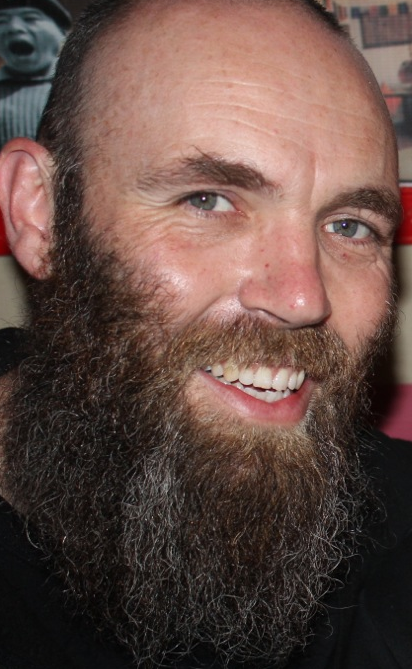
Ian McHugh’s debut short story collection, Angel Dust, was shortlisted for Best Collection at Australia’s Aurealis Awards in 2015. His work has appeared in publications including Asimov’s Science Fiction, Analog Science Fiction and Fact, Beneath Ceaseless Skies, Urban Fantasy Magazine and the Clockwork Phoenix anthologies. You can find all of Ian’s past publications either in Angel Dust or at ianmchugh.wordpress.com. Ian is co-editor of the Canberra Speculative Fiction Guild’s forthcoming (but not Next) anthology, The Never Never Land.


July 13, 2015
Review – Aurora: Meridian by Amanda Bridgeman
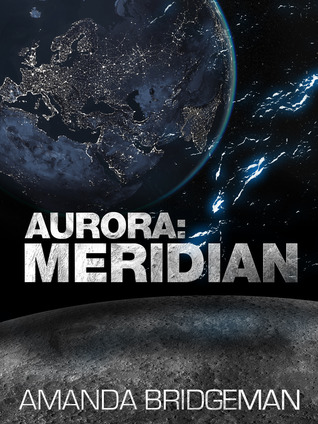
Published: September 2014 by Momentum
Format reviewed: E-book (mobi)
Series: Aurora #3
Genres: Science fiction
Source: Amazon
Reading Challenges: Australian Women Writers Challenge 2015
Available: Momentum ~ Amazon ~ Kobo
Disclaimer: This review may contain spoilers for previous books.
Captain Saul Harris has found himself at a crossroads. Haunted by dreams of the dead, he fights to keep his soldiers safe as events spiral out of his control. But has his search for the truth led him to discover there is more to this mission of chasing Sharley than meets the eye?
Meanwhile, Corporal Carrie Welles seeks revenge. Consumed with demons from her past two missions, she goes rogue in the hope that her actions will end all the pain and suffering the Aurora team has endured. But will facing the enemy free them all from Sharley’s cruel grasp, or has she condemned herself to a suicide mission?
As the mystery of Sharley and UNFASP unfolds and lives hang in the balance, Harris and Carrie are forced to search deep inside themselves, and what they find will shock them
When the previous book left off, Carrie had just been unwillingly transferred off the Aurora after her inappropriate behaviour led to a conflict between other crew members. Her humiliation by friend and foe made Aurora: Pegasus a difficult read for me and I was a little bit wary of where Aurora: Meridian might lead.
The book picks up almost exactly where Pegasus left off–with Carrie aboard the Vortex in shock over her abandonment by the crew of the Aurora. While this despair is completely understandable, I was also glad to see Carrie doesn’t wallow in it. Instead, she lets it crystallise into a determination that drives the rest of the book. She vows to get revenge, not against the crew of the Aurora, but against the man that started it all: Dr Sharley. It is a dangerous plan, but it works in the context of the story because it is clear Carrie is acting from a place that isn’t entirely rational after all the trauma she has endured.
While there is a hardness to Carrie’s determination, it doesn’t strip her of compassion. This is especially made evident by Carrie’s attitude towards the crew of the Vortex. She does her best to avoid getting close her new crew members, partly to make her escape easier. However, she also quickly realises that her presence among them puts them at risk and she does not want to see any more of her crew members die. And even though she does her best to keep her distance, she isn’t entirely successful. This only made me like her more.
Interestingly, I liked Captain Harris a bit less. Throughout the series, there has been some underlying suggestions that the crew of the Aurora aren’t very far removed from the Jumbo super-soldiers they face. Sharley has had designs to convert them since the very beginning of the series and I can see why. Harris comes across as particularly territorial in this book, both in incidents with his family and in his early exchanges with Captain Lee of the Vortex. This didn’t particularly endear him. Sharley insists that Harris will make a great leader for his Jumbos, and perhaps he may. But I’m not convinced he is doing a good job with his leadership of the Aurora. To be fair, the circumstances have been difficult and I felt he began to redeem himself a little in the end.
Overall, I found Meridian to be a stronger book than Pegasus. The pacing has improved and I found it a bit less predictable. My one criticism is that the ending started to feel a bit soapy for me. I feel that Aurora: Centralis is going to need to tread carefully with its treatment of relationships. Nevertheless, I found Meridian an enjoyable read.


July 9, 2015
Brewing Community with Stephanie Gunn
Photo by Chris Fitzgerald. Used with permission.
Brewing Community is a series of guest posts in which readers, writers, artists and fans are invited to share their experiences of community. Whether online or in person, these groups bring a great deal of support and sometimes stress to their members. The aim of this series is to share the joy and find ways to brew stronger communities. If you have some experiences you’d like to share, please let me know.
To get things bubbling away, Stephanie Gunn joins me today. She is a talented writer and one of the most astute reviewers I’ve come across. On top of that, she is one of the hard-working judges of the Aurealis Awards and has contributed a lot to the Australian speculative fiction community.
When the world falls down:
finding home in the speculative fiction community.
Everyone has an origin story, a once upon a time, a call to adventure. This is mine. This is the story of how my world fell down, and how, in the pieces of that world, I found a new home.
In my early twenties, I was midway through a PhD in genetics/immunology. I was going to my first overseas conference in New York to present some of my research, after which I was going to travel to England for a holiday. Stepping onto that plane, everything seemed full of possibility. Every since I was a little girl, I had wanted to be a doctor. This wasn’t the medical career I had planned for, but medical research was close enough.
The moment I set foot on English soil, I got sick. Just a bad cold or flu, I told myself. I took cold medication and dragged myself through the rest of the trip. I coughed badly enough that I developed laryngitis, and I barely slept. There’s a photo of me standing at Stonehenge—a place I had always dreamed of visiting, much as I’d always dreamed of being a doctor. I barely remember being there.
When I came home, my doctor told me to rest, not to speak. Told me I’d get better.
I never did.
My voice came back, but the crippling fatigue remained. I developed severe joints pains, had awful migraines, constant nausea, brain fog. I slept and I slept, and I always woke up feeling exhausted.
For the next few years, I struggled to keep working on the PhD. Eventually, after many appointments and tests, I was diagnosed with fibromyalgia, then an undifferentiated connective tissue disease (an autoimmune disease in which my body was producing antibodies against my connective tissue). I transferred my PhD enrolment to part time, started on medication. I kept pushing, still thinking that I was going to get better.
I felt acutely that I was letting everyone down. My supervisors were amazing, but I could tell that my work wasn’t what it once had been. I was always exhausted, always in pain, and sometimes the brain fog was thick enough that I lost words when I was speaking. I would try to be the first person in the lab in the mornings, thinking I could at least do that, but I was always limping my way home at lunchtime, to sleep away the afternoon.
I finished my degree and felt no achievement in it, just the sense that it should have been better. I was too ill to go to my graduation. No pictures of me standing in robes, just a degree unceremoniously delivered in the mail. Everyone else I was studying with went on to productive careers. I went onto the Disability Support Pension.
Every time I look at that degree on the wall, I feel a sense of failure. I feel that I let everyone down.
I had always been a voracious reader, and had always written. In my late teens, I had attempted to get work published, with no success (and rightly so, for that work was truly dreadful). As I had devoted more and more time to study, the writing had mostly been pushed aside. I always planned to write, but science would be my main career.
After I graduated, I battled with a severe depression. When I was really ill, I could barely read. My life consisted of moving from my bed to the couch, being almost totally dependent upon my mother. Slowly, however, I learned to manage my illness better, and I started to be able to read again. And I started to write again.
The internet was the greatest blessing I had in those years (other than my parents, who always supported me unconditionally). Through the screen of my laptop, I discovered a community: people who loved reading the same kinds of books I did, people who reviewed them, and the people who wrote them.
I came across people like Laura Hillenbrand, who wrote best-selling novels despite suffering from Chronic Fatigue Syndrome. And realized that, even though I’d lost my career as a scientist, I could still be a writer.
Slowly, I started branching out more, volunteering my time and energy to contribute to the speculative fiction community. I reviewed books for Horrorscope, then AsiF, then moved to reviewing on Goodreads and my own blog, the latter spurred on by joining the Australian Women Writers Challenge. I started reading slush for Andromeda Spaceways Inflight Magazine. I volunteered to judge the Australian Shadows Awards, then the Aurealis Awards, convening panels for the last few years.
It is hard for me to find the words to describe how much it means to be a part of this community. To have people who have trusted me enough to judge awards, to have editors who have liked my work enough to pay me for it and publish it. To be listened to. To be valued.
I have met so many amazing people in this community. So many of us are drawn to speculative fiction because we feel like outsiders. And yet, in this strange place—sometimes virtual, sometimes real—we find a kind of family, people who are like us. There are people who deal with chronic illness and disability, people who fight for feminist issues, people who believe that this world can be more than what others have made it. People who welcome, people who look beyond physical ability.
I discovered, years down the track, that there were people I worked with in science who doubted that my illness was real. In the speculative fiction community, no one has ever doubted me. No one has ever thought I was being lazy when I needed to sit down, or looked askance at the times I’ve needed to use a cane. No one takes offense if I need to leave early, or if I can’t go to something because I’m not doing well.
If I could go back in time and speak to that women boarding her flight to New York, if I had the opportunity to stop her from getting that flu, I’m not certain I would. There are limits to my life because of my illness, but there is a joy and value in spite of it. I aim now to give back as much as I can to the speculative fiction community by judging awards, buying books, reviewing them. Valuing others, no matter what. Hoping that I can be a part of helping others if their own worlds fall down.
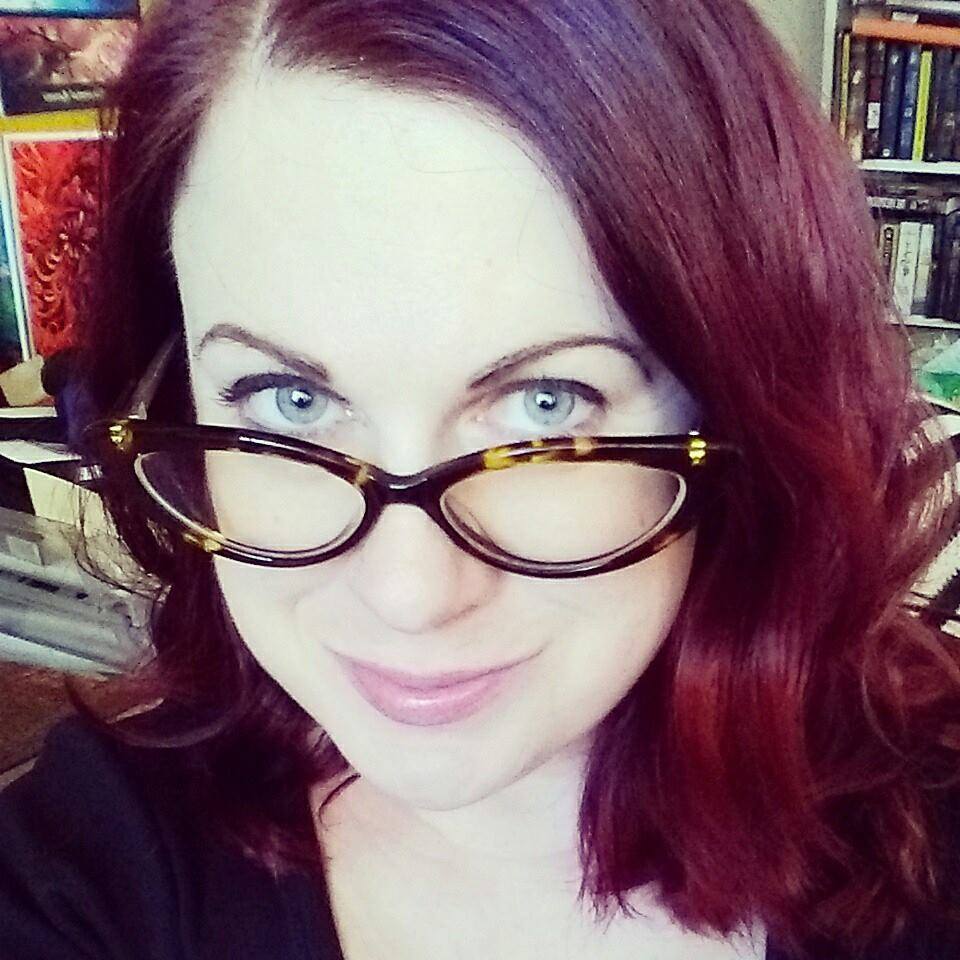
Stephanie Gunn is a writer of speculative fiction whose short stories have appeared in anthologies such as Bloodlines, Kisses by Clockwork, Bloodstones, Epilogue, Grant’s Pass and Hear Me Roar. In another life she was a research scientist, but now spends her time writing, reading and reviewing. She has reviewed for Horrorscope and AsiF, and now posts reviews on her own website, most of which are part of the Australian Women Writers Challenge. She has been nominated for Ditmar and Tin Duck Awards, and has won the latter for fan writing. She has judged for both the Australian Shadows and Aurealis Awards. She lives in Perth, Western Australia with her husband, son and requisite fluffy cat, and is currently at work on a contemporary fantasy novel. You can find her at stephaniegunn.com.