Elizabeth Fitzgerald's Blog: Earl Grey Editing, page 51
February 19, 2015
Conversation: Some Kind of Fairy Tale by Graham Joyce
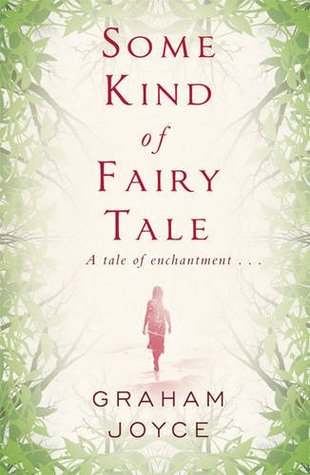
One of my very favourite things about reading a book is discussing it with friends afterwards… or better yet, during. I loved literature classes at university and I often wonder why I haven’t joined a book club. I love the way other people bring other perspectives to the text, allowing me to see it in a different way.
Back in late November, Lynn O’Connacht mentioned in her reading round-up that she’d set down Some Kind of Fairy Tale by Graham Joyce, finding it wasn’t a book she was able to connect with.
“It’s the kind of book I’d do best reading in a group-setting, the kind of book that I’d gladly read cover-to-cover for university classes and yet would never consider picking up for myself. As I’m not reading this for a group discussion or a course, I’d rather spend my time reading something else. I’d be happy to pick it up again at a later date if anyone wanted to read along with me, though.”
Since Some Kind of Fairy Tale had been on my wish list for a little while, I immediately went “Ooo… pick me, pick me!” And here we are.
Lynn has been a good friend of mine for many years, but for those who don’t know her, I will let her introduce herself:
Hi, everyone! I’m Lynn, an indie author, a reader, a gamer, and an occasional watcher of dvds. I mostly read and write speculative fiction and then blog about both. I have an MA in English literature, specialising in British fantasy as well as Creative Writing. I love discussing stories, so I was delighted when Elizabeth expressed interest in a discussion of Some Kind of Fairy Tale. I’ve had great fun with it and I hope you’ll enjoy reading our discussion too.
This is less of a review than a conversation. It is somewhat spoilery and will probably work best if you’ve read the book. If you haven’t, or you need refreshing, here’s the Amazon description.
Some Kind of Fairy Tale is a very English story. A story of woods and clearings, a story of folk tales and family histories. It is as if Neil Gaiman and Joanne Harris had written a Fairy Tale together.
It is Christmas afternoon and Peter Martin gets an unexpected phonecall from his parents, asking him to come round. It pulls him away from his wife and children and into a bewildering mystery.
He arrives at his parents house and discovers that they have a visitor. His sister Tara. Not so unusual you might think, this is Christmas after all, a time when families get together. But twenty years ago Tara took a walk into the woods and never came back and as the years have gone by with no word from her the family have, unspoken, assumed that she was dead. Now she’s back, tired, dirty, dishevelled, but happy and full of stories about twenty years spent travelling the world, an epic odyssey taken on a whim.
But her stories don’t quite hang together and once she has cleaned herself up and got some sleep it becomes apparent that the intervening years have been very kind to Tara. She really does look no different from the young woman who walked out the door twenty years ago. Peter’s parents are just delighted to have their little girl back, but Peter and his best friend Richie, Tara’s one-time boyfriend, are not so sure. Tara seems happy enough but there is something about her. A haunted, otherworldly quality. Some would say it’s as if she’s off with the fairies. And as the months go by Peter begins to suspect that the woods around their homes are not finished with Tara and his family…
This conversation also got rather long, so this is only part one. You can find part two over at Lynn’s blog.
So with one final warning (SPOILERS BELOW), let me kick things off.
Elizabeth: This book gets off to a bit of a bumpy start for me. Peter’s treatment by his parents in Chapter 2 was almost enough for me to put down the book. It felt like they were punishing him because he refused to stick his head in the sand like they were. I think responsibility is going to be a key theme of this book and I can see it being echoed in Ch 3 where Peter tells his son Jack to go and put the rat he killed in the bin.
Lynn: I have to admit, though, the way people treat one another, not just Peter’s parents, is one of the things that made me put the book aside. Responsibility does seem to be shaping up as a key theme. It keeps coming back to some form of that so far.
Elizabeth: There are some interesting choices of names. I wonder if Tara is related to the Irish Hill of Tara
Lynn: I’ve read about the narrative importance of names and I definitely agree. Tara’s name conjures up immediate images of Faerie. Later on we also get the psychiatrist Underwood who adds more layers to the naming that Joyce uses too. (This was always that part of literature essays I was worst at, though.)
Elizabeth: Even the boys’ names have some vague links to fairytale. Like Peter and the Wolf or Jack and the Beanstalk. But maybe I’m reading too much into it.
Lynn: I doubt it. It’s one of those stories where everything is about the details from what I’ve seen. Mrs Larwood’s first name is Helen, likely a reference to Helen of Troy, for example. I associated Peter more with Christianity myself, probably because he’s such an opposite to Tara. And Saint Peter, of course, has the keys of heaven in Christian legends. So far in the story it’s been Peter who’s keeping Tara at arm’s lengths from anyone. He’s barring her entry back into her old life and, well, with the stories of what happens to people who return from Faerie combined with the Christian notion that fairies are angels somewhere in between the good angels and the fallen ones… There’s a gate there. Tara can’t pick up her life where it left off, not only because everything is changed, but because Peter won’t let her in. He’s the one who sends her to a psychiatrist.
Elizabeth: Excellent point about Peter. I can definitely see what you mean about him being more aligned with Christianity (and I’d been feeling his connection with Peter and the Wolf was far too tenuous). I believe the book explicitly brings up that point you make about fairies being between the good angels and the fallen ones.
Lynn: It might. I think I remember seeing it too. *rummage around* There we go. Chapter 15. Right at the top. “These Siths of Fairies they call Sleagh Maith or the Good People … are said to be of middle nature between Man and Angel, as were Daemons thought to be of old”, Reverend Robert Kirk, 1691. It’s not the entire quote, but it’s the bit we’re remembering. It’s not quite our interpretation, as you can see, but it’s similar enough to make note of it. Joyce is clearly aware of the Christian interpretation.
Elizabeth: Peter’s oldest daughter, Zoe, also has Christian connections. Zoe’s name is another form of Eve and means ‘life’. I wonder if this is a way to set her up as an echo of Tara. After all, her dating a white rapper sounds rather similar to Tara dating musician Richie. And in fact, the epilogue seems to bear this out.
Lynn: I didn’t know that about Zoe’s name! I do agree with you, though. If she’s not an echo of Tara then she’s clearly an echo of Mrs Larwood at least. Of course the women could all be echoes of one another, each in a different stage of life. If we’re to take the third person narrative as a separate character, as we must in the end, and the story it tells as constructed then things are potentially even more complicated.
Elizabeth: Leaving aside the third person narrator for now, I definitely think Mrs Larwood, Tara and Zoe gesture towards a cycle, though I haven’t entirely pinned down what kind.
Lynn: Neither have I. Something feels a bit off about the age-suggestion I made. Not that I think it’s necessarily wrong, but that it’s not all of the connection. There’s more to it.
Elizabeth: The book seems to imply that they were all considered May Queens. That could have something to do with it. The May Queen I think is meant to be the embodiment of youth, beauty and spring. This seems to tie in with the descriptions of Tara’s charisma before she was spirited away, as well as the connection with the bluebells and cherry blossoms. In some versions, the May Queen was offered as human sacrifice. Likewise, though neither Tara nor Mrs Larwood were killed, their old lives were effectively destroyed.
Still not sure that pins down the cycle, though. There’s no sense of the destruction paving the way for rebirth.
Lynn: Maybe it’s not meant to destroy nor offer rebirth of some kind? We hear about Mrs Larwood’s loss of her husband, Tara’s decision to go back to save Richie and then Zoe being told to turn away the blossom-asker. The situations slowly change over the course of those three lives because of those lives intertwining.
Elizabeth: Good point! We see a lot of those lives intertwining, thanks to all the point-of-view changes. These changes were still catching me off guard by the end of Chapter Eight, when I realised this was going to be one of those books where we hear from everyone. I found it an effective way to unsettle the reader in the beginning (appropriate for the story). Then, once we’ve got used to the shifts, it turns into a handy way to show the widespread impact of the events and to emphasise the unreliability of the narrators.
Lynn: Yep. I wonder in how far the structure helps to showcase the responsibility theme you mentioned earlier as well. By showing us the impact of the events, as well as sharing the history leading up to it, it’s a good way to show how everyone shares their own bit of responsibility for all that happened.
Elizabeth: The book reminds me a bit of Fire and Hemlock by Diana Wynne Jones. I think both try to blur the line between fantasy and reality. Only, I loved F&H and absolutely devoured it. This doesn’t have the magic for me. And I think that’s quite literal in some respects. Everyone seems so cynical. Even Tara is worn out and resigned. F&H had a sense of wonder to it and more genuinely entertained the possibility that the magic was real.
Lynn: Good comparison! Although I agree. This book doesn’t have the magic for me and the cynicism and bleakness got wearing. It does pick up a little bit when Tara starts to feel believed, I think, but there’s a… tiredness to the book for me. Even when Tara is supposed to be (yep, I went for that verb) at her most lively and vivacious with the added wonder, magic and sparkle that so often comes with stories of Faerie, there’s… no sense of that for me in her narrative. I wonder if that’s on purpose or just that we’re not meshing too well with the book.
Elizabeth: Even when Tara begins to tell her story and is describing the carpet of bluebells, it’s less that it’s magic and more like she is disclaiming responsibility (yep, there’s that word again). As you said, there’s no sense of wonder in her narrative, so I suspect that it’s not just us. Underwood makes these very points in Ch 22. I think any wonder is tainted by the choices she makes.
Lynn: Ooooh. I’ll be curious to see how that progresses in the book and whether that comes back as a theme. It’d be an interesting one to see the way wonder and people (possibly people aging) shapes up. Though I think it offers a problematic view on Tara’s abortion. Since that’s when she vanished and has already been made a fairly important point in her disappearance from everyone else’s pov, I’m finding it hard not to consider whether that loss or taint of wonder is related to the abortion. I hope I’m reading too much into that now!
Elizabeth: That seems like a reasonable connection to me, though it’s worth noting we never really see Tara in a state of wonder. So perhaps it could be argued that she never had any sense of wonder to lose?
Lynn: Could be. She’s seemed pretty down-to-earth in the flashback bits, albeit clearly still young.
END OF PART ONE
For part two, please join us at Lynn’s blog where we’ll discuss disenchantment, themes of responsibility and the relationship depicted between science and magic.


February 16, 2015
Review: In Search of Lost Dragons by Elian Black’Mor and Carine M
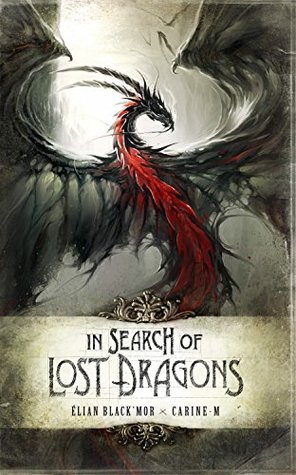
Published: December 2014 by Dynamite Entertainment
Format reviewed: E-book (.acsm)
Series: Black’Mor Chronicles
Genres: Fantasy, art book
Source: From the publisher via NetGalley
In Search of Lost Dragons presents itself as the diary of Elian Black’Mor, an intrepid explorer and naturalist with a dragon obsession. This obsession leads him to travel all over Europe and into Asia, with the story being told in diary entries, letters, maps, photos, ticket stubs and various ephemera. The format makes for a story that is jerky and incomplete in parts. Sometimes this was appropriate and at other times it seemed more a way to avoid describing how Black’Mor escaped whatever danger he was currently facing. The font didn’t help, for, while gorgeous, it was small and hard to read in places on the electronic version.
However, you don’t want the electronic version. This is the kind of book that demands gloriously full-sized colour pages in hardcover. It is the artwork that takes centre stage and the story is merely a pretext. The pages are predominately double-page spreads, many crammed with sketches, others with single, full-colour paintings. You can see a sample of the artwork in the book trailer, which I highly recommend checking out. It is truly breathtaking.
One area where the artwork disappointed me somewhat was in the design of the dragons. There are some wonderfully creative designs, particularly among the aquatic dragons. However, the dragons unfailingly had a strong European influence. I would have liked to see a stronger Asian influence in the dragons residing on that continent.
This is definitely a book fans of fantasy art won’t want to miss.


February 12, 2015
Interview with Gillian Polack
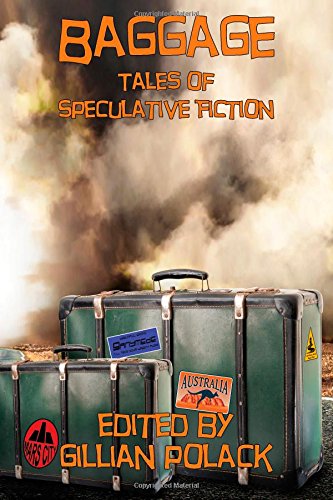
Back in October last year, I mentioned that Borgo Press had reprinted Baggage, an anthology of Australian speculative fiction that I had been honoured to work on as sub-editor. This is an anthology I am truly excited about and was thrilled to be part of. So today I’m sharing an interview with the editor (and my friend and mentor) Gillian Polack.
For those who are unfamiliar with the book, would you mind sharing a little bit about how Baggage came about?
Eneit Press had just published Life through Cellophane (now known as Ms Cellophane, and published by Momentum) and Sharyn Lilley and I were exchanging what I thought was just a fun set of emails. What would be your dream anthology? Who would you ask to be in it? That sort of thing. Except she was dead serious, as I found out when she gave me the pay rate to offer my dream writers.
It goes back further than that, though. Sharyn knew that one of my abiding interests is how people interpret the world around them, how they carry their culture and use it to shape and understand their lives. She also knows I am somewhat addicted to speculative fiction. It was a given that, given a dream anthology, I would ask writers to tell their speculative fiction tales through the lens of cultural baggage.
This theme of how people interpret the world and their lives through their culture is one that also occurs in your most recent novel Langue[dot]doc 1305. In the time between the release of these two books, how much has changed in the way you view this theme?
The way people view their world and live their lives is something I put into all my novels. These views, in fact, shape my novels. As I grow older, I learn more about people whose lives are different to my own and I find ways of understanding them (hopefully) enough so that I can write these people into my novels. It’s funny, so many of my readers tell me that this character is me or that character is me (I just had one tell me that Artemisia is me). What they are is me exploring the lives of others, so there is some overlap with things I know and this overlap leads to experiences I’ve never encountered and means I get to write about people I’ve never dreamed of being. As my wish to understand people shapes my novels, the understanding I try to achieve helps shape my life.
You were recently the GUFF delegate at Loncon and the Guest of Honour at Liburnicon. What was the most interesting piece of baggage—cultural or otherwise–you encountered on your trip?
I think the most interesting piece of baggage was my own. While I have no trouble doing the big things (presenting a Hugo, giving a Guest of Honour talk at Liburnicon) it doesn’t make me terribly happy. I love finding people who share interests and passions far more than I enjoy looking important.
How is this baggage? I found myself at the back of the stage, waiting to present that Hugo and thinking “This should have been someone else.” Australian culture is misogynistic: we are trained, and we train ourselves to ensure that men are seen and that women are worthy supporters. Once I realised that being a worthy supporter was entirely appropriate for an awards presentation (for the winner of the award is the centre of it) I was fine. It wasn’t the right thing at Liburnicon at all – I’m still thinking about that.
What was one highlight of working on Baggage?
Working on Baggage was full of many, many wonderful things but there’s one thing I haven’t talked about much and it’s at the heart of the book. I had worked on cross-cultural awareness and understanding for years before I edited Baggage. I’ve taught it to diplomats and to senior public officials and to community groups. By teaching these subjects, I learn about them from my students. This is what happened with Baggage, only it was a different kind of learning. Writers can reach deep into themselves when they write their best work. In some cases – Tessa Kum’s and KJ Bishop’s are the ones that always come to mind first – as they pushed their stories and shaped their ideas, I went on a tremendous voyage of discovery in their wake. I didn’t learn about culture and cultural baggage in the way I tended to when teaching; I learned about how it becomes a part of someone’s soul and where it can take a person.
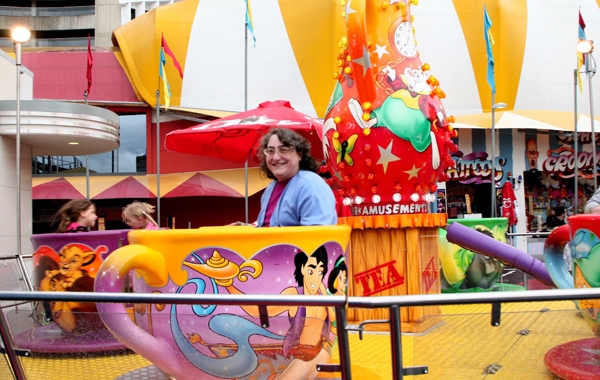
Gillian’s most recent novel is Langue[dot]doc 1305 (Satalyte). Her next novel will be the cursed one, The Art of Effective Dreaming, and will also be published by Satalyte this month. Polack is a writer, editor, historian and critic. Baggage was short-listed for a Ditmar and has recently been reprinted by Borgo. Gillian’s second novel Ms Cellophane (also a Ditmar finalist) was recently published by Momentum. She has sixteen short stories published. One of her stories won a Victorian Ministry of the Arts award and three more have been listed as recommended reading in the international lists of world’s best fantasy and science fiction short stories.


February 9, 2015
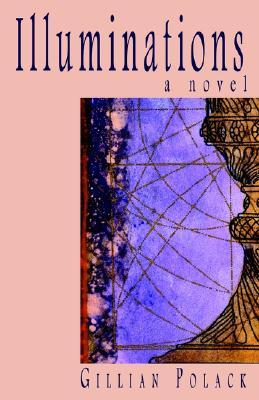
Illuminations by Gillian Polack
Published: 2002 by Trivium Publishing
Format reviewed: Paperback, 289 pages
Genres: Literary fiction, fantasy
Source: Canberra Speculative Fiction Guild
Reading Challenges: Australian Women Writers Challenge 2015
Disclaimer: The author is a friend. I have done my best to give an unbiased review.
Rose is an Australian medievalist on sabbatical in France. She discovers a strange manuscript that tells the tale of Ailinn and Guenloie, two women living in Arthurian Britain. As Ailinn and Guenloie seek to discover and overcome the evil threatening their world, Rose is preoccupied with her research and the strange behaviour of her boyfriend.
This is a Russian doll kind of story, beginning with the discovery of Rose’s letters home, then moving back and forward between Rose’s first-person account of her sabbatical and her third-person translation of Ailinn & Guenloie’s quest. Despite this, the two main stories don’t share obvious parallels so much as undercurrents the reader needs to dive for. I am not well versed in the tales of Arthur or the world of historians, so there were times I felt I was missing some of these undercurrents and some of the jokes. But I caught enough to appreciate it was a tale about the way small deeds and small lives can overcome great evil–often more effectively than flashy and powerful lives. It’s a very feminist novel, commenting on how those small lives are often overwritten by those with power. Arthur and his knights aren’t shown in a very favourable light.
Illuminations is definitely at the literary end of fantasy. Magic is portrayed in the matter-of-fact way of legends. It is slow-paced and it took me a while to get into the story. It was the characters that eventually drew me in. They are complex, with definite moods and their own motivations, and I could see bits of people I knew in them. However, it takes a while to get to know them. The book switches often between perspectives in the beginning and it wasn’t until the switches slowed down and Ailinn & Guenloie had finished their time in Arthur’s court that I began to settle into the story.
I don’t feel this is the strongest of Gillian’s novels, though I still very much enjoyed it. If you like gentle character studies mixed with Celtic legend, Illuminations is well worth looking into.


February 5, 2015
Mt TBR report: January 2015
It never quite feels like the summer holidays unless I have my nose stuck in a book. Despite the unseasonably cool, wet weather (or perhaps because of it), I did well with keeping my summer tradition. In fact, it has been a few years since I managed to read so many books in the month of January. I’m pleased to see 2015 getting off to such an enthusiastic start. If only my acquisitions hadn’t got off to an equally enthusiastic start!
Mt TBR status
Mt TBR @ 1 January 2015: 202
Mt TBR @ 31 January 2015: 209
Books read
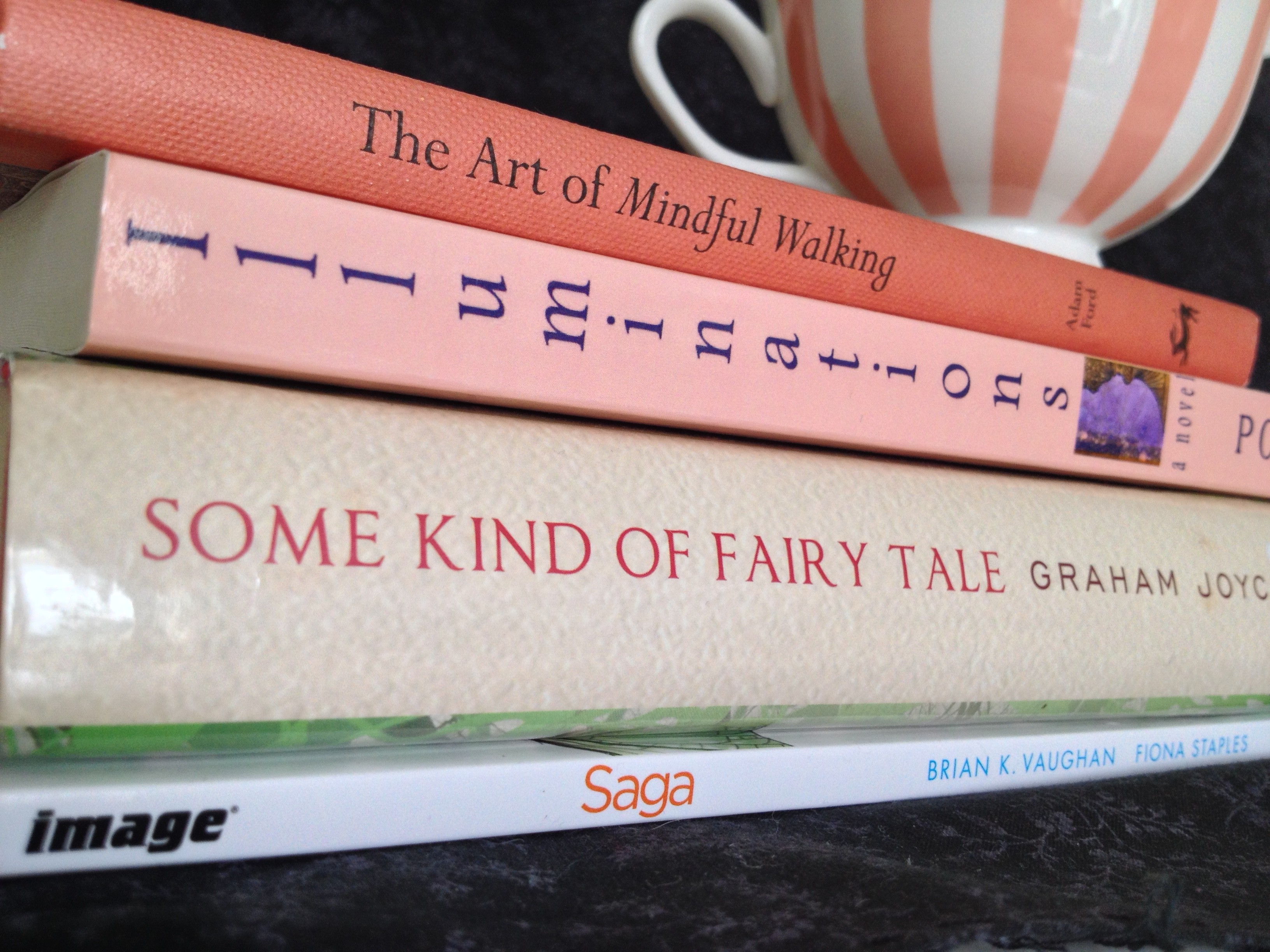
1. Illuminations by Gillian Polack. Review forthcoming
2. Ngunnawal Plant Use by the ACT Government. A field guide to native plants and the uses to which they were put by the Indigenous Ngunnawal people. Highly recommended for locals with an interest in natural history. The production values are excellent, making it the prettiest and most accessible field guide I own.
3. Some Kind of Fairy Tale by Graham Joyce. Review forthcoming.
4. Saga, Vol. 1 by Brian K Vaughan and Fiona Staples. Reviewed here.
5. The Art of Mindful Walking by Adam Ford. A strange mix of memoir, guide book and meditation on the divine written by an Anglican priest who lectures on Buddhism and Hinduism. It doesn’t pull off the mix quite as well as Corvus by Esther Woolfson but remains a pleasant read.
6. Nightmare in Steam by Lexi Ostrow. Reviewed here.
7. Saga, Vol. 2 by Brian K Vaughan and Fiona Staples. Review forthcoming.
Books acquired
Ngunnawal Plant Use
North and South by Elizabeth Gaskell
Jump: Twinmaker #1 by Sean Williams
Watcher’s Web by Patty Jansen
Cold Comfort and Other Tales by David McDonald
Saga, Vols. 1, 2 & 3 by Brian K Vaughan and Fiona Staples
Nightmare in Steam by Lexi Ostrow
The Very Best of Charles de Lint by Charles de Lint
Conan the Barbarian Omnibus by Robert E Howard
Online Reading
Finding Spring by Becca Lusher. A standalone piece that utilises characters from Becca’s novel Unbound and Free. Short and sweet, the birds particularly made me smile.
Spoils of the Spoiled Ch 3 & 4 by Pia Foxhall. For those who haven’t been following along, this is original fantasy m/m erotica and not suitable for all audiences. The characters start to come to a better understanding of each other in more ways than one. I was a little disappointed that this was the last of what has been written so far, especially now that Gwyn and Augus are starting to forge a bond (but no pressure, Pia. I have plenty of more of your work to catch up on).


February 2, 2015
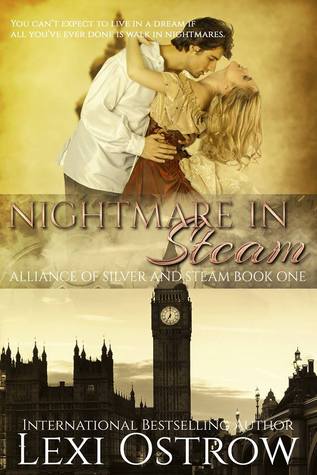
Review: Nightmare in Steam by Lexi Ostrow
Published: 2014 by Hot Ink Press
Format reviewed: E-book (mobi)
Series: Alliance of Silver and Steam #1
Genres: Erotica, Paranormal romance, Steampunk
Source: From the publisher via NetGalley
Lucius is a Nightmare Demon with the power to invade dreams and frighten people to death. On a mission to infiltrate the Alliance of Silver and Steam–a demon-hunting organisation–he encounters their top inventor, Eliza Dorley, and finds himself falling dangerously in love.
If you’re looking for a steampunk adventure with romantic themes, look elsewhere. The steampunk elements in this book are mostly set dressing for an paranormal romance/erotica and are likely to disappoint dedicated speculative fiction readers.
Although this is meant to be the first book in the series, it quickly became clear that this wasn’t the first time the author had used the setting. Eliza and Lucius have friends in common who had recently become engaged, and the Alliance is already well established. This might explain a tendency to use info-dumping as a way of bringing the reader up to speed. The alternate history was one of the most interesting things about Nightmare in Steam, so I would have liked to see a little more time spent on setting up the world for new readers and a little less on the numerous sex scenes.
The villain, Seraphina, could also have used a little more screen time. Her back story makes her motivation plain but her actions lack consistency and come across more as a way to drive the plot.
Lucius was charming and I enjoyed the way he remained pragmatic about who he was, even as he changed. The attraction between Lucius and Eliza was expressed well but I was never quite convinced by assertions that their relationship moved beyond the physical.
Overall, Nightmare in Steam wasn’t the right book for me.


January 29, 2015
Loose-leaf Links for January

No shiny covers this month, so instead here’s a photo of my new favourite loose-leaf tea, discovered courtesy of my Monstrositea subscription.
Awards News
Nominations for the 2015 Ditmar Awards close on 1 February, so if you’re a member of Australian fandom, you haven’t got long! Not sure if you qualify as Australian fandom? See section 4.1 of the Ditmar rules. Nominations can be made online and an incomplete eligibility list found here.
The 2015 Baen Fantasy Award is also open for submission until 1 April. They’re seeking stories of up to 8000 words that “captures the spirit and tradition of such great storytellers as Larry Correia, Robert E. Howard, Mercedes Lackey, Elizabeth Moon, Andre Norton, J.R.R. Tolkien and David Weber.”
The Aurealis Awards are set to be announced in April. This year the nominees for the Conveners’ Award for Excellence have been announced for the very first time. Congratulations to the Australian Women Writers Challenge for their nomination.
December saw both the Queensland Literary Awards and the Prime Minister’s Literary Awards running on the same night (which proved rather confusing for some of us following along on Twitter). The Australian Women Writers Challenge blog has a full list of winners for both awards.
Awards often come with controversy. Justine Larbalestier has written about sexism and awards.
On Diversity
Beth Revis notes that female writers continue to be erased by their male counterparts.
Nalo Hopkinson makes some suggestions regarding how editors should go about encouraging diversity in their anthologies. To which N.K. Jemisin adds a corollary.
For Writers
I’ve previously mentioned Macquarie University’s forum on changes to the Australian publishing industry. Australian Author Online has released another part of their series on this study, focussing on the global communities of authors.
Thinking about submitting to a competition (or perhaps even the Baen Fantasy Award)? Then you may be interested in this ArtsHub article on getting the most out of writing competitions.
Peter Ball also offers some commonsense advice for new writers. I admit I’m a bit of a fan of Peter’s blog and especially appreciated his post on what can get done in twenty minutes.
For Readers
Looking to discover which Australian YA books will be released this year? Check out this handy checklist from Shaheen at Speculating on SpecFic. I was especially grateful she managed to track down a tentative release date for the third book in Ambelin Kwaymullina’s The Tribe series, The Foretelling of Georgie Spider. Thanks, Shaheen!
Alan Baxter‘s Australian horror story Dream Shadow has been included in episode 155 of the Tales to Terrify podcast. Dream Shadow first appeared in Winds of Change and this is, to the best of my knowledge, the first time a story I’ve edited has ever been on a podcast.


January 26, 2015
Review: Saga, Volume One
Published: 2012 by Image Comics
Format reviewed: Paperback, 160 pages
Series: Saga #1
Genres: Science fantasy, space opera, speculative fiction, graphic novel
Source: On loan from friends
Two soldiers from opposing sides of a galactic war fall in love, desert their respective armies and have a baby together. Naturally, their commanders are less than impressed by this turn of events and want them killed. As if parenting a newborn wasn’t hard enough.
I’m late to the party on this one and I’m rather glad. The fast-paced narrative sucked me in from the very beginning and kept me turning the pages. The fourth volume has just been released and, even though I’m not that far through the series yet, I’m not looking forward to the wait once I catch up.
Volume One starts with the birth of baby Hazel on the war-torn planet of Cleave. Future Hazel serves as the narrator, though we don’t hear from her a lot. Mostly, the focus is on her parents, Marko and Alana, as they try to get off the planet alive. These two really made the comic for me. Marko is a badass swordsman who became disillusioned with the pointlessness of the war. He’s also a total softie who is almost definitely going to be wrapped around his daughter’s little finger when she grows up (provided they survive that long). It will be up to Alana to be the strict one in this parenting duo and she shows herself to be more than capable of the role. She may be somewhat vulgar but she has a backbone of steel as she drags her family out of some tight spots.
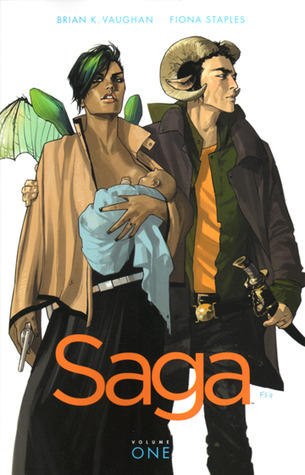
My one complaint was that Saga, like Alana, tended to be a little on the vulgar side for my tastes. I’m not fond of ‘retarded’ as a curse, even one applying to a situation. Alana is the subject of a disproportionate number of slurs compared to Marko. And there are enough boobs to keep HBO happy, should they ever decide to turn it into a TV series. That said, putting a breastfeeding woman on the front cover of the first volume earns it some respect from me.
The artwork is gorgeous. I love the use of colour and Staples has done an excellent job with the character design. In particular, I found the bounty hunter called The Stalk to be delightfully creepy. The warring armies sport a variety of horns on one side and wings on the other, rather than being two uniform races.
Being a space opera, the scope of the worldbuilding is epic and Volume One barely scratches the surface. I’ll be interested to see whether the next volumes dig deeper.
This is definitely a series I’m keen to continue, especially after the cliffhanger at the end of this volume.


January 22, 2015
Diversity and Reading
It’s that time of year where readers and reviewers are taking stock of what they’ve read, looking at their stats (if they track them) and make goals for the new year. You’ve probably noticed I’ve been doing the same. It was in this spirit that Andi of Estella’s Revenge posted her thoughts on the slippery slope of diversity tracking. She set herself a goal this year to make sure 40% of her reading was written by authors of diverse backgrounds. However, she quickly discovered this was going to be a very complex issue.
This led to the question on Twitter…
“If you’re tracking diversity in reading, how do you actually know if the person is of a racial or ethnic background you consider diverse?”
I got some answers like “I Google them!” or “I go by last name.” But if Google comes up dry, is evidence of a non-white skin color or an international-sounding last name enough to deem that author diverse? In itself, it seems that using qualifiers like skin color and last name as a deciding factor promotes the same stereotypes we’re trying to get around by reading diversely.
I’ve been mentioning the importance of reading diversely almost from my very first post here on Earl Grey Editing, so this is not some shiny new concept to me. Nevertheless, I have not tracked diversity in my reading. Partly, it is because of the issues Andi touches on but mostly it’s because I’m lazy. Why spend time researching authors when I could be reading?
We Need Diverse Books shares some very important reasons why I should spend the time:
What benefits are there to reading diverse books?
They reflect the world and people of the world
They teach respect for all cultural groups
They serve as a window and a mirror and as an example of how to interact in the world
They show that despite differences, all people share common feelings and aspirations (Source here)
They can create a wider curiosity for the world
They prepare children for the real world
They enrich educational experiences (Source here)
(For more information on why diverse reading is important, try their list of key posts and links. Also, see this excellent article on reading diversely by BookRiot.)
This still leaves the quandary of determining what constitutes diverse. For some, this means anything not written by white, straight men. For others, it means work by authors of a different race, gender, sexuality or religion. Andi concludes that it is ultimately up to each of us to determine what diversity is for ourselves. This strikes me as being a reasonable approach. Diversity in the USA looks very different to diversity in Australia, for example. As Andi puts it:
I’ll research every author. Not just the ones with non-white skin or cool last names. There’s so much more than that to discover. Our definitions of diversity will ultimately prove as diverse as the authors we choose to read.
This year I’ll be tracking diversity in my reading. I won’t be setting a target percentage like Andi, but I’m curious to see how diverse my reading really is.
Do you need to know that I’m doing this? Not according to Didi from Brown Girl Reading. In her post Reading Diversely?, she says:
I say, if you want to read a variety of literature then stop talking about it and do it. In the end, when you do it no one is going to give you a prize because you do. Lumping authors all together because they aren’t white, straight, males doesn’t valorize at all the differences in authors.
While she makes some excellent points (and the comments are well worth reading), I disagree that this is something we should stop talking about (as might be evident by the fact I’m posting on the topic). Back in September, Aarti from BookLust ran her annual A More Diverse Universe reading challenge. I participated by reading The Interrogation of Ashala Wolf by Ambelin Kwaymullina, thus discovering a new favourite author.
Would I have discovered Kwaymullina anyway? It’s possible–the Australian spec-fic industry is a small one and we have friends in common. However, it is far from certain, especially since I already have plenty of books to read. So you could say that it was Aarti’s discussion of diverse reading that lead to me reading more diversely, just as Andi’s post has encouraged me to do the same. Perhaps speaking about the issue here will encourage someone else. Diversity in reading is a complex issue and requires complex and diverse approaches. I feel that discussion and the tracking of statistics is part of that for some of us.
In that spirit, I’d love to hear any thoughts you have on the subject.
For now, I’ll let Andi have the last word:
It takes a little digging and it definitely takes some thought, and so far I’m grateful not only for the books read and authors found, but for the exercise of thinking through these issues because they’re that important.


January 19, 2015
Review: Blood of Elves by Andrzej Sapkowski
Published: 2009 by Hachette
Format reviewed: Paperback, 398 pages
Series: The Witcher #1
Genres: Fantasy
Source: Bought on Amazon
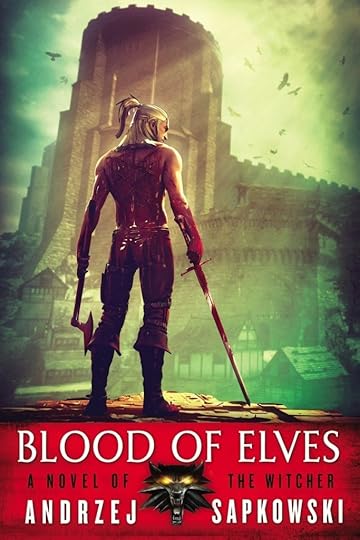
When an invading empire conquers her country, Ciri is rescued by a monster hunter called Geralt of Rivia. The princess slowly learns magic and trains as the first female witcher (as the monster hunters are called). However, her guardian has his hands full trying to keep her safe from the various factions trying to kill her.
My first encounter with Geralt of Rivia was through a computer game called The Witcher. This fantasy RPG was released in 2007 and quickly became popular, leading to a sequel. The third game is now set to be released mid-2015. I found the games featured some excellent story-telling and I appreciated the way they asked the player to make some difficult choices as Geralt negotiates tensions between the ruling humans and the races they oppress.
These computer games were inspired by a series of novels by Polish author Andrzej Sapkowski. The popularity of the games led to the novels being translated into English fourteen years after they were first published. Having enjoyed the games (with a few reservations), I was intrigued enough to try the books.
Surprisingly, I found the games kept pretty true to the feel of the book, despite not being an exact retelling. Since this is only the first book in the series, it is difficult for me to pinpoint where all the differences lie. The most obvious one is that the game has tweaked the circumstances towards monster-hunting while the book focuses more on the political machinations. The difference wasn’t as great as I expected, but it did make me aware of just how often the book involves people standing around talking. While there were some instances where this approach worked, others felt too much like infodumping and I wondered whether there was a better way of delivering the information.
The structure of the book was quite interesting. Each chapter reads like a vignette, with time skips in between. I liked the way this kept events moving forward and the conclusions were reasonably satisfying. The conclusion to the book as a whole was less satisfying, leaving it feeling more like setup than story.
There’s a strongly European influence on the worldbuilding. Part of it is the physical setting: ruined castles, dark forests, warmer nations to the south. Part of it is also political. This is a world with a long history, often involving bloodshed as each wave of invaders seeks to conquer the last. This has resulted in a cluster of small kingdoms who squabble almost as much with each other as the empire that threatens them all. These kingdoms are also very keen to make sure the races they previously conquered remain subdued and there are references to pograms in the recent past. Such echoes of European history make this much more than a straightforward, hack-and-slash fantasy narrative. For me, this examination of racism and violence lifted it a little above the standard fantasy setting.
Despite the presence of elves and dwarves, this is fantasy much more in the vein of George R.R. Martin than R.A. Salvatore. If you like your fantasy dark with plenty of intrigue and moral ambiguity, Blood of Elves may be for you. However, before you dive into it, I’d recommend reading The Last Wish. Although Blood of Elves is billed as the first in the series, it was preceded by a book of short stories and these stories provide some necessary context.