Michael May's Blog, page 135
July 10, 2015
Never Say Never Again (1983) | Villains

Thunderball's villainous, but not that bright Count Lippe is turned into a nameless assassin in Never Say Never Again. There ain't much to him except he's played by frequent Indiana Jones henchman (and General Kael from Willow) Pat Roach. And he dies in an anticlimactic, unbelievable way.

Fatima Blush replaces Fiona from Thunderball, but she's so much crueler than Fiona. Fiona was ruthless, but Fatima is downright sadistic. And manic. There's a scene in the Bahamas where she thinks she's killed Bond and she's dancing alone, whooping it up to the Caribbean music, until she spots Bond and realizes that she failed. She suddenly gets very serious and stalks off to his hotel to plant a bomb, but when she passes another band, she can't help but grin enthusiastically, dance, and applaud them. Until she's past them and then she's all business again. It's like she can't help herself. She changes moods so quickly, like she's a prisoner to her whims.
Unlike Lady in Bahamas, who seems so comfortable in her solitude, Fatima's putting on an act. Everything about her is a delusion that she's created around herself and she's probably the saddest of any Bond character ever. That's why she can't accept that she's not the greatest sex of Bond's life.
Somehow, that ties into the crazy ass, overly complicated schemes she comes up with for killing people. I'm guessing that she can't just be a competent killer; she has to be an artiste about it. Just another mask for her bottomless cauldron of insecurities. She can't just plant a bomb in Jack's car; she has to toss a snake at him to get him to drive off the road first. She can't just shoot Bond with a spear-gun; she has to use a homing device and radio-controlled sharks. Frankly, I don't know how she's lasted as a SPECTRE assassin. Her doing so reveals some weakness on Blofeld's part.

Maximilian Largo is another debilitatingly insecure, psychotic member of SPECTRE. Why does Blofeld pick these people? Largo's façade isn't as desperate as Fatima's though and he's likeable as long as he feels in control. The difference between them is highlighted in a great scene at the casino party where Fatima questions Max's ability to leave Domino and Bond alone together. She's way more pissed about it than Max is, because if it were her, she would totally lose it. She can't stand the idea of not being the center of the universe and doesn't see how he can either. But Max has enough power at that point that he can at least keep his cool. He clearly doesn't like what's going on between Domino and Bond, but he assumes that he can force her back to him later on and everything will be fine.
That doesn't explain Max's fatal mistake though, which is letting Domino keep the necklace that identifies the location of one of the nukes. I suppose you could say that Bond drives him so crazy that he makes that error, but it doesn't ring true. About that same time, he also tells Bond where the other nuke is and he's pretty calm when he does it. I can't think of a plausible, in-story explanation, unfortunately. It's just the script rushing to wrap itself up.

Regardless of his inclination for hiring psychopaths, Max von Sydow's Blofeld is a perfect, full representation of the character in From Russia with Love and Thunderball. This is what he always should have looked and acted like.
Top Ten Villains
1. Auric Goldfinger (Goldfinger)
2. Ernst Stavro Blofeld (Never Say Never Again)
3. Ernst Stavro Blofeld (From Russia With Love and Thunderball)
4. Ernst Stavro Blofeld (On Her Majesty's Secret Service)
5. Maximilian Largo (Never Say Never Again)
6. Francisco Scaramanga (The Man with the Golden Gun)
7. Dr. Kananga (Live and Let Die)
8. Doctor No (Dr. No)
9. General Gogol (For Your Eyes Only)
10. Karl Stromberg (The Spy Who Loved Me)
Top Ten Henchmen
1. Baron Samedi (Live and Let Die)
2. Fiona Volpe (Thunderball)
3. Grant (From Russia with Love)
4. Nick Nack (The Man with the Golden Gun)
5. Gobinda (Octopussy)
6. Naomi (The Spy Who Loved Me)
7. Oddjob (Goldfinger)
8. Jaws (The Spy Who Loved Me)
9. Irma Bunt (On Her Majesty's Secret Service)
10. Miss Taro (Dr. No)


Never Say Never Again (1983) | Women

Lady in Bahamas doesn't even get a name, but I like her for a couple of reasons. First, I dig that she's just hanging out in the Bahamas on her own vacation, doing some deep sea fishing. She flirts with Bond when she first meets him, but she's not falling over herself about him. She appears to be independent and confident.
The second thing I like about her is that she's played by Valerie Leon. Leon had a bit part in The Spy Who Loved Me as a hotel receptionist, but Hammer horror fans know her as Margaret/Tera in Blood from the Mummy's Tomb.

If you'd asked 16-year-old me his favorite Bond Girl, he would have told you Fatima Blush. But that was all about the thong. I might have told you it was also about her confidence, but grown-up me realizes how shallow her self-assurance really is. She's a fake and a super dangerous one.

It's tough not to compare Kim Basinger's Domino with the ones from the novel and the previous movie. Literary Domino is one of my favorite women in the books and Claudine Auger - despite her weakness as an actress - brings some heat and fury to the part that Basinger is sadly missing. In Never Say Never Again, Domino is more prop than character. That's mostly a script problem. She at least gets her revenge on Largo for the death of her brother, but the rest of the time she's weakly submissive to first Largo and then Bond. Basinger's still able to make her likeable, but I end up pitying her when I want to admire her.
My Favorite Bond Women
1. Tracy Bond (On Her Majesty's Secret Service)
2. Melina Havelock (For Your Eyes Only)
3. Paula Caplan (Thunderball)
4. Tatiana Romanova (From Russia With Love)
5. Fiona Volpe (Thunderball)
6. Domino Derval (Thunderball)
7. Holly Goodhead (Moonraker)
8. Mary Goodnight (The Man with the Golden Gun)
9. Andrea Anders (The Man with the Golden Gun)
10. Honey Rider (Dr. No)

July 9, 2015
Never Say Never Again (1983) | Bond
Actors and Allies
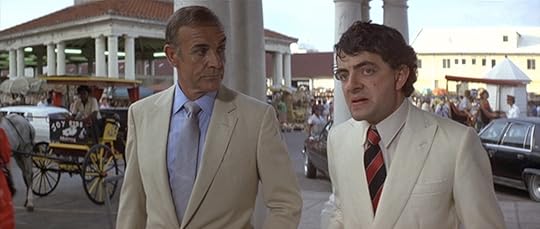
The best among many things that I love about Never Say Never Again is that it's the swan song from Connery that we deserve. His performances in You Only Live Twice and Diamonds Are Forever were miserable, but in NSNA he's right at home. He may not be as spry, but he's as relaxed, engaged, and funny as he was in Thunderball.
M's relationship with Bond is curious. Bernard Lee's M was often cranky, but NSNA turns that way up. We see right away that Edward Fox's M has little use for the whole Double-O division, but he's also not too keen on Q-Branch. When Bond meets Q, that whole department has been largely de-funded and shoved into a sub-basement. M gives away his disdain for gadgets when Bond suggests that SPECTRE may have used a fake eye to put real nukes on the missing missiles. M practically rolls his own eyes right out of his head.
He's also frustrated with Bond personally. His response to news of the attack on Bond at Shrublands is, "Caught you seducing his wife, did he?" He also says that he's tempted to suspend Bond for his attitude, which seems unreasonable in the context of the scene, but really drives home that this is not the M we're used to.
That's really the major arc for the movie though. Bond doesn't change significantly as a result of his mission. He makes some noise at the end about retiring, but with a literal wink. The character who changes is M, who finally sees the value of Bond and the Double-Os once they save the world. By the end of the film, M's ready to send Bond out on more missions, hinting at future movies from Kevin McClory and Connery.
Those never happened of course, though McClory said in interviews at the time that he intended to do more. But as successful as NSNA was, no one was clamoring for a whole series of Thunderball remakes; the only Bond story McClory had the right to produce.
In keeping with the downsizing of his department, Q's attitude towards Bond is way different in NSNA than it is in the Eon movies. He's no longer a member of the establishment, so he doesn't have the same irritation at Bond's irreverence. In fact, he says that he's looking forward to the return of some "gratuitous sex and violence." The movie makes it clear though that this Q is not Major Boothroyd from the Eon films, but someone named Algernon.
Sadly, NSNA doesn't do well by Moneypenny. She comes across as dim-witted and never in on the joke. When Bond tells her that his mission is to "eliminate all free radicals," her response is an overly earnest, "Oh! Do be careful!" And when Bond chastises her for working late, saying that she should be in bed, she has no clue she's making a double-entendre when she replies, "We both should!"
I love Bernie Casey as Felix. He's my favorite of the actors to play that character up to this point. The part isn't written any more strongly than it is in the Eon productions, but Casey makes it memorable. Not just because he's a different race from the traditional Felix, but because he gives the character some personality besides just tagging along and watching Bond work. The only other actor I can think of that was able to do that was Jack Lord, but the personality he brought was kind of cranky. Casey's Felix has an easy, believable camaraderie with Bond. It's easy to imagine these guys as old friends.
As in Thunderball, Bond has a local agent assisting him. This time, it's Nicole (Agent 326). She's okay, but she's intentionally written as being green, unlike Thunderball's agent Paula who was experienced, tough, and brave. Instead of committing suicide to protect secrets, Nicole is simply murdered by Fatima.
The MVP of Bond's NSNA allies though is Nigel Small-Fawcett played by Rowan Atkinson. It's Atkinson's first feature film, but he'd already had success doing sketch comedy on British TV and had just started Black Adder when NSNA came out. By which I mean that he knew what he was doing and he's freaking hilarious. My favorite bit is when he's telling Bond about all of Largo's charity work and Bond adds, "I'm sure he's very nice to his mother." Nigel looks very pensive as he helpfully replies, "Don't know his mother..."
Best Quip
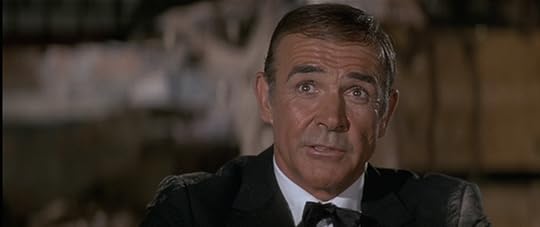
"To be perfectly honest, there was this girl in Philadelphia," to Fatima's insistence that making love to her was the greatest pleasure of his life.
But there are several good ones, so a couple of honorable mentions:
"Then I shall cut out the white bread, sir," after M's explanation that free radicals are toxins caused by consuming too much red meat, white bread, and dry martinis.
"I shouldn't have the fish," to party goers as Bond takes away a groaning bouncer whom he's just punched in the stomach.
Worst Quip
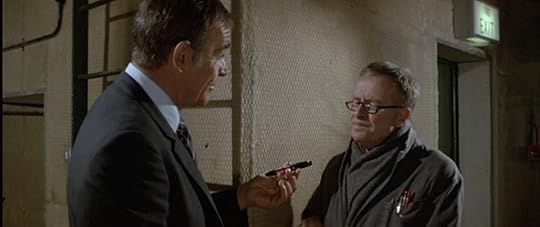
"You could write a very binding contract with this," concerning Q's rocket pen.
Gadgets
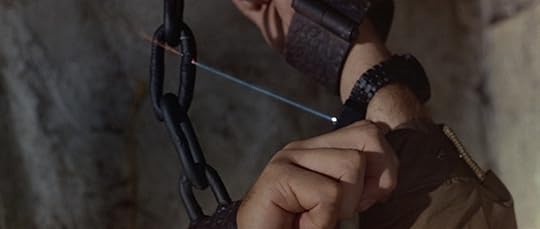
The rocket pen comes in handy and so does the laser watch. Those are the two, personal-sized pieces of equipment that Bond uses.
Q also sends him a motorcycle, but it's disappointing compared to vehicles in the Eon series. It has a cool turbo boost that shoots flame out the back, but other than some questionable bumpers, it's really just a cool-looking bike. I kept expecting to see some rockets, but I must have been confusing it with Fiona's ride in Thunderball.
I hesitate to mention the XT-7B missile-fired hover platforms that Bond and Felix use, because they're US Navy property and not MI6 (like M would ever spring for those), but they're pretty cool and worth at least a shout-out.
Top Ten Gadgets
1. Lotus Esprit (The Spy Who Loved Me)
2. Aston Martin DB V (Goldfinger and Thunderball)
3. Jet pack (Thunderball)
4. Glastron CV23HT speed boat (Moonraker)
5. Acrostar Mini Jet (Octopussy)
6. Crocodile submarine (Octopussy)
7. Little Nellie (You Only Live Twice)
8. Rocket cigarettes (You Only Live Twice)
9. Ski pole rocket (The Spy Who Loved Me)
10. Magnetic buzzsaw watch (Live and Let Die)
Bond's Best Outfit
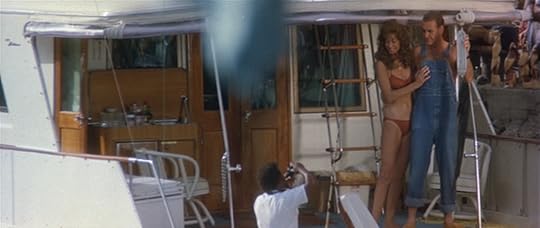
And I'm not just saying that to butter up Kelly. It's even better since that's what Bond's companion was wearing in the scene before.
Bond's Worst Outfit
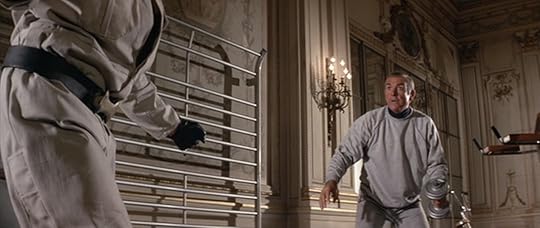
I know he was just working out, but he has better exercise wear in this movie than this plain, frumpy sweatsuit.

The best among many things that I love about Never Say Never Again is that it's the swan song from Connery that we deserve. His performances in You Only Live Twice and Diamonds Are Forever were miserable, but in NSNA he's right at home. He may not be as spry, but he's as relaxed, engaged, and funny as he was in Thunderball.
M's relationship with Bond is curious. Bernard Lee's M was often cranky, but NSNA turns that way up. We see right away that Edward Fox's M has little use for the whole Double-O division, but he's also not too keen on Q-Branch. When Bond meets Q, that whole department has been largely de-funded and shoved into a sub-basement. M gives away his disdain for gadgets when Bond suggests that SPECTRE may have used a fake eye to put real nukes on the missing missiles. M practically rolls his own eyes right out of his head.
He's also frustrated with Bond personally. His response to news of the attack on Bond at Shrublands is, "Caught you seducing his wife, did he?" He also says that he's tempted to suspend Bond for his attitude, which seems unreasonable in the context of the scene, but really drives home that this is not the M we're used to.
That's really the major arc for the movie though. Bond doesn't change significantly as a result of his mission. He makes some noise at the end about retiring, but with a literal wink. The character who changes is M, who finally sees the value of Bond and the Double-Os once they save the world. By the end of the film, M's ready to send Bond out on more missions, hinting at future movies from Kevin McClory and Connery.
Those never happened of course, though McClory said in interviews at the time that he intended to do more. But as successful as NSNA was, no one was clamoring for a whole series of Thunderball remakes; the only Bond story McClory had the right to produce.
In keeping with the downsizing of his department, Q's attitude towards Bond is way different in NSNA than it is in the Eon movies. He's no longer a member of the establishment, so he doesn't have the same irritation at Bond's irreverence. In fact, he says that he's looking forward to the return of some "gratuitous sex and violence." The movie makes it clear though that this Q is not Major Boothroyd from the Eon films, but someone named Algernon.
Sadly, NSNA doesn't do well by Moneypenny. She comes across as dim-witted and never in on the joke. When Bond tells her that his mission is to "eliminate all free radicals," her response is an overly earnest, "Oh! Do be careful!" And when Bond chastises her for working late, saying that she should be in bed, she has no clue she's making a double-entendre when she replies, "We both should!"
I love Bernie Casey as Felix. He's my favorite of the actors to play that character up to this point. The part isn't written any more strongly than it is in the Eon productions, but Casey makes it memorable. Not just because he's a different race from the traditional Felix, but because he gives the character some personality besides just tagging along and watching Bond work. The only other actor I can think of that was able to do that was Jack Lord, but the personality he brought was kind of cranky. Casey's Felix has an easy, believable camaraderie with Bond. It's easy to imagine these guys as old friends.
As in Thunderball, Bond has a local agent assisting him. This time, it's Nicole (Agent 326). She's okay, but she's intentionally written as being green, unlike Thunderball's agent Paula who was experienced, tough, and brave. Instead of committing suicide to protect secrets, Nicole is simply murdered by Fatima.
The MVP of Bond's NSNA allies though is Nigel Small-Fawcett played by Rowan Atkinson. It's Atkinson's first feature film, but he'd already had success doing sketch comedy on British TV and had just started Black Adder when NSNA came out. By which I mean that he knew what he was doing and he's freaking hilarious. My favorite bit is when he's telling Bond about all of Largo's charity work and Bond adds, "I'm sure he's very nice to his mother." Nigel looks very pensive as he helpfully replies, "Don't know his mother..."
Best Quip

"To be perfectly honest, there was this girl in Philadelphia," to Fatima's insistence that making love to her was the greatest pleasure of his life.
But there are several good ones, so a couple of honorable mentions:
"Then I shall cut out the white bread, sir," after M's explanation that free radicals are toxins caused by consuming too much red meat, white bread, and dry martinis.
"I shouldn't have the fish," to party goers as Bond takes away a groaning bouncer whom he's just punched in the stomach.
Worst Quip

"You could write a very binding contract with this," concerning Q's rocket pen.
Gadgets

The rocket pen comes in handy and so does the laser watch. Those are the two, personal-sized pieces of equipment that Bond uses.
Q also sends him a motorcycle, but it's disappointing compared to vehicles in the Eon series. It has a cool turbo boost that shoots flame out the back, but other than some questionable bumpers, it's really just a cool-looking bike. I kept expecting to see some rockets, but I must have been confusing it with Fiona's ride in Thunderball.
I hesitate to mention the XT-7B missile-fired hover platforms that Bond and Felix use, because they're US Navy property and not MI6 (like M would ever spring for those), but they're pretty cool and worth at least a shout-out.
Top Ten Gadgets
1. Lotus Esprit (The Spy Who Loved Me)
2. Aston Martin DB V (Goldfinger and Thunderball)
3. Jet pack (Thunderball)
4. Glastron CV23HT speed boat (Moonraker)
5. Acrostar Mini Jet (Octopussy)
6. Crocodile submarine (Octopussy)
7. Little Nellie (You Only Live Twice)
8. Rocket cigarettes (You Only Live Twice)
9. Ski pole rocket (The Spy Who Loved Me)
10. Magnetic buzzsaw watch (Live and Let Die)
Bond's Best Outfit

And I'm not just saying that to butter up Kelly. It's even better since that's what Bond's companion was wearing in the scene before.
Bond's Worst Outfit

I know he was just working out, but he has better exercise wear in this movie than this plain, frumpy sweatsuit.
July 8, 2015
Never Say Never Again (1983) | Story

Plot Summary
A new M has mothballed the Double-O section, but reinstates it and Bond when SPECTRE steals a couple of nukes.
Influences
Since Kevin McClory had the rights to Thunderball and SPECTRE, he made his own movie and convinced Sean Connery to return and play Bond. The title comes from Connery's promise to "never again" play the character, but he didn't like Cubby Broccoli and couldn't pass up the opportunity to ruffle those feathers.
How Is the Book Different?
Never Say Never Again sticks closely to its source material for legal reasons. McClory only had the rights to this one story. But he was able to mess around with details like locations, how particular events go down, and even characters' motivations and personalities.
Moment That's Most Like Fleming

One thing that NSNA keeps straight from the novel is M's sending Bond to Shrublands because M's a health nut. In the book, it's just a fad that M's latched onto, but we don't know NSNA's M well enough to know if that's it or if he's always this way. From the way he acts the rest of the time, you get the feeling that he's just got a big ol' stick up his butt.
Moment That's Least Like Fleming

Bond playing video games. You could argue that it's merely an update of Bond's general passion for gaming and I'd let you have it. It feels cynically contemporary to me, but that might say more about me than about the movie.
Cold Open

There's not really a cold open in NSNA. The credits start right away, but the scene they're running over sort of serves the same function as a teaser in the official series. It's a short adventure in which Bond infiltrates a jungle base, rescues a girl, and is betrayed and apparently murdered by her. It's easy to imagine this running without credits up until the point where Bond is stabbed. Then after the credits, they could open with the reveal that it was all a training exercise.
I'm not saying they should have done it that way though. I certainly see the rationale for not getting too close to the way Eon was doing things. All I'm saying is that it's easy to pull this scene out and compare it to the Eon teasers. But doing that, it doesn't stand up super well. It's nice to see Connery back in action, but there are no stunts or even really a story. It's a standard, '80s action movie sequence. Even so, it's still better acted than the Diamonds Are Forever teaser and more exciting than the From Russia with Love one, so it's gonna crack the Top Ten for now.
Top 10 Cold Opens
1. The Spy Who Loved Me
2. Moonraker
3. Thunderball
4. On Her Majesty's Secret Service
5. Goldfinger
6. The Man with the Golden Gun
7. For Your Eyes Only
8. Octopussy
9. Never Say Never Again
10. From Russia With Love
Movie Series Continuity

You wouldn't think there'd be any movie continuity in a film so separated from the official series, but NSNA builds in and refers to its own continuity and it's interesting how it potentially intersects with the Eon films. M is obviously not the same man whom Bond is used to working for. Bond mentions that since the new M took over, he's "had little use for the Double-Os." In fact, Bond's been stuck in a teaching gig and the training exercises are just to measure his fitness.
What's interesting to me is that Octopussy, released the same year, also introduces a new M (or at least a new actor, but I think of him as a whole different character). With the death of Sir Miles Messervy sometime after For Your Eyes Only, we've got two different scenarios that explore the results of two possible replacements. Octopussy's new M has a different temperament from his predecessor, but the same regard for MI6's traditional methods. The NSNA M feels very differently and only reactivates the Double-O section to deal with the new SPECTRE crisis.
It's also curious that when M starts talking about Bond's health, Bond anticipates that M's sending him to Shrublands. Bond's either heard of colleagues being sent there or has been sent there himself. The latter possibility raised a question for me about whether or not Thunderball happened in this timeline, but I shot that down quickly. It's madness to think that SPECTRE's pulled this exact scheme before and no one even mentions it.
A couple of other things leak in from the official series, though one of them is probably just pulling from the novels. That's the reappearance of Bond's Bentley, last seen in the movies in From Russia with Love. It's a different color than that one, but it's also a different color from the gunmetal gray car in the books. I love Bond's line about how it's "still in pretty good shape." He's obviously not just talking about the car. I wish the script would have left that subtle though instead of having Bond repeat the comment seconds later in explicit reference to himself.
The other thing NSNA has in common with the Eon films is Bond's notoriety. When Fatima Blush catches sight of him at Shrublands, she immediately identifies him as 007.

July 7, 2015
Kill All Monsters: "Ministry of Robots" concludes in September

The 3-part Kill All Monsters story, "Ministry of Robots," wraps up in Dark Horse Presents #14 and Dark Horse has announced the release date: September 16.
Here's the full solicitation:
Eisner, Harvey, and Stumptown award winner!
Dark Horse Presents #14
Steven Grant (W), Brendan McCarthy (W/A), Alex de Campi (W), Rich Woodall (W), Michael May (W), Anthony Zicari (W), Paul Gulacy (A/Cover), Jerry Ordway (A), Craig Rousseau (A), Jason Copland (A), and Oscar Capristo (A)
On sale Sept 16
FC, 48 pages
$4.99
Ongoing
Steven Grant and Paul Gulacy resurrect the Warren Publishing character the Rook—a time-traveling, gunslinging monster fighter! And the next chapter of Brendan McCarthy's Dream Gang begins here!
Plus, new chapters of Alex de Campi and Jerry Ordway's Semiautomagic and Rich Woodall and Craig Rousseau's Kyrra: Alien Jungle Girl! Michael May and Jason Copland's Kill All Monsters and Anthony Zicari and Oscar Capristo's Grimm Arcane conclude!

Dark Horse Presents: Kill All Monsters preview!


The Dark Horse website has a preview of Dark Horse Presents #12, which will be on sale next Wednesday, 15 July. The issue contains the first of three-parts of an all-new Kill All Monsters story... in COLOR. The story will be collected in the Kill All Monsters Omnibus next year, but it'll be reformatted for widescreen and will be in black-and-white. DHP will be the only place to get it with Bill Crabtree's glorious colors.
In addition to a preview page of our story, the Dark Horse site has previews of each of the other stories in the issue, including the second chapter of Rich Woodall and Craig Rousseau's Kyrra: Alien Jungle Girl story. That makes me really happy since Kyrra was part of the Artist Alley Comics digital comics project that Kill All Monsters participated in back in the day. Feels good being neighbors to Rich and Craig again.

July 6, 2015
A quick note about this week's Bond movie

So I'm doing Never Say Never Again this week (starting Wednesday, as usual). I probably don't need to explain it, but in case you're wondering why I'm including NSNA and not the 1967 spoof Casino Royale, the reason is that I can actually talk about this one the same way I do about the official movies. NSNA is trying to compete with those films on their own level, so measuring it against them is a direct comparison. That's not the case with the '67 Casino Royale, which would be better discussed in a series on '60s sex comedies. But not by me.

The Green Splotches [Guest Post]
By GW Thomas
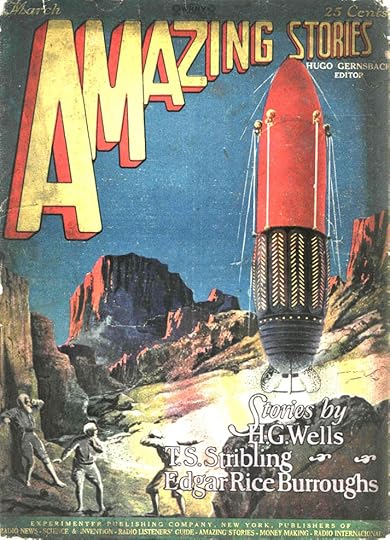
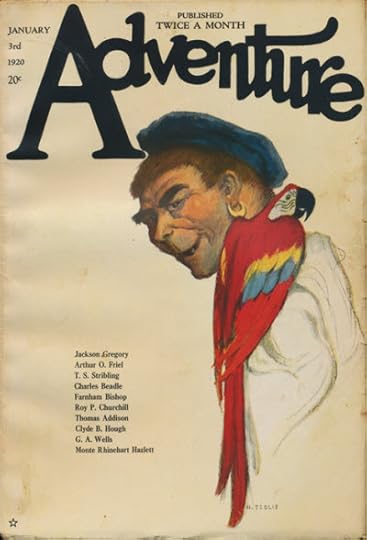 Ever see one of those stories that appears in all the anthologies, but you've never read it? For me that was "The Green Splotches" by TS Stribling. Originally published in Adventure (January 3, 1920), it was reprinted in Amazing Stories (March 1927), the four editions of Donald A Wolheim's The Pocket Book of Science Fiction (1943), then in Famous Fantastic Mysteries (August 1952) and finally in Fantastic (September 1967). For forty-seven years this story kept showing up. Why?
The fact that DAW chose it for The Pocket Book of Science Fiction, the very first mass market paperback of SF, is significant. The anthology is roughly divided into three eras: the old classics by Bierce and Wells, a middle period with Stribling and John Collier, and the later pulp era with Weinbaum, Sturgeon, Heinlein, and Campbell. So who was this TS Stribling that DAW thought him important enough to put beside the masters of the Golden Age of Science Fiction? I couldn't recall any other stories by him from the early days when SF had not been named yet but was known as "Off Trail" fiction. The answer was surprising.
 Thomas Sigismund Stribling (1881-1965) was a Pulitzer Prize winner! His novel, The Store, about life in the South, had won him America's greatest honor. But like many writers he had started out writing for magazines, including detective stories featuring Henry Poggioli for Adventure, Blue Book, and Red Book. In fact, writing for "The Soft Magazines" as the weeklies were known, had given him enough money to travel to South America. This is important because "The Green Splotches" (and much of his other science fiction) is set there.
The plot of the story has an American geographic expedition come to Peru to explore the Rio Infiernillo, a place so evil only two condemned murderers can be found to guide them. At the beginning of the valley the scientists find a collection of skeleton specimens, including a human, all hung up on display. Later they find a black patch that appears to not have been created by the local lava fumaroles, but is instantaneous enough to roast a nearby rabbit. The mystery deepens when one of their guides, Cesare, goes chasing after a stranger he has shot at, but doesn't return. The mystery man has left behind the green splotches of the title, a liquid filled with chlorophyll.
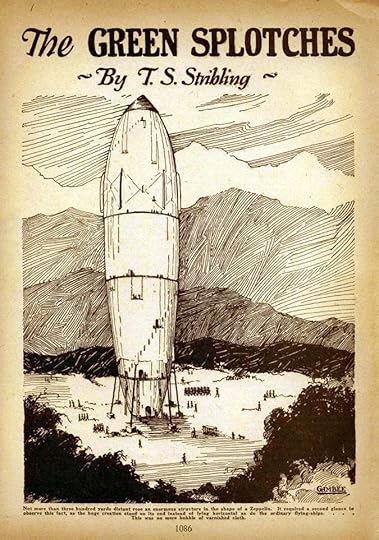 The scientists later encounter this stranger again and learn that he is a telepathic creature wearing the skin of their lost guide. He calls himself 1753-12,657,109-654-3 which they shorten to Mr. Three. Three explains he is from a place called One and refers to his race as The Firsts. His attitude is one of condescending amusement as the scientists try to imprison him for killing Cesare. Three and his fellows chase all the wildlife through the valley for collection, and they expect one of the geographic expedition to become one of these living specimens. In the end, the Firsts take Pablo, the other guide, leaving the scientists to witness the zeppelin-like ship take off on a shower of radium.
The characters on the expedition have their theories about what it all means. Pethwick thinks the yellow-skinned Firsts are an obscure offshoot of the Incans, possessing lost and secret technology. Professor Demetriovich thinks they are Bolsheviks. Stribling ends the story with a letter written by Gilbert H DeLong , the official administrator of the expedition. In it, he recommends the scientists for the Noble Prize, while giving his own interpretation of the record. He tells how the change in color as the ship flew off shows that the vessel was heading for space and at just above the speed of light. From the numeric name of Mr. Three and his incredible agility, DeLong deduces that the Firsts were headed for either Jupiter or Neptune. He envisions a heavy gravity planet populated by quadrillions of aliens, requiring their military lifestyle, their number names, and their interest in other forms of life (having none other on their planet). The green splotches were the blood drops of the Firsts, whom DeLong believes are plants, not animals. In this way, Stribling reveals all his secrets and finishes with a final sting. DeLong wins the Nobel Prize, not those he is advocating for; one last shot at human stupidity.
 The satiric nature of the story becomes obvious when you realize the aliens are a "geographic expedition" as much as the humans. This comparison allows Stribling to make his point as Pethwick begins to associate himself with the other animal specimens. But one character stands out in this story beyond the general jibes. This is the expedition's secretary, a writer named Standifer. The author pokes a lot of fun at certain kinds of writers/critics, self-important authors of poor selling self-published books of non-fiction. Standifer despises fiction, while praising the virtues of facts found in his dull book, Reindeer in Iceland.
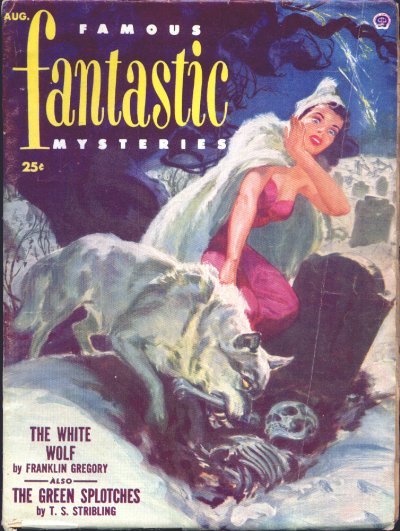
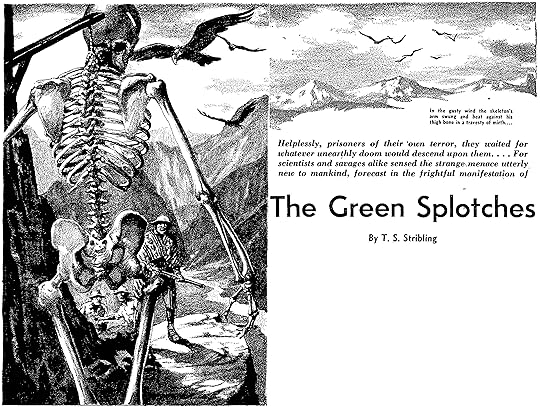
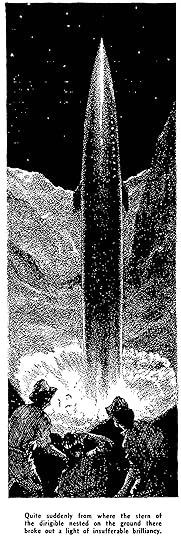
The story received several illustrations in its many reprints. Gernsback unwisely gives away the secret of the story by having Frank R Paul draw the spaceship on the cover and again in the illustration. Famous Fantastic Mysteries did better, beginning with the creepy skeletons and only showing the ship at the end. Stribling wrote a letter to FFM about his story. He down-plays its importance at the same time that he clearly indicates that he won't be writing anymore science fiction (that mood has passed). The editor praised his forward vision on rocket ship design, but Stribling confesses this was just dumb luck.
 So, now I know what "The Green Splotches" was and why it had been reprinted so often. Stribling offers up several science fiction ideas that will appear again by other authors. The idea of aliens wearing dead people will be used in HP Lovecraft's "The Whisperer in Darkness" (Weird Tales, August 1931), aliens who are plants will feature in Murray Leinster's "Proxima Centauri" (Astounding Stories, March 1935), and humans in an alien zoo will be used in "The Human Pets of Mars" by Leslie Frances Stone (Amazing Stories, October 1936). What strikes me as best about this is that Stribling did all this, but dressed it up like a 19th century adventure story a la Haggard or Conan Doyle. This may have been in part because he wrote the story for Adventure, but it also underpins his comments on the ruthlessness of scientific expeditions and silly notions like The White Man's Burden.
 I wonder now why "The Green Splotches" hasn't been seen so often since the 1950s. (I ignore the 1967 reprint which I don't think was done out of care for the story so much as because the publisher was recycling cheap reprints and therefore the motive was mostly economic. In 1967, "The Green Splotches" is cheap filler.) I think the story was cutting edge in the '20s, relevant through to the '40s, explaining why DAW used it. But after that time the number of alien visitors stories multiplies quickly. With the flying saucer period at Amazing Stories and other Ray Palmer magazines, "The Green Splotches" would have become rather mundane by the end of the '50s. (The story was adapted for Escape, the radio show on March 31, 1950, starring William N Robson, William Conrad, and Paul Frees.)
TS Stribling would write more science fiction for Adventure before winning that Pulitzer. A lost race tale, "The Web of the Sun" (January 30, 1922), Fombombo (August 20-September 20, 1923), the dystopic "Christ in Chicago" (April 8, 1926), and a tale of intelligent apes called "Mogglesby" (June 1, 1930). His last novel, These Bars of Flesh (1938) features the same kind of satiric fantasy of his earlier stories. His use of science fiction was Wellsian in that he set up situations where he could look (not always kindly) at how humans behave. (Think of Wells' "The Country of the Blind," also set in South America.) "The Green Splotches" was the first of these examinations and as such deserves its place in the Reprint Hall of Fame.
GW Thomas has appeared in over 400 different books, magazines and ezines including The Writer, Writer's Digest, Black October Magazine and Contact. His website is gwthomas.org. He is editor of Dark Worlds magazine.
 Ever see one of those stories that appears in all the anthologies, but you've never read it? For me that was "The Green Splotches" by TS Stribling. Originally published in Adventure (January 3, 1920), it was reprinted in Amazing Stories (March 1927), the four editions of Donald A Wolheim's The Pocket Book of Science Fiction (1943), then in Famous Fantastic Mysteries (August 1952) and finally in Fantastic (September 1967). For forty-seven years this story kept showing up. Why?
The fact that DAW chose it for The Pocket Book of Science Fiction, the very first mass market paperback of SF, is significant. The anthology is roughly divided into three eras: the old classics by Bierce and Wells, a middle period with Stribling and John Collier, and the later pulp era with Weinbaum, Sturgeon, Heinlein, and Campbell. So who was this TS Stribling that DAW thought him important enough to put beside the masters of the Golden Age of Science Fiction? I couldn't recall any other stories by him from the early days when SF had not been named yet but was known as "Off Trail" fiction. The answer was surprising.
 Thomas Sigismund Stribling (1881-1965) was a Pulitzer Prize winner! His novel, The Store, about life in the South, had won him America's greatest honor. But like many writers he had started out writing for magazines, including detective stories featuring Henry Poggioli for Adventure, Blue Book, and Red Book. In fact, writing for "The Soft Magazines" as the weeklies were known, had given him enough money to travel to South America. This is important because "The Green Splotches" (and much of his other science fiction) is set there.
The plot of the story has an American geographic expedition come to Peru to explore the Rio Infiernillo, a place so evil only two condemned murderers can be found to guide them. At the beginning of the valley the scientists find a collection of skeleton specimens, including a human, all hung up on display. Later they find a black patch that appears to not have been created by the local lava fumaroles, but is instantaneous enough to roast a nearby rabbit. The mystery deepens when one of their guides, Cesare, goes chasing after a stranger he has shot at, but doesn't return. The mystery man has left behind the green splotches of the title, a liquid filled with chlorophyll.
 The scientists later encounter this stranger again and learn that he is a telepathic creature wearing the skin of their lost guide. He calls himself 1753-12,657,109-654-3 which they shorten to Mr. Three. Three explains he is from a place called One and refers to his race as The Firsts. His attitude is one of condescending amusement as the scientists try to imprison him for killing Cesare. Three and his fellows chase all the wildlife through the valley for collection, and they expect one of the geographic expedition to become one of these living specimens. In the end, the Firsts take Pablo, the other guide, leaving the scientists to witness the zeppelin-like ship take off on a shower of radium.
The characters on the expedition have their theories about what it all means. Pethwick thinks the yellow-skinned Firsts are an obscure offshoot of the Incans, possessing lost and secret technology. Professor Demetriovich thinks they are Bolsheviks. Stribling ends the story with a letter written by Gilbert H DeLong , the official administrator of the expedition. In it, he recommends the scientists for the Noble Prize, while giving his own interpretation of the record. He tells how the change in color as the ship flew off shows that the vessel was heading for space and at just above the speed of light. From the numeric name of Mr. Three and his incredible agility, DeLong deduces that the Firsts were headed for either Jupiter or Neptune. He envisions a heavy gravity planet populated by quadrillions of aliens, requiring their military lifestyle, their number names, and their interest in other forms of life (having none other on their planet). The green splotches were the blood drops of the Firsts, whom DeLong believes are plants, not animals. In this way, Stribling reveals all his secrets and finishes with a final sting. DeLong wins the Nobel Prize, not those he is advocating for; one last shot at human stupidity.
 The satiric nature of the story becomes obvious when you realize the aliens are a "geographic expedition" as much as the humans. This comparison allows Stribling to make his point as Pethwick begins to associate himself with the other animal specimens. But one character stands out in this story beyond the general jibes. This is the expedition's secretary, a writer named Standifer. The author pokes a lot of fun at certain kinds of writers/critics, self-important authors of poor selling self-published books of non-fiction. Standifer despises fiction, while praising the virtues of facts found in his dull book, Reindeer in Iceland.
The story received several illustrations in its many reprints. Gernsback unwisely gives away the secret of the story by having Frank R Paul draw the spaceship on the cover and again in the illustration. Famous Fantastic Mysteries did better, beginning with the creepy skeletons and only showing the ship at the end. Stribling wrote a letter to FFM about his story. He down-plays its importance at the same time that he clearly indicates that he won't be writing anymore science fiction (that mood has passed). The editor praised his forward vision on rocket ship design, but Stribling confesses this was just dumb luck.
 So, now I know what "The Green Splotches" was and why it had been reprinted so often. Stribling offers up several science fiction ideas that will appear again by other authors. The idea of aliens wearing dead people will be used in HP Lovecraft's "The Whisperer in Darkness" (Weird Tales, August 1931), aliens who are plants will feature in Murray Leinster's "Proxima Centauri" (Astounding Stories, March 1935), and humans in an alien zoo will be used in "The Human Pets of Mars" by Leslie Frances Stone (Amazing Stories, October 1936). What strikes me as best about this is that Stribling did all this, but dressed it up like a 19th century adventure story a la Haggard or Conan Doyle. This may have been in part because he wrote the story for Adventure, but it also underpins his comments on the ruthlessness of scientific expeditions and silly notions like The White Man's Burden.
 I wonder now why "The Green Splotches" hasn't been seen so often since the 1950s. (I ignore the 1967 reprint which I don't think was done out of care for the story so much as because the publisher was recycling cheap reprints and therefore the motive was mostly economic. In 1967, "The Green Splotches" is cheap filler.) I think the story was cutting edge in the '20s, relevant through to the '40s, explaining why DAW used it. But after that time the number of alien visitors stories multiplies quickly. With the flying saucer period at Amazing Stories and other Ray Palmer magazines, "The Green Splotches" would have become rather mundane by the end of the '50s. (The story was adapted for Escape, the radio show on March 31, 1950, starring William N Robson, William Conrad, and Paul Frees.)
TS Stribling would write more science fiction for Adventure before winning that Pulitzer. A lost race tale, "The Web of the Sun" (January 30, 1922), Fombombo (August 20-September 20, 1923), the dystopic "Christ in Chicago" (April 8, 1926), and a tale of intelligent apes called "Mogglesby" (June 1, 1930). His last novel, These Bars of Flesh (1938) features the same kind of satiric fantasy of his earlier stories. His use of science fiction was Wellsian in that he set up situations where he could look (not always kindly) at how humans behave. (Think of Wells' "The Country of the Blind," also set in South America.) "The Green Splotches" was the first of these examinations and as such deserves its place in the Reprint Hall of Fame.
GW Thomas has appeared in over 400 different books, magazines and ezines including The Writer, Writer's Digest, Black October Magazine and Contact. His website is gwthomas.org. He is editor of Dark Worlds magazine.
July 5, 2015
7 Days in May | Terminate the Fugitive
The Terminator (1984)
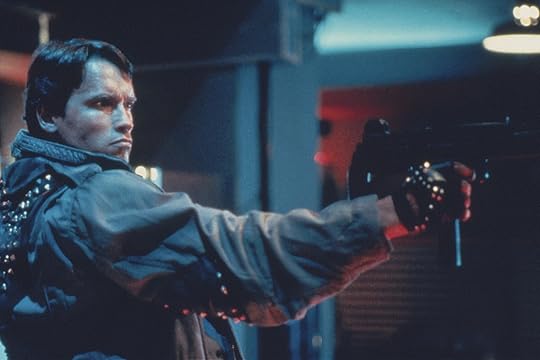
I don't have any special interest in Terminator Genisys, but it does remind me that David hasn't seen any of the Terminator movies yet and is old enough. So we watched the first couple.
The first one is still my favorite. It's such a small movie in many ways, from the relative obscurity of its cast to its perfectly cyclical and self-contained little plot. It's just a brilliant scifi horror/thriller awesomely executed.
Terminator 2: Judgment Day (1991)

I don't like Judgment Day as much, primarily because this is where the story starts to get sloppy. It opens a nasty can of worms to have the future machines be able to send back Terminators to various points in the timeline, basically getting a do-over whenever they fail. That means that the humans can never completely win, which is good for keeping the franchise going, but bad for viewers hoping for any kind of closure.
However... That being said, T2 does a great job of cleaning up after itself. In The Terminator, all the good guys wanted was to protect the version of the future in which they were able to defeat the machines. In T2, they're able to actually stop the machines from taking over to begin with. And with some great character development for Sarah Connor, a touching story between John and his robot friend, and huge action set pieces that the original couldn't afford. It works really well and I can see why so many people call it their favorite.
The only thing I don't like about it is the way it leaves the door unlocked for endless sequels. I enjoy Rise of the Machines and even Salvation well enough as movies (in fact, I like Salvation a little better than Rise of the Machines), but the timeline gets so convoluted after Judgment Day that I get bored with trying to keep track. Which goes back to my lack of interest in Genisys. I'll probably end up catching it on Netflix one day, but as far as my head canon goes, the series is only two movies long.
The Fugitive (1993)
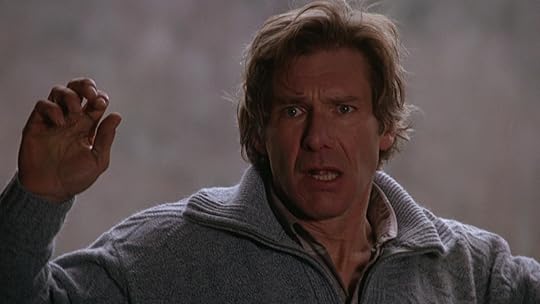
There's an episode or four of Clone Wars late in Season 5 that are a direct homage to The Fugitive. I'd been wanting David to see it for a while anyway, because I've been itching to share Wrongfully Accused with him, so this was a good excuse. It's still a great mystery/thriller and Tommy Lee Jones still steals the show. One of the best of Harrison Ford's movies from the '90s and he made a bunch of great ones.
A couple of surprises this time: I'd built up Julianne Moore's role in my head as being much bigger than it is, and I was tickled to recognize Jane Lynch in an early role as one of Richard Kimble's doctor friends.
Wrongfully Accused (1998)
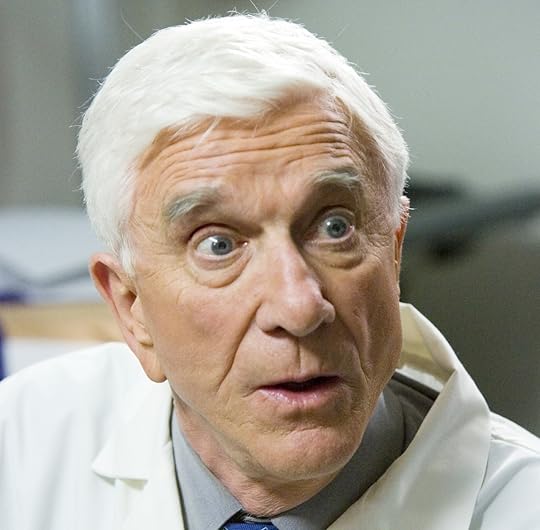
One of my favorite Leslie Nielsen comedies. I usually call it my favorite, but I need to see Airplane! and Naked Gun again. Wrongfully Accused relies more heavily on pop culture references than those movies, so the jokes aren't as original, but man it makes me laugh. I have to stop the movie every single time I get to the scene with the out-of-control lowrider so I can catch my breath and wipe tears from my eyes. And the whole scene in the bait shop with John Walsh from America's Most Wanted and Maury Hannigan from Real Stories of the Highway Patrol is especially full of great gags.
Thor: The Dark World (2013)
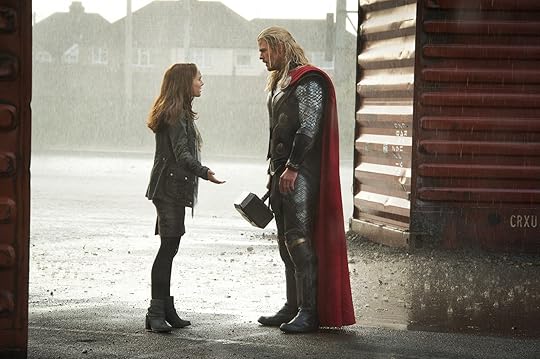
Finally, the Marvel rewatch continues. There's a lot that I love about The Dark World, but my main reason for doing this is to track the development of the Infinity Stones story and this is where it starts to ramp up. In fact, I'm pretty sure this is where the term "Infinity Stones" is mentioned for the first time. We also get to see the third Stone so far. The Tesseract contains the Space Stone and - while it hadn't yet been revealed at this point - Loki's staff contains the Mind Stone. Malekith's amorphous Aether is somehow also a Stone, though if we get to see how it takes solid form, I missed it. It looks like it's just being contained in a special box when Sif turns it over to the Collector for safe keeping.
I also don't think it's been revealed in the movies which Stone the Aether is, but consensus seems to be that it's the Reality Stone. In the comics, that one has the power to bend the laws of physics to the user's will, so that fits with the weird gravitational stuff we see in Dark World. I'm sure it'll become clearer as we go.

I don't have any special interest in Terminator Genisys, but it does remind me that David hasn't seen any of the Terminator movies yet and is old enough. So we watched the first couple.
The first one is still my favorite. It's such a small movie in many ways, from the relative obscurity of its cast to its perfectly cyclical and self-contained little plot. It's just a brilliant scifi horror/thriller awesomely executed.
Terminator 2: Judgment Day (1991)

I don't like Judgment Day as much, primarily because this is where the story starts to get sloppy. It opens a nasty can of worms to have the future machines be able to send back Terminators to various points in the timeline, basically getting a do-over whenever they fail. That means that the humans can never completely win, which is good for keeping the franchise going, but bad for viewers hoping for any kind of closure.
However... That being said, T2 does a great job of cleaning up after itself. In The Terminator, all the good guys wanted was to protect the version of the future in which they were able to defeat the machines. In T2, they're able to actually stop the machines from taking over to begin with. And with some great character development for Sarah Connor, a touching story between John and his robot friend, and huge action set pieces that the original couldn't afford. It works really well and I can see why so many people call it their favorite.
The only thing I don't like about it is the way it leaves the door unlocked for endless sequels. I enjoy Rise of the Machines and even Salvation well enough as movies (in fact, I like Salvation a little better than Rise of the Machines), but the timeline gets so convoluted after Judgment Day that I get bored with trying to keep track. Which goes back to my lack of interest in Genisys. I'll probably end up catching it on Netflix one day, but as far as my head canon goes, the series is only two movies long.
The Fugitive (1993)

There's an episode or four of Clone Wars late in Season 5 that are a direct homage to The Fugitive. I'd been wanting David to see it for a while anyway, because I've been itching to share Wrongfully Accused with him, so this was a good excuse. It's still a great mystery/thriller and Tommy Lee Jones still steals the show. One of the best of Harrison Ford's movies from the '90s and he made a bunch of great ones.
A couple of surprises this time: I'd built up Julianne Moore's role in my head as being much bigger than it is, and I was tickled to recognize Jane Lynch in an early role as one of Richard Kimble's doctor friends.
Wrongfully Accused (1998)

One of my favorite Leslie Nielsen comedies. I usually call it my favorite, but I need to see Airplane! and Naked Gun again. Wrongfully Accused relies more heavily on pop culture references than those movies, so the jokes aren't as original, but man it makes me laugh. I have to stop the movie every single time I get to the scene with the out-of-control lowrider so I can catch my breath and wipe tears from my eyes. And the whole scene in the bait shop with John Walsh from America's Most Wanted and Maury Hannigan from Real Stories of the Highway Patrol is especially full of great gags.
Thor: The Dark World (2013)

Finally, the Marvel rewatch continues. There's a lot that I love about The Dark World, but my main reason for doing this is to track the development of the Infinity Stones story and this is where it starts to ramp up. In fact, I'm pretty sure this is where the term "Infinity Stones" is mentioned for the first time. We also get to see the third Stone so far. The Tesseract contains the Space Stone and - while it hadn't yet been revealed at this point - Loki's staff contains the Mind Stone. Malekith's amorphous Aether is somehow also a Stone, though if we get to see how it takes solid form, I missed it. It looks like it's just being contained in a special box when Sif turns it over to the Collector for safe keeping.
I also don't think it's been revealed in the movies which Stone the Aether is, but consensus seems to be that it's the Reality Stone. In the comics, that one has the power to bend the laws of physics to the user's will, so that fits with the weird gravitational stuff we see in Dark World. I'm sure it'll become clearer as we go.