Michael May's Blog, page 131
September 7, 2015
Jeff Rice and Kolchak [Guest Post]
By GW Thomas
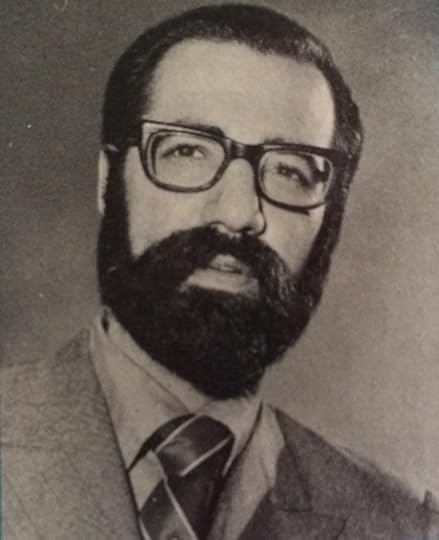 Today is a good day to be a horror writer, whether in print or comics. If your work gets picked up by a cable network, you are on your way. Robert Kirkman made it big with his comic The Walking Dead, perhaps the most popular show on the planet. Kirkman wisely signed on as a producer. Now Blake Crouch is doing the same thing with the Wayward Pines show. Based on his novels The Pines (2012), Wayward (2013) and The Last Town (2014), he is now a producer and writer on the show. I don't know if this is a sign that agents are getting better at writing inclusion clauses or if TV executives are just finally getting that, yes, the original writer just might be an asset to the show. In the past, it wasn't so. Take Jeff Rice for instance...
I've always wondered how Jeff Rice was involved (or not) in the creation of the Kolchak saga and why he didn't use the show as a launching pad to a career as a popular horror writer. Reading his interview in a copy of Marvel's attempt at a Famous Monsters type magazine, the very enjoyable Monsters of the Movies #1 (June 1974), I found the inside story on his novel The Kolchak Papers. The TV rights were sold even before the book, with Richard Matheson scooping up the screenplay job before Rice could (and winning himself an Edgar Award for the task). Titled The Night Stalker (1972), the TV movie was a huge ratings winner, setting records for that time. It was followed by a second, admittedly repetitious, but popular, The Night Strangler (1973) and then Kolchak: The Night Stalker, the poorly regarded TV show of twenty episodes.
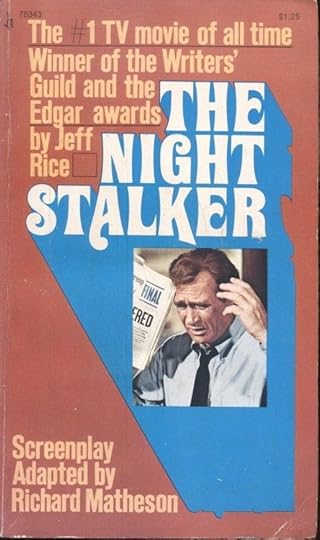 The original novel was eventually published as The Night Stalker after the TV movie aired. It had a picture of Darren McGavin on the cover, turning the show's inspiration into a mere after-the-fact marketing tie-in. Customers must have been a little confused by Rice's novel, which was intended to be a stake driven through the heart of Las Vegas. When The Night Strangler was produced, written again by Matheson, Jeff Rice got the job of writing the film into a novel, reversing the roles from the first book. The Night Strangler novel appeared in 1974. Both books sold very well. The Night Stalker, according to the Rice interview, sold half its copy run in the first month.
The Kolchak TV movies were making money too. Matheson and William F Nolan even wrote a third script about android replicas, but the network canned it in favor of the series. The only problem was that they didn't have Rice's permission to turn the movie series into a TV series, and he sued. Settling out of court, Rice was given credit as the series creator and Darren McGavin returned for the twenty episodes. This legal solution may have blacklisted Rice in Hollywood, ending any career in Tinseltown. Decades later in 2005, copyright was not a concern when ABC revived the show. Rice retained the rights to Kolchak in print, but not on TV. The new show did not last even as long as the original, only ten episodes. Somehow viewers knew something was missing, and that something was Jeff Rice.
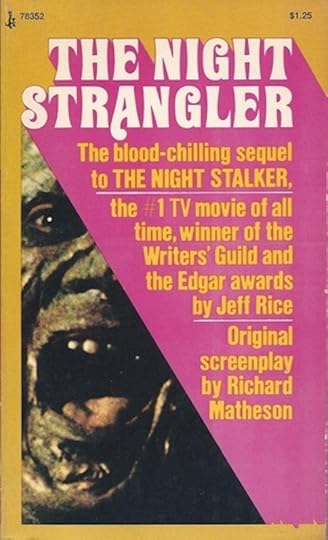 The two paperbacks are all the books Rice ever wrote. Why? If I had two media-tied paperbacks, I would have struck a deal with the publisher for a series of books. Imagine Night Stalker #17: The Deadly Bees or Night Stalker #32: Project Deathbot. As one who remembers all the Man From UNCLE and Planet of the Apes paperbacks of the 1960s and '70s (ghost written by John Jakes, Keith Laumer, Bill Pronzini, and Frank Belknap Long), this is a natural. Short, 60,000-worders with photo covers from the show. Only it never happened.
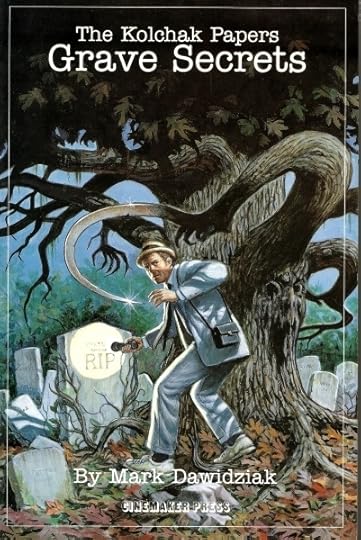
Because of the settlement, Rice was not allowed to use anything created by the show, only his original novel, making it hard to milk the occult detective cow for a few years even with the show faltering after one season. Only decades later, as Kolchak's cult grew, was this possible with Mark Dawidziak, a friend of Rice's, writing The Kolchak Papers: Grave Secrets in 1994. The novel did well enough to interest Moonstone Comics in a series, with tie-ins to other famous characters such as Sherlock Holmes and Dr. Moreau. Jeff Rice appreciated that fans still loved Kolchak, especially after Chris Carter acknowledged that it was the show that inspired his popular X-Files. Still, no Jeff Rice resurrection came...
 Rice's personal life is a bigger horror story than the novels he wrote. His father had been aligned with the mob in Las Vegas and Rice knew of its evils first hand, both from his private life and as a reporter. How did the original Night Stalker go over in Sin City with its anti-Vegas agenda? We can imagine all kinds of conspiracy theories involving black cars driving past Rice's house. Hard up for money, depressed and suffering from phobic paranoia, Rice remained a virtual recluse, writing no further books. He died under strange circumstances on July 1, 2015 at the age of 71. Even the sleaziest of entertainment programs made no mention of the fact. Hollywood had forgotten Rice in 1975 and that never changed.
Jeff Rice ends his Monsters of the Movies interview, which took place before the TV show, by saying, "The Night Strangler came out in February and is also doing record business. So, it looks like I am finally launched on a career as an author and, hopefully, I may soon sell my screenplays, as several producers have shown an interest. My career as an actor we won't talk about in this interview; at least the offers are coming in now." A frozen moment in time before the crap storm that was 1975. Hopeful, excited, ready for more. This is the Jeff Rice I like to remember. The man who gave us Carl Kolchak.
GW Thomas has appeared in over 400 different books, magazines and ezines including The Writer, Writer's Digest, Black October Magazine and Contact. His website is gwthomas.org. He is editor of Dark Worlds magazine.
 Today is a good day to be a horror writer, whether in print or comics. If your work gets picked up by a cable network, you are on your way. Robert Kirkman made it big with his comic The Walking Dead, perhaps the most popular show on the planet. Kirkman wisely signed on as a producer. Now Blake Crouch is doing the same thing with the Wayward Pines show. Based on his novels The Pines (2012), Wayward (2013) and The Last Town (2014), he is now a producer and writer on the show. I don't know if this is a sign that agents are getting better at writing inclusion clauses or if TV executives are just finally getting that, yes, the original writer just might be an asset to the show. In the past, it wasn't so. Take Jeff Rice for instance...
I've always wondered how Jeff Rice was involved (or not) in the creation of the Kolchak saga and why he didn't use the show as a launching pad to a career as a popular horror writer. Reading his interview in a copy of Marvel's attempt at a Famous Monsters type magazine, the very enjoyable Monsters of the Movies #1 (June 1974), I found the inside story on his novel The Kolchak Papers. The TV rights were sold even before the book, with Richard Matheson scooping up the screenplay job before Rice could (and winning himself an Edgar Award for the task). Titled The Night Stalker (1972), the TV movie was a huge ratings winner, setting records for that time. It was followed by a second, admittedly repetitious, but popular, The Night Strangler (1973) and then Kolchak: The Night Stalker, the poorly regarded TV show of twenty episodes.
 The original novel was eventually published as The Night Stalker after the TV movie aired. It had a picture of Darren McGavin on the cover, turning the show's inspiration into a mere after-the-fact marketing tie-in. Customers must have been a little confused by Rice's novel, which was intended to be a stake driven through the heart of Las Vegas. When The Night Strangler was produced, written again by Matheson, Jeff Rice got the job of writing the film into a novel, reversing the roles from the first book. The Night Strangler novel appeared in 1974. Both books sold very well. The Night Stalker, according to the Rice interview, sold half its copy run in the first month.
The Kolchak TV movies were making money too. Matheson and William F Nolan even wrote a third script about android replicas, but the network canned it in favor of the series. The only problem was that they didn't have Rice's permission to turn the movie series into a TV series, and he sued. Settling out of court, Rice was given credit as the series creator and Darren McGavin returned for the twenty episodes. This legal solution may have blacklisted Rice in Hollywood, ending any career in Tinseltown. Decades later in 2005, copyright was not a concern when ABC revived the show. Rice retained the rights to Kolchak in print, but not on TV. The new show did not last even as long as the original, only ten episodes. Somehow viewers knew something was missing, and that something was Jeff Rice.
 The two paperbacks are all the books Rice ever wrote. Why? If I had two media-tied paperbacks, I would have struck a deal with the publisher for a series of books. Imagine Night Stalker #17: The Deadly Bees or Night Stalker #32: Project Deathbot. As one who remembers all the Man From UNCLE and Planet of the Apes paperbacks of the 1960s and '70s (ghost written by John Jakes, Keith Laumer, Bill Pronzini, and Frank Belknap Long), this is a natural. Short, 60,000-worders with photo covers from the show. Only it never happened.
Because of the settlement, Rice was not allowed to use anything created by the show, only his original novel, making it hard to milk the occult detective cow for a few years even with the show faltering after one season. Only decades later, as Kolchak's cult grew, was this possible with Mark Dawidziak, a friend of Rice's, writing The Kolchak Papers: Grave Secrets in 1994. The novel did well enough to interest Moonstone Comics in a series, with tie-ins to other famous characters such as Sherlock Holmes and Dr. Moreau. Jeff Rice appreciated that fans still loved Kolchak, especially after Chris Carter acknowledged that it was the show that inspired his popular X-Files. Still, no Jeff Rice resurrection came...
 Rice's personal life is a bigger horror story than the novels he wrote. His father had been aligned with the mob in Las Vegas and Rice knew of its evils first hand, both from his private life and as a reporter. How did the original Night Stalker go over in Sin City with its anti-Vegas agenda? We can imagine all kinds of conspiracy theories involving black cars driving past Rice's house. Hard up for money, depressed and suffering from phobic paranoia, Rice remained a virtual recluse, writing no further books. He died under strange circumstances on July 1, 2015 at the age of 71. Even the sleaziest of entertainment programs made no mention of the fact. Hollywood had forgotten Rice in 1975 and that never changed.
Jeff Rice ends his Monsters of the Movies interview, which took place before the TV show, by saying, "The Night Strangler came out in February and is also doing record business. So, it looks like I am finally launched on a career as an author and, hopefully, I may soon sell my screenplays, as several producers have shown an interest. My career as an actor we won't talk about in this interview; at least the offers are coming in now." A frozen moment in time before the crap storm that was 1975. Hopeful, excited, ready for more. This is the Jeff Rice I like to remember. The man who gave us Carl Kolchak.
GW Thomas has appeared in over 400 different books, magazines and ezines including The Writer, Writer's Digest, Black October Magazine and Contact. His website is gwthomas.org. He is editor of Dark Worlds magazine.


September 2, 2015
Captive of Friendly Clove

I'm not shy about my love for sea adventure, but you may not know that I'm also a huge fan of stories about indigenous people, especially of North America. Not that I'm claiming to be a valuable or even that well informed an ally, but I've always felt a lot of empathy for Native Americans since I was a kid watching Westerns and recognized that most of the time I wasn't getting both sides of the story. I've been hungry for the Native perspective ever since. A couple of my favorite graphic novels so far on the subject have been George O'Connor's Journey into Mohawk Country and the Graphic Classics anthology Native American Classics (which I reviewed for School Library Journal). Time to add to that list with Rebecca Goldfield and Mike Short's Captive of Friendly Cove .
Captive of Friendly Cove has a lot in common with Journey into Mohawk Country. Both are taken from the journals of real life Europeans who interacted with Native Americans, both were heavily researched to get their visual details right, and both are utterly engrossing. Where Captive differs from Journey is its willingness to add to the narrative of its original author. In addition to John Jewitt's notes, Rebecca Goldfield also visited the Mowachaht people who currently inhabit what was once called Friendly Cove to hear their interpretation of Jewitt's story. As Goldfield explains in her preface, "I combined all I learned from as many sources as possible, but mostly stayed close to John's point of view. In the end, I also relied on my imagination as to what life there might have looked and felt like back then. Adding my ideas and words to his, I tried to keep the spirit of John alive."
I like that approach. Without knowing exactly where Jewitt's original words end and the other voices begin, I imagine that Captive is a more balanced tale for the effort. Not that I suppose Jewitt's version made him out to be a hero. If Captive captures anything of Jewitt's voice (and there's every reason to believe it does), then he was decidedly non-heroic. He was a good and kind man, but also capable of cowardice and deception. He was willing to make great compromises to stay alive once he was captured by the Mowachaht and made a slave of their chief.
Jewitt's story of capture and survival would be dramatic enough, but it's deepened by a couple of additional layers. One is the desire of the chief Maquinna for Jewitt to assimilate into the tribe, which clashes with Jewitt's desire to keep separate as he holds on to hope for rescue and an eventual return to his own people. The other layer of drama comes from a second prisoner from Jewitt's ship: an older man named Thomas who doesn't share Jewitt's reluctance to upset his captors. Thomas' attitude is more "live free or die," and that creates a great deal of tension as Jewitt tries to keep them both alive.
I don't want to give too much away, but even though I didn't agree with many of Jewitt's decisions, I was captivated by his story and wanted a happy ending for him. More than that though, I learned a lot about the Mowachaht from the early 19th century, which was what I hoped for. That's as much due to Mike Short's images as to Jewitt and Goldfield's words. He gives life to the story and tells it in a clear and compelling way. He's aided by impressive inks from Matt Dembicki and a gorgeous color palette from Evan Keeling that brings to the page very nicely the beauty of the Pacific Northwest.
Fortunately, you don't have to take my word for the art though. Fulcrum Publishing sent me the first chapter of Captive of Friendly Cove with permission to reveal it here for the first time. Take a look below and if you like what you see, it's available at IndieBound, Amazon, Barnes and Noble, and Books-A-Million.
Full disclosure: I received a free copy of the book for review.


Read the rest of the chapter after the break.


August 24, 2015
On the Trail of Lonesome Ghosts [Guest Post]
By GW Thomas
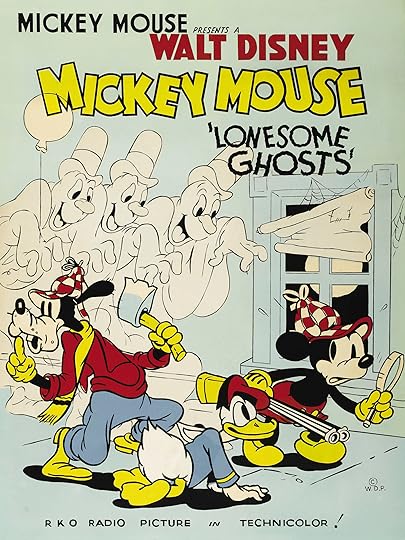 I've been watching Disney's "Lonesome Ghosts" from 1937 and wondering... where did Dick Friel get the story idea and how much it relates to the ghostbreaker tradition dating back seventy years. Now, if you've lived under a rock and never seen the cartoon I'm talking about, it appeared originally on December 24, 1937. (Like Mr. Dickens, Mr. Disney enjoys a ghost at Christmas.) But most of us saw it later: on Disneyland (1954), with The Sword in the Stone (1963), The Wonderful World of Color (1958), The Mouse Factory (1972), with The Legend of Sleepy Hollow in 1982, or in 1983, 1989, 1997, 1998, and on. Fisher-Price even had a silent, hand-cranked version as a toy. If you were like me, you saw it on The Wonderful World of Disney on the CBC back into the '70s. It doesn't matter. Most people have seen Mickey, Donald and Goofy go into the haunted house and try to deal with its mischievous inhabitants, laughed, and forgotten about it.
This cartoon has been haunting me though. I have to think "Lonesome Ghosts" was probably the very first piece of media to suggest the idea of "ghost busters" to me. I never saw The Ghost Busters with Forrest Tucker and Larry Storch in 1975. By then I had moved onto Kolchak the Nightstalker. (I was twelve after all!) 1975 was a good time to be a horror kid. My parents would never have let me see The Exorcist or anything like that, but television had Dan Curtis and other TV movie producers creating shows like Gargoyles, Moon of the Wolf, and The Night Strangler. And as long as you weren't allergic to Bradford Dillman, you got some kid-sized scares that worked you up to William Friedkin's The Exorcist and Steven Spielberg's Jaws.
 But to go back to 1937 and the three intrepid members of the Ajax Ghost Exterminators. I look for clues like our brilliant detectives. The first is the date: 1937. What films or books might have been so popular that Friel would think to do a cartoon from them? The answer was pretty easy to locate. Topper was the box office winner for 1937, coming out on July 16. Based on the 1926 novel by Thorne Smith, the film features two fun-loving ghosts played by Cary Grant and Constance Bennett. The couple torment conservative banker Cosmo Topper, played by Roland Young (who received an Oscar nomination for the part.) Topper is a Walter Mitty type, regimented by his wife who's played by Billie Burke. The scene that most likely affected Friel was the finale of the film, when the ghosts pull Topper out of a fancy hotel, playing gags on the house detective and bellboy.
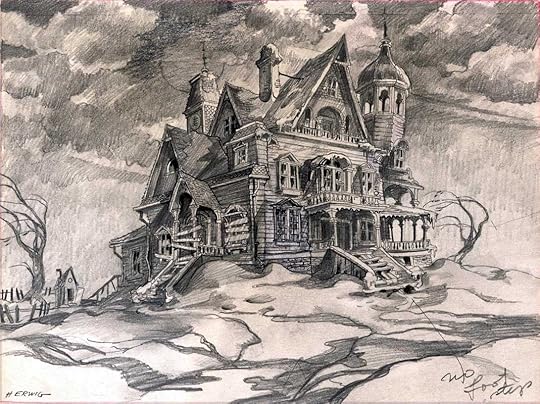
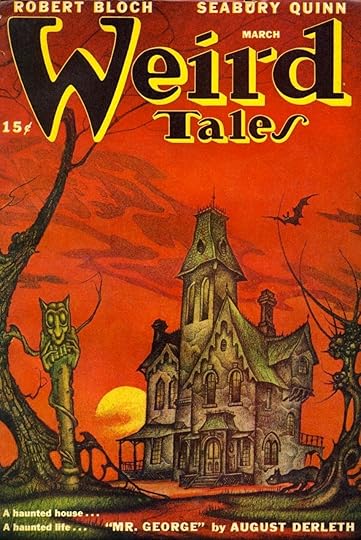
So far, so good. But it doesn't explain everything. The Disney story man could have just had Mickey and friends arrive at the old house late one night, a ploy used in some later Sylvester and Porky Pig cartoons at Warner Brothers. But Friel doesn't do this. He specifically makes them ghostbreakers, the three members of the Ajax Ghost Exterminators. Armed with silly tools like a shotgun, a butterfly net, an axe, and a mouse trap, the three characters enter a house worthy of a Weird Tales cover. Now, Friel may have done all this for the joke of comparing vermin exterminators with ghost exterminators, a trope that would last until the 1980s when Harold Ramis and Dan Ackroyd wrote Ghostbusters, but I wonder if Friel was inspired by something more?
 The date 1937 makes this hard. Many of the great ghostbreaker pieces don't exist until after that date. I Love a Mystery, the radio show that would inspire Scooby Doo, was 1939. Ghostbuster films like Bob Hope's The Ghostbreakers (1940, but based on the Paul Dickey and Charles W. Goddard's 1909 play) and the Bowery Boys' Spook Busters, as well as the Abbott and Costello films are all in the mid-'40s or later. Even Basil Rathbone as Sherlock in The Hound of the Baskervilles came on the verge of the war, in 1939. No actual ghost breaker films appear in and around 1937.
That leaves print stories. Was Dick Friel a horror connoisseur? There is very little information on the man. He worked for the Jefferson Film Corporation in the 1920s, a company that made the Mutt and Jeff cartoons. His only Disney credit is "Lonesome Ghosts." So who knows? The most popular occult detective in 1937 was Jules de Grandin in Weird Tales, but there appears to be no influence on Mickey, Donald, and Goofy. Another was Gees by EC Vivian (under his Jack Mann pseudonym). One of Vivian's influences was the jungle writer Arthur Friel. Friel's stories set in South America - like "The Barragudo" - have a ghostbreaker element. A strange coincidence, but hardly proof of anything. Were Dick and Arthur Friel related? Like ghosts, the threads are tantalizing, but disappear like smoke.
 In the end I can't find anything that links the cartoon to a specific horror icon. Mickey and Goofy wear Sherlockian deerstalkers but this was cartoon short-hand for any detective. One of the ghosts is sitting in a chair with a book called Ghost Stories on the floor, but not any particular ghost stories. As with all cartoons at this time, it was about the gags. The short soft shoe routine the ghosts do into a closet reminded me a little of Disney's "The Skeleton Dance" from 1929 (which won Disney an Oscar), but mostly it's pokes in the eye with Goofy getting stuck in a bureau, a scene that may have inspired a similar bit in "Prest-O, Change-O," an early Bugs Bunny cartoon from 1939.
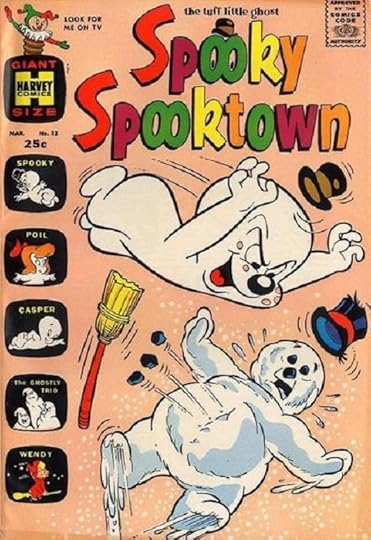
Ultimately, my biggest take away is Goofy's declaring, "I ain't a-scared of no ghosts," which will become Ray Parker Jr's singing "I ain't afraid of no ghosts!" in 1984. In between 1937 and '84 we had Casper the Friendly Ghost in cartoons and comics, who I am sure was inspired in part by "Lonesome Ghosts." The derby-wearing quartet became the Ghostly Trio in time, and Spooky sports some similar head gear. Strangely, the Casper copyright holders tried to sue Columbia for fifty million because of the ghost used in the ghostbusters logo. They lost. Disney never said boo.
GW Thomas has appeared in over 400 different books, magazines and ezines including The Writer, Writer's Digest, Black October Magazine and Contact. His website is gwthomas.org. He is editor of Dark Worlds magazine.
 I've been watching Disney's "Lonesome Ghosts" from 1937 and wondering... where did Dick Friel get the story idea and how much it relates to the ghostbreaker tradition dating back seventy years. Now, if you've lived under a rock and never seen the cartoon I'm talking about, it appeared originally on December 24, 1937. (Like Mr. Dickens, Mr. Disney enjoys a ghost at Christmas.) But most of us saw it later: on Disneyland (1954), with The Sword in the Stone (1963), The Wonderful World of Color (1958), The Mouse Factory (1972), with The Legend of Sleepy Hollow in 1982, or in 1983, 1989, 1997, 1998, and on. Fisher-Price even had a silent, hand-cranked version as a toy. If you were like me, you saw it on The Wonderful World of Disney on the CBC back into the '70s. It doesn't matter. Most people have seen Mickey, Donald and Goofy go into the haunted house and try to deal with its mischievous inhabitants, laughed, and forgotten about it.
This cartoon has been haunting me though. I have to think "Lonesome Ghosts" was probably the very first piece of media to suggest the idea of "ghost busters" to me. I never saw The Ghost Busters with Forrest Tucker and Larry Storch in 1975. By then I had moved onto Kolchak the Nightstalker. (I was twelve after all!) 1975 was a good time to be a horror kid. My parents would never have let me see The Exorcist or anything like that, but television had Dan Curtis and other TV movie producers creating shows like Gargoyles, Moon of the Wolf, and The Night Strangler. And as long as you weren't allergic to Bradford Dillman, you got some kid-sized scares that worked you up to William Friedkin's The Exorcist and Steven Spielberg's Jaws.
 But to go back to 1937 and the three intrepid members of the Ajax Ghost Exterminators. I look for clues like our brilliant detectives. The first is the date: 1937. What films or books might have been so popular that Friel would think to do a cartoon from them? The answer was pretty easy to locate. Topper was the box office winner for 1937, coming out on July 16. Based on the 1926 novel by Thorne Smith, the film features two fun-loving ghosts played by Cary Grant and Constance Bennett. The couple torment conservative banker Cosmo Topper, played by Roland Young (who received an Oscar nomination for the part.) Topper is a Walter Mitty type, regimented by his wife who's played by Billie Burke. The scene that most likely affected Friel was the finale of the film, when the ghosts pull Topper out of a fancy hotel, playing gags on the house detective and bellboy.
So far, so good. But it doesn't explain everything. The Disney story man could have just had Mickey and friends arrive at the old house late one night, a ploy used in some later Sylvester and Porky Pig cartoons at Warner Brothers. But Friel doesn't do this. He specifically makes them ghostbreakers, the three members of the Ajax Ghost Exterminators. Armed with silly tools like a shotgun, a butterfly net, an axe, and a mouse trap, the three characters enter a house worthy of a Weird Tales cover. Now, Friel may have done all this for the joke of comparing vermin exterminators with ghost exterminators, a trope that would last until the 1980s when Harold Ramis and Dan Ackroyd wrote Ghostbusters, but I wonder if Friel was inspired by something more?
 The date 1937 makes this hard. Many of the great ghostbreaker pieces don't exist until after that date. I Love a Mystery, the radio show that would inspire Scooby Doo, was 1939. Ghostbuster films like Bob Hope's The Ghostbreakers (1940, but based on the Paul Dickey and Charles W. Goddard's 1909 play) and the Bowery Boys' Spook Busters, as well as the Abbott and Costello films are all in the mid-'40s or later. Even Basil Rathbone as Sherlock in The Hound of the Baskervilles came on the verge of the war, in 1939. No actual ghost breaker films appear in and around 1937.
That leaves print stories. Was Dick Friel a horror connoisseur? There is very little information on the man. He worked for the Jefferson Film Corporation in the 1920s, a company that made the Mutt and Jeff cartoons. His only Disney credit is "Lonesome Ghosts." So who knows? The most popular occult detective in 1937 was Jules de Grandin in Weird Tales, but there appears to be no influence on Mickey, Donald, and Goofy. Another was Gees by EC Vivian (under his Jack Mann pseudonym). One of Vivian's influences was the jungle writer Arthur Friel. Friel's stories set in South America - like "The Barragudo" - have a ghostbreaker element. A strange coincidence, but hardly proof of anything. Were Dick and Arthur Friel related? Like ghosts, the threads are tantalizing, but disappear like smoke.
 In the end I can't find anything that links the cartoon to a specific horror icon. Mickey and Goofy wear Sherlockian deerstalkers but this was cartoon short-hand for any detective. One of the ghosts is sitting in a chair with a book called Ghost Stories on the floor, but not any particular ghost stories. As with all cartoons at this time, it was about the gags. The short soft shoe routine the ghosts do into a closet reminded me a little of Disney's "The Skeleton Dance" from 1929 (which won Disney an Oscar), but mostly it's pokes in the eye with Goofy getting stuck in a bureau, a scene that may have inspired a similar bit in "Prest-O, Change-O," an early Bugs Bunny cartoon from 1939.
Ultimately, my biggest take away is Goofy's declaring, "I ain't a-scared of no ghosts," which will become Ray Parker Jr's singing "I ain't afraid of no ghosts!" in 1984. In between 1937 and '84 we had Casper the Friendly Ghost in cartoons and comics, who I am sure was inspired in part by "Lonesome Ghosts." The derby-wearing quartet became the Ghostly Trio in time, and Spooky sports some similar head gear. Strangely, the Casper copyright holders tried to sue Columbia for fifty million because of the ghost used in the ghostbusters logo. They lost. Disney never said boo.
GW Thomas has appeared in over 400 different books, magazines and ezines including The Writer, Writer's Digest, Black October Magazine and Contact. His website is gwthomas.org. He is editor of Dark Worlds magazine.
August 22, 2015
Tomorrow Never Dies (1997) | Music
Éric Serra's attempt to combine the Bond sound with synth music in GoldenEye had been a failure, but film composer David Arnold was more successful. After scoring Stargate and Independence Day, Arnold more or less auditioned for the Bond gig by putting together an album of techno and rock covers of Bond songs. He called it Shaken and Stirred: The David Arnold James Bond Project .
It's an interesting album with covers by Aimee Mann ("Nobody Does It Better"), Chrissie Hynde ("Live and Let Die"), and Iggy Pop ("We Have All the Time in the World"), as well as a bunch of techno bands I'm less familiar with. It's experimental though, so if you're turned off by albums with the word "project" in the title, it may not be for you. It's not something that I'll listen to over and over again except for Iggy Pop's song and Propellerheads' nine-and-a-half minute version of the theme from On Her Majesty's Secret Service.
Rumor has it that John Barry heard and liked the album so much that he recommended Arnold to Broccoli and Wilson as the composer for Tomorrow Never Dies. I'm not sure about that timeline since Shaken and Stirred was released only a little over a month before Tomorrow, but maybe Barry heard the album while it was in production? Who knows. However he got the job, Arnold was hired to score Tomorrow and he was a great choice.
He uses the Bond Theme a ton in the movie. Pretty much any time that Bond's doing something cool the Theme - or a portion of it - is playing: during the teaser when Bond steals the plane, as Bond pulls into MI6 HQ in his Aston Martin, when he's test-driving the BMW, escaping from Carver's printing press, finishing up the remote-control chase in the parking garage, getting out of a helicopter, fleeing on a motorcycle while handcuffed to Michelle Yeoh, or stopping a missile. I don't think the Bond Theme had been used that much in any other movie so far.
Arnold also took a stab at writing the theme song, teaming up with lyricist Don Black (who'd co-written with Barry the songs for Thunderball, Diamonds Are Forever, and The Man with the Golden Gun) and singer-songwriter David McAlmont (who covered "Diamonds Are Forever" on Shaken and Stirred). Sadly, MGM wanted a more popular artist for the theme and invited several to submit their own versions. Sheryl Crow won.
Crow's isn't a bad song. It combines a) the tradition of writing a love song using the movie's title with b) the school of writing about a character in the movie. In it, a Bond Girl laments how Bond's treated her while holding hope for the future ("tomorrow never dies," you see). In fact, "not bad" is an understatement. It's a very good song. My problem with it is the wispy airiness of Crow's voice. That's always been a barrier to my enjoying her work. She's just not a strong enough singer to pound out a Bond song the way it needs to be delivered.
Contrast her with kd lang, who sings Arnold's stab at the theme song (re-titled "Surrender") over the closing credits. Lang belts it out as strongly as Arnold's bold, blaring arrangement. It's catchy, it's beautiful, and it's totally Bond. That should have been the main theme. One more bad decision by the filmmakers. It would have made my Top Five Theme Songs list.
Daniel Kleinman is back to design the titles again and he's still doing great work. Borrowing from the movie's themes of television and technology, the opening credits feature lots of TV screens (often being smashed) and computer circuitry (often in the shape of women's bodies). There's also a lot of x-ray imagery that I'm not sure where it comes from, but is very cool nonetheless. Maybe it's something about the power of the media to reveal hidden things? Dang. That would've made a great premise for this movie if it had been about that.
There's one puzzling sequence at the end where a woman dives from a floating circle of enormous diamonds and splashes into a TV screen. It might be weirdness for its own sake, but I can't help connecting it with Paris, whose fall from her position of wealth as Carver's wife contributes to the downfall of his television empire. I feel like I'm stretching there, but maybe it's another example of the credits sequence understanding the thematic potential of the movie better than the movie does itself.
Top Ten Theme Songs
1. A View to a Kill
2. The Living Daylights
3. The Spy Who Loved Me ("Nobody Does It Better")
4. On Her Majesty's Secret Service
5. Diamonds Are Forever
6. You Only Live Twice
7. From Russia With Love (instrumental version)
8. Live and Let Die
9. Dr No
10. GoldenEye
Top Ten Title Sequences
1. On Her Majesty's Secret Service
2. Dr No
3. Thunderball
4. Goldfinger
5. GoldenEye
6. From Russia with Love
7. The Spy Who Loved Me
8. Tomorrow Never Dies
9. Diamonds Are Forever
10. Live and Let Die

August 21, 2015
Tomorrow Never Dies (1997) | Villains

Elliot Carver may just be my least favorite Bond villain. I like Jonathan Pryce in most things (especially as Keira Knightley's dad in the Pirates of the Caribbean movies), so I don't know why he's so unbelievably exaggerated in Tomorrow Never Dies. Ultimately, the blame has to fall on director Roger Spottiswoode. He's made some movies that I enjoyed (Shoot to Kill being my favorite of his), but I'd need to go back and revisit them to see if overblown villains are a recurring theme for him or if he just thought that's what was needed for a Bond film. Either way, it's a horrible choice and if it wasn't his idea, he should have reined Pryce in.
Pryce isn't even trying to look real. One of the most hilarious things he does is his fakey way of typing, with his fingers flying all over his pad without his looking at it. That mirrors the character who also isn't trying to fool anyone, not that that makes it any better. Carver is clearly insane and how he's risen to such influence is even more incomprehensible for him than it was for Max Zorin in View to a Kill.
A minor example of Carver's craziness is his paranoia about Paris. He goes nuts and orders her execution when he overhears her asking Bond whether he still sleeps with a gun under his pillow. That's hardly incriminating if Bond used to date Paris' roommate, which was their cover story. Why wouldn't that be something she knew?
A bigger example though is his cartoonish megalomania. He thinks himself so untouchable that he pays no attention to covering his tracks. On the contrary, he draws attention to himself by reporting news before it's possible to know it. And he sends a British ship to its doom with a fatally misleading GPS signal that's easily tracked to his own satellite!

I always enjoy seeing magician Ricky Jay on camera, but he's the only interesting thing about the character of Henry Gupta. We see these scientist/tech support bad guys a lot in Bond movies and I don't usually mention them, but Ricky Jay has such a distinctive look that he makes me happy when I recognize him. And even though the part is thankless, it's still way better than the next guy.

The assassin Dr. Kaufman is the best example of my biggest problem with Tomorrow Never Dies: Its tone. Vincent Schiavelli is always weirdly comedic, but his dialogue in Tomorrow is impossible to take seriously, too. He belongs in a Get Smart episode, not a Bond movie where he's just murdered the alleged love of Bond's life. I was already having problems investing in Paris; Kaufman also makes a joke out of her death.

Stamper is the latest in the blonde, buff henchman archetype. Götz Otto is a handsome dude, but the only other thing that makes Stamper stand out is that he claims to have been Dr. Kaufman's protégé. And that's not standing out in a good way, because it makes him look dumb by association. Why would anyone follow that goofball?
None of these people crack the Top Ten.
Top Ten Villains
1. Auric Goldfinger (Goldfinger)
2. Ernst Stavro Blofeld (Never Say Never Again)
3. Ernst Stavro Blofeld (From Russia With Love and Thunderball)
4. Ernst Stavro Blofeld (On Her Majesty's Secret Service)
5. Maximilian Largo (Never Say Never Again)
6. Francisco Scaramanga (The Man with the Golden Gun)
7. Dr. Kananga (Live and Let Die)
8. Doctor No (Dr. No)
9. General Gogol (For Your Eyes Only)
10. Karl Stromberg (The Spy Who Loved Me)
Top Ten Henchmen
1. Baron Samedi (Live and Let Die)
2. Fiona Volpe (Thunderball)
3. Grant (From Russia with Love)
4. Nick Nack (The Man with the Golden Gun)
5. Gobinda (Octopussy)
6. May Day (A View to a Kill)
7. Jaws (The Spy Who Loved Me and Moonraker)
8. Naomi (The Spy Who Loved Me)
9. Oddjob (Goldfinger)
10. Necros (The Living Daylights)

August 20, 2015
Tomorrow Never Dies (1997) | Women

Language professor Inga Bergstrom isn't a character, she's a joke. Literally. She's just there to show Bond in bed with a woman ('cause that's how he do) and to set up really old puns about tongues and cunnilingus.

I've mostly said my piece on Paris Carver, but there's one more thing I want to point out. As much as I dislike retconning in "important" relationships to give a story weight, there's a way to do it well. Tomorrow Never Dies doesn't.
And it's Teri Hatcher's fault. I couldn't be a bigger fan of her from Lois and Clark, but there's no vulnerability in her performance as Paris. At all. She's so guarded when she asks Bond, "Did I get too close?" I get that she's pissed at him for most of the time she's on screen, but if we're ever going to feel any emotion for these two as a couple, that should be the moment that creates it. Instead, when Bond says, "Yes," I don't believe him. There's nothing ever between the two of them that sells them as ever having had a deep connection.

Wai Lin is fantastic. She's played by Michelle Yeoh, which helps a lot, but I love the way she's written, too. Unlike similar characters (looking at you, Amasova and Goodhead), she doesn't let Bond take over the whole mission. They're equal partners and their romance is an afterthought once the job is done. There's no pretense that it's anything but a hook up, but after the unconvincing "depth" of Paris, that's refreshing.
Wai Lin totally makes the Top Ten, pushing out Mary Goodnight. That makes me sad, because Goodnight's generally underrated, but the list is getting competitive and Wai Lin even makes my Top Five.
My Favorite Bond Women
1. Tracy Bond (On Her Majesty's Secret Service)
2. Melina Havelock (For Your Eyes Only)
3. Kara Milovy (The Living Daylights)
4. Wai Lin (Tomorrow Never Dies)
5. Paula Caplan (Thunderball)
6. Tatiana Romanova (From Russia With Love)
7. Natalya Simonova (GoldenEye)
8. Fiona Volpe (Thunderball)
9. Domino Derval (Thunderball)
10. Holly Goodhead (Moonraker)

August 19, 2015
Tomorrow Never Dies (1997) | Bond
Actors and Allies
Brosnan's not doing anything too different than what he did in GoldenEye, but the script's not helping him out. He's playing it straight, but the rest of the movie can't decide what tone it wants to take and undercuts him. Still, he's doing a fine job and is a much better Bond than I anticipated when they hired him.
When he was first up for the role to replace Roger Moore, I was a big Remington Steele fan, but assumed that Brosnan's Bond would continue the light-hearted, foppish take that Moore developed. After Dalton, I didn't want to go back to the Moore version and was thrilled that Brosnan apparently didn't either.
M continues to be a figure of restraint in Tomorrow, but this time Bond is her ally. She's at odds with the Navy, who wants to bluster forward and start a war with China, while she's trying to investigate and gather information. The Navy's position is stupid (especially since there's tangible evidence linking Elliot Carver to the sinking of the British vessel in Chinese waters), but I like that it puts M and Bond on the same side and gives her a reason to stick up for him. He's very much an instrument of her will, which is a theme I love and am glad it's going to continue through Judi Dench's time as the character.
I especially like when she has to remind him that sex is a viable tool to get information from his former girlfriend. I don't buy the Paris-Bond relationship, but it's a refreshing change to see Bond reluctant to use sex that way, but be ordered into it by M. Bond has always made jokes about "having" to go to bed with beautiful women "for queen and country," so it's cool (and kind of a comeuppance) to finally see him do it against his will.
Getting a bit more of a handle on Bond's relationship with Moneypenny now. It was vague in GoldenEye, but Tomorrow shows that she's not flirting with him. She knows what he's like and it doesn't bother her - in fact, she's able to wink and joke about it - but she's way too smart to fall for his crap herself. I miss the mutual flirtation of Lois Maxwell's version, but Stephanie Bond's take is cool too.
Joe Don Baker is back as Jack Wade and I still like him. I'd still rather see a great version of Felix, but I like Wade better than most versions of Felix up to this point.
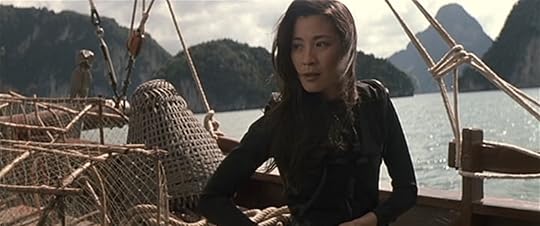
And finally, there's Michelle Yeoh's character, Wai Lin. Usually when I think of Tomorrow Never Dies, I remember Carver and Paris and will tell you that I hate the movie. But I'm forgetting about Wai Lin when I do that. She and Bond make an awesome team with neither of them really being "in charge." They're convincing as agents with competing priorities whose missions happen to align this one time. They also have fun chemistry and the last half of the movie is pretty great because of it.
Best Quip
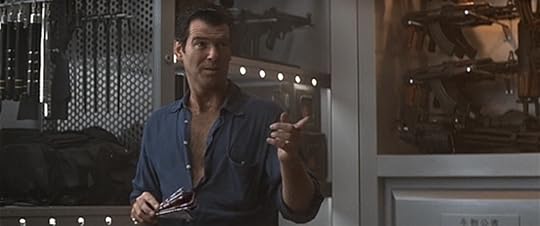
"I've always been a fan of Chinese technology," after playing with many Chinese spy gadgets culminating in a dart-shooting fan. It's a funny scene anyway with great reactions by Brosnan, but the pun puts it over the top.
Worst Quip
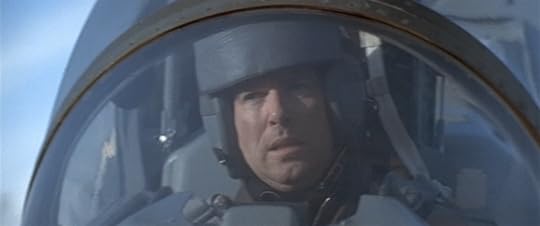
"Backseat driver," after ejecting the enemy gunner from the backseat of the plane Bond's stealing. Too easy.
Gadgets
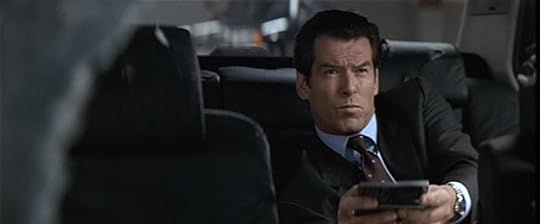
Tomorrow has a couple of pretty cool gadgets that I'll get to in a second, but there are also a couple of small items that need mentioning. Both are explosives: one concealed in a lighter and the other (stolen from Wai Lin's stash) is hidden in a watch. That second one is so tiny that I'm not sure what it's intended purpose is. Bond uses it to break some glass, but it doesn't produce any flame, so it doesn't look very effective against anything stronger.
The bigger personal item is a cell phone that includes a skeleton key, a taser, a fingerprint scanner/copier, and a car remote that not only unlocks Bond's new BMW, it also drives it.
The BMW is the big showcase item for Tomorrow. In addition to being able to be driven by the phone, it's also fully loaded with an electrified security system, smoke cloud, cable cutters, a caltrops dispenser (and matching re-inflatable tires), and rockets. It's also bulletproof and sledgehammer proof, but apparently not grenade launcher proof, though the bad guys don't try that until Bond's already in the car and getting away. When Q gives Bond the car, he also claims there are machineguns, but Bond never uses them.
Speaking of giving Bond the car, it's totally lame to squeeze in one more product placement by having Q wear an Avis jacket and hand the car over at the rental company. It's a funny scene as Q reads through the insurance options, but it doesn't make sense in the context of how MI6 usually does things.
Having the car be a BMW is another unfortunate effect of product placement. The vehicle's gadgets are mostly great, but the car itself is bland and not in the same class as the Aston Martins or Lotus. Also, the remote control is a cool fantasy, but doesn't seem like it would work in real life. Including it comes from the same impulse that's going to give us an invisible car in Die Another Day. Don't like it.
Top Ten Gadgets
1. Lotus Esprit (The Spy Who Loved Me)
2. Aston Martin DB V (Goldfinger and Thunderball)
3. Jet pack (Thunderball)
4. Iceberg boat (A View to a Kill)
5. Aston Martin V8 Vantage (The Living Daylights)
6. Glastron CV23HT speed boat (Moonraker)
7. Acrostar Mini Jet (Octopussy)
8. Crocodile submarine (Octopussy)
9. Little Nellie (You Only Live Twice)
10. Rocket cigarettes (You Only Live Twice)


Brosnan's not doing anything too different than what he did in GoldenEye, but the script's not helping him out. He's playing it straight, but the rest of the movie can't decide what tone it wants to take and undercuts him. Still, he's doing a fine job and is a much better Bond than I anticipated when they hired him.
When he was first up for the role to replace Roger Moore, I was a big Remington Steele fan, but assumed that Brosnan's Bond would continue the light-hearted, foppish take that Moore developed. After Dalton, I didn't want to go back to the Moore version and was thrilled that Brosnan apparently didn't either.
M continues to be a figure of restraint in Tomorrow, but this time Bond is her ally. She's at odds with the Navy, who wants to bluster forward and start a war with China, while she's trying to investigate and gather information. The Navy's position is stupid (especially since there's tangible evidence linking Elliot Carver to the sinking of the British vessel in Chinese waters), but I like that it puts M and Bond on the same side and gives her a reason to stick up for him. He's very much an instrument of her will, which is a theme I love and am glad it's going to continue through Judi Dench's time as the character.
I especially like when she has to remind him that sex is a viable tool to get information from his former girlfriend. I don't buy the Paris-Bond relationship, but it's a refreshing change to see Bond reluctant to use sex that way, but be ordered into it by M. Bond has always made jokes about "having" to go to bed with beautiful women "for queen and country," so it's cool (and kind of a comeuppance) to finally see him do it against his will.
Getting a bit more of a handle on Bond's relationship with Moneypenny now. It was vague in GoldenEye, but Tomorrow shows that she's not flirting with him. She knows what he's like and it doesn't bother her - in fact, she's able to wink and joke about it - but she's way too smart to fall for his crap herself. I miss the mutual flirtation of Lois Maxwell's version, but Stephanie Bond's take is cool too.
Joe Don Baker is back as Jack Wade and I still like him. I'd still rather see a great version of Felix, but I like Wade better than most versions of Felix up to this point.
And finally, there's Michelle Yeoh's character, Wai Lin. Usually when I think of Tomorrow Never Dies, I remember Carver and Paris and will tell you that I hate the movie. But I'm forgetting about Wai Lin when I do that. She and Bond make an awesome team with neither of them really being "in charge." They're convincing as agents with competing priorities whose missions happen to align this one time. They also have fun chemistry and the last half of the movie is pretty great because of it.
Best Quip

"I've always been a fan of Chinese technology," after playing with many Chinese spy gadgets culminating in a dart-shooting fan. It's a funny scene anyway with great reactions by Brosnan, but the pun puts it over the top.
Worst Quip

"Backseat driver," after ejecting the enemy gunner from the backseat of the plane Bond's stealing. Too easy.
Gadgets

Tomorrow has a couple of pretty cool gadgets that I'll get to in a second, but there are also a couple of small items that need mentioning. Both are explosives: one concealed in a lighter and the other (stolen from Wai Lin's stash) is hidden in a watch. That second one is so tiny that I'm not sure what it's intended purpose is. Bond uses it to break some glass, but it doesn't produce any flame, so it doesn't look very effective against anything stronger.
The bigger personal item is a cell phone that includes a skeleton key, a taser, a fingerprint scanner/copier, and a car remote that not only unlocks Bond's new BMW, it also drives it.
The BMW is the big showcase item for Tomorrow. In addition to being able to be driven by the phone, it's also fully loaded with an electrified security system, smoke cloud, cable cutters, a caltrops dispenser (and matching re-inflatable tires), and rockets. It's also bulletproof and sledgehammer proof, but apparently not grenade launcher proof, though the bad guys don't try that until Bond's already in the car and getting away. When Q gives Bond the car, he also claims there are machineguns, but Bond never uses them.
Speaking of giving Bond the car, it's totally lame to squeeze in one more product placement by having Q wear an Avis jacket and hand the car over at the rental company. It's a funny scene as Q reads through the insurance options, but it doesn't make sense in the context of how MI6 usually does things.
Having the car be a BMW is another unfortunate effect of product placement. The vehicle's gadgets are mostly great, but the car itself is bland and not in the same class as the Aston Martins or Lotus. Also, the remote control is a cool fantasy, but doesn't seem like it would work in real life. Including it comes from the same impulse that's going to give us an invisible car in Die Another Day. Don't like it.
Top Ten Gadgets
1. Lotus Esprit (The Spy Who Loved Me)
2. Aston Martin DB V (Goldfinger and Thunderball)
3. Jet pack (Thunderball)
4. Iceberg boat (A View to a Kill)
5. Aston Martin V8 Vantage (The Living Daylights)
6. Glastron CV23HT speed boat (Moonraker)
7. Acrostar Mini Jet (Octopussy)
8. Crocodile submarine (Octopussy)
9. Little Nellie (You Only Live Twice)
10. Rocket cigarettes (You Only Live Twice)
August 18, 2015
Tomorrow Never Dies (1997) | Story

Plot Summary
A stupidly short-sided news mogul tries to beat his competition to stories by creating events and reporting on them before they happen. Bond and Michelle Yeoh put a stop to it.
Influences
Fresh out of Fleming influences to pull from, Barbara Broccoli and her step-brother Michael G Wilson (Cubby Broccoli had passed away shortly after the release of GoldenEye) turned to screenwriter Bruce Feirstein. He'd been one of the writers on GoldenEye and came up with a story based on his own experiences as a journalist, creating a villain along the lines of Robert Maxwell and Rupert Murdoch. Drawing inspiration from the Beatles song "Tomorrow Never Knows," Feirstein named his bad guy's newspaper Tomorrow and the name of the movie was going to be Tomorrow Never Lies. Which makes tons more sense than Tomorrow Never Dies, but (so the story goes) thanks to a bad fax, that was what MGM thought the title was going to be and they fell in love with it.
How Is the Book Different?
Tomorrow Never Dies is the first Bond movie to take none of its name or plot from anything Fleming-related. Other than the standard cast of characters, I can't think of a single thing that it owes directly to the books.
Moment That's Most Like Fleming

There are a couple of Fleming-like elements though. A tiny one is that Bond keeps his gun in a special container in his glove compartment, but a major one is the way he approaches his case. He's in total Blunt Instrument mode.
As soon as he knows that Elliot Carver is his man (which is really early, thanks to Carver's stupidity), Bond's whole tactic is to go meet Carver and just stir crap up. Bond lets Carver know right away that he's under suspicion; then moves in on Carver's wife. I don't even know why Bond's "investigation" is necessary, because MI6 has enough evidence already to seize Carver's assets and launch a full inquiry, but whatever. Bond doesn't pussyfoot around with Carver and that's very much like Fleming's character.
Moment That's Least Like Fleming

There's a bunch about Tomorrow that feels off, but I'll mention two big ones. The first is Carver's wife (and a former girlfriend of Bond) named Paris. It's cool and all that Carver is married to someone that Bond used to date - that's kind of novel - but the movie claims that she was a major, important person in his life. It makes the claim super unconvincingly, but it makes it. That not only doesn't feel like Fleming's Bond, it doesn't even feel like the movie version. There's only ever been one significant woman for Bond and it ain't this one.
Paris is an example of an even deeper problem though, and that's the inconsistency of Tomorrow's tone. One of GoldenEye's strengths was that it reconciled Bond's humor with the darkness of his world. Tomorrow doesn't have that balance. It just gives us dark moments right next to goofy ones with no attempt to bring the two together. The silliness robs the tragic moments of their weight, and the grim stuff makes the humor inappropriate. Fleming was a way better writer than that.
Cold Open

The teaser starts with a terrorist arms bazaar on the Russian border (because we still don't trust those Russians). It's cool that the movie shows us this from the perspective of the MI6 command center with no Bond in sight for a while. Instead, M and her new Chief of Staff are at odds with an admiral about how best to handle the market. M wants to gather intelligence, while the Navy just wants to bomb the place and get it over with.
The admiral pulls rank and orders a missile strike over the objections of "White Knight," M's agent at the bazaar who's supplying them all with the video they're watching. Of course, White Knight is actually Bond and he's right that they should've held off the attack, because one of the planes for sale is carrying nuclear weapons and an explosion will kill far more than just the terrorists.
Since it's too late to abort the missile strike, Bond's only choice is to steal the plane and get it out of the area, which he does. There's a nice moment when the admiral wonders what the hell Bond is doing and M replies, "His job!" It's an unnecessarily combative question for the admiral to be asking - creating some extra tension that doesn't need to be there and doesn't really make sense - but I like that M defends her man despite their disagreements in GoldenEye.
We can't have a teaser without some kind of action set piece, so Bond steals his plane with the gunner still in the backseat. The gunner chokes Bond, who has to fly the plane with his knees, get it under a pursuing plane, then eject the gunner into the other plane, making it explode.
It's one of the more implausible teasers, made even clunkier by its not having much to do with the rest of the movie. Carver's tech guy makes a cameo appearance at the bazaar where he's seen buying some equipment that will help in Carver's plan, but he's totally unconnected to what Bond's doing there and as far as the rest of the movie's concerned he could have gotten that tech anywhere.
Top 10 Cold Opens
1. GoldenEye
2. The Spy Who Loved Me
3. Moonraker
4. Thunderball
5. On Her Majesty's Secret Service
6. A View to a Kill
7. Goldfinger
8. The Man with the Golden Gun
9. The Living Daylights
10. Licence to Kill
Movie Series Continuity

M's traditional Chief of Staff, Bill Tanner (from the novels and a few movies including GoldenEye) has been replaced by the extremely handsome Charles Robinson (Colin Salmon from Alien vs Predator, the Resident Evil movies, and Arrow). I wonder if it has anything to do with Tanner's calling M the "evil queen of numbers" last movie? At any rate, Robinson's going to stick around for the rest of the Brosnan films and I'm glad. Like him a lot.
The only other bit of movie continuity I noticed (besides Paris, I mean) is that Bond is still a secret agent. He hasn't been a world-famous spy since the middle of the Moore era. Carver does figure out who he works for, but has to do some digging to come up with it. And he also comes up with Michelle Yeoh's employer, so it's meant as an example of Carver's resourcefulness, not Bond's notoriety.

August 17, 2015
Tragg and the Sky Gods [Guest Post]
By GW Thomas
 I want to read all the old Gold Key original comics. Titles like Tales of Sword and Sorcery, Solar, Man of the Atom, and Magnus, Robot Fighter conjure up feelings inside me that are hard for anyone born before 1960 and after 1980 to understand. Unless you grew up in the '70s and remember all those comic book covers by Jessie Santos, Richard Powers, and others calling to you, you just won't get it. I never got to read many of them until now. Sure, they were twenty-five cents, sitting there in the wire rack, but I was a kid and a quarter wasn't easy to find. (And Marvel and DC always came first.) Later I saw copies in bags, two a piece, in stores like Woolco and Woolworths (two establishments as dead and gone as Gold Key). I have no idea what they sold for, but I didn't buy any of those either. But occasionally, I came across a copy somewhere. Just a taste...
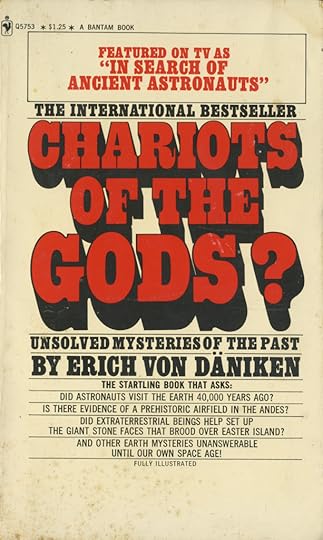
The contents were never as good as those covers, but it still remains a dream of mine to read all the old titles, especially those written by Donald F Glut. His books were always the best because he genuinely liked the science fiction, fantasy, and horror genres. I'm starting my journey with Tragg and the Sky Gods. This is a very appropriate title to begin with since the idea that inspired it could only have come from that decade. Erich von Daniken's Chariot of the Gods? (1968) inspired a good part of the '70s love of Bigfoot, the occult, UFOs, and other fringe beliefs. It was in to be out. Far out!
 Whether you believe the truth is out there or not, you can't deny that von Daniken had an impact on fantastic publishing. Tragg and the Sky-Gods (June 1975-May 1982) is only one example. DAW Books published John Jakes' Conan-parody-with-UFOs called Mention My Name in Atlantis (1972) as well as Kenneth Bulmer's more serious version in Dream Chariots (1977 with two sequels) to name only two. Marvel tried to cash in with Marvel Preview #1 (February 1975) featuring Doug Moench and Alex Nino's "Man-God from Beyond the Stars," as well as an 11-page article on von Daniken's book. Carl Sagan and other scientists have debunked von Daniken's ideas in later years but it didn't stop him from selling 63 million copies of his books and flavoring the '70s with unsolved mysteries and alien visitors.
Also popular in that decade was a hold-over from previous decades: cavemen and dinosaurs. Still hot in 1975, despite One Million Years BC appearing in 1966, the ideas that Conan Doyle started in 1913, Edgar Rice Burroughs expanded upon until 1950, and Frazetta painted in the '50s and '60s, eventually brought us Rachel Welch in a prehistoric bikini. When Dinosaurs Ruled the Earth appeared in 1970, Land of the Lost was 1974, The Land That Time Forgot showed up in 1975, and At the Earth's Core arrived in 1976. You get the idea. Sexy cave chicks and pterodons were as prevalent as Hostess Fruit Pie ads! Gold Key used a lot of dinosaurs in comics like Turok, Son of Stone and Tarzan, so another one wasn't going to be a problem.
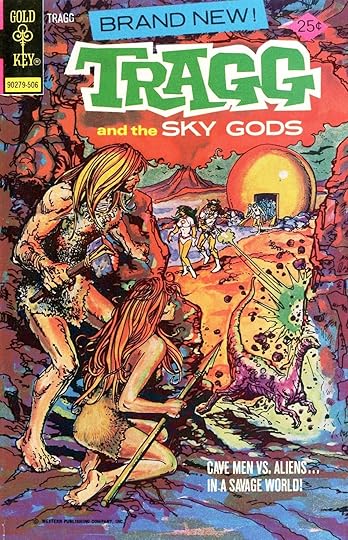
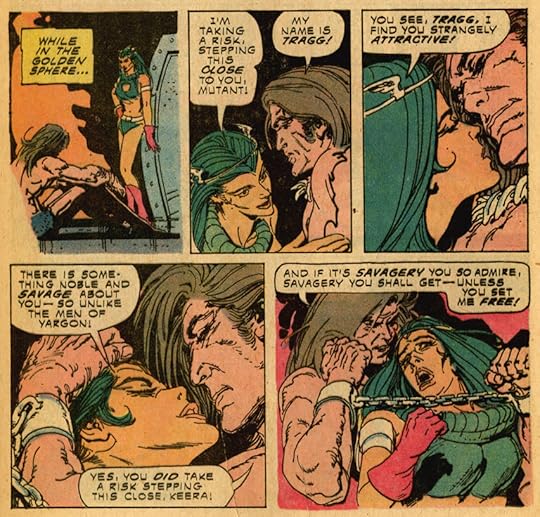 Tragg and the Sky Gods features Tragg and his lover Lorn (not a guy, but a hot red-head in a fur bikini), two advanced cavemen who, as children, were genetically manipulated by aliens from Yagorn with an evolvo-ray. The only problem is that the aliens left Earth and returned twenty-five years later. During that time, the benevolent scientists have been replaced by conquerors. No longer is the mission to help man evolve, but the enslavement of the human race! Tragg and Lorn have to leave their people but stay close to guard them against Zorek (a true Ming-wannabe, moustache and all) and the Sky Gods' nefarious schemes. There's only one problem for the dictator: his fiancée Keera has fallen for Tragg with his burly cave muscles. And despite having jet packs, ray guns, evolvo-rays, and - one would think - highly developed scientific knowledge, the baddies fail. Armed only with spears, dinosaurs, and Keera's treachery, Tragg and his friends set the invaders back, crippling their ship, destroying their volcano base, and stemming the coming invasion from Yagorn.
The comic ran for eight issues, with a reprint at the end, plus three additional stories in other Gold Key comics. In just eleven stories, Don Glut, Dan Speigle, and Jessie Santos presented an entertaining struggle between earthmen and aliens that unfortunately remains unfinished. But Glut did manage a couple of nice things in that short time. First off, I have to applaud his use of dinosaurs. Yes, they don't belong in an age of cavemen, but if you're going to have them, use them well. Glut identifies each major dinosaur that appears, making them as accurate as possible. (He does ignore time periods, with an allosaurus and a T-Rex existing at the same time. He also shows a saber tooth eating a dimetrodon, so what the hell?) It is apparent that the writer is a real dinosaur fan and not just throwing vaguely dino-shaped monsters at us. Looking at Glut's later career, I see he has written several volumes on dinosaurs including the award-winning Dinosaur Dictionary (1972) and The Dinosaur Encyclopedia (1997). He has also written for TV shows like Land of the Lost and Tarzan, Lord of the Jungle. He also maintains an interesting cave-girl and dinosaur website (not for the kids).
 The other thing Glut does is connect all his Gold Key series together in a mythos of sorts. In issue #8 (February 1977) he goes in a sword-and-sorcery direction, bringing the sorcerer Ostellon to Earth in a meteorite. The evil mage is serving the Dark Gods from Glut's Dagar comics. The dark ones show Ostellon the descendants of Tragg, namely Dagar and Doctor Spektor. They charge the magician with killing the caveman so these other men never exist. Of course he fails, but Ostellon is the only other big villain in the series. Later, when I get to those other two series, I will keep an eye out for the white-skinned, green-cowled mage and his masters.
My Gold Key journey has only begun. Was I disappointed with Tragg? Not at all. My appetite is only whetted. The journey continues in chronological order (of history, not publication date) with Tales of Sword and Sorcery: Dagar the Invincible...
GW Thomas has appeared in over 400 different books, magazines and ezines including The Writer, Writer's Digest, Black October Magazine and Contact. His website is gwthomas.org. He is editor of Dark Worlds magazine.
 I want to read all the old Gold Key original comics. Titles like Tales of Sword and Sorcery, Solar, Man of the Atom, and Magnus, Robot Fighter conjure up feelings inside me that are hard for anyone born before 1960 and after 1980 to understand. Unless you grew up in the '70s and remember all those comic book covers by Jessie Santos, Richard Powers, and others calling to you, you just won't get it. I never got to read many of them until now. Sure, they were twenty-five cents, sitting there in the wire rack, but I was a kid and a quarter wasn't easy to find. (And Marvel and DC always came first.) Later I saw copies in bags, two a piece, in stores like Woolco and Woolworths (two establishments as dead and gone as Gold Key). I have no idea what they sold for, but I didn't buy any of those either. But occasionally, I came across a copy somewhere. Just a taste...
The contents were never as good as those covers, but it still remains a dream of mine to read all the old titles, especially those written by Donald F Glut. His books were always the best because he genuinely liked the science fiction, fantasy, and horror genres. I'm starting my journey with Tragg and the Sky Gods. This is a very appropriate title to begin with since the idea that inspired it could only have come from that decade. Erich von Daniken's Chariot of the Gods? (1968) inspired a good part of the '70s love of Bigfoot, the occult, UFOs, and other fringe beliefs. It was in to be out. Far out!
 Whether you believe the truth is out there or not, you can't deny that von Daniken had an impact on fantastic publishing. Tragg and the Sky-Gods (June 1975-May 1982) is only one example. DAW Books published John Jakes' Conan-parody-with-UFOs called Mention My Name in Atlantis (1972) as well as Kenneth Bulmer's more serious version in Dream Chariots (1977 with two sequels) to name only two. Marvel tried to cash in with Marvel Preview #1 (February 1975) featuring Doug Moench and Alex Nino's "Man-God from Beyond the Stars," as well as an 11-page article on von Daniken's book. Carl Sagan and other scientists have debunked von Daniken's ideas in later years but it didn't stop him from selling 63 million copies of his books and flavoring the '70s with unsolved mysteries and alien visitors.
Also popular in that decade was a hold-over from previous decades: cavemen and dinosaurs. Still hot in 1975, despite One Million Years BC appearing in 1966, the ideas that Conan Doyle started in 1913, Edgar Rice Burroughs expanded upon until 1950, and Frazetta painted in the '50s and '60s, eventually brought us Rachel Welch in a prehistoric bikini. When Dinosaurs Ruled the Earth appeared in 1970, Land of the Lost was 1974, The Land That Time Forgot showed up in 1975, and At the Earth's Core arrived in 1976. You get the idea. Sexy cave chicks and pterodons were as prevalent as Hostess Fruit Pie ads! Gold Key used a lot of dinosaurs in comics like Turok, Son of Stone and Tarzan, so another one wasn't going to be a problem.
 Tragg and the Sky Gods features Tragg and his lover Lorn (not a guy, but a hot red-head in a fur bikini), two advanced cavemen who, as children, were genetically manipulated by aliens from Yagorn with an evolvo-ray. The only problem is that the aliens left Earth and returned twenty-five years later. During that time, the benevolent scientists have been replaced by conquerors. No longer is the mission to help man evolve, but the enslavement of the human race! Tragg and Lorn have to leave their people but stay close to guard them against Zorek (a true Ming-wannabe, moustache and all) and the Sky Gods' nefarious schemes. There's only one problem for the dictator: his fiancée Keera has fallen for Tragg with his burly cave muscles. And despite having jet packs, ray guns, evolvo-rays, and - one would think - highly developed scientific knowledge, the baddies fail. Armed only with spears, dinosaurs, and Keera's treachery, Tragg and his friends set the invaders back, crippling their ship, destroying their volcano base, and stemming the coming invasion from Yagorn.
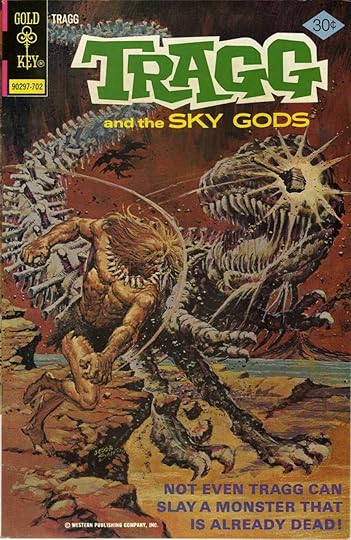
The comic ran for eight issues, with a reprint at the end, plus three additional stories in other Gold Key comics. In just eleven stories, Don Glut, Dan Speigle, and Jessie Santos presented an entertaining struggle between earthmen and aliens that unfortunately remains unfinished. But Glut did manage a couple of nice things in that short time. First off, I have to applaud his use of dinosaurs. Yes, they don't belong in an age of cavemen, but if you're going to have them, use them well. Glut identifies each major dinosaur that appears, making them as accurate as possible. (He does ignore time periods, with an allosaurus and a T-Rex existing at the same time. He also shows a saber tooth eating a dimetrodon, so what the hell?) It is apparent that the writer is a real dinosaur fan and not just throwing vaguely dino-shaped monsters at us. Looking at Glut's later career, I see he has written several volumes on dinosaurs including the award-winning Dinosaur Dictionary (1972) and The Dinosaur Encyclopedia (1997). He has also written for TV shows like Land of the Lost and Tarzan, Lord of the Jungle. He also maintains an interesting cave-girl and dinosaur website (not for the kids).
 The other thing Glut does is connect all his Gold Key series together in a mythos of sorts. In issue #8 (February 1977) he goes in a sword-and-sorcery direction, bringing the sorcerer Ostellon to Earth in a meteorite. The evil mage is serving the Dark Gods from Glut's Dagar comics. The dark ones show Ostellon the descendants of Tragg, namely Dagar and Doctor Spektor. They charge the magician with killing the caveman so these other men never exist. Of course he fails, but Ostellon is the only other big villain in the series. Later, when I get to those other two series, I will keep an eye out for the white-skinned, green-cowled mage and his masters.
My Gold Key journey has only begun. Was I disappointed with Tragg? Not at all. My appetite is only whetted. The journey continues in chronological order (of history, not publication date) with Tales of Sword and Sorcery: Dagar the Invincible...
GW Thomas has appeared in over 400 different books, magazines and ezines including The Writer, Writer's Digest, Black October Magazine and Contact. His website is gwthomas.org. He is editor of Dark Worlds magazine.
August 16, 2015
GoldenEye (1995) | Music
So much time had passed between Licence to Kill and GoldenEye that the Broccoli's and Wilson lost some of their traditional partners, including screenwriter Richard Maibaum, director John Glen, and composer John Barry. To replace Barry, they hired French composer Éric Serra who'd worked with Luc Besson on La Femme Nikita and Léon: The Professional.
Serra's score is notorious for its inappropriate (and to my ears, awful) synthesizer music, but there are some lovely orchestral sections. The romantic theme that plays as Bond arrives at the casino in Monte Carlo - and again when he's on the Caribbean beach with Natalya - is beautiful.
Sadly, he didn't include the Bond Theme almost at all, except for an electronic version that was supposed to play during the tank chase. Instead of his version though, the producers hired the score's conductor, John Altman, to write a more traditional arrangement of the Bond Theme that was used in the final cut.
Serra had nothing to do with the theme song, which was written by Bono and The Edge from U2. (Although he did do the closing credits song, a forgettable piece that sounds like a lesser Peter Gabriel or Sting song to me.) During the time when Duran Duran and a-ha were making Bond songs, it was a dream of mine that U2 also get to do one. I was a huge fan of that band. So I was excited that half the group would get to write the song for GoldenEye (appropriately, the other half arranged the Mission: Impossible theme for the first film in that series), but disappointed that it was sung by Tina Turner. She's got a great voice, but I didn't care for her stuff in the '80s and felt that she was another intentional throwback to older Bond songs instead of keeping up with the times, which is what I wanted.
It's a great song though. The lyrics are dark and creepy, about a woman who's been scorned by a dangerous man and is watching for her chance at revenge. There's a cool parallel between that story and Alec's in the movie, if Alec is the woman and Britain is the man. The "goldeneye" in the song is hers/Alec's as they watch their prey and it fits with the golden peacock eye in Carson McCullers' novel Reflections in a Golden Eye, which may or may not have inspired Ian Fleming for the name of his Jamaican house that gave GoldenEye its title. In McCullers' novel, the peacock sees a horrible, twisted reality that mirrors the point of view of some of the characters in the book. So, as the song points out, the Golden Eye of the Bond film isn't just the name of the MacGuffin, it's also Alec's way of looking at the world. Very cool.
What's also very cool is the opening credits. Maurice Binder was another casualty of the long break after Licence to Kill, so Broccoli and Wilson hired music video director Daniel Kleinman to design the main titles. He'd worked with a variety of bands in the '80s, including Madonna, Van Halen, Pat Benatar, and The Pretenders.
He brings a whole new style to the Bond credits, which was sorely needed, and he's been designing all of them ever since. Instead of just photographic tricks, Kleinman includes computer generated imagery, opening the sequences to many more possibilities and allowing more freedom to include themes from the movie. For GoldenEye, he opens with a reprise of the traditional gun barrel sequence, but shows the flames and bullet shooting out of it. The flames become a golden haze that then becomes a golden eye. This leads into imagery of falling Soviet iconography with some of the statues being broken up by women with hammers (more Soviet symbolism). Some of the statues also have golden eyes, further tying together the themes. And there's a sequence where two women's faces share the same head, representing the two-faced god Janus whose name Alec adopts as an alias. It's a fantastic job by Kleinman and one of my favorite title designs.
Top Ten Theme Songs
1. A View to a Kill
2. The Living Daylights
3. The Spy Who Loved Me ("Nobody Does It Better")
4. On Her Majesty's Secret Service
5. Diamonds Are Forever
6. You Only Live Twice
7. From Russia With Love (instrumental version)
8. Live and Let Die
9. Dr No
10. GoldenEye
Top Ten Title Sequences
1. On Her Majesty's Secret Service
2. Dr No
3. Thunderball
4. Goldfinger
5. GoldenEye
6. From Russia with Love
7. The Spy Who Loved Me
8. Diamonds Are Forever
9. Live and Let Die
10. Moonraker