Michael May's Blog, page 134
July 20, 2015
Atlas' Barbarians of Vengeance [Guest Post]
By GW Thomas
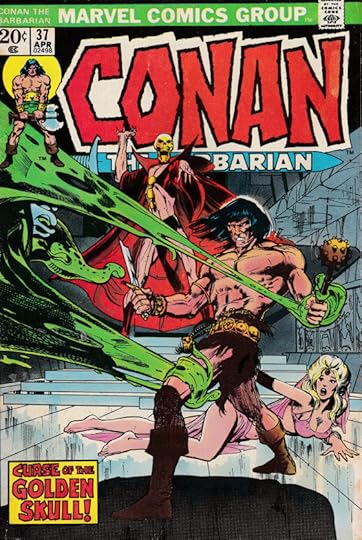 Atlas Comics (also known as Seaboard) has a weird but brief history. The company was started in 1974 by Martin Goodman, the man who took Marvel to the top of the pile. Having sold Marvel for millions, he was ready to walk away, with his son Chip Goodman ensconced as editorial director at the "House of Ideas." When Stan Lee fired Chip, some believe, Martin took his money and began the rival company, giving it the nickname "Vengeance Inc."
Goodman's policy was simple: Copy everything Marvel. Steal their ideas, steal their people, with higher pay and creator's rights. This included their successful sword-and-sorcery title, Conan the Barbarian, which became two titles: Ironjaw by Michael Fleisher and Wulf the Barbarian by Larry Hama. Despite the fact that both Ironjaw and Wulf were wandering barbarian/princes, the two comics were as different as their underlying philosophies.
Ironjaw's creator, Mike Fleisher, had a bad boy reputation in comics. At DC he wrote such downer characters as the violent Spectre and the unattractive gunslinger, Jonah Hex. He left DC to join Atlas and create the barbarian Ironjaw, giving him the same name as the 1942 Lev Gleason Nazi villain from Boy Comics, even the same wide metallic mandible. Much has been made of the essay at the end of the first issue where the editor tells about Fleisher's method of writing Ironjaw, basing it on "what a real man, placed in that same situation, would do." Sadly, this drive for "realism" means Ironjaw is a robber, a rapist, and an idiot. He lacks Robert E Howard's brooding fatalism and comes off like an adolescent.
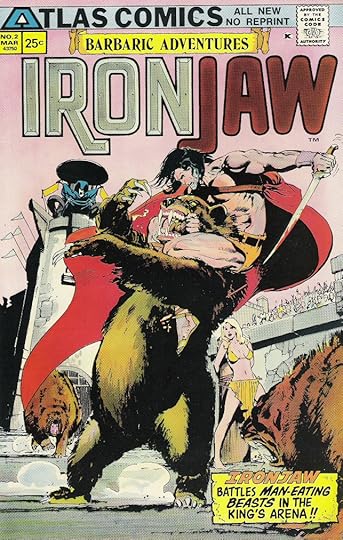 The first two issues of Ironjaw follow how he regains a throne he didn't even know he had lost. In a Hamlet-like scenario, the step-father had become king while the father was murdered. The baby heir Roland was supposed to be drowned, but instead was left among the rocks. He was found by the robber Tarlok, who raised the boy. Now a mighty fighter, Ironjaw seeks only gold, wine, and women. He ends up with the throne, but soon leaves it behind when he sees the job as monotonous and dull. In the third issue (May 1975), we see Ironjaw return home to his bandit brothers and rescue Tarlok from head-hunters.
Ironjaw #1 (January 1975) bore a Neal Adams cover. This is significant because Adams was the man who had produced the first covers for Marvel's Savage Tales and Savage Sword of Conan (strongly associating him with sword-and-sorcery) and because he was a relentless champion of creator's rights. Later he would be the point man on securing Jack Kirby his original art and getting the creators of Superman credit and money from DC. When the independents came along in the 1980s, he was active with companies like Pacific Comics. All that started here with Atlas, doing their best covers.
The interior art in the first issue was by Mike Sekowsky and Jack Abel. The look of the artwork was adequate, feeling a little like what Ditko had done for Warren back in 1965. Abel was one of the old crew of inkers from DC, having done Superman for years. Still, the look wasn't very Conan and Goodman wanted everything to scream Marvel. The second issue (March 1975) also had another Neal Adams cover, but the story art was done by Pablo Marcos. Marcos had been doing horror art for Skywald, Warren, and Marvel. This was his first chance to pencil and ink sword-and-sorcery and he made the most of it, producing very nice work that looked more like John Buscema's Conan than Sekowsky's did. Marcos would finish the run as artist. After Atlas folded he would become one of the regular inkers on Savage Sword of Conan.
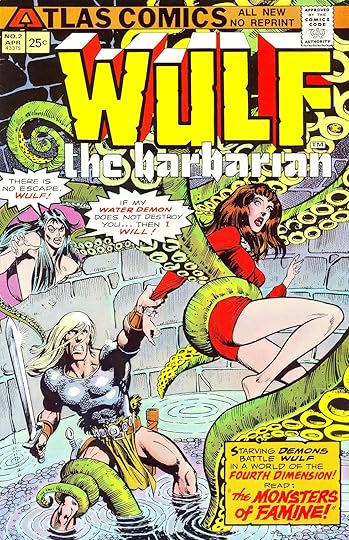 Alternating with Ironjaw, Wulf the Barbarian #1 appeared in February 1975. Written by Larry Hama, it has a very different feel to Fleisher's downbeat work. Where Ironjaw is a Conan imitation, Wulf the Barbarian bears a stronger resemblance to JRR Tolkien's The Lord of the Rings, with its Trolls of Drakenroost and the evil sorcerer Mordek, who rules them. Young Prince Wulf of Baernholm sees his father and mother slain and swears a blood oath for vengeance. He's raised by Stavro, the king's man, but when Stavro is murdered, Wulf arms himself and pursues the killer, the same troll who had slain his mother. Using one of Stavro's juggling tricks, Wulf gets back the sword of his father and takes his first revenge. He rides off, swearing to kill the sorcerer Mordek next.
The artwork was penciled by Larry Hama and inked by Klaus Jansen, who as a young fan had written letters to Charlton's Adventures of the Man-God Hercules, eight year earlier. Now he had a chance to do his own sword-and-sorcery comic. The Hama-Jansen art looks similar to DC's Sword of Sorcery or Claw the Unconquered. It didn't look much like Conan the Barbarian, but since Ironjaw did, perhaps there was less pressure. After leaving Atlas, Jansen became inker for Frank Miller on Daredevil, a move that would establish him in comics forever.
In the second issue (April 1975) Wulf takes up with a swordswoman, a rogue, and a magician to kill a wizard who has plagued the land with drought. Like the Conan story "Rogues in the House," they enter the wizard's domain and confront horrors, including a giant water demon named Bel-Shugthra. Sacrificing one of his comrades, Wulf summons a fire elemental to fight the water demon. They flee and the tower explodes House of Usher style. Of all of Wulf's adventures this one is closest to Robert E Howard. (Well, Lin Carter and L Sprague de Camp anyway.)
 By June 1975, Atlas was in trouble. The comics were not selling and Martin Goodman was losing writers and artists. The reason for leaving was not necessarily money, which Goodman had been generous with, but editorial tampering. All that promised freedom hadn't materialized when the owners looked at the sales figures. Goodman pushed for more Marvel-ness, and people left. This included both Michael Fleisher and Larry Hama. (Fleisher would write Conan the Barbarian from 1983 to 1985 before becoming a professional anthropologist. Hama would turn to acting, appearing in guest spots on MASH and Saturday Night Live, but would return to comics and create Bucky O'Hare.) In fact, all the titles were now written by Gary Friedrich. Friedrich had created Ghost Rider for Marvel and even the copy-cat "Hell Rider" for Skywald. He now had the big job of carrying on every title for the company.
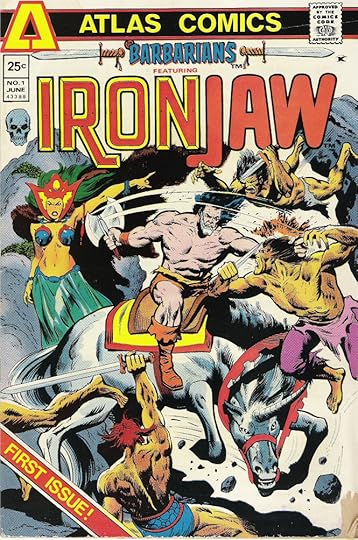
June 1975 saw a strange experiment for Ironjaw. The Barbarians featuring Ironjaw #1 published a short 10-pager called "Mountain of Mutants," written by Gary Friedrich and drawn by Pablo Marcos. Ironjaw is set in a post-apocalyptic America and this story tells how mutants from the nuclear war were created. Ironjaw is captured by these twisted creatures, but his life is spared by their queen. He must fight a giant mutant in an arena to prove the worthiness of the human race. Along with this tale was a reprint of the first portion of "Andrax," a European comic written by Peter Wiechmann and drawn by superstar Jordi Bernet. It too supposes a world strangely changed by radiation with monstrous mutations. Sadly, since there were no future issues, the "Andrax" story line is left incomplete. The cover for this one-shot was drawn by Rich Buckler and Jack Abel. Buckler did not give up his gig on Batman at DC for this, but had been experimental in sword-and-sorcery comics with "The Bloodstaff"(Eerie #29, September 1970) and "The Shadow of the Sword" (Hot Stuf'#1, Summer 1974).
 The changes at Atlas became apparent from the first cover. Wulf the Barbarian #s 3 and 4 had covers by Canadian newcomer, Jim Craig. Craig would pencil the last issue as well. His style is reminiscent of Joe Staton at Charlton. Even worse, the interiors art for Issue #3 was given to Leo Summers (who had drawn for Creepy) and inked by anonymous collectives like the "Atlas Bullpen." Issue #3 was written by Steven Skeates, who had created "Thane of Bagarth" at Charlton years before, then wrote for Warren and DC. Wulf and his new Moorcockian companion Rymstrydle rescue a lady from the Rat-Men and their kangaroo mounts only to find that she is destined to marry Modeo, the son of Mordek. They take her to her fiancé's tech-filled castle. Wulf almost kills Modeo until he finds out the machine master hates his father as much as Wulf does. Unfortunately, Modeo's been played for a fool and Mordek takes control of his giant robot. The good guys escape in a hot air balloon.
Issue #4 was written by Mike Friedrich (not Gary, no relation) who had only recently started publishing his independent comic anthology Star*Reach. After stealing a horse from a female brigand, Wulf falls in with Lord Makhel, an old friend of the family. The lord is afflicted with a curse, turning him into a blood-sucking fiend. The brigands attack again and Wulf is forced to kill his old friend when he transforms. The female brigand, Beatryce, escapes shouting behind her that she might one day be his queen. If more issues had been printed, we can assume Wulf eventually got his throne back and married Beatryce.
In the final issue of Ironjaw #4 (July 1975), Gary Friedrich begins the origin of Ironjaw's namesake. The adopted son of Tarlok grows up into a minstrel and his songs are turning all the bandit girls' heads. One of the bandits, Dektor, crucifies the minstrel (Conan style!), then mutilates his jaw with a hot sword. Carlotta, Dektor's betrothed, who has fallen for the minstrel, takes him to the witch Soran for medical help. The witch turns herself into a beautiful woman and falls for her patient. Not only does she save his life, but she augments his physique magically. She has a smith create his iron jaw to cover his disfigurement and allow him to speak. She also says she will take him to be trained in the martial arts so that he can exact his revenge on Dektor. The issue ends there, so we never get to see what comes about, but it's not hard to guess that Dektor will die and the witch will be spurned, Ironjaw riding away singing Lynyrd Skynrd's "Free Bird." Friedrich's approach to writing an Ironjaw story is not much different than Fleisher, except that he breaks up the flashbacks with some present day dragon-fighting.
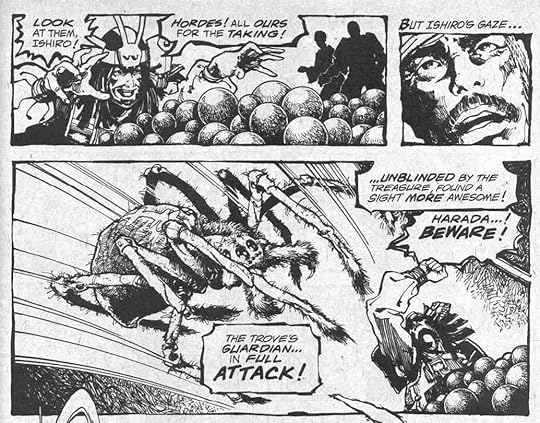
 But Atlas wasn't quite done with sword-and-sorcery yet. "Temple of the Spider" appeared in their black and white magazine, Thrilling Adventures Stories #2 (August 1975). This was written by Archie Goodwin and drawn by Walt Simonson, who both knew plenty about sword-and-sorcery comics. Goodwin wrote the first and most important sword-and-sorcery stories for Warren between 1965 and 1967. Walt Simonson worked on Sword of Sorcery at DC in 1973 and then wrote and drew a sword-and-sorcery parody, "A Tale of Sword & Sorcery" for Star*Reach #1 (April 1974). In later years, Simonson would bring a sword-and-sorcery feel to Thor at Marvel.
The plot for "Temple of the Spider" follows two ronin, the young and impulsive Harada and the older Ishiro. They seek a treasure in the Temple of the Spider, but find instead a cave behind the shrine, filled with giant spiders. "Temple of the Spider" is intriguing because it shows Simonson's interest in Japanese manga, a style he partially adopts for this piece. Manga had not really hit America yet, with the first piece to appear in Star*Reach #7 (January 1977) with Sitoshi Hirota and Masaichi Mukaide's "The Bushi."
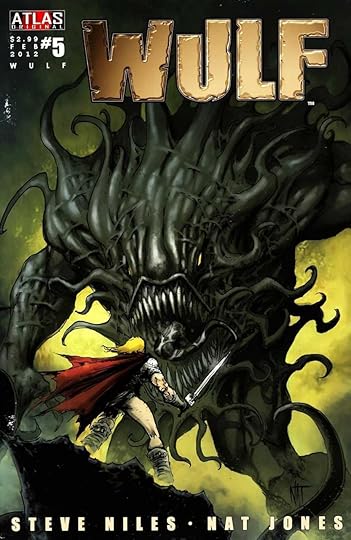
Atlas/Seaboard closed its doors fall of 1975. "Temple of the Spider" was later reprinted in Swords of Valor #3 (A-Plus Comics, 1990), a hint of what was to come in March 2011, when At Last Entertainment (started by grandson Jason Goodman) revived Wulf in a four-part mini-series written by Steve Niles and drawn by Nat Jones. The comic is dedicated to "the hard work of Martin and Chip Goodman." The new comic takes Wulf out of his barbaric world and places him in ours, chasing a hideous necromancer through dimensions. Ironjaw comes in halfway through and the two Atlas characters finally get to rumble together against some rather Cthulhian bad asses. Of all the comics produced at Atlas/Seaboard, only their sword-and-sorcery characters are remembered well enough to warrant reprinting or reviving.
GW Thomas has appeared in over 400 different books, magazines and ezines including The Writer, Writer's Digest, Black October Magazine and Contact. His website is gwthomas.org. He is editor of Dark Worlds magazine.
 Atlas Comics (also known as Seaboard) has a weird but brief history. The company was started in 1974 by Martin Goodman, the man who took Marvel to the top of the pile. Having sold Marvel for millions, he was ready to walk away, with his son Chip Goodman ensconced as editorial director at the "House of Ideas." When Stan Lee fired Chip, some believe, Martin took his money and began the rival company, giving it the nickname "Vengeance Inc."
Goodman's policy was simple: Copy everything Marvel. Steal their ideas, steal their people, with higher pay and creator's rights. This included their successful sword-and-sorcery title, Conan the Barbarian, which became two titles: Ironjaw by Michael Fleisher and Wulf the Barbarian by Larry Hama. Despite the fact that both Ironjaw and Wulf were wandering barbarian/princes, the two comics were as different as their underlying philosophies.
Ironjaw's creator, Mike Fleisher, had a bad boy reputation in comics. At DC he wrote such downer characters as the violent Spectre and the unattractive gunslinger, Jonah Hex. He left DC to join Atlas and create the barbarian Ironjaw, giving him the same name as the 1942 Lev Gleason Nazi villain from Boy Comics, even the same wide metallic mandible. Much has been made of the essay at the end of the first issue where the editor tells about Fleisher's method of writing Ironjaw, basing it on "what a real man, placed in that same situation, would do." Sadly, this drive for "realism" means Ironjaw is a robber, a rapist, and an idiot. He lacks Robert E Howard's brooding fatalism and comes off like an adolescent.
 The first two issues of Ironjaw follow how he regains a throne he didn't even know he had lost. In a Hamlet-like scenario, the step-father had become king while the father was murdered. The baby heir Roland was supposed to be drowned, but instead was left among the rocks. He was found by the robber Tarlok, who raised the boy. Now a mighty fighter, Ironjaw seeks only gold, wine, and women. He ends up with the throne, but soon leaves it behind when he sees the job as monotonous and dull. In the third issue (May 1975), we see Ironjaw return home to his bandit brothers and rescue Tarlok from head-hunters.
Ironjaw #1 (January 1975) bore a Neal Adams cover. This is significant because Adams was the man who had produced the first covers for Marvel's Savage Tales and Savage Sword of Conan (strongly associating him with sword-and-sorcery) and because he was a relentless champion of creator's rights. Later he would be the point man on securing Jack Kirby his original art and getting the creators of Superman credit and money from DC. When the independents came along in the 1980s, he was active with companies like Pacific Comics. All that started here with Atlas, doing their best covers.
The interior art in the first issue was by Mike Sekowsky and Jack Abel. The look of the artwork was adequate, feeling a little like what Ditko had done for Warren back in 1965. Abel was one of the old crew of inkers from DC, having done Superman for years. Still, the look wasn't very Conan and Goodman wanted everything to scream Marvel. The second issue (March 1975) also had another Neal Adams cover, but the story art was done by Pablo Marcos. Marcos had been doing horror art for Skywald, Warren, and Marvel. This was his first chance to pencil and ink sword-and-sorcery and he made the most of it, producing very nice work that looked more like John Buscema's Conan than Sekowsky's did. Marcos would finish the run as artist. After Atlas folded he would become one of the regular inkers on Savage Sword of Conan.
 Alternating with Ironjaw, Wulf the Barbarian #1 appeared in February 1975. Written by Larry Hama, it has a very different feel to Fleisher's downbeat work. Where Ironjaw is a Conan imitation, Wulf the Barbarian bears a stronger resemblance to JRR Tolkien's The Lord of the Rings, with its Trolls of Drakenroost and the evil sorcerer Mordek, who rules them. Young Prince Wulf of Baernholm sees his father and mother slain and swears a blood oath for vengeance. He's raised by Stavro, the king's man, but when Stavro is murdered, Wulf arms himself and pursues the killer, the same troll who had slain his mother. Using one of Stavro's juggling tricks, Wulf gets back the sword of his father and takes his first revenge. He rides off, swearing to kill the sorcerer Mordek next.
The artwork was penciled by Larry Hama and inked by Klaus Jansen, who as a young fan had written letters to Charlton's Adventures of the Man-God Hercules, eight year earlier. Now he had a chance to do his own sword-and-sorcery comic. The Hama-Jansen art looks similar to DC's Sword of Sorcery or Claw the Unconquered. It didn't look much like Conan the Barbarian, but since Ironjaw did, perhaps there was less pressure. After leaving Atlas, Jansen became inker for Frank Miller on Daredevil, a move that would establish him in comics forever.
In the second issue (April 1975) Wulf takes up with a swordswoman, a rogue, and a magician to kill a wizard who has plagued the land with drought. Like the Conan story "Rogues in the House," they enter the wizard's domain and confront horrors, including a giant water demon named Bel-Shugthra. Sacrificing one of his comrades, Wulf summons a fire elemental to fight the water demon. They flee and the tower explodes House of Usher style. Of all of Wulf's adventures this one is closest to Robert E Howard. (Well, Lin Carter and L Sprague de Camp anyway.)
 By June 1975, Atlas was in trouble. The comics were not selling and Martin Goodman was losing writers and artists. The reason for leaving was not necessarily money, which Goodman had been generous with, but editorial tampering. All that promised freedom hadn't materialized when the owners looked at the sales figures. Goodman pushed for more Marvel-ness, and people left. This included both Michael Fleisher and Larry Hama. (Fleisher would write Conan the Barbarian from 1983 to 1985 before becoming a professional anthropologist. Hama would turn to acting, appearing in guest spots on MASH and Saturday Night Live, but would return to comics and create Bucky O'Hare.) In fact, all the titles were now written by Gary Friedrich. Friedrich had created Ghost Rider for Marvel and even the copy-cat "Hell Rider" for Skywald. He now had the big job of carrying on every title for the company.
June 1975 saw a strange experiment for Ironjaw. The Barbarians featuring Ironjaw #1 published a short 10-pager called "Mountain of Mutants," written by Gary Friedrich and drawn by Pablo Marcos. Ironjaw is set in a post-apocalyptic America and this story tells how mutants from the nuclear war were created. Ironjaw is captured by these twisted creatures, but his life is spared by their queen. He must fight a giant mutant in an arena to prove the worthiness of the human race. Along with this tale was a reprint of the first portion of "Andrax," a European comic written by Peter Wiechmann and drawn by superstar Jordi Bernet. It too supposes a world strangely changed by radiation with monstrous mutations. Sadly, since there were no future issues, the "Andrax" story line is left incomplete. The cover for this one-shot was drawn by Rich Buckler and Jack Abel. Buckler did not give up his gig on Batman at DC for this, but had been experimental in sword-and-sorcery comics with "The Bloodstaff"(Eerie #29, September 1970) and "The Shadow of the Sword" (Hot Stuf'#1, Summer 1974).
 The changes at Atlas became apparent from the first cover. Wulf the Barbarian #s 3 and 4 had covers by Canadian newcomer, Jim Craig. Craig would pencil the last issue as well. His style is reminiscent of Joe Staton at Charlton. Even worse, the interiors art for Issue #3 was given to Leo Summers (who had drawn for Creepy) and inked by anonymous collectives like the "Atlas Bullpen." Issue #3 was written by Steven Skeates, who had created "Thane of Bagarth" at Charlton years before, then wrote for Warren and DC. Wulf and his new Moorcockian companion Rymstrydle rescue a lady from the Rat-Men and their kangaroo mounts only to find that she is destined to marry Modeo, the son of Mordek. They take her to her fiancé's tech-filled castle. Wulf almost kills Modeo until he finds out the machine master hates his father as much as Wulf does. Unfortunately, Modeo's been played for a fool and Mordek takes control of his giant robot. The good guys escape in a hot air balloon.
Issue #4 was written by Mike Friedrich (not Gary, no relation) who had only recently started publishing his independent comic anthology Star*Reach. After stealing a horse from a female brigand, Wulf falls in with Lord Makhel, an old friend of the family. The lord is afflicted with a curse, turning him into a blood-sucking fiend. The brigands attack again and Wulf is forced to kill his old friend when he transforms. The female brigand, Beatryce, escapes shouting behind her that she might one day be his queen. If more issues had been printed, we can assume Wulf eventually got his throne back and married Beatryce.
In the final issue of Ironjaw #4 (July 1975), Gary Friedrich begins the origin of Ironjaw's namesake. The adopted son of Tarlok grows up into a minstrel and his songs are turning all the bandit girls' heads. One of the bandits, Dektor, crucifies the minstrel (Conan style!), then mutilates his jaw with a hot sword. Carlotta, Dektor's betrothed, who has fallen for the minstrel, takes him to the witch Soran for medical help. The witch turns herself into a beautiful woman and falls for her patient. Not only does she save his life, but she augments his physique magically. She has a smith create his iron jaw to cover his disfigurement and allow him to speak. She also says she will take him to be trained in the martial arts so that he can exact his revenge on Dektor. The issue ends there, so we never get to see what comes about, but it's not hard to guess that Dektor will die and the witch will be spurned, Ironjaw riding away singing Lynyrd Skynrd's "Free Bird." Friedrich's approach to writing an Ironjaw story is not much different than Fleisher, except that he breaks up the flashbacks with some present day dragon-fighting.
 But Atlas wasn't quite done with sword-and-sorcery yet. "Temple of the Spider" appeared in their black and white magazine, Thrilling Adventures Stories #2 (August 1975). This was written by Archie Goodwin and drawn by Walt Simonson, who both knew plenty about sword-and-sorcery comics. Goodwin wrote the first and most important sword-and-sorcery stories for Warren between 1965 and 1967. Walt Simonson worked on Sword of Sorcery at DC in 1973 and then wrote and drew a sword-and-sorcery parody, "A Tale of Sword & Sorcery" for Star*Reach #1 (April 1974). In later years, Simonson would bring a sword-and-sorcery feel to Thor at Marvel.
The plot for "Temple of the Spider" follows two ronin, the young and impulsive Harada and the older Ishiro. They seek a treasure in the Temple of the Spider, but find instead a cave behind the shrine, filled with giant spiders. "Temple of the Spider" is intriguing because it shows Simonson's interest in Japanese manga, a style he partially adopts for this piece. Manga had not really hit America yet, with the first piece to appear in Star*Reach #7 (January 1977) with Sitoshi Hirota and Masaichi Mukaide's "The Bushi."
Atlas/Seaboard closed its doors fall of 1975. "Temple of the Spider" was later reprinted in Swords of Valor #3 (A-Plus Comics, 1990), a hint of what was to come in March 2011, when At Last Entertainment (started by grandson Jason Goodman) revived Wulf in a four-part mini-series written by Steve Niles and drawn by Nat Jones. The comic is dedicated to "the hard work of Martin and Chip Goodman." The new comic takes Wulf out of his barbaric world and places him in ours, chasing a hideous necromancer through dimensions. Ironjaw comes in halfway through and the two Atlas characters finally get to rumble together against some rather Cthulhian bad asses. Of all the comics produced at Atlas/Seaboard, only their sword-and-sorcery characters are remembered well enough to warrant reprinting or reviving.
GW Thomas has appeared in over 400 different books, magazines and ezines including The Writer, Writer's Digest, Black October Magazine and Contact. His website is gwthomas.org. He is editor of Dark Worlds magazine.


July 19, 2015
A View to a Kill (1985) | Music
The story goes that John Taylor from Duran Duran (with a few drinks in him) approached Cubby Broccoli at a party and asked when they were going to get someone "decent" to do a Bond song. Taylor's a Bond fan (he talks about it a bit in this 1985 interview for the movie) and I can imagine that his asking that was as much out of frustration over the blandness of the last few theme songs as it was out of ambition. At any rate, Broccoli listened and Duran Duran worked with John Barry to create one of greatest Bond songs of all time.
I kind of dread writing about Skyfall and having to pick between that song and this one, but I'm a huge Duran Duran fan and "View to a Kill" pushes all my buttons. From the pounding drums and synth to the nonsensically poetic lyrics and the delightfully whiney way that Simon LeBon sings them, it's a perfect Duran Duran song and it makes me so happy to have it in a Bond movie. I remember being ecstatic at the time, hoping that this was a herald for better times for Bond music.
To go with it, Maurice Binder created a very '80s opening credits sequence with blacklight effects and girls literally dancing into the fire. There's a lot of dancing in the credits, but also pointing guns and skiing. Binder's been using more photography in his last few sequences, with silhouettes just popping in now and then. At some point he'll work in a unique image like in A View to a Kill where he has Bond shoot at a woman to turn her into ice for some reason. It's been a while since I've felt any real inspiration from his titles. He's mostly just picking a gimmick and then doing his usual thing with it and I admit that I'm getting weary of the formula. Maybe that's because I'm watching these so close together.
Barry barely uses the Bond Theme in A View to a Kill. It shows up clearly as Bond chases the parachuting May Day through Paris, but other than that it's only just noticeable as part of another action theme that Barry uses during the ski chase, the fight at Stacey's house, and the fight on top of the Golden Gate bridge.
Top Ten Theme Songs
1. A View to a Kill
2. The Spy Who Loved Me ("Nobody Does It Better")
3. On Her Majesty's Secret Service instrumental theme
4. Diamonds Are Forever
5. You Only Live Twice
6. From Russia With Love (John Barry instrumental version)
7. Live and Let Die
8. Dr No
9. Thunderball
10. Goldfinger
Top Ten Title Sequences
1. On Her Majesty's Secret Service
2. Dr No
3. Thunderball
4. Goldfinger
5. From Russia with Love
6. The Spy Who Loved Me
7. Diamonds Are Forever
8. Live and Let Die
9. Moonraker
10. Octopussy

July 18, 2015
A View to a Kill (1985) | Villains

I know this is the point, but May Day is so weird. Grace Jones, man. I never know what she's doing, but I always end up sort of liking it. You always know exactly how she's feeling, whether she's glowering or laughing maniacally for no reason. And those emotions flip so quickly. She's all into sparring and wrestling with Zorin until he starts winning and then she turns feral, snapping and biting at him. When he exerts his power even more by trying to make out with her, she resists at first, but becomes totally okay with it as long as she's on top and in control.
It's fascinating to me that her defining characteristics - he need for control and having zero masks on her emotions - are huge weaknesses. She's such a strong and imposing woman, but there's a desperation about her that makes her endlessly compelling to me. I don't even know if I'm talking about May Day or Grace Jones now, because it's the same situation in Conan the Destroyer (though I like her character a lot better in that movie). It's probably a moot point, because I always get the feeling that she's more or less playing herself anyway.
I love that she switches sides at the end. Some folks have a problem with it because behind the scenes it was probably due to '80s sexual politics about Bond's not being able to kill a woman. I don't care about that as long as it works in-story and it totally does. It doesn't make May Day a weaker character; it makes her stronger by tragically letting her find her humanity moments before giving her an heroic death. Up to that point, she was basically a bizarre, flamboyant substitute for Oddjob, but turning against Zorin makes her into a character that I care about.

Speaking of May Day's transformation, let's talk about Jenny Flex. She introduces herself and her weird name to Bond like she's going to be important, but does nothing the rest of the movie. Her ultimate, best purpose in the film is to die, betrayed by Zorin, and motivate May Day to change.
Which, actually, I'm okay with. That's her role in the movie, to be the object of May Day's grief. It's the first sign of humanity we get from May Day when she sees Jenny's body and cries out her name. We have no clue what their relationship was, but whether they were close or Jenny was just a trusted underling, her death affects May Day and makes May Day see that Zorin is more monster than even May Day can take.
What threw me was Jenny's name. I'm used to women with punny names having more to do than Jenny does. But her name gets my attention and keeps it whenever Jenny's on screen, even if she's not really doing anything. That way, when she dies, I remember who she is and understand why May Day is upset.

Zorin's head of security is Scarpine (who has a scar, what are the odds?). He's one of the two people in Zorin's inner circle; the other being Dr. Mortner. I should maybe say a quick word about Mortner, partly because he also plays the king in Princess Bride and that's awesome, but also because his role in the story suggests something about Scarpine.
Mortner was a Nazi scientist who experimented with steroids on pregnant women in order to create super soldiers. Zorin was one of those babies and it's clear that he sees Mortner as a father figure. My theory - and I'm sure that others have had it before me - is that Scarpine was another of the steroid babies. That not only explains why Zorin doesn't betray him, it also explains why Scarpine seems to be just as psychotic as Zorin, ruthlessly and brutally helping Zorin to murder his own men.
My favorite thing about Scarpine is that he's played by Patrick Bauchau, whom I think I first noticed as the vampiric prince Archon in Kindred: The Embraced and also enjoyed on Carnivàle, Alias, and anywhere else I see him pop up.

Finally, I love Christopher Walken and Max Zorin is a very Walkeny performance. It's impossible for me to not enjoy him in this movie. The original intent was to have Zorin played by David Bowie or Sting, who were both doing a lot of acting in the '80s. I love both of those guys too, but they would have played the role straight and I'm glad we got Walken. Zorin is a miserably written character and desperately needs Walken's energy to keep him watchable.
Zorin is clearly insane and that's fine for a Bond villain, but we're also supposed to believe that he's been able to fool the whole world into thinking he's respectable. Watching him at his party, I can buy into that. He's super charismatic. But his plans are ridiculous and he goes to very little effort to conceal his involvement in them. There's a French detective who's looking into Zorin's horse racing activities and even though the guy has literally nothing on Zorin, Zorin has him murdered in a public place, in a spectacular way, and even drives the getaway boat himself. I can easily believe that Zorin's psychosis makes him want to be as closely involved with the killing as possible. I just don't accept that no one's noticed his activities before now and that he's got this perfect reputation the Minister of Defense refers to.
Then there's the fact that his plan rips off Goldfinger's and we even get a repeat of Mr. Solo's fate from that movie. And there's also Zorin's trying to drown Bond in a lake without killing him first. Zorin's a cliché, nothing villain and the movie is damn lucky that it has Walken to bring him to life.
Top Ten Villains
1. Auric Goldfinger (Goldfinger)
2. Ernst Stavro Blofeld (Never Say Never Again)
3. Ernst Stavro Blofeld (From Russia With Love and Thunderball)
4. Ernst Stavro Blofeld (On Her Majesty's Secret Service)
5. Maximilian Largo (Never Say Never Again)
6. Francisco Scaramanga (The Man with the Golden Gun)
7. Dr. Kananga (Live and Let Die)
8. Doctor No (Dr. No)
9. General Gogol (For Your Eyes Only)
10. Karl Stromberg (The Spy Who Loved Me)
Top Ten Henchmen
1. Baron Samedi (Live and Let Die)
2. Fiona Volpe (Thunderball)
3. Grant (From Russia with Love)
4. Nick Nack (The Man with the Golden Gun)
5. Gobinda (Octopussy)
6. May Day (A View to a Kill)
7. Jaws (The Spy Who Loved Me and Moonraker)
8. Naomi (The Spy Who Loved Me)
9. Oddjob (Goldfinger)
10. Irma Bunt (On Her Majesty's Secret Service)

A View to a Kill (1985) | Women

I'm kind of surprised that Kimberly Jones even gets a name. All she does is pilot the iceberg boat and "keep Bond company" on the way out of Siberia, but I like her. She seems to enjoy her job and why wouldn't she? She gets to drive that cool, swanky ride and hang out with super spies. I sort of want a whole TV show about her and her iceberg boat.

May Day is way more interesting as a villain than a romantic partner for Bond, so I'll save most of my thoughts for that post. I don't have a good idea about why she gets into bed with Bond; it's not like he's going to spill any important information because of it. I guess the one thing it does is shows us that she's not monogamous with Zorin. She and Zorin have a strange relationship that seems to be partly a battle for control and power, so maybe having sex with Bond is a way for her to show Zorin the limits of his control over her.
Not that Zorin seems to care, which means either a) that I'm way off the mark or b) his not being bothered is his own way of maintaining control. Walken plays Zorin so nonchalantly that it's hard to get a read on what he's thinking.

Pola Ivanova is a fun character. She's not in the movie much and is only there to give Bond information that he hasn't been able to pick up on his own, but I love the idea that he sometimes runs into former flings in his line of work. Rumor has it that Ivanova was originally intended to be Anya Amasova from The Spy Who Loved Me, but Barbara Bach wasn't interested in reprising her role. If that's true, it's too bad it didn't work out. That would have been even more fun.

And then there's Stacey Sutton, California State Geologist and daughter of an oilman whom Zorin put out of business. She's played by Tanya Roberts, who had replaced Shelley Hack (who'd in turn replaced Kate Jackson) on Charlie's Angels in 1980. That led to her roles in The Beastmaster and Sheena, which is where the Bond producers found out about her. She's not great in the part, but I like the post on Hill Place that defends her against her most aggressive critics. The author argues (successfully, I think) that the role of Stacey doesn't play to whatever strengths Roberts had as an actor, and that director John Glen seems to have done little to help her improve.
It's not that Roberts is unconvincing as a scientist, it's that the character is just bland and kind of dumb. She's only as necessary to the story as Pola Ivanova is: solely there to give Bond a crucial clue. The problem is that she sticks around well after she's done what the story needs from her. As far as Roberts' acting goes, she does just fine as a companion for Bond. Like I said earlier, their relationship is pretty innocent up until the last shot of the movie. The shower scene ruins it, because if that had been left out, Bond's relationship with Stacey is almost paternal. He very clearly notices that she's an attractive woman, but as I quoted yesterday for the Best Quip, he's "trying not to think about it." That's a cool relationship and Roberts holds up her end of it just fine.
My Favorite Bond Women
1. Tracy Bond (On Her Majesty's Secret Service)
2. Melina Havelock (For Your Eyes Only)
3. Paula Caplan (Thunderball)
4. Tatiana Romanova (From Russia With Love)
5. Fiona Volpe (Thunderball)
6. Domino Derval (Thunderball)
7. Holly Goodhead (Moonraker)
8. Mary Goodnight (The Man with the Golden Gun)
9. Andrea Anders (The Man with the Golden Gun)
10. Honey Rider (Dr. No)

July 17, 2015
A View to a Kill (1985) | Bond
Actors and Allies
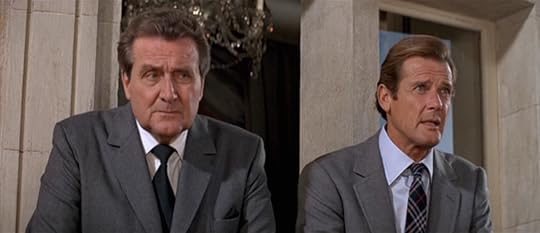
As mentioned many times by many people - including the man himself - Roger Moore was too old to be playing Bond anymore. But let's not lie by saying that his age is the problem with this movie. He's still as charming as ever and his age is only an issue when he's climbing into bed with much younger women. For the most part though, those trysts make sense. The one that doesn't is Stacey Sutton, but except for a tacked-on, last minute dalliance in the shower, their relationship is mostly chaste, so even that's not distractingly creepy for most of the movie.
The problem with A View to a Kill is the story, as we looked at yesterday. Since there is no one, central mystery to solve, Bond's not able to succeed through detective work. The script forces him to rely entirely on hunches. He looks into the horse steroids on a hunch. Then, when that leads nowhere, he goes to San Francisco on a hunch. While there, he hears about problems with some missing crabs, so he investigates Zorin's oil wells on another hunch. He has to get his details about Zorin's most sinister scheme from the Soviets, and he meets Stacey - the final piece of his puzzle - quite by accident at City Hall when he goes to visit the Department of Oils and Mines for some reason. Probably a hunch.
It's sad that Bond can't do his job through honest problem-solving, because it's not for lack of trying. He goes undercover twice in the movie, which has to be hard for him, because that never works out well for Bond. I mean, one of his aliases is James Stock. I had to chuckle when he tells Sir Godfrey that "a successful cover becomes almost second nature." Like he would know.
Speaking of Sir Godrey, it's a pleasure seeing Patrick Macnee in this movie. I've never seen The Avengers (something I have plans to fix soon), so I mostly know him from View to a Kill and guest appearances on '70s TV shows like Battlestar Galactica. But even if you don't get the spy reference, he's still a fun character and a pleasant companion for Bond during the rambling horse investigation. That part of the movie is always better when he's on screen.
Once Bond gets to San Francisco, his main ally becomes Jack Lee of the CIA. Rumor has it that the screenwriters considered using Felix Leiter for that role, but opted for a Chinese American agent since Chinatown is such a well-known part of San Francisco. Good for them. The character probably wouldn't have been as memorable had he been yet another Felix.
General Gogol is back. He's sort of an adversary in that the initial microchip that got Bond involved had been stolen from the British and ended up with the Soviets. But Zorin refuses to play nice with the KGB and gets on Gogol's bad side, so there's another alliance between the KGB and MI6 as they both work against Zorin.
Speaking of MI6, everyone's very professional during Bond's briefing. Except maybe for Q, who will keep playing with that robot. Bond is attentive and serious, so M and the Minister of Defense don't have anything to get upset about. I guess that Robert Brown's M is having a positive effect on Bond in that regard. He seems neither easily riled nor willing to put up with any crap from Bond. I imagine that if Bond played the fool, this M wouldn't just gripe. Discipline would probably be swift and stern.
I wish I had a good, in-story explanation for why M sends in Q's robot to check on Bond at the end of the movie. They make a big deal of not knowing if Bond is dead or alive, but instead of sending an agent around to Stacey's house, they sneak that robot in. It makes no more sense than Stacey's wanting to take a shower with Bond.
Finally, we need to talk about Moneypenny, especially since this is Lois Maxwell's last performance in the role. She's also the last remaining cast member who'd been around since Dr. No. There's no flirting this time, just some friendly ribbing, but we're used to that by this point. I enjoyed her relationship with Bond, which wasn't nearly as one-sided (most of the time) as legend has it. That more-or-less platonic relationship with a woman is something that I miss about the rest of the series. At least until Skyfall anyway.
Best Quip
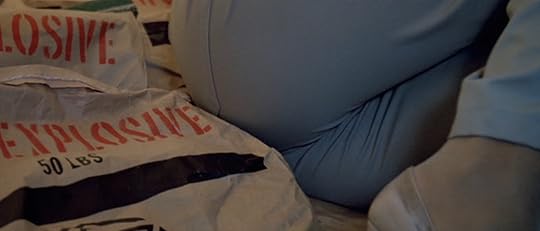
"I'm trying not to think about it," in answer to Stacey's question, "Do you know what I'm sitting on?"
Worst Quip
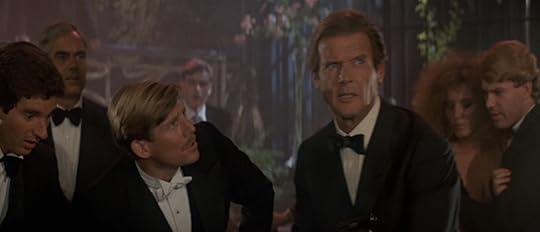
"There's a fly in his soup," after his dinner companion is murdered with a butterfly-shaped fishing lure.
Gadgets
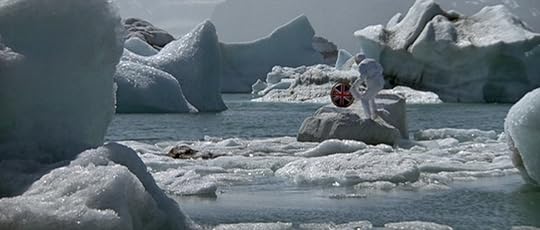
The best piece of tech in the movie is the iceberg boat that extracts Bond from Siberia. I love its camouflage, I love it's Union Jack hatch cover, and I love its swanky interior.
But while Bond doesn't have anything else that cool in the movie, he certainly makes up for it in quantity. View has to hold the record for most gadgets in a film so far, especially the personal kind. He uses a bug-sweeping device disguised as an electric razor, polarizing sunglasses, a reader that makes impressions of the last check someone wrote, a camera ring, and a credit card (from Sharper Image, naturally) that opens locks electronically.
Looking at how my Top Ten list is shaping up for gadgets, I wonder if I shouldn't have made two separate lists to differentiate between vehicles and personal items, because the vehicles are definitely taking over. But nah. The vehicles are just way cooler. It's still a fair list.
Top Ten Gadgets
1. Lotus Esprit (The Spy Who Loved Me)
2. Aston Martin DB V (Goldfinger and Thunderball)
3. Jet pack (Thunderball)
4. Iceberg boat (A View to a Kill)
5. Glastron CV23HT speed boat (Moonraker)
6. Acrostar Mini Jet (Octopussy)
7. Crocodile submarine (Octopussy)
8. Little Nellie (You Only Live Twice)
9. Rocket cigarettes (You Only Live Twice)
10. Ski pole rocket (The Spy Who Loved Me)
Bond's Best Outfit
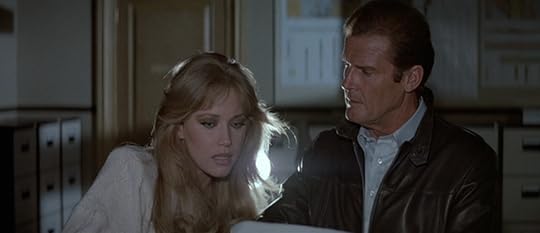
Love a leather jacket.
Bond's Worst Outfit
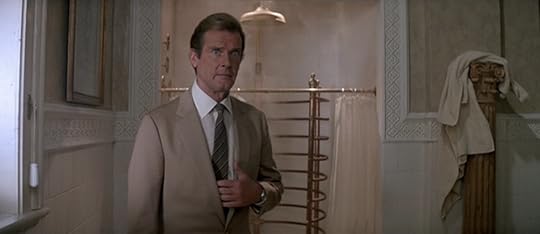
Still don't like brown suits.

As mentioned many times by many people - including the man himself - Roger Moore was too old to be playing Bond anymore. But let's not lie by saying that his age is the problem with this movie. He's still as charming as ever and his age is only an issue when he's climbing into bed with much younger women. For the most part though, those trysts make sense. The one that doesn't is Stacey Sutton, but except for a tacked-on, last minute dalliance in the shower, their relationship is mostly chaste, so even that's not distractingly creepy for most of the movie.
The problem with A View to a Kill is the story, as we looked at yesterday. Since there is no one, central mystery to solve, Bond's not able to succeed through detective work. The script forces him to rely entirely on hunches. He looks into the horse steroids on a hunch. Then, when that leads nowhere, he goes to San Francisco on a hunch. While there, he hears about problems with some missing crabs, so he investigates Zorin's oil wells on another hunch. He has to get his details about Zorin's most sinister scheme from the Soviets, and he meets Stacey - the final piece of his puzzle - quite by accident at City Hall when he goes to visit the Department of Oils and Mines for some reason. Probably a hunch.
It's sad that Bond can't do his job through honest problem-solving, because it's not for lack of trying. He goes undercover twice in the movie, which has to be hard for him, because that never works out well for Bond. I mean, one of his aliases is James Stock. I had to chuckle when he tells Sir Godfrey that "a successful cover becomes almost second nature." Like he would know.
Speaking of Sir Godrey, it's a pleasure seeing Patrick Macnee in this movie. I've never seen The Avengers (something I have plans to fix soon), so I mostly know him from View to a Kill and guest appearances on '70s TV shows like Battlestar Galactica. But even if you don't get the spy reference, he's still a fun character and a pleasant companion for Bond during the rambling horse investigation. That part of the movie is always better when he's on screen.
Once Bond gets to San Francisco, his main ally becomes Jack Lee of the CIA. Rumor has it that the screenwriters considered using Felix Leiter for that role, but opted for a Chinese American agent since Chinatown is such a well-known part of San Francisco. Good for them. The character probably wouldn't have been as memorable had he been yet another Felix.
General Gogol is back. He's sort of an adversary in that the initial microchip that got Bond involved had been stolen from the British and ended up with the Soviets. But Zorin refuses to play nice with the KGB and gets on Gogol's bad side, so there's another alliance between the KGB and MI6 as they both work against Zorin.
Speaking of MI6, everyone's very professional during Bond's briefing. Except maybe for Q, who will keep playing with that robot. Bond is attentive and serious, so M and the Minister of Defense don't have anything to get upset about. I guess that Robert Brown's M is having a positive effect on Bond in that regard. He seems neither easily riled nor willing to put up with any crap from Bond. I imagine that if Bond played the fool, this M wouldn't just gripe. Discipline would probably be swift and stern.
I wish I had a good, in-story explanation for why M sends in Q's robot to check on Bond at the end of the movie. They make a big deal of not knowing if Bond is dead or alive, but instead of sending an agent around to Stacey's house, they sneak that robot in. It makes no more sense than Stacey's wanting to take a shower with Bond.
Finally, we need to talk about Moneypenny, especially since this is Lois Maxwell's last performance in the role. She's also the last remaining cast member who'd been around since Dr. No. There's no flirting this time, just some friendly ribbing, but we're used to that by this point. I enjoyed her relationship with Bond, which wasn't nearly as one-sided (most of the time) as legend has it. That more-or-less platonic relationship with a woman is something that I miss about the rest of the series. At least until Skyfall anyway.
Best Quip

"I'm trying not to think about it," in answer to Stacey's question, "Do you know what I'm sitting on?"
Worst Quip

"There's a fly in his soup," after his dinner companion is murdered with a butterfly-shaped fishing lure.
Gadgets

The best piece of tech in the movie is the iceberg boat that extracts Bond from Siberia. I love its camouflage, I love it's Union Jack hatch cover, and I love its swanky interior.
But while Bond doesn't have anything else that cool in the movie, he certainly makes up for it in quantity. View has to hold the record for most gadgets in a film so far, especially the personal kind. He uses a bug-sweeping device disguised as an electric razor, polarizing sunglasses, a reader that makes impressions of the last check someone wrote, a camera ring, and a credit card (from Sharper Image, naturally) that opens locks electronically.
Looking at how my Top Ten list is shaping up for gadgets, I wonder if I shouldn't have made two separate lists to differentiate between vehicles and personal items, because the vehicles are definitely taking over. But nah. The vehicles are just way cooler. It's still a fair list.
Top Ten Gadgets
1. Lotus Esprit (The Spy Who Loved Me)
2. Aston Martin DB V (Goldfinger and Thunderball)
3. Jet pack (Thunderball)
4. Iceberg boat (A View to a Kill)
5. Glastron CV23HT speed boat (Moonraker)
6. Acrostar Mini Jet (Octopussy)
7. Crocodile submarine (Octopussy)
8. Little Nellie (You Only Live Twice)
9. Rocket cigarettes (You Only Live Twice)
10. Ski pole rocket (The Spy Who Loved Me)
Bond's Best Outfit

Love a leather jacket.
Bond's Worst Outfit

Still don't like brown suits.
July 16, 2015
A View to a Kill (1985) | Story

Plot Summary
Christopher Walken watches Goldfinger; thinks, "Hey! I should do that, but with computers!"
Influences
After the relatively down-to-earth Cold War stories of For Your Eyes Only and Octopussy, Cubby Broccoli and step-son Michael G Wilson (now listed as a full co-producer on the series) decided to go back to an over-the-top villainous plot. They also talked Roger Moore into one last movie, which confused me, because I was under the impression that everyone knew Moore was getting to be too old even for Octopussy, but they brought him back for that movie specifically to compete with Sean Connery in Never Say Never Again.
But it's the NSNA threat that best explains Moore's presence in View to a Kill too. The day before NSNA's release, Broccoli attempted to steal some of its wind by announcing that Moore would return for one last film. Without the benefit of hindsight, it must have seemed like a smart move. Everyone loved Roger Moore as Bond and no one really wanted to see him go. But if he was at his expiration date for Octopussy, he was long past it for View.
I wish I knew the thinking behind the movie's title. It was announced at the end of Octopussy as From a View to a Kill in keeping with the short story, but at some point it was shortened to the more wieldy version. The shorter version is better, but neither has anything to do with the movie. Even The Spy Who Loved Me at least has a plot suggested by its title. View just tries to force a reference with an extremely clumsy line of dialogue. It's true that they were running low on cool Fleming titles, but that's not even trying. What a cool challenge it would have been to improve on Fleming by creating a story that actually fits that title. Sadly, View isn't interested in doing anything challenging.
How Is the Book Different?
The one thing that the Fleming story has in common with the movie is Bond in Paris, but the circumstances are totally different and there's not a shred of Fleming's plot left. "From a View to a Kill" is one of the weaker Fleming stories, but it still has some set pieces that could have been put to good use. Instead, Wilson and veteran Bond screenwriter Richard Maibaum drew inspiration from the microchip boom and just laid that over the plot from Goldfinger.
Moment That's Most Like Fleming

Max Zorin is a mediocre villain because of his goals. With something else to do, he could have been great. Walken is pretty awesome in the role, but also, Zorin's origins feel very Fleming-esque. Like many of Fleming's bad guys, Zorin has his roots in WWII. And the evil program that created him is totally something that Fleming would have been interested in.
Moment That's Least Like Fleming

Sloppy diversionary tactics. The main problem with View is that it doesn't have enough plot to sustain a movie. Instead, it introduces a couple of extraneous plots to try to fool us into thinking there's more story than there actually is.
It starts the same way Moonraker did, with some technology going missing and Britain's only clue being the tech's manufacturer. In View's case, it's a special microchip that Zorin Industries was developing for Britain, but has now turned up in the Soviet Union. Because Zorin's organization has an obvious leak that needs looking into, MI6's lead is stronger in View than in Moonraker, but beyond that, the only thing Bond has to go on is an unsupported hunch that Zorin himself might be involved.
For some reason, this leads everyone to investigate Zorin's horse-breeding operation. The Minister of Defense urges caution because of Zorin's spotless record, but it's not even Bond who suggests the horses as a first line of inquiry. Moneypenny is all dressed for the races before Bond even shows up for his briefing, so this is apparently the approach to the case that M wants to take.
And it has nothing to do with the mysterious microchip that's supposed to be the purpose of the investigation. Man does it ever take a lot of time to look into though. Worse than that, despite the horse plot's including a microchip element and introducing Bond to the big players in Zorin's organization, uncovering Zorin's cheating in that area turns into a big, fat dead-end. All it does is confirm that Zorin is a bad guy, which - contrary to his reputation - everyone already suspected anyway.
Bond's second tactic then is to go to San Francisco where Zorin has other operations, and it's there that he uncovers Zorin's plan to profit from the deaths of millions of people. That's enough engine to drive the rest of the movie, but notice that it still has nothing to do with the initial microchip that started this whole thing off. What we have are three, different schemes of Zorin's that all involve microchips, but are otherwise unrelated.
Cold Open

I do like that the cold open at least appears to have something to do with the main movie this time. It takes place in Siberia where Bond finds 003 frozen with a locket containing a microchip. This is the second movie in a row where Bond picks up an investigation from a less-successful Double-O. The series never treats the rest of Bond's department very well and that won't end with this movie.
Once Bond has the microchip, he's chased by Soviets in another exciting ski chase (I honestly never get tired of these) until someone shoots his ski off and he has to steal a snowmobile from one of his pursuers. But than that gets blown up, so he turns the front ski into a snowboard and the chase becomes even more awesome.
Well, almost. As happens too often in Bond movies, the fantastic stunt-work is ruined by the soundtrack. This time it's the Beach Boys' "California Girls" playing, because snowboarding kind of looks like surfing, I guess?
After an otherwise thrilling chase, Bond escapes via a boat shaped like an iceberg, which is also pretty great. Without the Beach Boys, it would have made one of the best of the cold opens. Heck. It still does.
Top 10 Cold Opens
1. The Spy Who Loved Me
2. Moonraker
3. Thunderball
4. On Her Majesty's Secret Service
5. A View to a Kill
6. Goldfinger
7. The Man with the Golden Gun
8. For Your Eyes Only
9. Octopussy
10. Never Say Never Again
Movie Series Continuity

I already mentioned the presence of the Minister of Defense. He's outworn his welcome for me by this point. I'm ready to be done with his micro-managing and get back to M's running the show on his own.
Bond is sort of a show-off about wine during dinner at the Eiffel Tower, but he's eating with a French guy who appreciates Bond's knowledge, so it's not obnoxious.
The hat rack gag makes another appearance. This time, Bond is about to toss his hat, but notices a fancy, flowered hat already on the rack. That distracts Bond, so he just places his hat on the rack instead. It turns out that the flowery hat is Moneypenny's race-wear and he almost tosses it on the rack at the end of the scene, but Moneypenny stops him.
Proving once and for all that Bond's in-world fame can be used or discarded as the story demands, no one recognizes Bond in either of his aliases, even though he's wearing no disguise. He's in Zorin's database though, so Zorin's able to find Bond out when he needs to.

July 15, 2015
Nerd Lunch's Return of the Jedi drill-down

As usual, I'm late telling you about this, but last week Nerd Lunch released the third in their Star Wars drill-downs featuring me and Kay from the FANgirl blog. We wrapped up the original trilogy with a lively discussion of Return of the Jedi, white-boarding the Han Rescue Plan, arguing over which Sy Snootles song is better, and - most importantly - uncovering the secret Yoda Tapes.
I have many, many problems with Jedi, but I also have new appreciation for the Luke/Vader story, which moved me in a surprising way this time. Hope you'll give the episode a listen.

July 14, 2015
Signing tomorrow at The Source Comics and Games

Just a reminder for anyone in the Twin Cities area that I'll be at The Source Comics and Games tomorrow, signing copies of Dark Horse Presents #12, which kicks off the new Kill All Monsters story.
See you there!

July 13, 2015
The Time Travelers [Guest Post]
By GW Thomas
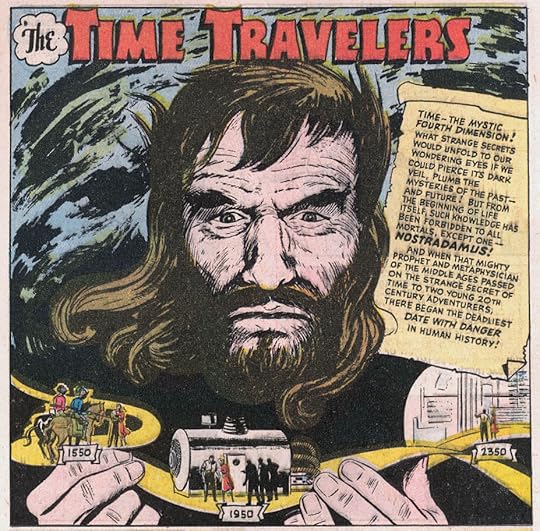 Science fiction comics usually run in anthologies of similar material. Forbidden Worlds, Mystery in Space, even Space Westerns. All their stories are clearly marked as fantastic in nature. This is why "The Time Travelers" (#1 October-November 1950 - #12 August-September 1952) in American Comic Group's Operation Peril was so unusual. The rest of the strips that accompanied the time-slipping tales of Dr. Tom Redfield and his companion Peggy Foster were the sea adventures of Typhoon Tyler and the detective cases of red-headed Danny Danger. All three strips got cover space and none of the three could be said to overshadow the others.
"The Time Travelers" was written by Richard E Hughes, ACG editor and writing mainstay. Hughes was the creator of such characters as The Black Terror, The Fighting Yank, Super Mouse, and Herbie Popnecker in Forbidden Worlds. The artwork for "The Time Travelers" was provided by Ken Bald, best known for his later work on the Dr. Kildare comic strip that ran from 1962 to 1984.
The first installment (October-November 1950) introduces Dr. Tom Redfield, a nuclear physicist who is working on a new type of cyclotron. His girlfriend, the wealthy Peggy Foster, drags him to an auction where she out-bids the Russian Vanov for newly discovered papers by Nostradamus. The papers contains Nostradamus' prediction of a nuclear war in 1956, but also speaks of an antidote to the radiation. Tom uses the ancient priest's design for a "tempus machina" to finish the cyclotron. The Russians capture Tom and Peggy and put the couple in the cyclotron chamber to kill them, but actually send them back in time to 16th century France. Tom and Peggy are arrested as English spies. Speaking with Nostradamus, they learn that the counteragent to radiation can only be found on Venus. The duo flee back to the spot where the time machine dropped them, waiting for the time beam to take them back. They are surrounded by angry pursuers when they return to 1950.
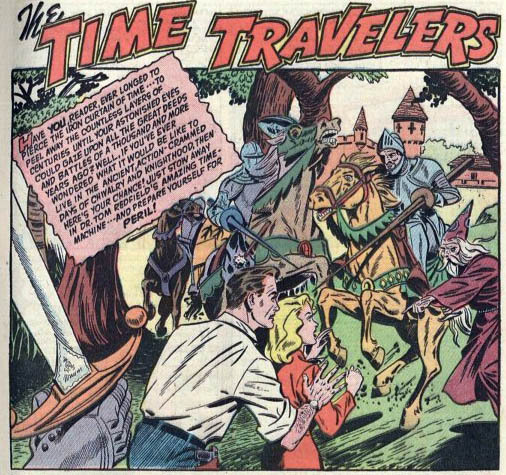 Several time travel clichés are evident already in Hughes' script. The time machine does not take them to 16th century America, but to France, making it a time and space machine. Second, the travelers have no problem understanding the locals, who speak archaic French. These problems have plagued SF adventure writers who have found ways around them like Dr. Who's TARDIS and Star Trek's universal translator. Certainly Hughes is no worse than the writers behind George Pal's The Time Machine (1960) or Irwin Allen's Time Tunnel in 1966. These are annoying difficulties that most writers don't care to deal with.
Issue #2 (December 1950-January 1951) has Tom and Peggy build a rocket that uses the time machine as an engine and go to Venus. A Russian spy sabotages the ship (for the Russians have a ship of their own), sending Tom and Peggy back to the cavemen of the Stone Age. Tom shoots a sabertooth, uses cavemen as laborers to fix the ship and even encounters a Tyrannosaurus Rex (yup, dinosaurs!). The duo fly to Venus only to be captured by Venusian Amazons. Tom is thrown into an arena and must fight first the brutish Skang, then the many-armed Beast of Tarv. Defeating both, he wins the love of the Amazon queen (to Peggy's chagrin) and helps her take out the Russians who have holed up in a temple where the anti-radioactivity metal is kept. Vanov and the other Russians end up being eaten by killer plants and Tom and Peggy return to Earth with the antidote. (The nuclear war of 1956 is never mentioned again.)
Issue#3 (February-March 1951) has Tom and Peggy going back to the time of King Arthur (the 6th century) to get the sword Excalibur for a wealthy college patron named JP Frisbee. When they arrive at Camelot they are captured (always!) and taken before the King. Tom wins Arthur's favor by shooting a torch out of Merlin's hand. The duplicitous Merlin, along with Mordred and Morgan Le Fay, trap Arthur and Tom but they escape. The baddies bring in Teutonic knights to depose Arthur. Tom heads back to the future, takes on a carload of armored motorcycles, and the good guys have a jousting battle with the horse-riding Teutons, killing Mordred. Merlin and Morgan die when Tom tips their cauldron of boiling oil on them. There are enough inaccuracies in this story to spin Malory in his grave. First off, the knights and their armor are from the 12th or later century and secondly, most of the King Arthur story is not historically or even fictionally correct.
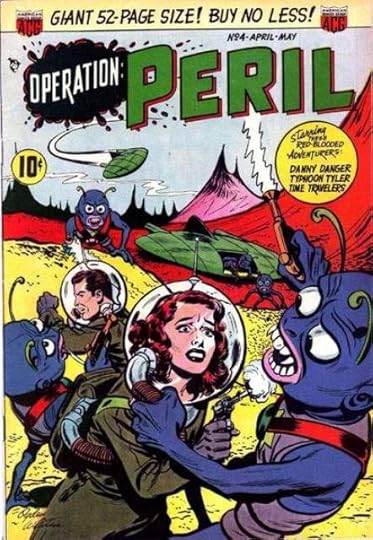 Issue #4 (April-May 1951) has Tom building a special rocket to take nuclear waste to the Moon. A Dr. Volka tries to dissuade him from the project, sabotaging the rocket and sending Tom and Peggy past the Moon and on to Saturn. There they discover that the rings of Saturn are made of flying saucers. Landing on Saturn they encounter the Cronians, the slave race of the Saturnians. Tom is placed in an arena (again!) and has to fight a big Saturnian on a platform. The loser falls off to be eaten by the dread Hydrid. Tom wins, but the overlord makes him fight the Hydrid anyway, with its impenetrable skin. The Cronians help Tom and Peggy escape and they take the slaves in the rocket. Going after Volka, Tom is waylaid by the beautiful Sirads, women so beautiful that men can't stop thinking about them. The only cure is a woman even more beautiful, so it's up to Peggy to get dolled up and break the spell. This episode contains the most interesting science Fictional ideas since the first episode, though some of it is just Edgar Rice Burroughs retread.
Issue #5 (June-July 1951) has a best selling historical author named Blake force Tom to take him to the age of pirates. The writer wants to give Anne Bonny, the famous woman pirate, modern guns so that she can acquire even more treasure, which Blake will get in the future. (I guess best selling authors don't make as much as they do now.) Tom and Peggy are stuck in the past because Blake has the key to the time machine. Blake and Anne begin a campaign of robbery that ends when a British warship attacks the pirates. Tom slows the pirates down by dropping a sail on them. The British arrest Anne, and Tom kills Blake with a sword. Tom reveals to Peggy that he had a duplicate key all along. Peggy suspects Tom has fallen for Anne Bonny but Tom explains that he knew Anne would be captured in 1720 and he wanted to make sure history was not changed. This is the last issue that hinges on Peggy's jealousy over other beautiful female characters, but she'd turn the tables in a few issues. It is also the only storyline that worries about preserving the timeline.
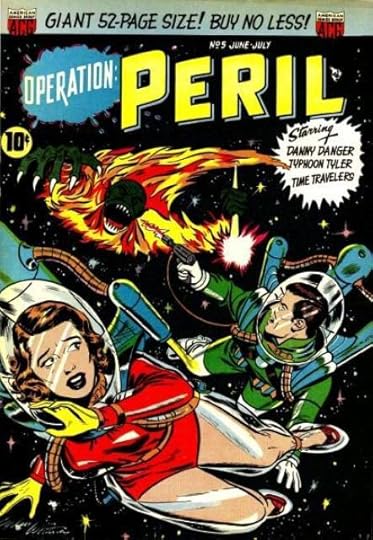 In Issue #6 (August-September 1951), the villain Emperor Ego has stolen the plans for Tom's spaceship/time machine and plans to recruit armies from the past to attack major cities. Tom uses the time machine to go back and hear Ego's plan, but it is a trap. Ego claims to be headed for Atlantis and Tom and Peggy go back in time. Once in Atlantis, Tom knocks down Kothos, Captain of the Guard, and uses him as a hostage to see the ruler, the beautiful Queen Thera. Kothos challenges Tom to a duel in the arena with chariots. Tom wins, but Kothos is a sore loser. Tom grabs Peggy and they flee. They are surrounded by archers and it looks bad when a great earthquake shakes Atlantis, sinking it beneath the waves. Tom and Peggy make it back to the ship and return to 1951. The spaceship picks up the signals of Ego's new vessel and Tom follows them to Ego's base. Tom kills Ego and his henchmen by burning them to death with the exhaust of the ship. Tom's violence against the villains increases as the comic goes on, but this is 1951 and the Comics Code has yet to be created.
Issue #7 (October-November 1951) has the Time Travelers off to Easter Island in the year 750 AD to discover the secret of the giant stone heads. Disguised as local Rotuma, Tom and Peggy join a war party getting ready for an invasion. Tarako, the war chief, discovers Peggy is a woman and uses a hypnotism drug on her. Peggy betrays Tom and he is strung up between two heads with a fire beneath. Tom saves himself by using his new remote control device. Taking the ship, he follows the invaders to Chile where they plan to capture Cuzco. Tom joins Princess Lanura, the Chilean ruler, and defeats Tarako in battle. Tom gets the antidote and Peggy is returned to her normal self. This time it was Tom's turn to be jealous. This episode introduces the remote control device that allows Tom to start and fly the ship from afar. Tom also supplies the information that the ship allows them to understand any language.
Issue #8 (December 1951-January 1952) tackles another fabled city. Tom leaves the time machine on and a beautiful princess named Amura comes out. She is taken back by some evil soldiers. This leads Tom and Peggy to go back in time to find the fabled city of Mu. When they arrive, they find they are gigantic in size. Tom explains: "It is just an illusion of time! Our bodies are still in the present... and since the relationship of time and space is a matter of distance -- the further back we go into history, the smaller things will seem..." (Of course, it's never happened before this. Hm.) The giant Tom knocks a boulder over and destroys a temple. Makarta, the soldier who took Amura, uses this as an excuse to sacrifice virgins on the altar of fire. What he really wants is to force Amura to marry him. Tom and Peggy shrink down to Mu size and spy around. Some guards catch them and take Tom's remote/size controller . By twisting it, they accidentally start the engines of the time machine and destroy the city. Tom and Peggy grow to normal size and see Mu buried by the sands of the desert. Peggy does almost nothing in this story and those that follow except act as a sounding board to Tom's conversation. This is too bad because she had real energy at the beginning.
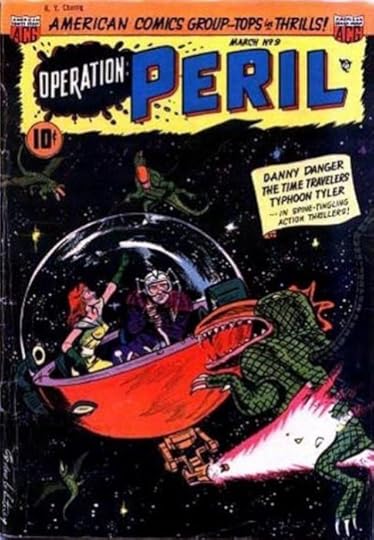 Issue #9 (February-March 1952) has Tom and Peggy go back six thousand years in the Arctic. There they find an Aztec-like race in a country called Nawata. They are captured by warriors and their mammoth and taken to see Princess Colima and the War Chief, Kormac. Kormac would depose the princess but he can only do this if death comes from the sky. This happens when two thugs named Mack and Harpoon use the remote control to take the ship. It crushes several warriors in the process. Kormac attacks, but Tom slips Colima away on a mammoth. Harpoon and Mack come to Nawata and strike a deal with Kormac. The ship will help Kormac in his conquests for half the gold in the kingdom. Tom attacks the city on mammoth-back and kills Harpoon by crushing him under the mammoth's huge feet. Mack tries to take over but Tom uses the remote control he took from Harpoon to crush Kormac's army with his ship.
In Issue #10 (April-May 1952) Tom and Peggy are off on a routine flight when two Russians, Zarian and Klubov, hijack the ship. They want to go to Phyrgia, the land of King Midas. Tom manages to turn the tables on the communists when the Phyrgians show up and capture Tom and Peggy. They get to see the city, which is covered in gold. They are taken to King Midas who thinks they are spies. The duo escape when Kyra, a woman archer, saves them. Meanwhile, the Russians have taken the spaceship. Tom has the remote control, but he wants to see what they are up to. The Russians have struck a deal with Midas. They plan to get modern mining equipment and help Midas produce more gold. Midas no longer needs the slaves who currently do the job and plans to kill them all. Tom saves them by destroying the dam above the mine with the remote control. He drowns the Russians and Midas's soldiers. Kyra is free to lead the rebellion against Midas.
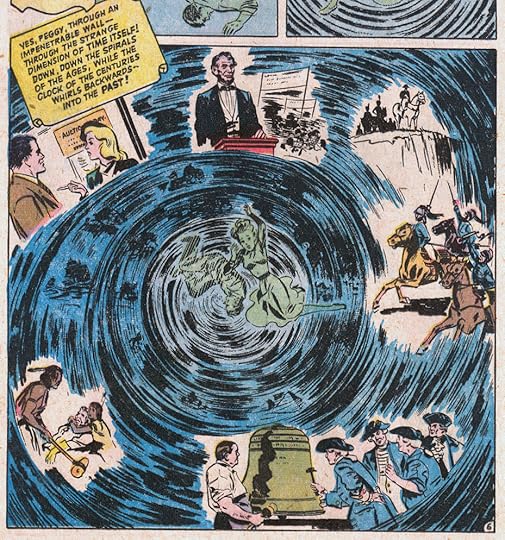 Issue #11 (June-July 1952) has a mysterious green planet approaching earth. Professor Romulus asks Tom and Peggy to go to the time of the Romans, when last the green planet came, and find out how the world was saved then. Tom takes the ship to the green planet of the past. There he and Peggy are captured by a dinoraff, a sentinel that looks like a cross between a duck-billed dinosaur and a tree. The same plot again but this time with Kumrack and the real king Roylan. The king does not propose to fight Kumrack's army, but to stop the green planet from destroying the earth. He plans to flood the city by breaking a dam and destroying the machinery that pulls the two planets together. The dinoraff hears the plan and sacrifices itself to accomplish it. Tom and Peggy fly to the green planet of the future and find that Roylan's heirs are not noble, but warmongers. They plan to imprison or destroy the earth. Tom and Peggy escape and use the ship to destroy another dam, flooding the city and its planet-pulling machines again.
In issue #12 (August-September 1952), Tom and Peggy are flying to Italy to see a Professor Bentini about a new mystery. Communists shoot Bentini down but are killed in turn by Tom, crushing them with his ship. The dying Bentini speaks a single clue on his death-bed, "Boadicea!" Tom and Peggy figure out that the Sixth Legion died mysteriously of radiation while fighting the British Queen. They fly to the past and are quickly captured by Boadicea's army and framed for the murder of the priest Iceno. Tom assumes Iceno's identity, luring the Romans to a cliff along the coast. He warns the Britons, so the Romans are routed. The uranium deposit is in the cliff which falls into the sea. Tom and Peggy return home to find and punish the communists who killed Bentini.
With issue #13, Operation Peril became a straight war comic, dropping "The Time Travelers" along with Typhoon Tyler and Danny Danger. The format change couldn't save it, ending with issue #16 (April-May 1953). Though the plots were recycled endlessly, Richard Hughes did show some inventiveness as well as an interest in topics as unusual as Nostradamus, Atlantis, Mu, and Easter Island. These same outré concepts would be big decades later in the 1970s. "The Time Travelers" suffers from many Cold War phobias and biases, but did explore territory made famous later, beginning in 1963 with the Doctor Who TV show in England, especially the early episodes starring William Hartnell. It would be easy to forget "The Time Travelers" since the strip did not appear in an all science fiction comic, but fortunately the run was reprinted by Boardman Books in 2014, using Ogden Whitney's best "Time Travelers" cover from issue #5.
GW Thomas has appeared in over 400 different books, magazines and ezines including The Writer, Writer's Digest, Black October Magazine and Contact. His website is gwthomas.org. He is editor of Dark Worlds magazine.
 Science fiction comics usually run in anthologies of similar material. Forbidden Worlds, Mystery in Space, even Space Westerns. All their stories are clearly marked as fantastic in nature. This is why "The Time Travelers" (#1 October-November 1950 - #12 August-September 1952) in American Comic Group's Operation Peril was so unusual. The rest of the strips that accompanied the time-slipping tales of Dr. Tom Redfield and his companion Peggy Foster were the sea adventures of Typhoon Tyler and the detective cases of red-headed Danny Danger. All three strips got cover space and none of the three could be said to overshadow the others.
"The Time Travelers" was written by Richard E Hughes, ACG editor and writing mainstay. Hughes was the creator of such characters as The Black Terror, The Fighting Yank, Super Mouse, and Herbie Popnecker in Forbidden Worlds. The artwork for "The Time Travelers" was provided by Ken Bald, best known for his later work on the Dr. Kildare comic strip that ran from 1962 to 1984.
The first installment (October-November 1950) introduces Dr. Tom Redfield, a nuclear physicist who is working on a new type of cyclotron. His girlfriend, the wealthy Peggy Foster, drags him to an auction where she out-bids the Russian Vanov for newly discovered papers by Nostradamus. The papers contains Nostradamus' prediction of a nuclear war in 1956, but also speaks of an antidote to the radiation. Tom uses the ancient priest's design for a "tempus machina" to finish the cyclotron. The Russians capture Tom and Peggy and put the couple in the cyclotron chamber to kill them, but actually send them back in time to 16th century France. Tom and Peggy are arrested as English spies. Speaking with Nostradamus, they learn that the counteragent to radiation can only be found on Venus. The duo flee back to the spot where the time machine dropped them, waiting for the time beam to take them back. They are surrounded by angry pursuers when they return to 1950.
 Several time travel clichés are evident already in Hughes' script. The time machine does not take them to 16th century America, but to France, making it a time and space machine. Second, the travelers have no problem understanding the locals, who speak archaic French. These problems have plagued SF adventure writers who have found ways around them like Dr. Who's TARDIS and Star Trek's universal translator. Certainly Hughes is no worse than the writers behind George Pal's The Time Machine (1960) or Irwin Allen's Time Tunnel in 1966. These are annoying difficulties that most writers don't care to deal with.
Issue #2 (December 1950-January 1951) has Tom and Peggy build a rocket that uses the time machine as an engine and go to Venus. A Russian spy sabotages the ship (for the Russians have a ship of their own), sending Tom and Peggy back to the cavemen of the Stone Age. Tom shoots a sabertooth, uses cavemen as laborers to fix the ship and even encounters a Tyrannosaurus Rex (yup, dinosaurs!). The duo fly to Venus only to be captured by Venusian Amazons. Tom is thrown into an arena and must fight first the brutish Skang, then the many-armed Beast of Tarv. Defeating both, he wins the love of the Amazon queen (to Peggy's chagrin) and helps her take out the Russians who have holed up in a temple where the anti-radioactivity metal is kept. Vanov and the other Russians end up being eaten by killer plants and Tom and Peggy return to Earth with the antidote. (The nuclear war of 1956 is never mentioned again.)
Issue#3 (February-March 1951) has Tom and Peggy going back to the time of King Arthur (the 6th century) to get the sword Excalibur for a wealthy college patron named JP Frisbee. When they arrive at Camelot they are captured (always!) and taken before the King. Tom wins Arthur's favor by shooting a torch out of Merlin's hand. The duplicitous Merlin, along with Mordred and Morgan Le Fay, trap Arthur and Tom but they escape. The baddies bring in Teutonic knights to depose Arthur. Tom heads back to the future, takes on a carload of armored motorcycles, and the good guys have a jousting battle with the horse-riding Teutons, killing Mordred. Merlin and Morgan die when Tom tips their cauldron of boiling oil on them. There are enough inaccuracies in this story to spin Malory in his grave. First off, the knights and their armor are from the 12th or later century and secondly, most of the King Arthur story is not historically or even fictionally correct.
 Issue #4 (April-May 1951) has Tom building a special rocket to take nuclear waste to the Moon. A Dr. Volka tries to dissuade him from the project, sabotaging the rocket and sending Tom and Peggy past the Moon and on to Saturn. There they discover that the rings of Saturn are made of flying saucers. Landing on Saturn they encounter the Cronians, the slave race of the Saturnians. Tom is placed in an arena (again!) and has to fight a big Saturnian on a platform. The loser falls off to be eaten by the dread Hydrid. Tom wins, but the overlord makes him fight the Hydrid anyway, with its impenetrable skin. The Cronians help Tom and Peggy escape and they take the slaves in the rocket. Going after Volka, Tom is waylaid by the beautiful Sirads, women so beautiful that men can't stop thinking about them. The only cure is a woman even more beautiful, so it's up to Peggy to get dolled up and break the spell. This episode contains the most interesting science Fictional ideas since the first episode, though some of it is just Edgar Rice Burroughs retread.
Issue #5 (June-July 1951) has a best selling historical author named Blake force Tom to take him to the age of pirates. The writer wants to give Anne Bonny, the famous woman pirate, modern guns so that she can acquire even more treasure, which Blake will get in the future. (I guess best selling authors don't make as much as they do now.) Tom and Peggy are stuck in the past because Blake has the key to the time machine. Blake and Anne begin a campaign of robbery that ends when a British warship attacks the pirates. Tom slows the pirates down by dropping a sail on them. The British arrest Anne, and Tom kills Blake with a sword. Tom reveals to Peggy that he had a duplicate key all along. Peggy suspects Tom has fallen for Anne Bonny but Tom explains that he knew Anne would be captured in 1720 and he wanted to make sure history was not changed. This is the last issue that hinges on Peggy's jealousy over other beautiful female characters, but she'd turn the tables in a few issues. It is also the only storyline that worries about preserving the timeline.
 In Issue #6 (August-September 1951), the villain Emperor Ego has stolen the plans for Tom's spaceship/time machine and plans to recruit armies from the past to attack major cities. Tom uses the time machine to go back and hear Ego's plan, but it is a trap. Ego claims to be headed for Atlantis and Tom and Peggy go back in time. Once in Atlantis, Tom knocks down Kothos, Captain of the Guard, and uses him as a hostage to see the ruler, the beautiful Queen Thera. Kothos challenges Tom to a duel in the arena with chariots. Tom wins, but Kothos is a sore loser. Tom grabs Peggy and they flee. They are surrounded by archers and it looks bad when a great earthquake shakes Atlantis, sinking it beneath the waves. Tom and Peggy make it back to the ship and return to 1951. The spaceship picks up the signals of Ego's new vessel and Tom follows them to Ego's base. Tom kills Ego and his henchmen by burning them to death with the exhaust of the ship. Tom's violence against the villains increases as the comic goes on, but this is 1951 and the Comics Code has yet to be created.
Issue #7 (October-November 1951) has the Time Travelers off to Easter Island in the year 750 AD to discover the secret of the giant stone heads. Disguised as local Rotuma, Tom and Peggy join a war party getting ready for an invasion. Tarako, the war chief, discovers Peggy is a woman and uses a hypnotism drug on her. Peggy betrays Tom and he is strung up between two heads with a fire beneath. Tom saves himself by using his new remote control device. Taking the ship, he follows the invaders to Chile where they plan to capture Cuzco. Tom joins Princess Lanura, the Chilean ruler, and defeats Tarako in battle. Tom gets the antidote and Peggy is returned to her normal self. This time it was Tom's turn to be jealous. This episode introduces the remote control device that allows Tom to start and fly the ship from afar. Tom also supplies the information that the ship allows them to understand any language.
Issue #8 (December 1951-January 1952) tackles another fabled city. Tom leaves the time machine on and a beautiful princess named Amura comes out. She is taken back by some evil soldiers. This leads Tom and Peggy to go back in time to find the fabled city of Mu. When they arrive, they find they are gigantic in size. Tom explains: "It is just an illusion of time! Our bodies are still in the present... and since the relationship of time and space is a matter of distance -- the further back we go into history, the smaller things will seem..." (Of course, it's never happened before this. Hm.) The giant Tom knocks a boulder over and destroys a temple. Makarta, the soldier who took Amura, uses this as an excuse to sacrifice virgins on the altar of fire. What he really wants is to force Amura to marry him. Tom and Peggy shrink down to Mu size and spy around. Some guards catch them and take Tom's remote/size controller . By twisting it, they accidentally start the engines of the time machine and destroy the city. Tom and Peggy grow to normal size and see Mu buried by the sands of the desert. Peggy does almost nothing in this story and those that follow except act as a sounding board to Tom's conversation. This is too bad because she had real energy at the beginning.
 Issue #9 (February-March 1952) has Tom and Peggy go back six thousand years in the Arctic. There they find an Aztec-like race in a country called Nawata. They are captured by warriors and their mammoth and taken to see Princess Colima and the War Chief, Kormac. Kormac would depose the princess but he can only do this if death comes from the sky. This happens when two thugs named Mack and Harpoon use the remote control to take the ship. It crushes several warriors in the process. Kormac attacks, but Tom slips Colima away on a mammoth. Harpoon and Mack come to Nawata and strike a deal with Kormac. The ship will help Kormac in his conquests for half the gold in the kingdom. Tom attacks the city on mammoth-back and kills Harpoon by crushing him under the mammoth's huge feet. Mack tries to take over but Tom uses the remote control he took from Harpoon to crush Kormac's army with his ship.
In Issue #10 (April-May 1952) Tom and Peggy are off on a routine flight when two Russians, Zarian and Klubov, hijack the ship. They want to go to Phyrgia, the land of King Midas. Tom manages to turn the tables on the communists when the Phyrgians show up and capture Tom and Peggy. They get to see the city, which is covered in gold. They are taken to King Midas who thinks they are spies. The duo escape when Kyra, a woman archer, saves them. Meanwhile, the Russians have taken the spaceship. Tom has the remote control, but he wants to see what they are up to. The Russians have struck a deal with Midas. They plan to get modern mining equipment and help Midas produce more gold. Midas no longer needs the slaves who currently do the job and plans to kill them all. Tom saves them by destroying the dam above the mine with the remote control. He drowns the Russians and Midas's soldiers. Kyra is free to lead the rebellion against Midas.
 Issue #11 (June-July 1952) has a mysterious green planet approaching earth. Professor Romulus asks Tom and Peggy to go to the time of the Romans, when last the green planet came, and find out how the world was saved then. Tom takes the ship to the green planet of the past. There he and Peggy are captured by a dinoraff, a sentinel that looks like a cross between a duck-billed dinosaur and a tree. The same plot again but this time with Kumrack and the real king Roylan. The king does not propose to fight Kumrack's army, but to stop the green planet from destroying the earth. He plans to flood the city by breaking a dam and destroying the machinery that pulls the two planets together. The dinoraff hears the plan and sacrifices itself to accomplish it. Tom and Peggy fly to the green planet of the future and find that Roylan's heirs are not noble, but warmongers. They plan to imprison or destroy the earth. Tom and Peggy escape and use the ship to destroy another dam, flooding the city and its planet-pulling machines again.
In issue #12 (August-September 1952), Tom and Peggy are flying to Italy to see a Professor Bentini about a new mystery. Communists shoot Bentini down but are killed in turn by Tom, crushing them with his ship. The dying Bentini speaks a single clue on his death-bed, "Boadicea!" Tom and Peggy figure out that the Sixth Legion died mysteriously of radiation while fighting the British Queen. They fly to the past and are quickly captured by Boadicea's army and framed for the murder of the priest Iceno. Tom assumes Iceno's identity, luring the Romans to a cliff along the coast. He warns the Britons, so the Romans are routed. The uranium deposit is in the cliff which falls into the sea. Tom and Peggy return home to find and punish the communists who killed Bentini.
With issue #13, Operation Peril became a straight war comic, dropping "The Time Travelers" along with Typhoon Tyler and Danny Danger. The format change couldn't save it, ending with issue #16 (April-May 1953). Though the plots were recycled endlessly, Richard Hughes did show some inventiveness as well as an interest in topics as unusual as Nostradamus, Atlantis, Mu, and Easter Island. These same outré concepts would be big decades later in the 1970s. "The Time Travelers" suffers from many Cold War phobias and biases, but did explore territory made famous later, beginning in 1963 with the Doctor Who TV show in England, especially the early episodes starring William Hartnell. It would be easy to forget "The Time Travelers" since the strip did not appear in an all science fiction comic, but fortunately the run was reprinted by Boardman Books in 2014, using Ogden Whitney's best "Time Travelers" cover from issue #5.
GW Thomas has appeared in over 400 different books, magazines and ezines including The Writer, Writer's Digest, Black October Magazine and Contact. His website is gwthomas.org. He is editor of Dark Worlds magazine.
July 12, 2015
Never Say Never Again (1983) | Music
The music for Never Say Never Again is where we'll have to depart from the usual template for talking about these movies. Without John Barry, but especially without the rights to the Bond Theme, the music is what feels most off. And of course there's no opening title sequence; just credits over the first scene.
The score was created by prolific and award-winning composer Michel Legrand, who won three Oscars for music from Summer of '42, Yentl, and The Thomas Crown Affair. The Oscar for Thomas Crown was for Best Song: "The Windmills of Your Mind," which he wrote with Alan and Marilyn Bergman. And it was the Bergmans that he teamed up with again to write the theme song for NSNA.
Unfortunately, the song is crap. It's even lousy from a simple production standpoint. The opening horns are all warbly and for years I would watch the movie on VHS and think the tracking was screwed up or something.
It's performed by Herb Alpert's wife, Lani Hall, who took the gig after Bonnie Tyler turned it down. Tyler was having a career resurgence around that time with "Total Eclipse of the Heart," so she would have been a nice, high-profile artist to record the song, but she didn't like it. Hall's got a fine voice, but its not that interesting and "Never Say Never Again" just blends in with the other disposable easy listening ballads by women that had defined the Bond theme songs since The Spy Who Loved Me. "Nobody Does It Better" is a great - and great sounding - song, but I hate that that style dominated the series for so long.
The lyrics of "Never Say Never Again" are lame too, sung from the point of view of a woman who's just met an attractive, but emotionally unavailable man and is vowing to fix him. He's been hurt and has declared that he will love "never again," but she's going to beg him, get him, reach him, teach him, take him, and make him change his tune. I just wish we could change this one, too.
Top Ten Theme Songs
1. The Spy Who Loved Me ("Nobody Does It Better")
2. On Her Majesty's Secret Service instrumental theme
3. Diamonds Are Forever
4. You Only Live Twice
5. From Russia With Love (John Barry instrumental version)
6. Live and Let Die
7. Dr No
8. Thunderball
9. Goldfinger
10. From Russia With Love (Matt Monro vocal version)
Top Ten Title Sequences
1. On Her Majesty's Secret Service
2. Dr No
3. Thunderball
4. Goldfinger
5. From Russia with Love
6. The Spy Who Loved Me
7. Diamonds Are Forever
8. Live and Let Die
9. Moonraker
10. Octopussy