Michael May's Blog, page 132
August 15, 2015
GoldenEye (1995) | Villains

GoldenEye fakes viewers out by setting up General Ourumov as a main villain similar to the evil Russian generals from Octopussy and The Living Daylights. His plan is much simpler than theirs though and he really plays more of a henchman role to the scheme's actual mastermind. Ourumov would be a forgettable character if he weren't played by Gottfried John, who gives him a wonderful sense of bemusement. And I love how he runs into Bond's interrogation, breathless and barely in uniform, to prevent Bond's revealing anything damaging, which he does nicely. He just comes across as incredibly bright and it's too bad he's dispatched so easily once the true villain is revealed.

I love Famke Janssen, but I have a rough time buying Xenia Onatopp. She has some great moments (I adore the way she says, "Nice to meet you, Mr. Bond" at the end of their first encounter), but her orgasmic sadism is too much. She's insane to the point that she's no longer fun.
She's also a super sloppy lover and her make-out scenes hurt me to watch as much as they do her partners to participate in.

GoldenEye just killed it on casting its bad guys. Boris Grishenko is an annoying character, but so watchable thanks to Alan Cumming. Among his many flaws though, what bugs me most about him is that he types one-handed so that he can use the other to play with Bond's explosive pen. I get being a tactile thinker, but that seems excessive in that particular scenario.

Besides being played by the great Sean Bean, Alec Trevelyan finally delivers what Scaramanga was designed to: the anti-Bond. Scaramanga was a great assassin, but that doesn't make him an evil version of Bond, who - licence to kill or not - has never been about murder. Trevelyan used to do what Bond does and he knows Bond's thought processes, because they were his own. There's a great moment where he questions whether Bond's drinking and womanizing work as cures for all the deaths that Bond's witnessed or caused. He's a crucial part of GoldenEye's pulling apart the character of James Bond to see how he works and how he can be used going forward.
Sadly, Trevelyan works much better thematically than he does as an actual villain. He makes all the usual mistakes, starting with failing to kill Bond when he has the chance. Instead, he goes with an overly complicated plan that involves tying Bond into a helicopter cockpit that's going to shoot itself with its own missiles. And later, he makes the same error that SPECTRE kept making in You Only Live Twice when Bond's looking for the secret base in Cuba. There's no way Bond would have found it if Trevelyan hadn't shot a missile at Bond's plane to let him know he was close. Guess those other Double-Os really are that bad.
Top Ten Villains
1. Auric Goldfinger (Goldfinger)
2. Ernst Stavro Blofeld (Never Say Never Again)
3. Ernst Stavro Blofeld (From Russia With Love and Thunderball)
4. Ernst Stavro Blofeld (On Her Majesty's Secret Service)
5. Maximilian Largo (Never Say Never Again)
6. Francisco Scaramanga (The Man with the Golden Gun)
7. Dr. Kananga (Live and Let Die)
8. Doctor No (Dr. No)
9. General Gogol (For Your Eyes Only)
10. Karl Stromberg (The Spy Who Loved Me)
Top Ten Henchmen
1. Baron Samedi (Live and Let Die)
2. Fiona Volpe (Thunderball)
3. Grant (From Russia with Love)
4. Nick Nack (The Man with the Golden Gun)
5. Gobinda (Octopussy)
6. May Day (A View to a Kill)
7. Jaws (The Spy Who Loved Me and Moonraker)
8. Naomi (The Spy Who Loved Me)
9. Oddjob (Goldfinger)
10. Necros (The Living Daylights)


August 14, 2015
GoldenEye (1995) | Women

Caroline, the psychologist sent by M to evaluate Bond, is a weak and easily manipulated character. She appears to be an intentional throwback to stereotypical Bond Girls from the past - a way of setting a base level for the rest of the movie to comment on - but she's still annoying.

I like Natalya Simonova a lot. She gets pulled into the story against her will, but even though she doesn't have spy skills, she's able to use what she does have to help herself and Bond. And in keeping with the theme of Bond's relationship to "female authority," he even defers to Natalya a couple of times, playfully calling her, "sir."
Like I said the other day, too, Natalya's also very perceptive. She sees through Bond's act and calls him on it, grieving that she'll never get as close to him as she would like to. Viewers always know that Bond's romances will never stick, but it's rare for his companions to realize it too. She's too good for him and cracks my Top Ten.
My Favorite Bond Women
1. Tracy Bond (On Her Majesty's Secret Service)
2. Melina Havelock (For Your Eyes Only)
3. Kara Milovy (The Living Daylights)
4. Paula Caplan (Thunderball)
5. Tatiana Romanova (From Russia With Love)
6. Natalya Simonova (GoldenEye)
7. Fiona Volpe (Thunderball)
8. Domino Derval (Thunderball)
9. Holly Goodhead (Moonraker)
10. Mary Goodnight (The Man with the Golden Gun)

August 13, 2015
GoldenEye (1995) | Bond
Actors and Allies
Brosnan's Bond in GoldenEye is darker than Moore's, but jokier than Dalton's, which means that he's essentially playing the Connery version. He's tough, but not taking things too seriously. On the other hand, some things that Dalton winked at - like ordering his special martini - Brosnan plays totally straight. It'll be interesting to watch the rest of the Brosnan films and see how well they can keep the balance between darkness and humor. My memory is that they don't do it as well as GoldenEye.
Not that GoldenEye has it perfect. For example, it can't find the right tone for Bond's relationship with Moneypenny (now played by Samantha Bond). Their scene together starts off pretty dark, with Bond's "flirtation" coming across more like sexual harassment. It's not that Brosnan's Bond is actually doing anything different from his predecessors; it's all in Moneypenny's reaction to him. She's barely tolerating him and eager to brush him off, which makes his jokes and innuendos seem unwanted.
That might be because she doesn't want to be in the office in the first place. It's after hours and she's dressed for a date, so maybe she's just irritated and taking it out on Bond. She does end up playing along with him by the end of the conversation, but is that just her going back to a banter she's used to? Or is she worn down by his nuisance?
Her being in evening wear isn't much of a clue. It's nice to know that she has a life outside of pining for Bond, but we don't know anything about the person she's going out with. Could be a first date; could be a night out with her sister for all we know. Unfortunately, we don't have enough to go on from these versions of Moneypenny and Bond yet.
Bond comments that he's never seen Moneypenny after hours. That reminds me of an interview that Lois Maxwell once gave where she talked about a backstory that she and Connery had created for their characters. They'd decided that Moneypenny and Bond had dated briefly while coming up through the ranks, but once they reached a certain level they realized that continued dating wasn't going to work. It was a mutual decision and that explains their easy flirting. Brosnan and Bond (Samantha, that is) don't have that kind of rapport and it's right there in the script that they don't. We'll have to keep watching the series to get a baseline for what kind of relationship they're supposed to have.
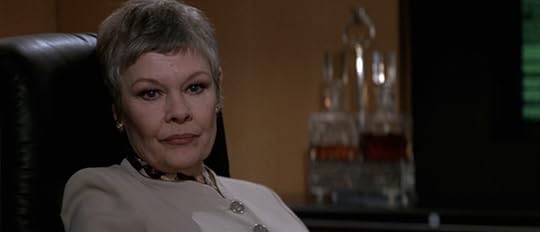
On to the more important woman in Bond's life, casting Judi Dench as M was a genius move. It puts a huge spotlight on Bond's attitudes about women, which was sorely needed if he's going to be a character that modern audiences can take seriously. More than just that though, Dench's M and Brosnan's Bond have an additional layer of conflict thanks to fundamental differences in their opinions about how espionage work should be carried out. She relies heavily on analysts (Bill Tanner refers to her as "the evil queen of numbers") where Bond is all about hunches and instinct born from experience.
It's manufactured conflict that doesn't pay off in a big way, but it does bring out a great conversation between the two of them. Explaining her methods, M gives Bond a speech about having the balls to send him to his death, and she means it too. Trusting the analysts isn't the same as playing it safe. But she's also not completely cold. As she dismisses him for his mission, she orders him to "come back alive" in a way that's extremely motherly. That's not a sexist thing. Bernard Lee was just as much the parental figure to Bond (as was the literary M), so Dench is carrying on an important tradition. She has something to prove in this introduction to her, but as we get to know her, she'll be just as strong as Lee. More so, because she'll be less enigmatic than he was. The weird M turns out to be Robert Brown, who was more cold and accountant-like than Dench by a long shot.
I love GoldenEye's intro to Q. When Bond arrives in Q-Branch, Q is looking frail and especially elderly in a wheelchair with a cast on his leg. Bond asks if it was a skiing accident (of course he would guess that) and there's a gleam in Q's eye as he fires a rocket from the cast and corrects Bond: "Hunting!" Then he stands up and starts the briefing. Desmond Llewelyn is in top form, as he was in Licence to Kill. Probably my favorite line of the movie is when Bond picks up a sandwich from a table and Q yells, "Don't touch that!" before adding, "That's my lunch!" It's a stupid line, but Llewelyn's timing on it is perfect.
Bond has a couple of field allies in GoldenEye, starting with Jack Wade. It's a much better role for Joe Don Baker than Brad Whitaker was in The Living Daylights. Wade is sort of a cross between Felix Leiter and Dikko Henderson from the novel You Only Live Twice. He's laid back like Felix, but in a crude way like Dikko. I like him a lot. My only problem with him is resentment that the Bond series had so screwed up Felix that the only way they could see to make him memorable was to replace him with a whole new character.
The other ally is Zukovsky, played by Robbie "Hagrid" Coltrane. I like that he and Bond already have some history and a shaky relationship, but the best thing about him is his karaoke-singing girlfriend, played by Minnie Driver just before her career took off.
Best Quip
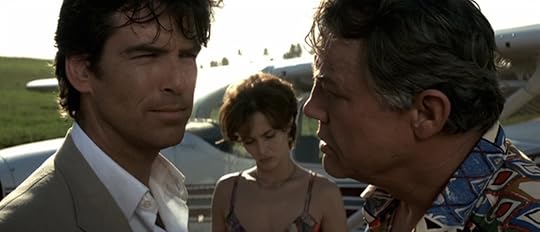
"Head to toe," in response to Wade's paranoid question about the Russian Natalya, "Did you check her out?"
Worst Quip
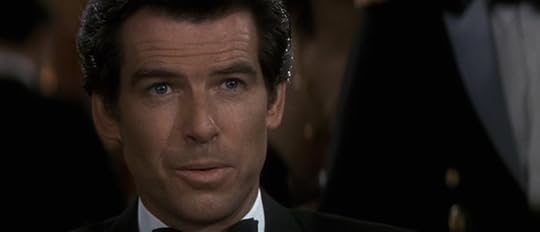
"One rises to meet a challenge," to Xenia Onatopp's expressing that she hopes he's more talented in bed than at cars or cards.
Gadgets
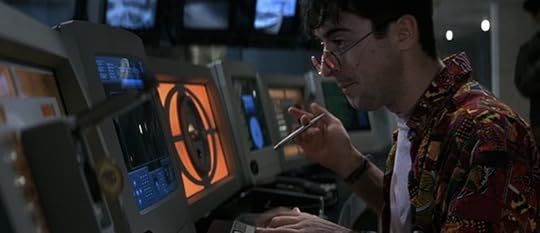
The gadgets are low-key in GoldenEye. Q pimps out Bond's BMW, but none of the tricks are ever used. All we get are some personal items. The laser watch is right out of Never Say Never Again and the explosive pen isn't super exciting either, even though it's used in a crucial moment. I do like the piton and rope built into Bond's belt, but it's not cool enough to crack my Top Ten either.
Top Ten Gadgets
1. Lotus Esprit (The Spy Who Loved Me)
2. Aston Martin DB V (Goldfinger and Thunderball)
3. Jet pack (Thunderball)
4. Iceberg boat (A View to a Kill)
5. Aston Martin V8 Vantage (The Living Daylights)
6. Glastron CV23HT speed boat (Moonraker)
7. Acrostar Mini Jet (Octopussy)
8. Crocodile submarine (Octopussy)
9. Little Nellie (You Only Live Twice)
10. Rocket cigarettes (You Only Live Twice)


Brosnan's Bond in GoldenEye is darker than Moore's, but jokier than Dalton's, which means that he's essentially playing the Connery version. He's tough, but not taking things too seriously. On the other hand, some things that Dalton winked at - like ordering his special martini - Brosnan plays totally straight. It'll be interesting to watch the rest of the Brosnan films and see how well they can keep the balance between darkness and humor. My memory is that they don't do it as well as GoldenEye.
Not that GoldenEye has it perfect. For example, it can't find the right tone for Bond's relationship with Moneypenny (now played by Samantha Bond). Their scene together starts off pretty dark, with Bond's "flirtation" coming across more like sexual harassment. It's not that Brosnan's Bond is actually doing anything different from his predecessors; it's all in Moneypenny's reaction to him. She's barely tolerating him and eager to brush him off, which makes his jokes and innuendos seem unwanted.
That might be because she doesn't want to be in the office in the first place. It's after hours and she's dressed for a date, so maybe she's just irritated and taking it out on Bond. She does end up playing along with him by the end of the conversation, but is that just her going back to a banter she's used to? Or is she worn down by his nuisance?
Her being in evening wear isn't much of a clue. It's nice to know that she has a life outside of pining for Bond, but we don't know anything about the person she's going out with. Could be a first date; could be a night out with her sister for all we know. Unfortunately, we don't have enough to go on from these versions of Moneypenny and Bond yet.
Bond comments that he's never seen Moneypenny after hours. That reminds me of an interview that Lois Maxwell once gave where she talked about a backstory that she and Connery had created for their characters. They'd decided that Moneypenny and Bond had dated briefly while coming up through the ranks, but once they reached a certain level they realized that continued dating wasn't going to work. It was a mutual decision and that explains their easy flirting. Brosnan and Bond (Samantha, that is) don't have that kind of rapport and it's right there in the script that they don't. We'll have to keep watching the series to get a baseline for what kind of relationship they're supposed to have.
On to the more important woman in Bond's life, casting Judi Dench as M was a genius move. It puts a huge spotlight on Bond's attitudes about women, which was sorely needed if he's going to be a character that modern audiences can take seriously. More than just that though, Dench's M and Brosnan's Bond have an additional layer of conflict thanks to fundamental differences in their opinions about how espionage work should be carried out. She relies heavily on analysts (Bill Tanner refers to her as "the evil queen of numbers") where Bond is all about hunches and instinct born from experience.
It's manufactured conflict that doesn't pay off in a big way, but it does bring out a great conversation between the two of them. Explaining her methods, M gives Bond a speech about having the balls to send him to his death, and she means it too. Trusting the analysts isn't the same as playing it safe. But she's also not completely cold. As she dismisses him for his mission, she orders him to "come back alive" in a way that's extremely motherly. That's not a sexist thing. Bernard Lee was just as much the parental figure to Bond (as was the literary M), so Dench is carrying on an important tradition. She has something to prove in this introduction to her, but as we get to know her, she'll be just as strong as Lee. More so, because she'll be less enigmatic than he was. The weird M turns out to be Robert Brown, who was more cold and accountant-like than Dench by a long shot.
I love GoldenEye's intro to Q. When Bond arrives in Q-Branch, Q is looking frail and especially elderly in a wheelchair with a cast on his leg. Bond asks if it was a skiing accident (of course he would guess that) and there's a gleam in Q's eye as he fires a rocket from the cast and corrects Bond: "Hunting!" Then he stands up and starts the briefing. Desmond Llewelyn is in top form, as he was in Licence to Kill. Probably my favorite line of the movie is when Bond picks up a sandwich from a table and Q yells, "Don't touch that!" before adding, "That's my lunch!" It's a stupid line, but Llewelyn's timing on it is perfect.
Bond has a couple of field allies in GoldenEye, starting with Jack Wade. It's a much better role for Joe Don Baker than Brad Whitaker was in The Living Daylights. Wade is sort of a cross between Felix Leiter and Dikko Henderson from the novel You Only Live Twice. He's laid back like Felix, but in a crude way like Dikko. I like him a lot. My only problem with him is resentment that the Bond series had so screwed up Felix that the only way they could see to make him memorable was to replace him with a whole new character.
The other ally is Zukovsky, played by Robbie "Hagrid" Coltrane. I like that he and Bond already have some history and a shaky relationship, but the best thing about him is his karaoke-singing girlfriend, played by Minnie Driver just before her career took off.
Best Quip

"Head to toe," in response to Wade's paranoid question about the Russian Natalya, "Did you check her out?"
Worst Quip

"One rises to meet a challenge," to Xenia Onatopp's expressing that she hopes he's more talented in bed than at cars or cards.
Gadgets

The gadgets are low-key in GoldenEye. Q pimps out Bond's BMW, but none of the tricks are ever used. All we get are some personal items. The laser watch is right out of Never Say Never Again and the explosive pen isn't super exciting either, even though it's used in a crucial moment. I do like the piton and rope built into Bond's belt, but it's not cool enough to crack my Top Ten either.
Top Ten Gadgets
1. Lotus Esprit (The Spy Who Loved Me)
2. Aston Martin DB V (Goldfinger and Thunderball)
3. Jet pack (Thunderball)
4. Iceberg boat (A View to a Kill)
5. Aston Martin V8 Vantage (The Living Daylights)
6. Glastron CV23HT speed boat (Moonraker)
7. Acrostar Mini Jet (Octopussy)
8. Crocodile submarine (Octopussy)
9. Little Nellie (You Only Live Twice)
10. Rocket cigarettes (You Only Live Twice)
August 12, 2015
GoldenEye (1995) | Story

Plot Summary
Coincidences and hunches throw Bond into a case involving a destroyed Soviet satellite station and a ghost from Bond's past.
Influences
Before getting into the influences for GoldenEye, let's pause for a moment of silence for The Property of a Lady, what would have been the third Timothy Dalton movie. The 007 Wiki has more details about it if you're curious, but a couple of things are relevant to GoldenEye.
First, it was a financial conflict between the producers and the studio that caused Property to be delayed. Dalton had a three-picture contract (just like Moore had started with) and everything was on track to fulfill it. There was a script, but Broccoli and Family didn't like the way that MGM (who'd bought United Artists) were dividing profits from a distribution deal. It's all very boring to me, but here's the Wikipedia article if you're curious. The point is that figuring all that out took a lot of time, during which Dalton's contract expired and he (as well as screenwriter Richard Maibaum and director John Glen) walked away.
The second thing about Property that's relevant to GoldenEye is that some script elements survived, including the villain's being a former ally of James Bond. Again, the 007 Wiki has specifics. For the most part though, they went with a whole new story and abandoned the idea of using a Fleming title. Instead, they drew inspiration from the name of Fleming's summer house in Jamaica where he wrote the Bond novels. That's a lame inspiration, but a cool name.
In the movie, Goldeneye is the name of the EMP technology the villains are using; presumably named that because the device is circular and gold-colored. I was curious to know if there was any connection between that and the reason Fleming picked the name for his house, but I couldn't find any. Fleming claimed two different inspirations for the name. One was the novel Reflections in a Golden Eye by Carson McCullers, but the golden eye in that refers to an imaginary peacock that sees horrible and distorted reality, so it's a weird thing to name your house. More convincing is Fleming's explanation that it came from Operation Goldeneye, a WWII mission he planned while working for British Naval Intelligence. I haven't been able to find the source of the operation's name though, so I have no idea how it might connect (or not) to the movie title. In my imagination, I thought that maybe the source of inspiration had something to do with the sun, but I can't find any evidence to back that up. It looks like they just had the name and then created a story around it.
By the time Broccoli and Wilson were finally ready to make the next Bond film, a lot had changed. (And by Broccoli, I really mean Cubby's daughter Barbara now, because she took over for her dad, whose health was deteriorating. He died less than a year after GoldenEye's release.) For one thing, the end of the Cold War had eliminated the Soviets as the easy go-to villains for the series. And with Kevin McClory's still owning the rights to SPECTRE, it would be tough to come up with a new, villainous organization that didn't seem derivative. So they borrowed the traitor idea from the aborted Dalton film and threw in some Russian gangsters (pretty much the new go-to villains for '90s spy movies).
How Is the Book Different?
GoldenEye isn't based on a novel, but it's worth mentioning how much the world had changed since Fleming wrote his series. Not only the collapse of the Soviet Union, but also attitudes towards women. There was a big question about whether Bond was still a relevant character. Wisely, GoldenEye didn't just recognize that, it confronted and commented on it. And it did so in a way that kept the character of Bond intact.
Moment That's Most Like Fleming

I'll get into Brosnan's Bond more tomorrow, but he's not as serious as Dalton's. He's not as nonchalant as Moore either though, because GoldenEye gives an explicit reason for his glibness and it's pretty dark. The script and dialogue acknowledge the grimness of Bond's world and present his casual attitude as a coping mechanism. GoldenEye's admission that Bond has a tough, horrible job is very Fleming, even if the two versions handle it in different ways.
I love that Natalya sees through Bond's humor. She's not one of the most memorable Bond Girls, but she's a good one and perceptive enough that when she tries to get close to Bond, she sees his barriers for what they are. When she calls him on it, his response is, "It's what keeps me alive." She disagrees. "No. It's what keeps you alone."
She and Alec serve similar functions like that. One way that GoldenEye directly matches Fleming is in its major theme about questioning duty. Fleming's Bond is constantly wrestling with whether or not he's in the right job and Alec is all about raising that issue. More on that towards the end of the week, too.
Moment That's Least Like Fleming

As often happens in Bond movies, they part company with Fleming around the tightness of the plot. In GoldenEye, Bond becomes involved in the story through the simple coincidence of his being in Monte Carlo at the same time that Xenia Onatopp is planning to steal the Tiger helicopter. Why is Bond there? Why does he suspect Onatopp enough to look into her activities?
The movie never even tries to answer these questions. Thematically, it fits though. Bond is acting on hunches, which is a point of conflict between him and M. But even though the story proves him right, it does so unconvincingly enough that I can see M's argument. Then again, maybe that's the point: that neither M nor Bond are totally right about which method is best. But even if that's what the movie's trying to achieve, it could have done a stronger job at it.
Cold Open

After three other cold opens where a Double-O dies, GoldenEye does a nice fake-out by pretending to do it again. Of course, casting Sean Bean as 006 kind of gives it away - you just know he'll be back later - but it's a cool effort.
This is my favorite teaser so far. There isn't just one great stunt; there are two. It's starts with Bond's bungee jumping into a Soviet chemical weapons facility and - like On Her Majesty's Secret Service - keeping his face in shadows for a while. He's finally revealed hanging upside down in a bathroom stall, quipping to a guard. It's great.
Then, after 006 is captured and supposedly executed, there's an even better stunt where Bond chases a pilotless aircraft off a cliff on a motorcycle, then freefalls to catch up with the plane, jumps in, and pulls it out of its dive just as it's about to crash into a mountain. And it all ties in to the main story. Just perfect.
Top 10 Cold Opens
1. GoldenEye
2. The Spy Who Loved Me
3. Moonraker
4. Thunderball
5. On Her Majesty's Secret Service
6. A View to a Kill
7. Goldfinger
8. The Man with the Golden Gun
9. The Living Daylights
10. Licence to Kill
Movie Series Continuity

Right after the credits, the movie reveals that the teaser sequence took place nine years earlier. That puts it between View to a Kill and The Living Daylights. Robbie Coltrane's Valentin Zukovsky character also suggests a rich history between him and Bond that we've never seen or heard of before. Which raises the question again about whether Brosnan is playing the same person as Moore and Dalton (and Connery and Lazenby before them). And again, there's no good theory that ties the series' continuity together.
I'm sort of working on one that involves brainwashing and false memories, but it's still a long way off. Mostly I haven't decided yet what benefit MI6 would see in such a scheme and why they would occasionally reinstate a Bond whom they'd used before and then moved away from. Or are there sometimes multiple Bonds? Was Brosnan's character operating simultaneously with Dalton's? Did they know about each other?
The Aston Martin DB5 makes a reappearance, driven by Bond in Monte Carlo as he's being evaluated by the world's worst psychologist. More on her later, but she's an intentional throwback to the kind of women who used to appear in Bond movies, while also introducing the idea of "female authority," as Bond puts it, and his reaction to it.
We see the new MI6 headquarters for the first time and it's the actual headquarters of the actual MI6, which had just opened the year before GoldenEye's release.
Bill Tanner makes his third appearance in a Bond movie, the other two being The Man with the Golden Gun and For Your Eyes Only. This is the first time that his friendship with Bond is especially emphasized though. In the novels, the two are best friends at the agency.
There's a new M of course. More on her later, but we learn that she has children.
And finally, we learn that Bond's parents were killed in a climbing accident. That's from the novels, but I think this is the first time the movies acknowledge it. Alec is also an orphan, leading us to wonder if that's an intentional similarity among the the Double-Os. Skyfall of course will explore this further, and it's looking like SPECTRE probably will, too.

August 10, 2015
Why I Watch Under the Dome [Guest Post]
By GW Thomas
 Damon Knight once reviewed a book thusly: "a plot that is kept in motion solely by the fact that everyone involved is an idiot." That very phrase could be applied to Under the Dome. Let's be honest right up front. Under the Dome is probably the stupidest show on TV. Any reasonable person would say - even science fiction and horror fans who have a much higher resistance to silliness - this show is garbage, let's watch something else. Despite this voice of reason in my head (and my wife's voice in my ears), I watch it anyway.
In Season One we had faith in Stephen King. We thought, okay this is strange but slowly we will get answers. At this point we thought, "King has a plan." We trusted him because he gave us so many great thrills in the past. And there was a book - which I haven't read - but perusing its pages I see familiar names and characters, even if they've been changed a bit. (Though I noticed the show was never sold as Stephen King's Under the Dome. Oddly, Steven Spielberg hasn't been very vocal about his involvement either. Hmm...) Still, 11.2 million viewers in Season One.
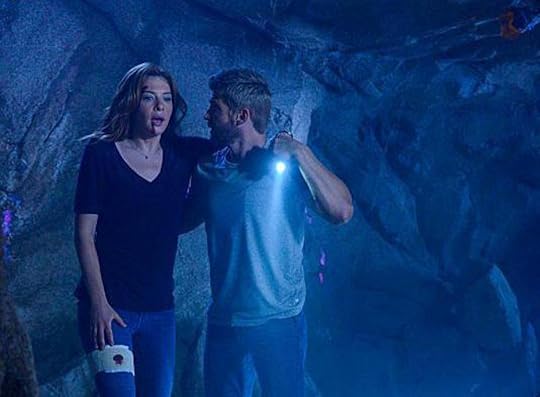 During Season Two, things begin to fall off the tracks. Stephen King writes and does a cameo in the opening episode and we hang on tight, hoping things will improve. (This episode was by far the best of the series. Even if the whole show falls into a smouldering pile of rubble, we will still have Season 2, Episode 1.) For example, characters start having things happen to them because, well, something has to happen this episode. My favorite of these MacGuffins is when Julia and Barbie crash in the ambulance and Julia gets a piece of rebar through her leg, then they re-enact a seen from James Cameron's The Abyss. Does it further the story of Chester's Mill? Not at all. Does it give Barbie a chance to be heroic, of course. But you know it's filler. Still 7.2 million viewers...
Worse yet, the woman who was shot twice in the chest and had rebar shoved through her leg will be up and running around Nancy Drew-style for the rest of the season. Each season is a week in the life of Chester's Mill and in Season Three (a week later), Julia's all better and the bandage over her jeans (that's all you need for a rebar puncture, I guess) is there, but it's on the wrong leg at one point and pretty much forgotten.
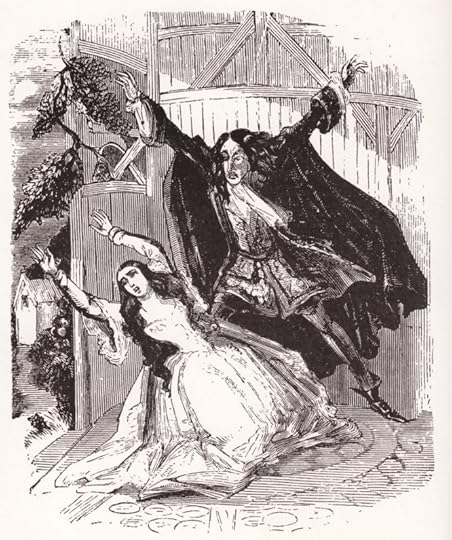 And that's when you realize what Under the Dome is. Like Lost before it, with its ever-shifting ideas, you see the truth. It's Varney the Vampire time. Under the Dome is a modern penny dreadful. (I'm not referring to the show Penny Dreadful, which is probably my favorite show this year. I have only the highest respect for John Logan.) I mean it is the television form of the old penny dreadfuls or penny bloods as they were known. These cheap serials were sold to the masses at a time when novels were very expensive. The average three part novel (The Mysteries of Udolpho, for example) was published in separate parts and sold largely to libraries. The wealthy or middle class didn't buy the books, but paid for a yearly subscription to mobile libraries. So if you had money, you only had to wait three times for the whole story. But if you were poor, you paid a penny a week and got the story a hundredth at a time. Or in the case of Varney, 220ths at a time. Anyone reading the story in this fashion could not be expected to remember all the details. And they certainly expected something to happen in each chapter.
The penny bloods offered up characters like Varney the Vampire by Thomas Preskett Prest (or James Malcolm Rymer, you decide) with 876 double-sided pages equalling 667,000 words. (To put that in perspective, that's the length of two GRR Martin Song of Fire and Ice books.) There was also Wagner the Wehr-Wolf by George WM Reynolds at over 211,000 words. This seems less impressive but Reynolds also wrote The Mysteries of London at a whopping two and half million words. Writing this kind of story required the author to add more and more incidents, dropping story lines, adding new characters. Sound familiar?
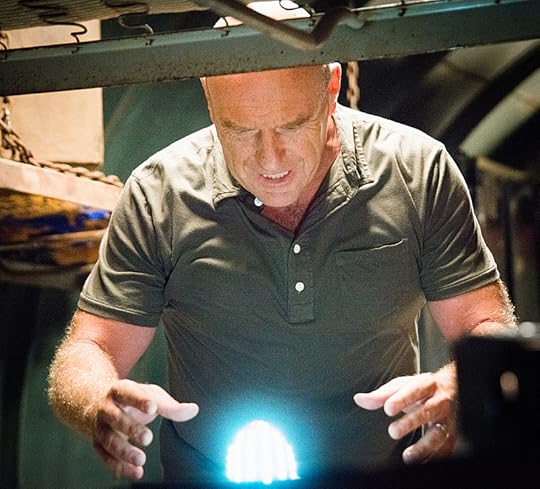 Despite having the ability to remember what happened in Episode 1, Under the Dome fans don't bother to recall certain details. Like the fact that Big Jim Renny has murdered a lot of people to keep his illegal gas business secret. That he converted to believing the Dome was heaven-sent and needed to be worshipped. That he got the egg outside the Dome. None of that matters. All you need to know in Season Three is he is one of the Good Guys, interfering with the alien-possessed Kinship, led by Marg Helgenberger's character, Christine. (Helgenberger should be familiar with King-style alien takeovers, because she was in the miniseries of The Tommyknockers in 1993.) Can't keep up? It doesn't matter, because something else will happen this week. An apocalypse may wipe out the world outside the dome. Or not, depending on which week you watch. By next season (if God help us there is a Season Four!) it will al be co-opted by a new explanation.
And that's why I watch Under the Dome. I may be one of the dwindling numbers, (down twenty percent from last week's episode), but I watch to see how crazy it will be this week. What previous story details will be conveniently ignored? Which of the good guys will become bad guys and vice versa? I sit there, daring the writers to outrage me. To come up with the crazy, stupidest crap imaginable. It's not what TV is supposed to be, but this is the 19th Century - I mean, 21st Century. (And if I get tired of it I can always go watch The Strain. Del Toro wrote three books and the show has a plan!) The penny dreadful has returned and it is called Under the Dome!
GW Thomas has appeared in over 400 different books, magazines and ezines including The Writer, Writer's Digest, Black October Magazine and Contact. His website is gwthomas.org. He is editor of Dark Worlds magazine.
 Damon Knight once reviewed a book thusly: "a plot that is kept in motion solely by the fact that everyone involved is an idiot." That very phrase could be applied to Under the Dome. Let's be honest right up front. Under the Dome is probably the stupidest show on TV. Any reasonable person would say - even science fiction and horror fans who have a much higher resistance to silliness - this show is garbage, let's watch something else. Despite this voice of reason in my head (and my wife's voice in my ears), I watch it anyway.
In Season One we had faith in Stephen King. We thought, okay this is strange but slowly we will get answers. At this point we thought, "King has a plan." We trusted him because he gave us so many great thrills in the past. And there was a book - which I haven't read - but perusing its pages I see familiar names and characters, even if they've been changed a bit. (Though I noticed the show was never sold as Stephen King's Under the Dome. Oddly, Steven Spielberg hasn't been very vocal about his involvement either. Hmm...) Still, 11.2 million viewers in Season One.
 During Season Two, things begin to fall off the tracks. Stephen King writes and does a cameo in the opening episode and we hang on tight, hoping things will improve. (This episode was by far the best of the series. Even if the whole show falls into a smouldering pile of rubble, we will still have Season 2, Episode 1.) For example, characters start having things happen to them because, well, something has to happen this episode. My favorite of these MacGuffins is when Julia and Barbie crash in the ambulance and Julia gets a piece of rebar through her leg, then they re-enact a seen from James Cameron's The Abyss. Does it further the story of Chester's Mill? Not at all. Does it give Barbie a chance to be heroic, of course. But you know it's filler. Still 7.2 million viewers...
Worse yet, the woman who was shot twice in the chest and had rebar shoved through her leg will be up and running around Nancy Drew-style for the rest of the season. Each season is a week in the life of Chester's Mill and in Season Three (a week later), Julia's all better and the bandage over her jeans (that's all you need for a rebar puncture, I guess) is there, but it's on the wrong leg at one point and pretty much forgotten.
 And that's when you realize what Under the Dome is. Like Lost before it, with its ever-shifting ideas, you see the truth. It's Varney the Vampire time. Under the Dome is a modern penny dreadful. (I'm not referring to the show Penny Dreadful, which is probably my favorite show this year. I have only the highest respect for John Logan.) I mean it is the television form of the old penny dreadfuls or penny bloods as they were known. These cheap serials were sold to the masses at a time when novels were very expensive. The average three part novel (The Mysteries of Udolpho, for example) was published in separate parts and sold largely to libraries. The wealthy or middle class didn't buy the books, but paid for a yearly subscription to mobile libraries. So if you had money, you only had to wait three times for the whole story. But if you were poor, you paid a penny a week and got the story a hundredth at a time. Or in the case of Varney, 220ths at a time. Anyone reading the story in this fashion could not be expected to remember all the details. And they certainly expected something to happen in each chapter.
The penny bloods offered up characters like Varney the Vampire by Thomas Preskett Prest (or James Malcolm Rymer, you decide) with 876 double-sided pages equalling 667,000 words. (To put that in perspective, that's the length of two GRR Martin Song of Fire and Ice books.) There was also Wagner the Wehr-Wolf by George WM Reynolds at over 211,000 words. This seems less impressive but Reynolds also wrote The Mysteries of London at a whopping two and half million words. Writing this kind of story required the author to add more and more incidents, dropping story lines, adding new characters. Sound familiar?
 Despite having the ability to remember what happened in Episode 1, Under the Dome fans don't bother to recall certain details. Like the fact that Big Jim Renny has murdered a lot of people to keep his illegal gas business secret. That he converted to believing the Dome was heaven-sent and needed to be worshipped. That he got the egg outside the Dome. None of that matters. All you need to know in Season Three is he is one of the Good Guys, interfering with the alien-possessed Kinship, led by Marg Helgenberger's character, Christine. (Helgenberger should be familiar with King-style alien takeovers, because she was in the miniseries of The Tommyknockers in 1993.) Can't keep up? It doesn't matter, because something else will happen this week. An apocalypse may wipe out the world outside the dome. Or not, depending on which week you watch. By next season (if God help us there is a Season Four!) it will al be co-opted by a new explanation.
And that's why I watch Under the Dome. I may be one of the dwindling numbers, (down twenty percent from last week's episode), but I watch to see how crazy it will be this week. What previous story details will be conveniently ignored? Which of the good guys will become bad guys and vice versa? I sit there, daring the writers to outrage me. To come up with the crazy, stupidest crap imaginable. It's not what TV is supposed to be, but this is the 19th Century - I mean, 21st Century. (And if I get tired of it I can always go watch The Strain. Del Toro wrote three books and the show has a plan!) The penny dreadful has returned and it is called Under the Dome!
GW Thomas has appeared in over 400 different books, magazines and ezines including The Writer, Writer's Digest, Black October Magazine and Contact. His website is gwthomas.org. He is editor of Dark Worlds magazine.
August 8, 2015
Licence to Kill (1989) | Music
John Barry wasn't available to score Licence to Kill due to some surgery he was recovering from, so Michael Kamen was hired to replace him. Because of the unexpectedly long break after Licence, Barry's last Bond score would be The Living Daylights. Kamen was an interesting substitute because Licence is already so reminiscent of other '80s action movie and Kamen's resumé included films like Lethal Weapon and Die Hard. He must have seemed like a natural choice.
Kamen didn't have anything to do with the theme song though. In keeping with the darker tone of the movie, Broccoli and Wilson first tried to get a song that hearkened all the way back to Dr. No. They approached Vic Flick, who'd played guitar in John Barry's band and is the one who recorded the classic Bond Theme riff for Dr. No. They were going to get him and Eric Clapton to write and perform the song, but didn't like what the duo came up with. Instead, they commissioned a song by a different group of songwriters; based on the horn line from Goldfinger. That's the one that Gladys Knight recorded.
Knowing the thought behind the song - that it was intentionally trying to emulate the older movies - helps me with it a little, but I still don't like it. Coming off of Duran Duran and a-ha, and hoping for a similarly contemporary sound for the Licence song, I was hugely disappointed with the throwback. Knight has a great voice, of course, but it's not a good song. The lyrics are so easy and on-the-nose and don't get me started on the cheesy, whispered "to kill" that repeats all through it. Just ugh.
Continuing the new tradition started in The Living Daylights, the movie also has a different end credits song. It's not a Bond-sounding song, but I do like "If You Asked Me To" by Patti LaBelle on its own merits.
The opening credits are designed by Maurice Binder one last time. I feel like his heart's in it more than it was in the last couple of movies, though I don't understand all of his choices. The teaser ends with everyone going into the church for Felix and Della's wedding, so Binder pulls back to show that shot in a camera lens, maybe like it's a photographer at the ceremony. There's other camera imagery in the credits too though: a stylized shutter and some contact sheets. He even finishes the credits as he began, with a camera lens that shows the first shot of the movie. Cameras aren't a big thing in Licence though, so I don't know why they're so prominent here.
He's also into roulette apparently, because there are two different shots relating to that: one of a table and the other of a spinning wheel (at least, I think that's what it is; it's going pretty fast). Bond does do some gambling in Licence, but he doesn't play roulette, so again, I'm not sure what Binder's up to.
He also uses crosshairs as a motif, which makes tons more sense considering the title of the movie. And there's a cool bit where a gun shoots and Bond's image is projected onto the smoke. Could've used more of that.
Kamen doesn't use the Bond Theme a lot, but he deploys it well. It first shows up in the teaser when Bond's dangling from the helicopter and tying up Sanchez's plane. There's a little bit of it when he's searching Krest's warehouse, but then it comes in big again during the waterskiing stunt and when Bond's popping wheelies in a semi truck.
Top Ten Theme Songs
1. A View to a Kill
2. The Living Daylights
3. The Spy Who Loved Me ("Nobody Does It Better")
4. On Her Majesty's Secret Service
5. Diamonds Are Forever
6. You Only Live Twice
7. From Russia With Love (instrumental version)
8. Live and Let Die
9. Dr No
10. Thunderball
Top Ten Title Sequences
1. On Her Majesty's Secret Service
2. Dr No
3. Thunderball
4. Goldfinger
5. From Russia with Love
6. The Spy Who Loved Me
7. Diamonds Are Forever
8. Live and Let Die
9. Moonraker
10. Octopussy

August 7, 2015
Licence to Kill (1989) | Villains

Like everything else in Licence to Kill, Sanchez is intentionally unconventional for a Bond film. He wouldn't ordinarily even be in Bond's league. He's not trying to take over the world or anything; he's the kind of guy who ought to be fighting Arnold Schwarzenneger or the A-Team. But because Bond's been de-powered in Licence, Sanchez is a tougher threat.
Robert Davi was typecast in these kinds of roles in the '80s, but I like him a lot. Sanchez is abominable in most ways, but he can be charming too. His downfall is the result of a defect in his character - that he's over-emotional and impulsive - which is as it should be. Bond ultimately gets to him just by finding his buttons and pushing them over and over again.
Not a complaint about the character, but another ding against the movie is the stinger missile plot. It's tacked on to give Pam something extra to do and provide a prop for the finale, but it doesn't have anything to do with the main story and the stakes around it aren't very high.

Sanchez' chief henchman is Dario, played by Benicio Del Toro. I'm hot and cold on Del Toro in general, but Licence is one of the movies where I really like him. He doesn't have to do much more than look terrifying and he does that well. He's not fleshed out enough to crack my Top Ten Henchmen, but I sort of don't want him to be. He's not one of the greats, but he's perfectly effective at what he's supposed to be doing.

Sanchez' organization is way more detailed than we usually see in a Bond movie. As I was compiling my list of Licence's henchmen, I realized how many underlings Sanchez has that not only have speaking parts, but are also integral to his business. There's the accountant Truman-Lodge and the head of security Heller, but also government agents like Ed Killifer and President Lopez who are in Sanchez' pocket. I'm not going to comment on all of them individually though.
One who does deserve a closer look is Milton Krest, partly because he's a Fleming character who was repurposed for Licence. The movie version doesn't have much in common with the book version though except that they're both slimy boat-owners who hunt for ocean animals. And Movie Krest is super slimy. Anthony Zerbe does a great job with him. His connection to Sanchez makes him blustery and brave around most people, but he's also clearly frightened of his boss. I love Krest's conversations with Lupe where she knows how to use Krest's fear against him. And I especially love Zerbe's performance when Sanchez interrogates him about the missing money. Krest has a drink in his hand and Zerbe plays him just slightly sloshed, hinting at other character flaws that are never explicitly stated.

Also not exactly a henchman, but in need of mention of Wayne Newton as Professor Joe. He makes no sense to Sanchez' operation, but Newton is so funny and awesomely cheesy that it just doesn't matter. I love every second he's on screen. Bless his heart.
Top Ten Villains
1. Auric Goldfinger (Goldfinger)
2. Ernst Stavro Blofeld (Never Say Never Again)
3. Ernst Stavro Blofeld (From Russia With Love and Thunderball)
4. Ernst Stavro Blofeld (On Her Majesty's Secret Service)
5. Maximilian Largo (Never Say Never Again)
6. Francisco Scaramanga (The Man with the Golden Gun)
7. Dr. Kananga (Live and Let Die)
8. Doctor No (Dr. No)
9. General Gogol (For Your Eyes Only)
10. Karl Stromberg (The Spy Who Loved Me)
Top Ten Henchmen
1. Baron Samedi (Live and Let Die)
2. Fiona Volpe (Thunderball)
3. Grant (From Russia with Love)
4. Nick Nack (The Man with the Golden Gun)
5. Gobinda (Octopussy)
6. May Day (A View to a Kill)
7. Jaws (The Spy Who Loved Me and Moonraker)
8. Naomi (The Spy Who Loved Me)
9. Oddjob (Goldfinger)
10. Necros (The Living Daylights)

Licence to Kill (1989) | Women

Talisa Soto was supposedly cast as Lupe because Robert Davi (Sanchez) was present at the audition and remarked that he would kill for her. I know what he means. She's a tragic, desperately powerless character, but she's also pleasant and helpful and I'm invested in making sure she's okay. She's using Bond to get away from Sanchez, but I never doubt for a second that she also really likes him. I like her a lot better than Pam, actually.

The trouble with Pam Bouvier is the same problem that so much of Licence to Kill has. Like with M and Felix, the movie wants to do something different with her, but can't bring itself to go all the way with it. She and Bond are supposed to have one of those adversarial romances where they bicker all the time. But the movie undercuts that by having her and Bond make out moments after they've teamed up. That's how Bond always does; it just removes all the will-they-won't-they tension that these kinds of relationships are supposed to have. Licence tries to replace it with some manufactured conflict between Pam and Bond, but it never feels real and it hurts Pam as a character.
She doesn't act like a normal person and it's especially awkward to watch that last scene where she gets jealous of Lupe and runs away crying. Again, the movie's trying to do some kind of weird romcom thing, complete with Bond's making a big gesture to convince her he really likes her, and followed by a cute prank to let us know that everything's okay. And what the hell's up with that winking fish?
My Favorite Bond Women
1. Tracy Bond (On Her Majesty's Secret Service)
2. Melina Havelock (For Your Eyes Only)
3. Kara Milovy (The Living Daylights)
4. Paula Caplan (Thunderball)
5. Tatiana Romanova (From Russia With Love)
6. Fiona Volpe (Thunderball)
7. Domino Derval (Thunderball)
8. Holly Goodhead (Moonraker)
9. Mary Goodnight (The Man with the Golden Gun)
10. Andrea Anders (The Man with the Golden Gun)

August 6, 2015
Licence to Kill (1989) | Bond
Actors and Allies
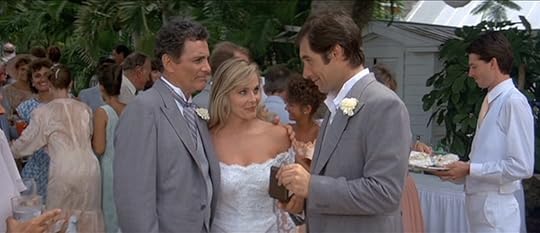
Timothy Dalton is doing the same thing in Licence to Kill that he did in The Living Daylights, but his character doesn't feel like Bond to me this time. The problem is the story. What worked so well about Living Daylights was that it put Dalton's super serious Bond in the middle of a traditional Bond adventure. Licence wants the story to match the character, but it goes too far and doesn't feel like a Bond movie to me. It's nothing more than an acceptable (but derivative) '80s action movie with some traditional Bond characters and gadgets laid over the top.
The one exception to that - the one time that it really feels like a Bond movie to me - is when Bond escapes underwater attackers by shooting a tethered spear into the pontoon of a seaplane and waterskis behind it as the Bond Theme blares triumphantly. It's a great stunt and an awesome moment.
An example of Bond's not really working in this plot is how forced his resignation is. M flies all the way to Florida to confront Bond about getting back on the job and heading to Istanbul for his next assignment. I love the idea that M's got Bond's next assignment ready and is anxious to get him there, but he's unexpectedly inflexible about it. Robert Brown's M has never been as personable as Bernard Lee's gruff, but caring boss was, so it's not out of character for him. It's just hard to reconcile with the numerous times that Bond has taken leave before to deal with personal stuff. There are other Double-Os. What's going on in Istanbul that's so important that Bond specifically is needed to deal with it? The world clearly doesn't come to an end because he takes time off (though how cool an ending would that have been?) and M welcomes him back to MI6 with zero consequences.
M may not be acting out of character, but Moneypenny certainly is. At least, she's not the same person that Lois Maxwell played. The Living Daylights gave us a hint of that, but it's really obvious in Licence. It's cool that she's worried about Bond, but not that it's making her incompetent at her job.
Back on the positive side: this may be my favorite Q story ever. We've seen Q hit the field before; usually to supply Bond with some complicated tech. This time, he's effectively gone rogue, bringing whatever crap he had lying around. The Bond/Q animosity was gone in Living Daylights, but this time there's genuine affection between the two of them. Q's taking a great risk in helping Bond and Bond tells him, "You're a hell of a field operative." It's lovely.
I like that Felix has more to do in this movie than he usually does. And Della is a great partner for him. I sometimes hear speculation that there's something going on between Della and Bond, but I don't see it. She's super friendly around him and kisses him all the time, but she does it in front of Felix and there's nothing sexual about it. She's just that kind of person and she genuinely loves Bond as much as Felix does. They make a great trio and it's tough to watch how happy they all are knowing what's going to happen. My complaint about the whole thing is how quickly Felix gets over Della's death. By the end of the movie he's in the hospital, but yukking it up with Bond on the phone like nothing's happened. It's the same as the M situation. The movie sets up this horrible, remarkable set of circumstances, but wants to hit the reset button at the end so that we're all back to normal for the next movie. It can't have it both ways.
Sharkey's a cool, original character. I'm curious about where he came from and wonder if with the other Live and Let Die references he might be inspired by Quarrel.
The only other allies worth mentioning - and I hesitate to call them allies - are the Hong Kong narcotics agents who conveniently get in the way just long enough to endear Bond to Sanchez. I like the idea of them, it's just that they're gone almost as soon as they show up. Would've been cool to see them and Bond working against each other for longer.
Best Quip
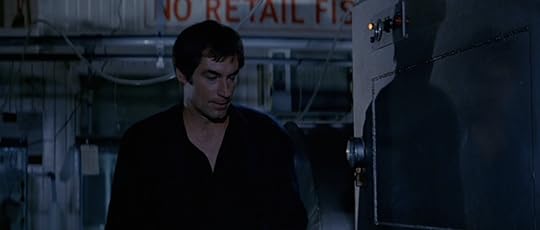
"Bon appétit," after locking a guard in a drawer full of maggots. After I picked it, I realized that it totally rips off Conney's piranha line from You Only Live Twice, but oh well. Quips aren't really appropriate to Licence's tone and Dalton doesn't sound comfortable with them, so this is as good as we get.
An honorable mention is when Bond turns over his weapon to M in Ernest Hemingway's house and says, "I guess that's farewell to arms." I love the pun, but again, that's a crazy awkward time to be making it.
Worst Quip
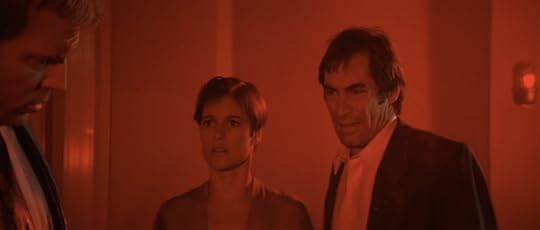
"Looks like he came to a dead end," when Sanchez's head of security is run through with a forklift and crashes through a wall.
Gadgets
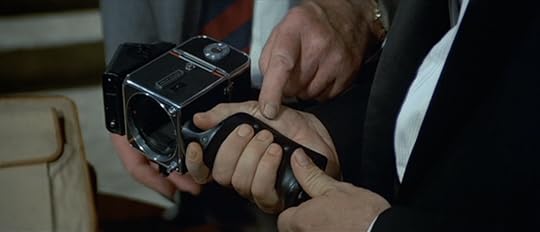
Not much in the way of gadgets for Licence. It's pretty much whatever Q had lying around, which is a tube of plastic explosive toothpaste, a cigarette pack detonator, and a camera gun keyed to Bond's handprint. They all come in handy, of course, but as befitting a box of junk, none of them are especially memorable.
Top Ten Gadgets
1. Lotus Esprit (The Spy Who Loved Me)
2. Aston Martin DB V (Goldfinger and Thunderball)
3. Jet pack (Thunderball)
4. Iceberg boat (A View to a Kill)
5. Aston Martin V8 Vantage (The Living Daylights)
6. Glastron CV23HT speed boat (Moonraker)
7. Acrostar Mini Jet (Octopussy)
8. Crocodile submarine (Octopussy)
9. Little Nellie (You Only Live Twice)
10. Rocket cigarettes (You Only Live Twice)
Bond's Best Outfit
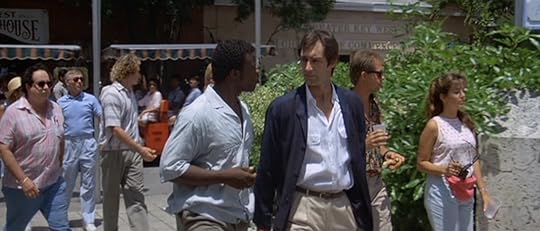
I'm getting bored with the fashion stuff now that we're out of the '60s and '70s. Probably going to drop this section from here out. I've always liked the white cotton shirt with khakis look though, and Bond's blue jacket is pretty snazzy too, even with the shoulder pads.
Bond's Worst Outfit
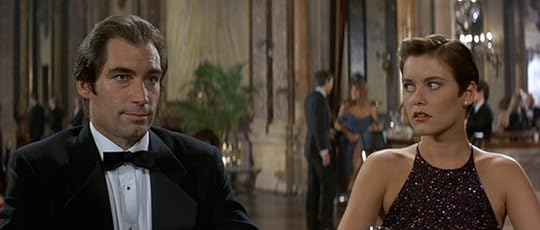
Strangely, it's the tux. It's Bond's iconic look, but Dalton doesn't look that comfortable in it. He's not that kind of spy.

Timothy Dalton is doing the same thing in Licence to Kill that he did in The Living Daylights, but his character doesn't feel like Bond to me this time. The problem is the story. What worked so well about Living Daylights was that it put Dalton's super serious Bond in the middle of a traditional Bond adventure. Licence wants the story to match the character, but it goes too far and doesn't feel like a Bond movie to me. It's nothing more than an acceptable (but derivative) '80s action movie with some traditional Bond characters and gadgets laid over the top.
The one exception to that - the one time that it really feels like a Bond movie to me - is when Bond escapes underwater attackers by shooting a tethered spear into the pontoon of a seaplane and waterskis behind it as the Bond Theme blares triumphantly. It's a great stunt and an awesome moment.
An example of Bond's not really working in this plot is how forced his resignation is. M flies all the way to Florida to confront Bond about getting back on the job and heading to Istanbul for his next assignment. I love the idea that M's got Bond's next assignment ready and is anxious to get him there, but he's unexpectedly inflexible about it. Robert Brown's M has never been as personable as Bernard Lee's gruff, but caring boss was, so it's not out of character for him. It's just hard to reconcile with the numerous times that Bond has taken leave before to deal with personal stuff. There are other Double-Os. What's going on in Istanbul that's so important that Bond specifically is needed to deal with it? The world clearly doesn't come to an end because he takes time off (though how cool an ending would that have been?) and M welcomes him back to MI6 with zero consequences.
M may not be acting out of character, but Moneypenny certainly is. At least, she's not the same person that Lois Maxwell played. The Living Daylights gave us a hint of that, but it's really obvious in Licence. It's cool that she's worried about Bond, but not that it's making her incompetent at her job.
Back on the positive side: this may be my favorite Q story ever. We've seen Q hit the field before; usually to supply Bond with some complicated tech. This time, he's effectively gone rogue, bringing whatever crap he had lying around. The Bond/Q animosity was gone in Living Daylights, but this time there's genuine affection between the two of them. Q's taking a great risk in helping Bond and Bond tells him, "You're a hell of a field operative." It's lovely.
I like that Felix has more to do in this movie than he usually does. And Della is a great partner for him. I sometimes hear speculation that there's something going on between Della and Bond, but I don't see it. She's super friendly around him and kisses him all the time, but she does it in front of Felix and there's nothing sexual about it. She's just that kind of person and she genuinely loves Bond as much as Felix does. They make a great trio and it's tough to watch how happy they all are knowing what's going to happen. My complaint about the whole thing is how quickly Felix gets over Della's death. By the end of the movie he's in the hospital, but yukking it up with Bond on the phone like nothing's happened. It's the same as the M situation. The movie sets up this horrible, remarkable set of circumstances, but wants to hit the reset button at the end so that we're all back to normal for the next movie. It can't have it both ways.
Sharkey's a cool, original character. I'm curious about where he came from and wonder if with the other Live and Let Die references he might be inspired by Quarrel.
The only other allies worth mentioning - and I hesitate to call them allies - are the Hong Kong narcotics agents who conveniently get in the way just long enough to endear Bond to Sanchez. I like the idea of them, it's just that they're gone almost as soon as they show up. Would've been cool to see them and Bond working against each other for longer.
Best Quip

"Bon appétit," after locking a guard in a drawer full of maggots. After I picked it, I realized that it totally rips off Conney's piranha line from You Only Live Twice, but oh well. Quips aren't really appropriate to Licence's tone and Dalton doesn't sound comfortable with them, so this is as good as we get.
An honorable mention is when Bond turns over his weapon to M in Ernest Hemingway's house and says, "I guess that's farewell to arms." I love the pun, but again, that's a crazy awkward time to be making it.
Worst Quip

"Looks like he came to a dead end," when Sanchez's head of security is run through with a forklift and crashes through a wall.
Gadgets

Not much in the way of gadgets for Licence. It's pretty much whatever Q had lying around, which is a tube of plastic explosive toothpaste, a cigarette pack detonator, and a camera gun keyed to Bond's handprint. They all come in handy, of course, but as befitting a box of junk, none of them are especially memorable.
Top Ten Gadgets
1. Lotus Esprit (The Spy Who Loved Me)
2. Aston Martin DB V (Goldfinger and Thunderball)
3. Jet pack (Thunderball)
4. Iceberg boat (A View to a Kill)
5. Aston Martin V8 Vantage (The Living Daylights)
6. Glastron CV23HT speed boat (Moonraker)
7. Acrostar Mini Jet (Octopussy)
8. Crocodile submarine (Octopussy)
9. Little Nellie (You Only Live Twice)
10. Rocket cigarettes (You Only Live Twice)
Bond's Best Outfit

I'm getting bored with the fashion stuff now that we're out of the '60s and '70s. Probably going to drop this section from here out. I've always liked the white cotton shirt with khakis look though, and Bond's blue jacket is pretty snazzy too, even with the shoulder pads.
Bond's Worst Outfit

Strangely, it's the tux. It's Bond's iconic look, but Dalton doesn't look that comfortable in it. He's not that kind of spy.
August 5, 2015
Licence to Kill (1989) | Story

Plot Summary
When a drug lord violently ends Felix's marriage, Bond takes it personally and goes for revenge, resigning from the Secret Service in the process.
Influences
After The Living Daylights, I remember taking stock of the remaining Fleming titles and trying to figure out which could possibly be the basis for the next movie. "Risico" and "The Property of a Lady" had already been thoroughly adapted by For Your Eyes Only and Octopussy, so they were out unless whole new stories were created for them (and neither are great enough titles to really warrant that). "The Hildebrand Rarity" would make a great seed for a movie plot, but the title is so clunky that I doubted they'd pick it. That left "Quantum of Solace" and "007 in New York." "Quantum" barely features James Bond, while "New York" is mostly about him sitting in a car. Not that anyone was going to make a movie called 007 in New York, even if it were the most exciting script in the world. It seemed unlikely that the movies could continue to adapt Fleming stories.
I also remember speculation among Bond fans about whether or not the movies would start to adapt the then-new series of Bond novels by John Gardner. I read the first two or three and wasn't a big fan, but the idea of adapting existing material was so ingrained at that point that it was hard to imagine completely original films. The first Gardner book is License Renewed, in which - much like Never Say Never Again - the Double-O section has been mothballed, but Bond is reinstated for a new mission. That would be a challenge to work into movie continuity, but it sounded like EON was headed in at least a similar direction when they announced that the next movie would be called Licence Revoked. Fans speculated that perhaps they were setting things in motion to follow Gardner's continuity with the next film.
That all turned out to be useless conjecture, of course. If Gardner's book inspired the title for what became Licence to Kill, that was its only influence. The writers' (Richard Maibaum and Michael G Wilson again) main motivation was to play to Dalton's strength as an intense, driven Bond. So they went all out with a revenge plot started by something horrible happening to Bond's best friend that's reminiscent of the greatest tragedy in Bond's own life.
The result has more in common with other '80s action movies than any particular Fleming story, but Licence does include elements out of a couple of books.
How Is the Book Different?
What happens to Felix is right out of the Live and Let Die novel, but he's not married in the book. Della is unique to Licence to Kill.
The character of Milton Krest is from "The Hildebrand Rarity," but his abusive relationship with his wife has been transferred to Sanchez and Lupe. Also Bond doesn't sleep with the abused woman in the Fleming story. That might sound more judgmental than I mean it. Lupe is a very different character from Elizabeth Krest. Where Elizabeth is completely powerless, Lupe is taking advantage of Bond and he's letting her.
Moment That's Most Like Fleming

Felix's getting fed to the shark is super close to what happens in Live and Let Die, including the horrible note. Bond's infiltrating the marine warehouse afterwards is also in the novel, but instead of finding drugs in a vat of maggots, he's looking for pirate treasure in a tank of deadly fish.
Moment That's Least Like Fleming

I'm going with the bar fight where a dude tries to fight Bond with a giant swordfish and Pam's shotgun creates a perfectly cylindrical hole in the wall. Those are things that would've worked in a Roger Moore movie and it's a shame to see them sneak back into Dalton's world.
A runner up would be the whole resignation and revenge plot, but that's not really a contradiction with Fleming's version. I can imagine a scenario in which Bond and M were so at odds that Bond was forced to quit. But it would have played out much differently than it does in Licence to Kill.
Cold Open

My favorite kind of cold open, leading directly into the events of the movie itself. We meet Felix, Sharkey, and Bond, and learn that they're all trying to get to Felix's wedding. Then the DEA shows up to let Felix know that Sanchez, the drug lord they've been trying to get forever, is in the area and needs catching. There's an especially cool moment when you realize that one of the DEA agents is played by Grand L Bush, who played Agent Johnson in Die Hard to Robert Davi's (Sanchez) other Agent Johnson.
At any rate, Sanchez is there to catch his girlfriend Lupe with another dude. Sanchez kills the rival by cutting out his heart, then beats Lupe with something that could be the ray tail from "Hildebrand Rarity," but I have a hard time making it out. There's an unintentionally funny slo mo shot of Felix and the DEA agents running in slow motion toward the camera. It's not ridiculous, but it's obviously borrowing from Tony Scott. That's not a bad person to borrow from if you're making an '80s action movie, but it's just thrown in there once without any attempt to marry it to the rest of John Glen's style.
Sanchez tries to get away in a small plane, chased by the good guys in a helicopter. Bond performs the big stunt of the teaser by getting lowered on a winch to the tail of the plane, then tying the cable to the plane so that the helicopter can drag it into custody. Bond fan Christopher Nolan did a similar bit in The Dark Knight Rises, just one of a few set pieces and plot points that he borrowed from Bond movies. I'll try to remember to point out more as we go, but the fellas at the Pod James Pod podcast do a way better (and funnier) job of it than I'll be able to.
The stunt is cool, as is Bond and Felix's parachuting down to make the wedding. I love the Florida Keys setting too. A solid teaser and one of my favorites.
Top 10 Cold Opens
1. The Spy Who Loved Me
2. Moonraker
3. Thunderball
4. On Her Majesty's Secret Service
5. A View to a Kill
6. Goldfinger
7. The Man with the Golden Gun
8. The Living Daylights
9. Licence to Kill
10. For Your Eyes Only
Movie Series Continuity

Licence to Kill specifically recalls Tracy's death and uses it as additional motivation for Bond's revenge. I can't tell you how much I love Bond's gentle, but insistent refusal to play Della's innocent who-gets-married-next game. His smile is heartbreaking.
I have more to say about the difference between Robert Brown's M and Bernard Lee's, but I think I'll save that for tomorrow.
There's a "shaken, not stirred" reference that's pretty funny when Bond sends Pam away to get his drink and she angrily orders it with obscene hand gestures.
The only other continuity-related bit is that Sanchez doesn't know Bond either by sight or by name. Somewhere towards the end of the Moore era, they dropped the idea that Bond's a world-famous spy, which is excellent. I really hated that in the late Connery/early Moore period.