Michael May's Blog, page 129
September 23, 2015
Quantum of Solace (2008) | Bond
Actors and Allies
Like in Casino Royale, trust is still a huge issue between M and Bond, but it's not about Bond's ego anymore. Part of it's just about knocking off the rough edges from his personality. As Vesper said in Casino Royale - and we learn more about in Skyfall - M tends to recruit orphans. But the lack of attachment M's looking for in candidates has to be moderated if they're going to be good agents. Bond's big problem is that he doesn't trust anyone. He learned to trust Vesper, but now he believes that was a mistake. He's still drinking the drink that he named after her - lots of them - so he's clearly not as over her as he claims, but he simultaneously loves and hates her. And that's wreaking havoc on his black-and-white worldview.
M sees this - and that Bond isn't being honest with himself about it - so that puts up another barrier to her trusting him. He keeps killing people who are potential leads, which is irritating for the investigation, but also suggests a deeper issue to her. It may not be just that he's an immature spy. She's worried that he's more interested in revenge than his duty to uncover Mr White's organization. He can always mature, but if he learns to put his personal feelings above his job, it'll make him useless to her as an agent.
His anger is fueling his distrust of everyone, so it comes full circle and M stays on him about both issues. "When you can't tell your friends from your enemies, it's time to go," she says. And Bond's relationship with Mathis is a great example of that.
Bond gets in a lot of trouble over Mathis' death, not just with the Bolivian police, but also the CIA and apparently with MI6. I've often wondered why anyone entertained the idea that Bond might have killed Mathis, but seeing the story through M's eyes, I get it. Bond totally considered Mathis an enemy at one point and Bond totally still has trust issues. And Bond totally has a habit of killing his enemies before he asks them any questions. I can see how M might wonder if Bond temporarily teamed up with Mathis to get to Quantum and then killed him. It's shortly after that when she outright says that she doesn't trust Bond.
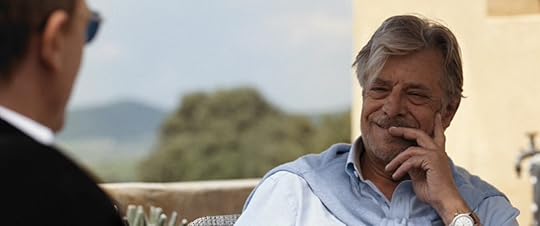
But of course Bond had learned to trust Mathis, which is a beautiful thing. I've always liked Mathis in the novel Casino Royale and Giancarlo Giannini plays him wonderfully. Fleming writes him as a fun, friendly character, but Giannini adds a ton of heart. Quantum makes great use of him and turns him into the only person after Vesper that Bond learns to trust. (Bond trusts M, too, to an extent, but that's a different relationship. Bond knows that M will always put Britain's interests over his. In contrast, Mathis - and Vesper, he'll argue - were intensely loyal to Bond as a person.)
Mathis has no reason to help Bond look into Quantum's activities in Bolivia, but he does it because he's a good man who believes in forgiveness. Bond, on the other hand, isn't, but Bond's goodness isn't a prerequisite for Mathis' mercy. Bond never even really apologizes or seems to regret his distrust of Mathis, but that's okay. In the simple act of turning to Mathis for help, Bond has admitted that he was wrong. And that's all Mathis needs to find hope that Bond can be redeemed.
Mathis helps Bond investigate Dominic Greene, but his real mission is to put Bond on a better path as a human being. He encourages Bond to forgive Vesper and to learn the right lesson from knowing her. In spite of everything, he's truly concerned about Bond, even with his dying words: "Vesper. Forgive her. Forgive yourself." He's completely selfless. If for no other reason, Quantum has a special place in my heart for doing right by him. I love that character so much.
For his part, Bond leaves Mathis' body in a dumpster and takes his money. Camille is there and she's horrified. "Is that how you treat your friends?"
"He wouldn't care," Bond replies. And he's right. Mathis is the freaking Giving Tree. But Bond should care. And when he doesn't, it reveals that he doesn't deserve a friend like Mathis. That's the whole point though. That's why Mathis is the only person Bond can trust for most of the film.
Bond even has reason to distrust Felix, his unequivocal ally in Casino Royale. The CIA is in bed with Greene and that makes Felix look guilty by association. Happily, Felix is able to turn that around. His hands may be tied - and the implication is that the CIA isn't any happier about it than Felix (his boss notwithstanding) - but they recognize in Bond a way to make things right. They can't move against Greene, but Bond can. Ironically, his withdrawn independence gives him freedom to be the force for justice that the establishment can't be.
M recognizes this too. Once it's revealed how connected Quantum really is, M is told by the Foreign Secretary to call off the investigation. "Mr. Greene's interests and ours now align." After that, M goes to Bolivia, finds Bond, and suspends him. Again. Seriously, this is the third movie in a row. But while I believe that she has multiple reasons for relieving Bond of official duty, I also have no doubt that one of them is to free him to do what she can't order him to do. She puts a detail on him to get him out of the country, but as soon as he escapes - which is right away - she tells Tanner that Bond's "my agent and I trust him." She says that she knows he's onto something and she wants him followed, but not interfered with.
Her comment about trusting Bond is curious, because she explicitly stated earlier that she didn't. In fact, she's riding him hard about rage and trustworthiness earlier in that scene. The only thing I can see that's changed is that when he escapes his escort, he doesn't take off into the night, but comes back to talk to M some more about Agent Fields. He's concerned about Fields' reputation, but he's also concerned about his relationship with M. "You and I need to see this through," he says, reminding her that they're a team and reassuring her that this isn't about his grief. It's quick and subtle, but it seems to be enough for her.
He puts duty before revenge a couple of more times, too. First, he saves Greene's life in the exploding hotel just on the slim chance that he has a chance to question the villain later. Even more importantly, he also lets Vesper's boyfriend live; the man who'd betrayed Vesper and caused her to betray Bond.
And he forgives Vesper, too. After her boyfriend is taken away, Bond tells M, "Congratulations. You were right." And when she asks him about what, he clarifies, "About Vesper." It's a reference to a conversation they had at the end of Casino Royale where she asked if he ever wondered why Quantum hadn't killed Bond. "Because," she suggested, "she made a deal to save your life." Bond hadn't accepted it then, nor had he accepted it at the beginning of Quantum when Mr. White outright confirms it. According to White, if Vesper hadn't killed herself, Quantum would have used her to control Bond, too. That's how they operate.
But thanks to Mathis and M and even Felix and definitely Camille (whom we'll talk about tomorrow), Bond has made peace and learned that he's not alone. Mathis was right, and he'd be pleased.
M, on the other hand, was wrong about Bond. She was right about Bond's not facing his grief, but wrong about how that affected his job. Bond was certainly angry, but his mission to uncover Quantum was never about revenge. It was always about duty and serving her. At the end of the movie, he's technically still on suspension, so M tells him that she needs him back. His response is lovely. "I never left."
Best Quip
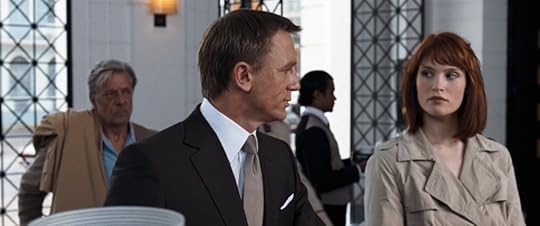
"We are teachers on sabbatical... and we have just won the lottery."
Worst Quip

"Thank you. She's seasick."
Gadgets
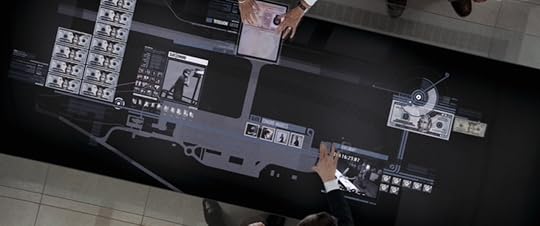
No gadgets in this one unless you count the fancy computer interfaces at MI6.
Top Ten Gadgets
1. Lotus Esprit (The Spy Who Loved Me)
2. Aston Martin DB V (Goldfinger and Thunderball)
3. Jet pack (Thunderball)
4. Iceberg boat (A View to a Kill)
5. The Q Boat (The World Is Not Enough)
6. Aston Martin V8 Vantage (The Living Daylights)
7. Glastron CV23HT speed boat (Moonraker)
8. Acrostar Mini Jet (Octopussy)
9. Crocodile submarine (Octopussy)
10. X-Ray Specs (The World Is Not Enough)

Like in Casino Royale, trust is still a huge issue between M and Bond, but it's not about Bond's ego anymore. Part of it's just about knocking off the rough edges from his personality. As Vesper said in Casino Royale - and we learn more about in Skyfall - M tends to recruit orphans. But the lack of attachment M's looking for in candidates has to be moderated if they're going to be good agents. Bond's big problem is that he doesn't trust anyone. He learned to trust Vesper, but now he believes that was a mistake. He's still drinking the drink that he named after her - lots of them - so he's clearly not as over her as he claims, but he simultaneously loves and hates her. And that's wreaking havoc on his black-and-white worldview.
M sees this - and that Bond isn't being honest with himself about it - so that puts up another barrier to her trusting him. He keeps killing people who are potential leads, which is irritating for the investigation, but also suggests a deeper issue to her. It may not be just that he's an immature spy. She's worried that he's more interested in revenge than his duty to uncover Mr White's organization. He can always mature, but if he learns to put his personal feelings above his job, it'll make him useless to her as an agent.
His anger is fueling his distrust of everyone, so it comes full circle and M stays on him about both issues. "When you can't tell your friends from your enemies, it's time to go," she says. And Bond's relationship with Mathis is a great example of that.
Bond gets in a lot of trouble over Mathis' death, not just with the Bolivian police, but also the CIA and apparently with MI6. I've often wondered why anyone entertained the idea that Bond might have killed Mathis, but seeing the story through M's eyes, I get it. Bond totally considered Mathis an enemy at one point and Bond totally still has trust issues. And Bond totally has a habit of killing his enemies before he asks them any questions. I can see how M might wonder if Bond temporarily teamed up with Mathis to get to Quantum and then killed him. It's shortly after that when she outright says that she doesn't trust Bond.
But of course Bond had learned to trust Mathis, which is a beautiful thing. I've always liked Mathis in the novel Casino Royale and Giancarlo Giannini plays him wonderfully. Fleming writes him as a fun, friendly character, but Giannini adds a ton of heart. Quantum makes great use of him and turns him into the only person after Vesper that Bond learns to trust. (Bond trusts M, too, to an extent, but that's a different relationship. Bond knows that M will always put Britain's interests over his. In contrast, Mathis - and Vesper, he'll argue - were intensely loyal to Bond as a person.)
Mathis has no reason to help Bond look into Quantum's activities in Bolivia, but he does it because he's a good man who believes in forgiveness. Bond, on the other hand, isn't, but Bond's goodness isn't a prerequisite for Mathis' mercy. Bond never even really apologizes or seems to regret his distrust of Mathis, but that's okay. In the simple act of turning to Mathis for help, Bond has admitted that he was wrong. And that's all Mathis needs to find hope that Bond can be redeemed.
Mathis helps Bond investigate Dominic Greene, but his real mission is to put Bond on a better path as a human being. He encourages Bond to forgive Vesper and to learn the right lesson from knowing her. In spite of everything, he's truly concerned about Bond, even with his dying words: "Vesper. Forgive her. Forgive yourself." He's completely selfless. If for no other reason, Quantum has a special place in my heart for doing right by him. I love that character so much.
For his part, Bond leaves Mathis' body in a dumpster and takes his money. Camille is there and she's horrified. "Is that how you treat your friends?"
"He wouldn't care," Bond replies. And he's right. Mathis is the freaking Giving Tree. But Bond should care. And when he doesn't, it reveals that he doesn't deserve a friend like Mathis. That's the whole point though. That's why Mathis is the only person Bond can trust for most of the film.
Bond even has reason to distrust Felix, his unequivocal ally in Casino Royale. The CIA is in bed with Greene and that makes Felix look guilty by association. Happily, Felix is able to turn that around. His hands may be tied - and the implication is that the CIA isn't any happier about it than Felix (his boss notwithstanding) - but they recognize in Bond a way to make things right. They can't move against Greene, but Bond can. Ironically, his withdrawn independence gives him freedom to be the force for justice that the establishment can't be.
M recognizes this too. Once it's revealed how connected Quantum really is, M is told by the Foreign Secretary to call off the investigation. "Mr. Greene's interests and ours now align." After that, M goes to Bolivia, finds Bond, and suspends him. Again. Seriously, this is the third movie in a row. But while I believe that she has multiple reasons for relieving Bond of official duty, I also have no doubt that one of them is to free him to do what she can't order him to do. She puts a detail on him to get him out of the country, but as soon as he escapes - which is right away - she tells Tanner that Bond's "my agent and I trust him." She says that she knows he's onto something and she wants him followed, but not interfered with.
Her comment about trusting Bond is curious, because she explicitly stated earlier that she didn't. In fact, she's riding him hard about rage and trustworthiness earlier in that scene. The only thing I can see that's changed is that when he escapes his escort, he doesn't take off into the night, but comes back to talk to M some more about Agent Fields. He's concerned about Fields' reputation, but he's also concerned about his relationship with M. "You and I need to see this through," he says, reminding her that they're a team and reassuring her that this isn't about his grief. It's quick and subtle, but it seems to be enough for her.
He puts duty before revenge a couple of more times, too. First, he saves Greene's life in the exploding hotel just on the slim chance that he has a chance to question the villain later. Even more importantly, he also lets Vesper's boyfriend live; the man who'd betrayed Vesper and caused her to betray Bond.
And he forgives Vesper, too. After her boyfriend is taken away, Bond tells M, "Congratulations. You were right." And when she asks him about what, he clarifies, "About Vesper." It's a reference to a conversation they had at the end of Casino Royale where she asked if he ever wondered why Quantum hadn't killed Bond. "Because," she suggested, "she made a deal to save your life." Bond hadn't accepted it then, nor had he accepted it at the beginning of Quantum when Mr. White outright confirms it. According to White, if Vesper hadn't killed herself, Quantum would have used her to control Bond, too. That's how they operate.
But thanks to Mathis and M and even Felix and definitely Camille (whom we'll talk about tomorrow), Bond has made peace and learned that he's not alone. Mathis was right, and he'd be pleased.
M, on the other hand, was wrong about Bond. She was right about Bond's not facing his grief, but wrong about how that affected his job. Bond was certainly angry, but his mission to uncover Quantum was never about revenge. It was always about duty and serving her. At the end of the movie, he's technically still on suspension, so M tells him that she needs him back. His response is lovely. "I never left."
Best Quip

"We are teachers on sabbatical... and we have just won the lottery."
Worst Quip

"Thank you. She's seasick."
Gadgets

No gadgets in this one unless you count the fancy computer interfaces at MI6.
Top Ten Gadgets
1. Lotus Esprit (The Spy Who Loved Me)
2. Aston Martin DB V (Goldfinger and Thunderball)
3. Jet pack (Thunderball)
4. Iceberg boat (A View to a Kill)
5. The Q Boat (The World Is Not Enough)
6. Aston Martin V8 Vantage (The Living Daylights)
7. Glastron CV23HT speed boat (Moonraker)
8. Acrostar Mini Jet (Octopussy)
9. Crocodile submarine (Octopussy)
10. X-Ray Specs (The World Is Not Enough)


September 22, 2015
Quantum of Solace (2008) | Story

Plot Summary
Bond tracks down the people behind Vesper's death, but is he doing it for duty or revenge?
Influences
The history of the Quantum of Solace script is long and troubled. Neal Purvis and Robert Wade started it and Paul Haggis did a re-write that he reportedly finished just hours before a major writers strike put the kibosh on any updates. Rules stated though that the director and actors were allowed to work on scenes together, so Marc Forster and Daniel Craig finished it up. I don't even want to try to unravel who was responsible for which parts, but the result is a movie that has fans divided about its quality. Some see it as a complete mess, while some see it as a fine continuation of the plot and emotional journey started in Casino Royale. I'm in the second group. I have issues with it, but they're minor.
It's the first Bond movie that's more than just a nominal sequel. It doesn't stand on its own and that seems to be a big reason a lot of people don't like it. But I love the way it builds on Casino Royale and even leads into Skyfall. This isn't what we're used to from the Bond series, but it's fantastic.
How Is the Book Different?
Quantum of Solace gets its name from a Fleming short story, but doesn't borrow any plot elements from there. The two versions do however have a major theme in common: finding a tiny amount of comfort in the midst of great suffering. It's a great title and I'm glad that the film series not only found a use for it, but was able to apply it directly to Bond this time. In Fleming, it's a whole other character who needs some relief.
Moment That's Most Like Fleming

In Fleming, Casino Royale is followed by Live and Let Die, which is very much a revenge mission for Bond since Mr. Big is funding the organization that tortured Bond and was responsible for Vesper's death. So, the whole idea of Quantum's continuing the emotional story from Casino Royale is perfect.
Other than that though, I also notice some similarity in director Marc Forster's focus on details. Skyfall rightfully gets a lot of praise for how beautifully shot it is, but Quantum is the same way. Roberto Schaefer was also Forster's cinematographer on Finding Neverland and he gets some great shots that highlight what's going on around the action. Fleming did that as well in his writing.
The problem is that these extra shots often feel extraneous and indulgent. For instance, Forster intercuts Bond's chasing M's traitorous bodyguard with shots from a horse race going on at the same time. And later, there's a ton of focus on the preparation for and presentation of the opera where Quantum is holding its meeting. I imagine that both of those are purposely juxtaposed with what Bond's doing in order to comment on his actions, but the connections aren't clear and I never want to quit paying attention to the action to try to figure out the meanings of the other stuff. I appreciate the effort, but it doesn't end up being worth it.
Moment That's Least Like Fleming

The set pieces are all very strong in Quantum, but the connections between them are weak. Fleming's story structure was always tight. Even when his pacing was leisurely, his plots flowed well and I always understand what's going on. Quantum is very loose and glosses past key story beats, especially in terms of MI6's investigation.
The information is always there, but the movie is so interested in Bond's emotional journey that it doesn't care if we believe in his detective work. Bond discovers Quantum's Haitian connection because some Quantum money was deposited into the account of a man staying at a hotel there, so he must be a lead. Bond finds Dominic Greene through a magical search engine that looks for everyone on earth with that name and picks the right one to send Bond a picture of. At the opera where Quantum's meeting, Bond is watching Greene, but happens to notice an audience member receive a special bag from under the gift table, so of course that must connect him to Quantum as well. None of it is exactly nonsensical, but it's obvious that not a lot of thought went into any of it either.
Cold Open

One of the weakest things about Quantum is the teaser. It's just a car chase. And though it's exciting, it's not innovative or different from most other car chases. The big reveal at the end is that Bond has Mr White in his trunk, letting us know that Quantum picks up right after Casino Royale, but that's small potatoes considering what Bond fans are used to.
There's not even the traditional gun barrel sequence, because that's been moved to the end of the movie before the closing credits for no reason.
Top 10 Cold Opens
1. GoldenEye
2. Casino Royale
3. The Spy Who Loved Me
4. Moonraker
5. Thunderball
6. On Her Majesty's Secret Service
7. A View to a Kill
8. Goldfinger
9. The Man with the Golden Gun
10. The Living Daylights
Movie Series Continuity

There's not much continuity with the broader Bond series, but of course there's tons with Casino Royale. M refers to Bond's arrangement to let the CIA have custody of Le Chiffre in exchange for Felix's poker chips. She says that the CIA "won't be happy," apparently referring to MI6's custody of Mr White.
Bond has the right response though. He reminds M that he promised Felix that he could have Le Chiffre. That Le Chiffre is dead isn't any fault of MI6's. In fact, now that I think about it, why didn't Felix arrange to capture Le Chiffre directly after the poker game? Would have save Bond's testicles a lot of trouble. It's the CIA's own fault that White got to Le Chiffre first and assassinated him. MI6 doesn't owe them White in compensation. Bond got White through his own, separate investigation and suffered a lot for it. I love Felix, but screw the CIA on this one. I don't know why M is even concerned.
In the same scene, Bond acts like he wants to move on from Vesper and he denies that she was important to him, but we know right away that's a lie when he steals a picture of her missing boyfriend from the file. Much more on this tomorrow.
The last bit of continuity worth mentioning is that Tanner's back, but played by Rory Kinnear now. Michael Kitchen played him in the Brosnan era, even after the character was replaced as Chief of Staff by Charles Robinson. I wonder if Judi Dench's M in the Craig films is even supposed to be the same character who gave Bond his orders in the Brosnan films.

September 21, 2015
Lois Lane: Jungle Girl [Guest Post]
By GW Thomas
 The early days of superheroes were pretty simple. You created a weird character and you threw villains at him. Superman, Batman, Wonder Woman; they just had to punch their way out. But by the late 1950s this had changed. What had been one title had become many. Action Comics for example had become Action Comics, Superman, Superman's Best Friend Jimmy Olson, Superman's Girlfriend Lois Lane, Superboy, Supergirl, and so on. What this did was allow the writers to pen different kinds of stories. Action Comics and Superman still had the basic rough and tumble formula, but some of these other titles delved into more private aspects of the superhero's life.
Superman's Girlfriend Lois Lane is a perfect example. Marketed towards the female reader, most of the plots hinge on Lois's emotional connection to Superman. Not quite a romance comic, it did explore her feelings of love (and jealousy) towards the Man of Steel. And finding a new way to do that issue after issue was quite a challenge with 137 issues from 1959 to 1974. Some sample ideas from just the first twenty-four issues include Lois becoming a witch, adopting a super-baby, getting really fat, going to prison, singing a hit song with Pat Boone, becoming a baby herself, wearing a lead box on her head to hide her face from Superman, falling for Batman, getting kryptonite vision by accident, marrying Astounding Man, getting X-Ray vision, and any number of plots involving Lana Lang's getting the upper hand on Lois for Superman's affections. And that's just the first 24 of 137.
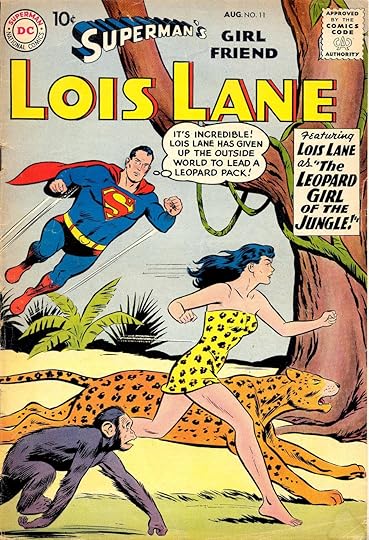
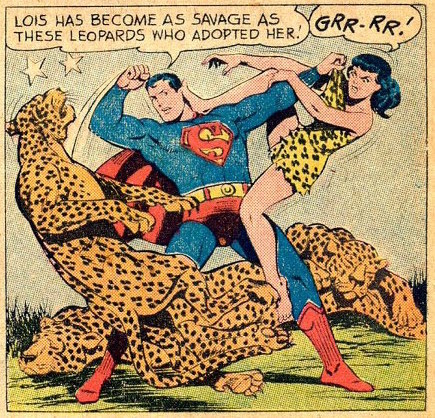 Issue #11 (August 1959) is a my favorite of them all. "The Leopard Girl of the Jungle" was written by Bill Finger and drawn by Kurt Schaffenburger. In this story, Lana Lang wants to see Lois. Lois, being ever jealous of Superman's first girlfriend, thinks the worst. But what Lana really wants is for Lois to read her new novel. It's a jungle thriller that's been rejected because it's too far-fetched. Lois reads the book, but has an interview in Africa, so she hops a plane. Which, of course, crashes and Lois loses her memory. She thinks she is a leopard girl and takes up with pack of leopards. (We'll come back to that one.) Superman finds her and restores her memory but Lois refuses to leave the jungle. She is determined to prove that a jungle girl can do all the things that Lana wrote about. Lois goes on a dangerous jungle crusade and accomplishes all of Lana's jungle adventures (with Superman always ready to surreptitiously save her, like pulling the crocodiles down in the river so they can't attack the swimming jungle queen and her furry companions). She returns with her proof and Lana's book becomes a bestseller. Superman is impressed by Lois's kindness to Lana (which Lois only admits to herself is why she did all those crazy jungle stunts.)
Now Bill Finger could have done some research and learned that leopards don't live in packs. And he could have acquired more in-depth, African geographical and political knowledge. Except that would have ruined the whole thing. Because Finger didn't want to write a real jungle adventure. He wanted to write something that harkened back to the jungle queens of old, like Sheena, Rulah, Camilla, and Cave Girl. And this is exactly what he does. Lois wears leopard skins. She escapes stampeding elephants and raging grass fires. She swims in crocodile-infested waters. The only thing she doesn't do is use a knife. This might have been a Comics Code issue or simply because Superman is continuously acting as her security blanket.
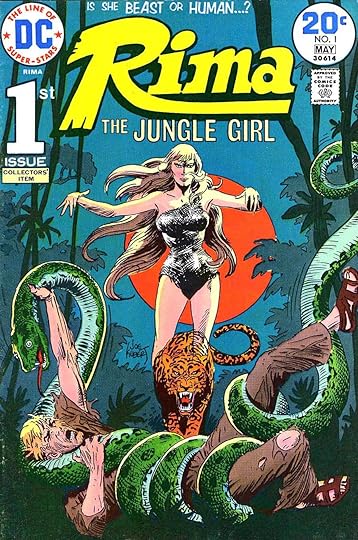 The end result is an homage strategically placed in the jungle girl history. Most of the jungle comics and movies were done by the early '50s. The only significant one was in 1959 with Audrey Hepburn playing Rima the Jungle Girl in Green Mansions. That premiered around the same time this issue of Superman's Girlfriend Lois Lane appeared. Coincidence? Probably not. DC had no jungle comics in 1959. (In 1972 Joe Kubert would take over Tarzan and would even adapt Green Mansions as a seven-part mini-series called Rima the Jungle Girl in 1974. But back in 1959? Nada.) Bill Finger's tale is a swan song to an era of liana-swinging gals in leopard bikinis. The 1960s would be the decade that gave us Ron Ely on TV, Jack Benny and Gilligan parodies, George of the Jungle, and Ray Stevens singing "Guitarzan." We had become too sophisticated for Nyoka serials or Irish McCalla as Sheena.
Good bye, jungle girls. And thank you, Metropolis, for one last swing.
If you'd like to read the entire comic you can at Benny Drinnon's Ominous Octopus Omnibus blog. I'd also like to thank Benny Drinnon for directing my attention to this story.
GW Thomas has appeared in over 400 different books, magazines and ezines including The Writer, Writer's Digest, Black October Magazine and Contact. His website is gwthomas.org. He is editor of Dark Worlds magazine.
 The early days of superheroes were pretty simple. You created a weird character and you threw villains at him. Superman, Batman, Wonder Woman; they just had to punch their way out. But by the late 1950s this had changed. What had been one title had become many. Action Comics for example had become Action Comics, Superman, Superman's Best Friend Jimmy Olson, Superman's Girlfriend Lois Lane, Superboy, Supergirl, and so on. What this did was allow the writers to pen different kinds of stories. Action Comics and Superman still had the basic rough and tumble formula, but some of these other titles delved into more private aspects of the superhero's life.
Superman's Girlfriend Lois Lane is a perfect example. Marketed towards the female reader, most of the plots hinge on Lois's emotional connection to Superman. Not quite a romance comic, it did explore her feelings of love (and jealousy) towards the Man of Steel. And finding a new way to do that issue after issue was quite a challenge with 137 issues from 1959 to 1974. Some sample ideas from just the first twenty-four issues include Lois becoming a witch, adopting a super-baby, getting really fat, going to prison, singing a hit song with Pat Boone, becoming a baby herself, wearing a lead box on her head to hide her face from Superman, falling for Batman, getting kryptonite vision by accident, marrying Astounding Man, getting X-Ray vision, and any number of plots involving Lana Lang's getting the upper hand on Lois for Superman's affections. And that's just the first 24 of 137.
 Issue #11 (August 1959) is a my favorite of them all. "The Leopard Girl of the Jungle" was written by Bill Finger and drawn by Kurt Schaffenburger. In this story, Lana Lang wants to see Lois. Lois, being ever jealous of Superman's first girlfriend, thinks the worst. But what Lana really wants is for Lois to read her new novel. It's a jungle thriller that's been rejected because it's too far-fetched. Lois reads the book, but has an interview in Africa, so she hops a plane. Which, of course, crashes and Lois loses her memory. She thinks she is a leopard girl and takes up with pack of leopards. (We'll come back to that one.) Superman finds her and restores her memory but Lois refuses to leave the jungle. She is determined to prove that a jungle girl can do all the things that Lana wrote about. Lois goes on a dangerous jungle crusade and accomplishes all of Lana's jungle adventures (with Superman always ready to surreptitiously save her, like pulling the crocodiles down in the river so they can't attack the swimming jungle queen and her furry companions). She returns with her proof and Lana's book becomes a bestseller. Superman is impressed by Lois's kindness to Lana (which Lois only admits to herself is why she did all those crazy jungle stunts.)
Now Bill Finger could have done some research and learned that leopards don't live in packs. And he could have acquired more in-depth, African geographical and political knowledge. Except that would have ruined the whole thing. Because Finger didn't want to write a real jungle adventure. He wanted to write something that harkened back to the jungle queens of old, like Sheena, Rulah, Camilla, and Cave Girl. And this is exactly what he does. Lois wears leopard skins. She escapes stampeding elephants and raging grass fires. She swims in crocodile-infested waters. The only thing she doesn't do is use a knife. This might have been a Comics Code issue or simply because Superman is continuously acting as her security blanket.
 The end result is an homage strategically placed in the jungle girl history. Most of the jungle comics and movies were done by the early '50s. The only significant one was in 1959 with Audrey Hepburn playing Rima the Jungle Girl in Green Mansions. That premiered around the same time this issue of Superman's Girlfriend Lois Lane appeared. Coincidence? Probably not. DC had no jungle comics in 1959. (In 1972 Joe Kubert would take over Tarzan and would even adapt Green Mansions as a seven-part mini-series called Rima the Jungle Girl in 1974. But back in 1959? Nada.) Bill Finger's tale is a swan song to an era of liana-swinging gals in leopard bikinis. The 1960s would be the decade that gave us Ron Ely on TV, Jack Benny and Gilligan parodies, George of the Jungle, and Ray Stevens singing "Guitarzan." We had become too sophisticated for Nyoka serials or Irish McCalla as Sheena.
Good bye, jungle girls. And thank you, Metropolis, for one last swing.
If you'd like to read the entire comic you can at Benny Drinnon's Ominous Octopus Omnibus blog. I'd also like to thank Benny Drinnon for directing my attention to this story.
GW Thomas has appeared in over 400 different books, magazines and ezines including The Writer, Writer's Digest, Black October Magazine and Contact. His website is gwthomas.org. He is editor of Dark Worlds magazine.
September 20, 2015
Casino Royale (2006) | Music
To fit the tone of Casino Royale, the filmmakers wanted a strong, masculine voice to sing the theme song. They hired Soundgarden's Chris Cornell to co-write it with David Arnold and sing it. I was never a fan of Soundgarden or Cornell, but man, that song is perfect. For the music, Arnold kept the feel of the Bond Theme without actually referencing it. Cornell's lyrics are basically a letter from Bond to Le Chiffre (or any victim, really) and he belts them out with as much conviction and confidence as Bond himself. As a rule, I prefer Bond songs to include the name of the movie, but not this time. It describes the feel of the movie too completely to want the words "Casino Royale" forced in just to satisfy tradition.
Daniel Kleinman also outdid himself on the credits sequence. Anyone could have predicted the card motif, but the two-dimensional, papercut look is surprising and unique. Kleinman mixes games and violence by turning spades and hearts into bullets, diamonds into blades, and using clovers to suggest gunsmoke. He also creates roulette wheels out of crosshairs.
On another occasion, crosshairs move over a Queen card to reveal the face of Eva Green. She's the only woman in the credits. This is too serious a business to mess around with naked assassins or female-shaped oil spills. The only silhouettes are of men fighting and killing each other, reminding me of the covers to the '80s Berkley editions of the Fleming novels.
The credits end with two bullet holes being shot into the 7 of Hearts, turning the number into a 007. That transitions into a computer screen that reads, "James Bond - 007. Status confirmed," letting the credits sequence also serve as a narrative transition from the teaser to the movie proper.
Because "You Know My Name" is so brash and badass, Arnold is able to use it as an action theme throughout the movie. He's never been shy about including the Bond Theme in the films, but except for a few, suggestive notes here and there, he withholds the Theme this time, because Bond hasn't earned it yet. He finally lets Bond (and us) have it at the very end, making it super powerful and important. And making viewers super impatient for the next film.
Top Ten Theme Songs
1. A View to a Kill
2. "Surrender" (end credits of Tomorrow Never Dies)
3. "You Know My Name" (Casino Royale)
4. The Living Daylights
5. "Nobody Does It Better" (The Spy Who Loved Me)
6. On Her Majesty's Secret Service
7. Diamonds Are Forever
8. You Only Live Twice
9. From Russia With Love (instrumental version)
10. The World Is Not Enough
Top Ten Title Sequences
1. Casino Royale
2. On Her Majesty's Secret Service
3. Dr No
4. Thunderball
5. Goldfinger
6. GoldenEye
7. From Russia with Love
8. The Spy Who Loved Me
9. Die Another Day
10. Tomorrow Never Dies

September 19, 2015
Casino Royale (2006) | Villains

Everything else about Casino Royale is more complex than previous Bond films, so that goes for the villains, too. The two, earlier adaptations of the story uncomplicate Le Chiffre by de-emphasizing the reason he's playing cards, but not this one. The Climax! episode and the '60s spoof both acknowledge that Le Chiffre needs to win some money, but that's just backstory and Le Chiffre is the clear and ultimate villain. The Eon version not only highlights the threat to Le Chiffre's life; it also builds the threatening organization into something big and scary that Bond's going to have to deal with later.
That means that on paper, Le Chiffre is really only a henchman in the Eon movie. But he functions in the story like the main villain. He has people whom he answers to, but he's the one driving the plot and making Bond react. That's true in both the 2006 movie and the novel.
Le Chiffre was previously played by Peter Lorre and Orson Welles, so Mads Mikkelsen had an impressive legacy to live up to, but he nails it. He's not as grotesque as the literary version; he's just super creepy and menacing. It's easy to believe that he gives Bond a hard time.

Because Le Chiffre is part of a larger organization, there are a lot of bad guys in Casino Royale. Most of them are henchmen who either work for Le Chiffre (or work for people who work for Le Chiffre) or work for the people whom Le Chiffre works for. There are so many that I didn't want to write about each of them separately, but significant ones are Alex Dimitrios (who's running Le Chiffre's operation to blow up a plane prototype), Obanno (a terrorist whose money Le Chiffre invests in the plane project), Mollaka (the parkour dude who's supposed to blow up the plane until Bond kills him), Carlos (the person assigned to replace Mollaka), Gettler (the one-eyed assassin who finds Vesper in Venice), and Kratt (Le Chiffre's bodyguard).
And then there's Mr. White, who seems to be running the whole show on behalf of his organization. I'd call him the true villain of the movie, except for two things. First, he's clearly got other people whom he answers to. If we were to compare Casino Royale to Thunderball, White would be Largo and Le Chiffre would be Count Lippe. One of the cool things about Casino Royale is that we never get to meet its Blofeld. We don't even so much as hear a name. Or hear the name of the organization, for that matter. White is a high-level henchman, but he's still technically a henchman.
The other thing that keeps him from being the real villain of Casino Royale is that he's never directly opposed to anything Bond is doing. For most of the movie, Bond isn't even aware that White exists, much less know enough about his plans to try to stop them. That changes at the end, of course, but that's epilogue to the main story and really just sets up the next film where his role in relation to Bond becomes more clear.
I'm going to leave White off my Top Ten for now, but I won't be surprised if he pops up on one of lists after Quantum of Solace.
Top Ten Villains
1. Auric Goldfinger (Goldfinger)
2. Ernst Stavro Blofeld (Never Say Never Again)
3. Ernst Stavro Blofeld (From Russia With Love and Thunderball)
4. Ernst Stavro Blofeld (On Her Majesty's Secret Service)
5. Maximilian Largo (Never Say Never Again)
6. Francisco Scaramanga (The Man with the Golden Gun)
7. Dr. Kananga (Live and Let Die)
8. Le Chiffre (Casino Royale)
9. Doctor No (Dr. No)
10. General Gogol (For Your Eyes Only)
Top Ten Henchmen
1. Baron Samedi (Live and Let Die)
2. Fiona Volpe (Thunderball)
3. Grant (From Russia with Love)
4. Nick Nack (The Man with the Golden Gun)
5. Zao (Die Another Day)
6. Gobinda (Octopussy)
7. May Day (A View to a Kill)
8. Jaws (The Spy Who Loved Me and Moonraker)
9. Naomi (The Spy Who Loved Me)
10. Oddjob (Goldfinger)

Casino Royale (2006) | Women

Dimitrios' wife, Solange, shares some superficial characteristics with her namesake from "007 in New York," but she's serving an entirely different purpose. This is the kind of relationship that Bond is used to: dating married women who can't afford to get attached to him. That's one of the great things about her. She's not just there for Bond to seduce and get information from. She's also there to show us something serious and important about who Bond is.
The other great thing about her is the performance by Caterina Murino, who totally sells how lonely and sad Solange is. She wants to be a good person, but she's weak and that's what gets her into trouble.

Before I get too deep into thoughts on Vesper Lynd, let's pause for a moment and acknowledge the weird way she's introduced to the movie. She joins Bond on the train to Montenegro and announces, "I'm the money." "Every penny of it," Bond replies. I don't know what we're supposed to pull from that joke. Moneypenny isn't in the movie, so I imagine that it's just a way of acknowledging her absence, but it's strange to do that in connection with Vesper, who has nothing in common with M's assistant. Moneypenny is a consistent, but minor friend to Bond. Vesper is exactly the opposite.
She's only with him for a short time, but - especially in the novels - Vesper is the defining female presence in Bond's life. I don't think he truly loves her in the novel, but she certainly changes him and remains a powerful influence on him for years. At least until Tracy shows up. That means that there was a ton of pressure on the movie to get Vesper right. Happily, not only did it do honor to the literary version, it improved her.
Fleming's Vesper is a complicated, mysterious person for a reason. Fleming famously wrote Casino Royale while sweating over his impending marriage and his fears about that are channeled right into Vesper. She's an enigma that Bond can't figure out and he's almost ruined by trying. Eva Green's Vesper is also complicated and has secrets, but she's not as inscrutable as the literary version. That's partly because we can see her face and read her body language - and because those elements are controlled by an extremely talented actress - but it's also in the script. Her character is going on every bit as much of a journey as Bond is.
When they meet, they totally fall into the Belligerent Sexual Tension trope, but it resolves more naturally than your typical couple in a romantic comedy. They never actually hate each other, but they have opposite goals. Bond's there to risk MI6 funds on an uncertain mission, while Vesper's job is to protect those funds by minimizing the risk. The conflict created by that situation deflates though once Vesper is caught in a violent situation and has to participate in killing someone. She's devastated by the trauma of it and - shockingly - Bond is sensitive and gentle with her as she breaks down.
He doesn't appear to have been traumatized by either of the murders he committed in the cold open, and certainly not by any that he's committed in the movie since then. But some part of him is able to empathize with Vesper's reaction and comfort her through it. That beautiful moment in the shower connects them, so that later, when they undergo even more serious suffering together, they become inseparable. That's so much more powerful than it is in the book where her love for Bond seems to be mostly driven by guilt over her role in his torture.
Her treason and death are different in the book and film, too, but I like both versions. The reasons each Vesper does what she does are connected to the unique relationships they have with their Bonds, but what they're trying to achieve is the same. In both book and film, Vesper tries to move past her betrayal, but it catches up to her and she dies trying to protect Bond.
That really confuses him. He's learned to trust her, then learned that his trust was misplaced, but ultimately has to wrestle with the knowledge that she was still on his side to the very end. That's a crazily uncertain place for him to be in as the movie ends, but resolving that uncertainty is what makes Quantum of Solace so powerful. Spoilers for my feelings about that movie.
My Favorite Bond Women
1. Tracy Bond (On Her Majesty's Secret Service)
2. Vesper Lynd (Casino Royale)
3. Melina Havelock (For Your Eyes Only)
4. Kara Milovy (The Living Daylights)
5. Wai Lin (Tomorrow Never Dies)
6. Paula Caplan (Thunderball)
7. Tatiana Romanova (From Russia With Love)
8. Natalya Simonova (GoldenEye)
9. Fiona Volpe (Thunderball)
10. Domino Derval (Thunderball)

September 18, 2015
Casino Royale (2006) | Bond
Actors and Allies
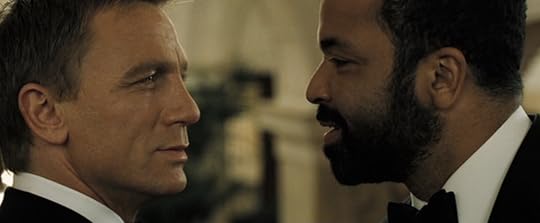
For the first time in ever, Bond has a character arc in a movie. He begins with a huge chip on his shoulder for undisclosed reasons, though Vesper later observes that it's a personality type that often pops up in Double-O recruits. Bond's all rough edges at first. He's not just a misogynist, but a misanthrope, too. M has some major work to do with him if she's going to whip him into shape.
She calls him a "blunt instrument" (borrowing the term Miranda Frost used in Die Another Day), but that's not what bothers her. On the contrary, also like in Die Another Day, M relies on his being that way. After he refuses to follow her orders and lie low, he confronts her. "You knew I wouldn't let this drop," he says. Her response is, "I knew you were you."
Her real problem with Bond is something that she tells him early in the movie: "Take your ego out of the equation." Bond's ego defines his character in Casino Royale. Her telling him to lie low after his mistake in Madagascar is another interesting connection to Die Another Day. She doesn't outright rescind his license to kill this time, but his ego has again put her in a spot where she needs him out of the way. The irony is that in Die Another Day, she took him out because she thought his ego had been torn down to the point that he may have betrayed secrets. It's just the opposite in Casino Royale. His ego is very strong and it's making him sloppy.
Vesper has a similar crisis of faith in him, because she believes that his ego is blinding him to the possibility of losing to Le Chiffre. He's not playing as smart as he needs to. In order to win, Bond has to confront his own fallibility and let the experience make him stronger.
A huge symptom of his inflated ego is his lack of trust in people. In the same conversation where M scolds Bond about his ego, she also tells him, "I need to know that I can trust you and that you know who to trust." Her trust in him is all about his ability to control his ego, but the comment about his knowing whom to trust is also important. It's not that she wants him to become super trusting. Later in the movie, she asks him, "You don't trust anyone, do you?" And when he says that he doesn't, she says, "Then you've learned your lesson."
But at the same time, Bond's egotistical reliance only on himself makes him a weaker agent. M criticizes him for his emotional detachment, and it's his instinctive distrust that makes him so ready to believe in Mathis' betrayal. Along the way though, Bond does learn to open up, like when he meets Felix Leiter, his "brother from Langley." It's a big change from the book that Bond hasn't yet met Felix before the card game. In the movie, Felix doesn't introduce himself until Bond is at his lowest: beaten by Le Chiffre and getting no additional support from MI6. Bond has decided that his only choice is to murder Le Chiffre - calling back to his tactics at the beginning of the movie. But Felix offers Bond a way to complete the mission as planned and Bond grabs onto that life preserver with both hands. Felix is kind of perfect that way. He doesn't require a lot of trust from Bond; all Bond has to do is accept Felix's chips. But it's a baby step towards Bond's learning that he's stronger when he's part of a team.
The tragedy of course is that when Bond finally does open himself up to trusting Vesper, she betrays him, too. It's a deep wound and he finishes the movie no more trusting than he did at the beginning, but his experimenting with trust has deflated his ego significantly. He's still not all the way there, but he's on his way toward becoming the agent M wants him to be.
Best Quip
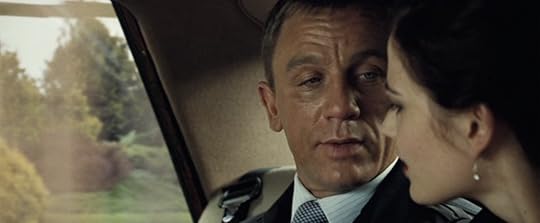
"I'm Mr. Arlington Beech, professional gambler, and you're Miss Stephanie Broadchest..."
Runner Up: "How was your lamb?" "Skewered. One sympathizes."
Worst Quip
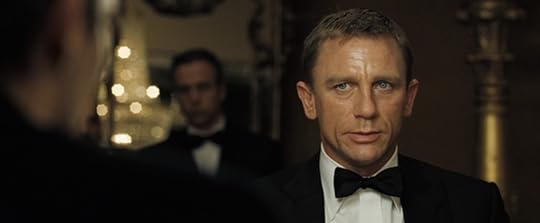
"I'm sorry. That last hand nearly killed me."
Gadgets

Casino Royale almost eliminates gadgets altogether. There were actually more gadgets in the novel, like the gun-cane used by one of Le Chiffre's henchmen. The movie replaces the gun-cane with poison, though, and doesn't offer much in the way of new gadgets to replace it. Bond's car has a fancy glove compartment with shelves holding medical equipment and a gun, but the only other sort of gadget is the tracker that M has implanted under Bond's skin.
Top Ten Gadgets
1. Lotus Esprit (The Spy Who Loved Me)
2. Aston Martin DB V (Goldfinger and Thunderball)
3. Jet pack (Thunderball)
4. Iceberg boat (A View to a Kill)
5. The Q Boat (The World Is Not Enough)
6. Aston Martin V8 Vantage (The Living Daylights)
7. Glastron CV23HT speed boat (Moonraker)
8. Acrostar Mini Jet (Octopussy)
9. Crocodile submarine (Octopussy)
10. X-Ray Specs (The World Is Not Enough)


For the first time in ever, Bond has a character arc in a movie. He begins with a huge chip on his shoulder for undisclosed reasons, though Vesper later observes that it's a personality type that often pops up in Double-O recruits. Bond's all rough edges at first. He's not just a misogynist, but a misanthrope, too. M has some major work to do with him if she's going to whip him into shape.
She calls him a "blunt instrument" (borrowing the term Miranda Frost used in Die Another Day), but that's not what bothers her. On the contrary, also like in Die Another Day, M relies on his being that way. After he refuses to follow her orders and lie low, he confronts her. "You knew I wouldn't let this drop," he says. Her response is, "I knew you were you."
Her real problem with Bond is something that she tells him early in the movie: "Take your ego out of the equation." Bond's ego defines his character in Casino Royale. Her telling him to lie low after his mistake in Madagascar is another interesting connection to Die Another Day. She doesn't outright rescind his license to kill this time, but his ego has again put her in a spot where she needs him out of the way. The irony is that in Die Another Day, she took him out because she thought his ego had been torn down to the point that he may have betrayed secrets. It's just the opposite in Casino Royale. His ego is very strong and it's making him sloppy.
Vesper has a similar crisis of faith in him, because she believes that his ego is blinding him to the possibility of losing to Le Chiffre. He's not playing as smart as he needs to. In order to win, Bond has to confront his own fallibility and let the experience make him stronger.
A huge symptom of his inflated ego is his lack of trust in people. In the same conversation where M scolds Bond about his ego, she also tells him, "I need to know that I can trust you and that you know who to trust." Her trust in him is all about his ability to control his ego, but the comment about his knowing whom to trust is also important. It's not that she wants him to become super trusting. Later in the movie, she asks him, "You don't trust anyone, do you?" And when he says that he doesn't, she says, "Then you've learned your lesson."
But at the same time, Bond's egotistical reliance only on himself makes him a weaker agent. M criticizes him for his emotional detachment, and it's his instinctive distrust that makes him so ready to believe in Mathis' betrayal. Along the way though, Bond does learn to open up, like when he meets Felix Leiter, his "brother from Langley." It's a big change from the book that Bond hasn't yet met Felix before the card game. In the movie, Felix doesn't introduce himself until Bond is at his lowest: beaten by Le Chiffre and getting no additional support from MI6. Bond has decided that his only choice is to murder Le Chiffre - calling back to his tactics at the beginning of the movie. But Felix offers Bond a way to complete the mission as planned and Bond grabs onto that life preserver with both hands. Felix is kind of perfect that way. He doesn't require a lot of trust from Bond; all Bond has to do is accept Felix's chips. But it's a baby step towards Bond's learning that he's stronger when he's part of a team.
The tragedy of course is that when Bond finally does open himself up to trusting Vesper, she betrays him, too. It's a deep wound and he finishes the movie no more trusting than he did at the beginning, but his experimenting with trust has deflated his ego significantly. He's still not all the way there, but he's on his way toward becoming the agent M wants him to be.
Best Quip

"I'm Mr. Arlington Beech, professional gambler, and you're Miss Stephanie Broadchest..."
Runner Up: "How was your lamb?" "Skewered. One sympathizes."
Worst Quip

"I'm sorry. That last hand nearly killed me."
Gadgets

Casino Royale almost eliminates gadgets altogether. There were actually more gadgets in the novel, like the gun-cane used by one of Le Chiffre's henchmen. The movie replaces the gun-cane with poison, though, and doesn't offer much in the way of new gadgets to replace it. Bond's car has a fancy glove compartment with shelves holding medical equipment and a gun, but the only other sort of gadget is the tracker that M has implanted under Bond's skin.
Top Ten Gadgets
1. Lotus Esprit (The Spy Who Loved Me)
2. Aston Martin DB V (Goldfinger and Thunderball)
3. Jet pack (Thunderball)
4. Iceberg boat (A View to a Kill)
5. The Q Boat (The World Is Not Enough)
6. Aston Martin V8 Vantage (The Living Daylights)
7. Glastron CV23HT speed boat (Moonraker)
8. Acrostar Mini Jet (Octopussy)
9. Crocodile submarine (Octopussy)
10. X-Ray Specs (The World Is Not Enough)
September 17, 2015
Casino Royale (2006) | Story

Plot Summary
James Bond earns his Double-O number, but risks losing his soul.
Influences
I always want to give Jason Bourne the credit for Casino Royale, but that's not fair. The Bond series has a history of letting itself get super bloated and crazy before paring back to Fleming-like realism. It happened after You Only Live Twice, it happened after Moonraker, and it happened after A View to a Kill. In all likelihood, the movie after Die Another Day was always going to be a smaller, more serious movie.
But even though Die Another Day grossed more than twice as much worldwide as The Bourne Identity (released the summer of 2002; Die Another Day came out that Christmas), Bourne was clearly the better movie and got people thinking about what a real spy movie should look like.
Eon Productions had had the rights to Casino Royale since 1999, but I guess the timing had never been right to make it as a Brosnan movie. Brosnan was 49 when Die Another Day came out and no one wanted him to overstay his welcome like Roger Moore had, so when it was decided to replace Brosnan with a younger actor, it must have seemed like the right time to adapt the first Fleming novel and reboot the whole thing. And however indirect Bourne's influence may have been, Casino Royale certainly competes with it in terms of tone and sheer action.
The novel is obviously a huge influence, but there's also some speculation about the name of Alex Dimitrios' wife in the film. It's never mentioned onscreen, but the credits list her as Solange. Fleming used that name in "From a View to a Kill" as well as "007 in New York." In "From a View to a Kill," Bond is simply fantasizing about hooking up in Paris and imagines meeting a Frenchwoman named Solange, but the woman in "007 in New York" is actually a friend of his who's in a relationship with a bad guy. She may not have directly inspired the Casino Royale character, but I can see why the filmmakers borrowed her name.
How Is the Book Different?
The film follows the book's plot pretty closely, but adds a lot of stuff at the beginning to make Bond more invested in Le Chiffre's defeat. In the novel, he's called in on the mission just because he's the Secret Service's best card player. That works just fine, but it's even stronger to have the card game be the climax of an investigation that Bond's been working on for a while. That means changing some things about how Le Chiffre lost his employers' money, but it also gives the movie the chance to put in big action set pieces that weren't in the novel.
Even in the part of the story that's directly from the book, there are some significant changes. Instead of Bond's assistant, Vesper has a more important role as the MI6 accountant who decides how much money is going to get thrown at this endeavor. Then there's the switch of the card game from the novel's baccarat to the more popular, but way less classy Texas hold 'em.
The biggest change though is the questioning of Mathis' loyalties. It's left ambiguous (and resolved in Quantum of Solace), but once Bond suspects Mathis, he never doubts the man's guilt. In the book, Mathis is a wonderful character and indisputably a good guy. It's important to Bond's character arc in the movie that he doubt Mathis' allegiance, but it still hurts every time I see it.
Moment That's Most Like Fleming

More than any other movie in the series to this point, Casino Royale drops the jokes. There's humor in it, but it's real-person humor, not quips. Since Dr. No, the Bond films had always taken a light-hearted approach to espionage, though Dalton and Brosnan each added layers to that. Dalton undermined his jokes with a self-deprecating delivery, while Brosnan was explicitly stated to be using humor to cope with his job. Daniel Craig is doing neither of those things. He relaxes around attractive women, but the rest of the time he's deadly serious.
That seriousness fits well with the themes of Fleming's novel, which are adapted nicely to the movie. The film doesn't deal with them in exactly the same way, but there's still a character arc for Bond where he questions his life as a cruel, emotionless spy and then comes to terms with it.
Moment That's Least Like Fleming

I'd argue that the movie deals with Bond's character arc better than the novel does. The book has Bond flirt with the idea of abandoning the Secret Service and his relationship with Vesper is really just something for him to hold onto when the rest of his world seems to be falling apart. In the film, Vesper isn't a distraction, but a vital part of what's pulling him away from MI6. It's her - not Le Chiffre's torture - that makes Bond question his life. "You do what I do too long," he tells her, "and there won't be any soul left to salvage. I'm leaving with what little I have left." And what little he has, he's offering to her.
The real, least-Fleming moment comes much earlier in the film, but it's related. Bond begins the movie with a childishly willful attitude towards M. That changes by the end of the movie as a result of his character growth, but it's a disposition that the literary Bond never would have dreamed of expressing, even when he thought M was wrong.
Cold Open

Casino Royale lets us know right away that it's breaking formula. There's no gun barrel before the teaser, first of all, and then the teaser is in black-and-white.
We're told that we're in Prague and Bond is waiting in the office of the MI6 section chief for that area. Apparently, the chief has been selling secrets to the enemy and M has sent Bond to put a stop to it.
The chief laughs about this at first. He clearly doesn't respect Bond and muses that if M was really bent on killing him, she would have sent a Double-O. He even states that he'd know it if M had promoted Bond to that level. "Your file shows no kills, and it takes..."
"Two," Bond interrupts. Smash cut to a brutal fight in a bathroom between Bond and the section chief's contact.
The implication is clear. Bond hasn't yet been promoted to Double-O, because he's just now earning it with this mission. From here, the teaser jumps between the two scenes; contrasting the ferocious murder of the enemy contact with the cold-blooded assassination of the traitorous chief. That's another thing the movie has in common with the novel, where Bond reminisces about the two murders that got him his number. They're unrelated missions in the book, but one was an emotionless sniper shot while the other was close and messy.
The chief obviously knows Bond from before this meeting. He tells Bond, "We barely got to know each other," suggesting that Bond has been stationed in Prague for a short time. Probably, I imagine, on assignment from M to investigate the chief.
Bond murders his boss and then we get one last cut back to the bathroom. It looks like Bond's won his fight, but there's a little life left yet in the enemy agent, who draws a gun on Bond. As he does, the camera moves us inside the gun barrel looking out as Bond pivots and shoots and the blood comes pouring down the screen. This may be a different sort of Bond film, but it's still a Bond film.
Top 10 Cold Opens
1. GoldenEye
2. Casino Royale
3. The Spy Who Loved Me
4. Moonraker
5. Thunderball
6. On Her Majesty's Secret Service
7. A View to a Kill
8. Goldfinger
9. The Man with the Golden Gun
10. The Living Daylights
Movie Series Continuity

Since it's ostensibly a reboot, there's not much movie continuity in Casino Royale. Really, the only clear connection is M, played again by Judi Dench and tying this movie to the Brosnan ones. For that reason, it's hard to accept Casino Royale as a hard reboot.
Bond also wins a 1964 Aston Martin DB5 from Dimitrios, which feels like continuity, but can't be. It's clearly a reference to 1964's Goldfinger where the car first appeared, but there's no way that Casino Royale takes place before Goldfinger or that this is the story of how Bond got that vehicle. For one thing, the Casino Royale DB5 has a left-hand driver seat, but that's a relatively small issue compared to trying to make the Brosnan movies lead into Craig's which then loop back around as a prequel to Connery's. It just doesn't work.
The only theory that makes any amount of sense (just barely) is that "James Bond" is indeed as much a code name as 007, but that in addition to the name, MI6 is also implanting memories. Not only of Bond's wife, but also - as we'll see in Skyfall - of his childhood. There's no good reason for MI6 to be doing this (they'd have to have a similar program for Moneypennies, by the way, and the CIA would as well for Felixes), but if we foolishly insist on a continuity for the whole series, this has got to be it.

September 16, 2015
Kill All Monsters: "Ministry of Robots" concludes today!

The final installment of the Kill All Monsters story in Dark Horse Presents is in comics shops today! It's DHP #14 and that's a preview above. Words by Macho Michael May, pictures by Jazzy Jason Copland, balloons by Extraordinary Ed Brisson, and colors by Breathtaking Bill Crabtree.
Here's the cover you're looking for:

Because I suck at promotion, I missed announcing last month's middle volume in Dark Horse Presents #13. Here's a preview and the cover for that one. Hopefully you got it without me reminding you, or maybe your shop still has a couple of copies on the shelf.


September 15, 2015
Mike Shayne's Weirdest Case [Guest Post]
By GW Thomas
 Spoiler Alert: this piece will reveal the solution to both a story and a TV episode discussed.
Tough guy private eyes are not known for their adventures amongst the weird world of gypsies and psychics. As detectives, they are the hard-hitting, fact-based heroes who use their guns to speak for them. They would never encounter a Sussex Vampire or a Hound of the Baskervilles. The closest Philip Marlowe ever got to the outré was mentioning The King in Yellow in a story of the same name. Sadly, the Yellow Sign and the hideously wrapped priests of Leng have no part in the tale. Private eyes are strictly rational, if rowdy.
Despite this rationality, the detective genre as a whole is a close cousin to the tale of horror, going back to Sheridan le Fanu and Edgar Allan Poe and then back to the Gothics that spawned both genres. Every so often you find the suggestion of the supernatural slipping into more modern tales. In the Golden Age, writers like Agatha Christie and John Dickson Carr spiced up a locked room or an impossible murder with the hint that the killing was committed by Satan or witches. After World War II, this kind of thing became the domain of the comic books and the cartoons.
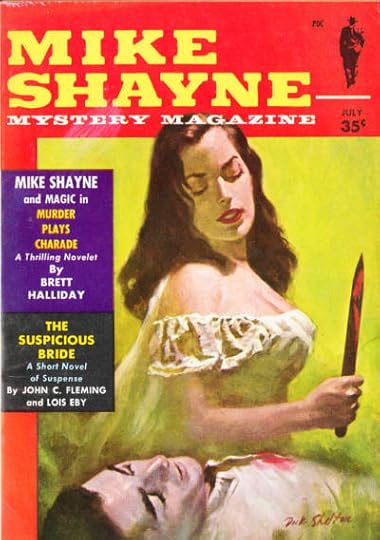
So it was a surprise to encounter it in the hard-boiled arena of Michael Shayne. "Murder Plays Charade" appeared in Mike Shayne Mystery Magazine, July 1959. The author of the story was, of course, Brett Halliday, a house name dating back to the first novel, Dividend on Death (1939) written by Davis Dresser. By 1956 and the creation of the magazine, Dresser had moved on, allowing ghost writers (no pun here!) to write the short novellas under the Halliday name. These included several authors associated with horror and science fiction, including Robert Arthur, Michael Avallone, Frank Belknap Long, Sam Merwin Jr. and Bill Pronzini. In 1959, the three most prolific ghosts were Robert Arthur, Richard Deming, and Robert Terrall.
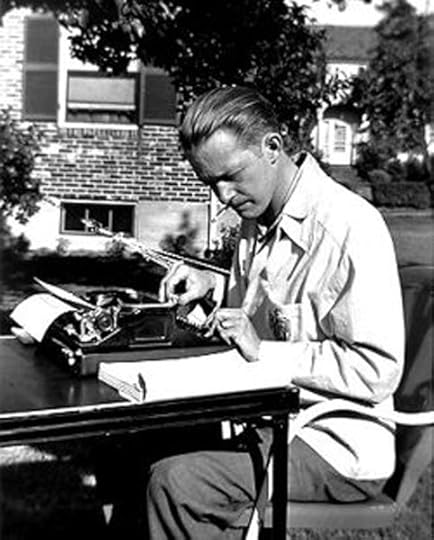
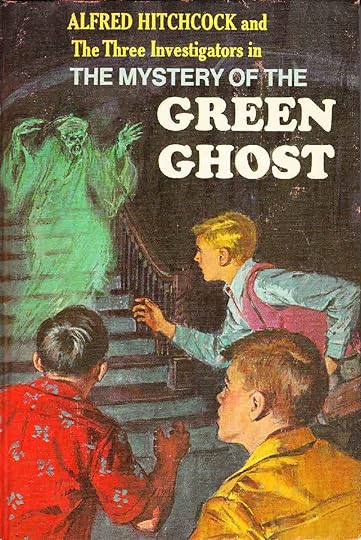 Of these, Robert Arthur was most likely to have written a supernatural storyline. (I asked James Reasoner, one of the latter day Brett Hallidays, and he agrees, though no one seems to know anymore.) Arthur would be responsible in 1964 for creating and writing Alfred Hitchcock's Three Investigators, Hardy Boys types who solve mysteries that appear supernatural. The Secret of Terror Castle, The Mystery of the Whispering Mummy, The Mystery of the Talking Skull, you get the idea. And no matter how supernatural things appeared, in the best Ann Radcliffe style, everything is explained away. Whether Robert Arthur wrote "Murder Plays Charade" or not isn't as interesting as what happens in the story, and later, to the story.
"Murder Plays Charade" begins when a strange-looking gypsy woman comes to Shayne's office asking for his help. She claims that through her gifts she knows her husband, the famous magician Voltane, will die if Mike Shayne doesn't do something to save him. Shayne blows her off, but a dollar bill he gave her appears with the words "YOU HAVE NO CHOICE," telling him it's not over yet.
It's Lucy Hamilton's birthday and Mike wants to please his girlfriend/secretary. She has tickets for the Voltane show, so he ends up there anyway. The centerpiece of the performance is the "Catching a Bullet With Your Teeth" trick. Supposedly, even Houdini never attempted it. It's not hard to guess how the trick ends up, with Voltane dead and the soldier who shot the bullet missing and under suspicion.
 Robert ArthurShayne follows the trial through Mrs. Voltane. Upset, she is taken into the care of Dr. Vogel, a psychiatrist as well as an authority on psychical research. He takes Kara Voltane under his care, whisking her off to his sanatorium. Left alone, Shayne examines Voltane's props and bags backstage. He finds a secret compartment, but in true PI style gets sapped and the important evidence is taken. After some coffee and brandy, Mike's at it again, seeking the secret of how the bullet trick was done. To find the killer, he must solve the magician's best kept secret. He visits Dr. Vogel and finds Kara Voltane an unwilling patient. Shayne rescues her from the doctor's special hospital. The Vogel character seems ripe for being a gothic villain, not to mention his ghostbreaking background, but he is left behind and no longer important to the story.
Shayne feeds Kara, then goes on a wild goose chase as she claims she is having a psychic vision. She directs him to the house of General Zamboni, a failed stage performer and a marksman who once drew huge crowds. He's also the husband of Voltane's mistress. Kara's trick falls apart as Shayne clues in that Zamboni's son is the disappeared soldier, and that the "house she had never been to before" was well-known to her. This is the last of the seeming supernatural episodes in the novel. Using leg work, Mike eventually tracks down the man who hit him over the head in Voltane's dressing room, Willie Kling, who was Voltane's assistant, and gets the secret from the trunk. Armed with this evidence, Shayne solves the bullet trick and pinpoints the murderer.
The solution to both proves to be a silver plate, which Kara used to carry the bullet from the marksman to a member of the audience for marking. Once back on the plate, using a secret hatch, she would substitute the bullet for a blank, then remove the slug and give it to Voltane who would place it in his mouth. To kill her husband, all Kara had to do was give him another slug and let the soldier use the live round. The solution is quick and all supernatural potential for the tale falls away largely unused. I can imagine, if Robert Arthur wrote this story, that more magic scenes may have been used, but perhaps were edited away. There are some choice props like the gypsy prophecy and Dr. Vogel the ghostbreaker/gothic villain, but these are never exploited much beyond mere mention. The supernatural is never really considered or discussed. Not surprising in 1959, but disappointing to those who like a little more spook in their spook stories.
A year and a half later the story was used for an episode of the new Michael Shayne TV show. Starring Richard Denning of Creature From the Black Lagoon fame as a blond and rather watered-down Michael Shayne, the show lasted only one season. The expected characters were there, Patricia Donahue. then Margie Regan as faithful "Angel" and secretary, Lucy Hamilton. There was newspaper sidekick, Tim Rourke, played by Jerry Paris, and Herbert Rudley as Will Gentry of the Miami Police. And added, just to keep the teens happy, Gary Clarke as Lucy's kid brother, Dick Hamilton. (Sadly, Clarke does the best acting on the show. It's no surprise he got picked up for The Virginian a year later.)
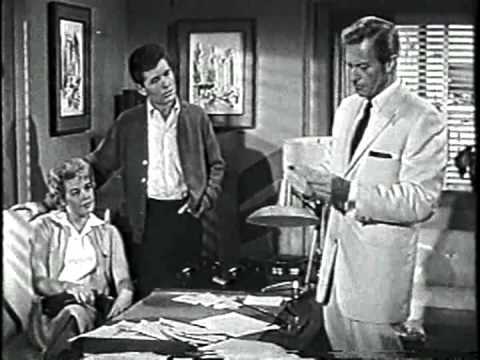 1959 novella became the ninth episode of the series, receiving a slight name change as "Murder Plays Charades" (December 9, 1960). It was directed by Paul Stewart and guest starred John Van Dreelan as Voltane, Jane Domergue as Kara Voltane, and John Considine as Bruno Zambroni. It was written by Don Ingalls, a seasoned TV writer, who later wrote for Star Trek, The Virginian, Adam-12 and Fantasy Island. He was a producer on TJ Hooker and wrote the screenplay for Airport 1975. He was an experienced hand even in 1959 and would need his skill for taking the magazine novella and turning it into a useable script.
First off, the story was too short and didn't have enough characters. To remedy this, Ingalls adds Mrs. Emily Tallen of the Dauphin Country Club Charity Committee, theater manager Ned Webster,and he beefs up the part of Willie Kling into Gus Hartman, Voltane's supposed best friend. He involves and expands Dr. Harris (Vogel) and adds a teen cupcake named Georgia played by Sue Randall. The story still contains everything from the story, though moved around, along with the trick plate, but the killer is changed and the method of killing is as well with Mrs. Tallen (Voltane's spurned lover) shooting from off stage on the count of zero.
Ultimately what Ingalls did was expand and improve the story. He also removed all the supernatural stuff, small as it was. Kara Voltane does not visit Mike Shayne at the opening of the story. She does not lead him to Zambroni's house, pretending to have a vision. Dr. Vogel is no longer a creepy madhouse keeper, but a love interest for Kara Voltane. Even the plate from the trunk is changed to a scrapbook of Voltane's infidelities, containing a photo that Gus Hartman uses to blackmail Mrs. Tallen. Shayne finds the plate later amongst the gear. The solution to the trick, which is the key to the novella, is shrugged off as almost obvious and explained early on. Ingalls takes all the clues and creates his own ending.
So ends Mike Shayne's weirdest adventure, stopped almost before it started. Thankfully this lack of magic in the hard-boiled school would change, with role-playing games like Call of Cthulhu (1981) and films like Cast a Deadly Spell (1991). The tough guys of magic detection would be numerous in the new millennium, from John Constantine in comics, film, and TV to Jim Butcher's Dresden Files. The combination of Chandlesque tough guys and magical bad asses is part of the landscape in 2015. Despite a little gypsy magic, Mike Shayne's editors back in 1959 didn't have a crystal ball to foresee it.
GW Thomas has appeared in over 400 different books, magazines and ezines including The Writer, Writer's Digest, Black October Magazine and Contact. His website is gwthomas.org. He is editor of Dark Worlds magazine.
 Spoiler Alert: this piece will reveal the solution to both a story and a TV episode discussed.
Tough guy private eyes are not known for their adventures amongst the weird world of gypsies and psychics. As detectives, they are the hard-hitting, fact-based heroes who use their guns to speak for them. They would never encounter a Sussex Vampire or a Hound of the Baskervilles. The closest Philip Marlowe ever got to the outré was mentioning The King in Yellow in a story of the same name. Sadly, the Yellow Sign and the hideously wrapped priests of Leng have no part in the tale. Private eyes are strictly rational, if rowdy.
Despite this rationality, the detective genre as a whole is a close cousin to the tale of horror, going back to Sheridan le Fanu and Edgar Allan Poe and then back to the Gothics that spawned both genres. Every so often you find the suggestion of the supernatural slipping into more modern tales. In the Golden Age, writers like Agatha Christie and John Dickson Carr spiced up a locked room or an impossible murder with the hint that the killing was committed by Satan or witches. After World War II, this kind of thing became the domain of the comic books and the cartoons.
So it was a surprise to encounter it in the hard-boiled arena of Michael Shayne. "Murder Plays Charade" appeared in Mike Shayne Mystery Magazine, July 1959. The author of the story was, of course, Brett Halliday, a house name dating back to the first novel, Dividend on Death (1939) written by Davis Dresser. By 1956 and the creation of the magazine, Dresser had moved on, allowing ghost writers (no pun here!) to write the short novellas under the Halliday name. These included several authors associated with horror and science fiction, including Robert Arthur, Michael Avallone, Frank Belknap Long, Sam Merwin Jr. and Bill Pronzini. In 1959, the three most prolific ghosts were Robert Arthur, Richard Deming, and Robert Terrall.
 Of these, Robert Arthur was most likely to have written a supernatural storyline. (I asked James Reasoner, one of the latter day Brett Hallidays, and he agrees, though no one seems to know anymore.) Arthur would be responsible in 1964 for creating and writing Alfred Hitchcock's Three Investigators, Hardy Boys types who solve mysteries that appear supernatural. The Secret of Terror Castle, The Mystery of the Whispering Mummy, The Mystery of the Talking Skull, you get the idea. And no matter how supernatural things appeared, in the best Ann Radcliffe style, everything is explained away. Whether Robert Arthur wrote "Murder Plays Charade" or not isn't as interesting as what happens in the story, and later, to the story.
"Murder Plays Charade" begins when a strange-looking gypsy woman comes to Shayne's office asking for his help. She claims that through her gifts she knows her husband, the famous magician Voltane, will die if Mike Shayne doesn't do something to save him. Shayne blows her off, but a dollar bill he gave her appears with the words "YOU HAVE NO CHOICE," telling him it's not over yet.
It's Lucy Hamilton's birthday and Mike wants to please his girlfriend/secretary. She has tickets for the Voltane show, so he ends up there anyway. The centerpiece of the performance is the "Catching a Bullet With Your Teeth" trick. Supposedly, even Houdini never attempted it. It's not hard to guess how the trick ends up, with Voltane dead and the soldier who shot the bullet missing and under suspicion.
 Robert ArthurShayne follows the trial through Mrs. Voltane. Upset, she is taken into the care of Dr. Vogel, a psychiatrist as well as an authority on psychical research. He takes Kara Voltane under his care, whisking her off to his sanatorium. Left alone, Shayne examines Voltane's props and bags backstage. He finds a secret compartment, but in true PI style gets sapped and the important evidence is taken. After some coffee and brandy, Mike's at it again, seeking the secret of how the bullet trick was done. To find the killer, he must solve the magician's best kept secret. He visits Dr. Vogel and finds Kara Voltane an unwilling patient. Shayne rescues her from the doctor's special hospital. The Vogel character seems ripe for being a gothic villain, not to mention his ghostbreaking background, but he is left behind and no longer important to the story.
Shayne feeds Kara, then goes on a wild goose chase as she claims she is having a psychic vision. She directs him to the house of General Zamboni, a failed stage performer and a marksman who once drew huge crowds. He's also the husband of Voltane's mistress. Kara's trick falls apart as Shayne clues in that Zamboni's son is the disappeared soldier, and that the "house she had never been to before" was well-known to her. This is the last of the seeming supernatural episodes in the novel. Using leg work, Mike eventually tracks down the man who hit him over the head in Voltane's dressing room, Willie Kling, who was Voltane's assistant, and gets the secret from the trunk. Armed with this evidence, Shayne solves the bullet trick and pinpoints the murderer.
The solution to both proves to be a silver plate, which Kara used to carry the bullet from the marksman to a member of the audience for marking. Once back on the plate, using a secret hatch, she would substitute the bullet for a blank, then remove the slug and give it to Voltane who would place it in his mouth. To kill her husband, all Kara had to do was give him another slug and let the soldier use the live round. The solution is quick and all supernatural potential for the tale falls away largely unused. I can imagine, if Robert Arthur wrote this story, that more magic scenes may have been used, but perhaps were edited away. There are some choice props like the gypsy prophecy and Dr. Vogel the ghostbreaker/gothic villain, but these are never exploited much beyond mere mention. The supernatural is never really considered or discussed. Not surprising in 1959, but disappointing to those who like a little more spook in their spook stories.
A year and a half later the story was used for an episode of the new Michael Shayne TV show. Starring Richard Denning of Creature From the Black Lagoon fame as a blond and rather watered-down Michael Shayne, the show lasted only one season. The expected characters were there, Patricia Donahue. then Margie Regan as faithful "Angel" and secretary, Lucy Hamilton. There was newspaper sidekick, Tim Rourke, played by Jerry Paris, and Herbert Rudley as Will Gentry of the Miami Police. And added, just to keep the teens happy, Gary Clarke as Lucy's kid brother, Dick Hamilton. (Sadly, Clarke does the best acting on the show. It's no surprise he got picked up for The Virginian a year later.)
 1959 novella became the ninth episode of the series, receiving a slight name change as "Murder Plays Charades" (December 9, 1960). It was directed by Paul Stewart and guest starred John Van Dreelan as Voltane, Jane Domergue as Kara Voltane, and John Considine as Bruno Zambroni. It was written by Don Ingalls, a seasoned TV writer, who later wrote for Star Trek, The Virginian, Adam-12 and Fantasy Island. He was a producer on TJ Hooker and wrote the screenplay for Airport 1975. He was an experienced hand even in 1959 and would need his skill for taking the magazine novella and turning it into a useable script.
First off, the story was too short and didn't have enough characters. To remedy this, Ingalls adds Mrs. Emily Tallen of the Dauphin Country Club Charity Committee, theater manager Ned Webster,and he beefs up the part of Willie Kling into Gus Hartman, Voltane's supposed best friend. He involves and expands Dr. Harris (Vogel) and adds a teen cupcake named Georgia played by Sue Randall. The story still contains everything from the story, though moved around, along with the trick plate, but the killer is changed and the method of killing is as well with Mrs. Tallen (Voltane's spurned lover) shooting from off stage on the count of zero.
Ultimately what Ingalls did was expand and improve the story. He also removed all the supernatural stuff, small as it was. Kara Voltane does not visit Mike Shayne at the opening of the story. She does not lead him to Zambroni's house, pretending to have a vision. Dr. Vogel is no longer a creepy madhouse keeper, but a love interest for Kara Voltane. Even the plate from the trunk is changed to a scrapbook of Voltane's infidelities, containing a photo that Gus Hartman uses to blackmail Mrs. Tallen. Shayne finds the plate later amongst the gear. The solution to the trick, which is the key to the novella, is shrugged off as almost obvious and explained early on. Ingalls takes all the clues and creates his own ending.
So ends Mike Shayne's weirdest adventure, stopped almost before it started. Thankfully this lack of magic in the hard-boiled school would change, with role-playing games like Call of Cthulhu (1981) and films like Cast a Deadly Spell (1991). The tough guys of magic detection would be numerous in the new millennium, from John Constantine in comics, film, and TV to Jim Butcher's Dresden Files. The combination of Chandlesque tough guys and magical bad asses is part of the landscape in 2015. Despite a little gypsy magic, Mike Shayne's editors back in 1959 didn't have a crystal ball to foresee it.
GW Thomas has appeared in over 400 different books, magazines and ezines including The Writer, Writer's Digest, Black October Magazine and Contact. His website is gwthomas.org. He is editor of Dark Worlds magazine.