Victoria Noe's Blog, page 8
November 15, 2017
First Draft and Beyond
 I returned to Chicago on Sunday after almost three weeks away in New York. Like my trip there in May, I hunkered down on the upper west side to crank out the first draft of my next book (Fag Hags, Divas and Moms: The Legacy of Straight Women in the AIDS Community). How did I do? Well, that depends…
Word count: I had a specific word count in mind and I fell short. I got to 75% of the goal, which isn’t horrible, but not what I’d hoped. Why I fell short can be blamed on two things. First, I made the biggest mistake you can make on a first draft: I self-edited. I didn’t realize it until I was half-way through the trip. I spent entirely too much time trying to clean up my writing instead of just letting it flow. I won’t make that mistake again. Second, distractions. Some of them were personal, like the realization that had my day’s plans not changed, I would’ve been near the Oct. 31 terror attack. Others were book-related (two new sources of material that will be in the book). But still, getting to 75% isn’t a failure.
Organization: I have had a breakdown of chapters for some time now, dividing the women by the role they played (educator, activist, artist, etc.). I planned ahead for which chapters I’d work on each day. That plan blew up on the second or third day. I wound up just writing women’s stories and sometimes guessing the right chapter. Many of the women resisted fitting neatly into a specific chapter. Their stories may pop up in two or more.
Themes: This was not something I was consciously aware of until I started writing. Without sounding too goofy, the women led me. They showed me themes and trends and proved a few points I only guessed were true. I heard some of their voices, loud and clear, and I expect that to continue.
Support: Though I saw very few people during my self-imposed isolation, among the ones I saw was a man whose very vocal support was unexpected and passionate. I hadn’t seen him for some time, so it was a surprise to run into him. It was also something I needed, because the day before I had been pretty discouraged about the book. His insights were just what I needed.
This weekend I should have the first draft finished. I’ll work on the second one next week, over the Thanksgiving weekend. At the same time, I’m requesting permission for use of quotes and images, as well as interviewing editors and public relations people. It’s a lot. It would be a lot if I had nothing else going on in my life, which of course I do.
But it’s good: frustrating at times, but good. It’s exciting and humbling and terrifying at the same time. And honestly, I wouldn’t have it any other way.
#short_code_si_icon img
{width:25px;
}
.scid-2 img
{
width:25px !important;
}
Share this post


November 8, 2017
Not My Time
 nytimes.com
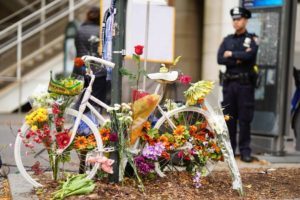
I returned to the little hotel I’m staying at late afternoon on Halloween. Just as I walked in, an alert chimed. Before I could read it, the phone rang. It was my daughter, in London. That was odd. Since she left in September for grad school we only talked at prearranged times. When I answered, she was crying. It took a couple minutes to figure out that she’d seen the alert before I did, though I was only a few miles away from what happened.
It was the terrorist attack in lower Manhattan, within sight of the 9/11 Memorial. That morning I’d chatted with someone from an organization that will be featured in my book. We discussed whether I should come down to their offices or wait. We decided to wait. Had I gone down, I would’ve taken the bus from there up to my favorite tea parlor. The bus stop is around the corner from the site of the attack.
After calming my daughter and going online, I saw that Facebook was doing what it does best. A page was set up for “The Violent Incident in Lower Manhattan”. It listed all my friends nearby (which meant everyone I know in NYC – quite a long list). But the most unsettling part was “Tell Your Friends You’re Safe”.
Whoa.
I wrote recently about this phenomenon, in the context of the horrific attack in Las Vegas, where my nephew was visiting. And though I find this one of the less annoying features of Facebook, I was shaken to realize that my daughter might not be the only one worried about me.
Over the next few hours, everyone I knew checked in. One friend who’s not on Facebook works very close to the site, so I texted him. His office was still on lockdown, but everyone was fine. He, along with several other friends, tend to go everywhere on their bikes. It wasn’t until later that evening that the last friend on the list checked in. He admitted he’d changed his route that day, one of those odd, serendipitous things that happen more often than you’d believe.
These sadly necessary Facebook pages have now been endorsed by disaster relief organizations because they allow accurate information to be shared. That means fewer people are tying up phone lines searching for help or information.
Still…whoa.
There have been a couple times I’ve been in real danger: an emergency plane landing, a mugging at gunpoint. I was the one who had to reach out, to give others the news and assure them I was safe. There was no other way. After 9/11, a website set up to allow people to indicate they were safe turned into a joke, with people listing Donald Duck and George W. Bush as “safe”. Now Facebook has proved its value by giving us all a way to avoid unnecessary fear after a natural or manmade catastrophe. Who knew that would be necessary, much less a good thing?
Before I leave town on Saturday, I plan to go down to Chambers Street, near the West Side Highway. I probably won’t bring flowers. But I will bring a prayer, for those who could not mark themselves safe.
#short_code_si_icon img
{width:25px;
}
.scid-2 img
{
width:25px !important;
}
Share this post
November 1, 2017
“Writing Comes Last”
 I was having lunch with one of my best friends. We’ve known each other since high school (LBJ was still president), so that’s a long time.
She’s been a successful writer for decades and now our occasional lunches include swapping information and commiserating about the business.
The past year has been a challenge for both of us, particularly health-wise. We’ve both faced medical situations that were unexpected and physically demanding. But we’re past them (knock wood). And because life itself is complicated and messy, there are continuing, long-term challenges unrelated to our health.
At one point she ticked off a list of everything and finished with, “And writing comes last.”
I’ve been self-employed most of my life, working from home. A lot of people don’t believe you’re really working. Your hours may be different, your wardrobe may be, shall we say, more casual, but you’re working just as hard as anyone who commutes to an office building downtown. I can write in coffee houses, on trains, in bed. The important thing is that writing is my job, so I don’t neglect it.
Except when I do.
When I was sitting the the emergency room a year ago, waiting for the ambulance to transport me to Lenox Hill Hospital for surgery to insert 5 pins into my broken fingers, I wasn’t thinking about writing. When I could form a coherent thought through the pain, I was wondering how to make sure my family didn’t freak out, since I was 900 miles from home. By the time I was in recovery, I was wondering how the hell I was going to function without using my right hand: get dressed, put on the seat belt in the cab, use the bathroom, wash my hair.
But later that night – probably as the meds wore off – I sat up in bed in my hotel room crying. I was in New York to interview women for my next book. I’d already interviewed almost a dozen and had more scheduled. Those were rescheduled, but the writing itself was an even bigger challenge. How could I ever finish my book?
I tried like hell to keep up my blog schedule and to post on social media. But what should’ve taken me 15 minutes to type now took me 2 hours or more pecking with my left hand. I was in pain for weeks and everything I tried to do exhausted me. I had to admit that writing was not a priority.
My recovery was slow, but mostly steady. Physical therapy and learning how to do things with my left hand consumed my time and focus. After six weeks, when the pins came out, I could start to use my right hand, but not easily or without pain.
After a few months even I had to admit that the schedule for my next book had to be adjusted. No one was surprised or upset, except me.
Like I said before, writing is my business. Even when I couldn’t use my right hand, I tried to spend at least a few minutes a day on writing. Maybe I didn’t actually write anything, but I could read articles online pertaining to my research. It was important to me that I keep up, to somehow find a way to keep my day job going. I give myself a solid “B” for that time. It’s now one year since my accident. My fingers still stiffen up at times, normal behavior according to my physical therapist. Sometimes they hurt, especially if someone gives me an enthusiastic handshake. I’m catching up to the writing that I was forced to abandon.
We all live complicated lives with serious demands on our time. As my girlfriend and I talked, I could see another reason why we sometimes put writing last. Because barring an unusual situation – four broken bones in your writing hand – we don’t always take our writing seriously as a business.
That’s why it’s important to change the way we consider this odd career of ours. Maybe you can’t sit down for three hours a day to write, but you can steal 15 minutes here and there. You can listen to a podcast on character development while you’re doing laundry. You could stay up a little later or get up a little earlier. Because setting aside time – any amount of time – every day makes it a habit and makes your writing a business.
So come on: turn off the TV, stop checking Facebook and write. Don’t self-edit. Just write. Before you know it, time has flown by and you have words on paper. Now do it again tomorrow. And the day after that.
That’s how you become a writer.
#short_code_si_icon img
{width:25px;
}
.scid-2 img
{
width:25px !important;
}
Share this post
October 25, 2017
What a Difference a Year Makes
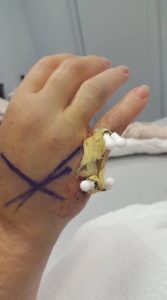 Nov. 1, 2016
Every morning Facebook shows me Memories from my newsfeed: posts I shared on that day in previous years. Some of them are funny. Some are occasionally sad, like birthday greetings for a friend who died.
Lately, those Memories have led off with my posts from my trip to New York a year ago. I was there to interview women for my next book and do more research at the New York Public Library’s Lincoln Center branch. As luck would have it, I was able to catch a couple of presentations that were related to my research.
As the Memories pop up each morning, I’m amazed at how much I accomplished and how excited I was. My focus was on the book and getting things done. I was on a roll. Everything was falling into place. Until “falling” became a little too literal.
In the middle of that trip, on an otherwise lovely Saturday afternoon, my only day with no work scheduled, I missed the curb crossing the street near the new AIDS Memorial in the West Village. Instead of stepping up, I tripped and fell on my hand. I knew as soon as I hit the ground that something was very wrong. I’d never broken a bone before, but I soon found out I had broken four, along with dislocating one finger.
As luck would have it – and I do consider it luck – I was maybe 100 feet from the entrance to a stand-alone emergency room. Strangers helped me up and in the door, where I was quickly taken care of. X-rays and a CT scan (because I’d bumped my head when I fell) were shared with a hand surgeon who happened to be there when I arrived. I was in more pain than I’d been in since my concussion in 2009. A lot more.
I was transported to Lenox Hill Hospital where that surgeon inserted five pins that stayed in my hand for almost six weeks. Because I’d just had lunch before I fell, I was given local anesthetic: a series of shots in my hand. Painful though they were, they bothered me a lot less than the fact that being awake for the surgery meant I heard the drill inserting the pins in my fingers. After some time in recovery, I was put in a cab to go back to my hotel. The whole thing – from fall to cab ride – was less than six hours.
I was still 900 miles away from home, and had to stay where I was until my follow-up with the surgeon three days later. Sleep was almost impossible: I had to keep my hand immobilized and elevated, which was awkward at best. The prescriptions I was given did nothing to alleviate the constant pain. I was alone, trying to do things like shower, wash my hair and eat using my left hand only because, of course, I’m right-handed.
When I finally returned home, I was faced with a daunting schedule of physical therapy, even before the pins came out. Twenty-nine sessions later, I was told I was done. Done, but not 100%.
Sunday is the one-year anniversary of my fall. My hand is much better, though there is still daily stiffness. The pain went down about 95% after the pins came out, but I do still occasionally have enough that I have to alter my activities or take some ibuprofen. All of this, I’m told, will fade eventually. If I had osteoporosis, the damage would have much worse.
I read those Facebook Memories and feel like I’m reading about someone else, not me. I’m back in New York right now, coincidentally. I’m hunkered down to write the first draft of that book. And I have to admit, my mood is not the same as it was a year ago.
My fall took a lot out of me: physically, financially, emotionally. I was as physically helpless as I’ve ever been, learning to work through pain to get back to normal. I just finished paying off the last of the hand-related medical bills this month. And I won’t deny falling into a depression that lasted longer than I expected. But despite the odd angle of the photo on the left, my hand looks normal again.
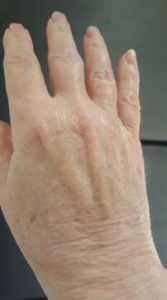 Oct. 25, 2017
But I’m back. There are two beds in my hotel room, one of them covered with file folders, each representing a woman in the book. They’re separated in piles – chapters – though those designations could change.
My audio recorder is on the desk, waiting for me to start transcribing notes. Books that I still need to reference are en route for delivery tomorrow. The mini-fridge is stocked with fruit, leftover Chinese food and other snacks.
What I was doing a year ago – before my fall – was the fun part. Now it’s nose to the grindstone to get this first draft written by Veteran’s Day. The following week I send off permission requests for quotes and images to be used in the book. The week of Thanksgiving, it will be time for draft #2.
A year ago, before my fall, the book was still theoretical. And while writing a first draft is not as much fun as what I was doing a year ago, it’s the real work. It’s daunting, but I’m ready.
So, when those Facebook Memories pop up next year, I hope my reaction will be “See? It was all worth it.”
#short_code_si_icon img
{width:25px;
}
.scid-2 img
{
width:25px !important;
}
Share this post
October 18, 2017
Putting Pen to Paper: The First Draft
 winghill.com
Next week I head back to New York. My creative juices flow freely there and it’s time – actually a little past time – to crank out the first draft of my next book.
I’m rushing to finish reading some books for research and photocopy pages I’ll need to refer to while I write. I have dozens of files to pack, along with some poster-sized Post-Its to keep track of my progress. I won’t know until I’m into it which chapters are light, so I have a list of women to add if necessary. I have my audio recordings of some two dozen interviews that lasted anywhere from 45 minutes to well over two hours.
I’m staying at an inexpensive – for New York – place I’ve stayed at before. It’s away from the midtown tourists and commuter traffic. It’s a short walk to parks, Starbucks and bookstores, relatively free of the typical Manhattan noise and crowds.
Bits of the book have been popping into my head. It’s been annoying because I think of them as I’m dozing off or while I’m driving. But it can’t be helped. It’s ready, I’m ready, despite feeling like I’m not.
Three weeks from now I’ll have a first draft that will probably be the worst thing I’ve ever written. I will be in full panic, realizing how much rewriting and editing is ahead of me. And I’ll have to remind myself over and over again that what I do is enough.
Fag Hags, Divas and Moms: The Legacy of Straight Women in the AIDS Community will not be definitive. There’s no way it could be, a fact I was slow to accept. The women in it – dozens – will be representative of thousands like them. I’m fully prepared for the chorus of “Why isn’t X in there?” when the book comes out.
Besides the fact that I would need 10,000 pages to include every straight woman who made a difference, I’m determined that the majority of women in the book will be recognized for work that has not garnered much recognition. Those are the women whose stories are the most compelling to me.
I plan to tell those people, upset that someone they knew didn’t make the book, to encourage her to tell her own story. I hope my book is the start of a larger conversation about a group previously left out of memoirs and documentaries about the epidemic. And I hope it will also be an incentive for other women to come forward and recount their experiences.
But first…I have to write it.
So far I have one terrible complete chapter and some disjointed paragraphs in another. I fully expect that what I have to show for myself when I leave New York will be pretty bad. That’s okay. I need that first draft finished so I can start on the real work: revising, rewriting, deleting, adding.
I’m stressed and panicked, excited and focused, all at the same time. And in an odd bit of serendipity, I’ll be there to mark the one year anniversary of falling on 7th Avenue and breaking my writing hand. That accident brought my world to a screeching halt. The whole experience – the fall, emergency surgery, five weeks with pins in my hand, learning to do everything with my left hand only, and 29 sessions of physical therapy – sent me into a deep, though temporary, depression.
The fingers I broke are still a little stiff, as expected. My book release had to be pushed back three months. I just paid off the last hand-related medical bill last week. You know what that means?
I’m ready.
#short_code_si_icon img
{width:25px;
}
.scid-2 img
{
width:25px !important;
}
Share this post
October 11, 2017
In Praise of Librarians
 The Catholic elementary school I attended was too small to have a library, so every time my grandmother took me to the local public library I checked out the maximum number of books. I read a lot and always finished them long before they were due.
Sr. Rosemary was the librarian at my high school. She did not tolerate talking, laughing or other manifestations of bad behavior. Her glare was enough to stop anyone who didn’t have a death wish. Forty years later, I was sitting in the dining room of the nuns’ motherhouse in Kentucky when I felt someone staring at me. A nun a few tables over was watching me, with a look that instantly inspired fear: what did I do? It was her. It wasn’t until I approached her and she smiled that I relaxed.
Long after high school I worked as an independent rep for two different children’s book publishers: Dorling Kindersley and Usborne. For 15 years most of my customers were Chicago Public School librarians. I learned a lot from them, not just about sales or working within the CPS bureaucracy.
There wasn’t a ‘Marian the Librarian’ in the lot. They were and are fierce advocates for their students, scary smart and hard working. My willingness to serve those working in schools on the south and west sides of Chicago – when other publishers’ reps refused – earned me loyalty I didn’t expect. When their funding was tight I simply checked in and dropped off a catalog: “Let me know if I can do anything for you.” They told me more than once that they appreciated hearing from me without a hard sell. When funding came through, I always got a call. Though they understood when a concussion ended my sales career, I miss working with them.
There are fewer of them now, and not just because many retired. In 2013, there were 454 Chicago Public School librarians. The current school year has seen that number sink to 139. Most schools are without a library or a librarian. It’s a crime and a sin and it’s not only happening in Chicago.
When I started writing, I knew libraries would be important. I couldn’t possibly afford to buy all the books I’ve used in my research (though my overdue book fines have been significant). At least half the books have come from libraries.
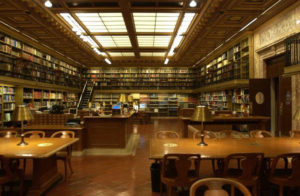
Along the way, I’ve made friends with the librarians: the staff at the Edgebrook branch of Chicago Public Library, as well as the research librarians at the Regenstein Library of the University of Chicago, the New-York Historical Society, the Brooke Russell Astor Reading Room (pictured) and the Performing Arts Library of the New York Public Library. They will all be acknowledged for their contributions in my next book.
Why are librarians critical? It’s not just the knowledge in their brains and at their fingertips. It’s the way they work.
To check out archival material at the New York Public Library’s Brooke Astor Reading Room, you make a request online or in person. Depending on the items, it can take an hour to a day to retrieve. On a visit last year, I made my request for the following day before I left just before closing time. One of the items was an ACT UP oral history videotape. I went back to my hotel and had dinner.
Later that evening, there was an email from the librarian: “I’m sorry, but that videotape is out being digitized. I took the liberty of adding the transcript to your photocopy order.”
I didn’t even know there was a transcript. But that willingness to help someone who wasn’t always sure what she was doing meant a lot to me. It still does.
My grandmother came to this country from what is now Serbia when she was three. She dropped out of school in 6th grade to help her mother with the younger kids. I think she liked school, even though the teachers made fun of her accent.
She made up for the lack of schooling by reading. She got books from the library and in the mail (Reader’s Digest Condensed). When I was old enough to read, she shared them with me. I remember her telling me that the best jobs were nurse and librarian, because you were always helping people.
She was obviously right about nurses. But I know for sure she was right about librarians, too.
#short_code_si_icon img
{width:25px;
}
.scid-2 img
{
width:25px !important;
}
Share this post
October 4, 2017
“Marked Herself Safe”
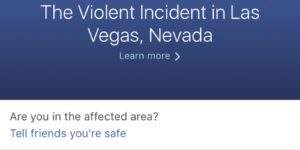 Monday morning was not like most mornings. Like you, I awoke to news of the massacre in Las Vegas. I turned on my computer and logged onto Facebook, where I saw a post from my nephew:
“Marked Himself Safe”
Safe from what? Is that some kind of joke? It was not a joke: he was in Las Vegas.
Then a friend also posted, “Marked Himself Safe”.
But the person I first thought of, a friend of 18 years who lives in Las Vegas, did not post anything. She used to work on the Strip and goes to a lot of concerts. There was no post.
After 9/11, there was no easy way to find out if friends or family were safe. Phone and internet service was spotty and unreliable for days. It took me until Thursday night to track down most of my friends in New York. It wasn’t until Friday – three full days later – that I found out that another one was missing.
A website went up so that people could list themselves as survivors. But it quickly turned into a joke, with people listing Osama bin Laden, Donald Duck and Chuck Norris as “safe”.
Sixteen years later, with the availability of sites like Facebook and Twitter, notifications after natural disasters and terrorist attacks have become more reliable.
There’s a Facebook page: “The Violent Incident in Las Vegas, Nevada”. It asks if you’re in the affected area and if you’re safe. It lists your Facebook friends nearby, with a notation if they’ve marked themselves safe. There are links to community support services and news feeds. It is – like the pages for other events – quite comprehensive.
(People can always mark themselves “safe” as a joke, but the page itself only shows your friends who are actually in the area.)
I sent a message to my friend, rather than post on her page. Not long after, she responded. She’d gone to bed early and was waking up to the same horrific news.
She marked herself “safe”.
It’s too easy, in this 24/7 instant news cycle world, for misinformation to spread. That’s why I sent a private message rather than a post on my friend’s page. Because if, God forbid, she’d been a victim, I didn’t want to take a chance that her family would find out that way. We may think sometimes that we have a right to news about our friends, but we have to wait for the families to take the lead. We are not the priority in a crisis.
I used to think those “Marked As Safe” posts were stupid: a way for people to get attention in the midst of a tragedy. But now, for the first time, I see the obvious value.
Next time there’s a hurricane or flood or tornado or man-made tragedy, there will be a Facebook page set up like the one for Las Vegas. Check that page first, before bombarding your friends with texts and phone calls. Take a deep breath. Say a prayer.
And while you’re at it, say another prayer that these pages cease to become necessary.
#short_code_si_icon img
{width:25px;
}
.scid-2 img
{
width:25px !important;
}
Share this post
September 28, 2017
5 Things That Make Me Feel Like a Successful Writer
 I’ve been thinking a lot about success in my writing career. It’s been much more difficult than I imagined, both the success and defining it:
When I was a stage manager, success meant a performance went off smoothly, with no major problems, as the director intended.
When I was a fundraiser, it meant an event that raised its goal or more, or a grant proposal that was funded.
When I sold children’s books to school librarians, I felt successful when
my customers were happy with their orders.
Writing, though, is different. So here are five things that make me feel successful:
Sales. Duh. I’m nowhere near being a best-selling author on any prominent lists. In fact, my sales are nowhere near where I’d hope. But I enjoy those direct deposits and consignment checks, no matter the size, because they mean someone’s reading my books (and hopefully liking them).
Trust. The first time I interviewed someone for my books, she cried twice. I was mortified. I’m not sure which one of us apologized more. It was never my intent to make these men and women cry. But they did, more often than not. It took me a while to realize their tears meant they trusted me enough to bare their souls and tell their stories. That’s a pretty big compliment.
Recognition. I don’t mean awards, though those are nice. I rarely enter contests because that kind of recognition isn’t that important to me. When I started writing the Friend Grief books, I wanted to shine a light on a type of grief often disrespected or ignored. Along the way, I became known as an “expert” on that type of grief, which somehow surprised me: I was focused on the books, not me. I’m content knowing that more people respect the grief for a friend in some small part because of my books.
Impact. When I started writing, I had no idea if anyone would care about these books. No idea. I often felt like I was writing for an audience of one: me. But then something began to happen, something that was unexpected. I would be talking to a prospective reader at an author fair and there would be a subtle change in their facial expression. They’d give me a little nod and maybe a tiny smile before they told me a story about a friend of theirs who died. That’s when I knew they “got it”: they not only understood why I wrote, but they understood that particular kind of grief.
Satisfaction. Sometimes it comes when the person I’m interviewing admits they just told me something they’d never told anyone else. Sometimes it comes when I’m asked to give a presentation or write an article. More often than not it comes from someone who says, “I can’t wait to read this.” Now that last comment brings on panic, too, because I don’t ever want to disappoint anyone reading my books. So the satisfaction of a job well done is always a goal.
Everyone has their own definition of success. For some it’s awards, for others it’s sales. For others it’s simply the satisfaction of seeing their name on the cover of something they created.
You may have very specific goals: to sell 1,000 books a month or win a Pulitzer Prize. You may have reached a level of success that you dreamed about, but now feel like there must be a new level to attain. Or maybe you have no idea what it would take to feel successful.
The funny thing about success is that it’s not the same for everyone. My goals are not your goals, nor should they be. Just be prepared to be surprised – as I have been – by the many ways you can achieve success.
#short_code_si_icon img
{width:25px;
}
.scid-2 img
{
width:25px !important;
}
Share this post
September 20, 2017
On the Road at Author Events
 I have three events in the next few weeks, none of them in Chicago, where I live.
First up this Saturday is the 3rd annual Author Fair at Princeton (IL) Public Library. Princeton is located just south of I-80, a bit north of Peoria. The library hosts a lovely author fair each year, with interesting authors selling terrific books in a variety of genres. This is a picture of me with Jessica Cage, another Chicago author, in Princeton two years ago. She won’t be there this year, but the following week I’ll see her at…
Penned Con! This is my first appearance at Penned Con, a huge author/reader event in St. Louis that supports autism being held September 29-30. There are some wild activities promised (I believe one involves wearing pajamas) along with the opportunity to meet dozens of authors – and buy their books. Here’s the link to find out more.
Last but not least is another return appearance, this time at the Oswego (IL) Public Library Literary Fest. It’s a beautiful building and just like Princeton, will host some pretty wonderful local authors on October 7.
Will I sell a lot of books? I have no idea. Sometimes I do. Sometimes (full confession) I sell none.
Will a lot of people show up? I have no idea. It depends on the weather, on the publicity, on the traffic, on competing events, luck. Unless there are reservations or pre-paid tickets, it’s hard to gauge even how many books, flyers and business cards to pack.
Not all the events I do incur a fee. The bigger ones do, the library ones usually not. But there’s gas, parking, food, and my time.
So with no guarantee of anything, why do it?
I like to meet my readers and potential readers. I like having the opportunity to share why I wrote my books and why I think they’re inspiring. I like chatting with other authors about the joys and challenges of this profession. I know I’ll always pick up some tidbit that will help me.
But the best part? The absolutely best part? I spend the day surrounded by books and people who love books.
And whether I sell a lot or a little, that’s a good day.
#short_code_si_icon img
{width:25px;
}
.scid-2 img
{
width:25px !important;
}
Share this post
September 13, 2017
The Grief That Takes You By Surprise
 Too many of my friends have lost parents this year. No matter what your age, it’s a shock to navigate that kind of grief. But as we grow older, we witness the deaths of the generations ahead of us: great-grandparents (if you’re lucky, like me), grandparents, parents/aunts/uncles. It’s normal. Expected. But then there are the losses that don’t feel normal, that aren’t expected.
Your friends.
My father was 75 when he died, the first one in his group of friends. They’d lost their parents long ago, but none of them had ever lost a close friend. And though at their ages that might sound like they were in denial, they weren’t. They knew it was possible. They just didn’t expect it to happen yet.
I was 16 the first time I went to the funeral of someone close to my age, the older brother of a classmate. He was in his early twenties, killed in Vietnam the first week he was there. The war was raging, but the losses did not begin to come close until that summer of 1968.
Through the years, there were other losses, mostly girls I went to high school with who died in car accidents, from cancer or suicide. Then the plague years of the AIDS epidemic took guys I was in theatre with, my coworkers, my assistant. By the time we reached our 50th birthdays, cancer seemed to be the #1 killer: ovarian, pancreatic, melanoma.
Not all of the losses were surprises to me. I knew they were sick, though not necessarily how sick. I felt guilty for not reaching out, staying in touch. It took losing a classmate on 9/11 to change my behavior, to make regular check-ins with friends a way of life.
Listen, I know there will always be shocking news to absorb. Death can’t be avoided, nor can the grief we feel when those friends are gone. Why then, do we seem so unprepared?
For a long time, I had no answer to that. Are we deep in denial? Are we unaware of the people surrounding us? Are we narcissistic?
Maybe, but the real reason, I believe, is that we’re scared.
We can always justify the deaths of people in the generation ahead of us. They were old, or at least older than us. But when people our age die, it hits us in a very different way. Because we have confirmation that it could happen to us, too, not at 90, but 30 or 40 or 50. And few of us believe we’ve accomplished enough to feel at peace about dying.
I’ll bet some of those friends of yours who died were at peace. Of course, some of them probably weren’t. And if you were able in any way to support them, you know what a gift that can be for both friends.
We’re all going to be blindsided some day by the death of a friend: whether it’s a terminal cancer diagnosis that left them with only weeks to live, or car accident or heart attack. Even if we had time to adjust to the idea that they were dying, we still grieve. It’s devastating and it’s not fair, but it’s life.
I can’t give you any suggestions on how to avoid this kind of grief. I can’t tell you how to fill the void left after your friend dies. Those of you who read this blog regularly already know what I’m going to say next: don’t wait.
Don’t wait until you have to give their eulogy to admit how much they meant to you. Listen, they already know, you insist. They probably do, but they might not. And let’s be honest: can you be told too often that you are loved?
No, I didn’t think so.
Tell them you love them. Make plans to hang out and write it in ink, not pencil.
And celebrate the joys of friendship.
#short_code_si_icon img
{width:25px;
}
.scid-2 img
{
width:25px !important;
}
Share this post