Summer Kinard's Blog, page 9
February 26, 2019
Learning to Speak
I couldn’t pronounce the letter R until I was six. Once I could, it turned up in odd places where it was planted by my family’s accent. Boil some oil on the coil, and don’t add water. “Borl some orl on the corl, and don’t add werter.” To this day, I cannot, as myself, say “gargoyle,” “Oil,” or words in sequence with Rs and Ls. My children laugh when I say, “the gargrrrl ate the carn earrrl” in my normal voice and “the gargoyle ate the corn oil,” in a fake British accent.
To fit in, I learned to speak like someone who is not me. I can talk with wealthy white people by dropping my natural speaking voice an octave and taking my accent in a hard turn to the Northeast. I can speak with people comfortable with women being feminine by dropping my natural speaking voice half an octave and letting my polite Southernisms out to play. Only my children and family hear my real voice, the one with inconsistencies and extra consonants, the one whose music sits higher on the staff and whose laughter is a descending scale.
I remember when “like” entered my speech as a verb. My cousin, who was good at being cool, pulled out a little booklet from her teen magazine. I was 9, and she was 10, and we were going to spend the sleepover learning to talk like Valley Girls. “Like, gag me with a spoon!” we giggled. “She was like, ‘I have pink Jordache and mint green ones.'” We were cutting edge conformists, talking like the rich girls on television.
I grew up in the mileau of “yes, sir,” and “no, sir,” and “yes, ma’am,” and “no, ma’am,” and this was respect for my elders. I was to look at people when they were talking to me or when I answered them, which probably explains a lot about my tendency to play far away from other people. At the edges of creeks and sandpits and woods, people didn’t make you look them in the eye to see their pain and fear and doubt. It was always too hard to see right through people. They didn’t usually like being seen through, but they seemed to ask for it rather a lot. I imagined that other people, cool kids like my cousin with the teen mags, had umbrellas in their irises to block out the things people didn’t know they said when you looked at them.
I couldn’t not see, so I had to learn to speak instead. I had to learn that people don’t like to be described. Someone who is practically screaming with anxiety and fear doesn’t want you to say, “I see that you’re terrified.” You can offer them tea or water, and you can see if one of the other umbrella people will sit with them. What you cannot do is let them know how transparent they are. You cannot say that walking into a room of them is utterly baffling because they all lie to each other constantly. I don’t understand if I’m the one making them uncomfortable or if they only hate themselves, so I stay out of the room most of the time. Some of them think themselves dreadfully friendly for pretending to look at you so you can admire them. It’s exhausting to listen to how friendly and honest and good they are, as they patch and spackle the cracks in the self esteem they think so valuable.
I don’t have self esteem. I used to feel bad about it, but now I just accept that it’s a fruitless quest for me. If I try to get self esteem, I wind up a weeping mess. Autistic people don’t have time and energy for made up problems like self esteem. It’s hard enough navigating the world without trying to think of oneself beside oneself, to pat oneself on the back in order to encourage oneself to think well of the thing we’re pretending we are. I’m not whatever it is that needs umbrella eyes to hide it.
The umbrellas and the self esteem are not off topic. They are part of learning to speak. I am autistic, and my children are autistic, and my husband is autistic. We have an unhiding house. I can see what my nonverbal children mean just fine, if I look with my real eyes and speak in my real voice. My real voice is high pitched and full of pictures, perfect for children. My real voice is kind and healing, perfect for broken hearts.
You don’t need to bring your umbrella to sit at my table. Set it down. Let’s help each other to say something true. We are all here learning to speak.
***
Summer Kinard, BA, MDiv, THM, is an Orthodox Christian author and speaker. She loves to learn and teach and to share what God has done for her. Come here her speak at her workshop on Concrete Thinking as a Model for Evangelism this June at the Ancient Faith Writing and Podcasting Conference.


February 15, 2019
Shattered: Praying with PTSD
You’ve read about my experiences praying with PTSD in other posts, such as “The Discipline of Weeping” and “Return to Your First Love: On Heart Prayer.” If you’ve spoken with me in person, I probably talked about the way God heals us sidealong. It’s time that I start talking more about the hands-on ways that God has helped me heal from extensive childhood trauma. For that I’ve created a new series in my just-launched video podcast, Some Myrrh. It’s called, “The P is for Prayer,” and you can watch or listen to the first episode now. This one is for anyone who has ever felt “Shattered.”
February 13, 2019
A Little Bit of God
“We don’t know if she’ll understand you, but she can hear you even though she’s sedated.”
I stood at my mother’s bedside last summer, watching as machines breathed for her. She was small, wasted by an infection that was worse than she had thought until it was almost too late. With my blue-gloved hand – required for the quarantine ward – I held her hand as she lay on the cusp of life and death, and I thought, “If only there were a wonderworker here, some holy person who understood about God and healing. I would ask them to pray, and she would get better.” I could almost see those saints on church walls come to life, waiting just outside the door to Mom’s hospital room.
[image error]
Some of the saints who are better than me. Virgin martyr saints in a mosaic in Ravenna, holding their victory crowns, wearing white veils over bejeweled golden clothing, marching along the walls towards the altar.
I knew there was a flaw in my thinking. I knew that walls couldn’t keep out holiness, not even the double-sealed walls and doors of the negative pressure room where Mom lay. My sigh was muffled by the face mask I wore, but my words were clear. “I’ll be back, Mom. I have to go get something.”
That evening, I returned with an arrangement of fake flowers, a little icon of the Protection of the Holy Mother of God, and my sister, who brought a rosary and a little standing cross. Mom’s condition had deteriorated in the few hours I had been absent, but this time when I walked into her room, quarantine mask and gloves in place as usual, I knew what to do. Just a little beauty reminded me. Maybe I only have a little bit of faith, and maybe I’m only a little bit holy, but I know that God is with me.
Mom’s sedation was wearing off when we arrived, and I looked across the bed at my sister. “You know, I can almost hear Grandma and Nana talking over each other right now like they did before they died. They’re here praying for Mom, and they are saying different things at the same time, even though they agree with each other.” Mom started to wake up at the mention of her mother and grandmother.
“Mom!” we said in unnaturally loud voices amplified by the silence of the sealed room. “Mom, guess what? You’re back in communion with church.” My sister told Mom about how a priest had come and administered the rite of the anointing of the sick, and how part of the prayers included forgiveness of her sins and restoration. “Mom, after more than 40 years, you’re a good Catholic again.”
We chuckled, but we were happy for the grace that had come to her. Mom had suffered a lot over those years from the harsh words and actions of people who wanted to shame her for having me when she was an unwed teen. She had rarely gone to church because she felt she had nothing to wear.
I had known since I was a child that what she meant was that she needed mercy to cover her. Now it had.
She nodded her head and tried to wake up.
Then I remembered about God and mothers and how bad we need them when death is creeping around.
“Mom, I brought you an icon of the Holy Theotokos, the Blessed Virgin. She’s your mother, too. She never stopped loving you.” Mom opened her eyes and saw the little image of Mary.
[image error]
I snapped this photo at the time because Mom wouldn’t let the rosary or the icon go, even when she fell back asleep.
Suddenly, Mom was lit from within. Though she was intubated and restrained, she tried to grab the icon to kiss it. Her face was filled with joy. We raised the icon to her mouth to kiss it, and tears flowed down her face. I sang “Ave Maria” through a quarantine mask that night, and my mother glowed and kissed the Mother of God until exhaustion overcame her.
That night, my sister and my brother-in-law and I talked about what we would do if Mom recovered and what we would do if she did not. Mom would need to live in a different place for her lungs to heal. She needed to be near the sea, if possible, and she would need someone to help her often. If she didn’t have those things, she probably wouldn’t recover once she left the hospital. The next morning, I woke up with a prayer in my heart. It wasn’t a wonderworker’s prayer but the kind that is said by people who only know a little bit of God. “Father, help. Give my mother a good choice. Give her the possibility of living.”
When I got to the hospital, the quarantine had been lifted. The illness that plagued her wasn’t the more contagious one that they had feared, though it was at least as serious in how it had affected her. I sat down in the chair near her, wondering if it was only my wishful thinking that made me see her as having turned back toward life. Was that one moment of blazing grace the beginning of recovery or simply a good ending?
My phone rang. It was my uncle, calling to say that he and his wife would take my mom in for six months so that she could recover. He lives a couple of blocks from the sea, and he’s retired and has taken her to her medical appointments.
When I flew home, I compared the shape of that experience with Mom to other times I had encountered a little bit of God. When my son was diagnosed, and I was told that he had almost no testable cognitive ability or communication ability, how I longed for a little bit of God! I remember how fierce that pebble of faith was then, when I demanded a mountain move in exchange for something as small as my love. And how swiftly God helped us then, too. And how gradually and faithfully and steadily my child has grown, until I found myself begging at night, “put your love in his heart” so often that the prayer got bright enough for me to see that God was already there. Almost like my mother’s reconciliation with God retold the story so that her glowing face showed us Who was with her all along.
I’m writing this now because I can take this shape of prayer and match it up to every story in my life. When I was a girl who was told I was not allowed to have the gifts of the Holy Spirit (teaching, knowledge, and so on) because they weren’t ladylike, I went home and decided that it was ok with me if I wasn’t allowed to talk about it, as long as I could have a little bit of God. When I was abused and broken and terrified, I went to the chapel at night and cried that even so, even if that was all I was, I would hold onto the little bit of God that I could see. I never read the Gospel except thinking of myself as the dog under the table. I never deserved any of the things they talked about in the talks about victory. But even though I spent most of my life believing it would embarrass God to be associated with me, I couldn’t stop treasuring every little bit of God I could find.
[image error]
With a lot of help from my aunts and uncle, Mom is living on her own again now. With a lot of help from therapists and saints and a lot of hard work and training, my son has above normal cognitive function (though his communication challenges are still extensive). With a lot of work and patience and people trying to coax me out of hiding, I went on to get three unladylike university degrees in church history and theology. With even more work, and thousands of hours of psalms and hymns and spiritual songs and the love of many people and the guidance of many elders, I’m halfway willing to hope that God isn’t embarrassed to be associated with me. But one way or another, I haven’t stopped that habit of picking up every shard of the shattered pieces of life where I can see God’s face reflected. I am not a saint on a mountain, but I am a witness to God’s love. I can do that. I can tell you a thousand million ways and more that I have seen that love poured out on me, the people around me, on and in you, too.
That’s because there’s no such thing as a little bit of God. God is all in all. Even though I’m not a wonderworker, God works the wonders. I can see a little at a time, and I see a little bit of God in every story I turn over in my hands, and in every day no matter how hard or happy, and I can see a little bit of God in you.
January 20, 2019
The Consolation of Those in the Fire
If you pick up an ancient Christian text on disability, you will probably encounter the metaphor of gold being refined. Suffering is given to refine us, the same way that fire purifies gold.
That’s true.
We all have to be purged of anything in us that does not tend toward the love of God and our neighbor, and that purgation can feel like fire. For someone suffering, though, there’s not much consolation in being held up as an example.
There’s a phenomenon these days of sharing feel good videos of people with disabilities doing normal things in the world, with community support. The videos are paired with captions that suggest that these persons with disabilities have meaningful lives, as you can see from the way they thrive when a community applies a bit of elbow grease and compassion.
That’s true.
We all need supports from our communities in order to thrive, and some of us need more or different supports in order to exercise our gifts and talents. For someone being held up as an example, though, there’s not much consolation in the suggestion that only paying work proves that life is worth living.
But back to the gold. Disabled people have been sermon illustrations since the early centuries of the church. If the sermons – lovely, virtuous, good sermons in many ways – were the only way the church talked about gold, talked about suffering, the consolation would ring hollow.
Be gold, you sufferers. Be gold, you people who do not suffer. Be thankful, all of you, because it’s good to be gold.
This is true.
Texts tell so little of a story, though. Tonight, I read this passage from St. John Chrysostom’s Homily on the Paralytic Let Down Through the Roof, and another word leapt out to me, and another meaning of that gold.
Knowing therefore that God is more tenderly loving than all physicians, do not enquire too curiously concerning His treatment nor demand an account of it from Him, but whether He is pleased to let us go free or whether He punishes, let us offer ourselves for either alike; for He seeks by means of each to lead us back to health, and to communion with Himself, and He knows our several needs, and what is expedient for each one, and how and in what manner we ought to be saved, and along that path He leads us. Let us then follow wherever He bids us, and let us not too carefully consider whether He commands us to go by a smooth and easy path, or by a difficult and rugged one: as in the case of this paralytic. It was one species of benefit indeed that his soul should be purged by the long duration of his suffering, being delivered to the fiery trial of affliction as to a kind of furnace; but it was another benefit no less than this that God was present with him in the midst of the trials, and afforded him great consolation.
Do you see that last word? Consolation.
That’s when I saw the passages on gold in a fuller context. There was the great bishop preaching to the people of the city, calling the sick and healthy, the abled and disabled to salvation together. All around them, holy icons covered the walls. Gold filled the nimbuses of the Lord and the Apostles and John the Forerunner and the Mother of God. That gold represented heaven and spiritual life. It represented the grace of God.
Here is how you get gold onto an icon: You pound the gold thin into leaf. You paint on clay and polish it until you can see your face in it. Then you breathe on the clay and lay the gold leaf over it. The clay opens with the breath and draws the gold into itself in an inseparable bond.
That is the consolation for gold. The breath of God breathes upon it.
Long-suffering, patience, steadfast love, hope that is waiting on God, all have in common the fire, but also the breath of God.
I don’t share those feel good videos about people with disabilities, not because they’re necessarily disrespectful, but because they miss the holiness altogether.
If you want to learn about the meaning of disability, you will have to step into the fire of God, too. You will have to let God breathe on you, too. Only then will you see the face of your brother or sister clearly, in the dignity for which he or she was created.
December 21, 2018
Free Sunday School Lesson: Silent Night
Not every family is able to attend church over the Christmas holidays, but lots of us want to teach our children about the Nativity. I teamed up with my daughter to bring you a free Autism-Accessible Sunday School Lesson on the Nativity of our Lord.
How is it autism-accessible?
sensory rich
images for focus
video modeling of another child participating
concrete examples of big ideas
imitate it at home
predictable: watch as often as you wish
To make it even more accessible, use this video along with an in person telling of the Nativity story. Download the Nativity story photos from my post, “Holiday Tips for Making Christmas Easier for Special Needs Families,” and use them to sequence the story as you tell it.
To enjoy at home, you can play from here or visit the YouTube link. You might also like to gather these supplies (affiliate links provided):
A picture of the Nativity or a holy icon of the Nativity.
A manger scen e that the child or children can touch and play with.
A plastic bin filled with cracked corn (or popcorn in a pinch), oats, or other food that animals might eat in a farmyard. Add cups for pouring.
A sheepskin or faux sheepskin or fluffy faux fur .
Animal puppets such as the lamb in our video .
A handheld light or flashlight that the child can turn on and off.
Incorporate this video into your Christmastide alongside picture Bibles, reading aloud the lessons, and church services.
Merry Christmas!
Looking for a good read? Purchase my books here.
December 17, 2018
The Need For Silence
“I’ll pray for you.”
“Thank you.”
This interaction happens countless times each day among people of faith, and it is always good. But for years, I had some wrong ideas about prayer. For one, I thought they had to be done in a prescribed way in order to matter. For another, I thought that I had to be someone different for them to matter. And again – and trust me, this is only the beginning of a list of things I’ve gotten wrong – I thought I had to say something for prayer to matter.
One of the hard-won lessons I have learned in ten years of helping my communication-challenged children talk and communicate clearly is that the love of God is not hindered at all by our ability or inability to speak or behave the “right” way or to fit a mold. I thank God when my children speak clearly and behave well, but I have also thanked God through years of hours-long screaming meltdowns and prolonged silences that lasted into months or years.
Look, not all of us will talk well. But that has very little to do with holiness or even eloquence. Think of Moses! Think of the many saints with speech troubles! Think of the quiet bishop commended by St. Ignatius as an example! Think of Hannah, seemingly drunk as she prayed so fervently!
God is with each of us no matter what. No Matter What. Hold that truth along with the hands of your sleeping child. God is with you and the child. Love is in the room.
Sometimes we make the mistake of thinking that the mystical Cloud of Unknowing is far removed from the uncertainties of parenting children with extra needs. That could only be true if God were far away. But here God is, with you now. You don’t know everything. You don’t even know how to pray beyond a few words, an outline of faith, that shapes your longing and directs your uncertainties back to the heart of God. Inquire of Lord — of course! Ask God for help — of course! Pray the prayers of the Church — of course! And then hush and let the quiet remind you of Who is near.
[image error]
Disability is not a hindrance to prayer. It reveals the true nature of prayer. Part of the nature of humans and of God and of prayer is silence.
Today I want to unburden you temporarily of the obligation to speak. Just for a minute, or five minutes, or twenty, if you have it, be still and let yourself know that God is with you and loves you. Even if you cannot have quiet in your household, you can have silence. You can remember, for a moment, that you are held.
[image error]
Silence gives you space to remember that the God who created you is restoring you. Only silence can answer the incomprehensible mercy of God with us. Silence is the “thank you” that speaks even when words are not possible.
December 5, 2018
Mercy Cleanings
A few weeks ago, I traveled to Antiochian Village to attend the Ancient Faith Women’s Retreat. On the first morning, I went to the first talk with that morning’s Gospel repeating through my heart:
Go and learn what this means, ‘I desire mercy, and not sacrifice.”
[image error]
Image from The Illuminated Gospel of St. Matthew by Oakwood Publications of Matthew 9: 9-13
The gospel had stuck in my craw that morning, stirring up the long weariness I had carried over my feelings of inadequacy in parenting. I sat myself down gingerly in front of the icon of the Theotokos, my failure smarting like a splinter I held out to the Holy Mother.
[image error]
The icon was screen-printed and matte. There was no gold to catch my eye. Yet, the curve of the Theotokos’ fingers did catch my eye. She was supporting him. There was a quickness to the gesture that called out to me, reaching out to me with my sadness and frustration. I was quiet, waiting. My friend was speaking eloquently about cooking with and without oil. I suppose my mind was opened by the thought of oil and the closeness in Greek between the word for olive oil (elaiolado) and the word for mercy (eleos). Because it was then that I heard it:
One word, spoken in my heart, as though placed there with the gentle gesture of the Theotokos’ hand.
“Eleos.” Mercy.
I looked up at the icon and waited.
“Pour eleos out on your children,” I heard, and I saw myself bending over to pick up one of the hundreds of daily messes the children pepper around the house. Only this time, I saw it differently. My hand, when I bent over, was like a spigot of the water of grace, pouring out over my home, over my children. “Clean up after your children without bitterness or complaint. Pour out eleos on them.”
Suddenly I understood that morning’s Gospel reading. “I desire mercy, and not sacrifice.”
I had tried to be a good parent, but in that area, I had gotten it all wrong. Sacrifice means doing X in order to receive Y. It’s transactional, and like any transaction, sacrifice sets one up for anger, disappointment, and frustration.
Mercy is pure gift. Not only that, but mercy is inexhaustible.
We are taught over and over in articles and well-meaning advice to sacrifice for our children. That’s because sacrifice keeps us in a position of control and subjects us to the judgments of others who believe themselves to be in control. Very few articles will advocate for mercy, because mercy always points to God as God.
[image error]
Mercy is what humans fear, not judgment.
Don’t sacrifice your relationship with your children on the altar of public opinion. Don’t sacrifice your relationship with your children in order to try to get them to imitate your behavior. When you have special needs children, cleaning up after them is not a matter of teaching them (because they probably will not follow your example for many years if at all) or living up to the standards of other people (because they aren’t your God) or living up to the life you imagined without your current challenges (because God meets us where we are, not waiting to meet us in a perfectly neat and decluttered dream home).
You will only be offering sacrifice if you try to pick up the toys and the books and the body messes and the food and the drink in order to win favor or approval or respect. You will become bitter and grumpy, and you’ll probably provoke the children to be less engaged and more messy. You will be sacrificing yourself and your sanity and your relationships to prove to God that you don’t need His help. Wait. What? Yes, when you sacrifice yourself, you forget that God isn’t asking you to do so. God asks one thing of us: to be merciful as He is merciful.
Pick up after your children in order to pour mercy on them. Do it because you love them, not to assuage the prickling temptations of comparison and shame.
Click to view slideshow.
I came home from the retreat with a heart full of the joy of companionship and plenty to reflect upon. I was surprised to find that the messes didn’t make me angry. I stepped over them or cleaned them, depending on what else I was doing. Each time I bent over to pick up paper shreds or clothing or to wipe up a spill or throw away trash or to sort layers of mess that someone had made in a moment of sensory overload, I thought, “Eleos.”
I began to feel peace in my home – not always freedom from conflict – but peace. Then, after a few days, I noticed the children bending down next to me to pick up. I was amazed. I could count on my fingers the number of times the children helped me clean up before this! But they did it again the next day, and the next.
[image error]
The children of joy have decided to clean the floor everyday by skating around on baby wipes. They’re having fun in this photo. Two of their brothers joined in right after I took the picture.
Then they started coming up with ideas of their own. They asked me if they could have baby wipes to skate around the living room to clean the floor. One child started, then three others joined.
I don’t understand it, the way I don’t understand any joyful surprise. But it’s true: having mercy on my children seems to have spread mercy to them. Now they’re having mercy on me, too.
I share this in hopes of lightening your burdens, not to turn mercy into another type of sacrifice. It wasn’t when the children began to join me in cleaning that my burden lifted, but when I began to treat cleaning as a mercy. I know that some of our children — some of my children — will not start cleaning up just because of a change of heart. Some of them might not have the ability to do so, and some of them might not understand. But even in this small way, in the tending of the ground beneath our feet, there is nothing to stop grace entering their souls.
Have mercy.
Lord, have mercy.
[image error]
Holiday Tips for Making Christmas Easier for Special Needs Families
The feast of the Nativity approaches, and with it, anxiety.
How will your family get along when everyone’s home? How will the kids do when you travel to visit relatives? Will you be welcomed at the church when you finally get a chance to go? For families with special needs, these questions are layered with the weight of additional needs.
[image error]
This week I’m sharing what I’ve learned from teaching and living with persons with special needs. Bookmark and share these best practices for home, travel, and church with special needs during the holidays.
THE GIFT OF 12 DAYS
Spread out gifts over 12 Days. Instead of subjecting sensitive family members -and let’s face it, lots of other folks, too!- to the overwhelm that comes from gift-opening sprees, give only one gift per day to each person. This will allow all family members and guests the extra processing time they need to enjoy each gift. It also allows for experience gifts, such as board games, museum trips, and shows, to stand out in a day. Families who need more time to recover from experiences will also appreciate the lower emotional, physical, and sensory load of spreading out activities.
[image error]
Pick services to attend that are not as crowded, or arrange away spaces with the church (see more below about Away Spaces) before attending. Many churches have a bride room or a spare room where you might step away to calm and tend yourself or family members. Ask ahead of time to make sure that the space is available. Churches can help by advising ushers or greeters to help make those spaces available to families who need them.
If you have time off over the holidays, consider offering a few hours of your time to a family with special needs. Maybe you are able to help care for a family member so a parent or caregiver can rest or shop for a few hours. Maybe you can run an errand or wrap presents for or with them. Your presence might be one of the best presents you can give during the 12 days of Christmas.
PROVIDE STRUCTURED TIME TOGETHER WITH RITUALS AND ROUTINES
Many types of special needs affect social communication. To include everyone most easily, it helps to plan for structured time together. These might include board games appropriate to developmental level, puzzles, ritualized meals, coloring, stringing popcorn, or following a star around the yard to search for the Christ child.
Games with low barriers to entry include cooperative games like our family’s favorite, Obstacles (affiliate link), or matching games such as the Nativity matching game you can print from the file below. If you happen to have a family of sensory-seekers who don’t mind loud noises, this nerdy cooperative game Spaceteam (affiliate link) has a lower entry level for pragmatic communication combined with higher vocabulary (particularly fun for many people with ADHD or autism).
Tea or cocoa or cookies and milk: Routines that are always the same, such as sitting down to tea or cocoa or having cookies and milk, can reduce stress for family members with special needs. Predictability is especially helpful for people who have challenges affecting transitions. Pour tea/cocoa and serve in the same order at the same places at the table each day. Serve cookies and milk at the same time and in the same place each day. The more variables you can eliminate through consistency, the more accessible you make your gathering.
AWAY SPACES
Many people with special needs will flourish if they have a small, separate space for calm and relaxed routines such as building with LEGO/DUPLO/wooden blocks, reading, or listening to music or silence.
If you’re spending the holidays away, ask about setting up a special Christmas closet as away space at relatives house. If the guest room has a large closet, for instance, see if you can borrow a string of Christmas lights and some large cushions to transform the space into a small reading/quiet nook.
Consider setting up a permanent away space in a closet as a gift to your autistic family members (Narnia or other literary theme optional!). In my house, we have a few closets set up this way–we even have a twin bed set up in a napping closet for when people need to recover from allergy exposure or too much light. You could also take the idea of a prayer closet literally and set up a closet as a small prayer corner.
KEEP FOODS SIMPLE
Share simple, familiar foods for comfort rather than focusing on novelty or show. Many people on the autism spectrum or with a variety sensory differences have trouble with new smells, textures, and colors in foods.
If your family member or guest suffers from food allergies or restrictions, make sure to have several safe options for them to eat.
If your family member or guest needs special equipment to eat, such as bowls, curved spoons or bendy straws, make sure to have them on hand and at the table for group meals.
If your family member uses a G-tube or other special feeding system, practice giving thanks for nourishment and the means to provide it. Plan your schedule with the rest of the family or guests so that feeding time is not loud or stressful or overlapping a fun time. If you’re hosting, consult your guests so that your group plan considers feeding time for people with special feeding needs.
Consider putting your display efforts into table setting rather than changing foods.
Presenting safe and familiar foods in pretty dishes or with lovely table arrangements can make a meal feel special while still including everyone.
If you have guests with visual impairments, they might still enjoy touching roses at their place setting. When I have hosted blind friends in the past, I clipped a few flowers with different textures to put on their napkins so that they could share the joy of the decorations.
BOUNDARIES AND BARRIERS
Learn and share attention cues.
Explain to guests or relatives how to get your family member’s attention and to not move the person as a first resort or without consent. It’s important to respect the person with a disability, neurodivergence, or impairment and not to treat that person like a prop rather than a human.
Each person may express attention differently, so it’s important to let others know what the signs are. Some persons might pause and turn their face toward you without making eye contact, for instance. Others might have a speech output device phrase or a cut out symbol to indicate that they’re listening. Share the signs of attention to prevent misunderstanding.
Talking to someone who isn’t hearing you either due to impairments or attention difference can lead to frustration for all members of the interaction. Establish attention cues at the beginning of visits to help further communication. This might mean a hand signal to ask someone to engage a hearing aid, coming alongside someone into a field of vision, using an alternative communication system, using sign language, or speaking at different volumes.
Provide hearing barriers.
The sounds of groups and background noise can be overwhelming for many persons with sensory differences. Provide noise-blocking earmuffs such as these (affiliate link), or have different activity zones with lower and louder noise levels to help everyone self-regulate. If you have several guests or family members with earmuffs, you can even provide Christmas stickers so that they can decorate their pair. You might also incorporate a “Quiet Zone” or “Silent Night” sign into your decor in order to let everyone know about the quiet area of your home or gathering.
SENSORY SOOTHING
Provide for sensory needs such as rocking or jumping.
One of the biggest helps for sensory soothing is the back and forth motion of rocking chairs or swings.
If you have space in your home or church for rocking chairs, make them accessible during holiday travel times. They will help ease anxiety for people in your environment.
Consider packing a folding camp rocking chair or an over-the-door playground swing (affiliate links) if you travel to visit relatives without access to swings or rockers.
Provide or bring along tactile options like kinetic sand, especially if you’re in a hands-off environment. Some relatives have lots of nice things on display to look at but not touch.
Easily available multi-sensory options:
Cutting out cookies or salt dough ornaments.
Kinetic sand or traditional sandboxes.
Snow or fake snow play. (Link leads to several fake snow options.)
Holiday scented bubbles or bubble bath.
Touching the Christmas tree while decorating.
Watching Christmas lights.
TEACHING THE CHRISTMAS STORY
Whether you’re teaching at home or at church, use the whole room and whole bodies to teach. Many people with differences in sensory processing think best when they can move their bodies and think with their hands.
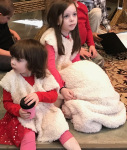
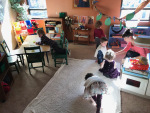
Churches can consider having sensory-friendly Sunday school options such as plastic bins of cracked corn (or popcorn kernels if you can’t get to an animal feed store) when talking about the animals at the Nativity, and be prepared to allow children to play with it during the entire lesson. [I will update this page soon with a free Accessible Sunday School video lesson using cracked corn!]
Have faux sheep skin for everyone to touch or for children to lie on when you talk about the Nativity story. Sensory anchors are huge attention boosters!
Encourage sign language for light or stars and encourage happy sounds that can be made by children with speech challenges for talking about a room full of animals.
Use sturdy Nativity sets to teach the Christmas story. Some customs you might include:
Set up the Nativity set at the beginning of Advent, either all together or adding an element each week.
Hide baby Jesus until Christmas Eve. Put him somewhere in the room and have the children hunt for Jesus before bed.
Move the wise men around the house for each of the 12 days, so that they arrive at the manger on the 12th Day of Christmas.
Alternative Communication:
[image error]
Work with your speech therapist or your software system to add the elements needed to tell the Nativity story into the speech output device or AAC system of your family member. You don’t want to get to Christmas Eve and find that your family member cannot say, “angel” with his/her device.
Download the free Visual Nativity Card PDF printable below (or print from image above). You can use the full page as a choice board or cut out the cards for sequencing or matching with the written words. You can also print two copies, cut out the cards, and use them to play a memory matching game.Nativity Visual Vocabulary
[image error]
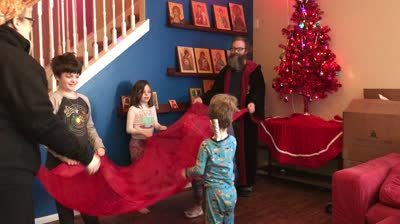
Include everyone into the group by means of centering activities rather than expectations to sit still and listen. Centering activities that create a group include kinetic sand bins, sensory bins, and giant playsilk or parachute play.
Here’s an example of my family centering with a playsilk:
You can also modify a playsilk or parachute in order to include persons with mobility challenges. When I taught a children’s choir, one of our singers was a boy with cerebral palsy who could not hold onto silks with his hands. I tied or sewed hair bands and scrunchies to all of our group silks so that he was attached to the group activity. This modification also helps children with dyspraxia from Down Syndrome, autism, and other motor coordinating challenges.
[image error]
Tie or sew a large elastic headband or scrunchy onto a playsilk. The playsilk can then be attached to a mobility device or a person’s arm, depending on their preference, so that they can participate in the group activity.
I hope these ideas will help you have more joy and less stress this Christmas season. See my Advent with Autism Guide for more tips.
Share your tips in the comments. What helps your special needs family stay centered at Christmas?
November 27, 2018
His Eye Is On The Spectrum
“Do not worry, for the very hairs on your head are numbered.”
I remember the first time I came across that verse. I was fascinated, in awe. My mother was in school to be a hair stylist, and I was around hair culture every day. I remember sneaking my mother’s hair styling manequin and trying to count the hairs. I kept losing track!
Later, I remember telling children about this verse for the first time. There are some things that children know to be impossible: counting sand, stars, hairs, the number of times a sparrow drops to the ground to steal a crumb. We are small, and these things (stars excluded in actuality but not in appearance) are smaller, and we can’t keep track of them, no matter how much they catch our attention. But there’s a loving attention that can, and that makes us say, “Wow.”
For those of us who struggle with attention, this witness to the capacity of God is a comfort and a joy.
There are parts of scripture where I think Jesus hid little Easter eggs for autistics. I’m claiming the Apostle Nathaniel as one of us autistics, for instance, because he was without guile. Then there are Jesus’ really detailed and specific, concrete teachings about worry and anxiety.
Autistic people tend toward both worry and anxiety because of the burden of sorting so much input. We have to work hard to train our big, especially complex brains to pay attention to the things that are important to us. I’m in the process of teaching my older children these skills now, and I couldn’t help remembering this passage of scripture.
It’s not only knowing that God loves us in a general sense that helps to calm the too-much feelings. It’s knowing that God cares about the little details of us and our days. Jesus blessed children who probably had grains of sand under their little fingernails. They might have been damp and grubby. He noticed them as they were. He noticed the smallest seeds that were taking over the garden. He could spot a fig in a canopy of leaves. More importantly, he taught that the God Who Sees that had been known in the stories of the Old Testament is still the God Who Sees in the New Testament.
The remarkable consistency of God’s character puts us at ease.
He looks after us and wants to hear our silence and our concerns. He looks after us and makes sure that we are always met with love, whether we rise or fall.
October 24, 2018
Finding Focus in a Neurodiverse Homeschool Day
Here are my Top Ten Tips Plus One on how to focus your children’s attention.
Don’t forget to click through to the shopping lists at the end for more ideas and how-to’s!
Rocking and swinging make for great calming effects and full body-brain coordination.
Balance boards and balance stools/balls allow for movement while learning in a room with others. If you use a balance board or other tool that makes a clunky sound, you might prefer to do so over a square of carpet liner or foam kitchen mat.
Calisthenics. All of those dorky looking floor exercises from the 70s and 80s actually do great things to your nervous system. Much of our attention and emotional and sensory regulation happens through our bodily movements. Taking five to ten minutes at the beginning or ending of the day to run through some simple floor stretches can help a lot. If you’d like to learn specific exercises that might impact your child’s ability to focus and coordinate, you might be interested in this online workshop on Retained Primitive Reflexes. (I’m not affiliated at all, nor do I receive recompense for sharing this resource. I’m finding the information helpful in my family, though, and I wanted to make sure others know about it.)
Walking music. Transition into and out of activities with music. At church, people often do this, either with processional/recessional hymns or the Trisagion. Add transition music into your routine.
Group movement games. Little Bunny Fu-Fu, The Itsy Bitsy Spider, I’m A Little Teapot, Wiggle Waters/Still Waters, Musical Chairs, The Hokey Pokey, The Macarena, Keyboard demo dance-off, Family music playlist dance songs.
Take frequent 2-5 minute breaks for movement or play. The play can be a short tablet video game break or silly music video, even. The goal is to make it a low-stakes, entertaining moment that the child will enjoy. Pay attention to your child’s attention span. Watch his or her cues, and begin offering short breaks about a minute before the child begins to lose focus. Gradually, by reliably offering breaks, you will be able to increase your child’s focus during attentive times AND lengthen his or her attention span. This will require baby steps of 15 second adjustments per day as long as progress continues, but that’s a potential gain of 20 to 30 minutes attention span in six months. Attention is the end game and the long game with neurodiversity. Plan for it.
Deep pressure through jumping or being squeezed. If you don’t have a crash pad, hay bales, trampoline, floor mattress, or snow drift to jump on, don’t worry. Squeezing pressure can come through lying on the belly, big hugs (with permission –sometimes kids can need pressure but be touch sensitive), carrying a heavy backpack, using a weighted blanket, weighted lap pad, or a rice sock/therapeutic neck wrap (either homemade or like the one on the sensory regulating wish list I put together). If you decide to use heavy objects for deep pressure, limit the time to 30 minutes at a time and keep the weight at 10% of the child’s body weight.
Coziness. I know that many cultures have words for coziness that include candles, warm drinks, and blankets. Those things are lovely but optional. I mean to evoke the year-round feel of a burrow. Our nervous systems are happy when we feel safe, and little mammals like to be tucked into tents, blanket forts, bed caves, and fluffy bean bags. When we feel safe and cozy, our anxiety-producing limbic systems calm down so that we can focus.
Mood lighting. This might mean bright white light, warm white light, small lamps, color-controled LED bulbs, twinkle lights, or varying portable lights for small spaces. It’s best to have a few levels and colors of lights at your disposal so that you can find which lighting calms or focuses your child and help them have both “on” time and down time.
Soothe senses with textures rather than moving parts. If your child prefers to use his/her hands while working or listening, provide textural input from toys such as kinetic sand, silicone-based toys, yarn crafts, and fabrics. Some children will be able to knit and listen. Some might enjoy having a silicone pop toy or bracelet. Others might want a sequined or velvet cloth to touch while they pay attention.
Make social thinking and attention building part of your curriculum. By all means, build in self-sustaining habits! But also remember: Attention is a skill that can be built! Use my Autistic Brain Owner’s Manual for tips on self-management skills relevant to neurodiverse persons. If you want to take things slower and add a few small activities at a time, I highly recommend The OT Toolbox. Join her mailing list for wonderful resources as well. (Also not affiliated, but I find the strategies SO helpful!) I also highly recommend the curricula at the Social Thinking website (no affiliation), and I’ve linked my favorite resource in the lists below.
If you’re looking for equipment ideas that you can purchase online, I’ve put together this helpful shopping list (affiliate link) or this Idea List (not affilate). Read more about the items I selected in the notes on the lists.
What would you add? Let us know in the comments!