Summer Kinard's Blog, page 8
May 13, 2019
Non-Verbal Prayer: The Jesus Prayer Matching
I’m working into the wee hours every night to finish up the manuscript for my book, Of Such is the Kingdom: A Practical Theology of Disability. Sometimes when I’m writing along, doling out advice, I realize that there’s an urgent need for resources to help my fellow Christians pray. Tonight, when I wrote about matching prayers, I thought, now that’s something I can help with right now! For anyone with communication challenges, with a need to pray without speaking, who might have trouble with working memory, who might need to pray with their hands, but who does not have a visual impairment (these images are not high-contrast friendly or readable by touch), this prayer offers an easy-to-repeat sequence.
[image error]
So here it is. A Board Maker symbol version of The Jesus Prayer. A few explanations if you are not familiar with the way this pictoral language works: The cloud with light is the Board Maker symbol for God, added to the symbol for “son”. The symbol for “have mercy” is a combination of the symbols for “help” and “love.” The outline of a circle on top of the line means, “on,” and the symbol with it means “me.” Because “sinner” doesn’t translate into this pictoral language, I have stopped with the shorter version of the prayer.
To use this prayer, print out the paper and cut along the dotted line. Cut out the images in the lower half to match with the images on the top of the page. You can laminate the cards and page, use velcro, or leave as-is.
Download the PDF here: Jesus Prayer Match
Follow this blog to receive updates including more free printables and resources for prayer for autistic Orthodox Christians.


May 4, 2019
Non-Verbal Prayer 3 Ways
Last week, I realized that my book needed a chapter dedicated to non-verbal prayer. After I reviews some talks I’ve had with Orthodox people and families living with disabilities, it became clear to me that this is a resource that’s desperately needed. I’ve already offered a non-verbal prayer card kit on this site, which you can find HERE and a tutorial on praying with a prayer silk HERE. But those are only two of dozens of ways to pray without words.
Because some of my children have spent years being non-verbal or are still emerging in their verbal abilities, and because I also prefer to pray in silence when my heart is full, I have a lot of experience with non-verbal prayer. Even so, I didn’t realize how many ways we pray without words until I brought up the idea of including non-verbal prayers in my book to my sister who served for many years as a religious education director of Catholic parishes. She and I started naming our favorite ways to pray without words. We came up with so many ideas that we realized we’d probably need to write other books just to tell everyone about the practices!
My book – Of Such is the Kingdom: A Practical Theology of Disability – that’s coming out this fall from Ancient Faith Publications will have more examples, but for now, I offer these three ways to help you pray when you don’t have words.
Cast Your Cares upon the Lord by placing photos, names, or objects under a cross or a holy icon. I’ve sometimes written names or prayer requests on post-it notes and placed them next to a holy icon or under a cross on the wall or a table. Many people I know bring up people they love in prayer by tucking photos of loved ones into the spaces under their holy icons or crosses. The action of bringing objects, images, or names to God and leaving them in a place will help you to develop the habit of trusting God.
Walk With Jesus by moving around the room to the sound of sacred music. You can play liturgical music or a favorite hymn or listen to the music in your head if you are so musically inclined. The key is to walk, or to move in rhythm as well as you can, to the music. If you cannot hear, this exercise can be done to the feeling of bass from lively or louder hymn settings or to the rhythm of a sound visualizer. By letting the music speak for you, you can respond with your body in this type of prayer to help you remember that God is with you, always at your right hand, always guiding you along like a shepherd.
He’s Got the Whole World In His Hands. Print out this map from the PDF file below (includes both the multi-saint and Jesus-only cut out versions). Simply cut along the dotted line, cut out the icons of saints or the Lord, and place the icons on the places on the map in order to pray for them. You can also print out a map of your local community and pray for your city or your friends and neighbors using the icon cut-outs. This visual and movement-based prayer helps you see that the world is looked after by God.
[image error]
St.Nicholas for those at sea, Holy Theotokos (Blessed Virgin Mary) , Archangel Michael, the Lord, Sts. Cosmas and Damian the Holy Unmercenaries for the sick, St. John the Baptist, The Dormition (Assumption) of the Theotokos (Virgin Mary)
[image error]
Pray For Us Prayer Map High Quality PDF for Printing
Try some of these methods of praying this week for yourself and any nonverbal family members, and remember that God is with you and loves you.
What is your favorite way to pray without words? Continue the conversation in the comments. Please share this blog post so others can find it, too.
I’m wrapping up the writing for my forthcoming book this month, but you can find more of my Special Needs Resources including free printables here and on the Of Such is the Kingdom site. Make sure to follow this blog to keep up with posts. In June, I’ll be speaking at the sold out Ancient Faith Writing and Podcasting Conference. I’ll share more about the conference and how to book me as a speaker later this summer.
May 1, 2019
The Anti-Gaslighting Light
We Orthodox Christians are rowdy this week with Paschal joy. We just put in a collective 7 weeks of repentance until the joy of the Resurrection made mercy seem like the better option than anything. The prayers tell us to rejoice even with those who do not love us, because we have found a joy that raises us out of everything lower: death, hell, even pettiness!
There is one exchange that particularly shoos off the usual sarcasm we often experience online and from insecure persons. It’s going around in every language and home and online gathering place. Perhaps you have seen it.
Christ is Risen!
Truly He is Risen!
When I experience mercy, I have joy, sure, and it’s quickly followed by a “What just happened?” response. I feel a kinship with all those people in the Gospels who witnessed amazing miracles and were still puzzled by who Jesus was. I can almost hear them asking, “Like, did y’all just see what I saw?”
Back then, there were plenty of people who wanted to tidy God back into ideas so they didn’t have to deal with the way God shuffled the human pecking order. Well, sure, He healed that woman, but did you ever stop to think about why she was going around touching people in her condition? I can almost hear the Pharisees sucking their teeth as they watched all the people they were better than walk away healed and joyful after they met Jesus.
I can do the same thing. I can watch a miracle or two and wonder if I can handle the fallout from God doing that sort of thing. I can count my blessings and sigh, “That’s enough for now” when I run out of fingers and toes. I can wince as I see God drawing So and So near, when it would be easier for me to ignore So and So if they just stayed mean. But there’s a good reason to stop trying to be sophisticated and ornery and to start being glad. The rankings of humans that let me compare myself to others were built around the doors to death and hell. And Christ has broken those doors.
Christ is Risen from the dead, by death trampling down upon death, and to those in the tombs He is granting life.
He has made us ministers of reconciliation. But once we take that song and that light of mercy out into the world, we start to knock against the hardness of the world and of our own broken hearts. We need each other to keep the light alive. So we remember the truth that sets us free, reminding each other of the truth over and over again the way that people light fires by clacking flint and steel.
[image error]
Christ is Risen! But what about violence and hatred and pettiness and perversions and competition and misunderstanding and addiction and poverty and crime and war and pollution and illness and corruption and pain and death?
Truly He is Risen! And everything is worked back towards the good and mercy is over all of God’s works and there is nothing to stop grace entering the soul.
Christ is Risen! But what about loneliness and despair and emptiness and vanity and vainglory and selfishness and greed and people dying before their time and storms and extinctions?
Truly He is Risen! And nothing can separate us from the love of God in Christ Jesus our Lord.
This world is not easier if you know where you’re going. The trials are harder for the strong. But when you know the truth, you are set free, like Christ was free among the dead. You can move forward with courage and vision and confidence and hope and even the greatest gift of love. There will be a thousand voices trying to tamp down the light of Christ, but for these 40 days, we shield each other against the effects of their gaslighting.
Christ is Risen!
Truly He is Risen.
Christ is Risen!
Truly He is Risen!
These words crack against the lies of the world like flint making fire from stone. With these words we keep the light of truth alive against the gaslighting of this broken age.
Christ is Risen!
Truly He is Risen!
This post is part of a new project I am starting on reclaiming the conversion experience from popular culture. Conversion has come to be understood as a marketing term instead of a spiritual one. People are being sold a bill of goods in many spheres of life, all to assuage their isolation and loneliness. But conversion is a normal part of a life of faith. Let’s reclaim it so that we can rejoice that if the Son has set you free, you are free indeed. Join the conversation in the comments.
April 30, 2019
Faith Like a Coin
I used to get eyeroll headaches from the faith writing trope that goes like this: I used to go to religious gatherings and follow a religion, but I realized that I don’t like groups of people much and that it’s more convenient for me to think about God on my own, plus I like to hike…#spiritualnotreligious. My least favorite form of this writing is the burned out preacher/leader version that pretends that they got better at life by losing their faith.
Why do I not buy these narratives?
Introverts get burned out. They didn’t invent the burnout, and avoiding religious groups isn’t really the cure. The cure is alone time.
Of course everyone experiences God in nature! You’re supposed to, because God made the world.
Faith was meant to get lost.
Today I’m going to talk about that third reason: Faith was meant to get lost, or rather, we’re supposed to lose sight of it as we grow. Part of growing is discarding the lesser goods that we used to make do when we were getting to where we could see better, know better, and do better.
If the kingdom of God is like a woman searching for one lost coin out of ten, our faith is like that, too. We sometimes have to search and clean and rearrange until we find what we have lost. That doesn’t mean that the treasure is taken from us, but that we know that the coin is there to be found and that it’s worth finding.
Sometimes we can’t find our faith because it grows past our expectations of it. We go back year after year looking for an acorn that has grown into a tree over our heads. Finding that tree is a reckoning, a recognition that God gives abundantly according to His nature, not in regard to how small-minded we can be.
You may think I’m making light of faith crises, which faith losers also didn’t invent by the way –they aren’t new or unique, nor do they make you special or smarter than everyone else– but hear me out. The American evangelical narrative of a conversion experience is wrong. We’re meant to have ongoing conversions. Part of that process is losing faith and (important!) finding it.
Why is it good and normal for us to become disillusioned with our faith? Because faith always seeks what is real. It’s the substance, the real stuff, of things hoped for, the evidence of things not seen. If you are believing in a beautiful fantasy, it’s good for you to stop. That way you can believe in the real stuff instead.
[image error]
Let me tell you about hope. Hope is waiting. That’s not something we like to hear, but it’s something we need to hear, especially when we’re going through hard times. The biblical poetry goes, “Why are you cast down, o my soul, and why are you disquieted within me? Hope thou in God, for I shall again praise Him, my help and my God,” and again, “I believe that I shall see the good of the Lord in the land of the living. Wait, my soul, on the Lord,” and again “My soul waits on the Lord.”
Hope is not only waiting. It’s waiting with an expectation that God is there.
Sometimes, maybe most of the time, we ignore God. Prayer is waiting on God until we hear Him listening, until we are listening for Him.
This listening makes all the difference in a faith crisis. If you believe that you will find something real, you train a lot more energy and attention on finding it, like a woman looking for a precious lost coin or a shepherd searching everywhere for a lost sheep.
If the challenge to faith is that someone in your family has a disability, you might be setting tests for faith that don’t have anything to do with the reality with God that you crave. Maybe you started looking for the acorn of total physical healing, but you are missing the tree of life growing over your head. Maybe you were looking for the coin but never moved over the furniture so the wheelchair could fit at the table. Maybe the coin is right there in front of you, behind the dusty icon you no longer see, behind the books too heavy to lift these days when you think there’s no use in trying to teach this one. Maybe you left it under a pile of hopes discarded like off-season clothes in a corner. Go and look for it. This discomfort is only the pressure of a new beginning.
This post is part of a new project I am starting on reclaiming the conversion experience from popular culture. Conversion has come to be understood as a marketing term instead of a spiritual one. People are being sold a bill of goods in many spheres of life, all to assuage their isolation and loneliness. But conversion is a normal part of a life of faith. Let’s reclaim it so that we can rejoice that if the Son has set you free, you are free indeed. Join the conversation in the comments.
We are Not Alone
I sit in front of an icon of Christ the Bridegroom. In the reflection on the glass that covers the icon, my small son’s art project of the healing of the man born blind stares at me with eyes still muddy. My face, and Christ’s face, and the mud-eyed man’s face, shine in a circle. We are part of a quiet sect of hopers – you know it, too? You know Him, too? You know me, too? – who have ducked under cover like seeds about to burst up into the light. I see Him and him and me when I try to put a mystery into words.
We are not alone.
That line has been twisted into so many meanings of late: You are not alone. You’re one of us now. Accept our terms, or be alone again. We’re not alone. Every terror you feared is real and is bigger than you. Be afraid with us, because it’s the only way to not be alone in the frightening world. You’re not alone. Here is the product I will sell you so you can show everyone that you’re like them.
But the worst way that truth has been twisted is in the lie that our suffering sets us apart from everyone, from God. The lie that seems nice at first comes to us: God will come to be with you in your suffering.
What’s wrong with that? Shouldn’t God enter our suffering?
What’s wrong is that it starts with a lie. We were never alone to start with. God became human so we might know Him, not because He wasn’t around before. We enter Christ’s suffering, not the other way around. He was always with us, and when we suffer, we are only tasting a little of His suffering.
[image error]
In baptism, we imitate the suffering of Christ, but we receive the real salvation, not an imitation grace.
This matters to the man born blind, who did not receive his eyes from a God who became blind to enter his suffering but from a God who restored His own creation and opened to the man the path of life along with opening his eyes. This matters to me, because I have not been alone even when I was in despair or in the shadow of death or beaten or harmed in other ways. God was already there, is already here, is already wherever I go, seeking me, calling me, loving me, inviting me to enter into the sufferings of Christ so that I can be healed. With His stripes we are healed.
Maybe you have been looking for God. Maybe people have told you to interpret the discomfort in your life as an opportunity to join them to assuage the loneliness and isolation you feel. Maybe they offer you solutions – products, surgeries, group memberships, supplements, a thousand expensive options, street credit, victim status, moral high ground -that they promise will take away the pain of isolation you feel. But we have a word for that longing that fits better than the hollow hopes for sale. It’s homesickness. You feel it because you are already walking along beside the God you seek. You want it to be harder, to be more dramatic, but He’s already there. You only have to reach out, to breathe out, to seek for a moment with your whole heart.
We are not alone.
This post is part of a new project I am starting on reclaiming the conversion experience from popular culture. Conversion has come to be understood as a marketing term instead of a spiritual one. People are being sold a bill of goods in many spheres of life, all to assuage their isolation and loneliness. But conversion is a normal part of a life of faith. Let’s reclaim it so that we can rejoice that if the Son has set you free, you are free indeed. Join the conversation in the comments.
April 22, 2019
Icons for Christians with Visual Impairments
The Orthodox Church has a rich language of images that teach us about the Incarnate God with us in Christ. But what do you do if you want to teach the language of holy images to people who are blind or have visual impairments?
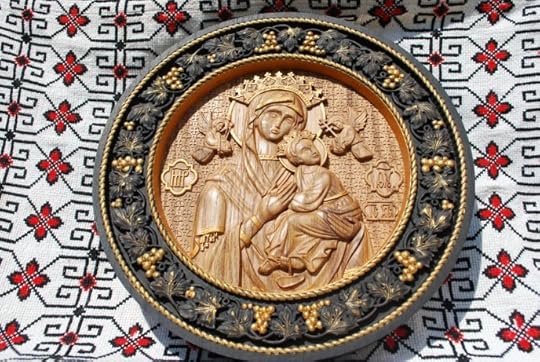 This is an icon of the Theotokos with Jesus that Catholics call Our Lady of Perpetual Help. I recently ordered this icon from the Woodenicons Etsy shop.
One option for people who cannot see at all or who have severe limits in vision is to order carved icons. Several iconographers have translated holy icons into carvings such that the patterns can be felt with the fingers. There might be local options where you are, but I have had success ordering from Etsy. Three (not-affiliated) Etsy stores that sell carved icons and have good reviews at the time of publication are the Woodenicons shop, the shop, and the TarasovAndFamily shop.
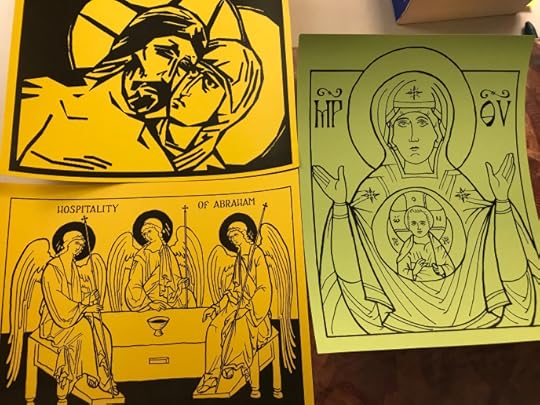 These icon drawings of Christ and His Mother at the Deposition, the Hospitality of Abraham (Holy Trinity), and the Platytera (Mary Mother of God, Wider than the Heavens) are printed on yellow or bright green cardstock from the “Raster” files from the Orthodox Illustration Project.
Another option for people with limited vision is to print icon outlines in black ink on high contrast paper, such as neon green, neon pink, or bright yellow. The Orthodox Illustration Project by the Orthodox Arts Journal is a wonderful resource for high quality icon drawings that are free to use for non-commercial purposes. These high contrast images also work well for people who are colorblind.
If you don’t have money to purchase a carved icon, you can also print out one of the icon line drawings and trace over the lines with glue or puff paint. When it dries, you have a touchable icon outline that people can access without being able to see. This works better for simpler icons such as close-ups of faces. If you try this method, allot two days for drying time in case the paint or glue shrinks and you have to do touch ups after the first day.
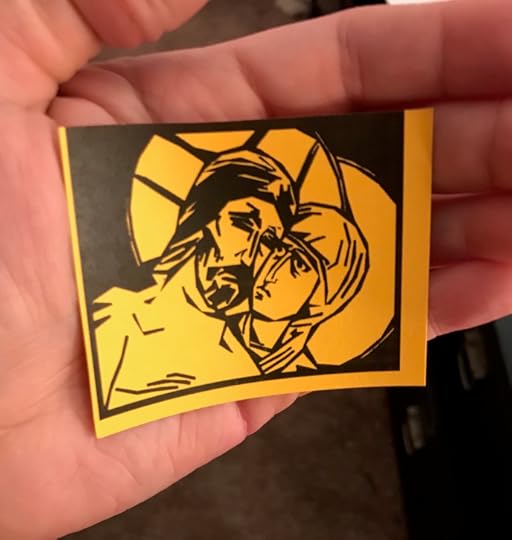
Does your church have a teaching ministry that brings the language of icons to people with visual impairments? Tell us about it in the comments.
The post Icons for Christians with Visual Impairments appeared first on Summer Kinard.
April 16, 2019
Mercy Warning
Tonight I soaked my arms in Epsom salt for an hour so I could type again. I am writing a book on the theology of disability, and it’s going well enough that my finger and wrist joints swelled up from the strain. Today I had to calm down my son who only just fought his way out of an OCD spiral caused by being confined for too long at night on a road trip we took a year and a half ago. He was crying because he loves going to the Lamentations service on Good Friday and the late night Pascha service, but he has not yet recovered from the abject horror he experiences during late night car rides owing to that roadtrip. I had to tell him he’s loved and good even if he can’t go this year. It’s ok, because God’s mercy is still here for him. It eats at him, his weakness, and all I can do is tell him what I know: that God’s strength is made perfect in weakness. That God comes to us, even when we cannot get to him on our efforts.
We made a family plan for Holy Week so that the children can go with us to the daytime services they love: Holy Unction on Wednesday, the Deposition on Friday afternoon, and the Harrowing of Hell on Saturday morning. One of the children who has the easiest to meet sensory challenges (and who is lightest in case I need to carry him) might go with me to the evening service on Friday, where I will sing in the choir. Usually we have gone as a family or most of the family for the big Friday service (our favorite), but our new church doesn’t have a role for my daughters this year. They only ask girls from an older age group to participate as myrrhbearers. Most of my children were only able to stay in past years because they looked forward to their sisters throwing rose petals on the tomb of Christ.
Our memories are shaped around roses and icons and candles and tombs and songs in the darkness, not because my children have all gone to the services or have all gone all of the time. They’re shaped around the cross because my husband and I have nothing else to offer our children so good as the great love of Christ. We tell them the stories and read them the stories and have shaped our home as a lampada to shelter the holy fire of God’s love, even when we aren’t good at bringing home the Paschal flame each year. Some years, only one of us has gone to Pascha. Some years, we missed it because our kids needed us to be home.
Every year, someone steps forward to shame mothers for not bringing children to all of the services of Holy Week. Some years the circulating post is about how children really can behave like well-regulated adults if we are just better mothers. Some years the assumption is that families are doing fun stuff and shirking their Christian responsibilities by not attending Holy Week services. Bless their hearts, the people who write those sorts of articles doubtless mean well. They are the sort of women who don’t have arthritis or disabled children or car trouble, who live within 20 minutes of their church and have a large group of encouraging friends who will help look after some of their not-disabled kids while they walk another of their not-disabled kids around to look at icons and grow sleepy or focused. They’re lovely, reliable people, the sort that probably back in Jesus’ day would have been at the table with him or maybe allowed to cook for him. They’re the right sort of people who do the right sort of things and can give advice about getting to heaven by acting right.
[image error]
I’m sorry to disappoint you, but I don’t have that sort of advice to offer you. If I lived in Jesus’ day – a bastard kid born to a teen mom who was abandoned, an abuse survivor who didn’t grow up the right way, who has fond memories of getting excited about chocolate and maybe a dress at Easter and the joy of music declaring that He is Risen- I would not have been allowed to cook his bread or talk with his disciples. Don’t get me wrong. I would have followed him anyway, because he would have healed me. I would have loved him, even if I couldn’t appear with him in public, owing to not being the face you really want to see when you think of someone as big a deal as Jesus. I would not have been able to believe that he was really gone. I would have woken up early one morning when the first breeze of dawn brought to me a smell of new life such as I had never smelt before. I would have gone to the tomb even though I couldn’t roll away the stone.
Some people seem to think that the Christian life is about rolling stones away. They press on with their phenomenal strength of will and not-disabled bodies and wide social networks, and Christ rises on schedule for them. They don’t ask who will roll away the stone, because they take all of their children to all of the Holy Week services, and that gives them profound spiritual and physical abilities. They never rob their children of the memory of waving palms before the Lord or eating beans each day until they eat lamb and bacon and cheese (none of which foods most of my children will even touch, because most foods terrify them). They arrive at the tomb, and it’s open already, because of course it is. God is reliable. Do the right things in the right order, and your spiritual plumbing will work just fine. You will have the water of life right when you turn on the faucet. These people are never embarrassing to God, because they have the pattern down.
But some of us are here because we’re embarrassments. We love first and act without even preparing properly. We crucify Jesus and have to borrow a tomb. We gather everything good we have, and it’s only a bunch of spices. We’re the annoying pop up ads of church life, offering essential oils to the wounds of Christ. We show up before he’s even tortured and pour oil on him. Thieves, anyone? We take everything precious with us when we are wakened by the wind blowing from that tomb. We limp along and wonder how we’re even going to roll away the stone. We wake up when the kids wake us up, the way that sometimes one can rise from a dream into a day more beautiful than dreaming. We sing to them, “Christ is risen from the dead, trampling down death by death, and on those in the tombs, bestowing life,” as a lullaby and morning song, and that morning, it’s sweetest. There is even chocolate and muffins and beautiful eggs.
Somehow the Lord manages to rise for us, too. Somehow the mercy of God reaches us even though we only got to Palm Sunday and Holy Unction and Deposition. We see Christ trample death by death from the cheap seats of our houses as we watch over our disabled children. Somehow the smell of bay leaves on Holy Saturday morning fixes our hearts toward the love of God, even though we cannot take our children with us into the night watches. We are women who keep vigil night after night, even when we’re not at church where people can see us, cajole us, praise us. Even if like thieves in the night we steal into the icon corner and extend our swollen jointed arms toward the love of God and beg him to come and steal our hearts and our disabled children’s hearts away from every vanity of the world. When we can go, we go and kiss the Lord. But our lips still burn with the holy song, even when we sing it in a strange land.
If you cannot bring your family to Holy Week services, if you cannot fast as harshly as others, if you cannot eat festive foods, let the wind of heaven refresh you anyway. The mercy of God blows out from the tomb, and even if your dear ones sleep in their beds instead of the church, Christ will rise for them, too.
Tips for Holy Week When You Cannot Attend [Many] Services:
Look up streaming services from Orthodox churches, such as THIS ONE from Annunciation Greek Orthodox Cathedral. Play them if you are able so you can keep the rhythm of the beautiful prayers of Holy Week.
Find Holy Week and sacred music through online services such as Ancient Faith Radio , YouTube, Spotify, Pandora, Amazon Music, or Apple Music. Listen when you’re at home or in the car so that your heart is prepared for the joy of Christ’s Resurrection.
If you don’t usually pray with holy icons, print one or bring one out of storage into a central place in your house. Venerate it (kiss it and make the sign of the cross over yourself) often, because God is with us. If you are not able to print one or cannot have paper in the hospital room or other place where you have to spend Holy Week, search for “Christ Bridegroom icon” and “Resurrection Orthodox icon.” Screenshot some of the images onto your phone so you can look at them where you are.
Read St. John Chrysostom’s Paschal Homily , even if you can’t be in church for Pascha. It will remind you of where you stand with our victorious and merciful Lord.
March 27, 2019
Accessible Prayer Corner Tutorial
The most effective and lasting way to teach is through how we arrange and prioritize spaces.
The ancients knew this well, and they learned vast amounts of story, scriptures, and sermons by associating ideas with places that were familiar to them. In daily life, our movements around our homes, classrooms, work spaces, and churches teach us just as much as the lessons we might study in those places.
This human way of learning in three dimensions is a wonderful asset for sharing the faith with children with disabilities, impairments, and neurodivergences. Unlike the speech or reading or heavily language-based ways of teaching that fail to engage the attention or enable the interaction of children with disabilities, this prayer corner is a meaningful way to build the practice of hoping in God.
[image error]
An accessible prayer corner or wall teaches with space.
Here are some reasons it reaches everyone:
The prayer wall is the primary focal point of the room. When you enter the room, you see it on the far side of the room. It is large and beautiful, tactile, and this is very important: obstacle-free. Other parts of the room might be tucked into nooks or around tables, but you get to this prayer area by going in a straight, unobstructed line from the door. Prayer shouldn’t be tucked off to the side of life if you want to form kids around it. Just as the altar area is the focal point in a church, the prayer area should be the focal point in a Christian teaching space.
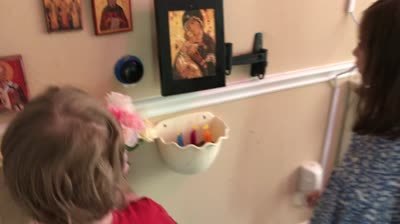
The prayer area gives children several things to do to make their prayers and offer their love. They can make their cross. They can add a little bouquet of silk flowers to the basket. They can put a felt candle into the sand box mounted under the icons. They can kiss the icons. They can read a picture version of prayer, hold up a “help” hand to God, or press the prayer button for a speech output button to say, “Lord, have mercy. Lord, have mercy. Lord, have mercy.”
The swing arm icon mount allows children to venerate even if they’re using a wheelchair or scooter or if their height makes it difficult to reach over the candle box. Every part of the prayer routine is available to children with disabilities as well as those without disabilities.
Icons that are especially meaningful for the children, such as St. Nicholas and the Theotokos, are at a level where the children can kiss them or touch them without help.
Children are encouraged to use all of their senses to engage in prayer. This prayer area meets several types of sensory needs and encourages children to pray with their eyes and hands open to the beauty and presence of God.
The prayer area is usable for children with impaired vision. To make the prayer area more engaging for children with visual impairments, add a carved or resin relief icon to the swing arm mount. The felt candles in kinetic sand and the small silk flower bouquets can be navigated easily and safely by touch.
Teaching is not only imparting knowledge and habits. It’s preparing the way of the Lord. Set up an accessible prayer corner in order to prepare for the children God has called into your home or classroom.
When you use the prayer corner regularly, establish a routine of bringing flowers and adding a candle to the sandbox first. In my church school class, I would stand at the door holding flowers to hand to the children as they entered. They would then proceed directly to the other side of the room, where they offered their flowers to honor the Theotokos. My co-teacher would then hold out the felt candles so the child could choose one to place in the sandbox under the icons. The children would kiss the icons before they moved to play, and in this way, each child entered the room in prayer. (We also had crochet censers for the children to use in the classroom. I list them below, though they are not part of the prayer wall currently set up in our home.)
(The children volunteered to show people how they use their prayer corner. It’s not rushed or chaotic when we pray in our daily routine. You’ll want to take your time in real life.)
Here’s what you’ll need to set up a similar prayer area in your home or classroom. Amazon affiliate links are offered where available to make it easier for you to find items you see here. Such links are marked (aff).
Holy Icons. You can find holy icons in Orthodox or Catholic church bookstores or online from places such as Skete.com, Uncut Mountain Supply, or the Ancient Faith Store. Make sure that some of the icons are low enough for the children to reach on their own.
Swing Arm Icon Mount. We used this wall-articulating tablet mount (aff). I cut the thinner section out of the included silicone pads for mounting smaller tablets, and the tablet mount perfectly fit a standard sized 6″x10″ wood-mounted icon of the Theotokos. My husband carefully drilled indentations to the wood mount so that it fit well over the fasteneres. For larger icons, you might consider a swing-arm television mount. If you have more advanced carpentry skills, you can build an articulating mount from scratch. The key is to allow children with mobility devices like wheelchairs and walkers and scooters, to be able to reach and venerate the icon. This also helps with shorter children who have trouble bend over the sandbox and flower basket to reach the icons.
Flowers and a hanging flower basket. You can find hanging flower baskets and silk flowers at your local craft or home decorating stores, or find them online. This is the basket (aff) and some of the flowers (aff) shown. I have made a prayer wall using this smaller wall basket (aff) as well. Make sure the basket is easy for all of the children to reach. Bringing a flower to the basket is a wonderful way to enter the room and to begin interactions prayerfully.
Wall-Mounted Half-moon Planter, Felt Candles, and Kinetic Sand. This planter (aff) mirrors the shape of many candle boxes for lit candles in churches, and it’s scalloped edge adds visual and textural beauty. It will hold a fair amount of kinetic sand (aff), which can be removed and used in lessons or for a calming sensory break and replaced as needed. I ordered the felt candles from the BrightHappyCreations Etsy shop, and I have two sets, one in bright colors for everyday, and one in white for Pascha or other special feast days. We store our felt candles in a short bud vase in our taller prayer nook, and I bring them out for the children when we are gathering to learn and pray.
Crocheted Toy Censer or Empty Hand Censer. Though we do not have a toy censer out in our prayer area currently because I am repairing it, children in our home and my classroom have always enjoyed playing priest or nun and pretending to cense the icons and the room. You can find toy censers at the CozyHouseCurios or LivingLiturgically Etsy shops. CozyHouseCurios also offers a pdf pattern. We also have two hand censers at home, so the children can imitate my husband or me when we use the lit censer. We purchased our hand censers from our church bookstore, but they are also available at the Ancient Faith Store.
Laminated Visual Prayer Aids. Stop by my Special Needs Resources tab and print out some of the resources that work best for your classroom or home. Laminate them, punch a hole in the corner, and hang them on the wall to use when you pray together. You can also print out the Flexible Orthodox Liturgy Visual Schedule cards onto cardstock, cut them out, number the backs, and mount them in order onto a binder ring to hang in your prayer area or toss in your church bag.
Speaking Prayer Button. I used one of the Learning Resources Recordable Answer Buzzers (aff) to record, “Lord, have mercy. Lord, have mercy. Lord, have mercy.” Because my children like to press the small red “record” button, which erases messages, I also sealed the small red button with melted beeswax once I had recorded the prayer. I mounted the button to the wall with Command Picture Hanging Strips (aff), which I also used to place several of the icons on the wall above. There are only about 7 seconds of recording time on the buttons, so you will need to keep the prayer short and sweet to use one of these buzzers. I have used them in several places in my home, so it was more economical to use the short message buzzers. However, this and similar 30 second recordable buttons (aff) allow you to provide longer pre-recorded prayers, such as the Lord’s Prayer (20 seconds-ish) or the prayer before meals (about 8-10 seconds).
Click to view slideshow.
When you have your accessible prayer area set up in your home or classroom, post it on Instagram with the hashtag #accessibleprayer! Share your nurturing and creative ideas, and let’s build one another up!
I’m speaking at the Ancient Faith Writing and Podcasting Conference this June, and I’d love to see you there. There’s still space to register, but the conference is almost sold out.
Don’t forget to follow my blog while you’re here.
March 20, 2019
Learning in the Garden: Interview with Mary Riddle
Spring is here! In my household, we’ve spent the past few weeks working hard to set up a garden. We’ve planted fruit trees and shade trees and dug beds for herbs and vegetables.
Read to the end of the post for a free printable Garden Time vocabulary aid.
When I was a girl growing up with undiagnosed autism, the garden was my refuge. I learned a lot of life and relationship skills because of my desire to grow things. I would find old women in their garden beds and ask them to help me figure out the difference between miracles and weeds.
My friend Stepheny Houghtlin introduced me to the idea of “the long conversation that is English gardening.” While I garden in a subtropical climate instead of a mild one, I have not let go of the thought of gardening as a long conversation across time and space. That idea – of growing things and learning to speak at the same time – has inspired me to engage my children in gardening.
As I was working out my ideas for our garden as a learning environment, I had the joy of being introduced to Mary Riddle, whose expertise in sustainable gardening and education caught my attention right away. (Seriously, go read about her and check out her thoughtful, beautiful blog.) Mary agreed to carry on that long conversation about gardening with me. We talked about best practices in learning in the garden. I hope you enjoy listening to her wise advice as much as I have!
Mary, welcome to my site. I told you about how we’re trying to grow plants that suit our environment and will add beauty and bring fruit to our yard. I love the idea of a garden that can grow over time and that will help feed us, too. Tell us some of your background with sustainable gardening.
I’ve worked in farming and agricultural education for over ten years. I figured out in high school that I wanted to either be a teacher or a farmer, but it wasn’t until after I graduated from college that I figured out that I could combine those passions. I’ve managed mid-sized farms, helped homeowners and businesses install and maintain their own gardens, and consulted with educational programs to create top-notch sustainable agriculture components to their curriculum. The best part of what I’ve gotten to do is to help kids fall in love with being outside by showing them what they can do in a garden.
[image error]
Help kids fall in love with being outside.
You work in a school for girls that focuses on teaching in the garden. Can you share how this works practically? Are there lessons outside year-round?
[image error]At Hutchison School, I work with teachers in all grades, from our two year old program all the way through high school, on how to use the garden to help their classroom instruction. My mantra is “a garden can teach you anything.”
We do have lessons outside year-round, but they don’t solely focus on the life science side of a garden. We use the school farm to teach history, world languages, civics, math, and more. It works so well, because gardening isn’t a separate thing that they have to teach, but it’s a lens through which they can examine the rest of the world.
What are some best practices you might share about learning in a garden?
I always tell people to aim small, then succeed. Building up slowly is good. I see parents and schools sometimes undertake ambitious gardening plans, only to get overwhelmed a few months in. A few pots of tomatoes on your patio is a good place to start. Add one or two new things every season.
I also believe that raised bed or container gardens are the best way to go when working with kids. Creating manageable sizes and spaces for weeding and tending helps to ensure success.
[image error]
Summer’s garden features lots of fruit plants and trees, like this plum tree that her son loves.
Amen to that! We started our garden with very low-maintenance fruit trees in part to encourage the children when they see the fruit. We also have a big melon patch, because there’s nothing like fresh melons in the summer for making the garden feel like a reward. As you know, my children are autistic. Have you worked with autistic children before? If so, what has been the effect of garden-centered education?
I have worked with autistic children, though not extensively, but I have found the sensory experiences of gardening to be therapeutic for them. I’ve helped parents of autistic kids select especially fun sensory plants to grow with their kids: things with interesting scents, textures, and flavors. I like growing perennials like comfrey, because they’re so soft, or annuals like “sensitive plant,” which will close up when you touch it.
We actually have sensitive plant growing wild in our yard! I love teh idea of adding comfrey. We have sage and other herbs because of their strong fragrances.
[image error]
Creating emotional connections with food.
Speaking of herbs and strong fragrances: Picky eaters. I have read a lot about how picky eaters will often be more willing to try foods that they grow. Does that pattern hold true?
YES! That is one of the most gratifying parts of my job. Every week, girls from Hutchison School will help me harvest a vegetable to deliver to our dining hall, where it is turned into a new dish for them to try. I can’t tell you how many times parents have come up to me and said something like, “My daughter won’t touch anything green, but because she tried it here, she’ll now eat kale.” I know this isn’t true for every child with every vegetable, but creating emotional connections to their food through growing, harvesting, and preparing makes them far more likely to try it. We create as many opportunities for low-pressure tries as we can.
I love the idea of creating opportunities for low-pressure tries. The pressure is so overwhelming to my children, too. What would you say is your favorite insight from learning in the garden?
I always like to remind kids and adults alike that failing is a valuable way to learn. Nobody has a “green thumb” or a “black thumb.” We all accidentally kill plants, but curious learners will try to figure out why, learn from those experiences, and try again. That’s the fun and intrigue in gardening. A while back, I had a group of 5th graders working on a project that wasn’t going terribly well. One of the girls said, “Oh no, we’ve failed!” Another girl in the group piped up, “We didn’t fail. We found a new way that this doesn’t work!” That was probably one of my proudest teaching moments of all time, because that’s one of the most valuable lessons that a garden can teach.
Thank you so much for joining me, Mary!
Readers, why not start your garden this spring with this easy to grow Easter grass project?
Or use this free Garden Time vocabulary printable to help your children enjoy your garden this year. Print the image below or download the PDF version here: garden time
[image error]
March 7, 2019
Feed The Parents: Lent for Families With Special Needs
There’s no shortage of advice for how to give things up for Lent, how to read extra books for Lent, and how to eat simpler foods for Lent. But parents of children with special needs can’t use much of that advice. Instead, we have to resist these opportunities to overcommit by seeing them for what they are to us: opportunities to overextend our resources.
This Lent, resist the temptation to overfunction.
You’re a person who probably spends most of his or her time caring for your children or fretting over how to meet their needs. For you, overdoing it a bit is normal and often necessary.
Don’t add anything to your to-do list unless it feeds you.
How can you tell what will feed you? Look for what will lower your stress and build up your most important relationships.
Some examples of how to evaluate and address common Lenten pressure points:
Caffeine. Giving up coffee might not be good for you. It might wreck the fragile balance you’ve brought to your days. Having coffee or tea with a friend or spouse once a week, though, might lower your stress and build up important relationships.
Fasting. Changing your family’s food routine in a dramatic way might be a recipe for disaster. Consult your priest as needed, and consider ways you can be kinder –starting with kindess to yourself and people in your household. If the goal of fasting is to learn about the unending love of God, look for ways to apply the love even if your family’s needs make ordinary food changes impossible or inadvisable.
Almsgiving. It might help to ignore requests from organizations during Lent. Almsgiving is meant to be between two persons, so ignore organizations without guilt this season. Instead, focus on small, real ways you can help someone like you. Can you afford another weighted blanket like the one that helps your child sleep? Donate one to a foster home or domestic violence shelter. Do you know another parent in a special needs family? Send them a card in the mail. Focus on the personal aspect of almsgiving, whether you are able to give money or resources to relieve another person’s suffering or take a few precious minutes to let another parent know you’re thinking of them.
Social media. Maybe the people who announce that they’re leaving social media for Lent have already vacated your timelines. If not, make sure you have an email address or other contact option for the ones you’d like to keep in touch with. Social media is one of the best technologies for breaking the social isolation that comes with special needs parenting. If you want to limit screen time or be kinder or mindful or read only notifications, go ahead. But be realistic about your unusual schedule and heavily demanding family life. Will you be able to talk to friends without social media? If not, you will probably want to keep your accounts up.
Attending More Church Services. It might seem scandalous at first, but I’m going to suggest that you try to go to a few of the extra evening services without your children. See if a trusted friend or your spouse can stay home with the kids for a few nights during Lent so you can go and soak up the beautiful prayers without dividing your attention as much as usual. Trade childcare duties with another special needs parent or your spouse so that each parent gets to go to a service or three without the children. This doesn’t mean you should neglect taking the kids to church in general. It means that all those extra services in Lent are an opportunity to feed the parents.
Going to Church in Lent With The Kids. The Sunday service will probably be longer by at least a few minutes. Prepare for the longer service by reading the Gospel at home before you go to church in case you have to walk the kids around more. Consider making a quiet activity to give the children during the extra prayer times. (My Church Bag Tour has some ideas.)
Reading More Books. Reading a book with friends sounds lovely, but when it’s a daily habit or on a tight group schedule, special needs parents frequently fall behind and drop out. If you want to add reading, try finding times when you can read aloud from a beautiful book. Parents can feed each other by reading aloud in this way. Audiobooks might help, as well. If you join a reading group, tell the group leader ahead of time that you will probably not be able to keep up. That way you don’t feel guilty when your kids need you more one week and you don’t get to the assigned reading. Discussion time when you only listen can help you when you get a chance to read the book later.
Silence. If you cannot maintain silence in your home because of your children’s needs, find a few minutes when you can be quiet on purpose. It’s hard when you feel the weight of responsibility to help kids with complicated communication needs to talk, but intentional quiet for 5 or 20 minutes at a time won’t set your child back. If you decide to be quiet in the middle of the day, you might use a visual timer (like this one that I love–affiliate link) to let the kids know when you’ll be back to speaking.
Prayer Routines. Some people will encourage you to add a simple 45 minute prayer routine to your day in Lent. Those people aren’t familiar with special needs life, so it’s best just to thank them and move along. Prayer is a great practice. But you need to be fed, not to fall asleep reading prayerful poetry. I recommend praying in a way that your kids can see, too. Even if you’re not used to doing so, go to your holy icons or wall cross and say out loud that you need help. Just ask for help. Let the kids hear you and see you do it. Say “thank you for helping us,” and walk away to go about your business. Add that routine of walking over and praying in that place, and you will give yourself a gift. You will start to let go of your burdens when you ask God for help, because you will have a physical routine along the lines of dropping your prayers into a spiritual key hook or dresser, the same way you put your keys and wallet in the same place when you get home each night.
Prayer Lists. Another way to pray that doesn’t ask you to overfunction is to go to that prayer corner and tell God you’re there, no matter how you feel. Offer whatever you have –exhaustion, frustration, anger, inadequacy, brokenness, sadness, regret, repentance, joy, mixed feelings, ambitions, jealousy, crankiness, laughter, gratitude, grief, fear — all of it, no matter what you’re feeling, to God as if God is listening. That will help you know that God is listening, and that will help you listen for God, too. If someone asks you to pray for them, offer yourself to God like this first. Then tell God about the person’s needs. Ask God to help. Then let it go.
Be kind to yourselves. God loves us. God is with us right here amongst our still-not-potty-trained sticker charts, our occupational therapy tools, our instructional posters, our special feeding equipment, our sensory regulation tools, our stacks of books and games, our hopes, our rocking chairs. Ask for help. Build relationships. Do what feeds you. Resist the temptation to overfunction.
Good Lent to y’all!
Want to learn more about practical, concrete ways to pray and grow in faith? Follow this blog, or come here me in person at the Ancient Faith Writing and Podcasting Conference this June 13-15.