Summer Kinard's Blog, page 3
February 27, 2023
Finding Christ in Lent: Virtue Detectives & Mary Gardens
As we approach lent, it is natural to turn our thoughts and prayers towards Jesus Christ. As teachers and parents, how can we use the season of Lent to best help ourselves, our parishes, and our families? One great way to do this is to practice discerning virtues. We have an opportunity over these upcoming weeks to look deep inside ourselves and examples in the world around us for strengths that imitate Christ, His Mother, and the saints. Additionally, instead of letting outside events or stressors direct us during this time, let us find solace in quiet gardens where His beauty surrounds us and constantly reminds us that He loves each one of us as his beloved children. Let’s explore these practices during Lent together so that successful nurturing can result from them!
I prepared the printables contained in this post as part of our parish’s Holy Heritage Day on Lent. I offer them here for your use as part of a free (or in the case of forthcoming books, low cost or pay as you’re able) Accessible Church School model that aims to help prepare the way of the Lord and to include all students in the faith. Please share this post and make as many copies as you’d like, but please link back here so we can continue the conversation! A lot of what I prepare is based on answering questions from my readers! Good strength to you all this Lent!
 VIRTUE DETECTIVES
For this activity, you’ll need to print out the booklet (PDF below) and the virtue circles. Additional supplies (amazon affiliate links if you click them): Magnifying glasses, ball bead keychains, 1.5″ hole punch, regular hole punch. To assemble: cut vertically between the columns of circles to make strips of all seven virtues. Using the 1.5″ punch, place the circles face down so you can see the borders of the circle through the bottom as you punch. Make sure to use the small, regular hole punch on the bottom half of each virtue circle. If you’d like to preserve the order of cardinal virtues plus theological virtues in order of prominence (as they appear in the booklet), the order is: Wisdom, Justice, Fortitude, Moderation, Faith, Hope, Love. This allows children to look at each virtue attached to the magnifying glass without detaching the circles from the keychain.
Virtue circlesDownloadvirtue detectivesDownload


 MARY GARDENS
Did you know that St. Patrick isn’t the only Christian to tell the story of faith using a plant? For many centuries, Christians have prayed and taught about Christ’s life using the memory aids of common garden plants. These gardens particularly focus on Mary the Mother of God, who of course witnessed all of Christ’s earthly life. In our parish, we started a little garden by planting locally hardy plants that remind us of Mary and her Son Jesus. We also handed out packets of seeds for households to take home to plant. While the following printout is great for us in USDA zone 10 (southern Texas), you can search online for traditional Mary Garden plants that grow well where you live.
Mary Gardens Places to Pray for the WorldDownload


Don’t forget also to check out my book Of Such is the Kingdom: A Pracitcal Theology of Disability, that shows how Mary Gardens offer several accessible ways to pray. Good Lent to all of you!
The post Finding Christ in Lent: Virtue Detectives & Mary Gardens appeared first on Summer Kinard.


January 18, 2023
Accessible Church School Template Starter Kit
I’ve been working on a lot of curricular resources in the background these past few years, and it’s time to start sharing them! As I am working on books filled with room design tips (to teach through space) and lesson plans, I want to share some basic tools that will help all Sunday school teachers share access to the faith.
Here’s what you need to get started:
Sensory AnchorsUse some of these worksheets or print outs to find patterns that recur throughout salvation history in the Bible, saints’ lives, hymns, Divine Litury/Mass, and our own lives with God! Sensory Anchors (or somatic markers) are explained in my book Of Such is the Kingdom: A Practical Theology of Disability, available from (aff link) Amazon or the Ancient Faith Store. Identifying these markers not only builds theological reasoning, discernment, and awareness of God in our lives, but it is vital to the formation of long term memories, especially when we combine study with gross motor movements and room design.
somatic anchors and actions 16DownloadSENSORY-ANCHOR-TILESDownloadsomaticanchors&actionsfullDownloadPrint these out and have them available in several places around your classroom or as laminated sets, so that all students have access to them. If you have visually impaired students, consider getting the physical example of that week’s anchors and bringing them in so the students can touch it.
That week’s anchors? How will I know? Well…
LECTIONARY LEARNING TEMPLATE & EXAMPLEWhile I have not yet compiled a full year of lessons to share, I have a template for you today as well as an example lesson prep form for this coming Sunday’s Gospel in the Western Rite Orthodox jurisdictions. Over the course of the year, I will be compiling Western Rite and Eastern Rite Orthodox Lectionary guides, which I will list as low cost PDFs or paperbacks in the Park End Books store as part of the Accessible Church School project. But for now, here’s what we have.
These templates help you look ahead over the course of the month or season, sketch out the Gospel readings, summarize, identify the virtues and sensory anchors, and plan for discussions. As is, using them will give you all you need to teach HIGH SCHOOL LEVEL and ADULT students, alongside physical examples of sensory anchors (show and tell), acting out lessons with brief skits or conversationally, outdoor lessons, or with full-scale artwork if you’d like. You can incorporate the insights gained from these worksheets into learning conversations while kids paint artwork or try out an activity (like rope weaving) in a saint’s life.
For younger children especially, it’s important that you ADD GROSS MOTOR EXPERIENCES such as sensory bins, building with large foam blocks, moving through a classroom as a group, processing around a prayer path, and other movement-based teaching. Read more about this in my book Of Such is the Kingdom. Younger children will likely need two or three weeks to practice very important lessons like those from the parables. But even for preparing to teach young children, this template is an excellent TEACHER PREPARATION TOOL. When you know the context, you can be flexible with the young children and teach them more of the faith in a child-led inquiry.
Here’s the template alone in PDF:
Lectionary-Lesson-TemplateDownloadLet’s take a closer look:The top section is for you to add which Sunday in which season, for instance the 3rd Sunday after the Epiphany, or the Fourth Sunday after Pascha. The Gospel is where you will write the scripture reference, such as Matthew 8: 1-13. Below that, there are spaces to list the sensory anchors you notice in the passage as well as the virtues you see in the passage. If you happen to be teaching a passage with vices in it, you can identify the opposite virtue. Lower down, there are prompts for noting where else the sensory anchors show up in the life of faith. Your students can help you brainstorm these, too, but this is important to go over on your own at first in order to get started. For saints’ lives, start with the ones closest on the calendar, and then add ones that particularly stand out, either for their related sensory anchors, virtues, or because they’re in the scripture. Next, note some of the most important passages so you can prompt the kids to act those out. For instance, if Jesus heals someone, you will want to have that part acted out. Finally, if there are things in your parish’s life, current events more broadly, or something appropriate to share that occurred to you from your own life, note those things at the bottom of the page.
 EXAMPLE
Here’s an example of a filled in form to help teachers get started. Notice that there’s room for more. You should always ask the kids to add what they know first in discussion, and then you can add more to fill out the lesson. But for preparation, it’s important that you go through the whole process yourself, too. When you’re teaching, write the students’ responses on a white board or a large piece of paper taped to the wall. This will encourage participation by giving immediate feedback that they are being heard.
 CHRISTIAN EDUCATION/SUNDAY SCHOOL DIRECTORS
If you’re preparing one of these templates for your teachers, make sure to include a print out (and paste into an email) the full Gospel passage as well as scriptural references for the Old Testament anchor passages. I usually use a site such as Oremus or Bible Gateway to find and print out the scripture passages in whichever translations we need.
If you’re interested in moving your program towards accessibilty, please contact me at summerkinard at gmail dot com. I consult with parishes for a fee. Also please look through the generous list of free resources on my Disability Resources tab.
Thank you fof stopping by! Please add your questions, thoughts, and comments below, and subscribe so you will see future posts.
The post Accessible Church School Template Starter Kit appeared first on Summer Kinard.
December 21, 2022
Eulogy for my mother
I’m posting this publicly for my relatives who requested it. We have, understandably, had a very different type of Advent this year, one filled with radical hospitality and love to the end, but nonetheless difficult. I am grateful more than I can say for being able to be there, singing Psalm 91 (90) as my mother peacefully reposed. I gave this eulogy at my mother’s Catholic funeral Mass. Later, I sang the Ave Maria at the offertory. Now I am grateful for the quiet of Christmas with the Silent Word, God the infant, so I can know God in quiet, too.
Poems, like lives, don’t have to rhyme to be beautiful and true.
When we realized that Mom’s mortal life was drawing to a close, I tried to write an epic poem about her life. I only managed three stanzas before I realized that I wasn’t up to the task. It was called, The Ballad of Wendy Elaine, and it was going to be epic! But it turned out to be like a sea shanty without the dope beats and harmonies. Here’s a sample:
When they were small Keely reached for a balloon
That was caught on a live wire, as she found out soon.
Our mom saved Aunt Keely from dying by wire
By hugging her sister whose hands were on fire.
When Mom was a tween, she was happily swimming
Without realizing a cloud started spinning
Her dad pulled her onto the shore of the beach
Thus saving Mom from getting pulled into the breach.
Then she got older, and this is the turning
Of our tale from adventure to heartache and yearning.
Mom’s three big loves left her rather bewildered–
The musician, the dreamer, the steady builder.
Well, you see why I gave it up. How can you rhyme a whole life? I wanted to write you a poem about Mom’s life, but besides the difficulty of summarizing so much, I couldn’t figure out how to rhyme some of the saucier bits—like how she rocked a bikini in the 80s—with the somber ones, like how she had a broken heart that she never quite came to peace with. Or how she would fight a wolf or a dog to save her children, but she couldn’t save herself away from the Wolf at the door.
Then, I remembered that poems, like lives, don’t have to rhyme to be beautiful and true. Some of Mom’s lines were brilliant, warm and good, even if they were in unworthy stanzas. This is part of the reality of dancing the delicate balance in life between giving people space to grow and pushing them away.
But the good thing about grief is that, like love, it gives us an excuse to set aside all the messy and crossed-out lines, the smudges, the rewrites that never quite gelled, and to highlight only the good parts, the ones worth keeping.
So in that spirit, here are some of Mom’s best lines. She loved the beach. She loved animals, especially horses and songbirds and dogs. She loved to garden. She loved music and cooking and dancing. She loved to laugh with her friends and neighbors, and especially with her sisters and brothers and aunts and uncles and cousins and grands and great-grands.
Before she died, Mom told us that her mama came to talk with her in the hospital. She loved her mama and felt increasingly close to her in her last days.
But most of all, my mom loved children, especially her own children and grandchildren. She told everyone who came to see her about how proud she was of each of us. And even if she didn’t quite get the details right on our accomplishments—an unrhyming line here or there—her love for us and pride in us was true and good. Lest it seem self-serving for a child to boast of her own mother’s love, I’ll tell you this: Mom never met a baby in the world that she didn’t smile at, and you know, Mom’s smiles (that lit up her bright green eyes) were contagious. Those babies almost always smiled right back.
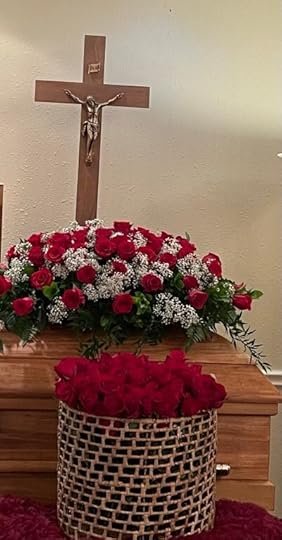 We buried my mother with 150 roses in her casket.
 I haven’t painted you a clear picture yet, so I’ll try again. Imagine, if you can, a garden filled with flowers and healing trees. It’s by a river with banks of sand that mold perfectly around your toes so you feel like maybe you’re a tree, too. Mom is standing there in that sand with green leaves in her hair that smell like the prairie after the rain, and a sea breeze rustles her hair. Did I mention? The river leads on to an ocean with water so pure that you can drink it even though it’s salty. Mom’s hands are full of hibiscus and roses, and she sees through the trees a parade of those who’ve been waiting for her. First come her dogs, because they run faster than everyone else. There’s Brownie, and Bear, and Chubs, and Kutsut and Stupid, and Goliath, Blimix, Jill, Hank, and Old Blue, and Yawnie and Andre, plus a few strays she never named but who followed her anyway during their short lives. Then there are little children running rast on the heels of the dogs. Her three miscarried babies and her miscarried grandbaby Seraphim look up at her with sweet faces that now she can kiss. They grab her hands, and Mom drops the flowers on the shore. The whole frolicking group of dogs and children surround her and tug and guide her forward with tiny hands and soft nose boops, to splash through the water to the other side.
Mom remembers her dancing days then, when as a teen and in her twenties she loved to go to Gilley’s and Magnolia Gardens to hear the live music and to dance with one of the loves of her life—she had three—and someone has been playing a fiddle to a dancing tune all along, which she just noticed. She and the children pick up their feet and splash dance across the river, which is so smooth that their movements ripple out around them like music notes. Her foot reaches the other shore, and a faithful horse nuzzles her neck. She pats its nose, then looks up at the sound of her name. “Wendy,” her mother calls, and there they are in bright clothes and shining faces, all the loved ones whose faces were engraved on her heart.
She feels like life was the photograph of this new reality. It was all so beautiful and good, but it was not the most real part after all. There’s a song being sung, and her people sing it to her in between their greetings. She is singing it, too, between the laughter and the hugs. It echoes back to her and seems to come from everywhere. The walls of time recede a bit, and she can hear the song when she was a child on Galveston Island, playing under Aunt Max’s house with her cousins and brothers and sisters. She hears the music louder during big moments—the time she saved Aunt Keely from being electrocuted, the time Mom was pulled to safety from the water during a waterspout, the stories she told of porpoises to calm children, the ghost stories around campfires, the hours in the library surrounded by the vanilla crisp of old paper as she searched out her family roots. Now she sees all the faces that were once only names on paper.
The song gets louder with the birth of children and the times she brushed our hair off our foreheads when we were sick. She hears it through the review of her hours standing on her feet doing hair. Before her, moments of her life unfold to reveal hidden pictures and mercies that she couldn’t see before. Every word of comfort of kindness she spoke, every time her intuition was one for love instead of fear, echoes with the song. And then there are the horrible moments, which she can face at last in that place: the days and nights of abuses, the bad decisions and the times when she couldn’t see her way out to a better option. She’s surprised that the song doesn’t stop there. It simply changes from a dance to a cradle tune, asking her to lean on the unseen voices that are leading the music.
Now it shifts again, to long days when soaking in the heat of the sun were her best joys, and books—so many books!—flutter their pages in salute as she draws nearer. Their pages carry her forward like a conveyer belt, closer to the fiddle and the singing. And she sees good days again near the end of this parade through the grove by the river. There she is beaming with pride and joy in her children and grandchildren, laughing with her sisters and brothers and nieces and nephews, drinking chocolate milkshakes and watching Charmed with Kristin and T.J. Admiring the drawings and handicrafts of her grandchildren and enjoying the music they made on guitars and drums and singing, and telling everyone how smart they are.
Suddenly a bright red bird comes into the procession, and Mom follows it with her gaze until she is looking one last time right at us. The cardinal sits on her left shoulder, and two doves alight on her right hand. “When you see these birds,” she says to us, “Know that I am smiling at you. If ever you’re thinking of me, I am also thinking of you.”
Then the music gets so loud, it’s hard to hear her. And a brightness grows so much that we observers can’t make out the details well of the procession and the garden Mom has entered. We hear a quiet voice that might in fact be louder than everything –it’s hard to tell– and the source of all that brightness, a person clothed in light, opens His arms and says, “Give her to me, now.” To Wendy Elaine, it sounds like this: “Come to me, now.” And we say, “Oh!” because there’s not really a word for that kind of peace.
But there is one word we can remember from the song, because it’s still singing all around us. Mom’s passing by has helped us hear it. Holy. Holy. Holy. Holy, this sacred life. Holy, this sacred love that can heal all things. Holy, this song that is with us.
And to this merciful God who loves all humankind and whose character is always to have mercy, we commend our dear mother, grandmother, sister, aunt, cousin, and friend to Christ our God. Holy. Holy. Holy. She is at peace in that song now, and we are singing it, too, because God sings it in and with us.
Remember Wendy Elaine when you feel the sun or smell the salt air, when you tend a rosebush or smoke a brisket or fry a chicken fried steak or cook with her recipe for chicken and dumplings. Remember her when you smile at a child or pet a dog or feed a horse, when you read a good book or have a just-right cup of coffee. Laugh for her now. Smile for her now. Live for her. Zoe se sas.
You can read my mother’s obituary here.
The post Eulogy for my mother appeared first on Summer Kinard.
September 27, 2022
Joyous Michaelmas!
We celebrated our Michaelmas Holy Heritage Day at church on Sunday with examples of angels in art and prayers and liturgy, and then we leaned into the wild joy that is celebrating when angels have your back!
Archangel Michael, defend us in battle. Be our protection against the wickedness and snares of the devil.


 These are a few images of the inside. Outside we defeated a red dragon pinata, beat up an inflatable dragon with our foam swords, and blew bubbles from bubble swords afterward.
View this post on InstagramA post shared by Summer Kinard | Autistic Faith (@somemyrrh)
We gave out Archangel Michael postcards with the short version of the prayer for his protection. I added lollipops turned so that the sticks looked like swords, and the lollipop had one of these shields on it. It made the postcards look like the lollies were shields and swords. (Click images to print).


We also decorated the cross, recalling the ancient custom of painting the standing crosses and church statuary on major market day feasts. Since our little ones were in church clothes, we provided them with jeweled stickers instead of tempera paint this year. But the teens were given gilding markers to brighten the reliefs on the cross.
Back at home this week, I’m showing the kids Pride & Prejudice movies since Bingley takes possession at Michaelmas! We’ll make a cake since several people in our family have Michaelmas as our Name Day.
What are your Michaelmas plans? Joyous Feast!
Michaelmas for Christians on the Western calendar (Catholics, Protestants, Western Rite Orthodox, and some others) is September 29th.
The post Joyous Michaelmas! appeared first on Summer Kinard.
July 14, 2022
Checklist for wonder-working
There are four obvious things you need for wonderworking, and they might not be what you imagine. Then there’s the key.
An impromptu video I took in my kitchen.You probably think of a wizened old man who has hidden himself from the world, or perhaps a silent, veiled woman who only shows up to drop off gifts that weren’t hers to begin with (she’s just the messenger). Or someone whose faith crackles from his eyes like lightning or whose voice sings with a strength that reaches across time and into chambers of power, despite her seclusion. We tend to typecast wonderworkers into whatever is impossible for us.
There are four traits of all wonderworking that will be obvious when I point them out: 1. God is the one working the wonder. 2. Faith. 3. Hope. 4. Love.
Because God is with us, we can pursue the virtues of faith, hope, and love. But what else is needed?
The key to seeing wonders is to show up.
Stability is the key, not because one particular place of meeting is more holy than others, but because God heals us through synergy. God is with us. We who believe and hope and love with God can bring others into the gifts of God’s presence. This is why you find wonderworkers in kitchens and bedsides and parish halls and park benches and jails as well as in wild places or mountains. The prerequisite is showing up, whether you are called to be a sea level saint or a mountaintop saint.
Build your character with God, and take it the next step, to be stable, to be with others in the place you are set. You will see wonders.
The post Checklist for wonder-working appeared first on Summer Kinard.
June 25, 2022
A ladder of quiet and song
When I was little, I spent hours waiting for God. I listened so hard that I could feel the pulse in my eardrums and the sound of my own eyelashes. Mostly I heard God when I slept and dreamed. Sometimes I would enter the tumble-jumble of prayer: wild space, big and small at the same time joy. The quiet of growing plants soothed me; I recognized it.
When I was twelve, I found myself facing the threat of death. Just outside my bedroom door, the roaring fight might have taken me at any moment. I called out to God and listened deeply. What I saw in prayer surprised me: a ladder with sharp blades on the rungs, leading me to redemption. The lower rungs would be excruciating, but healing balm was ready higher up. I chose the ladder. I broke the cycle.
Later I read about St. Perpetua, who saw a similar ladder, this one with sharp implements along the sides of the rungs. When she climbed it, she saw Christ as the Ancient of Days. He fed her sweet cheese from his hand.
Sometimes in dreams I will see fruit on an orchard stretching into the distance farther than I can see. It is the fruit of Christ’s passion, and it is for us all to eat. He plucks it open and feeds us more easily than you can pinch off a piece of soft cheese to feed a loved one. But how do I pluck the fruit to share it?
Even when we dream of ladders to heaven as Jacob did, there’s a gap like the empty space under fire escapes. How do we grab the lowest rung?
I have pondered these images these many months. Ladders and pain, sweetness and fruit, the healing love of Christ and the way it flows to others when we listen for Christ with them. There is Mother with us, her cloak protecting us. She is a ladder, too. Her humility and love lead us like steps to God. Her pain was like swords piercing her heart.
What I have learned lately is simple: the rungs of the ladder to heaven are the swords that pierced Her heart.
Love is this way. We listen without shame in sorrow and pain and suffering and joy, and hearing God in it is contagious, like a mother’s song. I have often offered my work to God for healing, so that with it God might heal, so that with God we will heal. I have discovered that healing and love and hearing God are motherly truths; they take place in spaces made for them. We make spaces for each other to hear God. We become spaces together to listen and receive.
Maybe it will be that tomorrow in church you will be fed a morsel from Christ’s hand. Maybe you will listen for God in the cry of the child or the strange one. Maybe you will find yourself in a house formed from the bowed heads of all the listening saints. Lift your heart into the strain of music that they hear and echo. Let the sword pierce your heart, too.
The post A ladder of quiet and song appeared first on Summer Kinard.
February 1, 2022
Get to Know St. Brigid
At St. Paul Antiochian Orthodox Church, is the Western Rite parish where I’m the Christian Ed director, I led a mini series on St. Brigid as part of a developing curriculum on Western Orthodox Saints. Though the song listed here is still in-progress (with future verses planned to reference the lives of the three other saints in the first verse), I include it here in honor of St. Brigid. I’m also working on additional acts for the little play-in-mini-skits that I have included below. The teaching includes the four main elements of accessibility: Sensory-Friendly Space, Sensory Anchor Props, Singing & Making a Joyful Noise, and Acting out the Story. This lesson built over two weeks, and we’ll circle around with a third lesson this coming week in Sunday school. As is my custom, I build out lessons over a few weeks, deepening and expanding them through the sensory anchors that center the discussion.
SENSORY-FRIENDLY SPACE
Start by putting together a calming area. Because I wasn’t certain of the group size and wanted to keep my classroom available as an away space due to the time of day (evening, when children might have a harder time self-regulating), I set up a makeshift tent in the hallway by pinning up some curtain panels and an old sheet. Why make a tent? 1.) Because flourescent lights are a sensory nightmare! The tent blocked the offensive flickers from the lights and dampened the sound somewhat, while allowing in plenty of light to see. 2.) Because it adds a sense of coziness and fun. 3.) More importantly, it connects our memories to the pan-historical Christian sense of being pilgrims on a journey with no lasting city here. The tent itself is a sensory anchor to Bible and saint stories as well as the ongoing story of holiness.
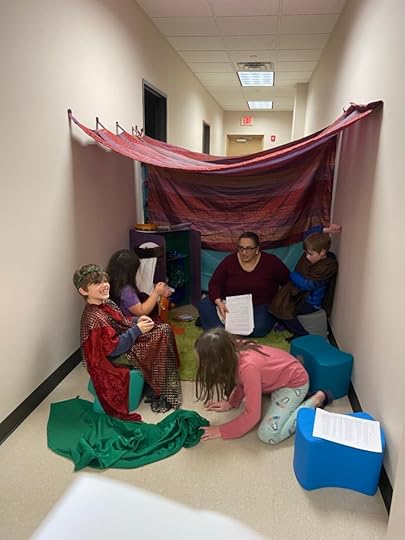
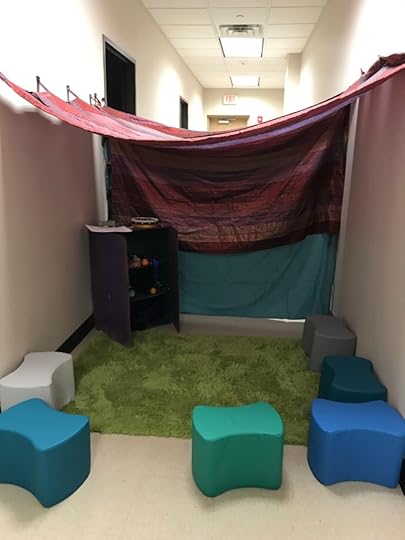 Here’s the set up, with and without the students. See how the tent blocks the flourescents? We set up right outside my classroom (St. HIlda’s Class) and pulled the rug and foam seats from their usual spot in my class into the hall. The cabinet was in a corner where I could reach items out of it to go along with the play.
SENSORY ANCHOR PROPS
Since I wrote a little play with a mini-skit format, I built a small cabinet from a recycled shipping box, tape, and paint to go with it and serve as Brigid’s father’s storeroom. I filled the shelves with a few items from home to represent what would have been luxurious then: honeycomb, oranges, spices in little teabag twists, beeswax candles, a woolen scarf, a child’s kilt, a couple of velvet cloaks, a soft baby blanket, a little jar of lotion that I relabeled Healing Balm, a fancy fish pie, a faux fur wrap, a bag of fake gemstones, and a foam sword. On top of the cabinet, I placed the bodhran (Celtic hand drum) and scripts and songs. We also brought out some of the saint dressup clothes from my classroom for the King to wear.
Before we started the actual play, I told the children about how Brigid was not rich, living with her mother who was a milkmaid, but she was also the daughter of the local chieftain who was like a king in her area. Because of this, she had access to rich dairy products like butter from her mother as well as to the king’s storehouses as one of his children and servants. We passed around the rich spices for everyone to smell, and the children got to hold the jewels, too. Once we had looked at or touched and/or smelled everything in the storehouse, we started the play.
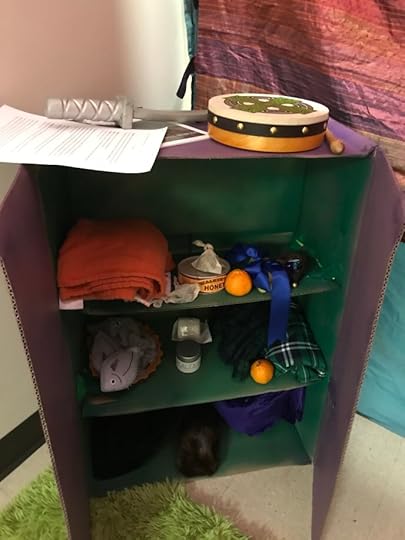 The King’s storehouse
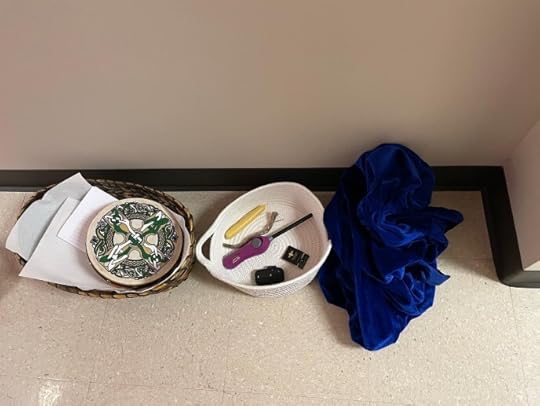 A basket of bread, a cloak, fire-building implements
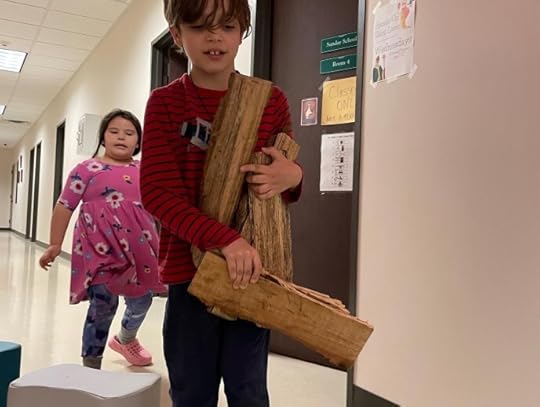 Gathering Firewood in week twoHere you can see the cabinet from week one as well as the sensory anchors from the second week of the lesson, where we built on the first week and added a new activity (see below).
 For the second week, the lesson was still under the tent, still included the song, but the goal shifted a little. I wanted to teach the children about the Benedictive (and Western Rite) value of STABILITY in Brigid’s life. We did this through gathering firewood. My assistants and I spread a small stack of firewood around the Narthex and hallway around the tent. At the beginning of the lesson, I had the children collect the firewood. We stacked it in the middle of our circle. Then I showed them modern firestarting implements (candle lighter, plasma lighter, firestarting waxed rope, matches, a candle [you can add flint and steel if you have it handy]). Then I tucked the basket of firestarters out of reach behind me, since they were not really options back in Brigid’s day. How could we get the fire started?! What if the wood was wet? We discussed how many parts of life depended on fire: cooking food, making medicines, fresh water, heat, light, clean clothes. We NEEDED fire. How would we get it? It turns out that borrowing fire from a neighbor was the best option. When Brigid’s monastery kept an eternal flame for a thousand years in honor of the Light of Christ, they were not only helping people understand a scripture in church. (Western Rite Orthodox read the first part of John’s Gospel every week at the conclusion of Mass, so the children will have heard about the light that shines in the darkness many times.) They lent stability to the hearths in the whole region of Kildare, whose flames could be lit by the monastery fire in a time of need. We took a reverent little field trip next, quietly going up to the steps leading to the Altar. We knelt on the floor near the steps outside the Altar and peeked in. There was a Vigil lamp! We talked about how the priest keeps the light lit in honor of Christ’s presence and to remind us that His light never goes out. The children asked very practical questions about how the light was transfered from one candle to another to keep the flame going. We went back to our area, and I demonstrated the idea of a long wick for lighting candles using Wiki sticks (waxed string toys) that I had on hand. Then I brought out a big loaf of gluten-free sourdough bread (to accommodate the group’s food allergies). We talked again about how the stable fire would lead to food, and everyone was offered the chance to break off chunks of the bread to eat. This was an intentional anchor to link in the children’s memories the Vigil candle and the Holy Bread and Stability and the eternal flame and Brigid’s almsgiving and feeding of the poor.
For a Sunday School follow up, we also pulled out our kinetic sand bin and arranged our wooden houses into the traditional Celtic double monastery (with a separate women’s and men’s monastery nearby one another, but both overseen by the abbess). This encouraged further conversation, as one of the students wanted to turn the infirmary into a jail for theives. I pointed out that it would be incredibly hard to steal anything from Brigid, since she would simply give away anything someone asked for. He was astonished at this idea. He came up with the example of a crown. Would Brigid give away a crown, even though it was worth so much money and also represented power? We acted it out. Brigid didn’t hesitate to hand over the crown. He couldn’t wrap his head around her generosity, so I encouraged him to ponder in the week until our next lesson what could have made Brigid happy with giving away earthly goods.
SINGING (or Making a Joyful Noise!)
Start each return to this lesson (and the ones for the other saints in the first verse, once I get them written!) with song and drum. One of the hallmarks of ancient Western Orthodox Christianity was the way it spread: primarily through songs and poetry and saints’ lives told as epic tales from village to village. By writing songs about the saints and singing them with the lessons, I am working to recover that vital part of WR tradition.
Brigid gave her family riches away,
butter and food and sword
Her generosity showed every day
She served Christ as her Lord
Fire she fed, eternal flame
Shone Christ’s light all around.
Beautiful books, generous souls,
Grew up from Kildare’s ground.
Four saintly friends hymn by summer Kinard, to the tune of “Skye boat song”
If you have a small hand drum or bodhran, have the children play with it. Settle into a steady beat (3/4 time, with a big downbeat on 1: ONE-two-three, ONE-two-three). Then you can start singing. Print out the words for students to follow along. Repeat the first verse as the refrain.
Four Saintly Friends Song (to the tune of the Skye Boat Song) by Summer Kinard
WesternSaintsHymnDownloadACTING OUT THE STORY

Since only half the children were readers on our first time through the skits, I paused and coached the little ones on their parts, which they repeated. Ideally these lessons would be taught so that tweens and teens could help perform the skits, too, with the help of the younger children. Older groups can use the skits as a springboard for more in depth conversations. For instance, as I mentioned above, one of the older students in the second group I taught this to wondered why Brigid would give away such expensive items. That’s a great question. Let your students explore it.
Brigid-PlayDownloadWe haven’t done our final lesson on Brigid, which will be this week in Sunday school, but we are going to work on illuminating manscripts in our classroom scriptorium, revisit the almsgiving skits briefly with the added idea that God’s storehouses are always open to us, and talk about Brigid’s wonderworking so as to show the children about synergy with the Holy Spirit. To show them that faith is a way of not only trusting God but also cooperating with God, we are going to act out trying to do something impossible with and without help. I’m going to play some of this by ear, depending on the students who show up. We have a heavy crash pad in the classroom that can be a prop to show how the children can move it much farther with help, for instance. I will also bring a stencil to help them make a difficult pattern in Scriptorium time, to show how being guided helps us to do much more than we could alone. I don’t want the children to think of Brigid as magic, that is, as someone who can just make things happen on her own, but I also don’t want them to think of her as a channel/someone through Whom God acts on His own. Both of those are errors. God works with us and wants us to cooperate with Him, to combine our love, our will, our strength, our hearts, and our minds with His. Every part of the life of faith with God is a both/and of God and humans, from His covenant love for us (and ours for Him and other people) to our prayers and even faith itself. This reality reflects the fully human and fully divine nature of Christ, whose human and divine wills cooperated wholly in perfect love. That’s our goal in the Christian life, not self-obliteration or attempting to channel God, and not making idols of the power God works through us. God’s storehouses don’t open on a formula; they’re more than is possible through not only the Divine will but also through the love of God in the Church, the extra muchness that comes from working together with God. I’ll update this post once we have played out the lesson.
WHOLE LIFE TIE-IN
My family loves to take walks in the forest at our local state park. When we went on Saturday, I took everyone to a quiet part of the forest that I call The Cathedral of the Forest. It’s a part of the path surrounded by very old oak trees for about 100 meters. There’s a bee tree somewhere nearby, and the air is sweet with beeswax. I walked the children there and asked them to be quiet for a moment to feel the change in the air under the canopy of the old trees. As we walked slowly through the Cathedral of the Forest, I reminded them of St. Brigid’s monastery, Kildare, which means church of the oaks. We were in our forest, and she was in hers, but for a few minutes we could feel the kinship of being under trees that gave sacred shelter. “Don’t forget, children. The roots of the Cross of Christ feed the roots of the trees of all the forests.” Sensory Anchor teaching works everywhere because it’s how God Incarnate, the God who made the world, wants to teach us!
Further Reading: Three of today’s saints (Perpetua, Felicity, and Brigid) are featured in the board book God’s Saintly Friends by Kathryn Reetzke, Art by Abigail Holt. Check it out! (Notice: I am the owner of Park End Books, which published this book.)
 This board book goes great with the theme of the song and includes St. Brigid and St. Patrick.
The post Get to Know St. Brigid appeared first on Summer Kinard.
January 16, 2022
Walk With Me
I had forgotten that I love to find places to sing in the wilderness. As a child, I would wander deep into the forest and sing country tunes to my dog. In the lean years when I had no woods, I sang in the garage or under my breath as I panted up and down my street, speedwalking in the soupy air. In college I would sing in the cathedral-proportioned chapel, the next closest thing to a forest, when the deep night made the pillars creak in the wind. I sang to my husband on the glacier lake where we honeymooned. I hummed motets all through the botanical gardens I hiked twice a day in grad school. I sang by the clear brown streams at scenic overlooks in Scotland and in the ruins of abbeys and to the seals on Iona. When my children were smaller, I would whisk them to the forest paths of the museum and sing them the little tunes I made up for them about peripatetic toddlers and whichever curious animals were nearest. Then deadlines and stress and singing under my breath in grocery stores, the eccentric lady humming Madame Butterfly in Costco or harmonizing with the butter cooler at the corner store. As soon as I could sit up after getting Covid in 2020, I sang breathless lullabies to my mom on Facebook live. Recuperating was a kind of wilderness. Then, gradually, as breathlessness turned to exhaustion and exhaustion turned into aches and aches turned into slow progress, I began to miss the old ways.
That’s when I found myself back in the forest. At first I could hardly walk a mile. My first flirtations with this wildness were trials of my meager endurance after long illness. I woud walk a little and then crash for weeks. But something came alive in me during those short, painful circuits of the shortest paths. I began to thrive on the beauty and ferocity of the land, the overwhelming details that calmed my hyper-perceptive senses. In late August, I took my first solo hike, pushing myself to walk for 45 minutes. I made it about two miles.
It seemed like a coincidence at the time, but now I know it wasn’t, that I woke up the morning after that first hike to feel a lifelong shame lift off of me. For forty years I had struggled with a sense of being bad, damaged, defective, after incidents of severe abuse when I was four. I had fought my way through and out and to and for–through hell, out of it, to safety and stability and deep roots, and for healing–but could not feel that I was loveable as I was. When the illusion finally broke that morning, I laughed so hard that I had to lie down. It seemed like divine good humor to make me wait forty years to hear something God had been saying all along. That it’s me as I am who God loves, my salty personality, my autistic inability to resist deep diving when I learn, my loudness and transparency and unsettling quiet and intensity. Whatever it is about me, the things I know and don’t know, they’re part of how we love each other, God and I.
Most of my autumn was wasted with coughing. Then my family got the cough. I did my best to tend them, but I found that I needed to slip away to the woods once or twice a week in order to be present to them. The woods healed my battered attention, replenishing the calm I need to navigate the loud world of other people. I would envision my favorite trees when I reached for quiet in my mind. But sickness kept sweeping through the family, wave after wave until we decided to stay home from everything for the weeks around Christmas. Everything except the wilderness.
For two weeks, I hiked every day that wasn’t soaking with rain. I took the children half the time, and the other times I went alone to let the wind clear out my illusions. My hearing transformed in the roar of the evening breezes over the lakes. Delight in the call of birds can fill a belly. When I would get back to the car and around people, they were no longer noisome. The falling night was filled with the songs of speaking confidantes, the echoes of a laugh that makes fruit ripen, the solidity of families cooking under trees.
Each day a different path, each day the certainty that the roots of the Cross were feeding the whole underground life of the forest. I switched to only three hikes a week but made my solo hikes longer. A map grew in my senses with landmarks like, “the deepest quiet” and “sweetest air.” I know where the deer are, where the biggest alligator can be spotted on bright cold days, the copses and clusters of trees that must be ready-made holy places, the haunts of cardinals, the patch of new trees that makes the playground of those small blue gray finches, and the part of the stream filled with giant purplish snails. I’ve always had a mapping brain, the kind that remembers places after one visit, and I love to test my maps with return visits. Yes, these trees still smell like beeswax. Yes, the earth is cool and quiet here. Yes, this is where the oldest trees stand sentry to memories that smell like grief, of incense and the bite of life.
There’s a change that comes over me as I hike. I spend the first mile unlearning the stiffness of walking around people. My hips ache until I walk so fast that they’re released from their polite candences. I know when my natural walk has returned when I feel the muscles in my back and belly come to life. I feel my hips swinging the way they’re meant to do, the way I can only let them move when no one is behind me. I take on a gait like the Wife of Bath’s horse, confident and sturdy, burly enough for pilgrimage.
Now I make good time, because I can move freely to the places I love. I get to my favorite path between a lake and swamp, favored not because it’s more beautiful but because I can go ten minutes or more without passing anyone. I sing Dvorak’s Biblcial Songs (God is My Shepherd, Hear My Prayer, O Lord, I Will Sing New Songs). I sing carols and hymns and art songs. I sing whatever pattern comes to mind. Then it’s up the hill in silence, and I try to put my conversation with God into words.
Four miles into a hike, in the part of the forest that smells like honey (the quietest part), I pray aloud, “What do you want me to know?” I hike around a curve in the path, and there are three deer paused, ears twitched towards me. “I mean you peace,” I whisper. They don’t run away. I repeat my benediction the whole while the path runs along their meadow. They do not raise their tails in alarm. They go back to grazing.
When I get to the end of the path, I wonder if that’s something else I ought to know about myself. Here’s what has made me say thank you aloud on this hike: that God granted my prayer that I would rather be a doorkeeper in the house of the Lord than to dwell in the tents of wickedness, because I’ve held keys in all the churches I’ve been part of in my adult life, that being able to walk without fear is as good as having wings (something Teresa of Avila said in Interior Castle that I used to misunderstand), that there must be a bee tree in the sweetest air of the forest, or else I am associating beeswax with holiness out of habit, and the place is just one that God likes to visit, that the sun is so golden that I think someone has painted the dock up ahead until I’m right upon it, that the day is so beautiful that the moon showed up early to be able to witness it. My feet ache as I enter the last half mile of the journey. I think, “This is the pain of coming back alive.” It rhymes with the sweet air and sadness and mystery of the copses and cathedrals of the forest. Suddenly the air is pink with the last rays of sun, and I recall, “Mercy and truth are met together; righteousness and peace have kissed each other.” I try to wrap my head around the words, but they’re inseparable from the calls of waterfowl and the brightening moon and the gold-pink sunset. They aren’t balanced, exactly, but I know it’s all part of the answer. What do I need to know? “Walk with me.”
The post Walk With Me appeared first on Summer Kinard.
December 21, 2021
Gaming for Heaven
The sunset was so pink and sweet that it hurt my teeth to look at it. My shoulders were hunched against the pressing dark of grief and exhaustion and unmet expectations. My body was coming unmoored from its patterns of health and sleep and being able to digest food. I could pick seeds. I could make bread. I could tuck in children, but everything else my hands forgot. My mind recoiled at the prospect of interacting with people outside my household. I ordered in our weird exotic groceries, our gluten free foods, even though I used to avoid deliveries from the thought of a shopper rolling their eyes and mocking us for avoiding “normal” foods that allergies had turned into poisons.
Last weekend I went to a bonfire with my extended family and told a friend there who’s an addict that I understood what she meant. There’s a way religion can be an addiction, too. Sometimes piety is just a game we play instead of loving. It’s so easy to try to get God’s approval instead of allowing that we’re loved as we are. Tomes are written about how to play that game, but it’s not a game when you get down to it. At some point you either walk away from that nonsense and think you’ve lost your faith, or you find faith by sitting with God through nights where God won’t leave you. You learn to feel all your pain and ask all your forbidden questions and admit you can’t fix the hateful things about you. It’s that or become a bitter harridan tearing people down for imagined transgressions. Or you become a professional, doling out God’s gifts on a schedule while being above taking cuts for yourself. Or you salve the stubs where your wings ought to have been with sex or substances or being an insufferable bore.
I like to walk in swamps where the water and animals on either side of the path will kill you. It’s honest work to walk like that. It’s the way faith is, because staying on the path isn’t easy like you’d think it would be. Stay on the path and walk with Powers too ancient to name, while the birds startle over your head in recognition of what your weak heart refuses to see. Walk by faith and not by sight, we’re told, but if you do it, you won’t find relief in it. There’s always too much there on a path, too many beauties to take in, too much quiet and acceptance, which feels to a gamer like giving up.
I get so tired of players that I turn sour on regular people with stars in their eyes who try to say nice things about going to heaven. “Why would I want to go there for?” I almost holler. Can’t they see the river I’m walking in? The world is already bright with more than I can bear of God. I resent people who put Heaven on my to-do list when there’s all this to tend to already.
Look, I know it sounds fanciful and nice to y’all noobs. Heaven so rich and warm and friendly, waiting to reward the high scorers when “Game Over” flashes on their screens. But I already have it. The keys to the storehouses were already in the locks when I got there, and all I had to do was watch them open and get to work sharing out everything I found there. (There’s no end to that House, and the work will still be undone when I’m done with my part in it.) Maybe my weak eyes will get used to the brightness so I can look towards the sun that y’all seem to want to seek. But I’m too tired to look with you. I’m spoilt for that kind of hunting. I’ve grown used to being led, to watching for the dim light of the Way at my feet, no matter how dark everything else gets.
I can hear the click of your pearls as you clutch them. “Isn’t she a theologian? Why doesn’t she want to go to heaven?” I didn’t say I didn’t want to go. I said I’m too tired to bother with looking for it. I reckon that if I get there, I’ll be carried in like everyone else. It won’t be as a reward. I don’t care for chasing approval anymore. What I want is to walk with God, and if heaven’s where we wind up, fine.
When my dad laid dying nine and a half years ago, I told him that he didn’t need to worry about the Judgment, because there would be a thumb on the scale when his life was weighed. That thumb is grace. I forgave him, and I told him truthfully that I would pester God all my days to make sure my dad always had grace tipping the scales for him. Look, that’s as far as I go in gaming for heaven. I will supply the cheat codes for my fellow sinners. I will talk to God about you as I walk this narrow trail, and I’ll put in a word for mercy.
What else do I need to tell you tonight? I’m behind on all my deadlines. I haven’t been able to shake this cold out of my household for two months now. Sickness and exhaustion and recycling are all clogging up the works. But there’s a tree in the front room with an angel on it, and there are seeds waiting to be scattered on Christmas. I am wrapping gifts that will provide hours of fun and learning. I have hugged the necks of my dear sweet aunties and uncles and laughed at my cousins’ dark humor and bared my heart at a bonfire alongside a friend who needs to know what I have learned. The path to heaven is wherever you are, because heaven is wherever God is. It’s not a glamorous truth or a pretty one. But it holds up to fire and water and teeth and tears. It won’t be overcome by the darkness.
The post Gaming for Heaven appeared first on Summer Kinard.
December 17, 2021
My 7 Favorite Accessibility Products This Year
If you follow me on Instagram, you’ll hear me rave about new products that make my life easier as an autistic person and parent of autistic children. A few people have messaged me over the past few months wondering where they can find the items I have mentioned in my posts. Here, I have gathered an Amazon affiliate linked list of my favorite products that made life easier to manage for me this year.
Accessible FoodsAlpine Smart Instant Coffee That Actually Tastes Good Sometimes when I try new things, like taking longer hikes by myself, I get a little more tired afterwards than I expect. I carry a few packets of this instant coffee & coconut creamer with me these days, and it’s come in handy to help me self-regulate when I’m learning my new limits. I’ve made it with cold water with no trouble. I usually hate instant coffee, but this stuff lives up to its name and doesn’t taste gross.
Swoffle Gluten-free Stroop Waffles These have become a favorite snack for a couple of members of my family. The link is for the vanilla flavor, but they also have great caramel and dark chocolate versions. I take these in my backpack when we go for hikes, and they help with the typical autistic hypoglycemia that some of my family experiences.
Visual & Tactile StimsKaliedoscopic Puzzle Flippers This is one type that happens to be in stock and lower priced, but we also have THESE and THESE. What I love about these flippers is that they’re fun for people who need a visual stim, a break from looking at the screen, or just a focal point while talking to people in a group, AND they give you something to do with your hands that’s satisfying. I even use them to help talk with kids about the weird ways that angelic movement is described in the Bible! We keep these on hand in our front room sensory bin and in my Sunday school classroom.
Spinners with Included Silicone Bubble Pops I’ve bought several sets of these to use for calm down stations around the house, for me to use while I’m muted in Zoom meetings, and to talk about angels and the dancing-within of God in Sunday school. As with the puzzle flippers, the combined visual and tactile stim options make them a lot better tools for sensory integration and self-regulation.
Stainless Steel Rosary Spinner Rings These unobtrusive rings are great for when you want to self-regulate without drawing attention to yourself. One of my children and I use them often in church services. Church is a difficult place sensorily because other people aren’t predictable and because there are sensory-nightmare flourescent lights. (Seriously, y’all, please switch to LEDs when you can. Flourescents are evil to autistic people. The flickering and noise are very difficult to ignore.) These rings are great, because we can use them to pray (usually by doing a full spin per prayer rather than trying to focus on one bead at a time) and to focus through weird social/people making eye contact moments like the line for Communion.
Sensory Strings These silicone stretchies are a family and guest favorite. There are so many ways to play with them and teach with them. I buy a few new sets every year to replace ones we’ve given away or played with so hard that they finally snap (not an easy feat!).
Crayola Model Magic Classpack I use this gluten-free moldable clay with the kids for lots of projects. It won’t go smoothly through Play-Doh tools, but it’s great for making shapes, including people. We often use it to focus in church by making tiny round balls to fit into each bump of a silicone popper toy. Then we press each clay ball down while saying, “Lord, have mercy,” for each one. It’s a great way to teach the Jesus Prayer and other prayers that repeat along prayer ropes or in Divine Liturgy or Mass.
I hope you’ll consider adding some of these tools into your daily or classroom routines next year. They’ve made a strong positive difference in our lives this year! What are some of your favorite tools that you discovered this year?
This post includes Amazon Affiliate links to help you find products easily. If you shop through any of the links, I will receive a small financial compensation for referring you to the site, with no additional charges to you.
The post My 7 Favorite Accessibility Products This Year appeared first on Summer Kinard.