Summer Kinard's Blog, page 30
January 3, 2013
The Jam Spoon
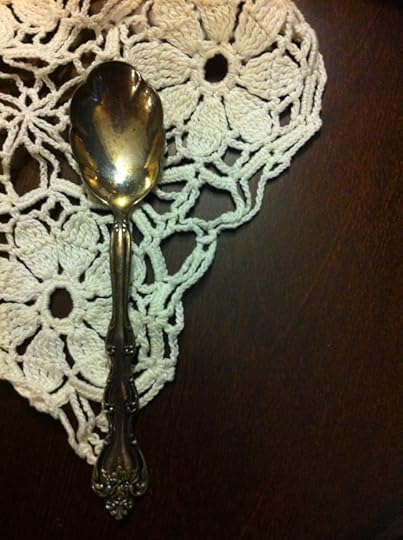
This is our jam spoon. A certain little girl loves to gaze at it.
I grew up in a family with little means. Our furniture was secondhand and practical, but not what you would call elegant. Even the desk my parents bought me when I was six, which I loved, was meant for function and sturdiness, not beauty. I had two beautiful things in my home as a child: a pretty bedspread, white printed with small pink clover flowers, and my parents’ jam spoon.
When I was little, it was off limits. I would sneak into the kitchen when my mom was hanging out the wash, open the flatware drawer, pull it out, and watch my reflection in its silver scalloped bowl. When a grown-up approached, I would drop it back into the drawer, shut it, and walk away. I have always been sensitive, but I lived with parents who tended toward loudness and humbler home life. Like a magpie, but without the theft, I would sneak beauty and store it away, to keep me through the long days of austerity and overstimulation.
This week, my little daughter found our jam spoon. It’s not the one I grew up with, but it’s one of the first things I bought for our household when we were newlyweds. I sympathized with her sense of awe as she took in the scallops, the tarnished silver that was still so much brighter than ordinary metals. Our home is chock full of beauty, but the jam spoon still impresses. I suppose some lovely objects can hold their own in any environment.



December 28, 2012
Spiritual But Also Religious
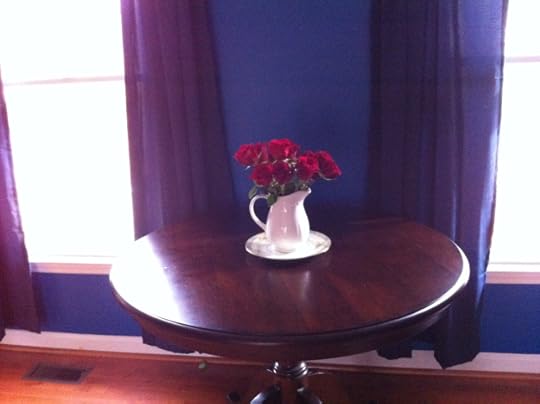
We have roses for the table every week.
It’s trendy these days to call oneself “spiritual but not religious.” I’m guessing the persons espousing such a designation have a two-fold goal: 1) To align themselves with the insights available to those who attend churches and synagogues and temples, and 2) To distance themselves from those tendencies and practices in formal religions that seem to them superfluous.
As a student of religion for some {mumbled} years, okay, since I majored in religion in college starting some 17 years ago, I have a very hard time letting the “SBNR” moniker go unchallenged. It’s not that I think people cannot be spiritual without religion or that I think that religious people cannot be spiritual. I just don’t believe that anyone is non-religious.
Each of us is a creature of habit. Our daily lives are rife with rituals. Therapists tell us to look out for places where we can self-soothe our senses. Usually these little soothing practices are regularized: going for walks, drinking favorite beverages, taking baths or showers, lighting candles, gardening, cooking, doing housework, writing, reading.
You may ask me how I come to think that such daily practices are religious. If they are not religious, what is? What does a faith mean, if it has no place among bathtubs and cooking pots? Religion is washing stinky feet, pouring a cup until it overflows, and feeding all comers. You find it in gardens and bars and bookshops.
One of my practices as a writer is to find these places where faith makes common things holy, to highlight the way we can be healed and healing through simple acts. There’s no such thing as a spirituality that is not practiced. It’s a figment of the imagination that has no place in life or fiction.
[Do the formal parts of religion matter as well? Of course. They are the source waters that irrigate the fields where we live and grow. But the habits in our daily lives are the floodgates and canals. They are no less interesting if they rely only on rain.]
What are the daily habits that sustain you? Do they connect with your faith in God or humans?


December 27, 2012
Who is that Masked Woman?
Lucha libre plays an important part in my forthcoming novel, Can’t Buy Me Love. Durham, North Carolina, where the book is set and I live, is home to a wonderful group of female Mexican wrestlers known as the Luchadoras. When I went to the match recently, the idea struck me that a replica of the wrestling mask used by a character in the novel would be a wonderful promotional item for the book. If someone could make the mask, I could raffle it off for a local charity. I made inquiries and was connected with Jennifer Collins, a local custom handbag and luchador(a) mask designer. {Visit her site here.}
[image error]
[image error]
[image error]
I contacted Jennifer, and she agreed to design the mask per the description in the book. We met recently to go over the sample, and wow! This mask is going to be so cool!
When you write a book, you want the characters to come alive in the readers’ minds. It’s very fun to have parts of the book made tangible. The luchadora mask that the heroine wears is a perfect vector for passing between the boundaries of real and imaginary. We’ll use the mask in book promotion, and it will make a real difference in the lives of the children who will benefit from its sale.
The book launch is currently set for June 16 at Fullsteam Brewery in Durham, NC. We’ll raffle off the mask at the launch party, with all proceeds going to NC FIELD, an organization that advocates for farmworkers, especially children who must work the fields in order for their families to get by. More details to follow closer to the date. I hope you can join us!


December 26, 2012
Social Climbing: The Perspective from the Wardrobe
Working Class:
White teeshirts, jeans, sneakers. “Nice” is a sports jersey or a graphic tee. You own one skirt, or a dress. Your flats may be held together with tape, or you stuff toilet tissue into the toes in order to make a borrowed pair fit.
Nobody pays you much attention.
Lower Middle Class:
You wear polos tucked into khakis or jeans, with a belt. Your shoes may be boat shoes or Keds. You have more than one dress or tie. People mistake you for someone who works there. Maybe you are a secretary, or maybe you just look like one. Don’t wear a red shirt to Target, if you want to get through the aisles without being asked where to find the pepper mills.
Middle Class:
You shop at the mall or other places beyond your means. You feel a strong need to buy new shoes and jackets every year. Your hoodies or graphic tees bear the name of mall stores if you are young, sporting goods companies if you are older. Your jeans are of the trendy variety. Your shoes are scarcely worn in before you think they seem trashy and discard them at the back of the closet.
Upper Middle Class/ Intellectual Set:
You buy a good quality blazer, nice tops and jeans, sturdy shoes, and wear them until they die. No one questions your wealth or status; it’s in your carriage rather than your clothes, though of course the poor could not afford your clothes. Your wardrobe lasts years and is peppered with good accessories. Your earrings are real. When you decide to make a statement, it is understated.
Upper Class:
People smell your money before they see you. You smell expensive, and your gleaming clothing only confirms what everyone already knows. They are not looking at your clothes. They are looking at your eyes or your hand, wondering if you come in peace.