Summer Kinard's Blog, page 22
October 27, 2014
Inside Story: The Cover Image
Well, the day is here! The Salvation of Jeffrey Lapin is live on Kindle and CreateSpace and will be available soon wherever books are sold. To celebrate, this week my posts will give you an inside look at the creation of the book and the story elements. First up, the cover!

The Salvation of Jeffrey Lapin debuted at #8 in Christian Allegory on Amazon!
I debated for awhile about which aspect of the book to highlight. After all, here’s the description:
What happens when a vampire gets baptized?
After 125 years of vampirism, Jeffrey Lapin wants to end his life of torment. A failed suicide attempt puts him in touch with Maddy, an Orthodox Christian police officer whose helping hand burns Jeffrey’s skin. Her touch shows him the solution to his problem: he will convert to Orthodoxy and say goodbye to the world when he gets baptized. But Jeffrey’s so focused on dying that he overlooks the first part of baptism: the exorcism. Parted forever from the demon that tormented him, Jeffrey has to learn to live as a Christian, free from the demon but not his own tendencies to mess up.
With compassion and coffee, confession and cake, Jeff’s new Orthodox family teaches him to accept the grace given him to live into true eternal life. Strengthened by new habits of faith, Jeffrey finds a new direction, purpose, and maybe even love.
Fans of The Screwtape Letters and The Sayings of the Desert Fathers will resonate with this story of redemption and love rooted in ancient Christian teachings.
And the description doesn’t even tell you that Mr. Lapin actually breeds rare rabbits! Should I highlight baptism and bunnies?

An early DRAFT of the cover. No one knew what they were seeing.
Um, NO! The cover did not make sense to anyone. Even though I knew that the background image behind the praying bunny was a baptismal font, I had to admit that it didn’t look like much of anything out of context. I briefly debated featuring Cake and Coffee, but that gave the impression of a recipe book and gave no hints as to what the story was about. Next, I tried referencing Jeffrey’s patron saint, St. Martin of Tours:

Is this a history book? What’s going on with the rabbit?
Again, NO! There was no indication whatsoever that my main character has a super dark past — He’s been a vampire for 125 years! — and most people wouldn’t be familiar enough with saint’s lives to understand that the panel of engravings (see the pin on my Jeff and Maddy Pinterest Board for the source) was showing St. Martin’s progression in salvation. I was at a loss. I needed something dramatic that referenced spiritual warfare. So I asked my author friends for help. If you think writing is a solitary venture, you are partly correct. We do spend hours upon hours writing alone. But it’s impossible to underestimate the help and great advice one receives from fellow authors! After chatting with a wonderful Christian romance author, I realized that the perfect image was right in my own home!

This icon of Archangel Michael was written by my husband in May 2012.
I grabbed the candle burning in front of our iconostasis (prayer station) and snapped a few photos of Archangel Michael by candlelight. Perfect! Archangel Michael is often depicted slaying the devil. He is the chief warrior of the heavenly hosts. Plus, even though my book is not gory, there is something gothic about any vampire story. The rich, deep colors of this handwritten icon conveyed the perfect air of mystery, spiritual power, and menace that I needed to give readers a “feel” for the story on the cover. Bonus: with my husband’s writing (painting) on the cover, this book was truly a family venture!
I hope you enjoyed this inside look at the making of The Salvation of Jeffrey Lapin. Join me tomorrow for the inside story on Holy Cake!
Note: This post contains affiliate links.



October 16, 2014
Why Salvation Requires Feasts

From the coming soon! Christian paranormal novel, The Salvation of Jeffrey Lapin by Summer Kinard.


October 9, 2014
Rising From the Dead: A Christian Response to Zombies
Rising From the Dead: Toward a Christian Response to Zombies
Zombies, which almost never occur in the singular, are hoards of undead corpses that stalk the living in order to bite and/or eat them. What should Christians, we followers of the only person to have conquered death and come back totally alive, think about zombies? Are they a good starting point for reminding ourselves about the resurrection, or are they a perversion of all that is holy?
“Christ is risen from the dead, trampling down death by death, and upon those in the tombs, bestowing life.” –Ancient Christian Easter anthem
I believe that zombies manifest evil and should not be embraced by thoughtful Christians. There is the obvious reason: these zombies make rising from the dead seem scary, instead of the sort of thing to hope for. But the problems with zombies are much deeper. They go against the faith by rejecting the iconographic center of the Incarnate Christ, and they go against the faith by manifesting the violence that Christ destroyed by his cross and resurrection.
“He is the image of the invisible God.” Colossians 1:15 (NRSV)
The ancient and ongoing practice of Christian iconography includes a striking image called “The Resurrection,” or sometimes, “The Harrowing of Hell.” In it, Christ stands triumphant and radiant on the broken gates of death and hell, not only risen, but also pulling up out of the depths all of the faithful, represented in Adam and Eve. In this image, we see the hope of the resurrection made plain, not only in the restoration of life, but in the making of peace between all humans, including the ones who first started fighting with one another. The iconographic body is glorified, reconciling, full of life, and triumphing through suffering. Christ, as the ancient anthem proclaims, is risen from the dead, trampling down death by death, and upon those in the tombs, bestowing life. That life is a life of peace.

An icon of the Resurrection, sometimes called “The Harrowing of Hell,” with Christ having broken down the gates to death and hell. He is pulling up Adam and Eve after him.
Zombies, in contrast to the iconographic body, are the ultimate manifestation of the pornographic body. They are dead in sin, and they exist solely to chase after their selfish, deadly desires. In the pornographic captivity of bodies in service to perverse desires, the zombie use of bodies is necessarily violent. Zombies come out of tombs, but they do not escape their service to death and deadliness. Their rising from the grave is not part of the reign of the peace of Christ. Zombies are what we envision when we fail to imagine a world without the domination of violence. The zombie resurrection body cannot experience Christ’s peace.
When Athanasius sought to explain why God became human, he got practical. The cross and resurrection of Jesus accomplished an end to the reign of demons and of violence. For Athanasius, one of the obvious proofs that God has saved us is the way Christians were set on a non-violent path when they converted.
“But when they hear the teaching of Christ, forthwith they turn from fighting to farming, and instead of arming themselves with swords extend their hands in prayer.” -On the Incarnation 8.52
This turn toward peaceable living is a mark of Christ’s victory over the demons, whose weakness was what inspired violence in the first place. The demons feared that “if [humans] ceased from mutual strife, they would turn to attack the daemons themselves.” (On the Incarnation 8.52) Christians have so given up violence, Athanasius says, that “they make light even of death itself, and become martyrs of Christ.” Martyrdom is the ultimate manifestation of the victory of Christ’s resurrection, for martyrs witness peacefully to the life of Christ in their willingness to die in confidence of Christ’s resurrection.
Christians: The Anti-Zombies
We have these two spectrums where zombies oppose Christians: the Iconographic Body of Christ versus the Pornographic bodies of zombies, and the Peaceful body of Martyrs versus the Violent bodies of zombies. Zombies are precisely the result of failed Christian witness (martyrdom). Zombies are the enslaved bodies that Christians have failed to free.
If Christians do not live as though Christ’s death and resurrection have opened the reign of peace, the world has no way to think beyond zombies.
If we are just as violent as everyone else, who will believe that “Christ is risen from the dead, trampling down death by death”? The very words of the hymn demonstrate the victorious peace of God, who made a way of reconciliation in his body, and conquered death with his death, as opposed to further violence.
Here is where our Christian cultural imagination has been most co-opted by the demonic: while no one would think of zombies apart from hoardes, many think of Christians as individuals. Yet, Christians do not occur in the singular. Our identity is precisely bound up in participation in Christ through sacraments, faithful service, virtues, and love for God and neighbor. Zombies infect, but Christians sanctify. We do not fight the pornographic, violent imagination that inspires zombies by engaging it on its own terms. We do not try to bat away the fear of death by wielding guns and other weapons of destruction. Nor do we attempt to use zombies to educate the undiscipled about resurrection. Rather, we must as communities of Christians, members of one body of Christ, act as though we believe that Christ has truly risen from the dead and bestowed life on those in the tombs.
If Christians do not reclaim the way we imagine human bodies, the problem is even worse than zombies. Pornographic bodies are slaves to misguided passions, violence, and will to power over others. Christ’s body, our model, is triumphant even in suffering, humble, and virtuous. It is a body strengthened by discipline and hope, that is ruled by love rather than lust. What we lose if we lose the battle for imagining the body is not just a culture war; it’s the claim for salvation itself. After all, it is in the body, even the body in the tomb, that we meet and experience God and so are given life.
Reference: On the Incarnation. St. Athanasius. Crestwood, NY: St. Vladimir’s Seminary Press, 2000.
Summer Kinard holds an M.Div. and Th.M. from Duke Divinity School. She lives and writes in Durham, North Carolina. Her first novel, Can’t Buy Me Love (Light Messages, 2013) is a love story of God making a way in the life of a freegan with a troubled past. Her first paranormal Christian novel, The Salvation of Jeffrey Lapin, comes out later this month.


October 4, 2014
Teaching Kids to Write
I firmly believe that children do not have to sit still in order to learn. (That’s one of the reasons we homeschool.) This month, I’m teaching a group of 8-11 year olds how to write creatively as my contribution to our homeschool co-op. I don’t have parent reviews up yet, but I thought I’d pop over here between writing my soon to be released next novel (The Salvation of Jeffrey Lapin) to let you know that I’ve published a short curriculum I’ll use for my elementary age creative writing group. Check it out!
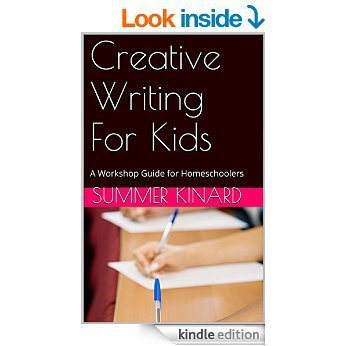
Available for 99¢ on Kindle and part of the Kindle Lending Library.
I like to over-prepare in case I wind up with a heavy imbalance of visual/audio/kinetic learners. You’ll see that these methods for getting started play to a wide variety of learning styles. There’s even a very important section on how to critique another writer’s work – one that I wish EVERYONE would read and apply. I hope this little booklet helps some of you in your homeschool or regular school groups! Happy writing!


September 29, 2014
Singer’s Circle Concert
When it rains, it pours. Not only am I pushing to get my next book out in just 3 weeks (!), but I’ve been keeping busy on the music front, too. I have spent the past six weeks learning music for a concert with my local classical singing group, Singer’s Circle. We had the concert yesterday afternoon at the recital hall in Durham’s Piano & Organ Distributors. Here’s a little sample of the concert! Enjoy.
Click player to hear, “In Questa Reggia” from Turandot, performed by Summer Kinard with Philip VanLidth DeJeude, accompanied by Ariadna Nacianceno Ravelo, September 28,2014, Singer’s Circle Concert, Durham, North Carolina.
https://writinglikeamother.files.wordpress.com/2014/09/in-questa-reggia-summer-kinard.mp3

Forgot to take photos at the concert, but I did my usual kitchen sink makeup check selfie. Just imagine me with red lipstick and more loudness.


September 23, 2014
Coming Soon! Cover Reveal.
Announcing my next book, coming in October to an eReader near you!
The Salvation of Jeffrey Lapin, a paranormal Christian novel.

The Salvation of Jeffrey Lapin. Christian paranormal novel coming October 2014 from Summer Kinard.
What happens when a vampire gets baptized?
After 125 years of vampirism, Jeffrey Lapin wants to end his life of torment. A failed suicide attempt puts him in touch with police officer Maddy, an Orthodox Christian whose helping hand burns Jeffrey’s skin. He finally lights on the solution to his problem: he will convert to Orthodoxy and say goodbye to the world in a blaze of smoke when he gets baptized. Unfortunately for his plan, Jeffrey is so focused on dying that he fails to grasp the important first part of baptism: the exorcism. Parted forever from the demon that bound him for so long, Jeffrey has to learn to live as a Christian, free from the demon but not his own bad habits. Can his godfather, his priest, and his friend Maddy help Jeffrey accept the grace that has been given to him to be transformed and find true eternal life?
Fans of The Screwtape Letters and The Sayings of the Desert Fathers will resonate with this story of spiritual warfare informed by ancient Christian customs.
Watch this space for release information and a free giveaway!


September 22, 2014
Self Esteem and Other Hindrances
I used to feel terrible about not having self esteem. Then I decided that since I was doing so well without it, maybe it wasn’t so important. Like the ideal of a magazine-worthy home decor, I jettisoned the goal of having self-esteem around about the time I had my second child.
The irony of trying to have self esteem when one lacks it is that it makes one feel terrible for not having it.
Still, I only recently went public with my lack of shame about the cheerios that stick in the corners of my home, and it’s only been about a week since I decided to ‘fess up about not having self esteem.

Gina Lamm is an immensely talented romance author. We are in the same RWA chapter, Heart of Carolina Romance Writers.
Most of the creative people I know suffer from intermittent profound doubts (see above, or ask any creative person ever), and I’m starting to think that maybe that’s a good thing. If we don’t hinder ourselves with guilt over not being confident and feeling great about ourselves, we are free to get on with our work. The problem, in other words, is not lack of self esteem, but fighting for self esteem when it’s actually useless to a productive life, creative and otherwise.

What makes a Christian writer? Relying on God’s mercy. Today on Writing Like a Mother.
But there’s an uglier side to self esteem that I only recently discovered. You know how Christian texts warn against “vainglory”? Guess another translation for that term. Yep. Self esteem is vainglory. As Thomas Buchanan points out on a post on Pravmir.com, the Greek word for vainglory or self-esteem is kenodoxia, or empty glory; as he says, “it carries with it the senses of vanity, conceit, and empty ambition.” {Go read the article.} It’s not long but has a lot of depth. Turns out, Cassian (among other early Christians) was deeply wary of self-esteem and its detrimental effects on Christian life.
Oh? And insider tip: Self-Esteem is a Demon.
I remember reading the writings of Evagrius Ponticus (EP) in graduate school. EP was eloquent about vainglory being the hardest demon to overcome, because when you have defeated every other foe and vice, Vainglory/Self Esteem rushes forward to congratulate you on doing such a great job. Sigh. It’s an ongoing trial for Christians throughout their lives.
Which means, even though I thought I lacked self esteem, all I lacked was admiration for it. Now that I understand better what it is, I think the task is clear.
We must not only reject the idea that self esteem is necessary, but fight it tooth and nail so that it does not rob us of what really matters.
Because, if I’m sitting by congratulating myself for doing something well, or feeling like a long suffering heroine for being dumped on, I’m just as bound up and unloving as I was when I sat moping for not thinking much of myself.
The solution to sticky spiritual and psychological issues in Christian life is always God-centered. When you’re fighting a big vice/demon like self esteem, the way to get back on target is to ask for God’s help. That’s where the Church steps in to help us out of the esteem cycle. We have been given an easy prayer that can be prayed in the space of a breath.
Lord Jesus Christ, Son of God, have mercy on me, a sinner.
We can be fooled so easily into any kind of vainglory. But if we ask for help and mercy, God always gives it.
Awareness of God’s mercy as our only grounding and creative principle is the heart of what makes Christian writers’ work “Christian.” We don’t always write explicitly about God or faith. Many of us write about love stories or mysteries or adventures or fantasies; we often follow the lives of characters for whom God talk would be foreign. But if we follow the heart of mercy, we write faithfully.
That’s my take; I would love to hear your thoughts in the comments. What do you think about self esteem? What do you think makes a writer a Christian writer?


September 18, 2014
How to Tell Your Dad He’s Going to Die
How to Tell Your Dad He’s Going to Die: Ancient Christian Prayer as a Model for Saying Goodbye
After fifteen months of my dad’s rapid decline from ALS, I finally got the phone call I dreaded. My stepmother gave me the news that my dad’s organs were failing; the head hospice nurse thought he had only a few days. I bought a plane ticket for the next morning and prayed about what I would do and say to help my father have a good ending. Dad and I had a complicated relationship due to his long-time struggle with alcoholism and past history of abusive behaviors, but he had found balance in his last six or seven years; we had found peace.
Still, I knew that I would carry a burden of memories into his death room, for him and for me. I was the one who had been sober when he had gone on drunken rages decades before, and I would have to find a way to hold those truths in love. With my background in church history and the prayers of lots of friends, I knew I wouldn’t have to work alone. One of the comforts of the Christian tradition is that we never pray alone. I knew that, as the end of my dad’s days drew near, Christians all over the world would be praying.
Perhaps that sense of worldwide community was what opened me to remember the penitential codes from the early and medieval church in those hours while I prepared to go and help my dad die in peace. Christian communities used to have standard practices for how a Christian should repent when they had fallen into serious sins (violence, sexual misconduct, mistreating the poor). Most serious sins required that the person who was repenting – the penitent – be excluded from the most intimate parts of the church services, when the faithful met God in communion. But there was always an exception when someone was on his or her deathbed. Then the community would go to the sick one and extend the forgiveness and full fellowship to them again by giving them communion. The Body and Blood of Christ given in communion was called “the medicine of immortality.” It healed the soul even when the body of the penitent died. It healed the community even when a member was parted from them in death.
I’m not a priest, so I could not take Dad communion, but I could bring him forgiveness and love. As I prayed for guidance, I started recalling the traditional prayers of evening time from the services of Evensong and Compline, with their themes of revelation, welcome, forgiveness, gratitude, protection, light and rest. Evening prayers are always a kind of homecoming, the rekindling of the light of Christ in the faces of our loved ones as we light the evening candles. They remind us that all light harkens to the joyous light of God in the face of Christ, who came as light to the world. I realized that evening prayers provided the perfect model for saying goodbye.

My parents and me, their first Christmas married when I was 2. Dad’s ALS was related to his time serving in the Army in the 70s. We had no idea back then what he would go through.
Revelation
Most of the Christian story unfolds at night. A gentle baby was born in a stable under a star, a tomb became a place of life in the hours before dawn, and it was at night that the women went quietly forth to anoint Jesus’ body. The first night with my dad, while he was still responsive, I felt the keen closeness of the God who is not afraid to work in the dark. Through singing, praying, and simple presence, I hoped to be a means for God’s grace to be made evident in that precious time near death.
Welcome
I started on the subject of food. I did not have the holy bread and wine of Communion, but I had a fragrant loaf of brioche, the best-smelling bread I could find. Dad was long past eating by then, but he had always loved food. Mindful of those earlier Christians who set out to heal the penitent at the end, I brought the bread to my dad.
“Smell this,” I said, and I waited till he raised his eyebrows in appreciation. I told him a little about the bread. Then I told him why I brought it. “When the children ask me about what will happen to Grandpa Tony when he dies, I tell them about bread.” Dad frowned in that way that dying people do; they show the grief of leaving. “I know you don’t want to go, Dad, but it’s almost time.” I told him what other relatives had kept from him, but that he must have suspected. His organs were failing, and he was coming to the end. “The reason I tell the children about bread is because Jesus is the bread of heaven. That means you can feast on the presence of God here while we’re still dying, and you won’t be separated from that presence when you die. The bread of heaven connects all of us Christians across time and space, and we will always be together when we eat it.” I told him that the one thing I was sure of with God, is that He never leaves us alone. Then it was time to do the work I had come to do.
Forgiveness
“Dad, I know you grew up with people asking you all the time, ‘If you died today, would you go to heaven?’ and sometimes they used that as a way to imply that you were not a very lovable person. You may not die today, but you will soon, so I’m going to tell you why I brought this bread to you. It’s because heaven has come to you. You don’t have to go to God, because he came to you. He loves you, and I love you, and you are forgiven.” Dad was out of time for avoiding sticky questions, so I plunged right ahead. I named some of the bad things he’d done, some of the experiences that had caused him shame or regret. I’ll not repeat them here, as they have already been sanctified to their final purpose and do not bear repeating for a holy reason. What’s important is what I was moved next to say: “I know you may still feel guilty for some of these things, or that the way people have talked to you about God might have given you the impression that you are going to hell for them. But here’s the secret, Dad: when your soul gets weighed out for justice, there’s a thumb on the scales. The love and forgiveness of God are so huge that there’s nothing they can’t outweigh.”
I told Dad about the parable in the Bible of the pearl of great price, and how the early Christians understood it to mean that God sees us as the pearl. He gave everything to be with us, and the love of God would cover any distance to hold onto my dad right where he was, dead or alive.
Gratitude
I spent the next little while naming the good things Dad had done. I talked about how he had four grown children, seven grandchildren, how he had done his best, and we knew that. Then I told him stories about good times we had together and about the way I live differently because of the skills I learned from him. Over the next days, we who kept watch also thanked God for my dad’s life and even for the painful privilege of being with him as he passed.

My Dad’s decline was rapid, but we were able to have one last summer with him while he could still move around and talk a little. He got to meet my daughter and give my sister away at her wedding. Only a few months after this photo, he had to go on a ventilator to breathe.
Protection
My sister Alyssa, who is a Christian education director at a Catholic parish, brought holy water to sprinkle Dad. I brought some blessed oil given to my husband by an Orthodox monk to anoint his head and hands and feet. We held his hands in ours. With those outward symbols of God’s love and blessing, we prayed for him prayers of blessing and protection from our traditions (Catholic and Episcopalian). The heart of what we prayed for him was from the broad tradition of Christianity – Psalm 139, lines from hymns. We were the women preparing his body for burial, and we were the angels singing him home.
Rest and Light
The next day, my Dad began to drift away. He stopped responding, but we knew he could still hear us. We sang every hymn we could remember that talked about God’s mercy and love. When our memories failed, we consulted online hymnals. We sang all the verses of the great old hymns. That night, before I left to go to my hotel, I sang the spiritual, “Steal Away to Jesus.”
Dad had a seizure a couple of hours later. The next day, he lay still but for the ventilator-assisted breathing, his body hot with fever, his pupils fixed and dilated. The family began to accept that it was time to let him go. I sang him big songs, loud arias, and sat with him and my sister in long stretches of quiet. In the afternoon, when the late sun came into his bedroom window, I opened the blinds. By their light, I sang out the words that had been my informal guide all along, the words of the Compline service which are meant to be prayed just before sleep. The name for Compline comes from the Latin for lying down. I knew this was my dad’s last Compline, his last lying down. I looked up the ancient evening hymn Phos Hilaron – O Gladsome Light – from the Eastern Christian Church and sang it into the prayers. I added the evening hymn Te Lucis Ante Terminum – To You Before the Close of Day – from the Western Christian Church and sang it into the prayers. I added a section of prayers from the Episcopal Book of Common Prayer that are meant to be prayed at the time of death. I wanted Dad to feel the embrace of the church in its Western and Eastern arms as he passed from the world. The final antiphon of Compline is one of simple beauty. Tears streamed down my face as I sang it in the golden light. “Guide us waking, o Lord, and guard us sleeping, that awake we may watch with Christ, and asleep we may rest in peace. Alleluia.”
In the quiet that followed, I watched by Dad’s bedside. I remembered all the stories about the deaths of saints that I read in the course of taking three degrees in religious studies and church history and theology. Saintly deaths usually told out in beautiful visions and holy final words, in acts of creative beauty in the world around them. This was a quiet death of a man who believed in Christ but had not gotten everything figured out before the end. He, like many who approach death on a ventilator, was silent. But as I watched Dad’s chest rise and fall with each puff from the machine, I saw that his death had the essential part in common with the deaths of Saints writ large. He was the recipient, like they, of big grace. The same grace of God extends to big sinners as for big saints. Dad would go into his rest in peace because of that grace.
That night, Dad died just like the songs suggested. He stole away. When we came to his side within an hour after his passing, my sister and I prayed a final prayer of release and blessing. Family who could come, came to say goodbye then. A nurse practitioner came to declare him officially dead. My stepmother spent a few minutes alone with Dad. The funeral home came to take him for preparation. We began to do the work of grief.
Dad’s last months were painful and hard. His history was checkered, his family not always in agreement. But the leave-taking was peaceful in the way one says goodbye to light at the end of any prayerful day. Food is remembered but put away till morning. The light is banked in our hearts. The love of God embraces us like a good rest after a long, long day.
Resources
I hope that my experience of saying goodbye to my dad through the model of the old evening prayers of the church might help others find a way to peaceful leave-taking. If you are called to a loved one’s deathbed, you might not be able to gather a collection of hymnals and prayer books to take with you. But you can use these online resources to help you focus your time around the themes of evening prayer – Revelation, Welcome, Forgiveness, Gratitude, Protection, Light, and Rest. Most hymnals have a section for evening worship, and some have a section devoted to evening prayers. Above all, I hope you take with you an awareness of the unrelenting grace of God who is not afraid of the dark and the prayers of Christians the world over who never cease to pray. My prayers for you will be among them.
The prayers we used for a model:
Online Book of Common Prayer [www.bcponline.org] – Click Daily Office, then Click “An Order for Compline”
Online hymnal resource that you can use from a smart phone:
Hymnary.org [www.hymnary.org] has many of the most used hymnals in different U.S. denominations, including The United Methodist Hymnal and the Episcopal Hymnal 1982, both of which include evening prayers along with hymns.
Some Evening and Big Grace Hymns:
Abide With Me; O Gladsome Light (O Gracious Light); To You Before the Close of Day; Come, O Thou Traveler Unknown; Amazing Grace; Hold to God’s Unchanging Hand; Jesus, Lover of My Soul; O, the Deep, Deep Love of Jesus; The King of Love My Shepherd Is; My Shepherd Shall Supply My Need; I Heard the Voice of Jesus Say; How Great Thou Art; Come, Thou Fount of Every Blessing; Steal Away to Jesus.
–
Summer Kinard holds a B.A. in Religion from Southwestern University and an M.Div. (2003) and Th.M. (Early church history and Theology, 2005) from Duke University Divinity School. Her zany debut novel, Can’t Buy Me Love (Light Messages, 2013), is a story of God’s healing in the life of a lovelorn dumpster diver. She homeschools, writes, and prays in Durham, North Carolina, with her iconographer husband and children.
I originally developed this post for a publication, but it was not Evangelical enough for that audience. I offer it here in hope that our time of hopeful grief will help others saying goodbye to a terminally ill loved one, dealing with complicated relationships, or wanting to find a Christian framework for the hard work of parting.


September 15, 2014
Your Real Smile
I came across this photo when I was scrolling through our photographer’s album from our Orthodox wedding earlier this summer. “It’s my real smile!” I said aloud (because I talk to myself, as one does). I remembered when I was in high school and in my 20s, when I would modify my smile to fit my idea of a more attractive or more polite or restrained image. And I had pity on my former self, because, ha! Look at me being real!

Photo Credit: Pelikan Portraits, 2014. http://www.pelikanportraits.com
Then I started thinking about how real smiles are like real writing. We all know people who have deer in headlights profile pictures meant to disguise their round cheeks. They look fake, but to the insecure, those photos put the subject in a better light than a real smile. In writing, the fake wide-eyed smile looks derivative or pretentious or like it’s trying too hard to be like Twilight. As in profile photos, so in life.

I’m not forcing my eyes open; you’re imagining that.
If you ask an agent what’s selling, they’ll usually warn you not to write in a genre just to try to sell it. That’s because readers, publishers, agents, kids, animals, and some species of plankton, can spot a fake a mile away.
It’s easy to lose your way when you first start writing, because writing is risk taking. The story you need to tell may make you feel exposed. It may make you feel like a weirdo. You may worry that no one will understand, or worse, that they all will, and you won’t look too good for being the one to speak up first and out yourself for knowing such a thing.
Sometimes you’ll have to spread your stories across genres. Sometimes you have to write where no genre has gone before.
At a conference last spring, I met another Orthodox women’s fiction writer. I told her about my plans to start writing fiction with an Orthodox Christian framework, some historical, some modern. We wound up commiserating over the market prejudice against historically attuned forms of Christianity. Most publishers who call themselves “Christian” really mean a strict form of evangelicalism that holds priests, saints, and early and medieval Christianity in deep suspicion — largely because the denominations sprung up in a time before Western Christian scholarship was underway, so wild stereotypes and frankly false versions of history inform the worldview. (For instance, there’s a VERY popular idea among many Evangelicals that the Church was watered down after Constantine c. 314AD, that the Church lost its tradition of healing and spiritual gifts from Constantine until their pastor’s granddaddy’s day, and so on. It’s a patently false point of view, but the evolutionary view of history from the turn of the 20th Century that infected much modern Protestant thought did not have access to knowledge on the whole of Christian history or the Eastern Churches. In absence of actual facts, stereotypes, political biases, and an idea that history always replaced worser things with better solidified in the minds of many Protestant thinkers the idea that older forms of Christianity were superstitious, ignorant, backward, and so on, without regard to the actual forms of prayer and practice of traditional Christians.) Forgive my digression.
The problem is, that if a writer needs to tell a story about people who make up 90% of the world’s Christian population (Roman Catholics and Orthodox combined), “Christian” publishers think the subject is unmarketable. Blink. Blink. Blink.
But to write, you have to take risks. So, hopefully this fall, I am going to become what is called a hybrid author. That means, in addition to writing for publication with my wonderful publisher (and maybe others in the future), I am going to branch into self publishing. I’ll still edit and revise and put forward a professional text, of course. But I can’t wait for marketers to shift their models to include global math; I need to talk about Christian experiences outside of the Evangelical movement.
I may be quiet for the next few weeks as I push to wrap up the first part of this self-pub project. But watch this space for updates come October.
And please, in your writing and your smiles, be real.


September 3, 2014
Bookmarks Festival Signing
From Singing to Signing!

Did you know that Can’t Buy Me Love was a USA TODAY Happy Ever After pick for women’s fiction?
I’m up to my ears in arias right now as I prepare for a concert at the end of the month. But I will be taking a break from singing to meet with readers and sign copies of Can’t Buy Me Love at this weekend’s Bookmarks Festival in Winston-Salem, North Carolina. If you are in the area on Saturday, stop by the Light Messages booth between 3:20-5:00pm and see me! I’d love to visit and sign your copy of Can’t Buy Me Love.

Tea and Crumples is an inspirational novel that follows tea and stationery shop proprietor Sienna as she navigates grief with integrity with the help of faithful friends, a chess master, and a good deal of tea. It will be published in October 2015 with Light Messages Publishers. This pen features the logo from the eponymous tea and stationery shop.
I’ll also be giving away free pens with the custom Tea and Crumples logo. I’m always glad to share my writerly affection for ink and tea, the two most important fuels for the craft!