Summer Kinard's Blog, page 7
January 7, 2020
#bloginstead Three-Day Challenge Introduction: Pondering the Graeaes
My friend Melinda Johnson has a fabulous gift for bringing people together for mutually upbuilding creative projects. When I saw her challenge to #bloginstead for three days, I sensed an adventure worth joining. This Wednesday through Friday, a group of other bloggers and I are going old[ish] school. Instead of posting to social media like Facebook, Twitter, and Instagram, we’re going to blog conversationally. (Think of how we used to all blog to each other in the Oughts.) Yes, some of you might be reading this now through a Facebook or Twitter or LinkedIn feed, but please comment here if you want me to see it this week. I’m strictly blogging.
[image error]
I have to admit I find this project a huge relief. I had to unpublish my old mommy blogs out of courtesy to my kids several years ago – and rightly so!- but I miss the real personalities that come through the blogging platform when you don’t have to worry about posting “evergreen content” in order to help your site show up on search engines. I cherish lifelong friends I made from those days. I miss being able to talk with people about my actual days instead of condensing everything into something sharable. For the next three days, I’m going to lay aside my essay writing pen and tell you what I’m pondering. I might repeat myself, because pondering works that way.
A Beginning: Illuminating the Graeae Cavern
This project is also a serendipitous antidote to a growing cynicism that snuck up on me as I watched in alarm the creeping extremism in social interactions online. I found myself fascinated today, while we watched and discussed a documentary on the Greek myth of Perseus, with the portrayal of Medusa’s less-fearsome sisters, the Graeaes.
The Graeaes were three sister-minor deity-witches who were born already old to some minor sea gods. They had heavily wrinkled skin, an apparently repugnant lair, and the distinctive trait of having only one eye and one tooth between them. They passed the eye and tooth amongst themselves, the eye to see and the tooth to devour their visitors. Now, besides being truly mythical bastions of Sharing Culture, these three were also sisters to the Gorgons, another set of three sisters, that included Medusa. They come into Perseus’ story when he, grossed out at how old they are, tricks them by stealing their eye and tooth so he can force them to tell him what he needs to find Medusa.
I know I’m supposed to mock them and praise Perseus, but today, I was amazed by the Graeaes. Here were three wise women hated at first sight by an arrogant young punk who everyone knows is just going to wind up killing his grandpa anyhow, and all because they are: old, have a weird cave, and share an eye and a tooth.
I couldn’t help but think of the way women writers are treated like the Graeaes, deliberately misunderstood by other (often male) writers who ignore them until they want something. Here, ladies with thoughts in their heads and insights to share: One eye and one tooth between you. Take turns. Only one of you is allowed to be visible at a time, only one allowed to be perceived as having teeth – or, a tooth. Unless you’re one of the sycophant courtesans at the king’s table, destined to be turned into stone, and unless you are a goddess lofty and removed except for the occasional distribution of preternaturally strong weapons at critical moments in the story, you are a Graeae, bound to spend most of your time with neither tooth nor eye.
I started thinking about all the wise old women I have known, of the beauty in their wrinkles, of the wonders they have produced from cupboards and closets and storied memories. If you wanted something from them and were in a hurry, wouldn’t their beautiful homes and winding stories filled with wisdom seem like clutter and disarray? If you were trying to reduce them into a task list, wouldn’t their rich joint attention and improvisational group stories and sound advice seem like a faded Kindergarten certificate for Sharing, a tooth passed like a talisman to be pitied rather than feared? If all you wanted was a shiny shield and an impervious sickle, wouldn’t books look useless? Wouldn’t hospitality? Community?
I just couldn’t let Perseus’ point of view be the only one I took today. I mentioned some of my thoughts in front of the kids. They took my discomfort literally. We play acted passing that eye to check the soup and see if there was a beetle in anyone’s hair. We laughed at someone willing to face a Gorgon fearing the potential in one Graeae tooth. We wondered what was maybe in their cave after all.
The post #bloginstead Three-Day Challenge Introduction: Pondering the Graeaes appeared first on Summer Kinard.


January 1, 2020
Teaching With Games: A Winning Strategy for Therapeutic Homeschools
Later this month, I have the honor of presenting the webinar, “”They Shall All Know Me”: Seven Best Practices for Therapeutic Homeschools,” as part of the Ancient Faith Speaker Series with St. Raphael School and Schole´ Academy (learn more and sign up for the free webinar here). A “therapeutic homeschool” is my term for a homeschool for children with disabilities and other special needs. We’ve been homeschooling our five special needs children from the get-go, and I’ve learned a lot about what works to overcome a wide variety of learning and communication challenges.
[image error]
Why Games?
One of the best tools in our therapeutic homeschool toolbox is teaching with games. Games give you a chance to practice coordination, communication, following directions, turn taking, paying attention, vocabulary building, literacy, creativity, critical thinking, and playing together. You might think that “playing together” is obvious, but for kids with pragmatic communication challenges, anything that engages joint attention and relationship building is a major win. In special needs education, attention is the primary goal. When you can engage attention, you can build relationships with people and ideas. For people of all ages, the best way to engage attention is through play.
Which Games?
Of course, you won’t engage someone’s attention with a game that’s not suited to their abilities and interests. I didn’t plop my nonverbal four year olds in front of Monopoly and debate aloud the finer points of landing on Free Parking. Monopoly might be a perfectly fine choice for building math skills in older kids, but it’s not a game with wide utility for kids with special learning and communication challenges.
Games that will be most helpful will scale to several ages and interests and will share the following characteristics:
Reliance on gross motor skills. If games are filled with hundreds of small pieces or rely on a great deal of precision, they won’t suit a lot of children with disabilities that affect coordination.
Humor and surprise. Games should have some sort of physical humor or chance to engage the attention of concrete learners.
Cooperative or Low Risk. If a game is competitive, there should be enough element of chance to make the likelihood of winning extremely high for the children. Competitive games should also be of short duration so that you can play 2 or 3 times in a 15-minute attention window.
Short duration or easy stopping points for breaks. Kids might want to play again in the time frame, or they might need breaks. Games that last for 5-15 minutes or which have built-in stopping points work best for teaching. Use a visual timer like this one (affiliate link) to keep game play sessions to 15-20 minutes.
Easily adaptable or with simple rules. Games where a turn is a simple action have the lowest entry points and can engage children with a wider variety of challenges. But if you have a game, such as a picture trivia set, that has cards or parts that can be used more simply than the full game set suggests, that game might be helpful, too. (We play Pictopia without the game board, for instance, by taking turns answering the questions on the cards.)
Supported with AAC (augmented and alternative communication). Simpler games are easier to support with vocabulary boards and speech output devices, but you can continue to model emotions and communication with AAC even for complicated games. (See below for a free set of game play vocabulary boards.)
AAC Supports for Games
Some of the biggest benefits of teaching through game play are building attention, vocabulary and functional, pragmatic communication through modeling. This is especially effective if, along with using short, simple spoken phrases as you work, you point to choice boards or press key words on a speech output device. If you have a speech therapist, talk with them about AAC supports for your game play. I’ve put together a helpful set of four pages that you can print out and laminate for use with your game play. This vocabulary board set includes a choice board for sixteen of our favorite games, which I will also list below so you can find them online easily.
Enjoy this free download of four Game Comment Boards for Therapeutic Homeschools:
Game Comment Boards for Therapeutic Homeschool
Example Games
There are many games that fit the parameters I listed above, but here are the sixteen of our favorites that I included in the Game Comment Board printables. I’m listing affiliate links to Amazon, and you might find many of the games at your local store. If you shop through any of these links, your price will be the same as ever, but I will get a small percentage for referring you. All proceeds go towards covering my costs from providing printables and hosting this site, and I appreciate your support.
Pop the Pig
Dragon Snacks
Kerplunk
Don’t Break the Ice
Greedy Granny
Pull My Finger
Lion in My Way (Obstacles)
Hiss
Fishing Game
Picture Charades
Mystery box (Hiding Hat version)
Super Kitty Bug Slap
Connect Four
Jumping Jack
The Floor is Lava
Taco Takeover
Two other games that we love but were not included on the comment board printables are Big Letter Bananagrams and the Zones of Regulation Navigating the Zones game. I also included supports for role playing games on the comment boards.
[image error]Sample page from the printable set, Game Comment Boards for Therapeutic Homeschool. Download the PDF linked earlier in the post for all four pages.
Please share this post online and by email so that others can benefit! As always, I love hearing from you in comments as well. Happy New Year!
Don’t forget that you can purchase my book, Of Such is the Kingdom: A Practical Theology of Disability, from your favorite bookseller, or you can request it at your local library.
Upcoming Events:
Saturday, January 18, 2020, 11am CST: St. Emmelia Ministries South Conference (link to registration page)
“The Whole Household of God” with Summer Kinard. Building Lifelong Memories by Teaching With Space. Learn how our attention and memory is shaped by spaces and how to apply the ancient Christian wisdom for teaching through space and sensory spatial anchors. After an overview of patristic sources and modern neurological insights that confirm the lasting wisdom of our Tradition, participants will apply the patterns and insights to subject matter ranging from history to literature to the faith.
Tuesday, January 21, 2020, 7pm EST: St. Raphael School Ancient Faith Speaker Series (link to registration page) This talk will be recorded and available to watch on the St. Raphael website, sans discussion, after the event.
“They Shall All Know Me”: Seven Best Practices for Therapeutic Homeschools. Whether you’re an established homeschooler or just beginning, teaching children with disabilities requires shifts in strategies, teaching spaces, and priorities. This interactive talk will help you set expectations and rethink the scope of your teaching so that all children can thrive in your homeschool and grow in knowledge of Christ. You will come away with tools to evaluate your child’s goals and progress as well as practical tips for simple changes that allow your child’s strengths to emerge.
The post Teaching With Games: A Winning Strategy for Therapeutic Homeschools appeared first on Summer Kinard.
December 16, 2019
Meltdown Calming Card
It’s the time of year when our routines change. Even when those changes are good, joyful, and holy, they can make for major sensory overload or disintegration, leading to meltdowns. For Christmas this year, I’m giving you a little card printable set that fits in your pocket and can help you communicate with your overwhelmed child when they are beyond words. I call it the Meltdown Calming Card. To use it, you point at the images and say the words out loud, modeling them. For instance, if you’re in a very loud place, you might model, “I don’t like this. It’s too loud.” (flip the card) “I need headphones.” Or if you’ve been in a crowd for a while and everything is too much, you might model, “I don’t like this. It’s too much.” (flip) “I need a break.” Even if you use a PODD or core vocabulary board or a speech output device, having a handy card for emergencies will help with on the spot modeling without awkward pauses while you flip pages and find buttons.
In addition to this card, at minimum you’ll need to have noise canceling headphones such as these (Amazon affiliate link), a pair of sunglasses, and the willingness to give your child a break if they need it. You might also find these sensory brushes or this chewy bead necklace useful (Amazon affiliate links).
[image error]
Here’s the free printable for you to download and print. I cut out the group of four images and laminate them so that the fronts face outward on either side. (See the example in the image above.)
Portable meltdown calming cardDownload
Come visit my table at the St. Emmelia’s South Homeschool Conference on January 18 to pick up a free laminated Meltdown Calming Card. I will be giving an interactive talk called, “The Whole Household of God”: Building Lifelong Memories by Teaching with Space. Read more about the talk below. To register for the conference, which runs from January 17-20, 2020, visit the St. Emmelia Ministries South Conference site. I’ll be signing copies of my book, Of Such is the Kingdom: A Practical Theology of Disability, as well.
“The Whole Household of God”: Building Lifelong Memories by
Teaching with Space
Learn how our attention and memory is shaped by spaces and how to apply the ancient Christian wisdom for teaching through space and sensory spatial anchors. After an overview of patristic sources and modern neurological insights that confirm the lasting wisdom of our Tradition, participants will apply the patterns and insights to subject matter ranging from history to literature to the faith.
[image error]
For more help this holiday season, visit these past posts:
Free Sunday School Lesson: Silent Night
Holiday Tips for Making Christmas Easier for Special Needs Families
Faith Encouraged podcast with Fr. Barnabas Powell, “Making Room for Everyone This Christmas.”
And don’t forget to stop by my Special Needs Resources page.
Merry Christmas!
The post Meltdown Calming Card appeared first on Summer Kinard.
November 4, 2019
Prayer Book With Visual Prayers
One of the ways to invite families into praying together is to keep things simple and accessible. This set of prayer printables helps families or church groups turn a small notebook or pages fastened together into a simple, easy to use prayer book. I’ve included three prayers in visual (AAC) format to help people of all abilities pray. If you want to explore more ways to pray accessibly, make sure to pick up a copy of my book, Of Such is the Kingdom: A Practical Theology of Disability (
Click to view slideshow.
For the prayers with only words, I have made the images small so that you can print several per page (using your printer settings) or only one at a time. The visual prayers are placed four per page in columns for easier cutting. Students can glue the prayers into a notebook or onto pages that they fasten together into a custom booklet. I used the 16 page mini notebooks from a discount store to make the ones I feature here. Many students will want to decorate the pages with crayons, markers, or stickers, as well.
Click to view slideshow.
Download all of the prayers in PDF below:
Lord Help visual prayer printables
To print a visual Jesus Prayer to pair with the words, stop by this post.
If you’d like to add the visual Lord’s Prayer, stop by this post to print it.
Read more about Of Such is the Kingdom: A Practical Theology of Disability on my book page.
The post Prayer Book With Visual Prayers appeared first on Summer Kinard.
October 18, 2019
Can People with Disabilities be Happy?
[image error]
Why should we seek happiness, the cynics wonder, when life is hard and people are stupid and cruel or at best miserable? Or for the comfortable magical thinkers, why should we seek happiness when just reveling in the present will show us that the universe is sweet and rewards those who think positively? Some people try to sidestep happiness by attaching the idea of it to a political point or an evolutionary goal. None of these reduced visions of human goodness holds out any hope for happiness if you live with a disability. Rather, you’ll be blamed or shamed for disability and defined outside their notions of happiness altogether. For the magical thinkers, disability means you haven’t sorted yourself in a cosmic way. For the cynics, your presumed misery puts you in their company, but that’s a shallow cup to drink from. For the sophists, disability is not so much about persons as talking points.
There’s a toxic reductionism in our culture that overshadows even the question of happiness. Usually when happiness comes up, it’s to denigrate it as a useful goal. The irony is that happiness as it was classically and theologically understood is just that: a goal. In fact, “happiness” or “blessedness” is shorthand for The Goal.
Happiness is not about fleeting comforts or moods or whether you have met your life #goals or look pretty on Instagram #blessed. Happiness is far more basic, far more universal, far more bodily and real. It’s the assumption that we are made for somewhere, that we can get there, and that even heading in that direction gives us a taste of the joy of being there.
[image error]
God is a place for us, and in the Incarnation, Christ became the Way for us to be in God. That’s happiness, and we are all of us invited into it, whether we have disabilities or not.
Of Such is the Kingdom: A Practical Theology of Disability will be available wherever books are sold on October 22. Sign up for my newsletter to be entered into a drawing each month. October’s drawing is on October 25th, for a Sensory Friendly Book Club Kit: 4 copies of Of Such is the Kingdom, 4 matching notebooks, 4 containers of Aroma Putty, and 8 feather bookmarks. Sign up today!
The post Can People with Disabilities be Happy? appeared first on Summer Kinard.
October 14, 2019
No Turning Back
I read sometimes about the phenomenon of God withdrawing from a soul or withdrawing consolations for a time, and I don’t believe a word of it. I can’t think of a greater nonsense than distance from God. Sure, there’s always the possibility that one has turned one’s attention aside a bit or mixed lies into one’s thoughts or habits. That happens to everyone sometimes, because we aren’t perfect. We’re all still learning, and even our best intentions are inexpert and wobbly like the steps of toddlers. But God never turns away from us.
Still, every person goes through periods of feeling deeply nourished by prayer and study, and times when they feel “dry” or drowning, alone or afraid. I’ve been told by well-meaning people that God steps away from people so they can know more fully what to cherish. But I don’t believe it. God doesn’t abandon us in order to teach us that we like and need Him, any more than we would leave our children in the woods so they would appreciate being in the family or pull fish out of the water for a bit so they can appreciate respiration. God who won’t let anyone or anything pluck us from His own hand, wouldn’t flick us out into the void as a learning experience.
Rather, I have come to think of the “withdrawal of consolation” as a symptom not of distance, but of acclimation. We are made to move forever closer and fuller into communion with the unlimited, inexhaustible God. We will always be outgrowing our old tolerance levels and need more.
[image error]
When you acclimate to mercy, you feel your need of it ever more. There’s no self-righteousness in growing closer to God, only an awakening of the natural hunger and thirst for the righteousness of God. That righteousness is just this: that we can commune with God forever and ever, ever deeper, ever more closely, ever with new consolations.
Life with disabilities is hard enough without well-meaning people threatening you with abandonment by God. Don’t believe it if someone tells you that God has withdrawn. Don’t believe it if your own thoughts tell you that God has withdrawn. Rather, remember those words of God spoken by the prophet Isaiah, “I have engraved you on the palms of my hands.” Remember the words of Christ to Mother Julian of Norwich, “I hold you quite near.” Remember the words of St. Anthony the Great, “Let Christ be as the breath you breathe.” There is no place you can go without God already being in front of you and behind you, no trial you face that is not a sharing in Christ’s own suffering, no sadness with which God is not acquainted, no sleeplessness that God sleeps through, no love that is more reckless and unconditional and hopeful and true that God isn’t its source and aim.
When I wake up in the wee hours of the night to tend to a restless child or to make sure a night fowl’s call wasn’t a child’s cry, I feel the eddies of my own uncertainty around my feet as I walk through the shadowed house. Uncertainties are the waters we walk on when we rear children with disabilities. The children’s needs are always higher than my head. I am never able to stay above water on my own. But God has not withdrawn. I have only to reach out my hand.
He has already caught me.
The post No Turning Back appeared first on Summer Kinard.
October 13, 2019
You have a place.
[image error]
I’ve been reading a lot lately about imperfect hospitality. If you have survived the “entertaining” culture of the late 1990s and 2000s thus far, you are familiar with the concept of gathering friends to your esquisitely outfitted, immaculately clean, well-decorated and -appointed home redolent of gourmet cooking. This form of hospitality, called “entertaining,” turns hospitality into showmanship. And, frankly, most of us don’t have the time, energy, money, or patience for it. Most of us just want to see our friends and meet our neighbors, without worrying about whether we put away the boxes of diapers that came in the mail that morning or whether we have already taken the apples out of their bag and arranged them in a bowl…on a cleared table…next to a scented candle…that our kids have somehow not used to catch their hair on fire.
The new movement towards imperfect hospitality is actually a revival of the kind of get-togethers that I grew up with in the 1980s and early 1990s. We used to stop by our friends’ and relatives’ houses when we were on that side of town, and we would gather around to talk right in the midst of daily life. If we came over and someone was mopping, we would tiptoe around the wet floor with socked feet to sit at the table for hot coffee or sweet iced tea. The hosts and hostesses had only one requirement, and it wasn’t to be perfect or to put on a show of elite homemaking. The one requirement for good hosts was to make people feel welcome at the table.
A good host at home is the best model I can think of for welcoming people into the church. When someone comes to my house as a guest, I don’t doubt my place. I know that I’m in my own home, and I know what I have to offer. My goal is to share love by bringing the visitors to the table and sharing with them. I am not worried about myself. On the contrary, I feel the gratitude and joy of being able to share my abundance. Even if you come when I haven’t cooked and need to go to the store, I will gladly share water and whatever I can rustle up in the kitchen. The point isn’t my particular vittles or decorating skills. It’s the joy of bringing someone else into the circle of love that is the heart of our home.
In church, the people who are best at making others feel welcome are those who have taken to heart the truth that God has prepared a place for them. They feel at home with God, and they want to bring others into the circle of love they experience with God in church.
[image error]
Sometimes people ask me what they can do to welcome families with disabilities into church life. The first, best thing you can do is practice knowing that God loves you and has made a place for you. Then you will want to share that welcome. You will want to help the child who needs help fitting into the patterns of church movement, just as you would help a child who needed to know where to sit to eat at your table at home.
But getting beyond the practicalities, the first thing I want you to know is that God is a place and a home for you. You are loved. You were made by God and for God, and who can pluck you from His hand?
Know what that’s like, and the practicalities of welcome won’t be so intimidating. Hospitality is not about perfection. It’s about sharing home. God is your home. Look for ways to make that truth visible.
Of Such is the Kingdom: A Practical Theology of Disability is coming soon from Ancient Faith Publishing! Look for it wherever books are sold October 22, 2019.
I will be a speaker at the St. Emmelia Homeschool South Conference in January 2020. I hope to see some of you there! I will be talking about “The Five Principles of Therapeutic Homeschools.”
The post You have a place. appeared first on Summer Kinard.
August 11, 2019
Free Month of Hands-On Sunday School Curriculum
[image error]
Have you ever wished there was a way to get children’s attention instead of having to cajole them about their behavior? Have you ever wished that children would remember the Sunday school lessons that so many people worked to bring them? Have you lamented the need to get back to teaching the virtues? Do you need ideas on how to teach children with learning or communication challenges? Do you have an empty classroom and want some ideas on how to arrange it for learning? Do you just need a free set of lesson guidelines for September?
THIS POST IS FOR YOU!
I don’t quite have my feet on the ground after my summer “break.” (I’ll be posting more regularly again in September.) But I wanted to share with you this starter set of guidelines and lesson ideas in the meantime. This is based on the way our church school is going forward this year. We’re loosely following (with adaptations for grade levels) the Y2AM ministry plan, and everyone is doing a group lesson on the theme once/month. The first week of the month is an accessible activity on the theme of Stillness. Check out the {Y2AM Ministry Plan HERE}.
[image error]
IN MY FREE HANDS-ON CURRICULUM, you’ll find the guidelines for making an accessible and hands on program, the physical elements in my Sunday school class, descriptions of the games and lessons we’ll add on to main lessons in order to help teach prayers, a description of an entire month of hands-on lessons, and two free printable lesson aids. Don’t forget to check out my Special Needs Resources tab for more printable prayer aids!
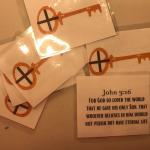
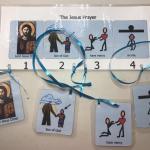
Over the next year, I will create full-fledged hands-on curricula complete with supply lists, budget and ability adaptations, and custom sequence images. In the meantime, enjoy this working copy of the curriculum I made for the little ones in my care this year.
In Christ, Summer
The CURRICULUM: HandsOnSundaySchoolSeptember2019
The STORY SEQUENCE: Fishers of Men
The MEMORY VERSE: For God so loved
My book, Of Such is the Kingdom: A Practical Theology of Disability, is coming out THIS fall from Ancient Faith Publishing. Make sure to follow this blog for giveaways and free resources.
June 26, 2019
One-Way Skin and a Myrrh-Bearing Heart
Almost two weeks ago, I attended the Ancient Faith Writing and Podcasting Conference, a two-day gathering that builds up the Church by strengthening the people helping to teach in it. In its short history, this conference has become the preeminent conference for Orthodox Christian creatives, or in internet terms, “content creators.” But we’re not really those things. We’re not abstractions. The lovely thing about the conference is seeing the faces of people like the people they speak to, whose disciplined lives are laid out in cruciform pattern, whose words are shaped around the Cross, and whose hands smell of being in the fire.
[image error]
This was my first year as a speaker —Read and listen HERE –, and it was the first year anyone has sought me out to speak with me (such a joy to meet you). I had one solid plan for how I would spend my time: give the best talk I could, and then talk with my friends old and new. Everything else had to be optional, though I made it to some of the other talks. I knew that I would need a couple of hours of quiet and alone time in between meeting people and talking with friends, so I made sure to go to my room, turn on my chant playlist, and lie down with my scarf over my eyes and the air conditioner cranked full blast for a little while each day. I also asked a couple of friends ahead of time to help me navigate if the crowds and noise caused me to have sensory integration blips. I didn’t go into rooms until they were full so that the movement of so many people didn’t confuse me. I asked lots of questions when I wasn’t sure of things. Taking those measures to adapt my schedule so that I could manage being autistic in a large group of people made a huge difference. I was able to spend time with dear friends and have deep conversations with new ones.
One of the recurring themes was the idea of whether creative Christians have or should have thick skins. When Fr. Stephen Freeman spoke about shame, he brought up God clothing us in garments of skin and switching the conversation away from shame that says someone is a bad person and back to relationship, where guilt can be forgiven and relationship restored. I had that image in mind when the Friday evening social hour rolled around.
I had the privilege of talking with several talented young twenty-something creative types, either on the side of the room or in the back of the shuttle bus, and they seemed to understand the potency of that question better than most. As young adults who have grown up in the internet age, they know how vicious and fickle the online public can be. I told them about how we oldtimers grew up in the Cold War when having a Russian troll or three would have been seen as a sign that you were a true American. I laughed off some painful experiences I’ve had online by posing as Captain Mom-merica, and we joked about how we would put our feelings into memes. We laughed, and then I said, “But seriously I forgive them. They didn’t have to be my enemy if they wanted me to pray for them. They could have just asked.” “You must have a thick skin.” But I don’t. I’m autistic and probably what most people would consider hyper-sensitive. What I have is one-way skin.
I am not here talking to people because I am better than anyone else. I was born poor and dead and naked, and Christ brought me to life and clothed me in Himself and opened to me the treasury of heaven. I didn’t do those things. God did. I bear witness because it’s what people do when they encounter the fire of God.
Moses took off his shoes and breathed the air around that fire, and even with his speech impediment, he said what needed to be said for the freedom of God’s people. The three in the fiery furnace sang as the Lord made the fire like dew on a cool breeze. The Song of Songs is a song from within the flame of the Lord – love that is a flashing fire. Our God is a consuming fire. When you draw near or step into that flame, you begin to smell of incense or of myrrh or of water. Each of us, whether we speak online or publicly or not, will find that somewhere in our lives there is a sweetness like incense, a warmth like fire, a persistence like water, and that is what flows out from us.
But what approaches us is tested by the fiery clothes we are covered in when we come up out of the font as members of Christ’s Body. What comes at us, be it good or evil, has to pass through Cross and flame to get to us. The fiery furnace was so hot that the ones who stoked it in order to torment the three youths were consumed by it themselves. So it is with all evil intentions. They will be rebuked by God and consumed in the flame, and they will be transformed into good, even if I can’t see it.
Being clothed in the fire of Christ is like a one-way skin: the myrrh and incense and water stream out, but incoming praise and hatred become themselves an offering unto God.
That is my goal when I write: a one-way skin armored in the fire of God, and a myrrh-streaming heart filled with love for God. I am only little and a little (or maybe all) broken, and love is still breaking through. The logs in my eyes are still in the fire. But I won’t develop a thick skin. I won’t become a skeptic or a cynic or side-eye the efforts of people sincerely seeking. When I get hurt or make mistakes, I walk a little further into the fire instead.
When the Bridegroom comes in the middle of the night, I will see Him not because I am holding an oil lamp, but because I am a lamp. I want to become all flame. I want to follow Christ into the flame where my heart lives and strive to make my heart a fitting home for the Holy Spirit.
[image error]
When I began to reflect on the weekend, I started out thinking about how we are houses in our dreams, and how the innermost part of the house is a room with a stone lintel marked with blood, into which stone is carved, “Come,” my heart says, “Seek His face.” (Thy face, Lord, will I seek.) I had set it aside to focus on pressing needs, but that image sprang forward again when I heard these beautiful words on Saturday from His Eminence Archbishop Elpidophoros, “Ready is my heart, O God, ready is my heart.”
To make hearts ready to receive the mercy of God is our work. It starts with laying out the patterns for our clothes, for God’s clothes, so we can recognize what is good. The world and humans are made by God, and He has made them good and is restoring it and us to good. Like fractals, like leaves and seashells and pleasing symmetries and music in rhythm and standing waves and cycles and growing things, goodness repeats and can be recognized everywhere. Evil, on the other hand, is nonsense. It’s pollution of clear water and the mixture of poison into good food and the twisting of sacred things into nasty shapes by means of words or other forms of abuse. We combat evil by teaching the patterns. Good is contagious, and it is cumulative, and it repeats. When you build and build layers of meaning, pulling the thread over and over through a pattern, you start to see the fabric. You start to see the clothes. You start to understand yourself in fire.
The first night of the conference, as I stood in Vespers alongside saints and icons, I had an experience of knowing myself outside of myself. I felt as though my hands, hanging quietly at my sides, were streaming myrrh like the image in the Song of Songs. Myrrh is for healing and for burial. It is the sweetness of life in the midst of death, the sign of love that sometimes is seen or smelled or touched, sometimes experienced from within. I have given up trying to understand such experiences. The earth is the Lord’s and the fullness thereof. There is no part of the universe that is not ready to burst with the joy of the Lord in due time. Instead, I stood there and let myself pray and let my heart stream until I felt my hands and heart were ready to go further into the flame.
When I returned home, I thought about the hidden myrrh in daily life. We fashion our homes into larnacas – decorated reliquary coffins – for holy hearts. Everything we do is ultimately small but not ultimately unimportant or unbeautiful. We plant trees and seeds, and God gives the increase. We step into the flame of Christ, and God makes us shine. We die to everything but the love of God, and the graves and our hearts become life-giving. Cooking in a pan, over a flame, tells us about the flame of God, tugs the cords of memory near. Lighting the evening candle tells us about the flame of God, showing the holy faces that reflect Christ’s light. And every breath is a fire, too, and the tiny fires of thousands of cells burning for the joy of the Lord. (Don’t we parents know this!, when we listen for soft breaths at night before we close our eyes.)
Being a creative type who is clothed in Christ means that we must cling to God in love. Every penstroke and brush stroke and fingerprint on clay and susurrus of page and bright darkness of music comes from that fire of love.
June 5, 2019
Girl, Wash Your Soul
[image error]
It happened again when I opened Instagram a couple of days ago. Yet another platformed Christian woman was telling the rest of us off for not looking polished – we don’t have to be homely to be holy! Here was someone boldly declaring to me that I should imitate her as she imitates Christ –by acting like Quinn Morgendorffer. She was having her hair dyed and nails done. I glanced at her photo, prayed for her, and unfollowed. I’m done with being told that washing my face or applying my makeup or updating my wardrobe is the key to happiness or my salvation.
If you’re a woman, you’ve probably been bombarded with some variety of this lie: You don’t have to look frumpy in order to be a good person. Well, yes, often, you do. That’s because our true beauty lies in our actions. Love in action is not great for hair, makeup, nails, or fine clothing.
Can you look put together? Sure. Sometimes for a photo or for a very short period of time. You can even strive to be tidy and neat. Will you usually look great? No, not if you’re actually living a good life.
The good life is a life of virtue, of humble and loving service on the behalf of your neighbors, your family, your fellow members of Christ’s Body the Church.
You will probably have frizzy or frazzled hair and splattered clothes and reminders of cooking and baking clinging to you, and worn shoes and chipped nails a lot of the time. At the place where your hands hang by your sides, you will have crumpled skirts or wrinkled jeans from using your clothes as a handtowel when you get really busy. If you’re caring for an ill relative or a young or an aging one, you might go for a day or three without washing your face or getting a proper shower. You won’t have a closet stacked with designer clothing and shoes, because you don’t have time and money to fuss over those things when there are people who need food and kind words and someone to notice them. You won’t have $700 or more worth of cosmetics to slather on your face each day, and you won’t miss them. You’ll look at a holy icon instead of a mirror, and you’ll try to be like what you see there: someone who brings peace and acts kind and true until your character grows firm in mercy and humility.
What makes us beautiful is doing good works. Our bodies are never more beautiful than when acting kindly toward someone else. If you want to be beautiful, do something beautiful. It can be small, like mailing a card or sliding a cup of tea across the table or touching a child’s head in blessing, or big like caring for someone every day who cannot thank you. It can be inexpensive, like passing extra tomatoes along to your neighbor, or elaborate like sponsoring a family in need. What matters is that it be humble, loving, truthful, and self-giving. Actions like that are virtuous. Actions like that are the kind of beautiful that rubs off on us and makes us beautiful.
When the woman poured out the jar of expensive ointment on Jesus, he said she had done a beautiful thing to him. Imagine her for a moment. Was she ugly? Could she have been ugly? It’s a ridiculous question, because she did a beautiful thing. All we know about her is beautiful. That’s how we’re all remembered, if we’re remembered – as having done a beautiful thing, once or every day.
Enough with comparing our grooming habits as though they could be anything but shallow! Do a beautiful thing.
Beautify your hands with giving and your feet by stepping humbly alongside someone who needs you there. Beautify your face by weeping with those who weep and rejoicing with those who rejoice, with speaking words in season with the weary, by finding something kind to say even if it’s only, “I’m glad you’re here.”
God made your face and likes the way you look. Turn toward His love and let the light of mercy turn you beautiful. Prayer is just a turning, of the face, of the shoulder, of the feet, of the heart, towards the light. You can look how you look and still look like God. In fact, that’s kind of the point.
Wash the laundry, again, and wash the counters, again, and wash your hands after gardening, feeding, diapering, averting domestic disasters. Wash the dishes for a friend who’s overwhelmed. Wash the lure of glamour from your eyes with tears of compassion and repentance. Wash your soul.
[image error]