
Grace Marshall's Blog, page 9
June 14, 2015
5 tips to stop email taking over your life
 The average worker spends 41% of their time on email management, and the volume of email each of us receives is currently doubling every 4-5 years. More than half of all UK workers admit to being stressed by how much email they receive, and being distracted by email can be worse for your brain than being on drugs!
None of us are in business to send emails. Email is not our job, but it is a tool we use in our jobs. If you feel like email is doing you, rather than the other way around, it’s time to take control. Here are 5 tips to get you started.
1. Turn it off!
Think about it, your postman only comes once or twice a day. Would you welcome him delivering every letter individually? Would you check the door if you hadn’t heard a knock in the last few minutes?
Instead of reacting to emails as and when they come in, get into the habit of doing email when you choose. Only open it when you want to deal with emails. Close it down at all other times.
If that sounds too drastic, then experiment with closing it down for just 30 minutes when you really need to focus. Enjoy having your brain back to yourself, then see how much you’ve missed when you check back in. Chances are, it’s less than you think!
2. Set expectations
When I ask people what their biggest stresses are around email, these two always come up: not knowing when other people are going to get back to you, and being chased for a reply (you know, that phone call that starts with “did you get my email?”).
The problem with email is that there are no universal rules. Everyone has different expectations and email etiquette, so don’t assume or mind-read. Be specific about timings and expectations. Use your out of office or email signature to let people know when your working hours are, or when to expect a response. Ask people to text or call if there’s an emergency.
3. Be mindful
Have you ever asked yourself why you’re sending an email, or why you’re copying that person in? Email has become the default method of communication, and so often we use it without thinking. If you find yourself typing “not sure if that makes sense”, perhaps it’s time to pick up the phone. Instead of playing email ping pong to set up a meeting, use a shared calendar, or something like Doodle or Timetrade.
4. Turn off the notifications
If you don’t feel you can turn the whole thing off, then at least stop it pinging you every time you get an email. You can turn off the sound, the pop up, even the little flag on your mail icon that tells you you’ve got mail. That way you can start doing email when you choose. Because let’s face it, when that email pops up in the corner and you see who it’s from, even if you choose not to look at it straight away, it’s already stolen a little bit of your attention.
5. Treat your inbox as an inbox
Like the doormat where new post lands. Not a to-do list. Not a catch-all bucket. Not a “just in case” dumping ground. Don’t leave things piling up in your inbox. As soon as you do, it piles up quick. Once it goes beyond what fits on one screen, you’ll find yourself scrolling up and down, wondering what you’ve missed, what’s lurking, and where the heck that those ticket reservations are. Getting your inbox to zero for the first time can be a wonderfully liberating experience. Knowing how to keep it there will keep the email monster at bay and put you firmly back in control.
To get the full low down on how to get your inbox to zero and stay in control, grab an early bird ticket today for the Inbox Zero One-Day Challenge on 29th June.


June 7, 2015
Basic Human Needs
Remember Maslow’s Hierarchy of Needs?
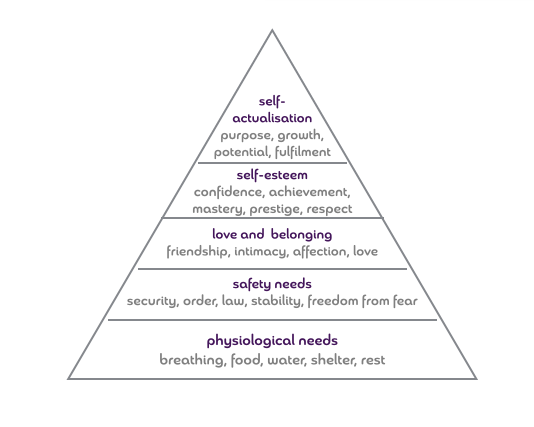 When it comes to productivity and performance, we so often focus on the higher levels – fulfilment, achievement, purpose – but what happened to our basic human needs?
Why is it that we think we can sacrifice sleep as long as we have enough self-fulfilment or that prestige will compensate for a lack of close relationships?
Or that we can do our best thinking on one glass of water a day?
It’s true that the higher needs are our true motivators – the more we get, the more it fuels our motivation. Maslow referred to the lower levels as “deficiency needs” – strong drivers when unmet, but once they are met, they no longer fuel us.
Once we have enough food or sleep, getting more generally doesn’t really excite us! But we do need to meet them – our basic human needs.
Which of your basic human needs do you tend to overlook?
June 1, 2015
Struggling to get started?
“Begin at the beginning,” the King said, very gravely, “and go on till you come to the end: then stop.” – Lewis Carroll, Alice in Wonderland
 Start at the beginning – seems straight forward enough doesn’t it?
Except when it’s not.
Except when you find yourself with a project that’s been stuck on your to-do list for ages, precisely because you don’t know where to start.
Except when you have no idea what the beginning looks like.
Or when the beginning is SO IMPORTANT that the pressure to get it right overwhelms you and stops you from getting started at all. Like how to start a speech (what is it, 7 seconds to make a first impression?) or what to name a book.
My new ‘baby’ (aka my second book manuscript) is now with the publisher, who assures me it’s in safe hands. And by the end of today, after lots of back and forth, it should have a name. Boy has it been an agonising process – I thought choosing a name for a child was hard enough!
But here’s the thing – if I had told myself I had to come up with a name before I started writing, I suspect I’d still have a book to write now.
Because sometimes you can’t name something – or even introduce it – until you know what it is that you’ve created. And it’s not until you start creating that you find out what it is. Some stories, projects and creations have a life of their own, and we need to let them grow before we find out what they can become.
Sometimes you just have to start where you are – with that one line, that one idea, that flash of inspiration somewhere in the middle – and let it grow from there. You may find that the beginning is the last thing you write, because it’s not until you get to the end that you realise what it’s all about.
So back to that project you’re stuck on, or that thing you’ve been struggling to get started. What if you skipped the beginning, for now – and started somewhere in the middle? What if you gave yourself permission to start right where you are, wherever that is, and allow it to grow from there?
Drop me a line in the comments box below and let me know what you think.
May 24, 2015
Cancellations and chance encounters
 When plans change and you find yourself with a clear diary, what do you do?
Do you use it to catch up with work, get ahead of yourself or just keep slogging away at the pile? Do you get annoyed, thinking of the missed opportunity – what you could have booked into that time, had you known in advance? Or do you take the day off?
I had a workshop cancellation this week, a rather welcome reprieve as I was launching into a 4-day-workshop-week after handing in my book. I had a pile of stuff to do, deadlines I had pushed back, enquiries to follow up, conversations to reignite, and when I came off the train after workshop number 3 I was looking forward to having a day just to ‘catch up’.
Until I serendipitously bumped into my running buddy at the queue for the car park pay station. She suggested going for a run the next morning and I found myself eagerly accepting. The next day I woke up to a message from a friend I had been trying to catch up with for months, asking me if I fancied sneaking in a quick cuppa while she was in the area, and again I found myself saying “why not?”
You see, if I had been running a workshop, the other stuff would have gotten done anyway. I would have found a way to fit them in. But going for a run and seeing a friend for coffee are things I always consciously have to make time for. And it felt so good, to choose to use this time that I had been gifted, and thoroughly enjoy it.
It’s a bank holiday again for those of us in the UK. What are you choosing to use this time for?
And if it’s a regular working day for you, when’s the next gap in your diary?
It doesn’t need to be a day or even half a day. As I overheard on Facebook the other day, “I work 8 to 5 with half an hour for lunch and because it’s my bliss it feels like about 2 hours. Time is weird.”
When’s your bliss this week? How will you enjoy the time you have?
May 17, 2015
More than we expect
 Sometimes plans change, sometimes things don’t go to plan.
And sometimes, when we are wiling to abandon our plans, we can find ourselves with far more than we expected.
In the last days of writing my book I had this nagging feeling. Several people had suggested that I make a fairly substantial change to the structure, but I couldn’t see how it would work. I could see their point, but when you’ve spent so long stitching something together, it’s hard to see how you can tear it out, put it somewhere else and stitch it all back together seamlessly.
There was also a smaller change I wanted to make – which may or may not affect the need for the bigger change – but for the life of me, I couldn’t work it out.
My editor suggested that if I wasn’t sure, perhaps I should stick with what I already had, but that nagging feeling remained. Every time I tried to put it behind me, to stick with the decision I had already made I had another conversation that nudged me to reconsider.
What I already had wasn’t bad – and that made it harder to decide. The hardest decisions to make are often not the ones where there is a clear right or wrong answer, but where it really is your choice.
It was agonising!
In the end I had to give it a try, just to satisfy myself. So on deadline eve I sat down to ‘have a go’ at moving the chapter and ‘let’s just see what happens’. By the end of the night, I thought I might have something that could work, sent it off to a couple of reviewers and slept on it.
The next day, after sitting at my inbox pressing the Get New Messages button repeatedly (yes, even I do that sometimes!) waiting for the verdict, I decided to carry on and work on the smaller change.
The most amazing thing happened. Somehow, in making the big change first, something fell into place in my head. I saw that section that I’d been struggling with in a new light, an idea came to mind and words began to flow. It was as if something had unlocked in my head and it all made sense again.
I found myself writing away, thinking “I don’t know if this is complete crazy or pure genius, but either way I am loving it!”
By the time my editor’s reply came, I was no longer seeking his advice, I was waiting on his confirmation, ready to argue if he didn’t agree!
Isn’t it funny, how sometimes it’s not until you take a step that a path becomes clear? Not because that path wasn’t there before, but because you had to be in a different place, to see things in a different light, in order to see that path?
And how the decisions we desperately want someone else to take off our hands are probably the ones we need to make ourselves?
Is there a decision that’s nagging away at you? Are you holding onto plans that are preventing you from seeing new paths?
If that’s you right now, I wish you courage, wisdom and peace to explore the decision – and enough annoying people around you to keep nudging you until you do! And when you do, may you find too that you get way more than you expected!
May 10, 2015
Reclaiming Good
 A friend said to me the other day “I’m trying to stop aiming for progress.” It stumped me at first. I’ve always though of progress as a good thing - the antidote to perfection even. But what she meant was that she kept finding herself measuring success as reaching for something more than what she had.
Success was growing her business, taking on more clients, increasing her turnover and her profit, improving her game, increasing the opportunities she created for herself and her son. Which are all great things. But she was so focused on progress, on reaching something greater, that she was missing the good she already had in her life.
Sometimes the pursuit of achievement and greatness can leave us feeling inadequate, exhausted and underwhelmed. Sometimes we can be so consumed with achieving more, we can forget to enjoy what we have, and what is good.
In the book I’m currently reading, The Artisan Soul, Erwin McManus explains it like this:
“There is a subtle side effect when it comes to the language of good and great. Good has become less than great. Good has become “above average”. Good to great has become the same as better to best, when in fact they are of different qualities altogether when it comes to essence… Great is about execution and achievement good is about essence and ethos. The artisan soul aspires to do great work but never neglects the importance of being inspired by all that is good and beautiful.”
Good isn’t less than great, it isn’t the opposite of great, and it certainly isn’t – as I picked up the other day – “the enemy of great”. Good is something entirely different. You can have something good that is or isn’t great, and you can also have something great which may not be all that good.
Like the stories I’ve heard recently of a highly successful entrepreneurs who had become trapped by their own success, bound by the expectations, commitment and demands of the very business they had built: great businesses that wen’t doing them any good.
We often associate productivity with greatness – the act of doing more, achieving goals and reaching upwards and outwards, but I think true productivity is also about goodness.
It’s about doing good work, beautiful work, satisfying work. Work that does you, and others, good. It’s about living a good life – one where we embrace and enjoy being as much as becoming. Where exploring, wondering (and wandering) and asking questions are just as valid as achieving, reaching and having answers.
Yes let’s continue to aim for and achieve great things, but let’s reclaim the good too. I wonder, what does good look like for you this week?
April 27, 2015
Unlikely leadership
 I was at a leadership conference this weekend and had the privilege of being asked to be on the Q&A panel.
It wasn’t until I got there that I caught myself wondering – what am I doing here? Who am I to be on this panel? The other panelists were leading churches and charities. They have teams of people who are answerable to them. Who do I lead? What qualifies me to to answer these questions?
Thankfully, one of the speakers shared this quote, which reminded me:
“If your actions inspire others to dream more, learn more, do more and become more, you are a leader.” – John Quincy Adams
That’s good enough for me. I don’t lead a team of people as such, but my work is all about inspiring others to lead themselves and others well, which meant I could answer all the questions from my own authentic perspective.
How often do we forget that leadership is an act, not a status?
How often do we find ourselves in situations beyond our direct control, situations where we don’t have authority, status or power, where we’re don’t necessarily identify ourselves as a ‘leader’ and yet we can lead anyway?
We can lead in the words we choose to speak
We can lead in the energy and the attitude we take into a room
We can lead in the vision we cast, even when we’re not stood at the front of the room
We can stand up for what we believe in, or follow the crowd
We can lead by example, by the tone or standard we set
We lead when we show up instead of shrinking back
We lead when we give freely and fully, instead of waiting for permission
We lead in how we choose to respond to every situation, whether we are ‘the leader’ or not.
What would it look like to take a lead in that meeting with your boss this week, in your relationship with that demanding client, in the tricky conversation at home you know you need to have, or even in the casual chit chat on the playground?
Where could you show up in a way that inspires others to dream more, learn more, do more and become more? What are your unlikely territories of leadership this week?
April 19, 2015
Eyes wide open
 When you look at your week ahead, what do you see?
A heavy schedule – or a week full of opportunities? A diary full of meetings – or decisions you can influence, relationships you can build and conversations you can give your voice to? Pressure to perform, or the opportunity to do your best work?
Do you see the challenge or the opportunity to stretch? Do you see gaps and limitations, or do you see what you already have, and how far you’ve already come? Do you see the person you’re not or the person you already are?
Do you see the person who’s asking for help? The person who’s unusually quiet today? The person who needs a smile, a word of encouragement or a hug?
When plans fall through, do you see curveballs or plot twists? Failure or the opportunity to do something new? Doors closing or new beginnings? Delays and cancellations, or space to be still?
When somebody let’s you down, do you see frustration, neglect or incompetence, or an opportunity to start a new conversation?
When it looks like nothing’s working or paying off, do you see the ditches that you’re digging?
Do you see mess, or a plan that’s coming together? Chaos – or beauty in formation? Emptiness or space to brew new dreams?
Perspective matters. What you see shapes your world and how you live in it.
What do you see today?
April 6, 2015
Daily treasures
 There’s a lovely old man who comes into my writing cave – the local cafe where I’m fast becoming part of the furniture.
He’s a regular too – he usually visits as part of his daily routine to get out the house, pick up a couple of things from M&S, then stop by the cafe to read his paper over a cup of coffee and usually a few extra treats from the staff.
He used to volunteer at another cafe (I seem to live my life in cafes!) where I used to take my kids, and has known them since they were babies.
Normally we say hello, he asks about my family, and he settles down to his coffee and paper while I carry on typing.
On Good Friday however, the cafe was busy. I had negotiated a few precious hours to type away in my little corner when I spotted him come in and turn around, and his face fell as he noticed there were no free tables. Despite the staff calling out to him to wait, he said he’d come back tomorrow. I called out to him, and he looked in my direction without seeing me, his eyes dejected and his shoulders slumped.
I ran after him. I had to. To invite him to share my table (he would say I attacked him)
“Are you sure I won’t be bothering you? Haven’t you got work to do?” he asked.
I wouldn’t take no for an answer.
We talked for ages – about his life, his family, his memories. Memories he hadn’t visited for a long time, stories that came pouring out because there was somebody to hear them. I learned more about this man in a couple of hours than in some six years of knowing him.
“You’ve really made my Easter weekend” he told me, “ with all these memories fresh in my mind.”
“Aren’t I boring you?” he kept asking. “Not at all.” I replied.
He kept apologising for taking up my time, and kept wondering suspiciously if I was a good listener or a good actress.
“Haven’t you got work to do?”
Yes, about 30000 words worth. But that doesn’t matter right now.
Right now I get to watch this man come alive, as he relives perfectly ordinary memories that mean the world to him. I get to watch the sparkle come back to his eyes, his shoulders bounce as he laughs, his face light up as the joy of those moments pour into the present.
He refused to leave without buying me lunch. So I made him a deal – if he was to buy me lunch then he wasn’t allowed to feel guilty for “taking my time”.
Because it was a pleasure and a privilege, it really was. To see him come alive, to know that in that moment, whatever I had planned, whatever I had on my list, right there and then, I was in absolutely the right place, doing absolutely the right thing. And all I have to do, is sit and listen.
And that was his gift to me. To be fully in the moment, witnessing this man recall moments past with a joy that was so tangible and present – because he was fully present in the moment when he first experienced them. That’s the gift of being in the moment. When you live fully in the moment, you get to relive it, time and time again.
So as you go through the remainder of your Easter weekend and into the week ahead, that’s my wish for you. Whether you’re working, resting, playing or anything else – let yourself be completely absorbed. Notice as time slows down and you stop counting, and just live in that moment. Take that gift and treasure it. Because it will be treasure you can come back to, time and time again.
March 29, 2015
What happens when you say “I can’t”
 When you say “I can’t” what are you really saying?
That you don’t know how? You don’t have the resources to? That you’re not sure you want to? That you’re already committed to something else?
Sometimes it’s easier to say “I can’t”.
“I can’t make it” rolls off the tongue easier than “actually I’d rather not” or “I’d prefer to do something else” or “I’ve already committed to something that I don’t want to cancel”
“I can’t possibly do that” is easier to swallow than “that scares me to death” or “I’m not sure that would work” or even “I don’t know how to do that.”
When there’s a risk involved, a cost, or a trade-off, “can’t” lets us off the hook. Rather than owning the decision, we default to “can’t”. It’s out of our hands.
The trouble is, after a while, we believe our “can’t”s and they become the walls we build that hem us in. “Can’t” puts us in a position where we feel helpless. It signals impossibility and incapacity – so why bother trying?
I had a couple of conversations recently with friends who have made some pretty radical decisions about their businesses. Decisions they had previously said “I can’t” to.
“I can’t take time off”
“I can’t raise my prices”
“I can’t do any more/less”
“I can’t do this in any other way (I’ve tried… it doesn’t work… not for me/my business)”
But something changed. They hit a crisis. A health crisis that meant they had to take time off. A personal crisis that meant that they had to make some tough choices. Instead of “I can’t” they found themselves saying “This needs to happen. How do I make it happen?”
All of a sudden, “I can’t” was no longer an acceptable answer. Impossibility was out of the question. Everything was possible and something had to give.
Before, “I can’t” had them utterly convinced that there were no other options. Now, all the rules were thrown out, and they found themselves facing down hard choices, determined to find a way through, making tough decisions with courage, setting boundaries with ruthlessness and letting go of the need to please everybody and get everything right – because “I can’t” wasn’t an option any more.
There’s something about a crisis that gives us clarity. Clarity over what really matters. What’s non-negotiable and what’s up for grabs. But I wonder if we could create that clarity for ourselves more often, with less crisis, by being more truthful about our “can’t”s.
Mindset trainer Caroline Ferguson shared this on Facebook last week:
When you hear yourself say “I can’t…”, try seeing if one of these works instead:
“I choose not to…”
“I haven’t yet…”
It sends a completely different message to your brain.
What are you saying “I can’t” to this week? Try saying what you really mean – even if just to yourself. And see what happens.


