
Grace Marshall's Blog
November 22, 2023
Are we collectively holding our breath?
I was chatting to a leader about how his team were doing, and what he was noticing in his world of work: “I don’t know what to call it” he said. “Is it burnout? Wellbeing? Change fatigue? Mental health? I don’t know. I just feel like we don’t have the same resilience we used to.” […]
The post Are we collectively holding our breath? appeared first on Grace Marshall.


May 10, 2023
Been dealing with a lot lately?
I’ve been hearing from a lot of people recently that they feel busier than ever, but when they look at what they’re actually accomplishing, they can’t work out how, or why. You know what, I suspect it’s a cumulation of things. …it’s a lot! And by the way, stress reduces our cognitive and emotional resource […]
The post Been dealing with a lot lately? appeared first on Grace Marshall.
April 27, 2023
Practical thoughts on being a strength giver
“In my early days of parenting I struggled…what I needed wasn’t a fixer…I needed a witness… The fixer wants to take our burden. The witness gives us strength” Struggle Question: Any practical thoughts on how to be a strength giver? My good friend Sean asked me this and this is what I shared with him. […]
The post Practical thoughts on being a strength giver appeared first on Grace Marshall.
December 1, 2022
3 ways to create safety around mistakes
One thing I often explore with a team or organisation in a Struggle talk, is the culture around making mistakes. Specifically how safe is it, to talk about and learn from mistakes? And what helps? Here are three practical ideas: #my-latest-mistake At Think Productive, we have a Slack (our internal comms) channel called #my-latest-mistake. Here’s […]
The post 3 ways to create safety around mistakes appeared first on Grace Marshall.
July 22, 2022
Noticing resentment
Sometimes our fight/flight instinct is really easy to spot – like when we’re in complete procrastination or avoidance mode, or when we’re gripped by email rage (like road rage but with email). Other times it’s more subtle. It doesn’t look like panic or rage. It looks more like resentment, defensiveness, feeling got at, taken advantage […]
The post Noticing resentment appeared first on Grace Marshall.
March 9, 2022
Struggling to say no?
Saying no is like a muscle. You get stronger with practice. If you know you could use some practice, here are three supporting ideas, curated from Twitter for you. The No folder This is brilliant because often the immediate pain of saying no overshadows the long term gain. Collecting up your ’no’s helps you to […]
The post Struggling to say no? appeared first on Grace Marshall.
March 8, 2022
Struggling to say no?
Saying no is like a muscle. You get stronger with practice.
If you know you could use some practice, here are three supporting ideas, curated from Twitter for you.
The No folder
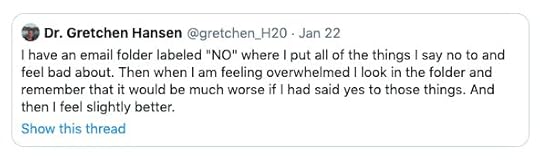
This is brilliant because often the immediate pain of saying no overshadows the long term gain. Collecting up your ’no’s helps you to recognise your progress and reinforce your decisions. When you look back and realise you don’t regret any of those ‘missed opportunities’, your future self really will thank you for it.
The No buddy / committee
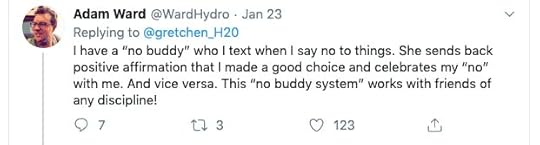
A comment further down the thread also refers to this as the No committee. We often find it easier to say other people’s no’s for them. So as well as celebrating & affirming each other, we can also go to our “no” committee for help and encouragement.
I’m always grateful when one of my colleagues upholds a boundary with a client where I might be tempted to waver.
Other ideas in this thread included the ‘No’ calendar, and having a ‘No’ quotient – along the principle of “what gets measured gets done”
But finally, here’s one that a contact privately messaged to me:
The #DNR tag
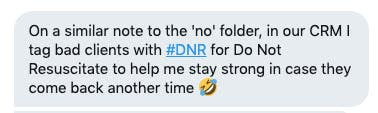
If you didn’t manage to say no the first time round, this one makes sure you don’t fall into the same trap if comes round again!
Which of these would you use? And what would you add?
The post Struggling to say no? appeared first on Grace Marshall.
October 28, 2021
“Why am I feeling so exhausted?”
This one’s coming up a LOT recently. Are you feeling it too?
One big factor I’ve noticed is all the stuff we’re starting anew. New school year. Return to the office. In person events. Weddings (so many weddings!)
There’s a certain intensity to doing new things. We know that. But we forget this can also apply to old things we haven’t done for a while.
My husband found this on his first visit to the new office after starting a new job during lockdown. Commuting is something he’s done for years, yet this time he said it felt like he was going to a high stakes job interview. The nerves took him completely by surprise.
I found this too after going to a wedding. It was so lovely to see old school friends and celebrate the happy couple, but boy did it wipe me out for the rest of the weekend and beyond – and I don’t even drink so can’t blame it on a hangover!
Then of course there’s the amount of stuff we tend to cram into this time of the year. Whether it’s the change of seasons, the start of a new school year, the return from holiday or the run up to Christmas (yes I said it!) there’s a certain change of pace that often happens in the autumn.
Add to that a few broken nights’ sleep (probably due in part to the change in season and rhythm) and it’s no wonder we find ourselves exhausted, when it feels like we’ve only just gotten started!
Here are three thoughts to help:
1. Sleep affects everything
If you’ve not slept well recently, be aware that your lizard brain reactions are going to be heightened (fight/flight stress responses, road rage / email rage, reactive fire-fighting, emotional sensitivity).
Think HALT. It’s an acronym that tells us to avoid making decisions when we’re Hungry, Angry, Lonely or Tired. It’s also a really useful reminder to just stop. Pause.
How we’re feeling right now might just be because we’re tired (or hungry, angry or lonely) rather than the thing that’s triggering us.
Whatever your lizard brain’s telling you: Do this. Fix that. Back off. Cancel. Confront. Jump on it. WTF?! How dare they? Oh sh*t. What’s wrong with me?
Wait a minute. What if it doesn’t mean all. that. stuff? What if it just means I’m tired?
2. The Morning After
Sometimes our feelings tell us about what where we’ve been, rather than what we’re going through now. I write about this in Struggle, in a section appropriately titled “When we’re spent”
What this means is there might be nothing you need to do here. Nothing to fix or rectify. Just space for recovery.
3. Already Got Loads On vs Gotta Make Stuff Happen
If you’ve already got loads on, your definition of productivity right now might not be “gotta make things happen”.
It might be more:
How do I make space to do this well?How do I want to show up?What will help me with that?This changes our focus, our perspective and what we add to, or take away from, our to-do list.
What helps you when you’re exhausted?
The post “Why am I feeling so exhausted?” appeared first on Grace Marshall.
July 6, 2021
Facing change and building space
One of the unintended benefits I noticed when the pandemic first hit, and we all had to get used to working and living in a very different way, was that our collective tolerance for imperfection increased. We were all trying new things, reinventing business models and practices, using unfamiliar technology, and getting to grips with a whole new way of working. We had the freedom and permission to do it imperfectly, and to learn as we go.
I wonder, do we have that same tolerance now?
Or is our talk about “can’t wait to go back to normal” in danger of creating an expectation where we just sail smoothly back into the groove?
The truth is, all change is unsettling.
Sometimes that unsettling is refreshing, like a good gust of wind that disperses the stale air. Sometimes it knocks us sideways.
The best thing we can do is to give ourselves space – time, headspace, emotional energy – to navigate change. Here are five practical ways to build in that space:
1. Margin (a.k.a. blank space in the diary)
We can’t plan for everything – particularly when there’s a lot of uncertainty around. A new protocol or commute to get used to, a new project or team to work with, the new dynamics of hybrid meetings – these can all take longer than expected. Resist the urge to pack everything in so tightly you have no room for manoeuvre.
Blank space is not dead space. It is breathing space.
2. Lizard brain spotting
I write about how this plays out with procrastination in How to be Really Productive (Chapter 3: Mind monkeys and lizard brain) and with how the fight/flight fear response labels all change as a threat in Struggle.
The lizard brain is fast, emotional and hard-wired. We can’t always prevent it from kicking in, but when we notice it and name it, we can prevent it from taking over. Get used to spotting your lizard brain in action, and applying the acronym: H.A.L.T. – never make decisions when you’re Hungry, Angry, Lonely or Tired.
3. Recovery
In Struggle, I write about The Morning After, that hangover we have after periods of intensity – whether that’s something traumatic, stressful, or even amazing and exciting. It often takes us by surprise, because we think “but nothing’s happening right now, why am I feeling so rubbish?”.
Recently, I did my first gig in shoes since the pandemic hit! It was broadcasted live from a studio in Manchester, and involved me spending the best part of 24 hours away from home and ‘on duty’ apart from the 8 hours or so in my hotel room. It was an amazing experience, and I’d like to think the audience found it a more immersive experience than your average webinar. But it was full immersion for me too. I wouldn’t be able to do that several times a week!

As the landscape of life and work changes and we start meeting people in person, perhaps travelling, socialising (maybe even hugging!), whether it’s something that fills us with joy, anxiety or a jumble of both, we may find that the emotional intensity of it all leaves us exhausted afterwards. We need to honour that with recovery, rather than press on through to burnout.
4. Review
We’re not going to nail it straight away. And perhaps it isn’t something static to nail at all! How we live and work in the “new normal” is something we get to figure out as we go. It’s a road we make by walking. And that means its subject to change, review, recalibration, rehaul and refinement. Getting into the habit of regularly reviewing means we don’t get stuck in perfection paralysis or beating ourselves up for making the wrong decision, but instead make progress one decision, one learning, at a time.
5. Wellbeing check-in
This is something we do as a team at Think Productive. Every Tuesday, someone starts a Truth Tuesday thread on Slack (our internal comms platform). Anyone can share anything from an emoji to several paragraphs on how they’re feeling or what’s going on for them.
Over the years, and particularly during lockdown, this has strengthened our team relationships as well as our individual wellbeing. Understanding why someone might be particularly sensitive, tired, distracted or prone to mistakes helps us to add understanding rather than frustration into the mix, and find constructive ways to support each other and work productively together. Plus, hearing from a colleague that you really need to give yourself a break can be something you take to heart more than just knowing it yourself!
How much space do you give yourself to navigate change? Which of these do you think would help you the most?
Let me know how you get on.
The post Facing change and building space appeared first on Grace Marshall.
May 12, 2020
End of the world as we know it
There’s something about knowing that we associate deeply with competence, confidence and professionalism.
We turn to teachers because we want to know what they know.
We follow leaders because we believe they know where they’re going.
We give the work to those who know what they’re doing.
We believe that our value, our professionalism, our expertise exists in what we know.
We are valued for what we know. We contribute what we know.
So what happens when we don’t know?
When the path that lies ahead is uncertain, untrodden, unexplored?
When we don’t know, we tell ourselves that something’s gone horribly wrong. We become imposters, waiting to be found out. We’re terrified to ask for help, because we believe we should know what we’re doing. We feel the guilt of letting others down, because they trusted us to know.
In these situations we flounder, we feel exposed, unqualified.
And yet…
When our job is to discover, to build, to create, to develop, then surely it’s in the job description to go beyond what we know, and step into the unknown?
When our goal is to learn, surely it’s not knowing that feeds our curiosity and signals “here lies the treasure you seek”?
Those butterflies in your stomach – what if they’re a good sign? An invitation to excitement rather than fear, a signal for adventure rather than foreboding?
In fact, it’s only when we don’t know that we’re most likely to seek, listen, explore and learn. It’s only when we stop relying on what we know that we become open to what’s possible, new and surprising.
Somewhere along the line we’ve mistaken certainty with confidence.
We’ve learnt to see unknowing as a sign that we’re out of our depth, that we can’t cope.
We think knowing qualifies us, and keeps us safe. But it also keeps us stagnant.
Curiosity, creativity and change cannot exist without unknowing.
Is the more capable person the one who never struggles or the one who knows how to struggle well? The one who faces struggle with vulnerability, courage and a willingness to learn, to fall, to screw up, to get up, to keep on showing up?
Great professionals know what they don’t know. Dangerous health professionals are the ones who think they know it all.
A confident driver is one who recognises the unpredictability of other drivers and road conditions. A dangerous driver is the one who thinks they are fully in control.
And when we’re afraid of showing our unknowing because we don’t want to let others down? Turns out owning our unknowing is the very thing that builds trust:
“We asked a thousand leaders… what do your team members do that earns your trust? The most common answer: asking for help. When it comes to people who do not habitually ask for help, the leaders we polled explained that they would not delegate important work to them because the leaders did not trust that they would raise their hands and ask for help. Mind. Blown.” Brene Brown, Dare to Lead
The truth is, we’re all on the brink of unknown territory. We live in an age of change, where uncertainty is the new normal, and the people we need around us – the people we need to be – are those who are willing to leave the safety of the known, and figure out how to live and work well in this new world we’re getting to know.
This is an excerpt from my upcoming book Struggle: the surprising truth, beauty and opportunity hidden in life’s shittier moments
The post End of the world as we know it appeared first on Grace Marshall | Productivity Ninja, Author, Speaker, Coach.


