
Grace Marshall's Blog, page 4
September 22, 2017
The 4 Letter Word That’s Killing Our Productivity
I had a lot of fun delivering this fast & furious closing talk at DisruptHR London in May. Would love your thoughts on this four letter word that’s killing our productivity.


May 27, 2017
Broken plans
In a world that is unpredictable, it is so much more important to decide who we are going to be, than to plan what we are going to do.
Plans can go awry, what we do may change, but we can always, always stay true to who we choose to be.
This week, I found out that a friend I worked with years ago to set up a local mum’s networking group when my daughter was 6 months old, died aged 45 after being diagnosed with lung cancer only a couple of months ago. When she was alive, Carol was tenacious, defying expectations, bringing life to so many projects, people and communities. Even in the face of death I’m told she earned herself the name “warrior princess”. And for those of us who knew her, her legacy lives on strong.
And in Manchester, when a fun night out turned into the most horrific nightmare, an attack intended to create terror and strike fear, brought the city out in kindness, resilience and hope.
Sometimes when you don’t know what’s ahead, or when your plans go completely out the window, the only thing that’s left, the only thing that matters is how you show up – who you choose to be in that moment.
I’ve heard so many stories.
The taxi drivers who drove all night, taking people to safety, reuniting loved ones.
The businesses and residents who offered warmth, shelter, food, cups of tea.
The homeless man who went from beggar to carer – rushing to help, pulling nails from the arms and faces of injured children
The nurses and doctors who went straight to work – some after taking care of their own kids who were caught up in the incident.
There’s something strong, heroic and humbling about the way these huge events can bring out the best (and yes also sometimes the worst) in us.
But I think the same can also be true of the little things, if we choose to.
When your boss lands a surprise request on you at 4.30 on a Friday afternoon. When a colleague lets you down. Or a customer complains. Or the IT system fails again.
When your kids drop a bombshell at 8 in the morning about what they need for school that day. When the house is a state or the car breaks down again. When a friend or a family member lets you down. Or you find yourself at the blunt end of someone else’s frustration.
We have a choice.
We can choose to react with frustration, a perfectly natural reaction. Frustration comes from the gap between what is, and what we think should be. It comes from mis-matched expectations.
But frustration has a way of widening the gap, rather than closing it. It makes us feel more helpless, more hard done by, more frustrated.
Or we can choose to be the person who brings something else to the table. Calm, clarity, humour, kindness, even forgiveness perhaps.
The carer who asks “how can I help?” or acknowledges “I know this isn’t easy”
The peacekeeper who says “shall we take this offline?” in an email or “let’s take a break” in a meeting
The teacher who says “it’s ok to make mistakes” or “dude, I messed up”
Or the guide who shines a light with “ok here’s what’s possible”.
Our words and our actions have the power to change the atmosphere and experience of any event. You can be the person who encourages and builds up, who speaks strength and peace and hope into those around you.
Of course, do make plans, but if your plans get scuppered, remember the power isn’t in the plan. It’s in you – who you choose to be in that moment.
March 27, 2017
Technology and Productivity with Francesca Geens
Technology is not enough. You need to use it well.
That’s the theme of my latest interview, where I got together to discuss technology and productivity with Francesca Geens, of Digital Dragonfly, who specialises in helping solo-business owners get their tech right.
In this 38 minute interview, Francesca, shares her insights on:
How your biggest productivity gains could lie in getting the basics right
The one question you need to start with to create your personal cocktail of ‘tech’
The most important thing to have under control to avoid digital distraction (no surprise that I’m in complete agreement here!)
We also discuss:
What happens to our brains when we switch off from technology
The difference between a busy culture and a productive one
And… are we going to see the death of email?
Prefer to listen to this as an audio track instead? Here’s the mp3.
Further resources:
Francesca’s e-course: From Tech Overwhelm to Productivity
My next Inbox to Zero online challenge
Blog post: Why decluttering is not about tidiness
Over to you
On digital clutter: Francesca talks about getting to the work in a straight line. How straight is your line? What hurdles, temptations and distractions do you have to navigate past?
On reclaiming your relationship with technology: how clear are you on what you want your tech to do for you?
I’d love to read your thoughts and insights in the comments below.
February 17, 2017
Worst Productivity Advice Ever
What’s the worst productivity advice you’ve ever heard?
I think one of mine has to be “just try harder” along with “do better”.
My son’s been struggling with high school lately – for many reasons which are his story to tell, not mine – but one thing I have noticed is how he’s mostly been left to his own devices to ‘get organised’.
He’s gone from primary school where he’s had one teacher, one room and all his books in one tray, to being in different rooms in different buildings throughout the day, with multiple teachers, multiple books, varying rules for handing in homework and a two week rolling timetable.
Yes that’s the way with high school life in general, and yes he’ll have to get used to that, but it amazes me how often people are just left to figure it out for themselves – and not just in schools but in the workplace too.
Imagine starting a new job where suddenly you find yourself hot-desking every 90 minutes and answering to 8 different bosses who each have their own way of doing things. Add to that an increased workload, more responsibility and a whole new culture and people you’re getting to know from scratch.
That’s what’s tricky about today’s world of work. It’s often not the individual tasks that are difficult, it’s the multitude and complexity that expands when there are so many moving pieces, so much uncertainty and change, to the point where ‘keeping on top of it’ feels like a full time job, instead of being able to just get on with doing the work and doing it brilliantly.
Skills and support. That’s what we all need, especially when in a new situation – whether that’s a new job, a new team, a new season in life, new targets or new challenges. And getting organised is a skill. Some, like my daughter take to it quite naturally (who else spontaneously decides to organise the shoe cupboard at age 3?). Others, like me, need more training, support, nurturing and practice to flourish.
That’s why I love running Stress Less Achieve More workshops. It’s about giving people skills and support to free them up from the nagging worry of “am I missing something?” and the extra work of having to retrace tracks, find things, fix things, make amends and play catch up – so that they can get to their brilliant work more often – and enjoy that deep satisfaction when they do.
If you’re fed up of “just try harder” or “do better”, book a place now for my Manchester workshop in March – I’d love to support you in developing your productivity skills.
February 7, 2017
The book that almost never was
I almost didn’t write this book.
The opportunity came at an inopportune time. I’d just taken on sole responsibility for our family income to release my husband to do a full time Masters. Work and family commitments were already stretching.
Besides hasn’t it all been said before? Who am I to write another productivity book?
There were so many reasonable reasons not to pursue this.
But I’m so glad I did.
I went along to an awards ceremony yesterday, with the expectation only to enjoy an evening of meeting and celebrating fellow authors and book-lovers – and getting to show my husband a little bit of my world of work.
Then I found myself collecting this!
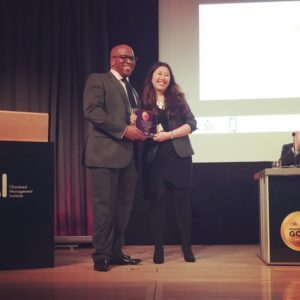
(Incidentally I was the only winning author present to collect my award!)
I’m still stunned, that out of some 150 books nominated, it was my book that “in the opinion of the judges, will best serve commuters and retain their attention during a journey to work by inspiring them, informing them about and engaging them with a management and leadership topic.”
What struck me even deeper were their reasons for choosing my book, which echoed exactly what I wanted to achieve – that it would be thought provoking, a joy to read, extremely useful and entirely human.
A fellow author once described a book is an act of co-creation. Writing is only part of the process. It is in the mind of the reader that the words come to life and take shape – and therefore each reading is a unique experience.
And that’s why this means so much. To hear from people I’ve never met before, how our co-creation has inspired hope, joy and change – in some cases dramatic transformation. That is worth more than any accolade.
So next time you find yourself wondering, “Who am I to…?” or “Hasn’t it all been done before?” here’s what I have to offer:
No one will see it, say it or do it exactly the way you do. There is room for you to step up in a way no one else can. It is more often a question of if you will, than if you can.
The adventures that both terrify and excite you are usually the ones that call you to discover more of yourself. So no matter where the adventure takes you, you win.
There is never a perfect time. Life is a beautiful, messy rollercoaster of breathtaking highs and heartbreaking lows – and this week has certainly been no exception. Don’t mistake the presence of uncertainty, vulnerability, imperfection or incompletion as a sign that you’re not ready.
So, what adventures are you ready to say yes to?
January 16, 2017
Is Inbox Zero yesterday’s news?
Someone suggested to me a while ago that inbox zero is a fool’s errand. That there is so much streaming in, it’s impossible to stem or control the flow, so we might as well let it flow past.
She spoke of colleagues who would sit with their phones in meetings, desperately trying to swipe their way to zero. And the futility and sheer un-productivity of being a slave to your email.
You know what, she’s right.
Email is not your job. It’s one of tools involved in your job – and more often than not, it’s wielded in a way that does more damage than good.
If the quest for Inbox Zero has you constantly checking and swiping, the chances are you’re not doing your job. The job that requires your thoughtful attention – the thinking, the negotiating, the inventing, the making, the problem solving and the relationship building. If you’re constantly distracted with checking and swiping, then yes Inbox Zero is a fool’s errand.
So what’s the alternative?
1. Give up on email altogether. Delete your account. Tell your colleagues to call instead, or come see you in person.
Actually I had a delegate once whose boss told him he was only ever allowed to send her one email per day. He started printing off his emails to put on her desk. The truth is, email overload isn’t just a tools problem. It’s a behaviour problem. Even if you can remove the tool altogether (and let’s face it, not many of us can get away with that) the problem will just find another channel to inhabit. Slack overload, or open office hell, anyone?*
2. Go fishing. Treat your inbox like a fast flowing river that you visit regularly to fish out the things you need to pay attention to. Accept you won’t get through everything. Be ok with what you don’t manage to catch. Try not to wade in too deep so you don’t get swept away.
I know one or two people who appear to have made this work. They seem to have perfected the knack of dipping into their inbox to retrieve just what they need to. Most other people though find they get swept away by the river. The fish are all over the place they can’t choose which one to pick. They get lost diving in, trying to find that fish they could have sworn they spotted two days ago. They get caught up in the undercurrents, find themselves swimming round in circles. Or worse, they find the river goes right through their front door – and they’re living in it rather than fishing from it.
Let’s face it, if you find yourself scrolling up and down, more often than not, trying to find or figure out what you need to pay attention to, it’s probably a sign that your system isn’t working.
3. Learn the true inbox zero techniques of a Productivity Ninja.
A Ninja takes a ruthless and unorthodox approach to email, separating out thinking from doing and the wheat from the chaff.
A Ninja is weapon-savvy enough to know how to make the tools do the work so they don’t have to.
A Ninja can and does switch off from email – often – and returns from holiday without email dread.
A Ninja sets clear expectations and lives up to them – emailing a Ninja is a pleasantly straightforward experience.
A Ninja is confident – not obsessed – about getting their inbox to zero.
Want to learn how to do email like a Productivity Ninja? Join me in next week’s Inbox to Zero challenge.
December 18, 2016
What if this is the new normal?
I don’t know about you but 2016 for me has been full of uncertainty, transition and plenty of ‘oh crikey’ and a few ‘WTF?!’ moments.
It’s also been a year of huge achievement, success and excitement, don’t get me wrong, but as I come towards the end of the year, I find myself concluding that uncertainty is my new normal.
Something funny happens when you accept your reality as the new normal.
You stop waiting for it to pass.
You stop planning for when it’s over.
You look it right in the eye.
You raise your game.
Ever since I decided to see this as my new normal, my thinking has shifted – from ‘How do I get through this?’ to ‘How do I want to live here?’ From ‘When this is over…’ to ‘What does success look like here and now?’
I’ve asked myself ‘Who do I want to be in this season?’ and ‘What do I need to give myself?‘
This has led me to some decisions already:
New boundaries
New territories often have new rules of engagement, but it’s not just the rules of the world around us we need to understand and adapt to – it’s our own internal rules, our boundaries that we need to establish.
As I’ve been reviewing the year, I’ve noticed plenty of highlights, achievements and ‘champagne moments’ – and I’ve been mindful not to ignore the struggles, as these can often be signposts to change.
For example, this year I worked through some of the school holidays. The total number of days probably wasn’t that much, but it had a way of breaking up our down time and creating in a whole new level of logistical juggling, and we’ve all noticed the results in a prolonged period of endoftermitis in recent weeks.
So one new rule for the new year is to fiercely protect my school holiday boundaries. I’ve never needed that rule before – it was more of a guideline which worked well up until now. Now we’re in a new season, where the demands of family and work life are different, I need new rules. And funnily enough, I was tested on it twice within hours of making that decision – a sure sign that it matters!
Uncommit to create space
As my kids have grown, their needs have changed. What they need from me has changed, and what we need as a family has changed too. As our priorities change, it’s good to review how we spend our time. Even my 7 year old noticed the other day that life had gotten a little “too busy” (her words!) and decided to quit her Thursday lunchtime club at school.
If uncertainty is our new normality, then space is our new fuel – to navigate the inevitable changes and surprises. Reviewing our regular activities and commitments, decluttering our physical space, and streamlining my social media accounts are all on my radar to create space.
Explore
One of the most liberating things about living in uncertainty is to realise that my role is no longer to have all the answers. If this is new territory, then I am the explorer, not the expert. It means I can take each new surprise as an adventure to explore. I can take each ‘I don’t know’ as an opportunity to discover more.
Instead of worrying, I can start getting curious about my soon-to-be-teenager’s brain. Instead of being the person who always has to answer ‘what are we going to do today?’ we’re all going to take turns deciding what we do with family time – the kids included. Even in my marriage I’m ditching the ‘I should know what I’m doing by now after 14 years’ in favour of a spirit of exploration. Sometimes exploring isn’t about discovering new pastures, it’s about rediscovering the beauty hidden in the familiar.
So here’s to my new normal – a season of making space to explore and dig deeper. Bring it on!
How about you? What’s your new normal? Who will you be in this season?
November 20, 2016
Clear is better than fast – especially with email
In the digital world, everything is instant. Instant notifications. Instant messaging. Instant downloads.
And in the world of email, we get drawn into thinking that faster is better. That a fast response means you’re giving good customer service, delivering to your boss, supporting your colleagues. That you’re on it – reliable, responsive and super productive.
Except sometimes fast isn’t better.
I was with a friend the other day where the push for fast led her to send a rushed, unfiltered draft to her client. What followed was a barrage of confusion and disappointment when the client reacted to what he saw – all of which could have been avoided had she braved the temporary initial disappointment and made her client wait for the final version.
Another workshop delegate was caught in the middle of an email cross-fire, where emotions were riding high and the conversation was getting more and more convoluted. “It needs a meeting,” she says, “but no one’s got time for a meeting so we’re all sending emails.”
It’s easily done – the quick fire request that makes complete sense to us – but comes across totally different.
The paragraph of context that we typed in our heads but not actually on screen.
The tiny typos that are not hilarious enough to be obvious, but flip the sentence entirely, like “now” vs “not” for example.
The marathon round of email ping pong where no-one is getting ‘it’ because it turns out everyone has a different ‘it’ in mind.
The email you send to the wrong person – or the message from one client that you mistake for another and end up cancelling the wrong appointment – all because you’re trying to move too fast.
When fast comes at the expense of clear, it creates more work – and harder work.
So, next time some chases you by email – or even better before they chase – try these on for size:
The simple acknowledgement:
“Yup got it!”
“Leave it with me”
“It’s all in hand”
Sometimes when they ask ‘did you get that email?’ they genuinely just want to know if it’s arrived, so we can safely cross it off our to-do list. Perhaps a simple ‘Yup got it!’ or ‘On it!’ is enough for now.
The expectation setter:
Whether it’s an auto-response that says “we’re committed to responding to all queries within 2 days” or an individual time frame for the matter in hand, often what people want more than speed is clarity – a clear indication of when they’re likely to hear back. Once they know that they can plan accordingly:
“I’ll be looking at this on …”
“They’ll be in touch within…”
“I need to give this some thought. Let me come back to you by…”
“We’ve got some pressing deadlines to deal with right now. Let’s pick up the conversation in January.”
The negotiator
Sometimes you might need to renegotiate expectations:
“The earliest I can give this my full attention is… Does that still work for you?”
“It’s going to take a week to get a definitive answer. In the meantime, what I suggest is…”
“What I can give you before Friday is… Would that help?”
“That’s going to be too tight given what you want to achieve. Can I suggest an alternative?”
The Clear No
“I’d love to be involved, but it’s going to have to be a no.”
“My diary’s full booked for the next three weeks – sorry I can’t help this time.”
“Actually, that’s not my area – you’d be better off speaking to…”
“Just a quick note to say, I’m not going to have a chance to look at this by [your deadline]. Hope that gives you time to find someone else.”
Sometimes we delay saying no, because we want to be helpful, and instead we leave them hanging on, following up, waiting and wondering. Sometimes a clear no upfront is actually the kindest, most helpful contribution you can make. If you can’t give them what they want, at least give them the clarity of knowing where they stand – and the opportunity to find an alternative.
And finally, the 4 word email stopper:
“Let’s take this offline.”
Next time you notice emotions escalating, confusion rising or you’re tempted to end an email with “Hope that makes sense!” be the one to use these four magic words to stop that email ping pong in its tracks.
Is email killing your productivity? Check out the next Inbox to Zero Challenge or get in touch to talk about Getting Your Inbox to Zero and Email Etiquette workshops for your team.
September 13, 2016
A thousand tiny decisions
Death by a thousand tiny decisions. This is a phrase that has been echoing in my head for the past few weeks, and one the quite aptly sums up my summer.
Big decisions we tend to plan for. We set aside time and headspace. We prepare ourselves, mentally and practically. We do our research, evaluate, weigh up options, seek help, ask for advice, talk it out, make a list or two (or five)… Sometimes we do a bit too much of that, granted, but we identify those decisions and we devote time, attention and headspace to tackling them.
Tiny decisions, on the other hand, can bypass our decision radar completely. They appear deceptively as simple tasks on our to-do list: Buy school trousers. Book train tickets to take the kids to stay with mum & dad. Buy new laptop. It’s not until we try to do them that we realise there’s even a decision to make.
‘Buy school trousers’ for example turned into a hunt on the internet for the one supplier that explicitly advertised ‘charcoal grey trousers’ only to find when they were delivered, that they were exactly the same grey as every other supplier.
‘Book train tickets’ required checking what time my parents would be happy for us to arrive, which station to travel to (the mainline one or the little one closer to them?), deciding whether to travel before, during or after lunch time and what to feed the kids if eating en route.
‘Replace laptop’ was one that sprung up when my laptop died rather unspectacularly (again) whilst on the road, after being fixed just months before. I’d already made the decision to replace it with a much lighter, travel-friendly MacBook Air, and as there was an Apple store close to where my parents live the decision of where to buy was pretty easy. The decision I hadn’t planned for though, was which configuration of RAM, hard drive, CPU – and once that was decided (less storage, more RAM), it then opened up a whole other set of decisions on external and cloud storage solutions, not to mention the massive file decluttering & re-organising I had to do before I could even migrate my data to the new machine.
Those were just three of the thousand tiny decisions I had to make over the summer. Don’t even get me started on trainers, bus routes and mouthguards!
When we don’t register these tiny decisions, we don’t see them coming – and we don’t see them piling up. What we dismiss as insignificant becomes a plague of locusts, or perhaps less dramatically, a ton of feathers. And because we don’t register them as decisions, we end up tackling them on the fly, reactively, at the last minute – and more than likely whilst multitasking. I’ve lost count of the number of times I’ve taken the wrong turn on a familiar drive because I’ve been trying to work something out in my head.
So what do you do, when you find yourself being battered by a tiny thousand decisions? The key I’ve found is clarity.
1. Clear thinking
There’s a lot to be said for the power of simply knowing what you’re dealing with. We tend to resist writing down tiny decisions, either because it feels like overkill, or we’re actively trying to avoid thinking about it. But when we get everything out of our heads and into plain sight, we can see both the complexity and the boundaries of what we’re dealing with – where it starts, where it ends, and how much work is involved.
Instead of chasing the little buggers around our head, we can nail them down and actually spend less time worrying about them.
I found this with my son this weekend, when he had a moment of overwhelm over the amount of homework he had from his first week of high school, and I did what any mother with a stationery addiction would do… Twenty minutes of sitting down with Sharpies and Post-it notes and he had a plan that saved him a whole day of panicking.
2. Clear out
The more decisions we have to make, the quicker we reach decision fatigue, so reduce, reduce, reduce. Ruthlessly eliminate any unnecessary decisions. Delete files and emails you don’t absolutely need. Decline invitations and ideas where you think ‘well maybe I’ll come back to that’. Reduce the number of unmade decisions you’re carrying round in your head.
I must admit I didn’t relish the prospect of decluttering those old files, but boy did it feel cathartic once it was done. It reminded me how far my business has moved on, and it was good to let go of the things I didn’t need anymore, that I had almost forgotten about, but were probably still taking up a tiny corner of my mind somewhere.
Likewise, when my sister-in-law told me she had started selling at car boot sales, I made one decision – to give her all the stuff that we needed to get rid of. No more deliberating whether it’s worth putting that leather jacket on eBay, figuring out which charity shop will take what kind of stuff, or wondering which of my Facebook friends would be in the market for a big box of Bionicles. I simply don’t have the headspace for it. The very next day I grabbed a ton of clothes that were taking up space in my wardrobe, loaded the car and took it to her. It wasn’t all of it, but it was enough to get started and make me and my wardrobe breathe a sigh of relief.
3. Clear space
I’ve come to realise that the main source of all these tiny decisions is simply the season of new starts we’re in. My eldest has just started high school, and my husband only started his new job 8 weeks ago. It’s so easy to underestimate the number of decisions each new start can spawn.
Just factoring in one new set of school start and finish times has had multiple knock-on effects on morning routines, bedtimes, meal times – even what meals can be cooked on which day, especially when after school activities have also changed. All mundane decisions I’ve made many times before – but I hadn’t appreciated just how many shortcuts my brain had built into our old routine, and how many I needed to recreate to avoid daily brain melt.
The best thing I could do was to give myself space – extra margin to account for all the new decisions, recalibration, shortcuts and checklists my brain needed to work on – and acknowledge that while a ton of feathers may not seem impressive, it’s still a ton of feathers. While I may not be writing a book, launching a product, or preparing a conference keynote, I am still lifting the weight of a thousand tiny decisions, and my brain needs space and energy to do that.
With the helpful nudge of a horrid cold last week, I gave myself permission to have a few zombie days, and ignore all the other people on Facebook who seem to be hitting the ground running and taking great strides. After all, the only pace that truly matters is the pace I set myself.
4. Clear purpose
While all these tiny decisions may feel mundane, it wasn’t until I stumbled on this TED Talk on how to have a ‘good life’ in the 21st century, that I realised, all my tiny decisions add up to this one question: How do we live – as a family, in this new season? When I tell myself that, those tiny mundane decisions stop being a source of frustration, They become thoroughly meaningful, well worth making space for, and that’s where I find peace with the work I have before me.
How about you? Have you experienced death by a tiny thousand decisions? What strategies have you found helpful?
Need some clarity yourself? Book in a clarity shot with me and let’s navigate your mundane and your meaningful together.
August 1, 2016
Three ways to extend your holiday
Do your holidays always go by way too quickly?
They say time flies when you’re having fun. But it also flies when you’re distracted, overwhelmed or just too busy.
If you find that happens to you, here are three experiments to try on your next holiday:
Create a holiday bucket list
I remember starting this one year as an antidote to the “I’m bored” moments in the six week school holidays. I sat down with the kids, got out a bit sheet of poster paper and a bunch of Sharpies, and we proceeded to come up with all the things we might like to do during the holidays. The deal was no promises, no commitments, just ideas. This then lived at the bottom of the stairs for all our “what shall we do today?” and “I’m bored” moments.
Because let’s face it, when we’re bored, tired, grumpy or about to go mad with cabin fever – that’s not when we’re at our most creative. It’s so much easier to have our best ideas already captured.
The holiday project list
My sister’s coming to visit from Pittsburgh this summer – yay! Which gives us the perfect kick up the backside to get the house sorted. Again, we brain dumped everything onto post-it notes and mapped out our own little house project plan – but this time, the idea wasn’t to get as many ideas as possible onto paper, the idea was to under-commit.
You see, the holidays can sometimes become the dumping ground for ‘everything else we didn’t get round to’ in the rest of the year – and none of us wanted to spend the entire holiday sorting the house out. Getting everything out of our heads and onto paper meant we could honestly and objectively look at it all and make some ruthless decisions about what needed to get done, and what could wait – or not be done at all.
And because it was visual, it got our kids involved too – in both the planning and the doing!
Unplug – and enjoy the moments
Holiday is when you sense freedom rather than panic when you discover you’ve left your phone at home.
Irony is when you automatically reach for your phone to post this insight. (Yes that happened to me this weekend!)
It’s so easy to default to our screens when we’re on holiday. Screens tell us what to pay attention to. They feed us stimulus. And when we respond we get a convenient quick hit of dopamine which makes us feel like we’re doing something useful. And if we’re in the habit of checking our phones some 85 times a day then we probably don’t even notice when we’re doing it.
When we let our screens dictate our pace, time passes quick – and often in a blur. And we forget that in our minds, we have the ability to slow time down.
Life is measured not by minutes, but by moments – so the saying goes. And research suggests that those who feel more ’time rich’ than ’time poor’ tend to be those who allow themselves to be regularly captivated by the present moment.
The beauty of the holidays I find is the freedom to take each moment as it comes – moments in my dad’s garden with a cup of tea and a book, moments blowing bubbles with the kids by the lake, moments watching my husband play tig with the kids like a big kid himself. I remember that at any moment, I can mentally slow down and soak it all in, freeze frame the picture in my mind, savour the tastes, sounds and sights – or even let my mind rest and do absolutely nothing – and for that moment, in my world, time stands still.
Happy holidays – may yours be filled with plenty of moments.
What makes your holiday last longer? Leave a comment and let us know.


