
Grace Marshall's Blog, page 2
May 12, 2020
End of the world as we know it
The post End of the world as we know it appeared first on Grace Marshall.


December 18, 2019
Community building vs crowd control
Community has been on my mind a lot in the past few weeks.
When I was getting ready for one of my recent conference keynotes I was struck by how my job isn’t so much to impart wisdom, but to raise the collective wisdom in the room. Yes I share insights, expertise and practical tips, but often what I share isn’t completely brand new or rocket science, but a fresh revelation of what’s hidden in plain sight. Common sense that isn’t common practice.
It’s my favourite thing to do – to be a light rather than a star. To help people see themselves in a better light and unlock the wisdom and brilliance that’s already in the room.
And I’m seeing it in the wider world too.
A few weeks ago, when I was in desperate need for a complete day off, I joined in with my friend Emma’s spontaneous sauerkraut making session! She had a surplus of cabbages left over from one of her Wild Pickle fermenting workshops, so we all turned up to an afternoon of chopping, chatting, and eating – each bringing and contributing what we had. Emma brought all her jars, bowls, utensils, ingredients and fermenting knowledge. The rest of us brought willing hands, greedy stomachs and bags of enthusiasm. The topics of conversation ranged from business building, home making and parenting to accepting there is joy in having a larger pile of books than you can ever get round to reading! What was especially lovely was that we each came away feeling full and blessed.
There’s something about community that multiplies, that’s not about one person giving and everyone else receiving, but rather a collective contribution that leads to everyone coming away fuller.
I’ve noticed that when my kids and I went to a workshop to make a piece of art together for our new kitchen.
I noticed that in the couple who hosted me in Aberdeen, friends of friends I’d never met before, who were so generous with their home and themselves, and the wonderful conversations that ensued.
I’ve noticed that in the various builders, contractors and carpet cleaners who we’ve hired to help us with Project Homemaking, along with friends who have contributed much appreciated advice in areas I have no clue about, like how to tie curtains!
And others who have gladly taken furniture that we no longer need. Who knew that a little trolley we had in our loft would be the perfect completion to someone’s toddler’s Christmas surprise?
We all came away with more.
How does that play out in your world of work and life in general?
Are you building a community? Or are you trying to do it all yourself?
The other day I was chatting to another training supplier who confessed to having taken on a piece of work she shouldn’t have. It wasn’t that she couldn’t do it, but it wasn’t right for her, and as a result was much more draining & costly piece of work to deliver. Why did she take it on? Because she’d had a quiet summer and was worried about not having enough work.
We’ve all been there. The fear of missing out. Fear of not enough.
And yet, just recently when I found myself referring a coaching enquiry to another coach who I felt would be a better fit – and same again with a collaboration request that I passed onto my colleagues in North America – what I experienced was freedom.
There’s freedom in letting go of something that’s not quite right for you, because it signals that you’re making space for what is right. There’s freedom in blessing others – whether it’s giving a team member the opportunity to shine, or passing on furniture to an old babysitter who’s kitting out her first house.
There’s freedom in knowing we don’t have to do everything ourselves. We don’t have to be jack (or master) of all trades. We can bring our strengths and our gaps.
There is a generosity in living and working this way. And generosity has a way of multiplying.
But of course it’s not always easy.
Communities can be noisy places and people can be unpredictable. Sometimes the pain of working together can make it feel like it’s easier to just do it ourselves.
One reader described to me recently:
“Today I feel like I’m a packed commuter train, standing with no room to move. I’m trying to edge forward but I’m getting pushed back. The only thing keeping me upright are the crowds, but it also them who are holding me back.
If the train driver applies the brakes suddenly we are all going to end up in a heap, and with my luck I will be at the bottom!!”
Such a vivid image! And one I think a lot of us can identify with, in this day and age where work is relentless and life keeps getting busier, and especially in this merry season when things suddenly get bigger, brighter, louder and faster.
The very people we live and work with can be both the people who hold us back and the people who hold us up.
We’re not short on people. But when we are a crowd, we end up getting in each other’s way. When we are community, we can accomplish things and reach places that no individual can.
Which do you have around you – a crowd where everyone serves themselves, or a community that serves each other?
And what are you investing in right now? Crowd control or community building?
The post Community building vs crowd control appeared first on Grace Marshall | Productivity Ninja, Author, Speaker, Coach.
August 19, 2019
Too much R and not enough H
“Too much R and not enough H”
That’s how a friend of mine described her HR director a while ago.
It got me thinking. Human Resources: humans as resources, or well-resourced humans?
The first makes us think that the answer to all our productivity problems is to throw more people (or time, or money) at it.
The second makes us rethink – what if the answer isn’t how much we work, but how we enable, resource and release people to do their best work?
What makes you well-resourced?
Summer is a brilliant time to get resourced.
Whether that’s taking time out to recharge your batteries – stocking up on basic things like sleep and Vitamin D.
Taking a different perspective – the chance to reflect and reconnect with who and what matters to you,
Or deliberately going at a slower pace – rather than trying to tackling ‘everything else’ that’s been on hold for the rest of the year.
Here’s one of my go-to summer resources (picture from last year):
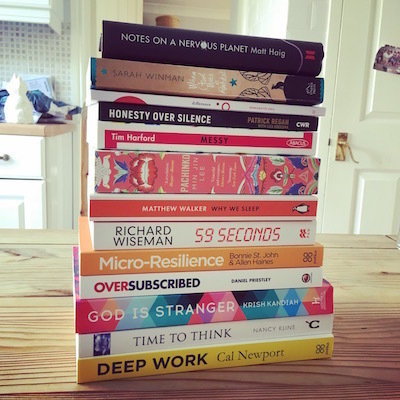
Where some girls have a shoe habit, I have a book habit!
Now, let me just say – this to me is a dream because I love reading. Others – my husband for example – would be overwhelmed at the sight of it.
To me, it’s as inviting as a full cookie jar would be to him. I think of it as “plenty to keep me going” rather than “that’s a heck of a lot to get through”. (Update – I never did make my way through all of them, but I did come away feeling resourced!)
People often ask me how I manage to make time to read. The answer is two-fold: I enjoy it, and I treat it as a resource, not an indulgence. It feeds my curiosity and fuels my creativity – whether I’m reading about Micro-Resilience, Why We Sleep or When God Was a Rabbit.
When I find I’m running on empty, reading is what recharges me. It gives me insight, inspiration, ideas to play with and raw materials to work with.
What about you? Where are you feeling depleted?
With two weeks left of the summer what one thing could you do with investing in, to arrive at September well-resourced?
The post Too much R and not enough H appeared first on Grace Marshall | Productivity Ninja, Author, Speaker, Coach.
July 12, 2019
Efficiency or Deficiency?
“What was efficient yesterday is deficient today.”
This phrase struck me recently. I heard it from Christy Wimber, who was speaking in the context of healing ministry in churches, but it caught my attention because it described exactly what I’ve been noticing in the world of productivity – and 21st Century living in general.
Take bread making for example. As a friend recently educated me, in the industrialisation of bread-making:
We swapped traditional farming methods and crops for intensive mass farming – favouring monoculture and less diverse wheat crops which rely heavily on fertilisers and pesticides. The lack of diversity and addition of chemicals compromise the nutritional value of the soil. And intensively grown modern wheat is unable to grow deep roots to access the nutrient richest part of the soil.
Millers exchanged stoneground mills for steel rollers, which are very efficient at separating the component parts of the grain, but also strips out most of the micronutrients concentrated in the outer layers of the germ. A bunch of the main nutrients that get lost get added back in later, but there’s a whole load that doesn’t. The rollers also get hot in the process, which significantly reduces the wild yeast or lactic acid bacteria that might be present in the flour.
Bakers who always used good ingredients and slow fermentation methods (which allow good bacteria cultures to develop) were replaced by large scale industrial factories where bread is made using roller milled flour and fast-acting industrialised yeast which enables bread to be produced at a rapid rate. At this rate, bread isn’t able to develop the wealth of lactic acid bacteria found in real bread, making it less nutritious and nourishing, and also harder on people with digestive problems. It’s also here where a bunch of additives are also put in in order to extend the shelf life of the bread.
At each stage of the process – from crop selection, to agricultural methods, manufacturing and baking – the drive for efficiency has stripped bread of its nutritional value.
The same thing happens with our obsession with efficiency at work.
In focusing solely on doing more for less and getting stuff done faster…
We stop thinking. We get so focused on the doing, we don’t give ourselves time to think.
We stop discerning. As Peter Drucker put it, “There is nothing so useless as doing efficiently that which should not be done at all” I wonder, how much work do we create for ourselves and each other because we were so focused on getting stuff done, that we didn’t stop to ask if it should be done at all.
We stop listening. We tell, we shout, we send another email and schedule yet another meeting. We create noise, trying to get our message through – and when something does reach our ears we jump straight into either defensive or problem-solving mode, forgetting to just listen first.
We stop stopping. We value motion over progress. We fill in all the blank spaces. Working through lunch. Tweeting on the loo. Emailing on our commute. Frenetic pace becomes the norm and stopping becomes unusual, uncomfortable, feared or even derided.
We stop caring. Either because we’re burnt out – or in some cases, we’ve streamlined the work so much that all we do is follow a series of tick boxes and scripts. Work becomes completely devoid of meaning and dangerously lacking in care, compassion or humanity.
We stop trusting. In optimising performance, we add in measures that take away autonomy and ownership, replacing them with bureaucracy, data and targets that result in people spending more time servicing the system than serving the clients, patients or community.
We stop questioning. When everyone’s frantically busy meeting deadlines, questions are disruptive and frowned upon. “Because I said so” and “just get on with it” becomes the default answer – whether spoken or not. What’s more, we surround ourselves with people who are just like us – likeminded people are less likely to debate, differ or disagree, so less time is ‘wasted’. Our echo chambers get louder and our blind spots get larger when we sacrifice diversity for the sake of uniformity.
We stop learning. When there’s no time to think, we stick with what we know – or asking who we know. Those with expertise get inundated with interruptions, and those without never learn, because it’s always quicker to ask than to risk the time it takes to actually learn it for yourself.
We stop innovating. Efficiency is about doing the familiar faster. Streamlining, smoothing, ordering. Innovation is about stepping into the unfamiliar. Taking risks. Breaking things. Disrupting the status quo. Getting things wrong. Going back. Going sideways. Going round in circles. Often the steps that lead to innovation look incredibly inefficient.
We stop laughing. I remember a client telling me the change she’d notice in her company as workload and schedules got more demanding “People used to laugh more. Now when I walk through the office, there’s a lot less laughter.” When we fill every gap in the diary and fly from one meeting to another with military precision – it’s often the human experience that gets squeezed out. The laughter, the connection, the unplanned conversations and the relationship building. As a result our whole work-life experience becomes deficient.
The crazy thing is, efficiency is what robots do really well. Us humans? It’s the care, the compassion, the collaboration and the creativity that we have a unique handle on.
Isn’t it time we started redefining productivity on more human terms?
The post Efficiency or Deficiency? appeared first on Grace Marshall | Productivity Ninja, Author, Speaker, Coach.
July 3, 2019
What’s your ‘no’ strategy?
If it isn’t a clear yes, it’s a clear no” – Greg McKeown
I love this advice. I aspire to this advice. Most of my life, my default has been the opposite. If I couldn’t find a clear reason to say no to something, I would end up saying yes to it.
That’s one of the reasons why it’s harder for me to say no – it takes more time than saying yes.
I can say yes very quickly. There have been times when that’s served me well to go faster than the speed of fear. Other times I regret it sorely afterwards.
It takes more time because I need a clear reason.
Partly for myself – so I can be at peace with my decision, and stop second guessing myself.
Partly to honour the person who’s asking. Relationships matter to me, so if someone’s gone to the trouble of reaching out, I want to honour that relationship – even if the answer’s no.*
So how I say no matters.
* that doesn’t count for cold callers, spam bots and door-to-door salespeople who are just playing the numbers though – as there’s no relationship there to begin with!
Recently I decided to say no to applying for an award.
Part of me thought I should see it through – out of appreciation to the person who had nominated me, or because it seemed like the right and brave thing to do, or well… because I’d written about it before and I wanted to keep my word.
Particularly when they tweeted me to remind me to apply, I wanted to say a clear no, rather than ignore it and let the deadline slip by.
The reasoning in my own head was this:
It’s mentally intensive, filling in an application form and extolling your own virtues. As anyone who’s ever written their own ‘about me’ web page, LinkedIn profile, CV or job application will know – writing about yourself is hard! I can do hard things, but what would this particular hard thing actually achieve?
The judging criteria didn’t match my own success criteria. Financial performance, and local community impact, for example. All really good things, but not the key things I’m focusing on right now in my business – and not what I want to be judged for actually. Spending time aligning myself to those criteria would actually be a distraction, not an achievement.
And this is how I ended up saying no:
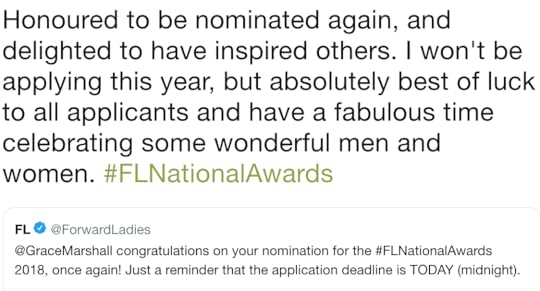
Notice how I didn’t actually explain my reasons? Because in this case, my reasons were for my benefit. I didn’t need to justify them. Once they were clear to me, I found I could say no clearly.
There are other times when it is worth explaining your reasons.
I was on the receiving end of a ‘no’ when I reached out to a fellow writer to see if she was interested in exploring a potential collaboration.
Instead of a flat out no, she took the time to explain why my proposition wasn’t right for her right now. A couple of emails later, we reached an agreeable understanding.
It took us both time to do that, but I’d like to think that’s time invested in the foundations of a potentially productive relationship in the future.
How about you? What’s your ‘no’ strategy? Do you need a good reason to say no – and therefore need to give yourself time to get to a clear no? Or are you more like the Greg McKeowns of this world?
I’d love to know where this takes you. Leave me a comment or get in touch.
The post What’s your ‘no’ strategy? appeared first on Grace Marshall | Productivity Ninja, Author, Speaker, Coach.
June 13, 2019
What do you want to make space for?
There’s a question I like to ask all my subscribers.
If you had an extra hour today, what would you spend it on? And why?
It’s such a good question.
Because far too many productivity conversations are focused solely on ‘saving time’ and efficiency – essentially how to spend less time on the things we’re currently doing.
But what happens when you do free up some time? What do you spend it on?
Would it be that super important thing you keep putting off because there’s “never enough time to do it justice”? Or would you treat yourself to something that feels like a luxury or a guilty pleasure?
Or would it be more of the same?
It’s scary how easy it is to fill our time.
If you’re not clear on what you want to make space for, there’s a chance you’ll just keep doing more of the same. You’ll do more, yes. But more of the same.
Before you know it, your days are just as long, and just as busy – at an even faster pace than before.
What we focus on grows.
If we focus all of our attention on trying to get ‘everything else’ under control, with the best of intentions, we can find ourselves with very little left. What matters ends up perpetually on hold, or getting the dregs of our attention.
But when we’re clear about what matters – and crucially why it matters – even if we’re currently short on time, we’ll start paying attention to it, subconsciously and consciously. We’ll start noticing and looking for opportunities to make it happen.
What about you? What do you want to make space for?
The post What do you want to make space for? appeared first on Grace Marshall | Productivity Ninja, Author, Speaker, Coach.
May 20, 2019
Why wont they leave me alone?
“Why won’t they leave me alone?!” she said.
We were both watching our daughters in a horse-riding lesson. Every few minutes her phone would ping, and she’d huff, type a reply, then put her phone away, only to be interrupted a few minutes later.
I wondered if it was an emergency – but apparently not.
“It’s my husband and mother in law. I don’t think they realise I’m here, with my daughter, in the middle of a riding lesson.”
“I just want to watch my daughter have her lesson!” she sounded exasperated.
I shared my philosophy with her – surely a text means you can send me a message whenever you choose, and I’ll reply when I choose. After all, if you want to have a same-time conversation, you can always call me.
“Oh no, you see, I like to be punctual…”
I think what she meant was she liked to be prompt. She didn’t like the thought of keeping people waiting. But were they really waiting in the first instance? And were they simply replying because she was replying to them?
What if they’re not leaving you alone because you’re not leaving them alone?
A similar conversation cropped up with a friend who works in the charity sector – where a work conversation for her was generally an outside-of-work conversation for everyone else:
“People who want to volunteer or fundraise for us generally do it outside of their working hours – so I quite often find emails arrive in the evenings after I’ve done a full day’s work.”
But how many of them would have been absolutely fine with her replying the next day, during her office hours, I asked? She smiled. The penny dropped.
Often the truth is, we don’t really want them to leave us alone – at least not forever. We still want to hear from our family, our friends, our supporters and our clients. Just maybe not right now.
And who says it has to be right now? What if it’s just you?
What if they’ve already left you alone – or at least left it with you, to pick up when you choose?
Sometimes when we feel taken for granted, it’s actually our own assumptions that we’ve taken for granted.
We often answer this question with some form of “because they…”. Have a go at starting it instead with “because I…” see where that leads you.
I’d love to hear what comes up for you. Let me know in the comments below!
The post Why wont they leave me alone? appeared first on Grace Marshall | Productivity Ninja, Author, Speaker, Coach.
May 10, 2019
How do you spend your time – Does it spark joy?
Thanks to Marie Kondo, so many of us are currently asking this question about our stuff.
But what about how we spend our time?
There was a moment recently when I spotted an email that got me surprisingly excited.
It wasn’t a big deal or opportunity. It was my new violin teacher following up our first lesson with a few recommendations of music scores to buy.
But there was definitely an ‘ooh!’ and maybe even a little squeal of excitement when I spotted it.
It sparked joy .
How much of what you spend your time on sparks joy for you?
Now I’m not suggesting that everything that doesn’t spark joy is worthless. (Although if you do decide to have a ruthless cull of your diary – I’d love to know!)
But it’s worth asking, if it doesn’t spark joy, what purpose is it serving?
Perhaps it’s something that supports the things that bring us joy
Laundry, tax returns and negotiating contracts certainly fall into that category for me..
Perhaps it’s something we’ve just defaulted to
Booking in a manicure, a night out with friends, or a trip to Legoland with the kids – just because it’s what we’ve told ourselves ‘rest’, ‘fun’ and ‘life outside of work’ looks like.
Like when we say yes to all the social engagements when we’d secretly love to have a date-for-one with a hot bath and a book. When we ‘treat’ ourselves to a day in front of the TV with our PJs on, but our limbs are yearning for a good stretch on a long hike.
When we splurge on a spa day when we’d be far happier getting muddy in the garden. Or when we put ourselves forward for that big shot promotion, because that’s what we’ve told ourselves ‘success’ looks like – but in reality it takes us further away from the work we really love to do.
Perhaps we’ve just tried to pack so much in, that we’ve squeezed the joy out of it
I love reading. It feeds my soul, and my work. But last year, the Goodreads challenge I set myself was too high. There came a point where I noticed I wasn’t enjoying it – or absorbing – as much, because I was simply trying to fly through books to hit my target.
Setting targets can be great for momentum – just as scheduling can be a great way to make things happen – but if our targets and our schedules have us flying from one thing to another, we can end up squeezing out the value, impact and the joy.
When you think about how you spend your time – does it spark joy? Let me know below!
The post How do you spend your time – Does it spark joy? appeared first on Grace Marshall | Productivity Ninja, Author, Speaker, Coach.
How do you spend your time? Does it spark joy?
Thanks to Marie Kondo, so many of us are currently asking this question about our stuff.
But what about how we spend our time?
There was a moment last week when I spotted an email that got me surprisingly excited.
It wasn’t a big deal or opportunity. It was my new violin teacher following up our first lesson with a few recommendations of music scores to buy.
But there was definitely an ‘ooh!’ and maybe even a little squeal of excitement when I spotted it.
It sparked joy .
How much of what you spend your time on sparks joy for you?
Now I’m not suggesting that everything that doesn’t spark joy is worthless. (Although if you do decide to have a ruthless cull of your diary – I’d love to know!)
But it’s worth asking, if it doesn’t spark joy, what purpose is it serving?
Perhaps it’s something that supports the things that bring us joy
Laundry, tax returns and negotiating contracts certainly fall into that category for me..
Perhaps it’s something we’ve just defaulted to
Booking in a manicure, a night out with friends, or a trip to Legoland with the kids – just because it’s what we’ve told ourselves ‘rest’, ‘fun’ and ‘life outside of work’ looks like.
Like when we say yes to all the social engagements when we’d secretly love to have a date-for-one with a hot bath and a book. When we ‘treat’ ourselves to a day in front of the TV with our PJs on, but our limbs are yearning for a good stretch on a long hike.
When we splurge on a spa day when we’d be far happier getting muddy in the garden. Or when we put ourselves forward for that big shot promotion, because that’s what we’ve told ourselves ‘success’ looks like – but in reality it takes us further away from the work we really love to do.
Perhaps we’ve just tried to pack so much in, that we’ve squeezed the joy out of it
I love reading. It feeds my soul, and my work. But last year, the Goodreads challenge I set myself was too high. There came a point where I noticed I wasn’t enjoying it – or absorbing – as much, because I was simply trying to fly through books to hit my target.
Setting targets can be great for momentum – just as scheduling can be a great way to make things happen – but if our targets and our schedules have us flying from one thing to another, we can end up squeezing out the value, impact and the joy.
When you think about how you spend your time – does it spark joy? Let me know below!
The post How do you spend your time? Does it spark joy? appeared first on Grace Marshall | Productivity Ninja, Author, Speaker, Coach.
March 18, 2019
Personal Productivity – The Conversation
It always amazes me how many people try to solve the productivity puzzle on their own. They read books, they scroll through blogs, they even book themselves onto workshops.
And while that’s all brilliant, at some point we need to talk about how we work with other people. Our clients, our colleagues, our bosses, maybe even our family. Because we don’t work in a bubble. Like it or not, other people have an impact on how we work.
Given that it’s National Conversation Week. I’m inviting you to start a Really Productive conversation with someone you work with and ask them:
“If you could tell me one thing about yourself that would help me to understand how you work best and how we can work better together, what would it be?”
We often treat people how we’d like to be treated, but what’s more helpful is to treat them how they’d like to be treated – and that’s not always the same thing!
As I wrote in the Being Human chapter of How to be Really Productive, productivity is inherently personal. What works for one person doesn’t necessarily work for someone else.
The more we understand our own personality and preferences, the more we can tailor our productivity habits and strategies to suit. Likewise, the more we understand how other people like to work. The better we all work together (and the more we enjoy it too).
So, here’s my invitation to you – use this question to start a conversation with someone you work with.
“If you could tell me one thing about yourself that would help me to understand how you work best and how we can work better together, what would it be?”
I’d love to know what kind of conversation this sparks. Let me know below!
The post Personal Productivity – The Conversation appeared first on Grace Marshall | Productivity Ninja, Author, Speaker, Coach.


