
Grace Marshall's Blog, page 7
January 11, 2016
The question that should replace ‘how do I get more done?’
 I was interviewed last week by the lovely Julie MacDonald, journalist, broadcaster and founder of The Daily Juggle.
I loved the question she started with: “Grace, this isn’t a book on how to be more busy is it?”
Quite the opposite, actually!
But it’s an interesting question. Because much of our conversation on productivity tends to start with “how do I do more?”
“Too much to do, not enough time, how do I fit it all in?”
“Higher targets, less resources, how do we do more with less?”
And if we’re not careful, our efforts to become more productive can become an exercise in cramming more in, resulting in a quest for “how to be more busy”, rather than how to get more value out of our work and our lives.
Let’s face it. Most of us are already experts at being busy. We are by definition always doing something, even when we think we’re doing nothing. The question isn’t “How do I do more?” but “How do I do more of the things I want to do, and less of the other stuff: the stuff that steals my time, energy and attention, and gives me little in return.”
Perhaps a more useful question would be to ask: What do I want to do more of, and what do I want to do less of?
Because it reminds us that there is a trade-off, and that if we are to make space for more of something, we may need to do less of something else.
One of mine last year was ‘less networking, more geek out conversations’ which for me meant stepping back from networking groups to make space to meet individual connections, being less committed to regular meetings in favour of in depth conversations, and giving myself permission to travel to meet one person rather than a roomful of people.
This has led to some fascinating conversations with fellow authors, trainers, change makers and productivity geeks – all of which have made my life and my work richer.
This year, I have a new one: ‘less proving my worth, more doing the work’ to remind me not to let my ego distract me into chasing opportunities to be seen in the right places, so that I can remain fully focused on serving and delivering value right where I am. I know that this is how I do my best work, and trust that in the process, the right doors open to the right places, and my work can speak for itself.
What about you? What do you want to do less of/more of, this year? Perhaps it’s…
Less faffing, more focus
Less fake work, more real work
Less confusion, more clarity
Less emails, more conversation
Less hiding, more stepping up
Less pressure, more passion
Less distraction, more attention
Less reactive, more strategic
Less perfect, more human
Less default, more choice
Less burnt out, more fired up
Less standby, more recharge
Less brain dead, more creative
Less headless chicken, more brilliance
Less zombie, more wide awake
Less busy, more productive
Or something else?
I’d love to know your less of and more of’s – whether for the year ahead, week ahead or just for today.
Leave me a comment, or drop me a line and let me know…


January 4, 2016
Three words to banish new year panic
That first day back. It’s so easy to get caught up in ‘have to’s.
The hundreds of emails you have to wade through in your inbox. The couple of bits that got missed at the end of last year that you have to get off your desk. The brand spanking new plan you have to come up with to make 2016 amazing. The meetings, projects, tasks and commitments already starting to pile up that you have to deal with.
It’s easy to get caught up in that panic, like somehow the rest of the world has got their act together and you’re trailing behind.
Days like these I’m reminded of something I wrote three years ago, to start now, rather than play catch up with someone else’s race.
And to focus on what I get to do, rather than all the things I have to do.
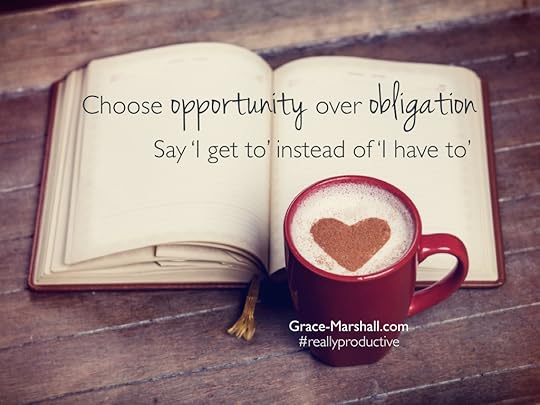 As I wrote in How to be Really Productive, ‘have to’ signals obligation and powerlessness, whereas ’get to’ signals opportunity and choice.
Today I get to have my brain back to myself, as the kids are back at school.
Today I get to pick up the conversations that have been put on hold while I’ve been enjoying jigsaws, Narnia films and far too much food.
Today I get to start the year with a big review, to give myself permission to check in with me first, to choose how I want to show up in the rest of 2016.
What do you ‘get to’ do today?
December 14, 2015
Busy is new normal

How often do we answer the question “How’s it going?” with “Busy!”
Busyness has become the norm. But it has also become strangely aspirational. As much as we complain about being busy, we’re also strangely resistant to being not busy.
When was the last time you heard anyone admitting to not being busy? That they had plenty of time, things were nice and slow, and they had plenty of spare capacity? Why are we afraid of the alternative? What would it mean to be not busy? Does that mean I’m lazy? Not doing enough? Will someone come and give me more work to do?
For those who run our own businesses, ‘busy’ is often seen as a measure of success. Busy means you’re in demand, therefore you must be doing something right. If you’re not busy, what have you done wrong? Is your product substandard? Is your service poor? Have you neglected your marketing?
For those who work in ‘busy’ organisations, admitting to not being too busy might land you with more work to do. You’re on top of your work are you? Great – go help Sally with her backlog! Or worse, maybe someone will start questioning whether you’re surplus to requirements…
We might even feel resentment if someone isn’t busy – that somehow they aren’t pulling their weight. If the rest of us are suffering, surely they should be carrying their piece of the burden too?
We validate our worth with busy. There’s something about being busy that gets associated with being wanted, being needed, being in demand. Honestly, there’s a part of me that enjoys being busy. I feel useful.
We use busy to judge whether we decide to do something or not – it seems more acceptable (or at least easier) to say “no sorry I’m busy” than to say “thanks but no thanks”
We satisfy ourselves that we’re doing the best we can because we’re busy and couldn’t possibly do any more. Or we feel like a constant failure because we’re so busy trying to catch up.
Busy is seen as good work ethic. And those who aren’t busy are viewed with suspicion.
Busy is our means of achieving, but also our excuse for not achieving. Not dealing with that problem that we’ve been avoiding. Not making that appointment to get that lump checked out. Not taking a break, or booking that holiday you keep promising yourself. Not going for that run, or that swim or that walk. Not having that difficult conversation with your partner, or your boss, or your kids. Not cutting your losses on the project that’s not working out. Not letting go of that customer you’ve outgrown. Not being ruthless and saying no…
We know what we need to do, to manage our stress and stay healthy, but we don’t do it because we’re too busy.
As the American Psychological Association’s Stress In America 2010 report found “In general, Americans recognize that their stress levels remain high and exceed what they consider to be healthy. Adults seem to understand the importance of healthy behaviors like managing their stress levels, eating right, getting enough sleep and exercise, but they report experiencing challenges practicing these healthy behaviors. They report being too busy as a primary barrier preventing them from better managing their stress…”
Dr. Susan Koven of Massachusetts General Hospital wrote in her 2013 Boston Globe column: “In the past few years, I’ve observed an epidemic of sorts: patient after patient suffering from the same condition. The symptoms of this condition include fatigue, irritability, insomnia, anxiety, headaches, heartburn, bowel disturbances, back pain, and weight gain. There are no blood tests or X-rays diagnostic of this condition, and yet it’s easy to recognize. The condition is excessive busyness.”
The above is an extract from my new book “How to be Really Productive: achieving clarity and getting results in a world where work never ends.“
–
So what’s the alternative to busy?
Perhaps we should simply start by swapping the word busy for something more truth-telling. When you say “I’m busy”, what do you really mean? Are you fully committed, or over-committed? Are you excited or exhausted? Confused? Distracted? Undecided? Lost?
If life is full on, what exactly is it full of? Opportunity, excitement, adventure and wonderment? Or distraction, demands, emails, meetings, deadlines and drudgery?
Here’s my question to you as we approach the end of one year and the beginning of another:
What word would you love to swap busy for in 2016?
Would it be clear, content or in control? Blessed, abundant, hopeful, excited? Taking your time? Living the dream in progress? Making it all up as you go along? On a mission?
What word – or words – would you choose? I would really love to know. Please do leave a comment here or drop me a line and let me know what you’d love to swap busy for in 2016.
December 7, 2015
Creating a routine that works for you
 Last week I was invited to speak at a Sage Small Business Saturday session, along with Brendan Flattery, President of Sage Europe and Maria G del Pozuelo, CEO of Womenalia.com on how to create a routine that works for you.
Technology prevented me from actually speaking in the session (that’s a whole other story!) but here are some of the tips I shared:
1. Energy levels – know what energises you and what drains you, and organise your routine around that. It’s one thing knowing when you’re at your best compared to when you’re in zombie mode. What also affects your energy levels is what you do. If you are energised by being around people, then consider breaking up a day in front of a screen with some well-timed conversations. If it’s being in creative mode that energises you, make space in your routine to tap into your creativity and you may find that everything else flows smoother too.
2. Recovery & performance – Sustaining peak performance depends on taking recovery seriously. Recharging is not a luxury it is fuel for your productivity. Planning in how and when you recharge is just as vital as planning the work itself. The same goes for making space for the things that matter to you. Brendan and Maria both have family time they commit to before the work gets planned in, rather than waiting for ‘when they have time’.
3. Manage your availability and communicate it clearly – There are times when you need to have your brain to yourself so that when you are available you are fully available. Whether you are CEO of a large organisation where everyone wants a moment of your time, or Chief Everything Officer where there is nobody else to take that call, everybody benefits when you take the lead and set clear boundaries around your availability.
4. Margin – leave space in between fixed commitments. Don’t fill in all the gaps. Leave room for the unexpected, for breathing space, thinking and flexibility. Brendan shared that he comes up with his best ideas when he has time away from the office to think. I find that without margin, I am far less human than I’d like to be.
Finally, make it personal – I loved that Maria defies the stereotype of CEOs who do their most productive and successful work before 7am. Yes that may work for others, but she knows it doesn’t work for her, so she starts her day at 7am. When we are true to ourselves, we let our best selves show up.
Productivity is about giving yourself what you need to be at your best, because that’s when you do your best work.
Over to you. What tips, tricks or lessons learned would you add when it comes to creating a routine that works for you?
November 30, 2015
One Evernote trick that will transform your business networking productivity
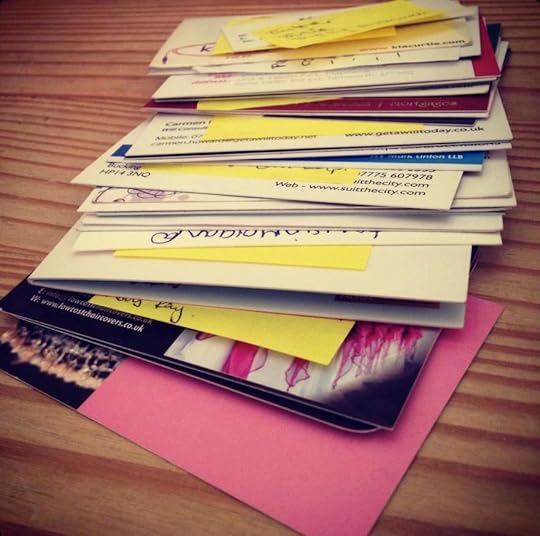 Hands up who has a pile of business cards collected from a networking event in a box or a drawer somewhere?
Yes, we tell ourselves we need to ‘make time’ in between meetings and events to follow up but honestly, how often does that actually happen?
What if you could do it all there and then?
A few weeks ago I met Imran Azam at Thinking Digital Manchester. We struck up a conversation over coffee, and he ended up interviewing me for his podcast. He had it recorded, uploaded and live before the first session of the day, which was pretty impressive!
Even more impressive was what he did with my business card. I was so excited I had to get him to share this trick with you.
Here goes…
Picture this; you’re out networking trying to connect with people who are relevant to your profession. At the end of the evening you’ve made a ton of contacts and a grasp a well earned stack of business cards. Sounds like the perfect result right? Well thats only half the story of productive networking. The other half is about what you do with those precious business cards. What use is a stack of contacts if they sit around your desk gathering dust?
What if there was a way to scan a business card there and then, create a contact in your address book, send an email with your contact details AND make a Linkedin request all in one go in the time it takes to read this sentence? Well there is!
In this guest blog post Imran Azam shows you how you can use Evernote to maximise your networking impact.
About Imran Azam
Based in Manchester Imran is the founder of creative social video agency thisisreel.co, a digital communications strategist and the Media Director at thepeoplewhoshare.com.
Imran also runs ‘The Art of Smartphone Filmmaking’ monthly Meetup where bloggers, brands, agencies, filmmakers and journalists come together to learn how to produce broadcast quality films produced, edited and published solely on a smartphone.
twitter: @moiazam
November 23, 2015
What to do when you don’t know what to do – a guide for goal getters without a goal
 Ever found yourself floundering – knowing that you could be really productive, if only you knew what it was you were supposed to be doing? That you have the drive, focus, skills, ability and know how to succeed, you just don’t know what?
Especially if you’re used to being a goal-getter, it can be the hardest thing when you feel like you’re raring to go with nowhere to go.
What do you do, when you don’t know what to do? Here are three suggestions:
Look back before looking ahead
I spoke to someone this week who felt like she was floundering. She was having a lot of fun, but felt she was lacking focus. Which in itself isn’t a bad thing, but she wanted to feel more on purpose, less aimless, to have a sense of cohesion and purpose.
I remember having a similar conversation with my church pastor about six years ago, telling him all the different things I was involved in, describing myself as a chameleon, able to turn my hand at most things, enjoying the variety but feeling fragmented and aimless.
“I’ve never fitted neatly into one box” I told him, but as we spoke, as I described all the different roles and projects I was involved in, he picked up on a thread. “You’re an encourager” he said, and he was right. It was blindingly obvious once he said it – whatever box I was trying to fit myself into, that was what I brought to the table every time. That was my thread, and that thread has guided me ever since.
Our thread is personal. We weave it as we go along. As another speaker said this week sometimes “clarity comes from engagement, not thought” so even when you feel like you’ve been floundering or going off on all sorts of tangents, the chances are you’ve already been weaving your thread. You just need to look back to see it, and then let that guide what’s next.
Reverse engineer what you don’t want
Someone else I spoke to recently was feeling frustrated and grumpy – angry even. Angry because she knew that she could succeed at whatever she turned her hand to, but she felt like she was going through the motions. She didn’t know what she wanted, but she knew what she didn’t want. She was angry because there was something about the way things were being done in her industry that didn’t sit well with her. And she was angry because it wasn’t like her to be angry!
As someone who generally has a positive disposition, I get how hard this can be. I thrive on focusing on the positive. That’s what motivates me. I hate dwelling on negatives.
But perhaps there are times when we are called to be revolutionaries. When the thing we want doesn’t exist yet, and we are simply convicted that it shouldn’t be like this. These are the times when we need to confront what’s wrong instead of avoiding it. When the thing we seek is on the other side of what’s wrong, and we need to face the injustice, the frustration, the thing that riles us head on, in order to get to the other side. I often wonder how many times Martin Luther King must have gone through “we have a nightmare” before he got to “I have a dream.”
Identify the questions
My husband is quoting for a job at the moment. It’s potentially a big job, in a completely new field. He feels like he’s not making progress. On one hand, he just wants to ‘do the damn quote’. On the other hand, every corner he turns reveals something new to investigate. What started off as a single task has become a project that unfolds at every turn.
Often when we’re embarking in new territory, we have more questions than answers, but sometimes we can be so focused on finding the answer, we forget to clarify the questions. “How much should I quote?” might seem like a straight forward question, but if you find you can’t answer it, chances are there are many other questions contained within that question.
Instead of “what’s the answer?” try asking yourself “what questions do I have?” and map them out. When we are navigating new territory, it’s often our questions, not our answers, that create the map.
Over to you. If you find yourself struggling to figure out ‘what to do’ or ‘what next’, take one of these strategies: look back and track the thread you’ve been weaving; confront the problem and face it head on; or give yourself a break from the answers and focus on the questions.
And if you’d like to another pair of eyes and ears to bring a fresh perspective, feel free to book yourself a Clarity Shot and I’ll be happy to work through it with you.
November 15, 2015
Why trying to get everything done will ruin your productivity
 With the launch of How to be Really Productive, I’ve been doing a few interviews lately, talking about what productivity is really about. One thing that keeps coming up for me is what I call The Everything Myth.
Productivity is not about getting everything done. In fact, trying to get everything done can actively hamper your productivity. Here are six reasons why:
1. You distract yourself
It’s really hard to focus on just one thing when everything else is beckoning. Whenever I run Productivity Ninja workshops and ask the question, “Who or what distracts you most from getting things done?” the top answer is often “Me!”
We distract ourselves with thoughts of everything else we’re trying to get done – other projects, other ideas, other reminders and nags. When you try to get everything done, everything distracts you from the one thing you’re trying to get done.
2. You dilute your impact
When you try and do everything, all you end up doing is spreading yourself thin and diluting your impact. It’s what Greg McKeown describes as “the unfulfilling experience of making a millimetre of progress in a million directions.”
You actually achieve less, and do your clients no favours either. Ever tried to shop in a store that sells ‘everything’? How easy is it to actually find what you need? And how reassuring would it be, to take your car to a mechanic, and find half-assembled washing machines, printers and lawnmowers in the garage?
Being able to be all things to all people might seem like an attractive proposition, but in reality it creates confusion, mediocrity and vagueness. You make less impact, give less value and everyone ends up frustrated.
3. What you actually get done becomes a lottery
When everything’s a priority, nothing is. When faced with a giant to-do list, choosing what to do becomes more like a lucky dip than a thoughtful decision.
You keep plugging away, day in, day out, in the hope of hitting the jackpot. There’s always a tiny chance that you will, but more often the pay-offs you actually see are the token amounts – or nothing at all.
4. You become addicted to activity
There’s a difference between fake work and real work. Fake work is the activity that keeps you busy and gives you very little in return. Real work is the action that takes you closer towards your goals and gives you meaningful results.
The problem with trying to get everything done is the pressure gets so high, it’s easy to get hooked on the momentary satisfaction of ticking something – anything – off your to-do list. And often it’s the activity that gives a quick hit – rather than the actions that take more of your thoughtful attention, tenacity and creativity to work through.
5. You worry about things beyond your control
Another common symptom of trying to get everything done is we overextend our sense of responsibility and worry over things we can’t actually do anything about.
Not everything you worry about is within your control. Take a look at your to-do list. How much of it is filled with clear, actionable tasks? How much of it is just a sense of worry – something you have a vague sense of responsibility over, or something you’re taking too much responsibility over?
As cricketer Glenn Turner put it “Worrying is like a rocking chair, it gives you something to do, but it gets you nowhere.” There is plenty of worry in this world to keep us busy. If we’re going to be really productive, we need to separate the work from the worry.
6. You never get to the end of everything
As human beings, we are not designed to function on a constant output. We need times when we stop, and times when we start again. Times of recovery in between times of performance. Our momentum, energy and motivation depend on our ability to stop. To derive satisfaction from a sense of completion, to be able to switch off and feel good about what we have accomplished, so we can rest and start again tomorrow.
Without this, we lose our fire, our drive, our clarity and our ability to do our best work. We become overwhelmed, disillusioned and eventually burnout.
The problem with everything is, it never ends. And the truth is, there is always more work we can do – more calls we can make, ideas we can have, more projects we can pursue. In a world where work never ends, it’s up to us to create our own finish lines. To decide what job done looks like, what success looks like, and enjoy the sense of completion and satisfaction that comes with doing good work.
True productivity is not about doing everything.
It’s knowing what you don’t do, so you can genuinely commit to what you do do. It’s separating the worry from the work, and the fake work from the real work. It’s choosing what you get done, instead of leaving it to chance. It’s being focused on where you create your biggest impact and make your best contribution, and giving that everything you’ve got.
Over to you. What do you make of The Everything Myth? What would it mean for you to let go of trying to do everything? What would that allow you to focus on instead?
October 26, 2015
Perspective
 I was in Barcelona last week! As glamorous as that sounds, here’s a confession. I’m a bit of a wimp when it comes to traveling alone. If my husband had been with me, we would have been hitting the tapas bars, exploring the local delights. But when I arrived, I was tired, the streets were busy, it was getting dark and I didn’t know where to go (all excuses, I know!) So I stayed put in the hotel instead. It was a very nice hotel – but it could have been a very nice hotel anywhere.
I did venture out the next morning, before my workshop and explored the amazing indoor market, and even had Patatas Bravas for breakfast (got to be done right?)
But later on in the day, during a workshop break, I saw the street from an entirely different perspective. Just a few metres up, from the second floor balcony the street looked almost peaceful. People milling about, trinkets twinkling as they caught the sun. I could have stayed there all day, watching the world go by.
A few hours later, I was in a plane again, taking off. Watching the streets turn into strings of sparkling fairy lights, completely peaceful, totally beautiful. I’ll never tire of that view.
Amazing what a difference a shift in perspective can make.
One of my workshop delegates noticed something similar with the way she’s learned to deal with difficult email conversations – whether it’s a customer complaint, a harsh response, or a brusque demand. Whenever she gets an email that might potentially upset her she imagines as if the email had come from one of her nicest colleagues, someone who’s “always sweet, always lovely”, and tries to imagine if that colleague had written the email – what would cause her to write an email like that? What would she have meant by it? What else could be going on? Was she having a bad day, or distracted, or under pressure? Is there another way of reading it? Perhaps there’s even a typo, or a line missing? What else could it mean?
This simple shift in perspective allows her to see beyond her initial reaction and interpretation, and seek a different understanding. She avoided taking things personally, and was able to deal with the issue at hand – if there was even an issue to begin with – and was able to respond thoughtfully rather than react heatedly.
What situation do you feel surrounded or overwhelmed by – or even under attack?
Try shifting your perspective:
Imagine the situation from the other person’s perspective – or someone else entirely
Change the face – or tone of voice – behind the words
Stand up, or take a walk. Physically look at it from a different perspective
Imagine navigating a 6 year old through the situation – or your best friend
Sleep on it. Come back to it in the light of day.
What other ways have you used to change your perspective? And what could a shift in perspective do for you this week?
Let me know…
October 18, 2015
In survival mode? You need pockets…
 It’s been a crazy busy week. In five days, I’ve run 4 workshops and set foot in 12 different train stations (some of them several times). My husband has finally completed his MSc and is now in decompression mode, recovering mentally – and physically from a trapped nerve in his shoulder. And my son recovered from ‘hand, foot & mouth’ (which thankfully has nothing to do with ‘foot and mouth’!) in time to make 3 of his 5 day school residential trip.
It was great to end the week with a Skype chat with Michael Sliwinski, CEO of Nozbe and chief editor of Productive! Magazine, about productivity, work & family life and my upcoming book.
He asked me about my strategies for dealing with a crazy busy week – which was apt, as I had practically walked in from my workshop in Birmingham, thrown my poor husband out of the kitchen, plugged my laptop in and dialled into our interview. If you look carefully when the interview’s live, you’ll probably see all sorts of random paraphernalia in the background of my kitchen!
I realised that something I’ve learned to do, is to create pockets where I step out of survival mode.
Because while survival mode can be very effective in making sure we get through something in one piece, its long term effects are that we actually stop living.
Survival mode often means we strip back everything except for the bare essentials. We cancel that date, push back our plans, lower our expectations, shelve our dreams, and just concentrate on putting one foot in front of another without falling.
And survival mode is absolutely what we need sometimes.
But not all the time.
When we’re in survival mode we miss the small moments that make us smile, because our minds are racing ahead to the next thing. We refuse to let our minds ease and our bodies relax, because we’re constantly on alert, poised, ready to react. We never rest, because we’re never done.
We risk squeezing out the very things that bring joy, meaning and purpose into our lives. We put life on hold.
And so what I’ve realised I’ve started doing, when I’m in survival mode, is to create pockets.
Pockets of joy – where I just close my eyes on the train and let the sun warm my face. Plug my headphones in and shut out the world. Give myself permission to celebrate the tiniest of victories. Allow myself to delight in simple pleasures, like the beautifully thoughtful tea tray in my B&B room, with chocolate, cookies and fresh milk to go with my earl grey tea!
Pockets of peace – where I stop thinking about what I’ve got to do, what I’ve yet to figure out and what I need to pull off in the week ahead, and just be at peace with myself, my capacity and my choices. Where I stop mentally rehearsing and triple checking, and trust that I am enough.
Pockets of surrender – where I remind myself that I don’t have to change everything at least not right now! Where I tell myself to just let the world be for a minute. If that sounds all a bit too ‘zen’ for you, it’s also what my friend Debbie Huxton would affectionately refer to as a “F*ck it” moment. Seriously, when it all gets too much, try that. Say that out loud, with gusto, and notice how much better you feel!
Because when we allow ourselves to stand down from survival mode, just in those tiny pockets, everything changes. We remember what it’s like to be alive. We realise that we are alive, and perhaps things aren’t as threatening as they seem. We regain our sense of humour and restore our perspective. We may even recognise the opportunities that lie before us – opportunities we’ve worked hard to create – and decide to grab them with both hands rather than feel strangled by them.
Are you in survival mode at the moment? What would be a pocket for you?
October 12, 2015
On winning
 Wow, what a week it’s been!
On Thursday I had some local fame when my local paper ran a piece on my award nomination for Emerging SME Business of the Year in the Forward Ladies National Women in Business Awards.
On Friday I celebrated being a finalist in the Midlands regional heats in Nottingham, and my kids came home with TWO well done certificates from school.
And then on Saturday, the first print copies of my new book arrived, hot off the press (take a sneak peek here!)
In case you were wondering, I didn’t win the award, but when two good friends texted within two minutes of each other to tell me that I was a winner in their eyes, I realised that I did indeed feel like a winner!
I felt proud. I had stood up, owned my success and celebrated my achievements. And some two hundred fabulous women (and men!) in business had celebrated with me.
Somehow it didn’t matter that I didn’t win the trophy (or glass bowl in this case) or the title. It mattered that I was proud of what I had achieved.
One of the organisers stopped me as we were leaving, and urged me to apply again next year. It hadn’t occurred to me to do that – but perhaps that’s also the mark of a winner. Someone who gets up and goes again. Because if I think about it, it probably takes more courage to put yourself forward a second time, than the first.
And all of this happened in and amongst a whole load of other things: hard things, messy things, frustrating things, things that feel so far from winning. Because life is like that sometimes. Winning isn’t about perfection. It’s not the absence of tears, fear and failure. It’s owning the success alongside the struggle.
Perhaps winning is more about choosing an attitude, than being given an award. Maybe it’s more about your recognition than anyone else’s.
To stop and take a moment, away from ‘what’s next’, to celebrate what’s done – away from the to-do’s to be proud of our ta-da’s…
To be proud of what you achieve even when someone else achieves more…
To get up and go again, especially when you didn’t get there the first time round…
To hold your head up and be proud of your successes – amongst the messiness of things that haven’t worked out and things you’re still working on…
That’s winning.
Next time you see a winner, on stage holding a trophy, on a podium receiving their medal, or anywhere else, remember this: they are not perfect. Their life is not charmed. They struggle too.
Next time you find yourself getting up and going again, celebrating your successes amongst your struggles, choosing to acknowledge your achievements rather than compare them to someone else’s, know this: you’re a winner too.
Here’s to your wins this week – feel free to share them in the comments below.


