
Grace Marshall's Blog, page 6
March 21, 2016
5 Signs of a Strong Team
 “Strong teams pull together when the shit hits the fan, where others fall apart.”
I shared this on social media a couple of weeks ago, after working with a particular team that really struck me with their team spirit.
Like many teams I work with, they were dealing with the pressure of heavy workloads, rapid change, high uncertainty, obstacles aplenty and constant pressure from both colleagues and clients. One thing they did that was very noticeable, was that they pulled together, at times where other teams were falling apart.
So you can imagine the irony when shortly after writing a post about what strong teams do differently, my own teamwork and crisis management was put to the test – when my laptop died in the middle of the hotel the night before 2 days of workshops.
The good news is, my laptop has been revived – hurrah! And all the lessons I wrote about held true for me too. So what is it that sets strong teams apart from others? Here are five things I’ve noticed:
1. They laugh more
The most noticeable thing about the group I worked with the other week was how much they laughed. And I mean proper belly laughs, not just polite chuckles. They laughed at the good and the bad, at themselves and the situation. And in laughter, they found sanity, survival and surprising solutions too. Laughter is immensely powerful. It releases pressure, builds resilience and unlocks creativity.
I’ve noticed this from TPHQ’s famous ‘Cake and Irate’ sessions, and more recently in how wonderfully inappropriate humour has featured in my friend’s blog about her cancer journey.
The morning of my first workshop sans laptop, I found myself holding onto this. And yes, laughing is not the first thing you think of in times of crisis, but the truth was I couldn’t afford a sense of humour failure. It’s amazing how much you can find to laugh about, when you allow yourself to: from the security guard mysteriously changing my name to Michelle, to joking with my host and delegates arriving in the room laughing about various things that had happened to them over the weekend. I found myself surrounded by a lightness that was contagious, that lifted everyone up during the day.
Laughter is like oil on parched skin. It soothes, it heals, it fills the cracks and restores suppleness and flexibility. Next time you feel like you’re cracking up, find something that actually makes you crack up – in a good way.
2. They choose to be hummingbirds
My friend and fellow author Cathy Madavan speaks of the difference between being a hummingbird and a vulture. A hummingbird seeks nectar and signs of life. A vulture looks for death and decay. Both find what they are looking for.
In times of pressure, finding the problems – the broken, the messy, the things that go wrong – is easy. Finding the light, the good, the things that go well or right, may not be as obvious, but strong teams will actively look for those things in themselves and each other. They will choose to take home the one thing that went well instead of the fifty things that didn’t. They will choose to start each meeting with “what’s your good news?” rather than “what’s the problem?” and they will actively celebrate successes – especially in the tough times.
So what’s the upside of spending two hours waiting for my laptop to download some kind of fix via a slow hotel wifi – which in the end didn’t work? I got to spend two hours on the phone with my husband, which is an opportunity we haven’t had for a long time!
3. They encourage each other
Strong teams genuinely care about each other – not just about what they can do for each other at work, but about their lives outside of work as well. They support each other through births and bereavements, diets and marathon training, concerts, childcare, court cases… They know that these details matter. They are the glue that connects us together as human beings and take our relationships beyond the transactional to something potentially transformational.
This last week I have been so grateful to my team who rallied around me with backup slides, backup laptops, tech support, logistics support, emotional and prayer support – and far from being annoyed at the extra work, they were so incredibly encouraging. I felt so cared for – not just in my ability to deliver the work, but for my own sanity and wellbeing too.
4. They speak openly about mistakes
There’s something very powerful about working in an environment where you can ‘fess up to your own mistakes “Oh dear, I f*ed up” or to point out a colleague’s mistake constructively “Hey did you mean to…” or “Oops I just noticed…”
The ability to speak honest truths, candidly and openly, without blame or shame means that resentment has no place to fester. And everyone can focus on taking the learning forwards rather than hiding, or beating themselves up about it.
My mistake? Turns out that when the little rubber feet come off the bottom of your Macbook Pro, it exposes the inside of your machine to dust and crumbs. Apparently it only take a small crumb to wedge its way between a cable and the outer shell, to rub and short out the cable that connects to the hard disk. There you go, now you know – if you use your Macbook so much that the rubber feet have come off, get them replaced – or tape over the holes!
5. They share what works
Seems like an obvious one, but when the pressure is on and everyone is busy, it’s amazing how we can find ourselves locked into our own screens, lists, issues and commitments that we forget to share with each other our discoveries, workarounds, resources, contacts, answers and ideas – and we hold back from asking too.
Strong teams keep the lines of communications open when they are in survival mode, instead of locking down to every individual for themselves.
Laptop issues aside, the past few weeks have been an unprecedented stretching season for us as a team, and while there have been plenty for each of us to get on with, we’ve taken the time to share our thoughts and learnings along the way and I believe that has made us stronger, both individually and as a team. It’s been a challenging season for sure, but at no point have I felt alone in my challenges, and for that I am grateful.
What about you? What have you noticed about strong teams you’ve been part of or seen in action? I’d love to hear your stories and experiences too. Feel free to comment and share…


March 7, 2016
Are you getting too involved?
 I’ve had some interesting conversations recently about trust, delegation and involvement.
Specifically how being too involved can get in the way of your productivity. Here are 5 signs that you might be over-involved:
You constantly have a backlog of unread or part-read emails you never get round to reading – most of which you’ve been CC’ed into.
You get asked a lot of quick questions ‘just to check’.
You get invited to far more meetings than you can actually attend.
You are the founder of a team/organisation that has grown over time and as CEO you still have the info@ email address coming directly to you.
A large proportion of your to-do list consists of requests from others and you struggle to ‘find time’ for your own work.
Of course we all have to work with and around other people’s timings and priorities. Of course we all do things for others that mean more to them than it does to us. And yes, there will always be people who continue to CC you when you ask them not to. But if we say yes to every invitation to get involved, we’ll quickly find ourselves over-involved.
You see, while workshop participants have been telling me about the pain of being copied into too many emails and invited into too many meetings I’ve also noticed that sometimes it’s our own curiosity, responsiveness, desire to help or temptation to control that causes us to get over-involved.
Like the CEO I spoke to last week who was still holding onto the @info email address because he was “being nosy!” Or the manager who couldn’t help overhearing his team’s conversations and offering his thoughts and experience. Or the various customer and colleague requests I’ve had recently which have gotten resolved without my involvement, because I’ve not been able to respond straight away.
The past few weeks have been a real eye-opener for me. Being on the road, with almost back to back travel and workshops, and calls lined up on the days when I’m not travelling, I’ve simply not been as responsive as I’d like to be! But far from things falling apart, I’ve witnessed something surprising:
When I’ve been less responsive, I’ve actually come back to less work!
People asking ‘what do you think?’ decided they didn’t really need to know what I thought after all.
Other questions found answers elsewhere in my absence.
Panicking clients were beautifully reassured and served by my more than capable team mates without my involvement/interference.
Emergencies turned out not to be emergencies and disappeared.
Changes to plans continued to change and had stabilised by the time I picked up the conversation, which meant that I just had to respond to the last one, rather than get involved in all the back and forth.
Others made decisions in my absence and did a stellar job.
Discussions in FB groups happened without me and my ego survived just fine!
Most of all I learned that trusting other people to do what they can do meant that I was free to do what only I could do, which is my go-to definition of delegation.
So if you think you might be a little too involved for your own good, here are three ways to be less involved and more productive as a result:
1. Delegate decisions, not tasks
Need an event organising? A problem solving or a project scoping out? Consider delegating the decision, project or outcome, rather than the individual tasks. Delegating tasks is the perfect breeding ground for micro-management, and means that the bulk of the work – the thinking and the decision-making – still lies with you. You’ll likely find yourself being drawn into ‘just checking’ questions and ‘FYI’ conversations, and there’s a high chance you could become the bottleneck in the project. Instead, when you delegate the decision, you hand over the responsibility of what needs to be achieved, and give the freedom, within the parameters you outline, to figure it out and get it done.
2. Slow down your response
Not every ‘urgent’ email requires an urgent reply. If things are changing rapidly and likely to keep changing, consider when it might be appropriate to let the dust settle first before responding, rather than dive straight into the fray. It’s amazing how many questions change or even resolve themselves given some time to breathe.
3. Experiment with not replying at all.
If you’ve become the office Google, a little bit of selective non-response – or even a straight-forward ‘no’ – may help to reeducate your colleagues and readjust their expectations. As human beings we tend to default to the path of least resistance. If you make it harder for them to get their answers from you, they may be encouraged to explore alternatives.
Over to you. Which ones of these will you try? What strategies, ideas or comments would you add? Let me know in the comments box below.
Are you getting too involved?
I’ve had some interesting conversations recently about trust, delegation and involvement.
Specifically how being too involved can get in the way of your productivity. Here are 5 signs that you might be over-involved:
You constantly have a backlog of unread or part-read emails you never get round to reading – most of which you’ve been CC’ed into.
You get asked a lot of quick questions ‘just to check’.
You get invited to far more meetings than you can actually attend.
You are the founder of a team/organisation that has grown over time and as CEO you still have the info@ email address coming directly to you.
A large proportion of your to-do list consists of requests from others and you struggle to ‘find time’ for your own work.
Of course we all have to work with and around other people’s timings and priorities. Of course we all do things for others that mean more to them than it does to us. And yes, there will always be people who continue to CC you when you ask them not to. But if we say yes to every invitation to get involved, we’ll quickly find ourselves over-involved.
You see, while workshop participants have been telling me about the pain of being copied into too many emails and invited into too many meetings I’ve also noticed that sometimes it’s our own curiosity, responsiveness, desire to help or temptation to control that causes us to get over-involved.
Like the CEO I spoke to last week who was still holding onto the @info email address because he was “being nosy!” Or the manager who couldn’t help overhearing his team’s conversations and offering his thoughts and experience. Or the various customer and colleague requests I’ve had recently which have gotten resolved without my involvement, because I’ve not been able to respond straight away.
The past few weeks have been a real eye-opener for me. Being on the road, with almost back to back travel and workshops, and calls lined up on the days when I’m not travelling, I’ve simply not been as responsive as I’d like to be! But far from things falling apart, I’ve witnessed something surprising:
When I’ve been less responsive, I’ve actually come back to less work!
People asking ‘what do you think?’ decided they didn’t really need to know what I thought after all.
Other questions found answers elsewhere in my absence.
Panicking clients were beautifully reassured and served by my more than capable team mates without my involvement/interference.
Emergencies turned out not to be emergencies and disappeared.
Changes to plans continued to change and had stabilised by the time I picked up the conversation, which meant that I just had to respond to the last one, rather than get involved in all the back and forth.
Others made decisions in my absence and did a stellar job.
Discussions in FB groups happened without me and my ego survived just fine!
Most of all I learned that trusting other people to do what they can do meant that I was free to do what only I could do, which is my go-to definition of delegation.
So if you think you might be a little too involved for your own good, here are three ways to be less involved and more productive as a result:
1. Delegate decisions, not tasks
Need an event organising? A problem solving or a project scoping out? Consider delegating the decision, project or outcome, rather than the individual tasks. Delegating tasks is the perfect breeding ground for micro-management, and means that the bulk of the work – the thinking and the decision-making – still lies with you. You’ll likely find yourself being drawn into ‘just checking’ questions and ‘FYI’ conversations, and there’s a high chance you could become the bottleneck in the project. Instead, when you delegate the decision, you hand over the responsibility of what needs to be achieved, and give the freedom, within the parameters you outline, to figure it out and get it done.
2. Slow down your response
Not every ‘urgent’ email requires an urgent reply. If things are changing rapidly and likely to keep changing, consider when it might be appropriate to let the dust settle first before responding, rather than dive straight into the fray. It’s amazing how many questions change or even resolve themselves given some time to breathe.
3. Experiment with not replying at all.
If you’ve become the office Google, a little bit of selective non-response – or even a straight-forward ‘no’ – may help to reeducate your colleagues and readjust their expectations. As human beings we tend to default to the path of least resistance. If you make it harder for them to get their answers from you, they may be encouraged to explore alternatives.
Over to you. Which ones of these will you try? What strategies, ideas or comments would you add? Let me know in the comments box below.
February 29, 2016
How to create an extra day
 It’s leap day today. The extra day we get once every four years. What have you been doing with your extra day?
My guess is, for most people, it’s just another Monday at the start of another week. Yes it was nice to discover we had an extra day’s grace before the bread went past it’s best before date, but in all practicalities, it’s just another day.
The truth is, whatever date we give a day, each day rolls on from the next. The only time we can truly create an extra day, is when we protect it. When we take an ordinary day, set it aside and make it special.
If you’re thinking “I could really use an extra day!” here are four ideas on how you can ‘create’ an extra day:
1. Set your out of office for one day longer than your holiday
If you return from holiday on the 4th, tell everyone else you’re back the 5th to give yourself an extra day to get back up to speed and make your way through your inbox before people start expecting your reply.
2. Declare a meeting free day
When you have back to back meetings all day every day, when are you actually going to do the work that comes out of these meetings? Or the preparation that goes into them for that matter! Experiment with having a set day in the week when no-one can book meetings into your diary (and no I don’t mean the weekend!) It’s amazing how meetings will find their way into the other days of the week when you hold those boundaries firm.
3. Work a four-day week
Taking it a step further, how about working a 4 day working week rather than a 5 day one? Work expands to fill the time available, so says Parkinson’s law. If you only make 4 days a week available for work, you may find yourself working faster and much more focused to meet that 4 day deadline.
I know many entrepreneurs and freelancers who have deliberately set their working patterns to a 4 day week, in order to create space for commitments and interests outside of work. And it can work just as well for teams too. See Think Productive CEO’s take on the 4 day work week for an employer’s view for example.
4. Make a date with yourself
In an ideal world, we can simply take time out when life slows down. In reality, most of us find that life is far more likely to speed up than slow down! And if we run until we collapse, we end up in enforced damage repair mode, rather than having time to recharge, retreat or whatever we might choose to use an ‘extra day’ for.
The truth is, it’s only going to happen if you make it happen. Commit to a date. Block it out in the diary. Honour your commitment, and let everything else fit in around it. Just as you would if you had the day booked out for a client, a boss, a medical appointment, or Richard Branson.
This is something I’ve personally done on an ad hoc basis in the past – a day here to run away with my best friend for a spa day, a day there to attend a writer’s retreat. But my work is picking up at such a pace I’m aware that I need to start booking days in well in advance, to create an intentional rhythm of making space for myself.
I know of some church leaders who religiously (pun intended!) take themselves off for a 24 hour period of solitude once every 6 weeks to recharge, reconnect and tend to their own spiritual life. One of my fellow Ninjas books himself onto silent retreats on a regular basis to balance the intense people-facing aspects of his work. Another friend has a monthly spa ritual which she pays for upfront once a year.
Whatever your retreat of choice, book it in. Ideally in someone else’s calendar as well as your own. Book that cabin in the woods or your mum’s caravan (depending on your budget!). Book the childcare arrangements. Book the hotel room or the table at the restaurant, or the train tickets. Because then you’re much more likely to show up.
Make it a proper date. Pack, get ready, dress for the occasion, show up on time and be fully present. Don’t stand yourself up, don’t be late, don’t disappear halfway through to check your emails, and don’t cut it short unless it’s a genuine emergency. Honour your commitment to yourself, just as you would a date with any other human being.
Over to you. Where could you use an extra day? Which one of these ideas would you most like to experiment with? Drop me a line in the comments below and let me know.
February 19, 2016
True productivity is knowing what not to do, so you can genuinely commit to what you do do.
True productivity is knowing what not to do, so you can genuinely commit to what you do do.
February 15, 2016
The importance of saying ‘no’
When is it good to say ‘no’? Not just necessary, but actually good? When is ‘no’ a better answer than ‘yes’?
I’ve been using Lent as an opportunity to practice saying ‘no’. I must admit, some days are easier than others. Saying ‘no’ to further automated sales calls by adding the number to my block list was particularly satisfying. Taking myself straight off a group that a well-meaning friend had added me to was also relatively painless and saved me numerous ‘no’s further down the line.
It’s making me more mindful of what I commit to, what I can un-commit from and where I can renegotiate my commitments. It has also made me much more aware of what happens when you don’t say ‘no’ often enough.
I’ve blogged before about the dangers of saying yes to everything, and what happens when you try to please everybody – and the impact this has on your own productivity.
But not being able to say ‘no’ can have a big impact on other people’s productivity as well.
It happened to two of my friends this week, when they found out that the person who had agreed to write the foreword for their book, had pulled out at the eleventh hour – after his name had been on the cover for the past four months.
They had initially been delighted when this particular person – someone well respected in their field – replied personally and positively to their request, but after subsequent unanswered emails and much chasing and persistence, they finally heard from his PA that he was “too busy” – two months after the deadline.
Had he said ‘no’ from the outset, they would have had plenty of time to approach other people, there would not be the awkwardness (for both parties involved) of having publicised his name on the cover of the book, and most of all, any initial disappointment would have been temporary, with little collateral damage.
Had he said ‘no’ when he realised he was overcommitted (or indeed if there was a misunderstanding over what had been agreed) when the first reminder email arrived, there would have still been time to recover the mistake.
The longer that ‘no’ was delayed, the more costly it became.
The thing is, as one of my friends said, this person is probably “a good man who just isn’t very organised” He’s probably the sort of person who’d genuinely want to have read the manuscript before writing the foreword – someone who likes to take his commitments seriously. But this time, his eagerness to say ‘yes’ backfired, and led to him failing to honour his commitment.
Our reluctance to say ‘no’ often comes from fear: fear of missing out; fear of what others might think; fear of disappointing, offending, letting someone down or compromising our integrity. But that can be precisely what happens when we fail to say ‘no’ quickly and clearly.
Our desire to say ‘yes’ often comes from a place of wanting to be helpful, liked and involved.
Yet saying no can sometimes be the kindest, most helpful contribution we can make.
A clear ‘no’ up front releases the other person to seek alternative solutions.
I remember someone giving me some business advice a while ago, to “fail fast and fail often” because failure is inevitable, so the more we embrace it rather than avoid it, the quicker we get to success.
Perhaps the same principle can also hold true for saying no. Say no, quickly, clearly and often. Because you will have to say no to many things, in order to get to the yeses. And the longer you leave it, the more it will cost – for you and the person you’re trying not to disappoint.
So, when is ‘no’ a better answer than ‘yes’? When it’s a clear, honest, wholehearted ‘no’ rather than a halfhearted yes – or even a hopeful yes.
Now there’s a challenge…
February 7, 2016
40 Days of Baby Steps is back – with a difference!
It’s a big week for us in the Marshall house. It’s Chinese New Year, my daughter’s turning 7, and it’s Pancake Day and the start of Lent.
Lent always holds a special time for me, partly because pancakes happen to be one of my favourite foods, but I’ve also found that making a commitment to do something different – however small – for a sustained period of time, can create some powerful shifts.
In other words, baby steps can indeed move mountains.
One year I gave up alcohol for Lent and inadvertently became permanently tee total! Another year I quit having sugar in my tea, and it’s been ‘milk, no sugar’ for me ever since.
Four years ago, I ran my first 40 Days of Baby Steps, an accountability programme for people who wanted to make something happen without putting life on hold. It’s how my first book 21 Ways to Manage the Stuff that Sucks Up Your Time was written, in just 40 days.
This year I’d like to invite you to experiment with your own 40 Days of Baby Steps.
What’s one productivity habit you’d like to cultivate? What if you committed to putting that habit into practice every day over the next 40 days?
Maybe it’s
Saying no – doing one less thing each day, to make space for what you really want to say yes to.
Starting the day well – checking in with yourself before you check in with the rest of the world, or being deliberate with what you’re choosing for each day
Switching off with some screen free time
Making a commitment to yourself and showing up for it, just as you would for someone else.
Practising gratitude, or writing a ‘ta-da list’
Doing 11.5 minutes of exercise daily
Doing one thing that recharges you
Taking a proper lunch break, away from your desk
Eating a frog for breakfast
Delegating one decision a day
Or making one decision a day instead of delaying it
Reframing your perspective
Transforming overwhelm into opportunity with the words ‘ I get to ’
Banning yourself from saying ‘ busy ’ or ‘ I can’t ’
or something else…
So often people say to me: “I know what I need to do. I just need to do it!”
So here’s your chance to do it.
I’d love to know what you decide to do. I find that declaring your intention publicly and sharing your progress daily is the best way to keep the momentum going. This is where it changes from being ‘what I’d like to do someday’ to ‘what I am doing today’.
So come on over to the Facebook page or tweet me @gracemarshall #40daysbabysteps over on Twitter and share your commitment and your daily progress.
February 1, 2016
Is your can-do attitude getting you into trouble?
Amongst fun stuff like writing, speaking and singing, this is what much of my work has looked like over the last few weeks.
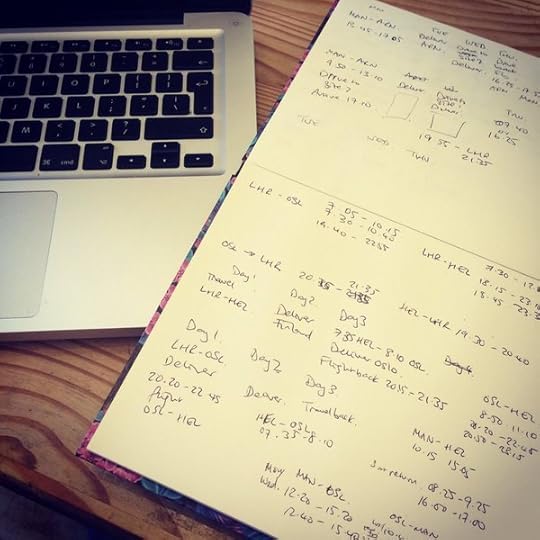
Crikey!
Deploying 3 Ninjas across 20+ UK workshops, 6 overseas missions across 6 different sites plus 12 webinars, all in the space of 2 months for 1 client is exciting for sure, but organising the logistics is not my idea of fun!
It’s something I can do, and I’m happy to do, when it means I get to do more what I love – namely speaking, coaching, training and writing. But it’s not work that brings me to life. In fact, it would kill me if this was all that I do.
So as much as it was a compliment to have a colleague (who herself is a logistics queen) tell me I’m really good at it, my immediate response was a rather forceful NO: don’t ask me to to do more of this!
The truth is, we all have work that brings us to life – the work that we enjoy doing so much that it gives us energy. The work that we’d gladly do all day long if we could.
And we all have work that’s harder, more draining, that’s not in our strength, that we can do – and are willing to do – to enable more of the work we love. But when this supporting work becomes the only work, that’s when we hit trouble.
That’s when we lose our passion, purpose and drive, when our work becomes drudgery and wholly unsatisfying. Ironically it’s also when the quality of our work suffers, and we question our own capability.
Just because we can, doesn’t mean we should. When we say ‘yes I can’ to too many things, it becomes one giant “I can’t”. I’ve wrote about this a while ago in what I called the curse of the capable.
But it’s one thing knowing something, and another thing applying it.
So here’s an opportunity to coach yourself and reflect on how your year has started.
What’s been your life-giving work in the past month? The work you’ve enjoyed doing so much, it gives you life. This is the work you need to make space for.
What’s been your life-support? The harder, more draining work that’s worth doing to enable the life-giving work. This is the work you need to balance – so that it genuinely supports, rather than replaces the life-giving work.
What’s been the distracting work? The work that neither gives life nor supports it. The work that actually taken you away from the work that brings you to life. This is the work to eliminate, to actively say ‘no’ to.
And here’s the clincher: What would you like to do differently next month?
Leave a comment and let me know. I’d love to hear your thoughts on this. Or if you’d like to dive in deeper with a coaching conversation, check out the different ways of working with me.
January 25, 2016
Are you pretty clear or really clear?
This is a question I came across in Greg McKeown’s book Essentialism, and one I’ve been sharing lately in talks and conversations.

Greg suggests that in any team or organisation, “clarity of purpose consistently predicts how people do their jobs.” When people are clear they know where to direct their efforts. When things are vague, people begin to grapple with how to look good to justify their efforts, rather than do the right things, because they don’t really know what those right things are.
This translates to individual productivity as well as team productivity.
I know that the times when I’ve been really clear, I’ve been more focused and fired up, less caught up in comparison, less tempted by other people’s business models or magic pills, and less distracted by my own wild imagination.
On the other hand when I’ve been pretty clear, I’ve found myself chasing shiny objects, starting multiple projects (because I’m not sure which one will fly), saying yes to things simply because I’ve been asked, and being far easier thrown off course by fear, criticism, overwhelm and other people’s definitions of success.
When we are really clear about what we’re saying yes to, it’s far easier to say no.
When we are really clear about what we value, it’s far easier to set and keep our boundaries.
When we are really clear about our work and our why, it’s far easier to know the difference between real work and fake work, between opportunity and distraction, between doing the work and proving our worth.
And it’s not just big picture clarity we need. We also need clarity in the day to day.
If you have ‘write book’ or ‘research venues’ on your to-do list, what does that really mean? When you have a vague email, how much surplus thinking, extra noise or confused action does that generate?
When everyone turns up to a vague meeting, how much of that meeting is spent figuring out why you’re all there, going off on different tangents or ‘filling time’ – only to get to the end of the meeting to conclude that you probably need another meeting to do some more ‘figuring out’?
Lack of clarity creates work, because when nothing’s really important, everything can be pretty important.
How clear are you about your work this week? Pretty clear or really clear?
January 17, 2016
The tiny tasks that can take you off track
 How much work can you create with one sentence?
Turns out, quite a lot!
It all started when a client got in touch. I ran several Productivity Ninja workshops for her and her team last year, and she was now exploring some training around mindfulness. She thought she had seen something on my website, and so got in touch.
As it happens, I don’t run mindfulness training (I do offer a Distraction Detox Day, but that’s not quite what she was after) so I offered to ask around for her.
In the course of my work I meet lots of trainers and coaches, who all have their own specialisms. When it came to recalling who specialised in mindfulness, my mind drew a blank, so I decided to put it out there on Facebook: Who do I know who specialises in mindfulness training?
This one question, posted in two different places, generated 34 comments, 3 private messages, and several invitations to have a chat.
Now I love a good conversation, probably more than the next person, but here’s the thing: this is not my work. My work over the next few days already involves writing two articles, prepping and delivering a talk, designing a workshop, briefing calls, proposals, enquiries, writing website copy and two photo shoots!
This was just a ‘quick favour’ I wanted to do, to hopefully help two people out by connecting them. But it was fast turning into a mini project of its own.
It’s amazing how quickly a small task can grow legs and take you off in all sorts of directions, without you really noticing. Large distractions are easy to spot, but the little peripheral tasks, the small favours and quick questions can be far more unassuming and yet just as distracting.
Let me be clear, I love being helpful. If I can connect two people together and add value to my client at the same time, I welcome the opportunity. But in order to preserve the space I need to do my work, I need to keep the peripheral in proportion.
And this is the one question that helped me to do that:
What do you need?
If you’re the one being asked for your opinion, help or involvement, asking this one question will cut through the back story, debate and chatter, and get straight to the point of what they are asking of you. In fact, a workshop delegate was recently inspired by The West Wing to ask this question far more often!
If you’re the one putting the question out there, being clear on what you need will clarify and focus the kind of answer you get back. For me, what I needed was a web link to pass on, not a conversation to discuss details that weren’t mine to discuss. And once I asked for that, my job became much easier.
And as several clients mentioned this week, sometimes it’s not our own work that’s too much, but when we have a little bit of everyone else’s work on our radar as well, it all becomes a bit overcrowded.
Over to you. How’s your work looking this week: how much is actually your work, and what’s the peripheral stuff that you need to keep contained?
Where could you use this question to give you more clarity: What do you need?


