
Grace Marshall's Blog, page 12
October 19, 2014
Where’s your fire?

“Where’s the fire?”
The times when I get asked this, I’m probably flying around a million miles an hour like my life depends on it.
Usually it means: Slow down. Stop panicking. There is no real fire. Nobody’s going to die. Breathe.
In the main, I help people do less firefighting. And to fight fires with less headless chicken and more brilliance.
But there is something about a fire that makes us focused.
When we’re up against a deadline or a crisis. When there’s impending destruction that will get rapidly worse if we leave it. When there’s a wider impact and the fire threatens to engulf everything else. When there’s a risk of it all becoming very public and other people will know. That’s when a fire can be incredibly effective for getting us focused.
For some people it’s the only time they have complete focus. When they know for certain that everything else can wait.
That’s the beauty of a fire. It’s very very certain.
Sometimes we need others to light a fire beneath us to leap into action. Isn’t it amazing how long we can sit on something until someone else gives us a deadline?
But constant firefighting can be exhausting and unrewarding, especially if you’re always tending to someone else’s fires.
This week I saw one of my clients on fire. She’d been through a period of flitting – from one project to another, one direction to another. Every time we spoke she had a new priority. A new direction which was “definitely the right thing to pursue”.
Until this week. This week was different. She had a clarity of purpose that I had not seen in her before. There was no hint of ‘should’ in her language, and her reason why went way beyond what was logical and sensible. She was on fire. She knew exactly what she needed to do, and procrastination didn’t even get a look in.
When we’re on fire we have an amazing clarity of purpose. We know exactly what we needed to do – even when we don’t know. The unknown doesn’t stop us. It just drives us to find a way or make a way.
When we’re on fire, we can’t wait to get started. Procrastination doesn’t get a look in. Distractions pale in comparison.
When we’re on fire, it’s not a question of if we have time. “How do I find the time?” becomes “Get out of my way.”
Of course we need to fuel our fire to keep going and not burn out. Fire isn’t the only thing we need, but it is a damn good start.
So here’s my question to you. Where’s your fire?
Are you on fire? Or are you too busy reacting and tending to other people’s fires?
Do you need to start a fire – or get someone else to light a fire under you, to get you leaping into action?
Are you fighting too many fires that are threatening to get out of control?
Or have you gotten so used to fighting fires, that you’ve forgotten how to take action without it?
I’d love to know your take on this. Drop me a line in the comments below and let me know…


October 12, 2014
Being Kind
 Last week I looked at my diary and saw two late nights followed by two early starts, in four different cities. My first thought: “I should have scoped this better…” followed by “I need to start booking hotels if I’m going to keep doing this.”
I decided to be kind to myself, and get a train 20 minutes earlier that would actually cut an hour off my journey, and give me the opportunity to grab some proper breakfast when I arrived. I’m never hungry when I wake at 5am but breakfast at 8am after all the travelling was done and before the day starts – now that’s a treat.
So cue alarm at 5am. Woke up, surprisingly awake. Got to the station in plenty of time to buy my tickets for the 6.22. Which was then delayed for 15 minutes. Which meant that I would miss my connecting train.
Ok there’s nothing that interesting about a delayed train. But what was interesting was my reaction.
My first reaction was to try and control the situation. How long is it delayed for? When’s the next connecting train? What are the alternatives? What if I changed at Birmingham instead? But that train takes much longer. Oh hang on, the expected time keeps moving. The 15 minute delay is now counting up. It’s getting nearer to 30 now. My head’s scrambling to make the calculations. Should I jump on the other train? Would it be worth it? I was like a dog who’s owner was whispering “Stay…”
In the end I just had to make a decision, not knowing if the delay would keep on growing or if I had made the ‘right’ decision. But once I made the decision, and the alternative train had pulled away, I felt… peace.
Sometimes we need to let go of making the ‘right’ decision, and just make the decision and choose to be at peace with it.
Of course, the irony hadn’t escaped me that I had got up super silly early, in order to catch a train that was then 30 minutes late. But there was another thought. I was awake, I was actually feeling awake rather than like a zombie. I actually managed an early night the night before and it had worked!
I chose to be grateful to be awake, rather than resentful. I chose to focus on feeling good because I’d had enough sleep, rather than frustrated that I could have had another half an hour in bed.
I chose to be kind. To me.
Sometimes being kind to you means giving yourself more time than you need. So you can stop, have something to eat or simply take your time.
Sometimes being kind to you means letting go of trying to control the outcome – or the pressure to ‘get it right’. Simply making a choice and being at peace with it.
Sometimes being kind to you means choosing to focus on reasons to feel good, rather than reasons to feel frustrated.
That’s what being kind to me looked like last week.
What about you? How would it be if you chose to be kind to you this week? Go on, give it a go and let me know what you discover.
September 29, 2014
On the road: Surviving long days, early starts and travel
 How do you maintain your energy levels (and sanity) when you travel? How do you make sure you arrive fresh, on the ball and raring to go for a full day’s work, training or meetings when you’re getting up before the crack of dawn and stumbling back in late at night?
I’ve been travelling a lot recently. Officially, I’m the Productivity Ninja for the Midlands, but lately the Midlands has stretched to include London, Edinburgh and Geneva!
On the whole it’s a lot of fun, but I have to admit, those early starts and long days can be a bit of a killer, especially when I have a few stacked up.
So I ask some of my friends who have been doing this travel malarky longer than I have, for some collective wisdom. Here are their top ten tips to surviving long days, early nights and travel for work:
1. Plan ahead, get everything ready
“Prep all the logistics stuff so you don’t have to worry about any of that: bag pre-packed, all electronics charged, chargers & spare batteries, route planned, tickets saved to your phone (or printed if you’re a Luddite ;), fallbacks & alternatives ready.” Dominic Wellington
“Making sure everything is to hand in a rush is important – I keep both paper and electronic copies of my itinerary so I can pull up details in a rush. Planning your travel (even between meetings) ahead of time is important too – it all goes into my calendar.” Richard Tubb
2. Have a kit bag that stays packed
“Checklists, naps, energy bars, and a kit bag you don’t need to pack and unpack every time (extra chargers, toothbrushes, etc etc that stay in the bag)” Graham Allcott
“I’m also at places where there might not be lunch options, so a big bottle of water, bags of whole nuts and seeds and granola bars always, always should be classed as part of your kit bag.” Jenny Flintoft
3. Know your stuff
“Preparation is key: know your material well enough that you can fall back on autopilot if your brain is running a bit hot. If possible, try to break a long day into manageable chunks: your attention span is the first thing to go, especially in semi-interactive situations.” Dominic Wellington
4. Eat
“Proper meals whenever you can (especially on an all-nighter, but I’ve managed two or three breakfasts before after early starts)” Alice Waltham
“Eat/drink as healthy as possible” Carrie Wilkerson
“On the day I always left early enough to arrive in plenty of time for a good breakfast before the start of business, At the end of the day I would always have a decent meal during the early part of the trip home. In this way the day had discrete parts and seemed easier to deal with.” Alan Wyatt
“Nuts..i try to have nuts to eat. Other than that I just get exhausted. Sometimes drinking too much beer or wine helps” Amanda Alexander
5. Sleep
“Nap anywhere (I have learned to sleep on the most bumpy road in Africa)” Alice Waltham
“Keep your sleep bank full. 4 hours sleep when you’ve been getting 7-8 hours for the past week is fine, but when it follows 5-6 hours for the past week it always leads to feeling rubbish all day and much higher chances of being ill.” Iain Wyatt
“Squeeze in power naps/meditation/relaxation as you can too – the Paul McKenna App I use can give you anything from a 2 to 30 min session which helps keep energy levels up.” Richard Tubb
6. Relax on the road
“Try to make travel time a buffer: favourite music, a film you’ve been meaning to watch, a TV series to binge on, a new book. Podcasts or audiobooks if you’re driving. Planning helps to keep travel a buffer instead of an additional source of stress.” Dominic Wellington
“If I’ve got a long and busy day when I’m travelling then in meetings I try not to work in travel time but read a book or similar to chill out – not much use if you’re driving but singing loudly along to music in the car is almost as beneficial!” Katharine Matthews
7. Build in recovery time:
“Making sure you leave time to recover afterwards is key – I don’t book any meetings at all for a day of return from travel, and allocate 1 hour per day away just to catch up on paperwork and emails. A week away = 1 full day in office of catching up.” Richard Tubb
“Try to leave office stuff AT the office and create some margin for yourself so you are not always feeling behind. Plan like a pessimist, not an optimist…less likely to over obligate yourself.” Carrie Wilkerson
8. Be kind to yourself:
“I plan very well. Today my day (all at home) is 0800 to 2100 and so it has to be early to bed the night before plus extreme self-care throughout today and being kind to myself tomorrow and Friday, i.e. not too many of those days stacked up. And if I work weekends I have some or all of Friday and Monday off etc. Buffers. Put something in the tank before and don’t rush straight on to the next.” Judith Morgan
9. When you’re have several trips in a row
“I make sure that I have planned everything for the days either side, particularly the ones after the ‘event’. This is everything down to having bags packed with the right tools, books, etc and putting out all the clothes I’m going to wear including underwear and of course, the all important shoes!! This means I have nothing to think about when I get home late other than getting a shower and getting in to bed. Some weeks I have the whole week’s clothes and a row of bags lined up for each day of the week!” Dawn Owen
“If you’ve got a week where you’re out for long days, home, then back out again the next morning, have somewhere where you can pile each day’s materials at the start of the week. When you come home, take out old materials, put in pile in place of tomorrow’s materials and put tomorrow’s materials in your bag.” Jenny Flintoft
10. Attitude
”Don’t collapse in public” Carrie Wilkerson
“When in doubt, fake energy and enthusiasm – you’ll surprisingly often convince yourself!” Alice Waltham
“Main thing is – you HAVE to think positive. The minute you start thinking “OMG I’m so tired/I’ve got to get up at 5am/I’ve got a 15 hour day ahead of me, oh woe” you will feel tired, crabby and resentful.” Jenny Flintoft
Over to you
What are your favourite tips or rules for the road when travelling for work? Or which of these tips are you going to take forward? Leave a comment and let us know.
September 21, 2014
Where do you do your best thinking?
 One of the things I often challenge my clients to do is to give themselves more thinking time, which sometime prompts the question of ‘where?’
There are the usual suspects:
in a quiet room
on my own
in the shower
on a walk/run
in the car
The glamorous:
On holiday
On the beach
In a cafe
At the art gallery
And the bizarre:
Sitting on the toilet
Standing up anywhere
While doing housework (really?! I’m not convinced…)
Where do you do your best thinking?
I don’t know about you, but my best thinking rarely happens at my desk and certainly not in front of a screen, but it’s easy to find myself there – my default place of work.
Get up, move around
The next time you need to do some creative, strategic or problem solving thinking, get up and move. Take yourself to a different location, or walk around to get your creative juices flowing.
Invite someone to join you
Sometimes I do my best thinking when I’m in conversation with others. Sometimes we need others to be part of that thinking. How about scheduling your next meeting on the move – like a walking meeting for example?
Two friends of mine found themselves completely uninspired with their business plan, so they left the office and went for a long woodland walk instead. As they walked, they talked, and by the end they had a brilliant business plan.
Go on, treat yourself
Got some thinking to do that you’re actively avoiding? A problem you’re dreading working on? Don’t make it a punishment by chaining yourself to the desk. Go somewhere you would normally go to procrastinate, and take your thinking with you. Or bring the treat to you – grab a drink, put on some music, have a slice of something indulgent to go with your thinking.
Over to you
What thinking do you need to do this week? Where will you take yourself? Drop me a line in the comments below and share your favourite thinking place.
September 14, 2014
Killing yourself to meet a deadline? Give yourself a lifeline.
 I have a bit of a love hate relationship with deadlines.
I love them, because they work. There’s nothing like a deadline to get me moving, out of uncertainty and procrastination, and into crazy wild-eyed get it done mode.
But I also hate the stress they bring on. The way they loom in the distance for ages, then all of a sudden creep up on us and send us into blind panic. Even the word deadline seems so final and last minute – do it or die.
I won’t deny it, there is something quite seductive about that adrenaline rush you get when you’re up against the clock, not entirely sure if you’ll make it, followed by the supreme sense of satisfaction when you do pull it off.
But there’s always a price to pay – late nights that take a toll on your health, opportunities you have to say ‘no’ to, or having to put the rest of your life on hold ‘just for now’… Not to mention the times when several deadlines creep up on you, backing you into a corner, all wanting a piece of you.
And when you do survive and make that deadline by the skin of your teeth, you vow to yourself that you’re never going to leave it that close again… until the next time.
It’s an exhausting place to be, constantly at the edge, wondering if you’re going to survive.
So, what’s the alternative? Avoid deadlines and stay in the nice, comfortable fields of ‘someday’?
Or is it time to throw yourself a lifeline?
A lifeline is something YOU create.
A self-imposed ‘deadline’ if you like, but instead of killing you, it breathes life into your project, giving you momentum without the panic.
A target date that creates margin, ahead of your deadline, giving you breathing room and the capacity to respond to last minute hiccups, unexpected changes and surprise opportunities.
A timeline that helps you to work at a pace that’s sustainable and enjoyable around everything else you’ve got going on in life, instead of yo-yoing between ‘stuck and thinking about it’ and ‘killing yourself to get it done’.
A deadline works by taking choice away, but a lifeline gives you choice. Nobody dies if you don’t take a lifeline, but when you do – you get so much more. More opportunity, more fun, more freedom, and yup, you get more done.
That’s what we’re in the business of doing in my 40 Days of Baby Steps.
Turning deadlines into lifelines.
Instead of procrastinating for 5 weeks, then killing ourselves in the 6th, we take every week as an opportunity to make progress, so that:
when curveballs come flying (and they do) we are on our feet ready to respond
when we’re running hard meeting existing commitments, we are also honouring the commitments we make to ourselves (remember those?)
when surprise opportunities arise (which they will), we have the choice and freedom to grab them with both hands.
That’s exactly what happened to one of my graduate Baby Steppers this week, when a BIG opportunity arose to submit a proposal – that very same day. As she put it, “there is no way I could have drafted together a proposal in 6 hours but it was easy to print off the one I’d created during 40 days!”
What about you? Are you ready to stop killing yourself with deadlines and start creating some lifelines?
Come and join me for the next 40 Days of Baby Steps – we start today!
September 7, 2014
Planned Sponteneity
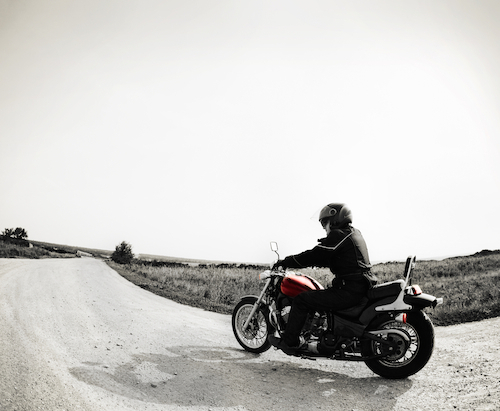 My husband laughed when I suggested this.
When we first got together we were pretty spontaneous. Meeting friends, going out, what’s for dinner, driving over to Italy for the weekend – all that just happened, when we felt like it. We didn’t do much planning. We didn’t need to.
Then we had kids, and in came the routines. The meal plans, the bed times, the school runs, the housework… My theory is that kids are so unpredictable, we tried to scope ahead and plan as much as we could, to give ourselves at least a fighting chance of being able to respond in the moment. Let’s face it, when you have kids, last minute is really not the time you want to be getting dinner in or buying nappies!
It got to the point where the diary and the to-do list was full weeks in advance, and my husband got frustrated that nothing happened spontaneously any more. Whenever he wanted to do something spontaneous, the day was already full of chores and commitments.
So I suggested we plan some time to be spontaneous.
I know, sounds ridiculous doesn’t it? He laughed too.
But it worked. We set aside family time, when we wouldn’t book anything in the diary. We’d book babysitters for date nights and decide last minute what we wanted to do. And earmark cave time for my husband to recharge and restore his sanity – in whatever way he chose.
Essentially, we created space to be spontaneous.
My husband mentioned this to a friend recently and he laughed too. But he tried it on a trip to New York for a friend’s wedding. In between all the wedding plans and rehearsals, times where he had to be in a particular place at a particular time, he earmarked the times that he had to himself, and used them to wander around and go with the flow. It worked for him too.
We all need time when we’re able to say to ourselves “This is my time. Time to use as I choose.” Ideally that would be all the time.
But when life is full on and full of commitments, when we do share our time with someone else, when other members of our family can book things into our diary, the way I see it, it’s better to have planned spontaneity, than to wake up with spontaneous regret for all the things you never seem to have time to do.
What do you think?
August 25, 2014
Two simple questions
 I went for a run last week, finally, after a three months of “I really want to get back into it!”
As I was in the shower afterwards, I found a familiar conversation going on in my head.
That was great. I really shouldn’t leave it so long next time. It would be great to make this a regular thing again.
Do you ever find yourself saying that?
Perhaps with healthy habits like exercising, going to the gym or getting an early night.
Or treating yourself to a holiday, a hobby or a get together with friends you don’t see often enough.
Or work habits that you know would make a big difference to your sanity and productivity as long as you keep it up?
Why is it, that there are some things we seem to do once, put down, and struggle to pick up again, even though we want to, when there are other things we never seem to be able to put down at all?
I think it might have something to do with two very simple questions:
“What now?”
Straight after a run, this is the primary question in my head.
What now? Now that’s finished what shall I turn my focus to? What’s for breakfast? What am I going to wear? What have I got on for the rest of the day?
In other words, I’m done with running, and I’m done thinking about running. Until much later when I think “oh yes, whatever happened to that idea?”
“ What next?”
On the other hand, when it comes to the things I find hard to switch off to – projects I’m working on, problems I’m in the process of solving, plans I’m in the middle of hatching – when I get to the end of one piece of work, my brain is much more likely to say “What next?”
What’s the next step in the project? What’s the next action? What’s next on my hit list? If left unchecked, my brain can quite easily stay at work long after I’ve clocked off, trying to answer this question over and over again.
So what if we switched these two questions around?
Use “What next?” to keep you going
If I ask myself “what next?” after each run, it gets me thinking about when my next run is going to be, or what distance or time I’ll aim for next, or even which race I might enter myself in for.
It gets me deciding and committing to a next step before I put the matter to rest. It puts my focus on continuation and creates momentum.
Use “What now?” to remind you to stop
Sometimes our minds need actively distracting from work. Asking “what now?” means that yes, there may be more to do later, but right now, I’m done. Right now, it’s time to move on. Right now, it’s time to eat / sleep / play / read a bedtime story / enjoy that barbecue …
It gets you focusing on the present, on what matters right now, rather than worrying about what needs to happen later.
I’m going play around with these questions this week, and I’d love for you to join me.
Where can you ask yourself “what next?” to make sure you keep going? What is it that you would like to make happen on a more regular basis? What habits would you like to reinforce?
And where do you need to stop? What are you in danger of never putting down? Where can you ask yourself “what now?” more often, to remind yourself to be in the now?
Have a play and let me know how you get on!
August 17, 2014
What’s in your hand?
 I heard a great story recently, of a Ugandan villager who was asked this question. The only thing he owned was a piece of swamp land where mosquitos bred. His land was responsible for the soaring Malaria rates in the village. Not only did he feel he had nothing of value, but what he did have was killing his people.
But instead of doing nothing with it, he was inspired to dig. For weeks he dug, until finally he hit water. Out of his swamp land, he dug two giant ponds, which became full of fish. The fish fed his family, his village and still there were more, so he took them to market, made an income which he invested back into the village, in building and education.
And the icing on the cake: the fish fed on mosquito larvae. So the malaria rates dropped too. What once brought death, now brings life.
I love this story on so many levels.
It is a story of faith, a refusal to settle for hopelessness. A story of recreation, the genius that takes something worse than worthless and turns it into a thing of beauty. And a story of relentless action, not waiting for things to be better, not knowing how it’s all going to pan out, but taking action anyway.
Another story I love is the story of Rubies in the Rubble – a social enterprise that started with a frustration over food waste, a passion for the vulnerable and an old family chutney recipe:
Brilliant things start in the ordinary.
We all have something in our hands. We can choose to discount it, dismiss it, bury it and wait to be given a better hand.
Or we can start using what we have, right here, right now – and see where that takes us.
What’s in your hand? What are you going to do with it today?
August 3, 2014
Forget balance. How’s your work life rhythm?
I haven’t had a 9-5 job for a long time. But I don’t think many people do these days, even if they are supposed to.
Ever since I became a mum 9 years ago, I’ve been juggling and experimenting with different working patterns – from 2 mornings to 3 days a week, evenings, weekends, random nap times, and varying combinations of nursery, childminders and amazing supportive friends.
I never knew how to answer the question “how many hours a week do you work?” because every week was different.
When my youngest started school last September, I found myself with 5 days a week to work again. And this too has been an experiment.
There have been short days, where I find myself saying:
“What? 3 o’clock already?!”
And long days:
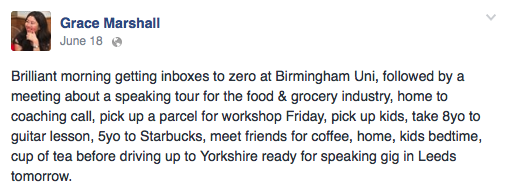
Indulgent days off, because if I don’t make these things happen, they never just happen:
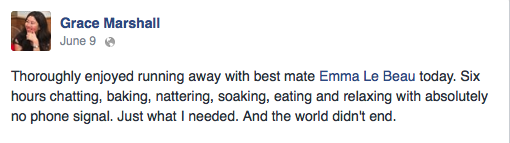
And slightly more random ones:
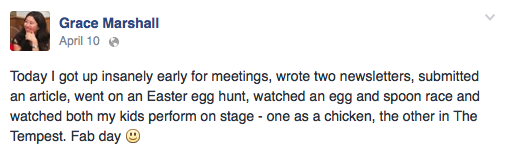
It doesn’t always work out:
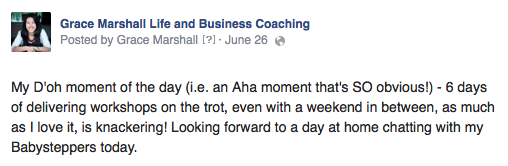
At least not in the way I planned:
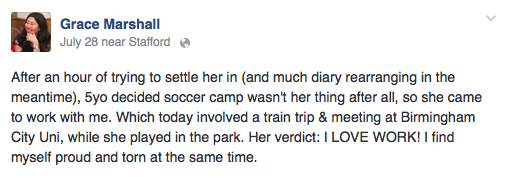
I learnt to say no:
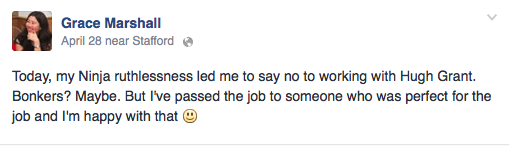
So that I could say yes to what really mattered to me.
Like the day I did a workshop first thing in Birmingham, came back to Stafford to watch Punch and Judy and eat ice cream with my daughter to celebrate the end of her reception year at school, before jumping on another train to London…
Friends think I’m crazy. “What a nightmare!” said one of my Think Productive colleagues.
But on the contrary, it’s my dream in progress. As I told them, I wouldn’t have it any other way. I get to do work I love, with people I love working with, and be there for the people I love. Yes it’s hard work, yes it’s a juggle, yes it’s messy.
And no, I wouldn’t call it balanced at all. And that’s ok. Because I’ve never really believed in balance.
Instead, I’ve been learning to find my own rhythm.
And it is most definitely an ongoing experiment. But here’s what I’ve learned so far:
1. There will be highs and lows, ebb and flow. Life isn’t uniform, so don’t try and make it that way. Generally speaking, flat lines usually indicate an absence of life.
2. Allow yourself to run with life when it speeds up, and you’ll realise you can indeed run. You might even find it addictive – don’t say I didn’t warn you!
3. Create pauses. Don’t wait for the music to stop. Be deliberate about creating moments to stop, pause, take a deep breath, recover and recharge.
4. A steady beat holds everything together. Develop habits and structure to give yourself some constant.
5. Don’t try to work out all the steps before you start. The only way to find your groove is to start moving.
6. Learn to speed up and slow down. There is beauty and brilliance in both. Much of my learning this year has been in soaking in the slow moments as well as enjoying the thrill of the rollercoaster. Don’t wish any of it away.
7. There is a season for everything. Whatever you choose to do with each moment, do it wholeheartedly.
8. There is life at work and life outside of work. Don’t forget to live it.
9. Play with your rhythm. Make it up as you go along. Sometimes you’ll fall, sometimes you’ll fly.
10. Everything is negotiable. It’s ok to create your own rules.
Over to you – what do you think? Are you a fan of balance? Or are you ready to create your own rhythm? Let me know your take on things in the comments below.
July 28, 2014
Renegotiating Rules – why I write
 Why do I write? Seems like an easy enough question.
I was invited to be part of a writers’ blog tour by the lovely Erin Casey – writer, book coach, editor, and contributing editor for SUCCESS magazine.
The remit: blog about why you write. Then introduce your readers to three other people to do the same a week later.
Sounds simple enough. A little bit like the old chain letters, except without the death threats and promises of wealth and love. Hmm… more about that later.
So why do I write?
Sanity
Eight years or so ago, when I started blogging, it was for my own sanity. It was my way of making sense of the world I found myself in – sleep deprived, dazed, confused, with the most important job in the world and no idea how to do it well. Here’s one of the first posts I ever wrote about motherhood.
These days, writing is still the place where I make sense of things. Conversations spark ideas, but writing is where I wrestle with them, work on them, hone my ideas and put my finger on exactly what I’m trying to say. Writing is my process for clarity.
Engage and Encourage
When I started my coaching business, one piece of advice I was given was to pick one way of connecting with your audience and focus on that. Add all the other bells and whistles later. I was completely brand new to public speaking at that point, I’d just moved to a new area so while I went networking, I certainly wasn’t well connected, but writing I knew. Writing I’d done – and loved – since I was a child. Writing was my safe option. Writing was my strength.
Nowadays, writing is still where many people connect with me first. It has become the a safe place for other people to get to know me. They can wait in the wings of anonymity and get to know me first, before they decide if they want to engage in further conversation.
It’s the part of me I give away – an invitation into my head and my world. Those who like what they read, and want more, invite me into their head and their world. Whether we take it further or not, it is always my hope and privilege to encourage and inspire.
Expression
I decided a while ago that writing for me would be an expression, not a chore. That’s the reason why there are no dates on this blog. It gives me the freedom to write from the heart, not out of obligation.
At a time where the prevailing wisdom was that you had to write regularly, at least once a week, and preferably the same time every week, I decided to buck the trend and break the rules. Because I knew that if writing became a chore, I would be writing for all the wrong reasons – and that would show in my writing. It would be dry and mechanical. It would not bring clarity to me or encouragement to you.
Funny thing is, I do write once a week now, as my Monday Momentum message to you. It’s taken me several years to get to this point. And to let you into a little secret, I still don’t plan my posts. I have an ideas park full of titles and topics, but I don’t have a blogging schedule or calendar. Each week, I write about the thing that’s on my mind or has gripped my heart. That way, I’m always writing from my truth, and I hope, giving you my best.
Which brings me back to this chain letter thing.
When I agreed to write this, I did so because I thought it was a good idea. I thought it might start an interesting conversation. I agreed to do it because I wanted to help Erin out, and yes, I was flattered to be asked. There are also some stonking writers I’d love to introduce you to.
But when I contacted them, I found myself chasing people, asking them to commit to the one thing I had actively avoided – the obligation to write to a set time.
So I’m sorry. If you’re a stickler for the rules, look away now. I’m going to break the rules.
I’m going to introduce you to my three favourite writers, but only one has actually agreed to be part of the blog tour. The other two have their attention on other commitments right now, but in my book, that doesn’t take anything away from their writing. In fact it probably adds to it. So I’m going to introduce you to them anyway.
There’s no obligation whatsoever for them to continue the tour, but I’m sure they’ll introduce you to other writers in their own time and their own way, because they are all incredibly generous people. And fabulous writers. Enjoy.
Bev Murrill
Bev is a speaker and writer based in Australia. After over 30 years as a senior church leader, leadership mentor and church planter, Bev is a now embarking on a PhD exploring the responsibility patriarchy plays in the commodification of women and girls. Passionate about being an influencer for growth and development, Bev works with leaders and emerging leaders, both women and men, to help them become their strongest and most effective self at at BevMurrill.com.
I absolutely loved Bev’s book “Speak Life and Shut the Hell Up”, always come away from our conversations inspired and challenged, and am in awe of the fact that she’s been married 43 years (to the same person) with four fantastic children, 4 wonderful children in law and nine unspeakably amazing grandchildren.
Jenny Flintoft
Jenny works with people who are committed to raising their game and making a positive difference within their lives and the businesses in which they work.
She has carved out an inspiring track record of working with and developing hundreds of leaders, coaches and individuals across the world and is described as dynamic, passionate, practical, challenging and supportive… and as “human caffeine!”
Always striving to be an exceptional role model in her consultancy, coaching and facilitation, it is Jenny’s personal quest to inspire and encourage others in all their encounters with her and to enable them to feel fired up and energised in the work they do – and that’s absolutely what Jenny does for me. Every. Time. Her “Wake Your Life Up” emails are one of the only newsletters I make a point of reading each week.
Get a dose of Jenny at JennyFlintoft.com.

Josie George
Josie is an absolutely phenomenal writer. That’s all I want to say really – I want you to go and read her words and experience them for yourself.
But in the interest of completion, she is a writer, a full time freelance copywriter, content creator and storyteller at JosieGeorge.co.uk, where she has the only set of T&Cs I’ve ever had the pleasure of reading.
A single mum to a lively five year old, Josie’s days revolve entirely around words, food, naps and answering questions such as “Do Stormtroopers have swimming lessons?” She’s made it her life’s ambition to wrestle with the truth of life in all its complicated messiness and prove that being kind, to yourself and other people, is the most important hobby you can ever take on.
The Bad Day Blog aims to stand as a testament to that.

What about YOU?
If you find yourself feeling bogged down, burdened or uninspired by your commitments, perhaps it’s time for a little renegotiation. Here are three suggestions to get you started:
1. Know your reasons why – not just your big WHY, but your little why’s along the way.
Why do you do what you do? Why are you running that particular marketing campaign, in that way? What have you committed to doing this week? What’s your reason for doing it?
“Because someone else told/asked me to” is not a good enough reason. It won’t motivate you, it won’t call the best out of you. You need to find your reason.
2. How does serving others serve you?
Sounds like a selfish question, but really it’s not.
Your strengths are the things that strengthen you. When you operate from that place of strength, when your work calls you to be the best of who you are, your passion grows, your work is energising and you have a natural hunger to hone your craft. It’s hard work, but never a chore.
I’m a firm believer that when you’re passionate, on purpose and giving the best of who you are, your work becomes as much a blessing to you as you are to others.
If that’s not how you feel about your work or life right now – let’s talk.
3. Don’t be afraid to renegotiate the rules.
I’ve had many conversations with clients and friends who are not writers, who have asked me to help them with their writing. Sometimes it’s been more a case of confidence or getting past internal blocks, but sometimes, it’s simply because they don’t like writing. It’s not their thing.
If it’s not your thing, why force yourself to do it? Renegotiate the rules. How else could you get the message across? Could you speak, shoot a video, draw, paint, make something, or get someone else to write for you?
Practice unorthodoxy. Challenge convention. How could you do it differently and get the same or even better results? When you get something really working for you, chances are that’s when the world gets to see your best work.
Over to you: I’d love to hear what this post inspires you to rethink or renegotiate. Or if you’ve been practising unorthodoxy and renegotiation lately, do share your experience in the comments below.


