
Grace Marshall's Blog, page 13
July 20, 2014
How to get things done when the work never ends
 Do you find your work ongoing, your to-do list never-ending? Does it feel like there’s always something else to do – as soon as one thing is done you’re moving onto the next thing?
Here’s the bad news – the work never ends. The nature of much of our work these days is that there’s always more you can do – more ideas, more calls, more campaigns, more research, more tweaking, more thinking, more clicking you can do…
Which is why it can be hard to find momentum and motivation, and easy for inertia and procrastination to set in. After all, if there’s just more work ahead, what’s the incentive for getting on with it and getting it done?
I’ve just finished another round of 40 Days of Baby Steps – where I coach a group of people through their 40 day project, the same way I got my book written.
One of the things that makes this process so powerful is the finish line.
Everyone commits to delivering something in 40 days: a new website live, an SEO campaign underway, a product launched. There’s a definite finish line.
Without a finish line, it’s easy to lose momentum, and for the project to creep. The product is never quite ready to be launched, the website still needs tweaking, the SEO campaign becomes so long and arduous, you find yourself reluctantly trudging along rather than powering through.
Without a finish line, it’s easy to get distracted by shiny things “I’ll just take a look at this first”.
Or quick wins “I’ll just deal with this first… oh and that one…”
And get stalled by the enormity of it all “woah that’s a long way to go, I’m going to have to wait until I have more time. Better make that cup of tea…”
When there’s a finish line in sight, you’ve got something to aim for. It gives you direction, definition and a reason to muster up the strength and sprint ahead. So as well as our 40 day finish line, we also had weekly check-ins, where everyone declared and committed to their own weekly finish line.
One of my Baby Steppers in particular discovered the power of honouring that finish line.
She was one of those people who had a tendency to go all guns blazing at the beginning of a project, full of enthusiasm and adrenaline, so much a so that in those early days, it would not be unusual for her to get more done than she set out to do. She’d power through her to-do list, find she still had time left in the day, and add a few more jobs in.
But after a while she’d burn out. She’d run out of energy. And start becoming aware of everything else in life she had put on hold, then wonder how on earth she could ever fit it all in.
Instead, in her 40 days, she decided to honour her finish line. Whenever she got to the end of her to-do list, she gave herself permission to stop. Instead of doing ‘just one more thing’, she took a break, clocked off early, celebrated ‘done’ and enjoyed the time for herself.
The result? She found herself with far more energy throughout the 40 days. Instead of running as fast as she could for the first couple of days, and running out of steam, she was able to keep pace, and keep going. Yes there were peaks and troughs during that time – some weeks were more productive than others, but ultimately she procrastinated less, got more done, took more breaks and enjoyed greater satisfaction. She got everything she wanted to get done before the summer holidays, and showed herself she could do it without killing herself.
So the bad news is, the work never ends. But the good news is we get to create our own finish lines. We get to define what job done looks like. When we honour those finish lines, when we enjoy life beyond the finish line, each race is satisfying, and we find we have more than enough to keep going.
What about you? What are you working on right now? What’s your finish line? Drop me a line and let me know – I’d love to hear from you!


July 13, 2014
How to change a habit
“Culture eats strategy for breakfast.”
“What you do every day creates a culture.”
These are a couple of truths that really resonated with me at a leadership conference this weekend.
It doesn’t matter how great your strategy is, if it goes against culture, culture will always win.
And I’ve certainly seen that a lot lately, with groups I’ve worked with who have felt at the mercy of their organisational culture – non-stop culture, last minute culture, email 24/7 culture, immediate response culture, crazy deadline culture…
Let’s take that down to a personal level for a minute. We can have great plans, brilliant strategy and the best of intentions, but it is the things we do on a daily basis that have the biggest bearing on where we end up and how fast we get there. The little things we do every day. Our habits.
I’ve been working on one of my habits this week – trying to change my “just in time” habit into a “in plenty of time” habit.
You see I’ve always been a last minute girl, and most the time I do that pretty well. But “just in time” is risky business for a Productivity Ninja – let’s face it, it just wouldn’t look good if I turned up late to my own session would it? And it’s also exhausting, all that worrying and panicking, and rushing and running. And there’s the fact that trains and planes, unlike friends, won’t wait for you.
So how do you change a habit of a lifetime? Here are four key steps:
1. Understand the pay off
Habits form for a reason. And they stick for a reason. If you find a habit hard to shift, the chances are, there’s still a pay-off somewhere – however annoying or useless you think it is. And the more that reason stays in your subconscious, the more you’ll find yourself subconsciously sabotaging your efforts to change.
For me, it’s the adrenaline. The buzz of meeting a deadline just in time. And my impatience at having to wait if I get somewhere early, thinking I could have done ‘just one more thing’ if I had left a little later.
What’s your pay-off? If there’s a habit you’re trying to kick, what might you potentially be giving up or letting go of, if you did kick it? Be honest with yourself.
2. Raise the stakes
We often stick with habits even when we know they don’t serve us because, well quite frankly, it’s not hurting enough. I hate running last minute for a train and worrying if I’ll get there on time. I hate the difference 10 minutes can make between calm and serene vs stressed and sweaty. But most the time I get away with it. It’s ok. The world doesn’t end, therefore I don’t really have to change. I’d like to, but I don’t have to.
Inertia is a powerful force. If you want to change a habit, you need to have a big enough reason. You need to be bothered enough – or as a friend of mine has as her mantra “Be arsed!”
This week the stakes were higher. I was flying to Geneva to speak at a conference. The client had paid for my air fare and was meeting me at the gate. If I was late, not only would I look a complete muppet, but goodness knows how much it would have cost – if it was even possible – to book myself last minute on the next flight. There was no Plan B. So I couldn’t run the risk of running late.
How could you raise the stakes? Take away plan B. Or play the movie forwards. If you continued with your current habit day in, day out, what culture would you create? What reality would you create for yourself and those around you?
3. Sweeten the deal
Make the new path more irresistible.
Feedback and reward are key to changing habits. If I’m going to let go of my adrenaline rush and deal with my impatience, I need a good incentive.
This week, my reward for arriving in plenty of time to London Heathrow was pancakes for breakfast at Gordon Ramsay’s restaurant 
I’m a sucker for bribery. It works just as well on me as it does on my kids.

4. Forget perfection
So I managed to do “ahead of time” beautifully in my trip to Geneva this week, but there have still been plenty of other “oops better hurry up” moments in the week.
And that’s ok. That’s absolutely fine.
You see, if we expect our habits to change completely and instantly, perfection will have us giving up before we’ve barely gotten started. It takes time to change habits, and the key is to keep reinforcing progress, not dismissing it.
And who says I want to go completely the other way anyway? It’s up to you to decide how you want to change your habits. Don’t let perfection tell you otherwise.
Over to you. What habits have you successfully shifted before? What worked for you? What habit are you trying to change right now? Let me know in the comments below…
July 6, 2014
Five ways to stay focused
So there was big controversy this week when Facebook revealed that it was manipulating news feeds in a social experiment to see how that would affect people’s moods. Outrage aside about how the study was conducted or communicated, the findings are, well, pretty obvious actually.
What we see affects us. The messages we read, hear, or are otherwise exposed to, influence our mood and our perspective.
A friend of mine, who works in PR, decided several years ago to stop listening to the news on her way in to work, because it depressed her so much. Even though part of her job was to keep up with what was going on in the world, she decided the cost of doing that first thing in the morning was too high on her attitude and performance.
Do you choose your focus for the day? Or do you let it choose you?
If email or social media is your first port of call in the morning, what messages are you taking in?
The world is full of messages. It’s amazing how easy it is to be buffeted from one thing to another when you’re not clear on your own agenda, and spend the day reacting to whoever or whatever’s shouting the loudest.
One thing I often encourage people to do is to have half an hour in the morning to check in with themselves first, before they check in with the rest of the world.
Once you’ve identified your focus, how do you stay on track? Here are a few ideas:
1. Social media – yes really! Use it to set your intention or declare your focus and let the rest of the world hold you accountable.
“One chapter down, one more to go. See you in an hour Twitter…” was something I tweeted a lot when writing my book.
Or instead of “ugh… early start, busy week, tired again” try “Early start. Full on week. #bringiton”.
2. Momentum – if you’re a Chrome user, check out this Momentum extension where you can be inspired and reminded of your main focus for the day, every time you open a new browser tab.
3. Screensaver/Wallpaper – if you don’t have chrome, how about using your screensaver or wallpaper to remind you of something inspirational? Here’s a selection I made for you earlier.
4. Password – it’s something you type in several times a day, why not get it working for you? I love this story of how one guy used his password to literally change his life!
5. The humble post-it note – sick of technology? Or know that it’s more likely to take you off track than keep you on track? For a much more low-tech option, simply write yourself a message on a post-it note and stick it to the side of your screen, or your keyboard, to remind you of whatever it is you need to know.
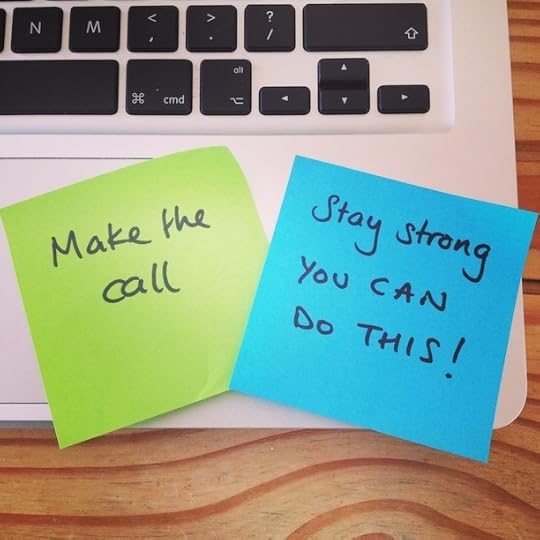
What’s even more powerful than what others say to you, is what you say to yourself. So what message do you want to give yourself today?
Have a play and let me know how you get on!
June 22, 2014
Is your schedule demanding perfection from others?
 I am a recovering perfectionist. I’ve always had high standards of myself, but I’ve never demanded perfection from others. In fact, even when I’ve been hard on myself, I’ve still been encouraging others to be kinder on themselves.
I’m too ‘nice’ to be a perfectionist when it comes to other people… or so I thought.
Until this week, when I found myself printing at midnight, after a 2 hour drive back from Leeds, when I should have been getting some sleep before my workshop the next morning.
I thought I had it all worked out. I knew it was going to be a bit of a 3 day marathon. I’d scoped ahead, taken a deep breath and gotten everything prepared and lined up in advance. For once, I wasn’t the one leaving it to the last minute.
This time it was someone else. Someone else’s mistake and oversight that I had to sacrifice sleep to rectify.
Disaster was averted, and even though I had a terrible night’s sleep, the workshop went brilliantly.
But it did get me thinking. Yes it was someone else’s mistake. Yes they should have spotted it. Yes they could have given themselves more time (I know it’s also been a busy season for them). No, it wasn’t my job to make sure they did theirs. And yes, we will be having a conversation about it. (Thankfully, I knew better than to fire off an email when tired and very grumpy!)
I realised this:
When my schedule is so tight that there is no margin for error, then by default I am demanding perfection – not just from me – but from everyone around me.
Because I simply have no time to accommodate mistakes.
No time for the waiter who’s got my order wrong.
No time for the learner driver who’s stalled at the roundabout.
No time for the cashier who’s trying to get to grips with the till on their first day.
No time for my kids to have a meltdown at the door.
No time for my colleague to notice let alone recover from their mistake.
And here is my dilemma.
I know we are all human. I believe absolutely passionately in being human. Being superhuman is a lie that robs us of life and there is beauty in imperfection.
But to live this out in the day to day, I need to live in a way where I am not stretched to my limits. Where things don’t fall apart if someone drops the ball. Where I have margin: room to accommodate mistakes, hiccups and delays. And I need to do that, in order to be kind – not just to myself, but to others around me too.
As one of my favourite sayings go, “Always be kinder than necessary because everyone you meet is fighting some kind of battle.”
And that is how I want to live. I want to be that person. The person who has time to stop and smile, and wait, rather than the person who rolls her eyes, freaks out and demands better service. The person who has time to have a constructive conversation, and give someone the chance to make amends and rebuild trust, rather than the person who resigns herself to resentfully doing everything herself.
I wonder, what would the world be like, if we all had more time for each other’s mistakes?
I’d love to hear your take on this. Go ahead and speak your mind in the comments below.
June 15, 2014
Trying too hard to get it right?
 When I was a child, I spent a lot of time trying to ‘fit in’. My family moved around a lot, so I had plenty of practice at being the new kid at school. One thing I got good at doing was adapting.
Which comes in handy when you’re setting up in business, exploring new ground, adapting, evolving and generally making it up as you go along.
But sometimes, my ability to adapt can go too far. Sometimes I’m too willing to adapt, too eager to please. Sometimes adapting becomes people pleasing.
I found myself in a situation recently, where I was under pressure to ‘get it right’. There was a lot at stake, professionally, commercially and personally. When what I delivered didn’t quite hit the spot, it took up so much space in my head, trying to figure it out, work out what was missing, what went wrong, what I should have done differently, or how I needed to change.
All that wrestling got me nowhere. Until a friend reminded me of something I often say to her:
Some people get it. Some don’t.
If they don’t get it, it doesn’t necessarily mean you’ve got it wrong. It just means they didn’t get it.
You can help them get it, if they want your help (which is different from changing yourself or running off to find a different ‘it’ to give them).
And don’t forget the people who do get it, and absolutely want what you have to give.
People pleasing happens when you start thinking more about “what will make them happy” than “what will help them”, when you’re focused more on “what do they want from me?” rather than “how can I best serve these people?”
It takes us down the road of questioning ourselves and doubting the value of what we have to give. It convinces us that we need to change, to be someone else, to be accepted, loved and valued. It lures us away from what we do best, and has us chasing shadows…
And ironically that’s when we have the least impact. When we try to change who we are to fit in, the best we can do is a good imitation.
As Judy Garland said, “Always be a first rate version of yourself and not a second rate version of someone else.”
It’s only when we stand firm in who we are and what we have to give, that we can give our best – and funnily enough, that’s when we do our best adapting too.
In my particular situation, I went back with a perspective of “How can I help?” rather than “What did I do wrong?” and we had a really useful conversation, that will hopefully be the start of a fruitful partnership.
What about you? Do you sometimes slip into people pleasing? Do you get tempted to fundamentally change who you are or what you offer, to fit in with what you think other people want?
Remember, some people won’t get it. And that’s ok. Instead of trying to please everybody, ask yourself this:
When am I at my best?
How do I give my best?
Who do I give my best to?
I’d love your take on this. Leave me a comment and let me know what you think!
June 8, 2014
What’s in a name?
 Another 40 Days of Baby Steps has just started, with a brand new group of Baby Steppers all fired up and focused to get their 40 day project DONE. We kicked off last week with our Name it, Nail it session, and we’ve been having fun naming our projects.
What’s in a name? How often do we label our projects with generic names like Website, Marketing or Admin?
What does that do for our focus, clarity and motivation?
Here are four common pitfalls of having a generic project name:
1. There’s no defined outcome
So how do you know when you’ve got there? It’s hard to stay focused when you’ve got no finish line to focus on. And it’s hard to get that ‘job done’ sense of satisfaction, or even a sense of progress, when you don’t have a clue what ‘done’ looks like.
2. It becomes a dumping ground
Without a defined focus, generic projects like Website can become an easy catch-all bucket for any tasks, thoughts or ideas that are remotely website related, but don’t actually come together towards a common goal. Which means you either end up busily ticking things off with no real sense of direction, or get so overwhelmed that you shut the door on your dumping ground and turn your attention to something more manageable instead.
3. There’s plenty of room for project creep
You start off with plans for a simple website to showcase your expertise. Then you decide to add a blog, and a shopping cart… and some social media integration. Which means you need to revive your Twitter account… what about Pinterest? Maybe you’ll add an interactive forum to the website, get people engaged… and really you should have some video… All potentially good ideas, but it doesn’t matter how big the project grows, if you’re not shipping anything, if that simple website remains un-launched, none of it makes any difference.
4. It’s boring
Generic project names often feel boring, heavy, serious and too much like a chore. Like Maths homework. Just thinking about it makes you groan and look for the nearest light relief to procrastinate with.
That’s the reason why I renamed my Admin project into Engine Room. Admin makes me want to run a mile. Where as Engine Room reminds me that this is the stuff that keeps my business running and ticking over. It may not be pretty, and I might have to get my hands dirty, but it’s sure as heck vital if I want to carry on playing above deck, and that gives me the motivation to roll my sleeves up and get stuck in elbow deep in accounts and paperwork.
What about you?
Do you have any generic projects on the go at the moment? Have a go at renaming them. Think positive, desired outcome. Be clear, be decisive. And be playful – choose a name that excites you – and see what that does for your focus and momentum.
Leave me a comment and let me know what you come up with!
And if you want to jump on board the 40 Days of Baby Steps, you can still catch the replay of the Name it, Nail it session and get started today.
June 1, 2014
Is this why you get stuck in indecision?
 Things have been a little crazy over here lately. My diary has been changing so fast I’ve had a hard time keeping up!
Just in the last week I’ve had two cancellations, one last minute booking and two lots of international travel to organise. And that was on my week off!
So I’ve been doing some regrouping, and trying to work out where some of my own plans fit in with everything else. The plans where I’m not answerable to anyone else but me.
And I found myself stuck.
Stuck in indecision. Trying to work out – do I do it this way or that, or the other? Do I go crazy guns blazing or will I just end up going out guns blazing? Should I pare it down, simplify it, delay or ditch my plans altogether? Or should I just stop analysing it and JFDI – whatever ‘it’ is?
No kidding I’ve spent the best part of the day stuck, deliberating, trying to find a way out. Painfully aware of how much time was passing when I’ve got so much to get on with!
I hate being stuck in limbo. I’m a girl who likes to have a plan. Even if that plan is “make it up as you go along.”
As I was staring at my calendar, wondering “what exactly am I stuck on here?” I noticed something.
The decisions I had made quickly were all ones that were bound by someone else’s timetable.
We’ve got an emergency – can you fly to Dublin to cover a workshop on Tuesday?
The only date we can do is the 18th. Can you do it?
This opportunity only comes up once a month/quarter/year…
In all those situations, the parameters are defined. There’s a specific timeline involved, set by someone else. And limited options: are you in or out? Yes or no?
Of course, there’s work involved with reshuffling, planning and logistics to accommodate those changes, but the decision itself was relatively easy to make because someone else had defined the problem.
By contrast, the decision I got stuck on was my own. I was in control, but because of that, I had too many options. There were too many variables. I was paralysed by having too much choice and I was trying to solve the problem by coming up with more options!
I didn’t need more options. I needed definition.
I needed to be ruthless and limit my options. Once I did that, the decision came quickly and I was free to move on (thank goodness for that!).
Has that ever happened to you? Are you stuck on a decision at the moment, where you have too much choice?
Instead of coming up with more ideas, try limiting your options, and see what that does for your clarity.
Drop me a line in the comments below and let me know how that works for you.
As for my decision, watch this space when I reopen the doors to my 40 Days of Baby Steps programme later this week (and make sure you’re signed up to my Monday Momentum messages over on the right to be the first to know!)
May 26, 2014
Two brilliant email autoresponses
How available are you?
Do you have email on 24/7? Does your phone buzz when someone tweets you? Do you wake up to that familiar red light flashing on your Blackberry?
What about times when you’re in a meeting? With a client? On the phone? When you’re travelling, driving, at a conference or attending training? When you’re off work? On holiday, with your kids, on a date, in the bath or asleep?
Whether you like it or not, there will be times when you’re not available to answer emails – and probably arguably plenty more times when you could do with being less available.
Yes there’s often an expectation that email requires a quick, or even instant response. Yes, some industries and organisational cultures actively perpetuate this expectation.
But I wonder, how much of that expectation do we set ourselves?
Here are a couple of examples of people taking control of their inboxes and setting their own email availability expectations.
Linda West at Clear Accounting Solutions was inspired to implement this after a talk I gave on ‘How to Be a Productivity Ninja’:

What I love about this example is it highlights the reason why Linda won’t be responding to emails straight away – so that her clients get her full attention. If I was a client seeing this message I’d find that pretty reassuring.
She says “It has helped a lot already. I do not feel the pressure to answer straight away; giving me a clear head to work on the clients work I am doing. I know that if it is urgent; they will call me.”
And the following from Sarah Bishop at Recruit Recruit just made me laugh out loud – which is always a good thing in my book. I’ve not even met her yet and I like her already:
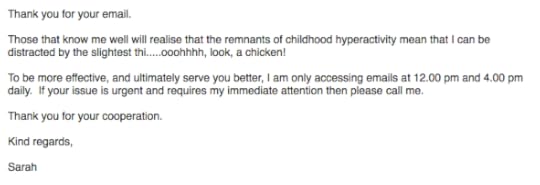
What about you? How do you set expectations on your availability? What’s the best email autoresponse you’ve seen? Let me know in the comments below.
And if you want to get your emails under control, come and join me at the Getting Your Inbox to Zero workshop, live in Staffordshire on 20th June.
May 19, 2014
The real reason I don’t get enough sleep
 There’s been a lot in the news about sleep this week.
I must admit, this isn’t one of my better habits.
I know sleep is important. I know it affects my capacity, my thinking, my wellbeing and my mood. I even consider it a luxury – I make that joke most parents do about how I’d prefer sleep over a box of chocolates for my birthday.
Yet I very rarely give myself that gift. More often I let other things creep in.
In the evenings “I’ll just…”
send another email
comment on this Facebook post
do the accounts
tidy up the proposal I was working on earlier
finish off that article
look up that app someone told me about
do the laundry
load the dishwasher
watch another another episode of the latest find on Netflix
any or all of the above… and more
Or I’ll squeeze away some sleep in the morning. I can rise to the challenge of being at my desk, on a train or pounding the streets at 6am, but I still don’t manage to get to bed earlier!
Granted some of these things are definitely more of a trade off than others. But the fact remains. Sleep is the currency I most willingly trade with.
Why is that?
It hit me the other day. I’ve seen this before.
When my son used to fight his sleep as a baby, to the point where he would fall asleep mid cry. When my daughter is bouncing round the walls until she see’s her brother go to bed then she’s out like a light.
It dawned on me: I am no different to my kids. The one thing that stops me from getting more sleep boils down to this:
Fear Of Missing Out
Yup. No more complicated or profound. Just plain old FOMO. How silly do I feel?
My friend Karen announced last week that she was pulling the plug on the website she started ten years ago. Because her business had moved on, and it was time for her to shed that skin, let go of the old and make more room for the present.
It sparked a discussion about how sometimes we hold onto things that served us before, long after their usefulness, and here’s what I said:
Some things we keep building. Others become stepping stones. And sometimes we have to let go of some good stuff so we can grab what’s next with both hands.

Maybe I need to take my own advice on this. There was a time when the nights were my most productive, the only time I had my brain to myself.
But with my kids now in school and I’m working fuller days, quite frankly, my brain is often toast when it comes to the evenings. Perhaps it’s time for a new season and a new rhythm. Time to admit that the thing I fear I’m missing out on is far less valuable than the thing I’m really missing out on…
What about you? Does Fear of Missing Out stop you from letting go? Have you ever made that decision in your business to let go of something that’s passed its usefulness?
I’d love to hear your story – go ahead and share in the comments below…
May 11, 2014
Doing Learning
 When we were on holiday, we took our kids to play badminton.
My son loved it, got the hang of it pretty easily, and even invented a tennis-like serve that seemed to work for him.
My daughter on the other hand, found it harder, so my husband took her away from the net and practised throwing the shuttlecock to her so she could get used to hitting it.
When we got back home, they both decided they wanted to play again – this time on the field outside our house. It was a gorgeous, sunny day, but it was windy.
My son quickly got frustrated. The shuttlecock wasn’t behaving the way he was used to. The game had changed, and in between every miss (and there were many) he stomped, yelled and gave me that hurt, frustrated look that said “it’s not working!”
My daughter on the other hand flashed me a smile and announced “I’m going to do some learning mummy”, threw the shuttlecock into the air and started counting how many times she could hit it.
With each miss, my son got more and more frustrated, declaring “I can’t do it!”.
With each hit, I could hear my daughter counting, “5, 6… 7… … … 8…”
By the time we went home, my daughter had racked up a hundred hits (although I’m pretty sure she went from 34 to 55!) My son on the other hand, felt like a failure, because all he focused on were the misses. The truth is, they probably both got better. But only one knew it, and only one grew in confidence for the next time.
What are you learning at the moment? What feels clunky, difficult or frustrating?
Maybe it’s something completely brand new. Or maybe it’s something you already do well under different circumstances. Maybe the game has changed, you’ve entered a new arena, the stakes are higher and you feel like a novice again.
How are you doing your learning?
Are you counting the hits or the misses?
Are you focused on the practise or frustrated that you haven’t mastered it yet?
Ultimately learning isn’t about knowing what to do. It’s about putting that knowledge into action. It’s about doing learning.
How are you doing yours?


