
Grace Marshall's Blog, page 18
July 23, 2013
Stressed by email? Time to take control

Email adds to stress. We all suspected it, now it’s ‘official’.
A study at Loughborough University found that 83% of workers became more stressed while using email, that stress levels peaked at points in the day when people’s inboxes were fullest, according to the Daily Telegraph.
Sound familiar?
The average worker spends 41% of their time on email management, and the volume of email each of us receives is currently doubling every 4-5 years. More than half of all UK workers admit to being stressed by how much email they receive.
It’s time to take control.
If your inbox is out of control, and email is taking over your working life, there’s good news. I’m delighted to be bringing Think Productive’s Getting Your Inbox To Zero to Stafford as a public workshop for the first time this September.
 Spend half a day with me and I’ll help you get your inbox under control and work with you practically to reduce or clear your inbox by the time you leave.
Come away with a clear inbox and a clear strategy, with new ways to think about email, tools to convert emails into actions, tips, tricks and tried and tested ‘ninja email’ moves.
By the end of the 3 hours, you will:
actually get your inbox to zero (or at the very least be close to it!)
implement the structures to help manage email volume and keep your inbox clear
know how to create ‘rules’ and tactics to reduce the volume of emails that actually enter your inbox.
Here’s what a few of our previous delegates have said about this workshop:
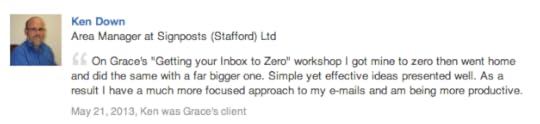
Many thanks for a super course yesterday afternoon – I thoroughly enjoyed it and left feeling I had learnt a great deal. Your drive and determination to get us to zero was very encouraging and you will be pleased to know it is still at zero! Thank you once again Grace – I will definitely recommend this to my colleagues in Estates.
Gillian Ward, Events Co-ordinator, Open University
I was really impressed with the course you held at the OU a while ago, and put your advice into practice on the same day.
Recently, I was on sick leave for about 3 weeks, and came back yesterday to 160 emails which I sorted the Inbox Zero way. This has really worked for me and I am so pleased.
A workshop delegate at the Open University
Sound good? Book your place now to join me in Stafford on 20th September and get your emails under control, once and for all.


July 16, 2013
Responsibility: Burden or Empowerment?

 Remember those days when you actually wanted responsibility? Perhaps as a child, wanting your parents to trust you with responsibility, or in those hungry ambitious early-career days, wanting more responsibility at work.
Maybe you wanted more autonomy or authority. Maybe you wanted to be in charge, to make things happen, to feel in control, make a difference.
Yet the reality of responsibility can feel like anything but.
The responsibility of being a parent – the burden of everything that needs to be done, all the decisions you make, that you might get wrong, and all the guilt that comes with that.
The responsibility of being a business owner – that the buck stops with you. That the only way anyone gets paid is if you keep bringing in the business. As the annoying saying goes, “if it is to be, it’s up to me.”
But what does it really mean to be responsible?
When we feel overwhelmed and burdened by responsibility, helpless, unable to take action or make a difference, are we actually taking responsibility?
Perhaps it’s more helpful to think about it as response-ability. Our ability to respond.
If you’re carrying a burden so heavy you can’t move, you don’t have the ability respond.
If you’re feeling trapped by your commitments and unable to make a choice about what you actually spend time on, you’re not responding.
Being response-able means making choices about how you respond, and owning that choice. Not automatically saying yes to everyone else and no to yourself. That’s abdicating responsibility.
It’s about YOUR response
Take Katie for example. Who was always cancelling her own business plans when she was called upon in her school governor role because she felt responsible. And yet if they had called on one of her employed working days, she knows she would have said no.
Instead of just feeling responsible, she took responsibility and made a choice. She chose to give an hour of her time rather than let them take a day. And that worked out fine for both parties.
It’s your choice to define the way you do business or parent your kids. That’s the only way you’ll be happy with it. Your choice how you show up in all your different roles, and who you show up for. Your choice what you say yes to and what you say no to.
It’s about your ABILITY to respond
If you’re always putting yourself last and running on empty, how does that affect your ability to respond?
If you never take time to work on your business, how does that affect your ability to respond within your business?
If you’re over-committed and things are already falling off your plate, how does that affect your ability to respond to an emergency, curve ball, or a dream opportunity that comes out of the blue?
I don’t know about you, but if I’m tired, my ability to respond to spilt milk or moody tantrums is much much much reduced.
That’s why I’m taking August off.
Because my kids have end-of-term-itis and I think it might be contagious.
Because this is the last summer before both kids are at school full time *cue hyperventilation*
Because I’m tired. Yes, I’m human, and happy to admit, I need a break!
Because my husband’s been amazing at holding the fort when I’m on my ninja travels, and I want to respond well to him 
Because my house needs de-cluttering and that affects my ability to respond.
Because I love my work, and I know I’ll have so much more to give when I recharge and renew my ability to respond.
Because I want to show up as my best self. In all my roles.
So I’m taking responsibility this summer and taking August off.
How about you? Where in your life do you feel overwhelmed or burdened by responsibility? How are you going to take responsibility?
July 4, 2013
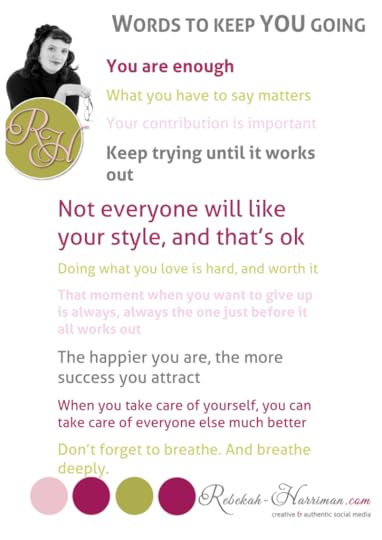
Words to Keep YOU Going

If you read my last post, you’ll know how passionate I am about words and how our language impacts our productivity.
Which is why when one of my Baby Steppers created this after a call we had on motivation, self-belief and productivity, I absolutely had to share it with you.
Over to Rebekah…
Whilst working with Grace through the 40 Days of Baby Steps I have come to realise several truths and had quite a few realisations so I decided to collate them to help keep myself motivated to reach my goal. I hope they help you too, whenever things in your life or business start to feel a bit, well wobbly!
About Rebekah
Rebekah Harriman is a social media consultant, coach and trainer who wants to give you the tools, know how and confidence to be yourself and authentically promote your business online. She is passionate about helping people communicate, learn about being themselves and find their voice, about giving them the best tools to use that voice effectively, authentically and in a worthwhile way to make money and maybe make the world a nicer place whilst they are doing it. Find out more about her and how she works, get free tips, downloads and social media news at her blog Rebekah-Harriman.com, creative and authentic social media. Get advice from someone who gets you!
June 21, 2013
Two and a half words that will improve your productivity

 I’ll admit, I’m a bit of a word geek. I love language. And I notice language a lot. Friends and clients will testify to that.
I’m trying to teach my son the art of speaking persuasively, especially when his little sister is being particularly annoying. Yes, he’s perfectly entitled to say “Get out the way” but “Excuse me please” or “Can you come this way?” is likely to be met with less resistance.
In the same way, the words we use with ourselves can affect our own levels of resistance and motivation.
Here are two and a half little words that can affect your productivity, amongst other things:
But
“I’m confident at what I do, but running a business/networking/public speaking is all new to me”
“Website’s lovely but the font’s too small.”
“Written 5 chapters, but there’s 20 more to do.”
“I’m excited, but I’m scared.”
“99 happy customers this week, but one complained”
Notice how ‘but’ changes the tone of the story? We have good news…yay! But there’s bad news… Oh cr*p.
‘But’ has an effect of negating whatever came before. Good news gives way to bad news. Confident becomes not confident. Praise gets overshadowed by criticism. Progress leads to stuck. Done gets replaced by not done. Excited is overwhelmed by scared.
Replace ‘but’ with ‘and’
“I’m confident at what I do, and running a business/networking/public speaking is all new to me”
“Website’s lovely and the font could be bigger.”
“Written 5 chapters, and 20 more to do.”
“I’m excited and I’m scared.”
“99 happy customers and one complaint this week”
Notice the difference? Both parts of the sentence can exist alongside each other and have equal weight. In fact, the positive statement lends itself to the rest.
I’m confident and this is new. This is great, and this is how it can be even better. This is what I’ve done and this is what I’m working on. 5 down, 20 to go – progress all the way. I’m excited and scared – it’s ok to be both. 99 right and 1 wrong – we did well and what can we improve?
Try it! Notice what happens when you say ‘and’ instead of ‘but’.
am vs doing
I’ve blogged about this before, that “I am” speaks to our identity. It feels permanent, part of who we are.
“I’m doing” describes an action, something we are taking part in, at this moment in time, which is temporary and detachable.
So when clients say to me “I’m a terrible procrastinator” I remind them procrastination is something you do, not who you are.
We can all do procrastination. How do you do yours? What do you say to yourself or out loud? What actions do you busy yourself with? What goes through your mind? What do you imagine? Where do you allow your attention to go?
Once we know what we’re doing, it becomes much easier to decide what to do differently.
“-ing”
So often we focus on what’s done and what’s not done. What about the stuff in between? What about the work we’re actually doing?
My friend Jenny Flintoft once asked me, “What are you working on?”
“How’s business?” would have prompted a static answer: great / good / ok / not bad / could be better / awful / don’t ask!
“What are you working on?” prompted a much more enthusiastic response. “Well, I’m putting together a… and it’s really exciting because… I’m still working out…. and I’m looking forward to launching it in…”
Progress isn’t static. So much of what we do is work in progress. Building a business, raising a family, growing in confidence…
What are you working on? What are you creating? Where are you growing? What are you building on? What are you reaching? What are you celebrating? What seeds are you sowing? What harvest are you reaping? What results are you seeing?
And when you do take a snap shot and review what is done and complete, where is that leading you?
If you want the momentum and flow of being in progress, make sure your language has plenty of “ing” in it.
Over to you. What words help or hinder your productivity? I’d love to know. Add your voice to the comments below.
And if you’re working from home, building a business while juggling family and other commitments, check out this clarity retreat for crazy busy entrepreneurs.
May 27, 2013
Countdown to Summer: How to Get from Panic to Productivity When Time’s Ticking

 It’s half term AGAIN. After that, we’ll be on our final countdown – 7 weeks until the summer holidays. At least at our school it is. What about yours?
I probably should be used to it by now – having kids may not physically make time move quicker, but you sure as heck notice it!
So what do you do when time’s ticking?
What NOT to do (trust me, from personal experience, it’s not worth it)
Panic – Spend your time fretting about how little time you have. Remember, “Worrying is like a rocking chair. It keeps you busy but gets you nowhere.”
Yes, by all means have your “Gah!” moments but don’t stay there. Move on.
Do everything now – or at least try to. It’s as if someone’s just rang the bell at the bar, and your brain decides to cram everything it’s been holding onto into that one last order. Everything you’re working on. Everything you’ve been meaning to work on or wanting to work on. And probably a few things you’ve been avoiding too.
It all needs doing, and it all needs doing now. Sound familiar?
It’s a sure fire way to send yourself into overwhelm, where everything needs doing but nothing actually gets done.
Give up. Call it a day. If you can’t get everything done, you might as well wait… until you have time. More time. All the time in the world. It’s bound to happen someday, right?
The thing is, you don’t want to be paralysed by panic, stuck waiting for the perfect time while the days, weeks and terms of imperfect times pass by.
Equally you don’t want to be so overwhelmed with trying to cram everything in, that all you end up doing is your best headless chicken impression, piling lots onto your plate, but getting nothing actually done.
What to do instead
So how do you get things done without driving yourself crazy?
How to you get beyond the panic and into productivity? How do you make every moment count, however fleeting or imperfect?
Get it out of your head
If you’re playing things on loop in your head, trying (and failing) to get your head around all the stuff to do, with varying degrees of panic that you might have missed or forgotten something fairly important, it’s time to get it out of your head.
Braindump all the things you need to do, have to do, want to do and feel you should do. Only when it’s out of your head can you really take a step back and see it for what it really is. One giant menu.
Be picky
If you tried to eat everything on a menu at once, it would become a torturous rather than tasty experience, and you’d probably be sick. The same applies to your braindump.
Pick one thing. One thing that you can be proud of achieving by the summer, instead of a starting a hundred things that you feel bad about not finishing.
Make it personal
Life’s too short to live by anyone else’s values but your own. Yes the bins need emptying, laundry needs doing, and there’s always a fair share of underwhelming stuff that needs doing, but if your time is going to feel productive – time well spent – it’s got to be on something personally meaningful.
If you’re faced with a host of possibilities, wondering “how do I choose?” start asking yourself, “why does this matter?” and notice what makes your heart sing, your spirit soar or your gut wrench.
Out of all the possible things you could be doing between now and the summer, what would really make a difference to you?
Give yourself definition
Without definition, you have nothing to focus on. When you don’t know what done looks like, you’ll always be chasing your tail.
A deadline without definition creates panic.
Define exactly what done looks like and be clear on what you’re going to do. Make it personal. Be picky. And don’t be afraid to park things.
Take baby steps
Eating a frog for breakfast is all well and good, but if your frog’s more like an elephant you’re going to have to take it one bite at a time.
Take baby steps. Avoid overwhelm of doing everything – and everything at once. Break it down, make it clear, make it doable, make it easy to get on and do.
If I had woken up to “Write Book” on my to-do list every day, there’s no way I would have gotten it done. Instead “draft way 16 on saying no” gave me focus and definition to get on and do it, rather than sit and think about what I need to do next.
Know what fires you up (and it’s not necessarily work!)
Sometimes the most productive thing you can do is to stop working, and do something that charges you up.
So often, we think that when we’re not working, we’re not being productive. Yet, taking time to recharge your batteries, rest your brain and renew your passion, can be infinitely more productive than flogging yourself to work harder.
What will supercharge your action? What input into you will make a massive difference to your output?
Whether that’s rest and relaxation, hair raising adrenaline-fueled fun, doing something creative, learning something new, being on your own or spending time with people.
Whatever it is that leaves you recharged, renewed, inspired and fired up – do it. And know that you’re being productive.
Over to you. What are you going to focus on getting done before school’s out for summer?
Could you do with some extra support and accountability in defining and taking your baby steps? Join me and a fab group of entrepreneurs for 40 Days of Baby Steps – starting soon!
April 29, 2013
Three Ways to Grow Your Confidence

 What is confidence? Is it something that you either have or lack? Or is it something that grows in all of us? My opinion is the latter.
Every Tuesday I get to watch my son learn how to swim. And this week, when he swam a whole width with no floats or aids, it struck me how far he’s come, and how much his confidence has grown in just six months. From being hesitant to jump in, afraid of getting water on his face, tensely curling up and clinging onto the teaching assistant – to pouncing in, stretching out, taking big scoops with his arms, and arriving to the other side with a massive grin on his face.
As I reflected on this change, I realized that each step of progress he made required a little bit of confidence, and with each step his confidence grew too, in a kind of virtuous cycle. So the good news is, you don’t have to be super confident to start, and here are three simple ways to boost that growth cycle.
1. Appreciate baby steps
Oliver didn’t suddenly go from hesitantly clinging to confidently swimming. In fact, if they had thrown him in at the deep end (literally and figuratively) he probably would have been completely put off. They started small, with games to get him used to the water. They encouraged him to put his chin in the water, then his nose, then his whole face. He had armbands to begin with, plus a teaching assistant to hold on to, then progressed to a ‘wiggly worm’, then no aids, and then the assistant let go and he swam on his own. And this progression happened gradually, week by week. Each time he practiced, his confidence grew a little bit more, and each time he did something new, his confidence grew massively.
I think often as adults, we don’t appreciate the baby steps we make. Many of us focus on what we haven’t yet mastered and what we don’t feel confident doing. We talk about our achievements as “it’s not much really” and then put great emphasis on what we haven’t done.
Yet it’s the baby steps that pave the way to big achievements. In fact, the momentous occasion of a baby’s first step is the culmination of many stages of learning to move muscles, coordinate and balance – and all while their dimensions are constantly changing too.
So what are your current achievements and highlights in what you’re working towards at the moment? What new territory have you taken steps into? One of the quickest ways to grow your confidence it to do something new, and I bet in some area of your life or business, you’re already doing that.
Even if you have to start with “It’s not much but…” then cross that first bit out! Keep noticing, appreciating and celebrating your baby steps, and you’ll notice a massive difference even over a short period of time.
2. Encourage confidence by speaking life
We all know how praise and encouragement empower children, so wouldn’t it make sense to give ourselves some of the same?
Friends and clients of mine know that I am quite hot at picking up on phrases like I’m rubbish at…, I’m not very good at…, I can’t… or I’m not confident…. I’m passionate about words, and the power of words. As someone who told herself for years “I’m a loner, an introvert and difficult to make friends with” I know the power words can have on how you feel, how you see the world and ultimately how you do life.
They say the tongue has the power of life and death, which means that you can speak death over a situation (just watch an episode of Eastenders for a whole host of examples!) or you can speak life into it.
Sometimes it can feel like a big leap to go from I am rubbish to I am brilliant – and you might be thinking ‘but Grace, you don’t know how much I’ve struggled with this, it would just feel fake to pretend that everything’s hunky dory!’ For the record, I don’t believe in ‘faking it to make it’. I think integrity has a lot to do with confidence, and you can absolutely take a positive perspective and be able to say it with truth and conviction, simply by using phrases like:
Well I am good at… AND
I’m learning to…
I’m starting to…
I’m getting better at…
I’m becoming…
I’m on my way to…
Even swapping “I’m lacking in confidence” for “I’m growing in confidence” transforms a limitation into a work in progress.
Finally here’s a slightly different approach from my other child – a two year old rocket named Catherine
3. Go faster than the speed of fear
Despite (or perhaps because of) being three years younger, my daughter is far less cautious than her brother. On one occasion when I took her swimming, when it was time to go, she decided she didn’t want to go, so promptly ran straight into the pool – with no hesitation whatsoever. On being rescued by my friend who was still in the pool, she was a bit startled and wet, but absolutely fine.
Sometimes when we know logically that we have the skills and resources to do a pretty decent job, and just don’t quite feel confident about doing it, and given enough time we might just talk ourselves out of it, speed can be a very helpful tool.
On deciding some time last year that I was going to “find my voice” both in a singing and speaking capacity, I’ve taken to saying “yes” to pretty much every opportunity that comes my way. Sometimes that “yes” is followed by sheer panic and “aargh what have I just let myself in for?!” but every time it’s given me opportunity to learn, practice and grow in confidence.
So if you recognize that feeling – that gut instinct of ‘yes I know this will be good for me, and yes part of me really wants this, and at the same time a part of me is absolutely terrified!’ – I encourage you to say “yes” once in a while and notice your confidence surge in the mix of the adrenaline.
Confidence isn’t something you either have or don’t. It’s something we all have, and something that grows. Sometimes our confidence gets knocked by unexpected changes, conflict, setbacks and circumstances beyond our control. Maybe that’s redundancy, illness, a relationship breakdown, difficult work situation or simply sleep deprivation. We all have some confidence in us, in some area of our life, and that confidence can be nurtured to grow. And like all things that grow, the more you feed it with life, the more it grows, and the more it grows, the more robust it becomes.
This article was originally published in my newsletter in 2011 (in case your eagle eyes have spotted the my kids seem to have gotten younger!). For more encouragement like this direct to your inbox, pop your email address in the box at the top right of this page. For individual help with growing your confidence take a look at ways of working with me.
Like this article? Please share it and add your thoughts to the comments box below
April 25, 2013
Is your definition of success playing havoc with your motivation?

 How do you define success? By results or by actions?
Results are easy to define. Tangible. A workshop booked. A new client on the books. A sale made. A sum of money in the bank. Another product sold and shipped. And it can be great for motivation, knowing what you get when your actions pay off.
But it can also be demoralising, when you’re in the middle of taking the actions you need to achieve that success. When you’re making call after call, writing email after email, sending invitations, posting blogs, tweets and statuses, and they’re not translating into results… at least not yet.
The actions you take to achieve your results are vital. Yet if success is defined purely by results, your actions have no value until they lead to a result. Your motivation hangs on the hope of reaching that goal, otherwise your efforts are for nothing.
The problem with focusing purely on results is, you’re a failure until you get that result. And when you do get the result, success is fleeting and momentary. Then it’s onto pursuing the next booking or the next client, where you’re yet again back in the place of pursuing, hoping and wondering if you ‘have what it takes’.
Some people love the chase. The ruthless pursuit of success.
For me, honestly, I find it hard work, unrewarding and draining. And I don’t think I’m alone here.
You see the problem is for most people, feeling like a failure doesn’t push us towards success.
It invites us to spend time and energy entertaining doubt and indecision, to go round in circles questioning ourselves and our own abilities.
It tempts us to spend hours, days and even weeks researching obsessing about the competition, devoting our energy and attention on studying their every move, rather than our own.
It makes us desperate for the sale – and we all know well from dating days, desperation does not attract.
It puts all our focus on what other people do, rather than what we do. Whether the audience smile or frown rather than how we deliver our message. Whether the prospective client says yes or not, rather than the conversations we have, the relationship we build, the work we do that gives them a reason to say yes.
And it steals our joy.
I caught myself being too focused on results recently. Despite having a couple of great weeks, lots of reasons to be happy, I found myself feeling subdued. Not terrible, or bad, just a bit muted.
I got to the end of what by all accounts was a very productive day. I’d taken account of everything I’d done. But I hadn’t put a metaphorical tick in my ‘results’ box, I felt like there was an itch I hadn’t quite scratched. I felt dissatisfied. Unproductive even.
That evening I was with a small group of church friends and we did an exercise of writing down what we saw in each other, then each of us took away a list of our own qualities, attributes and words of encouragement from the the rest of the group.
At the top of my list were three things: “A seed sower. An inspiration. A light in the dark.”
That’s when it hit me. Sowing seeds. Inspiring people. Shining a light. This is what I do. These are my measures of success. And I had done all of them that day.
In the words of Heather Small, “What have you done today, to make you feel proud?”
When I do these things day in, day out, the results come. I know that. (Seriously one just did, literally just before this post went live – talk about timing!)
Plus, when I focus on doing these things, my day is fulfilling. I’m proud of how I’ve spent my time. I am being successful.
Of course results are important. Setting goals are useful. But when we define success purely by results, it’s always something out there. Something we’re aiming for or pining for. Something we want but don’t have.
But when we define success by the actions we take, success becomes a journey, rather than a destination. Something we have and something we continue to grow and create. Every day we take that journey, we are living in success.
Now that I find motivating. Rocket fuel for actions and results.
What do you think?
April 22, 2013
Ask a PR Expert – Nadia Finer

 PR – we all know it can be great for our business, and whenever I see someone who’s ‘made it’ as the next ‘big thing’ in the realms of mainstream media I think, “Wow, how on earth did they get there?”
When it comes down to the nitty gritty of it, how do you do PR? What makes the difference between sending out hundreds of press releases and getting nowhere, to having enthusiastic journalists eager to talk to you?
Is the magic touch of PR reserved for those with big budgets and big personalities (or big boobs?!) and do us mere mortal, hardworking small businesses stand a chance in getting noticed by the shiny bright lights of the media world?
I don’t know the answer to all these questions, but thankfully I know a girl who does.
Nadia Finer is the author of “More to Life Than Shoes”, a UK Ambassador for Female Entrepreneurship and founder and MD of Media Darlings – where she brings her years of experience working with big brands like NIVEA, Avon and The Body Shop with her talent and passion for marketing small businesses to help people like us raise our media profile.
Nadia has agreed to spend an hour of her time answering your questions, in our Ask a PR Expert call next Thursday 25th April at 10am UK time.
To join in this call (it’s free) and ask your questions (they can be as specific as you like!) register here:
March 28, 2013
Taking a break? 7 Quick Tips to Switch Off and Recharge

 With Easter coming up, there’s definitely a ‘quick, get stuff done’ feeling in the air today. Whether you’re taking a 4 day weekend off or a full two weeks of school holidays, how do you make the most of your break? How do you make sure you actually switch off and give your batteries a chance to recharge?
I’d love to hear your thoughts on this. Here are 7 quick tips that came into my head (because I’m busy finishing stuff off today too!):
1. Social media blackout
Take a Twitter time out or Facebook fast. A change is as good as a rest right? So give yourself a break from being constantly digitally connected. A break can be a couple of hours, a couple of days or a couple of weeks. If you suspect you might be a little bit more than ‘connected’ and leaning towards ‘addicted’ you might want to make a change that slightly outside your comfort zone – like this one I’ve been doing for the past month.
2. Set your email out of office
We’ve all got better things to be doing than wondering if someone got your email, or worrying that someone’s wondering if you got their email. Give yourself and your contacts that assurance that yes their email has arrived, and when you’re likely to respond. You can include emergency contacts if that’s useful for your business.Even if you might pop in and out of the ‘office’, if the shop’s shut to the public, tell them it’s shut. Set clear expectations for when normal service will return, and make sure you switch off (or change) the out of office notice on that day. If your out of office’s are regularly out of date, people will start to ignore them.
3. Brain dump
Everything you’ve yet to do or think about. Stuff that’s not finished, stuff that’s not started, things you need to follow up on, bits of information you’ve collected over the past week and need to process, nagging thoughts and brilliant ideas – write it all down, brain dump it, then leave it.
Go to your diary, block out 1-2 hours first thing on the day you return, and use that time to make sense of it, organise, plan, prioritise etc.
Or
4. Do your weekly review now
Before you switch off. Stop working. Get yourself up to speed with where all your projects and tasks are, plan your priorities for the first day back – leaving plenty of margin for the unexpected that might crop up between now and then – so that you can switch off, knowing that when you’re back you can hit the ground running.
And when you’re on holiday
5. Go out, leave your phone
…on silent / in your bag / in the car / at home. It’s amazing how naked this can feel at first. And how creative your imagination can be at conjuring disaster scenarios of what you might miss, which usually turns out to be a bit of an anti-climax when you come back to it.
My friend Carrie Wilkerson, does this deliberately when she goes for a lunch date with her husband. She’ll put her phone in the glove box and ask her husband to remind her that’s where she left it, which also means he knows he’s got her full attention. Accountability and brownie points. I like her style.
6. Leave your phone on charge downstairs
…at night, rather than by the bed. It’s not like you need an alarm during the holidays anyway, right? Enjoy those morning moments of waking up to your own thoughts and company, rather than to someone else’s news. Same goes for a radio alarm, if you normally wake up to the news or traffic reports. Switch it off – you’re on holiday!
7. Make plans
Get the kids together and draw up a menu, map or mission plan of what you want to do, could do and might do during the holidays. We like to get a big sheet of paper onto the kitchen table, with a load of coloured pens, and let everyone write or draw their ideas onto the plan.
Give yourself plenty of choice – indoor and outdoor activities, things to do together or on your own, supervised and independent fun – to avoid that “I’m bored…what are we doing today?” conversation. Get everyone into the habit of making their own fun instead of waiting for something to happen.
What do you think? What tips would you add? I’d love to read your thoughts in the comments below!
March 25, 2013
How to Get Things Done comes to Stafford

 Big thanks to everyone who came to the How to Get Things Done workshop in Birmingham on Valentines Day and helped make it a great success!
I’m delighted to announce that we have added another Midlands venue for our Think Productive workshops, and I will be running How to Get Things Done in Stafford on 16th May.
Wondering what you’ll get out of it? Here’s what some of our delegates had to say last time:
Packed with opportunities to consider real-life issues and workable tips
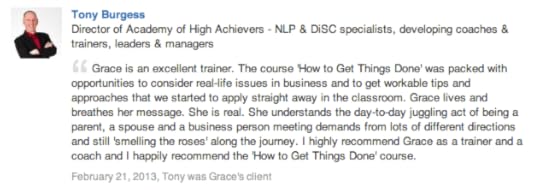
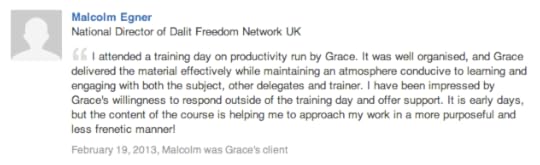
Helping me approach my work in a more purposeful and less frenetic manner!
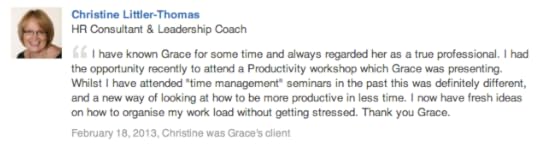
Fresh ideas on how to organise my work load without getting stressed
Want less overwhelm, less stress, and more playful, productive momentum? Join us in Stafford, for this fun, practical productivity workshop – book your place here and use code Staff30M to claim a special discount for my blog readers.


