
Alex Roddie's Blog, page 7
September 24, 2014
Thoughts on Kindle Unlimited, KDP Select, and being exclusive to Amazon

Kindle Unlimited has launched in the UK! Why is that good news for readers? For £7.99 a month, subscribers will get unlimited access to thousands of Kindle ebooks. That includes every KDP Select title plus a good selection of others as well.
So: great for avid readers, but what about authors?
There's been a lot of debate about this. Some worry that it will dilute author royalties, and others object to the fact that all titles enrolled in KDP Select are automatically put in KU whether the author likes it or not.
For my part, I knew this was coming so I have had a chance to think it through. My two most recent titles are already exclusively available on Kindle, and reports of increased sales from other authors have encouraged me to continue the experiment ... for now.
However, the great thing about being an independent author is that I can review my policy and make alterations at any time. If the time comes when being in KDP Select and KU no longer serve my needs, I'll change things.
Here are my books currently available on Kindle Unlimited:
Crowley's Rival
The Atholl Expedition
The exclusivity question
I am extremely wary about being an Amazon-exclusive author. I know for a fact that some of my readers don't have Kindles and don't shop on Amazon, because they've contacted me to say so. The Only Genuine Jones remains available on many digital platforms.
However, the bottom line is that OGJ has sold abysmally on every platform except Amazon Kindle.
Sales on Kobo, Nook, iBooks, and Sony stand at twenty two to date. Combined. That's twenty two sales in almost two years. I have yet to see a penny in revenue from Smashwords (my non-Amazon distributor). Compare that with thousands of sales on Amazon — who, incidentally, are far more user-friendly than Smashwords — and I think you can see that exclusivity starts to look a little more attractive. You also have to consider the fact that free promotions on Kindle require exclusivity. Amazon won't give you access to that promotional tool if you publish electronically on Kobo, Nook, or elsewhere.
I don't believe in regular free runs — they can do more damage than good, both to the book and the market as a whole — but it's a valuable strategic tool to have in your arsenal. Removing the ability to do a free run ever is a big deal.
So it comes down to this: sign up to Amazon's exclusive KDP Select programme and exercise greater promotional clout, or publish widely on platforms that may never make you a single sale. When you put it in those terms I think you'll agree that it's a difficult decision. Frankly it's no wonder that so many authors are now exclusive to Amazon.
Fundamentally I don't like the idea of being exclusive to a single vendor. It goes against the grain. But for now I find myself moving in that direction for practical reasons, because Kindle is quite honestly the only competitive ebook platform left. Nook is dying a slow death by a thousand cuts and Kobo is to all intents and purposes dead in the water. Sony announced their decision to suspend sales of ereaders some time ago. Like it or not, Kindle rules the roost.
If the market changes then I'll gladly publish more widely, but for now you'll be able to enjoy all my titles (apart from The Only Genuine Jones) as part of a Kindle Unlimited subscription.


September 15, 2014
Announcing the Pinnacle Editorial Press edition of The Only Genuine Jones

Regular readers will be aware that I recently started a new job as a freelance editor and literary consultant. I started Pinnacle Editorial in July, and it's been going from strength to strength.
As part of my new line of work I have been taking a critical look at my own books. The editing has always been top notch — I have Clare to thank for that — but I have long been aware that a few small tweaks might make the books even better. I decided to establish a self-publishing imprint, Pinnacle Editorial Press, to handle all my future publications and to bring a more consistent look to existing ones.
To all practical intents and purposes, little is actually changing. I'm still publishing my own books and using the same business model. The key difference is perception: readers will now see published by Pinnacle Editorial Press, which makes a big difference.
It will improve quality, too. My first job is to create a style guide for the new imprint: a complete specification of how my published books will be formatted and presented to the reader. There was no consistency between the look of my first and second novels, but that's about to change.
The new Kindle edition of The Only Genuine Jones
The first item on my list was cover design.
My original cover for The Only Genuine Jones was striking and I have received many compliments on how well it fitted the subject matter. The cover was designed by the talented John Amy. Striking it may have been, particularly at thumbnail size, but gradually the look of my work changed. I decided to create a new one, specifically designed to adhere to my new style guide.
The new cover uses typography which will be consistent with future books. The slight sepia tone reinforces the historical genre. The more prominent author name and puff quote, not to mention the "Pinnacle Editorial Press" logo, help to build gravity and authority. It is, in short, a better cover.
Apart from slight changes to the copyright pages, there no changes to the book's interior.
The new paperback edition
I'm also working on a new paperback version of OGJ, using the typographical format of The Atholl Expedition as a template. I'm also switching the printing company from FeedARead to IngramSpark (largely so I have more control over which bookstores can order the book). This edition won't be available for a few months, so for now the first edition with the original cover will remain on sale.
September 13, 2014
British climbing is changing
My esteemed colleague John Burns, who is a mountaineer with forty years of experience and a skilled writer, has penned an excellent piece about the changes in British climbing.
“I’m going to start climbing,” a friend told me last summer. My mind raced back to when I began climbing forty years ago. Learning to climb then meant you had meet up with some experienced climbers and learn the secrets of their trade. That usually meant meeting bearded young men in the back rooms of pubs. They’d give you old pieces of equipment no one used anymore, smiling, “Just to get you started.” I thought of my days in Sheffield, driving out to Gritstone edges in my clapped out Marina, I thought of sitting in Grindleford Café, drinking tea and eating bacon butties, while we watched the rain run down the steamy windows. I thought of shaking my way up easy climbs, taking the skin off my fingers on the rough rock, being shown the mysteries of rope management by a grey bearded climber.
More than anything else, of course, I thought of going…outdoors. Here I made my biggest mistake, that wasn’t what my friend was talking about at all. For an old git like me that came as a surprise.
Outdoors! Why would anyone want to climb there?You can read the full piece over at John's blog (which I wholeheartedly recommend, by the way, for his frequently humorous accounts of adventures on the Scottish hills).
September 1, 2014
How's the new job going, Alex?

I have been asked this a few times over the last month, so I thought it was time for an official update on my progress.
In early July I made a significant decision. Prompted by a trip to the Alps that changed my perspective on a few things, I decided to quit my day job at the Carphone Warehouse and begin work as a freelance editor and proofreader. The idea had been on slow burn for a while but as soon as I started thinking about it seriously the decision was an easy one to make.
I established Pinnacle Editorial in mid July and haven't looked back.
These are early days, but I'm glad to say that things are going extremely well. I've already worked on some tremendously exciting projects: dark science fiction, a conspiracy thriller, and a book for children. I have several projects in the pipeline and am fully booked until mid October. Best of all, two of my clients have already come back with offers of repeat work.
I must admit, it's a relief. Freelance editing is a competitive industry, and I was by no means certain of being able to attract so much work right from the start. I was prepared to heckle old colleagues and offer to do work for free in order to get clients, but none of that has been necessary so far.
Best of all, I love everything about the work itself. I've always enjoyed editing my own books, and I find a great deal of satisfaction in polishing a manuscript to the best of my abilities. I like the fact that I set my own targets. It's far easier to believe in a target I have set myself than an arbitrary number passed down from on high. I like the fact that I can structure my own day, work the hours I want, and — to an extent — pick and choose the work I want to do.
It is, in short, absolutely fantastic. I've always been aware that self-employment suits me more than being an employee, and I'm finally reaping the benefits of that awareness.
Of course, things won't be this great all the time. It's inevitable that I'll experience quiet periods, and it will take a while before I'm earning as much as I would like. I began this job with realistic expectations and I'm not going to start complaining the moment things get a little more difficult.
The only real disadvantage so far is that I'm finding it harder to find time to work on my own fictional projects. Other editors who write have warned me of this, and I'm still seeking the ideal balance between work and writing. David Wailing's strategy was to take the whole of August off to do nothing but write, and while I doubt I will be forced to take such drastic measures I have no doubt that it will take me a little while to find a balance. Have no fear: work is continuing on the second volume of Alpine Dawn, and I hope to publish it by the end of the year.
In general, though, things are going extremely well. I have every one of my readers and followers on Twitter to thank for that. You've helped make it happen.
August 14, 2014
Please nominate The Atholl Expedition for Outdoor Book of the Year
It's that time of year again! Nominations are now open for The Great Outdoors Awards 2014. These prestigious awards showcase the best outdoor retailers, establishments, organisations, and books each year.
I would like to humbly ask my readers to nominate my most recent novel, The Atholl Expedition , for the Outdoor Book of the Year award. Many worthy titles have been published in 2014, but this one is mine and I would be very grateful to anyone who nominates it. Winning such a prestigious national award would be a high point in my career.
You don't have to make a nomination for every category, but why not take the opportunity to put forward the names of retailers or outdoor pubs who have impressed you this year?
You can submit your nominations here.
I would like to humbly ask my readers to nominate my most recent novel, The Atholl Expedition , for the Outdoor Book of the Year award. Many worthy titles have been published in 2014, but this one is mine and I would be very grateful to anyone who nominates it. Winning such a prestigious national award would be a high point in my career.
You don't have to make a nomination for every category, but why not take the opportunity to put forward the names of retailers or outdoor pubs who have impressed you this year?
You can submit your nominations here.
August 12, 2014
How Not to Self-Publish by Rosen Trevithick — book review

How Not to Self-Publish The Totally Splendid Hotshot Author's Survival Guideby Rosen Trevithick
I have published my review of Rosen Trevithick's very funny new book over on the Pinnacle Editorial blog. You can read it here.
Author's note: From now on, all blog posts on the subject of writing or publishing will be posted on Pinnacle Editorial. This blog will continue to offer articles on mountaineering, the outdoors, history, and reviews of books on similar subjects.
July 31, 2014
One hundred and fifty years
 Image from http://1865.chamonix.fr/En/Next year, in July 2015, the Chamonix valley will begin a series of celebrations marking 150 years since 1865, and paying tribute to one of the most remarkable periods in modern history: the Golden Age of Alpinism.
During this period, which lasted from roughly 1854 to the 14th of July, 1865, the Alps were thoroughly explored by sportsmen for the first time. Before the mid 1850s, people climbed for pleasure in the Alps, but the focus of attention was firmly on Mont Blanc and the majority of ascents were still being made for scientific reasons. That changed, however, when a new wave of leisured travellers (many from Britain) began scaling unclimbed Alpine peaks purely for the adventure.
Fifty-eight first ascents were made in the Alps between 1854 and 1865. Facilities in most Alpine valleys were still spartan. Climbing equipment was extremely rudimentary, consisting of nailed boots, hawser-laid rope, and long ice axes used to hew steps in the ice. Despite this, there were few serious accidents — until the 14th of July 1865.
On that fateful day, Edward Whymper and his companions finally made the first ascent of the Matterhorn after a determined campaign lasting many years with many failed attempts. The expedition famously ended in tragedy and cast a gloomy cloud over the sport of mountaineering for a long time afterwards. It marked the end of the carefree, joyous years of Alpinism.
Chamonix has always been the international centre of mountaineering, and it sounds like the celebrations will be something special to behold. Exhibitions, conferences, readings, performances, and much more are scheduled for July 2015. It appears that a retro ascent of Aiguille Verte is also being planned!
July 27, 2014
The Ascent of Sasseneire

I must begin this blog post with an apology, because I meant to write up this route weeks ago but life has intervened!
In the first week of July this year I conducted a journey through the Alps, beginning at the city of Aosta and ending at Evolene in the Valais. My original plan had been to climb Mont Brule on my way over the glacier from Italy, but the weather was bad that day so it never happened.
Towards the end of the week I found myself not having climbed a single mountain. On the fourth of July I decided to rectify that situation, and as you shall see, the subsequent climb proved to have a positive influence not only on my Alpine holiday but on my life as a whole.
Sasseneire, 3254m
Sasseneire, whose name means the Black Rock, is a mountain at once mighty and shy. It's actually one of the biggest satellite peaks of the main chain in that part of Valais, but is invisible from any point in the Val d'Herens and the main bulk of the mountain only comes into view once a substantial portion of the ascent has already been completed.
It's one of the easiest 3000m peaks I've done. There are no glaciers to negotiate, no snowfields, and minimal scrambling (although there is a lot of very loose rock). The main challenge is a physical one, because it's a hell of a slog from the valley: almost two thousand vertical metres up and then down again.
A pastoral Alpine walk
I planned my route on the map beforehand. A winding collection of roads, ancient paths, and cattle tracks climb wooded hillside to the odd little community of Villa — which is in one respect a perfectly ordinary pastoral Alpine village, but it displays clear evidence of incursion by wealthy holidaymakers. I would estimate that 50% of the houses are second homes, and the juxtaposition of new, immaculate chalets with the tiny ramshackle structures of the old village is peculiar to behold.
 Typical old Alpine architecture at VillaFrom Villa, the terrain opens up to a broad Alpine meadow, dotted with hay barns, navigated by a switchback road that climbs steadily higher through the pollen haze and the (at times) deafening buzz of grasshoppers and crickets.
I strode out the miles, enjoying the expanding view backwards. The main chain was displayed to great advantage from this location, and I could see most of the peaks at the head of the Arolla glacier, in addition to the Dent Blanche and the Grand Cornier.
 Cattle pastureThe route consisted of a series of convexities, each of which obscured the route onward and had a different character to the one before and the one to follow. Meadows gave way to cattle pasture, which gave way to ancient moraine. These old banks of glacial debris had been softened and grassed over by the centuries, and gargantuan erratic boulders reared from the crests of ridges, fractured by a million frosts and weathered to the hue of old iron. Marmots emerged from their burrows to twitch their noses at me but capered out of sight before I could bring my camera to bear.
The land grew wilder as I climbed. Vegetation gradually gave way to rock, and finally, just before reaching the tarn at Béplan, I saw the upper two thousand feet of the mountain for the first time.
A ridge with a difference
The mountain is appropriately named. A desolate cirque, filled with shattered towers and the waste of ten thousand years of erosion, guards the head and shoulders of a peak that appears at once threatening and indifferent. Dashes of snow here and there only serve to make the rock seem even more stark. Like a Cairngorm giant, Sasseneire sprawls and covers its bulk over a vast area. It certainly did not look inviting to climb.
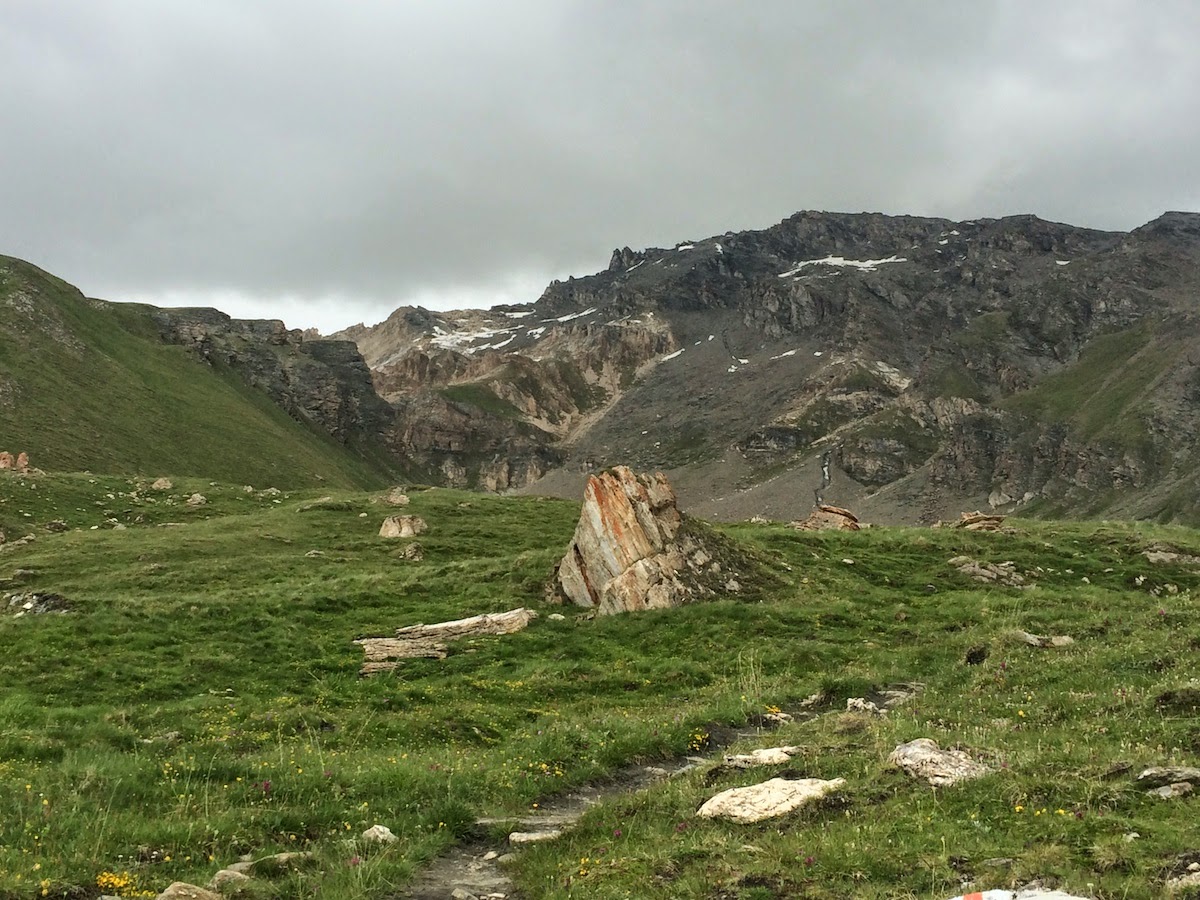 My first view of SasseneireMy route climbed steeply to the Col de Torrent: a notch in the satellite ridge thrown down by Dent Blanche far to the south. As I approached the col, any final vestiges of grass disappeared beneath masses of shifting scree. At almost 2,900m it felt like I was finally on an Alpine peak and not a British hill.
 The Col de TorrentThe Col de Torrent provided a good view down to the Moiry, and across to the glaciers beyond. I took the opportunity to pause and examine my route onward.
The ridge extended up and to my left: an arête of shale, almost all of which had been pulverised to loose scree by the elements. My first challenge came in the form of a vertical rock step with holds that crumbled under my fingers. I climbed this tottering pitch with care, wary of the gusts of wind that blew with increasing strength from the west.
 Looking back along the ridge
 Typical crumbling terrain on the South RidgeWith a thousand feet left to climb, I was starting to feel the effects of altitude and had to stop for deep breaths every few minutes. The loose terrain compounded my sense of insecurity. Although the going was never technically difficult, the staggering drop to my left was a constant pressure on my mind because every step had to be kicked in the finest, most unstable scree set on a slope of forty degrees. It was rather like trying to climb a sand dune in places. Where turrets of rock obliged me to climb with my hands, I found myself confronted by crevasses where the poorly-bonded shale had peeled away from the underlying rock, usually in car-sized chunks. I'd never seen anything quite like it on a mountain before.
The dark shale soaked up the heat, so there was little snow in evidence: only the occasional hoary bank of old stuff, coated in debris and melting in the sun.
A final rickety scramble on exposed rock slabs led me to the summit, where the obligatory Swiss cross marked the highest point.
 The final scramble
The wind now blew with galeforce strength, and the sun had long since hidden away behind banks of ragged clouds that threatened rain or snow, so I decided against a lengthy summit pause. Five minutes was enough to wolf down a tracker bar, take a few snaps of the view, and goggle at the stupendous drop down to the snowfields at the foot of the north face.
 The view NorthBattered by the wind, I picked my way back down the way I had come. The combination of high winds, constant exposure, and a surface that slid and shifted under every step made me cautious. I didn't relax until I was back on the relatively firm path of the Col de Torrent.
There aren't many options for variation of route when descending to Evolene, but I found that I enjoyed the walk more in reverse because the best views were in front of me instead of behind. I took my time, and was fortunate to avoid the columns of rain I could see sweeping the Arolla district.
My moment of revelation
All the best ideas of my life, all of the moments when a lightbulb goes "ping!" in my head and the pieces slot together, have occurred while I've been alone and out in the open — usually on a mountain. Ideas don't come to me during the frantic rush of everyday life — at least, not consciously — but they require long periods of time to incubate, and further time alone with my own thoughts to bring them to fruition.
For a long time, I have considered changing career. The idea of taking on work as a freelance editor first occurred to me over a year ago, but the time wasn't right and the idea simmered away, waiting for the stars to come into alignment.
Something about the expansive views on the way down from Sasseneire brought that idea out from the shadows and into the light. Perhaps it was the hours of solitude, immersed in nature, or perhaps it was because I could see the entire landscape of the mythical Pégremont — the legend that will take form in the third volume of my Alpine Dawn series — stretched out on the skyline to the south. The unique perspective of Sasseneire provided a new perspective on my own life. I realised that the time was right to make a change, to stop putting time and effort into things that didn't matter.
 A better perspectiveI still had to seek advice and investigate the details, but during the course of that descent from a high Alpine peak I made up my mind to quit my day job and dare to do something different: to devote every aspect of my working life to books and writing, to finally find a day job that would work with me instead of against me.
Almost a month later, I'm working out the last two weeks of my notice period and am halfway through my first editorial assignment. Pinnacle Editorial is now up and running and I'm accepting jobs. Would all this have happened if I hadn't climbed Sasseneire that day? Maybe ... maybe not. Mountains have always been places of transformation for me and I think Sasseneire will prove to have caused the most positive transformation so far.
Advice for walkers
Sasseneire is one of the easiest 3000m peaks in the Alps, and during the regular summer tourist season is a practical objective for strong UK summer walkers. Crampons are unlikely to be required in summer but precipitation can fall as snow at this altitude on any day of the year. I climbed the route in approach shoes and with trekking poles; big boots and ice axe will only be required if substantial snow still remains on the route, which is unlikely in July or August. Some experience of easy scrambling and a head for heights is recommended. If you've done Striding Edge you'll be fine on Sasseneire.
July 12, 2014
Introducing Pinnacle Editorial

In my last post I revealed that I had quit my day job and would be setting up as an independent editor and proofreader. I'm happy to say that, a mere three days later, I have a fully functioning website and am in the position to begin taking on a limited amount of work.
Pinnacle Editorial offers affordable, professional editing and proofreading. Since my background is in indie books and indie publishing, that will be my main area of focus and I anticipate most of my clients will be indies. However, I'll also deal with non fiction and copy for professional individuals and organisations.
If you have need of my services but might be concerned about the cost, don't worry — my rates are very reasonable, although I can't promise I won't increase them when I become more established.
Please feel free to drop me a line if you would like to discuss your work and how I can help you out.
(To my readers: don't worry, I'm going to keep writing!)
July 9, 2014
I quit the day job
It's a fact of our profession that, throughout history, most writers have been obliged to take on secondary employment in order to pay the bills and put food on the table. I'm no different. Although I have been a published author since October 2012, income from my books isn't anywhere near high enough to support me alone — although it's a welcome supplementary income, of course — and I have worked part time at the Carphone Warehouse as a customer consultant to earn the money I need to live.
It hasn't worked out too badly for the most part, and if anything I enjoy having a day job. It provides structure and new ideas, and of course the financial flexibility to write when I have the time.
However, for the last year I've become increasingly aware that the system isn't working as well as it used to. The nature of my role has changed, becoming increasingly competitive and salesy in a cut-throat industry, and it got to the stage where I felt it was no longer the right job for me.
The easy option would have been to find another "safe" job unrelated to my writing career. However, I've been nurturing an idea for a while now and last week while walking in the Alps I decided that the time had come to act on it.
Whenever I go to the Alps, good things happen in my life:
In 2007, I conceived the idea for my first novel.In 2008, I made the decision to move to Scotland shortly after getting back from the Alps, largely thanks to a chance conversation with someone James and I met out there (and who is now a friend).In 2010, I put the finishing touches to my first novel, and not long after returning I made the decision that I wanted to move away from Scotland to be with my new girlfriend Hannah (now my long term partner).
So you see, the Alps are good for me, and this time is no different!
What's next?
For years now I have been doing manuscript critiques, beta reading, document appraisals, and even line editing on an informal basis — never taking payment for it, and usually as a favour to someone. I am also a dedicated reviewer of mountain literature, and am frequently contacted by publishers and authors to review new books before they go on sale. From self editing my own books I have learned how to be rigorous and focused in knocking a manuscript into shape. I've also been writing (both fiction and non-fiction) for many years now and have learned a fair bit about the mechanics of stories and the market itself. I have contacts high and low in the industry and plenty of allies to help me.
I think I have a great deal to offer new writers who are starting out and need some guidance.
After seeking advice from others in the same field, my intention is to find work as a freelance editor, proofreader, and literary consultant. I will offer a range of services from lightweight manuscript appraisals through to full, in-depth line edits. I'll also be offering my abilities as an ebook formatter and paperback layout designer. I already have the basic skills and a reasonable amount of informal experience; what I need now is to hone those skills and do some paid work for clients.
This is a bold step, but it's the right thing to do on so many different levels. If I'm going to do it then now is the right time.
I will be able to reveal more details about my exciting new direction in time, but for now, if you are an author with a manuscript that needs attention, or anyone else looking for editorial or copywriting work, please get in touch and we'll talk!
It hasn't worked out too badly for the most part, and if anything I enjoy having a day job. It provides structure and new ideas, and of course the financial flexibility to write when I have the time.
However, for the last year I've become increasingly aware that the system isn't working as well as it used to. The nature of my role has changed, becoming increasingly competitive and salesy in a cut-throat industry, and it got to the stage where I felt it was no longer the right job for me.
The easy option would have been to find another "safe" job unrelated to my writing career. However, I've been nurturing an idea for a while now and last week while walking in the Alps I decided that the time had come to act on it.
Whenever I go to the Alps, good things happen in my life:
In 2007, I conceived the idea for my first novel.In 2008, I made the decision to move to Scotland shortly after getting back from the Alps, largely thanks to a chance conversation with someone James and I met out there (and who is now a friend).In 2010, I put the finishing touches to my first novel, and not long after returning I made the decision that I wanted to move away from Scotland to be with my new girlfriend Hannah (now my long term partner).
So you see, the Alps are good for me, and this time is no different!
What's next?
For years now I have been doing manuscript critiques, beta reading, document appraisals, and even line editing on an informal basis — never taking payment for it, and usually as a favour to someone. I am also a dedicated reviewer of mountain literature, and am frequently contacted by publishers and authors to review new books before they go on sale. From self editing my own books I have learned how to be rigorous and focused in knocking a manuscript into shape. I've also been writing (both fiction and non-fiction) for many years now and have learned a fair bit about the mechanics of stories and the market itself. I have contacts high and low in the industry and plenty of allies to help me.
I think I have a great deal to offer new writers who are starting out and need some guidance.
After seeking advice from others in the same field, my intention is to find work as a freelance editor, proofreader, and literary consultant. I will offer a range of services from lightweight manuscript appraisals through to full, in-depth line edits. I'll also be offering my abilities as an ebook formatter and paperback layout designer. I already have the basic skills and a reasonable amount of informal experience; what I need now is to hone those skills and do some paid work for clients.
This is a bold step, but it's the right thing to do on so many different levels. If I'm going to do it then now is the right time.
I will be able to reveal more details about my exciting new direction in time, but for now, if you are an author with a manuscript that needs attention, or anyone else looking for editorial or copywriting work, please get in touch and we'll talk!
Alex Roddie's Blog

- Alex Roddie's profile
- 27 followers
Alex Roddie isn't a Goodreads Author
(yet),
but they
do have a blog,
so here are some recent posts imported from
their feed.

