
Alex Roddie's Blog, page 3
April 9, 2015
A Tour of Kinder Scout

I’ve made some changes to my backpacking gear this year. Old, heavy items have been replaced by lighter alternatives, and I’ve stopped carrying quite a few things that I never really used or needed. The overall result is a significantly lighter load that makes mountain travel far more pleasant. The biggest change has been a complete shift to lightweight trail shoes.
I’m planning some big trips for later in the year, so decided that a short backpacking route to test out some of my new items of equipment—and to gauge the effectiveness of the overall package—was necessary to avoid pitfalls later on.
I selected a circular route in the Peak District, with a goal of circumnavigating Kinder Scout via the northern edge. It’s about twenty-four miles in length. I walked it anti-clockwise to have the Great Ridge to look forward to at the end.
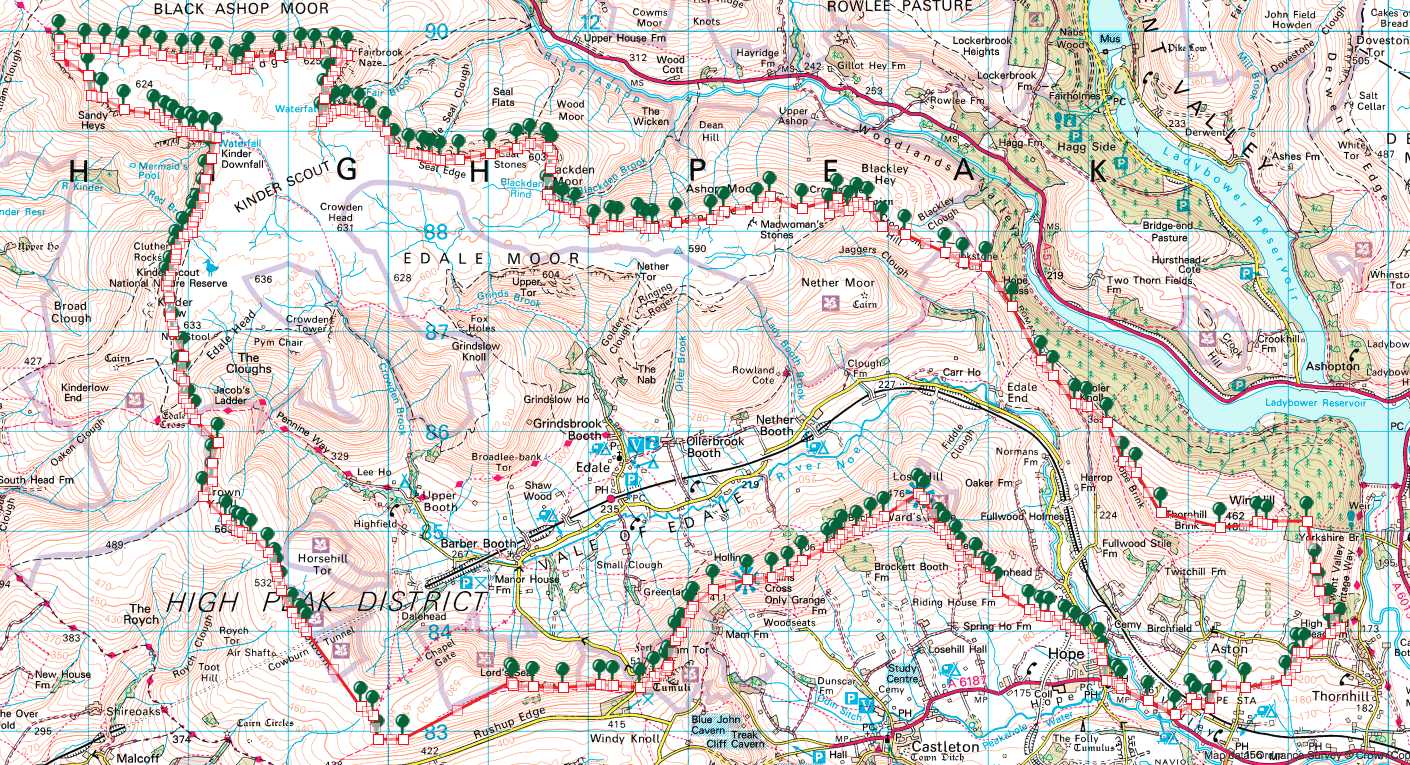 A map of the route, which begins and ends at the train station in HopeDay One
I caught the train up from Lincolnshire and arrived in Hope just before three o’clock in the afternoon. The weather was glorious for early April. I trod grassy paths to the summit of Win Hill, delighting in the sensation of air across my toes. My new shoes are fantastically comfortable and I was already getting the sense that this change to my gear alone would make a huge difference to my comfort on the trail.
I made good time to the summit of Win Hill, where I paused for a few minutes to take in the beautiful views. I could see the trail stretching out for miles ahead of me, down and then up again to the flat plateau of Kinder.

Part of my new lighter-weight strategy is to carry less water, making use of a compact water filter instead. This particular model screws directly onto the top of a Coke bottle, making it very convenient to simply fill your bottle in every stream you pass. By carrying a maximum of 500ml of fluid instead of a litre or more, I would carry less weight—at least, that was the theory.
My map showed that I would cross several streams on the northern edge of Kinder, so I expected to be able to top up my water supply every mile or so. However, the reality was a little different. Up until I camped for the night at Blackden Edge, I passed only a single watercourse with any water in it at all! Kinder seemed extraordinarily dry, and many of the streambeds were empty. I decided to fill up my reserve one-litre water container for use the next day.
 Replenishing the water supplyI walked only about six miles that afternoon. When the light began to fail, I took a little time selecting the right campsite. There’s lots of flat ground on Blackden Edge, but most of it is tussocky or heathery. Eventually I found a comfortable patch of grass beside a boulder.
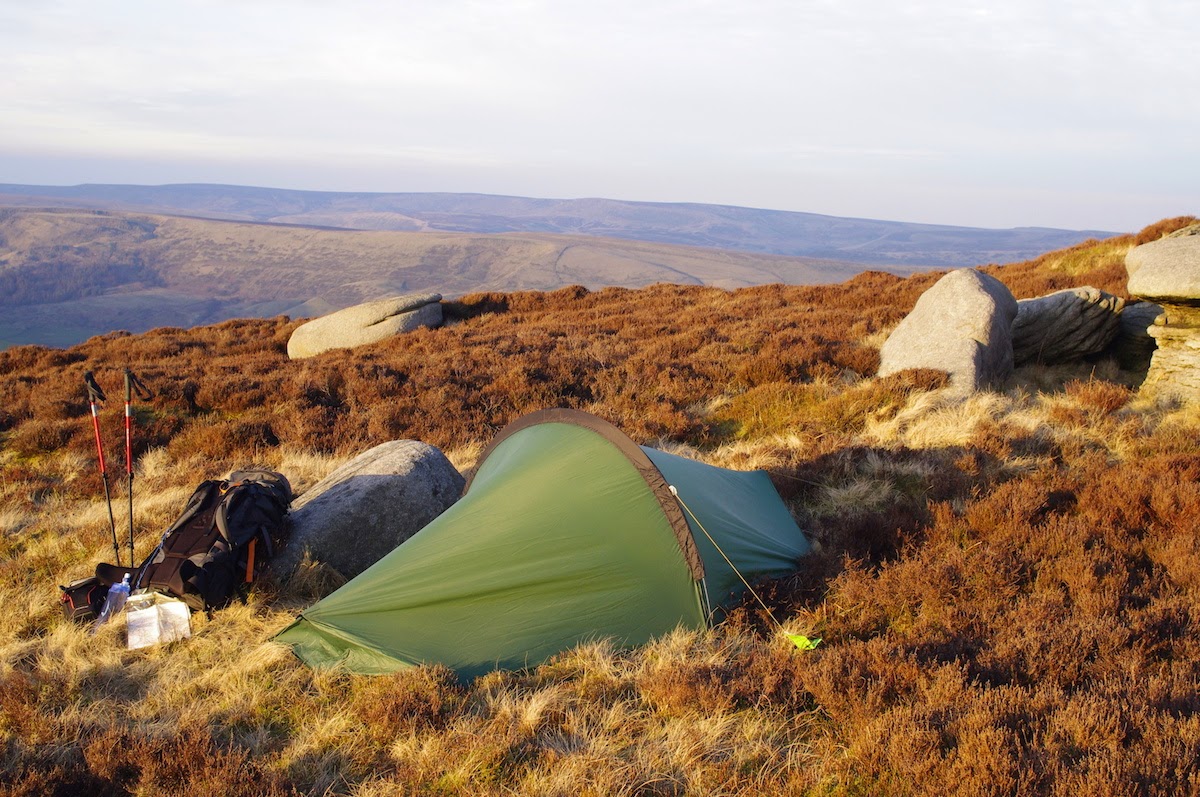 My campsite for the night. Not exactly flat, but comfortable.The temperature soon dropped when the sun dipped behind the shoulder of the hill. The sunset was vivid and made the sky glow for a long time, forcing me out of my tent and into the chill outside to admire the view.
 SunsetDay Two
I awoke at six to a sunrise just as beautiful as the sunset had been. The first tendrils of light crept over the slopes of Kinder, and as I ate my breakfast and contemplated the map, I couldn’t help but feel excited about the trail ahead.
My tent dripped with condensation and frost had tinged the edges of the flysheet. No time to dry it out now—I bundled it up and shoved it into my rucksack.
 First lightAs I strolled along the northern edge of Kinder, I was again struck by how dry the plateau was. Most of the streambeds were empty. The paths were, by and large, dry and firm underfoot. On my last visit to Kinder in 2008, the entire mountain had been a great big quagmire and I remember being plastered up to my knees in mud when I stumbled into the Old Nag’s Head. This time I was wearing trail shoes and hadn’t even got my feet wet!
The going got rockier after Fairbrook Naze, the terrain wilder. It was still early in the morning and I was alone up there except for the skylarks, who dipped and dived around me, punctuating the silence with their warbles and trills. Grouse sat belligerently on the rocks and commanded me to go back. I ignored them and strode out the miles, feeling invincible thanks to the slippers on my feet and the lighter load on my back.
 Kinder EdgeAt the far northwestern edge of Kinder there is a sharp prow of land where the northern trail intersects the Pennine Way. Suddenly the character of the landscape was different; the track was rockier, more eroded, and for the first time I met other people—mainly coming the other way, from Edale. Some were runners while others laboured under monstrous packs, and I was asked on several occasions to point out an uncertain walker’s location on the map.
Conservation efforts are underway on this side of Kinder. Much of the peat has become severely eroded, and the National Trust is coordinating efforts with other bodies to protect the remaining habitat and plant new vegetation. I noticed areas of peat recently re-planted with grass, and it seems that life is tenaciously clawing back its hold in this desolate landscape.
 The Pennine WayAfter descending south from Kinder Low and crossing the top of Jacob’s Ladder, I continued along the wilder landscape of Brown Knoll and Horsehill Tor. These hills are broad and almost completely featureless, and far, far boggier than Kinder itself. Until then I had managed to keep my feet dry, but within ten minutes of walking across the bog of Brown Knoll I had given up on trying to keep the water out. I lost time as I picked my way across the vast stretch of peat. My train home was at twenty to five, and for the first time on my journey I began to consciously increase my pace, well aware that I had many miles yet to walk.
Horsehill Tor is a little slice of wildness. I had felt alone on the northern edge of Kinder, but the bustling Pennine Way had reminded me that Kinder is very much a playground for hillwalkers, runners and cyclists. Likewise, the Great Ridge of Edale stretching over Mam Tor is extremely popular. But the paths are sketchy on Horsehill Tor and I didn’t see another soul as I marched through the bog.
On Rushup Edge the path improved once again and I took the opportunity to make up for lost time. I was starting to feel the miles in the muscles of my legs but, despite a good soaking in bog water, my feet felt remarkably fresh. In boots my feet would be hot and sweaty by this point, maybe with a hotspot or two starting to form. I can say with 100% confidence that trail shoes made a huge difference, and in less than an hour my feet were very nearly dry again.
 Paragliders near Lord's SeatI hardly paused at Lord’s Seat despite the spectacle of paragliders swooping through the air nearby. Ahead I could see Mam Tor, the last major high point of the day, and even from this distance the crowd on the summit was clearly visible. In fact, I hadn’t been alone since joining the track up Rushup Edge. Many other walkers were enjoying the fine weather.
 The Great Ridge of Edale. Fine walking!Mam Tor is a fine mountain in miniature and the summit makes a particularly splendid viewpoint for the surrounding countryside. I’d climbed it almost a year ago when I made the ascent from Edale with Hannah, my brother James, and his partner Nicole. On that day we’d chilled for a while on the grassy slopes near the summit and squinted down at the patchwork of fields in the valley below, or maybe looked across at the uniform bulk of Kinder and tried to see walkers picking their way, ant-like, across the Edale skyline path. But on this occasion the clock was against me. I took five seconds to gulp down a mouthful of water and began to jog down the ridge towards Back Tor. I’d made up the time I’d lost crossing the bog and had caught my second wind.
 The view back to Kinder from Mam TorThere’s something uniquely exhilarating about striding along a ridge at a good pace, particularly when you’re on the home stretch and can imagine that pint waiting for you at the end of it. I hardly noticed Back Tor and Lose Hill pass under my feet, and before I knew it I was yomping down the grassy slopes and crossing stile after stile with Hope and journey’s end in my sights.
 The descent, through pastoral lovelinessI paused for breath at the Old Hall Hotel in Hope. I thought I’d be pushing my timetable, but to my surprise I found I still had an hour to go—and that hour was put to good use savouring a pint of Old Peculier.
 Job doneSo it turns out that the tour of Kinder Scout makes a splendid walk. I took a day and a half and a wild camp to complete the circuit, but there’s no reason why a strong and fit walker shouldn’t be able to do it in a day. For me, however, part of the pleasure of a route like this is in enjoying that night spent on the mountain—being up there when the sun sets and rises again, selecting a safe haven for the night, and attuning myself to the rhythms and ways of the hill. Go up there just for the day and I’d feel like I was missing out.
What about my other goal, to test my new, lighter kit? I’m glad to say that was a success, although I did learn that sometimes you can’t rely on taking water from streams that might be running low or empty. I can’t believe I didn’t fully commit to trail shoes years ago, and at no point did I stop myself and think, ‘I really wish I’d packed that bivvy bag and extra spare clothes I used to take just in case.’ This trip has given me confidence in the equipment I’ll be relying on for longer and more serious trips later in the year.
Light is right, but ultimately the gear you carry (and the gear you leave at home) is just a means to an end. Watching the sunset from the hill, or that feeling of freedom as you stride along a ridge in the sunshine, is what it’s all about.
Postscript: Gear List
By request, here's the gear I took on this trip. I haven't weighed the items individually but base pack weight is now under 10kg. If I left the DSLR at home I could get it to less than 9kg, but a good camera is a necessity for me.
Please note that this is the gear load I intend to take on the Cape Wrath Trail, so I specifically wanted to use the exact same setup for this trip; I didn't actually use any of the spare clothes, repair kit, or most of the wash kit.
CAMPING / SLEEPING KIT:
Sleeping bag — Rab Neutrino 400
Silk liner
3/4-length self-inflating Multimat
1/2-length closed-cell foam mat
Terra Nova Laser Competition
15 x Titanium pegs
COOKING KIT:
MSR Pocket Rocket
500g gas
1l aluminium pot (bought from Blacks, model unknown)
Firesteel
WATER KIT:
1l water bladder
500ml water bladder
500ml Coke bottle
Sawyer Mini water filter
Backflushing syringe
TRAIL KIT / STORAGE:
Poles — Black Diamond Trail Back
60l rucksack — Haglöfs Matrix 60
2 x large drybags
Various carrier bags
CLOTHING — WORN:
Baselayer
Walking trousers with belt
X-socks
Underarmour pants
Hat
Inov-8 Roclite 295 trail shoes
CLOTHING — CARRIED (not used on this trip except for the fleece):
Spare baselayer
X-socks
Spare pants
Fleece pullover
Softshell gloves
Waterproof jacket — Berghaus Paclite
Waterproof trousers — Berghaus Paclite
ELECTRONICS:
iPhone with case
Headphones
Power bank + cables
Charger
Headtorch — Pezl E+lite
CAMERA KIT:
Pentax K-x
28mm lens
Polarising filter
Rubber lens hood
Spare batteries
Lens cloth
Camera bag
NAVIGATION:
Map
Compass — Silva Expedition 4
Map case — Ortlieb
Cord and clip for attaching map case to rucksack strap
WASH KIT AND FIRST AID (not used on this trip except for the toothbrush and toothpaste):
Pack towel
Toothbrush
Toothpaste
Suncream
100ml concentrated soap
Gehwol foot gel
125ml 50% DEET
Midge headnet
Toilet paper
Sticking plasters
Antiseptic wipes
Compeed blister plasters
Tick extractor
REPAIR KIT (not used on this trip):
2m of 3mm cord
Sleeping mat puncture repair kit
Safety pins
Sewing needle
Dental floss
Penknife
Duck tape
Seam grip
2 x bulldog clips


April 5, 2015
Book review: Moonwalker by Alan Rowan

Moonwalker: Adventures of a midnight mountaineer by Alan Rowan
Walking the Munros. This is a time-honoured subject for hillwalking books, and it might be thought that nothing new can be contributed to the topic. Search for books on the Munros and you'll find everything from detailed guides to memoirs. However, Alan Rowan's book Moonwalker: Adventures of a midnight mountaineer is something altogether different, and not only for the most obvious reason.
The premise of this book is clear from the outset: it's about climbing the Scottish hills by night. I was prepared for an unusual take on what it's like to climb mountains after dark, maybe with some poetic descriptions of the many sunrises the author must have seen.
What I wasn't prepared for was such a continuously enjoyable narrative, told with a compelling blend of candour and razor-sharp wit. This is actually the account of an epic undertaking and I take my hat off to the persistence, toughness, and hill skills of Alan Rowan. There's a wealth of mountain experience contained in these pages.
The author's journey to climb the Munros largely took place in the 1990s, at a time when his hectic day job prevented regular weekends on the hills. He was not an experienced mountaineer when he began his journey, and the early chapters are filled with entertaining anecdotes about poor gear and misjudging the conditions. When he caught the bug, as so many of us do, he made it fit around his work commitments by heading out after a shift and climbing at night — often heading straight back into work immediately afterwards. At first this was just a stop-gap attempt to fit his hillwalking ambitions in with his work schedule, but he soon began to enjoy the finer points of being on the hill after dark.
In my opinion, two particular qualities make this book special. First there's the journey: an incredible voyage of self-discovery and perseverance, featuring low points as well as highlights. Then there's the quality of the writing itself. The author's voice is very distinctive, with a sharp wit and a handsome turn of phrase. Many of the situations Alan Rowan got himself into on his journey are genuinely hilarious, too. Parts of the book had me laughing out loud.
In summary, Moonwalker deserves every word of the praise I've been hearing about it, and I wholeheartedly recommend it to all lovers of the Scottish hills.
Further reading
Buy the book on Amazon UKRead Alan Rowan's blog
April 1, 2015
Character focus: Josette Barbier
 Painting: William-Adolphe Bouguereau,
"Reverie sur le seuil"
This is the first in a series of articles highlighting characters from my second Alpine Dawn novel, The Invisible Path. Don't forget to sign up to my mailing list for advance notice of publication!
Painting: William-Adolphe Bouguereau,
"Reverie sur le seuil"
This is the first in a series of articles highlighting characters from my second Alpine Dawn novel, The Invisible Path. Don't forget to sign up to my mailing list for advance notice of publication!Two kinds of characters inhabit my novels: those who were once real historical figures, and those who are entirely the products of my imagination. I love both kinds for different reasons, but I can have the most fun with characters who are entirely mine. Josette is of that class.
I've been complimented before on the strength of my female characters, but I don't really make a distinction; I try to create strong characters, and gender is incidental. Never has that been more true than of Josette Barbier. She is one of the main characters of The Invisible Path, and her character arc is absolutely critical to the future of the entire series.
The portrait above is from an 1893 painting by William-Adolphe Bouguereau. It's the closest image I can find to her likeness, although it isn't quite right; I see Josette wearing an old-fashioned frock coat with missing buttons, face smeared with red brick dust, and a percussion pistol concealed under layers of ragged clothing. Her eyes are savage. Maybe there's blood on her sleeve.
Who is Josette? She's at once fragile and dangerous — a little bird, a starving creature from the slums of Paris, but she has known more heartbreak and suffering in her nineteen years than many experience in their entire lives. Although from a wealthy middle-class background, her family disintegrated years before the events of the story. Her father, Armand Barbier, had been a successful lecturer at the Hôtel-Dieu, but gradually surrendered to an obsession regarding a mythical peak lost in the wilderness of the Alps, and the legend surrounding it: the Pégremont.
After the family fell apart, Josette's mother died in poverty, leaving the child to fend for herself at the age of fourteen.
She has lived alone on the streets ever since. She has suffered rape, starvation, misery, and has been forced to steal and kill in order to survive. Josette is tough, but she doesn't always look it. In the revolutionary year 1848, Josette joins the fight for bread or death against General Cavaignac's armies.
So what is her role in the story?
When she was a child, her father was tutor to a young English medical student named Albert Smith. Smith and Josette became friends, but Smith left Paris years before Josette and her mother began their life on the streets. Smith returns to Paris in 1848 to find his old tutor, seeking answers to questions about the Pégremont legend.
 The Barricade Saint-Martin, where Smith and Josette fight for their lives in The Invisible PathHe is caught up in the revolutionary war sweeping the city and plucked from death by the more streetwise Josette — a woman he hardly recognises from the bright child he once knew. Reluctantly (for she did not part from her father on good terms) she helps Smith seek an audience with the old man. They find him living in reduced circumstances; his obsession has driven him to poverty, just as it did the rest of his family.
Disastrous events follow (spoilers, so I won't give the plot away just yet!) and Smith finds his destiny intertwined with Josette's. They leave the wreck of Paris together and travel to Zermatt, seeking the answers to questions posed by Barbier. Although the trail went cold decades ago, Smith thinks he can be the one to solve the mystery of the Pégremont. His motivations — and the grand quest which consumes the thoughts of several of my characters — will be the subject of a future article.
Josette is permanently damaged by the events of Paris. Smith has a promise to keep, but he is too blinded by the thrill of the adventure to recognise what is happening to his travelling companion — and she has been very silent over the past few weeks. When the dam bursts, it bursts with violence.
Section I of the book concerns Albert Smith's first attempt to follow the invisible path, but Section II is all about Josette and how she pushes against the forces that seek to govern her future. Despite all her efforts to avoid it, she gradually becomes just as committed to the quest for the Pégremont as Albert Smith — although she has absolutely no intention of performing the role he has in mind for her. And she is haunted by the obsession that destroyed her family when she was a child and ruined all the happiness she once knew.
Josette is one of my favourite characters in this project, and she continues to be unpredictable and difficult to work with — which is usually a good sign!
 How Zermatt would have looked when Smith and Josette visited in 1848
March 27, 2015
Inov-8 Roclite 295 trail shoes — first impressions

I don't often review outdoor gear on this blog, but in light of the new 'words - mountains - imagination' tagline I am going to be broadening my horizons a little. I hope my readers who are into the great outdoors find these articles interesting.
Since childhood, I've mainly worn boots on my feet while exploring the outdoors. You know the sort of boots I mean: big, clomping, probably made of dinosaur leather and chunks of meteorite. Accepted wisdom was that the rougher the terrain, the heavier the boots you needed. I bought into the 'ankle support' thing and never thought another world might exist.
About six years ago, my perspective changed. A friend introduced me to 5.10 Guide Tennies: lightweight, flexible, minimalist approach shoes designed for fast mountain travel and easy rock climbing. I wore the things on every summer day trip in the Scottish mountains for about two years, until they wore out.
But I was wary of using trail shoes for backpacking. I thought carrying a heavier load might require more ankle support than Guide Tennies offered — until, that is, June 2013 when I found myself walking part of the Blair Atholl – Aviemore route in Scarpa Zen Pro trail shoes. The increase in comfort was amazing, and I didn't suffer from blisters as I often do when wearing big boots.
Shoes for the Cape Wrath Trail
My Scarpas are starting to wear out. This summer I intend to thru-hike the Cape Wrath Trail, so I asked for advice online about the best footwear to use. The response was almost unanimous: get a pair of Inov-8 Roclite 295s.
These shoes are light. They weigh in at about 300g, depending on size, and they're much less robust in construction than my Scarpas (which are actually more like minimalist, low-cut boots). In fact, they're light enough to make me a little concerned about durability, but it's obvious that a pair of shoes like this aren't going to last as long as a pair of B1 hiking boots; the question is, is that a price worth paying?
They felt incredibly comfortable when I tried them on in the shop. I was impressed by the level of ventilation allowed by the mesh uppers; I could actually feel the airflow across my toes, which was a positive sign after years of backpacking in hot, uncomfortable boots. My toes had far more room to wiggle and move around than I was used to but my heel was held firmly in place. The soles are made of a softer material than the Vibram rubber I'm used to, but the grip is very aggressive and specifically designed for mountain use.

Another concern I had was water ingress. Footwear for backpacking is all about compromise between keeping water out and getting the shoe dry again afterwards. Even if you choose fully waterproof boots, water will always get in after a few days of hiking in wet weather — and when it does, those boots take ages to dry. I can attest to this from long experience!
If you choose lightweight, quick-drying footwear, you have to accept the fact that your feet will be wet some of the time. The Roclite 295 sits at this end of the scale. They make no attempt whatsoever to keep the water out; in fact, they welcome it in, but promise to dry just as quickly. I was interested to test this new approach.
The first twenty miles
The first step in the assessment of these shoes was to walk a few miles in them. Nothing too taxing at first: just five miles through the local fields. I decided to swap out the stock footbeds for my Superfeet Blues, which I have worn in all my hiking footwear since 2010.
I decided to stomp through as many ice-encrusted muddy puddles as possible.
 SquelchAt first it was a shock! Water poured straight through the mesh uppers in a way that my Scarpa trail shoes had never allowed. However, within two minutes of walking through frozen puddles, my feet felt warm again and I could feel the water being pumped back out. I walked the five miles with wet feet but felt far more comfortable than I would have done wearing big boots in similar conditions.
When I got back home, the shoes were extremely muddy both inside and out. I cleaned them under the tap with an old toothbrush, reflecting that cleaning out the silt would be vital under similar conditions while backpacking, to avoid sediment rubbing against skin and causing blisters. However, in practice it's highly unlikely that you'll be forced to walk through such continuously oozy terrain for long distances; it's almost always possible to pick a different path. And, after all, wading through burns will do a lot of that washing-out for you.
I realised that the Superfeet were not the best insoles for these shoes. They're quite rigid, and didn't allow my feet to flex as much as they should have done. I decided it was better to use the minimalist footbeds that came with the Roclites.
Nevertheless, things were looking good. My next step was to take a slightly longer walk, this time in dry conditions. I selected a fifteen-mile hike through the Lincolnshire Wolds on a sunny day.
The hike was a pleasure. The shoes were continuously comfortable; it felt like hiking in slippers, and my feet never got too hot. Wearing boots in similar temperatures is always uncomfortable, because my feet tend to overheat and blister. It just wasn't a concern on that day. I didn't even feel any soreness under the balls of my feet. After fifteen miles, it felt like I had hiked about five in big boots.
How did the footbeds perform? Impressions were mixed. On the positive side, the thinner footbeds allowed more natural foot movement and were very comfortable. On the other hand, I don't think they fitted very well in the shoe, and both of them 'drifted' a little towards the heel — the left one by about an inch, leaving a gap under my toes. I had to stop twice to sort this out, which is unacceptable on a hike of such modest length.
The footbeds are clearly not the right size for the shoes. Rather than going back to the Superfeet, or looking for another pair of insoles to fit, I decided to adopt a more DIY solution. Seamgrip to the rescue! I don't want to stick them down permanently as this will make the shoes more difficult to dry out, but dry Seamgrip is very sticky so should provide enough grip.
 A layer of Seamgrip on the bottom of the footbeds will stop
them drifting backwards in the shoeSummary of first impressions
Overall, my first impressions of these shoes are extremely positive. They're lightweight, comfortable, and keep my feet cool and blister-free. They're grippy enough for mountain use and comfortable in the wettest, coldest conditions. My only ongoing concern is durability; will they last the two hundred miles of the Cape Wrath Trail? I don't know, but I'm beginning to think that durability is a sacrifice worth making for trail shoes this good.
I'll be sure to write up a more thorough review after I have tested these shoes to their limit on the long and rough miles of the Western Highlands.
March 25, 2015
Ditching the infinity machine — five months later

In October 2014, I wrote about how I felt taking my smartphone with me into the hills was spoiling my enjoyment of being in the wild. The resulting article struck a chord; it remains one of the most popular pieces on this site, and many people chose to leave a comment or contact me on Twitter to convey their thoughts on my decision to stop using my smartphone.
At the time, I thought that my irritation with using a smartphone — both in the hills and in general life — stemmed from over-reliance on technology, and the atrophy of analogue skills and processes I had once enjoyed. So I started an experiment. I bought a Nokia dumb phone.
Phase One: The Brick

My dumb phone of choice was the Nokia 6310i from the year 2002. Yes, that's right — I went full retro.
The first few days were a mixture of freedom and minor adjustments. In my pocket I no longer carried the infinity machine that had begun to feel like a burden; instead, I carried a piece of antique hardware that was capable of performing only two tasks: making calls, and communicating via text message.
Despite the limitations of the hardware, the Brick performed both of those tasks extremely well. It was comfortable to hold during calls (something many modern phones fail miserably at), audio quality was superb, and the keyboard was a pleasure to use. I could type faster on the damn thing than I could on the touchscreen of my iPhone. At first, the battery life went on and on.
Fantastic, I thought. I have broken free of the shackles of twenty-first-century life! The experiment felt incredibly self indulgent (what one might call a first-world problem) but I was determined it would be worthwhile.
I combined the Brick with a pocket notebook, digital wristwatch, film camera, Garmin GPS, and my old iPod. For a few weeks things were great; I was undisturbed by the endless pinging of notifications, my attention span was recovering, and if I needed to use a computer I ... used my computer. Of course, the truth is that I work from home so am at my desk most of the time anyway; using a dumb phone was no great hardship when in my office.
When I actually left the house, things became a little more complicated.
Freedom from needlessly surfing the Web was great, but I had failed to appreciate how often in modern life one actually has to look something up online then and there. A bus timetable, for example, or a weather forecast. Maybe you're waiting for an important email and can't be at your desk for a few hours. Coping without this convenience is something that many of us have forgotten, and it started to feel like needless deprivation after a couple of months.
What about using the Brick in the hills?
I took the phone with me on my less-than-successful Lairig Leacach bothying trip in November. For a couple of days it worked fine: great signal strength, and calling and texting were all I needed. I liked not being able to succumb to the temptation of lazily using my phone for navigation.
Then the battery ran out, much earlier than I had expected. Afterwards I realised that a battery from 2002 is going to have problems.
I had assumed that this Nokia would work with my 13,000 mAh charging unit. This device stores energy and can be used to charge almost any device that takes a standard 5V USB power input. However, even though I had purchased the right cable, the Brick simply refused to charge. It kept saying 'charger not supported', and eventually the phone ran out of juice as I was on my way back from Scotland — and travelling in the direction of an almighty public transport cock-up.
I'm well known for my public transport cock-ups. You might say that I'm a connoisseur of the great British rail fail. I've been stranded at Peterborough train station more times than I can count — it generally happens a few times a year, and the tradition has been going on for about a decade — and I am notoriously bad at interpreting bus timetables. This isn't a skill that has atrophied since the onset of the digital age; it's a skill I have never had.
I hadn't realised how much my ability to extricate myself from these situations was due to the ability to access the Web on the move.
On my way back from Scotland I found myself not only without access to the Web but also without access to a phone of any kind. I ended up stranded at Glasgow Central, having missed the last train, and vaguely contemplating a night in a bus shelter. I hadn't been able to find a hotel because I didn't have access to mapping and I couldn't find anywhere to buy a paper map that late at night. I managed to call Hannah, my long-suffering partner, on a pay-phone; she got in touch with some friends who swooped in and rescued me just before the station was due to close for the night.
It was a lesson worth learning. When I got back, the Nokia 6310i went into a drawer and hasn't come out since.
Phase Two: Compromise

My next phone of choice was the simple, inexpensive, but relatively modern Nokia 206.
My rationale for the purchase was that the 206 would allow me to access the internet via the Opera Mini Web browser. It's a slow and clunky connection, to be sure, but in a pinch it would do the job. I could even read my emails and check Twitter if I wanted, but the connection was so lousy that I wouldn't be tempted to waste time online. Essentially, I believed it would be the best of both worlds: freedom from distraction and the infinity machine, but also a safety net should the need arise.
The Nokia 206 is actually a great phone. Call quality is loud and clear, I generally get about five days of battery life out of it, and it works extremely well for messaging.
I have used the Nokia 206 quite happily for several months now. It does almost everything I need, but it isn't a burden in the same way that a real smartphone can feel like a burden. When I took it to the hills in February this year, it performed admirably in areas of poor signal and kept me just connected enough to the outside world without coming between me and my enjoyment of the outdoors. It has no GPS so there is no mapping option.
But...
The thing is, I've slowly come to appreciate that the utility of a smartphone is not truly in giving you a portal to the Web, but in replacing other items. For a backpacker this is a big deal. For example, if I take the Nokia 206, I have to also take a Kindle, an iPod, a GPS device, a camera (I'll come back to this), and the necessary paraphernalia to keep them working (spare batteries or special cables).
I'm currently planning my attempt at thru-hiking the Cape Wrath Trail in June this year, and one of my objectives is to keep my pack weight as light as possible. Originally the plan was to pack the Nokia 206 and take advantage of its stellar battery life. However, the combined weight of the 206 and all the other items I'd need to keep me sane on the trail was not insignificant. I would have to carry the 13,000 mAh portable battery regardless of which device I carried, so the weight of that didn't factor into the equation.
I started to think about things that the iPhone could replace. GPS — that's a no-brainer. iPod — absolutely. Kindle — this one made me pause, because reading on a small, bright screen isn't the same; but if I'm going to be ruthless about cutting pack weight then it's certainly possible to read Kindle books on an iPhone. Camera — this is the only area where I'm unwilling to compromise. I've just bought a DSLR and an iPhone camera is simply no substitute.
I did the sums. Taking the iPhone on the CWT with me will reduce my pack weight by almost a kilo. I would have to be an idiot to ignore that kind of weight saving when I'm committed to keeping my base pack weight below 10 kg.
Sometimes the more practical solution wins the day.
Phase Three: Adaptation

I've mainly been using the iPhone as a WiFi powered mini-tablet over the last few months, albeit with all notifications disabled and a massively reduced payload of apps. Maybe I'll only switch it on a few times a day, and it doesn't always leave the house with me. But the thing is, I haven't made the step of selling it — because there are certain things it does that are occasionally essential.
Sometimes I need digital mapping when I'm in unfamiliar place and need to get around. Sometimes I need access to certain nineteenth-century texts, digitised and stored in Google Play Books. Sometimes I need to get my email and don't fancy waiting five minutes for the Nokia 206 to draw my messages from the server. And having a pocket camera is priceless every now and again.
There are, of course, workarounds for most of these first-world problems. But I've come to realise that there is often simply no point in jumping through those hoops; that there is no inherent virtue in using a slightly less advanced mobile phone just to make your life a little more difficult or 'analogue'. It's all in how you approach the technology. Maybe I knew this all along and needed to try it for myself to realise it.
I find myself gradually using the iPhone more and more, but never as much as I did before. And now I'm planning on taking it with me on the CWT, I'm contemplating ending the experiment and going back to it full time — with certain important changes to my habits.
What I've learned
I've learned that a phone is just a phone.
What I called the infinity machine is not the slab of metal and glass in your hand. It's the laziness in your mind that is unable to use the almost limitless capabilities of that hardware wisely.
When you're bored, it's easy to look to the infinity machine to entertain you instead of looking around and engaging with your surroundings. Notifications and 'social' interactions online provide tiny hits of pleasure that become addictive, feeding into a cycle of craving even as part of you is aware how they disrupt your concentration and ruin your ability to focus on the task at hand. It's easy to fall into that groove because, after all, everyone is doing it. Maybe you feel you need to use all these apps all the time to be successful; maybe you feel you have to respond to that email right now otherwise the person who sent it will think you don't care.
The truth I've learned is that — for me, at least — my own weakness was the true root of my original discontent, not the phone itself. It turns out that destroying that cycle of behaviour is actually quite easy: remove all apps you don't need or use, and deactivate all notifications except incoming calls. Be ruthless in trimming the phone down to what you need it to do. Notifications are a subtle poison.
You probably don't need to reply to that email right away. You almost certainly don't need any social media apps on your phone; having access to them through the Web browser is enough, and provides just enough friction to discourage you from signing in every minute or two. With notifications gone, your usage will drop naturally. Removing games is another step in freeing up your time and energy for things that actually matter to you.
My iPhone no longer disturbs me when it wants attention. I turn to it when I need it to perform a task; for the rest of the time it lies silent, dormant, without needs of its own. I can use it when necessary and retain my focus. I rarely use it when I'm out and about unless I actually need to. This is more or less what I wanted to achieve with the dumb phone experiment, and I'm pleased to discover it's possible to do this without giving up the significant advantages of having a smartphone in the first place.
How the experiment has changed my habits for good
I might be back to using an iPhone again, but some of the good habits I adopted during the experiment are not going to be abandoned.
Most importantly, all notifications are going to remain off, and I will be ruthless about only keeping apps that I actually need on my phone. I'm also going to be vigilant about what I use it for. If I find myself listlessly browsing the Web when I should (or could) be doing something more interesting or useful, I'll go back to the Nokia 206 for a while.
Carrying a pocket notebook was a very positive change back to my earlier way of doing things. In my article on thought processing, I explained how I had somehow drifted into the habit of using a smartphone for taking notes, and felt the desire to change back to pen and ink. It's just a better experience for me and I will continue to use pocket notebooks.
Wearing a wristwatch is another welcome return to an earlier habit. It's more convenient than checking the time on your phone, and I have to get my phone out of my pocket less often.
Lastly, I have found a greater appreciation for real photography over the last five months. I've used gorgeous old film cameras and now own a DSLR. Before last October my photography was very much of the point-and-shoot variety, but I've improved as a photographer largely because I've made the effort to carry a real camera around and work a bit harder for my shots. That certainly isn't going to change, and this has been an especially positive aspect of the experiment.
Conclusion
I'm not here to tell you what you should or shouldn't do with your smartphone. What I found frustrating about my smartphone use may not trouble you at all, and what worked for me may not work for you. But if you have found yourself wishing you could be a little less connected, or think that you're spending more time on your phone than you would like, it's worth considering a change in your habits. Switching to a dumb phone is the nuclear option; as I've discovered, all it really takes is being self-aware and making small changes to how you do things.
Smartphones are valuable tools in the modern world. But, like all tools, they can be both used and misused.
March 21, 2015
Alpine Dawn II — a teaser

As many of you know, I am currently writing the much-delayed second volume to my Alpine Dawn series. The first volume, The Atholl Expedition, is currently available on Kindle and in paperback. I hope to release the second, The Invisible Path, this year.
Here's a portion of a scene in which Josette Barbier sees the mountains of the Alps for the first time, and meets a significant character. As always, this is uncorrected rough draft material.
***
1848 — JUNE
Josette wandered alone.
Smith had not seen her leave the inn. He was busy with his work, and since they had left the smoking wreck of Paris he had spoken of little but his quest.
La Pégremont. Her heart broke a little more each time she heard him utter that name. She did not even know precisely what it was, but she knew what it meant to her — the destruction of a once-happy family, the abandonment of her mother to a life of shame and poverty; finally the death of her father and the city she had loved above all else.
Her life had been filled with happiness before the quest had consumed her father's mind, leaving room for nothing more.
Now Albert, her childhood friend and the last untainted memory from the time before all had failed and wilted, could think of nothing but the quest which had ruined every moment of her life.
Tormented, she trod the crooked alleys of Zermatt, giving no thought to her direction of travel. She passed beneath the eaves of the church and the hummocky earth of the burial ground. To her surprise, the charnel house had no door. Morbid curiosity got the better of her and she peered into the timber structure to see a raven pecking at a skull.
She shivered and drew her ragged dress more tightly around her shoulders. She had heard of the savage practices of these remote valleys.
Within a few minutes of walking she had left the village. She was astonished that it could be so small, but then she had never before left Paris. They had passed through many villages on the long stagecoach journey across France and through Geneva, but none appeared to merge into the wilderness as abruptly as this one. After the last ramshackle hay loft, the road plunged directly into an ocean of rippling grassland, painted iridescent shades of green and magenta by the brisk sun and a steady wind from the valley head. Her gaze followed a wave in the long grass as it sped away from her with a sound like dry grain falling through her fingers. The ripple passed through a cloud shadow, parted at a gigantic boulder, and finally died a little way up the slope where the first stands of trees stood guarding the mountain ramparts above.
She had felt absent on the journey from Paris: a ghost, her mind imprisoned by the carefree betrayal of her genial travelling companion; blind to her surroundings as visions of fire, death, and the annihilation of the world she knew occupied all of her senses.
Now her senses were open. She closed her eyes and inhaled deeply. Outside the stale atmosphere of the village, she breathed the purest air she had ever tasted. It was ... cold, yet also warm. She smelled what she imagined to be the scent of distant snow, and flowers, and ripe grass, and animals free to roam and to live — not confined in stinking cellar pens that smelt of death.
She opened her eyes, and allowed that lowest fringe of forest to capture her gaze and sweep upward. Trees, trees by the million, stretched in an unbroken swathe from the edge of the grassland to a point higher in the sky that she would have believed possible. The textures delighted her as much as the colours. The world she knew was made of hard lines and dull shades, and mud, everywhere mud; but here was a rich, random, organic tapestry like nothing she had ever seen.
Only after her eyes had drank in every detail of that wild forest did she dare raise her head and look higher still.
And she beheld the ice world.
A dome of white dominated the valley. It was the biggest thing she had ever seen. Fractured into crystalline shapes, with a smoothed-over brow that reflected a delicate blue, it seemed as distant as Heaven. When she squinted at it, the light was so powerful that it seared her eyes. A great tendril of snow reached down from that elevated plateau, tumbling in chaotic shapes down the valley a few miles to the south. It looked rather like a slumbering dragon; dark lines or ridges followed the curves of its spine, and a torrent sprang from a cavern where its mouth would be. If she listened carefully she could hear cracks, bangs and echoes carrying on the wind.
She wondered if that was what her father had called a "glacier". It frightened her a little; she wondered when the beast would awaken and bring ruin to the people who lived in the valley below.
So intent had Josette been in her study of the mountain that she failed to notice the approach of a stranger until his shadow fell upon her. She gasped and shrank back, suddenly wary.
'Do not be frightened, miss!'
The man's voice was low, rich, with a curious nasal accent. She understood his French, but it was not Parisian.
She looked up. At first she saw only the silhouette of a powerful man, all wide-brimmed hat and square shoulders; but then her eyes adjusted to the harsh lighting and she found herself able to discern a few details.
He was of medium height — not more than a few inches taller than she was herself — and wore a much-darned shirt of chequered fabric, loose at the collar. He carried a jacket over his left shoulder and supported himself with a long pole. She noted a hatchet wedged in his belt, and beneath his hat the skin of his face was deeply lined and tanned the colour of old leather. An enormous black beard completed the picture, but it was his eyes that captured her attention: uncommonly large, mobile, and imbued with an intelligence she had not expected.
'I am sorry, Monsieur,' she replied instinctively, stepping out of his way, averting her eyes.
'Nothing to be sorry for.' She saw him smile in her peripheral vision. 'And I am no Monsieur. They call me Balmat.'
March 15, 2015
The 2015 site refresh — words, mountains, imagination

This website has been through a number of incarnations since it was first established on the 21st of March 2007. It completely changed direction exactly three years ago, when I reforged my old walking and climbing blog into a website suitable for an author. The last major redesign occurred in December 2012.
The old design has served me well, but my requirements are a little different now. In 2012 I was just starting out as an indie author and was searching for my audience. That meant keeping a very narrow focus on my subject matter (19th century history and the culture of mountaineering in Britain and the Alps).
In 2015 I find myself not only an author in my original genre, but science fiction too — not to mention non-fiction articles for various publications. I also work as a freelance editor. In short, I have a lot more ground to cover than I did three years ago.
The changes made in the 2015 site refresh
I have spent the weekend rebuilding, repainting, and restructuring my website. I've got rid of some clutter and emphasised other areas. There's an added biography and bookshelf. It's my hope that the refreshed look — which is designed to be new but familiar — will serve me better as I use this platform for every aspect of my working life, not just my mountain fiction. I think it's also cleaner and easier to navigate.
The tagline, suggested by Neil Reid on Twitter, is now 'words - mountains - imagination'. I believe this reflects my role far better than 'writer of mountain fiction', which was starting to feel a little restrictive.
What isn't going to change
I remain committed to my core genre of historical mountain fiction. Most of my readers enjoy the outdoors and I am certainly not going to make any changes to remove that key focus. I may not have as much time to write as I would like, but work continues on book II of my Alpine Dawn cycle. I hope to publish The Invisible Path this year along with a wealth of other outdoor content.
So this is not truly a redesign, more a lick of paint. I look forward to continuing to serve my readers throughout 2015 and beyond.
March 13, 2015
The Grand Route Forbes — a long-distance hike in the Alps

Regular followers of this blog will be aware that I admire the writings of James Forbes, a Scottish geologist best known for his pioneering studies on the glaciers of the Alps. I have written before about the long foot journey he conducted in 1842, and I've even followed the central portion of this route myself.
It turns out that his wanderings of 1842 can be adapted into a truly superb long-distance Alpine trail.
I've been picking at the idea for a couple of years. While reading his book, I plotted the approximate route on the map Forbes used to explore the Alps (a variation on Keller's map, which is very inaccurate). I have not yet plotted all of the route on modern maps to any degree of detail, but I've seen enough to realise that this is potentially one of the best long-distance hiking routes in this part of the Alps.
 Forbes's wanderings, plotted on his map of 1842.Adapting the original route
It's important to realise that Forbes was a nomadic scientist, not a backpacker. Consequently his journey was planned with certain specific objectives in mind, and also the practicalities of travel at a time before the Alps were developed for tourism. He mainly stayed in inns and friendly houses, so sometimes he was forced to make detours towards centres of population. He covered the same ground more than once on several occasions and made one particularly lengthy out-and-back detour to the Great St Bernard Pass.
There's also technical difficulty to consider, and the fact that the glaciers of the Alps have changed considerably since 1842. For example, the traverse of the Col du Geant and Mer de Glace from Courmayeur to Chamonix is a very different proposition in the early 21st century. Following this section of his route would require covering most of the Tour du Mont Blanc twice.
 View from Prayayer Alp, above the ValpellineIt's therefore necessary to adapt Forbes's 1842 route if we want to turn it into a modern trail. The purpose of a journey like this today would, after all, be to enjoy a beautiful long walk in the Alps — it would certainly not be to slavishly copy a historical journey, although I believe there is much enjoyment to be had in emulating Forbes's voyage in spirit.
The modern Grand Route Forbes
My adapted "Grand Route Forbes" follows the majority of the original route, with a couple of omissions and modifications. I believe it takes the traveller through some of the finest landscapes in the Alps. Here's a quick mockup on a Google Maps screenshot:

The first portion of the voyage follows the Tour du Mont Blanc from Chamonix to Courmayeur, then up Val Ferret. Instead of heading back towards Chamonix, it passes through Orsieres and enters the Val de Bagnes, crossing the Fenêtre de Durand to Valpelline. The walker then follows the length of Valpelline before crossing the Col Collon and Arolla Glacier to Evolene. From Evolene — which makes a natural midpoint of the route — the glacier pass over the Col d'Herens takes the traveller to Zermatt (this is the most difficult section, and the only leg that will certainly require full glacier travel gear and the experience to use it).
From Zermatt, the hiker then embarks upon a variation of the Tour of Monte Rosa — a superb high-level route circumnavigating that great mountain massif via a number of high cols, and visiting several tributary valleys of the Valle d'Aosta. I have modified this portion of the route to avoid a needless diversion to the village of Chamois. The Theodul Glacier pass takes the walker from Zermatt to Champoluc, Gressoney, Alagna, Macugnaga, and over the Monte Moro pass to Saas Grund. Finally, the stunning Balfrin Höhenweg conveys you along the length of the Saastal to Stalden and finally Visp, where Forbes concluded his journey.
Distance, timings, and practicalities
 Oyace, in the Valpelline. Beautiful walking country!I have not calculated the full length of the Grand Route Forbes, but I estimate it — very roughly — to be between three and four hundred miles. Although it crosses many wild and high cols, it also visits numerous centres of population and is almost certainly possible to complete without having to wild camp or sleep rough, if that's the hike you want to hike. The voyage can be broadly viewed as a variation on three existing long-distance paths: the Tour du Mont Blanc, part of the Haute Route, and the Tour of Monte Rosa. There are numerous facilities along the way. If you have the money to spend, you can probably stay in mountain huts or hotels most nights.
This is not a mountaineering expedition, but some of the cols are high and glaciated. Notably, the route crosses the Col Collon, Col d'Herens, and Theodul Glacier. The first and last of these are not difficult and might be passable without glacier equipment by experienced walkers in good conditions, but the Col d'Herens is a technical, crevassed portion and it would be highly unwise to cross this without a rope and the necessary equipment. Walkers without a background in alpinism will probably need to hire a guide for this section.
The majority of the other cols along the way are below 3,000m, and during the summer season should be passable with standard walking gear. However, weather in the Alps can be fickle and it can snow any day of the year at these altitudes, turning an easy path into a much more difficult proposition. It's also likely that snow will lie on many of the higher areas well into July. The Tour du Mont Blanc, which largely forms the first portion of the route, can be viewed as a gentle introduction to the more difficult sections beyond. This is not a route for a novice walker.
My Grand Route Forbes journey
 Mont Brule, from the Col Collon pass to Arolla.I don't have a month or two to thru-hike the route in its entirety, but I have already walked the central section (Valpelline — Evolene) and intend to complete the entire route in instalments over the next few years. I relish the challenge of taking on my next planned section in September: the Tour of Monte Rosa.
It's a real pleasure to follow in the footsteps of one of my heroes from the history of Alpine exploration, seeing the same sights that Forbes saw, and reading his beautiful descriptions. When I hiked the Valpelline — Evolene section last year, I found the comparison between the landscape in 1842 and the modern era extremely interesting. It really hit home just how much the Alps have changed since then. The glaciers are, sadly, mere shadows of what they once were.
When I walk each section of the Grand Route, I will do so with Forbes's book in hand and my eyes open, trying to see the Alps as he saw them — and recording my thoughts on the changes that have taken place. It's going to be an incredible adventure, and if it takes me years to do it then it will be even more worthwhile in the end.
I am keen to hear from walkers who have already completed this route, or maybe even decide they would like to try it for themselves after reading this introduction. Please get in touch!
March 12, 2015
First look: Between the Sunset and the Sea by Simon Ingram

A beautiful hardback book landed on my desk this afternoon. Between the Sunset and the Sea by Simon Ingram (from £13.59) was published today and offers a detailed look at sixteen of the UK's mountains and hills through prose, history, story, and photography.
The mountains are:
- Beinn Dearg
- The Black Mountain
- Cadair Idris
- Crib Goch
- Cnicht
- Cross Fell
- Schiehallion
- Ben Loyal
- An Teallach
- The Assynt Hills
- Askival
- Ladhar Bheinn
- Loughrigg Fell
- Great Gable
- Ben Macdui
- Ben Nevis
As I flip through, I can see that the book is characterised by gorgeous typography and some excellent black and white photographs. I'll be reading Between the Sunset and the Sea and reviewing it shortly. In the meantime you can order your copy from Amazon or Waterstones. It is available as an ebook from both stores.
March 2, 2015
No Way Home is out — the best new voices in science fiction

NO WAY HOME
Stories From WhichThere Is No Escape
An anthology of the best new voices in science fiction.
I'm happy to announce that No Way Home is now available to purchase on Kindle and in paperback.Amazon.com linkAmazon.co.uk linkInternational link
Eight talented writers have come together to contribute stories on the theme of stranded. Some have interpreted that theme literally, others more loosely. Some of the stories are hard, traditional science fiction. Others are more psychological. There's something for everyone here. As a member of the editorial team as well as a contributor, I was very impressed by the strength of the pieces.
The book has already received a number of advance reviews, and they're all looking good. In particular, bestselling author E. E. Giorgi has this to say about No Way Home:
Strong, dramatic and thought-provoking stories, all with a powerful take-home message. I particularly enjoyed Renata, by Nadine Matheson -- truly well written, loved the descriptions of London -- and Revolver, by Michael Hicks -- hard to digest and scary, and yet if you look at the news you start wondering whether or not we are heading in that direction for real. All stories have unique takes on life and unique twists on the human race. A very enjoyable read.I'd also like to highlight the recent advance review by science fiction author David Wailing (full review here):
Each of the authors featured here are clearly at the height of their powers. These are professional, polished works that each paint an effective picture, ranging from alien worlds to distant futures to historical environments. The quality is consistently high throughout.Signed copies
As usual, I will be offering signed copies of this book to my readers — signed just by me, not all of the authors, as we are from all over the world! The RRP is £7.99, but to cover the additional postage cost (UK only) signed copies are £9.99. If you would like one, please email me.
Alex Roddie's Blog

- Alex Roddie's profile
- 27 followers
Alex Roddie isn't a Goodreads Author
(yet),
but they
do have a blog,
so here are some recent posts imported from
their feed.

