
Alex Roddie's Blog, page 4
February 28, 2015
More about Cold Witness, the first story by A. S. Sinclair

For the last few months, I've been involved in a fantastic project. A group of talented writers, drawn together by author Lucas Bale, have produced an anthology of speculative fiction based around the theme of stranded.
My role in this project was twofold. First, I contributed a short story, Cold Witness, under the pseudonym of A. S. Sinclair. Second, I was responsible for editing and formatting the anthology.
It's been quite a ride, and I'm glad to say that we're nearly there. Advance reviews for the book are rolling in — all positive so far! — and the book will be available to purchase in paperback and Kindle on Monday the 2nd of March. You can enter a giveaway on Goodreads here to win a paperback copy, and if you're on Facebook we are hosting an event on Monday. Please come along!
About Cold Witness
Here's the Afterword that I was asked to contribute regarding my story, Cold Witness.
In 2002, my family moved to the Suffolk coast and I developed a love of hiking. One of the places I discovered was an eerie expanse of shingle and salt marsh known as Orford Ness, dotted with hulking ruins from decades of military activity. It had been an RAF airfield, a munitions testing range, an atomic weapons research base, and – most recently – home to Project Cobra Mist.
The Cobra Mist blockhouse is a sinister monolith that dominates the landscape for miles. The antenna array had once been visible from space, although most of the pylons are long gone now. Inspired by the terrible grandeur of those ruins, I wrote a novel – a clumsy teenage novel – about what the facility might have been like in its heyday. About the awful secrets I imagined it must once have contained.
It was a story of conspiracies and nightmares, death and darkness. My writing was immature at the time but the core idea was a good one. When Lucas Bale approached me regarding the No Way Home anthology, I knew immediately what I had to write about. The story of Cold Witness had stayed with me, refusing to be forgotten, and I believe that stories which follow you down the years should not be ignored.
The historical background
 Declassified information from the Cobra Mist filesThe story of Cold Witness — a name from an old conspiracy theory — is really the story of Project Cobra Mist, a military installation on the Suffolk coast associated with many strange tales. Information about this project was declassified a number of years ago, and I was fascinated to read through the reports of a mysterious form of interference that garbled radar readouts and wrecked equipment. Millions of dollars were sunk into trying to fix the problem, but the source of the interference was never located. One theory refers to a Russian trawler often to be seen anchored offshore. It was believed it may have been broadcasting some form of jamming signal.
 Inside the atomic testing labThe mysterious signal inspired me. The original novel of Project Cold Witness featured a signal being broadcast from underneath the facility, from an arcane machine known as the Ethereal Sword being controlled by Major Wheatley. This machine had the power to warp perception and reality past breaking point, and in my original novel the characters gradually lose their sanity as electronic hallucinations haunt the corridors of the facility and UFOs are seen flying overhead. I even tied it in with the Rendlesham Forest UFO incident.
 The Cobra Mist insignia. Ominous!When I came to adapt the novel into a short story, a lot of this had to go. Short stories have to be concise and focused. I retained the essence of Wheatley's electronic disruption field and drew the story around just a few characters.
It was a lot of fun to write, and I hope you enjoy reading it. I'll leave you with some of my photographs from the mysterious Orford Ness.
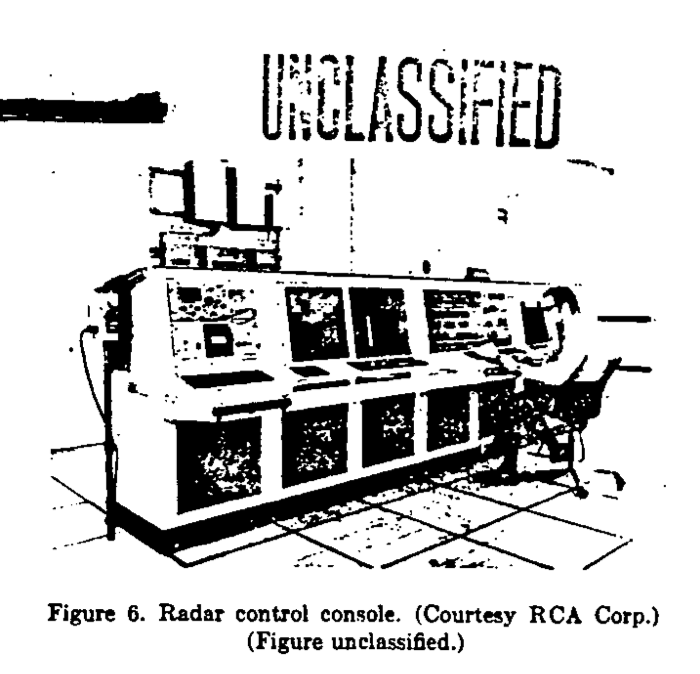 The control console used by Marshall in the story
 This is the Cobra Mist blockhouse in 2004. It has no windows.
 A ruined atomic lab.
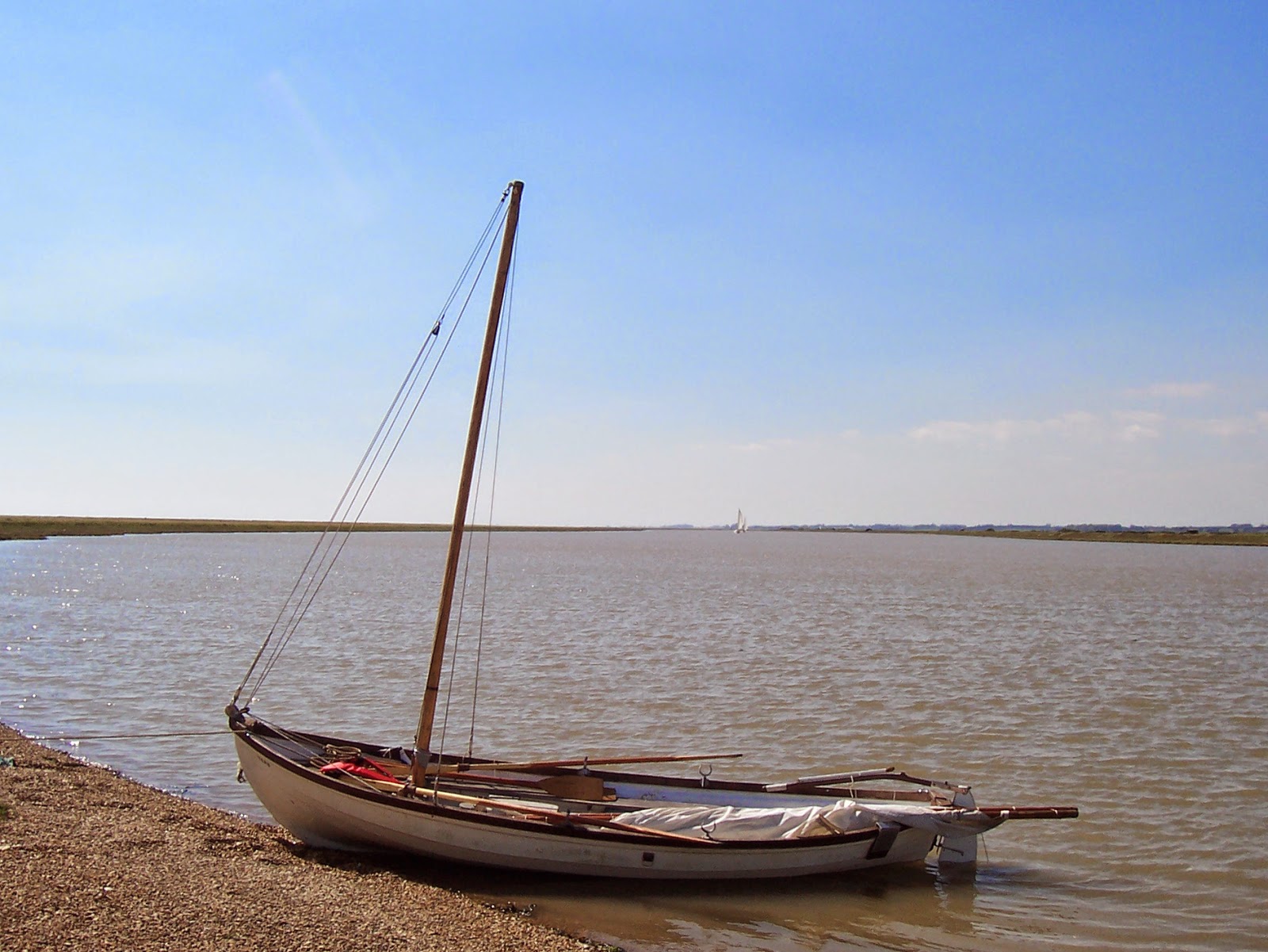 The River Ore.
 The rusted desert of Orford Ness. A lot of unexploded ordnance here — it's a dangerous place.


February 24, 2015
The Caplich Wind Farm proposal threatens the wild land of Scotland

Although I lived in Scotland for a number of years, I can't claim an intimate acquaintance with the far North West of the country — that wild and desolate corner of the UK that comparatively few think about, or even really know exists. It always seemed just a bit too far away even when I lived in Glencoe, and besides, all the biggest mountains were in Lochaber. I think that's the attitude that keeps the NW so quiet.
I did pass through it once. Isi, Jamie and I organised a cragging road trip out to Reiff and Sheigra, and as we drove through the sunny paradise of Assynt I found myself unable to look away from those towering, prehistoric mountains that reared like dinosaurs out of the jigsaw of lochans and peat, stretching for many miles away to the Atlantic.

We camped on the soft grass beside Sheigra bay. Glencoe had been cloaked with rain and mist for weeks, but up here the weather was mild and calm, the waters blue, the seabirds calling. We climbed for a day on the sun-washed cliffs before heading back home to the murk and the clag. I never forgot the beauty of Assynt or NW Sunderland, although I haven't been lucky enough to return — yet. I plan to go back to the NW this summer as I thru-hike the Cape Wrath Trail.

My single brief visit was enough to stamp a certain knowledge in my mind that this wild land is special. It's unlike anywhere else in the UK. It's nothing like the wilderness of the Cairngorms or Knoydart; it's quite unique, and somehow doesn't even quite feel like the rest of Britain. I'm sure more experienced voyagers in the NW will know exactly what I mean. That sense of North is not to be found anywhere else in these islands.

The threat of the Caplich Wind Farm development
I'm sorry to say that this wild land is under threat. A proposed wind farm development near Oykel Bridge will have a major visual impact on large areas of the NW if it goes ahead. It won't be quite visible from Sheigra, but this map speaks for itself.

Others more learned in these matters (see links at the bottom of the page) have written more eloquently on this subject than I am able to. I'm not an expert on renewable energy or conservation, but I do know with absolute certainty that humanity's purpose on this earth is not to despoil it in order to make a quick buck. In all of nature, our species has the unique position of being able to choose our role. Do we want to be custodians of this wild land, protecting it for a time beyond our own limited vision, or do we want to exploit it for short-term greed?
Make no mistake — I'm a pragmatist, and as much as I believe in the protection of the environment and the biosphere, I know that energy for human growth has to come from somewhere. But this is not the right place for this wind farm because it will set a catastrophic precedent. I just don't think that should even be up for negotiation. That's my stance and I doubt it will ever change.
If you wish to object, and I believe it's your duty to do so if you agree with my point of view, then you can make your voice heard here. The outdoor community is rallying around this cause. Please consider making a public objection.
Further reading
I would encourage you to read Alan Sloman's more detailed analysis of this proposal here: Scotland's fabulous north west is about to be destroyed
Chris Townsend's piece on wind farms and wild land: Allt Duine, Wind Farms & Wild Land
James Boulter's analysis: The Fall of Assynt
February 20, 2015
Work in Progress Blog Tour — The Invisible Path
I've been nominated by Lucas Bale to participate in a work in progress blog tour. Lucas Bale is an author I've welcomed to my blog before, and it's been my privilege to work with him recently on the
No Way Home
anthology (coming out March 2nd, more information here). Lucas writes compelling science fiction and if you have any interest in the genre you really ought to check out his books. Each new one is better than the last, and if the teaser on his blog tour post is anything to go by, A Shroud of Night and Tears will be the best yet.
Here are the rules guidelines of the blog tour.
1. Link back to the post of the person who nominated you. Here's Lucas's post.
2. Write a little about and give the first sentence of the first three chapters of your current work in progress.
3. Nominate some other writers to do the same.
My work in progress: The Invisible Path (Alpine Dawn II)
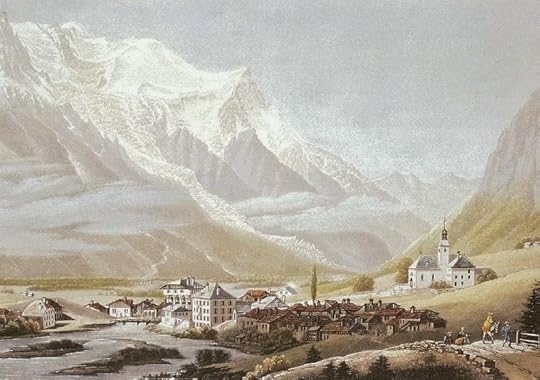 Chamouni in the early 19th centuryThe second novel of my Alpine Dawn cycle has been gestating for a very long time now, but in recent months I have made significant progress and am currently almost 50,000 words into a rough draft. The year is 1848 and many of the characters from
The Atholl Expedition
return to follow an elusive quest that takes them from the hills of Deeside to the high Alps.
Chamouni in the early 19th centuryThe second novel of my Alpine Dawn cycle has been gestating for a very long time now, but in recent months I have made significant progress and am currently almost 50,000 words into a rough draft. The year is 1848 and many of the characters from
The Atholl Expedition
return to follow an elusive quest that takes them from the hills of Deeside to the high Alps.
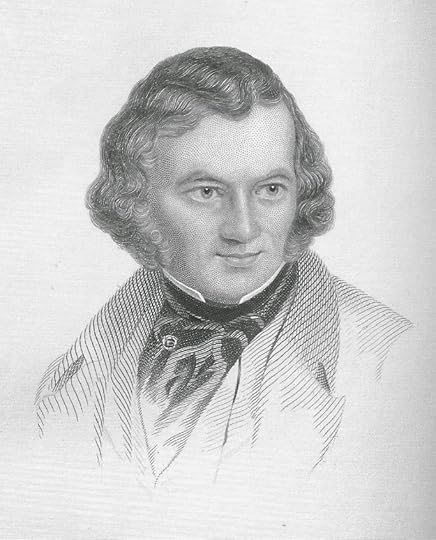 Albert SmithAlbert Smith makes his debut in this novel. Smith is a hack writer, journalist, stage showman and would-be Alpine explorer, but he has repeatedly failed to climb Mont Blanc and seeks a fresh challenge. When he discovers the story of the Pégremont, a legendary mountain of ice rumoured to exist somewhere in the wilderness between Chamouni and Zermatt, he becomes obsessed with the hunt for the peak. The Pégremont myth is a sinister tale involving loss, bloodshed and treachery — and it extends back into the last decades of the 18th century, when the great explorer and philosopher H.B. de Saussure first turned his gaze on the glaciers of the Alps.
Professor James Forbes, the Scottish geologist who stars in The Atholl Expedition, returns in this adventure. He has a very personal connection with the Pégremont tragedy. Besides, his professional curiosity is provoked by the rumour of a mountain of ice that may be navigated beneath its surface. An expedition could provide the evidence he needs to complete his grand unified theory of glaciology.
As events move towards the 1850s, the actions of these characters begin to lay the foundations for the great wave of exploration that will later become known as the Golden Age of Alpinism.
1. Prelude — August 1832 — The Mer de Glace, Chamouni, Territory of Savoy
'I can see something down there. A coat — perhaps a coat!'
'Do not be absurd, Monsieur. Nobody has been here for twenty years.'
'Lower me some more, Couttet.'
James Forbes gripped the rope with both hands as his guide lowered him in jerks and stops into the abyss. The fibres quickly froze to his bare skin. After the heat of the glacier's surface, up there in the open sun, it was a refreshing sensation — but he knew that soon the cold would work its way beneath his layers of woollen clothing, probing and teasing, sapping his warmth.
2. Chapter 1 — June 1848 — Montmartre, Paris
A brick crashed through Smith's hotel room window. He woke instantly, groped for his pocket-watch, but the reflected sunlight from the courtyard blinded him. Of only two facts could he be certain: first, that he had overslept; and second, that this was Paris, his second home — but an exceedingly dangerous place for an Englishman at this precise moment.
3. Chapter 2 — June 1848 — The Île de la Cité, Paris
Smith very deliberately did not believe in destiny. He had written articles on the subject, satirising those who believed they had a calling, or who read great significance into chance encounters or coincidences. Life is complicated enough, he had written for The Comic Almanack some years ago, without believing cosmic forces direct our steps and set out a path that we must follow. One advises the intelligent reader to take responsibility for his actions before ascribing events to the work of the Almighty.
My onward nominations
To continue the blog tour, I would like to nominate the following authors.
Stuart Ayris writes a variety of literary and historical fiction, and I have found his books weird, wonderful, and heart-warming. Tollesbury Time Forever is of particular note and quite simply defies description.
Michael Brookes is an author who specialises in the genres of horror, fantasy, and science fiction. His Third Path Trilogy features a mind-reading psychopath as a main character, and it was recently my pleasure to edit the third book in the series, The Last True Demon. It's epic stuff.
Here are the rules guidelines of the blog tour.
1. Link back to the post of the person who nominated you. Here's Lucas's post.
2. Write a little about and give the first sentence of the first three chapters of your current work in progress.
3. Nominate some other writers to do the same.
My work in progress: The Invisible Path (Alpine Dawn II)
 Chamouni in the early 19th centuryThe second novel of my Alpine Dawn cycle has been gestating for a very long time now, but in recent months I have made significant progress and am currently almost 50,000 words into a rough draft. The year is 1848 and many of the characters from
The Atholl Expedition
return to follow an elusive quest that takes them from the hills of Deeside to the high Alps.
Chamouni in the early 19th centuryThe second novel of my Alpine Dawn cycle has been gestating for a very long time now, but in recent months I have made significant progress and am currently almost 50,000 words into a rough draft. The year is 1848 and many of the characters from
The Atholl Expedition
return to follow an elusive quest that takes them from the hills of Deeside to the high Alps. Albert SmithAlbert Smith makes his debut in this novel. Smith is a hack writer, journalist, stage showman and would-be Alpine explorer, but he has repeatedly failed to climb Mont Blanc and seeks a fresh challenge. When he discovers the story of the Pégremont, a legendary mountain of ice rumoured to exist somewhere in the wilderness between Chamouni and Zermatt, he becomes obsessed with the hunt for the peak. The Pégremont myth is a sinister tale involving loss, bloodshed and treachery — and it extends back into the last decades of the 18th century, when the great explorer and philosopher H.B. de Saussure first turned his gaze on the glaciers of the Alps.
Professor James Forbes, the Scottish geologist who stars in The Atholl Expedition, returns in this adventure. He has a very personal connection with the Pégremont tragedy. Besides, his professional curiosity is provoked by the rumour of a mountain of ice that may be navigated beneath its surface. An expedition could provide the evidence he needs to complete his grand unified theory of glaciology.
As events move towards the 1850s, the actions of these characters begin to lay the foundations for the great wave of exploration that will later become known as the Golden Age of Alpinism.
1. Prelude — August 1832 — The Mer de Glace, Chamouni, Territory of Savoy
'I can see something down there. A coat — perhaps a coat!'
'Do not be absurd, Monsieur. Nobody has been here for twenty years.'
'Lower me some more, Couttet.'
James Forbes gripped the rope with both hands as his guide lowered him in jerks and stops into the abyss. The fibres quickly froze to his bare skin. After the heat of the glacier's surface, up there in the open sun, it was a refreshing sensation — but he knew that soon the cold would work its way beneath his layers of woollen clothing, probing and teasing, sapping his warmth.
2. Chapter 1 — June 1848 — Montmartre, Paris
A brick crashed through Smith's hotel room window. He woke instantly, groped for his pocket-watch, but the reflected sunlight from the courtyard blinded him. Of only two facts could he be certain: first, that he had overslept; and second, that this was Paris, his second home — but an exceedingly dangerous place for an Englishman at this precise moment.
3. Chapter 2 — June 1848 — The Île de la Cité, Paris
Smith very deliberately did not believe in destiny. He had written articles on the subject, satirising those who believed they had a calling, or who read great significance into chance encounters or coincidences. Life is complicated enough, he had written for The Comic Almanack some years ago, without believing cosmic forces direct our steps and set out a path that we must follow. One advises the intelligent reader to take responsibility for his actions before ascribing events to the work of the Almighty.
My onward nominations
To continue the blog tour, I would like to nominate the following authors.
Stuart Ayris writes a variety of literary and historical fiction, and I have found his books weird, wonderful, and heart-warming. Tollesbury Time Forever is of particular note and quite simply defies description.
Michael Brookes is an author who specialises in the genres of horror, fantasy, and science fiction. His Third Path Trilogy features a mind-reading psychopath as a main character, and it was recently my pleasure to edit the third book in the series, The Last True Demon. It's epic stuff.
February 13, 2015
Snowshoes on Bynack More

All photographs taken with a Pentax MX 35mm camera, Pentax-M 50mm f/1.7 lens, and Ilford XP2 400 black and white film.
On the 2nd of February, I took the long train north and alighted at Aviemore. My mission was simple: to hike into the Cairngorms and get up some hills. Given the quantity of snow on the ground I didn't have any ambitious plans, but two ideas presented themselves: either get to the Hutchison Hut and climb some of the Munros in that area, or use Ryvoan as a base and climb Bynack More. I secretly wanted to do both.
When I arrived in Aviemore it was quite clear that the depth of snow up in the mountains would require either snowshoes or skis. Aviemore was under about six inches of snow, and people were skiing about in the town. The roads were pretty bad.
I made inquiries at all the gear shops in town. Nobody had any snowshoes — every shop I visited had just sold out. Fortunately I already had advance intelligence that the little ski shop at Glenmore had snowshoes in, so I started walking.
The walk to Ryvoan
The hike through Rothiemurchus is pleasant at any time of year and I always enjoy striding between those grand old Scots Pines, hopeful to catch a glimpse of a red squirrel or red deer, maybe even a wildcat. On this occasion I'm sorry to say I saw no wildlife whatsoever. The forest was still and utterly silent under its blanket of snow, which grew deeper as I approached the mountains. There was very much a sense that the forest was asleep for the winter.

I received a friendly welcome at the Glenmore ski shop where, to my surprise and delight, I found that they had adopted a remarkably tame robin who was singing merrily inside the shop. They soon fitted me out with some snowshoes. Although renting them was an option, I decided that buying them would be more economical in the long run. They're not particularly technical but served me very well for this trip.
I began the short walk through the forest to the Ryvoan Bothy.
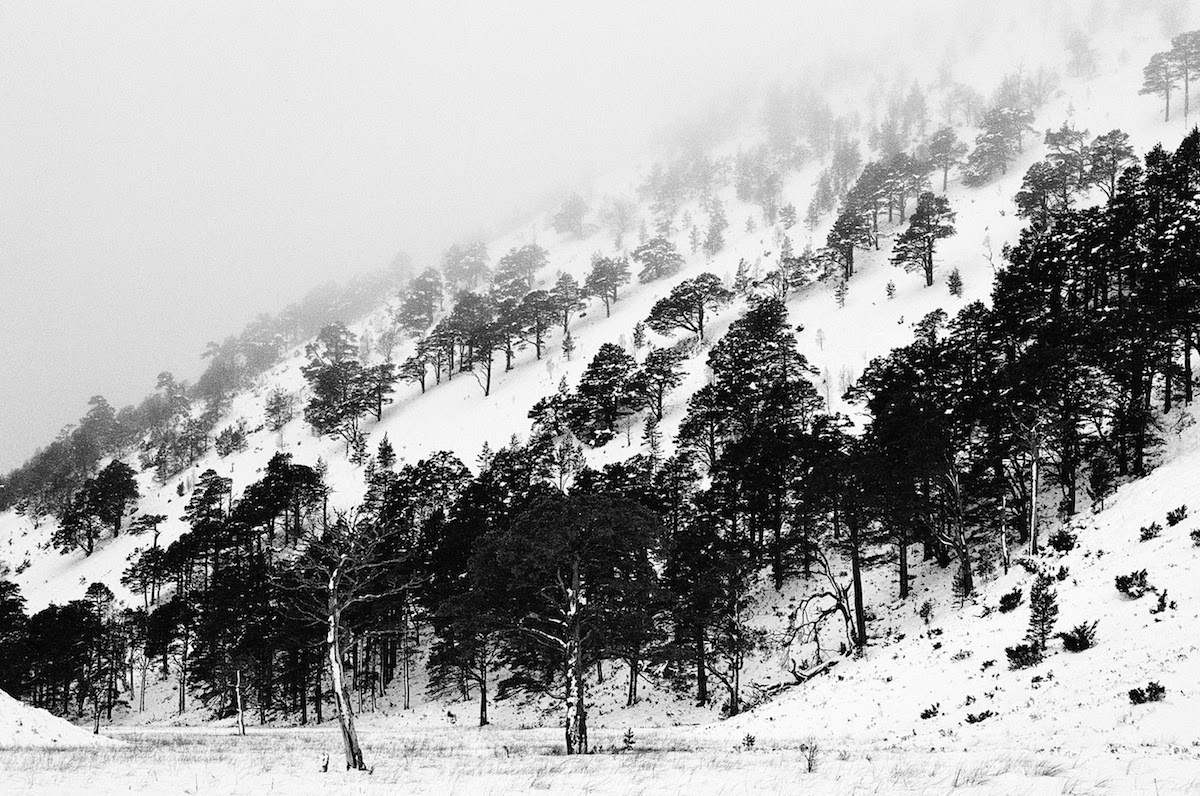

Ryvoan is not one of the legendary bothies of Scotland. It's pretty close to the nearest road, the walk-in is easy (if scenic), and a stay there cannot be considered essential for the ascent of any mountain. Bynack More is the closest Munro, but I suspect most walkers simply begin their route at Glenmore Lodge. However, Ryvoan does have positive qualities. It's a snug building with a good fireplace and comfortable sleeping platform, plenty of chairs, and hooks on the walls and roof for safeguarding food from rodents (I'll come back to this later!) The only real disappointment was the lack of a bothy book.
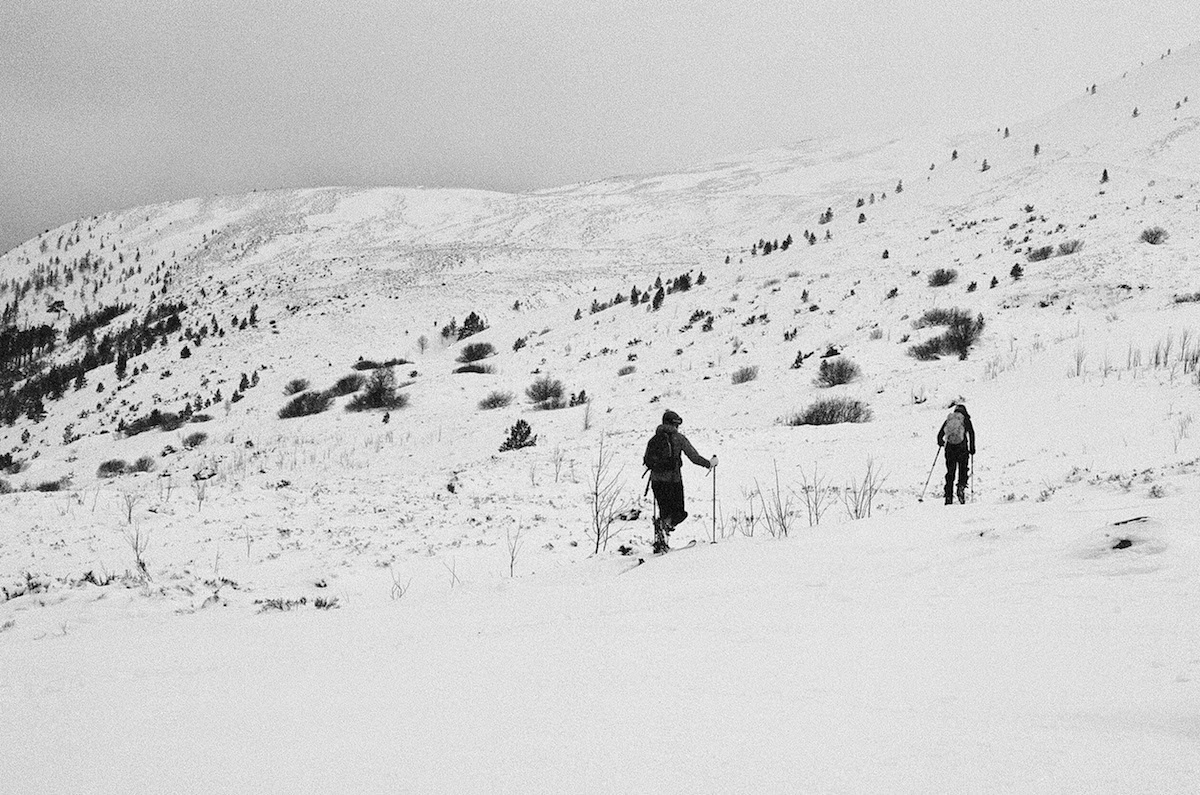 Skiers near Ryvoan
 Looking back to the forestI enjoyed the walk to Ryvoan. The forest is beautiful there, and covered under such a dense carpet of snow it had the feel of a remote Arctic woodland. The snowshoes eased my progress; not many others had walked along the track since the last snowfall, although I could see ski tracks (and later met a pair of skiers).
 Home for the next two nightsWhen I arrived at the bothy, I unpacked and chatted with the other chap who had also just arrived. He was called Pat, and had just come from the other side of the Cairngorms with a heavy pack. It's fair to say that he was utterly knackered after slogging over two hills with a 20kg load. Pat was an interesting man to talk to and it turned out that we had visited many of the same mountain areas over the years.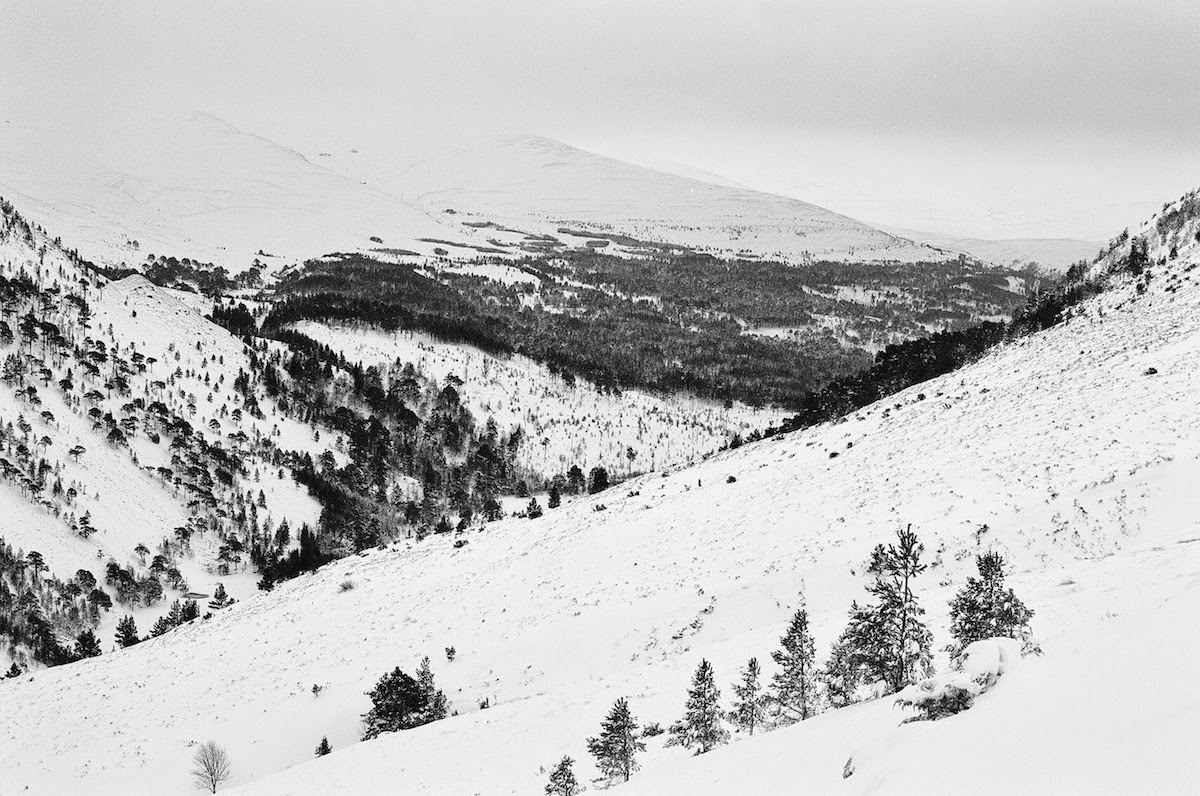
Keen to get out and see some views before the last of the light, I plodded a little way up adjacent Meall a' Bhuachaille. A loaded and dodgy-looking slope stopped progress at about the 530m mark, though. I returned to the bothy and got a fire going.
That night I was kept awake by the interminable racket of the Ryvoan mice, who liked to use an empty tin on the shelf as a hamster-wheel.
 Cooking dinner
 Bothy bokehThe ascent of Bynack More
I began my walk at first light. The access track in the bottom of the glen was very deeply drifted over, and even snowshoes couldn't prevent me from postholing in the softest stuff. They definitely made a difference, allowing me to walk over some surfaces I would have sunk knee-deep in had I been wearing boots, but it was still hard going. Progress was slower than I would have liked.
 A sombre day for Bynack MoreViews were misty and I didn't see the bulk of Bynack More until reaching the footbridge. The mountain looked completely white.
I kept plodding through the snow. It's a very easy ascent, possibly one of the easiest Munros I've done. The initial ascent follows a gentle path up an easy spur of land, browsed by grouse. I could see black tufts of exposed heather where the grouse had been digging for fresh shoots. Of course, the conditions made the going much more difficult than it would be in summer, and everything was pretty well drifted over. I couldn't see the path for most of the way (not that following the path was at all necessary on that kind of terrain).
I reached the large flat plateau north of the summit ridge. This area undulates gently and has a few spot heights of minimal prominence, but in general it is a featureless area. Visibility was not at all bad (maybe a couple of kilometres, with cloud hovering at 1000-1100 metres) but the lack of contrast, white on white, felt almost as disorienting as being in a proper whiteout. I trudged along through the deep drifts.
 A lot of white. This is the last clear shot I got before the summit ridge and the clag set in.When I finally reached the base of the summit ridge, the wind was getting up a bit and the terrain ahead looked much steeper. I decided to swap my snowshoes for crampons and my trekking poles for an ice axe. This proved to be a good decision because the rocks were coated with rime ice and much of the snow on the crest proved to be iron-hard neve.
The wind increased as I climbed, battering me from the side. It got a lot colder, too, and I swapped my liner gloves for Dachsteins. Navigation was never an issue as the ridge only goes one way, but with the poor visibility and lower temperatures it felt very different to the benign conditions on the plateau below. By the time I reached the summit I couldn't see a thing and my beard was iced up.
I didn't pause on the summit for long. I retraced my steps and descended the ridge swiftly, returning to the place where I had hidden my snowshoes and poles in the lee of a boulder. Back on with the snowshoes and off across the plateau!
Going the other way, without the shark's fin of Bynack More to guide me in the distance, I had to pay a little more attention to navigation. I took several bearings to take me back to the footbridge (it was getting dark by this time) and I have to say it was ideal terrain for that kind of dead reckoning. It felt good to be using map and compass properly for the first time in months.
By the time I returned to the bothy, eleven hours had somehow elapsed — much longer than I expected for a 10.2 mile route. Even with snowshoes, my progress in the deep snow was slow and the going was more tiring than you might expect.
 Back at Ryvoan, which has a very handy gear porch.The Ryvoan mice have their revenge
Now I'm going to tell you a pathetic tale. Before I left for Bynack More, I made sure I hung my food bag from the hook in the middle of the ceiling. The idea is that mice cannot get to your food up there. I thought my stuff was safe, suspended more than two metres above the floor.
When I got back, I found that mice had somehow entered my food bag and devoured a truly astonishing quantity of victuals. They had eaten an entire malt loaf, three packets of dried pasta, and several packets of oatmeal. They'd also shredded the packaging for several other food items and generally made a mess of everything. The only things they hadn't touched were the cereal bars (sealed in plastic tubs) and, bizarrely, the cheese.
I truly have no idea how they managed to get up there. I can only conclude they must have constructed some kind of ladder, or developed flying powers.
To make matters worse, the little devils had left their doings in my sleeping bag and my saucepan, in which I'd left some snow in the hope it might melt while I was out on the hill.
Now, my intention had been to trek out to Hutchison and climb some more Munros, but with a decimated and spoiled food supply — now hardly enough to feed me for a single day — that was no longer a sensible option. Besides, the walk to Hutchison would be hard going, and I had concerns about the snow slope from the Loch A'an Basin up the back of Cairngorm.
I decided to head back to Aviemore the next morning. It's possibly the most ridiculous reason I've had to cut a trip short yet, but after half an hour of moping I must admit I saw the funny side of it. I noticed one of the mice sitting on the table and twitching his nose at me. He looked fat as a barrel.
A new perspective?
As I walked back to Aviemore the next morning, I reflected on the trips to the mountains I've enjoyed over the last few years. I thought about failed objectives and trips that, in one way or another, ended up being a disappointment. It always came down to names of summits on lists. As I passed the frozen lochan, and listened to the snow melting and dripping off the trees, it occurred to me that the actual summits I write down in my logbook are not why I do this at all. The reason I venture into these beautiful and wild places is to be there and enjoy the journey.
 TranquilityIt might be obvious — it should have been obvious, really— but it was something of a small epiphany for me. I started to think about all the backpacking routes I'd done without any focus on getting to summits, and I realised that I enjoy the backpacking more than getting to the top these days. I've already written about this return to my old activities in the hills. I think this new/old approach will lead to much enjoyment this year.
The mountains are a constant in my life, and when I'm amongst them I think more clearly and more honestly. I'm a better version of myself when I'm in the hills. They encourage me to be the best I can be, to take every opportunity, to always be thinking about how I can improve my life and make the most of everything. There's simply no other way I can put it. In everyday life a person can be stressed, tired, over-worked, lazy, selfish, and focused on things that don't matter — but it's difficult to be any of those things when you're in the hills.
Every time I visit the mountains, I gain more than I can possibly put into words. That's why I'll keep coming back no matter how many times mice eat my food, or the snow is too deep, or I fail to climb hill after hill. It's good for the spirit.
 Until next time.
February 11, 2015
I forgot I was a backpacker

I started walking as a child in the Scouts, and on family holidays to the Yorkshire Dales, but I didn't really think of myself as a walker until about 2002. I've written before about my years walking and backpacking in the Sandlings. In 2003 and 2004 I put in some considerable mileage in the flatlands, often walking more than twenty miles a day and wild camping or bivvying in the forest. I wore out my first pair of boots.
My gear was basic and often pretty dreadful. Check out this cheap Eurohike tent with fibreglass poles, one of which broke the first time it was pitched:

Then mountains came along. Boy, did things change!
In 2005 I backpacked through the Lake District at a leisurely pace, walking 160 miles in twenty days and climbing a fair number of Wainwrights along the route (averaging about one peak a day). Instantly my focus changed. Backpacking became a means to an end — and the end was to climb as many mountains as possible. That focus saw me through University (2005–2008), and as a member of the UEA Fell and Mountaineering Club I regularly escaped to Wales, the Lakes or Scotland to add to my tally of mountains.
I seemed to be in a hurry in those days: a hurry to accumulate mountaineering experience, a hurry to "become" a rock climber, an ice climber. When I moved to Glencoe things only accelerated. In 2009 I was at the peak of my powers, climbing routes I wouldn't even dare consider now.
I can't deny that I had a great time, and the pace felt right. I was in my early-mid twenties and I wanted adventure.
But somewhere along the way I forgot that I started out as a backpacker, and I forgot how much I enjoyed backpacking as an activity in itself, not a means to an end. In 2010 I tried to correct the balance and set off for Jotunheimen, Norway.
It was a great trip, but my mind was still in peak-bagging mode and that spoiled things a little.
 Glacier camp in the Gjende Alps. This proved to be an exposed location and my tent suffered from fierce cross-winds, but look at that view!I felt disappointed that I only managed to climb one 2,000-metre peak on the trip. I'd planned to climb at least ten. Frankly the weather wasn't that great, and given the remoteness of the backcountry my margin for error was much lower than it was in Scotland. Backing off a summit ridge scramble in high winds made me feel like I had somehow failed, rather than having made a good decision. I ended up focusing on the things I hadn't done rather than the bigger picture.
If you ignore the mountaineering portion of the trip, it was actually a great experience. Trekking for a week through such wild and pristine country was wonderful. But that little voice that said get up mountains! backpacking alone is boring! did take the edge off my enjoyment.
In 2013 I planned a short backpacking route from Blair Atholl to Aviemore. This time my main focus was on the journey, because I was researching my novel The Atholl Expedition and wanted to cover the same ground Forbes and his friends had. I stopped off at Corrour for a day to climb Cairn Toul, Angel's Peak and Braeriach, but that was very much incidental — the journey was the main focus.
And I had an absolutely brilliant time.
 Wild camp at the Falls of Tarf. Couldn't ask for a better pitch!Another fantastic backpacking trip was June 2014, in which I completed the central section of the 1842 Forbes Route. Again, my attention was all on the journey, not the peaks.
The problem is that I now live in Lincolnshire, so I don't get that many opportunities to head into the hills. When you only get four or five chances to climb a year, the understandable temptation is to focus on mountains rather than journeys. It's an easy trap to fall into. In 2014 I only stood on the tops of three mountains, and when my October trip to Lochaber didn't go so well I ended up feeling despondent. Similarly, my recent trip to the Cairngorms was not as "productive" as I would have liked (trip report coming soon!)
But I'm starting to think I have it the wrong way round. I think I've been trying to keep that focus on mountains, and lists, and grades, that I had when I lived in Glencoe — even if I insist to myself that I haven't. When I have a great time backpacking, it feels like a fluke. But maybe a pattern is emerging.
Every single time I have been backpacking over the last few years, I've had a great time — if I allow myself to let go of the "mountain obsession" and simply enjoy the journey.
The answer is obvious. I need to focus on what I enjoy. I need to plan more backpacking routes, and if they happen to take me to the tops of mountains along the way then that's a great bonus.
Watch this space. I have some amazing plans for this year. Soon I'll be blogging about my preparations for thru-hiking the Cape Wrath Trail in June, and I have my sights on an Alpine backpacking route later in 2015. Maybe see you on the trail!

February 10, 2015
Book review: Rattlesnakes and Bald Eagles by Chris Townsend

Rattlesnakes and Bald Eagles: Hiking the Pacific Crest Trail by Chris Townsend
Chris Townsend is one of the world's leading authorities on backpacking. He's been doing it for a long time and has written many books on the subject. In fact, his Backpacker's Handbook was a major source of inspiration for me as a teenager, when I was first developing a love of the outdoors and wanted to try backpacking for myself. It went in my rucksack in 2003 when I embarked on my first multi-day trip. I always look forward to new books from this author.
Rattlesnakes and Bald Eagles is an account of Chris's 1982 thru-hike of the epic Pacific Crest Trail. The book stands out for several reasons, and readers will be blown away by the sheer scale — not only of the landscape through which the author voyages, but the scale of the challenge itself. This is a really big walk. Thru-hikers routinely take up to six months to complete the 2,663-mile route, and it crosses a variety of wild terrain including remote deserts and the High Sierra. Even in the 21st century, the PCT requires real commitment, fitness and experience to complete ... so what was it like thirty-odd years ago?
Part of the value of this book comes from Chris, now a backpacker with a lifetime of experience, looking back on the hike and offering a retrospective view. He frequently refers to the journal he kept on the trail and includes many photographs originally taken on slide film (no digital cameras in those days, so shots had to be rationed). The real eye-opener is the gear. Nowadays, lightweight gear is the norm, but many of the innovations we take for granted nowadays simply didn't exist back then. In particular I'm astonished by the weight of his pack as he crossed the Sierra, with many days' food supply plus ice axe, crampons, snowshoes, and other items essential for the high mountains.
 Yosemite. Photograph from WikipediaHe learned many important lessons along the way, perhaps the most important being that thick, heavy boots (more or less the only hiking footwear available at the time) were not ideal for the task, particularly in the desert sections. He quickly switched to the running shoes he carried as backup footwear and ended up wearing them for most of the rest of the walk. This tactic was ahead of its time, but has now become widely accepted.
For me, what makes this book really shine is the adventure itself. It's impossible not to be captivated and enthralled by the majesty of the landscape, and the monumental challenge of taking on a route of this calibre. Before reading Rattlesnakes I knew that the PCT was a long route, but I didn't appreciate how hard or committing it was, or that it joined together some of the wildest and most beautiful landscapes in the USA. Only a handful of other hikers completed the PCT in 1982. It is, quite simply, one of the great foot journeys of the world — and this is a fine account of it.
This is a great book, skilfully written with charm and authority, and it will be enjoyed by anyone with an interest in backpacking or wild places.
Buy the book on Amazon UK
Further reading
Chris's blog, which features many interesting articles on the PCT and backpacking in general
January 24, 2015
Illustrations from after the Alpine golden age

Today I'd like to share some beautiful illustrations with you. One of my most prized books is the Badminton Book of Mountaineering, a massive tome of 19th century climbing lore compiled by C.T. Dent and published in 1892. It features contributions from the greatest climbers of the post-golden age era, including W.M. Conway, D.W. Freshfield, C.E. Mathews, and C. Pilkington.
This book isn't unique. It's one of a number of guides that aim to be complete mountaineering manuals — the most famous is probably Mountain Craft by G.W. Young — but what sets Badminton apart is the charm and humour of the illustrations. The captions are frequently witty (or not so witty) puns. There's a real sense that mountaineering is starting to find itself again as the 19th century draws to a close. After the 1865 Matterhorn disaster, and the first ascents of all the 4000m peaks were completed, Alpinism experienced something of a lull — but it didn't take too many years for a new generation to burst upon the scene with enthusiasm and new ideas.
Badminton is also notable for being the book that Aleister Crowley used to teach himself climbing.
This book has been absolutely key in shaping my knowledge of Alpinism in the 19th century, and was one of the most important sources of inspiration for The Only Genuine Jones and Crowley's Rival. I'll let the pictures speak for themselves. (Click for a larger version.)

 This is the only photograph in the entire book.


January 22, 2015
Introducing No Way Home, a speculative fiction anthology
Today I'd like to talk to you about something a little different. I've been working with a group of other writers to produce an anthology of speculative fiction called No Way Home, and it's going to be launched on the 2nd of March this year. Science fiction author Lucas Bale has curated the project, and the other contributing authors are S. Elliot Brandis, J.S. Collyer, S.W. Fairbrother, Michael Patrick Hicks, Harry Manners, and Nadine Matheson. Jennifer Foehner Wells, bestselling author of
Fluency
, will be writing the foreword.
My contribution is a short story called Cold Witness, published under the pseudonym A.S. Sinclair (to differentiate it from historical fiction published under my real name, as the subject matter and writing style is completely different). It has been a real pleasure to return to a genre I have enjoyed writing in the past, and I suspect this is only the beginning for A.S. Sinclair.
I am also responsible for editing the collection. I'm glad to report that Pinnacle Editorial continues to go from strength to strength, and my editing schedule for this year is packed with exciting projects.
If you're on Goodreads, you can add the anthology to your reading list here. Subscribers to my mailing list will get early access, if you aren't already a subscriber, sign up here for an email notification.
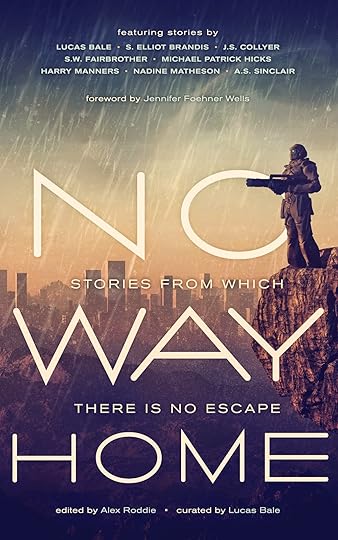
No Way Home.
Stories From Which There is No Escape.
Nothing terrifies us more than being stranded. Helpless, forsaken, cut-off. Locked in a place from which there is no escape, no way to get home.
A soldier trapped in an endless war dies over and over, only to be awakened each time to fight again – one of the last remaining few seeking to save mankind from extinction.
In rural 70s England, an RAF radio engineer returns to an abandoned military installation, but begins to suffer hallucinations, shifts in time and memories that are not his own.
A widower, one of ten thousand civilian space explorers, is sent alone to determine his assigned planet's suitability for human colonisation, but stumbles across a woman who is part of the same programme and shouldn’t be there at all.
A depressed woman in a poverty-stricken near-future America, where political apathy has allowed special interests to gain control of the country, takes part in a particularly unpleasant crowd-funding platform, established by the nation’s moneyed elite to engage the masses.
An assassin from the future, sent back in time to murder a woman, is left stranded when he fails in his mission and knows he will soon cease to exist.
These sometimes dark, sometimes heart-warming, but always insightful stories and more are to be found in No Way Home, where eight of the most exciting new voices in speculative fiction explore the mental, physical and even meta-physical boundaries that imprison us when we are lost.
My contribution is a short story called Cold Witness, published under the pseudonym A.S. Sinclair (to differentiate it from historical fiction published under my real name, as the subject matter and writing style is completely different). It has been a real pleasure to return to a genre I have enjoyed writing in the past, and I suspect this is only the beginning for A.S. Sinclair.
I am also responsible for editing the collection. I'm glad to report that Pinnacle Editorial continues to go from strength to strength, and my editing schedule for this year is packed with exciting projects.
If you're on Goodreads, you can add the anthology to your reading list here. Subscribers to my mailing list will get early access, if you aren't already a subscriber, sign up here for an email notification.

No Way Home.
Stories From Which There is No Escape.
Nothing terrifies us more than being stranded. Helpless, forsaken, cut-off. Locked in a place from which there is no escape, no way to get home.
A soldier trapped in an endless war dies over and over, only to be awakened each time to fight again – one of the last remaining few seeking to save mankind from extinction.
In rural 70s England, an RAF radio engineer returns to an abandoned military installation, but begins to suffer hallucinations, shifts in time and memories that are not his own.
A widower, one of ten thousand civilian space explorers, is sent alone to determine his assigned planet's suitability for human colonisation, but stumbles across a woman who is part of the same programme and shouldn’t be there at all.
A depressed woman in a poverty-stricken near-future America, where political apathy has allowed special interests to gain control of the country, takes part in a particularly unpleasant crowd-funding platform, established by the nation’s moneyed elite to engage the masses.
An assassin from the future, sent back in time to murder a woman, is left stranded when he fails in his mission and knows he will soon cease to exist.
These sometimes dark, sometimes heart-warming, but always insightful stories and more are to be found in No Way Home, where eight of the most exciting new voices in speculative fiction explore the mental, physical and even meta-physical boundaries that imprison us when we are lost.
January 1, 2015
20% VAT for ebooks arrives today — what’s your strategy?

If you publish ebooks on any digital platform, you should be aware that an increase in VAT has been in the pipeline for some time. It came into effect this morning and applies to all digital downloads. For the purposes of this brief article I’m going to be talking about how it affects UK-based users of the Kindle Direct Publishing (KDP) platform.
How it used to work
Calculating VAT was always a little arcane in the old version of KDP. VAT was fixed at 3%, but it wasn’t included in the price you set on the book’s dashboard. For example, if you wanted your book to cost £1.99 to the customer you had to set a price of £1.93.
For the kind of prices we’re talking about, 3% VAT was negligible and made very little difference to an author’s bottom line.
How it works now
I woke up to find that one of my titles had been automatically hiked in price from £1.99 to £2.32 (curiously, my other titles remained at their original prices). When I delved into the KDP bookshelf I found a link to Amazon’s explanation of the new rules.
 The new VAT panel on the KDP dashboardIt’s actually much easier to use now. Rather than having to figure out the VAT-exclusive price from your desired list price, you just enter your list price and the system automatically deducts VAT. For example, if I want my book to sell for £1.99 then I simply type in £1.99. It ought to have worked like this from the beginning.
The problem, of course, is that VAT is now 20%. Amazon won’t absorb that price. You have a choice: you can either make your readers pay it, or you can pay it yourself. Put another way, if you continue to sell your £1.99 ebook for £1.99 you will make less money for every sale.
Coping strategies
I’ve had plenty of time to think about this since Amazon sent out their first email about the VAT increase. My initial reaction was to absorb the extra cost myself to avoid hitting my readers with higher prices, but in time my stance changed.
Things aren’t as bad as many authors claim — and I am strongly of the view that we are right in the middle of a golden age for writers — but there can be no denying that an increase in books on the market has driven prices down. I believe that authors should be paid for their hard work. When you think about how much readers gladly pay for paperback or hardback books, ebooks (the same content, differently packaged) start to sound like an excellent bargain.
I priced my full-length novels at £1.99 for a long time. £1.99 was a good compromise between value for the reader and value for me, but now the rules have changed. I think the average selling price of ebooks will increase slightly — and I don’t see that as a bad thing.
For that reason, effective immediately, I have increased the price of my full-length novels on Kindle to £2.49. I think anyone would agree that this is still an excellent deal for the reader, considering that the paperback editions of these novels weigh in at £7.99. And people are quite happy to pay what a novel is worth if they really want to read it; in fact, one school of thought claims that a low price actually damages a book’s chance of success.
Not every author will decide to do this. Some might be better served by keeping their prices as low as possible — which is, after all, a tried-and-tested method of getting a bigger audience. But my books are selling fairly well as they are, and I’m long past the point of underselling myself in an attempt to get more readers at any cost.
Everyone needs to think things through and come up with their own strategy, but I’d encourage authors to think twice before decreasing their prices yet again. We do a skilled and time-consuming job for scant reward, and we deserve to be paid for our efforts.
December 28, 2014
Book review: The Walk Up Nameless Ridge by Hugh Howey
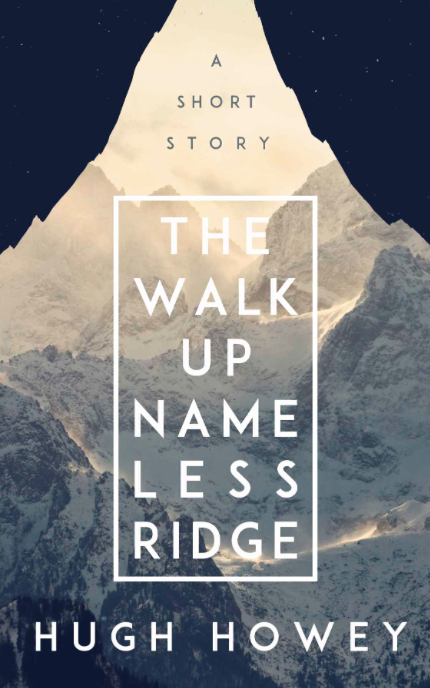
by Hugh Howey
The Walk Up Nameless Ridge is a short story by science fiction writer Hugh Howey, best known for the post-apocalyptic series Wool. Mountaineering fiction is an obscure genre at the best of times so it was with some surprise that I learned about this title. How, I wondered, would a science fiction writer tackle the subject of mountaineering?
The result is an utterly unique and — in its own way — compelling imagining of what mountain climbing might become in the distant, space-faring future. However, as I shall explain, I don’t think the central premise would stand up to scrutiny in a longer piece.
This story explores themes that already exist in the mountaineering culture of today: improving standards, the erosion of climbing ethics, summit fever, the difficult decisions faced by climbers on the cusp of success or failure. It can be summed up best by Alfred Mummery’s famous quote:
It has frequently been noticed that all mountains appear doomed to pass through the three stages: An inaccessible peak — The most difficult ascent in the Alps — An easy day for a lady.Victorian sexism aside, in this case Everest has become the “easy day for a lady” in the far future, with a tram extending to the summit. Humanity has long since expanded beyond Earth, and mountaineers have exhausted the climbing possibilities of their home planet thanks to a combination of higher standards, performance-enhancing drugs, and technology that would be considered cheating by the climbers of the early 21st century. The same can, of course, be said for today’s climbing culture when viewed from the perspective of the 19th century pioneers, which I suspect is the point.
The ultimate climbing challenge in this story is an impossibly high peak called Mt. Mallory, located on a planet called Eno. Mt. Mallory is an exaggerated nightmare of a mountain, sixty thousand feet high and pummelled by relentless hurricane-force winds. Climbers have attempted to scale it for decades but most have perished. Everything about high altitude climbing on this planet is exaggerated, from the conditions to the danger, from the insanely technical climbing gear (mechanical hiking pants!) to the vicious rivalry between different teams. There’s even an android trying to climb the mountain and be first to the top.
The idea is fascinating. It works on several levels because it serves as a critique of modern climbing culture while examining how the sport has developed since its early days, and making a logical extension into the future to look at where this exponential curve might take us. The writing is also beautiful and efficient.
But I think the idea itself only works as a thought experiment packaged as a short story, and collapses under close scrutiny. Will humanity still be obsessed with mountains and climbing centuries in the future, when we have the capability to travel to other worlds and do things currently only dreamed of? Possibly, but I’m not so sure. For the vast majority of human history, people did not generally climb mountains for fun; they did so only if they had to climb them for some practical reason. Even the leisured classes had no interest in climbing mountains before the late 18th century. The current popularity of mountaineering is largely due to an explosion of interest in the 19th century, and continuous development in standards and participation ever since. There’s a very persuasive argument that ties mountain climbing with modernity and industrialisation.
Our sport is changing in ways more complex and subtle than the changes portrayed in this story. Exploration is so rapid that only exceedingly difficult or exceedingly remote routes remain unclimbed. As the possibilities for first ascents dry up, the focus for the majority of climbers is slowly moving towards sport climbing, indoor climbing, and (above all else) convenience. People are still going into the mountains in the early 21st century, but what will another century of progress do the sport — another century away from the enthusiasm of the pioneering years?
I believe that, even if mountaineering still exists several hundred years from now, it will see drastic change far beyond the relatively simple extension of current trends presented here. For this reason, The Walk Up Nameless Ridge works very well as a thought experiment and a short story, but the flaws in the idea would be amplified in a longer piece and it would fall apart. The being said, I enjoyed the story and it certainly got me thinking, which should be the goal of all good fiction. The Walk Up Nameless Ridge is a fascinating short story and a worthwhile read for science fiction fans or outdoor enthusiasts.
Alex Roddie's Blog

- Alex Roddie's profile
- 27 followers
Alex Roddie isn't a Goodreads Author
(yet),
but they
do have a blog,
so here are some recent posts imported from
their feed.


