
Alex Roddie's Blog, page 2
May 28, 2015
Sidetracked Volume Four is here
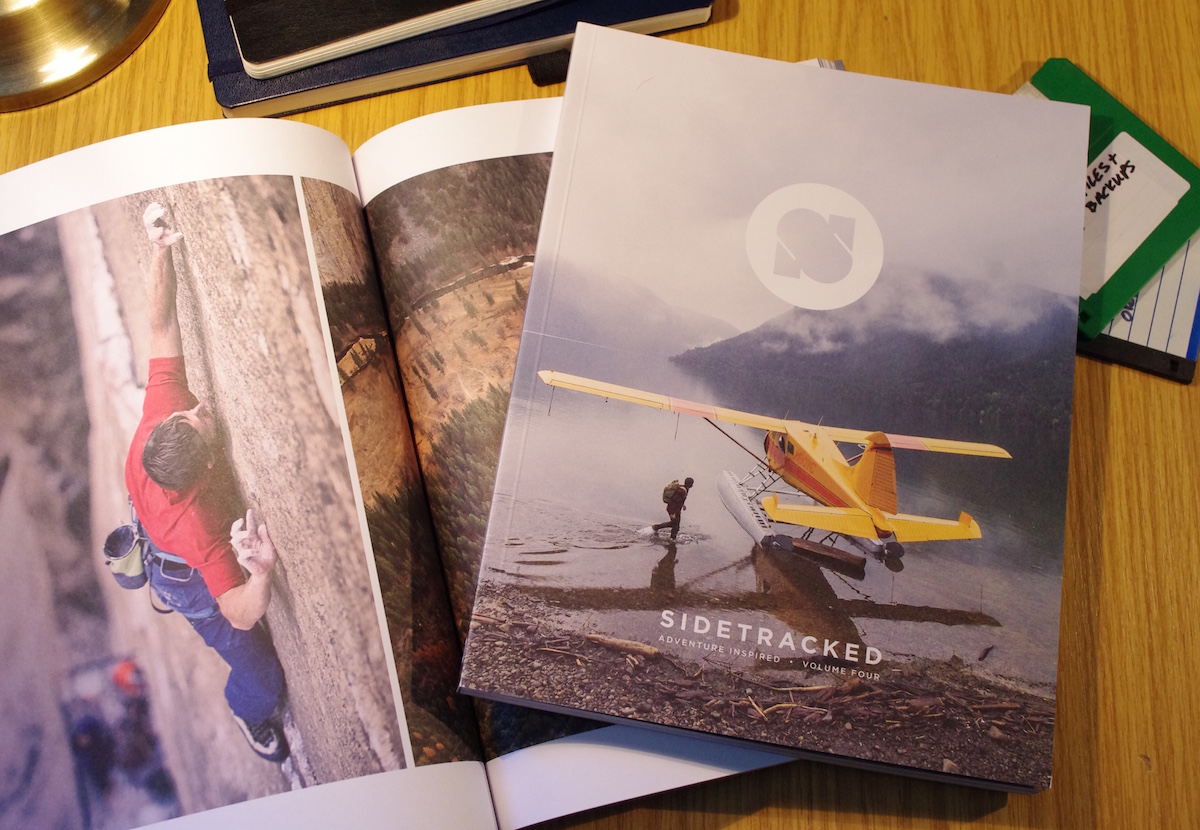
A few months ago, an exciting opportunity arose. I was invited to do a little freelance editorial work for Sidetracked – an adventure travel magazine with a focus on exploration and wild places. The stories are told through a blend of excellent writing and stunning photography. It's just the kind of magazine I love to read – more quality and less fluff than the average outdoor publication.
A while later I was offered the position of Sub-Editor at Sidetracked, and recently we have been working hard to ready Volume Four for publication. Sidetracked publishes web content in addition to a tri-annual printed journal. This was my first issue, and it's now ready to order.
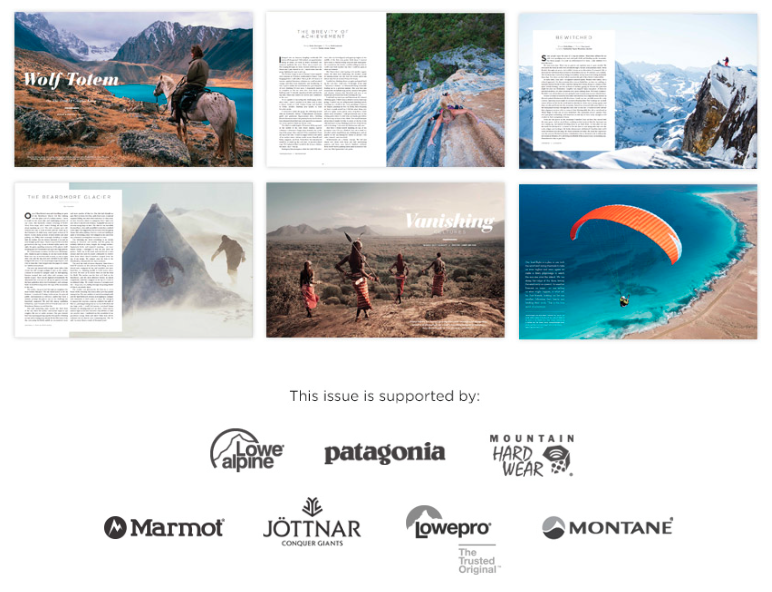
I've worked on some amazing stories written by talented writers – tales of exploration and discovery set in some of the most remote, inhospitable, and exotic locations around the world. There's a strong focus on Antarctica in this issue but it really does have something for everyone. For example, there's an account of the Dawn Wall climb, mountain biking in Afghanistan, and running in the Namib Desert.
Working with the Sidetracked team has been a pleasure, and we're already starting to put together the next issue. If you're into adventure travel and exploration, I think you'll enjoy it too. You can order copies of Volume Four here: http://www.sidetracked.com/volume-four/


May 25, 2015
Book review and interview: A Shroud of Night and Tears by Lucas Bale
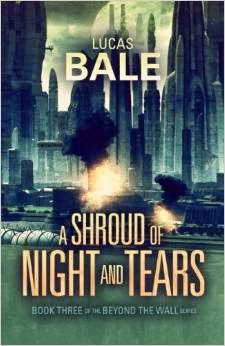
Over the past year or so, it's been my privilege to follow the career of science fiction writer Lucas Bale. In my review of The Heretic, his first novel, I concluded by saying that "... I suspect this new author will go far." I wrote those words in July 2014. Since then he has released another novel, several short stories, curated an anthology (and contributed to others), and we've worked together on a number of projects.
The third novel in his epic Beyond the Wall series, A Shroud of Night and Tears, launches on Wednesday (Facebook launch party here). As usual, the author sent me an advance copy of the book to read and review.
In my review of Defiance I mentioned that Lucas Bale's science fiction world was really beginning to flower and unfold – that a sense of the true scale of his vision was starting to become apparent. This process reaches its apex in the third volume of Beyond the Wall. Cataclysmic plot twists will make you question everything you think you know about this universe, and both the stakes, and the sheer scale of events taking place, are so much higher than ever before. This is a world of stupefying danger for anyone who chooses to go against the status quo. And humanity's place in this universe is more precarious than ever before.
Readers who may have been disappointed that the characters in The Heretic did not return in book two will be glad to hear that Shepherd, Jordi, the Soteria, and other characters from the first novel all play significant roles here. It's really satisfying to see how their individual struggles fit into the big plot that takes place over multiple books. Some great new characters are introduced, too. Everyone has their own private war to fight, and just when you think you know what's going on, the big twist comes along and changes everything. I'm not at liberty to give the game away – you'll have to read the book to find out for yourself!
It's probably apparent by this stage that I loved this book. I like Lucas Bale's characters, I like the universe he's weaving, and the themes he chooses to pursue in his science fiction are fascinating to me. Better still, this is by no means the final chapter of Beyond the Wall; in many ways the story has only just begin.
Each book has been a little grander, a little more ambitious than the last. A Shroud of Night and Tears is the most epic yet and the author pulls off a complex storyline with considerable skill. If you have yet to discover this author, check out the links below. His short fiction is also well worth reading.
Disclaimer: I received a free review copy of this book from the author.
Visit the author's website
@balespen on Twitter
Lucas Bale's books on Amazon
Interview with Lucas Bale
Now on to what is in many ways the main event of this blog post. I got in touch with Lucas and asked him a few questions about his work. In this interview he casts a little light on the themes he explores in fiction, the nature and future of civilisation, and his future plans for the series.
Each volume of ‘Beyond the Wall’ has shown us a little more of the context and wider world in which your stories are set. In ‘Shroud’ the reader is shown a glimpse of what’s really going on. Are there more big surprises in store for us in future books – and if so, what can you tell us about them?
 I think any story needs to contain surprises in order for it to be compelling. Robert McKee taught me that. That gap between the reader's expectations and the actual result is one of the most enthralling aspects of any story. We love to be surprised, for stories to take unexpected turns. So yes, there are more revelations to come. Obviously there are major events that hammer out the stakes clearly in Shroud, but that was always my intention – the first two books would set up two separate storylines that would converge in Shroud and the truth of the story would be revealed. When they have finished Shroud, readers will realise there is a much greater depth and scope to the setting than at first assumed by those comparing it to, say, Firefly.
Whilst I enjoyed the light nods I made to Firefly in the first book, and there were some to the original Battlestar Galactica series too, they were never meant to continue into Defiance and beyond. The setting is much more expansive, and very different. The themes to come are different too – humanity being the main one: who we are, what we want from our future, what it means to be human and our place in the universe. Is there such a thing as 'humanity', or is what we consider humanity in truth a set of shared values which is really a measure of sentience or sapience instead? Shroud is a much bigger book than the first, at 465 pages, and Into A Silent Darkness will be bigger still as the story truly unfolds. This gives me a much greater scope to explore these questions.
The story of Beyond the Wall can be seen as the story of civilisation – and the threats that face it, both from outside and from within. When humanity reaches for the stars, how do you think our civilisation will adapt – and do you think a future collapse is inevitable?
The twinned concepts of civilisation and government have always been critical to the themes underpinning the series as a whole. I wanted to explore the question of what system of government was perfect for a given civilisation – and whether it was even possible to answer that question. Are there too many competing interests in a civilisation to actually find a system that could be considered ‘perfect’, or will there always be a large portion of society that is negatively affected by any given system? Certainly, democracy has much to behove it, and in many ways there is no better system. Churchill once said, in a House of Commons speech on November 11th, 1947, "Democracy is the worst form of government, except for all those other forms that have been tried from time to time.” There’s a double-sided truth to that – democracy is flawed (Churchill said that having just won the war, but having lost the general election that followed it), but, in our circumstances as they exist now, there is probably no better system.
The same might not be said for the position in the Beyond the Wall universe – humanity is on its last legs, almost extinct, and trying to rebuild. An authoritarian government seeking to propagate humanity must make hard decisions. Yet they’re not altruistic either – power corrupts, as the old adage goes, and the Quorum of the Consulate Magistratus is no exception to that. In fact, perhaps they define it. And who knows what threats wait in the shadows – a government knows a great deal more of the threats it faces, and regimes or systems of law that might seem harsh are infinitely more explicable with that guarded knowledge.
Beyond the Wall certainly explores that. Perhaps there is a didactic element to it – or more likely I just want people to ask their own questions. Science fiction is not intended to answer questions, but it should seek to raise them in the first place.
As to where we will be when we reach the stars and colonise new planets – it will depend on where the nations of Earth are at the time, as well as who goes to colonise. A US government will be a very different regime to a Chinese or Russian. A lot will also depend on the nature of the planets – the harshness of the wilderness we find and how easy it is to live there. I find it hard to believe that it will be easy to maintain law and order in the same way on a fully fledged colonial community on another planet (as opposed to, say, a closed, self-contained professional community of astronauts and scientists) as it would be here on Earth – picture the lawlessness of the Wild West and even remote (or war-torn) parts of the world now. I think the frontier mentality will become ever more important in those communities and the ability to protect one’s home will actually be critical. The only alternative is a considerably more authoritarian regime than we are used to on Earth.
The response to your first two novels has been phenomenal. Has the reaction from your audience shaped the process of writing Shroud, and if so, how?
Audience reaction hasn’t so much shaped the story itself – that was set the moment I began planning the series back in 2013. It has however made writing Shroud considerably more challenging and stressful. Although I think every author hopes that their work will break out, when more and more readers do in fact connect with your work, it increases the pressure to make every word sing. It’s inevitable that you begin to question more, especially in the later stages, and, with a book like Shroud, where the revelations are potentially surprising and controversial, there are days when that pressure exerts itself more openly than others! It’s important to believe in the work, believe in your process and remain focused on the themes underpinning the story. I don’t normally respond to reviews, but I did post on my website at one point when a number of reviewers complained about the change of characters between The Heretic and Defiance. I took the opportunity to quash a few assumptions, and to reassure too.
I have a plan – a structure for the series – and there is sense to it, reasoning behind telling the story the way that I have. But the truth is, negative reviews can break a new author so they matter. They hurt. So often I turn to Kameron Hurley’s blog and I get refreshed by her brutal honesty about the creative process and about publishing in general. Now, with a year writing and publishing behind me, I think the most important thing is to focus on the success of the books, the readers emailing me telling me they can’t wait for the next instalment, or commending the work. I suspect more experienced authors no longer need that affirmation, but sometimes it’s nice to know that you’re hitting the right notes when you’re just starting out. I write more, I read more, I learn more. I ensure I infuse every page with what I hope keeps people reading – a great story. Keeping that focus pulls me out of the low points.
~ ~ ~
Many thanks to Lucas Bale for sharing his thoughts with us today. Don't forget, the book comes out on Wednesday. Keep an eye on the Facebook launch page for more details.
May 21, 2015
Cape Wrath Trail Gear List

Regular readers will be aware that I'm planning to hike the Cape Wrath Trail in June this year. I've already blogged about my preparations, but my gear list has changed a few times over the last month so, due also to several requests on Twitter, I thought I'd post my final gear list.
I daresay I may make some last-minute adjustments – I've just been recommended to buy some waterproof socks, for example, although the consensus is that they aren't worth it – but I think this is now pretty much final.
I'm new to lightweight backpacking, and if I had done this walk a year ago the list would look very different (and probably about five kilos heavier). Still, I'm holding on to a few luxury items. The big one is probably the second pair of shoes. Trail shoes have been a revelation, but I'm not quite confident enough to embark on a 250-mile journey with a single pair of flimsy-looking shoes that might fall to bits before the end of it. I'm prone to having problems due to wet feet so carrying Goretex shoes is also a psychological crutch, although I intend to do most of the walking in my Inov-8 Roclite 295 shoes.
Overall I have achieved a base weight of 8.7kg, which I'm pretty happy with, and I think this kit will cope with everything the trail can throw at me.
First look: Walking the Border by Ian Crofton

Walking the Border: A Journey Between Scotland and England by Ian Crofton
I have just started reading this handsome volume by Ian Crofton. The author has a number of books to his name, and has a reputation for bringing history and facts to life in an engaging way. He's also a keen climber and walker. The outdoors and writing often go together, don't they?
The premise is straightforward enough – it's a book about walking the border between England and Scotland. I was expecting an account of the walk, but from the first page it's apparent that a great deal more is going on here in addition to the coverage on the hiking itself. The first chapter explores the very concept of borders and the author weaves his research throughout the book. He visits and talks to immigrants and refugees at many of the UK's borders, and there's also some very topical material on the Scottish independence question. I suspect these issues will become absolutely central to the story Ian Crofton has to tell.
Some readers are bound to disagree with the author's political views – not usually a concern in a straightforward hiking book – but this is hardly a manifesto or an opinionated rant. From what I've read so far, it's an intelligent and informed study on the very concept of borders. This side of the book was a pleasant surprise and I think I'm going to really enjoy this one.
As always, I'll follow this post up with a full review when I have finished reading it.
Disclaimer: the publisher sent me an advance copy of this book to review.
May 14, 2015
Backpacking in the Yorkshire Dales
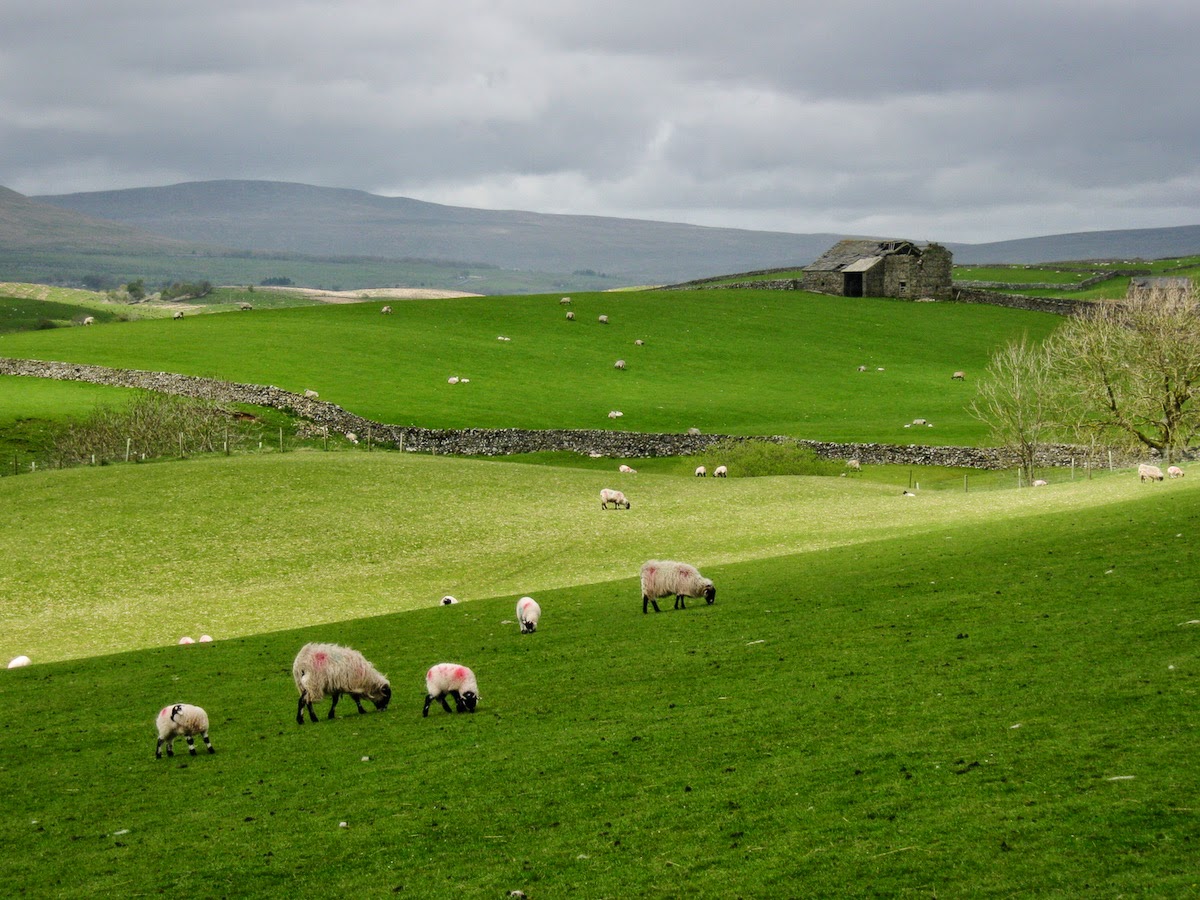
I spent a lot of time exploring the Yorkshire Dales as a youngster. My dad's family is from the area, and we would go up most summers to spend a couple of weeks in the caravan. At the time I was obsessed with fossils and minerals, so the main focus of my activities would be splashing around in becks, searching for precious stones (and weighing down the car with boxes of specimens on the way home).
Little did I know that my time spent in the Dales would stealthily introduce another passion: the hills. In fact, my first proper hill was Pikedaw, above Malham, when I was twelve years old.
My last visit to the area was 2008. Since then I've been focused on bigger mountains, but with my departure date for the Cape Wrath Trail rapidly approaching, I wanted to get another short training mission done to test out a few new items of kit.
This is the report of my trip. I've also included some observations on my failure to adequately deal with wet feet on day two, which had slightly uncomfortable consequences – fortunately no worse than that, although it has taught me a valuable lesson for the future. I'm still learning when it comes to using lightweight trail runners in the hills.
The route
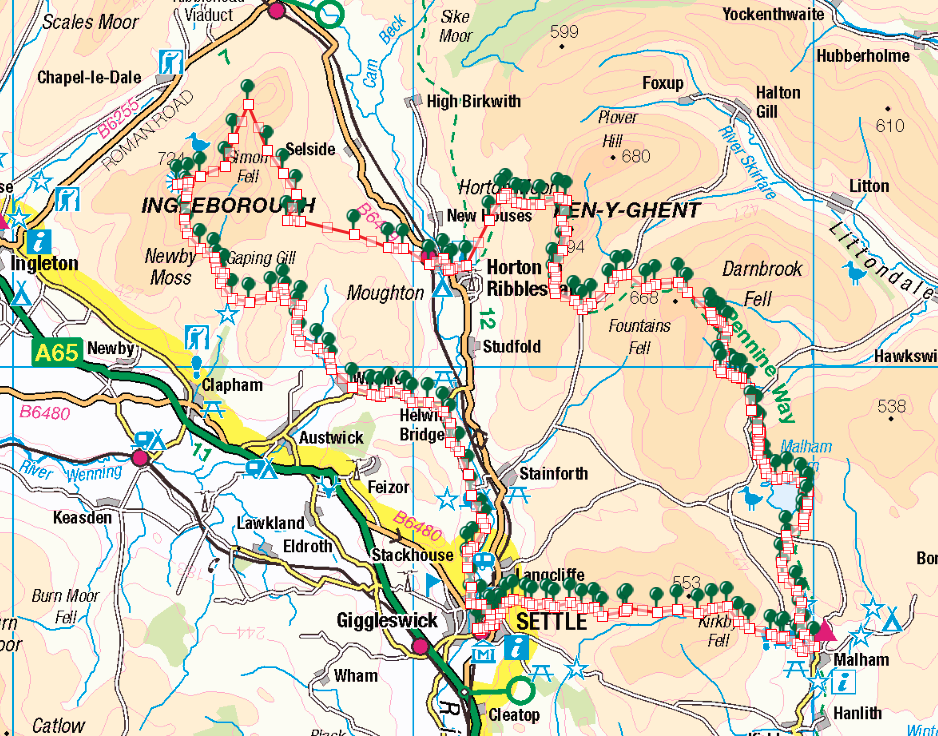
My route began and ended in Settle. Here is a link to the ViewRanger file. It's a reasonably obvious circuit: head east to Malham, then follow the Pennine Way to Horton in Ribblesdale before tackling Ingleborough from the east and returning to Settle. The original route I planned deviated slightly from the Way between Malham and Fountains Fell, but given the bad weather on day two I decided to stick to the established paths.
The overall length of this route is a shade over 37 miles. I tackled it over three days, beginning at 4 p.m. on the first day and finishing at 3 p.m. on the third. My campsites were at SD 901 672 (above Malham Tarn) and SD 769 736 (behind a wall near Nick Pot on the huge Sulber limestone plateau).
Day one
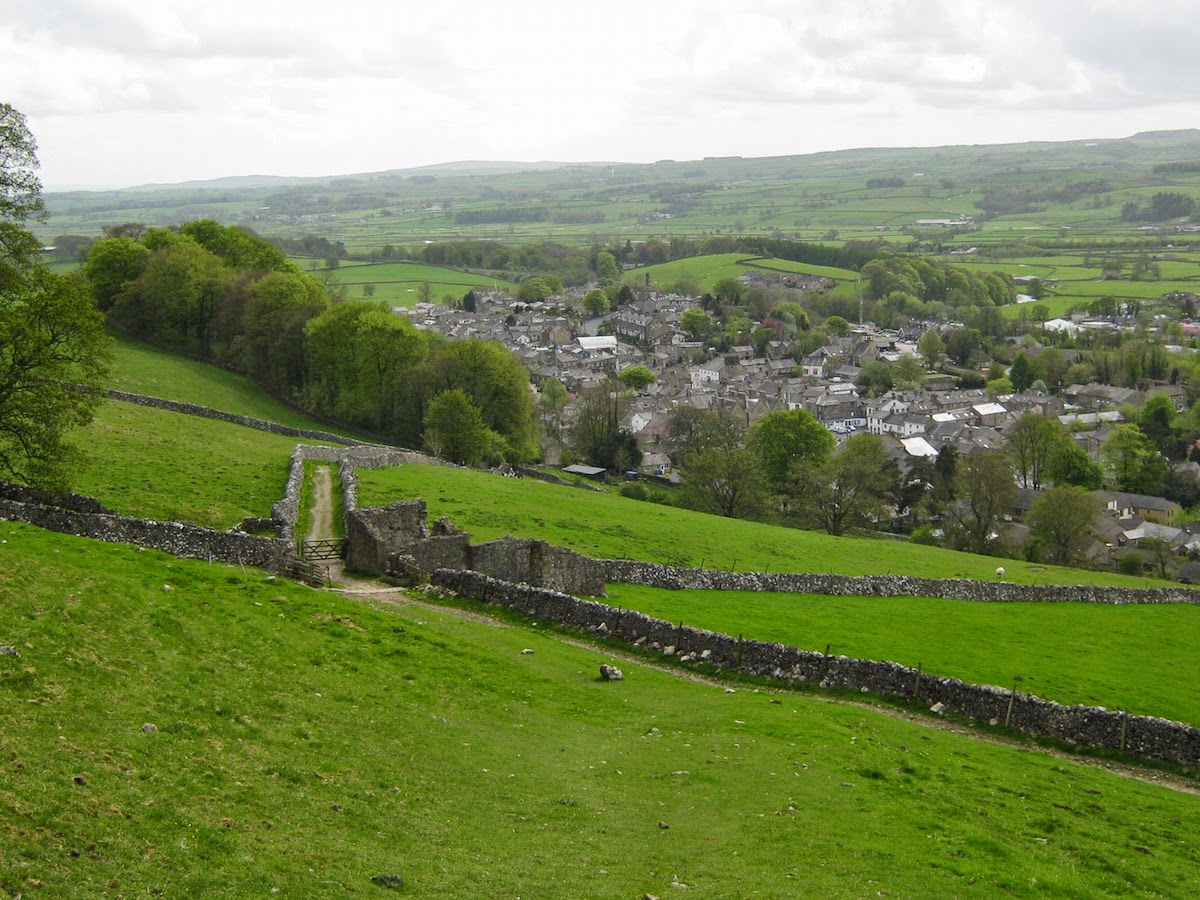 Departing SettleThe weather was fair but overcast as I left Settle, rapidly climbing the Dales High Way on grassy slopes towards Attermire Scar. It doesn't take long before the relatively built-up valley is left behind and limestone outcrops begin to dominate the hill pasture.
This is a lovely section of walking. Attermire Scar is an impressive shattered corrie, all secret places and hidden caves. I vaguely remember seeing it as a child but coming back here as an adult immediately made me think of ancient landscapes from Tolkien – a place dense with natural and human history. This sense of a semi-mythical landscape was to follow me throughout the entire walk.
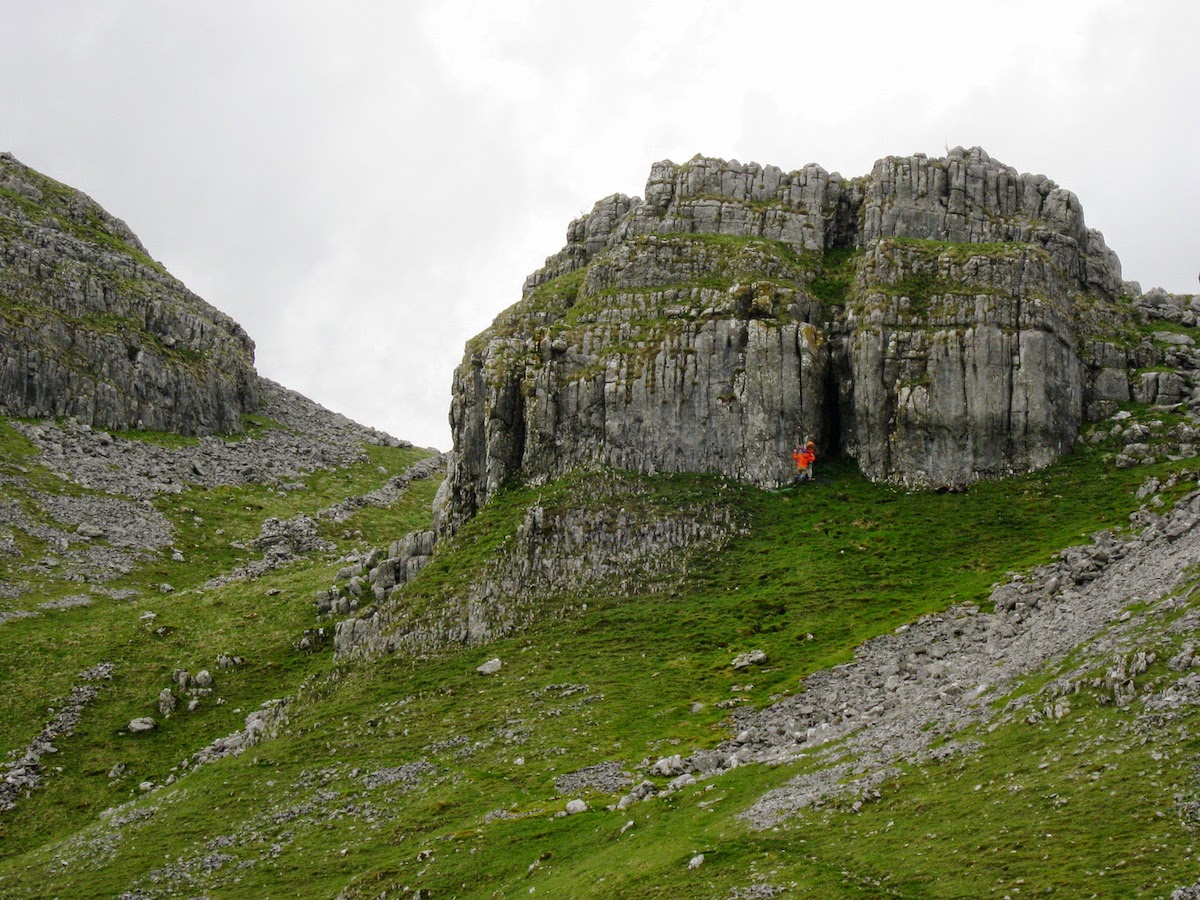 Cragrats at play
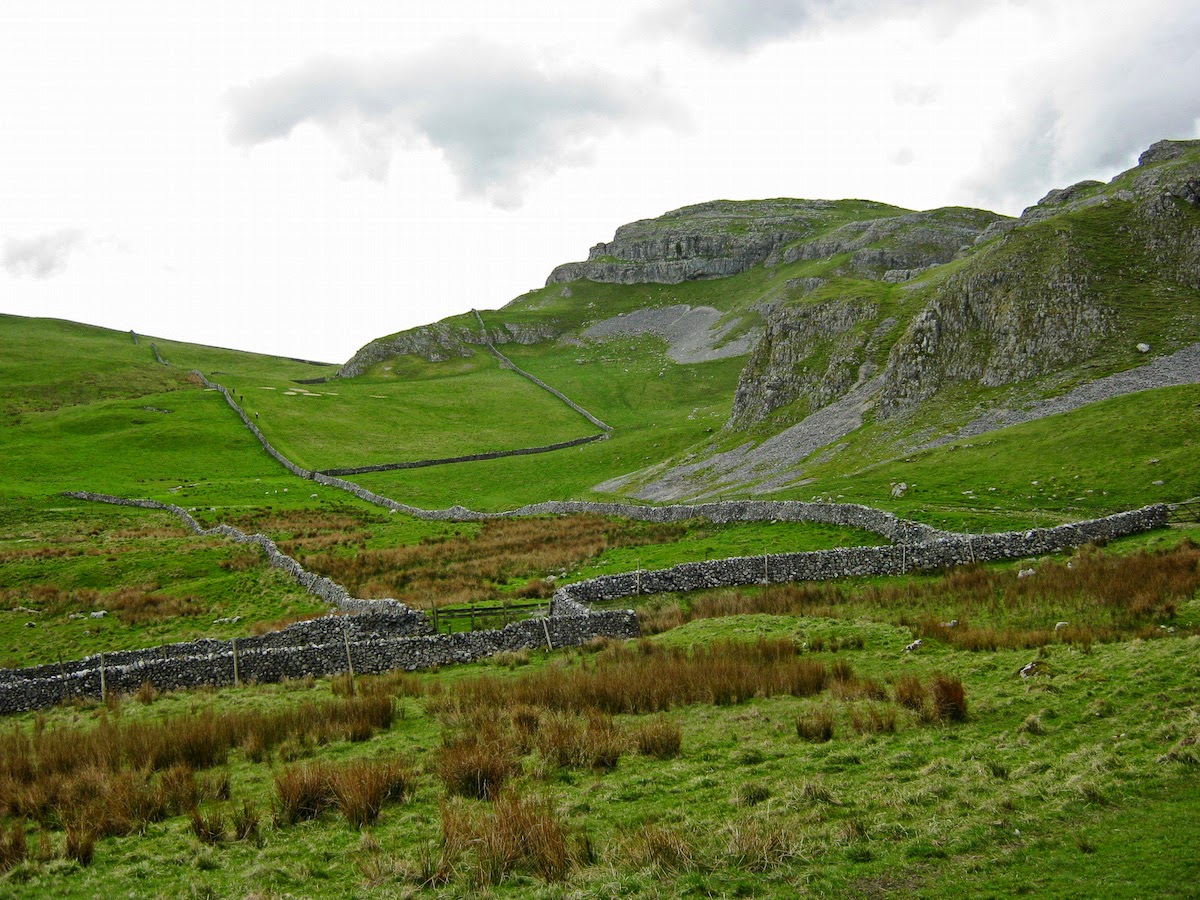
The ground is porous in limestone country, so becks – burns for the benefit of my Scottish readers – are relatively scarce. I knew I'd have to carry a bit more water than normal because many marked becks on the map would be dry. The first water source I encountered was a beautiful bubbling spring near Attermire Cave.
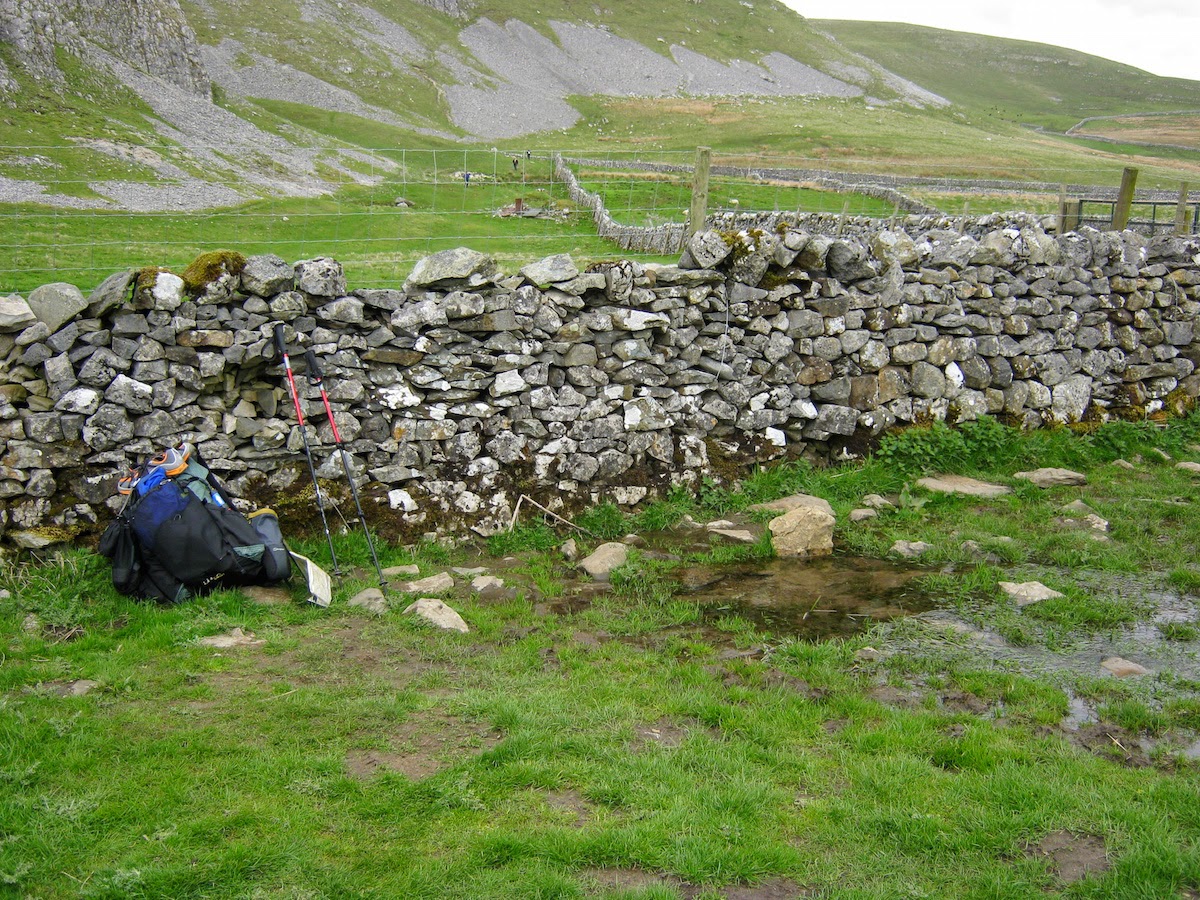 Topping up at the spring. The water was literally welling up from the ground
beneath my feet.Again the sense was reinforced that the surface of the land was merely the skin on a vast system, the majority of which was hidden and secret. Where did the water come from, and why was it being forced up from the depths of the earth? Who knows – possibly only cavers. It got me thinking about how landscape is so much more than what is seen by the passing walker.
I made rapid progress along the old road past Rye Loaf Hill and Kirkby Fell, soon dropping down to the steeper pass behind Pikedaw Hill. I remember coming up this way as a child, and as I passed the remnants of ancient mine workings the ghosts of old enthusiasms drifted to the surface ... is this the mine where malachite could be found? I remembered the excitement of hunting for minerals and fossils.
 A half-remembered sceneI dropped down to Malham. It was gone seven in the evening and the village was deserted. I pressed on, and fifteen minutes later marvelled at the novelty of having Malham Cove to myself – almost. There were no other walkers about, but climbers were larking about on the enormous overhanging cliff.
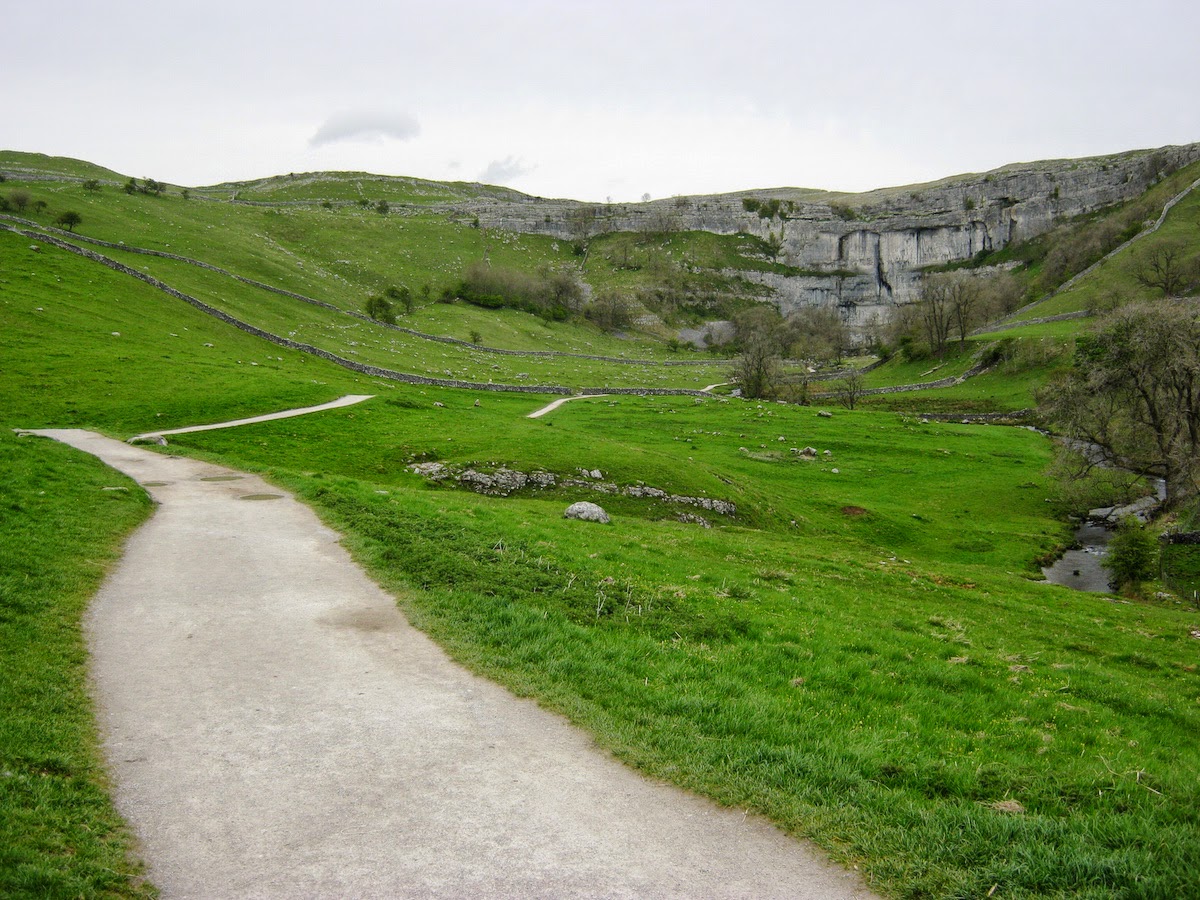 Normally this is a busy path.
 Too steep for the likes of me.Malham Cove is another old place of inspiration for me. The water that emerges at its base has been on quite an adventure after disappearing underground about a mile uphill, at a place called Water Sinks. Once you know a little about the geology of this area it adds an amazing extra dimension to your appreciation of the walk. I recommend this page for a basic overview. You'll never look at limestone hills in the same way again.
The limestone pavement at the top of Malham Cove is another impressive feature. It's easy to disparage the Pennine Way as a 'tourist trail', but let's not forget that it passes through some of the most amazing and distinctive landscapes in the British Isles.

After the limestone pavement, the path takes you through the Watlowes dry valley – another geological marvel. Thousands of years ago, this ravine contained a massive torrent from a melting glacier on the higher ground above. Now the water takes a dark and silent path far underground.
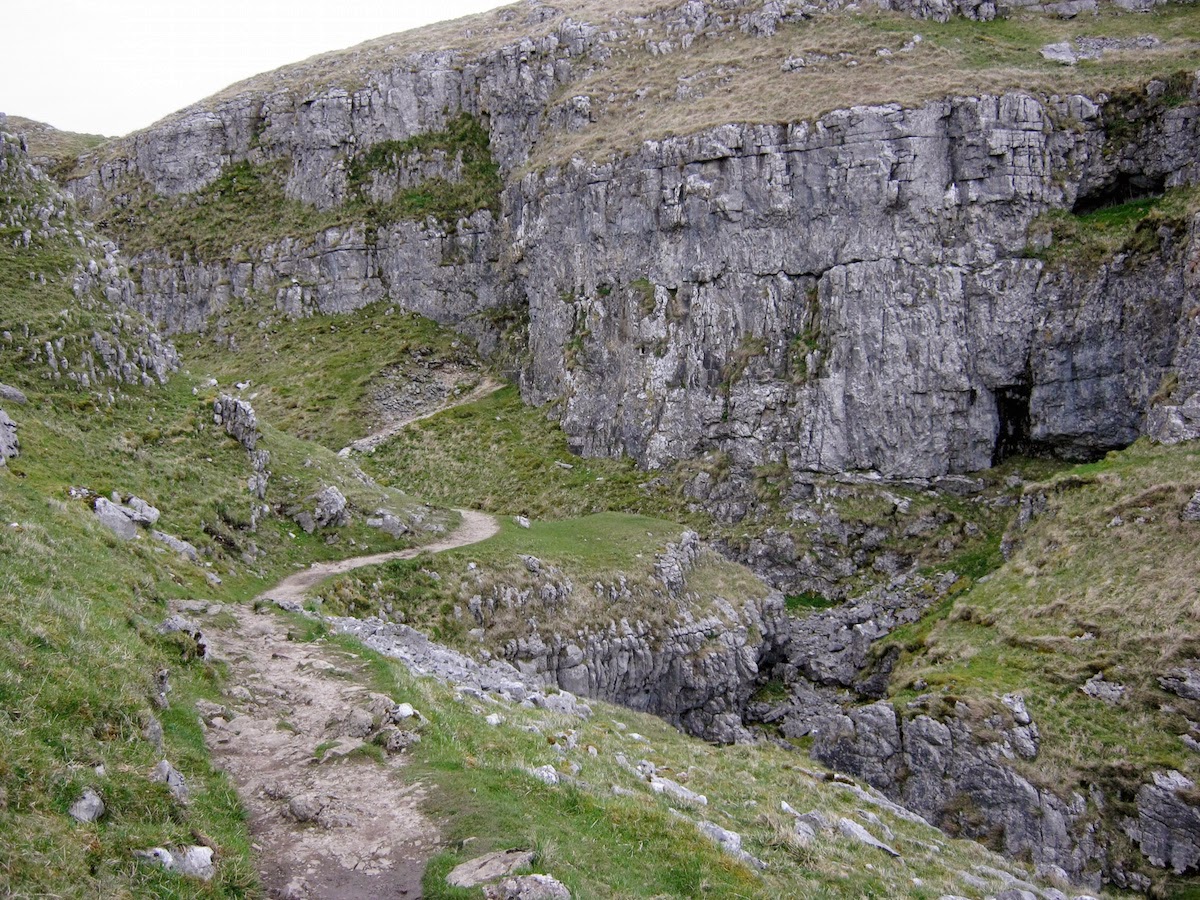 Watlowes. I was on the lookout for trolls.The wind was increasing by this point, and I was keeping my eyes open for potential campsites that might be sheltered. I considered a pitch in Watlowes but was reluctant to camp so near to the trail. The land above, near Water Sinks, was very exposed. In the end I kept going to Malham Tarn where I eventually found a relatively sheltered spot some way above the lake.
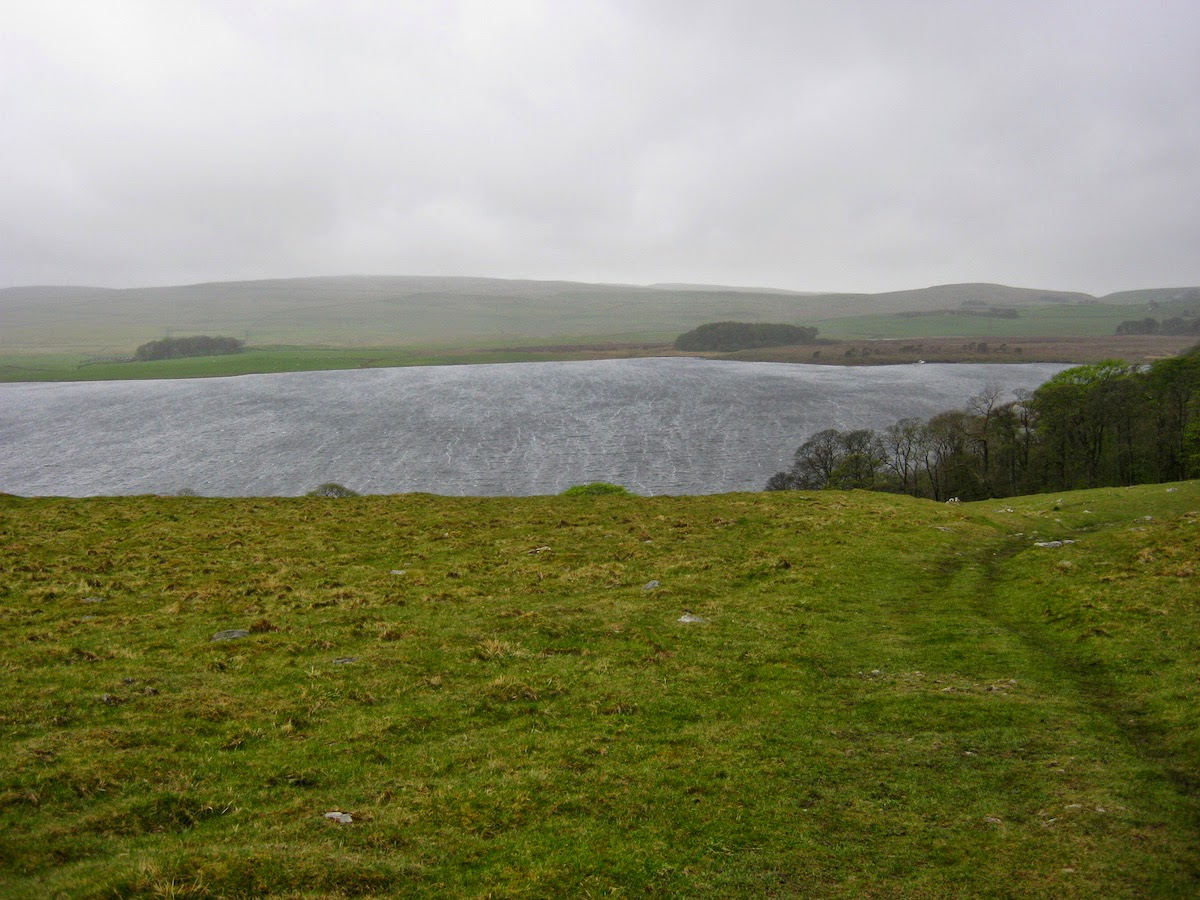 The wind starting to howl over the waters.
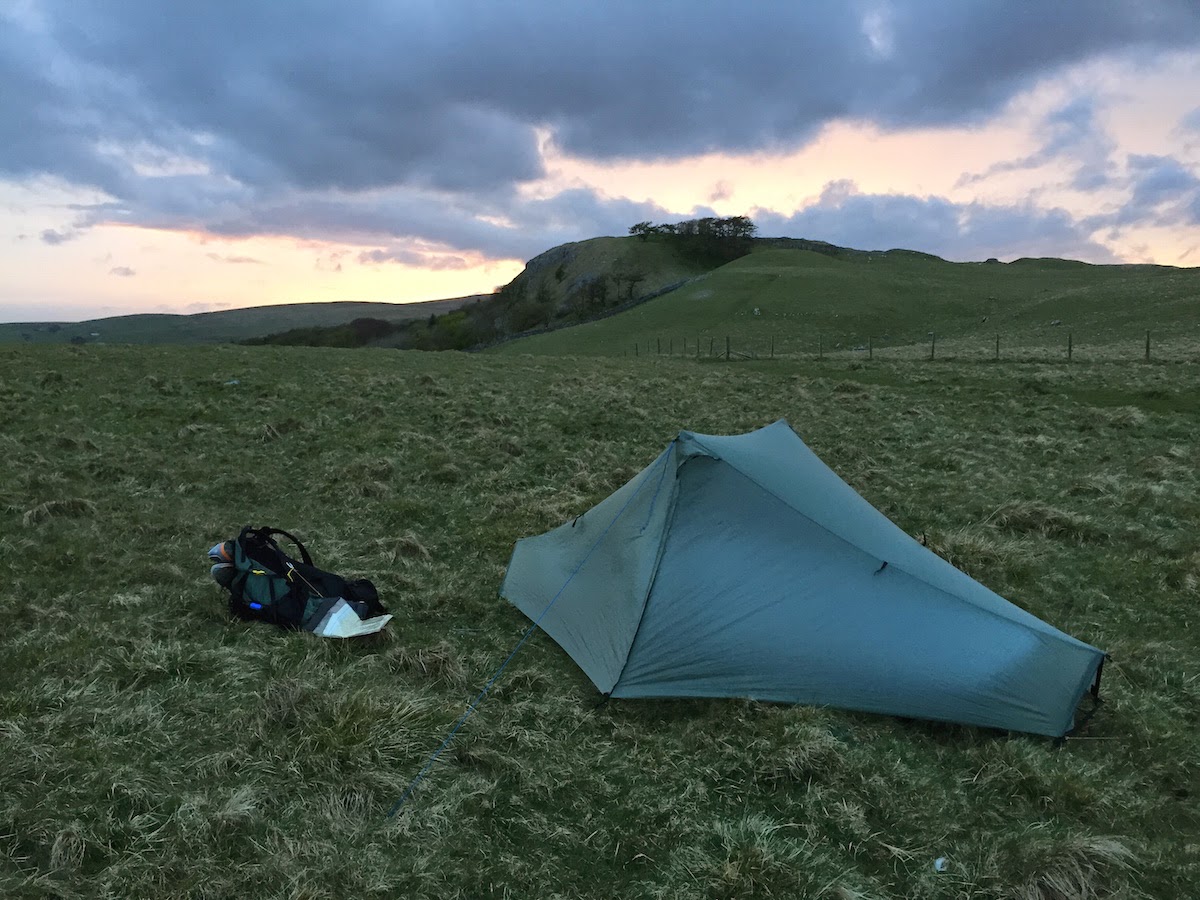 Camp one. Actually more sheltered than it looks, but still a windy spot
for the night.This was my first time using the Tarptent Notch in anger, and I have to say it coped very well with the galeforce winds overnight. (See my first impressions of this tent here.) The tapered ends cut into oncoming winds magnificently and the pole apex guylines held the structure rigid. Ventilation was excellent and there was no condensation to speak of. Thanks to my earplugs, I had a very good night's sleep – but woke to heavy rain and even heavier gusts the next morning.
Day two
I'd originally planned an off-path route over the high ground marked 'Out Pasture' on the map, then to follow Darnbrook Beck up Fountains Fell, but decided to take my 'foul weather alternative' which was to simply keep following the Pennine Way. The first mile or so was a trudge in driving rain and sleet which didn't let up until I started the ascent of Fountains Fell.
 The first break in the weatherFountains Fell is a hill my dad has spoken of many times. I'd never set foot on it myself, though, and he warned me about a bog at the top. Nowadays a good trail cuts through the bog and I succeeded in reaching the summit plateau without any serious bog-squelching, although my feet had become wet from water splashing through the mesh uppers. This was expected – I was wearing lightweight trail runners, after all – but given how foul the weather was I hadn't begun my planned schedule of swapping socks every two hours to allow them to dry. I'd also promised myself I would stop every hour to air my feet (an important precaution in such conditions when wearing trail runners). However, again the foul weather deterred me from making these stops, and it was much too tempting just to press on and ignore my damp feet.
At the top of Fountains Fell there was a rather alarming warning notice:

And sure enough, not far from this location:
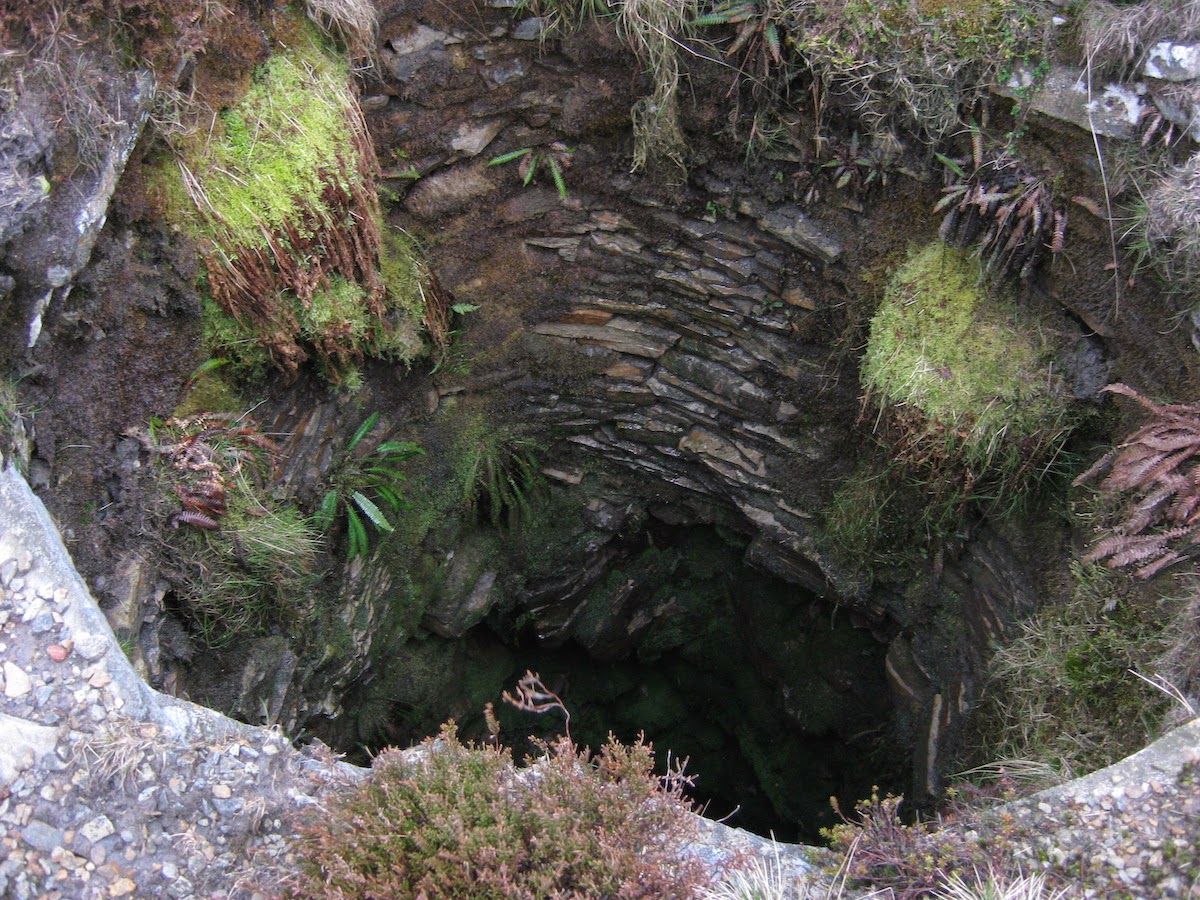
Crikey!
The descent from the top was much boggier and a squelchy time was had, although the view was significantly better on this side of the hill. Pen-y-Ghent and Ingleborough looked starkly majestic – and also very remote. I was about fourteen miles into my route and this was my first real reminder of the distances I had yet to cover.
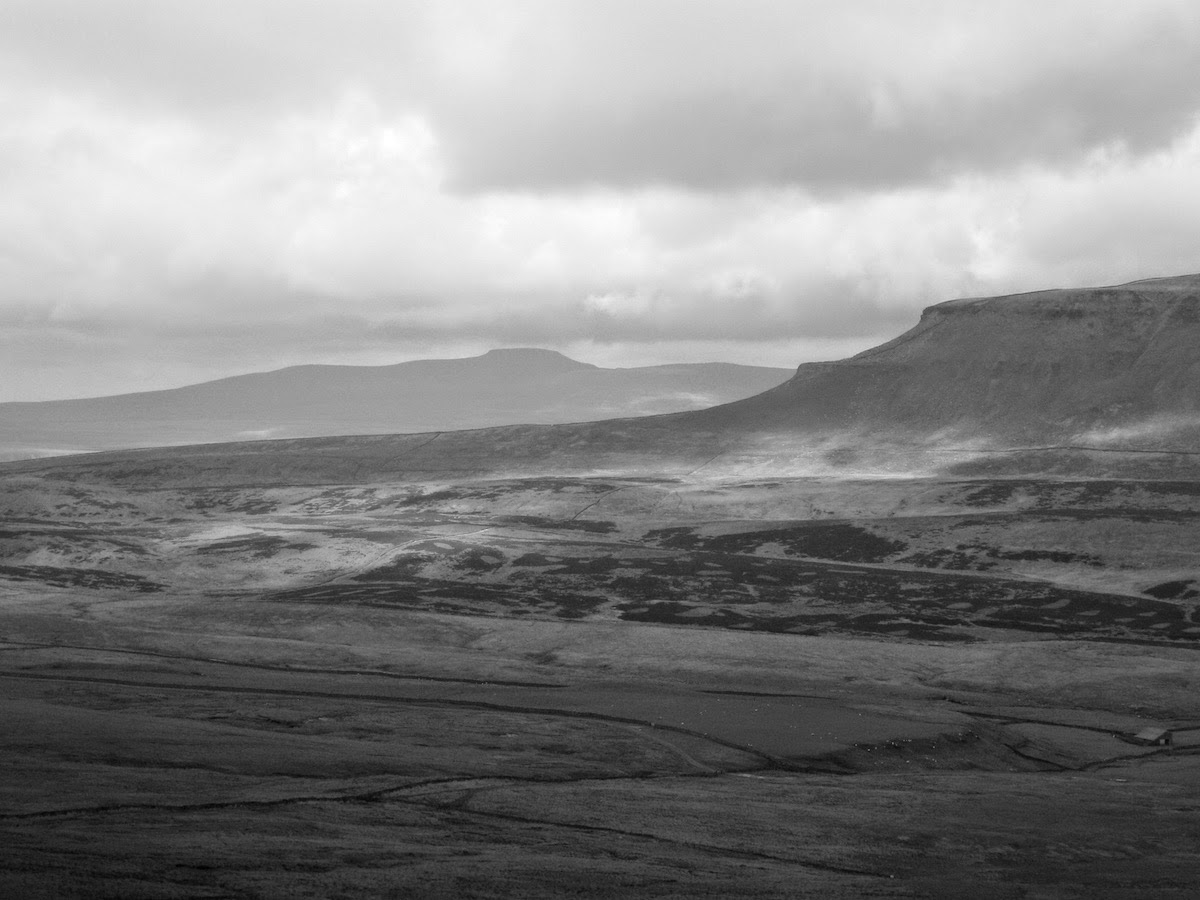
Fortunately the weather was beginning to improve, with occasional breaks in the cloud base and longer pauses between showers. Still, I didn't stop to dry my feet or change my socks; given the boggy ground, I thought it would be fruitless. With hindsight this was a mistake.
I made good time to the start of the climb to Pen-y-Ghent. By this point the wind was on the increase again, but I found a sheltered spot and finally paid attention to my feet. They were wet and wrinkled. I let them dry for ten minutes and put on some dry socks, then attached the damp ones to the back of my pack to dry in the wind.
 Pen-y-GhentPen-y-Ghent is a beautiful mountain, and it looks bigger than it actually is. The steep climb up the nose is deceptively short, although it features a brief section of easy scrambling. The wind was now so bad that a group of army cadets behind me decided to turn back when one lad was bowled over by a gust. I kept going, but I paid great care to my balance on the rocky section, and was thankful for my lightweight pack.
The wind shrieked and howled through the gaps in the stone wall to my left, like a chorus of angry spirits defending their mountain against intruders. Maybe I had The Lord of the Rings on my mind again but I half expected to find the Ringwraiths waiting for me on the summit.
I paused for a bite to eat at the summit shelter then pressed on.
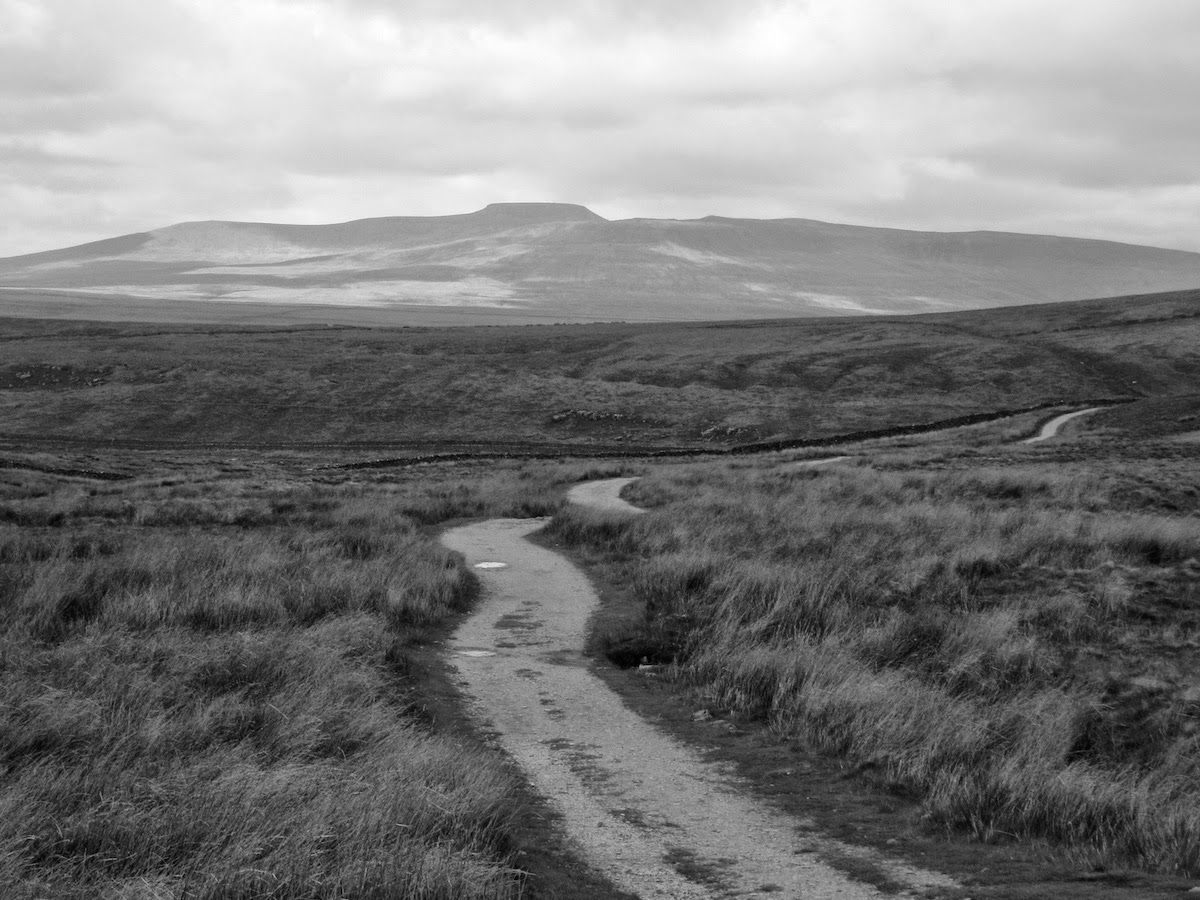 A long way still to go.On the way down I met a couple who had wisely decided to turn back, given that the wind was gusting 40mph+ and they were not particularly well equipped. I stopped to change socks and dry my feet again, but probably didn't stop for long enough; my feet were still decidedly damp when they went back into damp socks and damp shoes.
As I approached Horton in Ribblesdale I noticed that a point on the sole of each foot under the heel was sore. I inspected the damage, dreading a blister, but to my surprise I could see nothing at all. Back on with my shoes; again a slight but noticeable soreness with each step.
When I reached Horton, I stopped for half an hour in the pub for a pint and a chance to dry my feet off properly. The soreness was a bit more pronounced this time, and the skin (which was still macerated, despite belated attempts to dry off) was a little red. Suddenly I remembered an occasion when this had happened to me before – I realised it was the first stage of immersion foot! Clearly I had not been taking good enough care of my feet.
I set off from Horton at about three in the afternoon in another heavy rain shower, travelling along the path of Sulber Nick, which passes through more interesting limestone pavement. I was actually considerably ahead of schedule by this point, as I had intended to camp somewhere in this vicinity overnight. I took my time exploring the moors.
Finally, at about half past four, I realised I could go no further without encountering steeper ground where good camping spots would be difficult to find. It was still windy at this point but the forecast was significantly better for the next day. I found a stone wall to use as a windbreak and pitched the Notch.
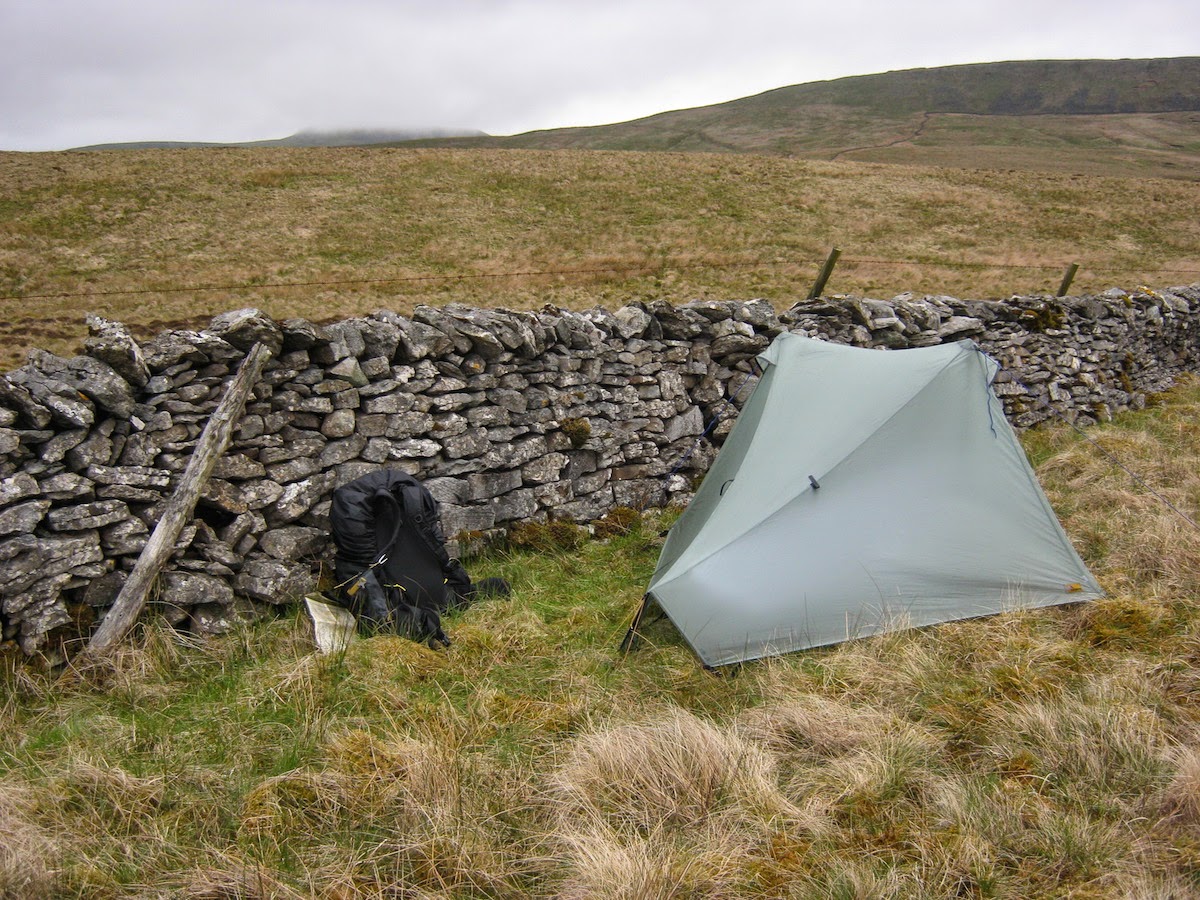 Camp twoNeedless to say, the first thing I did when getting into my shelter was to take off my socks and take a proper look at my feet. This is where I made a slightly foolish error. I had brought some Gehwol Extra foot cream with me, which is highly recommended by walkers who use it to keep feet in good condition when faced with wet weather. I'd never used Gehwol Extra before and was keen to assess its suitability before it earns a place in my Cape Wrath Trail pack. I slapped a good covering on to each foot in the belief it would aid recovery.
The thing is, there are several different sorts of Gehwol cream. I later discovered that the Extra variety is a barrier cream, not a recovery cream. It's my belief that applying it when my feet were damp actually prevented them from drying out properly, because about half an hour after going to sleep I woke up with very itchy feet – another symptom I remember from my last encounter with immersion foot.
 Airing gear. The socks went inside my sleeping bag liner to completely
dry out overnight.
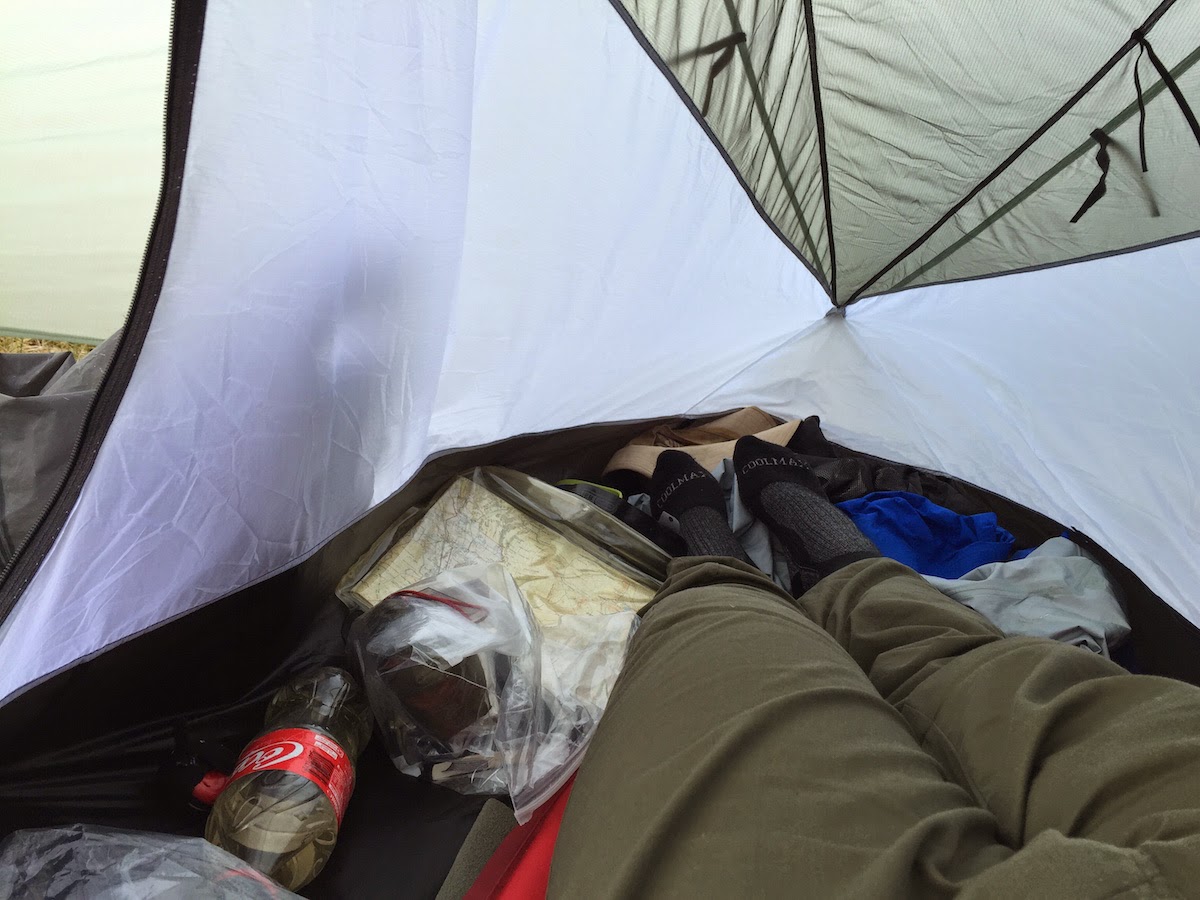 The interior of the Notch is surprisingly roomy.
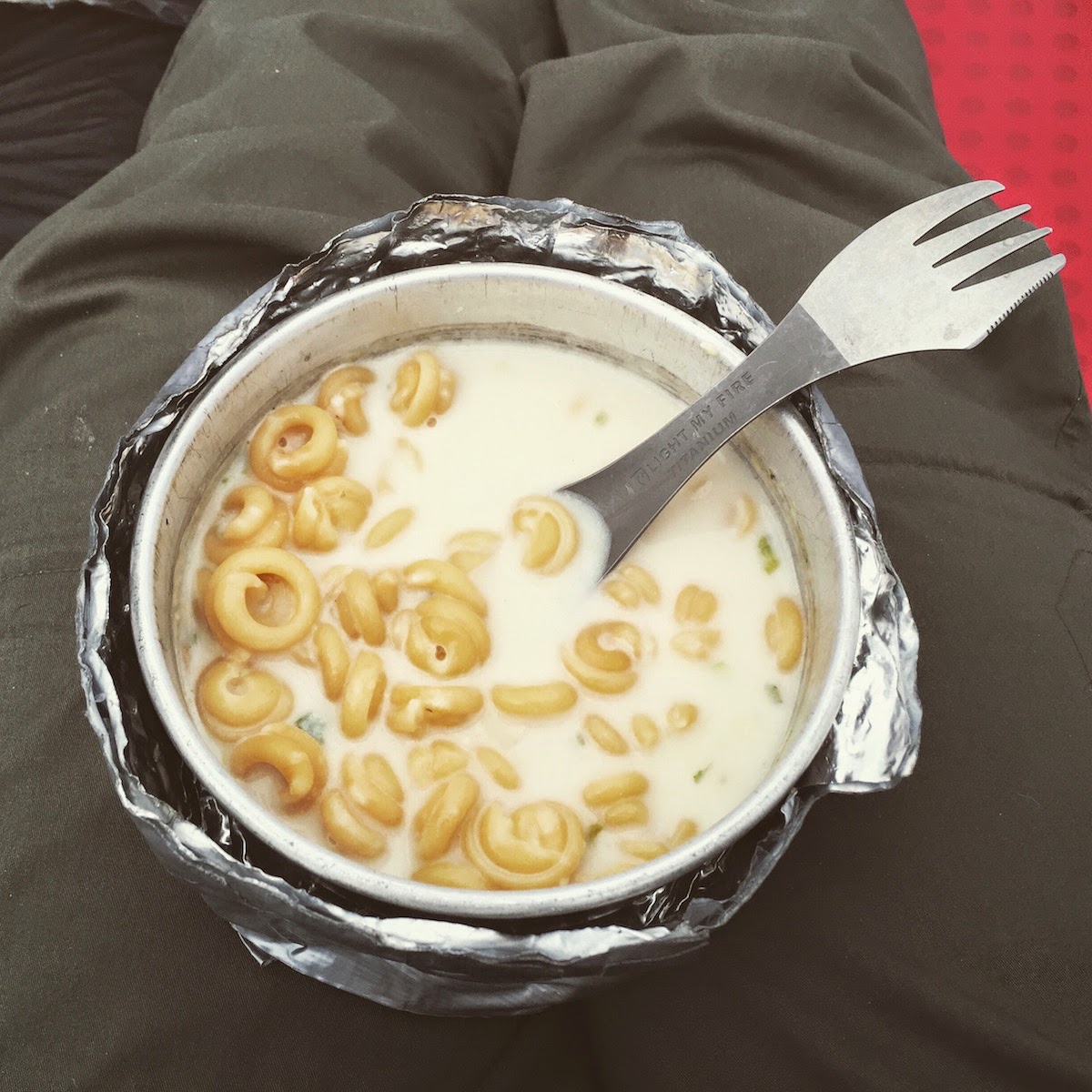 Pot cosy cooking. It really does work!Day three
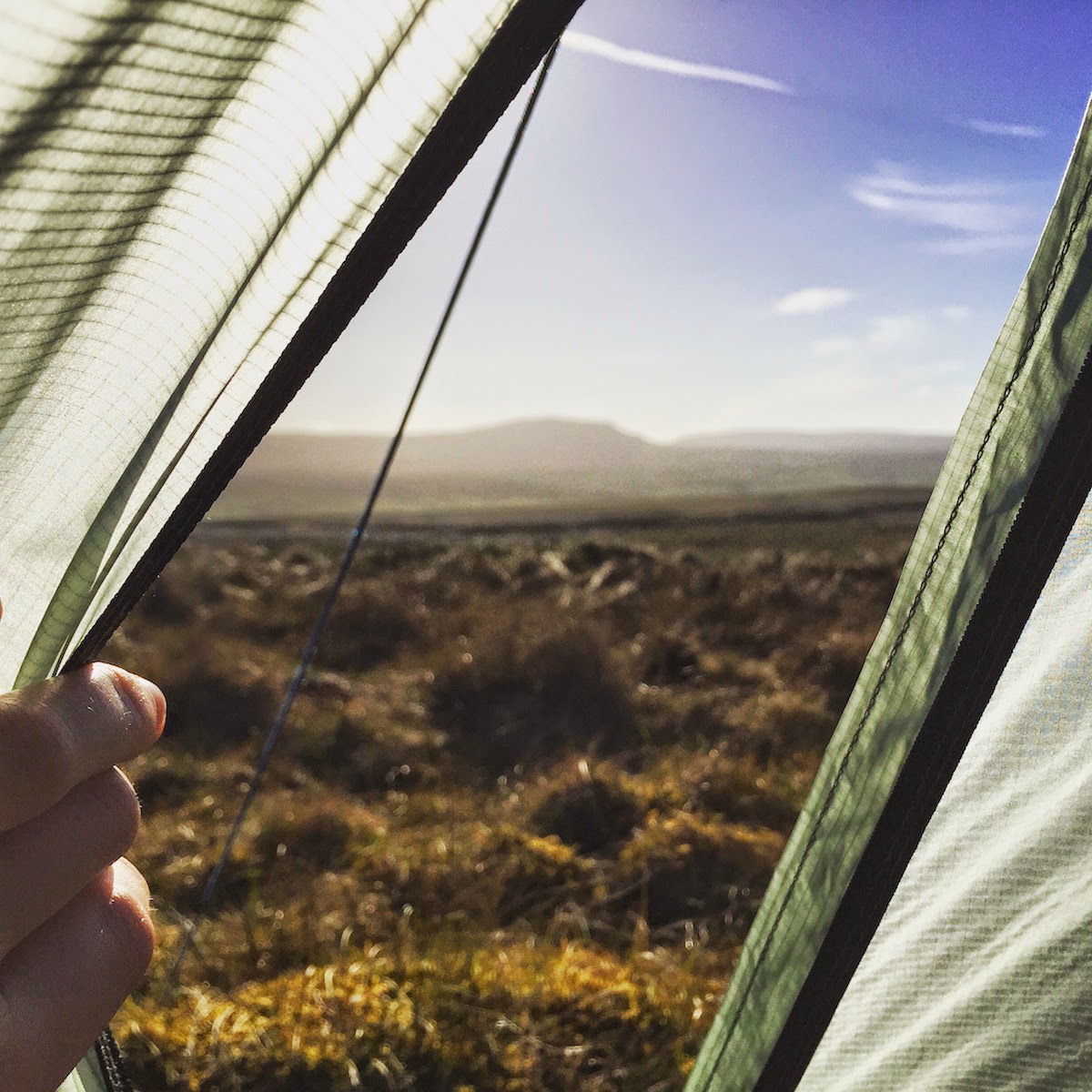 Well hello, blue skies!I knew I'd overslept when I felt myself slowly roasting in my sleeping bag. The full sun was on my tent and it was already warm outside. I breakfasted and packed in less than half an hour, and was back on the trail by half past nine (later than I had intended).
But what about your feet? I hear you cry! The itching was gone, replaced with a slight tenderness when taking a step, and again the soles were red beneath the heel. This was the point when I figured out that I had made a mistake in applying the Gehwol when my feet were still wet, because they did not dry out adequately overnight. Fortunately I'm more competent when it comes to my gear, and had made sure my shoes and socks were entirely dry.
As an aside: I'm focusing a lot on my foot issues here, but at the time it was no more than a minor irritation. It certainly didn't affect my enjoyment of the walk. Consider this post-hike analysis!
The ascent to Ingleborough's summit ridge was a delight. I'd never climbed this mountain before, and it pleasantly surprised me. There was nobody else about, the skylarks were singing, and I could see for miles in every direction. What more could you ask from a hill?
 Wide views from near the top of Ingleborough.
 Looking back to the route of my ascent.The summit itself is a robust cap of gritstone, a natural fortress; it's no wonder that it was used as a stronghold in antiquity. I imagined myself as an ancient Briton patrolling the ramparts, watching the forested wilderness beyond for advancing Roman legions.
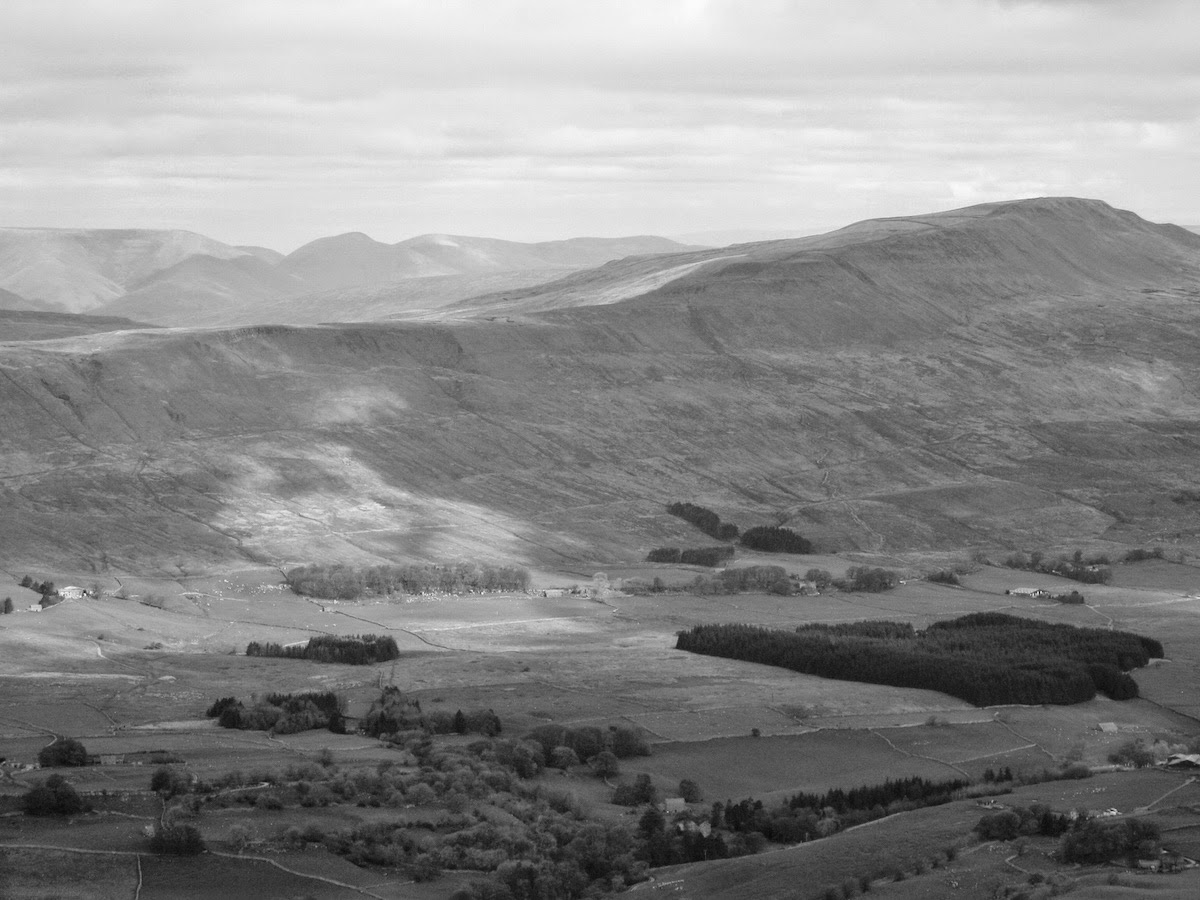 The forests are mostly gone now, but it still looks prehistoric, doesn't it?I had the summit to myself. There's a very solid shelter right at the top.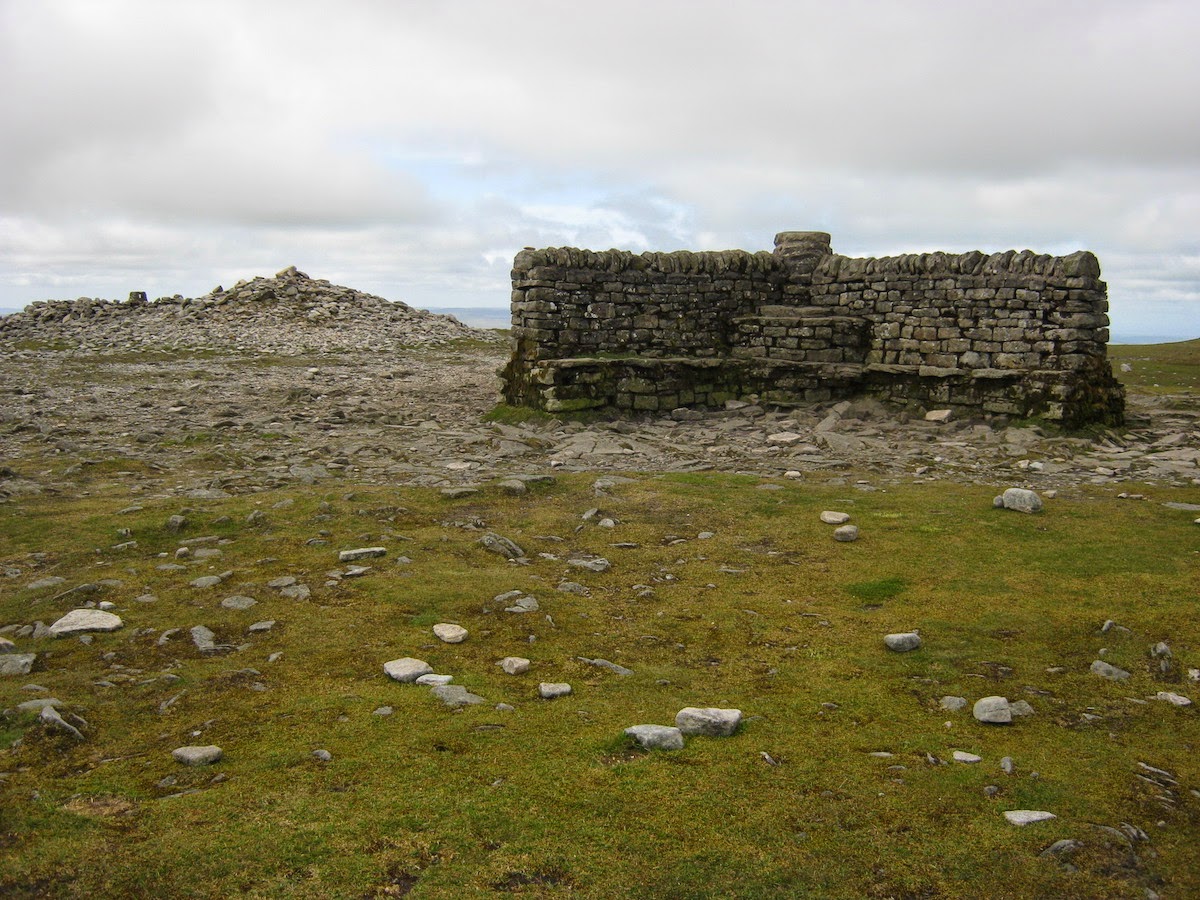
After stopping for a snack, I dropped down from the summit cap and took a traversing line east to find the south ridge path. The traverse, along a natural terrace, was full of interest – the ground was liberally dotted with shake holes, some opening up to caverns, others filled with water. Again I was reminded that there is a lot going on beneath the surface of these hills.
I jogged down the south ridge. My feet were feeling a little more sore, but I was making good time and the terrain was dry, so I didn't bother to stop and air my feet every hour as I had originally planned.
When I passed Gaping Gill, I saw an enormous encampment of tents and a semi-permanent-looking winch arrangement at the entrance. A sign identified the campers as members of the Bradford Pothole Club.
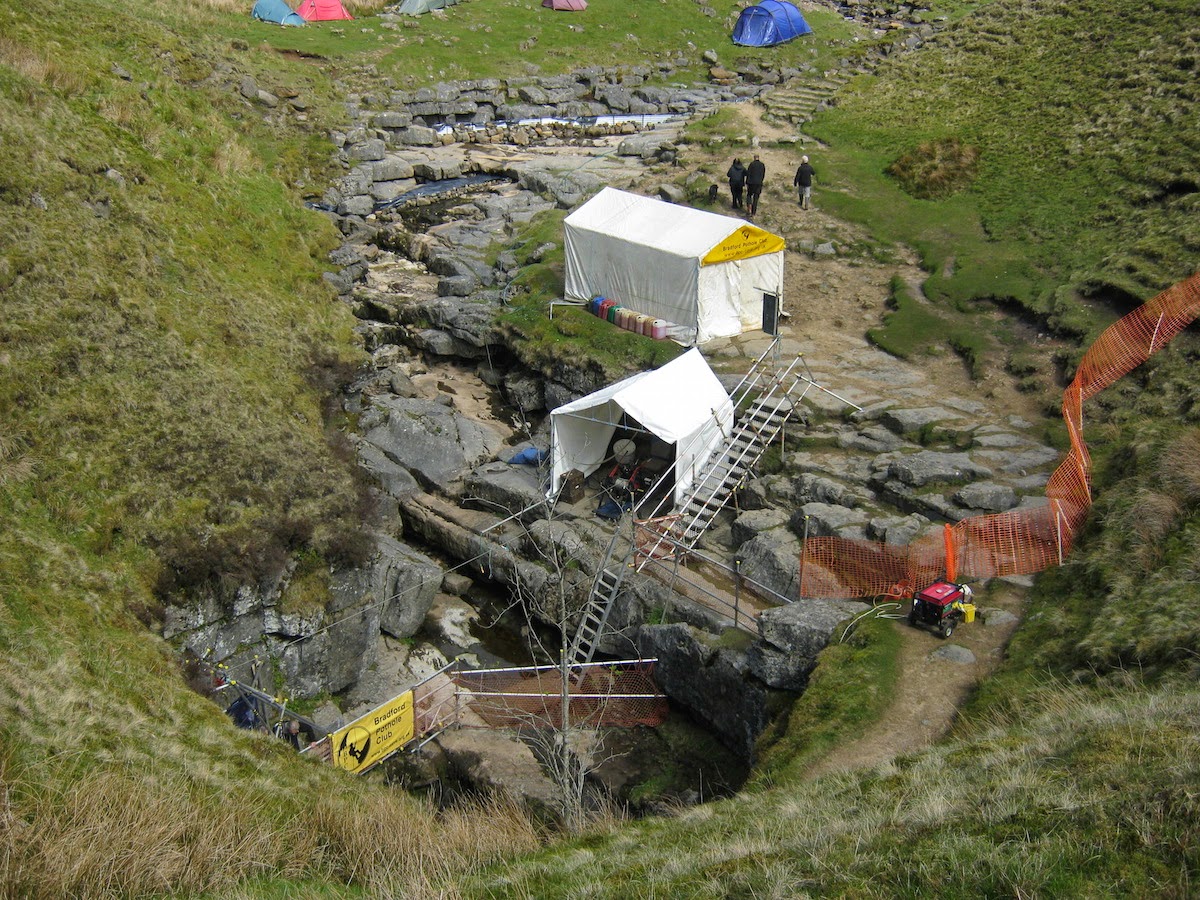
The way down took me through some beautiful countryside. I trod delightful grassy slopes in an area marked Clapham Bottoms, then followed good paths to the top of Long Scar and down into Crummack Dale.
 A view back to Ingleborough.

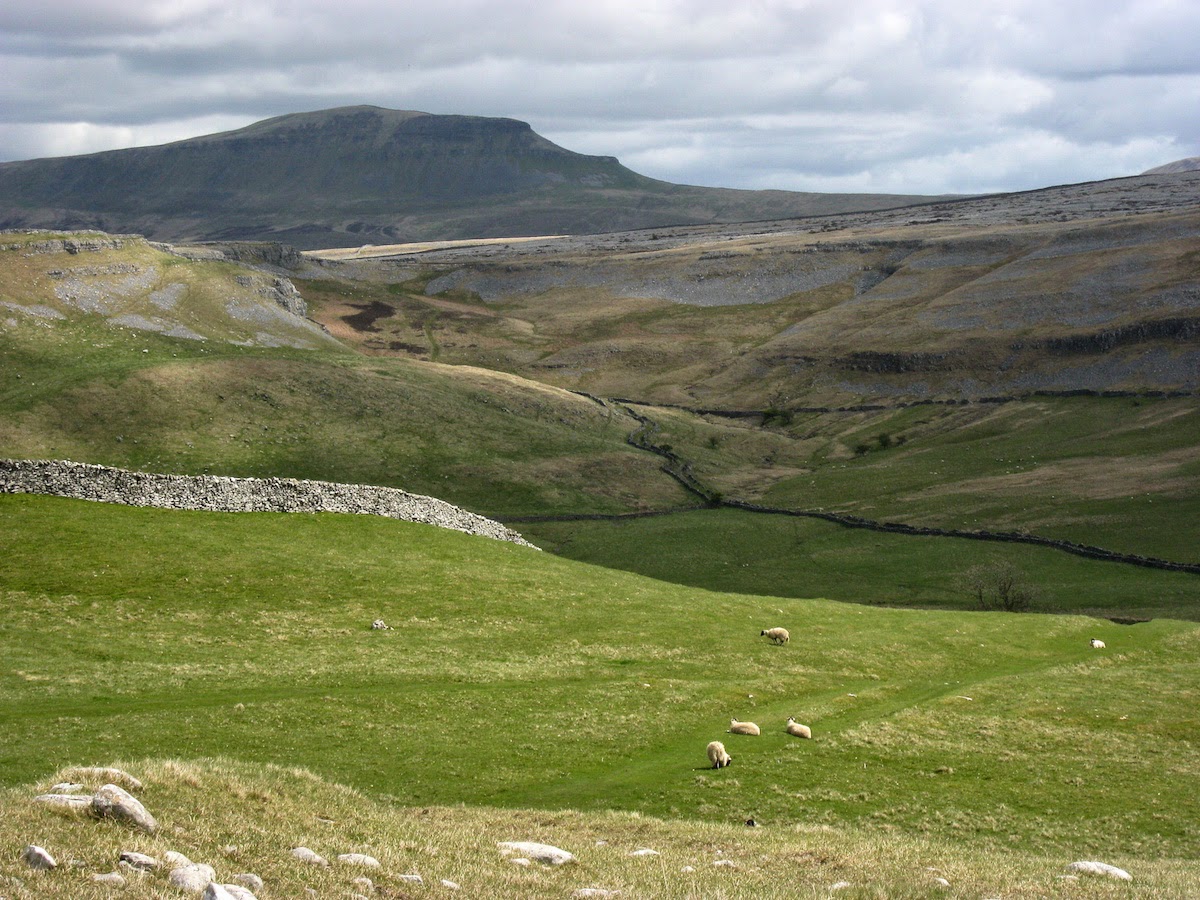 Another view of Pen-y-Ghent.
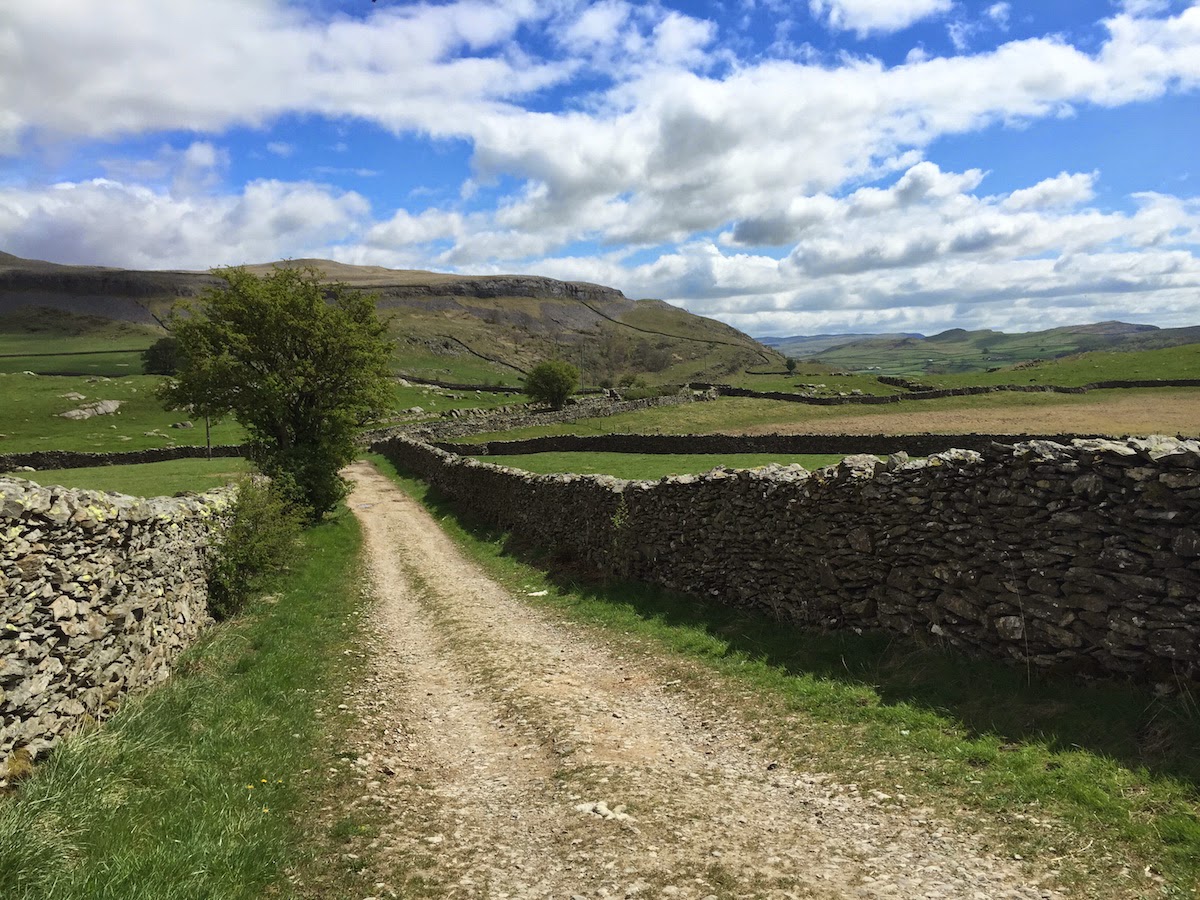 The bridleway to Wharfe.There were more walkers about that day, thanks to the great weather, and for a while I found myself walking with a group of ramblers who were looking for a bluebell field. It was at some point after passing the hamlet of Wharfe that I became aware that the soreness in my feet was worse than it had been at the start of the day, and it seemed more painful when going downhill (as this placed more pressure on the soles of my heels). I stopped a couple more times to let my feet air, but not for long enough; the pint at the end of the journey was calling me on, and I had a train to catch.
In the end I reached Settle at about three in the afternoon. I was footsore, but overjoyed at having completed a stunning three-day walk in the Dales.
 Job done.Final remarks
The route I completed this week was great. It has grand hills, scenic dales, geological wonders, and the nature of the landscape stimulated my imagination every step of the way. I was accompanied by the trolls and goblins of my childhood imaginings as I walked. Certain places reminded me of locations from Tolkien, and as I strode out the miles I found myself constantly wondering at the subterranean secrets buried far beneath my feet.
Most of my new gear acquisitions have proven themselves already. The Tarptent Notch was rock solid in high winds, and the ÜLA Circuit backpack was supremely comfortable. My first attempts at pot cosy cooking were completely successful and I think this technique will save me a great deal of fuel on the Cape Wrath Trail. Overall, this is the first time I'd been backpacking with a pack that light (less than 10kg including food) and it really made a huge difference to my experience on the trail.
And I've learned a valuable lesson when it comes to foot care. Trail runners have many benefits – I have, after all, just walked 37 miles without a hint of a blister or much fatigue to speak of – but on wet days your feet are going to get wet. Keeping your feet as dry as possible is a challenge that needs to be taken seriously. I knew that already in theory, but a touch of immersion foot does tend to sharpen you up. A day later I'm happy to report that the soreness and redness is greatly reduced.
Here are the things I learned when it comes to using trail runners on wet terrain:
Even on dry days, it's important to regularly take off socks and shoes to let the feet air.On wet days, I'm going to rotate two pairs of socks on a two-hourly shift pattern. The drying pair will be attached to my rucksack or fitted over the handles of my trekking poles. Feet must be absolutely dry before going to sleep.Socks and shoes must be dried overnight.Gehwol Extra is a barrier cream to be applied in the morning to completely dry feet, to minimise maceration. It shouldn't be applied to damp feet in the evening as I believe it actually helped to stop my feet drying out.On multi-day trips, foot care is really important!After years of suffering from blisters I finally have that one nailed down, only to find that my new strategy places me at higher risk from immersion foot. Every trip is a learning experience!
Backpackers: any tips for dealing with wet feet that you'd like to share?
May 5, 2015
Ten years ago
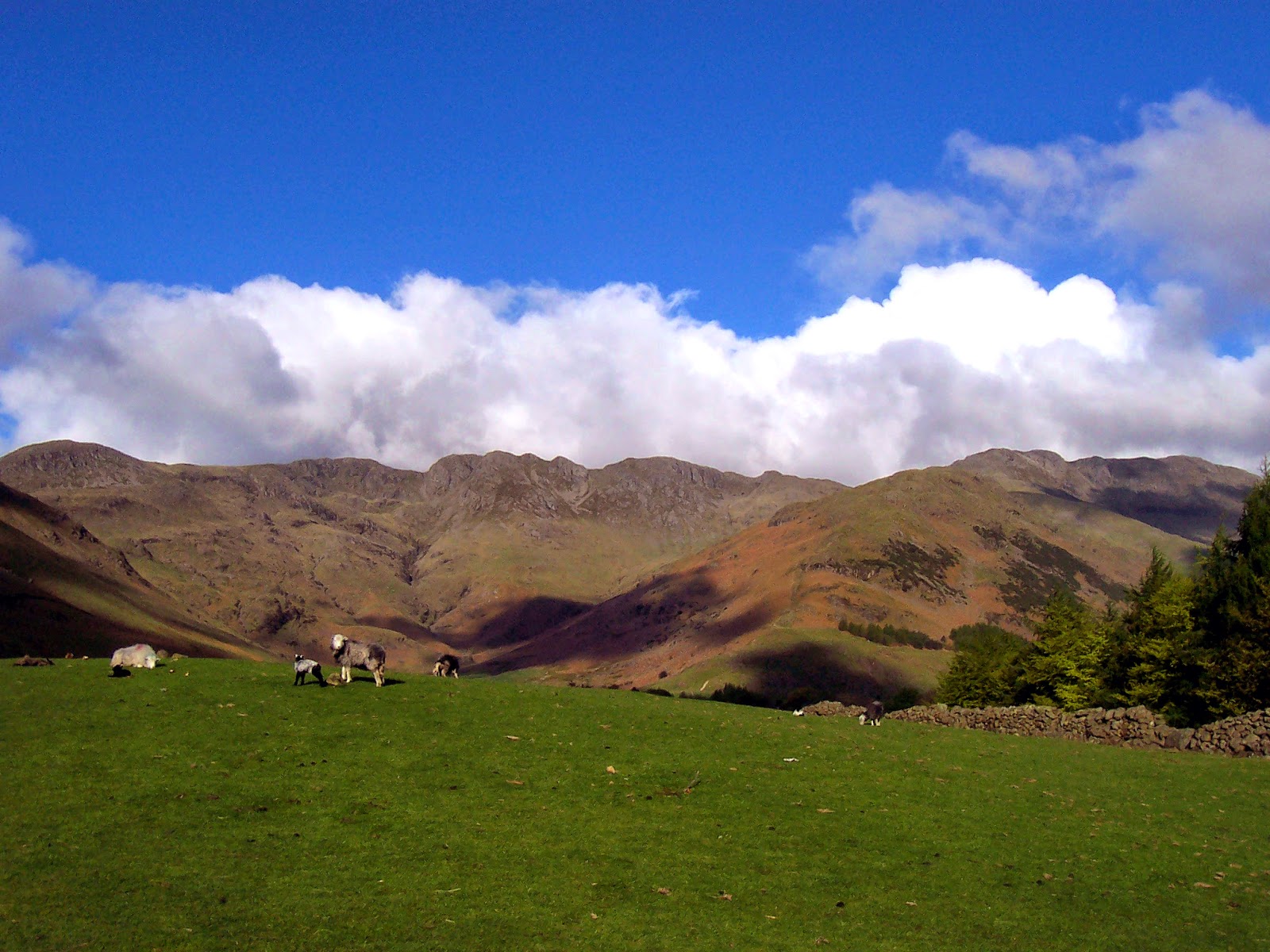
Ten years ago right now — at precisely 11 a.m. on May the 5th, 2005 — I was taking my first steps on an amazing journey. At the time it didn't feel like very much, but in a very real sense that journey continues to this day, and maybe I never left the trail at all.
Background
Between 2002 and 2005 I was a lowland walker. I walked hundreds of miles through the forests, across the heaths and along the coastlines of Suffolk, but I only rarely ventured into the hills. I was not a hillwalker, although I wanted to be one.
In late 2005 I had a place at the University of East Anglia coming up, and I had the idea that this would spell the end of my wanderings. I wanted to do one last big trip while I still could. The trip acquired a code name: the terminal trek. I planned to do a hell of a lot of walking and visit the tops of as many Lakeland fells as possible in twenty days, transforming myself from a rambler to a hillwalker in the process.
So, on the 5th of May 2005, I found myself slogging up the Walna Scar Pass towards Dow Crag in horizontal rain and 40 mph winds. I had a cheap non-breathable waterproof coat, a decidedly non-waterproof rucksack, and had never heard of gaiters.
Say hello to the eighteen-year-old Alex Roddie:
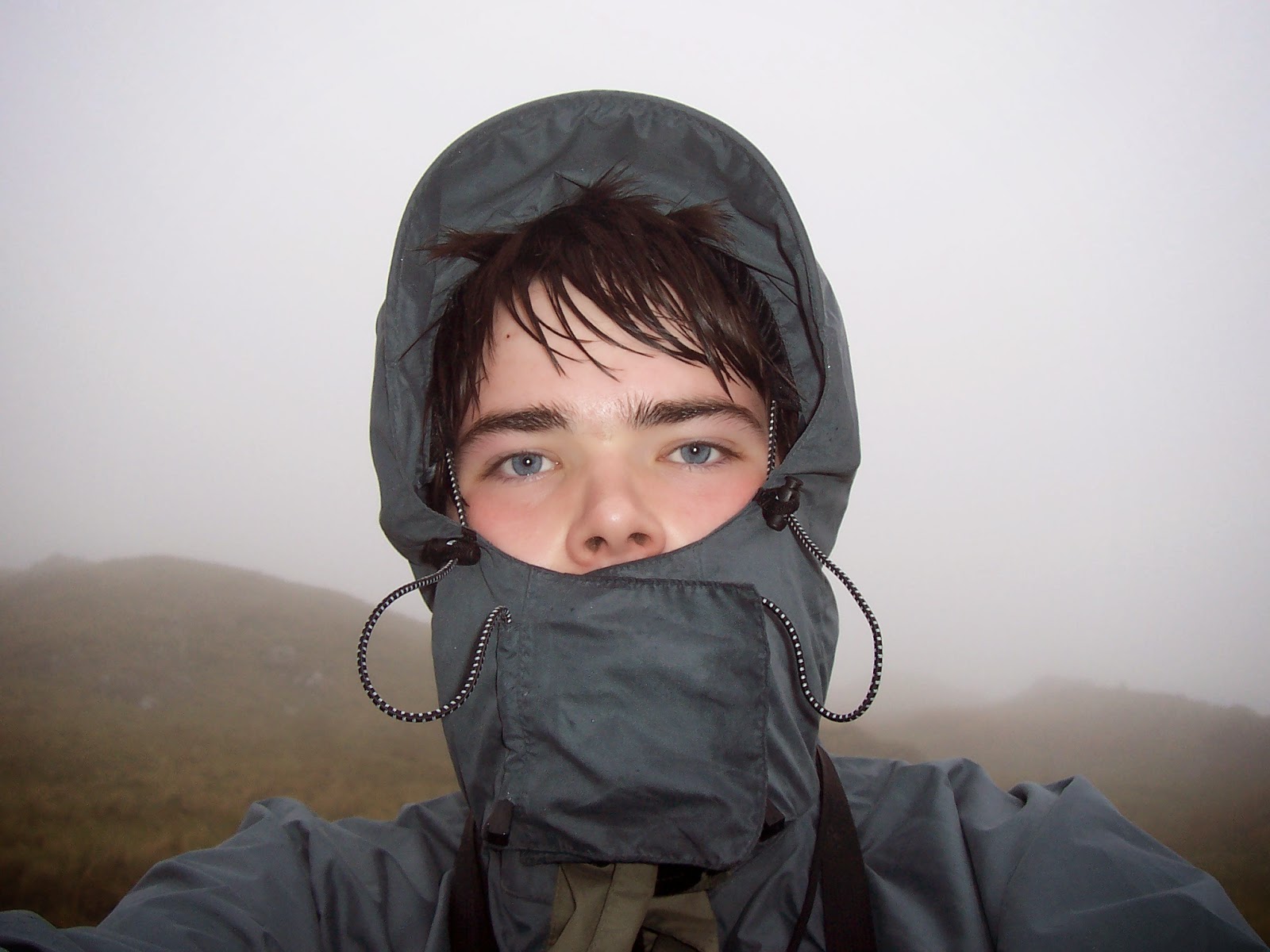 Are we nearly there yet?I climbed Dow Crag and Coniston Old Man, but didn't see so much as a hint of a view. Nevertheless, I had climbed a couple of decent mountains, and despite being a little knackered the next day I had the sense that something had changed in me. I was awakening.
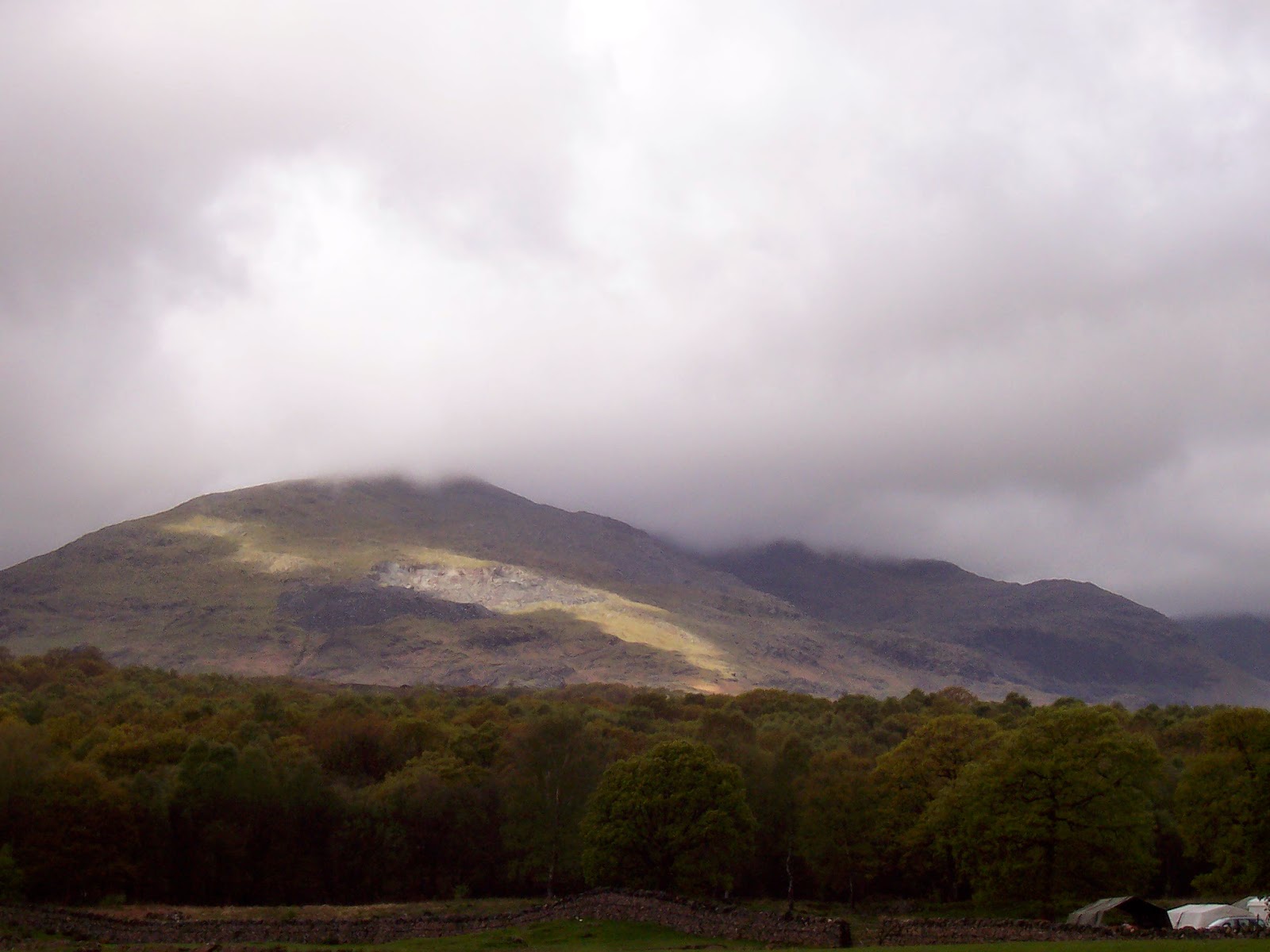 View of the mountain from my campMy journal entry for the next morning reads as follows:
Another very cold morning. Most of my clothes are still damp, which means I am forced to stay inside my sleeping bag to keep warm. My boots are the real problem: a lot of water got into them by the ankle cuffs yesterday, and they haven't dried out yet. How am I supposed to go anywhere if my boots are wet? I can't risk getting these socks wet as well. I only have another five spare pairs.It makes me smile. It was, of course, the first step of a long learning process in the mountains, and ten years later I'm still learning.
May started cold and wet that year. Over the following week I frequently encountered torrential rain, sleet, snow, the lot — more like April in Scotland. Nevertheless, the weather did improve, and I moved my base of operations into Langdale.
 The Langdale PikesI had never been to Langdale before, and I fell in love with the valley immediately. I climbed virtually all of the Langdale fells on various days, starting off with Pike o'Blisco and Cold Pike, gradually building up to an ascent of Bowfell on my final Langdale day. Clawing up the River of Boulders made me feel like a proper climber. But I could see bigger and better things in the distance.
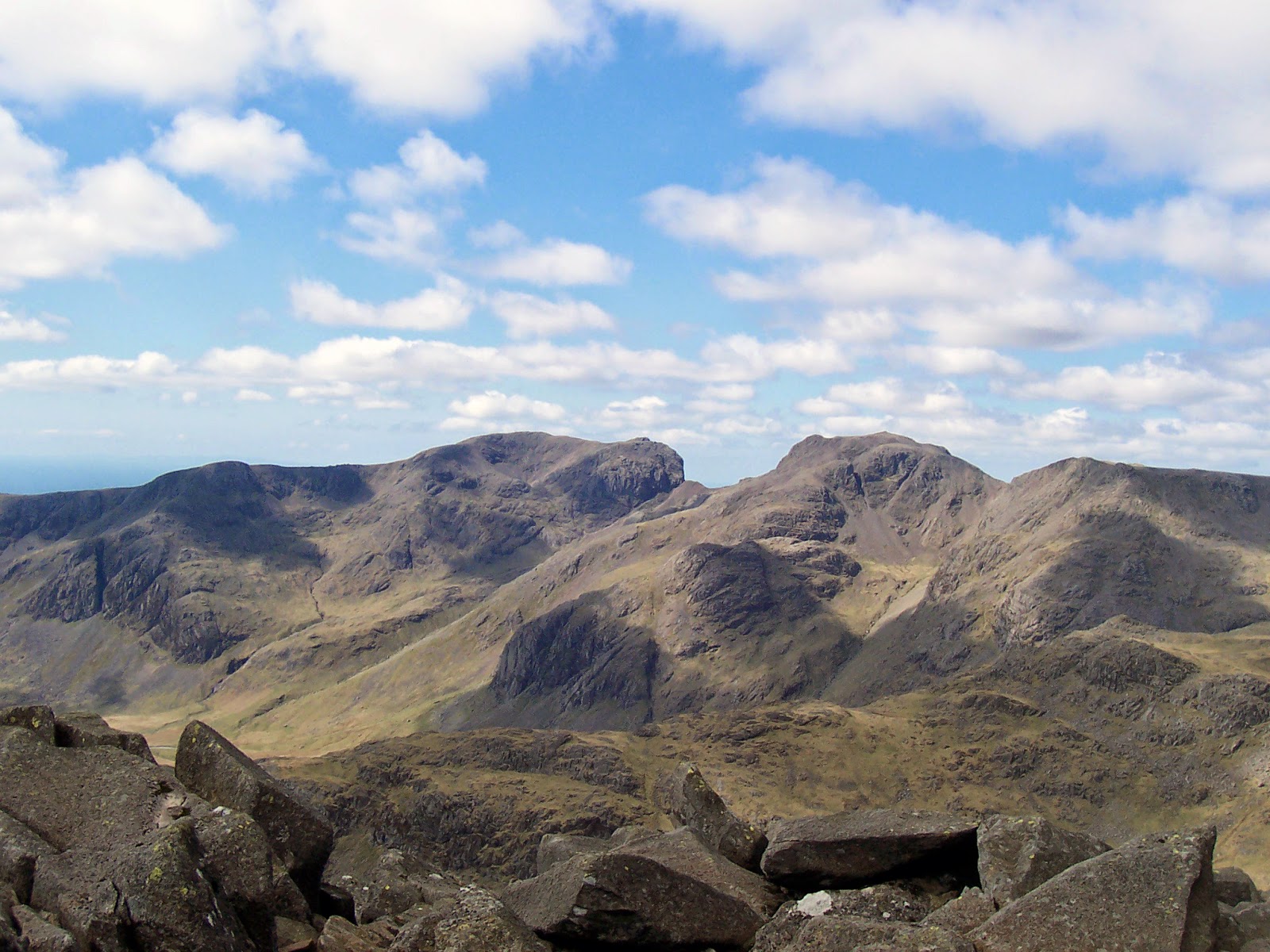 My first glimpse of the ScafellsI crossed Rossett Pass and loved the comparatively wild terrain on the other side. As I picked my way across the barren land beneath Great End, I pretended the motorway of a path wasn't there and imagined myself in pristine wilderness. Of course, droves of people on their way up Scafell Pike did spoil the illusion somewhat, but for the first time in my life that unmistakable frisson of wild coursed through my mind. This was a place where the human scale of things became utterly unimportant, and existence danced to an older and grander tune.
.JPG) Great EndI descended the delightfully quiet Valley Route into Wasdale, a place I already knew and loved from previous family holidays. But this time I was alone, and I was there to climb mountains. The craggy bastions of the fells took on a grander and more noble appearance. I imagined myself at last on the summit of Great Gable, on the summit of Scafell Pike.
Great EndI descended the delightfully quiet Valley Route into Wasdale, a place I already knew and loved from previous family holidays. But this time I was alone, and I was there to climb mountains. The craggy bastions of the fells took on a grander and more noble appearance. I imagined myself at last on the summit of Great Gable, on the summit of Scafell Pike.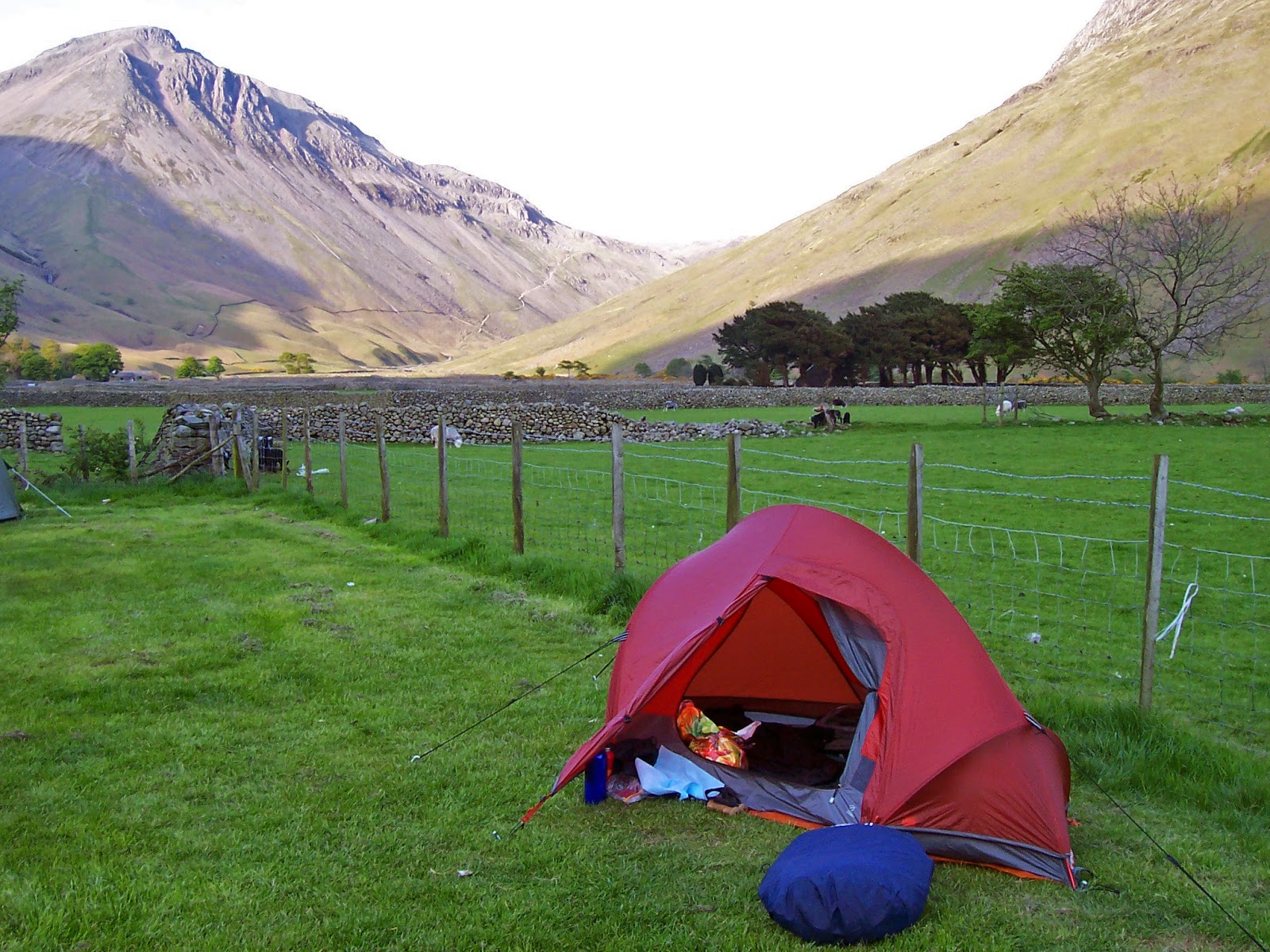 Base camp at the Barn Door Shop Campsite, Wasdale Head. This tent was
a TNF Particle 13 — not a bad tent, but heavy by modern standards
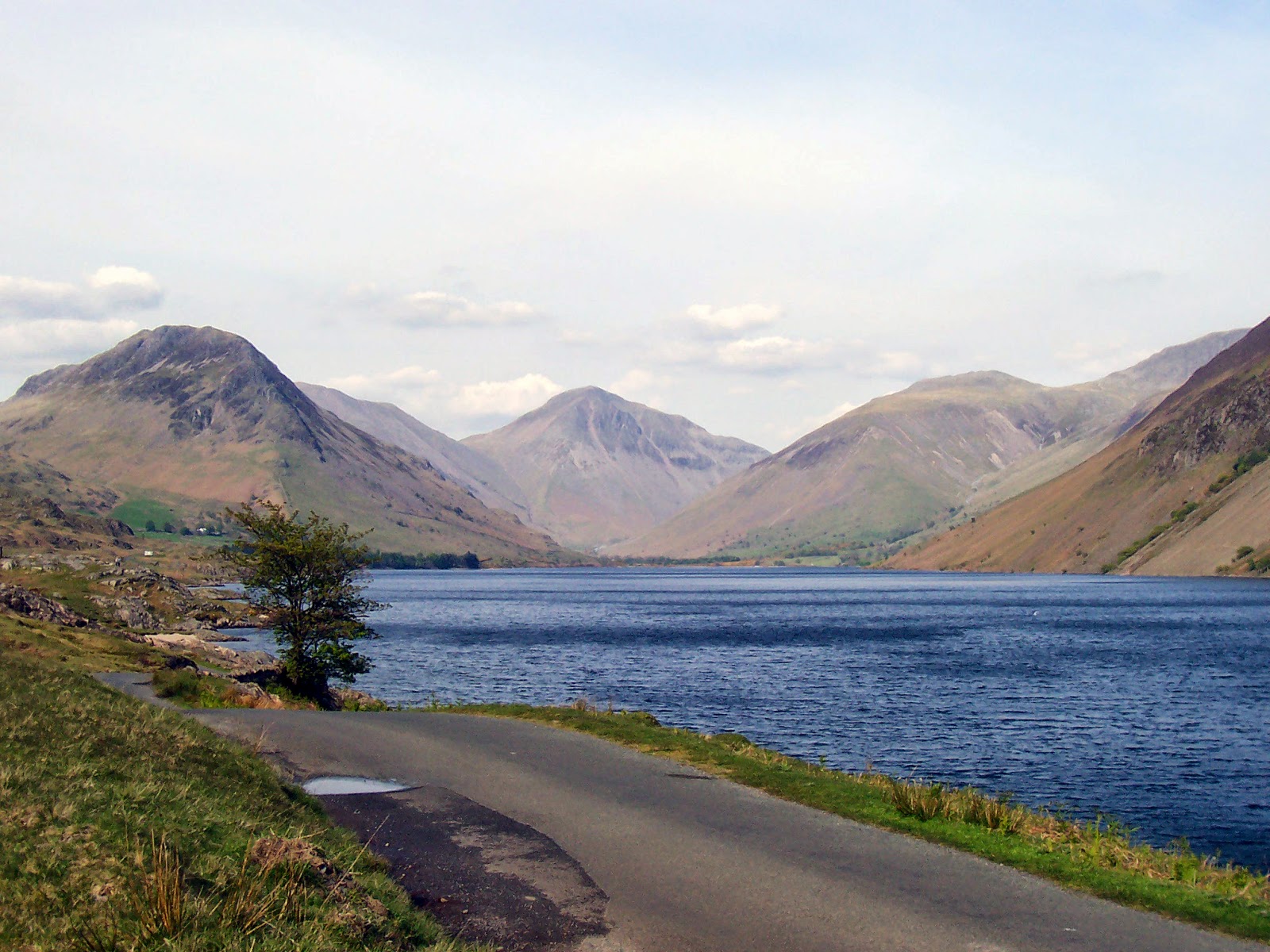
and tricky to get a perfect pitch.I had a great time in Wasdale. My first day out took me over Whin Rigg and Illgill Head, and I marvelled at the blueness of Wastwater when viewed from a couple of thousand feet up. I climbed Great Gable on Friday the 13th of May and it was the best day of my life up until that point. The Climber's Traverse was a great introduction to easy scrambling, and the day as a whole was quite simply the perfect hillwalking experience.
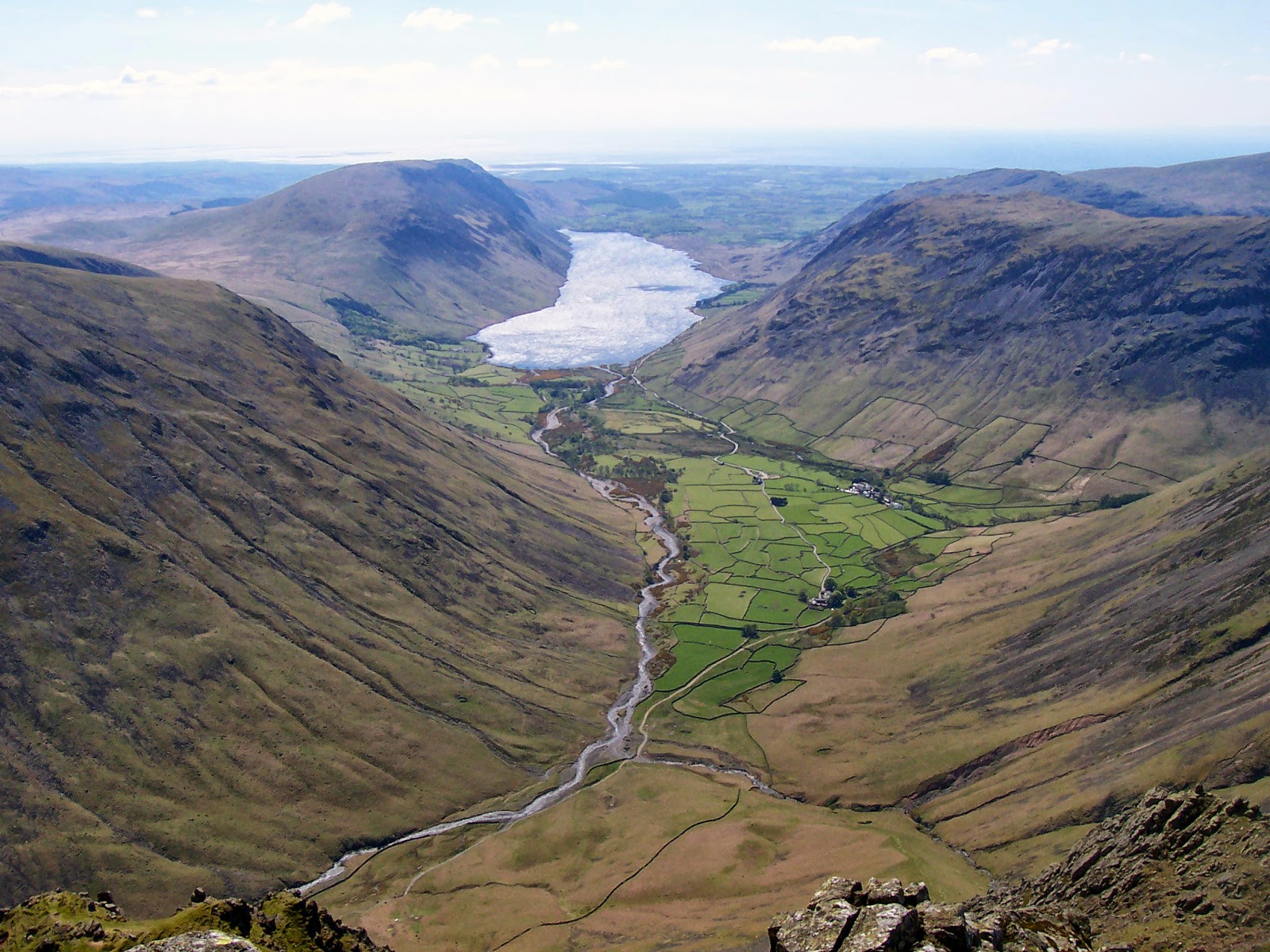 View from the Westmorland CairnOver the following days I climbed Red Pike, Scoat Fell, Steeple, Pillar, Lingmell, Scafell, and Scafell Pike. It was a hell of a weak, and the only low point was breaking my camera on the final day.
How the trip changed me
Looking at the numbers, the trip was nothing spectacular. In twenty days I climbed twenty fells and walked 160 miles — certainly no marathon. However, this trip was greater than the sum of its parts, and in the course of those twenty days I fully transitioned from a lowland walker to a hillwalker. The experience was profound, and many of the lessons I learned in that month still yield benefits today.
So was it the 'terminal trek', as I feared at the time? Absolutely not. It was not the end. It was the beginning — the first step along a bigger trail and a better path.
May 1, 2015
The Tarptent Notch backpacking tent — First Impressions

Recently I blogged about how my old Laser Competition was showing signs of wear and tear, and that for my planned hike of the Cape Wrath Trail I would need to find a new shelter. My requirements for a new shelter were as follows:
Lightweight — specifically, under 800g;Big enough for one person plus gear, but no larger than necessary;Two-wall, with a decent inner and bathtub floor (therefore midge-proof and capable of being pitched on swampy ground);Tougher and more capable of riding out storms than the Laser Competition;Supported by trekking poles;Simple to put up and take down;Not costing a fortune!
Simple, right? It turns out that it's fairly easy to find tents that fulfil five or six of these requirements, but not all of them. I narrowed it down to the Tarptent Notch and the Six Moon Designs Skyscape Trekker. The Skyscape Trekker looked like a great option, relatively expensive and available in the UK. However, when I did a bit of research I found that people have been having trouble with the zips and the reinforced area at the pole apexes. Additionally, it isn't a true twin-wall shelter; condensation has been reported as a problem by some users.
The Notch, on the other hand, costs a bit more and has to be imported from California. However, every single review I've seen has been extremely positive, and Tarptent has a reputation for quality. It's actually a cottage business, like many manufacturers of ultralight gear, and the designer (Henry Shires) takes feedback from his customers very seriously. In fact, I've heard that improvements were made to the Notch thanks directly to a forum thread on Backpacking Light. This is a shelter specifically designed for thru-hiking.
So I decided to fork out the extra cash and get the Notch. It arrived today and I eagerly pitched the tent. The question is, was it worth the investment?
Unpacking and pitching the shelter
The Notch came in a stuffsack with four aluminium nail tent pegs (reassuringly sturdy, unlike the Laser Comp's titanium pins), an instruction sheet, and a seam-sealing kit. The instructions were basic but sufficient, and provided a link to an online video showing you how to seal the flysheet.
The Tarptent Notch weighs 770g, which is a weight saving of about 200g over the Laser Competition — pretty phenomenal when you consider that this is a twin-wall shelter, not a tarp. The packed size is also very compact.
I pitched the tent in the garden. Pitching was extremely easy. First you peg out each end, which has an interesting tripod arrangement of short guylines radiating from the corners of a venting panel, reinforced by carbon fibre poles. Next you insert your trekking poles extended to the correct height (105-115cm), then peg out the sides. After adjusting the toggles and spacing the poles correctly, you're set.
 The end panel. Ignore the dodgy pegging!
 My initial pitch. Note that the tent does not come with extra guylines —
what you see here is what you get.It was very easy to get a taut pitch, unlike the Laser Comp, which always required several adjustments after pitching. And I found myself impressed by the attention to detail that has gone into the design of this tent. There are clips at the end of the vestibule zips to take the strain, avoiding damage to the zips in high winds or heavy snow. It's possible to adjust most of the pegging-out points without leaving the shelter. There are several intelligent venting options to reduce condensation, and I opted for the 50% solid inner tent (instead of 100% bugnet) which will improve its suitability for winter conditions. Thanks to the use of trekking poles set to 105-115cm in length, you get a good amount of headroom too. It's surprisingly spacious inside.
Best of all? You get two vestibules, one on each side, and each vestibule has its own door! What luxury!
 A decent amount of space inside. Note the PU-treated walls, to stop cold winds
and drips of condensation. The standard version has a 100% bugnet inner
tent, which is more suitable for hot/dry climates.
 The point where the flysheet is supported by the pole is heavily reinforced.
No worries about the point going through the fly here. Note also the plastic
clip — it's trivial to detach the inner altogether and just use the flysheet. This
turns it into something more like a shaped tarp.
 One of the vestibules. I suspect I'll use one for storage and the other for entry
and exit.
 Both vestibules and doors open. An option for hot and dry nights?Basic modifications to the Tarptent Notch
In its factory configuration, the Notch is a sturdy tent capable of withstanding three-season conditions. However, even before my tent arrived, I had some basic modifications in mind. Scotland, after all, often throws some pretty diabolical weather at the wild camper.
The manufacturer makes it very easy to add guylines to the Notch. There are two clips, one at each pole apex. I cut lengths of 3mm cord and fitted guylines. It took about two minutes.
 Custom guylinesI don't think that lateral guylines should be considered essential, but they do stabilise the entire structure and I'm confident they will add crucial support in the event of high winds — particularly if the wind changes direction overnight and hits you broadside-on. Conditions like this often resulted in an uncomfortable night when camping in the Laser Competition. Most importantly, it takes some of the strain away from the lightweight Silnylon flysheet.
I also added short extra guylines fore and aft:
 Extra dorsal guylineI have no idea if these will make any difference in high winds or not; they didn't actually seem to improve stability, as the tripod structure is already pretty solid. However, two pegging points are better than one in high winds, and the weight penalty is tiny.
I also had to seam seal the tent, as the seams do not come sealed out of the factory. This is a fifteen-minute job and easily accomplished. For an instructional video, click here and scroll to the bottom.
Final thoughts
To say I'm impressed by the Tarptent Notch is an understatement. I haven't used it in anger yet, but I've used backpacking tents for long enough to know a good one when I see it. This is the lightest tent I've ever owned, probably the strongest in high winds, and has many intelligent and thoughtful qualities to its design. It wasn't cheap, and I would have preferred to support a British manufacturer, but when it comes down to it the Notch was the only shelter that fulfilled all of my requirements. I think I'll get on well with it.
As always, I'll return with a full report when I've tested the Notch in the field.
April 27, 2015
Book review: Between the Sunset and the Sea by Simon Ingram

Between the Sunset and the Sea by Simon Ingram
It seems that every British hill is on a list of some kind. The Munros, the Corbetts, the Wainwrights – it can be all too easy to get sidetracked by the list itself, perhaps forgetting about the magic of the hills in the process. Do you suffer from ticklist fatigue? Then maybe this book is for you.
Between the Sunset and the Sea is all about the magic of the British uplands. It’s a little ironic that Simon Ingram chooses to do this by creating a new list, but I think that can be forgiven – it’s a very select list, and each of the sixteen mountains (or mountain areas) is given an entire chapter to describe its own unique charms. The hills in question are:
Beinn Dearg; The Black Mountain; Cadair Idris; Crib Goch; Cnicht; Cross Fell; Schiehallion; Ben Loyal; An Teallach; The Assynt Hills; Askival; Ladhar Bheinn; Loughrigg Fell; Great Gable; Ben Macdui; and Ben Nevis
A motley collection, then! There’s real variety in the mountains Ingram has chosen to explore, and I use that word deliberately – this is no mere collection of routes.
For the full review, please click through here to my article on UKHillwalking.
April 23, 2015
Preparations for the Cape Wrath Trail

The time has come to talk a little about my plans for this summer. It's been ten years since my first long-distance walk in the mountains — a hundred and sixty miles through the Lake District in May 2005 — so I thought it was only appropriate to do something special this year.
The idea came to me back in February, when I was contemplating the snowy Cairngorms and considering a change in direction for my outdoor activities. My interest in Munros was on the wane and my interest in backpacking experiencing a renaissance. Reading the excellent Rattlesnakes and Bald Eagles by Chris Townsend helped to re-ignite that interest in long-distance hiking, and since then I have enjoyed books by Keith Foskett (who is right now walking his first miles along the epic Continental Divide Trail in the USA).
I don't have six months I can devote to thru-hiking one of the world's longest routes, but now that I'm self-employed I can certainly arrange a month off work to take on something shorter. I wanted to tackle a walk of decent length, considerable challenge, and passing through truly wild country. In the UK there can only be one candidate.
The Cape Wrath Trail
The Cape Wrath Trail is not an official long-distance route. It came to prominence in the mid-1990s due to various publications, but there is no one recognised path, and it certainly isn't waymarked like, for example, the Pennine Way. The general idea is to make your way from Fort William to Cape Wrath at the farthest NW corner of the UK. Most CWT thru-hikes are approximately two hundred miles in length.
This screenshot is from the CWT page at Walkhighlands and shows two of the most common variants at the start: the Great Glen variant, and the Glenfinnan variant.

I knew at once that the Glenfinnan variant was for me. Not only is it the wilder route, it's also the most interesting and gives you the chance to trek through the wilds of Knoydart. I have been to Glenfinnan once before but never set foot in Knoydart. The opportunity is too good to miss.
 On my last visit to Glenfinnan, in April 2011I have selected the Iain Harper route as the basis for my CWT attempt. I've consulted his guide, which offers a number of options along the way, including bad-weather alternatives. The route is continuously superb and takes the hiker to some wonderful locations including Knoydart, Glen Shiel, Torridon, the Great Wilderness of Fisherfield, Assynt, and Sandwood Bay.
I have selected June the 3rd, my twenty-ninth birthday, as the date to begin my thru-hike of the CWT.
 Beinn Fhada, from near MorvichPreparations: fitness
Fitness is one of the most important aspects of a long-distance walk. I live in the lowlands and have a job that keeps me at a desk for several hours a day, which means that maintaining the right level of fitness can sometimes be a challenge. I don't get the chance to visit the hills more than a few times a year.
My strategy is reasonably simple, and based on one fact: I enjoy road biking. I don't take it 'seriously' (I don't own any lycra and my bike is about as old as I am), but the Lincolnshire Wolds are great for long days out on the bike. There are enough ups and downs to get the blood pumping.
I sometimes end up working weekends, but I'm aiming to get a twenty-mile route done at least once every couple of weeks. More importantly, I get out on the bike every morning before work. My circuit is only a couple of miles long, and it only takes me fifteen minutes, but it includes a decent gradient and I have already noticed a significant improvement in my fitness since I started this routine.
Of course, cycling alone isn't enough. The only real training for carrying a big pack over long distances is, you've guessed it, carrying a big pack over long distances. I plan to get out walking as often as I can between now and June, and will hopefully have time for another short backpacking trip next month.
 The Forcan Ridge of the SaddlePreparations: gear
When I started planning this trip I thought I'd be able to make do with the gear I had. Most of it was five to ten years old, but still serviceable. However, as I planned I realised I would have to make some changes to my kit. Why? It's simple: my pack was just too heavy, and some items were starting to wear out.
The first thing to be changed was my footwear. For the last three years I've been wearing a fairly clumpy pair of Scarpa B1 mountaineering boots for more or less everything, although I've dabbled in trail shoes for much longer. I decided immediately that this will be the year I switch entirely to trail shoes for everything except winter and full-on mountaineering. I've already blogged about this decision and I've started to reap the benefits.
 The Inov-8 Roclite 295 shoesA critical look at my backpacking load resulted in a number of unnecessary items being removed from the list, including my bivvy bag and various items of clothing. Next I re-appraised my cooking system.
Finally, two of the 'big three': my pack and my tent.
Pack
My old rucksack is a Haglöfs Matrix 60, purchased in 2010. The pack has served me well — it's incredibly tough and holds a ton of gear. I've carried 18kg in it on winter backpacking trips. However, a few niggles prevented me from really loving this pack. First, the main clips holding down the floating lid required modification with a penknife on day one (there were random rubber flaps that got in the way). Second, the shoulder straps tend to slip after about ten miles. Third, the hip belt was never really a perfect fit for me, and is not removable on this model. Fourth, it's a mountaineering / climbing pack so not ideal for thru-hiking, with few external storage options.
I decided to replace it with a ÜLA Circuit 68. ÜLA packs are made in Utah and are specifically designed for long-distance hiking. This model only weighs about 1kg, and I was able to order one tailor-made to my requirements. It's lightweight, incredibly comfortable, and has a number of features I really like such as the roll-top closure and the massive mesh pocket on the back. The total volume is 68 litres including all the external pockets, but the main compartment is only about 45 litres so the pack is far more compact than my Matrix — but still big enough for the Cape Wrath Trail.
Tent
What about my tent? Since 2010 I have used a Terra Nova Laser Competition, and it's a fantastic shelter — again, with a few reservations.
 The Laser Comp on its first real test: a week backpacking in Jotunheimen,
NorwayI first used the Laser Comp while backpacking through Jotunheimen in Norway. I was battered by some extreme weather on that trip, and although I liked the small pack size and roomy interior of this tent, it was frankly terrifying to sit out a storm in it. You can see in the picture above how I was forced to use my ice axe to reinforce one of the guylines. The supplied Titanium pegs were useless in anything but optimal ground, and I ended up replacing them with slightly heavier aluminium tri-beam pegs. Also, the structure just isn't that stable in high winds and some big gusts flattened the tent so much that the pole warped and the canvas was blown flat against my body. During one particularly bad gale I had to hold the structure upright with my own body to prevent the tent from being blown into Sweden.
The tent survived some fierce winds on that trip, and after replacing the pegs my opinion of it improved somewhat. Since then I've probably spent about thirty or forty nights in it, including a few more gales. The other major drawback of the Laser Comp is that ventilation never seems to be sufficient and it suffers badly from condensation.
 Heavy interior icing while camping near Ben Alder, February 2012I was prepared to live with these drawbacks for the CWT, but yesterday I read this worrying article by Terry Abraham about how lightweight tents often accumulate unseen damage caused by repeated stress. He had a Laser Comp at the time of writing, and noted a number of points of wear and tear. Worried, I did a proper inspection of my tent.
To my horror I saw a number of issues I had never noticed before. The main pole was bent — not that big a deal, but more concerning was severe wear and tear in several places on the flysheet.
 Wear visible near one of the guyline attachment pointsOrdinarily I'd be happy to slap on some duct tape and carry on, but these are critical points where the flysheet rubs against the top of a carbon-fibre pole and is attached to the bow and stern guylines. I have heard of catastrophic failure at these points for this model of tent, where the short poles split through the fly and the entire structure collapses. There is also wear to the stitching on several other attachment points, not to mention what appear to be friction burns in places where the fly rubs against the pole sleeve.
Full repairs would be costly, and I wouldn't trust any home-made bodges, so I made the decision to ditch the Laser Comp for this trip and find something else. Preferably something lighter with better wind resistance.
I settled on the Tarptent Notch. This is another American product — they do lightweight gear better than we do — and I think it'll be perfect for my needs. It is supported by trekking poles (why carry dedicated tent poles when you're carrying trekking poles anyway?), weighs less than 800g, and is far more stormproof than the Laser Comp. Unlike many shelters designed for American thru-hiking, this one has a full inner tent with bathtub floors — features I'm not yet ready to give up, despite the recent popularity in using tarps in Scotland.
I have yet to receive the Notch, but I'll be sure to test it out before I start my CWT journey.
 View of Skye from the summit of the Saddle, Glen ShielPreparations: logistics
Opportunities for re-supply are scarce in the NW Highlands, and I'll most likely be limited to Shiel Bridge, Kinlochewe, Ullapool, and Kinlochbervie. Consequently I'll have to carry up to a week's worth of supplies with me at any given time.
Some CWT hikers organise supply boxes to be sent to post offices along the route, but I'm not sure I can be bothered with the hassle. Most of these remote post offices only have limited opening hours, and if I arrive at the designated location (say) five hours early, I'll have to hang around for five hours, or possibly make camp at an inconvenient location. I'd far rather carry enough supplies and re-equip where I can.
You can't send stove fuel through the post, anyway, so that's something I'll have to source in the field. By my calculations, my new efficient alcohol burner setup should enable me to eke 330ml of fuel out for at least eleven days, so it's hardly a major concern.
I'm going to allow twenty-six days for the route, but may complete it in twenty — it depends on a variety of factors, mainly the weather, final adjustments to the route, and how my feet hold up to the rigours of the trail.
Final thoughts
I'm really looking forward to this trip. I haven't felt this excited about going into the mountains for years — the last expedition that really inspired me this much was probably Norway 2010. The idea of living in the wild for a month, slowly making my way north until there is no more north to travel, is a compelling one. In many ways I've been building up to something like this for years now, and although there is of course no guarantee that I'll actually complete the route, I think that's part of the allure. For its length it is one of Britain's toughest hikes, and after more than a decade of mountaineering experience in Britain and Europe, I know that I'm ready for it.
I won't be blogging on here during my journey, but I'll be posting to Twitter when I can.
Maybe see you on the trail?
April 18, 2015
Lightweight stoves for backpacking — the alcohol option

Like many a backpacker, I started my outdoor apprenticeship with a classic stove: the Trangia. These stoves run on methylated spirits (denatured alcohol) and include several nesting pots with an integrated pot stand and windshield system. The Trangia system is very reliable and safe when used correctly, but it has one major disadvantage: it's really heavy! It's also slow to boil a pan of water, although I'd argue that isn't really a disadvantage.
In 2004 I switched to a Mini Trangia, which includes the traditional brass burner with a minimal aluminium pot stand and 600ml pot. The weight problem was reduced, but I was seduced by the marketing of more modern, trendier gas burners. I bought an MSR Pocket Rocket in October 2005.
Ten years with a gas stove

The Pocket Rocket is one of the most popular canister stoves in the world, and it's a great option for backpacking. It has given me almost ten years of flawless service. It weighs only 85g, and consists of a valve, nozzle, and integrated pan supports. For cooking a basic meal in a small pan, it works pretty well and the power can be controlled accurately, ranging from a tiny flame to a rocket exhaust (it sounds a bit like a rocket taking off, too!)
Where canister stoves shine is in sheer convenience. You screw the canister in, open the valve, and strike your match. Flame control is superb, and you can bring a pan of water to the boil very quickly. The canister can be used many times until it's depleted. In short, the system works.
However, no stove system is without disadvantages, and over the years I've gradually come to realise the drawbacks of canister stoves.
1. The canisters themselves are inefficient and wasteful. A proportion of the weight you're carrying is the pressurised can, and when it's depleted there is no way of re-filling it. You have to carry that weight back out with you, and when you return to civilisation it will end up in landfill.
2. On a long trip, it can be difficult to judge how much fuel you'll need because there is no way of accurately determining how much fuel you've used, or how much is left in a can. With experience you can guess this to an extent, but it's very hit and miss. Inevitably you will end up carrying more fuel with you than you actually need — and you can't carry less than 100g (the smallest available cartridge), even for an overnight trip.
3. When you near the end of a can, pressure drops and you'll only be able to simmer. After a couple of years you'll end up with a box full of nearly-but-not-quite-empty gas cans in your garage.
4. As a result of the above points, canister stoves are bad for the environment. Don't forget that you're also burning a fossil fuel.
5. Canister stoves are not very stable. If using one in your tent vestibule (which you shouldn't really do, but I've done it hundreds of times) there is always the risk of knocking the whole setup over — at which point liquid fuel sprays from the nozzle and ignites at high velocity! This has happened to me once before, but fortunately I was able to put out the blaze before it spread to the tent fabric. Remote-canister stoves are available, but there is usually a weight penalty.
6. Canister gas is expensive. A 250g can might set you back £6 nowadays.
7. Gas canisters can explode or malfunction. It's rare, and it has never happened to me before, but it remains a (small) risk.
Back to an alcohol burner?
I'm in the process of planning a hike of the Cape Wrath Trail, and I'm evaluating every item of my gear to assess its suitability. At first I took my gas stove setup for granted, but after some thought I realised it may not be the best option this time.
There are only a few resupply points on the Cape Wrath Trail, which means I'll have to carry supplies for up to five or six days at once. With my gas stove, I'd probably take a 250g can along with me and aim to replace it when it runs out, but the difficulty in judging how much fuel remains bothers me — what happens if I run out of gas two days from the next shop? And what if that shop doesn't even sell gas canisters anymore? Alcohol fuel is available more or less anywhere, but it's rare that you can pick up gas cartridges from (say) a petrol station. It's just easier to find fuel for an alcohol stove.
I like the fact that, with an alcohol burner, you can measure how much fuel you will need accurately, and only carry the fuel necessary for your purposes. Boiling times will decrease, but that doesn't bother me on the trail. And I think I've put together a stove that's a fair bit lighter than my old Pocket Rocket setup.
My new setup

My 'new' setup is actually based on my old Trangia Mini. It uses the same excellent aluminium pan, which is just the right size and very lightweight. It even uses my old windshield (bodged from an old MSR petrol stove windshield). The pot stand and pot gripper are also the same.

Where it differs is the burner. The old Trangia burner weighed over 100g and was never particularly efficient, but I've replaced it with a Trail Designs 12-10 burner weighing only 16g. It's a similar idea to the Trangia burner — you measure out some fuel, which sits in the central reservoir and burns until it's used up — but far simpler and made from recycled aluminium cans. It's also much more efficient than my old Trangia burner, and can keep water boiling for longer on the same amount of fuel.
Many backpackers swear by the full Caldera Cone setup, which matches the 12-10 burner to a special conical windshield specifically designed to fit their pot. However, my existing windshield and pot stand rig is already pretty good, so I decided only to replace the burner.
So how does it perform? I've loaded up the 12-10 burner and done a test run in breezy conditions. It boiled 500ml of very cold water in eight minutes, continuing to burn for another three minutes until the fuel ran out. This boiling time is nowhere near as fast as the Pocket Rocket, but the 12-10 burner accomplishes this feat on 30ml of fuel — that's the equivalent volume of an empty 35mm film pot. Not bad, I think. And the addition of a pot cosy should allow me to save 5-10ml of this fuel for a future meal.
The pot cosy

After reading this excellent piece on Keith Foskett's blog, I decided to make a pot cosy to go with my pot. I've never used one before, but it promises to boost fuel efficiency yet further by allowing you to extinguish your stove as soon as the water boils. You then transfer the pot + food to this insulated jacket, tailor-made to your pot, where it continues to simmer in its own heat for up to half an hour.
In my (completely non-scientific) test, freshly boiled water was still piping hot after twenty minutes in the pot cosy. An uninsulated pot with the same amount of boiling water was tepid at best after the same interval. In short, I'm convinced — but I have yet to try it out in the field.
My pot cosy weighs only 50g so I'm sure it will pay for itself in terms of fuel weight saved.
The weight of the whole setup, minus fuel, is only 200g. That's actually nearly 100g lighter than my Pocket Rocket setup, including windshield — and while alcohol stoves are not as efficient as gas in the long term, I'm confident that the advantages stated above will make this the right choice for my summer backpacking adventures this year.
Do you use an alcohol stove in the hills? What's your setup of choice?
Alex Roddie's Blog

- Alex Roddie's profile
- 27 followers
Alex Roddie isn't a Goodreads Author
(yet),
but they
do have a blog,
so here are some recent posts imported from
their feed.

