
Steven Colborne's Blog, page 34
December 24, 2021
If You’re Struggling This Christmas…
Spending time with family and friends at Christmas can be a strange mix of exciting and challenging. While Christians will rejoice today in remembrance of their Saviour’s birth, for many people who have strained relationships today might also be uncomfortable. For those in the latter group, here are three ideas to help you enjoy your day:
If you are feeling overwhelmed, take a walk alone. You can use the alone time to pray, and others will respect you for looking after your mental health.Express your feelings openly. Are you anxious about something? Angry with someone? You can communicate these feelings in a kind and gentle way, simply by voicing your emotions calmly and respectfully. It takes bravery, but doing this could lead to healing and restoration.If in doubt, be unceasingly kind. Whatever you’re going through, you always have the option to be as kind as you can possibly be in every situation, to whoever you’re with. Volunteer to do the washing up or tidy the house, or put on your loved one’s favourite music, perhaps. If someone is mean to you, afford them some grace and respond with kindness.I’m spending Christmas Day alone this year, but this is no cause for concern. I am content. I can remain focused on my relationship with God, which is ultimately the only relationship that really matters to me. I have food and drink, warmth and shelter, great music to listen to and access to sacred Scripture, among countless other blessings. Thanks be to God!
Feel free to leave a comment letting me know how you’re spending Christmas Day this year — I’d love to hear what you’re up to, whatever your beliefs or circumstances. Wishing you all a very merry Christmas.


December 22, 2021
Journalling as a Coping Strategy
Over the last couple of years, I’ve spent more time alone than at any other time in my life. This is obviously linked to all things Covid, and I know many other people are in the same boat. I’m also estranged from my closest family members — my sister lives abroad and I’m only in occasional contact with my father, mostly by letter. I don’t have any other relatives I’m in touch with regularly, either because they have passed away or there are just no historical bonds.
In this article, I wanted to share a little about how journalling has kept me mentally stable during the times of immense frustration and loneliness that I have sometimes felt over the last couple of years, during the lockdowns and even in-between lockdowns with the constant societal upheaval related to Covid.
Everyone knows that electronic communications are not private these days. I don’t know about you, but when I write emails I’m always cautious about what I write, not knowing which crawlers, robots, or even human beings might be scanning my messages. I don’t often share personal thoughts on this blog, partly because I want the blog to be focused on philosophy and theology and partly because of the lack of privacy and not knowing who might be reading from the shadows. You might call this paranoid, but the world is Big Brother on steroids these days, there’s no denying it.
So I have taken to journalling to express my thoughts — those thoughts that I don’t feel comfortable sharing online. Since 2019 I have completed no less than twelve extra large Moleskine journals! Here’s the evidence:
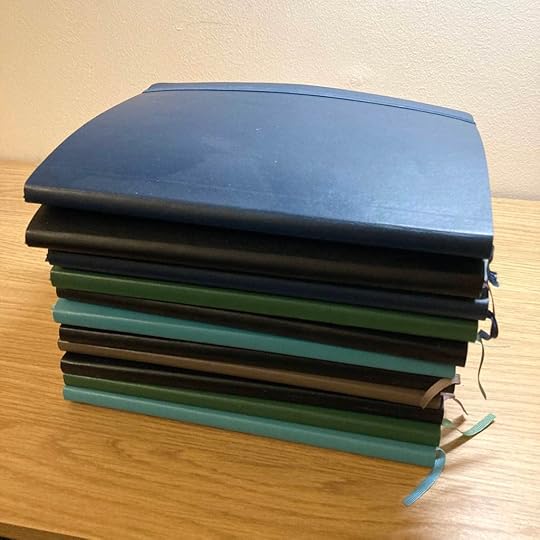 Excuse the fact they are a little dusty!
I’m not going to share any images from inside the journals because my handwriting is awful. I shared in my interview with Collin Cooper the story of how during a spell in psychiatric hospital I re-taught myself to write from scratch, making all my letters look entirely different. I can’t really explain why I did this, but my handwriting is a real mess as a result. It’s a jumble of connected letters mixed with isolated letters and f’s and t’s that haven’t been crossed and big letters mixed with small letters — I don’t know whether anyone apart from me would be able to make any sense of it. If I write very slowly I can make it neat, but I don’t usually write slowly, so it’s often a mess (I’m probably exaggerating a little). Maybe at some point I’ll share some examples!
The subject matter of my journal entries is very varied. Normally, I start by putting the date and saying what time of day it is, then I just share whatever thoughts come to mind, whatever they are, even if it’s something as mundane as ‘I’m drinking a cup of tea’ or ‘I’m thinking about taking a shower’. I don’t know why, but I find it immensely therapeutic simply writing openly about what’s going on in my mind, whatever it is. I also sometimes draft blog posts and compose prayers in my journals, as well as brainstorming ideas like my plans for a particular project, or a budget, for instance. I would certainly say writing out the Psalms in my journals, particularly Psalm 37, got me through some of the toughest times I’ve ever experienced.
Recently I was thinking about what to do with all these journals. I don’t want to throw them away, despite my inclinations towards minimalism, because they have been such an important outlet for me and I therefore consider them valuable. It would certainly be interesting to look back through them in the years to come. Perhaps at some point I will give them away as a competition prize or something — if someone else were to read them they would certainly be entertained, of that I’m quite sure!
Committing my thoughts to paper has helped me a lot at times when I’ve been feeling anxious. For example, when I was waiting for a grocery delivery once I managed to fill quite a few pages of a journal, because there was a two-hour delivery slot and I always get anxious waiting for deliveries (for reasons I won’t go into). Writing down my thoughts kept me distracted from clock-watching and made the time pass quickly and lessened my anxiety considerably.
I know there are different styles of journalling, like bullet-journalling for example, but I haven’t felt the need to look into these because journalling for me is generally not about planning. I do my planning on my computer using various apps — my journals are much more of a general mind dump (bad choice of phrase, perhaps ‘thought repository’ would be more apt!).
There’s something amazing about writing in a journal. I know you probably all understand this because you’re writers. I think it’s a bit like having a conversation but without another person, so it’s a great way to combat loneliness, as well as a way of giving expression and coherence to thoughts which might otherwise be lost forever.
Do you have a passion for journalling? What do you use your journal for? Are you concerned about privacy when writing online? And do you get frustrated that I use the English spelling of journalling rather than the American ‘journaling’? Comments below! 
December 21, 2021
‘How to Avoid Hell’ Book Research Update
A couple of months ago, I mentioned that I was beginning research for a new book. The book will explore approaches to hell in the three major Abrahamic religions (that is, Judaism, Christianity, and Islam). My motivation behind the book stems from my personal interest in understanding Scriptural teaching on hell more deeply, as I believe it’s probably the most important subject for anyone who believes in God.
I shared in this post how I was exploring the Hadith literature in Islam. Unfortunately, the six books I borrowed from the philosophy and theology library I joined recently weren’t particularly helpful, although one of the books — The Wiley Blackwell Concise Companion to the Hadith — did provide some useful insights. In any case, I have decided that the book I am writing will focus almost entirely on sacred Scripture. I will explore insights on hell in the Hadith literature as well, but my focus when it comes to Islam will mostly be on the text of the Qur’an.
As part of my research into Christian views of hell I have been exploring Universalism, which is the view that eventually all human beings will be saved, although some may suffer in hell first. I have a few books lined up to read on the subject. I have read a couple of books about Annihilationism, which is the view that those who suffer in hell will have their personhood annihilated once they have paid the penalty for unforgiven sins.
Today I read an interesting article about the subject of hell in Judaism. It’s fascinating to me that hell is rarely discussed in the Torah, and I am having to look to the Talmud, which is the central text of Rabbinic Judaism, in order to deepen my understanding of the subject. I have reserved six books about Jewish theology from the library, and I was hoping to pick these up before Christmas, but circumstances have meant I’ve been unable to take the trip into central London to collect the books. This is frustrating as I would have liked to use the Christmas holidays to explore these books. I will have to be patient and collect them early in the new year.
All in all, I’m excited to continue my research for this new book. Some of you may have seen I’ve added a preliminary cover for the book to my books page which I can use when I make the book available for preorder, which will probably be in a few months time, God willing. I am learning so much through my research for this book — I’m so glad to have an opportunity to explore the subject of hell further and I hope to produce a final product that will be interesting and insightful to readers of this blog.
In the meantime, if you have any recommendations for books related to the subject of hell, feel free to comment or drop me an email and I’ll be happy to investigate. I hope you are doing well and are enjoying preparing for the Christmas holidays.
Just as a reminder, you can currently read my book God’s Grand Game for free as an eBook. For full details, visit the Books page. You can subscribe to this blog for further updates related to my existing and work in progress books. God bless you and peace be with you.
December 20, 2021
For Christmas We Gave our Children ….
Beautiful words from Intentionally Alex.

For Christmas we gave our children parents in a committed, loving, marriage. We gave our children financial stability and parents who don’t fight about money.
For Christmas we gave our children our time, our smiles, our full attention and we chose not to give them rushing, loud stores, and the hunt for the “perfect gift” for a relative/friend we barely see. For Christmas we chose not to give our children debt they’d hear us stress about in January.
For Christmas we gave our children less. We gave them less toys to manage and be told to clean up, on repeat. We gave our children less “have to’s.” For Christmas we gave our children our togetherness and memories which don’t have a monetary value, but nourish the soul.
For Christmas we gave our children values they can carry on to their children, so they can live a more free life, unchained…
View original post 29 more words
December 13, 2021
End of Year Survey
As a bit of fun, I’ve put together a short (three minute) survey using Google Forms. The intention is to get your feedback and find out what you like and dislike about my blog and how I can do a better job in 2022.
To fill out the form, click here.
I’m intrigued to see how this little experiment goes, please do participate!
Love and mince pies,
Steven 
December 11, 2021
Getting Ready for 2022
I’m ready! Are you ready? If not, the first thing I would recommend you do is pray. Put God first as we prepare for an uncertain year ahead. The second thing I would recommend you do (far less important, of course) is read my tips for getting organised as we move into a new year:
Mimimalist Organisation Tips: Get Ready for 2022The above linked article is an updated version of a post I published at the start of the year, and it seems that when I republished it today the comments from the earlier version carried across to the new version. So apologies if you see your name in the comments and wonder what’s going on!
I also wanted to share that I’ve been listening to an absolutely brilliant music artist named Jordy Chandra. He writes very chilled, very beautiful songs. I think I love virtually every song he has ever released, which is really rare for me. So I hope you’ll check him out on your music service of choice and be uplifted by his gentle and wonderful songs. He is a relatively unknown artist but I reckon he’s destined for great things.
Feel free to leave a comment and let me know what music you’re listening to and how you’re preparing for the new year. Peace and blessings!
Minimalist Organisation Tips
I admit it, I absolutely love all things Minimalism. Even though I blog mainly about faith and philosophy, I actually get more excited to read articles from minimalist bloggers than philosophy and theology bloggers!
Today, I thought I would share five of the strategies I employ to reduce the amount of stress and anxiety in my life and which enable me to feel more peaceful and happy. With a new year approaching, it’s a good time to get organised. Perhaps you will find something in these tips to improve your peace of mind as we head into 2022.
1. Life Planning System: Calendar, Notes, Reminders. I find these three apps work together to form a really great system for keeping my life organised. I use the Apple Calendar app for appointments (for example, a doctor’s appointment or a repair visit to my apartment), I use Notes to brainstorm ideas for projects and plans and also to keep an inventory of everything I own, and I use Reminders as a daily ‘Things To Do’ checklist. In Apple Reminders you can schedule To Do’s to recur daily, weekly, monthly, or annually, which means you can get reminders to do your grocery shopping every week, or to do an annual Spring Clean or boiler service, for example. There are of course dozens of To Do apps out there (I’m actually using Things 3 currently, but here I’m recommending Reminders because you will probably already have it if you have a Mac and/or iPhone).
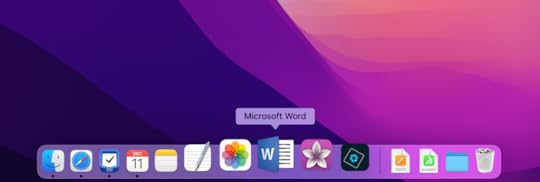
2. Clutter-Free Digital Organisation. I don’t have a single file on my computer desktop. I keep just those applications and folders I use most often in the dock at the bottom of the screen. There are 10 applications in my dock, plus a single folder, a budget spreadsheet, and a simple life plan document. Within the folder are only files I believe I may need to access regularly; the bulk of my files are on an external Samsung hard drive which I regard as a kind of storage cabinet. Keeping legacy documents on an external hard drive frees up storage space on my computer allowing it to run more smoothly. I also backup my computer every Sunday to another external hard drive (I have a reminder set to do that!).
3. Cleaning Blitzes. This is a tip I always love to share with people. Instead of letting cleaning jobs pile up and feel like a terrible chore to tackle, instead you can set a timer for 20 minutes and do as much as you can in that time. At the end of the 20 minutes, have a cup of tea and I expect you will feel satisfied you’ve made good progress. Most people can spare 20 minutes in a regular day, and if you do this a few times a week you should stay on top of the cleaning with hardly any stress.
4. Inventory. I find it very reassuring to have an inventory of everything I own. If I need to move to a different home, or if I were to pass away, the inventory could be really useful. It also stops me from buying duplicate items, and when I started doing this I was able to donate many spare items to others in my community which is always a positive thing to do. If you’re bored during yet another lockdown and have the motivation, I highly recommend having a crack at making an inventory. Do it on your smartphone so you can access and update it whenever you need to.
5. Contingency. It can be really reassuring to plan for the unexpected in life. I keep a few backup plans in my documents in case things in my life change unexpectedly. These relate mainly to work, finances, and accommodation. Also, I recently wrote a will and got it signed and witnessed. Included alongside my will is a document with instructions for my next of kin related to my physical and digital assets. I also keep a copy of my inventory document (listing and locating everything I own) alongside my will. It gives me peace of mind to know my family would not have too much stress if I were to unexpectedly pass away.
Just as an aside, I also have plans for if there is a time when I have no computer. If my MacBook broke I would still be able to manage my author business with only a smartphone. I also keep a stock of physical copies of the books I have written in my apartment in case all technology ceases to function and I can’t access the Internet for a prolonged period of time for some reason. These are uncertain times, folks!
What are your tips for staying organised and do you believe there’s a correlation between how organised you are and your happiness levels? Feel free to leave your thoughts in the comments below. Thank you for reading!
Minimalist Organisation Tips — Get Ready for 2022!
I admit it, I absolutely love all things Minimalism. Even though I blog mainly about faith and philosophy, I actually get more excited to read articles from minimalist bloggers than philosophy and theology bloggers!
Today, I thought I would share five of the strategies I employ to reduce the amount of stress and anxiety in my life and which enable me to feel more peaceful and happy. With a new year approaching, it’s a good time to get organised. Perhaps you will find something in these tips to improve your peace of mind as we head into 2022.
1. Life Planning System: Calendar, Notes, Reminders. I find these three apps work together to form a really great system for keeping my life organised. I use the Apple Calendar app for appointments (for example, a doctor’s appointment or a repair visit to my apartment), I use Notes to brainstorm ideas for projects and plans and also to keep an inventory of everything I own, and I use Reminders as a daily ‘Things To Do’ checklist. In Apple Reminders you can schedule To Do’s to recur daily, weekly, monthly, or annually, which means you can get reminders to do your grocery shopping every week, or to do an annual Spring Clean or boiler service, for example. There are of course dozens of To Do apps out there (I’m actually using Things 3 currently, but here I’m recommending Reminders because you will probably already have it if you have a Mac and/or iPhone).
2. Clutter-Free Digital Organisation. I don’t have a single file on my computer desktop. I keep just those applications and folders I use most often in the dock at the bottom of the screen. There are 10 applications in my dock, plus a single folder, a budget spreadsheet, and a simple life plan document. Within the folder are only files I believe I may need to access regularly; the bulk of my files are on an external Samsung hard drive which I regard as a kind of storage cabinet. Keeping legacy documents on an external hard drive frees up storage space on my computer allowing it to run more smoothly. I also backup my computer every Sunday to another external hard drive (I have a reminder set to do that!).
3. Cleaning Blitzes. This is a tip I always love to share with people. Instead of letting cleaning jobs pile up and feel like a terrible chore to tackle, instead you can set a timer for 20 minutes and do as much as you can in that time. At the end of the 20 minutes, have a cup of tea and I expect you will feel satisfied you’ve made good progress. Most people can spare 20 minutes in a regular day, and if you do this a few times a week you should stay on top of the cleaning with hardly any stress.
4. Inventory. I find it very reassuring to have an inventory of everything I own. If I need to move to a different home, or if I were to pass away, the inventory could be really useful. It also stops me from buying duplicate items, and when I started doing this I was able to donate many spare items to others in my community which is always a positive thing to do. If you’re bored during yet another lockdown and have the motivation, I highly recommend having a crack at making an inventory. Do it on your smartphone so you can access and update it whenever you need to.
5. Contingency. It can be really reassuring to plan for the unexpected in life. I keep a few backup plans in my documents in case things in my life change unexpectedly. These relate mainly to work, finances, and accommodation. Also, I recently wrote a will and got it signed and witnessed. Included alongside my will is a document with instructions for my next of kin related to my physical and digital assets. I also keep a copy of my inventory document (listing and locating everything I own) alongside my will. It gives me peace of mind to know my family would not have too much stress if I were to unexpectedly pass away.
Just as an aside, I also have plans for if there is a time when I have no computer. If my MacBook broke I would still be able to manage my author business with only a smartphone. I also keep a stock of physical copies of the books I have written in my apartment in case all technology ceases to function and I can’t access the Internet for a prolonged period of time for some reason. These are uncertain times, folks!
What are your tips for staying organised and do you believe there’s a correlation between how organised you are and your happiness levels? Feel free to leave your thoughts in the comments below. Thank you for reading!
December 10, 2021
20 Things I’m Thankful For Today
We learn in the sacred Scriptures that it’s important to give thanks to God, even when we’re going through challenging times. When we focus on having an attitude of gratitude, we remember how there are very many ways in which God blesses us each day that we perhaps take for granted.
Things I’m thankful for today:
My amazing MacBook Air My blog and books
  The WordPress community The ample supply of food and drink I have
  The fact that I live in a largely self-contained flat
  The opportunity to pray
  Electricity
  My YouTube Premium subscription
  My bedroom window
  My comfortable bed
  My awareness of God
  God’s generous promises to me
  My journal
  My mobile phone
  All my crockery and cutlery
  My knowledge that God is in control
  Access to sacred Scripture
  My warm clothing
  The occasional cigarette
  My guitar
If you tried to count God’s blessings, you could never take them all in: He is truly most forgiving and most merciful.
(Surah 16:18, The Qur’an)
Why not write down 20 things for which you are thankful today? If you put them in a blog post, feel free to leave a link to your post in the comments below, I would love to read what you’re thankful for! God bless you 
December 9, 2021
On the Nature of the Self
In a spirit of philosophical enquiry intended to make us think deeply about inherited ideas, in this article I will be pushing the boundaries of what it means to have a personal identity.
The idea that I am Steven Colborne is just an impression in consciousness that comes and goes. It has no stable or lasting reality, it manifests as certain thoughts that come to my mind sometimes when God wills me to think a certain way. There is no absolute reality other than the present moment, and in the present moment there is no past or future, no identity, there is only ‘this’, ‘now’, ‘being’, ‘reality’.
The thoughts that I have about who I am often manifest in the form of memories, but in truth, the memories that I have about myself might be unrelated to what I consider to be my ‘past’. It all depends on what God wants me to believe about myself at any particular time. God could bring to my mind that I am Penelope Foxtrot, and all my memories of Steven Colborne could be gone forever, in an instant.
God is the cosmic animator, He is bringing thought impressions to our awareness which give us a sense that we have things like an age, a gender, an occupation, a political affiliation, a nationality. What are all these things? They are merely changeable thoughts, even though most people gain their sense of identity from them.
We are not what most people think we are. What is a person? What tangible thing can I point to that makes me who I am? I suppose you could say, ‘my body is what I am’. That could well be as close to the truth as one can get. But your thoughts about who you are are distinct from your body — who you are is not merely physical processes. I am not a machine powered by a brain without any discernible cause for my neurophysiological processes, which is what some materialist scientists believe I am.
We are animated, in our thoughts and actions, by a living God. Any thought that you have about your body is just a thought — it could be other than it is. Even the ideas ‘male’ and ‘female’ are just thoughts, even though physically there are bodily differences between men and women. It’s conceivable that I might think myself to be other than merely my body, perhaps believing that my bed is part of me, or that my fingers are in fact other beings.
Where is your sense of gender when you sleep? You might dream that you are a person of the opposite sex, and yet maintain your sense of ‘I’. So it would seem that you are not your body. All our ideas about ourselves disappear when we sleep. God could wake me up as Steven Colborne today and Penelope Foxtrot tomorrow. God does whatever He will.
Have you ever thought about that voice you hear in your mind when you are thinking? Have you considered what gives it its character and intonation? Imagine if it were to change to a different kind of voice, so that a male might hear their thoughts as a female, and vice versa. I’m sure this does actually happen in some people. It’s certainly conceivable that it could.
You might resist what I am arguing in this article if you have a strong attachment to what you have learned in education about what and who you are. That would be understandable, and I hope my reflections don’t make you feel angry. They might present a challenge to your personal egoic stability. Perhaps, if you are angry, God may open your mind a little, and you may see that it’s possible to understand who and what you are in a slightly different light. I’m sorry for any hard feelings.
In this article, I have mentioned the word ‘mind’. But what is a mind? And as a related question, what is a soul? Tell me, what is your definition of a mind? What are its characteristics? Does it have physical characteristics? Does it have spiritual characteristics? Or is there no such thing — is it actually a myth that there is an entity that is the mind? Has anyone ever been able to coherently define what a soul is?
I believe that what I am is pure consciousness, focused by God through a human being’s body. God is reality, and we are all contained within His being, like separate branches of the same tree. We are not our brains, and there is evidence for this in the fact that God remembers things without having a brain. Surely it would be absurd to posit that God has a brain, so why do we think our memories and thoughts are somehow connected with our brains?
That’s quite enough metaphysical speculation for today. I will certainly close comments for this post, as I fear I could be opening up a metaphorical (and metaphysical) can of worms. But I ask you to consider these ideas for yourself. Thank you for reading.
Steven Colborne's Blog

- Steven Colborne's profile
- 16 followers

