
Steven Colborne's Blog, page 33
January 28, 2022
Life Update: On the Verge of Homelessness
Greetings, friends. Unfortunately, you read that title correctly. I’m very close to homelessness right now. I’m sat in a coffee shop and have a large backpack with me containing all my most important belongings. I left my apartment at 2am this morning and I’m unlikely to go back.
Some of you will recall that over the last few years I’ve been struggling with a difficult accommodation situation. I have a neighbour who has serious behavioural issues and is nothing short of dangerous. I have nearly moved out on several occasions, but it’s a struggle to find housing in London, as you can perhaps imagine.
I won’t go into details regarding what this person has been doing, but I will just say the stress has been really something. It has been affecting my frame of mind and emotional health, and I must not keep putting myself in this situation any longer as it’s not good for me.
When I have almost moved out previously, it didn’t work out, and I ended up reluctantly returning to the flat, despite feeling unsafe. It’s always a case of weighing up the relative danger of staying in the flat versus sleeping rough or trying to find someone willing to lend me their sofa. It’s possible that I could be offered alternative accommodation by the council (I’ve been on a waiting list for years), but I fear that the kind of housing provided by the council might do little to improve my circumstances.
I’m currently weighing up my options. Part of me really wants to get out of London, this is a crazy city and I am longing for peace. On the other hand, London has been my home for over 20 years and there’s nowhere obvious for me to go outside of the city. I’m connected in with the mental health team in my part of London, but the system can be a nightmare to navigate and housing is in short supply.
With all this uncertainty, I’d be grateful for your prayers. I’m very tired and will need to sleep at some point, though I don’t currently know where! I hope the weather will be favourable and that I get to speak with some people who can provide guidance. As it’s Saturday today, I think all the relevant agencies will be closed, so I’d imagine I will have to wait until Monday at the earliest to get help.
I’ll try to provide an update this evening or tomorrow.


January 22, 2022
A Precious and Beautiful Truth
Those who labour to do the will of God are often spiritually insecure. This is because we have great fear of God and recognise that He has all power and the freedom to do whatever He wishes. We are genuinely afraid of falling short and angering God or failing to understand Him correctly and failing to be fully obedient to His will. I know many Christians feel this way, and so do Muslims and others who are devoted to God.
Today, I came across a scripture in the Qur’an that gave me great comfort. I am continually troubled that I could be doing something wrong; that I might have misunderstood something God requires, or be sinning inadvertently in some way. I fervently desire to be saved by God from the fires of hell on Judgment Day, a day which I fully believe will come, God willing.
The scripture that I read is in Surah 51:
I created jinn and mankind only to worship Me
(Surah 51:56)
This is immensely comforting to me! God reveals this absolutely enormous truth in a single sentence. How incredibly reassuring to understand the reason why God created mankind! Philosophers might argue about questions surrounding the origin of the Universe, the meaning of life, and such, but they should take heed: God created us to worship Him, this is the Truth that God has revealed.
I find it both comforting and liberating understanding that this is why God created me. It gives focus to my prayer life, as I can ask God: “How can I worship You as You would like?” It puts my labouring to serve God in the right perspective, and it makes sense of my dreams and ambitions as well. Thanks be to God!
January 20, 2022
Three Inspirational Joshua Becker Videos
Joshua Becker is best known for being a minimalist YouTuber and that’s how I discovered him. Admittedly, the first time I encountered his channel I thought it was a bit strange and eccentric that all his videos are just ‘talking head’ videos, which I prematurely judged to be rather bland! I’m ashamed to say this, particularly as my own YouTube videos are mostly talking head videos.
I kept encountering Joshua on YouTube as I searched for inspiring minimalism videos. I learned from watching more of his work that he was a pastor for fifteen years. I’d never have guessed, though I did wonder about his faith. The more I watched, the more I came to appreciate that he is a wise and generous person with some great advice to share — not just about minimalism but also about finance, family, and life lessons in general.
I started sending some of Joshua’s videos to a friend of mine who is struggling to find the motivation to declutter. She was inspired! I have been trying to encourage another friend with his videos as well. And now I want to inspire readers of this blog, so today I thought I’d share three of Joshua’s videos that I’ve found inspiring (I have picked only three, but they are all good!). I hope you enjoy.
If you have seen any videos related to minimalism and simple living that you’ve found inspiring, feel free to leave a link in the comments. I personally find minimalism to be very compatible with my worldview and my faith and am always looking for new tips and words (or videos!) of wisdom.
Image by By Gabriella Hileman, downloaded from Wikipedia.
January 19, 2022
Search History
Hilarious post from my blogging buddy Tara!

The other day I went to clear out my search history on Google, as I do occasionally, and as I read my recent searches, I began to giggle. It stuck with me and I thought, I know I’m not the only one…
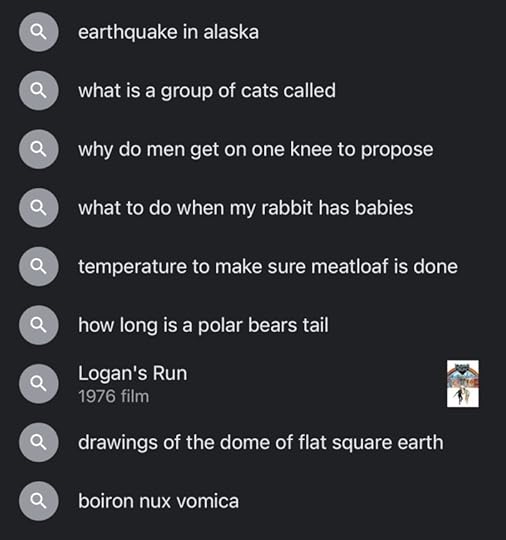
And I guarantee I don’t have the weirdest search history out there.
First of all, may I say, writers are weird. Yes, I’m talking to you. We research, even minorly, the strangest things for our writing efforts. I bet some of you who write history or science fiction have some very interesting searches.
I’d love to hear some of your recent searches! I hope you’ll comment and share a few. I asked on my social media and received some funny and some head-scratching responses.
~tara
January 18, 2022
Work-in-Progress Book Update
Greetings, friends. As I type, it’s coming up to midnight here in London. I’ve just woken up after falling asleep late evening — my sleep pattern is quite random at the moment! Maybe someone reading this can relate (I know that Covid has messed with the body clocks of many). In any case, as I’m planning to go to the library tomorrow to return and borrow some books, I felt I’d like to offer a quick update on the thought process behind the book I’m working on writing.
The motivation behind my upcoming book release is largely personal. After I read the Qur’an at the end of 2020, with its oft-repeated stark contrast between the fate of those whom God guides and those whom He leaves to stray, it raised a lot of questions for me in relation to the doctrine of hell. Having been immersed in Christian theology exclusively for many years, I felt there was a doctrinal puzzle presented by the Qur’an in relation to which I needed to put the pieces together. How should I reconcile the warnings about hell emphasised in the Qur’an with Christian theology? Is there a way in which the Qur’an and the Bible fit together, or is it a case of ‘either/or’ — that I must accept one of these holy books and reject the other?
To begin with, I felt so impacted by the clarity of the Qur’an that the whole world of Christian theology began to feel like a complex mess by comparison. I was reading some books about New Testament textual criticism and all the complex issues to do with manuscripts, translation, and canon, and I honestly considered whether I should abandon the whole thing and focus my spirituality solely on the Qur’an. However, I have witnessed miracles being performed in the name of Jesus, and I spent years worshipping as a member of Christian congregations. Surely I could not abandon the faith in Jesus that had led to so many euphoric worship sessions and a complete reorienting of my life towards Biblical principles and Biblical teaching?
I prayed long and hard about this. Specifically, the Jesus divinity issue became a pressing concern for me. I had attended prayer groups for years and had frequently experienced troubles melting away when gathered in a Christian fellowship for prayer and worship. I had surrendered my life to Jesus! Honestly, I felt, how could I even conceive of embracing Islam and its teachings concerning the unity of God and its rejection of the Trinity and deity of Jesus? This presented an almighty predicament.
And this, friends, is where I’m currently at. I cannot dismiss the feeling that the Qur’an is divinely inspired, and I cannot wholly reject the Bible, which has been such a huge part of my life over the last decade, and which led me to get baptized in water and in the Holy Spirit. Writing about Islamic theology on this blog is difficult sometimes, because I completely understand the resistance to the Qur’an from some of my Christian readers who haven’t yet read it. I was in the same boat — I used to be part of a Christian street outreach team and talked with and prayed for quite a few Muslims who I was keen to persuade that Jesus is the way, the truth, and the life, and the only way to have peace with God. However, I hadn’t even read the Qur’an before doing this! How arrogant.
The book I’m working on writing is giving me an opportunity to try to reconcile the Bible and the Qur’an in my own mind. And while the motivation is selfish in a sense, I think the book will be well worth a read for anyone who is open-minded enough to take Islam seriously, despite their Christian background.
To begin with, I was going to call the book ‘How to Avoid Hell’, and was planning to compare the teachings on hell found in the Torah, the New Testament, and the Qur’an. I hoped through my research to come to a deeper understanding of all the relevant issues. I didn’t know where it would lead. I designed a very simple temporary book cover reflecting this focus on the doctrine of hell. Designing a cover before writing a book might seem like a case of putting the cart before the horse, but it was a way of helping me to keep focused and inspired concerning the task at hand. I actually developed that original cover and produced a new version I was reasonably happy with, though I felt the fire extinguisher would perhaps create too much of a jovial impression — not good, because I take the idea of hell very seriously indeed.
I continued to undertake research for the book. I read a concise introduction to the Hadith literature in Islam and realised this would need to be discussed as part of the book. I read a 10-part blog series on Christian universalism, and realised I would have to discuss this in the book as well. I felt that writing exclusively about hell was not going to be enough. This was going to have to be a book about divine justice in general, even though the scope of the project would become very wide. I went back to the drawing board and felt the title ‘Divine Justice’ would be wholly appropriate. I designed a new cover (again, to keep me inspired and focused), and felt really happy with this.
The books I’m due to collect from the library tomorrow are all about Judaism, and this is the main area where I feel my understanding is currently lacking. Obviously through studying the Christian Bible I have a basic understanding of the Torah, but I feel for this project I must explore Rabbinic teaching more broadly. This is the next ‘phase’ of my research, and eventually I hope to produce a book which compares approaches to divine justice in the Tanakh, the Christian Bible, and the Qur’an. It could take a few months or a few years to write, but I hope that by the time the book is published I will have the deepest possible understanding of divine justice in the Abrahamic religions considering the resources I have access to.
If any of you are still reading this, thank you for indulging me. It’s late, I’m a little tired, and I know this post isn’t perfect. But it helps me to share these thoughts and hopefully helps some of you with an interest in my books to better understand the driving forces behind my latest project. You can subscribe to this blog and follow along with this journey if you’re interested in interfaith matters — I’d love to have your support as I work on producing the best book I possibly can.
Just a reminder that all my books are currently free in their eBook editions — visit my Books page for details. Feel free to comment below and give me some encouragement!
January 13, 2022
If you only believe one thing about God…
I came across a wonderfully well-written, honest, and thought-provoking post today on a blog named ‘120 Words of Torah’. I will quote the article — 120 words in length — in full (emphasis in the original):
It’s easy to preach causality: take enough precautions, you’ll stay healthy. Keep divine commandments and you’ll be rewarded, or punished if not. “If you listen to the Voice of God… I will not strike you with the plagues of Egypt. I am God the healer.” The first part is a simple reward-and-punishment formula. But ‘God the healer’ adds a twist: the Talmud explains “I heal whomever I please.” The true truth: healing is as chaotic and random as disease. Many vaccine-deniers are healthy; many pious people fall sick; many prayers don’t ‘work’; much suffering is meaningless. Only after abandoning a quest for fairness, at least sometimes, can we begin to pray again, by encountering the world as it actually is.
https://120torah.wordpress.com/2022/01/14/beshalach-5782/ [accessed 14/01/2022]
I agree entirely with one aspect of this, that is, the absolute freedom of God to do whatever He pleases. This is something I have emphasised repeatedly on my blog and in my books. However, I believe there is something lacking in the view that because God has total freedom, we must abandon any confidence in His fairness.
The Qur’an is believed by Muslims to be a perfect revelation reflecting what God has written on a preserved tablet which He keeps with Him. Note the recurring theme of God’s fairness and justice in the following verses:
Beware of a Day when you will be returned to God: every soul will be paid in full for what it has earned, and no one will be wronged.
Surah 2: 281
…anyone, male or female, who does good deeds and is a believer, will enter Paradise and will not be wronged by as much as the dip in a date stone.
Surah 4:124
Whoever has done a good deed will have it ten times to his credit, but whoever has done a bad deed will be repaid only with its equivalent—they will not be wronged.
Surah 6:160
Whatever you give in God’s cause will be repaid to you in full, and you will not be wronged.
Surah 8:60
On the Day when every soul will come pleading for itself, every soul will be paid in full for all its actions—they will not be wronged.
Surah 16:111
I could give many other examples from the Qur’an expressing the same sentiment.
The ideas of ‘fairness’ and ‘justice’ and ‘being wronged’ are of course subject to the subjectivity of God; that is to say, ultimately God will decide what is fair and what is not. But we must trust that the God who created the Universe is able to administer justice appropriately. We must also not neglect to understand that what may seem unfair during our short sojourn on Earth, will eventually be put right after we are resurrected to face judgement.
The subject matter of this article highlights why interfaith dialogue is so important, because we need some of God’s revelations (i.e. the Qur’an, which claims to be a ‘corrective’ text) to illuminate others. According to Muslims, the Qur’an was sent down to humankind to provide clarity concerning the Scriptures of the People of the Book (Jews and Christians) who came before. While the Jewish Scriptures may have relatively little to say about the nature of the afterlife, the Qur’an is very focused on providing insight in this regard.
If you only believe one thing about God, believe that God is just. Having read the Qur’an and wept at the emphatic insistence that God will administer perfect justice, I refuse to believe otherwise.
You can read my 80-page book Discovering the Qur’an for free. Click here for retailer links.
January 12, 2022
God as a Parent
In my ongoing research for my work-in-progress book about human and divine justice, I’m reading a book titled Raising Hell: Christianity’s Most Controversial Doctrine Put Under Fire by an author named Julie Ferwerda. The book presents arguments in favour of Christian universalism — that is, the belief that all people who have ever lived will ultimately be reconciled to God through Jesus Christ.
The book is interesting and well-written. A consistent theme throughout is that the author compares the relationship between God and human beings with that of a parent and a child. The thrust of her argument is that because Earthly parents want what’s best for their children, God must be the same and must want the best for all human beings (or ‘children of God’).
The author writes about how if you are a parent, even when your children go astray, mess up, are rebellious, or do something very evil, the instinct of a parent is always to seek reconciliation and what’s in the best interests of the wayward child. She suggests that a sustained punishment is never what an Earthly parent wants for their children, and her belief is that the same thing must therefore be true of God.
While the Bible does refer to the idea that believers are God’s children, my personal view is that it’s problematic in some respects to equate Earthly parents with God. God is wholly other than anything that He has created. Just because a human being has certain feelings and instincts, this does not mean that the God who created the Universe is the same. God is transcendent.
In the Qur’an, we find the following statement addressed by God to the prophet Muhammad:
Say, ‘He is God the One, God the eternal. He begot no one nor was He begotten. No one is comparable to Him.’
Surah 112:1-4
The ‘otherness’ of God is also expressed in the Bible in the following quotation:
“God is not man, that he should lie, or a son of man, that he should change his mind.”
Numbers 23:19 (ESV)
I do actually believe it is possible for God to lie and change His mind, indeed it would be absurd if the Creator of the Universe could not do so, but that’s a discussion for another time. The purpose of this article is to highlight the ‘otherness’ of God (as the above two quotations do), and the reason why the comparison between Earthly parents and God is lacking.
It is emphasised in the Abrahamic religions that God is just, and the Qur’an in particular presents a very clear picture of the distinction between the destinies of believers and unbelievers. Believers will find they are awarded the bliss of paradise, and unbelievers will be subject to the fires of hell. We cannot escape the severity of what God has revealed in the Qur’an.
There is no statement in the Qur’an (to the best of my knowledge) that indicates all human beings will eventually be reconciled to God. There is the idea that unbelievers will be subject to a ‘lasting torment’ (see surahs 5:37; 39:40; 42:45) though what happens after that torment is not altogether obvious — the suffering of the damned is not described as eternal. It is possible that eventually God could reconcile even the worst of offenders to Himself after a prolonged punishment in the fire.
There may be something in the Hadith literature which clarifies what the Prophet Muhummad said about the ultimate destiny of the damned, but I have not yet read very much of the Hadith literature, so such teaching, if it exists, has not yet made its way into my awareness. You are welcome to comment if you have any insights pertaining to this.
God is described in both the Qur’an and the Bible as ‘all-sufficient’, and this leads me to believe that God has no attribute which by necessity compels Him to torture any human beings in an unjust way. And yes, we are created in the image of God (according to the book of Genesis) and there is a scripture in the Bible which succinctly states ‘God is love’ (1 John 4:16). God is also described at the beginning of nearly every surah in the Qur’an as ‘the Lord of Mercy, the Giver of Mercy’. So there is reason for optimism.
God does whatever He will and is beholden to no one — this should always be acknowledged as we discuss these things. Due reverence for God will lead to caution when comparing His divine attributes to the attributes of human beings, including the parent/child comparison.
January 9, 2022
A Prayer for the New Year 2022
Here, Eva puts into words my own prayer for 2022 in a way more beautiful than I’ve been able to express


Almighty God, Sustainer of all things, Lord of the seasons and the years, Controller of the times and calendars, we pause to say thank you for life, breath, provision, and protection over the past year.
Thank you for faithful partners in prayer and ministry, thank you for family and loved ones, thank you for helping us through a tough year. We recognize that we would not be here without you.
We declare aloud that you are our God and we love you. You are great and good, mighty and merciful, strong and compassionate, powerful and loving.While we may not understand you norwhy you do what you do,we know you will not fail us. As you have been faithful in the past, you will remain who you are—Lord of heaven and earth.
We confess we are fearful creatures needing reassurance about what lies ahead in the unknown. We come to you…
View original post 165 more words
January 1, 2022
The Calf Path by Sam Walter Foss (poem)
Sam Walter Foss (1858-1911) was an American writer who I had never heard of before today. Perhaps Americans study his work in school, I don’t know. I came across his wonderful poem ‘The Calf Path’ today as it is included in the opening of a book I’m reading titled ‘Raising Hell’, which is part of my research for the book I’m writing about portrayals of hell in the Abrahamic religions. Reading this poem brought me to tears. It’s just so beautifully written. I hope you enjoy it, too.
One day, through the primeval wood,
A calf walked home, as good calves should;
But made a trail all bent askew,
A crooked trail, as all calves do.
Since then three hundred years have fled,
And, I infer, the calf is dead.
But still he left behind his trail,
And thereby hangs my moral tale.
The trail was taken up next day
By a lone dog that passed that way;
And then a wise bellwether sheep
Pursued the trail o’er vale and steep,
And drew the flock behind him, too,
As good bellwethers always do.
And from that day, o’er hill and glade,
Through those old woods a path was made,
And many men wound in and out,
And dodged and turned and bent about,
And uttered words of righteous wrath
Because ’twas such a crooked path;
But still they followed—do not laugh—
The first migrations of that calf,
And through this winding wood-way stalked
Because he wobbled when he walked.
This forest path became a lane,
That bent, and turned, and turned again.
This crooked lane became a road,
Where many a poor horse with his load
Toiled on beneath the burning sun,
And traveled some three miles in one.
And thus a century and a half
They trod the footsteps of that calf.
The years passed on in swiftness fleet.
The road became a village street,
And this, before men were aware,
A city’s crowded thoroughfare,
And soon the central street was this
Of a renowned metropolis;
And men two centuries and a half
Trod in the footsteps of that calf.
Each day a hundred thousand rout
Followed that zigzag calf about,
And o’er his crooked journey went
The traffic of a continent.
A hundred thousand men were led
By one calf near three centuries dead.
They follow still his crooked way,
And lose one hundred years a day,
For thus such reverence is lent
To well-established precedent.
A moral lesson this might teach
Were I ordained and called to preach;
For men are prone to go it blind
Along the calf-paths of the mind,
And work away from sun to sun
To do what other men have done.
They follow in the beaten track,
And out and in, and forth and back,
And still their devious course pursue,
To keep the path that others do.
They keep the path a sacred groove,
Along which all their lives they move;
But how the wise old wood-gods laugh,
Who saw the first primeval calf!
Ah, many things this tale might teach—
But I am not ordained to preach.
What was your response as you read this poem? Are you guilty of following the calf path in your own life, or do you try to question establish norms and pursue a better way? Leave a comment below!
December 31, 2021
Happy New Year 2022 — A Prayer
May my life be focused on God alone and doing His will in 2022. May God bring justice swiftly to Earth, though His timing is perfect and should not be questioned. May God grant mercy to those who are suffering in this new year. May God be true to the good things He has promised all believers and may He bless all who hunger and thirst for righteousness. May we recognise God’s infinite wisdom and power and hold Him in awe. May many turn to God and repent and believe and receive His forgiveness. All praise, honour, and glory are due to God alone. Amen.
Steven Colborne's Blog

- Steven Colborne's profile
- 16 followers


