
Steven Colborne's Blog, page 35
December 9, 2021
Are you sure you are what you think you are?
In a spirit of philosophical enquiry designed to make us think deeply about inherited ideas, in this article I will be pushing the boundaries of what it means to have a personal identity.
The idea that I am Steven Colborne is just an impression in consciousness that comes and goes. It has no stable or lasting reality, it manifests as certain thoughts that come to my mind sometimes when God wills me to think a certain way. There is no absolute reality other than the present moment, and in the present moment there is no past or future, no identity, there is only ‘this’, ‘now’, ‘being’, ‘reality’.
The thoughts that I have about who I am often manifest in the form of memories, but in truth, the memories that I have about myself might be unrelated to what I consider to be my ‘past’. It all depends on what God wants me to believe about myself at any particular time. God could bring to my mind that I am Penelope Foxtrot, and all my memories of Steven Colborne could be gone forever, in an instant.
God is the cosmic animator, He is bringing thought impressions to our awareness which give us a sense that we have things like an age, a gender, an occupation, a political affiliation, a nationality. What are all these things? They are merely changeable thoughts, even though most people gain their sense of identity from them.
We are not what most people think we are. What is a person? What tangible thing can I point to that makes me who I am? I suppose you could say, ‘my body is what I am’. That could well be as close to the truth as one can get. But your thoughts about who you are are distinct from your body — who you are is not merely physical processes. I am not a machine powered by a brain without any discernible cause for my neurophysiological processes, which is what some materialist scientists believe I am.
We are animated, in our thoughts and actions, by a living God. Any thought that you have about your body is just a thought — it could be other than it is. Even the ideas ‘male’ and ‘female’ are just thoughts, even though physically there are bodily differences between men and women. It’s conceivable that I might think myself to be other than merely my body, perhaps believing that my bed is part of me, or that my fingers are in fact other beings.
Where is your sense of gender when you sleep? You might dream that you are a person of the opposite sex, and yet maintain your sense of ‘I’. So it would seem that you are not your body. All our ideas about ourselves disappear when we sleep. God could wake me up as Steven Colborne today and Penelope Foxtrot tomorrow. God does whatever He will.
Have you ever thought about that voice you hear in your mind when you are thinking? Have you considered what gives it its character and intonation? Imagine if it were to change to a different kind of voice, so that a male might hear their thoughts as a female, and vice versa. I’m sure this does actually happen in some people. It’s certainly conceivable that it could.
You might resist what I am arguing in this article if you have a strong attachment to what you have learned in education about what and who you are. That would be understandable, and I hope my reflections don’t make you feel angry. They might present a challenge to your personal egoic stability. Perhaps, if you are angry, God may open your mind a little, and you may see that it’s possible to understand who and what you are in a slightly different light. I’m sorry for any hard feelings.
In this article, I have mentioned the word ‘mind’. But what is a mind? And as a related question, what is a soul? Tell me, what is your definition of a mind? What are its characteristics? Does it have physical characteristics? Does it have spiritual characteristics? Or is there no such thing — is it actually a myth that there is an entity that is the mind? Has anyone ever been able to coherently define what a soul is?
I believe that what I am is pure consciousness, focused by God through a human being’s body. God is reality, and we are all contained within His being, like separate branches of the same tree. We are not our brains, and there is evidence for this in the fact that God remembers things without having a brain. Surely it would be absurd to posit that God has a brain, so why do we think our memories and thoughts are somehow connected with our brains?
That’s quite enough metaphysical speculation for today. I will certainly close comments for this post, as I fear I could be opening up a metaphorical (and metaphysical) can of worms. But I ask you to consider these ideas for yourself. Thank you for reading.


December 5, 2021
No One is Wiser than Anyone Else
When you are immersed in conversation with another human being, the way the discourse unfolds is dependent on the will of God. God is the animator of all activity in creation, including all human activity.
The way our conversations unfold is inevitably surprising — we may enter a conversation such as a business meeting with thoughts and plans, but the conversation is likely to unfold in a way that is different to our expectations. This is part of the game of life God is unfolding, and God is the greatest of schemers.
Imagine an accomplished academic in conversation with a young child. The child may well say something that strikes the academic as very wise, while the academic may be clumsy in their expression. The wisdom expressed by the child is not the result of years of academic study, it is merely the case that God brings an idea to the child’s mind that impacts the academic in a humbling and thought-provoking way. God has all knowledge — there is no one truly wise but God.
It is not necessarily the case that as we advance in years we grow wiser. Actually, with age can come a deterioration of intellect and of the inability to express oneself with the clarity one may have had earlier in life. And it’s not always the case that a teacher is wiser than their students.
The psychologist Alfred Adler spoke about the idea of horizontal and vertical relationships. Horizontal relationships are equal, while in vertical relationships one person is superior and the other inferior. All healthy relationships, no matter the age of those involved, are horizontal relationships. A good teacher will not think them self superior to their students, and a good parent will not think them self superior to their children.
There’s nothing wrong with studying to gain knowledge and understanding. But we should always be humble in our dialogue with others, because we don’t know what nuggets of wisdom God will bring to their mind in an unexpected way, and how we might well be put to shame for thinking ourselves superior to or wiser than another person.
Approach all things with open mind
All have gifts to which we’re blind
Be sensitive to others’ cries
Others, too, are also wise
(Author unknown)
No One is Wiser Than Anyone Else
When you are immersed in conversation with another human being, the way the discourse unfolds is dependent on the will of God. God is the animator of all activity in creation, including all human activity.
The way our conversations unfold is inevitably surprising — we may enter a conversation such as a business meeting with thoughts and plans, but the conversation is likely to unfold in a way that is different to our expectations. This is part of the game of life God is unfolding, and God is the greatest of schemers.
Imagine an accomplished academic in conversation with a young child. The child may well say something that strikes the academic as very wise, while the academic may be clumsy in their expression. The wisdom expressed by the child is not the result of years of academic study, it is merely the case that God brings an idea to the child’s mind that impacts the academic in a humbling and thought-provoking way. God has all knowledge — there is no one truly wise but God.
It is not necessarily the case that as we advance in years we grow wiser. Actually, with age can come a deterioration of intellect and of the inability to express oneself with the clarity one may have had earlier in life. And it’s not always the case that a teacher is wiser than their students.
The psychologist Alfred Adler spoke about the idea of horizontal and vertical relationships. Horizontal relationships are equal, while in vertical relationships one person is superior and the other inferior. All healthy relationships, no matter the age of those involved, are horizontal relationships. A good teacher will not think them self superior to their students, and a good parent will not think them self superior to their children.
There’s nothing wrong with studying to gain knowledge and understanding. But we should always be humble in our dialogue with others, because we don’t know what nuggets of wisdom God will bring to their mind in an unexpected way, and how we might well be put to shame for thinking ourselves superior to or wiser than another person.
Approach all things with open mind
All have gifts to which we’re blind
Be sensitive to others’ cries
Others, too, are also wise
(Author unknown)
December 3, 2021
The Destiny of Satan in Christianity and Islam
While with some of my blog posts I aim to share insights, others are written with the hope of gaining insights from my followers. Today’s post is of the latter variety.
In my Bible reading today a passage from 1 John came up:
He who sins is of the devil, for the devil has sinned from the beginning. For this purpose the Son of God was manifested, that He might destroy the works of the devil.
(1 John 3:8, NKJV)
I find it interesting that Christianity provides a solution to what will happen to Satan in the End Times, alluded to here in 1 John. In the book of Revelation, which is the final of book in the New Testament and deals with events related to the End Times, we read the following:
And when the thousand years are ended, Satan will be released from his prison and will come out to deceive the nations that are at the four corners of the earth, Gog and Magog, to gather them for battle; their number is like the sand of the sea. And they marched up over the broad plain of the earth and surrounded the camp of the saints and the beloved city, but fire came down from heaven and consumed them, and the devil who had deceived them was thrown into the lake of fire and sulphur where the beast and the false prophet were, and they will be tormented day and night for ever and ever.
(Revelation 20:7-10, ESV)
What occurred to me today is that the Bible contains a great deal of prophecy, whereas the Qur’an does not. I don’t think the Qur’an has teaching related to the End Times and the events which will unfold, whereas the Bible does. Please correct me if I’m wrong, but I have read the Qur’an a few times now and I don’t think there is much prophecy.
The reason I find this so interesting is because I’m passionate about interfaith dialogue and the ways in which the Bible and the Qur’an are similar and different. I know that Muslims do discuss eschatology (the study of the End Times), because I once had a conversation with an Ahmadi Muslim who went into quite a lot of detail concerning his perspective on End Times events. However, I don’t know what his sources were.
It’s possible that there is eschatological teaching in the Qur’an which I’m simply not recalling, or perhaps there are non-Quranic sources (such as the Hadith literature) which give Muslims their understanding of the End Times. Perhaps someone can comment and let me know?
If the Bible is a prophetic book, but the Qur’an is not, this would seemingly lead to an argument that both Scriptures are important in different ways, and that both should be embraced for different reasons. This is of considerable interest to me in terms of interfaith understanding.
I look forward to any relevant thoughts in the comments.
December 2, 2021
Blog shenanigans
A while ago I made all the images on my blog black and white. It took me days to update all my posts. Even while I was doing this I had niggling doubts about it, but once I had completed the process the thought came to me that the black and white images reflected the ‘black and white’ will of God; He guides some and leaves others to stray; some are considered righteous and others wicked; we will all go to heaven or hell. This felt like justification for the laborious changes I made!
However, some images just look incredibly bad in black and white. Although it gave a nice consistency and perhaps originality to the blog, I was not happy. A couple of days ago I was up late, and I think God appreciated my frustrations as I felt inspired to update all my images again back to colour! We’re talking hundreds of posts, folks (I’ve been blogging regularly since 2012!).
Fortunately, I found some awesome stock images and am currently about a third of the way through updating all my posts again. I am so much happier with the blog in colour, and with the new images I have found I’m feeling very satisfied. I hope that you like the way the blog looks as well, that’s important to me.
I wanted to just mention a post I wrote a couple of days ago. The post, titled ‘What does it mean to say God is love?’ took me a few hours to write, and I had originally saved it as a scheduled post. However, there’s a bit of a bug in WordPress — when you unschedule a scheduled post, and then later publish it, the blog still appears in the Reader under the previously scheduled time. For this reason, many of you won’t have seen the post. So I thought I’d just give it a mention and share the link again:
What does it mean to say God is love?
In my studies of late, I have returned to reading the Bible after a few months reading the Qur’an every day. It’s very interesting returning to the Bible having read the Qur’an, and also having read a big book about New Testament textual criticism. Although I’m financially hard up right now, I’m thinking about getting the Kindle version of Bart Ehrman’s book, Heaven and Hell. Have any of you read it? I’ve read a couple of his other books but as I’ve been studying perspectives on hell in the Abrahamic religions it seems it could be interesting to read this.
I hope you are all well and are making nice plans for Christmas. I am planning to borrow a few books about Judaism from the library in the run-up to Christmas, though I think I’ll be reading the Bible quite frequently as well. I’m a huge fan of organisation and brainstorming and am looking forward to sketching out some plans for 2022 on paper (not that my plans ever turn out anything like I expect them to!).
Lastly, if you have read one of my books recently, please consider leaving a review on the relevant retailer website. Many hundreds of people have been downloading my books, but I have hardly any reviews, so would appreciate your support with this. You can find all my books (both paid and free) on my Books page.
Peace and blessings upon you and thank you for following Perfect Chaos.
November 29, 2021
What does it mean to say God is love?
In this article, I’ll be reflecting on the idea that God is love, drawing upon some personal experience as well as some Scripture quotations. I hope my reflections will be thought-provoking and interesting.
The first scripture that comes to mind in relation to this topic will be familiar to many Christians:
So we have come to know and to believe the love that God has for us. God is love, and whoever abides in love abides in God, and God abides in him.
1 John 4:16 (ESV)
When we talk about love in everyday life we cannot help but talk about relationships. We might think about the love between a husband and a wife, or the love a parent has for their child. This is not so much a feeling which can come and go; it’s more of a commitment. Love in this context is a kind of stance we take towards another person — it is a promise to treat another person kindly.
The scripture I quoted above from 1 John gives the impression of a rather more mystical kind of love. The idea that whoever abides in love abides in God is an interesting concept. It certainly accords with my understanding of God’s omnipresence. If God is omnipresent, and God’s nature is love, then there is a sense in which we are abiding in God and abiding in love at all times. I’m not sure this is what the author of 1 John was intending to convey, but it’s how I personally make sense of the ideas ‘abiding in God’ and ‘abiding in love’.
Some Christians talk about there being love in the Godhead because from a Trinitarian perspective there is a relationship between Father, Son, and Holy Spirit, which demonstrates love. These Christians use this argument to defend free will, suggesting that God is a ‘God of relationship’ intrinsically, and that we have been given free will so that we can choose to enter into relationship with God without any compulsion. The argument is that if we were compelled to love God, this would not be real love.
Those familiar with my writing will know that I do not believe we have free will. God’s absolute sovereignty means that if we do love God, it is through His acting in our lives, not through any free choice. We are merely puppets under God’s control, and we are not free to make the decision of whether or not to follow God; God guides whoever He will in whatever way He wishes.
In any case, I find the idea of love within the Trinity to be a very confusing concept — Jesus as God loving God who is really Himself in some way and the Holy Spirit being a person even though it’s difficult to perceive of spirit being a person — the Trinity is certainly not a straightforward concept to fathom and I don’t think the argument for free will based on love within the Godhead is logical or convincing.
Returning to the quote from 1 John, which I referred to as feeling rather mystical, I have had a personal experience which has contributed to my understanding of what it might mean to say God is love. Long before I read the Bible properly for the first time I was very interested in Eastern spirituality and used to meditate regularly. In my book The Philosophy of a Mad Man, which is a kind of spiritual memoir, I describe how for the most part my meditation practice was frustrating, but at times I experienced a kind of expansive feeling of peace; I might even call it bliss.
What this led me to consider is whether the feeling of bliss I experienced in deep meditation actually reflects the fundamental nature of God — that God is in essence perfect bliss. Perhaps when we meditate deeply we can in a certain way draw closer to the way God experiences reality: perfect bliss at all times. I’d be the first to admit that this is conjecture and that I don’t have any idea at all how God experiences reality. People who are drawn to Eastern spirituality, in which it is often understood that we have an ‘I-it’ relationship with God rather than a ‘I-thou’ relationship, may relate to this idea better than most Christians.
Returning to our discussion of love in Christianity, it’s appropriate to quote the famous passage from 1 Corinthians in which the apostle Paul describes love in a rather beautiful way:
Love is patient and kind; love does not envy or boast; it is not arrogant or rude. It does not insist on its own way; it is not irritable or resentful; it does not rejoice at wrongdoing, but rejoices with the truth. Love bears all things, believes all things, hopes all things, endures all things.
1 Corinthians 13:4-7 (ESV)
In the above scripture, Paul gives a detailed explanation of how love is to do with attitude. This relates to what I was saying above about love being understood in terms of relationship. Those who have a very high view of Scripture might argue that Paul’s description of love is inspired by the Holy Spirit, as all Scripture is (2 Peter 1:21). Therefore, if God is love, then we could trust that the kind of love God demonstrates would accord with Paul’s definition of love.
In my book God’s Grand Game, I detail and defend my understanding that God is in control of everything that happens (I touched upon this above). If this is true, it means that not only does all love come from God, but all hate also comes from God. This can be a hard way of seeing things for Christians, who are understandably keen to defend the idea that God is omnibenevolent (that all His ways are loving and kind).
I do believe that God is ultimately a kind, merciful, and gracious God. This is not incompatible with the suggestion that God causes evil as well as good. We just have to understand that God uses evil as a means to an end; it is a way of Him unfolding the game of life in the way that He pleases. Creating evil as well as good allows God to give expression to different aspects of His creativity, and to unfold intricate and complex storylines in creation, such as the story of Christianity over the last two thousand years (which of course couldn’t have existed without sin and evil).
Perhaps the biggest challenge to the idea that God is love is the concept of hell. There are three main views of hell within Christianity. The most severe view is that of eternal conscious torment. In my understanding, this idea is so extremely terrible that I believe it would be too severe a punishment for even the worst of human crimes. There are a couple of scriptures in the book of Revelation which support the idea (Revelation 14:9-11; 20:10) and there is the parable of the rich man and Lazarus in the gospel according to Luke which many Christians use as evidence for the idea of eternal conscious torment (Luke 16:19-30).
Alternative views in relation to the doctrine of hell include annihilationism and universal reconciliation. Annihilationism is the view that suffering in hell is only temporary, and after suffering for a time the personhood of each individual will be annihilated. Some Scriptures which can be seen to evidence this view are Psalm 1:6, Psalm 37:20, Psalm 92:7, Matthew 10:28b, John 3:16, Romans 6:23, Philippians 3:19, 2 Thessalonians 1:9, and James 4:12a. These Scriptures either explicitly or implicitly point to the idea of eternal death and the cessation of consciousness as the ultimate fate of the damned.
The final of the three main views of hell found in Christianity is that of universal reconciliation. This is the idea that eventually all people will be saved. Pastor Curt Parton has produced an in-depth study of this perspective in the form of a 10-part series on his blog, and this is highly recommended reading. One of Curt’s main arguments (which he supports with Scripture citations and exegesis) is that universal reconciliation best reflects the character of God as revealed in the Bible as a whole.
Interestingly, in Islam, hell is discussed as being a ‘lasting torment’ and very severe, but not (to the best of my current knowledge) as eternal conscious torment. So our discussions of these three views of hell are relevant to Islam as well as Christianity and Judaism. Nearly every surah in the Qur’an begins with the words, ‘In the name of God, the Lord of Mercy, the Giver of Mercy’. And I do hope that God is ultimately merciful to all sentient beings. Suffering can be a truly terrible thing and I know God understands this better than we do.
God’s love is also linked to justice. According to the Abrahamic Scriptures, there will be a judgement day when everyone will be repaid for their deeds, both good and evil. Part of God’s love is that He promises not to be unjust; the Qur’an embodies this sentiment very well and very clearly. While in Islam we find the idea that our good and bad deeds will be weighed and we will be judged accordingly, in Christianity, faith in Jesus is often understood to be the key to our justification (our right standing with God).
I will end with a closing reflection. If God Himself is love, and He experiences perfect love at all times, it seems to me that He would have no motive for causing great suffering to sentient beings. I know that people often argue against religion on the grounds that there is so much suffering in the world, but we must remember that God is all-powerful, and could, if He wished, put us all in perpetual agony. He chooses to be much more merciful, and most humans will acknowledge that their lives consist of not only bad times but also good times (sometimes very good). In any case, the Scriptures teach that we all have the hope of spending eternity in paradise if we humble ourselves before God, repent, and ask for His forgiveness — this is a central idea in all three of the major Abrahamic religions and should therefore be taken very seriously.
November 26, 2021
For a few more hours…
This has absolutely nothing to do with Black Friday (phew!). A couple of weeks ago I made ALL my books free from all retailers in their eBook editions. However, this offer is ending very soon — I have already requested that the retailers return the books to their list prices, I’m just waiting for them to update the prices on their websites.
If you’d like to get a free copy of one of my books, you should do so right away, because I’m expecting an email from Amazon any time to notify me that the prices have reverted to paid.
Here’s my Amazon author page: https://amazon.com/author/stevencolborne
The books are currently still free in all Amazon territories. Last chance! 
November 17, 2021
In What Way is the New Testament Inspired by God?
In this article, I’d like to offer some thoughts about the inspiration of the New Testament canon from a philosophical perspective. My aim is to make us think deeply about what inspiration is (within a theological context) and how this relates to the Bibles we read today.
A precursory remark is that I am not a scholar of New Testament textual criticism. As I explained in a recent article, this is a highly academic and specialised field, and scholars dedicate their whole academic careers to its study. The complexity of the subject is such that no one could become an expert by reading just a few relevant books. My reflections come after studying a book called Myths and Mistakes in New Testament Textual Criticism (InterVarsity Press, 2019), which I highly recommend for a deep dive into the subject.
The term ‘canon’, if you weren’t aware, refers to a collection of books which are generally accepted as authoritative. There are 27 books in the New Testament canon accepted by most Christian denominations today.
The manuscripts from the early centuries of Christianity that have been discovered reveal a wide variety of writings sometimes contained in codices, which are like an early form of books. Before codices there were scrolls. While a codex allowed for books to be compiled in a way scrolls couldn’t be, it’s important to point out that just because a codex contained a particular selection of books this doesn’t mean it solidified a canon. Codices often contained books that would not today be considered ‘inspired’, along with others that would.
So how did the faithful of Christian history come to know what to regard as the official New Testament canon? What scholars usually do is refer to lists of books cited in the works of the early church fathers (for example, Origen, Eusebius, Cyril, Athanasius, and many others). The books the church fathers listed as canonical varied, and there are books some of them listed which are not included in the New Testament canon generally accepted today (for instance The Shepherd of Hermas and The Apocalypse of Peter).
According to the information presented in Myths and Mistakes, the church fathers (at least those discussed in the book) were generally in agreement in respect of the majority of New Testament books. So, for instance, the Gospels and the Pauline epistles have almost unanimous attestation.
What interests me for the purposes of this article is that what scholars appear to be doing is resting the authority of the canon on these lists produced by the church fathers. But doesn’t this mean that what they are saying is that it is these lists which are ‘inspired’, rather than the books themselves? (bear with me, I’m going to elaborate!)
In order to answer this question, we need to look more closely at the idea of inspiration. I have heard Christians often justify the inspiration of the Bible by referring to a single scripture, 2 Peter 1:21, which says, “For no prophecy was ever produced by the will of man, but men spoke from God as they were carried along by the Holy Spirit”. If the justification for inspiration is that an author is ‘carried along by the Holy Spirit’, what does this mean? And if this is the criteria for ‘inspiration’, how did the church fathers (from whom we derive our canon) know which authors were ‘carried along by the Holy Spirit’ and which were not?
On the subject of what exactly the Holy Spirit is, I wrote an article about that. I highly recommend giving that article a read if the subject matter of this post is of interest to you.
So why are some writings considered to be inspired by the Holy Spirit and others not? From the perspective of my own philosophy, God’s omnipresence means God is in control of everything that happens. If this is true, it means that anything anyone writes is inspired by God. God works through human beings as the animator of all our actions. What makes the ‘inspired’ writers of Scripture different? Did they enter into a trance-like state while they were writing? Or did they perhaps see the words they were to write in their minds in a unique way? To the best of my knowledge, the Bible doesn’t explain the way in which the Biblical writers were inspired.
It is true that Christians believe we receive the Holy Spirit when we are baptised. Acts 2:38 reads, “And Peter said to them, ‘Repent and be baptized every one of you in the name of Jesus Christ for the forgiveness of your sins, and you will receive the gift of the Holy Spirit.'” The Holy Spirit, in my experience, is reflected in a personal relationship with God — God talks to us directly and makes us constantly (or at least, a great deal more than previously) aware of His existence and His presence. But that’s the case for all Christians and doesn’t explain how the Biblical writers were different.
If the writers of the 27 books of the New Testament canon were not inspired in a unique way, this would allow us to lend extra weight to the many books from the early centuries of Christianity that were not included in the canon. The canon can then be seen as a series of books chosen by committees and councils to fulfil their purposes, rather than being in themselves inspired and authoritative in a unique way. The New Testament is certainly not inspired in the way the Qur’an claims to be in Islam, where the words of the Scripture are believed to be written on a preserved tablet which God keeps with Him.
In general terms, I believe a ‘closed canon’ can be perceived in two ways. One is that human beings made a decision regarding which books should be considered canonical. The other is that God made this decision, and by His providence worked through human beings to ensure the 27 books of the New Testament that are widely accepted today are canonical. The truth might well be that these two perspectives are not incompatible, and that both are true. When you read a Bible, God has placed that particular version in your hands for the purposes He wishes to accomplish. And perhaps that’s good enough assurance for the majority of Christians.
November 7, 2021
What is the Hadith Literature in Islam?
The hadith literature is a body of writings which attempt to accurately reproduce the words spoken by the prophet Muhammad. The value in this endeavour is that, if deemed authoritative, the hadiths can be used to shed light on a number of issues related to Islamic life, including legal proceedings, matters of social conduct, and more.
An example of a hadith is as follows:
‘Abd Allāh bin Yūsuf narrated to me, [he said that] Mālik reported to me from Hishām bin ‘Urwa [who reported] from his father, [who reported] from ‘A’isha the wife of God’s Prophet [that she said,] “Hamza ibn ‘Amr al-Aslamī said to the Prophet: ‘Should I fast while traveling?’ [A’isha states:] He [Hamza] used to fast a lot. The prophet replied ‘If you wish, you may fast, if you wish you may leave off fasting.’”
(Bukhārī 30 sawn, 33) Quoted in ‘The Wiley Blackwell Concise Companion to the Hadith‘ (Daniel W. Brown (ed), published by John Wiley & Sons Ltd, 2020), p17
Each hadith contains both an isnād, which is the line of narration going back to the Prophet, and a matn, which is a saying attributed to the Prophet. The isnād is intended to convey sufficient authority in relation to the matn.
There are many different collections containing many thousands of hadith, and it seems that scientific approaches have been developed to help scholars to try to ascertain which hadith can be considered ‘strong’ (authoritative) and which are relatively ‘weak’ (questionable). This is a huge field of study in Islam.
There has been debate, however, since the days of early Islam, concerning whether or not the hadith literature should be used as guidance in addition to the teaching found in the Qur’an. Some of this uncertainty is reflected in the following passage written by scholar of Islam Alfred Guillaume in his book about the hadith literature first published in 1924:
Probably the hadith literature presents us with more contradictory statements on the question as to whether it was permissible to write down traditions of the prophet in the early days of Islam than on any other question. Many express prohibitions can be quoted.
Abu Sa’īd al Khudrī asserts that he asked the prophet’s permission to write down hadith, and it was refused. Abū Huraira is reported to have said: ‘The prophet of God came out to us while we were writing hadith, and said, “What is this that you are writing?” We said, “Hadith which we hear from thee.” Said he, “A book other than the book of God! Do you not know that nothing but the writing of books beside the book of God led astray the peoples that were before you?” We said, “Are we to relate hadith of you, O prophet of God?” He replied, “Relate hadith of me: there is no objection. But he who intentionally speaks falsely on my authority will find a place in hell.”’
In one version Abū Huraira adds that the writings were heaped together and burned. Further Abū Nadhra relates: ‘We said to Abū Sa’īd: Would that you would write down hadith for us, for we cannot remember them.” He answered: “We will not write them, nor will we collect them in books. The prophet of God related them to us orally and we remembered them, so you must do the same.”’
The comment of Ibn ‘Aun (d. 151) on the situation is not without interest. He says: ‘The men of the first century who disapproved of writing held that principle in order that the Muslims might not be kept by other books from the study of the Quran. The ancient scriptures have been forbidden because it is impossible to distinguish what is true in them from what is false and the genuine from the spurious: moreover the Quran renders them superfluous.’
Guillaume, Alfred: Traditions of Islam: An Introduction the the Study of the Hadith Literature (Kessinger Publishing 2010, p16-17)
The quotation from the Prophet suggests that writing down hadiths was acceptable to him, though it appears he was extremely cautious about the idea. And note the concern that Ibn ‘Aun expressed; that the authority of the Qur’an is such that it renders other religious books, including pre-Islamic scriptures, ‘superfluous’. Ibn ‘Aun could be alluding to the the Scriptures of the People of the Book (the Christians and Jews) when he says ‘the ancient scriptures have been forbidden’, as the Qur’an says these Scriptures have been corrupted (see, for example, Surah 4:155-159).
In Islam, the Qur’an is the perfect Word of God; a Scripture which ‘makes things clear’. See, for example, Surah 5:19, which says the following:
People of the Book, Our Messenger comes to you now, after a break in the sequence of messengers, to make things clear for you in case you should say, ‘no one has come to give us good news or to warn us.’ So someone has comes to you, to give you good news and warn you: God has the power to do all things.
(Surah 5:19)
No hadith writings could ever compete with the status of the Qur’an in terms of authority, because the Qur’an is the direct Word of God, and the sayings of the Prophet are not. It therefore seems wise that if in doubt, a spiritual seeker should go directly to the Qur’an for guidance. Hadith study is a very large field of intellectual scholarship, and delving into the study of this area would take many years and is much too vast an undertaking for me personally at this stage in my life.
I recognise that for some scholars and academics, studying the hadith literature could have practical application, but I am certainly unqualified in this respect. The clarity of the Quranic text is sufficient for me as guidance for my life. For those who seek to further their understanding of the hadith literature, I recommend The Wiley Blackwell Concise Companion to the Hadith (edited by Daniel W. Brown, published by John Wiley & Sons Ltd, 2020) as a good starting point.
Interestingly, a parallel might be drawn between the study of the hadith literature in Islam and New Testament textual criticism in Christianity. Both are fields of study that aim to increase clarity in relation to the way God has spoken. In Islam, the hope is to find clarity through understanding the words and conduct of Muhammad the messenger of God as they have been passed down to us through lines of authoritative narration. In New Testament textual criticism, the aim is to reach a deeper understanding of how God has spoken through the person and teaching of Jesus Christ and those who wrote the New Testament Scriptures.
Despite the good intentions of scholars who work in these fields, such studies can become so intellectual and obscure that there is a danger they could draw people away from true religion, which is relatively simple as I understand it from the teachings found in the Qur’an. We should always be cautious to avoid our religious practice becoming an intellectual enterprise at the expense of practicing what is taught simply and clearly in the sacred Scriptures.
It’s not necessary to study the hadith literature, or New Testament textual criticism, in order to understand God’s commandments to human beings in relation to how we should order our conduct and be in right standing with Him. This is not to belittle these academic fields of study, which certainly have value, but they should be understood as being primarily of use to specialists rather than needing to be studied by every spiritual seeker on Earth. To understand what God requires of us, we need look no further than the clear and direct revelation found in the pages of the Qur’an.
I have written a short book titled Discovering the Qur’an, in which I relay the thoughts I had after reading the Qur’an in its entirety for the first time. The book is free and can be downloaded from these retailers.
October 28, 2021
Six Free eBooks: Last Chance to get Your Copies!
Dear friends, for some time now I’ve been offering six of my short-read books for free. Each book is between 60-90 pages long and they make for great reading when you’re perhaps short of time or don’t want to commit to reading something very lengthy.
Having made these books free for several months, I will be reverting the books back to paid from this weekend. If you would like to read any of the eBooks, feel free to take advantage of the promotion while you still can.
These are the books that are currently still free:
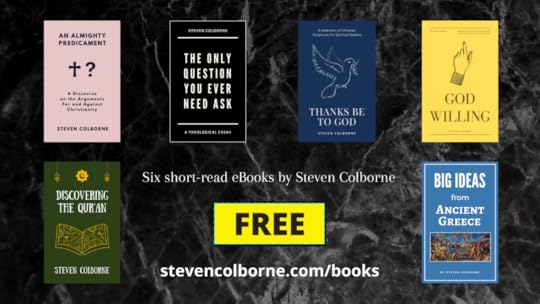 How to get your copies
To download a book, simply visit my Books page and click on the book or books you would like to download. This will take you to a ‘choice page’ on which you can choose your preferred retailer.
Click here to visit the Books pageRemember, you don’t need an eReader to read the books, you can read them on a desktop PC. You just need the right app, which you can find here.
If you enjoy reading one or more of these eBooks, I would really appreciate a positive review on the retailer website from which you downloaded your copies. Thank you so much and happy reading!
Steven Colborne's Blog

- Steven Colborne's profile
- 16 followers

