
Steven Colborne's Blog, page 36
October 28, 2021
The Lord’s Prayer as Guidance Rather than Mantra
In the passage of Scripture known as the Sermon on the Mount, the subject of prayer is discussed. The words attributed to Jesus, as found in the New Testament (in Matthew 6), are as follows:
“And when you pray, you must not be like the hypocrites. For they love to stand and pray in the synagogues and at the street corners, that they may be seen by others. Truly, I say to you, they have received their reward. But when you pray, go into your room and shut the door and pray to your Father who is in secret. And your Father who sees in secret will reward you.
“And when you pray, do not heap up empty phrases as the Gentiles do, for they think that they will be heard for their many words. Do not be like them, for your Father knows what you need before you ask him. Pray then like this:
“Our Father in heaven, hallowed be your name. Your kingdom come, your will be done, on earth as it is in heaven. Give us this day our daily bread, and forgive us our debts, as we also have forgiven our debtors. And lead us not into temptation, but deliver us from evil.”
(Matthew 6:5-13 ESV)
Note the important point that Jesus commands people not to ‘heap up empty phrases’. To me, this reinforces the idea that it is the meaning behind the words that is important, not the words themselves.
Some Christians (and I have noticed this particularly in Roman Catholicism) do repeat the Lord’s Prayer ritualistically. But surely what’s important to God is the heart behind the words. Therefore, an idea I would suggest is that rather than ritualistically repeating the prayer you could try paraphrasing, keeping the broad meaning of the phrases but putting them in your own words.
For example, ‘My God and King, you are most holy, your plans will not be thwarted, you are in sovereign control. Please keep me from sinning, provide for me, and keep me safe from all evil. Please forgive me and those who have sinned against me. You have all power, glory, and majesty, and you will reign forever. Please accept my prayer. Amen’
I’m not suggesting you replace Jesus’ prayer with mine, just that you could create your own prayer, from your heart, which reflects Jesus’ teaching but is your personal petition to God. That way you can ensure you aren’t guilty of ‘heaping up empty phrases as the gentiles do’.
I’m not saying the Lord’s Prayer isn’t perfect, just that we should all avoid praying it in an empty and ritualistic way. I hope I’m making a valid suggestion.


October 26, 2021
Do you need help with your book?
Having self-published over a dozen books myself, I have learned a lot about self-publishing and the publishing industry in general. Taking this into consideration, I’m currently looking to help other authors to write, publish, and promote their books.
Tealight Books is my publishing imprint and has now been developed to incorporate author services. Some of the things I’m able to help authors with include the following:
Building an author platformOptimising a blog for book salesBlog promotion and marketingCreating an author websiteBook cover design and interior formattingDistribution of books and eBooksBook promotion and marketing…and much more!
I’m looking to work with individuals at any stage of their book publishing journey to help clarify and achieve their goals and make an impact in their chosen genre. My expertise is mainly in non-fiction, though I’m open to working with any author who is producing work that is groundbreaking or interesting.
Visit the Tealight Books website to learn more.I’m offering a 20% discount on my service fees in the run-up to Christmas, though I can only work with one or two clients at a time so space is limited. I’m open to working with authors anywhere in the world, and I can accommodate different time zones and preferred methods of communication.
With any questions, or with an expression of interest, please email steven@tealightbooks.com. It would be great to hear from you.
October 25, 2021
The Book of Job: A Chapter a Day
Dear friends, I recently read through the book of Job — an Old Testament book — and it spoke to me in a deeper way than ever before. I thought I might try re-reading one chapter each day and typing out each chapter to share here on WordPress, perhaps with some of my own reflections.
Job is a very powerful book telling the story of a man who is described as “the greatest of all the people of the east”. He is a godly person and blessed with abundance by God. However, when God asks Satan to consider how Job is blameless, Satan responds that if Job is afflicted terribly he will not keep his faith. God gives Satan permission to afflict Job, but only so much. The book unfolds with Job suffering great affliction, and various of his companions try to give him wise advice in relation to his predicament. At the end of the book, God speaks to Job out of a whirlwind and sets matters straight, both for Job and for his companions.
While my current plan is to share a chapter each day, please be aware that life is unpredictable, and there are over 40 chapters in the book of Job, so this is a big undertaking. I can’t promise I will be able to post every day. However, the depth and beauty of the book is such that I feel it’s worthwhile to give this a go — it will help me to absorb the book in a deeper way and hopefully provide comfort and encouragement to some of you reading as well. I hope you’ll follow along and be blessed. I’ll begin with Chapter 1 tomorrow (God willing).
October 21, 2021
An Interview with Collin Cooper (Philosophical Rambler)
Collin and I met through the blogging community here on WordPress. We have a mutual respect and appreciation for each other’s work. Collin kindly asked me to do an interview for his blog recently (which you can find here) and in return I asked Collin some questions about his life and work, the substance of which you can find below.
Can you tell us why you refer to yourself as Philosophical Rambler?Firstly, thank you for inviting me to do this interview Steven, it is a great pleasure.
This is a great question! I actually refer to myself as the Philosophical Rambler for many reasons. It is a persona, a personality, a character, that truly represents me. I love seeing the world and traveling to new places to find inspiration for my writing. That is the rambler, the person who travels and has stories to tell. They have seen a lot of this world, maybe they have gone through a lot too. It is very hard to find new inspiration as a writer without a new environment, and that doesn’t always have to be a new place physically.
Many times, the place you are in this week emotionally or spiritually is vastly different than even a month ago. You must keep moving forward in your personal life so that you will have new content to create. This leads to the problem we see in the music industry with so many artists dying at such young ages. There is a myth that you need to be messed up to write something new, something unique, that is simply not true.
One of the greatest songwriters in my opinion, Justin Townes Earle, talks about this in many of his interviews before he passed away in 2020 due to an accidental overdose. He said that he was able to write much better when his mind was clear. Life is inspirational enough when you experience it without distortion. The philosophical in the name describes the type of rambler. It is a person who is questioning culture, society, and broadly, existence.
Do you have a specialism, or particular area of interest, when it comes to writing?Yes, I definitely specialize in poetry and short essays. I write what I would call philosophical poetry. A lot of what I write in the form of poetry deals with emotions, culture, and the struggle for existence in modern society.
It is much easier for someone to understand a poem about nostalgia than a thousand-word essay, it really depends on who you want your audience to be. I try to balance being an intellectual with also being practical. Many of my essays are very in depth and moderately long, but they have brought me great success and opportunities I never imagined.
My recently released poetry collection, Blood Stained Mahogany, has a general appeal to anyone. You don’t have to like poetry to read it. Traditional rhyming poetry is not what you see in most contemporary journals today. I do not have a particular poetry style that I adopted when I began writing, I was writing the early poetry on my blog without any idea of tradition or standards.
Looking back, I see that as a good thing. Now I definitely have a style, but it is completely my own, it tends to be short but packed with meaning. It is harder to add levels of meaning to a longer poem without it being read more as a narrative. I would encourage people interested in writing to write what they feel, you can get some really unique work when you experiment.
Can you name three books that have influenced your thought, and why you like them?This is a very interesting question. My favorite philosopher is Jean-Jacques Rousseau, so I definitely have been impacted by “The Social Contract.” It contributes a lot of the foundation for modern political philosophy and can be seen as a manual for society. Though there are many critiques of social contract theory throughout contemporary philosophy, I have been able to build a unique approach to deconstructing the theory which I expect to be published on my blog in the coming months.
Another book would be “Walden and Civil Disobedience” by Henry David Thoreau. It was one of the first philosophy books that I read, and it impacts my view of economics, nature, political theory, and housing. It is a must read for anyone interested in philosophy. It can be read as a narrative, or a guide on how to live free. The bulk of my original philosophical work deals with the self and our relation to society, culture, and government.
Lastly, a book that has had a big impact on me personally is “Lost Illusions” by Honoré de Balzac. It is a novel which highlights the struggle of the writer in society. I have internalized the understanding of the main character, Lucien Chardon de Rubempré, where I now realize when I am acting in the same manner as him. We are very similar; it is incredible he is a fictional character. Honoré de Balzac was an extremely talented novelist, I would personally equate him with Leo Tolstoy.
Your new book is titled Blood Stained Mahogany. Can you tell us about the book — why you wrote it and who it might appeal to?Yes, Blood Stained Mahogany is my most recent book and reflects how far I have come as a writer within a short period of time. I think it also reflects how far I have come as a person; I have experienced a lot since Time Eternal (my debut chapbook) was released in April of this year.
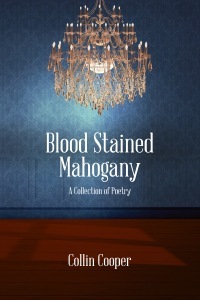
The book appeals to anyone. I say that not as an author looking for someone to get the book, it is a collection of over 170 poems that deal with so many themes that many people have experienced. People who have read it, never before reading any poetry, really enjoy it. The work speaks for itself when you read it. There is so much that this book deals with, as I say in the preface, each poem needs to be read first individually, and then how it reflects to the larger collection.
I see Blood Stained Mahogany as art, a story, and in many cases, my own evolving understanding of this world, and sometimes what is beyond. I began writing this book immediately after releasing Time Eternal in April, I had a good amount of the first poems in this book completed before the production on Time Eternal was even finished.
Time Eternal was a single, in music terms, and Blood Stained Mahogany is an album. The two books definitely reflect each other, but I identify much more with this recent release. An artist will always be most critical of his old work. The poems in Blood Stained Mahogany were all written during the late spring and early summer, and I think the season impacted their creation in many ways. Some of the poems are historical, there is one about the French Revolution and another about the Bolshevik Revolution. I was reading a lot of Russian and French literature at the time.
Other poems near the end of the book are nearly psychedelic. I have created each line of the poems very carefully, but they can be read in an infinite number of ways. I want the reader to put their own life and journey into the words. The book will appeal to anyone who is interested in learning more about our struggle to exist, our culture, and really, themselves. I learn something about myself every time I read a poem from the collection, and I am the author.
The title, Blood Stained Mahogany, is reflective of something very valuable like mahogany wood, being stained with blood, being scarred. The stain won’t go away, it will be there as long as the wood lasts. The idea for the title comes from having the great experience of visiting the Lotz House in Franklin, Tennessee. The wood in the room is stained with the blood of soldiers from the American Civil War who were injured in the nearby battle. You can see exactly where the people were due to the stains. What was going on in the mind of those people as they were slowly dying? They were sitting in a mansion, likely with people they never knew, as they struggled to hold onto life. The pain, the screams, the trauma. You can not enter that room without feeling that it is not a normal place.
The title of this book can be deconstructed to mean that though you may have wealth, that does not mean that it is not bought with blood. You have a story, you have a past, and that is something you will not be able to get away from. This is just one interpretation of the title, there are many layers of meaning to explore.
What’s the meaning of life?Ha, this is a good question. What is the meaning of life? Who can answer that? I do not claim to be able to answer that, I don’t think that throughout your entire life you will have the same answer. As a Christian, I would say that the meaning of life is to live with honor and to glorify God. As a human, I would say that the meaning is to live with honor, endure suffering, create and conserve beauty, and find real truth at the bottom of the chaos of modern society and culture. That is the best we can do. We are very fragile.
Where can people find out more about you and your books?People can find out more about me and read my work on my blog Philosophical Rambler here. If they are interested in getting my books, they can get them from Amazon here. Thank you very much for hosting this interview Steven, it has been a great experience.
Many thanks, Collin, for answering my questions! I hope readers have enjoyed learning more about Collin and his work and will consider purchasing a copy of one of Collin’s books and following his blog.
October 16, 2021
There is Only One God
In the course of my faith journey, I often find myself asking people if they believe in God. The answers people give can be quite telling.
I’ve heard many people respond, “I believe in something“, which to me suggests an openness to the existence of God without an inclination to use the word ‘God’ or associate themselves with a particular religion. Other people, such as those in the ‘Law of Attraction’ movement, tend to say they believe that ‘the universe‘ is what brings them good or bad fortune, rather than a personal God who is directing all activity in creation.
In my discussions with Christians, when conversation turns to the subject of the existence of God — and I tell them I believe in God — they sometimes respond by asking me, “Ah, but which God?” The motivation behind their question is that they believe only Christians worship the true God, which many of them say is the triune God of Father, Son, and Holy Spirit.
The way I describe my personal understanding of God is to simply argue that in reality there is only one God, the God who has created all things. I believe in the unity of God, that God is omnipresent and that His being pervades all things. God is the self-existing, all-sufficient one, and everything that has been created was brought into being by Him. He has created every religion, every belief system, every plant and every animal, every planet and every star, and He has existed from eternity past and will exist eternally into the future. He has all knowledge and all power and is in control of everything that happens.
The best way to get to know the One True God is to explore the teachings of the messengers He has sent to every community. According to the Qur’an, no community faces the judgement of God before a messenger has been sent to give warning, and to make clear the way in which we can please God and obey Him. But no one will follow God unless He wills them to — God is sovereign over the unfolding of all events. God guides whoever He wills to guide, and leaves to stray whoever He wills to stray.
If you’re not sure whether or not there is a God, or if you believe in ‘something’ or ‘the universe’ but don’t really understand what it is you’re referring to, I strongly advise you to read the Scriptures of the major Abrahamic religions, which in my understanding reveal a lot about the nature of God and the requirements which He asks human beings to obey. There are of course disagreements among religious people over theological issues, and I personally find the Qur’an to be the clearest revelation of divine truth, although the other Abrahamic Scriptures are clearly an important part of God’s plan as well.
The reason why I believe in the Abrahamic religions, rather than in Hinduism or Buddhism for example, is because Abraham was a monotheist who was favoured by God. As a monotheist myself, I find I can relate philosophically to the teachings found in the Abrahamic Scriptures, especially those teachings in which we do not attribute partners to God, but worship God alone.
Are you uncertain about all this? If in doubt, pray to God for guidance. He is not far from those who humble themselves before Him. It’s a vitally important subject because Christians, Muslims, and Jews all believe in a day of judgement following the resurrection of the dead at a time in the future known only to God. We must strive to find the right path to please God and the right way to follow Him so that we can have hope that we will avoid the punishment of the fires of hell and instead live in paradise in the afterlife.
For in-depth discussion of theological issues, I invite you to visit my Books page. I am currently offering six free eBooks, as well as a range of paid books. Thank you for reading and peace be with you.
October 13, 2021
Initial research for my next book
Friends, I hope you are all well. I wanted to share with you some of the books I’ll be reading as I embark on my new book writing project. I can’t say too much about the book at this stage but what I will say is that interfaith issues will be central to the book. In these initial stages of planning and researching, I’m intending to read quite widely. However, there are two subjects that I’m particularly interested in right now…
The Hadith Literature
Since reading the Qur’an had such a profound impact on me, I have been keen to learn more about the Hadith literature, which is a body of work documenting the life and sayings of Prophet Muhammad.
Interfaith Spirituality
I’m very interested to explore how the Abrahamic religions fit together and to get a deeper understanding of the areas of theological resonance and dissonance between them.
With the above considerations in mind, I have borrowed the books pictured below from a philosophy and theology library in London that I recently joined.
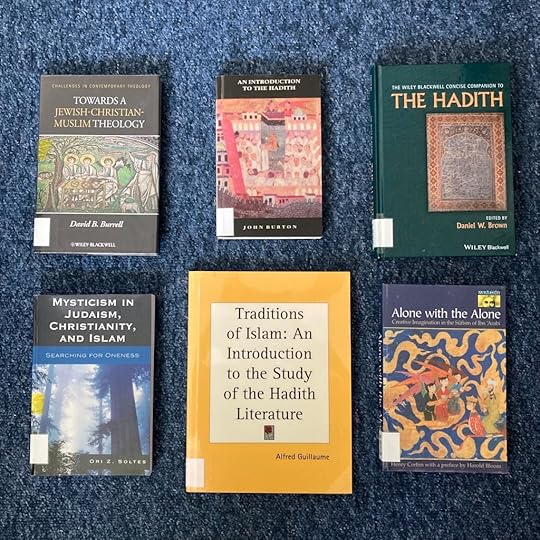
The yellow book is a large print book, which I actually reserved by mistake! However, my eye sight isn’t perfect, and one of my pet hates is books that have really small font sizes (that cause me eye strain), so I’m actually not disappointed to be reading a large print book at all 
These books may take me months to read. I’m a slow reader, because I like to try to fully understand, absorb, and digest every sentence when I’m reading a good book. I’m not sure where to start with this bunch; they are each fascinating to me in their own way.
I’m feeling quite fatigued at the moment. I’ve been doing a lot of walking and have been wrestling with a cold which I picked up when the weather changed, so I’m not going to immerse myself in study too deeply until I feel back to 100% (or at least somewhere close!). But yeah, I feel excited and privileged to have access to this fascinating reading material and I look forward to sharing any interesting discoveries with you all here on Perfect Chaos in due course.
October 12, 2021
Call for reviewers!
Would you be interested in receiving a free review copy of one of my books? This would hopefully be a mutually beneficial arrangement — not only would an honest (hopefully, positive!) review help me out immensely, but you get to choose any book from my catalogue and receive a copy in your preferred format entirely free of charge. You might post your review on a blog, on a retailer site like Amazon, or on a social site like Goodreads.
To see all my published works and choose a book to review:
https://stevencolborne.com/books
Once you’ve made your choice, simply drop an email to steven@tealightbooks.com requesting your preferred book and format.
If you have read any of my short-read books already (all six are currently free), but haven’t yet left a review online, it would be a great help if you would do so on Amazon or whichever retailer site you used to download the book. Every review helps me out a lot and you don’t have to write more than a line or two if you don’t want to — it needn’t take more than a couple of minutes.
As an added incentive for you to write a review, if you email me a link to your review (on any platform) once it’s live I will send you a free copy of a music album I released in 2018 entitled Tell Everyone Now, which features me singing and rapping about science and religion, among other things!
Thank you so much for your support and I hope to hear from you 
October 9, 2021
Interview for Collin Cooper’s Blog
I was invited by Collin Cooper, also known as Philosophical Rambler, to do an interview for his blog. Collin writes poetry and philosophy and is soon to be publishing a full-length book titled Blood Stained Mahogany in addition to a short poetry book he has published previously, titled Time Eternal.
In my interview for Collin’s blog I discuss some quite personal and sensitive topics, but my answers were from my heart and I just shared what came to mind without holding back. I hope that if any of you check out the interview, you’ll find it interesting.
You can read the interview here:
https://philosophicalrambler.com/an-interview-with-steven-colborne/
I also invite you to subscribe to Collin’s blog. He’s a Christian and a philosopher and is involved with some intriguing projects. He’s also a very articulate writer.
I hope you enjoy reading the interview, which Collin and I feel turned out well. Thanks Collin!
October 8, 2021
‘The Abrahamic Faiths’ by Jerald Dirks (book review)
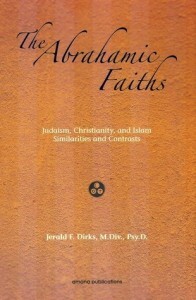
Jerald F. Dirks is an American scholar whose spiritual journey took him from being an evangelical Christian to an ‘atypical Christian’ and finally to being a convert from Christianity to Islam. Dirks was educated at Harvard Divinity School and his family came from a Methodist church background.
At the beginning of his career, Dirks was a minister in the United Methodist Church, but he left the ministry in 1974 owing to theological struggles he was having around issues such as the doctrine of the trinity, the sonship of Jesus Christ, the historicity of the crucifixion event, and the Christian view of ‘atonement in the blood’.
Dirks encountered and became friends with many Muslims due to research he was doing into the history of the Arabian horse. He was struck by how impeccable the conduct of these Muslims was, and despite being determined to cling to his Christianity, he was appreciating more and more about Islam and even started adopting Muslim ritual practices while still describing himself as an ‘atypical Christian’ rather than a Muslim.
There was no single moment of epiphany that signalled Dirks’ conversion to Islam, except that he does mention a conversation he had when he was visiting the Middle East and was asked directly about his faith. While previously he had clung to the ‘atypical Christian’ title, on this occasion he said he believed there is only one God and that Muhammad is God’s messenger, thus reciting the shahada in a way that was really unintentional but revealed the extent to which his beliefs had shifted.
While Chapter 1 of The Abrahamic Faiths contains Dirks’ personal testimony, the rest of the book is dedicated to the discussion of interfaith theology. Dirks spends a long time contrasting the direction found in the Qur’an with the teaching found in the Bible, and the tone Dirks adopts when discussing the Bible is at times very critical.
There is one chapter towards the end of the book, for instance, when the author is discussing the role of women in Islam, Christianity, and Judaism. The picture Dirks paints of the treatment of women in the Bible is deeply critical, and the way Dirks writes indicates that he has little respect for the Bible and doesn’t consider it to be inspired revelation. I found this a little difficult to stomach, and I wish Dirks had been less attacking and more understanding of Biblical teaching, seeing as the Judeo-Christian Scriptures have been transforming the lives of millions of people for thousands of years.
The Abrahamic Faiths is full of quotations from both the Qur’an and the Bible, as well as from the Hadith literature and from theologians from Christian church history. Dirks’ arguments are on the whole very persuasive, and he presents a strong defence of Islam against ‘Islamophobia’ and the portrayal of Islam in the American media and in American culture. Dirks dispenses with many of the stereotypes Americans have of ‘Islamic extremists’ and ‘jihadists’, and the author cleverly shines light on the true meaning of Islamic terms and teachings that have been mistranslated or taken out of context.
This book has imperfections, as nearly all books do. There are some errors in printing, including the very last paragraph of the book having not printed properly meaning the book ends on an unfortunate cliffhanger! The printing errors (and there are quite a few) do detract a little from the sophistication of the book, but as an author myself I know how easily things like this can happen so I’m entirely forgiving of it. Perhaps there will be a subsequent edition that will iron out the mistakes.
All in all, The Abrahamic Faiths has served as a great primer for me as I embark on my own mission to explore matters of interfaith dialogue, especially in relation to the Scriptures of Judaism, Christianity, and Islam. Dirks’ book is quite America-focused, and will therefore appeal primarily to Americans, though there is still lots of meaty theological content for non-Americans such as myself.
The Abrahamic Faiths is available on Amazon here (not an affiliate link). I would advise, however, that the book is currently priced significantly higher on Amazon than I have found it priced elsewhere, so if you’re interested in reading the book I would recommend checking out a few different retailers. I was able to get my copy from Blackwells here in the UK for £14.99 compared with £24.22 which is Amazon’s list price for the same edition at the time of writing.
Please note: I never give star ratings for book reviews on Perfect Chaos because I believe they encourage people to make snap judgements rather than deepening their understanding of why they may wish to read or ignore a particular book. To view a full list of all the books I have reviewed on this blog to date, click here.
September 28, 2021
Sacred Scripture: The Contextual and the Timeless
Steven Colborne's Blog

- Steven Colborne's profile
- 16 followers

