
Jerome R. Corsi's Blog, page 8
November 23, 2025
Other than these GOP ‘lowlifes,’ Trump says ‘Republican Party has never been so UNITED’
 President Donald Trump and Speaker of the House Mike Johnson shake hands after signing the funding bill that reopens the government, Wednesday, Nov. 12, 2025, in the Oval Office. (Official White House photo by Daniel Torok)
PALM BEACH, Florida – While simultaneously bad-mouthing some members of his own political party, President Donald Trump on Sunday asserted Republicans are at their peak of unity.
“The Republican Party has never been so UNITED AS IT iS RIGHT NOW!” Trump exclaimed on Truth Social.
He then named at least three members of the GOP with whom he has serious problems, labeling them “lowlifes.”
“Other than Rand Paul, Rand Paul Jr.([Thomas] Massie!), Marjorie ‘Traitor’ Brown, and a couple of other ‘lowlifes,’ and other than the fact that many want the Election threatening Filibuster TERMINATED (the Dems will do it in the first minute of their first chance!), and some don’t, there is great spirit and cohesion.”
“Plus, the Republican Party is MUCH BIGGER than it was when I announced in 2015 or, ever was before – Many Millions More Members!” Trump continued, as he touted the successes of his administration.
“We now have the Strongest Border EVER, Biggest Tax Cuts, the Best Economy, Highest Stock Market in USA History, and sooo much more. BUT, THE BEST IS YET TO COME! VOTE REPUBLICAN!!!”
According to the Pew Research Center: “Today, Americans are about evenly split between the two parties: 46% identify with or lean toward the Republican Party, and 45% identify with or lean toward the Democratic Party.
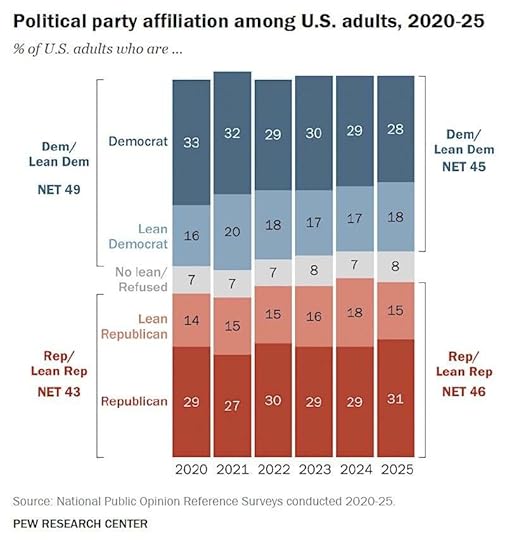
“This balance of partisanship is similar to 2024, but the current near-even division marks a shift from the affiliation advantage the Democratic Party enjoyed a few years ago.”
Follow Joe on X @JoeKovacsNews


Marjorie Taylor Greene jumps to third place for 2028 Republican presidential nominee, but will she run?
 U.S. Rep. Marjorie Taylor Greene, R-Ga.
In the wake of her announcement she’s quitting Congress, U.S. Rep. Marjorie Taylor Greene has jumped to third place on the Polymarket prediction market to be the 2028 Republican presidential nominee.
The Georgia Republican currently stands at 6%, just behind second-place Secretary of State Marco Rubio at 8%, and far behind the current front-runner, Vice President JD Vance who has 55%.
She is ranked ahead of other well-known names, including President Donald Trump, with whom she has had a highly publicized falling out, as well as journalist Tucker Carlson, Florida Gov. Ron DeSantis, and Donald Trump Jr.

But is the MAGA firebrand interested in running?
Time Magazine suggested yes, writing on Saturday: “The Georgia lawmaker has privately told allies that she has considered running for president in 2028, according to two people who have spoken with her directly about the prospect and three others familiar with her thinking.
“The possibility comes amid the dramatic rupture in Greene’s relationship with President Donald Trump, which contributed to her decision to announce on Friday that she would resign from the House of Representatives in January.”
But Time’s article prompted a forceful denial on Sunday from Greene, who called it a “complete lie.”
“TIME claims ‘sources’ told them I’m running for President in 2028, which means this is a complete lie and they made it up because they can’t even quote the names of the people who they claim said it. That’s not journalism, it’s called lying,” Greene said in a lengthy statement on X.
“I’m not running for President and never said I wanted to and have only laughed about it when anyone would mention it. If you fell for those headlines, you’re still being lulled everyday into psychosis by the Political Industrial Complex that always has an agenda when it does something like this.”
TIME claims “sources” told them I’m running for President in 2028, which means this is a complete lie and they made it up because they can’t even quote the names of the people who they claim said it. That’s not journalism, it’s called lying.
I’m not running for President and… pic.twitter.com/i99LgGvVSx
— Marjorie Taylor Greene (@mtgreenee) November 23, 2025
She continued: “Running for President requires traveling all over the country, begging for donations all day everyday to raise hundreds of millions of dollars, arguing political talking points everyday to the point of exhaustion, destroying your health and having no personal life in order to attempt to get enough votes to become President all to go to work into a system that refuses to fix any of America’s problems.
“The fact that I’d have to go through all that but would be totally blocked from truly fixing anything is exactly why I would never do it. And most importantly, I’m not the kind of person who is willing to make the deals that must be made in order to be allowed to have the title. Again, I’m not motivated by power and titles.”
On Friday, Greene posted a video of herself telling supporters, “I will be resigning from office with my last day being January 5, 2026.”
My message to Georgia’s 14th district and America.
Thank you. pic.twitter.com/tSoHCeAjn1
— Marjorie Taylor Greene (@mtgreenee) November 22, 2025
Last Sunday, as WorldNetDaily reported, after being labeled by Trump as a “traitor,” “fake politician” and “ranting Lunatic,” Greene said the commander in chief put a target on her back, placing her very life in danger.
“Being called a ‘traitor’ isn’t just hurtful, it puts a target on my back and puts my life in danger,” she said.
I stood with President Trump when almost no one else would. I campaigned for him all over this country and spent millions of my own dollars helping him get elected.
That’s why being called a “traitor” isn’t just hurtful, it puts a target on my back and puts my life in danger.… pic.twitter.com/LPDjpldExn
— Rep. Marjorie Taylor Greene (@RepMTG) November 16, 2025
Greene told CNN’s Dana Bash, “The most hurtful thing he said which is absolutely untrue is he called me a traitor and that is so extremely wrong. And those are the types of words used that can radicalize people against me and put my life in danger.”
Follow Joe on X @JoeKovacsNews
‘Nothing ever gets better’: Marjorie Taylor Greene announces resignation from Congress
/*! This file is auto-generated */!function(d,l){"use strict";l.querySelector&&d.addEventListener&&"undefined"!=typeof URL&&(d.wp=d.wp||{},d.wp.receiveEmbedMessage||(d.wp.receiveEmbedMessage=function(e){var t=e.data;if((t||t.secret||t.message||t.value)&&!/[^a-zA-Z0-9]/.test(t.secret)){for(var s,r,n,a=l.querySelectorAll('iframe[data-secret="'+t.secret+'"]'),o=l.querySelectorAll('blockquote[data-secret="'+t.secret+'"]'),c=new RegExp("^https?:$","i"),i=0;i<o.length;i++)o[i].style.display="none";for(i=0;i<a.length;i++)s=a[i],e.source===s.contentWindow&&(s.removeAttribute("style"),"height"===t.message?(1e3<(r=parseInt(t.value,10))?r=1e3:~~r<200&&(r=200),s.height=r):"link"===t.message&&(r=new URL(s.getAttribute("src")),n=new URL(t.value),c.test(n.protocol))&&n.host===r.host&&l.activeElement===s&&(d.top.location.href=t.value))}},d.addEventListener("message",d.wp.receiveEmbedMessage,!1),l.addEventListener("DOMContentLoaded",function(){for(var e,t,s=l.querySelectorAll("iframe.wp-embedded-content"),r=0;r<s.length;r++)(t=(e=s[r]).getAttribute("data-secret"))||(t=Math.random().toString(36).substring(2,12),e.src+="#?secret="+t,e.setAttribute("data-secret",t)),e.contentWindow.postMessage({message:"ready",secret:t},"*")},!1)))}(window,document);
/*! This file is auto-generated */!function(d,l){"use strict";l.querySelector&&d.addEventListener&&"undefined"!=typeof URL&&(d.wp=d.wp||{},d.wp.receiveEmbedMessage||(d.wp.receiveEmbedMessage=function(e){var t=e.data;if((t||t.secret||t.message||t.value)&&!/[^a-zA-Z0-9]/.test(t.secret)){for(var s,r,n,a=l.querySelectorAll('iframe[data-secret="'+t.secret+'"]'),o=l.querySelectorAll('blockquote[data-secret="'+t.secret+'"]'),c=new RegExp("^https?:$","i"),i=0;i<o.length;i++)o[i].style.display="none";for(i=0;i<a.length;i++)s=a[i],e.source===s.contentWindow&&(s.removeAttribute("style"),"height"===t.message?(1e3<(r=parseInt(t.value,10))?r=1e3:~~r<200&&(r=200),s.height=r):"link"===t.message&&(r=new URL(s.getAttribute("src")),n=new URL(t.value),c.test(n.protocol))&&n.host===r.host&&l.activeElement===s&&(d.top.location.href=t.value))}},d.addEventListener("message",d.wp.receiveEmbedMessage,!1),l.addEventListener("DOMContentLoaded",function(){for(var e,t,s=l.querySelectorAll("iframe.wp-embedded-content"),r=0;r<s.length;r++)(t=(e=s[r]).getAttribute("data-secret"))||(t=Math.random().toString(36).substring(2,12),e.src+="#?secret="+t,e.setAttribute("data-secret",t)),e.contentWindow.postMessage({message:"ready",secret:t},"*")},!1)))}(window,document);
‘Ranting lunatic’: Trump officially cuts off support of Marjorie Taylor Greene
/*! This file is auto-generated */!function(d,l){"use strict";l.querySelector&&d.addEventListener&&"undefined"!=typeof URL&&(d.wp=d.wp||{},d.wp.receiveEmbedMessage||(d.wp.receiveEmbedMessage=function(e){var t=e.data;if((t||t.secret||t.message||t.value)&&!/[^a-zA-Z0-9]/.test(t.secret)){for(var s,r,n,a=l.querySelectorAll('iframe[data-secret="'+t.secret+'"]'),o=l.querySelectorAll('blockquote[data-secret="'+t.secret+'"]'),c=new RegExp("^https?:$","i"),i=0;i<o.length;i++)o[i].style.display="none";for(i=0;i<a.length;i++)s=a[i],e.source===s.contentWindow&&(s.removeAttribute("style"),"height"===t.message?(1e3<(r=parseInt(t.value,10))?r=1e3:~~r<200&&(r=200),s.height=r):"link"===t.message&&(r=new URL(s.getAttribute("src")),n=new URL(t.value),c.test(n.protocol))&&n.host===r.host&&l.activeElement===s&&(d.top.location.href=t.value))}},d.addEventListener("message",d.wp.receiveEmbedMessage,!1),l.addEventListener("DOMContentLoaded",function(){for(var e,t,s=l.querySelectorAll("iframe.wp-embedded-content"),r=0;r<s.length;r++)(t=(e=s[r]).getAttribute("data-secret"))||(t=Math.random().toString(36).substring(2,12),e.src+="#?secret="+t,e.setAttribute("data-secret",t)),e.contentWindow.postMessage({message:"ready",secret:t},"*")},!1)))}(window,document);
‘Lost her way’: President Trump ‘surprised’ at Marjorie Taylor Greene
/*! This file is auto-generated */!function(d,l){"use strict";l.querySelector&&d.addEventListener&&"undefined"!=typeof URL&&(d.wp=d.wp||{},d.wp.receiveEmbedMessage||(d.wp.receiveEmbedMessage=function(e){var t=e.data;if((t||t.secret||t.message||t.value)&&!/[^a-zA-Z0-9]/.test(t.secret)){for(var s,r,n,a=l.querySelectorAll('iframe[data-secret="'+t.secret+'"]'),o=l.querySelectorAll('blockquote[data-secret="'+t.secret+'"]'),c=new RegExp("^https?:$","i"),i=0;i<o.length;i++)o[i].style.display="none";for(i=0;i<a.length;i++)s=a[i],e.source===s.contentWindow&&(s.removeAttribute("style"),"height"===t.message?(1e3<(r=parseInt(t.value,10))?r=1e3:~~r<200&&(r=200),s.height=r):"link"===t.message&&(r=new URL(s.getAttribute("src")),n=new URL(t.value),c.test(n.protocol))&&n.host===r.host&&l.activeElement===s&&(d.top.location.href=t.value))}},d.addEventListener("message",d.wp.receiveEmbedMessage,!1),l.addEventListener("DOMContentLoaded",function(){for(var e,t,s=l.querySelectorAll("iframe.wp-embedded-content"),r=0;r<s.length;r++)(t=(e=s[r]).getAttribute("data-secret"))||(t=Math.random().toString(36).substring(2,12),e.src+="#?secret="+t,e.setAttribute("data-secret",t)),e.contentWindow.postMessage({message:"ready",secret:t},"*")},!1)))}(window,document);
WATCH: Forget their recent ‘lovefest,’ Mamdani doubles down on calling Trump a ‘fascist’


Zohran MamdaniDemocratic New York City Mayor-elect Zohran Mamdani stood by his past characterizations of President Donald Trump as a “fascist” and “threat to democracy” during a “Meet the Press” interview recorded Saturday.
Mandani defeated former Democratic New York Gov. Andrew Cuomo and Republican mayoral nominee Curtis Sliwa on Nov. 4, ending the race to replace outgoing Independent Mayor Eric Adams. “Meet the Press” host Kristen Welker asked Mamdani about his past verbal attacks on Trump following Friday’s surprisingly congenial meeting between the two New Yorkers in the White House.
“In that press conference with President Trump, a reporter asked you whether you believe that President Trump is, in fact, a fascist, a word that you’ve used in the past. You were about to answer and President Trump sort of jumped in and said, ‘That’s okay. You can just say yes, it’s easier than explaining it,” Welker asked. “Mr. Mayor-elect, just to be very clear, do you think that President Trump is a fascist?”
“And after President Trump said that, I said yes,” Mamdani replied.
WATCH:
!function(r,u,m,b,l,e){r._Rumble=b,r[b]||(r[b]=function(){(r[b]._=r[b]._||[]).push(arguments);if(r[b]._.length==1){l=u.createElement(m),e=u.getElementsByTagName(m)[0],l.async=1,l.src="https://rumble.com/embedJS/u3rtroj&qu..., document, "script", "Rumble");
Rumble("play", {"video":"v6zyib4","div":"rumble_v6zyib4"});
“So you do?” Welker pressed.
“That’s something I’ve said in the past,” he responded. “I said it today and what I appreciated about the conversation that I had with the president that we were not shy about the places of disagreement and the politics that has brought us to the moment.”
“You’ve also said in the past that President Trump has engaged in ‘an attack on our democracy’ and called him a despot. Do you still think that President Trump is a threat to democracy?” Welker asked.
“Everything I said in the past I continue to believe and that’s the thing that’s important about politics,” Mamdani replied.
Some conservatives say negatively charged rhetoric about Trump has contributed to a rise in political violence. White House Deputy Chief of Staff Stephen Miller and his family were forced to move from their home in Arlington, Virginia after a campaign of harassment that included writing messages such as, “Stephen Miller is destroying democracy,” “no white nationalism,” and “trans rights are human rights” on public sidewalks near his residence, along with posting flyers listing his home address.
Turning Point USA founder Charlie Kirk was fatally shot Sept. 10 while taking part in a “Prove Me Wrong” event at Utah Valley University. Trump survived two assassination attempts during the 2024 presidential campaign, including a similar attack during a July 13, 2024 campaign rally in Butler, Pennsylvania and a Sept. 15, 2024 attempt to ambush him at a golf course.
Then-Vice President Kamala Harris also escalated attacks on Trump in the closing weeks of the 2024 presidential campaign, devoting a major speech to attacking the then-former president as a threat to democracy and portraying him as “unstable” days after calling him a “fascist” during an Oct. 23, 2024 CNN town hall.
Content created by The Daily Caller News Foundation is available without charge to any eligible news publisher that can provide a large audience. For licensing opportunities of our original content, please contact licensing@dailycallernewsfoundation.org.
The follies and the files
 Adam Schiff
It’s been a busy week. The latest Democrat accused by Trump aides of “mortgage fraud” is Rep. Eric Swalwell, a California Democrat. On a hyper-partisanship scale of 1-10, Swalwell is a 12, so it’s possible that while filling out his loan papers he got distracted tweeting nasty things and erred on a loan document. But so far all these cases all seem quite thin – and the fact that they are lodged only against people who’ve attacked Trump make these prosecutions seem sketchy, or worse.
* * * *
Sen. John Fetterman was hospitalized Thursday after a nasty fall. Pennsylvania’s maverick Democrat was feeling light-headed, apparently owing to a flareup of his previously disclosed irregular heartbeat. “Out of an abundance of caution, he was transported to a hospital in Pittsburgh,” his office said in a written statement that described the injuries to his face as “minor.”
“If you thought my face looked bad before,” Fetterman wisecracked, “wait until you see it now!” Such self-deprecating humor reminded me of another gangly American politician – our greatest statesman, actually.
Accused during one of his famous debates with Sen. Stephen Douglas of being “two-faced,” Abraham Lincoln replied, “If I had another face, do you think I’d wear this one?”
* * * *
Bobby, We Hardly Knew Ye
Chris Matthews has written a new book about his favorite political dynasty. It’s titled “Lessons from Bobby: Ten Reasons Robert F. Kennedy Still Matters.” It’s the second one the former MSNBC mainstay has written on President Kennedy’s brother, and the first since Robert F. Kennedy Jr. emerged as a political force in his own right – and joined Trump’s cabinet.
If you want to know why Chris felt called to resurrect the martyred hero of the 1968 presidential campaign, buy the book. If you want to know what the author told Bobby Kennedy’s son and namesake in a recent phone call, listen to RCP’s hour-long radio show, carried live on SiriusXM channel 111 each day at 11 a.m. (and reprised on our pages later in the day as a podcast). Tom Bevan, Andrew Walworth, and I had Chris on our show yesterday.
By the way, Tom was also a guest on C-SPAN’s Washington Journal Thursday morning, hosted by John McArdle. With a nod toward Trump subalterns who routinely praise their boss to the skies, I’d say that Tom was incredible on this show, tremendous, the best guest ever. I’m told it was the highest-rated C-SPAN show in history.
* * * *
Trump’s Follies
The president who famously dismisses unfavorable public opinion polls as “fake news,” while exaggerating the findings of other surveys, is finding creative ways to stay positive. On Veterans Day, Trump proffered a statistic – I don’t where it came from – that over 90% of military veterans voted for him.
“They’ve been fantastic,” Trump added. “They’re incredible people. They also voted for me about 92% or something. So we have to remember that it’s always nice when you have that – they’re spectacular people.”
I concur with the commander in chief’s assessment of America’s military families. For that reason, I almost hesitate to point out that his own job approval rating has fallen significantly. Almost hesitate, I said. The numbers in the RealClearPolitics Poll Average are dismal for the president. He’s under water by 12.3% in our average – the worst showing of his presidency.
The government shutdown certainly didn’t help, but the data shows that Trump is hemorrhaging support over his handling of the economy. James Carville’s 1992 wisdom endures (even if the buzzword du jour is “affordability,” instead of “the economy.”)
* * * *
Democrats’ Follies
The New York Times reported Thursday that Democratic National Committee chairman Ken Martin faces a revolt from the DNC’s unionized workforce over his announcement that the party’s headquarters staff will have to come to the office in person.
Working from home can be a nice break – I do it sometimes – but it’s hardly an unalienable right. Moreover, since Democrats supposedly believe that combatting Trumpism and recapturing the House of Representatives in 2026 is tantamount to preserving democracy, you wouldn’t think they’d need to be coaxed into coming into the office. You’d be wrong. This, from the Times:
The complaints began almost immediately — both in the room and on Zoom, where his comments were streamed to those working remotely. People who participated in the call described a flurry of thumbs-down emojis and other online expressions of discontent.
“It was shocking to see the D.N.C. chair disregard staff’s valid concerns on today’s team call,” the union’s leadership wrote. “D.N.C. staff worked extremely hard to support historic wins for Democrats up and down the ballot last Tuesday, and this change feels especially callous considering the current economic conditions created by the Trump administration.”
I’m not sure what “current economic conditions” the union is talking about. The main expense for commuters is travel – and gas prices have dropped since Trump took office. One suspects that young Democratic Party aides don’t have their eye on the prize. In January, the Congressional Progressive Staff Association proposed (in writing) a 32-hour work week. It reminds me of the time I quipped that any RCP reporter who mentioned “quality of life” as part of their working conditions would be fired. I was kidding. But, in the old expression, I was kidding on the square.
* * * *
Epstein Files
Speaking of the New York Times and the DNC, which are oftentimes indistinguishable from one another, here is how the Times teased out the latest Jeffrey Epstein development:
Epstein References Trump in Emails: In a message obtained by Congress, the convicted sex offender Jeffrey Epstein wrote that Donald J. Trump spent hours at his house with one of Mr. Epstein’s victims .
Almost every Democratic Party official or officeholder you’ve ever heard of went further. “Trump is a pedophile! We have the proof! He should resign now! They’ve finally got him now!” they said. So did most of the media. Here’s the problem: The emails the Democrats released Wednesday don’t prove any of that. What they show is that Democrats will stoop to anything in their efforts to slime their nemesis.
I have no insight into how much Trump knew about the sick crimes committed by Jeffrey Epstein and Ghislaine Maxwell. And I have no idea why Trump is fighting the release of the trove of investigative files the Justice Department compiled on the duo. But I do know that what the Democrats did Wednesday was nothing less than a political dirty trick.
Here is the story Democrats put out: In a 2011 email, Epstein told Maxwell, “I want you to realize that that dog that hasn’t barked is Trump.” The version of the email the Democrats put out added, “(A victim) spent hours at my house with him…he has never once been mentioned.”
That sounds bad, but it took Republicans on the House Oversight Committee about 10 minutes to realize that the Democrats had redacted the name of the victim on their own. Why? Here’s why. The woman in question was certainly “a victim” (of Epstein, Maxwell, and God-knows-who-else), but she was not a victim of Trump’s. How do we know? Because she said so. Under oath.
Her name is Virginia Giuffre, and before she died earlier this year by her own hand, Giuffre testified that she was never in Epstein’s house with Trump – and, in fact, did not even know if Trump was ever in Epstein’s house at all. So in the emails Epstein was apparently lying to his former girlfriend and co-defendant Ghislaine Maxwell. This fact shouldn’t surprise Democrats. Epstein was a pervert and a con man and a liar and a criminal.
But the Democrats decided to ignore all that – and basically take the account of a serial child molester over his most courageous victim. So much for their commitment to the women in this case. Virginia Giuffre, by the way, did remember Trump, whom she portrayed as friendly and gentlemanly. After she died, her ghost-writer finished the autobiography they were working on. That woman, Amy Wallace, described Giuffre “as a big Trump fan.”
One reason for her admiration was that Giuffre believed that in his second term as president, Trump would order the Justice Department to release its investigative files on Epstein. Instead, the president has resisted doing so. Yet that seems where things are headed – sooner or later.
This article was originally published by RealClearPolitics and made available via RealClearWire.Securing America’s drone manufacturing surge
 An R80D SkyRaider small unmanned aircraft system (SUAS) carries a Mjolnir munitions system during a combined arms live-fire training exercise involving the employment of SUAS to deliver munitions on designated targets at Camp Lejeune, North Carolina, July 3, 2025. (U.S. Marine Corps photo by Cpl. Zachariah Ferraro)Why OT Cyber Resilience Must Match Production Speed
The U.S. Army’s new SkyFoundry initiative marks a historic acceleration in domestic drone production. Announced as a pilot program in October, it aims to manufacture up to 10,000 small unmanned aerial systems (UAS) per month in the next 2 to 3 years and ultimately scale to 1 million units annually once fully operational. The program will integrate advanced digital and automated manufacturing across multiple U.S. facilities, including a dedicated innovation hub to rapidly evolve drone designs based on lessons learned from global conflicts.
SkyFoundry represents more than a production milestone. It signals a transformation in how the United States approaches defense manufacturing in the digital age. At the same time, the Department of Defense must address a growing and often underestimated challenge: the cybersecurity of the operational technology (OT) systems that underpin production.
The Expanding OT Attack SurfaceDigitally enabled manufacturing promises speed and scale, but it also expands the attack surface across critical OT environments. Modern production lines depend on programmable logic controllers (PLCs), robotic systems, additive manufacturing platforms, and industrial sensors, all of which are increasingly network-connected. These assets blur the line between cyber and physical domains, meaning a digital intrusion could have kinetic consequences.
A compromised PLC, for example, could introduce minute alterations to a drone’s airframe or payload configuration. In large-scale, automated production, such a modification could propagate across thousands of units before detection. The potential implications, ranging from flight instability to mission failure, underscore why OT network integrity must be treated as a national security priority alongside production capacity.
The Supply Chain ChallengeSkyFoundry’s distributed model, which brings together multiple domestic manufacturers contributing hardware, software, and mission-specific components, also introduces new firmware and AI supply chain risks. Each vendor integration point, whether for sensors, navigation software, or onboard processing, creates a potential entry vector for adversaries.
Foreign actors targeting firmware update processes or model weights used in onboarding AI could subtly alter drone behavior in the field. Ensuring AI model integrity, secure firmware signing, and continuous validation across all partners will be essential. These are not just IT concerns; they are mission assurance imperatives.
The challenge is compounded by the pace of production. When a facility is producing thousands of units per month, it is impractical to fully flight-test every drone before deployment. This makes real-time visibility and anomaly detection within OT environments a critical safeguard.
The Case for Automated Anomaly DetectionTraditional cybersecurity tools are designed for IT networks, not for the deterministic, safety-critical nature of industrial systems. What is needed in a program like SkyFoundry is continuous, automated OT network monitoring that can baseline normal operational behavior and detect deviations in real time, whether they stem from cyber manipulation, misconfiguration, or equipment malfunction.
By leveraging anomaly detection and network segmentation, defense manufacturers can quickly isolate potential compromises before they propagate across production lines. Such monitoring provides an added layer of assurance that each drone matches its approved digital twin and that no unauthorized changes have been introduced during design or assembly.
Balancing Velocity, Visibility, and ResilienceSkyFoundry’s success will depend on the Army’s ability to balance velocity, visibility, and resilience. The program’s promise to dramatically expand domestic UAS production capacity is strategically vital. But speed without visibility creates risk. A single undetected cyber intrusion within an OT environment could undermine thousands of assets, negating the very advantage this rapid production model seeks to create.
Embedding OT security from the ground up through network segmentation, strict access controls, firmware validation, and automated anomaly detection can ensure that manufacturing speed does not come at the cost of system integrity.
Securing the Future of Digital Defense ManufacturingSkyFoundry is a bold step toward strengthening America’s defense industrial base, but it also signals the future of digital manufacturing across all sectors, where physical production and cyber systems are inseparable. As the United States transitions to this new model, cyber-physical resilience must be viewed as integral to readiness, not a secondary consideration.
In an era where adversaries can exploit the invisible seams between IT, OT, and AI, securing those seams is as critical as any armor or airframe. The Army’s initiative offers an opportunity not only to reimagine how drones are built, but also how secure, adaptive, and trusted the entire defense manufacturing ecosystem can become.
Col. Jen Sovada (U.S. Air Force, ret.) Public Sector GM at Claroty.
This article was originally published by RealClearDefense and made available via RealClearWire.‘These conversations were very hostile’: ‘Research’ now threatened by avalanche of academic conclusions rushed into print

This is the third part of a series on academic publishing. Read part one here and part two here .
For many years, the prestigious journal Philosophy & Public Affairs published about 14 peer-reviewed articles annually. So its small volunteer staff of renowned scholars was shocked to learn that its publisher, Wiley, was demanding a significant increase in production, at one point requiring 35 new articles within 60 days.
Instead of compromising its peer-review process and rushing low-quality papers into print, then-Editor-in-Chief Anna Stilz at the University of California, Berkeley, led a revolt that culminated in the mass resignation of the journal’s entire editorial staff and board.
“Wiley told me if I didn’t publish more, I wouldn’t have a journal for long. These conversations were very hostile,” said Stilz, explaining the mass resignations. “I wanted to give our readers high-quality pieces. We were selective.”
The rebellion is one of the latest examples of the crisis engulfing the influential world of scholarly journals, which have been a foundation of research and learning for centuries. In recent years, Wiley and four other major publishers of academic literature, called the Big Five, have generated robust profit margins by ushering in large and unprecedented increases in the number of published papers. The globalization of research, with China emerging as the world’s leader a few years ago, and the ongoing ethos of “publish or perish” that’s the lifeblood of academic success, have generated an avalanche of scholarship. The Big Five has accommodated and encouraged it by launching new journals and special issues and fattening others.
Even scientists admit that much of academic publishing has run amok, overwhelming the quality-control methods of many of the 12,000 journals owned by Elsevier, Springer Nature, Taylor & Francis, Wiley, and Sage. As RealClearInvestigations has reported, unscrupulous paper mills are exploiting the publishing breakdown, producing a growing number of fraudulent articles with fake data and AI-generated text that’s tainting the world of science.
The publishing mess has consequences outside the hallowed halls of academia. The $12 billion in annual revenue that the Big Five and smaller publishers collect from research papers is also an issue for taxpayers. A sizeable chunk of this revenue comes from public universities and federal grants that pay fees to publishers for making scholars’ articles available to readers through either journal subscriptions or freely on the internet. The fees, coupled with the low production costs – journal editors typically work for free – have given the Big Five profit margins in the 30%-40% range, matching Microsoft and Alphabet and surpassing Apple last year.
“The biggest problem is that taxpayer money that was supposed to be spent on research instead goes to these publishing companies,” said University of Ottawa Professor Stefanie Haustein, a leading researcher of the publishing market. “I’m not saying publishing should be free, but these companies are making an insanely high profit. They are price gouging taxpayers.”
NIH Moves To Rein In Fees
The Trump administration is moving to rein in the fees. Jay Bhattacharya, the director of the National Institutes of Health, said in July that the publishers’ article processing charges (APC) are “unreasonably high.” These charges are an increasingly popular alternative to subscriptions because papers become “open access,” or freely available to the public. To protect taxpayers, Bhattacharya said price caps or other restrictions will be placed on the publishing charges for NIH-funded papers starting in January.
The Big Five oppose the caps, saying their fees fairly reflect the many costs involved in publishing. “An APC funding cap is a blunt instrument that would create more problems than it solves, restricting author choice, exacerbating inequities, and destabilizing the publishing ecosystem,” a Taylor & Francis spokesperson told RCI.
Some critics are looking beyond price caps for a “radical change in academic publishing,” according to a report by Cambridge University Press. It surveyed the views of 3,000 researchers, librarians, and funders and came to a conclusion that it admits is “surprising” for a publisher: The industry should churn out fewer articles, and focus on quality over quantity, while the academic community builds out lower-cost alternatives to commercial publishing.
“[T]he sheer volume of publications threatens to overwhelm the ecosystem. Important work risks being lost or drowned out by a surge of low-quality or AI-generated content,” Mandy Hill, managing director of the press, wrote in the October report.
Academic Publishing’s Secret Sauce
It’s hard to imagine a better business model than commercial academic publishing. The Big Five’s dominance, accounting for more than 50% of indexed published papers, has given them the market power to raise fees often above inflation, research shows. Universities are caught in a costly vicious circle: Although they often protest the fees that have increased to about $11 million a year on average, or about a third of a library’s total budget, they also pressure their scholars to publish at a brisk pace. That, in turn, ensures robust demand for space in journals, particularly the prestigious ones such as the Big Five’s Nature and Cell with the highest fees.
In addition to a captive market, academic publishers also enjoy a sizable cost savings particular to their industry. Publishers have various operational costs, but they don’t pay researchers who write the papers, editors who revise them (with the exception of a small honorarium for the editor-in-chief), and academic peer-reviewers who provide basic quality control.
All told, the publication cost on average for a paper is about $400, while the average article processing charge collected by journals is $1800, according to a 2021 study by Alexander Grossmann of Leipzig University in Germany.
“[T]he scholarly community must eventually make a number of decisions if it is to tackle the affordability problem,” writes Grossmann, a professor of publishing. “Are profit margins of 30-40% on taxpayer funds tolerable?”
The Big Five deny they are gouging taxpayers. A Taylor & Francis spokesperson told RCI that the charges are needed to cover “the full spectrum of publishing services, including submission and peer review management, editorial development, ethics checks and investigations, metadata tagging, indexing, metrics, content preservation, technology development and much more.”
A Springer Nature spokesperson told RCI its article processing charges are in line with the expenses associated with publishing an article. “The outreach and editorial support we provide, the promotion of scientific work we conduct, and the infrastructure we maintain and invest in are all undertaken with one goal in mind: enhancing the reach and impact of research,” the spokesperson said.
Growth of the Big Five
The crisis in academic publishing has been decades in the making. In the 1970s, the Big Five controlled less than 10% of the market – sharing it with scientific societies and university publishers – mostly through journal subscriptions to libraries. The subscription model was controversial from the get-go, with the Library of Congress calling out the “sharp and alarming increases” in subscription prices – hovering between 5% and 12% in most years, well above inflation – that were “damaging to the development of the library’s” collections.
With stagnant university library budgets crushed under with weight of increasing subscription prices, a rebellion of academics and librarians gave rise to the open access movement in the early 2000s. It sought to both lower publishing costs and freely share papers with an expanding global research community in the developing world whose universities couldn’t afford multi-million-dollar subscriptions. Under open-access deals, universities or researchers would pay a one-time article-processing charge for each published paper, which would be freely available to the public forever, made possible by the internet.
The Big Five, having expanded their market share almost fivefold after two waves of consolidation in the 1990s, resisted the new open-access model first rolled out by a few smaller publishers, such as BioMed Central. But as open access gained steam, Springer gobbled up BioMed in 2008, a first step in the Big Five’s embrace of the model, giving it a second revenue stream. Today, researchers applaud the growth of open access, which accounts for almost half of all published papers globally, as a triumph for the dissemination of knowledge. But rather than reducing the costs of publishing, they keep going up.
In an extensive study of fees from six major publishers for the period 2019-2023, Haustein, who codirects the Scholarly Communications Lab at Ottawa, found that researchers paid $2.5 billion in article processing charges to these publishers in 2023, triple the amount in 2019. Almost 90% of the journals had increased the charges, often above inflation. The average charge was about $2,900 per paper, with a high of $11,700 for high-profile journals.
“Our analysis demonstrates that there is a massive amount of money spent on APCs and that this amount is growing at a rate that is almost certainly unsustainable,” co-author Haustein wrote.
When publishers are paid by the article, it provides an incentive to maximize production and helps explain the boom in papers. The total number of indexed articles soared 47% between 2016 and 2022 to 2.8 billion, according to a study by University of Exeter’s Mark Hanson.
The publishing spike was led by MDPI, a big publisher devoted to open-access papers. It made most of its revenue from article processing charges for special issues built around a research theme. They epitomize the crisis of quantity over quality. For special issues, guest editors drive demand by soliciting articles from researchers, breaking with the standard practice of allowing researchers to submit papers when they are ready. The turnaround time from submission to acceptance is also sped up, according to Hanson’s study, allowing less time for editors to scrutinize articles for weaknesses and even fraud. And MDPI stood out among the publishers for having lower rejection rates of papers.
“If a publisher lowers its article rejection rates, all else being equal, this will lead to more articles being published,” Hanson wrote. “Such changes to rejection rate might also mean more lower-quality articles are being published.”
The blowup at Hindawi, another publisher focusing on special issues, alerted the publishing world to the magnitude of its fraud problem. Wiley bought Hindawi for $298 million in 2020, calling it an “innovator in open access publishing,” to expand into that fast-growing market and reap the article processing charges. Three years later, Wiley discovered that Hindawi had been heavily infiltrated by paper mills, forcing the retraction of 8,000 suspect articles and ending the Hindawi brand. It lives on as Exhibit A for an out-of-control publishing industry.
Detecting Fraudulent Paper Mills
The Big Five now say they are serious about curbing the publication of fraudulent papers, which are growing at an even faster rate than legitimate publications, according to a 2025 study. Springer Nature, which received 2.3 million submissions last year, has invested many millions in technology and a team of 75 experts to identify suspicious articles, such as AI-generated text and images, before publication and ensure the credibility of its research, the spokesperson said. Taylor & Francis says its integrity team prevents “thousands of fraudulent articles from being published every year.”
But plenty of flawed and fake papers continue to be published, which raises the question of whether the Big Five could be investing more in the battle against paper mills. For example, it can take years for journals to retract junk science articles after they have been flagged as suspicious, and by then it’s often too late, said Nancy Chescheir, chair of the Committee on Publication Ethics (COPE), which recently issued new guidelines to speed up the retraction process. “Editors need to act more quickly in retracting papers before they get included in systematic literature reviews and clinical care, which is happening,” Chescheir told RCI.
Cleaning up the scientific literature, however, is at loggerheads with the exponential growth of papers each year. Busy editors, particularly at less prestigious journals that are most vulnerable to paper mill infiltration, don’t have the time and resources to promptly handle the complexities of figuring out if a paper should be retracted, said Chescheir, who has served as the editor in chief of two biomedical journals.
Chescheir says publishers do need to devote more resources to protecting integrity, particularly for underfunded journals in the developing world. Wiley, for example, owns journals in China through its acquisition of Hindawi.
“The globalization of research is a wonderful thing, but as for providing resources that are adequate to deal with integrity problems across the globe, we are far away from that,” Chescheir said.
Breaking Away From the Big Five
A small number of journals have decided that the best way to protect their integrity is to break away from commercial publishing. Since the 1980s, the editorial boards of about 38 journals have declared their independence, mostly from the Big Five, and gone on to operate, typically under a new name, says Saskia van Walsum, a Ph.D. student researching this trend at the University of Ottawa. In the recent wave of breakaways, including Stilz’s philosophy journal, the push by publishers for more papers was a major complaint.
Stilz’s successor journal, Free & Equal, embraces an alternative approach to academic publishing called “diamond open access” that harkens back centuries to a time when scholars were in charge. It’s a growing movement of thousands of small journals based on the principles that scholars shouldn’t pay to publish papers and the public shouldn’t pay to read them.
The Open Library of Humanities (OLH), a nonprofit that publishes Free & Equal, started in 2013 to address the rising fees of the Big Five. Some 350 libraries, including the Ivies and major public universities in the U.S. and U.K., are backing OLH because they only pay a relatively small fee to the nonprofit, compared to what the Big Five charge, to enable the publication of its 34 titles.
While the economics of nonprofit publishing can work, breakaway journals like Free & Equal, founded in 2024, face a significant reputational challenge. Younger scholars need to publish in prestigious journals to build careers, and it can take several years for new titles like Free & Equal to receive an Impact Factor rating that signals their influence among researchers. Stilz says her new political philosophy journal has started strong, getting almost as many submissions as her former Wiley title.
“You have to trust that your community will come with you when you do a mass resignation,” she said. “You don’t have a brand.”
This article was originally published by RealClearInvestigations and made available via RealClearWire.WATCH: Behind the scenes with ICE in sanctuary state that endangers agents and children

PORTLAND, Ore. — Before dawn broke over the quiet streets of a town an hour outside Portland, federal agents sat in their cars watching a small home in the middle of a suburban block. Their target, an illegal immigrant once charged with sex crimes against children, was believed to be inside.
As sunrise first hit the driveway, a man stepped out and climbed into a car registered to the suspect. Agents noticed a child in the passenger seat. The team waited until the kid was safely dropped off at school before making their move.
When agents finally closed in, the driver wasn’t the man they were after, but he wasn’t innocent either. He admitted to being in the country illegally, with prior convictions for driving under the influence and a hit-and-run. ICE agents took him into custody, even as their original target, a convicted child sex offender, remained at large.
The arrest, which the Daily Caller News Foundation witnessed during a ride-along with ICE’s Portland field team, shows how Oregon’s sanctuary laws not only hinder immigration enforcement but also endanger the very communities they claim to protect.
ICE’s initial target was deported 25 years ago but later returned, repeatedly encountering local law enforcement and charged with several counts of rape, sodomy and sexual abuse of a child.
In 2011, the Mexican national was convicted of four counts of second-degree felony sex abuse, receiving just over eight years for his crimes. But he never served his full sentence, as ICE officials told the DCNF he was convicted again shortly after his release.
“ICE did place a detainer on him. The detainer was not honored, and he has been released into our community,” Laura E. Hermosillo, acting field director of the Portland ICE office, told the DCNF.
“This is why sanctuary policies are so dangerous,” Deputy Field Office Director Julio S. Hernandez told the DCNF. “So what happens is … the resources that we’re wasting here on the street, in other states like Arizona, we send two officers, they collect him at the jail, because he committed a crime, and then they bring him into ICE custody. Oregon doesn’t honor detainers, and they release.”
Hermosillo echoed Hernandez’s concern. “They just don’t tell us when they were released,” she said — a warning of how many illegal immigrants with criminal records are back on Oregon’s streets under the state’s protective policies.
THE COST OF SANCTUARY
The heart of the issue, agents said, runs deeper than a single arrest. Oregon’s decades-old sanctuary laws have erected a wall between local police and federal immigration agents — one that, in ICE’s view, keeps dangerous criminals on the streets.
Oregon first passed its sanctuary state legislation in 1987, later strengthening protections through the Sanctuary Promise Act in 2021. The law effectively created a safe haven for illegal immigrants by prohibiting state and local law enforcement from cooperating with federal immigration enforcement.
While data is limited on how many illegal immigrants have entered Oregon since the Biden administration’s border crisis, the Migration Policy Institute estimated about 105,000 illegal immigrants lived in the state as of 2023. The estimate is based on U.S. Census Bureau data from the pooled 2019–2023 American Community Survey (ACS) and other federal surveys.
“All of us deserve to feel safe and secure in our homes and communities,” Democrat Oregon Gov. Tina Kotek said in January, reaffirming the state’s stance. “Our immigrant communities are Oregon communities.”
Arrests of illegal immigrants in Oregon have surged in recent months, jumping roughly 550% in October alone, accordingto OPB who cited data from the Portland Immigrant Rights Coalition (PIRC).
The PIRC group, which tracks ICE activity across the state, reported 329 arrests in October. That number marks a steep jump from the combined monthly average of 237 arrests across Oregon, Washington, Idaho and Alaska between January and July, based on data from the Deportation Data Project, OPB reported.
But not every lawmaker in Oregon agrees with the state’s open-door policies. In a statement to the DCNF, Republican State Rep. Dwayne Yunker said the laws have not only tied officers’ hands, but turned the state into “a haven for crime and chaos.”
“Oregon’s sanctuary laws have turned our state into a haven for crime and chaos,” Yunker said. “Tying the hands of our officers and blocking cooperation with ICE and assistance from the National Guard makes enforcement more dangerous for the men and women who risk their lives to keep us safe. Look at Portland’s South Waterfront neighborhood.”
“Families, schools, and small businesses are being driven out by the Antifa mobs and the defund-the-police Democrats. Ordinary Oregonians are the real victims of this lawless experiment,” Yunker said.
WATCH:
While Democrats continue to defend the policies as claims of compassion for doing so, agents on the ground told a different story. To them, those same protections are what keep repeat offenders in Oregon, with illegal migrants who’ve already faced deportation but slip back in. Some eventually end up committing new crimes under the state’s protection.
One of them was Mexican national Sergio Martinez-Mendoza, who was sentenced to 92 months in federal prison for illegal reentry in 2018. He was deported from the U.S. 11 times before that year. After his eleventh illegal reentry, Martinez-Mendoza was convicted of violent sexual assault against two women in Portland, according to the Department of Homeland.
At the time, then-U.S. Attorney for the District of Oregon Billy J. Williams argued that notifying ICE of Martinez-Mendoza’s custody status under state law could have prevented those crimes.
“Effective communication between federal and state law enforcement is imperative to ensure dangerous illegal aliens are identified and deported according to law,” Williams said in a 2018 press release.
More recently, in June, a Portland federal jury found Mexican national Nelson Pablo-Morales guilty of illegally reentering and residing in the state. ICE first learned of Pablo-Morales in 2015 after his arrest for reckless driving and driving under the influence. He was deported in 2017 — only to be arrested again in February.
With Oregon’s laws essentially tying the hands of local police, Hermosillo said she knows most officers want to cooperate but are legally prohibited from doing so.
“Our law enforcement want to help us, right? Our law enforcement partners want to be there to protect the communities, and we are part of the community. They’re just not allowed to,” Hermosillo told the DCNF.
UNDER SIEGE IN PORTLAND
Beyond the political roadblocks, Portland’s ICE facility faces relentless near-daily protests and riots. The chaos quickly spiraled in June when rioters damaged federal property, with far-left agitators and Antifa protesters gathering outside the site for months.
Due to the escalating violence, President Donald Trump announced plans in late September to deploy the National Guard to protect ICE agents and secure the facility. The move was delayed, however, after the state filed a lawsuit against the Trump administration.
Turning the conversation to the stalled National Guard deployment, Hermosillo didn’t hesitate to tell the DCNF that any reinforcement would make a difference for the agents as they would take “all the help” they can get.
“I mean, we’ve been getting attacked for almost a year now, right? Our officers, our agents, our law enforcement partners that are here supporting us, they’re being followed. They’re being doxed. They’re being cornered in, stopped, and assaulted on a regular basis,” Hermosillo said. “So, no it has not stopped.”
After a three-day trial, Trump-appointed U.S. District Judge Karin Immergut ruled on Nov. 8 the National Guard would be permanently blocked from deployment in the state, acknowledging that while “violent protests did occur,” law enforcement was able to address the situation.
“As someone with extensive military training, I know the difference between lawful protest and coordinated disruption,” Yunker said in a public statement. “What’s been happening in Portland is a calculated campaign to destabilize and bait law enforcement.”
“After President Trump announced his decision last month to deploy the National Guard, agitators and their funders pivoted from riots and violence to inflatable costumes and propaganda in an attempt to whitewash months of destruction,” Yunker added. “I stand with President Trump on deploying the National Guard to restore order. And I support using the RICO Act to go after the funders who are bankrolling this chaos.”
For ICE agents in Portland and many throughout the U.S., the threats don’t end when the arrests do. Since the Trump administration renewed its crackdown on illegal immigration, officers and their families are facing a massive increase in death threats and doxxing.
According to a Department of Homeland Security press release on Oct. 30, the department revealed the threats have surged by more than 8,000%, jumping 7,000% since their last statement in September.
“The safety of our officers is very important to us,” Hermosillo said. “We want to make sure that everybody comes home at the end of the day.”
Content created by The Daily Caller News Foundation is available without charge to any eligible news publisher that can provide a large audience. For licensing opportunities of our original content, please contact licensing@dailycallernewsfoundation.org.
‘Horrific’: Pro-lifers call for repeal of Biden-era abortion drug policy after Toledo tragedy

A Toledo surgical resident has had his medical license suspended after he allegedly forced a woman he impregnated to take abortion-inducing drugs. In pro-life circles around the state and around the country, this “horrific case” has reignited calls to end Biden-era policies that they claim lead to the proliferation and abuse of these drugs.
Dr. Hassan-James Abbas, a surgical resident at the University of Toledo Medical Center, had his medical license suspended after allegedly forcing the woman he impregnated to take the drugs, which he reportedly ordered under his estranged wife’s name.
Ohio Right to Life Executive Director Carrie Snyder said in a press release, “If the allegations are true, this is attempted murder, plain and simple.
While no criminal charges have been filed against Abbas at this time, Bethany McCorkle, a spokesperson for Ohio Attorney General Dave Yost’s office, told The Daily Signal, “The publicly reported facts, if true, would lay out probable cause for a murder charge. The attorney general‘s office has no authority to conduct a criminal investigation absent an invitation from a local prosecutor, sheriff, or police chief.”
“The attorney general has full confidence in local law enforcement but is fully prepared to assist if asked,” McCorkle added.
Biden-era Policies to Blame, Pro-Lifers Say“We are calling on the Trump administration to finally protect women and preborn babies from aggressors who don’t care about either,” Kristi Hamrick, the spokesperson for Students for Life of America, told The Daily Signal in response to the case.
Pro-life organizations believe that a 2021 policy of former President Joe Biden has created opportunities for abuse of abortion-inducing drugs. The Biden administration relaxed regulations on abortion-inducing pills so they can be easily acquired online in December 2021. This has also made the method rife for abuse, as appears to be the case in Toledo.
Susan B. Anthony Pro-Life America President Marjorie Dannenfelser released a statement calling on the Food and Drug Administration to rescind the policy.
“We call on the FDA to end Joe Biden’s mail-order abortion rule today. This horrific case shows exactly how the policy endangers women and empowers abusers. This mother wanted to keep her baby – instead, she and her child were violently assaulted because the FDA allows dangerous abortion drugs to be ordered online with no oversight,” her statement began.
“Another woman has allegedly been poisoned by an abusive partner with abortion drugs under a Biden-era rule allowing the mail-order of the drugs,” an SBA Pro-Life America press release said of the Toledo incident. “With reports of the woman losing her child and going to the hospital with severe bleeding, SBA Pro-Life America calls on the FDA to end the Biden rule immediately.”
Alliance Defending Freedom, which argued the 2024 case of FDA v. Alliance for Hippocratic Medicine, is looking to take further action against the FDA.
Rosalie Markezich had a similar experience.
She is now suing the FDA. https://t.co/nE6JYke7Qn pic.twitter.com/GXR2UXu8VO
— Alliance Defending Freedom (@ADFLegal) November 12, 2025
Local pro-lifers are speaking out as well, as the Center for Christian Virtue’s Aaron Baer did over X. March for Life President Jennie Lichter put out a quoted repost of Baer to call on the FDA to take action.
This is absolutely appalling. Easy access to chemical abortion pills – through the mail, no in-person appt required – plays right into the hands of vile, abusive men who see it as the easy way out of taking responsibility for their children. Pls stop this @US_FDA @DrMakaryFDA https://t.co/nMHBElGWVJ
— Jennie Bradley Lichter (@JennieMFL) November 12, 2025
The Department of Health and Human Services did not respond to The Daily Signal’s request for comment.
A Harrowing TimelineAbbas separated from his wife in October 2024 and began a romantic and sexual relationship with a woman identified as Patient 1, WTOL 11 reported.
The timeline of events over the course of Patient 1’s pregnancy is harrowing.
When Patient 1 informed Abbas she was pregnant on Dec. 7, 2024, Abbas told her to get an abortion, but Patient 1 stated she did not want one.
The day after, Abbas, “without Patient 1’s knowledge,” allegedly ordered the cocktail of drugs used for the method, mifepristone and misoprostol, “from an out-of-state telemedical abortion provider.” Abbas “allegedly placed the order using his estranged wife’s name, date of birth and driver’s license number without her knowledge or consent, while using his own credit card, email address and delivery address.”
The drugs were delivered to Abbas’ address three days after he ordered them.
In the early hours of Dec. 18, 2024, after Patient 1 had stayed the night at Abbas’ home, she allegedly woke up to Abbas on top of her as he held her down and forced a crushed powder inside her mouth. The woman fought to get to the kitchen where she called 911, though Abbas is said to have taken her phone and hung up.
The woman drove to a hospital emergency room at 5:59 a.m., where she was documented as “Assault victim (Pt was held down by the neck by sexual partner after telling him she had a positive pregnancy test. Pt states that he forced an unknown substance into her mouth. She shoved and scratched him off her and got away at kitchen)” and had a diagnosis of vaginal bleeding.
According to WTOL 11, Abbas was interviewed by board staff on July 21 and admitted to allegations, though he claimed Patient 1 agreed to take the crushed-up pills.
The article mentions Abbas “further admitted to crushing the abortion medication for it to dissolve more quickly and adjusting the medication administration, not following the provided instructions and substituting his own medical judgment.”
On Nov. 5, the State Medical Board sent Abbas a letter revealing he “is no longer authorized to practice medicine and surgery in Ohio.”
The University of Toledo Medical Center shared a statement speaking to cooperation.
“Dr. Hassan Abbas, a surgical resident at The University of Toledo, was placed on administrative leave after the State Medical Board of Ohio suspended his license on Wednesday, Nov. 5. The matter under investigation by the state is unrelated to his role at UToledo,” the statement read. “UToledo holds its employees to the highest standards of professional conduct and will cooperate with the state medical board’s investigative processes.”
The Broader ProblemWhat happened in Toledo is not an isolated incident, pro-lifers claim.
“We’ve known for a while that no test, online distribution of chemical abortion pills exposes women to injury, infertility, and death, as well as creates a risk to the environment through abortion water pollution. But there are two groups who really love it—abusers and pill pushers,” Hamrick told The Daily Signal. “We are helping all the wrong people with the unregulated, negligent policy in place now. Three Democratic Party presidents—[Bill] Clinton, [Barack] Obama, and Biden—set this up through federal agencies without 60 votes in the U.S. Senate.”
The method not only involves “coercion” and “abuse,” but also other dangers, as Melanie Israel, a visiting fellow at The Heritage Foundation’s Richard and Helen DeVos Center for Life, Religion, and Family, claims in a report titled “Abortion Pills, Coercion, and Abuse.”
Snyder says the incident is evidence that more needs to be done to protect women and children in the Buckeye State.
“Radical activist judges in Ohio have continued to block Ohio laws that would limit easy access to abortion pills. They bear some responsibility for this. We look forward to the Ohio Supreme Court overturning the lower court ruling,” Snyder said in a press release. “In the meantime, Ohio Right to Life calls on the legislature to pass HB 324, the Patient Protection Act, which would prevent situations like this from happening by restoring common sense laws in the prescription of the dangerous abortion drug mifepristone. We will also pursue other ways to restore the protections of women which have been stripped away by judges who are subverting the will of Ohio voters.”
As for what’s next for Abbas, the State Medical Board may take further action, including permanent action that would make Abbas ineligible to hold a medical license or a certificate to practice in the state. He may also face a civil penalty of up to $20,000.
[Editor’s note: This story originally was published by The Daily Signal.]
New MAGA weapon: ‘Fight tanks’ for rural America
 (Photo by Joe Kovacs)
Another conservative satellite has joined the Trump constellation.
Jenn Pellegrino, formerly chief spokesperson for the America First Policy Institute, has launched twin think tanks in time for a brewing fight on Capitol Hill over health care and ahead of the coming midterms. The GOP is scrambling to build legislation from scratch to lower health care costs when Biden-era Obamacare subsidies expire on Dec. 31. Those same Republicans are hoping to keep their seats in the election next year.
Enter Defend Forgotten America (DFA). Enter also Defend Forgotten America Action (DFAA).
The names are pulled directly from President Trump’s first victory speech when he vowed in 2016 that “the forgotten men and women of our country will be forgotten no longer.” The goal is to bridge the divide between flyover country and the D.C. beltway, between what Pellegrino describes as rural and small urban communities and “unelected Washington bureaucrats.”
Though still in its infancy, the groups already have a window into the White House. Chris LaCivita, Trump’s 2024 campaign manager, serves as an advisor to the mission, RealClearPolitics is first to report.
DFA will focus specifically on health care policy. The DFAA policy portfolio will include everything from agriculture to housing policy. Internally, they call themselves “fight tanks.” The shared mission statement: “Championing forgotten communities and restoring power to the people who built America.”
The right-wing universe is already vast – and increasingly decentralized. Mammoth organizations, like the Heritage Foundation and the America First Policy Institute, anchor the landscape, but numerous small upstarts now dot the horizon. All of them orbit one man, President Trump, who has redefined conservativism for the last decade, much in the same way as he remade the GOP in his own image.
The Pellegrino operation will be distinct in its emphasis on the local. A key issue, one that some Republicans feel has become a blind spot, is affordability.
“President Trump has done a great job on inflation. Look at gas prices – they’re down. The cost of eggs is certainly way down from what it was several months ago. But there’s still work to be done,” she told RCP in a brief interview.
“Just like Secretary Scott Bessent was saying recently, we’re not going to speak like the Biden administration did and say that everything is great,” she added, referencing the head of the Treasury Department. “We understand and see that Americans are still feeling pain on so many issues from health care to housing. Especially in rural communities, like the blue-collar one I grew up in upstate New York, a lot of them are living paycheck to paycheck. We are focusing on their issues.”
And two recent humanitarian disasters provide a rubric for just exactly what the organizations plan to do: the train derailment in East Palestine, Ohio, and Hurricane Helene that ravaged North Carolina. A breakdown in communication, in both cases, slowed the response from the federal government.
In the face of future disasters, Pellegrino said the twin think tanks would get on the ground, not to write white papers, but to develop immediate policy proposals to guide the response. And then absent catastrophe, the organizations will seek to bring the concerns of rural Americans directly to D.C.
The Democratic brand has become radioactive in rural America. A former Newsmax host, Pellegrino is unabashedly conservative. The organization immediately makes clear its dissatisfaction with the left and liberal policy prescriptions. “They don’t understand us,” she says of Democratic politicians in a promo video, “because they have never lived like us.” Unsurprisingly, prominent Republicans have already welcomed the new group with open arms.
“We proved in 2024 that when you speak directly to working Americans in the communities the establishment ignores, you build an unstoppable coalition,” LaCivita said in a statement. “These organizations are built in that same spirit.”
New York Rep. Claudia Tenney heralded the new endeavor as “a strong advocate for the hardworking Americans who have been left behind for far too long.” Florida Rep. Anna Paulina Luna, meanwhile, described it as a bulwark against “corporations who have taken over via special interest efforts in Washington.”
This article was originally published by RealClearPolitics and made available via RealClearWire.The dire state of America’s shipbuilding infrastructure
 Sailors assigned to the Wasp-class amphibious assault ship USS Iwo Jima (LHD 7) participate in flight quarters on the ship’s flight deck, Tuesday, Dec. 3, 2024, while the ship is underway conducting aviation certifications in the Atlantic Ocean. (U.S. Navy photo by Mass Communication Specialist 2nd Class Isaac Rodriguez)Background
In 2018 Congress mandated 355 combat force ships for the Navy. According to the United States Naval Institute as of October 2025, we now have 287, a deficit of 68 or 20% fewer ships than required to protect the country. Naval experts, Defense think tanks, national security strategists, members of Congress, concerned citizens and the Navy itself call for much higher numbers of ships. Rising threats in every region of the globe substantiate the demand for more ships. More ships at sea to face these rising threats can be provided from two only sources…. existing ships in commission actually ready for sea or building more new ships. Exacerbating the dangers caused by a low number of ships in commission is the fact, at any given time, a large percentage are in long-term maintenance, most of them either awaiting being worked on or if actively worked on, behind schedule. The United States Naval Institute reports that ~100 ships are deployed forward at any given time. Fleet Forces command’s goal is surge ability for another 75 ships quickly. However, they acknowledge that presently only about 50 ships could surge rapidly to join deployed forces when required. Result, today the Navy can only put ~150 ships to sea to fight our enemies around the world. The actual requirement is much more than double that. The reasons for a lack of ships is too few shipyards that build and maintain our ships. The shipbuilding industry has been seriously neglected since the end of WWII. This article will examine the infrastructure, public and private, that we have to build new ships and to repair existing ships such that they are actually deployable. A ship sitting in a shipyard waiting to be overhauled or repaired is of no use in fighting our nation’s wars. The existing infrastructure we have to both build and maintain the nation’s combatant force ships will be examined and unfortunately, the picture is not pretty.
Facilities we have for shipbuilding and repair/overhaulPublic (Government-Owned) Shipyards for Overhaul, Maintenance and RepairThe U.S. Navy has four public shipyards. They are Norfolk (VA), Portsmouth (ME), Puget Sound (WA), and Pearl Harbor (HI). These are the backbones of depot-level maintenance and modernization for nuclear carriers and submarines. All are old and outdated, originally built for the wooden and steel fleets of the 19th and early 20th centuries. For contrast, at the end of WWII, the nation had 11 public (Navy) shipyards and 60+ private shipyards, a decline to the present of 80%.
Navy’s physical plants—dry docks, machine shops, foundries, and utilities are in outdated configurations that detract from efficiency. Norfolk was established in the early 1800s; Portsmouth, founded in 1800, is the oldest continuously operating naval yard in the U.S.; Puget Sound and Pearl Harbor are more recent but likewise developed for pre-nuclear ships and are outmoded in comparison with modern shipyards in the private sector or overseas. None were designed for today’s ships, especially our massive carriers and our exquisitely complex submarines.
To Navy’s credit the Shipyard Infrastructure Optimization Program (SIOP), was launched in 2018, a 20-year plan to modernize all four facilities—reconfiguring dry docks, recapitalizing utilities, and digitizing workflow. Yet progress has been slow: the Government Accountability Office (GAO) has reported cost growth, schedule slips, and planning deficiencies. Until SIOP is complete, these yards will continue to operate under inefficient layouts, with maintenance queues contributing to fleet readiness shortfalls. It will be years before the modernization will be completed and meanwhile the fleet will be lacking the ships that are needed for today’s threat environment.
The Heritage Foundation summarizes the problem bluntly: “The four Navy shipyards as they exist today are inadequate… they have too few functional dry docks, and their facilities and capital equipment are old and poorly configured.” NAVSEA concurs, noting that the yards were “originally designed and built to build sail- and conventionally powered ships” and are “not efficiently configured” for nuclear fleets. Heritage is not some casual observer of the Navy. They do a detailed analysis annually performed by experts; most retired senior Navy personnel and they paint a very accurate picture of the Navy’s limited capabilities.
In short, the Navy’s public yards are essential but structurally obsolete—their mission limited to repair and overhaul rather than new construction, and even that function is severely hampered by antiquated infrastructure and capacity bottlenecks.
Private (Commercial) Builders: The New-Construction BaseThe combatant force, destroyers, amphibious ships, carriers, submarines, and auxiliaries, is built entirely by the private sector yards. The yards are:
Huntington-Ingalls Shipbuilding (Pascagoula, MS): Builds Arleigh Burke–class destroyers, LPD-17 Flight II amphibs, and America-class LHAs.General Dynamics–Bath Iron Works (Bath, ME): Co-builder of DDG-51 Burke-class destroyers.Huntington Ingalls–Newport News Shipbuilding (Newport News, VA): Sole builder of the new Ford-class carriers; partner with Electric Boat on Virginia- and Columbia-class submarines. Columbia class is the replacement class of our vital nuclear ballistic missile submarines, our key nuclear deterrent.General Dynamics–Electric Boat (Groton, CT / Quonset Point, RI): Currently building Virginia and Columbia class submarines.Fincantieri Marinette Marine (Marinette, WI): Building the new Constellation-class frigate.General Dynamics–NASSCO (San Diego, CA): Constructs oilers and expeditionary bases.Austal USA (Mobile, AL): Builds auxiliary and small-combatant steel ships (T-AGOS, T-ATS) and built the Independence class LCS, the last of its class being delivered in July 2025, the USS Pierre (LCS-38).These yards are far more modern than the Navy’s public yards and equipped for modular construction, but most unfortunately remain capacity-limited. Put bluntly, they can only build a few ships at a time due to facility incapacity. Destroyer output averages roughly two per year split between Bath and Ingalls while the requirement is much higher. Through FY 2024 the Congress has authorized and funded 94 ships and only 68 have been delivered. At two per year, it will be years until the program is fully delivered. The frigate program started at Fincantieri is years behind schedule and is in extremis. Both our critical submarine programs are struggling to ramp up. Workforce shortages and lack of interest in the trades by young people, supply-chain fragility such as dependence on overseas suppliers even including China and limited dry-dock capacity keep production much slower than needed.
Despite being privately owned, most major shipyards are special-purpose naval yards, not diversified commercial shipyards. The United States has largely lost its large-scale commercial shipbuilding sector since WWII due to ill-considered policy decisions made by our government. Thus, our naval yards lack the economies of scale, modern construction methods, and steady capital reinvestment that sustain foreign peers.
America’s Obsolescence and the Modernization GapThe contrast between U.S. public shipyards and those abroad is depressing. While America’s naval yards are steeped in history, their infrastructure remains ancient by modern standards. Studies as far back as 1972 found Navy yard production to be about 30 percent more expensive per hull than comparable private work. How we got into this situation is a long story for another day. Today, modernization is needed for every aspect: modern dry docks for Ford-class carriers, crane upgrades for submarine modules, digitized design integration, and expanded workforce availability and training in the trades.
The SIOP aims to address some of these deficiencies through roughly $20–25 billion in upgrades over two decades. Yet until those investments bear fruit, throughput at the public yards will remain a bottleneck for fleet availability—limiting how many ships can be refueled, overhauled, or modernized or repaired each year. A perfect example of this lack of capacity is the USS Connecticut. The submarine was in the Pacific on patrol in October 2021 and it collided with an undersea mount causing extensive damage. The Navy now estimates that it will not be back in service until late 2026. This is largely due to the lack of repair facilities. Over 5 years out of service for this vital submarine from this accident is a testament to our nation’s failure to be serious about what it takes to support our Navy.
Private yards, meanwhile, face the opposite challenge: limited numbers and narrow specialization. Only one yard builds aircraft carriers; only two build destroyers; only two produce nuclear submarines. With few competitors and minimal surge capacity, the U.S. industrial base lacks elasticity for rapid fleet expansion—a deadly situation for the nation’s needed “Manhattan Project for Ships” concept.
Comparison with Japan and South KoreaIndustrial Scale and Modern FacilitiesJapan and South Korea are the free world’s most sophisticated and technically savvy nations for shipbuilding. Both nations possess extensive commercial shipbuilding industries that build dozens of vessels annually, ranging from super-tankers to Aegis-equipped destroyers and submarines. Their defense production benefits from dual-use, military, and commercial, industrial base, ensuring continuous investment in infrastructure, automation, and skilled labor. They also have the advantage of much lower labor costs.
South Korea’s HD Hyundai Heavy Industries and Hanwha Ocean (formerly Daewoo Shipbuilding & Marine Engineering) operate immense, purpose-built shipyards at Ulsan, Geoje, and Okpo. Japan’s Mitsubishi Heavy Industries (MHI), Japan Marine United (JMU), and Kawasaki Heavy Industries (KHI) maintain similar complexes at Nagasaki, Yokohama, and Kobe. These yards build both commercial and naval ships using highly modular, automated construction techniques with synchronized digital design.
Because their facilities are continuously refreshed through profitable commercial orders, these nations enjoy a self-sustaining modernization cycle—each generation of commercial hulls funds new cranes, dry docks, and robotics that also serve naval programs. In contrast, U.S. naval shipbuilding depends entirely on government appropriations and often operates in boom-and-bust cycles tied to congressional budgets. To complete the comparison, Japan, and South Korea account for 45% of the global market share of shipbuilding while the U.S. comes in at less than 1%.
Throughput and EfficiencyThe throughput differential is dramatic. A U.S. destroyer yard typically delivers about 1.5 ships per year, whereas Korean yards of comparable scale can turn out several large combatants annually alongside commercial production. The Japanese and Korean destroyer programs—the Maya and Sejong the Great classes—are Aegis-equipped and technologically sophisticated yet constructed at a faster cadence in facilities optimized for modular assembly.
Automation, digital integration, and standardized hull modules allow these yards to reduce labor hours and cycle time, achieving consistent quality and lower cost per ton. By contrast, U.S. yards—especially public facilities—still rely heavily on older, slower processes, stagnant configurations, and aging equipment.
Structural Advantages AbroadWhy do Japanese and Korean shipbuilders have such an edge? There are multiple reasons including:
Commercial Volume: Continuous civilian orders sustain workforce and capital upgrades.Modern Layouts: Dry docks, cranes, and assembly facilities are configured for modular blocks, enabling parallel work streams.Vertical Integration: Steel mills, component manufacturers, and shipyards operate within closely linked industrial conglomerates.Automation and Digital Engineering: Advanced CAD/CAM integration and robotic welding reduce errors and rework.Government-Industry Coordination: Both nations treat shipbuilding as a strategic national asset, aligning defense and commercial objectives.The United States, lacking a major commercial sector and operating within a fragmented acquisition system, cannot replicate these efficiencies without major changes to the way we do business and massive investment necessarily directed by and funded by the government.
Strategic ImplicationsThe nation’s present shipyard capability represents a major strategic vulnerability for the U.S.’s urgent need expand the fleet and the need for robust repair capacity. Public yards suffer from structural obsolescence, private yards from limited numbers and fragile supply chains and limited workforces. Together they represent a feeble industry and industrial base incapable of rapid surge production without radical reforms.
In a prolonged maritime competition—particularly against a nation like China, with enormous shipbuilding throughput—this imbalance puts the US at a distinct disadvantage. Japan and South Korea demonstrate what modern industrial shipbuilding looks like. We should look to them for insight on how to reform our capability.
Programs such as SIOP and incremental investments at private yards are needed for sure but are woefully inadequate and too slow. Closing the gap will require a comprehensive national mobilization of policy, funding, and workforce. Such a plan was outlined in my “Manhattan Project for Ships.” articles. Recommendations included:
Dramatically accelerating SIOP timelines and fully funding dry-dock reconstruction.Urgently establishing new public-private yards configured for modular, high-volume naval construction.Dramatically expanding apprenticeship and technical-trade programs to rebuild the shipbuilding workforce.Government incentivizing commercial shipbuilding in U.S. yards via subsidies, tax incentives, regulatory relief and other innovative solutions copying Japan and South Korea methods to create steady throughput and capital renewal.Leveraging allied cooperation with Japan and South Korea for technology transfer and best practices in digital ship design and modular construction.ConclusionAmerica’s shipbuilding infrastructure is in crisis and is at a historical crossroads. The four public yards—vital to sustain the nuclear fleet—are relics of the industrial age, only now entering long-overdue modernization. Private yards, though technologically advanced, are few and stretched way too thin. In stark contrast, allied shipbuilders in Japan and South Korea operate state-of-the-art complexes whose productivity and modernization far outpace the U.S.
Unless we embark on a major national renewal of our maritime industrial base, public and private, it will remain constrained in both building and maintaining the Navy required for our national defense. The U.S. must now urgently rebuild our shipbuilding industry if it hopes to restore true maritime capability in time to defend the nation from our enemies.
CAPT Brent Ramsey, (U.S. Navy, ret.) has written extensively on Defense and policy matters. He is a director with Calvert Task Group whose recent book, Don’t Give Up the Ship, was strongly endorsed by Secretary of War Pete Hegseth, Board of Advisors member for STARRS and the Center for Military Readiness, and member of the Military Advisory Group for Congressman Chuck Edwards (NC-11). He supports many other military advocacy organizations such as Flag Officers 4 America, Veterans for Fairness and Merit, the Heritage Foundation, and the MacArthur Society of West Point Graduates.
This article was originally published by RealClearDefense and made available via RealClearWire.Jerome R. Corsi's Blog

- Jerome R. Corsi's profile
- 74 followers

