
Jerome R. Corsi's Blog, page 2
November 29, 2025
‘It’s pointless if we can’t do anything’: Slain Guard member had mixed feelings about D.C. mission


West Virginia National Guard Specialist Sarah Beckstrom expressed a desire to “make [a] difference” while deployed to Washington, D.C., her ex-boyfriend told CNN on Friday.
Beckstrom and West Virginia Air National Guard Staff Sergeant Andrew Wolfe were allegedly shot Wednesday by Rahmanullah Lakanwal roughly a mile from the White House. Lakanwal, an Afghan national brought into the United States by the Biden administration in the wake of the American withdrawal from Afghanistan, allegedly shot the duo with a Smith and Wesson revolver at the Farragut West Metro Station in Washington.
WATCH:
!function(r,u,m,b,l,e){r._Rumble=b,r[b]||(r[b]=function(){(r[b]._=r[b]._||[]).push(arguments);if(r[b]._.length==1){l=u.createElement(m),e=u.getElementsByTagName(m)[0],l.async=1,l.src="https://rumble.com/embedJS/u3rtroj&qu..., document, "script", "Rumble");
Rumble("play", {"video":"v707iu0","div":"rumble_v707iu0"});
“She was like, ‘People spit towards us, cuss at us, throw things at us, and we can’t do nothing.’ She couldn’t detain nobody. She couldn’t stop them from doing wrong. It was— they told them to call the cops,” Adam Carr told CNN reporter Gabe Cohen what his ex-girlfriend said about the deployment. “She wanted to make a difference. She wanted to extremely. She was happy with it. And she just was also like, ‘Why am I here if I can’t do nothing? Where they limited them so much.’ She’s like, ‘It’s pointless.’ She’s like, ‘I get why we’re here. Crime is bad, but it’s pointless if we can’t do anything.’”
President Donald Trump ordered the deployment of the National Guard to Washington after his Aug. 11 announcement of a federal takeover of the capital city’s Metropolitan Police Department following an attempted carjacking which left Department of Government Efficiency (DOGE) staffer Edward Coristine injured when he intervened to assist a victim.
Beckstrom died Thursday from the wounds inflicted in the attack.
“Sarah Beckstrom of West Virginia, one of the guardsmen that we’re talking about — highly respected, young, magnificent person, started service in June of 2023, outstanding in every way — she’s just passed away,” Trump said as he called servicemembers for Thanksgiving.
United States Attorney for the District of Columbia Jeanine Pirro announced Friday that Lakanwal would face first-degree murder charges due to Beckstrom’s passing.
Content created by The Daily Caller News Foundation is available without charge to any eligible news publisher that can provide a large audience. For licensing opportunities of our original content, please contact licensing@dailycallernewsfoundation.org.


How to remain grounded and thankful amid the chaos

In a year marked by political vitriol in seemingly every conversation, a relentless scourge of political violence, and the highest-profile political assassination since 1968, Thanksgiving arrives just in time. Truthfully, it always does. And it always reminds us that long before Americans were addicted to constant clickbait-driven outrage, ours was a nation rooted in gratitude.
That sentiment can feel pretty unfamiliar – perhaps even foreign – these days. Our national political and cultural discourse, especially online, has degenerated into a permanent fever dream. Social media, which at its advent offered the promise of greater community and interpersonal connection, now thrives on the adrenaline rush of digital combat. Seemingly every news cycle and every social media feed brings more reason to believe America is splintering into warring political tribes.
Yet Thanksgiving, that most quintessential and timeless of American holidays, endures. Thanksgiving, and the broader holiday season that it kicks off, is our annual reminder that gratitude is not merely just one sentiment among many – it is our core, the glue holding us together. And the more we forget this, the more we risk an irrevocable national unraveling.
Consider how our current political climate erodes gratitude. Gratitude requires perspective, but perpetual outrage devours perspective. Gratitude necessitates humility, but algorithmically exacerbated confirmation bias destroys humility. Gratitude mandates presence with family, community and God, but the digital world keeps us frantic, aloof and distracted. Nothing about the ginned-up fractiousness of our politics and our ear-splitting online fracases encourages that healthier and more holistic view of our lives.
Thanksgiving season offers a respite from this Sturm und Drang. This time of the year forces us to step back from the outrage and the noise. It invites us to contemplate the blessings we did not necessarily think we earned and the duties we cannot necessarily avoid. It reminds us that America’s cultural inheritance – a shared moral vocabulary, a biblical framework for meaning, a commitment to the common good – is something we must preserve for the next generation.
It is telling that even in today’s environment, the cultural forces that often try to redefine other civic rituals have a much harder time rewriting a holiday that revolves around such basic staples as family, religious devotion and a shared dinner table. There is a reason for that resilience: the holiday’s elegant, time-tested simplicity.
America needs that simplicity – and common sense – more than ever. Family, community and faith remain the best antidotes to the widespread malaise and social breakdown of our age. The fall-winter holiday season harks back to an America that, while often riven and contentious, was always rooted in man’s permanent sources of meaning. And it is those same permanent sources of meaning that, if rediscovered and cherished anew, can still bring us back from the atomism, mass despondency and debilitating acrimony that define our political and cultural landscape today.
This holiday season, I’m thankful for my family – above all, my wife and our beautiful daughter, who is about to turn 1. I’m thankful for having found in recent years a resurgent commitment to the ancient religion of my forefathers. I’m thankful for my wonderful friends, who have helped serve as a stabilizing counter to the destructive political and social maladies of the day – some conspiratorial elements of which have targeted me personally. And I’m thankful to live in what still is, warts and all, the greatest country in the history of mankind.
Perhaps you may be thinking that you don’t necessarily have all these things in your own life right now. But you can change that. You can pursue a serious romantic relationship and get married. You can have children and form a family. You can make friends. You can discover, or rediscover, religion and the enduring wisdom found in Scripture. And you can recognize, especially as we approach next July’s 250th anniversary of the signing of the Declaration of Independence, everything about America that we ought to be thankful for.
Politics, policy and law are undoubtedly very important areas of public life. I have many strong opinions on these matters, and perhaps you do as well. But the mistake too many Americans are now making is to look at these areas as sources of meaning and fulfillment themselves. That is unhealthy: Politics, policy and law are false sources of meaning. Fortunately for us, the true sources of meaning still exist. Better yet, those bedrocks are as plentiful as ever. And this is the perfect time of the year to fall in love with them anew.
Classical liberal education: Scarce, embattled, essential

Excellence in most any interesting or worthy human undertaking requires years of discipline and training. To perform at the highest levels of sports, the arts, law, medicine, commerce, teaching, scholarship, writing, military service, statesmanship, and virtually every useful, honorable, or intrinsically rewarding pursuit typically depends on extensive discipline and training.
It would be odd, therefore, if excellence as a citizen and human being called for anything less. Indeed, down through the ages a liberal education, an education to foster flourishing as a free person, was understood as essential to the achievement of civic and human excellence.
Yet rights-protecting democracies also dispose citizens to see threats to freedom and equality lurking behind every claim to promote excellence, including the excellence involved in respecting the rights and responsibilities of citizenship and in exercising the qualities of mind and character central to living a good life. Many progressive educators, who dominate in our schools and universities, reason that imposing structure, establishing priorities, and supposing that teachers know better than students what should be taught and learned impairs students’ freedom and undercuts democratic equality.
Other progressive educators adopt a more radical approach. They implicitly acknowledge that American education requires structure, should establish priorities, and properly supposes that teachers know best. But they aim to instill disgust with America. They organize education around the claim that the evil institution of slavery and the abhorrent practice of racial discrimination reflect the fundamental substratum of American politics. They concentrate on spotlighting America’s flaws and mistakes while sweeping under the rug America’s extraordinary accomplishments. And, insisting that their account of the facts is beyond dispute, they stifle dissent, exclude countervailing evidence, vilify opposing views, constrict students’ moral imagination, and truncate intellectual exploration.
Consequently, American education frequently provides a training ground for illiberal and antidemocratic dispositions.
To make matters worse, American education does poorly at teaching the literacy and numeracy on which liberal education depends.
A recent University of California San Diego report illuminates the problem. “Between 2020 and 2025, the number of freshmen whose math placement exam results indicate they do not meet middle school standards grew nearly thirtyfold, despite almost all of these students having taken beyond the minimum UCOP [University of California Office of the President]-required math curriculum, and many with high grades,” according to UCSD’s Senate-Administration Workgroup on Admissions. “In the 2025 incoming class, this group constitutes roughly one-eighth of our entire entering cohort. A similarly large share of students must take additional writing courses to reach the level expected of high school graduates, though this is a figure that has not varied much over the same time span” (emphasis in the original). Substantial remedial education brings high costs: “Admitting large numbers of students who are profoundly underprepared risks harming the very students we hope to support, by setting them up for failure,” the UCSD report states. “It also puts significant strain on faculty who work to maintain rigorous instructional standards.”
Two main systemwide factors set back student preparedness and hampered the admissions office’s ability to identify qualified candidates, observes the UCSD report. One was COVID restrictions on in-class instruction. The other was the UC Board of Regents’ elimination of standardized testing – SAT and ACT –as an admissions criterion; this gave more weight to high-school grades despite grade inflation making grades less reliable.
Accordingly, the UCSD report urges reconsideration of the use of standardized testing in admissions and exploration of ways to diminish the effect of grade inflation on the assessment of candidates.
While better than nothing, the UCSD report’s narrow concerns and lackluster remedies drastically understate the problems afflicting American education.
In contrast, the London-based think tank Civitas released on November 20 an ambitious report that identifies fundamental defects of British K-12 education and proposes far-reaching reforms. The defects afflict American education as well, and the proposed reforms are pertinent on this side of the Atlantic.
In “Renewing Classical Liberal Education: What it is and its history,” Briar Lipson and Daniel Dieppe observe that “it is widely assumed by educators, policymakers and parents, and even more widely communicated to children, that the purpose of schooling is preparation for work; schools exist now to boost incomes and gross domestic product (GDP).” This, Lipson, an educator and education expert, and Dieppe, a Civitas researcher, recognize as one of contemporary education’s proper purposes. Welcoming recent reforms, they note that “England’s 15-year-olds now outperform their peers in almost all other Western countries” in reading, science, and math skills.
But education, they insist, should go beyond imparting technical proficiency to encompassing larger questions about ethics, justice, and the variety of ways of being human. “It is still perfectly possible to pass through school, including with flying colours, having never picked up a work of classical literature, having never considered the nature of truth, without the basics of Western chronology, with not one line of poetry committed to memory,” they lament. “Modern schooling has become a gateway to riches but not our full humanity.”
The gateway to our full humanity, they maintain, is liberal education. Such an education involves “the cultivation of the human spirit; the grounding of a child into a lifelong adventure through ideas and ideals, that they might enter, through the gradual cultivation of wisdom, style and virtue, into the fullness of humanity, ‘the good life’ as we might call it.” Liberal education originated in classical Greece and Rome. Variants flourished in Christendom and during the Enlightenment. In all its forms, liberal education furnished knowledge of the tradition into which students had been born, developed skills for participating effectively in civic life, and refined appreciation of justice, beauty, and the good.
Liberal education typically involves Socratic inquiry. Teachers put forward observations and raise questions about conventional and controversial opinions, and about the interpretation of great books and enduring ideas. Students offer answers while sharing their own observations and posing their own questions. In response, teachers provide additional observations and ask more questions, which stimulates fresh observations and questions from students. And so the conversation goes, sparking curiosity, enlivening inquiry, and replacing thoughtless certitudes with tempered judgments. Done well, Socratic inquiry opens students’ minds to the intricacies and depths of ethics, politics, and religion.
Contemporary liberal education combines the humanities and sciences because human beings are part of nature while also transcending nature by virtue of our capacity to speak and reason about right and wrong. The humanities – literature and the arts, history, philosophy, and theology – take precedence not least because they equip us to assess the right and wrong uses of the fruits of science.
In the 20th century, Lipson and Dieppe argue, three powerful forces operated to substantially erode classical liberal education.
First, “scientific materialism or scientism” weakened the humanities’ appeal. Dazzled by modern science’s great achievements in describing the physical world and spurring the production of civilization-changing technologies, many succumbed to scientism, the belief that all the world is reducible to the operations of physical nature, and therefore science alone yields genuine knowledge. Scientism disparages as pettifoggery the study of old books, inherited ideas, and venerable disputes. It claims the prerogative to address questions of justice, nobility, and love but only at the expense of reducing them to issues of matter in motion and nothing more. Since science describes how the world really is but cannot determine how it ought to be, scientism paved the way to moral relativism, or the belief that all moral judgments are equally valid, none more reasonable or binding than any other.
Second, moral relativism combined with the postmodern conceit that individuals are the self-originating source of value to encourage “rejection of past authorities.” Moral relativism cuts the ground from under the belief that the past is a storehouse of wisdom about civic and human affairs. Furthermore, viewing morality as the expression of subjective experiences and preferences, none better or worse than any other, suggests that education should set aside what others have thought and said down through the ages, regardless of how influentially and profoundly, to concentrate on fashioning students’ own perspectives and priorities. Progressive education has championed versions of this approach for a century.
Third, an “expanding state,” with its bureaucratic demands for objective assessments and quantifiable outcomes, distanced schools “from their ancient and humane calling.” Democratic imperatives propelled the movement from education as a private affair and the privilege of aristocrats to public education as a civic entitlement. But “viewed in the only way the state can measure it, of everyone getting the same materially, rather than every child fulfilling his/her highest human potential, it has brought the unintended consequence of narrowing schools’ focus onto a subset of measurable skills that are rewarded in the job market.”
The Civitas report illuminates a core difficulty: Scientism, scorn for the past, and statism subvert the liberal education that provides the moral compass and intellectual furnishings to grasp the urgency of, and the obstacles to, reclaiming liberal education.
This vexing dilemma only heightens the interest that friends of freedom and democracy in Britain and the United States should have in reintroducing – or introducing – liberal education into their nation’s schools and universities.
This article was originally published by RealClearPolitics and made available via RealClearWire.Chip Roy unveils plan to fix America’s legal immigration revolving door
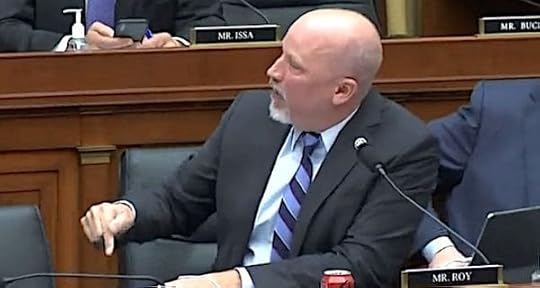
U.S. Rep. Chip Roy, R-TexasTexas GOP Rep. Chip Roy is demanding a near-total ban on immigration until the federal government hammers down large-scale changes to the immigration system.
The Republican lawmaker introduced the PAUSE Act on Thursday, a bill that would temporarily freeze legal immigration admissions until long-standing policies that enable illegal immigration are scrapped and the current system of unfettered chain migration is replaced with a merit-based model, according to texts of the legislation obtained by the Daily Caller News Foundation. Roy, a longtime border hawk in Congress, is touting the proposal as he seeks to become the Lone Star State’s top prosecutor.
“The problem isn’t just illegal immigration; it’s also legal immigration,” Roy stated to the DCNF. “While the Biden administration opened our borders and allowed millions to flood into our country, they also rubber-stamped millions more arriving through convoluted legal schemes, completely overwhelming the system.”
“The American people are done being taken advantage of by the rest of the world,” Roy continued.
The congressman’s bill follows record levels of illegal immigration experienced under the Biden administration, which drove many city governments to the financial brink. While the Trump administration has achieved unprecedented success in securing the southern border over the past year, a litany of issues remain embedded in the immigration system. The White House has worked to keep foreign nationals away from taxpayer-funded benefits and remove the incentives that drive illegal immigration.
Should the PAUSE Act be signed into law, the federal government would be forced to pump the brakes on nearly all immigration until the Diversity Visa Program and chain migration is scrapped, putting an end to admitting extended family members or winning admission based on mere luck, according to the legislation. The bill also excludes birthright citizenship to minors who don’t have at least one U.S. citizen or green card holder parent, something President Donald Trump himself has vehemently supported since returning to the White House.
Other prerequisites include banning foreign nationals from government entitlements like food stamps, public housing, Medicaid, Medicare and other freebies. Roy also wants state and local governments to be enabled with the authority to limit access to public schools to just American citizens and lawful permanent residents.
Several lawmakers in the House of Representatives have begun lining up in support of the bill, with GOP Reps. Keith Self and Brandon Gill of Texas, Andy Biggs of Arizona, Lauren Boebert of Colorado and Andy Ogles of Tennessee listed as original co-sponsors.
“Rep. Roy’s Pause on Admissions Until Security Ensured (PAUSE) Act provides exactly the ‘PAUSE’ in immigration that is necessary for America to get our house in order,” Rosemary Jenks, co-founder of the Immigration Accountability Project, said in a statement provided to the DCNF. “A national conversation about an immigration policy that actually serves Americans’ interests is long overdue, and the PAUSE Act’s immigration moratorium will give us the space to have it.”
“Congress should pass the PAUSE Act to protect the public, uphold ordered liberty, and reaffirm that entry is a privilege linked to allegiance to our constitutional order; once again, Rep. Chip Roy sets the standard,” RJ Hauman, president of the National Immigration Center for Enforcement, said of the bill.
Roy’s legislation also demands a prohibition on immigrants who are Chinese Communist Party members, adherents of Sharia Law, known or suspected terrorists or otherwise belong to a designated foreign terrorist organization, according to the bill. The Pause Act would also end the adjustment of status for foreign nationals who enter on an H-1B visa and would completely scrap the controversial Optional Practical Training (OPT) program, which the congressman argues displaces tech workers by allowing foreign graduates to work in the U.S. instead of returning to their home countries.
“Our immigration system is supposed to benefit Americans,” Roy said to the DCNF. “We must put a pause on immigration until we fundamentally fix our broken system.”
Roy — who has been championing tougher immigration laws since first entering Congress in January 2019 — launched his bid to become the next Texas Attorney General in August. The conservative lawmaker would replace the outgoing Ken Paxton, who is seeking election to the U.S. Senate.
Content created by The Daily Caller News Foundation is available without charge to any eligible news publisher that can provide a large audience. For licensing opportunities of our original content, please contact licensing@dailycallernewsfoundation.org.
‘How chaotic’: Here’s an inside look at the U.N.’s disastrous climate conference

The United Nations’ annual climate conference concluded Saturday, and some critics in attendance told the Daily Caller News Foundation that it was a chaotic affair.
After Thursday’s fire forced an evacuation and temporarily halted the talks, COP30 was prolonged by an extra day. Corporate media outlets and green groups critiqued the final agreement reached on Saturday, arguing that it did not do enough to restrict carbon emissions. The environmental groups claimed the resolution departed from COP28’s declaration which called for an end to fossil fuels.
Hosted in Belém, Brazil, COP30 provoked backlash after developers razed the Amazon rainforest ahead of the climate talks and China worked to seize the spotlight in America’s absence. Craig Rucker, co-founder and president of the conservative nonprofit known as the Committee for a Constructive Tomorrow,(CFACT) told the DCNF that this year’s UN climate talks were especially chaotic and disorganized.
“I’ve been to 27 of the 30 conferences. … What you see on the ground is just how chaotic it’s gotten. There was a certain chaos in the past, but this was particularly disorganized because they picked a venue that I think was unsuited for all the delegates that were coming in,” Rucker told the DCNF in an interview. “They wanted to emphasize the rainforest, yet hypocritically, they’re chopping them down to accommodate delegates flying in on private jets.”
The UN did not respond to the DCNF’S request for comment.
Rucker and Marc Morano, who publishes CFACT’s ClimateDepot.com, ventured into the Amazon rainforest to investigate the four-lane highway initially reported by BBC in March. Rucker told the DCNF that Brazil was “still cutting and burning. We heard the chainsaws ourselves, and this is something they [the Brazilian state] try to keep [quiet].”
The highway, known as Avenida Liberdade, was shelved multiple times in the past due to environmental concerns but revived as part of a broader push to modernize Belém ahead of COP30, according to the outlet. State officials say the development efforts will leave a lasting legacy, including an expanded airport, new hotels and an ungraded port to accommodate cruise ships.
The Brazilian state denied that the highway was built for the climate conference, noting that plans for the road were underway as early as 2020 — well before Brazil was selected to host COP30, Reuters reported in March.
President Donald Trump sharply criticized the conference for deforesting portions of the Amazon to ease travel for environmentalist attendees. The U.S. did not send an official delegation this year.
Democratic California Gov. Gavin Newsom and Democratic Rhode Island Sen. Sheldon Whitehouse attended the talks, where they denounced the Trump administration’s energy policies and absence.
A top United Nations official reportedly directed Brazilian authorities to address concerns including leaky light fixtures, sweltering heat and lackluster security at the conference, according to Bloomberg News. Days later, the fire broke out.
Morano also documented water pouring from vents, and Rucker told the DCNF that attendees were not allowed to flush toilet paper as the venue “didn’t have a septic system.”
Rucker also recalled what he described as elitism, noting that delegates were in the “blue zone” while other attendees and indigenous groups were relegated to the “green zone.”
“The blue zone is where the official delegates go, the people that are from Spain, Portugal, Brazil. … And these are the people that make the decisions,” Rucker said. “The indigenous people, they say, don’t have a voice allowed in there. That’s partially why they crashed it.”
Though COP30 did host several events featuring indigenous voices, some native groups stormed the COP30 venue the first week, demanding their voice be heard by the UN.
Rucker told the DCNF that China seemed to have become a “new leader” on the environmentalism and green energy front at the climate conference, though the oriental nation is “pumping out with two coal plants per week.”
Recent media reports have hailed China as a giant in building out “renewables,” though China is far from dependent on intermittent resources like solar and wind as it also churns out new coal plants and is the world’s top emitter.
“They genuinely looked at China as the world leader on climate change,” Rucker noted, branding it as “totally bizarre.”
Rucker recalled that upon the entrance of the “blue zone,” there was a “very impressive Chinese booth.”
Additionally, a statue demeaning Trump stood outside COP30, according to Reuters, as well as a horned jaguar-dragon hybrid statue with its hands gripping the globe. The fanged construction purportedly represented China and Brazil partnering to protect the rainforest.
“The statues are purely political statements: one symbolizes how communism is alive and well in Brazil and China, and the other is a misguided attempt to shame or critique Trump,” Director of the Arthur B. Robinson Center on Climate and Environmental Policy at The Heartland Institute Sterling Burnett told the DCNF. “Trump’s promotion of fossil-fuel development and broader use — especially encouraging developing countries to tap into affordable energy — will do more to help children in poor countries than all the climate agreements and green energy scams combined.”
Content created by The Daily Caller News Foundation is available without charge to any eligible news publisher that can provide a large audience. For licensing opportunities of our original content, please contact licensing@dailycallernewsfoundation.org.
WATCH: Joe Biden tells Ukrainians in Nantucket he is ‘pushing hard’ for Ukraine

Did Joe Biden forget that he is no longer in the White House or is he engaging in shadow diplomacy?
The Biden family took over Nantucket against this year and enjoyed a lavish Thanksgiving vacation while staying at billionaire David Rubenstein’s sprawling mansion.
The Bidens completely shut down Main Street of Nantucket on Wednesday to shop at ritzy stores. Wednesday is one of the busiest shopping days of the year when people are trying to get ready for Thanksgiving.
Joe Biden completely shutting down Main Street of Nantucket on one of the busiest days of the year when people are trying to get ready for the holiday. #NHPolitics #Thanksgiving @JoeBiden @DrBiden pic.twitter.com/0CwVZ1wGrp
— Jay Surdukowski (@Jay1043) November 26, 2025
On Friday, Joe Biden was shuffling around Nantucket like a zombie before the Christmas tree lighting.
At one point, Joe Biden made his way over to Ukrainian women in Nantucket and told them he was engaging in shadow diplomacy.
“Thank you so much for your support of Ukraine,” a woman said to Joe Biden.
Biden told the women that he’s pushing hard for Urkaine.
“By the way, I keep pushing as hard as I can [for Ukraine],” Biden said.
WATCH:
!function(r,u,m,b,l,e){r._Rumble=b,r[b]||(r[b]=function(){(r[b]._=r[b]._||[]).push(arguments);if(r[b]._.length==1){l=u.createElement(m),e=u.getElementsByTagName(m)[0],l.async=1,l.src="https://rumble.com/embedJS/u4ni4cs&qu..., document, "script", "Rumble");
Rumble("play", {"video":"v707j9w","div":"rumble_v707j9w"});
Joe Biden sent billions of dollars to Ukraine and now the US’s total number of artillery rounds, air defense missiles and precision munitions are sinking.
Over the summer the Pentagon halted some weapons shipments to Ukraine after it was revealed that Joe Biden depleted the US stockpiles.
Biden sent Ukraine as much money and military aid as possible in his last few weeks in office.
Last September, the Biden Regime announced an eye-watering $8 billion in military aid for Ukraine during Ukrainian President Volodymyr Zelensky’s visit to Washington.
Since the onset of Russia’s full-scale invasion, Congress has approved nearly $175 billion in aid and military assistance for Ukraine.
[Editor’s note: This article originally appeared on The Gateway Pundit.com.]
‘Arsenal of freedom’: To win with speed, the Pentagon must slow down


Its new Acquisition Transformation Strategy promises speed, flexibility, and a Warfighting Acquisition System to “rebuild the arsenal of freedom” by overhauling how the Department buys, tests, and fields weapons.
Few people understood the cost of overconfidence better than Daniel Kahneman, who won the 2002 Nobel Prize for explaining how people make decisions under uncertainty. At the same Princeton school, future Defense Secretary Pete Hegseth was a student. His reforms now hinge on absorbing one of Kahneman’s core lessons.
The Pentagon’s chronic delays share a simple cause. Kahneman called it the planning fallacy, the belief that we can do things faster, cheaper, and better than experience ever shows. This cognitive bias is not harmless optimism. Inside the defense establishment, it distorts priorities, skews risk assessments, and inflates expectations of what forces and contractors can deliver. The result is predictable: programs that begin with confidence often end in costly delay.
That record explains the current push for reform. The secretary is right that the department must move faster to maintain deterrence and rebuild the industrial base before competitors surge ahead. His plan to replace the legacy acquisition bureaucracy with a Warfighting Acquisition System reflects that urgency by streamlining oversight, elevating Portfolio Acquisition Executives, expanding the industrial base, and accelerating delivery of critical capabilities.
The goal is sound. But speed alone will not fix the problem. The same biases that slowed yesterday’s programs can just as easily derail today’s transformation if they are not confronted directly. Real progress depends on pairing urgency with the discipline that separates confident plans from successful ones.
The Pentagon now faces its own set of hard choices. Speed has become the new watchword, but history shows that speed without structure leads to failure. As the department rewires its acquisition system, including cutting regulations, delegating authority, and betting on rapid pathways, it must balance urgency with discipline across five connected tasks. Together, these tasks define how to move fast and still get it right.
Face the data.Every major program should start with a realistic view of history, not a blank slate. Portfolio Acquisition Executives, newly empowered under the strategy, can lead this effort by drawing on performance data from past programs within the department, with allies, and across commercial industry. Those records show how long projects actually take, what they really cost, and where they most often fail.
New plans should stay within those proven ranges unless leaders explicitly choose to take and resource additional risk. Portfolios should hold contingency reserves for shocks at the portfolio level, not pretend they will never occur. Before major decisions, teams should run a pre-mortem to test assumptions and invite an outside view to challenge optimism. Progress should be measured against historical baselines, not against slide decks. That is how disciplined speed begins, and how the department can turn talk of a wartime footing into results.
Think deliberately, act decisively.The strategy rightly elevates Mission Engineering and Integration Activity as a core tool for acquisition. Those capabilities should be used to test options before commitments, not to justify decisions already made. Every major program should run an early design iteration that includes rapid prototypes, digital models, and focused trials, then narrow the field to what works best. Portfolio executives can make this a standard gate before production decisions.
The aim is not to slow progress but to learn fast while change is still affordable. Programs that invest in learning early will move faster later because they will pivot less in production and reduce costly rework. That is how the new acquisition approach turns authority into results.
Build reusable, not unique.During World War II, Ford’s Willow Run bomber plant divided the B-24 Liberator into large assemblies built in parallel, producing one bomber every 63 minutes. Eighteen shipyards on the Atlantic, Pacific, and Gulf Coast applied the same modular logic to Liberty Ships, welding prefabricated sections together in weeks instead of years. Modularity turned complexity into scale.
Today’s strategy talks about fully implementing a Modular Open Systems Approach and expanding competition across the supply chain. Federal law requires a modular open-systems approach in defense acquisition. Enforcing shared standards for hardware, software, and data will let the department build once and reuse often. It will cut cost and delay while keeping innovation focused where it matters most: the mission.
Plan deliberately, deliver relentlessly.The strategy promises streamlined oversight, more flexible use of the Middle Tier of Acquisition pathway, and faster decisions in Planning, Programming, Budgeting, and Execution. Pending bipartisan legislation in the House and Senate would reinforce those efforts by promoting stable demand and predictable funding. But new authorities will matter only if the department uses its existing ones with rigor.
Digital twins, mission-engineering, and shared test data should be in place before programs scale production so work can continue without interruption once it begins. Streamlining paperwork matters only if it creates clarity through better data, clear accountability, and defined decisions. The goal is continuous delivery with fewer pauses, fewer redesigns, and fewer surprises. When planning is disciplined, execution becomes routine, and speed stops being an aspiration and becomes a habit.
Turn data into discipline.The strategy calls for portfolio scorecards, supply-chain illumination, and lifecycle sustainment plans to improve performance and manage risk across the Defense Industrial Base. The final step in building faster is learning from evidence. Successful programs constantly measure performance and use those findings to improve the next cycle of planning. Portfolios should track time to field, cost variance, reuse rate, and operational availability against clear baselines. Using real performance data instead of estimates keeps decisions grounded and turns speed into a habit rather than a headline.
The department is already building the framework for continuous learning. The new boards that tie priorities to resources, the mission-engineering teams that experiment early, and the funds that scale proven ideas can together form a true feedback loop. Each stage should inform the next round of planning, from requirements to budgeting to production. When evidence drives planning, programs stop repeating the same mistakes and begin compounding what works. That is how speed becomes sustainable.
U.S. Special Operations Forces have a saying: “slow is smooth, and smooth is fast.” Kahneman’s work on human decision-making explains why. Deliberate, evidence-based choices create the foundation for true speed. The Pentagon’s task now is to restore urgency without losing discipline, proving that speed and precision can coexist. America has done this before. It can do it again by rebuilding its arsenal and revitalizing its defense industrial base.
Jeffrey M. Voth is an engineering and technology executive focused on strengthening the U.S. defense industrial base and allied cooperation. For over two decades, he has worked across several major defense acquisition programs.
This article was originally published by RealClearDefense and made available via RealClearWire.‘Give me a baaa’: Watch cop read runaway goat his rights

A policeman Tuesday stopped along the side of a busy roadway to “arrest” a runaway goat, eventually reading the animal his Miranda rights, and it was all caught on the cop’s bodycam.
WATCH:
‘BAD MAMAJAMA’: A police officer reads a runaway goat its rights after catching it on the side of a busy roadway. pic.twitter.com/1Y7MzfVOxR
— Fox News (@FoxNews) November 29, 2025
‘Professional development’: Chicago school system spends millions on swanky travel
 The Magic Kingdom at Walt Disney World in Orlando, Florida
Topline: Chicago Public School employees spent an “exorbitant” $14.6 million on travel in 2023 and 2024, including to vacation spots like Disney World and Las Vegas, according to a Nov. 12 report from the Chicago Board of Education Inspector General.
Key facts: The investigation began following a complaint that one elementary school planned to spend $20,000 on a staff trip to Egypt without approval. The trip was cancelled one day before departure, but it was not an isolated incident.
Staff members had already spent $142,000 on 15 “professional development” trips to Egypt, Estonia, Finland and South Africa, the inspector general found. The bill included hot air balloon rides and camel rides.
More than 600 employees from 140 schools spent $1.5 million attending professional development conferences in Las Vegas. Almost 90% of them violated school travel policy by spending too much on hotel rooms, including luxury options like Caesars Palace and the Bellagio Hotel and Casino, the audit found.
One principal spent $945 per night on a hotel. Another stayed in his hotel an extra night after the conference to celebrate his anniversary with his wife.
There was an option to attend the exact same conference virtually or locally in Chicago, but few employees chose to do so.
Another teacher spent $4,700 on a seven-day trip to a Hawaiian resort for a professional development seminar.
Several trips were booked through travel agencies that charged 20% fees.
The total travel bill was $6.9 million in 2023 and $7.7 million in 2024. From 2019 to 2022, employees spent between $1.8 million and $3.6 million annually on travel.
The audit placed most of the blame on the school’s written travel rules, which are allegedly “so riddled with holes and poorly written that they have been misinterpreted in the field or ignored.”
There are no written spending limits on international travel. Trips are approved based on whether paperwork has been filled out properly, without considering if they are “worth the taxpayer dollars involved or could be replaced by a less expensive alternative,” the audit claimed.
The school district has almost $10 billion in debt. It had to lay off staff this year to close a $734 million budget deficit. Fewer than 1-in-3 students can read at grade level, and fewer than 1-in-5 are proficient in math.
Search all federal, state and local salaries and vendor spending with the world’s largest government spending database at OpenTheBooks.com .
Critical quote: “Just because employees participated in expensive trips does not mean they were out to game the travel system,” the inspector general wrote. “Yet clearly, many taxpayers would find some excursions described in this report objectionable and even excessive — especially in tight budget times. Such outings were possible because of lax, vague, inadequate and unenforced travel rules, training and procedures.”
Summary: It’s difficult to teach students how to read and do math when their teachers are on another continent.
The #WasteOfTheDay is brought to you by the forensic auditors at OpenTheBooks.com
This article was originally published by RealClearInvestigations and made available via RealClearWire.‘Reagan would be rolling in his tomb’: Ukraine talks highlight GOP pivot away from Bush era foreign policy
 George W. Bush
As an American delegation negotiates an end to the land war in Europe, a debate over the particulars of that proposed deal is reopening old wounds stateside, once again pitting Bush era foreign policy adherents against Trump’s America First approach.
Both sides agree on one thing: A peace deal will not just determine the fate of that country, it will determine, in large part, the future of the Republican Party.
“Reagan would be rolling in his tomb,” Rep. Don Bacon told RealClearPolitics of the plan before turning his ire toward the vice president, now the standard-bearer of America First realpolitik. The Nebraska Republican found it “bothersome” for JD Vance to ask “‘why would Republicans care about Ukraine?’”
“Well, we care about national security,” Bacon said, answering his own question. “We learned in the 1930s that isolationism does not work.”
Bacon has emerged as one of the more vocal pro-Ukrainian lawmakers. A retired Air Force general, he even considered resigning early from the House in protest, a move that would eat further into Speaker Mike Johnson’s slim majority. He does not plan to seek reelection in 2026 and, in the meantime, has sharpened his words for the Trump administration, accusing them of “sounding like Neville Chamberlain in 1938” and of “checkers playing” when geopolitical chess is required. He says that Vance has “a weak argument” on the Ukraine question and complains that the NATO skeptics in the administration “act like they know more than Eisenhower.”
Those words are as sharp as they are rare these days. Republicans are not in the habit of crossing Trump or Vance, his apprentice and presumed successor. A Vance spokesman declined to comment when asked about the Bacon criticism.
The vice president did react generally, however, to dissent in the ranks, accusing “the beltway GOP” of elevating Ukrainian issues over more domestic ones like crime and affordable housing. “The political class is really angry that the Trump administration may finally bring a four-year conflict in Eastern Europe to a close,” Vance wrote in a social media post Tuesday.
“Putin has spent the entire year trying to play President Trump for a fool. If Administration officials are more concerned with appeasing Putin than securing real peace, then the President ought to find new advisors,” Kentucky Sen. Mitch McConnell said in the statement on Friday.
“Rewarding Russian butchery would be disastrous to America’s interests,” the former Senate majority leader added.
The old hawks are fighting a losing battle in many ways, their arguments amounting to little more than rearguard action. President Trump ran on a promise to wrap up the war in Ukraine, and all of his lieutenants, from Vance to Secretary of State Marco Rubio and White House special envoy Steve Witkoff, are united in their mission.
“As a senator from America, I believe our core national interests involve protecting the homeland and our hemisphere while focusing, in a much more meaningful way, on China,” said Missouri Sen. Eric Schmitt. A new kind of Republican, Schmitt has stepped into the role that Vance and Rubio recently occupied in the Senate before decamping to the administration. Their elevation after the last presidential election, Schmitt told RCP, is further evidence that “the realist perspective is the ascending foreign policy view of the Republican Party. It is where the real people are at.”
The old dogmas that defined the Cold War are no longer applicable, Schmitt argues. The enemies and the world they inhabit are different. What is needed now, and what the U.S. delegation is focused on, he says, “are the realities on the ground.” The Missouri Republican said that while Ukraine had fought “valiantly,” that fledgling democracy remains “outmanned” by Russia. Hence, the need for compromise, peace, and an end to “the meatgrinder” of a war that has claimed the lives of hundreds of thousands.
“The American people have grown tired of forever wars, blank checks, and this Wilsonian adventurism that believes America can be everywhere, all at once, all the time,” Schmitt said. “The 21st Century will be defined by who wins this great power competition – the United States of America or communist China.”
The White House grew weary of the land war in Europe long ago, with frustration alternating between Ukrainian President Volodymyr Zelensky and Russian leader Vladimir Putin. The talk from Schmitt about defending the homeland and the Western Hemisphere reflects the new, closer-to-home priorities of this administration. Nevertheless, there is a feeling that perhaps the weekend talks in Geneva could finally bear fruit and bring the conflict to a close.
The proposed plan requires, among other things, that Ukraine cap the size of its military at 600,000 troops and agree never to join NATO. It requires Russia, in turn, to agree not to invade neighboring nations in exchange for reintegration into the world economy. Critics contend that the details, which are not final, lean heavily in Russia’s favor.
Zelensky has agreed to the framework, though he qualified that “much work” remains ahead. He offered to fly to Mar-a-Lago to meet with Trump over the Thanksgiving holiday. Previously, the administration threatened to cut off aid if Ukraine did not agree to come to the table.
“The nature of any kind of compromise is that not everyone will get what they want,” Schmitt said. “But the goal here is to end the war and bring about peace.” Critics will have their say, but from the beginning of the Biden administration until now, he argued, “the only thing that they’re espousing is that somehow this war needs to go on in perpetuity.”
“When you’re dealing with these issues of war and peace, you have to be honest about where you’re at,” the senator said of the situation on the ground, “and I think right now is the optimal time for the parties to come to an agreement and end this war.”
Bacon took a more dour perspective. He has been on the phone with foreign ambassadors since details of the plan dropped. His early assessment: “Our allies are wondering, can they count on America? And right now, their confidence is shaken.”
Turning his attention back to the vice president, Bacon said, “For someone like Vance, if he thinks he is going to be a serious candidate in 2028, and he’s really saying, ‘Why would Republicans care about Ukraine, well a lot of Reagan Republicans won’t vote for that kind of guy.”
“It means Republicans will be a losing party for a while, until we regain some kind of new identity,” he concluded. “But there’s people like me, and we’re not going to go away.”
This article was originally published by RealClearPolitics and made available via RealClearWire.Jerome R. Corsi's Blog

- Jerome R. Corsi's profile
- 74 followers

