Annie Cardi's Blog, page 91
May 25, 2012
Friday Fifteen
This week’s Friday Fifteen takes us into a long weekend–woohoo! Onto the reviews:
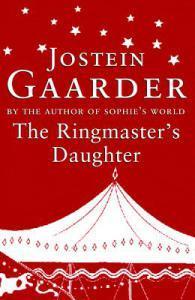 The Ringmaster’s Daughter by Jostein Gaarder
Per usual Gaarder, there are storytellers, philosophy, precious children, and a certain level of weirdness.
This Lullaby by Sarah Dessen
Small town romance meets music. Not my favorite Dessen, but fun.
Frankenstein by Mary Shelley
The Romantic period at its best and eeriest. Victor passes out a lot.
Logan Likes Mary Anne! (The Baby-sitters Club #10) by Ann M. Martin
Mary Anne manages to snag the cute new guy guy, giving hope to awkward preteens.
Let’s Go 2005 London by Let’s Go Inc.
My travel guide for summer study abroad. Didn’t lead me astray.


Links Galore
Ending the week with a few fun links:
A short mystery by Diana Renn, author of the upcoming Tokyo Heist . Thrills! Chills!
Apparently T.S. Eliot isn’t just big inspiration for writers: musicians love him too.
Reading the schedule for this year’s Children’s Literature Association Conference really makes me wish I could attend.
10 myths about being a writer–and 10 things that make up for the myths.
Tracking science fiction trends.


Less Evil Cheerleaders, More Flying Motorcycles
Love this list of stuff to stop doing in YA novels. A few favorites:
“4. No more main characters who want to be writers.”
Because then you quote something your main character has written and it’s supposed to be amazing, and I put on my judgment cap.
“5. No more evil cheerleaders, even if it IS true to life. May still work if they’re zombies or something, though. I HAVE always wanted to do a book called “Pushing Cheerleaders Down the Stairs.”"
Evil non-zombie cheerleaders are so 1994, guys. There are lots of evil people in high school. Let’s give them their chance to shine! Or something.
“9. No more dystopias without flying motorcycles. Because flying motorcycles are awesome and I don’t want there to be a future that doesn’t have them. Really, any dystopia set in a world that doesn’t look like a Meat Loaf video is just not okay with me.”
If Sirius Black can have a flying motorcycle, we should all have flying motorcycles. Work on it, scientists!
My own additions:
No more wild and wacky best friends. You want to give your characters fun friends, sure, but they should also feel like real people, not caricatures.
No more total lack of anything related to school. We don’t need major details on math class, but lots of kids have extracurricular activities they love, midterms they cram for, and rivalries with other schools.
No more characters not eating. (Okay, novels about people dealing with eating disorders get a pass.) I hate seeing characters sit down for lunch and pick at their food or leave suddenly. People eat every day! Have a sandwich!
Obviously this is just for fun and there’s always a good reason to break rules when writing. Still, I think we’ve got a solid list going here. Anything you’d add?


The Neverending Love of Books and Bookstores
My friend Sarah writes about The Neverending Story, writing as a career, why physical books matter, and her search for the ideal bookstore:
“And then, of course, I moved to Salem and found Derby Street Books. I quietly freaked out a little when I first walked in and saw the stacks of books teetering over my head. But how often do you step into a childhood dream?
Everything was right. The literal taste of the air — dust and leaf litter and that tongue coating you get from breathing leather and ideas and mold — was right. Even the guy behind the counter was such a dead ringer for Carl I had to double check he wasn’t reading anything exceptionally magical. Derby Street Books is on a very short list of Perfect Places, along with a Perfect Bar, McSorley’s Old Ale House in Manhattan, a Perfect Restaurant in Corniglia, Italy, and a Perfect Park Bench, which is under a tree in Aberystwyth outside the National Library of Wales.”
She also quotes Giles from Buffy. Why yes, I do get to hang out with her on a regular basis. Seriously though, it’s a heartwarming literary read.


May 24, 2012
Fashion Meets Function for Writers
When I was in eighth grade, I went to Montreal on a class trip. While I was there, I got a necklace–a simple chain with a book charm. It was really cheap, but the book opened so I was infatuated. “That’s perfect for you!” my friend said. I quickly parted with a few Canadian bills. Now I had a necklace that showed off how much of a writer I was. The world would know!
Obviously I’m still not quite over that, because I dig these book necklaces by Peg and Awl.
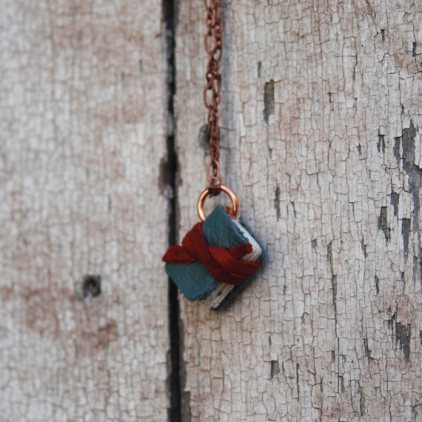
I love the red tie around this one. Plus you can actually write in the pages–just in case a story idea strikes and your regular notebook is elsewhere.
(image: Peg and Awl)


In My Room
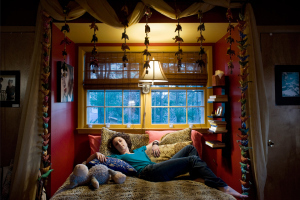 Really intrigued by photographer Rania Matar’s project, “A Girl and Her Room,” which features photographs of teen girls and their bedrooms from around the world. About her photographs, Matar says:
“I was discovering a person on the cusp of becoming an adult, but desperately holding on to the child she barely outgrew, a person on the edge of two worlds and trying to adjust to the person she is turning into.”
Since most of my characters tend to be teen girls, Matar’s photos made me think about their rooms and how their stuff reflects that balance between adulthood and childhood. Might be a good character exercise to write down all the things that are in a character’s room and why they’re there.
Incidentally, my bedroom as a teen was kind of a mess. I hated the pink wallpaper I’d had since I was five (not that I ever liked it) and tried to cover it up with movie posters, pictures of friends, collages I’d made, and lists of quotes I liked. Nothing came together well–probably a reflection of that childhood/adulthood dynamic.
(image: Rania Matar, via Newsweek)


Lasting Fame and the Span of Time in the Universe
This New Yorker article looks at what makes a popular novel lasting and what makes famous writers fade into obscurity. If readers polled in 1929 couldn’t pick out who would be the leaders of the literary cannon in one hundred years, could contemporary readers do any better?
My question: does it matter?
We all think about fame and glory. My imaginings even veer into talents I don’t have. (Why yes, I will accept that Academy Award! And how awesome will it be when I will a gold medal in marathon running?) But I’m also reminded of Virginia Woolf’s To the Lighthouse, in which Mr. Ramsay thinks about how fleeting fame is:
“It is permissible even for a dying hero to think before he dies how men will speak of him hereafter. His fame lasts perhaps two thousand years. And what are two thousand years? (asked Mr Ramsay ironically, staring at the hedge). What, indeed, if you look from a mountain top down the long wastes of the ages? The very stone one kicks with one’s boot will outlast Shakespeare. His own little light would shine, not very brightly, for a year or two, and would then be merged in some bigger light, and that in a bigger still.”
I’m a big Woolf fan, and that part of To the Lighthouse has really stayed with me. Even famous writers who have seemed to withstand the test of time–Shakespeare, Chaucer, Sophocles–are blips when you think about the span of time of the planet or the universe. Even if people read your stories for thousands of years, that’s nothing to the span of time.
So why stress about who’s going to be popular or considered a genius in a thousand years, or even a hundred years? Shouldn’t the people who are reading your stories now matter more than the people who might be reading them in a thousand years? I think it’s more important to focus on the readers who are currently moved by your work–even if it’s just one person and that one person is your mom/spouse/best friend.
Again, I’m going to keep imagining accepting my Academy Award/gold medal/Nobel Prize. But I also think it’s good to focus on the readers you want to connect with now. If people read your books in a hundred years, that’s awesome. Just remember that lasting fame is meaningless. Even Shakespeare’s a blip.


May 23, 2012
Links Galore
Lots of cool links today:
A true Harry Potter fan would never buy an owl and then mistreat/abandon it. Anyone who does this deserves a few dementors at their door.
Sci-fi, serial killers, and girl detectives: a few of the upcoming trends in YA.
Classic children’s lit favs and their contemporary equivalents.
Speaking of children’s classics, you know the girl on the cover of Number the Stars ? Here she is, all grown up!
Speaking of Lois Lowry, Mallory gives The Giver (aka BEST BOOK EVER) a reread.


Stories That Will Never See the Light of Day: Writing from High School
In this video, YA author John Green talks about the stories he wrote when he was in high school–which, of course, made me think of my own high school attempts at fiction.
Like John says about his early work, none of mine was good. Most of it was knock-off versions of what I was reading or watching at the time. A few highlights from the past fictional files:
a girl who likes art and has run-ins with the popular crowd
a coven of high school witches
a Robin Hood-esque girl hero in a vague fantasy world (plus half a sequel)
a series of linked short stories about a group of friends; everyone took walks and thought about stuff but never did anything
Pretty sure none of this will ever see the light of day. (Actually, not sure if I could track most of this down; it might be in my parents’ basement or it might have gotten tossed when they were tossing a lot of stuff from aforementioned basement.) But I am so, so glad I wrote these horrific stories. After each one, I’d learned more about writing and was excited to move onto the next project. I got to try different genres and styles without the pressure of having to show these stories to anyone in particular.
Also, they primed me for taking writing seriously as an adult. Working on my thesis novel wasn’t so bad because I knew I’d written “novels” before and would eventually get to the end through a lot of hard work and perseverance. I know that sometimes projects don’t work out, but that doesn’t mean that you can’t keep the general idea or characters tucked away for future projects.
My theory: writing is never a waste. Maybe it won’t pay off like you think it will (somehow that girl hero never landed me on the Today Show like I imagined), but it always teaches you something. And at the very least, maybe you can tell your legion of fans about it via Youtube video.





You Write What You Eat
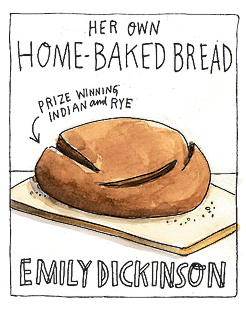 Writing requires sustenance–sometimes weird sustenance. Check out Wendy MacNaughton’s illustrations of famous writers’ favorite snacks. I’m all in favor of Emily Dickinson’s homemade bread (we could swap recipes), but I’m not sure I can get behind Fitzgerald’s canned meat.
I try to limit the snacks during actual writing time. Otherwise it’s an excuse for me to not be working. But when I am munching, I tend to go for almonds or dried mango from Trader Joe’s, and a steady flow of water and coffee.
Do you have any favorite writing snacks?
(image: Wendy MacNaughton)(via the Kitchn)