Annie Cardi's Blog, page 84
June 29, 2012
Reading in the Near Future
I’m a little jealous that I didn’t get to take part in this ALA debate on YA titles we’ll still be reading in 45 years because OH MY LORD there are some awesome books on this list. Having to choose between The Book Thief, The Golden Compass, and The Hunger Games? Now that would lead to some awesome debates.
My choices in each round would have been:
Round 1: Speak by Laurie Halse Anderson
Round 2: Monster by Walter Dean Myers
Round 3: The Golden Compass by Philip Pullman
Round 4: To Kill a Mockingbird by Harper Lee
Round 5: The Giver by Lois Lowry
Round 6: Hatchet by Gary Paulsen
I’d probably narrow that down to The Golden Compass, To Kill a Mockingbird, and The Giver. Since To Kill a Mockingbird has already proven itself to be a classic for generations, my inclination is to vote with Harper Lee. But damn, The Giver is one of my favorites as well, and The Golden Compass is a stunning novel and a start to a powerful series.
The ALA groups didn’t vote the same way I did, so make sure to check out the recap on The Hub. Feel free to share your own votes in the comments!


Cell Phones, Blogs, and Writing YA
When I was in high school, cell phones were pretty new. We emailed and IMed, but we didn’ tweet or reblog things. Sometimes I’m really glad that Facebook didn’t exist when I was a teen.
For better or for worse, technology and social media are a huge part of teens’ lives today. So if you’re writing contemporary YA or MG, you need to deal with these issues at least a little–how does your main character keep in touch with friends? Does he have to pay for his own cell account? Does she have a vlog?
If you’re wondering how your main character might actually use social media and gadgets, check out this study on how teens view their digital lives. There’s even a neat infographic with some summary. One point I found interesting is that almost half of teens would prefer to talk to their friends in person. It’s not like everyone is hiding at their computers. They want interaction, but texting and Facebooking can also help teens keep in touch when they’re not together.
It’s not like you have to make you main character attached to his cell phone, but it’s good to recognize and these things have some kind of impact on teens lives.


June 28, 2012
Entomologist, Barista, and Other Famous Writer Jobs

Just imagine Margaret Atwood behind that counter.
Even famous writers didn’t start out as full-time writers. They had day jobs and summer jobs like the rest of us. Mental Floss has a great list of other jobs famous writers had, such as:
Nabokov was an entomologist of underappreciated greatness. His theory of butterfly evolution was proven to be true in early 2011 using DNA analysis.
Margaret Atwood first worked as a counter girl in a coffeeshop in Toronto, serving coffee and operating a cash register, which was a source of serious frustration for her. She details the experience in her essay, “Ka-Ching!”
Harper Lee, author of one of the great American novels and winner of the 1961 Pulitzer Prize for Fiction, had worked as a reservation clerk at Eastern Airlines for years when she received a note from friends: “You have one year off from your job to write whatever you please. Merry Christmas.” By the next year, she’d penned To Kill a Mockingbird.
Harper Lee, you have the best friends ever.
Make sure to check out the full list. If anything, it’s a nice reminder that a bad job isn’t necessarily going to stop you from achieving literary glory.
(image: sleepymyf)


June 27, 2012
Summer Reading and Books That Deserve More Attention
Love the idea of YARN’s Blockbuster-Free Summer Reading Exchange. They’re collecting summer reading suggestions that aren’t the big “blockbuster” books–no bestsellers or books with multimillion dollar movie tie-ins. Those books are great, but there are also a lot of books out there that don’t get as much attention but are just as much fun to read.
Gotta start thinking about my list of suggestions. Head to YARN with your own!


Being an Author
From Terence Blacker’s list of what it means to be an author:
You write a book, and when it’s gone, it’s gone. It turned out not to be the perfect work you once envisaged but, for better or worse, it has reached its destination. If you are lucky enough to be asked to talk about it months later when it is published, you will see it from the outside, almost as if it has been written by a stranger. Your mind is on what you are writing now.
You long to be part of what is described as “the literary establishment”, but you never will be. Other authors, swanning about smugly at a festival or a Royal Society of Literature reading, may cause a knot of rage and jealousy to form in your stomach, but they are worrying about being outside the establishment, too.
You are lucky. You are doing something which, for all its agonies and uncertainties, allows you to lead a fuller life than you would otherwise have had.
Rest of the list through the link; he hits on lots of the anxieties and joys in the writing process.
(via Neil Gaiman)


Making This Fun: Nora Ephron
Writer and director Nora Ephron passed away yesterday, which is quite a loss for the film and literary industry. Her When Harry Met Sally is one of the best romantic comedies ever. Much like YA, romantic comedies don’t get a lot of credit, but a well written one can truly touch on what so many of us experience on a daily basis.
One part of her obituary in the New York Times struck me in particular. About working with Ephron, Meryl Streep said:
“Nora just looked at every situation and cocked her head and thought, ‘Hmmmm, how can I make this more fun?’”
I wish more people looked at their job and coworkers and had that same thought. Although writing is often seen as a solitary activity, I think there’s a huge element of community to it. I’m going to try to instill this philosophy into my writing life.
(image: )


June 26, 2012
The Same Old Story
At Limebird Writers, LimebirdSter takes a look at basic plots and if any story is really new. She breaks plots down to seven basic types, like Quest, Rebirth, and Overcoming a Monster. You can fit almost every story into at least one of these categories.
I’ve heard plot broken down even further, into just two categories: A Stranger Comes to Town, or Someone Goes on a Journey. And that can get even further broken down, since A Stranger Comes to Town is just Someone Goes on a Journey told from another perspective. Obviously that doesn’t have to be even close to literal, but I like thinking about what kind of journeys various characters are on.
I don’t think it really matters if there’s any new story or not. It’s the telling that matters.


Another Reason Armored Bears are the Coolest
Angela Rizza’s illustrations are so cool. My current favorite is her Armored Bears print:
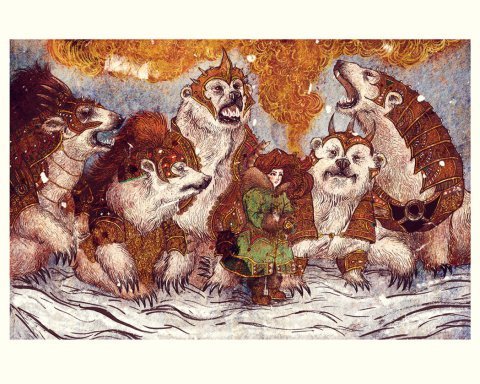 I think Iorek Byrnison would be proud.
Angela has a lot of other children’s lit-related prints (Harry Potter fans, take note!), so make sure to check them out.





June 25, 2012
Susan Cooper and the Magic of Writing Stories
Check out Susan Cooper’s acceptance speech for the 2012 Margaret A. Edwards award.
Such a well-deserved award. Congratulations to Susan Cooper; we’re luck to have her as a voice in children’s literature.





Quote of the Day
Juvenile or adult, War and Peace or Treasure Island, Pride and Prejudice or Beauty and the Beast, a great work of the imagination is one of the highest forms of communication of truth that mankind has reached. But a great piece of literature does not try to coerce you to believe it or agree with it. A great piece of literature simply is.–Madeleine L’Engle
This is from my current read Madeleine L’Engle Herself: Reflections on a Writing Life, which is basically a bunch of awesome quotes from L’Engle about writing, reading, and art.