Annie Cardi's Blog, page 80
July 26, 2012
Moving on From Panem
My mom read The Hunger Games recently and afterward she told me, “I don’t even know what to do. What else can I read that’s like that?” I suggested The Handmaid’s Tale, which might have been a little too intense for her. (Sorry, Mom.) I should have directed her to the Lawrence Public Library’s flowchart for what to read after The Hunger Games. A sample:
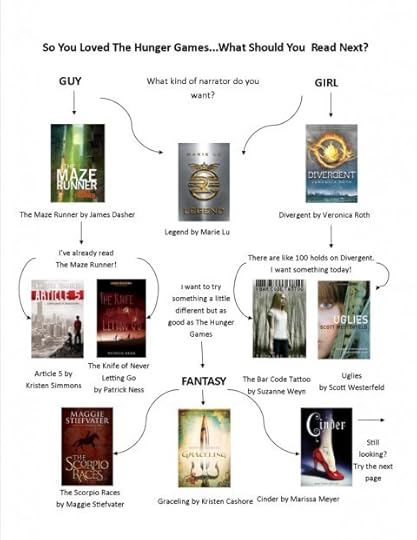
Make sure to click through for the rest of their fantastic suggestions. I might take some of these recommendations to share with my YA Dystopian Society Book Club.


July 25, 2012
Adaptations and What We Bring to Them
I love adaptations of classic tales. Fairy tale adaptations like Shannon Hale’s The Goose Girl, or takes on Shakespear ala Something Rotten by Alan Gratz always gets my attention. But what makes a good adaptation? On her blog today, Mary Kole looks at that exact issue and why an adaptation has to be its own story as well. I love this description of making an old story new:
“She didn’t just tinker with the original, she took the entire thing apart, repainted it, and put it back together her own way. An adaptation in today’s market takes nothing less.”
The adaptation in question is Marissa Meyer’s Cinder, which I haven’t read yet (I know, I know), but even from the description it sounds like a really fun, unique, compelling take on the Cinderella story. Another one I love is Ella Enchanted by Gail Carson Levine. Even that’s a little more on the “traditional” site (there are fairy godmothers and princes), but it takes the Cinderella story to the next level by giving Ella a physical and emotional journey.
It’s always good to ask yourself “Why does this story need to be told? And why does it need to be told this way?” But it’s especially important when dealing with adaptations. Shakespeare already told us about Hamlet. Why do we need another Hamlet story? And is your Hamlet story going to be different than Something Rotten or Rosencrantz and Guildenstern Are Dead? It adds another layer of pressure onto the author, but it can lead to some rich and engaging new takes on old tales. I find it exciting to be told the same story from another point of view or with another layer added to it. Just make sure you’re still writing your own story.


SCBWI Summer Conference and That Lovin’ Feeling
The 2012 SCBWI Summer Conference is fast approaching. If you’re headed to LA and want to get pumped, or staying at home (like I am) and want to feel that conference-y goodness, check out these pre-conference interviews from the SCBWI conference blog. In Martha Brockenbrough’s interview with agent Jill Corcoran, Jill talks about what she’s looking for in YA romance and why that’s hard to find:
“Maybe it is difficult to recapture the innocence and wonder of first or even second love. Of crushes and unrequited love. Of waiting for that kiss, that touch, that moment when you no longer think straight and lose a part of yourself–for the good and the bad–to the person you ‘think’ you love. Of discerning between love and lust towards another person, and towards you. Of truth and lies. Of wanting to believe and not trusting your gut…it is about characters–soul-searching, groin-yearning, heart thumping, heart breaking, fast paced, laugh out loud, cry out loud, make me want to be your character ROMANCE!”
It’s easy to look down on romance, but it’s so hard to do well. I think Jill’s statement above touches on a lot of the very real, understandable feelings we’ve all experienced or wanted to experience. One of my YA favorites, Feeling Sorry for Celia by Jaclyn Moriarty, handles romance beautifully. Elizabeth experiences the pains of rejection and the hope of adorable first love. As Jill mentions, it captures that innocence and wonder of first/second love. (Plus it’s a hilarious and awesome book.) I’m definitely keeping Jill’s advice in mind for my romantically-inclined characters.
Make sure to check out the SCBWI blog for all the interview and more pre-conference info. Have fun in LA, conference-goers!


July 24, 2012
Links Galore
A few more links to take you through Tuesday:
Technically this list isn’t just YA, but it is made of literary awesomeness. Vote for your favorites!
Mrs. Dalloway: the Mix Tape –be still my heart!
Anyone want to go to Wales?
Playing with words–another way to .
Excellent suggestions on ways to trim your manuscript.
Last but not least, happy 115th birthday, Amelia Earhart! And as ever, the search continues.


Teen Girl Protagonists Lead Book Sales
It’s a good time to write about teen girl protagonists–and not just in YA:
“To get to the million-dollar mark for debut fiction this year, it apparently helps to have a female teenage protagonist. In February, Riverhead bought 30-year-old Washington University writing professor Anton DiSclafani’s first novel called The Yonahlossee Riding Camp For Girls. The book is about a 16-year-old named Thea Atwell during the Great Depression who is sent to an equestrian boarding school in North Carolina’s Blue Ridge Mountains. And just out in hardcover is The Age of Miracles by 32-year-old Karen Thompson Walker, who worked on the coming-of-age story for about an hour each morning before going to her editorial job at Simon and Schuster. That is, until she received a million-dollar advance from Random House.”
Coming-of-age stories have always been popular, but I wonder if this trend is part of YA becoming more accepted as a genre. The Katniss effect?


School for Rare Books (and the People Who Love Them)

Sometimes Alderman Library inspires silliness instead of scholarship.
This article combines three of my favorite things: books, libraries, and Charlottesville, VA. The Rare Book School, a summer program at the University of Virginia (wahoowa!), is an intensive course about the study, care, and history of the written word. How cool is that? Also cool:
And rare books aren’t just a matter of leather and fine paper. Mr. Suarez has added a number of classes about digitization and likes to begin his own course, Teaching the History of the Book, by passing around a box of Harlequins. Romance novels, he notes, are the biggest part of the publishing industry, and the part that has been most radically transformed by e-books.
“I tell my students to follow the money,” he said. “If you don’t understand the money, you don’t understand the book.”
Would love to hear the Rare Book School’s take on children’s literature. Make sure to check out the rest of the article. If you’re like me, you might be getting started on the application for next summer’s Rare Book School session.


Listen All Y’all, It’s a Sabotage
From this list of 5 ways your brain sabotages your writing:
Your brain says: “Watching that video of a baby otter eating a medley of seafood with his little paws is a great use of your time.”
The reality: Your brain favors immediate rewards over long-term ones, so it tries to trick you.
My brain is totally on this one. Especially when the time wasted on funny videos and links can masquerade as developing my social media platform. One solution to this problem:
“Fool your brain by providing short-term rewards for completing parts of your long-term goals. Finish a chapter of your novel? Go eat frogurt, head to the pub, or do bath salts…whatever is rewarding for you.”
The hard part is not allowing yourself that reward until you’re actually done. Make sure to check out the whole list so you can figure out how to outwit your crafty brain.
And seriously guys, you need to check out that otter. So cute!


July 23, 2012
Powering Through the First Draft
There’s a great post up today at Kate Messner’s Teachers Write. Author Karen Day talks about getting through that first draft, especially when you’re 50 pages in and things stall. It can be exciting to write the first chapter or so, but things can get harder when you’re that much further in. One suggestion Karen has that I really like:
“Sometimes I’ll be 60 pages into a manuscript and lose my way. Then, writing an entire chapter seems daunting. So I tell myself that I’ll just write a scene. A conversation with the antagonist. A resolution. Something my main character discovers. I might write 10 pages or more of these short “scenes”. Out of this, I usually can get myself going again. Don’t worry if this part of your manuscript doesn’t look like the other parts. Remember, it’s a draft!”
I know I get caught up in the writing of a draft and worry that everything has to be perfect. But it doesn’t at all! As Karen suggests, you can write scenes that will never, ever be part of your final manuscript and that’s okay. It’s still teaching you more about your characters and the themes in your story.
Make sure to check out the rest of Karen’s suggestions for powering through first draft stalling. And if you keep reading, you get to learn about flash fiction from Danette Haworth. What more could you want to jumpstart your Monday morning writing?


July 20, 2012
Friday Fifteen
Welcome back, Friday Fifteen fans! Onto the fifteen-word reviews:
 1) Measure for Measure by William Shakespeare
Previously classified as a comedy, now considered a problem play. Sex comedy gets unusually creepy.
2) Karen’s in Love (Baby-Sitters Little Sister #15) by Ann M. Martin
Do kids really marry each other during recess? Also, Karen?
3) The Subtle Knife by Philip Pullman
Second book in His Dark Materials series introduces Will and reality as we know it.
4) The Ugly Duckling: The Talking Mother Goose Fairy Tales by Worlds of Wonder
This came with the Talking Mother Goose toy. It was awesome.
5) Signing Naturally, Level 2 (Book & VHS Tape) by Ken Mikos, Cheri Smith, and Ella Mae Lentz
Used in second year ASL class. It came with a VHS. I feel ancient now.


Links Galore
Lots of great links to take you into the weekend:
Libba Bray has a touching post in response to the Aurora shootings. “We have love. We have empathy and compassion. We have the ability not to be lost to the undertow of violence and terror.”
AC Gaughen looks at author responsibility for young female readers.
In case the Olympics don’t give you enough athletic excitement, the Horn Book suggests these sports-themed books.
Talent is great, but successful writing is all about getting the work done. Forever.
Lots of excellent posts about digital rights and how to blog/share content appropriately.
Are you going to the National Book Festival in September? (If so, blog about it so I can live vicariously!)
Great look at the crossover between YA and adult lit, and what these labels mean for readers.
In case you’re worried that your beach read isn’t literary enough.