Annie Cardi's Blog, page 81
July 20, 2012
Counting Stars: Review Ranking Systems
At A Chair, a Fireplace, and a Tea Cozy, Liz has a great post up about star-rated reviews, like the ones on GoodReads. Liz feels a lot of pressure when it comes to assigning a star rating to a book review:
“What if I think the structure is amazing but the characters average? In my review, I’ll talk about the plot mainly and not touch on the characters because it’s the plot that engages my interest. How does that fit with stars? What if I don’t think its amazing but I know other readers will –which, again, I can address in a review but not in stars.”
I have the exact same problem. I can see where things like a system of stars or number rankings can be helpful–if you go on Amazon and see that a book has 453 one-star reviews, you can guess it’s probably not a great book. But what’s the difference between a three- and four-star review? Even if half-stars were available, I think I’d still have a rough time deciding how exactly a book should rank. It’s hard to quantify exactly how much you like the book because there’s so much that goes into the reading experience. Like Liz, I’m more inclined to talk about the things that worked for me and the things that didn’t without thinking “That’s totally a three-star book.”
Do you use a rating system when you review books? How do you quantify quality?


Books and Their Readers
Love this print:
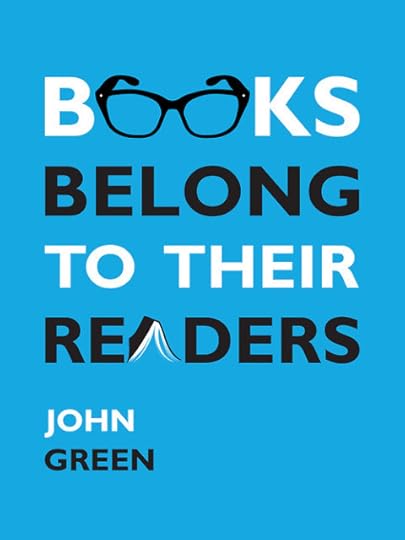
I think this is one of the awesome things about books (and art in general). They can affect you in such a deep, personal way. And it doesn’t even have to be as direct as “I read a book about skateboarders, and I’m a skateboarder, so I felt emotionally moved.” Books and other art can have such a deep resonance that it doesn’t have to be based on anything you can put into words. But you know that the book is part of you.
(image: Perpetual Thoughts)(via eff yeah nerdfighters)


July 19, 2012
Darkness and Hope: the History of Fairy Tales
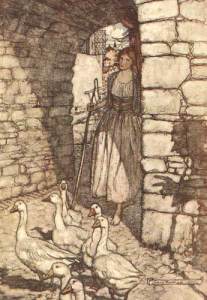 Very interesting article about fairy tales by Joan Acocella over at the New Yorker. One part I found especially interesting:
“The main reason that Zipes likes fairy tales, it seems, is that they provide hope: they tell us that we can create a more just world. The reason that most people value fairy tales, I would say, is that they do not detain us with hope but simply validate what is. Even people who have never known hunger, let alone a murderous stepmother, still have a sense—from dreams, from books, from news broadcasts—of utter blackness, the erasure of safety and comfort and trust. Fairy tales tell us that such knowledge, or fear, is not fantastic but realistic.
I wonder if fairy tales have to be hopeful or realistic. Many tales end with the villain defeated (even if it’s a violent manner, ala The Goose Girl), which suggests hope. Maybe it’s not as bright as Zipes would like, but I think it balances with the realism and darkness Acocella mentions. Cruelty and violence are real. We need to confront the world and its violence. But I think folktales also reference how goodness can prevail, even if death is inevitable.
Make sure to check out the whole article through the link. Lots of engaging history and literary criticism.
(image: Grimm, Jacob and Wilhelm. The Fairy Tales of the Brothers Grimm. Mrs. Edgar Lucas, translator. Arthur Rackham, illustrator. London: Constable & Company Ltd, 1909, via SurLaLune Fairy Tales)


I Still Have Talented Writer Friends
Remember that time my friend was a finalist in the Amazon Breakthrough Novel Award? Now his book won the AWP Award Series in the Novel and is getting published!
His book, What Ends, is about a family living on a very small island off the northwest coast of Scotland. It’s a novel for adults, but from what I’ve read I think YA readers will really enjoy it as well.
Congratulations, Andrew! Spring ’14 is gonna rock!




July 18, 2012
Cover Stories
Love this six-year-old’s description of classic novels based on their book covers. Her version of The Great Gatsby sounds pretty exciting:
“I think it’s a book about a haunted theme park and it stars a magical magic guy and he’s good and evil and he’s trying to get rid of the ghosts. And I think at the end, since it’s haunted by a ghost, he tried to make the park go on fire and it did.”
Not gonna lie–I’d read that.
When I was little, I thought To Kill a Mockingbird was about a girl who got bitten by a rabid squirrel. Why did I think that? I guess it had to do with the rabid dog. But squirrel?
(H/T bookshelves of doom)


Link It Together
On her blog, Erika Dreifus looks at linked story collections (several stories with similar characters/locations/themes/etc.). How can they be written and evaluated in comparison to novels or collections of separate short stories? She quotes Junot Diaz:
“I’ve always conceptualized linked collections as these wonderful Lagrange points between the story collection and the novel. In them there’s this weird bit of space—again not as much as in a novel, but more than a standard collection—from which wonderful stuff can be spun, stuff that neither the traditional novel nor the traditional story collection can generate. A fascinating patch of liminality that writers haven’t done quite enough with, in my opinion.”
YA and children’s literature has a limited amount of short stories in general, let alone linked short stories*. I wonder if a collection of linked short stories could work better than just a standard collection. Teen years are filled with so many facets and contradictions–maybe a series of linked stories could reflect that really well.
*Oddly enough, when I was a YA myself, I wrote a series of linked stories, even though I didn’t know that was what it was called at the time.


July 17, 2012
Forever Tuck

My childhood copy of Tuck Everlasting.
Over vacation, I reread Tuck Everlasting by Natalie Babbitt. I read it a million times when I was in elementary/middle school, but I hadn’t read it in at least ten years. A little part of me was afraid it wouldn’t hold up. I mean, it was one of my favorites. I remembered it being so compelling. How could it stack up after so many years?
Guys, it was even better than I remembered.
The writing is stellar. I don’t think I really noticed that when I was a kid. It’s a beautifully written novel, and Babbitt is a master craftsman. For example:
“Mae’s husband, on his back beside her, did not stir. He was still asleep, and the melancholy creases that folded his daytime face were smoothed and slack. He snored gently, and for a moment the corners of his mouth turned upward in a smile. Tuck almost never smiled except in his sleep.”

Did I mention that it’s also signed? Squee!
What a gorgeous introduction to the patriarch of the Tuck family. You Tuck’s gentleness and sadness perfectly, and he’s not even awake yet. It’s brilliant writing. I’ve seen her speak on a couple of panels and both times she’s mentioned that children’s literature shouldn’t be dumbed down in any way. Children are savvy readers and deserve excellent literature. Her philosophy is obvious in her writing–the language is sharp, the characters are compelling, and the themes are moving.
Obviously, Tuck Everlasting is a children’s lit classic, and for good reason. Recently, I also came across Italian author Italo Calvino’s list of what makes a classic. A couple of points on the list struck me in relation to Tuck Everlasting:
The Classics are those books which constitute a treasured experience for those who have read and loved them; but they remain just as rich an experience for those who reserve the chance to read them for when they are in the best condition to enjoy them.
A classic is a book which with each rereading offers as much of a sense of discovery as the first reading.
A classic is a book which has never exhausted all it has to say to its readers.
I came across Tuck Everlasting when I was a fifth-grader in the mid-90s, twenty years after the book was first published, so I’m hopeful that kids today are still reading it. When I was reading it over vacation, I kept thinking I wish I had a fifth-grade class just so I could use this book on my syllabus.
After finishing it recently, I thought: This totally won a Newbery, right? It’s brilliant. Of course it won. Then I checked the Newbery Medals and Honors list.
Shock: it didn’t.
The 1976 winner was The Grey King by Susan Cooper, so I can understand that winning. But there were only two Honor books listed–The Hundred Penny Box by Sharon Bell Mathis and Dragonwings by Laurence Yep. Considering the committee can include more than two Honor books, why didn’t they call out Tuck Everlasting?
I’m sure the committee had there reasons, but for me it’s a good reminder that even beautifully written, emotionally compelling books don’t win all the awards. Maybe your novel is absolutely amazing, but there will still be agents and editors who pass on it, critics who write bad reviews, and awards you won’t be nominated for. It doesn’t mean you’re a bad writer or your book isn’t good. It just means that sometimes the literary world is tough.
Really glad I returned to this beloved classic. Are there any books that you loved as a kid and reread as an adult only to find they’re still fantastic?


Reading with Rory Gilmore
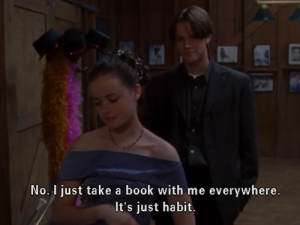 When I was in college, my roommate and I were obsessed with Gilmore Girls. We borrowed seasons on DVD from the library and rewarded ourselves with episodes when we were done studying for finals. (Or, in my case, in the middle of studying for finals.) I still love rewatching episodes–the writing is quippy, the characters are quirky, and I like spending time in Stars Hollow.
Another reason I love Gilmore Girls–Rory’s a bookworm. I can’t think of many other shows in which the main character carries a book with her everywhere and deeply cares about her academics. As a pretty nerdy high schooler, this hit home.
So of course I love Rory’s Book Club, which lists all the books Rory read/referenced on the show. Or maybe more? There are a lot of books listed. Kind of want to go back through my DVDs and see how many books I can spot.
If you’re looking for some good movies or music, that’s around too. A girl can’t live by books alone (no matter how much we’d like to).
(via babble)