
Matador Network's Blog, page 1401
February 18, 2018
How Europeans say i love you map
Learning to say “I love you“ in as many languages as possible might seem like a party trick, but it could be more useful than you think. While “how are you?” and “my name is…” are typically the first phrases we are taught when studying a new language, there is nothing quite as powerful as being able to tell someone that you love them in their native tongue. With that in mind, get to work on learning how to say “I love you” in every European language with this map from Jakub Marian. (The color coding indicates languages that share certain linguistic roots). 
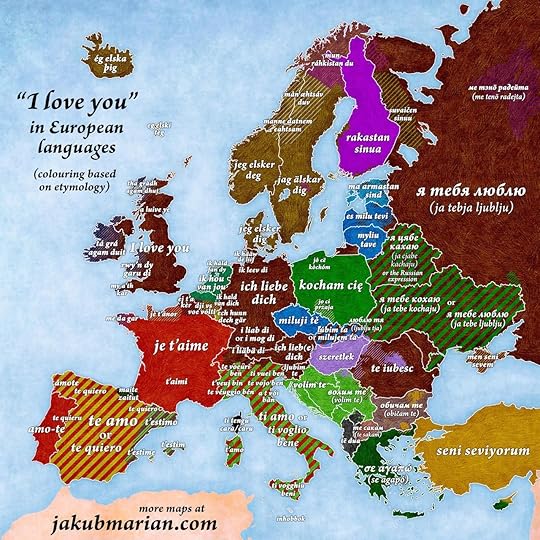
Photo: Jakub Marian

More like this: The ultimate guide to learning a language in record time


7 places to check out in South Korea
Whether you’re coming to the Pyeongchang 2018 Winter Olympics to support your country, to snag your own long down-padded jacket, or to cheerlead curling, exploring South Korea beyond the congested Olympics facilities is a must.
Luckily, South Korea has no shortage of adventure, and the country’s flawless transportation makes it a breeze to sightsee nearby Seoul, faraway Jeju Island, and everything in between.
Before practicing your hangul, check your itinerary and make sure at least one of the seven places below is on your to-explore list.
1. Gangneung Coffee Street
Gangneung Coffee Street, like Pyeongchang, is in Gangwon-do, so you won’t have to travel far for the best pick-me-up in South Korea. The street, sometimes also called Anmok Coffee Street because of its proximity to Anmok Beach, is home to plentiful cafes that dot the shoreline like seashells.
Plus, “Not willing to let the Olympic visitors leave without visiting the popular coffee shops during the Olympic period from Feb. 9 to 25, Gangneung is holding a world winter coffee festival centered around and near the street,” a recent article in The Korean Times said.
2. Insadong
If you’re flying into Incheon Airport in Seoul, Insadong is worth checking out. Actually, even if you aren’t, Insadong is worth checking out. The main street in the heart of Seoul is a piece of tradition tucked in the middle of high-rises and underground noraebang.
Rent hanbok, traditional Korean clothing; drink traditional Korean tea in a hanok, or traditional house; shop for Korean arts and crafts in the spiraling Ssamziegil building; and gorge on a veganized version of traditional Korean food at Ose Gye Hyang.
3. Ihwa Mural Village
Take shelter from Seoul’s “Bali, bali” or “Hurry, hurry” culture in Ihwa Mural Village. In 2006, the “Naksan Project” asked artists to create 64 different installations around the village. But, when the art drew in too many tourists, residents requested most of the art to be removed.
In 2013, artists came back to the area and put 60 more displays. Less tourist-packed and with new “quiet rules” enforced throughout the village, Ihwa is the perfect day trip for discovering murals and cafes through winding streets, away from the hum of crowds.
4. Gapyeong (Garden of Morning Calm, Nami Island, Petite France)
If you don’t want to pick just one thing to do during the day, consider a Gapyeong City Tour. For about 5,000 won, you can get on and off the circle tour bus as many times as you want. The bus stops along hotspots such as the oldest private garden in Korea, The Garden of Morning Calm; French cultural village, Petite France; and tree-lined getaway, Namiseom Island. While this bus line is usually a pretty popular tourist destination, perhaps the Olympics and Korean holiday Seollal will draw crowds south, away from Gapyeong.
5. Temple Stays
If you aren’t Buddhist, and even if you don’t know who this popular Buddha guy is, it’s okay. The monks and nuns will welcome you anyway with open arms and bland food.
South Korea is full of these experiences, some that that are quite strict and require certain prayer, meditation, and work times, and some that allow guests to roam the grounds freely and even to try their hand at calligraphy.
Whichever type you choose, you’ll find that temple stays are a fantastic way to learn more about Buddhism, Korean culture — and perhaps even yourself — all while in an enchanting setting.
Perhaps the most famous in Pyeongchang’s Gangwon area is the Woljeongsa Temple, but if you’re willing to travel farther, consider the Lotus International Meditation Center. I personally stayed at this center during New Year’s 2017 for three days, and it was one of my top three experiences in South Korea. This center’s head monk even speaks perfect English, so you can ask him anything you’d like during your time at the temple.
6. Jeju
How could I make a South Korean trip list without including Jeju? Although a bit harder to get to than some of the other places on the list, this paradise is where many Koreans themselves vacation. From the pristine Cheonjeyeon Falls to the white sands of Hamdeok Beach, Jeju’s breathtaking sites are worth exploring now that the weather’s warmed up a bit.
Ready for something a bit more devious? Check out Jeju’s Loveland, a sexual-themed outdoor sculpture park, featuring work too taboo for me to describe without blushing and giggling like a little girl.
More like this: 5 ways to enjoy winter in South Korea without freezing your butt off
February 17, 2018
Disney announces Toy Story Land
After much promising, Disney finally announced that it will be opening the doors to the new Toy Story Land on June 30th.
The new attraction will be located at the Disney’s Hollywood Studios park in Florida and feature 11 acres of Toy Story-themed adventures.

Photo: Disney Parks
In order to immerse guests into the world of Andy’s toys, the park is scaled to make visitors feel as is if they have shrunk to Woody’s size.
Two rides were constructed for the new attraction — the Slinky Dog Dash rollercoaster and Alien Swirling Saucers — along with a new restaurant and people-sized versions of your favorite Toy Story characters.
“This new land will place guests inside the wondrous world of Woody, Buzz and their pals – and invite everyone to experience the joy of being a toy.” said Bob Chapek, chairman of Walt Disney Parks and Resorts.
In keeping with the movie, the Toy Story Land rides and attractions will be family-friendly.
Disney also has plans for Star Wars-themed parks at both Disneyland and Disney World, as well as a Guardians of the Galaxy-themed rollercoaster at EPCOT’s Future World. So you won’t have to wait long if you are more into space wizards than talking green army men.
Follow Matador on
Vimeo
Follow Matador on
YouTube
More like this: If the US national parks were giant theme park rides
Enjoy travel without social media
Did you know that if a tree falls in the woods and you don’t post the video to your Instagram story, it still actually happened? I’m aware of the irony of writing about a topic like this on a popular travel website, where, if all goes well, it will be retweeted, shared on Facebook, and maybe even receive a video response on YouTube (please?), but there are ways to enjoy traveling without social media.
Low-tech travel is still an option
Some travelers get the idea that getting offline also means completely cutting themselves off from technology, when in fact a simple reduction will do. Leaving your phone at home and using a calling card to stay in touch may be annoying, but isn’t it worth removing the temptation of snapping a selfie? Just because we no longer live in a world where Polaroid cameras are ubiquitous doesn’t mean they aren’t out there to capture memories. If you use your blog primarily as an outlet for your creativity and not as a form of income, you can try jotting your experiences down on paper. Travel like it’s 1999.
Time goes further without technology
You may not be able to look back on what happened one day ten years ago in Thailand without some digital photographic evidence, but if you spent that time bathing elephants and getting drunk with expats you’re going to remember the experience better without wasting time documenting everything as it’s happening. My weekends in Japan usually fly by when I’m traveling solo and stop to write on my Macbook or scroll through IG on my phone, but when two Couchsurfers came to visit and we spent the whole day talking and exploring, I couldn’t help but appreciate how much longer the days seemed to last. Being mindful during your travels means taking the minute between when your food is served not to find the perfect angle for a picture, but instead reflect on how fortunate you are to have this nourishment in this foreign country with good friends.
Live your life without online feedback
Social media has fundamentally changed how we communicate in many ways, but probably none more than allowing snapshots of our lives to receive immediate feedback from the whole world. We’ve probably all taken a picture of a scene like a sunset over the ocean with the intention of wanting to know want other people think about it, without taking the time to wonder whether we actually like it in the first place.
Your travel experiences have value even if no else sees your picture and gives it a like. Seeing someone’s expression in person and understanding their reaction to your temple stay and spiritual awakening (even if it’s an eye roll) are going to mean more to you than someone writing a cliché comment with an emoji.
Think about where you travel, and why
I had a falling out with a friend last year after – having discussed the issue of the treatment of elephants at length – she chose to ride on one in Asia in a stereotypical tourist fashion. When I quite angrily asked what the hell she was thinking, knowing full well she was aware of how these animals were tortured, she casually replied “Yeah, well, I wanted a selfie with one.”
Think about your motivation in traveling to a place like Macchu Picchu or posing with a tiger… is it something you genuinely want to do, or just something you think would look pretty sweet on Instagram? Take away that incentive, and would you still go there, or do that?
Traveling without social media forces you to focus on why you travel, knowing that people may still hear about the story ex post facto, but you completely control the narrative. Why work yourself to death squeezing in another attraction before sunset to make sure it’s posted during prime viewing time if no one is going to see it? Avoiding social media generally gives you quality over quantity.
More like this: I dropped out of high school to vagabond around the country with no technology
queering the map lgbt spaces
When 22-year-old Lucas LaRochelle started “Queering the Map“, they probably didn’t expect that Trump supporters would end up trolling it. About a year ago the designer student at Concordia University in Montreal set up an online mapping tool that allowed users to drop pins anywhere in the world and leave messages about a queer experience that happened there. LaRochelle (who uses gender-neutral pronouns) hoped to geo-locate as many “queer moments, memories, and histories in both cyber and physical space” as possible.
A few weeks ago, it took off. Over 5,000 pins were dropped across the map, from Northern Canada to the US, Europe, India and Australia.
This is what the map looked like February 8th:
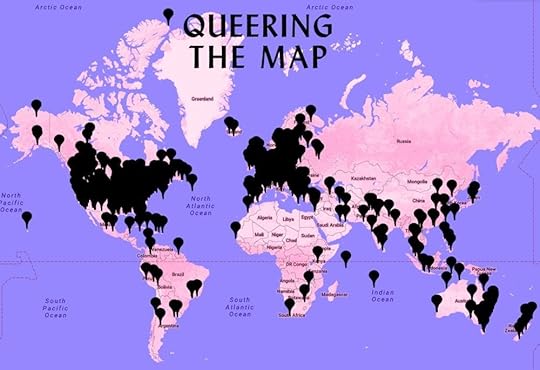
Photo: Lucas LaRochelle
And here are some of the messages left by users:
A post shared by Queering The Map (@queeringthemap) on Feb 14, 2018 at 12:26am PST
A post shared by Queering The Map (@queeringthemap) on Feb 14, 2018 at 12:26am PST
A post shared by Queering The Map (@queeringthemap) on Feb 14, 2018 at 12:25am PST
A post shared by Queering The Map (@queeringthemap) on Feb 14, 2018 at 12:25am PST
On February 9th, LaRochelle noticed that some users were spamming pro-President Trump messages, and decided to shut it down. But the project aiming to illuminate queer space got a new lease on life after a group of programmers offered LaRochelle their service. LaRochelle expects a new, more secure “Queering the Map” to be back online soon.
More like this: The reality of harassment and abuse in the queer female community

February 16, 2018
The sounds of Buenos Aires
THE SOUNDTRACK OF BUENOS AIRES
Over the last decade, Buenos Aires has been a second home. At different times I’ve lived in San Telmo, Palermo, Quilmes, and right on Avenida de Mayo in the city center. This city is always alive with music — more than anywhere I’ve ever been, and I’ve always wanted to share it with others. Please enjoy listening, and scrolling through some of the images below.
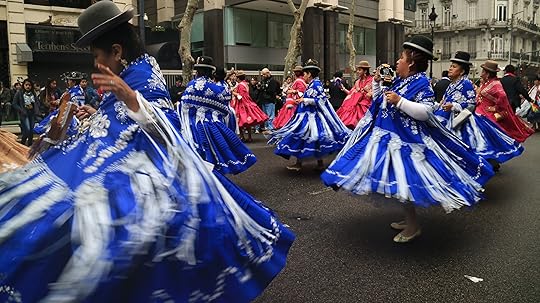
Bolivian dancers parade up Avenida de Mayo.
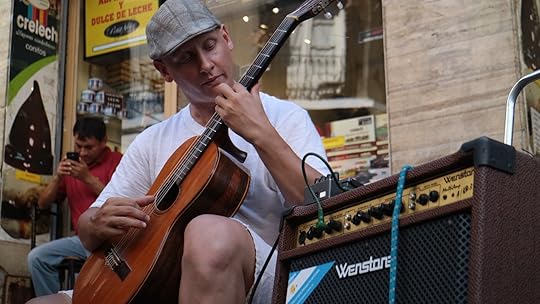
Tango guitar master Gastón Vinelli. When he played it was as if he were playing in an orchestra, or for the whole universe. He was in a complete trance.
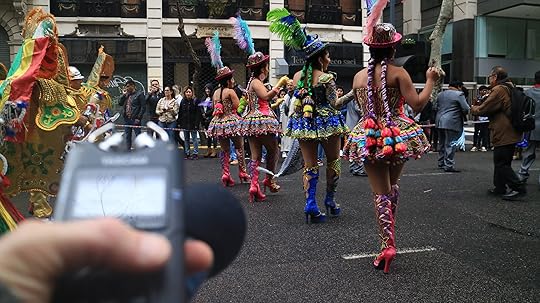
Field recording the murga along Avenida de Mayo.
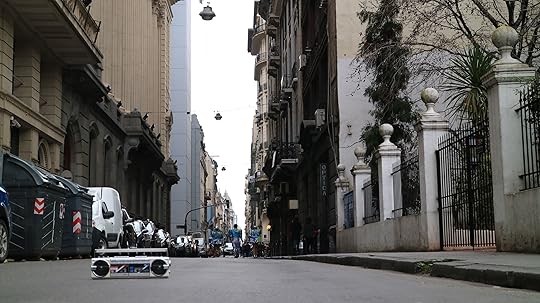
The soundtrack of Buenos Aires goes on 24/7. There's always music in the streets, on the subways, everywhere.
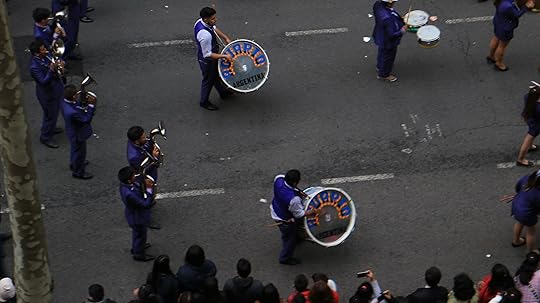
Murga of indigenous people living in Argentina. They mix melodies from Andean music with powerful drum rhythms.
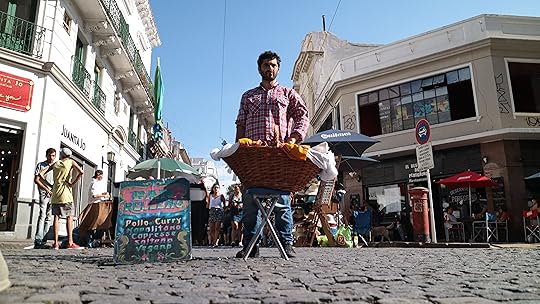
Bread vendor on Calle Defensa. The vendors in Argentina add to the soundtrack, singing out what they're selling to passersby.
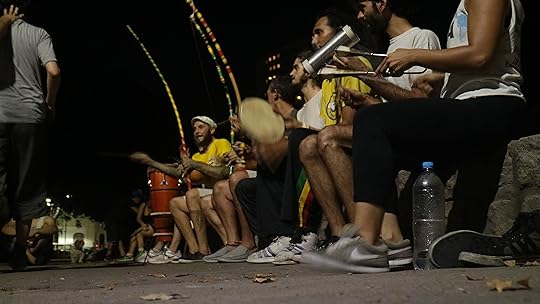
Throughout the parks are Capoeira groups, often led by Brazilians living in Buenos Aires.
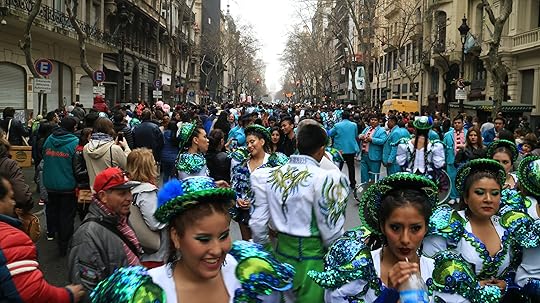
At any given time, Avenida de Mayo (the main boulevard in Buenos Aires) becomes a sea of people: protestors, dancers, or just pedestrians.
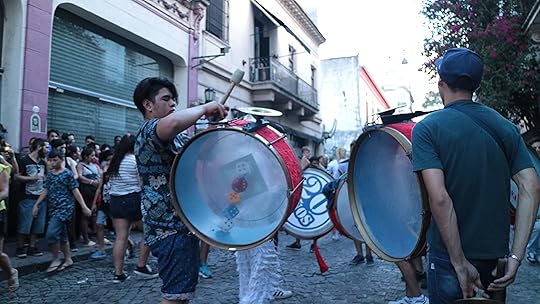
Murga on calle Defensa. These drummers use a bass drum with a kind of hit hat on top they play by hand.
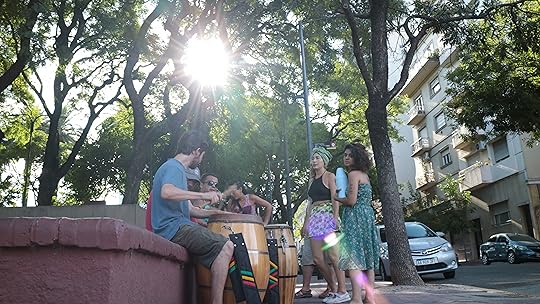
Candombe drummers practicing in Parque Lezama. These drummers parade all through the streets during Carnaval.

El Caminante Argentino, aged 85, from Junin, playing a Chacarera.

This youth lived on the streets with Oscar Sosa, a homeless man and former cumbia singer.

Charrango player on train in Buenos Aires
As travelers we tend to associate our journeys with seeing places. We photograph them, we post to Insta, we share.
But in its deepest moments, travel is the art of listening. You feel this in truly physical way when you begin to learn a new language. You listen, you take in the way local people talk, the way they express certain things. All of it plays into the soundtrack. In fact, my favorite moments while mixing this were simply hearing the people talk.
What fascinates me so much about sound is that for every sound there is a story. It’s just up to us to hear it.
What do your journeys sound like?
Recording, mixing, and photography by David Miller
Opening drone sequences by Lucas Ullua

Bryce Canyon NP in 11 images
We just made it back from another backpacking trip. We’re already dirty and tired, but Chris, Doug, and I welcome the drive ahead, a scenic road in the middle of nowhere to Bryce Canyon National Park. I had never been there and this would be one of my longer trips through Utah. From what I’d heard about Bryce Canyon, I know this trip would be one to remember.
1
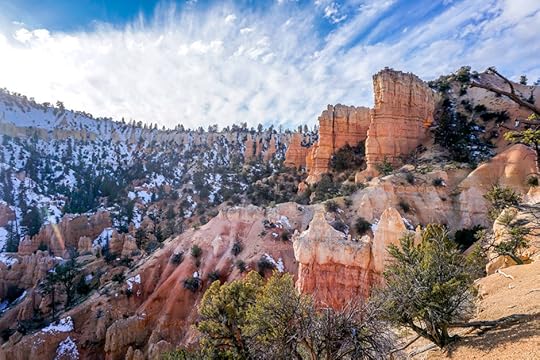
Before we even enter the park, the iconic formations of Bryce Canyon National Park begin to puncture the horizon. The almost 56-square mile park is speckled with hoodoo’s, the rock formations Bryce is renowned for, which are typically composed of hard rock topping a softer, easily eroded stone.
2
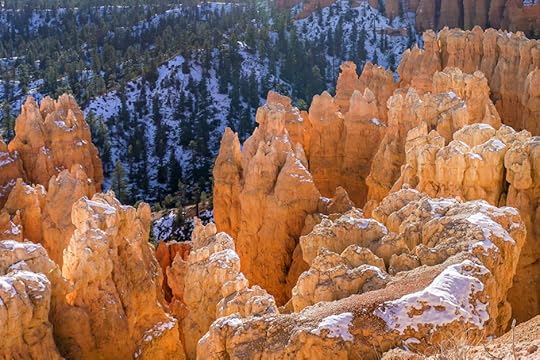
We look over the edge of the canyon to get a better look at the hoodoos. The morning light hits them before it touches the trees below, and the snow details their infinite contours.
3
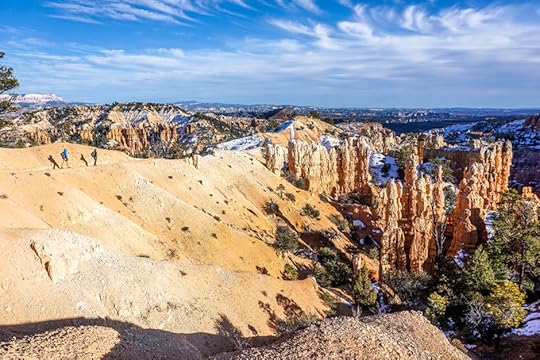
We begin the Fairyland Loop Trail, a moderate to strenuous 7.9-mile loop that also includes portions of the popular Rim Trail. Its difficulty rating is attributed to the elevation gain as you meander along the rim and into the canyon, giving you changing views with every turn.
Intermission
Culture Guides
13 memories you have if you grew up in Michigan
Cathy Brown
Jan 31, 2018
Parks + Wilderness
22+ spots that prove that our National Parks are the ultimate outdoor playground
Katie Scott Aiton
Apr 21, 2017
Sponsored
18 gorgeous images of winter in Boulder, CO
Katie Botwin
Jan 19, 2018
4
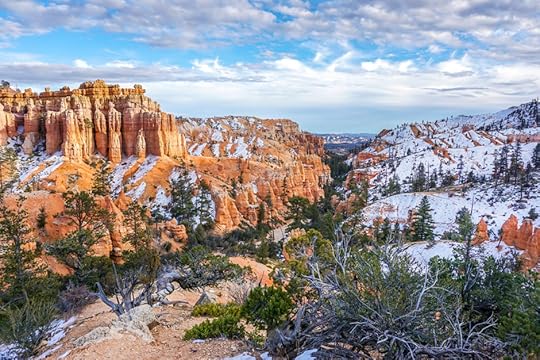
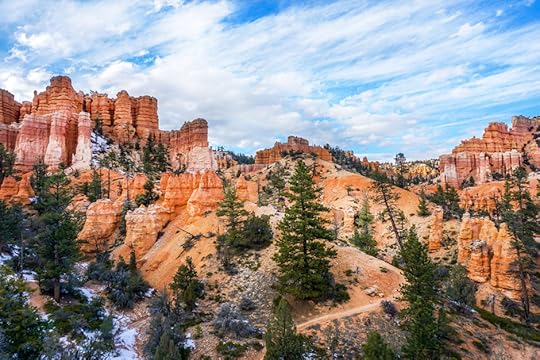
A recent snowfall produces a hill blanketed in white, forging a stark contrast for the fiery hoodoos. Wondering where our trail will lead us next, we admire the view as we discuss the unique geologic formations and glance at our map, pointing out the names of nearby valleys and cliffs.
5
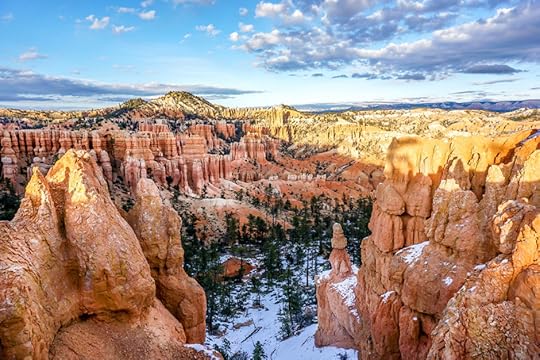
True to its description, the Fairyland Loop tries us with sporadic elevation gains and losses. But true to its name, we feel as though we’ve been transported into another world. The hoodoos stand as a stark contrast against the blue skies, and with each turn, we pause in awe at a new sight and new reason to marvel at Bryce Canyon National Park.
6
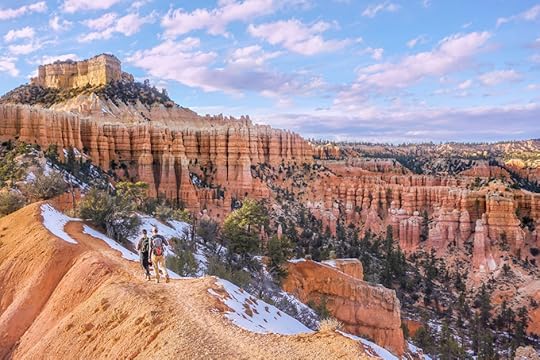
I’ve never seen anything quite like it. The sky opens to what appears to be an endless sea of quirky rock formations.
7
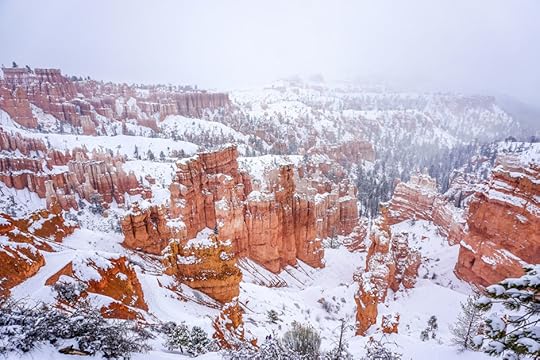
The sun begins to lower and the sky acquires a gentle purple tint. We finish our loop and an incredible day in Bryce Canyon National Park. Doug and Chris make their way along the trail, ready to head out of the park for dinner and a much-earned sleep.
8
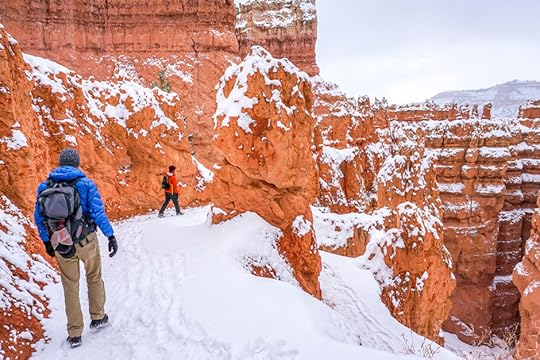
We brush the snow off the rooftop tent as we carefully clamber down. It snowed last night, and it’s snowing now. We cook sausage and eggs on our tiny stove before packing up and heading back into the Bryce Canyon National Park. We park, and walk to a nearby overlook. Our views are now socked in by thick snow clouds, and Bryce is a winter wonderland today.
9
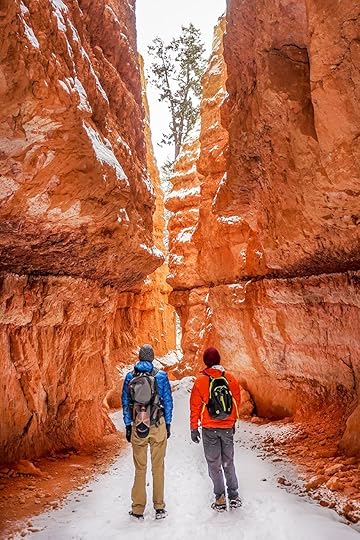
We decide we want to dive into the depths of the canyon, and plan on the Queens Garden and Navajo Trail combo. The complete hike is just a little over three miles, so it’s the perfect distance for a day that is trying to chill us to the bone. We layer up, snack up, and are careful to choose our steps wisely, as the trail offers a steep drop off to the side.
10
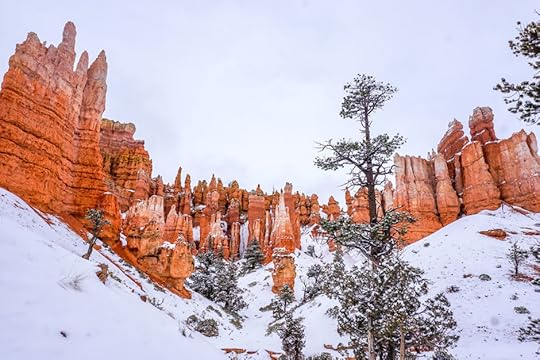
As we reach the bottom, Chris and Doug stop a moment to look at the incredible formations towering above us. A light dusting of snow causes the rock to glow like embers and the juxtaposing colors cause a distinct contrast.
11
Shied away by the weather, there are few others out today. We shuffle along a slippery trail, alternating between snow and ice, thankful we came prepared with proper traction. Whether it’s snowshoes and microspikes, plenty of layers, hiking poles, or water, it’s important to remember to always be prepared for all kinds of weather.
More like this: Travel guide to Bryce Canyon National Park, Utah

Travelers are saying no to fake snow
Reports of sub-zero temperatures and bone-numbing wind-chill have been whistling out of Korea, where the Winter Olympics are taking place, but what’s not as widely publicized is the problem with the snow. That all-important ingredient of a winter sports celebration can’t be depended on to fall here. Pyeongchang gets variable levels of snowfall and big blizzards are rare. In February 2017 it snowed just seven days.
In response, the Games organizers have brought in 250 snow cannons and installed three pumping stations to manufacture artificial snow. In total, 80 percent of the snow-based events will take place on artificially-created snow. But these snow cannons aren’t just shoring up the Olympics. Increasingly, they are relied on by ski resorts around the world, to compensate for patchy snowfall and guarantee the winter season. Far from being a handy solution to dwindling snow levels, though, making artificial snow is hugely damaging, in a whole host of ways.
Why some travelers are saying “no” to fake snow
Manufacturing snow is environmentally disastrous
It’s made to suit our calendars
Using artificial snow is not a long-term solution to dwindling snow levels
It’s super expensive to make
There’s an increased risk of accidents
Fake snow creates a fake landscape
What’s the answer?
1. Manufacturing snow is environmentally disastrous.
Vast amounts of water are needed to make artificial snow. In some regions of the Alps, for example, more than 50% of the available drinking water is directly used for snow production each day. This has impacts on local communities, creating water shortages. Artificial snow is also harmful to the environment, as its chemical composition disrupts natural biodiversity and harms wildlife.
2. It’s made to suit our calendars.
We want to go skiing and snowboarding when we want to go skiing and snowboarding – period. We don’t want to wait for the snow to fall naturally. We also really like to go at Christmas, New Year or Easter, please. This means that resorts, which can make up to a third of their income during the festive period alone, are under pressure to provide snowy slopes from November into late April, which creates a reliance on snow cannons, whether that’s a natural time for snowfall or not.
3. Using artificial snow is not a long-term solution to dwindling snow levels.
With the earth warming, snowfall is decreasing. It’s falling later and melting sooner, too, so resorts are increasingly depending on making snow to survive.
4. It’s super expensive to make.
It’s estimated that producing artificial snow for the Winter Olympics could cost around around $6 million. Obviously, the Olympics are a “money is no object” event, but ski resorts trying to stay open by making fake snow don’t have that kind of financial back-up.
5. There’s an increased risk of accidents.
Artificial snow is four times harder than natural snow, which brings with it a higher risk of injury if you fall on it. It’s formed of little balls of ice, doesn’t feel remotely powdery, and the quality is inconsistent, depending on the weather conditions, additives, and the machinery used to make it. In ski resorts, the runs that are artificially snowed and remain open can become overcrowded, too, which ups the risk of accidents.
6. Fake snow creates a fake landscape.
Pyeongchang’s artificially snowed slopes make look impressive, but many European ski resorts where snowfall is patchy and fake snow is relied upon look far less wintery during a typical season. Bare brown mountains with ribbons of artificial snow threading down the slopes are not the pristine snowy wilderness that most winter sports fans love. This is very much a man-made environment, not a natural one – and is far less enjoyable to be in.
What’s the answer?
Think about altitude, latitude and timing.
Anyone looking for an authentic winter break on real snow should head higher, where you can still enjoy great downhill skiing, but on real snow. Do some research. Look for resorts with high altitude slopes — in Europe, that means up to 3,500m — high-altitude lifts, north-facing slopes and historically reliable snow cover. Googling the resort you’re interested in will reveal if it has snow cannons, but ask questions to find out when and where artificial snow is likely to be used. Are there high slopes that never need it? Does snow reliably fall in January so the cannons aren’t used then? Quiz your holiday supplier for their stance on artificial snow. Some companies are starting to say no to fake snow altogether: at Responsible Travel in the UK, where I work as a writer, we now only promote winter sports holidays that either take place where no fake snow is produced or run when the likelihood of snow being manufactured is low.
You can also search out skiing regions that offer a good range of other activities. In the Austrian Tyrol, for instance, you can downhill ski, but the region is famed for its cross-country skiing. Organized holidays here might include winter walking (which isn’t snow dependent) and snow shoeing, too. These activities can travel to where the snow has fallen. Downhill skiing can’t do that; it depends on resorts with infrastructure and manufactured slopes, and that in itself can lead to a dependency on artificial snow.
Travel to higher latitudes, too. In Europe, that means looking towards Scandinavia and the Arctic Circle rather than the Alps. In Finnish and Norwegian Lapland you’ll find spellbinding winter wildernesses covered in pristine snow, and the chance to do way more than just skiing — dog sledding, snow shoeing, cross country skiing and ice fishing are all available. You might even spot the Northern Lights.
Think about when you travel, too. The skiing industry’s focus on Christmas, when snowfall can be patchy, and on extending the season into Easter, which can fall as late as mid April, has increased the demand for artificial snow. This is a recent development. Before we could make fake snow, we only did winter sports when conditions permitted. The first skiers, over a century ago, would not have expected guaranteed snow from November to April. So for a better chance of enjoying the real white stuff, go when winter is in full swing – in January, February, even early March.
More like this: Here’s the best skiing destinations in the US
the most popular cruise ships mapped
By the time February rolls around most of us are at peak-cabin fever, which is why now is the perfect time to book a summer vacation cruise. But where to go? After looking at more than 1.8 million posts on Instagram, Sea Hub broke down the most popular destinations in the world, the most popular ships, and the most popular months for a cruise. Unsurprisingly, warm places during the summer months are where you are most likely to bump into a crowd, but use these infographics correctly and you might be able to avoid that.
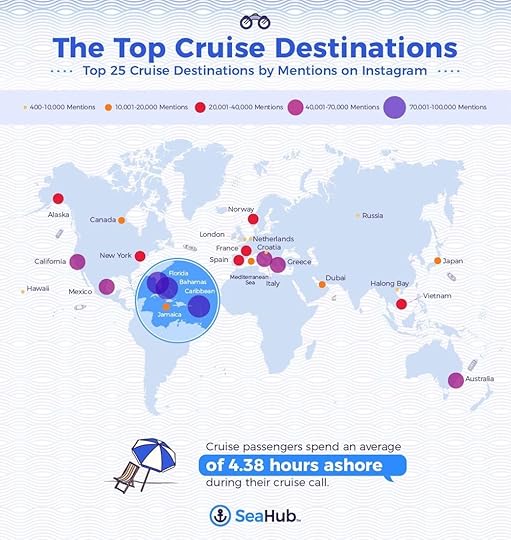
Photo: Sea Hub

Photo: Sea Hub

Photo: Sea Hub
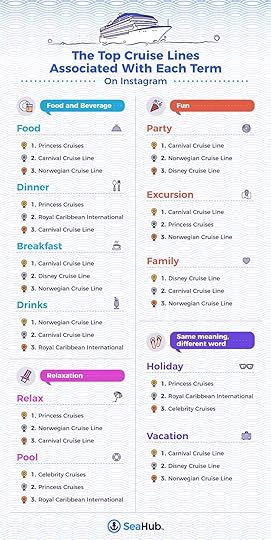
Photo: Sea Hub

Photo: Sea Hub
More like this: How to get a job on a cruise ship and travel the world for free


Matador Network's Blog

- Matador Network's profile
- 6 followers

