
Matador Network's Blog, page 1399
February 21, 2018
Ditch capital cities for small towns
For some travelers, a vacation is all about the bright lights and bustle of major cities. And so it used to be for me. There’s something to be said for the convenience of a capital city. The ease of being close to the airport, famous arches, towers palaces, museums, parks, etc. all make setting an itinerary easy. Then there’s the added bonus of being able to get around on foot without renting a car or worrying about the logistics of straying far and, of course, the abundance of nightlife that connects you with other travelers from around the world. While this may sound appealing, I tend to avoid capital cities when traveling. Here’s why.
1. Cathedral Fatigue is real.
I’ve never been seriously sick abroad, but I have come down with Cathedral Fatigue. It might not require a hospital visit, but it can only be cured with a change of scenery. Cathedral Fatigue is the term used to describe a very real feeling of repetition, weariness, and even boredom, by visiting similar architectural landmarks. If you’ve ever backpacked across Europe and hit several major capitals, you probably know what I’m talking about. Each cathedral, palace, castle, etc. is distinct and impressive in its own right, but — though you might not admit it to your more high-brow friends — when you see too many of them at once, they start blending together.
One week in spring I took a train from Prague to Vienna, and then to Budapest. The architecture was stunning in each city, but by the end, the photo album on my phone looked like my study sheet from Art History 101. I felt like I was looking at 30 pictures of the same church, and couldn’t remember where I had seen what. Unless you’re an art historian, this feeling is inevitable the more you travel. A good way to avoid Cathedral Fatigue is to avoid the cathedrals. The farther you stray from the city, the more the aesthetic shifts and becomes unique.
2. Sticking to capitals is limiting.
Call it a short attention span, but I find that if I spend any longer than two or three days in the same city, I get restless. Once I’ve done the free walking tour, a museum, a day of solo exploration, and a night or two out at the bar, I’m pretty much ready to move on. Of course, actually living in a foreign city for an extended period can be hugely rewarding; you can uncover all the little secrets they have to offer, especially in the older European or eastern cities. But if you’re only traveling to Denmark for a week, don’t limit yourself to Copenhagen. Helsingør, the site of Hamlet’s Castle, is only a short train ride north, or even head to Sweden for the day and check out Malmö or Lund. You’ll feel like you added a whole new layer to your trip.
3. Major cities are usually a bit less unique than provincial ones.
While anything can happen when you travel, especially when dealing with less-advanced countries, if you’re looking for a truly unpredictable, unique vacation, your best bet is straying farther afield. City tourism boards recognize the power of convenience and bright lights, and never fail to capitalize on it. As a result, historic buildings become “attractions”, quiet parks are featured on “things to see” lists, and as a result, everyone ends up with the same “things to see”. If you don’t mind having the exact same vacation as the dozens of people in front of you in the museum line — go for it. Lines generally form around cool stuff, and if something genuinely piques your interest, there’s no reason “predictability” should stand in your way. But if you’re looking for a unique experience, where you don’t necessarily know what to expect when you roll up to your lodging, an excursion to the countryside could be just what you need.
4. Cost is higher.
It goes without saying that cities are expensive. From restaurant fare to cab fare, you’re pretty much guaranteed to pay more for your daily essentials in a major city than anywhere else. If cost is no object, by all means, stay at that downtown hotel in London and pay $17 for cocktails; but if you’re on somewhat of a budget, like most travelers, you might want to think about staying even 30-40 minutes outside the city. You’ll have a more localized experience in a smaller environment, won’t be paying big city prices, yet can still reach the city relatively easily for day trips.
5. Cultural dilution in cities.
It can be tough to really get a sense for a country’s culture by visiting one of its major cities. This might sound illogical, but the fact is, cities attract so many tourists and expats that they all begin to resemble big melting pots. While this is great for the people living there, it can make cultural immersion difficult. Going out to bars in Edinburgh, it was more common to meet other Americans, or students from around the world, than Scots. When I went to Barcelona for a weekend, I think I met three Swedes, two Americans, four Brazilians, three Brits, and upwards of twenty Australians on a group holiday, but not a single Catalonian. Cultural fusion is never dull, but it did leave me feeling like I hadn’t really visited Barcelona, but rather a small sliver of beach that could have been anywhere.
Staying in more remote locales might take more effort and research, but you’ll get a better sense for how the country and its people work. There’s something to be said for leaving the city behind, and settling in in a small pub in the Highlands next to an unpolished Scottish farmer — with an accent so thick you can only pretend to understand his absurd stories — while a flutist plays a horribly out-of-tune folk song in the corner. 

More like this: Five incredible small European towns you can visit by rail


February 20, 2018
most common non-english language US
There’s a reason that more native English speakers in the US study Spanish than any other language. The Romance language is by far the most widely spoken non-English language in the US. Only French bests it as the most popular in two mainland states, according to a map shared by Redditor SciviasKnows. However, by looking at the second- and third-most commonly spoken languages in every state, we get a more complex view of American linguistic diversity. While Chinese (both Mandarin and Cantonese) and German have sizable speaking populations across the US, native languages such as Navajo and the languages of more recent immigrant waves start popping up in clusters.

Photo: SciviasKnows
More like this: Here are the languages the world is trying to learn

most common non-english language us
There’s a reason that more native English speakers in the US study Spanish than any other language. The Romance language is by far the most widely spoken non-English language in the US. Only French bests it as the most popular in two mainland states, according to a map shared by Redditor SciviasKnows. However, by looking at the second- and third-most commonly spoken languages in every state, we get a more complex view of American linguistic diversity. While Chinese (both Mandarin and Cantonese) and German have sizable speaking populations across the US, native languages such as Navajo and the languages of more recent immigrant waves start popping up in clusters.
Photo: SciviasKnows
More like this: Here are the languages the world is trying to learn
My nanny immigrant mother
My mother arrived in New York two weeks before she turned 22. It was 1988 and her first time on an airplane. Her uncle’s ex-wife and her two cousins greeted her at the airport; they drove her all the way across the country to where they lived in Washington State.
My mother, like many Moroccans, migrated to the United States on her own under a tourist visa. Like so many other immigrants, she was searching for a better life.
***
People often ask me, “Where are your parents from?” or “Where did your parents grow up?” For my mom, most of her growing up happened in America after emigration — the foreign reality crashing over her in waves. She and my father mostly lived between Florida and the suburbs of Toronto, where I was born. They moved wherever the money was.
Immigrants lose their worth the minute they board a plane. Women like my mother, who was not professionally skilled in her country of origin, become pre-marked for domestic labor in flight. It’s the default glass slipper, the gendered solution to immigrant women’s shattered American dreams. It’s cleaning your home. It’s caring for your children. The legacy of women of color raising the rising middle class in America is nothing new. Since migration and colonialism began, women of color have filled out a wholly invisible workforce.
In 2014, 1.26 million childcare workers worked for an average of $9.77 per hour in homes across the nation — hundreds of thousands of these workers are both documented and undocumented immigrant women of color. In my experience, this is an hourly rate that rarely gets paid out; it’s an average inflated by nannies who are white or college-educated, hired in wealthy areas to teach academic skills to the kids. A lot of women I know would be thrilled to make $9.77 an hour. Especially since many are forced to perform jobs that go far beyond childcare — whether that’s cooking or cleaning or staying overtime hours not in their job descriptions. This is historic racialization and their immigration status at work. Shadow mothers performing domestic tasks far exceeding a nine-to-five job have long been — and will always be — crucial to the U.S. economy. I know, because my mom was one.
But I am a woman of color, too, and my mother’s daughter — now in graduate school earning a degree in public health, focused on narrative therapy with minority populations. These histories and their marginalization cling to me and inform my work. It’s one thing to discuss this kind of thing in the classroom, but what will happen to the economy if the strata of immigrant childcare workers gains labor rights, or disappears altogether? While women of color have been forced to build ghost economies where their capital is invisible, many of their daughters are not in the assembly line to replace their gendered, domestic work.
***
My mom babysat multiple children over the years, including two white boys. The low status of her job meant she was not paid well — and sometimes not paid at all. Her shifts cutting vegetables and cooking in a restaurant in one of the wealthiest suburbs of Toronto used to embarrass me. It bothered me that she did not have jobs like my friends’ mothers, but today I can credit her income — supplemental to what my father earned working 20-hour shifts as a taxi driver — to the education I’m getting. Her work caring for other children and chopping crudite until she suffered carpel tunnel was all to put money in a college fund for me and my sister. Without the funds my mother contributed to my family for my education, there wouldn’t have been much hope for me beyond my filling her economic shoes.
Women of color like my mom raise, feed, clean, and pick up after the rising upper and middle class, but their children rarely flourish economically in the same ways the children they service do. If these children do succeed, it’s after overcoming far more barriers. Meanwhile, many of our mothers are painted as questionable because of their inability to be physically present with their children, while away caring for someone else’s. Their earnings go to college savings, remittances, or property in the countries they’ve left behind, their absence at home actually an investment in a promise of others’ success.
The labor women of color perform feeds seamlessly into a circuit of invisible capital that has existed since slavery, when black women raised and nursed plantation owners’ children but were considered unfit to raise their own. Popular culture resurrects this trope in films like The Help. Literature does the same in books like Raising Brooklyn, wherein Tamara Mose Brown sheds light on the role West Indian childcare workers have in raising white children in rapidly gentrifying Brooklyn. Brown’s story uses ethnography to highlight how the invisibility of childcare labor, low status, and low pay in many ways replicate the identity of woman of color as colonial subject. One nanny in the book considers her job to be a modern form of slavery.
The fight to make this type of labor safer and secure — positioned as the next frontier in the labor movement — has been discussed for years. In 2015, the Obama administration announced that federal labor laws requiring minimum wage and overtime protections would extend to the nation’s direct-care workers. However, vulnerable foreign workers are still an easy import, making winning them future dignity as domestic laborers seem very far off.
Removing yourself from this invisible labor force, even a half a generation early, isn’t yet very realistic either. You see, my mother went back to school — while maintaining her paid domestic roles — in an attempt to escape her domestic lot. Only recently have I started proudly talking about how she obtained her GED while I was growing up. Her education was certainly a point of pride for her, but it didn’t ever change the kind of employment she could find. My mother, her friends, women in my family, and many other women of color I work with and encounter never break out of their domestic paid jobs. Perhaps because this is the value they hold in Western economies and within circuits of capital as immigrant women.
***
I am in graduate school, tired and burned out. I’ve spent years feeling like a cantaloupe being hollowed out. I cannot imagine doing the jobs my mother did to get me here.
Reimagining how we can collectively define success in neoliberal times seems easy in a school seminar. It’s simplistic and almost robotic for a white Marxist gentrifier to tell me what my future should look like, in a vacuum where the loaded underlying assumption is that we all started off on the same playing field and begin from the same starting line.
Many are shocked when I tell them that my mother was a nanny. I believe it’s because the children of such women were not meant to exist in academic spaces. We were meant to replace our parents in the domestic labor circuit.
Still, too often in graduate school I hear echoes of my accomplishments labeled with descriptors of “doing good for your people” or “your people are taking over.” I would not be where I am today without my mother’s sacrifices. While our “lean in” feminism boosts some — primarily the wealthy — it continues to insert women of color just a bit less fortunate than me into the domesticated cycle where they replace others aging out. I could have been one of those replacements if not for my mother.
If I were to tackle the “behind every successful man is a woman” through a different lens, I would say that behind every upper-middle-class family there is a woman of color to care for their home and children. And behind everyone like me, there’s that same woman as well.
This article originally appeared on How We Get To Next and is republished here with permission.
More like this: The secret lives of immigrants

Carnival in Oaxaca, Mexico
Brazil, Italy, Trinidad and Tobago — these are the places I think of for Carnival. I did not really think of a little town outside Oaxaca, Mexico where devils take to the streets and people don animal skulls, clanging bells and covering themselves in motor oil. And yet, this year on Fat Tuesday (the final day before Lent begins), that is exactly where I found myself.

1
Preparations
San Martin Tijacete is about 40 minutes outside of Oaxaca City, in a valley known for its artisans. This event is called Carnaval Ancestral, as it's not just regular Carnival: it's a blend of the Catholic tradition and the village's local traditions. In a town so close to Oaxaca City, where Day of the Dead is the pinnacle event of the year, it's no surprise that painting your face up like a skull is completely normal. Don't ask about the dinosaur - my Spanish is good, but not *that* good.

2
Skulls and bells
Two major aspects of this event are wearing skulls (or terrifying masks) and clanging bells. I was told that this was to scare away bad spirits before the season of Lent (40ish days of fasting before Easter) by one person, and told it was to personify sins and sinful human nature by another. I expect both answers are true.

3
Say "cheese"!
Two boys ready to go.
Intermission
Culture Guides
13 memories you have if you grew up in Michigan
Cathy Brown
Jan 31, 2018
Travel Safety
9 safe and awesome places to travel in Mexico
Hal Amen
Sep 6, 2011
Festivals
5 transformational festivals to escape to this winter
Jessica Devnani
Jan 24, 2018

4
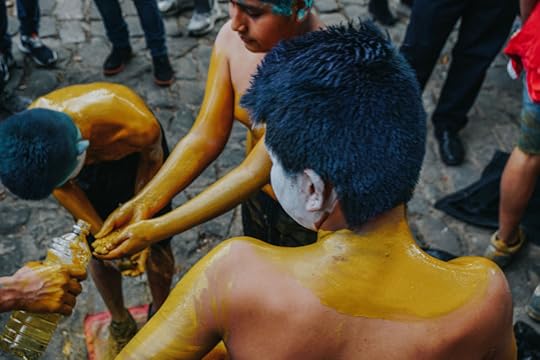
Ready to go
Children wait in their doorway, ready to hit the streets and get to screaming and rattling and wreaking havoc.
5
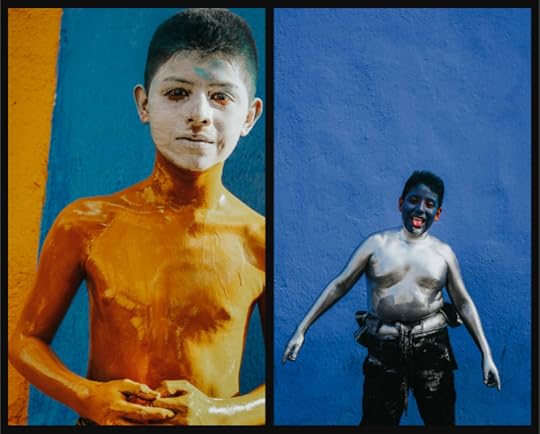
Bands of color
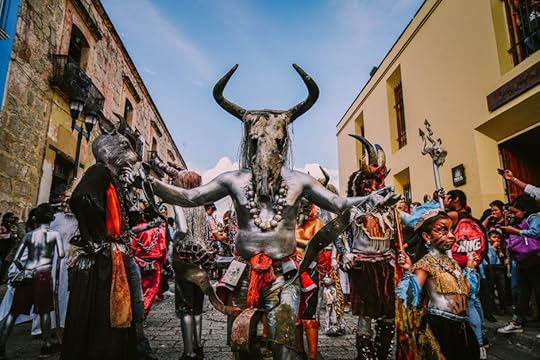
There was the black and horned band, the yellow and blue band, the full silver band, and more. Others head out solo, while some cross-dress, don skulls, or wear the traditional Albrejie masks the town is known for. Many had cowbells tied to them, reaching back and ringing them out at every turn.
6
Yellow and Silver
Whatever they're putting on their skin, it's strong. But it's worth it for the pop of color. The boys around this age seemed particularly invested in the parade and participation.

7
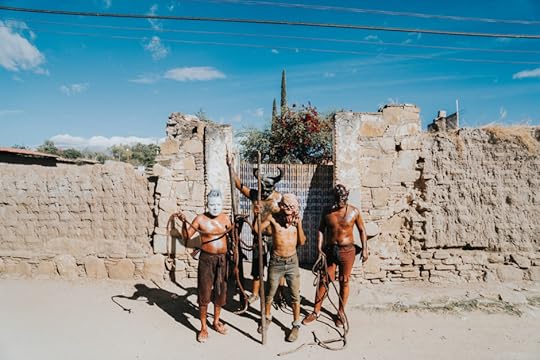
Teens are the same everywhere
Adjusting his hair time and time again, so it was just right. The universal teenager, ladies and gentlemen.
8
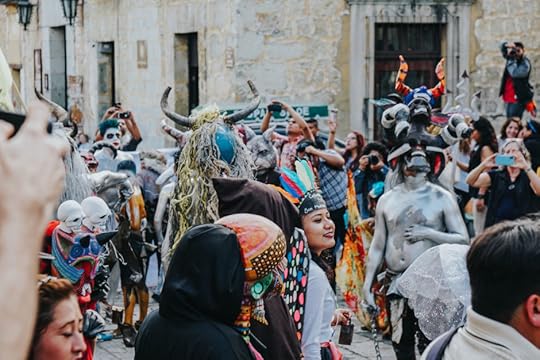
Take to the streets
This day begins around 8 AM when there is a public breakfast and life tumbles out into the streets. By 11 AM there are large crowds, ready for the traditional parade down the street.
9
Gather
As the parade commences, some are wearing devil costumes and masks to ward off evil spirits and cleanse the town for Lent while some wear hand-painted wooden masks instead, as the town is famous for wood carvings called Albrejie. Alongside the howling devils, there is a couple dressed as if for a wedding, whom the crowd marches to the Major's house where a fake civil ceremony is performed.
Intermission
Sponsored
8 amazing winter adventures in Colorado that don’t require a lift ticket
Tim Wenger
Jan 24, 2018
Photo Essay
Colors of Mexico’s markets
Allison Heiliczer
Feb 12, 2010
Sex + Dating
Sex and Burning Man: everything you need to know
Claire Litton-Cohn
Aug 18, 2017
10
Welcome
It was mesmerizing, unnerving, and magical.
11
Masks and mayhem
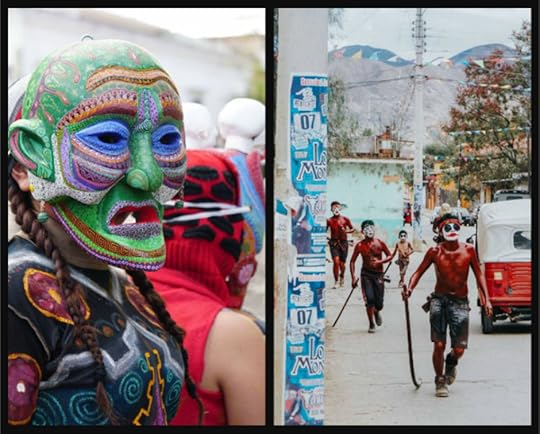
Left is a traditional Albrejie mask. San Martin Tilacete is famous for its work with copal wood, making fantastical animals, masks, and anthropomorphic carvings. If you saw the movie "Coco," the wild pink dog was an Albrejie brought to life. To the right, three rogue boys come shouting down the side street to join the fun.

12
Say "cheese", please
All day long, the locals paused and posed for the many photographers present; it almost felt like part of the fun. They were very proud of their special carnival and of the costumes they worked hard on. That said, the town must find itself a bit of tension: wanting the tourism and the pride of showing off such a unique tradition, but not wanting to compromise the tradition itself. For example, a band of 6 or 7 tourists had been painted up and joined in the parade, toting Dos Equis beers as they went. I have no doubt they were invited by locals - and honestly, welcomed into the parade warmly, it seemed - but I did find it a red flag that the tradition might be on the brink to some extent of losing something. I was unable to confirm there was any issue with the tourists joining, but as I watched the tipsy visitors happily dance and shout in skin paint and grass skirts, I wondered what it might mean. (An English-speaking local next to me quipped "I wonder if they got lost trying to find Burning Man?")
13
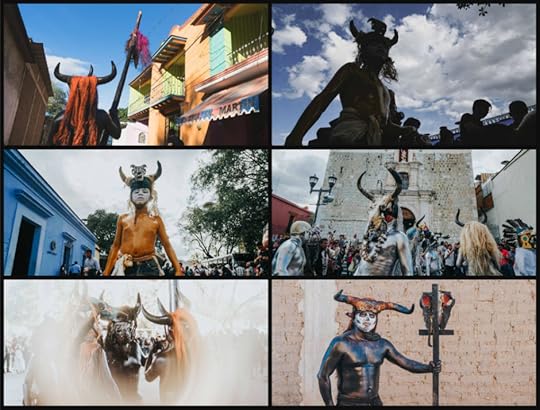
Horns, horns, horns
It didn't get old.
14
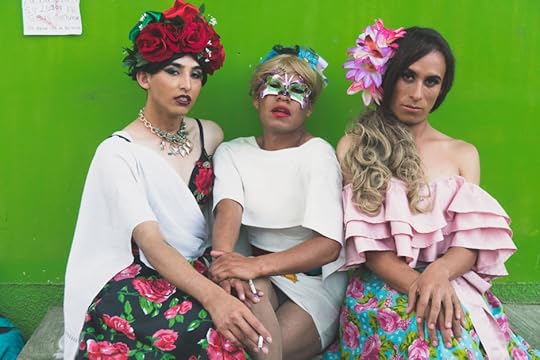
Smile, girls
While I couldn't figure out why, it did appear that cross-dressing was part of this event for some. My guess would be to confuse the devils, or to just let it all out before Lent.

15
Costume contest
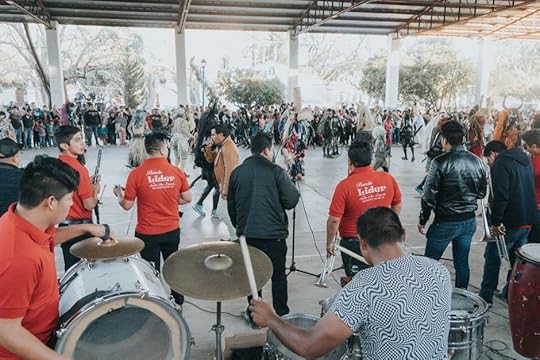
Later in the day, the town regrouped in the center for a large costume contest. The rowdy nature built up as the night went on. Someone was crowned King and Queen of the day, and I am pretty sure someone won a horse. This little girl is proof you don't have to dress up terrifying - almost any costume is acceptable.
16
The band plays on
A band that had marched along with the crowd lined up to play on for the costume contest. A tuba, a horn section, a drummer, and a singer were all on hand.

17
That's a wrap
Once the winners were announced, the event just turned into a huge cross-dressing, horn-wearing, mask-clad, undulating party. Everyone stayed out late, and then I assume made futile attempts to shower. Good luck - I got smeared with the black "'paint" and it was 100% motor oil. Six days later, I still have it all over my face and arms - it's an unpleasant but welcome reminder of this wonderful, odd, unique event over in San Martin Tilcajete.
More like this: The culture of Carnaval in Oaxaca is hauntingly beautiful

Wrong about Arizonans
No, only during Rodeo Week. And the Fourth of July. And other major holidays. And Tuesdays.
2. We all have guns.
Nope — but we’re number one in gun ownership in the US. Yeehaw!
3. We want a wall dividing our state from Mexico.
Quite the opposite — the majority of us welcome the healthy trade and cultural exchange.
4. We’re dyed-in-the-wool conservatives.
No, we’re growing more purple by the minute.
5. We can’t swim.
Wrong again. We all have pools.
6. We all speak Spanish.
Well, that’s partially true. We all speak at least some (bad) Spanish.
7. We’re actually from here.
Nope! Way less than half the population is native-born.
8. We ride horses to work.
Probably safer than driving, but no.
9. We enjoy the (dry) heat.
Make the inferno stop! Please!
10. We’re cautious about cacti. And snakes.
11. Our Native American population lives in tipis.
Never have!
12. We’re passable drivers.
Hell no — we’re the worst! Just add rain or snow, sit back on the front patio, watch, and laugh.
13. Our sunglasses and flip-flops are removable.
14. We’re all tan, all the time.
15. We all reside in beige houses in Phoenix, on golf courses.
16. We know what to do in a natural disaster.
Wrong. We only know what to do in the event of a flash flood.
17. We’re all over 65 years of age.
Nope! ASU, NAU, and UA are not filled with AARP members.
More like this: 24 things Arizonans don't blink an eye at
What to do with a day in Chicago?
Planning an itinerary that highlights the best of what a city has to offer in just 24-hours can be daunting. If you have a short window, sunrise to sunset, you need local advice to make sure you don’t miss out.
We pulled together top tips from Chicagoans. Here’s what they have suggested to do with a day in the Windy City.
What to do with a day in Chicago
1. Where to eat
2. Where to drink
3. Entertainment
4. Cultural activities
5. Outdoor activities
1. Where to eat
With regards to one of Chicago’s most iconic dishes, pizza, there seems to be a running theme that any local pizza joint would be a safe bet. That said, Mike Manly lists off “Pizano’s on either Madison (about a block from the Art Institute) or on State Street (800 north). Pizano’s, Pizzeria Uno, Due, and Lou Malnati’s are all great.”
If you are looking for a quick eat, Chris Wake says “there are a ton of outdoor spots to grab food or a drink. Lincoln Park and near north may be crowded, but there are equally good or better spots in the near west (Wicker Park, Bucktown, Roscoe Village, etc.).”
For brunch, Nycole Hampton, suggests the shellfish and seafood stations at Shaws Crab House. With regards to seafood, she also recomments the oysters at Eatarly, shrimp and grits from GT Fish & Oyster, and the seafood tower from Cold Storage.
If you have a sweet tooth there are many options, Nycole Hampton suggests that you head to Do-Rite Donuts for apple fritters, icecream from Rainbow Cone, and cookies that are the size of your face from Summer House Santa Monica. She adds that you should not skip the 14k chocolate cake from RPM Steak.
2. Where to drink
John Meyers suggests that you “Grab a drink at the Signature Room at the top of the Hancock Center. Fantastic views of Chicagoland and Lake Michigan.”
Richa Agarwal also recommends enjoying the view at the Vertigo Sky Lounge.
Jennifer Billock has this to say, “We may have our share of ritzy places to get a drink, but we’re also founded on working class ideals, so we know how to enjoy a good dive, too. For a night out on the town (a cheap night), we know better than to get all dressed up and head to rooftops and hotel lounges. We put on jeans and a t-shirt and go to the neighborhoods.” Jennifer’s top 7 dive bars are, The Victor Bar, Happy Village, L&L Tavern, Map Room, Slippery Slope, The Heavy Feather and Schubas Tavern.
3. Entertainment
According to Rishi Natarajan, “Chicago has a variety of comedy shows that are of particularly good quality and often are the platform from which national comedy stars arise. In particular, Second City in Chicago is a phenomenal comedy theatre with hilarious shows… if you’re into comedy at all, definitely add this to your list.”
Locals also suggest that the shopping in Chicago is good, especially in the summertime. Natarajan says, “Chicago’s famous Magnificent Mile is a 1 mile stretch of Michigan Avenue that’s lined with stores (think the Chicago equivalent of New York’s 5th Avenue).”
When it comes to live music, Natarajan explains, “There are a lot of long-running music venues in the city that are worth visiting. The Chicago Symphony Orchestra is one of the Big Five orchestras and is a pleasure to listen to. Chicago also has several good Jazz/Blues venues, if that’s of interest.” Local Lauren Victoria adds “Blues music has a rich history in Chicago, and you can get acquainted every night at B.L.U.E.S. on Halsted. Performers range from new artists to national legends, both equally enjoyed by the audience. The venue is small and can get quite crowded, so arriving early is always a good plan. If you visit on a Sunday, your ticket gets you free entrance to Kingston Mines — another famous blues bar down the street.”
Victoria goes on to add, “Did you know that Chicago is the birthplace of the poetry slam? In 1984, the competition was started to showcase the city’s diverse talent. More than 30 years later, the tradition lives on. Every Sunday from 7 to 10 PM, poets from all across the country recite their best work over the smooth sounds of The Green Mill Quartet at the Green Mill Cocktail Lounge. You can also expect a special musical performance from a featured guest at intermission.”
Chris Wake states that your schedule should include a baseball game and offers this tip, “Cubs for the beer, the atmosphere in Wrigley and the fans, or White Sox for the hot dogs.”
4. Cultural activities
Here are some of the recommended stand-out museums in the city.
Rishi Natarajan remarks, “Chicago has a variety of excellent museums that you might consider visiting:
The Museum of Science and Industry is the largest science museum in the country and has all sorts of cool (and nerdy) exhibits (a U-505 German submarine exhibit, a NASA spacecraft, a working coal mine, etc.).
The Art Institute of Chicago is a fine art museum that I think is known for its collection of Impressionist art and is the 2nd biggest art museum in the US (behind the MoMA in NYC).
The Field Museum of Natural History will definitely appeal to those interested in the natural sciences. It has over 20 million specimens.”
Paul Beyer also suggests The Adler Planetarium, “The Adler Planetarium is a public museum dedicated to the study of astronomy and astrophysics. It was founded in 1930 by Chicago business leader Max Adler.”
5. Outdoor activities
Depending on what time of year you are visiting Chicago, there are many green spaces to enjoy.
Richa Agarwal recommends a “walk through Millennium Park and especially the adjacent Grant Park for the gorgeous Buckingham Fountain.” Agarwal continues, “if it’s hot, enjoy the palm trees and Lake Michigan at Oak St. beach. And/or one of the river/lake boat tours.” She adds, “If you’re a runner, you can see much more. Running along the Chicago River to the lakefront is really awesome, and there are miles and miles of scenic lakeshore to run along. You can also rent a bike.”
Lauren Victoria favors Garfield Park Conservatory for it’s “stark contrast to the urban city, the lush trees and colorful flowers create a perfect nature escape. With just a small donation of your choice, explore an array of plants from countries from all around the world. It’s also a great place to take the kids — there are educational events offered everyday.”
When it comes to where to get the best view of the city, most Chicagoans recommend Navy Pier.
Mike Manley also recommends taking a boat on the water and adds, “Chicago Architectural Foundation’s river tour of Chicago architecture only takes an hour and gives you lots of great information about the city, as well as wonderful views of lots of great city landmarks from the water. You can board the boat down the steps to the Chicago River at the northeast corner of Michigan Ave. and Wacker Drive.”
Find some of these spots on our travelstoke map:
" target="_blank">42 things you have to do in Chicago before you die
Australian language mistakes
You say: Flip flops
Aussies say: Thongs
If you’re in Australia during the summer (or any other time of the year, really) you might be wondering why Aussies keep talking about their underwear, how they’ve broken one, or if you’ve seen their missing pair. It’s the quintessential language mistake that most foreigners make.
2.
You say: Kissing
Aussies say: Pashing
Favored by teenagers and iconic TV characters Kath and Kim, pashing is a classic Aussie word to describe a good old make-out session. What’s even better than pashing is the all-telling aftermath, known as “pash rash.”
3.
You say: Swimwear
Aussies say: Togs, cossies, swimmers
There’s a big countrywide debate as to what term for swimwear is correct but all we can say is that if you say “swimwear,” you’re not an Aussie. Oh and those delightfully small swimmers favored by old European men? They’re known as budgie smugglers.
4.
You say: Cooler
Aussies say: Esky
Eskies are classic example of how Australians have taken a brand name and made it a whole new word. Another example is Panadol paracetamol. No matter what brand of paracetamol it is, it will always be called Panadol.
5.
You say: Crisps
Aussies say: Chips
Us Aussies are simple creatures. We don’t want several different words for something created from the same vegetable. To us, chips are chips whether they come from a foil packet or served hot with gravy and chicken salt.
6.
You say: Aluminum foil
Aussies say: Aluminium foil
It’s funny how one single letter can create a debate between the Aussies and their North American acquaintances. To Americans, the handy kitchen product is pronounced “a-LU-min-num” and to us Aussies it’s “al-U-min-ium.” We could just settle it once and for all and say “al foil.”
7.
You say: McDonald’s
Aussies say: Maccas
Australians don’t like to waste time on three syllables. After all, fast food needs fast pronunciation.
8.
You say: Lots of/a lot
Aussies say: Heaps
“That was heaps good,” “thanks heaps,” “there are heaps of people here” — whatever you’re talking about, there are heaps of ways to include “heaps” into your Aussie lingo.
9.
You say: U-turn
Aussies say: Chuck a U-ie
Despite what Siri might say, Australians will never utter the words “perform a U-turn” when it’s necessary to turn around. “Chuck a U-ie, mate” is one of the most Australian phrases you’ll hear and it’s one we’re heaps proud of.
10.
You say: Drunk
Aussies say: Para/smashed/shitfaced/maggot
There are a thousand ways to say you’re drunk worldwide but it’s in Australia where it’s most eloquent. There’s nothing like hearing “Lets get maggot tonight” or “Mate, I’m para” to really make you proud of your country’s quirky vocabulary.
11.
You say: Toilet
Aussies say: Dunny/loo/crappa/outhouse/thunderbox/long drop
I shit you not; Australians have more words for the toilet than we do Prime Ministers in one year.
12.
You say: Tantrum/getting angry
Aussies say: Spit the dummy
Aussies are a laidback bunch of people so when someone is getting a bit angry, we like to bring them back a notch. You’re not getting angry, you’re spitting the dummy — because you’re being a baby.
13.
You say: “I got swag”
Aussies say: “I’ve got MY swag”
Long before “swag” was a way to describe how much street cred you had, it had a completely different meaning Down Under. A “swag” has long been an Aussie word for a mattress protected by a canvas cover, used for camping.
14.
You say: Talking
Aussies say: Having a chinwag
Us Aussies love a good chat so much that we’ve named it after the motion that your face makes. So if you hear someone say “chin-wag” it doesn’t mean they have loose facial features, it just means they’re having a bloody good chat with someone.
15. Bogan
I couldn’t finish this list without the ultimate Australian word. If there’s one word that leaves foreigners dumbfounded, it’s “bogan”. “Bogan” is one of those words that have no exact translation and it’s easier to spot a bogan than to describe one. I’ll just put it like this — if you find yourself using the slang above regularly, chances are you’re well on your way to becoming one.
More like this: 19 giveaways you're from Australia
Save money in Budapest
Budapest is already known for its budget status: it doesn’t get much better than a place where a frothy beer is cheaper than a bottle of water. But you don’t have to fill up on the local lager to enjoy the city at a discounted price. There are many ways to trim your costs in the Heart of Europe.
1. Venture outside the city center.
Even though Budapest’s city center is amazing in itself, it’s just as entertaining to wander outside of the bustling District V core. Some of the city’s best food, drinks, and nightlife require a little digging, but you’ll be rewarded with far more affordable prices and you’ll get to spend time with actual locals and not just other tourists.
Some of my favorite alternatives to the city center include District II, which is home to most of the city’s beautiful outdoors, District III, which holds some of the oldest history, District VIII, which is filled with stunning architecture and hip, young spaces, and District XIII, which has an entirely different look from the rest of the city. You will be just as entertained at a fraction of the price.
2. Walk or use public transportation.
Budapest has the oldest metro system in continental Europe, and its public transportation network snakes through the entire city. It’s complete with an underground metro, day and night buses, trams, trolleys, river taxis, and suburban railways. You can see all corners of the city in no time. And it’s extremely affordable. Transport passes that cover the entire network system start at $7 for one day, $17 for three days, or $20 for one week. You can also purchase a Budapest Card that includes all public transport and many of the city’s biggest sites for free (including one of the thermal baths and more than ten museums). Plus, river taxis are a really cheap alternative to the touristy river cruise.
All in all, there’s really no reason to hire a taxi in Budapest, especially when the public transportation is entertaining in itself. Opt to go by foot through the city’s historical core or bump and rattle along the Danube River on a historic yellow tram. Hop from one art-infused stop to another on the newest metro line (M4) or scoot into a bucket seat on one of the bright red trolleys. It’s all a part of the Budapest experience.
3. Be a tourist but act like a local.
You’ve probably heard of Budapest’s thermal baths. They should not be missed. But with the steady influx of tourism, the price tag keeps creeping higher and higher. Luckily, you can swap out extravagant prices and crowded pools by visiting some of the smaller and lesser-known spas.
Szechenyi, Gellért, and Rudas top every list, and for good reason. They are stunning and the perfect place to score that selfie for Instagram. But there are cheaper alternatives, like Szént Lukács (free with the Budapest Card) or Király. Or, if you’re in the city during the summer, then Palantinus on Margaret Island is a great option. You get the benefits of indoor hot spas, outdoor chilling pools, and the bonus of a giant wave pool and slides. It’s a total local’s summer hangout with a “beach” and restaurants inside. And if you arrive in the evening, or only spend 3 hours there, you receive a discount!
4. Create your own walking tour.
One of the most appealing aspects of Budapest is its array of architecture and incredibly impressive monuments. Just strolling a few blocks will leave you in awe, which makes this very inexpensive entertainment. You can easily find architecture ranging from Roman ruins to Neo-Renaissance to Art Nouveau to Communist-era. And along the way, you can see all the big monuments too.
If you’re more of a nature person, your walking tour can include some green spaces like Margaret Island, City Park, or a jaunt up Gellért Hill for excellent views of the city. Or, immerse yourself in the forests of the Buda Hills, which are teeming with both easy and challenging, short and long, trails. As a bonus, you get to see a lot of local families enjoying their weekends and you can score some of the best strudel at Normafa.
5. See a show.
Normally this wouldn’t fall into a budget trip, but it does in Budapest! If you’ve ever wanted to feel a little fancy in Europe and see a show at an elegant Opera House, then you’re in luck. You can get nosebleed seats for just a few dollars. Go early to stroll around the interior.
Or if performing arts isn’t your scene, you can catch a film (many in English) at one of the city’s old, historic cinemas. Some of my favorites include Puskin, Művész, Corvin, and (if you’re a true hipster adventurer) Bem Mozi. Again, the ticket will only set you back a few dollars and you can enjoy a film while absorbing the vintage atmosphere around you. For even more culture, visit Budapest in the spring during the International Film Festival, which will take you all around the city (and the world) at several different cinemas.
6. Join the locals and picnic outside.
There are plenty of public spaces where you can sit and sip at your leisure. You can bring all your picnic fixings with you, including your beer or wine and sparkling water for a refreshing fröccs. Fan your blanket out on the green grass and enjoy a warm summer evening along the shores of the Danube, the steps of the Basilica, one of the city’s parks, or in the heart of the city at Elizabeth Square.
7. Combine accommodation with entertainment.
Budapest is known worldwide for its incredible and unique nightlife. With bars and clubs built into old courtyards, decorated with quirky relics of the past, you can see why. If you’re in it for the parties, then you can easily combine your slumber with your fun. There are numerous party hostels that house you above an old ruin bar where music, dancing, and drinking carry on until the morning hours. No cover fees if you’re a guest, and many of these hostels organize walking tours and other events for their patrons, all for the reasonable price of a hostel bed.
More like this: 17 must-have experiences in Budapest
hidden costs of a hotel in Europe
Taxing tourism is not a new idea, and considering how expensive it can be to host throngs of tourists, it probably isn’t a bad one. But getting the bill for something you thought was going to cost you one price, only to realize that there are hidden taxes, can be infuriating. That’s why GlobeHunters put together an infographic of the tourist taxes of cities and regions across Europe. The taxes can be as low as €.5 Euros ($.63) per night in Greece and as high as 5% in Berlin. It pays to know the hidden fees of a night abroad.

Photo: Globe Hunters
More like this: 17 jaw-dropping images that will have us all eloping in Europe

Matador Network's Blog

- Matador Network's profile
- 6 followers


