
Matador Network's Blog, page 1403
February 15, 2018
6 things tourists do in South Korea
“Gimmieaventidecafwithlegsandleaveroom,” a sturdy tourist blurted from across the counter.
The Korean Starbucks barista froze behind her register.
“Give me a venti decaf with legs, and leave room,” the man repeated, this time slower but annoyed.
The barista nodded her head, punched something into the register, and pointed to the card reader. I’m sure the customer got some variant of coffee, but I promise he didn’t get what he meant to order.
I think most tourists would agree that speaking in jargon-filled English at the speed of an auctioneer in any country whose official language isn’t English is rude and, perhaps, a bit ethnocentric. If a visitor did that in the US, people would be annoyed.
But, even if you consider yourself a well-mannered globetrotter, there’s likely a few other South Korean faux paus you could break unwittingly if you aren’t privy to them. If you want to have a fantastic time in Korea and leave a fantastic impression, check out these six things tourists do in South Korea that drive locals crazy before boarding your flight.
1. Wear inappropriate clothing.
If you’re a man traveling to South Korea for sightseeing and soju, feel free to rock Crocs and a fanny pack. But if you’re a man traveling for business or to work in South Korea, it’s better to overdress than to underdress. Jeans and Converse might work in Silicon Valley, but not in South Korea.
The same workplace rules apply to women, who should wear pencil skirts or pants, a blouse, and close-toed shoes.
But for women, there’s more. Ladies, the good news: you can break out your high school mini-skirts and short-shorts; bare all of the leg you want. The not-so-good news: you should leave any cleavage-baring tops, spaghetti straps, and back-bearing shirts at home.
While these sort of tops are more common in some areas in Seoul home to a younger crowd, such as Hongdae, these pieces of clothing will get you extra negative attention elsewhere. Some men might ogle, and older Korean ladies might scold you (Yes, in public!). But this doesn’t mean you have to buy a whole new wardrobe; pairing a cardigan with these types of tops works wonders.
2. Talk loudly on the subway.
After being in Korea for only a year and a half, I can tell if a foreigner on the subway is new to South Korea or not just by their speaking volume. Talking on the subway isn’t taboo. But Koreans on public transportation speak at a low hum to avoid disrupting others.
Some foreigners who visit Korea have a naturally louder speaking voice, or perhaps aren’t used to taking public transportation, so they often speak louder without realizing it. Keep this Korean pet-peeve in mind to avoid a bus full of glares.
3. Greet friends with hugs.
Where I come from in Florida, friends hug their friends. I learned the awkward way that this isn’t a Korean tradition. The one time I forgot this quirk, I went in to bear-hug my Korean co-teacher I hadn’t seen in months, and she politely dove to the left and patted my shoulder.
Instead, you can do a slight bow. (Please do not do a full half-angle bow for your friends, or they’ll think you’re very strange.) Waving hello and goodbye is also OK with millennials and younger people.
4. Throw toilet paper in the toilet.
Rule number four: Don’t throw toilet tissue in the toilet. Usually.
Korean plumbing systems aren’t so good at dealing with toilet tissue, so most bathrooms require the wastebasket-method. When you’re done with your business, just throw the tissue into the basket. (Yes, even “number two” tissue.) If you just recoiled in disgust, I feel you. But, do you really want to be that one “waygookin” (foreigner) who clogs the toilet and overflows the restroom?
5. Wear shoes indoors.
Remember the co-teacher I mentioned above in the awkward hugging situation? When I first came to Korea, I invited this same co-teacher into my house. She began untying her shoes, so I stopped her and said, “It’s OK! You don’t need to take your shoes off.”
She looked horrified. She said nothing, and she took her shoes off, anyway.
You should follow suit. The same goes for restaurants and even schools. If everyone else is sock-footed or in slippers, you should do the same. If everyone is wearing shoes, it’s OK to keep them on. Honestly I’m not sure if the tradition stemmed from a germaphobe or if there’s a deeper reason behind it, but in Korea, it’s just what you do.
6. Be insensitive about Japan.
Korea has a long, complicated history with Japan that many tourists, long-term foreign residents, and even presidents don’t fully grasp. It’s best to do some research on Korean-Japanese relations before you pack your bags.
But, if you’re reading this with airline-pretzel crumbs already spilling from your mouth, just play by this rule: approach topics about Japan delicately. Do not refer to the “East Sea” as the “Sea of Japan,” respect the comfort women statues, and for the love of god don’t mention Dokdo. 

More like this: 10 Korean customs to know before you visit Korea


Know before visiting the Colosseum
Also known as the Flavian amphitheater, the Colosseum fell into neglect after the fall of the Roman Empire. Its ivory travertine marble was looted as a source of building materials, destroying much of the original structure. Fortunately, a series of renovations concluded in 2016 have helped restore some of its former glory. A few tips will help you join the almost 6 million visitors a year in appreciating this ancient arena.
Here are some things I wish I had known before visiting the Colosseum.
1. Visit during the off-season to visit to avoid the Roman heat and crowds.
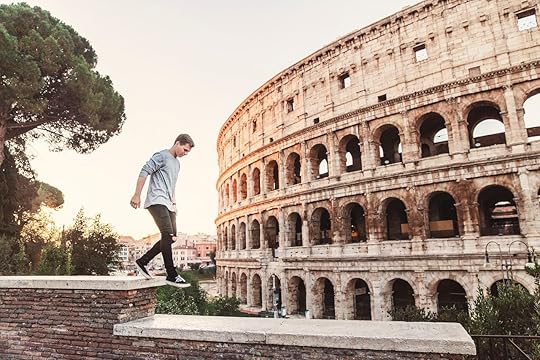
Photo: Joshua Earle
A Roman summer holiday sounds appealing, but it’s best to avoid the peak summer season and its infamous humidity. The best time to visit the open-air Colosseum is during the low season from November through March. Relatively mild winter temperatures make it easier to properly explore the Colosseum. Also keep in mind that tourism, and crowds, briefly increase during Christmas and Easter holidays. If you must travel in the summer, make sure to avoid visiting between 11 AM and 4 PM when the heat is at its worst.
2. There are lots of public transport options, but remember to buy your ticket before boarding.
The Colosseum can be easily reached by public transport or on foot from anywhere in central Rome. There is dedicated metro (Line B), bus (number 75), and tram (Line 3) stops for the Colosseum, but you must purchase your public transport tickets in advance and remember to validate the ticket upon boarding to avoid stiff fines. Tobacco shops (tabacchi) or magazine stands are your best bet for tickets. Or get the new app that allows to you to buy and download tickets as needed on a smartphone. Single integrated tickets (valid for 100 minutes, but only a single metro ride) cost 1.50 euros or you can choose from a variety of multi-use passes.
3. You can visit for free — just be prepared for longer lines.
Standard adult tickets cost 12 euros, but entrance to the Colosseum and over 300 other government managed museums, gardens, archaeological sites, and monuments are free on the first Sunday of the month. Just brace yourself for longer lines with no options for group tours or special reservations available during the free-entry days. Although the Colosseum can handle up to 3,000 people at a time, up to 30,000 visitors show up during high season to take advantage of the freebie.
4. Early birds can take advantage of the included admission to the Imperial forum.
The best time of day to visit the Colosseum is right at opening (8:30 AM) or 1-2 hours before closing, which changes throughout the year and is based on the sunset time. Plan to arrive at least 30 minutes before opening to breeze through the entrance. The standard ticket will also give you access to the Palatine Hill and Imperial Forum. Make sure you budget time for all three but start your morning at the Colosseum. I highly recommend purchasing tickets online in advance. The additional 2 euro convenience fee is well worth it. If you decide to wait to buy the tickets onsite, do it at the Palatine Hill or Imperial Forum entrances where the lines tend to be shorter.
5. Pay for a guide to skip the line and have a more enriching experience.
Joining a group tour organized by the Colosseum management or through independent operators such as Viator is a great option for skipping the lines. A competent guide will also provide a better sense of the site and its many uses since it was inaugurated in 70 AD. Otherwise, downloading a free audio guide and good headphones will allow you to explore at your own pace.
6. Get an elevated view of imperial Rome or visit the seedy underbelly of the Colosseum.
Parts of the Colosseum are not covered by the standard ticket but are now accessible through guided tours or special tickets (typically 9 euros). For the first time in over 40 years, the upper terraces of the Colosseum are open to the public through advanced bookings. This gives you access to two extra levels with panoramic views of imperial Rome. Ironically, these used to be the “nosebleed” seats reserved for the poor plebeians, ancient Rome’s lowest social class. You can also gain access to the hypogeum, or the underground tunnels and chambers beneath the arena, where gladiators awaited their fate alongside caged lions and tigers.
7. See the Colosseum by moonlight!
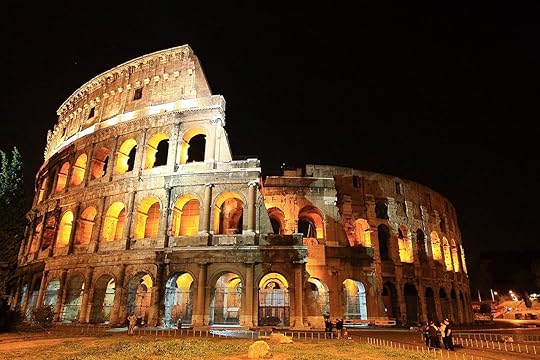
Photo: Sung Rae Kim
From March through December, you can also visit the Colosseum at night. There is a heftier 20 euro entrance fee for these special exclusive small tours. In return, you get the opportunity to visit the site almost entirely to yourself, walk out unto the arena floor, and tour the hypogeum. Of course, you can also return in the evening and stroll around the exterior for free. A full moon makes a great backdrop for photography. Make sure you stop by Constantine’s Arch, one of the oldest triumphal arches in the world, which is a few meters away.
8. Be respectful of baggage and photography restrictions.
Large backpacks, luggage, and tripods are not allowed inside. Also factor in time for any small bags and equipment you might carry to be screened by a metal detector. Selfie sticks were also banned due to concerns about damage to the recently renovated facade. However, enforcement was a losing battle with so many street vendors right outside ready to sell replacements. Now visitors are asked to refrain from using them during the tour.
9. Wear appropriate shoes and bring a hat for mid-day tours.
Comfortable shoes with good traction are a must! Italian women may have made an art form of balancing stilettos on cobblestone, but you will want to be comfortable for exploring ancient stone construction. The timeworn paths of the Colosseum and forum are filled with uneven stone which can be slippery for the uninitiated. There is also a decent amount of climbing involved if you want to explore the Palatine Hill or the upper levels of the Colosseum. Make sure you bring a hat for the mid-day sun, which is strong even in Roman winters.
10. Help the environment and your wallet by filling your water bottle at a Roman fountain.
The ancient Roman legacy of aqueducts lives on through thousands (over 2,500!) of operational water fountains scattered throughout the city. Bring your own bottle to fill up with safe and remarkably cold drinking water before you head to the sites. These fountains are a godsend during the months of July and August.
11. Enjoy a sunset drink with Colosseum views.
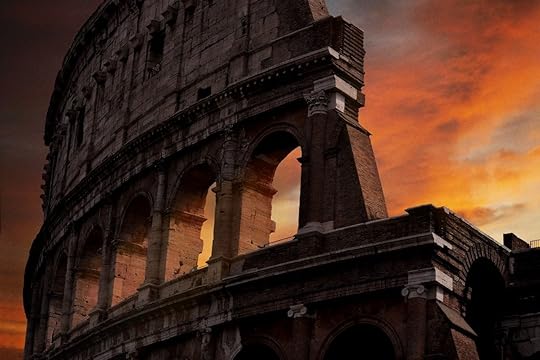
Photo: Dario Veronesi
After a long day of walking around ancient Rome, join in on the local pre-dinner aperitivo ritual. The cost of a drink usually includes some savory snacks that will tide you over until dinner since reputable restaurants will not serve main meals until 8 pm. For the best views overlooking the Colosseum, stop at one of the restaurants on Piazza del Colosseum with a rooftop terrace.
More like this: How to save money on your trip to Rome
February 14, 2018

How to visit Gardners Falls
THE SUNSHINE COAST HINTERLAND is worth a visit for anyone who considers themselves to be the least bit adventurous. Gardners Falls, just outside the tiny town of Maleny, is one of the freshwater gems of the hinterland.
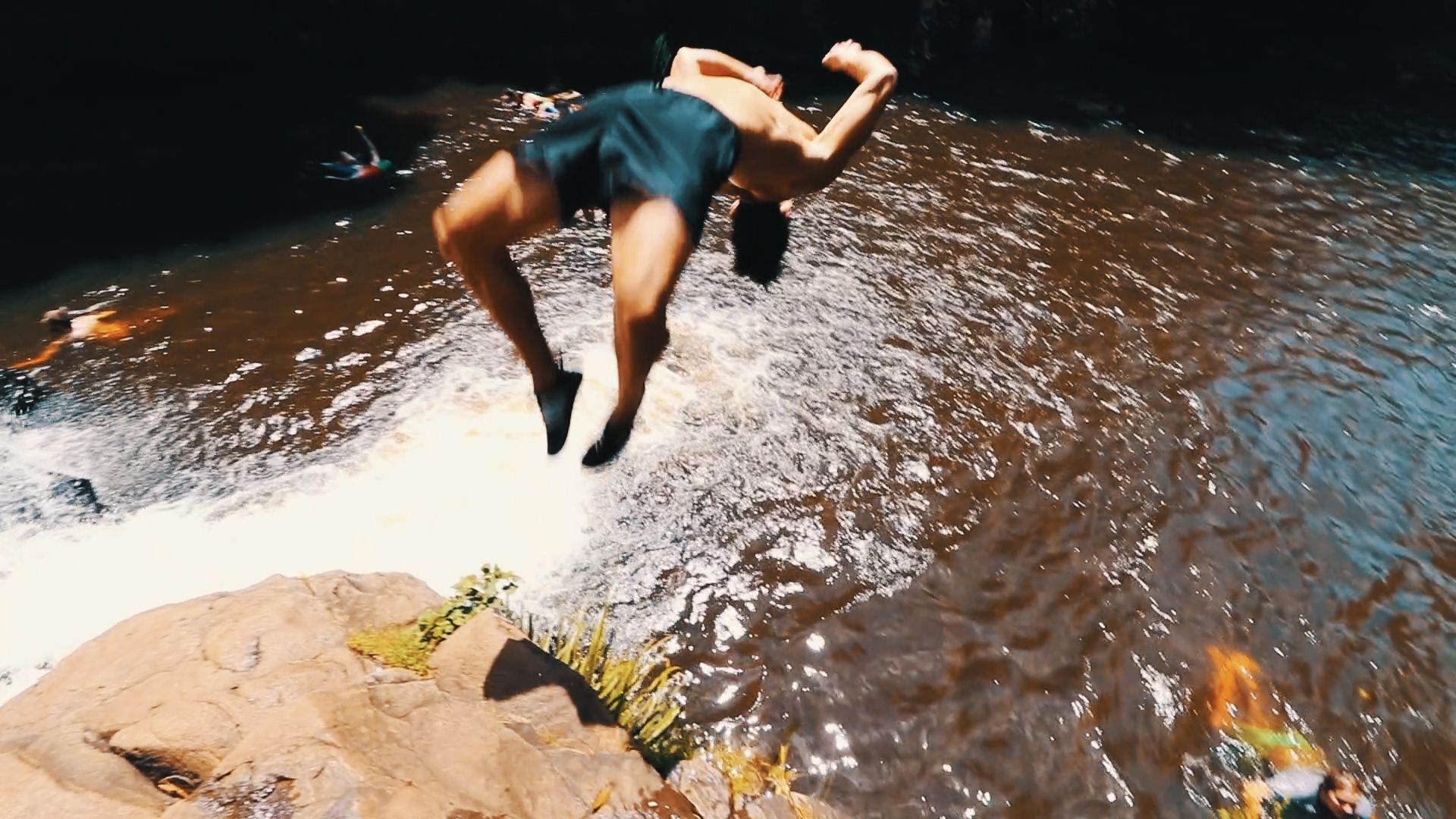
The falls aren’t very tall, and the pool’s not very wide, but it’s deep and surrounded by native forest which makes it perfect for rope swings—which, of course, there is one. During the hot summer months there’s not a better place to cool off.
It’s easily accessible for all abilities (although the path isn’t great for wheelchairs or strollers), there’s a parking lot and entry is free. Like many great swim spots, it can get busy on the weekends, especially in summertime.
And, as we travelers know, easily accessed natural spaces can be overrun and neglected by some. So make it your mission to not only enjoy the space, but pack out all rubbish (and other people’s too if you must). Let’s rally together to keep spots like Gardners Falls as pristine as they were had they never been discovered or enjoyed.
How to get there
Gardner Falls are just outside of the small town of Maleny. Drive south-east out of Maleny for about 4 km until you find Obi Lane. Park at the end (there’s an area). The path to the falls can be seen from the road.
What to consider
The path down to the falls was paved once, but has been damaged from flooding so doesn’t make for good transport of wheelchairs or strollers.
The walk to the pools is short and flat and will only take you 5-10 minutes each way.
Grab supplies in the cute town of Maleny as there aren’t any provisions near the falls.
The parking lot is small, get there early for a spot.
Pack a picnic. There are lots of places to recline and relax. You won’t want to leave just because you’re hungry.
There are no facilities in the area.
More like this: 11 pristine photos of Whitehaven Beach, Australia

How to use dating apps abroad
There’s some debate as to whether technology truly connects us in an otherwise lonely world, or in fact makes it difficult for anyone to get to know the real you. When you travel, you’re exposed to new languages, new cultures, and a new world of people who grew up with both of them. Even if you’re only planning to stay abroad for a few days, there are a few ways dating apps can help bridge this gap and let you meet people without hanging out at a bar or getting a bunk in a crowded hostel.
1. Choose the closest big city
Even if you’re not planning to spend the majority of your trip in a major metropolis, choosing one as your location (even before you arrive) maximizes your chances of meeting more people and crossing paths with fellow travelers. You might be lucky enough to find a match in the middle of the Sahara, but why not tip the odds in your favor?
2. Know the distance to the airport and the name of the area
There’s a good reason for this. Many travelers have a stopover and log in to their apps from the airport wifi to catch up on messages, but not to actively search for people. Nevertheless, the app records the most recent location as someone new in your area, and might match you with them. Chances are you’re just catching flight attendants and those on stopovers to another country rather than someone you’ll meet soon.
3. Know what you’re looking for: Language exchange or dating?
I’m personally not a fan of dating apps being overrun by people looking for language exchanges (or just free English lessons), but there’s no denying it’s an option for meeting people abroad. Just be aware that while some locals are using a language exchange as a pretext for meeting someone new, there are plenty who aren’t even open to the possibility of dating. For newbie travelers, being used as an English tape recorder might be fun if it means you can still engage with people you wouldn’t otherwise meet, but it gets a bit repetitive after a while. If someone says they’re only interested in learning English, it’s best to take them at their word rather than assume it has the potential to develop into a relationship.
4. Learn to spot the fake profiles.
No one who writes three-word sentences on their profile is a real person who wants to hook up with you that night. That supermodel cannot write perfect Cantonese, as much as you’d like to believe it. And who in their right mind would include their number, Kik ID, LINE ID, WeChat ID, or contact info for whatever the favorite texting app is in a country? Broken English and poorly written words in the native language are to be expected, of course, but there is not much of a chance that attractive blonde woman in the cropped-off University of Wisconsin sweatshirt grew up in Jakarta.
5. Just as at home: safety first.
If local men and women are looking on dating apps for language exchange, it’s a safe bet they don’t limit themselves to finding foreigners online. I’ve heard from far too many foreign women in Japan who have had to avoid new “students” trying to follow them home after a private lesson in a café.
Dealing with unwanted attention is something we have to face at home from time to time (some of us more frequently than others), but being abroad makes us stand out and be more vulnerable when we may not be able to speak the language, approach the police, or have the support of someone we completely trust. Scammers and predators don’t have to trick you into clicking on a link in the app when they can just meet you, wait for you to lower your guard, and then swipe your wallet… or worse.
As always, meeting in crowded places and letting someone know where you are is a reasonable precaution. For women, this advice is probably second nature, but men may be unaware of the need to be careful when there’s not always an easy escape in a foreign country. And remember: trust your gut.
More like this: 5 commandments for dating a foreigner
The world's longest honeymooners
All photos by HoneyTrek.
Planning a honeymoon is one of the more enjoyable elements of getting married. But what if you decided not to back to reality and instead continue traveling for six years? That’s exactly what Ben and Anne Howard have done. Since January 22nd, 2012, they have visited 53 countries and 500+ regions of the world and shared their experience on their blog HoneyTrek.com. We tracked them down and find out what goes into planning the worlds longest honeymoon.
It might sound wild to many people to extend a honeymoon to a six-year trip, how did this come about?
While dreaming about our honeymoon, the list of destinations was running off the page. Then we thought, what if we go to all of these places? We’ve got a little nest egg, we’re healthy, we don’t have kids…will there ever be a better time to travel than now? So after saving and planning like mad for a year, we quit our jobs, rented out our apartment, and left home on a one-way ticket to Brazil. Six years, seven continents, and 53 countries later…we’re still on the World’s Longest Honeymoon.
How do you plan your itinerary?
Our original travel philosophy was to go places too far to visit while we have 9-5 jobs and too rugged to tackle when we’re old. That meant skipping the nearby, pricier, and tamer North America and Europe and getting far-flung in South America, Africa, Asia and Oceania. As the years went on we got better at travel hacking and have since taken on a good chunk of Europe and are now RVing across Canada and the States. In terms of how we plan month to month, we keep a loose itinerary, picking out the must-see spots and leaving lots of wiggle room as cool opportunities arise. You never know who you’ll meet and what you’ll discover on the road — you don’t want too many reservations tying you down.
In a single sentence, how would you define your travel style?
A mix of local, luxury, adventure, romance, and flying by the seat of our pants.
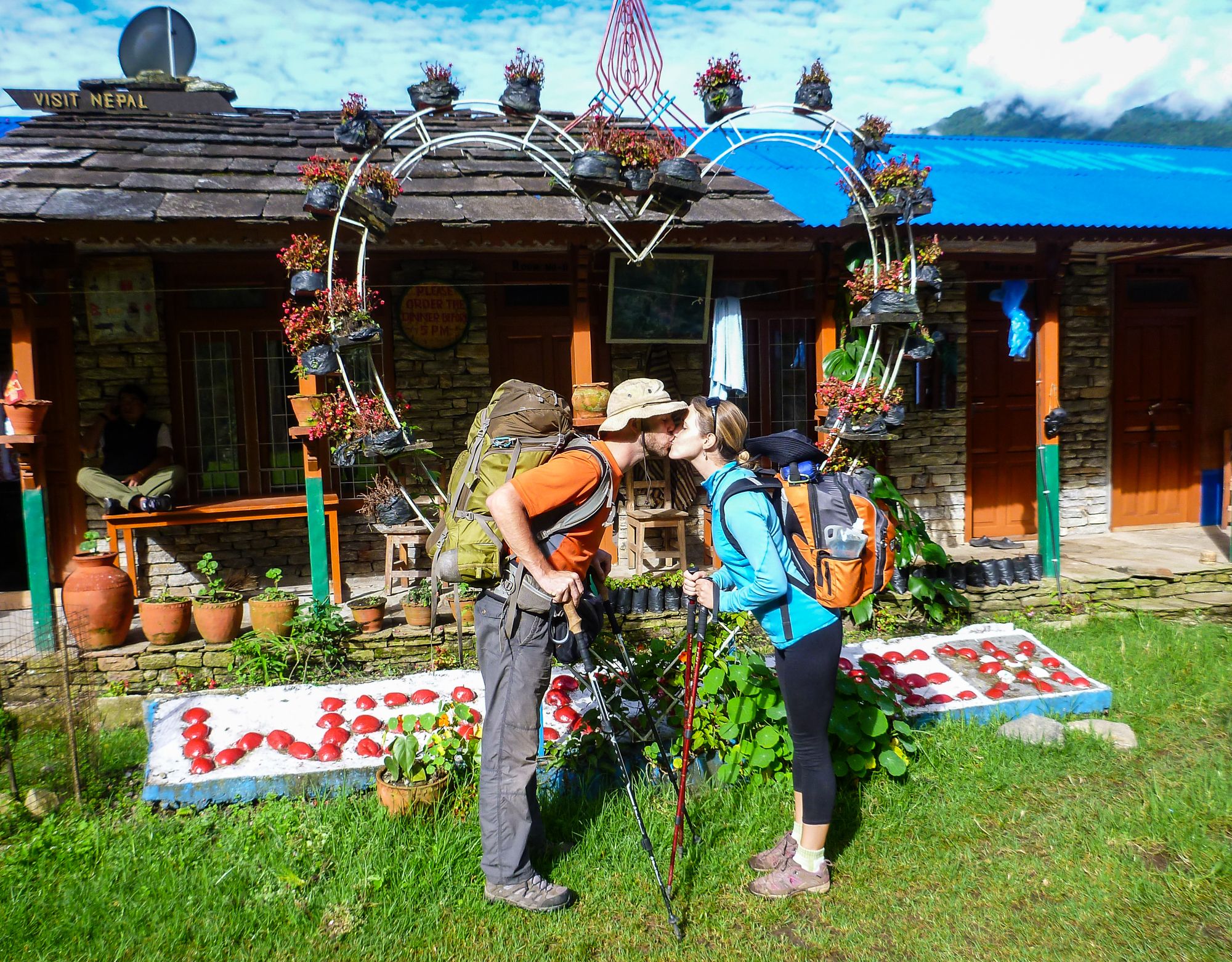
And what do you value most about traveling?
It’s the greatest learning experience you can have. When you see the way other cultures live, you realize how many ways there are to find success and happiness. That definition plays out very differently around the world and it never seems to correlate with how much money or stuff you have. The more we travel, the more we realize that love, health, and a positive outlook are the secret to “the good life.”
Being on the road for so long must interrupt daily routines, what does your day-to-day look like?
It’s definitely evolved over the years. For the first couple years, we’d try to see and do everything that region had to offer, jam-packing our days with sightseeing and adventures. After that, it morphed into slower more immersive travel, where we might travel to 10 countries in a year but live on a farm in Portugal or a beach house in Croatia for a month at a time. In April 2017 we started our most recent chapter when we bought Buddy the Camper (our first “residence” in six years). Since then our adventure mobile brought us 22,000 miles from Florida to California to Alaska to Maine and back to Florida. Even though our location changes nearly every day, having our own closet to unpack, kitchen to cook our comfort foods, and living area to kick back, has given us enough stability to have somewhat of a routine. Each day is a new adventure, then come evening we find the prettiest view we can, soak in the sunset views from our panoramic windows or camping chairs, make dinner with our four-burner gas stove and oven (as people who haven’t had a kitchen in five years, this is wildly exciting), then work on the latest HoneyTrek project until bedtime.
Sounds like the dream. Does the reality look a lot different to what people may perceive from the outside?
Our lives probably look really glamorous from Instagram & Facebook, and some days they are — between sketchy hitchhikes and boondocking in parking lots. There is a lot of hustle required to make these dreams come true. The days when we aren’t having awesome adventures we’re on the computer writing, editing, pitching, and planning from 9 am until midnight. That said, we can’t complain about the volume of work because we have the greatest job ever; people just don’t often realize travel blogging is more than a full-time job.
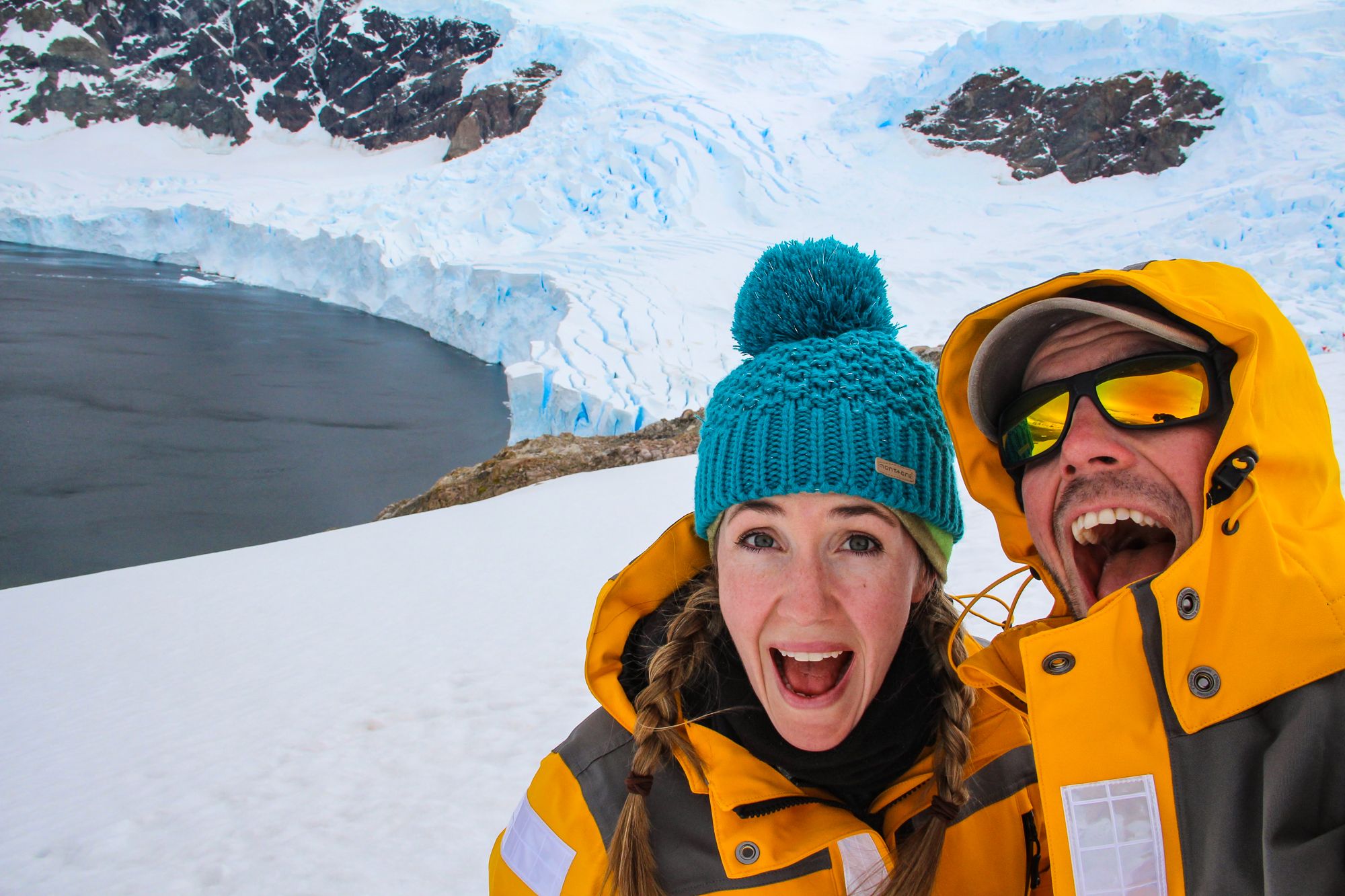
Can tell us a little about your business model and how you fund your travels?
HoneyTrek was never meant to be a business. We followed a dream to take a honeymoon around the world, saved up, scraped by to keep it going, and with enough passion and hard work it has evolved into a paying gig. We didn’t make a dime the first two years on the road, but we kept honeymooning and producing good content and people started to take notice. By 2016, Microsoft asked us to star in a TV commercial, tourism boards invited us to promote their destinations, and National Geographic asked us to write their first book on couples adventure travel, Ultimate Journeys for Two. We also fund the travel bug through freelance writing, photography, public speaking, and social media. Though our real secret to traveling long-term is keeping our expenses low enough to need little more than each other and sunshine.
How big of a role does social media play in this?
On the road, so many things happen on any given day. With the ease and immediacy of Instagram Stories, we find ourselves sharing more often than we used to and letting our audience in on the silly and raw day-to-day stuff. It’s a blessing and curse because the camera and social media can distract from being in the moment in these beautiful places…so we are constantly striving for the perfect balance. On Facebook, we like to make it more about the audience, asking questions and listening to their travel dreams. We want there to be a dialogue and encourage more people to get out there and see the world.
What is your earliest travel memory? Is there a particular place you hold dear to you? And how has all of this shaped the kind of travel you do today?
Anne: When I was seven, my Dad was working in Japan indefinitely so we considered moving there as a family. I have vivid memories of looking at potential homes with rice paper walls, visiting classrooms where you had to take off your shoes, and attempting to eat meals with chopsticks (I thought I was going to die of starvation or live off Hello-Kitty cookies). We didn’t wind up moving to Japan but I think it piqued my interest for other cultures at an early age. In high school, I studied abroad in Costa Rica, did a college semester in Spain, and used every vacation day I had while working in New York.
I’ve always been one for adventure and Anne and I started traveling abroad within months of dating. In fact, our first Valentine’s together was spent sneaking into Cuba.
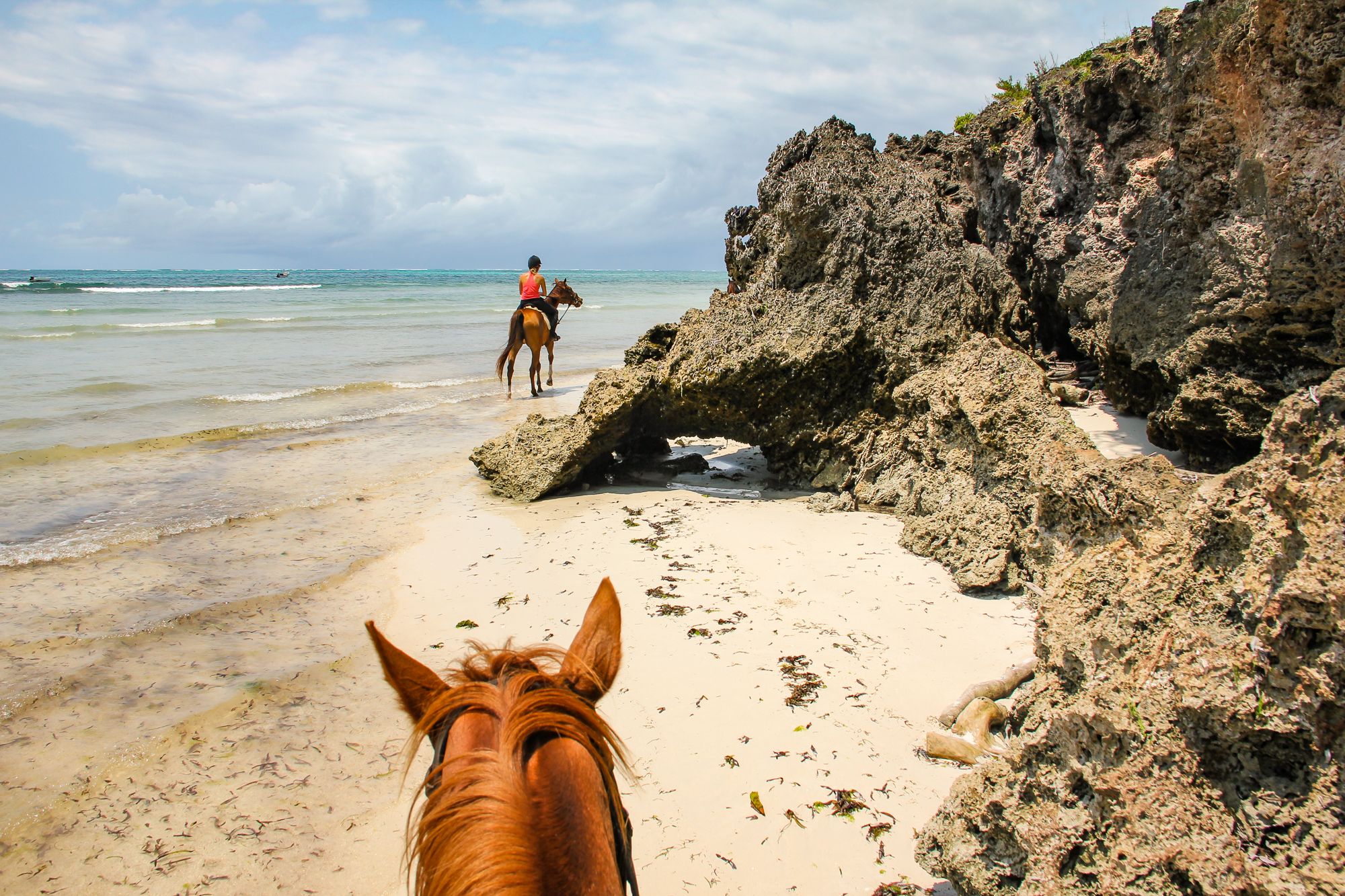
Talking of family, have you had people come and join you?
On 04/04/04 Mike started a tradition that when the day, month, and year aligned, he’d throw a party. So when 12/12/12 came about, we rented a house in Koh Samui, Thailand and 8 friends flew from the States to join us for 12 days of fun. Travel also allows us to meet up with friends we’ve made all over the world. For example, we met our friend Paal in Bolivia, and have since seen him in Norway and New York. Deb, we met in Cambodia then caught up with her again in Vietnam, Indonesia, and San Francisco.
Can you tell us about one of the most challenging places you visited?
Our four-day, 14-leg overland journey from Mozambique to Tanzania might take the cake. We were standing at a small junction of two dusty roads in northern Mozambique, waiting for a hitchhike for over three hours, night was falling, and there were still no cars going out direction. Adding to the uneasiness, a drunk guy kept babbling to us in Portuguese, making slit-your-throat gestures. Our Portuguese is horrible so we couldn’t tell if he was saying “Stay with me so you don’t get killed,” or “Stay in my town overnight and I’ll kill you.” Either way, we had to get the heck out of there. Just as the sun was going down, a pickup truck pulled up. The driver said he couldn’t take us as far as our intended destination but said that we could sleep on the floor of his cousin’s mud hut. This was looking like the bright side of a grim day, until we attempted to sleep and the mice started running around the dirt-packed rafters, knocking mud chunks on us with each scurry. If it wasn’t for fits of delirious laughter, we would have never made it out of that day. The next three days involved fording hippo-filled rivers and hitchhiking on banana trucks, read the full story here.
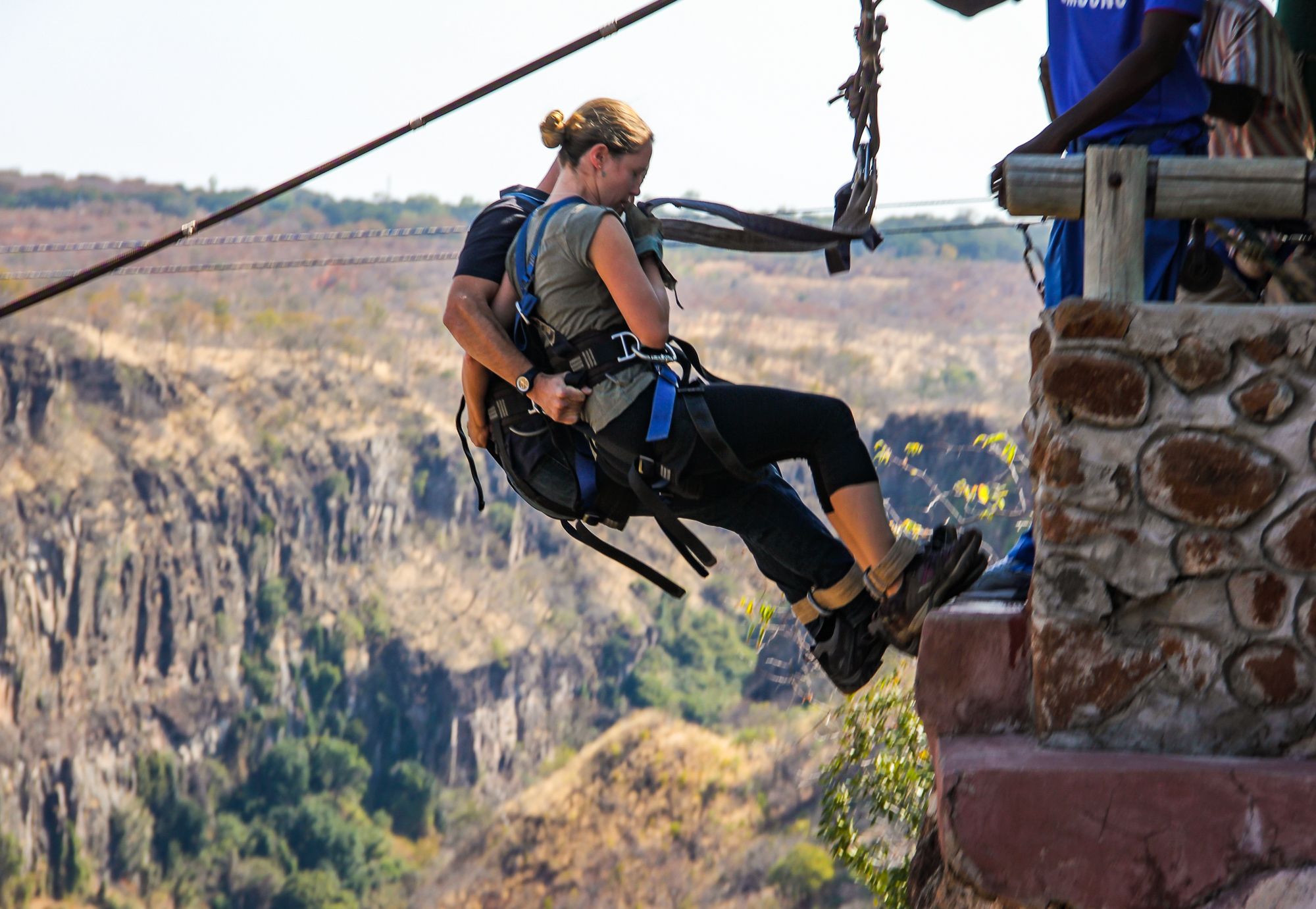
And just to balance it out, what was one of the happiest days on the road?
On our way to one of the deepest canyons in the world, hugging the curves of the Andes and yielding to cows, a fiesta of elderly Peruvians appeared in the middle of the road. We crept forward, assuming they’d move to the side, but instead a woman wearing a traditional embroidered dress knocked on our window. “Come dance!” she said in Spanish with a smile. “You may not pass until you dance!” Mike and I looked at each other, and then simultaneously swung open our doors. The partygoers cheered and the band of wooden instruments got louder. She took our hands and pulled us into a circle of twirling ladies. Around and around we went, with leg kicks and hip shakes, until the shot master appeared with an earthen jug. He poured us an overflowing chicha corn brew and we toasted with an exuberant, “Salud!” Arm in arm with our new friends, we danced until dark and happily never made it to the famed canyon. This is the day, we realized serendipity is the new bucket list.
When you face obstacles in your relationship, is it more complicated to overcome these when you are on the road?
Everything is more intense on the road. The things you take for granted at home — food, shelter, jobs, etc — are in flux all the time. This can create unnecessary stress in a relationship so learning to communicate and shake things off is key. That said, experiencing these incredible highs and lows bonds you like no other. Your brain starts to fuse and you can sense each other’s needs, anticipate reactions, and how to get a laugh. Together, our memories run deeper because we’ll always share them.
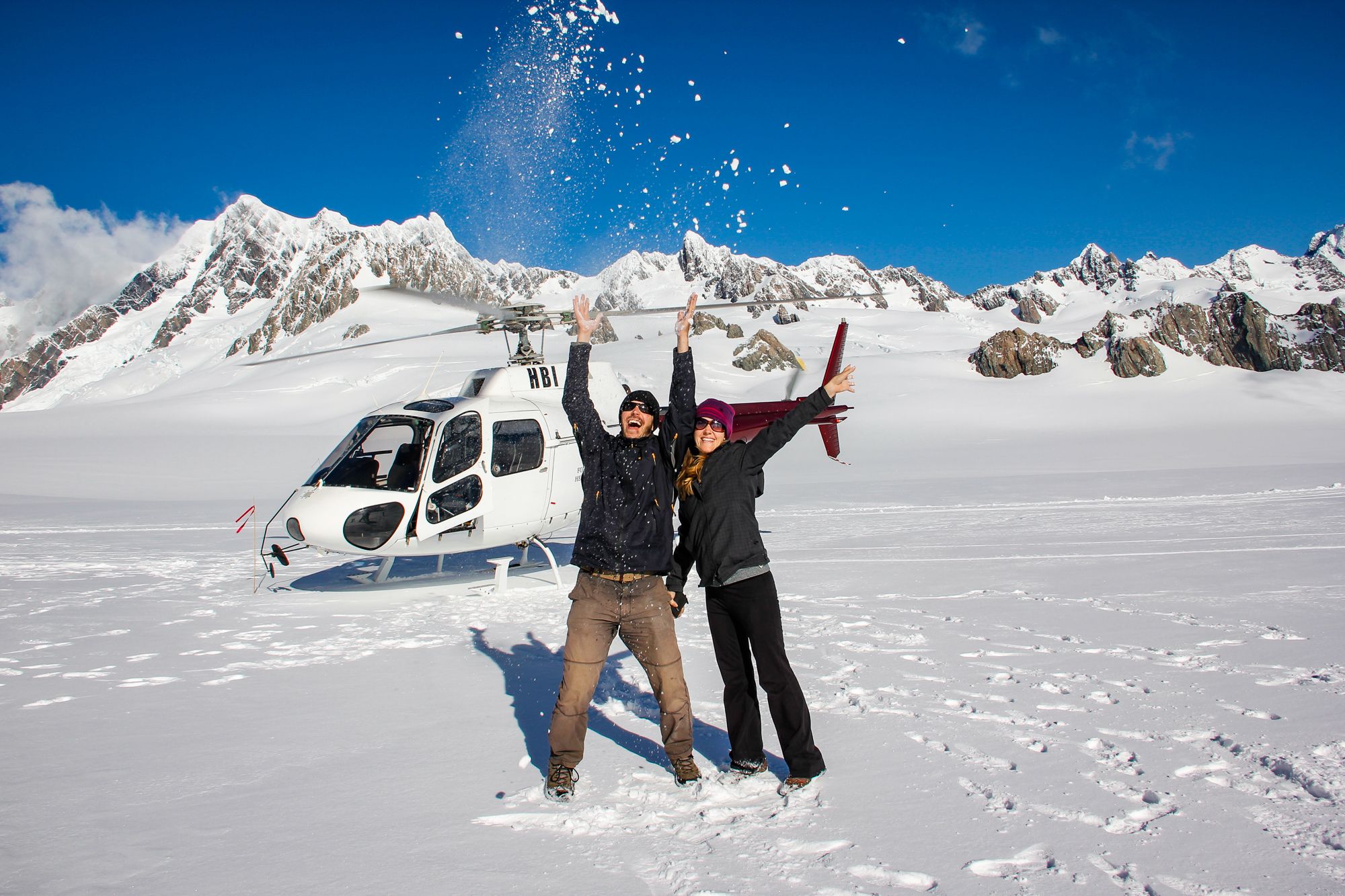
What’s your best advice for couples who want to find more time and money for travel?
Start a travel fund ASAP and automatically direct 5 percent of your paycheck into that account. Travel is an investment in yourself — don’t skimp! Join airline and hotel loyalty programs, and use credit cards that reward your everyday spending. Join sharing-economy sites and communities; the more you immerse yourself in the travel community, the more opportunities will present themselves. Don’t think just about planning your next Instagrammable vacation, think about the experiences you want in your life and how to make them a reality. We dive deep into the planning process in the “Travel Smart” section of our Ultimate Journeys for Two.
More like this: The inner lives of badass travelers: Joanna Franco
Romantic self-portraits tips
Thanks to our way of traveling, we often find ourselves alone. Our trips bring us to dirt roads and dead ends, mountaintops and riverbeds, vibrant lakes and sandy deserts — and often we find these places empty. So what are two photographers to do when no one else is around to take the photo? We decided to start taking them ourselves, of course. It’s been a different kind of journey learning the art of self-portraiture. We’ve learned a lot, and with that in mind, here are some of our favorite images — and our best tips too.
1. January in Korakukan Jigokudani, Yudanaka Onsen, Snow Monkey Park, Japan
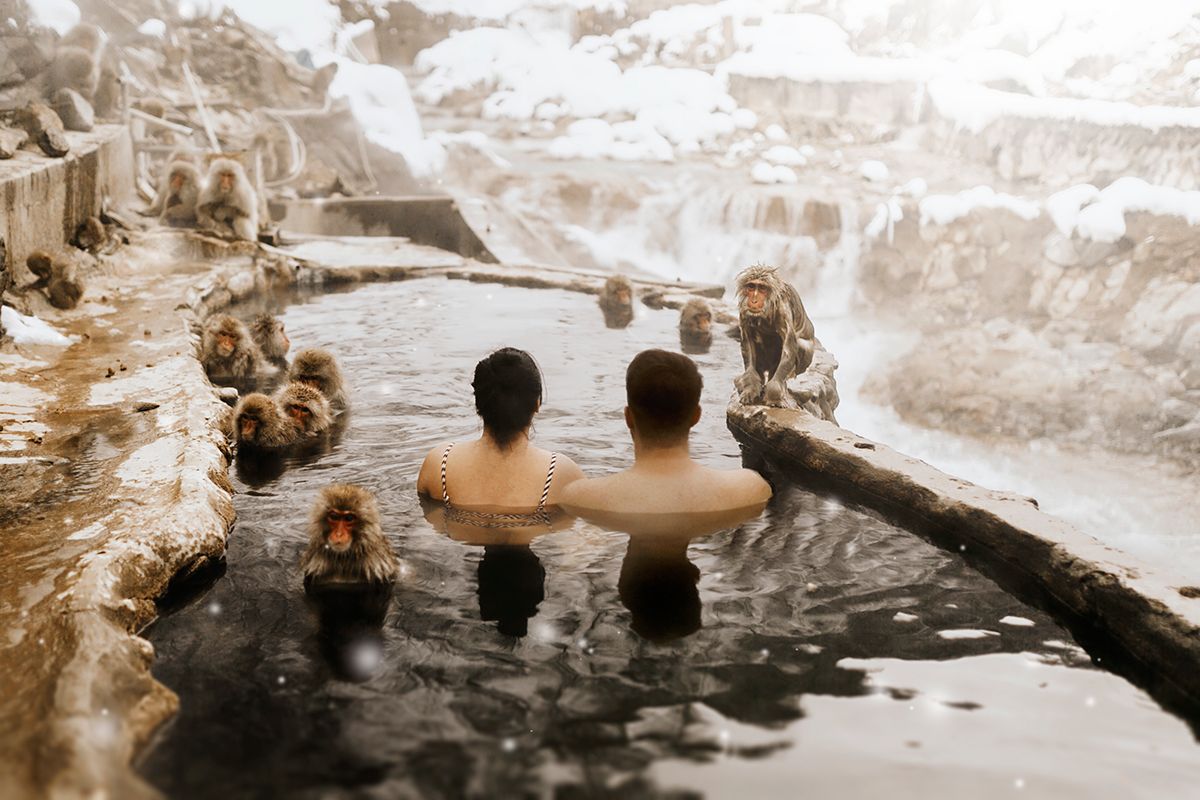
Early January, a 40-minute bus ride from Nagano station and a 40-minute walk through the snow. This natural hot spring, deep in the mountains, was the most rewarding prize after a long trek through the snowy woods. While it may look like we are freezing, the water is perfectly warm. After about 15 minutes, we were sweating while snow and ice were solidifying in our hair.
Tip #1: A few years ago, we found a camera remote on Kickstarter that allowed us to control our camera from a smartphone, we backed it immediately. This is where our self-portrait journey began, and we have been perfecting it ever since. That remote was the Alpine Lab’s Pulse remote. Our most used setting on the Pulse is the time-lapse setting, where we can set the camera to take photos every 3 seconds for a minute. This way don’t have to run into the frame and can try various poses and compositions at ease. Combine this with a tripod so you can safely walk away from your camera, and also to get eye-level (no one really wants to be photographed at an upward angle from the ground). We recommend a wide lens to capture the whole scene — we love a 35mm lens, which also works well in low light.
2. July in Lake Louise, Banff National Park, Canada
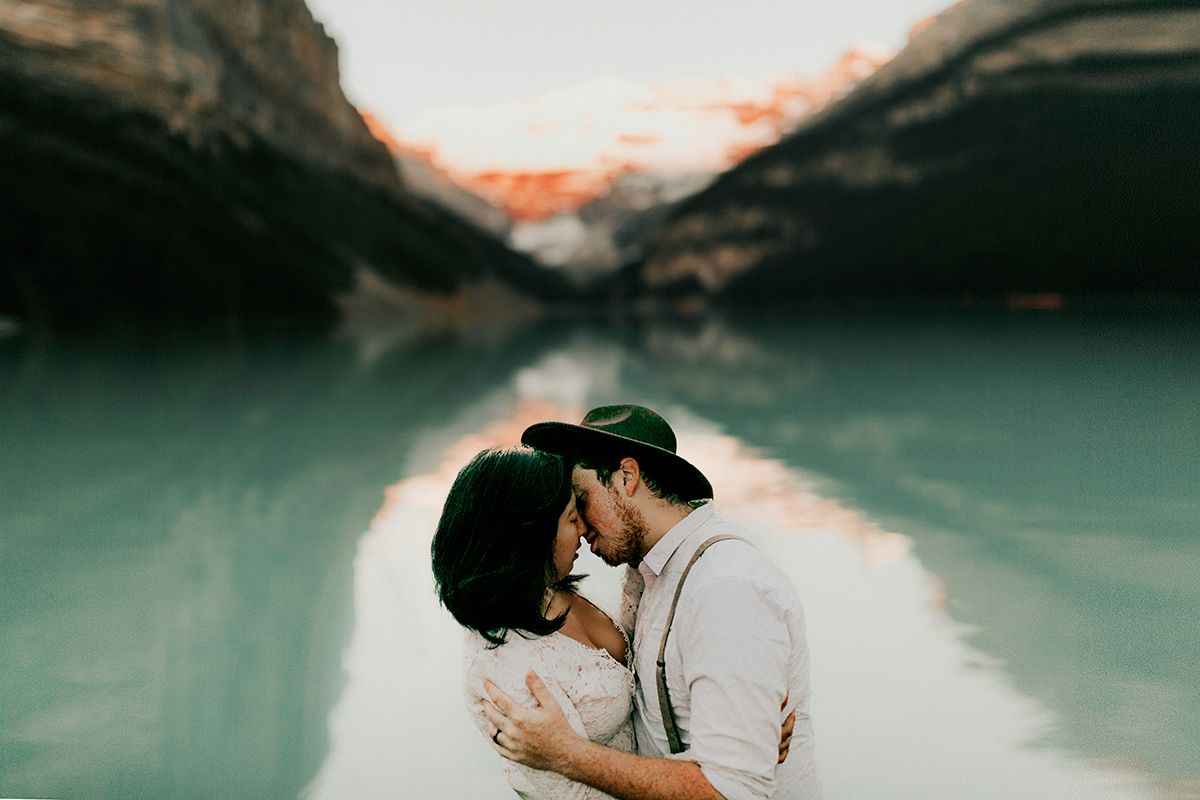
The warm summer air turns chilly as the sun slides behind the mountains. Only a sliver of light is left at the end of the valley, but in that moment, Banff revealed its secret to us: right at twilight, the water turns from a reflective blueish green to a vibrant green turquoise.
Tip #2: Style your clothing. It doesn’t have to be formal — hiking boots, t-shirts, and jeans are just as cute. Just be sure to take the time to coordinate your clothing based on the style you are going for — it will pay off in the end and look like a proper photoshoot. (If you were paying someone for photos, wouldn’t you dress up a bit?)
3. March in Glencoe Highlands, Scotland
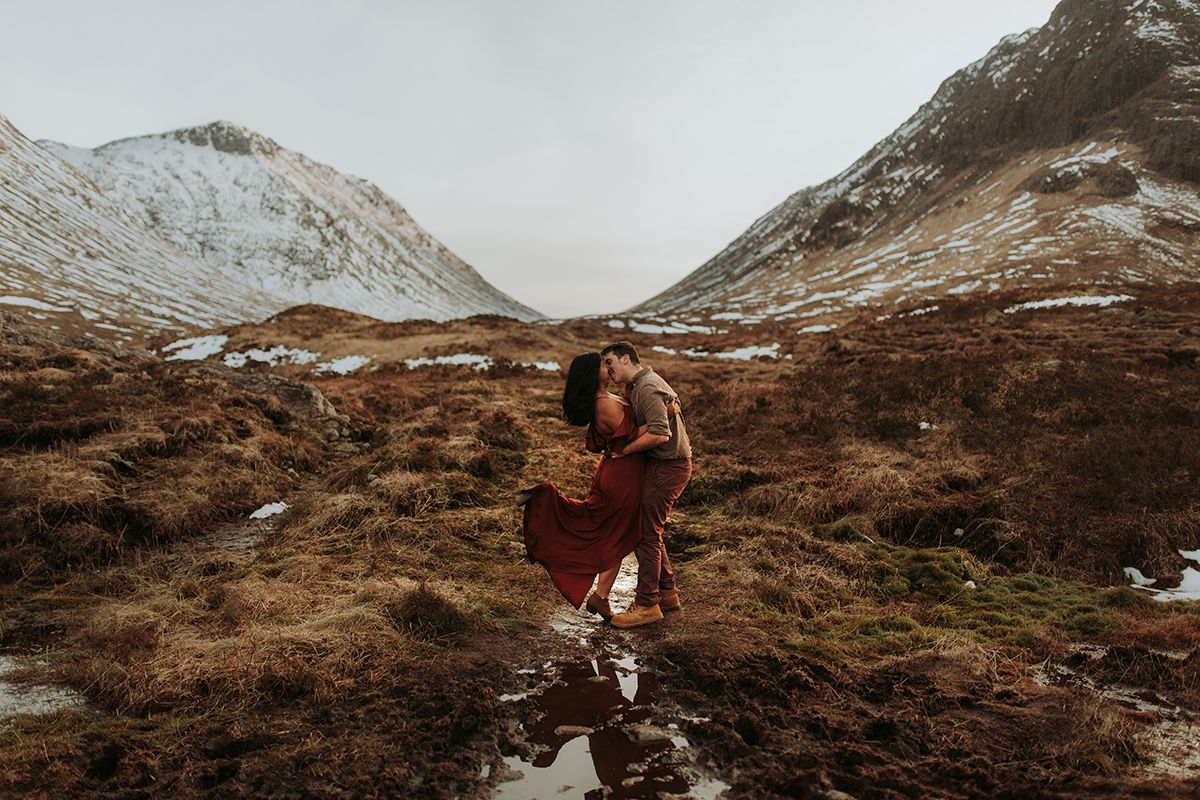
The mountains looked majestic from the highway, but the path leading up to it was a marshland of mud and melting snow. We placed the tripod, then worked our way around a small river to a small hill. Feet squishing into the ground, we threw caution (and clean clothes) into the wind for an epic shot in the highlands.
Tip #3: Prepare for various circumstances. Rain? Get our rain cover packed away. Cold? Bring a jacket that you can throw on in between shots. Hiking? Tuck your dress into some leggings (yes, that is exactly what I did to hike up for this shot).
4. June in Milford Sound, South Island, New Zealand
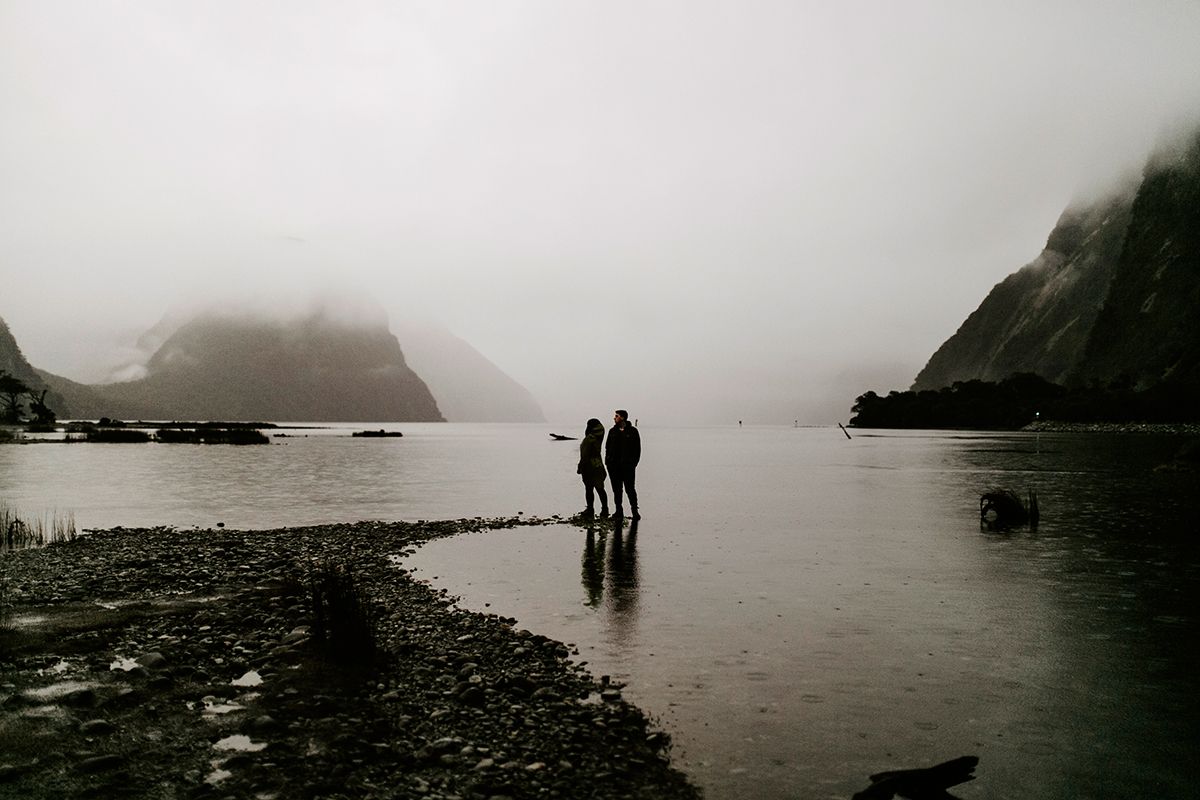
“I can tell you of the ocean, of its waves and the tides, but you will not truly understand it until you are surrounded by nothing but ocean on all sides.” -Kvothe, The Name of the Wind, by Patrick Rothfuss. That quote played through our heads constantly as we drove down into Milford Sound. An ancient sound with mountains and waterfalls too plentiful to name. Then we got to the coast, and as we stood at the feet of giants, we felt that spark of adventure and discovery all travelers crave.
Tip #4: As serious as the above photo looks, be ok with looking ridiculous. Yes, people will stare. And yes, you will feel a little silly running back and forth between posing and checking the photos. Though a time-lapse option will really help with that, there will be some running around.
5. February in Bear Valley, California, USA
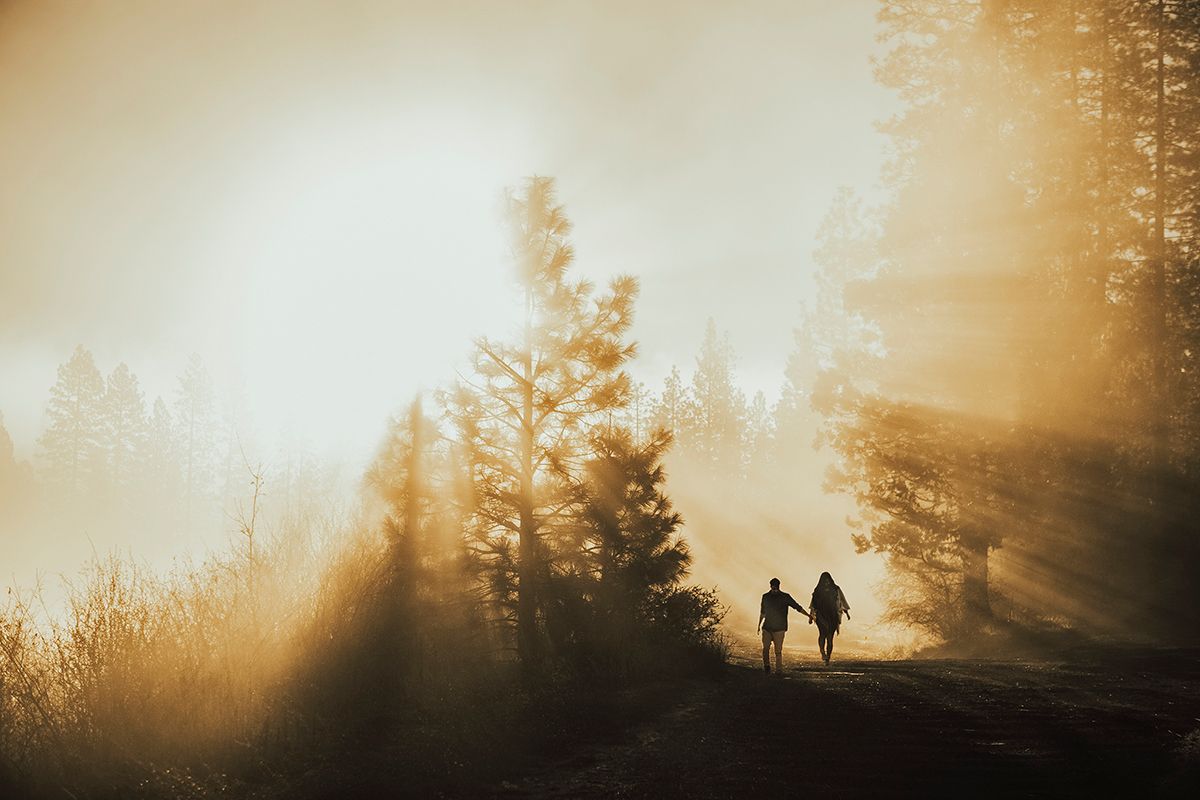
“God rays,” as we like to call them, or sunbeams are a somewhat rare sighting – only appearing in the perfect moment of the sun shining through a dense fog. These moments are even more fleeting during golden hour, so when we were driving down the road and we caught a glimpse of these rays, we immediately pulled a U-turn, blasted the stereo, and chased the light.
Tip #5: Rent a car — or better yet a campervan — and just drive. Tour companies and public transport can be difficult to get to really rural places and to get there for the best light. It also doesn’t afford you the luxury to do things like turn around, forge ahead, take a left instead of a right, and so forth.
6. December in Joshua Tree National Park, California, USA
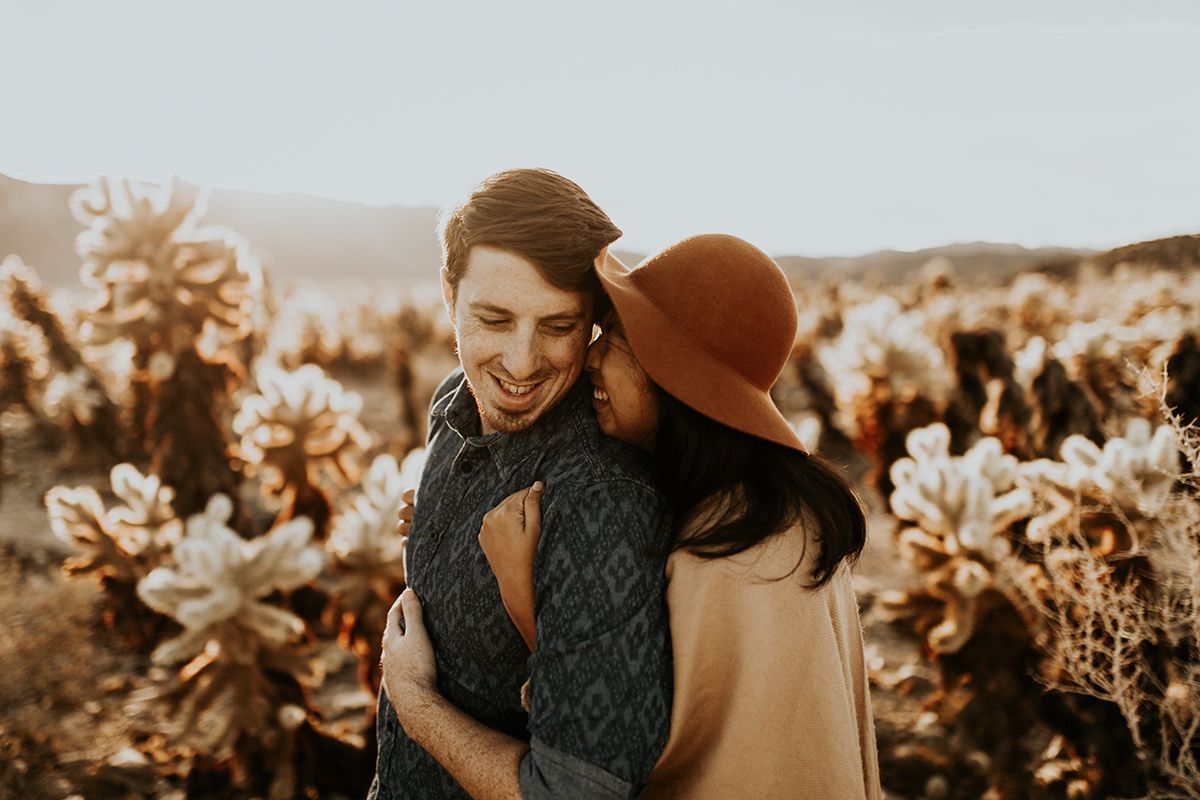
The hardest part about taking photos in the middle of a field of cactus was looking natural as we were both tensing up, trying to avoid being pricked by one thousand tiny needles. Winter in the desert means warm days that quickly fall into chilling nights, and we remember rushing to get our shots before the cold swept over the valley. Before long, we lost the light and had to navigate the death maze with only our wits to guide us.
Tip #6: Plan for the best lighting based on the weather. You’ve likely heard of golden hour, which is that magical time of the day for photos. If you know it will likely be sunny, avoid harsh sunlight by either shooting before sunrise or sunset. But don’t wait until golden hour to get to your location — you’ll find that you’ll need time to set up the shot and reframe it. If it’s cloudy, you can shoot at any time of the day.
7. March in Isle of Skye, Scotland
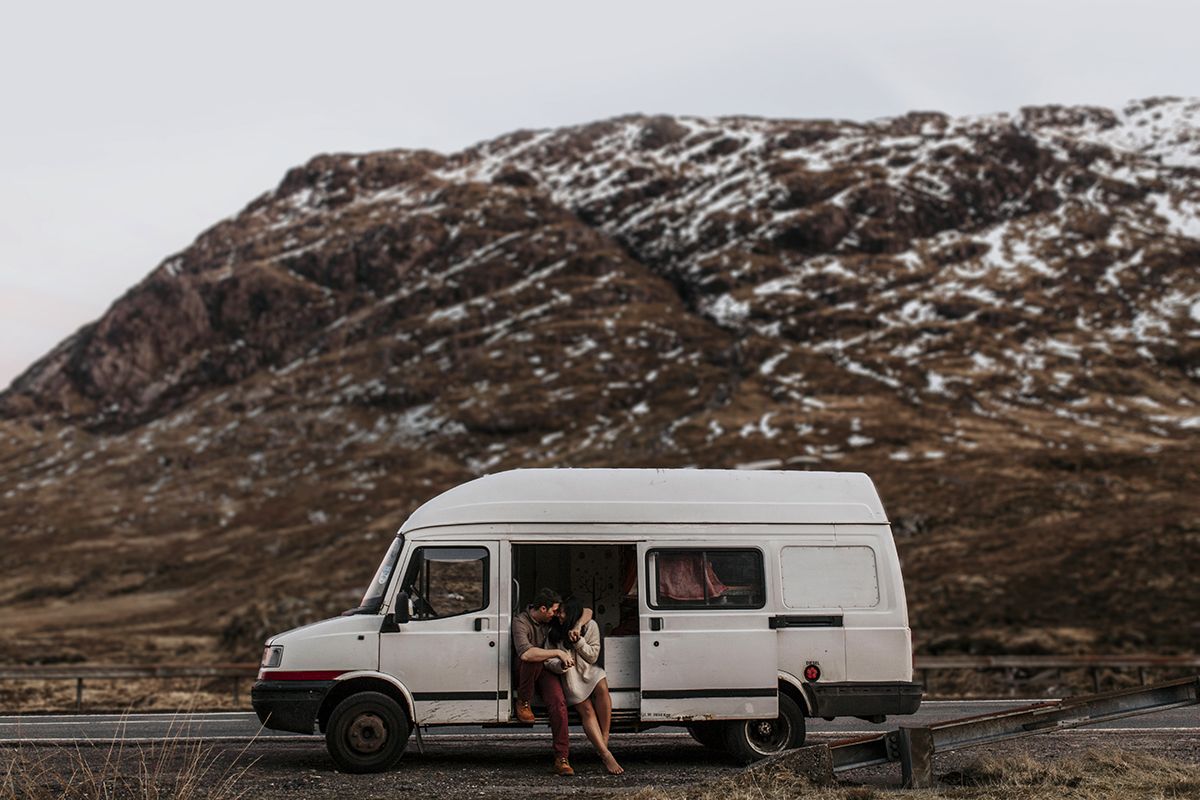
When taking campervan photos, make sure the parking brake is fully on when parked on an incline. Our car may have rolled back about 10 feet before Keith dove into the driver’s seat to stop it…. I was too busy setting up the camera to notice that the very car he was sitting in was slowly sliding down the road. But hey, it made a great story and the best memory.
Tip #7: Document your experience, not just the landscape. This is your adventure. We drove our very first campervan in Scotland — it was a bit rusty, run-down, and didn’t have water for the first few days, but it was our van. It was that rusty old van that we cooked meat pies in as we watched the sunrise over the fairy pools, cuddled up in with just enough room for our legs, and rolled down the windows to chase the sheep off the road. It was as much a part of our trip as the land, the people we met, and the places we saw, so it seemed right to include her in a portrait.
8. December in Valley of Fire State Park, Nevada, USA
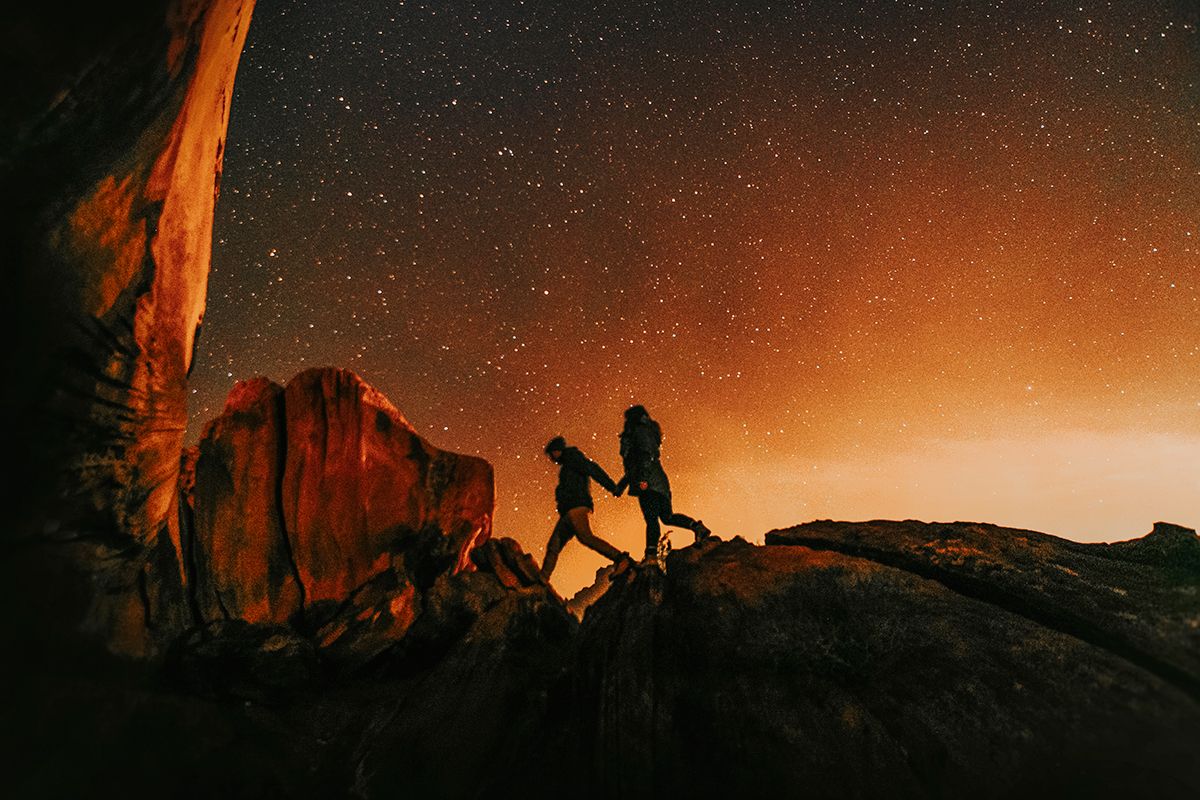
We didn’t expect to find a quiet place of solace and natural beauty so close to a place like Las Vegas, but even the campgrounds were incredible! Right in our own backyard, we caught not just shadows of the fire, but the fire itself.
Tip #8: Look for a different perspective. Before you go, look up different photographs, and also research the time of year as to what to expect. But don’t just copy a photo you saw on Instagram; use it as inspiration to tell your own adventure.
9. October in Yosemite National Park, California, USA
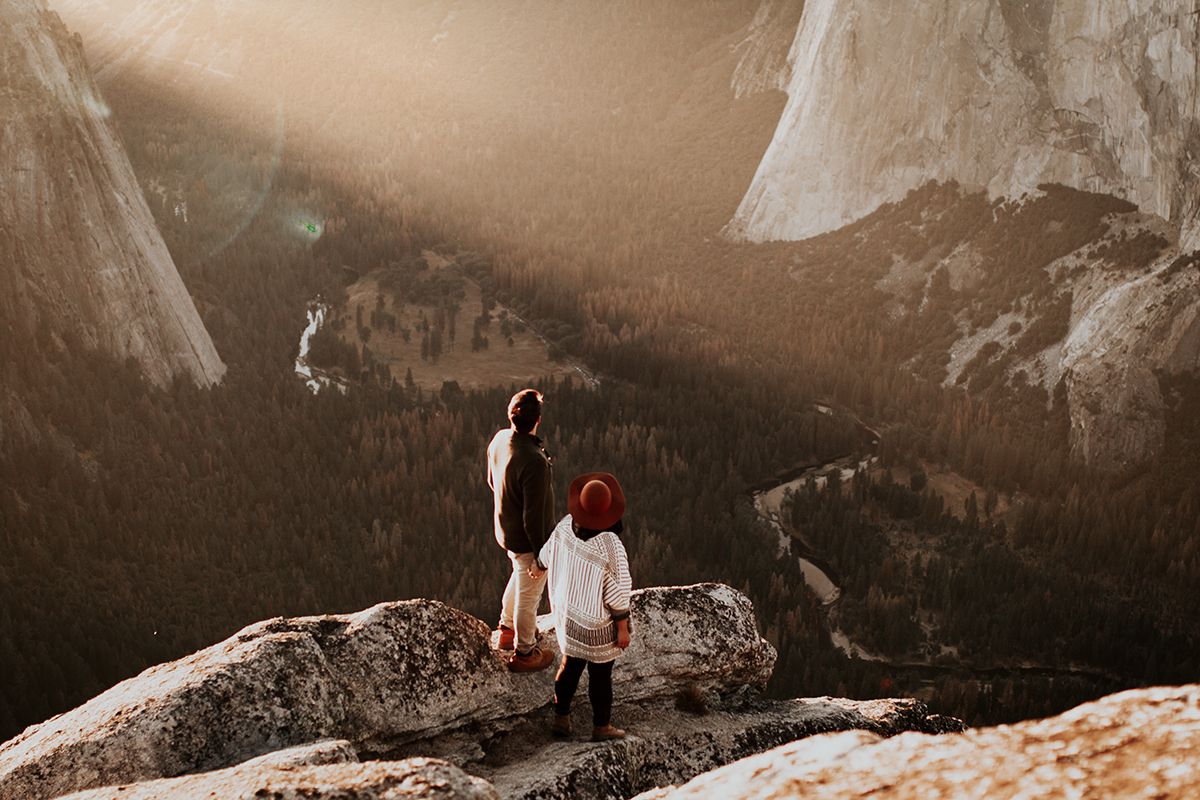
This photo brings back so many memories for us. It was the first time we went to Yosemite and the first trip we took with the Pulse remote. Every time we set up the tripod to take a photo, we saw a better spot – until we found this perch. We sat there, shared some breakfast, and enjoyed the sunrise.
Tip #9: Be in the moment. Savor it, marvel at the landscape, take in the colors and light. Compose a nice shot, sure, but then just enjoy it. What’s the point of an epic self-portrait if you didn’t actually embrace the moment, the place, and the experience? It should be so much more than a couple likes on Instagram. Relax with each other, talk to each other, and forget the camera is even there.
More like this: This Instagram couple show what it’s like to be in a long-distance relationship
How to get started snowboarding
Shaun White makes it seem so simple, right? While getting good at snowboarding is quite easy once you get the hang of it, the initial learning process is frustrating and painful. There’s really no avoiding it — you have to pay your dues, which in this sport means time spent ass-to-snow. Snowboarding is all about repetition. The moves, from turning to stopping, seem alien at first, but as you put in the time and gain experience it’s incredible how natural the process becomes.
Within a year you’ll instinctively wake up at the crack of dawn every time it snows, chomping at the bit to hit the hill. In the meantime, here are tips to make the process more enjoyable, less humiliating, and an experience that you may just want to have again.
How to get started snowboarding:
General advice
Gear
Lingo
Preservation of the environment
Preparation
General advice
1. Figure out if you’re regular- or goofy-footed before showing up to rental shop.
These terms refer to which foot you are more comfortable putting forward. It has nothing to do with being left-handed or right-handed. Try standing on a skateboard and seeing which way feels more natural to you. To save face, avoid terms like “backwards”, “left-footed”, and “facing the wrong way” when talking with the staff.
2. Take a lesson on the first day.
For real. Even if it’s only a half day lesson. Your friends might be seasoned veterans, but no matter how good they are, they don’t want to teach you. Even if they say they do – they don’t, and you don’t want them to anyway because they have no idea how to teach proper technique surrounding new muscle movement. In a lesson, you’ll learn from a pro. You’ll also spare your friends or significant other the stress and frustration of not being able to explain away the inevitable falls that are going to happen on day 1. Nothing ruins a relationship faster.
3. Get your body prepared — how to not get injured when snowboarding?
Stretch! Snowboarding is going to work muscles in your body that you didn’t even know existed. It works your core and puts considerable pressure on your calves. You will likely be sore after the first couple days. This is normal, and a sign that you’re whipping yourself into proper snowboarding shape.
I love a nice yoga session after a day on the hill. It helps me unwind and keeps my body loose, which is ideal for riding multiple days in a row.
Additionally, be mindful of the pressure on your knees. Jumps and icy conditions are tough on the joints. Keep a heating pad handy. Wrist guards aren’t a bad idea for your first few days as you may do a few forward tumbles.
Gear
Get your gear in order the night before. Always.
Few things suck more than getting to the mountain and realizing you’ve forgotten your left boot. I recommend writing out a checklist the first several times until you commit the necessary gear to memory.
Board/bindings
Boots
Gloves
Helmet/beanie
Snow pants, shell, under layer
Goggles
I’m all about a nice pair of wool socks. They’ll keep your feet warm and act as a cushion between your feet and the often rough rental boots.
Snowboarding lingo
Few activities, aside from surfing and a number of blue-collar trades, have developed a lingo as diverse and unrecognizable to the untrained ear as snowboarding. In an incredible bout of chance, nearly 80% of all snowboarder-specific catch-phrases seem to start with letter ‘S.’ Shred, schralp, slash, slashie, sickie-gnar, slashington, shrederific, schralp-tastic, you get the picture. Many others are mere sounds exaggerated by a profound “Ahhhhh!’ on the front or back end. Listen closely and observe.
Another marvel lies in the fact that nearly all of these terms appear to mean the exact same thing. Therefore, when caught in a bind, just repeat what that dude on the chairlift said and you’ll be high-fiving your way to the apres-bar feeling like the coolest kid on the block. But don’t get too cocky — a whole new chapter of the snow dictionary awaits if you ever venture into the backcountry.
Preservation and taking care of the environment
There’s no other way to put this: we need the mountains, and we need the snow. Approaching the sport with a humbleness and respect towards nature does two things for you right off the bat: it helps you appreciate the beauty and serenity of the environment, and instills a desire to protect what we have for future generations. It may even trickle into your daily life, helping you become more mindful of the environmental impact you’re leaving behind.
This simply cannot be taken for granted.
Snowboarders often come across as somewhat disconnected from mainstream society. Some have labeled us airheads, mountain jocks, the list goes on. But rarely will you encounter a group of people more passionate about their sport and the environment which hosts it. With organizations like Protect Our Winters and Beyond Boarding being vocal and active, the line between snowboarder and environmentalist is increasingly blurred. Collectively, the snowboarding community strives to protect and respect the mountains that host us.
It should go without saying, but being a good steward of the land is as important as the lines you take down the mountain. Be mindful — and clean up your damn trash.
Be prepared
Those who grew up skiing or who have spent time doing winter sports have the advantage of being familiar with the weather and gear. Those more accustomed to beaches and boat docks have some learning to do. Looking back at my early days, there were two things about snowboarding that intimidated me:
1. The gear
In grade school, I was a skier. When I first got on a snowboard, the constant strapping in at the top of the hill and unstrapping at the bottom took some getting used to, as did the stance. This was back in the days of stiff boards and click-in bindings that I was always terrified would come unhinged on the lift ride up. Snowboard gear has evolved a lot since the nineties and is easier than ever to learn. Part of why I encourage a lesson to start is that you’ll gain familiarity with everything involved before setting foot on the mountain. It’s actually very straightforward – after a few reps you’ll have it down. I encourage you to have the bindings set up on your board at a slight ‘duck’ angle (called this because both feet are angled outward, like a duck), between +10 +15 degrees in the front and -5 to -10 degrees in the back. There is a lot of twisting and turning in snowboarding, and this allows you to move back and forth in a manner that is more natural in all directions.
2. The attitude
This could be because I’m older now, but I personally believe that the style and swagger of snowboarding are more approachable today than it used to be. Skiers and snowboarders get along, don’t listen to anything contrary. Snowboard culture is like going to a random house party in college. When you first show up, you don’t really know anyone and it looks like there are some cool kids running the show. Everyone else seems to have the scene down and be comfortable in their skin. You’re an outsider. But after a couple beers, you break into conversation with someone standing next to you at the keg. Five minutes later you’re his beer pong partner. By the end of the night, you’ve got the phone number of everyone at the party and are going to breakfast with them in the morning. The snowboarding scene is a community. It’s a little different everywhere it exists but, in the end, it’s driven by passion. If you have that passion, you’re in – and you’ll find your crew of riding buddies.
More like this: How to plan a backcountry ski trip
A love letter to Sonoma County
By Shelley Jarvis
Photo: Christine
#wedge-0 { background-image: url('https://d36tnp772eyphs.cloudfront.net...') }@media(min-width:560px){ #wedge-0 { background-image: url('https://d36tnp772eyphs.cloudfront.net...') } }@media(min-width:1200px){ #wedge-0 { background-image: url('https://d36tnp772eyphs.cloudfront.net...') } }
We pass through the town of Sonoma with its plaza and historic buildings and continue on to The Valley of The Moon. Out the car windows, we see vineyards, wineries, charming local shops, art galleries and restaurants. I am overcome with emotion. I cannot help but profess my love for Sonoma County, California. My children groan.
“We KNOW Mom. It is so beautiful here. You were so lucky to grow up here. We know. We know. We know.”
Despite my children’s lack of appreciation, time has granted me newfound love and respect for my childhood community. Life experience has made me realize just how lucky I was growing up in Sonoma County in the 60’s, 70’s and 80’s.
For those unfamiliar with the region, Sonoma County is about an hour and a half north of San Francisco, California. In the 60’s, 70’s and 80’s, Sonoma County was a harmonious community of ranchers, farmers and hippies. The biggest town in the county was Santa Rosa with a population of approximately 30,000 people in 1960. Not a tiny town by any means, but to give you an idea of the landscape, there was nothing but farmland, ranches, fields of sheep, cows, and chickens in the 55-mile span between Santa Rosa and San Francisco. Today Sonoma County is a popular tourist destination, but back then it was the boondocks.
Photo: Trent Erwin
#wedge-1 { background-image: url('https://d36tnp772eyphs.cloudfront.net...') }@media(min-width:560px){ #wedge-1 { background-image: url('https://d36tnp772eyphs.cloudfront.net...') } }@media(min-width:1200px){ #wedge-1 { background-image: url('https://d36tnp772eyphs.cloudfront.net...') } }
It was so remote during my youth that when I moved to Los Angeles for university, more than one fellow Californian remarked, “North of San Francisco? What is north of San Francisco?” A girl from Laguna Beach asked me if we had running water. Another friend from Manhattan Beach picked up a photo of me and some friends and exclaimed, “Cute. What were you dressed up for?” The photo showed me and my friends donning cowboy hats, flared Levis and cowboy boots. “Uh, just another Friday night in Rosa,” I replied. She looked confused.
The Sonoma County of my childhood was a place where teenagers really did cruise the main street on Friday nights after American football games. A tight-knit community, it was not uncommon for your friend’s parent to be your teacher, counselor, principal, doctor, dentist, etc. and you almost always knew someone who was showing livestock at the county fair. It was a place where everyone in town knew what everyone else was doing, and, there was a safety in that feeling.
Truth be told, while Sonoma County offered a quiet beauty, there was not a lot for teenagers to do other than hanging out. And hang out we did. We climbed in and out of each other’s bedroom windows at night. We walked to the mall. We toilet papered each other’s houses. We sneaked into the pool area at The Flamingo Hotel to sun ourselves. Once we had driver’s licenses and the freedom of mobility, we hung out all over Sonoma County. We thought nothing of jumping in the back of a pickup truck and driving out to the coast for bonfires and beer. Or driving up Sugar Loaf Mountain for a snowball fight. We drove over Mount St. Helena, past the Petrified Forest to the stock car races in St. Helena and out River Road to Johnson’s Beach to swim in the Russian River. We explored, enjoyed and escaped to the outdoors as much as possible. We grew up in the age where having food on the table and a roof over your head was all that was required of parents. Thus, friends became the mainstay of emotional nourishment.
Photo: Bedrck
#wedge-2 { background-image: url('https://d36tnp772eyphs.cloudfront.net...') }@media(min-width:560px){ #wedge-2 { background-image: url('https://d36tnp772eyphs.cloudfront.net...') } }@media(min-width:1200px){ #wedge-2 { background-image: url('https://d36tnp772eyphs.cloudfront.net...') } }
It was during my misspent youth that California wines gained worldwide recognition. It began with the Paris Wine Tasting of 1976, known as the Judgment of Paris. In a blind tasting competition with all French judges, Californian wines rated best in each category and won 6 out 10 spots in the top prizes. Needless to say, the French were shocked and California was officially on the map as producing world-class wines. Suddenly Sonoma County began to experience tourism.
As the tourism grew, so did the towns. Development edged its way in yet, the small town feel and sense of community remained. And, while modernization and development have built up the space between San Francisco and Sonoma County, the landscape is still one of the prettiest I have seen. Everywhere you look you see pine, oak and Sequoia trees. There are mountains, vineyards, a dramatic coastline, rivers and lakes all in one county. As one friend so aptly put it, no matter how far I travel, no matter how long I am away, I still have the strongest physical pull to the actual place.
Why was this time in Sonoma County so special? Why are the ties that bind so strong? Growing up in a rural area, traditions are strong and the shared memories of those traditions are equally strong. A rural childhood means that you are free to explore and grow in a natural environment. When you find yourself away from the more sophisticated forms of entertainment you talk, you gaze at the ocean, you learn how to be quiet with yourself and others. Those quiet days foster an intimacy that sticks to your bones and soul.
Despite scattering to the far corners of the world, I am still friends with many people that I grew up with so I reached out to my Sonoma County friends and asked them what they thought about our bonds. Our bonds are more than simply understanding each other’s references. We concluded that what binds us so strongly is that each of us understands something about the others. Something deep and meaningful. We feel safe with each other.
I have not returned to live in Sonoma County for over 30 years, but I left a huge part of my heart there. The recent fires have devastated so many in the community and I am pulled to return. I need to sink my toes into the dirt. I need to smell the horses, the mix of pine and eucalyptus trees (or what my Mid-Western husband calls ‘the California smell’). I need to feel the fresh, cool, coastal air coming over the Mayacmas Mountains from Bodega Bay. I need to go home. I just need to be there again. To feel safe there again.
More like this: A love letter to South Dakota

Valentine's Day is overdone
My mother hated holidays when I was growing up; she used to joke that she wanted to join the Jehovah’s Witnesses mostly because they didn’t believe in celebrating Christmas. Valentine’s Day was mostly something we did at school: shoeboxes decorated with cut-out construction paper hearts, and everyone in the class had to send valentines to everybody else. They were usually the ones that came four to a punch-out card, with pictures of animals, saying “I wish you a bear-y happy Valentine’s Day”.
When I got older, I never really saw the point of Valentine’s Day. I was married young, at eighteen, to a very practical and logical man. He didn’t really like talking about — or having — emotions. I felt like the earlier creep of hearts and flowers in the aisles of the grocery store (first the beginning of February… then late January) was a lot of pressure that I didn’t want to cave to. I didn’t want to feel like I had to express my affection at a particular time, and the cultural narrative was one of romance and appreciation for that romance: if you didn’t have a partner, spouse, or at least a date for Valentine’s Day, you weren’t doing it right. I didn’t like that message, and I didn’t want to subscribe to a holiday that insisted my single friends were somehow failing just for being single in mid-February. I really liked the candy and chocolates that went on sale on February 15, though.
When I left North America for Australia, Valentine’s Day started to recede. American traditions are spreading a little bit like a benign fungus; thanks to popular culture and a global awareness through the internet, customs like Black Friday (the “biggest shopping day of the year”, the Friday after American Thanksgiving) and Valentine’s Day are grabbing a foothold everywhere. My Australian friends had obviously heard of Valentine’s Day but it wasn’t anything like the big deal the United States made out of it — maybe one small shelf in the store, tucked away in a corner, with a few pink and red cupcakes in the bakery section. We were too busy searching for avocados that cost less than $5 apiece to pay much attention.
Then eventually, I moved to Sweden, which has a way of celebrating Valentine’s Day that I really enjoy. Here, it’s called “Alla Hjärtans Dag,” and instead of being used to celebrate only your romantic partner, it’s an opportunity to show everyone you love how much you love them: grandparents, children, best friends, you name it. You can still make valentines and put them in shoeboxes, but Swedes think it’s important to celebrate love in all its different guises. That is an idea I can definitely get behind, and appreciate. Even though it’s still a bit of a made-up holiday, I look forward to all the opportunities I have to feel connected with my loved ones… and also get cheap candy.
More like this: Want to show someone you love them? Give them a Valentine’s gift that saves the world
Matador Network's Blog

- Matador Network's profile
- 6 followers

