
Matador Network's Blog, page 1400
February 20, 2018
Grew up on Californian coast
Growing up on the Californian coast can seem like something out of the movies with beautiful, bleached-blonde teenagers racing around palm-tree-lined towns in their vintage VW Bugs. However, just like any reality, that picture isn’t always the whole story. What that perfect clip crops out are the dive-bombing seagulls, frizzy beach hair, and spectacular wipeouts of anyone trying but failing to surf.
Nonetheless, if you grew up on the Californian coast you’ll also know that it’s commonplace to casually ride your beach cruiser along the boardwalk with a surfboard strapped to the side. There are just somethings you’ll only know if you grew up on the Californian coast.
1. You understand the futility of styling your hair for a beach date.
The coast is full of wonders, from playful dolphins to mesmerizing sunsets, but there are a few downsides. It only took a handful of dates spent strolling the pier to learn that wind, sand, and salt do not do your hair any favors. The only way to avoid the dreaded frizz was to throw it up in a bun and pretend it was supposed to be messy.
2. Seagulls are your arch nemesis.
Flying rats, kamikaze French fry stealers, picnic ruiners… it doesn’t matter what you call them if you grew up on the Californian coast, you know not to underestimate seagulls. While tourists laugh and take pictures as they dive bomb small children for their fist-clutched sandwiches, you know better. You diligently hide your food and keep an eye on your belongings at all times, because you remember your 10th birthday party. You won’t forgive the species for eating the cake you spent two hours decorating. California remembers. We always remember.
3. You’ve at least attempted to surf.
When asked, “Do you surf?” most of us say, “Ya, a bit” with a scrunched up face and pray they won’t ask us to prove it. The thing is, you’ve tried, you really have, but you’ve only stood up a handful of times and probably have spent more time eating sand than not. You are jealous of those blonde-haired water babies who look like they have more balance on water than you have on land.
4. Junior Lifeguards was a badge of honor.
While not all of us are the agilest on the water, we still love being in it. If you grew up on the coast, you likely spent the majority of your summer breaks swimming around piers, doing burpees on the beach, and watching in fascination as the beach guard in charge replicated stabs wounds on a watermelon. Junior Lifeguards was simply the best place to be as a kid in summer, you got to spend all day outside, you learned the sound a neck makes when it’s crushed into the sand post-skin board crash, and you ate a lot of watermelon. What could be better?
5. You know someone who got married on the beach.
When you grow up on the beach it’s no surprise that a lot of life ends up revolving around the beach. You spend your summers at the beach, you probably went on a date at the beach, and you maybe even got married on the beach (or at least know someone who did). Pro tip: beaches are beautiful places for weddings, but remember, afternoon wind is a thing and it can get chilly near dark. Make sure to remind your guests to bring coats and have the reception indoors unless it’s unseasonably warm.
6. Christmas beach walks are a tradition.
Without a doubt, the busiest days of the year on the boardwalk will be Thanksgiving and Christmas. It just makes sense when the whole family is off work, the sun is shining, and you live close to the beach. Some of us will run off those holiday indulgences while others will stroll merrily along simply enjoying the view. Some of us might even bring the four-legged members of our families, so make sure not to trip over any wayward leashes.
7. You know that September, not June, is the best beach month.
It will forever amaze me that tourists come to Ventura in June. It just doesn’t make sense, but maybe they like pea-soup-thick fog and weirdly cool temperatures for their beach days. Personally, I’d opt for the warm, cloud-free days of September if I had to pick the best time to visit.
8. Dolphins are good luck.
You definitely grew up on the coast if your lucky charm isn’t a four-leaf clover, but rather a pod of dolphins. It was always such a thrill to see their sleek, curved fins break the surface while I was driving home from school. Sometimes, if I was really lucky they’d put on a show, complete with flips and twirls, but no matter what they did, their simple presence could bring a smile to my face. 

More like this: 10 places Californian residents won't tell you about


Too long since left Alaska
Things work just a little differently in Alaska, and the longer you spend here, the more our strange ways will grow on you. We’ll all admit to being a little quirky, but once completely assimilated, you might go a little far off the deep end.
Here are a few signs it’s been a little too long since you left Alaska:
1. Smart wools have become your second skin, and you actually get excited about getting socks for Christmas.
2. It’s been so long since you’ve locked your door that you’ve lost your house key.
3. You look forward to catching new movies at the theater a month after they’ve been released.
4. You haven’t shaved your beard (or legs) since the turn of the century.
5. You don’t think twice about leaving your car running at the grocery store.
6. You count the amount of daylight you’ll have on any given winter day down to the minute.
7. You bust out shorts and a t-shirt at the first sign of 40-degree weather.
8. You’ve memorized the words to every song your local bands have ever written.
9. The first thing you do when you get the paper every week is flip to the police blotter.
10. You think the hour-and-a-half drive to your favorite fast food place is “a quick trip.”
11. On the rare occasion that you’re introduced to somebody new, you start naming off mutual acquaintances til you find someone you both know.
12. You think town laps are an acceptable Friday night activity.
13. You’re single AF because you know through experience that “the odds are good and the goods are odd.”
14. An Amazon Prime membership means you can get your packages in 12 days instead of 24.
15. You park your car in your driveway because the garage is overflowing with your toy collection.
16. You’ve taken to washing your vehicle no more than 3 times per year.
17. You’re used to choosing between sleeping in Sundays and catching your favorite football team play.
18. You refuse to take anything to the mechanic until you’ve jury-rigged the hell out of it.
19. You burn immediately upon exposure to sunshine.
20. There’s so much taxidermy in your basement that you’ve started gifting it to friends.
21. You’re not only convinced that Alaska should secede from the Union — you’ve got all the kinks worked out, too.
More like this: 20 things that happen when you leave Alaska
February 19, 2018
Best travel apps
Those who travel frequently know the frustration of keeping on top of work, itineraries, and personal stuff while on the go. Tracking expenses to file and contacts to follow up with is a just the tip of the iceberg — what about strong internet? Exercise? A good local meal?
For work-related travel, another thing that is endlessly frustrating is dealing with communication across multiple channels. Where one person uses Slack, another uses Ryver, and where one uses RedBooth, another uses Asana.
I’m the type of person who needs to process his thoughts, and writing them on paper is still the best way I’ve found to do that. I always travel with a moleskin notebook and am constantly jotting stuff down. That said, there are a handful of organizational apps that I absolutely love when on the road. I recommend these for minimizing simple frustrations that come with frequent travel.
1. For organizing travel itineraries: TripIt
The single most beneficial app for frequent travelers is TripIt. Send your travel itineraries and confirmation receipts to the app and it automatically imports them into one complete itinerary for your trip. Work multiple trips at a time, and add personal notes to each one. Their Pro version even imports flight details and updates and other up-to-the-minute travel features. I’ve yet to find a better tool for keeping travel plans all in one place. Plus, it keeps a backlog of past trips so that I can go back and look at the more hectic itineraries so that I don’t make similar mistakes again.
2. For working out on the road: SworkIt
SworkIt is a free exercise and stretching app that is awesome for travel and around the house. With options for upper body, core strength, yoga + pilates, and more, it makes exercising when you’re busy easier than ever. Not a full replacement for the gym, but a damn good start.
3. For general organization: Evernote
I constantly take notes on the road — breakfast, scenery, conversations. Something might be useful for a story down the line, or just might be something I don’t want to forget. Evernote makes it super easy to organize my thoughts, story ideas, notes regarding a specific client or project, song lyrics, or whatever else comes to my head into specific notebooks. Clipping webpages off the internet and storing them in the right notebook is super easy, as is taking screenshots and importing photos. If you find yourself arriving home from a trip with sloppy writing scribbled on hotel notepads, bar napkins, and receipts, Evernote is definitely for you.
4. For tracking expenses: Expensify
Expensify works like a done-up version of an Excel spreadsheet, and also allows for quick submission of expense forms to employers and clients. Add receipts, itemize each expense, and easily come up with the total balance due. This app eliminates the hassle of expense tracking when working for outlets that don’t have a standardized process.
5. For editing Instagram photos on the go: Aviary
Aviary is quick, free, and consistent. For Instagram, it eliminates any need to get into Photoshop or other more time-consuming photo-editing software. When traveling, I throw all of my Instagram photos through Aviary before scheduling posts to make slight adjustments to the exposure and color. As a bonus, I’m still able to throw in #nofilter without being (totally) full of shit.
6. For finding local hotspots: Travelstoke
As an editor at Matador I might be biased here, but Travelstoke is incredible for finding verified spots for a good meal, hike, cocktail, or tips on local customs or lingo. User-submitted spots include photos, tips and reviews — it’s kind of like Yelp meets Instagram meets Lonely Planet.
7. For finding vegetarian-friendly restaurants: Happy Cow
Those of us who are mostly or fully meatless know the struggle. I’m not one to inconvenience a group of fellow travelers, but I’m also not going to pay $12 for a Boca Burger. Happy Cow costs $3.99, but is a trusted way to find a veggie-friendly meal that you actually want to pay for in cities across the globe.
8. For finding nearby free internet: Café WiFi
Oh, glorious day. Cafe WiFi searches for nearby WiFi, tries to connect automatically, and includes tips, passwords, and other information that is readily available about nearby cafes and businesses. As a bonus, it also tests WiFi speed.
9. For finding trusted places to work remotely: Workfrom
Workfrom is in some ways similar to Café Wifi — it tests WiFi speeds, stores network passwords that other users have submitted, and shows the distance between you and nearby WiFi hotspots. But it’s specifically designed for remote work. Users post photos of spots they work, but they can also note important details like whether or not there are ample power outlets, how loud a place is, what type of seating they have, and the general vibe the user got by setting up shop there for an afternoon. It’s invaluable.
More like this: The best apps for the savvy traveler
climate analogues to Australia
If life in Australia is known for one thing, it’s that everything there is trying to kill you. There are deadly jellyfish in the ocean, brown snakes in the brush, fennel spiders under your pillow, and magpies that spend an entire season dive-bombing pedestrians. It takes a pretty diverse collection of climates to support all of these terrors, but how do the climate regions of Australia compare to others around the world? A new map from Redditor triton1982 reveals that, contrary to popular imagination, Australia isn’t just sunny beaches and the Outback.
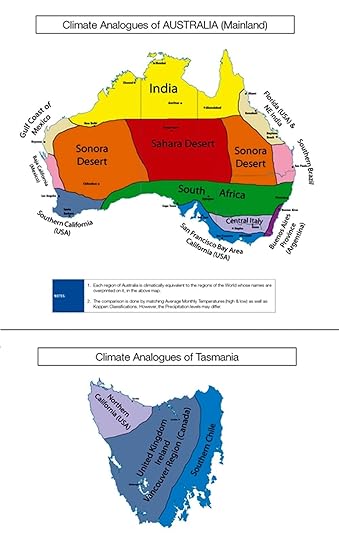
Photo: triton1982
More like this: The ultimate Australia travel bucket list


8 ways to save money in Toronto
Toronto is a popular travel destination in Canada but most of the tourist attractions and the hotels in the city center are not cheap, and eating a meal at a central restaurant can easily cost between $15 and $30 per person. However, there are several ways to see this city on a budget without compromising the quality of your trip.
1. The view of the Toronto skyline can be free.
While CN tower charges $36 for general admission, there are places that give visitors a free view of the Toronto skyline. Chester Hill lookout, 10 minutes walk from Broadview subway station, has a 180-degree view of the CN Tower, TD bank building, Rogers Center, Evergreen Brick Works, and Don Valley Parkway. Riverdale Park on Broadview Avenue is another place to witness the Toronto downtown skyline. It has a huge green space in the forefront for walking, relaxing, picnicking, and watching the sunset with your loved ones.
2. Eating at cheap restaurants.
There are several local restaurants that offer decent and cheap meals. El Furniture, on Spadina and Bathurst, has every dish, including the work burger, fish tacos, and beef spaghetti, priced at $5.95 all day every day. The Village by Grande, off St. Patrick subway station, has a large food court with cuisine from all over the world, and most plates cost between $3 and $8. The Extreme Taste, which features Mediterranean food, has a seafood plate for $5.99 and a chicken plate for $4.99, and chicken and beef pita for $5.00.
If you are looking for a cheap afternoon tea place, Brazilian Bakery and Pastry in Dundas West and Dufferin is a short subway and streetcar ride from downtown. Their Portuguese egg tart has been rated the best in town on Yelp and only costs $1. It also has bread, cake, sandwiches and various types of coffee and tea to keep you fed without breaking your bank.
3. Public transport gets you everywhere in Toronto.
There are regular subway, bus, and streetcar services and they can take you anywhere in the city and the suburban area. The fare costs only $3.25 and the transfer allows you to get another ride for free within the time limits. While you can take the UP express trains from the airport to downtown, cab, and Uber, it is much cheaper to take public transport to travel around the city.
4. Take advantage of free activities.
This website lists all the monthly free events and festivals in Toronto. From light festivals, food and photography exhibitions, Halloween parties, pillow fights, and film festivals, you can find the activities with detailed information, time, and location on this website close to the date. With this website in your hand, you do not have to pay anything to join the event, just prepared to show up, make new friends, and have fun.
5. Visiting beaches and parks.
Toronto has beaches, parks, and lakeshore areas that are open to the public. Those places usually take a half day to explore and they are a great escape from the hustle and bustle of the city center. Woodbine Beach on the east side of Toronto has 90 volleyball courts, a boardwalk, and warm water to swim in the summer. High Park has a waterfront, picnic areas, gardens, zoos, and a children’s playground. Bluff’s Park in Scarborough has a beautiful beach and looks like a tropical paradise during the summer.
6. Visiting free museums.
If your stay includes Wednesday night, be sure to check out the Art Gallery of Ontario, because that is when this museum offers free admission from 6 pm to 9 pm that allows you to see a collection of over 90,000 artworks. Bata Shoe Museum is free to visit and features a collection of 13,000 shoes and historical artifacts. 401 Richmond Street West has a collection of art galleries, exhibitions, a swipe bookstore, and a café shop that are worth spending a day.
7. Stay at the Planet Traveler Hostel.
There are not too many hostel options in Toronto, and a budget-friendly hostel with a central location is difficult to find. When you have to pay for $40 for a shared room without breakfast and oftentimes it is loud, and has bed bugs, it can be frustrating.
Planet Traveler Hostel is a good pick: it’s on Spadina and College, and within walking distance to China town and Kensington Market, has dorm rooms from $35CAD per night. It also has complimentary breakfast until 1 pm and a fully-equipped kitchen. Free Saturday BBQ on the rooftop offers a great opportunity for you to socialize with other travelers, enjoy the meal, and watch the city light up from the rooftop.
8. Watch comedy show at the Second City.
If you love comedy, you will adore the improved and stand-up performance at the Second City. Different shows take place every night and admission are $5 for adults and $2 for the Second Citizens. Grab a drink, bring a friend, and enjoy laughing and mingling with the actors. In some parts of the show, actors will choose a few audience members to perform with them. Just raise your hand high and you will find yourself on the stage performing with these light-hearted comedians.
More like this: 9 must-do experiences in Toronto
12 Kansas expressions
Sometimes, living in Kansas feels like we are in our own separate country. We are proud of our unique food, tradition, history, and culture. Kansans get so excited talking to newcomers about our home that we forget that not everyone will know our colloquialisms.
Here are 12 expressions you should learn before coming to Kansas.
1. “Caddy Corner.”
A direction best used to describe something on the opposite corner. “Her house is caddy corner to the Quiktrip.”
2. “Ope.”
Short for “oops” but it’s more of a sound someone makes when they drop something or run into another person or inanimate object.
3. “That’s nice.”
It’s the Kansas way if saying “I don’t give a shit.”
4. “Rock chalk.”
What to say to a fellow KU fan. The appropriate response is “Jayhawk!”
5. “EMAW”
This stands for “every man a wildcat.” What a battle cry.
6. “Pop.”
The south has “Coke” and the east has their “soda.” But us Kansans? We got our pop.
7. “Bless your heart.”
This is best used whenever someone really tries at something but fails. It’s a nicer way of saying “you’re an idiot.”
8. “Driving like a bat out of hell.”
Used to describe Missouri drivers.
9. “Giving them the runaround”
When someone is being evasive to a situation or another person. “Joe keeps giving Jane the runaround when she asked him about where he was the other night.”
10. “Sun shower.”
This is a weird phenomenon where it rains while the sun is shining. Because, Kansas.
11. “Hot minute.”
When it’s been awhile since you’ve seen someone, been somewhere or done something, but not a significant amount of time has passed. “I haven’t seen cousin Bob in a hot minute!”
12. “For crying out loud.”
What your mother says when you give her the runaround.
More like this: 17 signs you're back home in Kansas
33 signs you're back in New Mexico
You call it the Land of Enchantment, we call it the land of entrapment. New Mexico has its talons in us and every time we think we want to move elsewhere or even go away for a small vacation, it pulls us back in. (We literally cannot survive without green chile.) So when we do go back after a vacation or stop by for a visit, we know right away that we’re right back home in good ol’ Nuevo Mexico thanks to these 33 surefire signs.
1. You flew into ABQ.
2. Your first stop after leaving the Sunport was anywhere that would serve you anything with chile.
3. “Red, green, or Christmas?”
4. “Do you want a Coke?” *hands you a Sprite*
5. Your skin dries out instantly.
6. And you vaguely remember when your lips weren’t cracked all the time…
7. And your hair wasn’t a tangled hot mess.
8. Fast food franchises in faux-adobe buildings. (Panera? KFC? Really?)
9. “Orale, we have a *insert name of popular restaurant or store that we literally never thought would open here* now!!”
10. “Is that a new casino?”
11. If you are a Whataburger fan, you can breathe easy. If you’re an In n’ Out fan, you’re outta luck.
12. “Did you watch the game last night?” “The what?”
13. “Do you want to go to Chipotle?” “….Excuse me?”
14. Hello, juniper allergies; oh, how I’ve missed you.
15. You can’t open your door because a huge pile of tumbleweeds is blocking it.
16. The morning after you get back, you’re definitely going to your favorite greasy spoon for either huevos rancheros, a breakfast burrito, or blue corn pancakes.
17. That one road that was under construction when you left is STILL. BEING. WORKED. ON.
18. And a million other things are now under construction as well.
19. Catching up with friends means a Saturday road trip to the Jemez. Or White Sands.
20. Gassing up at Allsup’s also means running inside for a chimichanga burrito.
21. “Orale, there’s a coyote crossing the road.”
22. “Anyone want to go to Blake’s, man?”
23. If the weather is bad, give it ten. It’ll pass.
24. The rain knows when you’ve just gotten your car washed.
25. Say goodbye to being able to walk barefoot outside ever again.
26. You’ll definitely be teased if your chile tolerance has gone down while you were away.
27. Zia tattoos everywhere.
28. A turn signal is a foreign concept.
29. Land of mañana = nothing gets done on time. Say goodbye to productivity.
30. “Yeah, I know, huh?”
31. No one knows who goes first at a four-way stop.
32. “Anyone want pizza?” “Yeah, let’s get Dion’s, with green on top and green chile ranch.”
33. Glorious sunsets every night.
More like this: 23 commandments for living in New Mexico
How to swim with Florida's manatees
Midway through squeezing into our wetsuits, I remember my wife pausing mid-laugh to reflect, “It’s going to be cold.” If we were looking for a sand-between-our-toes, poolside-daiquiris type of Florida vacation, this wasn’t going to be it. But that’s not why we go to Crystal River.
Self-dubbed the Manatee Capital of the World, the Crystal River area is just that — home to hundreds of manatees who rely on spring-fed Kings Bay to keep warm during the winter. While you could search and find manatees up and down the Florida coast, Crystal River and Homosassa stand alone as the only places in Florida where you can legally enter the water and interact with manatees in the wild. That’s why we go.
Of course, it’s easy to wade into the bay with a pair of goggles and a little enthusiasm, but that only guarantees you’ll get wet. Here’s what you need to know to see some manatees, learn a little, and get home happy.
Timing really is everything.

Photo: Discover Crystal River Florida
The manatees of Crystal River and Homosassa are Florida manatees, which are a subspecies of the larger West Indian manatee population. They eat only plants, and in the warmer months, they rove up and down the Gulf and Atlantic coasts in search of food. The area does have resident manatees year-round, so summertime manatee sightings are possible, but the fact that they’re so mobile significantly lessens your chances.
Instead, time your trip to the Crystal River area for November through March, when cooler temperatures arrive. Wintering manatees are near the northernmost part of their range here. Despite reaching weights of more than a thousand pounds, manatees can get hypothermia, just like humans. Springs at Crystal River National Wildlife Refuge on Kings Bay flow at a consistent 73℉, giving manatees a warm refuge. All that to say, the colder the better for manatee viewing.
Keep in mind that manatees like to start moving in the morning, so you’ll want to get up early. If you time your visit right, the weather will be perfect for your adventure. (Don’t worry too much about the tides — low tide can be excellent for swimming, though high tide can be better for from-land viewings at Three Sisters Springs and Homosassa Springs Wildlife State Park.)
Get the right gear…
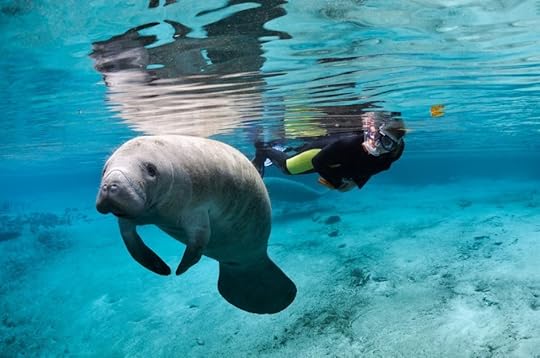
Photo: Discover Crystal River Florida
You can choose to see manatees from a boardwalk or spot them from the side of a boat, but to swim with manatees is definitely unique. That also means you need a plan.
If you want to experience Kings Bay at your own pace, go by kayak and bring a map. You’ll want to know where King Spring, Three Sisters Springs, and Hunter Spring are located, as well as the off-limits Manatee Protection Zones. Ask a local dive company for a map you can use (many of these companies also rent kayaks), and try to find an outfitter that lets you park, rent, and access a launch site. Otherwise, launch your kayak at Hunter Springs Park or Kings Bay Park, and don’t forget a rope to tie up your kayak as you swim.
It may seem like you don’t need any extra gear to swim with manatees. After all, the water temperature is 70+ degrees and the spring weather is clear. While that’s true, good gear will let you stay in the water longer. A wetsuit will keep you warm, flippers get you moving, a pool noodle will keep you buoyant so you don’t kick up sediment, and — of course — a mask and snorkel are essential when you’re face down in the water searching for manatees.
Important note: Before you ever get in a boat or in the water, you need to watch the Crystal River National Wildlife Refuge’s Manatee Manners video. This video produced by the U.S. Fish and Wildlife Service teaches you the do’s and don’ts of interacting with manatees and is required viewing before renting a kayak or otherwise participating in this unique wildlife experience.
…or just go with the experts.
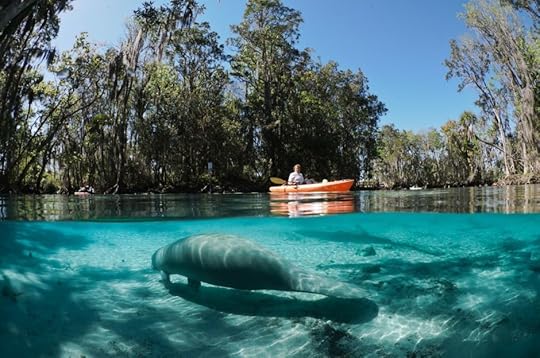
Photo: Discover Crystal River Florida
I’ve lost track of how many manatee tour and dive companies operate in and around Crystal River. That’s not a bad thing. Locals know where to go, what to do, how to act, and they can teach you all you need to know to have a successful experience. Though remember that, ultimately, it’s your responsibility to learn and understand the rules.
Some tours travel by kayak, but most go via boat. Motorized craft allow you to get in the water faster and provide a dry place to rest and throw on a jacket when you’re out. The average tour costs about $65, lasts three hours, includes an educational talk, and comes with all the gear you need to be safe and comfortable. A good tour gives you peace of mind, knowing that all you need to do is show up on time and follow directions.
Each company tries to set itself apart. Most of the special offerings are nice, but not essential. If you shell out for a VIP-type tour, pick one that stays out for longer, upping your chance of a great manatee experience. Or pick a less-popular tour location, like the River Safaris snorkel tour in Homosassa Springs. Other worthwhile perks include tour sizes of six or fewer people, in-water tour guides, and social-media-worthy pictures of you swimming with your new manatee friends.
Always follow your “Manatee Manners.”
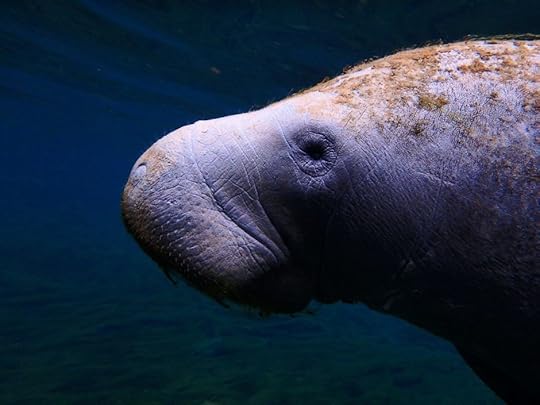
Photo: Mcleroy Photography
Don’t be surprised when you feel a connection with every manatee you see. Even though you’ll probably want to dive down to them as soon as you spot them, check that natural impulse. Instead, keep your Manatee Manners front of mind.
In 2017, manatees were moved from the endangered species list to the threatened species list. That’s an improvement, but it’s not a free pass to misbehave. As a visitor in their natural habitat, it’s important that you avoid putting the manatees in stressful situations. The key phrase in these parts is “passive observation.” Let the manatees take the lead. If a manatee approaches and touches you, you’re legally allowed to use one hand to reciprocate. Otherwise, you’re there to passively observe — and extremely lucky to have the chance to do so!
Again, you’re expected to know these regulations before getting in the water. Not abiding by them could result in a very sharp warning from Manatee Watch volunteers — or even a fine. People here feel very protective of the manatees, and boat captains, in-water guides, and concerned residents won’t hesitate to speak up if swimmers engage in inappropriate behavior. Remember, this is their home!
Stay positive and patient.
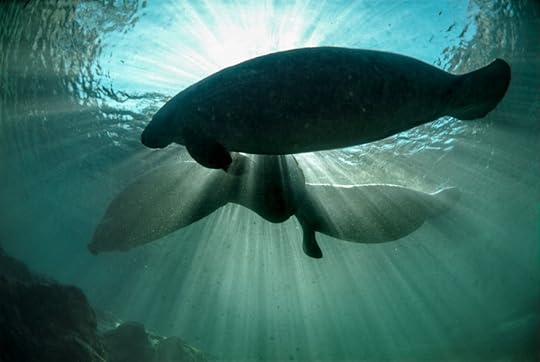
Photo: U.S. Fish and Wildlife Service Headquarters
My first time swimming with manatees started as a bust. It was a cold day (good), but we had no wetsuits (bad).
For a chilly, quiet hour, we kicked around Three Sisters Springs watching tiny, colorful fish dart from log to rock to log with a sleek black anhinga in pursuit. A belted kingfisher chattered above us as it looked for an unwitting fish-turned-meal. Turtles scuttled across the ground. We were entertained, but hoping the whole time that mounds of dirt below would suddenly reveal themselves as camouflaged manatees. Nearing our limits with the cold, we noticed a crowd had formed in the canal near our kayaks and the Manatee Protection Zone, where we were greeted by three resting manatees. Success!
We played the waiting game and won. It’s hard to imagine a comparable wildlife interaction, one that was at the same time exciting, natural, and safe.
Since then, we’ve fine-tuned our approach and haven’t struck out. Sometimes it takes hours, sometimes we stop at multiple springs, but it’s always an experience. Any uncertainty acts as a friendly reminder that manatees are wild animals that don’t operate on our schedule. Not just any wild animals, but gentle giants that seem just about as happy to be with us as we are with them. 
14 dirtiest expressions in German
Germans might come off as reserved and quiet at first, but they sure do know how to swear and use dirty language! Not all of it is meant in a negative way though. Here are some examples you are likely to come across when spending time with Germans (warning: German dirty language is very fixated on butts and excrements).
1. In German, if something suits really well, it “fits like an ass on the bucket” (Wie Arsch auf Eimer).
2. Instead of saying “what the hell!” when they are surprised, Germans will shout “shit on the wall!” (Scheiss die Wand an!)
3. If someone acts a bit dumb or slow, Germans call them an “ass violin” (Arschgeige).
4. When a German tells you what they are saying is “without any shit”, they are assuring you they are telling the truth. They will also ask you, “without shit?” to see if you are lying (Ohne Scheiss!).
5. If a German is really annoyed or stressed, “they vomit in circles” (Im Kreis kotzen).
6. To insult you, Germans might call you “piss clove” (Pissnelke).
7. If something is in the middle of nowhere, Germans tell you it’s “at the ass of the world” (Am Arsch der Welt).
8. Germans call idiots “flat wankers” (Flachwichser).
9. If you messed up really badly, you “shat in it” (Reinscheissen).
10. If you’re being a coward, Germans will call you “pant shitter” (Hosenscheisser).
11. If someone is being really crazy, Germans say they “have an open ass” (Den Arsch offen haben).
12. When Germans have to go for number two, they “lower someone down” (Einen abseilen).
13. When Germans vomit, they “scream at the ceramics/wall” (Die Keramik/Wand anschreien).
14. In German, if something is broken, it is “at the ass” (Am Arsch). Someone is also “at the ass” when they are really tired (Am Arsch sein).
More like this: The 21 funniest German expressions
Matador Network's Blog

- Matador Network's profile
- 6 followers

