Michael Hyatt's Blog, page 43
June 26, 2018
5 Essential Travel Apps
Save Time, Money and Have a Stress-Free Summer

Every year, 64% of Americans plan some sort of getaway vacation. Many people grew up with fond memories of packing up the car and heading to the beach, the lake, or Grandma’s house during the summer months.
Sadly, in American culture, the ability to get away is becoming more of a luxury and less of a priority. Nearly half of Americans report that they will not be taking a summer vacation this year because they either cannot afford it, or they are too busy with work.
This number is actually quite alarming. Failing to take even just a few days off to refresh your mind, body, and spirit can eventually lead to a burnout that may be difficult to bounce back from.
“ Failing to take a few days off to refresh your mind, body, and spirit can eventually lead to a burnout that may be difficult to bounce back from.—MANISH DUDHAREJIA

However, taking a vacation can actually have a positive effect on your productivity. Scientific studies have found that taking even a short weekend getaway can refresh your creativity and decrease stress levels. Additionally, a rejuvenation can lead to greater productivity; which leads to more opportunities in your career. In fact, employees who took more than 10 of their vacation days a year were twice as likely to be promoted or receive a bonus at their job.
Talk about an incentive for a vacation!
If the stress of planning a trip or the financial strain of getting away is holding you back from giving yourself a break, consider these helpful apps and tools that can help solve all of your travel worries.
1. Hopper—Know when to fly and buyOne of the biggest obstacles that stands in the way of most people’s getaway plans is the high cost of flying. During the summer, airline ticket prices can jump 20% or more, especially during popular travel weekends like Memorial Day.
The hassle of comparing flights from various websites is enough to make some travelers quit altogether. To make matters worse, travel comparison sites can come with hidden fees. Furthermore, they don’t always show every airline, and they won’t tell you if the price is actually the best deal or not.
If you have some flexibility with your vacation dates, Hopper can certainly help you find the best bang for your buck.
Simply type in your destination and preferred dates, then Hopper will scan nearly every airline to find the current rates and even suggest travel date adjustments for cheaper flights. But what’s even better is that Hopper tracks every single flight’s price fluctuations and will predict when the cost is about to change. If you set up travel alerts, Hopper will send you a notification when the price is at its lowest so you can rest assured that you are getting the best flight deal available.

You can download Hopper for free on iTunes and Google Play.
2. iExit—Your road trip pitstop finderIf your family is more of the road-tripping type, you know there is nothing worse than frantically searching for a rest stop. Bathroom emergencies or hungry travelers can certainly suck the fun out of a trip and make for some whiny kids (and adults).
Thankfully, iExit makes it incredibly easy to find a pit stop area. Its GPS function figures out your location and shows you where the nearest rest area, gas station, or restaurant is that won’t take you miles off your route. iExit is even integrated with apps like GasBuddy and Travel Coupons to help you find the cheapest gas and hotels along the way.

Download iExit on iTunes and Google Play.
3. Roomer—Find discounted hotel staysFinding nice, affordable accommodations during the summer months can often times seem like an oxymoron. Most of the best hotels are booked up months in advance, and the less-desirable lodgings may have overly inflated prices due to higher demand.
Thankfully, Roomer can help you find the best of both worlds by scouring hotel sites for last minute booking deals. Roomer works with travelers who are not able to use their previously booked travel accommodations. It then connects you with these rooms, which saves you money in the process by offering hefty discounts. This means that you can potentially score nice hotel stays and luxury resort spots all around the world for a fraction of the cost.
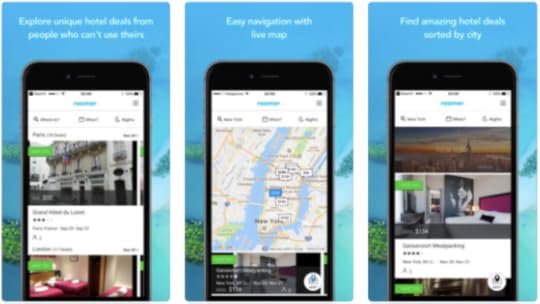
Get Roomer on iTunes and Google Play.
4. Guides by Lonely Planet—Discover your destinationThere’s nothing worse than arriving at your vacation destination and hearing the question, “What should we do now?”
While some travelers enjoy going with the flow and discovering things along the way, having a guidebook can be a lifesaver to eliminate moments of boredom in the meantime.
Guides by Lonely Planet acts like a super friendly and knowledgeable tour guide who is only there when you need them. The app compiles thousands of tips and recommendations from expert travelers so all the information you could ever want is right at your fingertips. The GPS function will help you navigate through cities while passing by famous landmarks and beautiful sites along the way. Plus, there’s a “Need to Know” tab to help you get a feel for the city’s layout and the can’t miss spots.
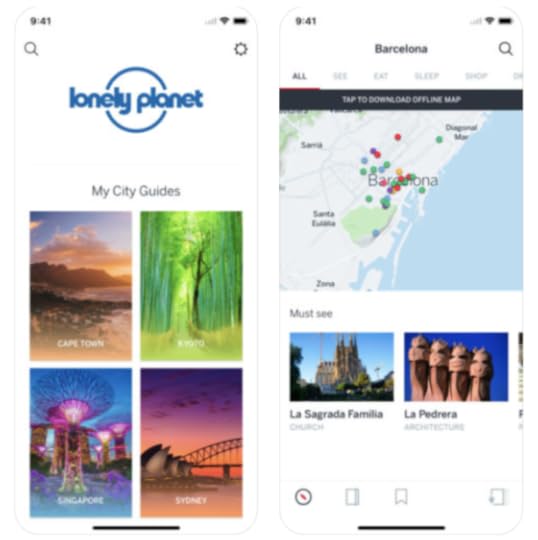
Get Guides by Lonely Planet on iTunes and Google Play.
5. TripLingo—Stay safe and savvy during trips abroadTraveling internationally is an amazing opportunity to experience new cultures and explore the world. However, one of the biggest issues while abroad is communicating with the people around you.
TripLingo can help you easily converse with locals thanks to its helpful language features. The app has thousands of phrases and translations from 42 languages to make conversations a little easier. There is even an instant voice translator feature, Wi-Fi phone dialer, and currency calculator built in to eliminate all of your language barrier woes.
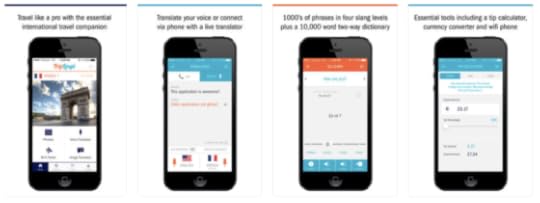
Download TripLingo today on iTunes and Google Play.
Don’t let obstacles like financial constraints or the stress of planning stand in the way of taking a vacation this year. After all, even a little getaway could be instrumental in helping you become more productive, happier, and successful. Give yourself the rest you deserve and let these apps do the hard work for you.






June 19, 2018
Why Every Leader Needs a Sabbatical

As leaders, we tend to be energized and motivated by our work. That can make us resistant to taking time away. Yet the more we work, the more we get caught up in the nonstop whirlwind of activity that can leave us exhausted and ineffective. In this episode, we’ll answer your top three objections to taking extended time away from work.


The Science of Sabbaticals
Take a Break to Take It to the Next Level

I used to take yearly sabbaticals. For three glorious months each summer my time was more or less my own. I did whatever took my fancy: running around the yard with my siblings, reading books, pestering my parents. You probably did, too. We were little, so the associated learning was not exactly productive. Luckily, sabbaticals don’t need to be productive to have benefits.
Sabbaticals were traditionally year-long, funded affairs reserved for scholars and professors. Today, most people consider any break from regular work lasting a month or more a sabbatical (though counting summer vacation is surely unconventional). A sabbatical might include long-term traveling vacations or goal-oriented career breaks. The trend is catching on: people are crafting their own sabbaticals and even companies are coming aboard. Nearly 17% of employers offered some form of sabbatical in 2017.
The goal of a sabbatical, even one that is goal-oriented, is to rejuvenate and reap the accompanying rewards. What does science have to say? Studies documenting the benefits of substantial breaks point to an increased sense of well-being, greater productivity, and a boost to creative thinking.
“ The goal of a sabbatical, even one that is goal-oriented, is to rejuvenate and reap the accompanying rewards.—ERIN WILDERMUTH
Sabbaticals enhance well-being and productivityIn a study of 129 faculty members who had completed a sabbatical, matched with 129 faculty members who had not, those who had taken time off reported a greater sense of well being. They indicated that their time spent away had not only been beneficial for their home lives and families but that their home institutions had also benefited. Scholars who had traveled overseas saw greater benefits.
A smaller, qualitative study of 70 medical school faculty members across seven universities echoed these findings. The study also identified tangible, institution-aiding accomplishments achieved by returning sabbatical participants. Three of four returnees accomplished something notable, such as writing books or reorganizing teaching programs, directly following their time away.
Though scientific study of sabbaticals, in particular, is limited, the benefits of its common components are well-documented. Viewing these components as a whole, we can begin to explain our professors’ experiences scientifically.

In 2012, a group of researchers set out to test whether novel experiences enhanced creativity. Their study was twofold. In the first experiment, participants walked through their school cafeteria in virtual reality, experiencing novel, physics-defying events. A control group used the same system but was fed a normal experience. In the second experiment, two groups of participants made a sandwich. One group made it as one usually would, the second switched up the order of ingredients.
In both experiments, participants who had been involved in novel experiences scored higher in a cognitive flexibility test. What is the biological relationship? Our understanding of neuroscience can illuminate the possible processes at work. When you have new experiences the neurons in your brain communicate in seldom used, or possibly even novel, ways. These new pathways increase connectivity, aiding in creative thinking and problem-solving.
Remember that of the 120 scholars included in our aforementioned sabbatical study, those who had gone overseas reported more benefits than those who stayed local. This ties into the idea that variety of experience powers creativity. After all, what’s more varied than an entirely different setting with novel social norms? Research further confirms the link between travel and creativity.
The organizational benefits of sabbaticalBeyond the personal and biological benefits of sabbaticals, social science provides further evidence of organizational benefits. In a study of 61 sabbatical-taking leaders of non-profit organizations, those taking sabbaticals reported the same innovative energy as we’ve seen from professors. They returned to work rejuvenated and ready to tackle problems with fresh eyes. In addition, the short-term absence of these high-level professionals opened opportunities for interim leaders. These newly appointed leaders excelled in their work, becoming more effective employees overall.
Planning your sabbaticalIf you aren’t lucky enough to work for a company that provides employee sabbaticals for years of service, you still have options. The first is to bring this idea to your management team. As job-hopping millennials invade the workforce, companies are looking for ways to increase retention. Sabbaticals may be an effective solution.
If the retention argument doesn’t sway the big boss, you’re not out of luck. Your employer doesn’t need to have a sabbatical policy for you to enjoy one. Speak to your supervisor about the possibility of a month of unpaid leave. Alternatively, breaks in employment as you transition from one role or company to another can easily be arranged to allow time for a sabbatical. My advice? Start saving, start planning, and reap the benefits.


Sabbatical on a Budget
What to Do With All That Time Off?

Picture this: you’ve been with the same employer for many years and they want to reward your loyalty with the recharge of a sabbatical. Typical sabbaticals can last anywhere from 1-6 months in length, for the sake of this article (and because I’m a teacher that is on sabbatical every summer) we will plug in a 3-month sabbatical.
You are floored by this opportunity until you look at your bank account statement and remember that you are on a strict budget and don’t have the money for a lavish European vacation. Be encouraged! And read on to discover ways that you can sabbatical on a budget.
What is a sabbatical?A sabbatical is defined as a break or change from a normal routine (usually from employment). It has biblical roots in the form of a sabbatical year, which occurred every seventh year during which the land remained uncultivated, except to the poor, stranger, or beast. In modern times Sabbaticals are used for various purposes by employers, churches, and schools to reward loyalty or to allow time for rest, travel, research and a renewed focus.
Some churches offer their pastors a three-month sabbatical for every seven years of service, which provides opportunities for ministers to visit other congregations, audit Seminary classes, write books, perform acts of service, and visit the Holy Land during this time off. Churches feel ministers need an occasional “re-boot” to care for the needs of its members and to develop fresh, relevant content for their sermons.
“ It has become more common than uncommon for companies to offer sabbaticals to their employees.—ANDREW LOTT
Corporate America has also caught on to the “sabbatical concept” due to the productivity benefits it brings to the work environment, and it has become more common to offer sabbaticals to their employees. Adobe Systems, which ranks #26 on the Fortune 100 Best Companies To Work For, offers employees a sabbatical for every five years of tenure, lasting four to six weeks depending upon the length of employment. The Adobe Life Blog documents inspiring ways in which their employees have used their sabbaticals, including volunteering at an orphanage in Guatemala and building houses in Romania.
Time to reconnectThere are a few common traits needed to achieve restoration for a sabbatical, especially one on a budget. First, there needs to be some time built in for introspection to reconnect with your life’s purpose. Ask yourself if you are living in line with your values. If the answer is no, what changes need to be made to get things back on track? Journaling, performing a strength finder test/assessment and asking others to give you honest feedback can be helpful. One area on which I plan to focus during my summer sabbatical is to adopt a low-tech life, including taking a technology “break”.
I confess that I often feel the pull to check my phone, and this constant pressure to be productive affects my ability to be truly present around others. My goal is to place the phone in the drawer each night (instead of on my nightstand), use a traditional alarm clock to wake up, check the weather by stepping outside (instead of checking the weather app first thing), having fewer appointments and meetings on the calendar, and having only a few check-in points throughout the day to answer texts, emails, and return calls.

The second objective of an effective sabbatical on a budget is restoration through local adventure; you get the opportunity to become an expert on your local scene! In Dallas-Ft. Worth, where we live, activities span across two major cities, so planning is important. We try to begin the day with outside time in the form of a walk, bike ride, or simply playing in the front or backyards. Our family often enjoys morning dog walks to one of our local parks where the kids enjoy the playground equipment and the parents take turns spending peaceful moments studying the Bible or having special prayer time, reading a book, and journaling.
Our middle of the day outing is typically more planned out and often involves something indoors or by water to take a break from the Texas heat. We have enjoyed trips to the local library, the Farmer’s Market, indoor play structures at various churches, a visit to the Perot Museum during one of the Bank of America Museum on Us Days, a day trip to a local lakes with a kayak/stand-up paddleboard rental, and play time at the dog park.
Our evenings are typically spent with a family meal and an evening dip at the local pool. We have also enjoyed free outdoor movies, affordable minor league baseball games, grill nights with friends, and even date nights at the dollar theatre. Our children are still young, so we also switch off giving the other person a break by allowing for occasional girl’s night/ guy’s night activities.
Time to travelAt some point during your sabbatical, it is a good idea to achieve restoration by taking a trip. The main expenses related to your trip are the travel/commute costs, lodging, food, and adventure. Staying within a few hours of home and driving your own vehicle is always the cheapest option, but some may have to spend a little bit more on a car rental. Once you arrive at your destination, you may be able to return the car and rely on public transportation, a bike rental, and the occasional Uber ride.

Glamping (it’s a thing)
Next, you must budget for lodging and ways to keep costs down include camping, glamping, Airbnb, couch surfing with friends/family, and WWOOF-ing. Two sabbatical summers ago, my younger brother and I went to Austin and kept costs low by splitting the expense of an Airbnb pool house rental; we were given access to a pool table, dart board, and even their pool for around $100 per night! If the budget allows, you may consider a longer trip to a destination location, which can be achieved on the cheap by travel hacking, buying a last minute discounted vacation package, or taking advantage of a house swap.
As for food and dining, there are several methods for eating well on the cheap. A few examples which we have practiced during our summer sabbaticals are intermittent fasting in the morning (for the adults), batch cooking on the grill or in the crock pot, preparing simple ingredients for lunches, eating leftovers for lunch, and taking advantage of happy-hour specials when a restaurant is the best option.

We have already discussed ways to have adventures on a budget but another worthwhile way to spend your sabbatical is by serving others. Organizations such as Habitat for Humanity allow for short-term involvement, local shelters need helpers during non-holiday times, and local churches and schools will be happy to direct you to many ways that you can volunteer your time.
You are now ready to accept your employer’s generous sabbatical offer! You have been given several possibilities for how to spend your time and overall you know to focus more on restoration and less on productivity. Now turn off your technology, break out the journal, and have a blast planning your next three months!


June 12, 2018
Questions Reveal Your Interest
5 Strategies to Get Understanding

Anytime a person must gather information, there is no substitute for asking the right questions. Asking the right questions means asking someone to teach you things you do not know, or correcting you if your knowledge is distorted.
We see forms of questions all around us: a manager interviews a job applicant, a detective talks with an eyewitness to a crime, a parent asks a child for a summary of the school day, a TV reporter interviews a newsmaker. One quality that drew me to journalism was the prospect of interviewing interesting people and writing about our discussions.
Based on my years of interviewing people for a living, and listening to other interviewers of greater talent, these are principles I have found reliable in helping people reveal their deeper truths, those things that they would like to discuss if only someone would ask.
1. PrepareUnless you are a genius of improvisation, you will likely need to prepare a list of questions and to do any necessary research in forming those questions. The most rewarding conversation often occurs if you rely on your list of questions only for your first question or two. Consider the list your safety net and something that will quietly inform your subsequent questions.

Why prepare a list of questions you may use only minimally? The most rewarding material in a conversation often occurs in a subsequent question informed by a person’s answer. You will hear this frequently in a gifted interviewer like Terry Gross of NPR’s Fresh Air: a celebrity will allude to a childhood memory, or to some other more intimate detail. Though Gross can sometimes go too far and ask questions that sound invasive or boorish, the important principle is that she is willing to take risks for the sake of a compelling detail. There is a delicious quality when Gross asks a risky question, there is a slight pause, and then the subject answers her question with a soul-baring candor.
3. Be open-endedAnother way of putting this is to be non-directive. Unless you are a prosecutor at full throttle in a courtroom, your task is not to prove a point or to ask people a question that conveys how you want them to answer. Your task is to ask an honest question about what you want to learn from them. Andy Raskin wrote on Medium about overhearing a Famous CEO teaching a Young CEO about two simple questions that the late Steve Jobs asked of employees at the film studio he helped oversee: “Tell me what’s not working at Pixar,” and, “Tell me what’s working at Pixar.” Who would not love answering a question like this by the boss, so long as it was clear the boss meant it?
4. Dig for a person’s dignityAny effective conversation builds on an understanding that you have something to learn from the person hearing your questions. That person has a family history, struggles that few others know about, and most likely some wisdom gained from experience. Ask questions that show you want to know some small part of that person’s story, something of what makes that person unique.
When I interviewed theologian Ron Sider for my book about tithing, I thought my best question was whether his book Rich Christians in an Age of Hunger had inspired many people to take on the hard discipline of a graduated tithe, in which a Christian gave a higher percentage with each higher step in income brackets. No, he said, precious few people had ever mentioned that detail. But somewhere in our conversation, he delivered what I considered the most poignant details by discussing his disappointment that his effort at living in intentional Christian community came apart at the seams. That sort of vulnerability does not come cheaply to the person making the disclosure, but it flows from a conversation that indicates love and respect.

This last point is simply my way of admitting that not every attempted conversation will succeed. I remember only a few examples from my years of interviewing people as a reporter. In one case, a public school teacher was so cautious about everything she answered she gave that she spoke at 50 percent of a conversational pace and had me read her answers aloud immediately afterward. After a few questions, I conceded that the interviewer was leading nowhere and (more important) assured her that I would not use anything she had said, lest she feel her remarks had been bowdlerized.
In another case, an actor launched into a long-winded monologue worthy of a telemarketer who will not you to get in a word edgewise. In short, sometimes the person to whom you are extending love and respect is less willing to receive or return it. In moments like those, there is no shame in cutting your losses and bringing the conversation to a polite conclusion.


The Science of Curiosity
Taking an Interest Can Lead to a Longer, Better Life

Curiosity starts early. Children throw cups from highchairs over and over, testing gravity and their parents. They repeat the same noises and ask the same questions, exploring sound and language. When everything is new, there are countless experiments to run. The answers are awe-inspiring: sunsets, gravity, hula hoops, and bugs.
As more and more questions are answered, our curiosity can subside or it can evolve. Philosophy, scientific innovation, and progress are the natural results of adult curiosity. Cultivating this curiosity is important in life, love, and success. Here’s why.
Curiosity enhances learningApplying knowledge in innovative ways is essential to discovery and progress. Curiosity helps us to build that knowledge, making it available for novel interpretations and applications. How? The neural circuits of curiosity prime the brain’s learning circuits, creating stronger activation and increasing our ability to learn.

In a 2009 research paper published in Psychological Science, Dr.Colin F. Camerer and team presented curiosity as “The Wick in the Candle of Learning.” In the study, subjects were given trivia questions to read out loud and instructed to guess the correct answer. They were also told to rate their level of curiosity.
Functional MRI showed increased activity in the caudate regions of the brain, associated with reward anticipation, in parallel with participants’ curiosity levels. When correct answers were revealed, the learning circuits in participants’ brains were activated more strongly if they had guessed incorrectly.
Based on these findings, Camerer and his team hypothesized that “curiosity would be associated with memory enhancement for new information.” Indeed, a follow-up study revealed that participants were better able to remember the answers to trivia questions if they had been curious about them beforehand.
Five years later, Dr. Charan Ranganath dug deeper into the relationship between curiosity and learning. Repeating a similar protocol as the 2009 study, Ranganath’s team also flashed photographs of faces during periods of high and low curiosity arousal. Curiosity not only helped participants to remember trivia, they were also better able to remember the photos if their curiosity had been piqued.
Curiosity feeds relationshipsYou probably already know that being genuinely interested in other people is an important precursor to building robust interpersonal relationships, but you may not know that scientists have delved into this very topic.
Likening curiosity to an interest in learning new things (exploration) and the ability to become absorbed in tasks (absorption), social scientists asked 90 students to complete researcher-designed Curiosity Exploration Inventories based on these two attributes. Then they gave each student forty-five minutes to talk to a participating stranger of the opposite sex. Half the couples were prompted to have an intimate talk, while the other half were set-up for small talk.
Curiosity mattered. When set up for intimacy, both groups experienced intimacy. When prompted to spend forty-five minute engaged in small talk, however, only those participants who had exhibited high curiosity and their partners felt a close connection. Curious people, even in low-intimacy situations, tended to engage in playful and probing interactions with their partners, prompting a greater feeling of intimacy and building more meaningful interpersonal relationships.
“ Though curiosity tends to decline with age, keeping novel-seeking behavior and a sense of wonder throughout life helps people to stay young.—ERIN WILDERMUTH
Curiosity keeps you youngThough curiosity tends to decline with age, keeping novelty-seeking behavior and a sense of wonder throughout life helps people to stay young. A 1996 longitudinal study followed 1,118 aging individuals while tracking their curiosity levels. Those who exhibited high levels of curiosity were more likely to be alive five years later, even after accounting for other risk factors.
How does it work? As in most complex systems, we can’t be 100 percent sure, but research points to neurotransmitters. Curiosity activates the brain’s reward centers, which are regulated by dopamine. This particular neurotransmitter is less prevalent in aging brains and has been linked to cognitive decline. There is almost certainly more going on, but understanding the dopamine response is an important piece of the puzzle.
Cultivating curiosityCuriosity can decline with age, or it can become an intrinsically woven part of your adult life. Here are 3 ways to keep your curiosity alive and well.
1. Find wonderYou don’t need to go trekking the Himalayas or scuba diving in a blue hole to find wonder. It is more of a mindset than an experience. Choose to notice the world around you. Take a moment to stop and revel in a sunset. Spend an afternoon with the sole mission of following bees back to their hive. Buy a camera. Nothing fancy. Framing beauty is a great way to learn to appreciate it.
2. Break the routineRoutine can be a blessing. It helps us focus on what we’re doing and allows us to build consistent, healthy habits. Routine is a great productivity hack, but not every day needs to be a productive one. Take time to break the routine. Try something new. Better yet, try something that makes you just a little apprehensive.
“ Routine is a great productivity hack, but not every day needs to be a productive one.—ERIN WILDERMUTH
3. Learn something newMost people learn new things every day, but these things are often in one particular area of interest. Learn something entirely new. If you’re a book person, learn something physical. If you’re always on the move, learn the benefits of stillness. It isn’t what you learn that is important, but that you are stretching new muscles, whether mental or physical.


3 Questions All Great Leaders Ask

As leaders, we often think we must have all the answers. That can result in a leadership style that exudes arrogance and ignores the wisdom that might be sitting in the room. In this episode, you’ll learn how to avoid becoming stagnated or committing foolish errors by learning to ask three types of questions in any situation.


Investigative Leadership
The Right Questions Can Lead to Business Breakthroughs

Eight years ago, Craig Ross achieved a career milestone. He became the majority owner, CEO, and president of Verus Global, a leadership development organization based in Littleton, Colorado. There was no time to celebrate because of declining profits and growth. “For the first time in my career, I was asking questions I’d never asked,” Ross says. “[I wondered], ‘Am I capable of leading a successful company?’”
In retrospect, Ross acknowledges that that question, along with similar ones (What am I doing wrong? Why isn’t the plan working? What skills don’t I have that our founder demonstrated?) weren’t just unproductive—they were also destructive, borne of feelings of inadequacy and rooted in Ross’s tendency to compare himself and his personal leadership style with that of the company’s founder.
It was during a conversation with his mother that Ross’s perspective changed. “I began to ask, ‘How can I get better at being true to myself and my leadership?’” Ross says. “It caused me to step back and more clearly identify my purpose, vision, and motivations. From this clarity, my leadership actions evolved.”
Not only did Ross’s approach to leading Versus Global shift, so did the company’s fate. Ross says that the company has “grown in ways that were unimaginable at that time.” Ross is more prepared than ever to navigate challenges—now that he knows the right questions to ask.
Questionable successSlowing sales isn’t the only precursor to a paradigm shift. Gemma Bonham-Carter had already achieved profitability as a blogger and blogging coach with a suite of successful products. But a reliance on launch-cycle revenue meant that when she wasn’t actively selling to her audience, she wasn’t making any money at all. “I would either be doing an intense, high-stress launch of one of my products—which was time-consuming even though it produced successful results,” she says. “But I would then go into a lull where I would be list-building but not actively making sales.”

The problem? When evaluating her income strategy, Bonham-Carter was asking the wrong question: “What’s the next product I can launch?”
The question that ultimately led to the breakthrough she needed was, “How can I automate the sales process so that I can make regular, consistent sales without having to constantly be actively launching?”
“After asking that question, I created video content and email sequences to use in a sales funnel that allowed me to build trust with my potential customer,” Bonham-Carter explains. “This has meant I can be hands-off with the launch and can instead focus my energy on providing the most high-quality program for my students. I have been able to scale this automated sequence using Facebook and Instagram ads, and I now generate more revenue month-over-month than was ever possible with the live launch strategy.”
Looking for answers in all the wrong placesSometimes even asking the right questions isn’t enough to achieve leadership breakthroughs. According to Ally Compeau, founder of Woof Signs, an online provider of customized signage. “As opposed to asking the wrong questions, I actually feel like I was asking the wrong people,” she explains. “I was doing competitor research, speaking to others in the industry, and trying to get a sense of what was popular in the market and how consumers were currently engaging in the market. I needed to ask the right questions to the right people—who ultimately turned out to be the end customer.”
To differentiate her new business by succinctly addressing customer pain points, Compeau began to interview each of her potential customers. After asking questions like “Have you purchased a sign before?”; “For your ideal sign, what would you pay?”; and “How would you like to be able to buy?”, Compeau was able to distinguish important data that could then be integrated into the Woof Signs marketing strategy.

“The breakthrough I achieved was identifying where customers were not satisfied with the industry and how I could capture that dissatisfaction and turn it into satisfaction with my approach,” Compeau says. “It helped me to innovate within an industry based on the end customer rather than based on what is already out there.”
Ellie Thompson agrees on the importance of customer-focused questions. The Washington, DC-based money coach notes that, despite her extensive finance knowledge and past experience helping others achieve financial freedom, she still had many clients who weren’t taking the necessary steps to improve their relationships with money.
“It was infuriating, feeling like you know the solution, yet for some reason, others aren’t willing to make that solution possible,” Thompson says. And simply turning to her clients to help her uncover the source of her business difficulties wasn’t enough. She also had to ask the right questions of the right people.
“This is when I realized I was asking the wrong questions,” Thompson says. “Instead of asking, ‘Why aren’t you saving up for retirement?’ I needed to be starting with the emotional side of things—such as, ‘How are you feeling about your money?’, ‘Are you overwhelmed?’, ‘Are you unsure?’, ‘Do you feel stuck?’”
Ultimately, that shift lead to a breakthrough in Thompson’s business. “I totally changed my process,” she says. “I asked the emotions up front and put the logical next. Now, I am receiving client after client who wants to feel free with their finances.”


June 5, 2018
The Counsel of Scorpions
Who We Choose to Listen to Matters

Solomon was said to be the most successful king that Israel ever had—renowned for his wisdom and his riches. His heir Rehoboam, not so much.
Of the 12 tribes of Hebrews that constituted the nation of Israel, 10 revolted under Rehoboam’s reign. Later leaders would manage shaky alliances. But after Rehoboam, it was no longer just Israel that people spoke of but rather “Israel and Judah.” (And what most of us think of when we think of ancient Israel—Jerusalem, the temple, the Davidic dynasty—was actually Judah.)
What happened?Some lump Rehoboam’s failure up to heavy taxation. That’s part of the story behind the fracture, but far from the whole of it. Kings, like all leaders, rely on their advisors to read the mood of their constituents. And whose advice Rehoboam chose to heed here proved ruinous.
Monarchy at the time was a new experiment for Israel, and it faced resistance. One failed dynasty (Saul’s) gave way to a more successful one (David’s, expanded under Solomon). The last recognized prophet-leader of Israel, Samuel, had warned the people against the high costs of a monarchy.

Samuel preached against “the ways of the King who will rule over you.” There would be mass conscription for his army and his palace, enabled by heavy taxation and with what we might call “eminent domain“ today.
The king would expropriate “fields, vineyards, and olive orchards,” along with “a tenth” of the nation’s grain and livestock and gift them to his generals and cronies. Echoing the Hebrews’ Egyptian past, the prophet predicted the people would ultimately be the king’s “slaves.”
And that is, by and large, what happened. “King Solomon created the wealthiest and most powerful central government the Hebrews would ever see” explains historian Richard Hooker, “but he did so at an impossibly high cost. Land was given away to pay for his extravagances and people were sent into forced labor into Tyre in the north.”
Consequently, when the great king died “between 926 and 922 BCE, the ten northern tribes refused to submit to his son, Rehoboam, and revolted.”
Whips and scorpionsThe story behind that revolt is told in dramatic fashion in the first book of Kings. Many people petitioned their new king at the time of his coronation. They rightly pointed out that his father had laid “a heavy yoke” on them and asked for some relief.
The people said they would pledge their undying loyalty to him if he would give them a little bit of breathing room. This seemed to surprise Rehoboam. He asked for some time to consider their petition while he consulted his retinue.
Among his advisors, Rehoboam found two schools of thought, diametrically opposed. One group, the greybeards, advised what we might call servant leadership. They said that at the very least he should “speak good words” to the people and consider reducing royal demands. Another group, his peers and flatterers, said that would indicate weakness. The impression that the people needed to have of their new king was that his “little finger” was “thicker than his father’s thigh.” He liked that advice better.
So when the petitioners returned for an answer, hoping for the best, they got an earful instead. “My father made your yoke heavy, but I will add to it. He disciplined you with whips. I will use scorpions,” the new king informed his subjects.
Sticks and stonedSuch a frankly Pharaonic pronouncement did not play well with this crowd. Rehoboam had promised scorpions, but it was their response that really stung. They declared, “We have no inheritance” in this “son of Jesse,” Rehoboam’s great-grandfather. They refused to recognize him as king and crowned their own competing king of Israel instead.
Rehoboam tried to reassert his rule by sending a fearsome “taskmaster over forced labor” into the North to restore order. The people responded by stoning the taskmaster to death. Even within Judah, Rehoboam found himself embattled, holed up in Jerusalem. He called up an army of 180,000 men to march north and take it back.
They were stopped in their tracks not by an opposing force but by a prophet named Shemaiah, who delivered a message from a Higher Power. “Thus says the Lord,” Shemaiah prophesied, “You shall not go up or fight against your relatives the people of Israel. Every man return to his home.” And that was that. Unified Israel was undone.
Rehoboam’s folly, and oursOne obvious lesson here is that Rehoboam failed because he acted not like a leader but like a caricature of a leader – what we would call a dictator or a tyrant. Though they may make claims to the contrary, no leader’s power is absolute. They operate under both material and manpower constraints. Their constituents or soldiers or followers or customers ultimately will have some say. In this case, what they said was, “Enough!”
Then there is the matter of the advice Rehoboam chose to take. It was whatever comes after “bad.” And it was a disaster.

Imagine that you are an ambitious new CEO. You have just laid our your vision for the organization and you talk to advisors who break down into two schools of thought.
One is a group of seasoned pros who know the workers and customers well. They say they want to help you realize your vision but point out real obstacles to progress. They propose that you make some practical concessions. They advise that you get buy-in from stakeholders and from your team—and that you give serious consideration to your customers as you change things.
The other group is younger, hungrier, more ambitious. They tell you that you should go forth and change the world, avoiding all advice from “naysayers.” They tell you that any caution is really a concession to fear and that you should “go with your gut.” In fact, maybe you aren’t going far enough! In other words, they tell you something that is much more pleasant for you to hear.
What this particular vignette teaches us is that it is unwise to dismiss the cautions of your seasoned pros out of hand. At a minimum, hear them out, take their reasonable concerns to heart, let that inform how you speak about your vision going forward. More honey, fewer scorpions.


The Science of Intuition
Your Brain's Attention-to-Detail Is Like a Superpower

Your intuition is a lot like Shawn Spencer. If you’re not familiar with the hit TV show Psych, Spencer is a private detective with a twist: he has everyone convinced he is psychic. In fact, his supernatural, detecting power is nothing more than exceptional attention-to-detail.
How is this like intuition? Though people are apt to consider fantastical reasons for their confirmed hunches, your subconscious is really an attention-to-detail guru. Intuition is how your subconscious communicates.
A good demonstration comes from a 2009 study in which participants were shown a series of images. Half the time they were able to concentrate on the images, the other half of the time they were distracted. Despite insisting that they were guessing, participants were better at recognizing the latter images as ones they had seen. “With the brain’s analytical system occupied by another task, the intuitive system—which excels at picking up the gist of a scene or situation—is better able to do its work,” coauthor Dr. Ken Paller explains.
“ Though people are apt to consider fantastical reasons for their confirmed hunches, your subconscious is really an attention-to-detail guru.—ERIN WILDERMUTH
Researchers haven’t always been so quick to describe intuition as a scientifically-based phenomenon. The first step was quantifying what had long been regarded as just a feeling.
Finding intuitionSomething that cannot be seen, touched, or measured is difficult to build and test hypotheses around, which made understanding intuition from a scientific perspective challenging. The breakthrough came when researchers discovered that intuitive knowledge results in physiological signals long before a conscious hunch develops.

In a 1997 study, sixteen healthy subjects were each given four decks of cards. Their aim was to make money, and each deck held a predetermined bias. One was set up to be a winner every time, but only small amounts would be won. Another offered major wins alongside major losses, with the losses slowly gaining ground. After about 50 cards, people began consciously choosing the better decks. After 80 cards, they could explain this decision.
Within only ten cards, however, participants exhibited a sweat response to the more risky decks: the hands reaching towards risky decks would sweat, while those that reached towards safe decks did not. Scientists had found physical, measurable sign of intuition. The next step was understanding where it came from.
The neurobiology of inner knowledgeWe experience our brains as a single organism, deciphering information and informing consciousness, but the multivariable complexity of the organ is far from being fully understood. We do know that the brain is compartmentalized, and consciousness is only one small piece of the puzzle.
In 2011, a group of Japanese neuroscientists set out to identify the source of intuition in the brain. They turned to shogi, which can be thought of as an incredibly complicated version of Japanese chess. Like chess players, accomplished shogi players understand the game intuitively, often knowing the winning moves unconsciously before they can articulate why. Using functional MRI, researchers scanned the brains of professional shogi players whilst giving them only one second to find the winning move on a shogi board. A tiny piece of the basal ganglia lit up with activity: the caudate nucleus. This may not be the only source of intuition, but it appears to be the brain’s intuitive hotspot.
Studies in cats and humans suggest that the caudate nucleus is involved in helping us to form relationships, among other things. Though perhaps not an immediately obvious connection, recognizing and correctly reacting to the complex behaviors of our fellow man is a herculean task. It is rarely accomplished without some sense of intuition. This may be why so many of our hunches involve human relationships.

Much as connections in your brain can be weakened or strengthened in a “use it or lose it” manner, intuition can be either undermined or fostered. As a method of more strongly linking the caudate nucleus to intuition, our neuroanatomy-finding researchers trained a group of novice shogi players in the game. Before training, they were unable to successfully predict winning moves and their caudate nucleases lit up sporadically or not at all. What impact did training have? Increased activity in parallel to a player’s improvement.
Intuition is task-specific, and strengthening an intuitive understanding of shogi is a different process than strengthening, say, your ability to identify an untrustworthy business partner. The strategy to development, however, is the same: practice makes perfect. Learn to listen to your inner voice. Whether you should follow its advice, however, is case-specific.
“ Learn to listen to your inner voice. Whether you should follow its advice, however, is case-specific.—ERIN WILDERMUTH
Intuition in contextIntuition is a fantastic tool, but it isn’t without flaws. Our special spidey sense is compelled to pick up patterns and draw connections, even where none exist. “Intuition leads us astray because it’s not very good at picking up flaws in the evidence,” Cornell psychology professor Dr. Tom Gilovich reminds us. “It will be faulty when the world conspires against us and presents information that is unrepresentative and misleading.”
The bottom line? Learning to listen to your gut is a formidable back-pocket skill that can guide you through business and life, but those who can weight intuition within the context of other measurements will always be a stroke ahead.