Michael Hyatt's Blog, page 44
June 5, 2018
Big Data is Overrated
We Need to Rediscover that Numbers Aren't Everything
If thou gaze long into an algorithm, the algorithm will also gaze into… well, not exactly thee, right? More like a patchy portrait of your likeness churned out by a mimeograph low on ink—sharply delineated in a few areas, sure, but hazy and obscure in many others.
Yet close enough in the broad strokes to serve as a makeshift Rorschach test for those who believe a selective data set can provide the imprimatur of scientific detachment to a conclusion in search of confirming evidence.
Back in 2013 an “Industry Insights” report published by IBM estimated there were 2.5 quintillion bytes of data created every single day. That’s the number one followed by eighteen zeroes and drawn from “sensors used to gather shopper information, posts to social media sites, digital pictures and videos, purchase transaction, and cell phone GPS signals to name a few.”
Now, five short years later, the ante has been upped considerably. In 2017, Forbes reports, “more personal data was harvested than in the previous 5,000 years of human history”—an impressive figure considering the Sumerians of Mesopotamia only invented the written word 5,500 years ago.
Go back any further and we’d have to start arguing over whether the European Union’s new General Data Protection Act requires us to erase Paleolithic cave paintings in France.
Big Data’s boostersThis, friends, is the grist that feeds the much-ballyhooed mill we call Big Data—and its boosters are legion. In fact, a writer for App Developer Magazine recently fretted that “less than 0.5 percent of that data is actually being analyzed for operational decision making.”

But is it really a positive development to find our data points tossed to and fro in oceans of petabytes, exabytes, zettabytes, and bytes likely so vast they can not yet be named, occasionally to be fished out by some technocratic administrator or another to determine whether we’re worthy for a loan, an education, a job, an insurance policy, an early release from jail?
“We risk falling victim to a dictatorship of data, whereby we fetishize the information, the output of our analyses, and end up misusing it,” Viktor Mayer-Schönberger and Kenneth Cukier warn in Big Data: A Revolution that Will Transform How We Live, Work, and Think. “Handled responsibly, Big Data is a useful tool of rational decision-making. Wielded unwisely, it can become a tool of the powerful, who may turn it into a source of repression, either by simply frustrating customers and employees, or, worse, by harming citizens. The stakes are higher than is typically acknowledged.”
Hmm. Seems like perhaps something of an understatement?
It also raises the question, what’s the next new thing? It’s one thing to blithely click “agree” on a social media user agreement; it’s quite another to have the information gleaned from there married to location data from your cell phone and facial recognition systems embedded in advertising.
Despite the velocity of change and the abstruseness of this digital architecture, we have largely placed our trust in the benevolence and good intentions of those who either constructed or administer these contrivances—without realizing how much flesh and blood creator has ceded to a machine.
Once gone will we ever get it back?
The tyranny of the collectiveTowards the end of his expansive, mind-bending tome Antifragile: Things That Gain From Disorder, acclaimed statistician/scholar/essayist Nassim Nicholas Taleb goes on an extended and convincing riff about the many ways “the abundance of data” can be “extremely harmful to knowledge.”
“More data means more information, perhaps,” he writes, “but it also means more false information.” Taleb illustrates his warning by asking us to imagine “distinction between real life and libraries.”
“Someone looking at history from the vantage point of a library will necessarily find many more spurious relationships than one who sees matters in the making, in the usual sequences once observes in real life,” he explains. “He will be duped by more epiphenomena, one of which is the direct result of the excess data as compared to real signals.”
Now hold on a second, you say, libraries have done alright by me!
Yes, of course. But we’re not talking about your local or university library in which the curation process is driven by compounding human consensus and diversity. This is more akin to being ushered into a theoretical library full of books chosen by an entity possessing a singular presupposition and devoted to a very specific agenda or agendas. Any volume that challenges or offers contrary evidence is ignored or discarded.

If you’d like to personalize this thought experiment even further, imagine all of these books are volumes detailing how your life should be run, what you should be allowed to do, the degree of trust you should be granted.
“The researcher gets the upside, truth gets the downside,” Taleb posits. “The researcher’s free option is in his ability to pick whatever statistics can confirm his belief—or show a good result—and ditch the rest. He has the option to stop once he has the right result.
“The spurious,” he adds, “rises to the surface.”
Big Data raises this “cherry-picking to an industrial level,” Taleb argues, adding: “Modernity provides too many variables (but too little data per variable), and the spurious relationships grow much faster than real information, as noise is convex and information is concave.” We find ourselves, he fears, at the mercy of a “tyranny of the collective,” made all the more formidable by those daily quintillions added to its mass.
Beware mathematicians bearing magic formula“When I was a little girl, I used to gaze at the traffic out the car window and study the numbers on the license plates,” Cathy O’Neil writes in the opening chapter of her always elucidating, frequently harrowing 2016 book Weapons of Math Destruction: How Big Data Increases Inequality and Threatens Democracy. “I would reduce each one to its basic elements—the prime numbers that made it up. 45 = 3 X 3 X 5. That’s called factoring, and it was my favorite investigative pastime.”
Not exactly the sort of material that’ll send folks into wistful exclamations of “Hey, kids will be kids!,” but for O’Neil math “provided a neat refuge from the messiness of the real world.” She went to math camp, followed numbers into college, eventually got her Ph.D. “My thesis was on algebraic number theory,” she writes, “a field with roots in all that factoring I did as a child.” She got a tenure-track gig at Barnard then made the jump to the hedge fund D.E. Shaw to “put abstract theory into practice.”
“At first I was excited and amazed by working in this new laboratory, the global economy,” she writes. Then, a little more than a year later, came the 2008 crash which “made it all too clear that mathematics, once my refuge, was not only deeply entangled in the world’s problems but also fueling many of them.”
“The housing crisis, the collapse of major institutions, the rise of unemployment—all had been aided and abetted by mathematicians wielding magic formulas,” she continues. “What’s more, thanks to the extraordinary powers that I loved so much, math was able to combine with technology to multiply the chaos and misfortune, adding efficiency and scale to systems that I now recognized as flawed.”
Yet in what should have been a humbling moment for her field, she notes in the aftermath, “new mathematical techniques were hotter than ever and expanding into still more domains.”
Without any real discussion and a tacit approval seemingly based purely on awe, humanity had surrendered to techno-deities and “like gods, these mathematical models were opaque, invisible to all but the highest priests in their domain: mathematicians and computer scientists.”
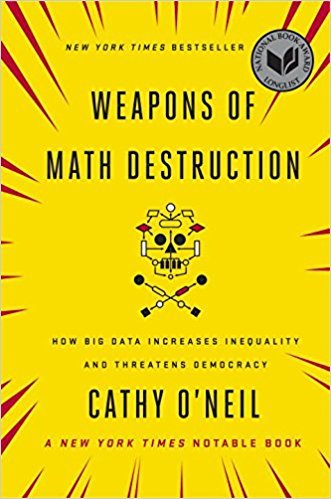
If this seems like hyperbole before you read Weapons of Math Destruction, it certainly won’t by the time you finish it.
From chasing excellent teachers out of failing public schools where they’re desperately needed to keeping qualified applicants out of good jobs and educational institutions to calculating the potential recidivism of inmates in dubious ways that keep the reformed as wards of the prison-industrial complex to creating false feedback loops that reinforce and amplify inequality and limit social mobility to preventing us from advocating for ourselves in the very political system that frequently appears determined to foist all of this upon us, O’Neil makes a convincing case that we should all begin and end our days acknowledging, There but for the grace of the algorithmic gods go I…
“[Y]ou cannot appeal to a WMD,” she writes. “That’s part of their fearsome power. They do not listen. Nor do they bend. They’re deaf to charm, threats, and cajoling but also to logic—even when there is good reason to question the data that feeds their conclusions.”
From her perch at the Mathbabe blog, through her books, and in a bracing TED Talk entitled “The Era of Blind Faith In Big Data Must End,” O’Neil has established herself as an eloquent advocate for humanity in the face of technocracy.
“Models,” she warns we laypeople, “are opinions embedded in mathematics.” Ah, but therein lies the rub. What incentive does any person or institution that benefits from a given algorithmic outcome to acknowledge to themselves or anyone else that the dispassionate automation that got them to it is a fiction, polite or otherwise?
What’s at stakeOf course, none of this is new. When in Ecclesiastes it is said that, “God made men upright, but they have sought out many devices,” it’s not a reference to iPhones and supercomputers…though it easily could be updated as such. Nor is the state of affairs hopeless. It simply requires more honest grappling and pushback than what has hitherto occurred. For that to happen we must first set aside a bit of convenience and have a frank discussion of the stakes.
“The essential point about big data is that a change of scale leads to a change of state,” Mayer-Schönberger and Cukier write. “[T]his transformation not only makes protecting privacy much harder but also presents an entirely new menace: penalties based on propensities. That is the possibility of using big data predictions about people to judge and punish them even before they’ve acted. Doing this negates the idea of fairness, justice, and free will.”
One hopes those remain universal ideals we can all come together to defend.






How to Avoid a Nuclear War
And Make Other Great Decisions
You will never make a fully-informed decision. Accept it. The reality is that every choice involves using limited information, can have unforeseen consequences, and, because of conditions that change before your very eyes, may end up being the wrong decision anyway. Then you will have to change your mind.
Yet you still can make good decisions within the limitations facing you. This starts by taking four critical steps that can focus your decision-making, help you assess the situation before you, help you avoid past mistakes, and provide you with enough flexibility to change course when necessary.
“ You will never make a fully-informed decision. Accept it.—RISHAWN BIDDLE
 1. Make your decisions with the goals in mind
Data is incredibly helpful when it is high quality, fully vetted, and used in sophisticated ways. But even the best data cannot help you assess the future—or make decisions that always hold up over time. As many a political and business leader will admit, unforeseen changes can alter the course of everything, rendering your data useless.
Given that life is full of uncertainty, your first step in decision-making starts with what you are setting out to accomplish. This means setting clear and concise goals that may be achieved even if you must change course or come up with new decisions. As part of that process, you should focus on making your goals specific, measurable, timely and realistic given the lay of the land.

But it isn’t enough to just think about your decisions in the context of your goals. You may even need to reassess whether the goals are achievable or worth doing. After all, the goals themselves may be the bigger problem than the decisions you make to achieve them. This means assessing your goals to see if they are too vague, merely aspirational, or just plain unrealistic.
2. Consider skeptically the conditions before youJohn F. Kennedy learned a critical lesson from his ill-fated backing of the Bay of Pigs invasion: Scrutinize an entire situation critically before making (or going along with) a decision. He put that lesson to good use nearly two years later when he learned that the Soviet Union was placing nuclear missiles in Cuba as part of its alliance with Fidel Castro.
To look holistically at the situation (and to discourage groupthink), Kennedy encouraged each person addressing the Cuban Missile Crisis to act as a “skeptical generalist,” asking tough questions about both the situation and the ideas of their colleagues. He also broke his advisers up into teams (and even asked them to meet without him present) so that they developed alternative strategies. As University of California, Berkeley, Professor Morten T. Hansen points out, Kennedy’s approach helped America (and the Soviet Union) avoid nuclear war.
Kennedy’s approach to his decision-making on the Cuban Missile Crisis is one we should embrace. After all, a situation can be more than what it appears to be, and we are limited in what we can assess from our particular viewpoint. One way to skeptically assess conditions is to seek advice from trusted sponsors, mentors, and colleagues who can provide honest feedback on an issue or situation. Another is to develop alternative solutions to the problems and situations you are tackling; doing so will give you additional approaches to take if you have to change course.
3. Learn from—but don’t dwell on—past mistakesNo one goes through life without making an error or a thousand; you wouldn’t be human if every choice was the right one. Yet those past errors and mistakes are critical in making better decisions; after all, you can only connect the proverbial dots of your life backward in your quest to move forward.
One way to learn from past mistakes is to look at every aspect of those situations. This means sitting down and charting out the conditions at that time, the decisions made in response to them, and how things went awry. What you will learn is that sometimes, the problem wasn’t the decision, but in how you assessed the situation. Other times, the problem may be everything, including unforeseen circumstances you could never anticipate.
This assessment should also include looking at the good that did come out of the mistake—including how you overcame the adversity. Understanding how you made it through a situation is helpful in making good decisions in the present and future.
“ Understanding how you made it through a situation is helpful in making good decisions in the present and future.—RISHAWN BIDDLE
4. Accept the possibility of course correctionEven if you take all the right steps, changes in conditions (from the departure of a supervisor to a natural disaster) can force you to make a different decision. This is okay. As the serenity prayer reminds us all, you are only in control of the things you can change.
The good news is that you can actually make a different decision to achieve your goals when those course corrections happen. So embrace the ability to make decisions—even if they end up being different from your first choices. Always remember that there is more than one way to get to the next level.


Anatomy of a Great Decision

Decision making may be the toughest thing leaders do. we have to make critical choices that affect the welfare and livelihood of dozens or even thousands of people—often using conflicting or incomplete information. In this episode, we’ll show you the three factors leaders must consider when making an important choice.


May 29, 2018
Words as Self-Sabotage
3 Steps to Get Your Brain Back on Track

You are often your own worst enemy. It starts with the words out of your mouth and the voices in your head. From telling yourself that you aren’t knowledgeable enough to take on a new challenge to the nagging doubts about important career moves, the negative words in your mind are obstacles to the success you want to achieve.
A little self-doubt is normal because life is filled with uncertainty. The risks that you take to stretch yourself and succeed are real ones, accompanied by the possibility of failure. But when you speak ill to yourself, you are hurting your chances for success.
It doesn’t have to be this way. There are three simple steps you can take right now to stop sabotaging yourself—and affirm your capacity for success.
“ The words in your mind are obstacles to the success you want to achieve.—RISHAWN BIDDLE
1. Change the words in your mindGospel singer Hezekiah Walker once sang, “I won’t harm you with words from my mouth.” But each and every day, people sabotage themselves with the I can’ts and I’m not good enoughs in their minds. Not only do these words cause career-limiting procrastination and indecision, they even contribute to physical ailments and untimely deaths.
Simply ignoring these words of doubt isn’t enough. You must combat them with affirmations of your capacity to take on challenges and succeed. This starts at the end of the day by listing and reciting I cans, I ams, and even I wills, affirming your ability to achieve. By affirming yourself before going to bed, you organize and focus your mind on achievement.
Another strategy lies in recalling your past successes—and writing them down so you can reference them every now and then. Even the simplest signposted achievement can cause you to feel positive about your ability to succeed in the future. More importantly, those thoughts, along with the positive words, crowd out the negative words stuck on repeat in your head.
2. Deal with the fears insideWilliam Shakespeare wrote in Measure for Measure that “Our doubts are traitors.” They make us “lose the good we oft might win.” Those doubts, and the words of self-sabotage that emerge from them, result from the fears of failure. Too often, these fears are allowed to fester.

You must realize that fear is not a sign that you are incapable, but merely the signal that you must take on the next challenge. By understanding fear as a positive signal, you can then take action instead of wallowing in indecision and procrastination. That fear can even help you find ways to avoid pitfalls on the way to progress.
At the same time, you should accept fear as a healthy way of driving your own self-improvement. You may not know everything you need to take on the next challenge. So read books on the areas you are about to undertake, and seek advice from sponsors, mentors, and others whom you trust.
3. Embrace the fact that you are enough.Once you embrace words of affirmation and leverage your fear for success, you will stop engaging in self-sabotage—and see yourself as more than capable of achieving what you set out to do.
“Life can only be understood backward, but it must be lived forwards,” said the philosopher Soren Kierkegaard. This means looking at your past successes and moments of overcoming adversity, then using those lessons to tackle the challenges and opportunities ahead.
“ Once you embrace words of affirmation and leverage your fear for success, you will stop engaging in self-sabotage—and see yourself as more than capable of achieving what you set out to do.—RISHAWN BIDDLE
Another step lies in realizing that you are smarter and talented than you think you are. If you have achieved in the past, you can succeed in the future. By remembering this, you are engaging in what author Margie Warrell describes as calling out the critic, dissecting the doubts and words of self-sabotage that keep you from seeing your full potential.
Finally, you should stay true to yourself. This is critical in pushing back against words of self-doubt and the self-sabotage that results from them. Steve Jobs once said that you shouldn’t let the noise of other people’s opinions drown out your inner voice. Knowledge that you are being true to your best self is a great way of shutting out the inner critic as well.


The Power of Your Words to Shape Outcomes
Leaders always want positive outcomes, but many are unaware of how their thoughts and words may undermine their success. Based on years of shaping the culture of organizations, Michael and Megan show you three key principles to ensure that your words have a positive effect on your organization—and yourself.


The Science of Words
How Repetition Can Be a Game Changer
The idea of self-talk elicits images of less-than-sane people muttering to themselves as they stumble about less-than-safe streets. I try not to look like that when I talk to myself. In theory, this means ensuring my internal monologue is actually internal when other people are about. In practice, people are always sneaking around corners and into elevators with me as I recite my day’s to-do list or ask myself if I turned off the stove.
Luckily, self-talk is more the rule than the exception and most people respond to its externalization with a knowing smile and a polite nod of the head. It’s polite to stop once caught in the act, of course, but having followed this protocol no one has ever backed slowly away from me in fear.
In fact, as scientists learn more about the benefits of self-talk, whispering “tuna fish” while hunting for cans on grocery store shelves has become more common.
Positive words enhanceSelf-talk is a growing research field, especially as it relates to sports performance. In one study, basketball players instructed to self-talk using the word “relax” experienced enhanced performance results when compared to those who either didn’t self-talk at all or used the word “fast.” Likewise, a 2017 study found that positive self-talk increased tennis players’ “enjoyment and perseverance.”
What is it about self-talk that helps athletes perform at such high levels?
Researchers believe it has to do with attention. Self-talk serves to help people focus, blocking out distractions and minimizing ego. Given this mechanism, you would expect self-talk to influence performance outside of sports, and you’d be right.
In a classically designed study of preschoolers, children were left alone in a room with an alluring, forbidden toy. Videotape footage revealed strategies of self-control, as well as showing which kids succeeded and which ended up with a shiny new toy in hand. Children who used verbal self-talk were more likely to avoid touching the toy.

In another study, nine cyclists spent two weeks training in motivational self-talk. The training was specifically meant to increase both physical and cognitive heat endurance. An additional nine cyclists were used as a control. Both before and after training the cyclists underwent rigorous training in the heat, punctuated by breaks in which executive function, reaction time, and working memory were tested. The self-talk group saw significant improvement in physical heat endurance, measured by time to exhaustion. They also saw improved executive function in terms of both speed and accuracy. The control group exhibited no such improvement.
Negative words limitJust as positive words can build us up, negative words have the power to cut us down. The link between critical self-talk and anxiety is recurrent in the literature. Medical students with test anxiety, for example, point to a critical inner monologue during their test preparation period as a culprit and negative self-talk has been linked to anxiety in children.
“ Just as positive words can build us up, negative words have the power to cut us down.—ERIN WILDERMUTH
Words and the biology of perceptionThough perception is often thought of as merely a mental process, it isn’t all in our heads. There is evidence that language changes the very biology of how we process the world around us.
In a 2013 study, researchers showed volunteers two images. Before one eye, a familiar shape. Before the other, high-contrast, flashing squiggles. The technique – continuous flash suppression – is a trick of sorts. Visual exposure to dynamic lines overpowers the familiar image, leaving it invisible to most people.
To test the power of language, volunteers were primed with either the word for the suppressed object, a random word, or static noise. Those who were primed with the word were more likely to see the object. Interestingly, subjects exposed to the wrong word were less likely see the suppressed object than those exposed to static noise. This indicates that language has a real impact on our systems of perception.
“If language affects performance on a test like this, it indicates that language is influencing vision at a pretty early stage. It’s getting really deep into the visual system,” explains researcher Gary Lupyan. In a subsequent study, participants were better able to find an object if they said its name out loud, so keeping whispering “tuna fish” at the grocery store.
“ Though perception is often thought of as merely a mental process, it isn’t all in our heads. There is evidence that language changes the very biology of how we process the world around us.—ERIN WILDERMUTH
Though visual biology has been most researched, preliminary data suggest that words can impact more than sight. One study, for example, points to self-talk as a possible mechanism of pain relief.
Applying the power of wordsThe more we learn about the power of words and self-talk, the more we can use this information to our advantage. Beyond grocery store incantations, words can be used to build our self-esteem, enhance performance and self-regulate our impulses. Whether repeated in your mind or out loud, words have power.


Words That Changed History
Why Lincoln, Henry, and Sojourner Truth Stood Out
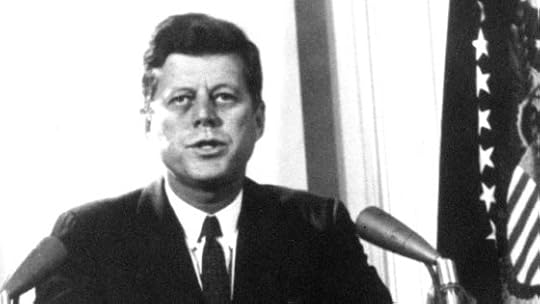
People have delivered countless speeches in history. But even speeches delivered by the most prominent people, on the most auspicious occasions, routinely make little difference. Think of presidential speeches, like inaugural or State of the Union addresses. How many of them had any lasting impact? Just a few, like John F. Kennedy’s 1961 exhortation to “ask not what your country can do for you—ask what you can do for your country.”
What makes great historic orations so powerful? Typically, they combine well-crafted words, clarity of thought, moral passion, and an uncanny sense of historical timing. Many of the greatest speeches of history were not destined to become great. Often the speaker was not the most famous person in the room, or was not giving the keynote address. Sometimes the oration was so unexpected that we don’t even have the text of the original speech. But that combination of apt, passionate words, delivered at the right moment, sometimes changes the course of history.
“ Apt, passionate words, delivered at the right moment, sometimes changes the course of history.—THOMAS KIDD
Three examples will illustrate my point. The first and third of these speeches you probably know; the second speech, you might not.
Liberty or bustThe first speech is Patrick Henry’s “Liberty or Death” oration in 1775 in Virginia, on the eve of the American Revolution. This was the most influential speech in inspiring the war of independence against Britain. Henry was already known as a brilliant, fiery orator in 1775. Some said that he spoke like the revivalists of the Great Awakening, whose meetings he had attended as a boy in the mid-1700s.
The Patriots at the Virginia Convention, meeting at St. John’s Church in Richmond, were divided between those who wanted to keep seeking reconciliation with Britain, and those like Henry who saw war as the inevitable outcome of their struggle over taxes and British power in America. Henry called on his fellow colonists to muster the courage to fight. “I know not what course others may take,” Henry thundered, “but as for me, give me liberty or give me death!” Part of the moral urgency of the short speech came from its repeated invocations of the Bible, especially the prophet Jeremiah. As was Henry’s style, “Liberty or Death” was part sermon, part speech.
“Liberty or Death” was also the most famous oration in American history for which we do not have the original text. Whether Henry failed to write down the speech or did not save a copy, we don’t know. The text we have was patched together forty years later, by an admiring historian. But Americans had already adopted the slogan “Liberty or Death” as a battle cry in 1776. Slaves knew the phrase, too, and made their own use of it. The slave rebel Gabriel in 1800 in Richmond reportedly intended to lead his collaborators marching under a banner reading “Death or Liberty.”
Woman speaks upThe author of our second speech, Sojourner Truth, was herself a former slave in New York. She delivered her 1851 oration “Arn’t I a Woman?” at a women’s rights convention in Akron, Ohio. Even more than Henry’s Liberty or Death speech, “Arn’t I a Woman?” took on a life of its own afterwards, becoming one of the most commonly cited historical addresses by an African American woman. The illiterate Truth (born Isabella Baumfree, but changed her name in 1843) boldly addressed those who said women should have no political rights. “I can do as much work as any man. I have plowed and reaped and husked and chopped and mowed, and can any man do more than that?” she asked.

Sojourner Truth Monument – Battle Creek CVB
Twelve years later, a friend of Truth’s recalled that she also declared, “And arn’t I a woman? I have borne thirteen children, and seen them most all sold off to slavery, and when I cried out with my mother’s grief, none but Jesus heard me! And arn’t I a woman?” As with Henry’s “Liberty or Death,” we don’t have the original text of Truth’s speech. But she spoke with unprecedented power and passion about the struggles of a woman and a slave in pre-Civil War America.
Forgetting EverettFinally, there’s Abraham Lincoln’s Gettysburg Address, given in 1863 at the dedication of the Union cemetery at the Gettysburg battlefield. This has become one of the most famous speeches in American history. It is so brilliantly brief that countless American schoolchildren have memorized it. But Lincoln was not even the featured speaker at Gettysburg that day. That role fell to Edward Everett, a former congressman and Harvard president who was probably the nation’s most celebrated orator in 1863. Everett gave a two-hour long speech which was probably well received at the moment, but which is now almost totally ignored.
No one expected Lincoln’s two-minute remarks to change the meaning of the war and of American history. Before the Gettysburg Address, many white Americans – including northerners – did not wish to extend the blessings of liberty to African Americans. But Lincoln insisted that the Declaration of Independence had founded a nation “conceived in liberty and dedicated to the proposition that all men are created equal.”
“Under God,” he proclaimed, America would have “a new birth of freedom.” His audience would have instantly understood what Lincoln meant. Because of the Civil War, America itself could be “born again,” as the Gospel of John puts it, into a new life of freedom: freedom for slaves. Moreover, he believed that the Union army’s victory would ensure that “government of the people, by the people, and for the people shall not perish from the earth.”
Unexpected orationsThese examples show that the greatest speeches are not always easy to anticipate beforehand. Many critics did not believe that Sojourner Truth, as a black woman, should even be speaking in public in 1851. Lincoln and Henry were far more prominent and accepted figures, of course, but Lincoln was not the main speaker at Gettysburg, and no one bothered to write down and save Henry’s speech. Yet all three, under differing circumstances, combined the right timing, clarity, and moral power to craft history-changing speeches.


May 22, 2018
The Science of Naps
Snooze Now, Conquer Later

My two-year-old is asleep for the third time today. I thought I had developed a clever disciplinary method when I started telling him that cranky kids need naps, and sending him to bed multiple times. Turns out I was being more clever than I knew. Instead of being better behaved, he just keeps going to sleep. There seems to be no limit to the number of naps this kid can take. As an added bonus, without fail, he awakens a much more pleasant child.
My father has also started taking naps more seriously. He has always an epic sleeper. I remember him lightly snoozing in his chair as the rest of us went about our business, mumbling that he was awake if asked. In celebration of retirement, he has taken it to the next level—graduating to daily, horizontal naps.
With the old and young around me choosing naps, I can’t help but wonder if I’m missing out on something.

I’m not the only one. Arnold Schwarzenegger and Arianna Huffington have spoken about their napping habits, and they are not alone. A quick glance through history books reveals a long line of influential nappers. Albert Einstein, Leonardo Da Vinci, and Thomas Edison were all known to take naps.
Their decision, it turns out, is backed by science.
Napping and productivityThe benefits of getting enough sleep are widely acknowledged, but why choose naps instead of catching more Zs at night? The simple answer is that it makes the second part of your day as productive as the first. About an hour after waking is considered our most productive time. Even if you consider yourself a night-owl, chances are your cognitive abilities are sharper after some shut-eye. It is more than common sense. It is science.
In a review of the many studies conducted on napping, Dr. Catherine Milner and Dr. Kimberly A. Cote find a host of productivity-related benefits. Napping improves reaction time, psychomotor speed, vigor, and vigilance. In one [study}(https://elibrary.ru/item.asp?id=7466161), participants saw their ability to complete additional tasks improve post-nap and in another, retirees saw improvements in episodic memory, visuospatial abilities, and general cognition. Yet another study on memory found that working-aged people were able to perform recall tasks better after a nap when compared to drinking coffee. The nap doesn’t need to be long: even a six-minute micro-nap improves declarative memory.
Napping and learningSleep is known to help consolidate memory and contribute to learning, but some scientists say the same benefits can be reaped from naps. Dr. Sara Mednick looks at how sleep impacts learning. In a 2003 study, she found that a 90-minute snooze is just about as good for learning perceptual skills as a full eight hours. Even better, the power of a nap adds to the learning potential experienced during regular sleeping hours.
Participants who napped in addition to their regular sleep schedule experienced “improvement, such that performance over 24 hours showed as much learning as is normally seen after twice that length of time.” The research suggests that if you’re struggling with complex learning tasks, a nap can help.

We know that getting enough sleep is important for overall health, but there is also evidence that napping, in particular, is a healthy habit. A 2016 study by the European Society of Cardiology compared the health of 386 patients with arterial hypertension to see how napping might impact their health.
Those that took mid-day naps had lower blood pressure and anatomical evidence of less blood pressure related damage. Napping was also associated with fewer medication prescriptions.
The benefits extend into real-world results. In a longitudinal study of over 23,000 healthy people, nappers had a much lower rate of coronary mortality. Those who napped occasionally had a 12% lower coronary mortality rate, while those who napped often had a 37% percent lower rate.
Towards a culture of nappingNapping is becoming popular because it is easier to coordinate than a full eight hours of blissfully uninterrupted shut-eye at night. Work hours are long and time with our families is precious. A twenty-minute nap can be slotted in between meetings or a longer snooze can take place over lunch, leaving free time at home to be spent on hobbies or with loved ones.
In China, public napping is commonplace. “It’s nothing unusual,” Chinese journalist Lorraine Lu writes. “If you get tired, you just put a cushion or pillow on your desk, lay your head on it and rest for 15 minutes.”
Aside from the workplace, subways and even Ikea are fair game. The same is true of several other Asia countries, and the afternoon siesta is a time-honored condition in many Spanish-speaking nations.
Though the United States is yet to catch up, some companies are coming around to the idea of corporate nap time. A 2011 found that 34% of respondents were allowed to nap at work and hundreds of sleep pods are popping up in offices, hospitals, and schools around the country.
If you aren’t one of the Americans already taking naps, there is no time like the present.


Bouncing Back After Burnout
Real Stories from Leaders Like You

The intentions are noble: You want to buy a house with a backyard for your kids, pay off debt, or do something to actually justify the $50,000 worth of student loans that feels like a noose around your neck.
You vow to work harder than everyone else on your team, to be the first one in and the last one to leave. Every new opportunity is a chance to showcase your talents, your leadership skills, your ability to thrive under pressure. You say “yes.” To everything. In fact, you’ve forgotten how to say “no.”
But you can’t do enough, be enough, earn enough, fast enough, and even as you devise a way to keep your head above water (barely), the things that matter most—your relationships with family and friends; your physical, mental, and spiritual health—spiral helplessly out of control.

The “whys” don’t matter anymore—you work too much to enjoy the new house, or the extra cash in your pocket now that you’re debt-free. All you can see is a list of to-dos that’s long and growing. Eventually, you hit a wall. You. Are. Burned. Out.
This pattern happens to the best of us. In fact, research from The American Institute of Stress shows that 80% of workers feel stress on the job, and nearly half say they need help in learning how to manage it—meaning they’re likely moments away from slamming into their very own wall if they haven’t already.
But an all-too-common case of burnout doesn’t have to be the end of your career, nor does it have to be the death of your desire to succeed. In fact, hitting rock bottom can provide the clarity that so many leaders lack after months or years of day-to-day drudgery. This clarity can propel you toward your life’s purpose and enable you to do work that is both fulfilling and sustainable. Just ask the following three leaders:
From over-caffeinated and broken to inspired and wholeCharlie Hugh-Jones is a perfect example of goals gone wrong. He hit the mark of becoming a partner at one of London’s top law firms within ten years of graduation, but that achievement came at the expense of his health and most valuable relationships. He was even known as “Mr. 11 by 11,” thanks to his propensity to down 11 shots of coffee by 11 am.
It all came crashing down when Hugh-Jones lost control in a meeting (what he refers to as his Jerry Maguire moment) And instead of pushing through, he decided to make some tough decisions and realign his life for good.
“ Burnout doesn’t have to be the end of your career. You can turn it around and realign your life.—ANDREA WILLIAMS
“The initial step was for me to redefine productivity from ‘getting more done’ to ‘getting more of what matters most done,’” Hugh-Jones says. “This shifted my focus and enabled me to become more intentional about what I gave my attention to, but first I had to define and determine what mattered most to me.”
Hugh-Jones, now living in Florida and working as a writer, speaker, and coach and helping others struggling to live their best lives, also developed a renewed focus on his personal health. He reduced his caffeine dependence, cut gluten and dairy from his diet, began to work out regularly, and established a nighttime routine to improve the quality of his sleep.
“All these steps enable me to function far more effectively, to be more present, to communicate better, and to listen far more powerfully,” Hugh-Jones says. “This, in turn, has increased my capacity to do more of what matters most—including helping others make a similar journey.”
Making work really workFinancially, entrepreneur and business leader Troy Hazard was having his best year. Sales were up 40 percent, with profits up 36 percent. He was doing so well, in fact, that he started to splurge a little on personal interests and hobbies instead of putting it all of the profit back into his business.
But neither the success nor the money could negate the 246 nights he spent away from home, or the back-to-back 16-hour days, or the weekends spent speaking at business conferences.
“I totally ran out of steam,” Hazard says. “In the middle of the year, I had an emotional brain snap and ended a long-term relationship with the woman I was convinced would be the mother of my children. And some months after that, I experienced yet another relationship breakdown. Put that all into one body and one year, and it was total overload.”
Hazard hired a “soul coach” who helped him reassess what really mattered in his life.
“Sometimes you need someone to hold up the mirror,” he explains. “Hitting the wall does not come from ignorance, it comes from distraction. I needed to look introspectively at what I was addicted to—was it success, respect, love, power, freedom? For me, it was a bit of all of the above. I needed to work out what addictions were leading me to the right place and what addictions I needed to get out of my life to help me be me and not be addicted to the need for happiness. I had to simply open up to what truly made me happy.

“Can money buy you happiness? For sure—so long as you understand what truly makes you happy. Then your business works for you, and you don’t work for it.”
As a successful entrepreneur with more than 12 business in the US and Australia, Hazard is constantly approached with new opportunities. Now, though, he uses a simple test to gauge their worthiness and avoid burnout.
“The typical question my wife asks when considering another project is, ‘Is it worth a sandcastle?’” Hazard says. “In our house, that means, ‘Is it worth taking me off the beach building sandcastles with our kids to invest my time in that. Most times, the answer is ‘No, we’re good; we have enough; our family is well cared for; go back to the beach!’”
Slow and steady wins in businessDepending on who you ask, email, app, and text message alerts are devices of torture crafted by the devil himself. Each and every one is a reminder of something else that needs to be done, and it’s for this reason, perhaps, that Tyler Butler, Founder and Principal of 11Eleven Consulting, tends to ignore them.
“Because of the hyper-connectivity that today’s technology affords us, being comfortably behind is a great tool to avoid burnout,” Butler says. “There will always be emails in the inbox and tasks that are newly designated to you, but it is how you manage yourself and your time that will determine your burnout rate. I believe that we train people as to how we want to be treated—in business and in life—so, by being realistic about bandwidth, you are training your team as to what is a reasonable workload to manage.”
Butler speaks from personal experience, of course. After working in several corporate executive roles, she began experiences constant fatigue, poor sleep, forgetfulness, loss of appetite, anxiety, and feelings of resentment toward her work—all common signs of burnout. Ultimately, she left the corporate world and made a conscious decision to overhaul her entire lifestyle—including her average response time to those pesky alerts.
“I took time to rest by sleeping 7-8 hours a night, taking weekends completely off from all adult responsibilities, and, in general, allowing myself to have lazy time,” Butler says. “I took a break from worrying about things always being perfect and instead adopted the mindset that done is better than perfect. I made a conscious decision to prioritize family and friends above all else, blocking out my calendar to ensure that the most important people in my life were treated as such. And I took real time to travel. In fact, last year alone I visited eight countries, placing a real importance on my own personal happiness and making time for things that I love to do.”
“ I made a conscious decision to prioritize family and friends above all else, blocking out my calendar to ensure that the most important people in my life were treated as such.—TYLER BUTLER
That doesn’t mean that Butler has put a pause on her career aspirations. Her new company helps large companies develop corporate responsibility initiatives, and while it isn’t directly related to her newfound enlightenment, more often than not, she uses her experiences to positively impact her clients.
“My hope is that, when I set a healthy and balanced tone, the rest of the team will follow so that, in conjunction with my actual deliverables, I can also be a change agent in other positive ways for that organization.”


The Importance of Play
Have an Adventure, Wherever You Are

This past weekend our family had to cancel a special trip to a friend’s lake house that had been circled on the calendar for months. Our initial weekend plans had play and adventure built into them to recharge the grownups, help us finish a busy season well and open our minds up to new possibilities for the season to come.
As we were scrambling to make new plans, each member of our family got a vote. And each intuitively cast a ballot for adventure as part of the new weekend agenda. Our 2-year-old wanted to visit great Paw Paw at the lake, so on Saturday morning after visiting the Farmer’s Market we drove 30 minutes north to the lake. Our son proceeded to play with vintage toys that have been enjoyed by countless generations while mom and big sister picked a bouquet of wildflowers.
Next, our 5-year-old wanted to play with the neighbor’s puppies. So on Sunday afternoon she brought over two Labradoodle-corgi mix puppies (Labracorgle anyone?) to play with our disinterested Bulldog.
If you have been around children for any extended period you will quickly notice their ability to play with the most basic objects for hours on end. For example, both of our kids have loved stacking ordinary objects like plastic solo cups and cans of tuna.
As they have gotten older the level of difficulty and creativity have also improved. Our oldest now enjoys creating forts, obstacle courses, and fairy gardens. Their primary job in life is to play and they do it well. As they are transitioning from play-only to something like play-clean up — play play with something else and then clean that up –, we are working diligently to not stifle their creativity in the name of organization and parental sanity.
For some reason, there seems to be an unwritten rule that adults move on from childish play to more serious work. Unfortunately, we sacrifice a lot of creativity by making the shift and some organizations are noticing the effects and making changes. For example, in a recent Story Brand Podcast, Donald Miller revealed that his staff took a middle of the day break to go play ultimate frisbee.

Other organizations bring in experts to structure team building activities that are play-based, require cooperation, and result in creativity. Entire workplace structures have even changed to adopt more play as evidenced by the trend of cooperative working spaces.
Popular blogger Mr. Money Mustache built a co-working and hangout space that is membership-based, promotes the things that he values such as biking to work, and offers several amenities include an outdoor gym and outdoor patio.
Closer to home, we have been privileged to enjoy a new hip and local co-working space named Communion Neighborhood Cooperative, that boasts a putting green and foosball table.
People are on the moveNot only are some organizations prioritizing play but individuals are seeking it out in the form of outdoor expeditions such as Way Forward Adventures in Colorado and Arctic Wild in Alaska.
Others are adopting more play into their lives by adjusting their exercise modalities. Movement such as MovNat, Parkour, rock climbing, and American Ninja Warrior have gained in popularity by encouraging adult participants to view the world as a playground and to open their minds to new possibilities of ways to move their body through space while using ordinary objects in unordinary ways. A tree no longer functions as merely a shady spot to park the car underneath but it is now an object to climb, hang from, run around, and do pullups on.
According to the Association for Psychological Science, “Research has found evidence that play at work is linked with less fatigue, boredom, stress, and burnout in individual workers. Play is also positively associated with job satisfaction, sense of competence, and creativity. Studies show that when a participant receives a task that is presented playfully, they are more involved and spend more time on the task.”
“ Research has found evidence that play at work is linked with less fatigue, boredom, stress, and burnout in individual workers.
While employers could certainly benefit from adopting more play, I would argue that it is up to each individual employee to find opportunities for play throughout their day. For example, instead of throwing your trash or recycling away, try shooting it into the receptacle and scoring a three-point shot.
Need help resolving an inconsequential disagreement like where to go for lunch? Play rock paper scissors (best 2 out of 3!). Do you have a menial task that no one wants to do? Try playing a quick card game of speed. The loser will at least be doing the task from a more playful state of mind.

Returning to our adventure, the grownups chose play and adventure as well because we have learned that it is so good for our souls and for our ability to give others our presence. Laura chose yoga and I chose pickup basketball as our modes of play for the weekend.
The entire family enjoyed community with trips to the Farmer’s Market, Sunday morning breakfast with our Home Group followed by attending the late church service together as a group, and a Sunday afternoon excursion to watch the local minor league baseball team in person.
Monday morning still came and the calendar showed a very busy week and month ahead. But we were more prepared to endure the season from the rejuvenation of the weekend. And our minds were opened to new possibilities from which both we and our employers can benefit.