Michael Hyatt's Blog, page 194
June 29, 2012
How to Know When to Change Course


This is a guest post by Thad Puckett. He is employed by The Karis Group, an Austin, Texas firm where he is an Implementation and Data Manager. He formerly served as a cross-cultural missionary in Asia for almost twenty years. You can follow Thad on his blog and on Twitter.
There will probably be no more iconic symbol for failure in our lifetime than the picture of the Costa Concordia cruise ship listing while aground off the shore of Italy. At least seventeen people died in the tragedy after the captain of the ship (apparently) intentionally moved closer to the shore than is safe for ships of that size.
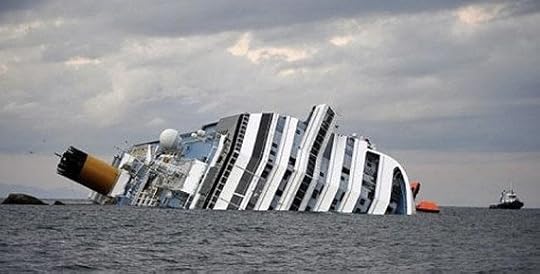
It is easy to compare the Costa Concordia with the Titanic, another cruise liner disaster from long ago. But there are some key differences. And it is in those differences that we can learn a few lessons to navigate life.
First, the Titanic was built in an era of big ships but with no technology available for the captain to see his way ahead. Radar was decades away from development. So as the Titanic was built and launched, its claim to being unsinkable was predicated on the toughness of the hull of the ship.
It is not surprising that the crew could not see an iceberg that was large above the water line and much larger still below the water line. Back then they could only see what their eyes could see. (Interestingly, if they really believed the ship was unsinkable, why would watches even need to be posted?)
The Costa Concordia, on the other hand, had all the advantages of modern technology. It not only had radar to see above the water, it had depth finders and quite possibly even sonar. (I am not one hundred percent sure of that, but the technology certainly exists today.) The crew should have known how deep the waters were and, because of GPS where they were within thirty feet of accuracy.
Yet due to hubris and human error, the Costa Concordia was where it should not have been. And despite the technology, the crew ran aground, the ship foundered, and lives were lost.
There is so much to learn here about leadership and life. Let me suggest four:
When we cannot see clearly, we should exercise caution. The Titanic’s crew could not see that far ahead, but they proceeded without caution. We may feel tough. We may feel unsinkable. But if we don’t have clear vision, or if we cannot enunciate a clear vision, we are in danger if we rush ahead blindly.
When we don’t pay attention to feedback, we can run aground. The danger here is due to not recognizing the danger. Failure to seek feedback is folly. Failure to listen to it is foolishness.
When we have vision, we need to clarify it regularly. Instruments on aircraft or ships need to be calibrated to verify accuracy. In life, we need to clarify our vision repeatedly in order to insure that we are on track with where we want to go. A friend once told me if you profess to have vision but no one is following you, it is likely you merely had indigestion.
When we have clarity, we need to practice humility. Every person who is more confident in themselves than in the vision they espouse is vulnerable to prideful downfalls. Great leaders can crash in the blink of an eye.
We all make choices as we navigate life. We all have an impact on others, whether it is our family, friends or colleagues. It is vitally important for us to have a clear sense of ourselves, a clear sense of our relationship with the Eternal, and a clear sense of our relationships with those we influence. If we have that clarity we will see success, but if we don’t we may well crash on the rocks.
Questions: What about you? Do you have a personal vision statement? Are you seeking feedback about your life’s direction? You can leave a comment by clicking here.







June 28, 2012
10 Strategies for Getting a Faster Response to Your Email
Responsiveness is a critical life skill. In fact, I think it may be the single most important factor to your success. People who are not responsive miss out on many opportunities. Why? Because others get tired of waiting on them.

Photo courtesy of ©iStockphoto.com/bookwyrmm
But, let’s be honest—not everyone you or I deal with shares this value. Or, even if they give lip service to it, they don’t practice it in daily life. And so, you wait. And wait. Meanwhile, your own work stacks up and you look unresponsive to your constituents.
It would be great if you never had to deal with these people. The problem is that sometimes “these people” include your boss, a colleague you don’t have authority over, or an important customer. How do you get them to respond to you in a timely manner?
Here are ten strategies that I have found helpful:
Put their name in the “To” field. This should be obvious, but if you want a response from a specific individual, put that person’s name in the To field and that person’s name alone. If there is more than one name, he or she might assume that one of the others will answer. Also, never use the CC field for any purpose other than FYI.
Double-check the email address. A few months ago, one of my colleagues wasn’t getting a response from one of our authors. He said, “I’ve emailed him five times.” I was a little irritated myself, so I said, “Forward me your last email, and I will follow-up.” When I got the email, I noticed that my colleague had one character missing in the email address. I asked him to resend the original email with the correct address. The author responded within the hour.
Write a relevant subject line. Think of the subject line like the headline of a newspaper. The goal is to get them to actually read the body copy. The more specific you can make it, the better. For example, if you are sending me a meeting agenda, don’t just put “Agenda” in the subject line. I get lots of agendas. Instead, put something like “Agenda for June 10th Executive Team Meeting.”
Put your question at the top. Writing a good email is like writing a good blog post or magazine article. As they say, “don’t bury the lead.” Put the most important content (the “lead”) in the very first paragraph. Don’t assume that the recipient will read beyond that. You can use the rest of the email to provide support or background information.
Keep your message short. Long emails only encourage procrastination. Think of your own behavior. What happens when you get a long email? Right. You save it for later. Unfortunately, many people never get around to “later.” If you keep the message short, you make it easy for the other person to digest what you have said and respond now.
Use the high priority flag. You have to be careful with this, because if you use it with every message, people will “brand you” as someone who always cries “Wolf!” However, if you use this sparingly, it can communicate urgency. You can also begin the subject line with the word “Urgent,” a colon, and then your subject. For example, “Urgent: About to Miss the Grisham Deadline.”
Offer multiple choices. Make it easy on the reader. Narrow the range of options down to two or three and then ask them to pick one. For example, “Which hotel do you prefer for our upcoming trip to San Jose: (1) the Marriott, (2) the Sheraton, or (3) the Hilton?” After you ask the question, you can provide the backup on each hotel.
Provide a deadline. This makes your expectations clear, so the reader is less likely to procrastinate. I would advise against providing an artificial or bogus deadline. If the other person discovers that the deadline was not real, your credibility will be damaged. He will never take your deadlines seriously again. Instead, provide the specific date and time. For example, “by noon tomorrow (Thursday)” or “by 5:00 p.m. on Friday, August 7th.”
Use a “negative option.” When all else fails, this is the strategy I use. Here’s how it works: You tell the person what you are going to do unless you hear back from them by a certain time. This makes their response optional. For example, “Unless you reply by noon tomorrow, I will assume that the proposal meets with your approval and send it on to the client.”
Copy their boss. This is dangerous, I know. The person may respond, but they will likely also resent it. I never do this unless I am out of options, and I can’t get a response any other way. Before you use this strategy, you need to consider the collateral damage to the relationship. However, there are times when you have no other choice.
Finally, maybe you shouldn’t be using email at all. I know it’s hard to believe, but not everyone prefers email. If the person isn’t responding, why keep beating your head against the wall? Instead, Twitter them (via DM), call them on the phone, or drop by for a visit. If the other person is your boss or customer, it is your job to conform to their communication preferences not the other way around.
What strategies have you found helpful for getting a faster response? You can leave a comment by clicking here.



June 27, 2012
#018: 7 Steps to Getting the Most from Your Vacation [Podcast]
In this episode, I talk about some nut-and-bolt strategies for getting the most from your vacation. Gail and I are about to take our annual summer sabbatical, so vacations are very much on our mind.

Surprisingly, some people never take vacations. I don’t know if this is because they think they are indispensable or because they might discover they are not. Regardless, vacations are essential for your spiritual, emotional, relational, and physical health.
Click to Listen
[image error]
Podcast: Subscribe in iTunes | Play in browser | Download
Episode Outline
My premise for this episode is that you will be more rested, re-energized, and refreshed if you are intentional about your vacation and do a little planning. I discuss the following seven steps.
Understand the various types of vacations.
Choose the vacation that makes sense for you.
Get caught up before you leave.
Delegate authority to act in your absence.
Set other people’s expectations.
Focus on the purpose of your vacation.
Block the first day when you get back to catch up.
Your vacations are more important than you think. If you are going to stay healthy spiritually, emotionally, relationally, and physically, you need to be intentional about them.
Listener Questions
Austin Hill asked, “I only have time to write and do social media on vacation, so how do I unplug.”
Jen McDonough asked, “Is it okay to be checking my e-mail during my vacation?”
Michael Nichols asked a similar question but with a story from Seth Godin that gives a different twist.
Michele Cushatt asked, “I always feel a pretty significant loss of momentum when I disengage. How can I prevent this?”
Tony Paganelli asked, “I find unplugging from e-mail really stressful, wondering what is landing in my inbox. Is this really necessary?”
Wayne Stiles asked, “What do I do with Twitter during vacation? Do I pre-schedule tweets or just let it go?”
Special Announcements
The Platform book continues to do well. It remains in Amazon’s top 500 books overall, which is fantastic a month after initial publication. It’s still #1 in several categories and it is #2 in Marketing. If you haven’t bought it yet, I hope you will.
I just returned from West Palm Beach, Florida, where I spoke at an event hosted by John Maxwell. We had about 800 people there, and I loved interacting with the people in the audience. I gave my “Platform: Get Noticed in a Noisy World” speech.
If you are interested in having me in to speak on this topic, I’d love to talk with you. Click here for more information. I can customize the content for your particular industry, whether it is mortgage bankers, real estate agents, small businesses, etc.
I am going on vacation until Friday, July 20th. I will not be producing a podcast while I am away. I will post my next episode on Wednesday, July 25th. In the meantime, you might want to take this opportunity to catch up. You can find my entire archive of podcasts here.
Episode Resources
In this episode I mentioned several resources, including:
Book: The Power of Full Engagement by Jim Loehr and Tony Schwartz.
Podcast: Episode #5, “How to Take Control of Your E-mail Inbox
Post: “What I Learned from My 48-Hour Twitter Fast”
Subscription Links
If you have enjoyed this podcast, please subscribe:

iTunes

Zune

RSS
Your Feedback
If you have an idea for a podcast you would like to see or a question about an upcoming episode, e-mail me.
Also, if you enjoyed the show, please rate it on iTunes and write a brief review. That would help tremendously in getting the word out! Thanks.
Question: What suggestions do you have for getting the most from your vacation? You can leave a comment by clicking here.



June 26, 2012
Leadership, Success, and Accessibility
The more successful you become as a leader, the more other people will demand of your time. As a result, if you are going to maintain margin for your most important priorities, you will have to make some difficult decisions about your accessibility.

Photo courtesy of ©iStockphoto.com/ugurhan
Recently, I was listening to Andy Stanley talk about this very topic. He said,
The harsh reality of leadership is that the more successful we are, the less accessible we become. As things grow and as more people become involved, a leader can’t be equally accessible to all people. So then we are faced with the dilemma of who gets my time and who doesn’t, when do they get it, and and how much of it do they get.
Your time is a zero sum game. When you say yes to one thing, you are simultaneously saying no to something else. The more successful you get, the more difficult this becomes. You find yourself saying no to good things—worthy things—in order to say yes to your most important priorities.
For example, last week I spoke at a writer’s conference. After my speech, at least a dozen people handed me their book proposal or manuscript and asked if I would read it and tell them what I think. I truly love helping authors. There was a time when I would have felt guilty about saying no.
After all, from the perspective of the one asking, it is not a big request. But, what they usually don’t realize is that I get dozens of these requests each week. To agree to their request would require a major investment of my time. Add all the requests together, and I am soon eating into the time allotted for my own projects, friends, family, and health.
As a result, I said to each one, “I am sorry, but I am afraid that won’t be possible. In order to be faithful to my other commitments, I have to say no to these kinds of requests. I hope you understand.”
What about you? If you are a leader with more demands than time, you are probably faced with similar situations on a daily basis. Here are seven ways you can limit your accessibility, so you can stay focused on what matters most:
Acknowledge your resources are finite. This is a fact. You have 168 hours per week. No more, no less. Every time you commit to something, you are depleting your available time. Your other resources are also limited, including your attention, money, and energy.
If you ignore this, it will eventually catch up with you. You will pay a high price when that happens—perhaps an emotional breakdown, a divorce, wayward kids, a business failure, or a health crisis.
Determine who needs access and who doesn’t. Not everyone needs full access to you. They may think they do, but they don’t. Therefore, you must prioritize your contacts and relationships.
For me, my family, the people I work with daily, and my close personal friends constitute my “inner circle.” They get my time first. Remember: once you let people in, it is hard to ask them to leave without creating misunderstanding or hurt feelings. Be intentional.
Take practical steps to limit your accessibility. Here are a few things I do:
I use two e-mail addresses: a private one and a public one. I monitor the first; my assistant monitors the second. Only about 30 people have access to my private address. If something hits my public account and requires my personal response, my assistant redirects it to my private account.
I follow a limited number of people on Twitter—about 170. These are the only ones who can direct message me. It keeps me from getting flooded with spam, which is what my life was like before I unfollowed 108,698 people. I still interact with people in the public space via replies. I think it is even more effective, because others can observe and jump in.
I have a private Facebook profile and a public fan page. The first one is for my inner circle and a few others. The fan page is for everyone else. My accessibility on Facebook is almost identical to my access on Twitter.
I also have LinkedIn, Google+, and Pinterest accounts, but I treat them as public accounts. I don’t even try to respond to private messages.
I have two phone numbers. You guessed it—a private one and a public one. I use Google Voice for my public number. It goes directly to voice mail, transcribes the message, then e-mails it to my assistant. If it is something requiring my personal attention (rarely), she forwards the notification to me.
Make a list of common requests. Go through your e-mail for the last few months and compile a list of recurring requests or comments. You’ll find that they fall into specific categories. Here’s a short sample of a few of my categories and requests:
Blog:
Thanks for your blog.
I noticed a typo on you blog post today.
How can I advertise on your blog?
Would you write a post about my product [or service]?
What WordPress plugin are you using to [specific feature]?
Can you recommend a web developer?
Do you accept guest posts on your blog?
Boards/Investing:
Would you consider serving on our board?
Would you consider investing in my company?
Books:
Would you read my proposal [or manuscript] and give me some feedback?
Would you publish my manuscript [or book]?
Can I send you a copy of my new book?
Consulting/Coaching/Mentoring:
Would you take a look at my blog and tell me what you think?
Would you consider mentoring me?
Would you consider coaching me?
Can you consult with my company?
Can you answer a question?
Meetings:
Can I meet with you over coffee [or a meal]?
Can I get together with you to ‘pick your brain’?
Can I schedule a call with you to discuss my service [or product]?
This is just a sample. Currently, I have identified about 50 common requests.
Decide how you will respond to these requests. This is a huge time-saver. Why keep re-inventing the wheel? Craft a thoughtful response that really adds value and use it to point people in the right direction. Save your response as an e-mail signature or use something like Typinator.
It also takes some of the pain out of saying no. It enables you to
June 25, 2012
How to Create More Margin in Your Life
The last five weeks have been incredibly busy for me. My new book, Platform, launched on May 22. My daughter Madeline got married the next weekend.

Photo courtesy of ©iStockphoto.com/toshimself
Since then, I have done seventy-three radio, podcast, magazine, and newspaper interviews. I have also had eight speaking engagements.
To be honest, it has been overwhelming, especially because I am committed to keeping up with my blog and podcasting. It finally came to a head last week.
I realized that if I didn’t take action now and regain control of my calendar, the train was going to come off the tracks.
So, I went back and reviewed my Ideal Week (see image below). I learned a long time ago, the best way to change anything is to start with the end in mind.
I didn’t worry about how I was going to make it happen; I first needed clarity about what I wanted my calendar to look like.
In a word, I needed margin.
In his excellent book, Margin: Restoring Emotional, Physical, Financial, and Time Reserves to Overloaded Lives, Richard Swenson, M.D. describes margin like this:
Margin is the space between our load and our limits. It is the amount allowed beyond that which is needed. It is something held in reserve for contingencies or unanticipated situations. Margin is the gap between rest and exhaustion, the space between breathing freely and suffocating.
Margin is the opposite of overload. If we are overloaded we have no margin. Most people are not quite sure when they pass from margin to overload. Threshold points are not easily measurable and are also different for different people in different circumstances. We don’t want to be under-achievers (heaven forbid!), so we fill our schedules uncritically. Options are as attractive as they are numerous, and we overbook.
If we were equipped with a flashing light to indicate “100 percent full,” we could better gauge our capacities. But we don’t have such an indicator light, and we don’t know when we have overextended until we feel the pain. As a result, many people commit to a 120 percent life and wonder why the burden feels so heavy. It is rare to see a life prescheduled to only 80 percent, leaving a margin for responding to the unexpected that God sends our way.
Margin is not something that just happens. You have to fight for it.
Everyone, it seems, wants a piece of you. And no one seems to appreciate the fact that you are a finite resource. (Perhaps you don’t even realize this.)
That’s why creating or re-visiting your Ideal Week is so important.
I was first introduced to this concept by author Todd Duncan in a series of audio recordings he made that eventually became the book, Time Traps: Proven Strategies for Swamped Salespeople.
The idea is similar to a financial budget. The only difference is that you plan how you will spend you time rather than your money. And like a financial budget, you spend it on paper first.
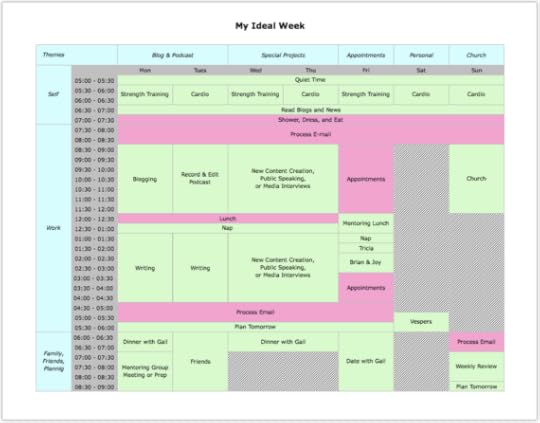
My Ideal Week—the week I would live if I could control 100 percent of what happens—is divided into a simple grid (see image above). Each day has a theme. In addition, each day is segmented according to a specific focus area.
Last week, I discussed My Ideal Week with my wife, my assistant, and my two managers. I realized that I didn’t have any hope of implementing it unless all of us were aligned on my intentions. I then updated my Ideal Week spreadsheet and distributed it.
Here’s how it works:
My themes are listed on the very top row:
Monday and Tuesday are devoted to my blog and podcast. This is the foundation of everything else I do.
Wednesday and Thursday are devoted to Special Projects. This will vary from season to season. For the next few months, I will focus on media interviews and speaking. When I get ready to write my next book, I will focus on writing. If I have a speaking engagement, it has to come out of this allotted time.
Friday is my day for appointments. Taking a page from my friend Don Miller, I am relegating all of these to one day a week. It is very difficult to write when I have any meetings on the same day.
Saturday is for personal chores and recreation.
Sunday is for worship, rest, and planning the next week.
My focus areas are listed in the left-most column:
The early morning hours are devoted to self: reading, praying, and working out. I usually listen to audio books or podcasts while running.
The middle of the day is devoted to work. I start at 7:30 a.m. and finish promptly at 6:00 p.m. If I don’t, Parkinson’s Law will become operative: “Work expands to the time allotted for it.” That is exactly what I have experienced over the last month. I have lost my “hard boundaries.”
The end of the day is reserved for my family, friends, and (on Sundays) planning. Currently, we don’t have any children living at home. Consequently, Gail I eat dinner together almost every night, taking time to connect and catch up.
Activities that contribute to my goals and priorities are shaded green. Those are not related to my goals are shaded red. Those that are grey are simply not scheduled. This represents “margin.”
This scheme is admittedly subjective, but it is helpful to me to make sure I am working on what matters most.
Does this sound like it might be helpful to you? Here’s what I suggest:
Create a template. You can either download my Ideal Week template or start from scratch. It’s up to you.
Identify your themes. This won’t be possible in every situation, but it is helpful if you can assign a theme for each day and then batch similar activities together.
Schedule the important activities. These are the ones you will shade green—they contribute to your goals and priorities. Allocate time for these first.
Fill in around the edges. Now schedule the less important activities. These are ones you will shade red. These items must be done, but they don’t really move you toward your goals.
Tweak and fine-tune. I usually have to go through several iterations before I get it right.
Share it with your team. If they are not aware of your Ideal Week, they may inadvertently sabotage your plans. But if you are aligned, they can help you stay on track.
Don’t be legalistic. The calendar was made for man, not man for the calendar.
If you are like me, not everything can be shoe-horned into the template. However, having this document will better enable you to to create the margin you need to get the important things done while still enjoying your life.
Question: Do you feel like you are out of margin too? You can leave a comment by clicking here.



June 23, 2012
Platform TeleSeminar Replay [Podcast]


“Platform TeleSeminar Replay”
by Michael Hyatt
Listen to this podcast on my website…

June 19, 2012
Last week, I hosted a Platform Teleseminar for almost 1,500 people. I shared the five steps necessary to build your own platform. Then I took questions from the audience. In case you missed it, here’s the recording.
I also made a special offer, which you can find here. (The offer expires at midnight on Monday, June 25, 2012.)



June 22, 2012
4 Ways to Pour Yourself into Your Pursuits
This is a guest post from Ryan J. Ferrier. Ryan has successfully launched internet startups that have been acquired by Microsoft and Zynga. He now helps young professionals launch lives that matter at Bootstrap My Life. You can also follow him on Twitter.
Norman Vincent Peale once said, “Nothing can stand in the way of the man who focuses his entire self on a problem” (from The Power of Positive Thinking).

Photo courtesy of ©iStockphoto.com/photosbyjim
If you have a problem worth solving or a prize worth pursuing, it’s not enough to just put your mind to fulfilling that purpose. It is not just a matter of putting your heart into it either.
If nothing is going to stand in your way, you’ve got to throw your entire self into that pursuit. It’s an all encompassing task.
But what does it look like to put all of who you are into something?
There’s a short scripture verse that I have found helpful:
“And Jesus grew in wisdom and stature, and in favor with God and man” (Luke 2:52).
Interestingly this sentence is just about all that is said about Jesus in the years leading up to his public ministry.
Still, it says quite a lot. In preparing to live out his purpose, Jesus grew in four key areas:
Wisdom: mentally and emotionally
Stature: physically
Favor with God: spiritually
Favor with man: relationally
With this model in mind, invest accordingly.
Invest in wisdom. Wisdom is more than just mental acuity. It’s really about insight and understanding. Insight into how the world works, how people operate, how situations unfold and in light of those insights, understanding the most appropriate way to live. Wisdom is mental and emotional intelligence applied to the study of life. It’s being ‘life smart.”
To grow in wisdom, I like to:
Read and study material that makes me smarter
Listen to my life by taking time to reflect on patterns and situations that reoccur
Watch and follow others that I admire
Practice what I have learned
Invest in your body. There is no area of my life that has as much immediate impact on all other areas as when I invest in my physical health. When I spend time nourishing my body, my mind is sharp, my emotions stabilize, my spirit is awake, and my relationships improve. However, the opposite happens when I either neglect my physical body or when I punish it by working it too hard.
Keep it simple and keep it fun:
Eat whole foods
Move around a lot
Go hard occasionally
Invest in your spirit. Whatever you believe, the benefits of activities like meditation, prayer, and being still are documented and well-proven. For me, these practices have a restorative effect on my soul and open me up to connect with a deeper sense of purpose for my life.
Each morning I like to take time to do the following:
Sit in silence
Read scripture and other inspirational material
Meditate on what I’ve read
Pray
Invest in your relationships. This is an area that, for me, has been underdeveloped over the last six years. I invested heavily in my professional career, starting companies and getting them off the ground. Frankly, I did this at the expense of developing meaningful relationships, and I have some regrets about it.
A company can fire you. It’s a lot harder for true friends to do the same.
And ironically, if you want the work of your hands to have a real and lasting impact, you’ll need key relationships to keep you committed to that purpose.
Here are the steps that I am taking to become more relationally connected:
Clear time on my calendar for family and friends
Open myself to chance encounters and impromptu social opportunities
Invest deeply in a few key relationships
So that’s the whole picture. And if, like Jesus, we commit to being whole people, nothing will stand in our way.
Question: Have you thought about what it takes to put your whole self into your pursuits? What area is the most difficult to engage? You can leave a comment by clicking here.



June 21, 2012
An Interview with Bob Goff [Video]
Bob Goff is one of the most amazing men I have ever met. I don’t think I know anyone else who is as adventurous as he is. I certainly don’t know anyone who is a better storyteller.
If you can’t see this video in your RSS reader or email, then click here.
I first read about Bob in Don Miller’s delightful book, A Million Miles in a Thousand Years. Shortly after that, Don introduced me to him. Then, I had the privilege of spending a few days with Bob and his wife, Maria, at their beautiful home in British Columbia.
Several months later, Don sent me the manuscript for Bob’s new book, Love Does: Discover a Secretly Incredible Life in an Ordinary World. Though I rarely read books from first time authors, I devoured this one. I read it from start to finish in one sitting. (In a moment, I’ll tell you how you can get a copy for free.)
What is the book about? It’s really a series of paradigm shifts disguised as stories. These stories are assembled to prove one thesis: Love is not merely about thoughts and feelings. it is about taking action. Or, as the title of his books says, love does.
Recently I had the opportunity to interview Bob about his book. I asked him the following questions:
I know you are doing something special with the royalties for this book. Can you tell us about that?
How did you get into law school? (This is one of my favorite stories ever.)
You used to think that Jesus was a guy in a robe who was mad at everyone. When did that change for you?
Can you elaborate on the difference between knowing and doing?
How do you get done everything you do? It sometimes seems like there are three of you!
What do you say to the person who says, “Bob Goff is an exception; I don’t have those resources or creativity?”
Love Does is pure inspiration. If you listen to Bob talk about it in this brief interview, you’ll get a little flavor of what to expect in the book.
Thomas Nelson, Bob’s publisher, has agreed to give 50 copies of his new book, Love Does to my readers. To get a chance at snagging one, you must take the following three actions:
Leave a comment below. Tell me why you want a copy.
Fill out the special form. I have set up a separate contact form to make it convenient for you to provide your mailing address. Please do not put your shipping address in your comment. This will automatically disqualify you.
Twitter a link to this post. You can do so automatically by clicking here. If you don’t have a Twitter account, you can use Facebook.
On Friday, June 29, 2012, I will select 50 people at random. If you are one of those selected, I will notify you via email. If you don’t hear from me, you can assume you were not selected.
Question: Why do you want a copy of Bob’s new book? You can leave a comment by clicking here.



June 20, 2012
#017: 7 Keys to Writing a Killer Blog Post [Podcast]
In this episode, I talk about how to write killer blog posts. I define what constitutes a killer blog post and then share seven keys for writing one.

In Episode 13, I shared how my blog traffic has grown from a few hundred unique visitors a month when I first started in 2004 to about 300,000 unique visitors a month now.
Click to Listen
[image error]
Podcast: Subscribe in iTunes | Play in browser | Download
Episode Outline
One of the things I love about blogging is the analytics. I can tell exactly how popular a blog post is. I know whether or not it resonated with my audience—or fell on deaf ears.
So when I talk about writing a killer blog post, I mean something very specific. I’m not talking about whether or not you, your family, or your friends liked your blog post.
My definition of a killer blog post is one that performs well as measured by three specific metrics:
Traffic
Engagement
Shares
Frankly, if you want to boil this entire episode down to one statement, it is this: The secret to creating killer blog posts is to write stuff people want to read and share.
Here’s how: You can unlock the potential of your blog posts with seven keys:
Focus on your readers.
Write a powerful headline.
Include a relevant photo.
Tell a relevant story.
Make your posts scannable.
Keep your posts brief.
End with a question.
If you put these keys to use, you increase the likelihood of writing killer blog posts.
Listener Questions
Bill Kerr asked, “What tip do you have for finishing blog posts that you start?”
Dana Pittman asked, “How do you do a blog post that is gives enough information but not too much?”
Jon Stallings asked, “How to you write a killer blog post without manipulating your audience?”
Mary DeMuth asked, “Have you ever had the experience where you have written a blog post that you didn’t think was very good, and it was a raging success?”
Melissa Taylor asked, “How do you tell personal stories and yet have the keyword in the first paragraph?”
Ron Cantor asked, “What do you mean when you encourage people to write a controversial blog?”
Shannon Milholland asked, “What metrics do you use to determine if a blog post was really a killer post?”
Sharon Swing asked, “What is the best way to get your customers to talk about what has wowed them about your products or services in a way that makes it easy to share on your blog or website?”
Travis Dommert asked, “How do you come up with a steady stream of great ideas for blog posts?”
Special Announcements
My book, Platform: Get Noticed in a Noisy World is continuing to sell well. As you may know, it hit all the major bestseller lists, including the New York Times, USA Today, and Wall Street Journal.
If you haven’t read it yet, I hope you will buy a copy. This is a book for authors, speakers, comedians, small business owners, realtors, mortgage brokers, corporate brand managers—anyone with something to say or to sell.
I will be speaking at “A Day About Books” with my friend, John Maxwell, this coming Saturday, June 23, in West Palm Beach, Florida. This is an unprecedented opportunity to learn from someone who has written seventy-plus books and sold more than twenty million copies. He is one of Amazon’s top 25 best-selling authors of all time.
I will be speaking on ”How Authors Can Build a Powerful Platform.” If you are an author or have ever thought about becoming one, this conference is for you.
If you are interested in having me speak at your event, please visit my Speaking page.
In the next episode of my podcast, I am going to talk about how to maximize your vacation time by going on a “digital detox” and reconnecting to what matters most. If you have a question about this topic, please leave me a voice mail. I will try to answer it on the air.
Episode Resources
In this episode I mentioned several resources, including:
Blog post: “How to Write Magnetic Headlines” by CopyBlogger.com
Book: Advertising Headlines That Make Your Rich by David Garfinkel
Course: Fast, Effective Copy by David Garfinkel and Brian McLeod.
Service: iStockPhoto.com
Service: Flickr.com Creative Commons
Show Transcript
You can download a transcript of this episode here.
Subscription Links
If you have enjoyed this podcast, please subscribe:
iTunes
Zune
RSS
Your Feedback
If you have an idea for a podcast you would like to see or a question about an upcoming episode, e-mail me.
Also, if you enjoyed the show, please rate it on iTunes and write a brief review. That would help tremendously in getting the word out! Thanks.
Question: What tips do you have for writing a killer blog post? You can leave a comment by clicking here.



June 19, 2012
3 Metrics Every Blogger Should Be Tracking
Bloggers often ask me what metrics they should be tracking. Google Analytics and other tools provide an enormous amount of data. However, you can quickly get overwhelmed if you aren’t careful.

Photo courtesy of ©iStockphoto.com/gmutlu
In reaction, some bloggers overreact and get too focused on one metric. This is the other extreme.
For example, I recently heard a podcaster say that the only metric that matters is conversion. Certainly, I think conversion is important, particularly when it comes to landing pages. But I think it’s a little more complicated than this one metric.
I pay attention to three metrics:
Traffic. This is usually expressed as monthly unique visitors or monthly pageviews. These metrics are the ones that are the most important to advertisers. Therefore, they are important to me.
I focus on unique visitors when it comes to my overall blog but pageviews when I am analyzing individual posts. Both are important. They are just two different ways of assessing traffic.
The one metric that doesn’t matter is hits. This simply refers to the number of “server requests” a browser makes to display a page. If someone lands on one of my blog posts, for example, each component of the post—images, external files, etc.—counts as a separate hit.
A pageview, on the other hand, refers to a visitor viewing a specific page, regardless of the number of components (i.e., files or images) that make up that page. This is the metric that matters.
Engagement. I use number of comments as a proxy for engagement. The more comments, the more people are engaging with a particular post. (Side note: there is usually a correlation between traffic and the number of comments.)
If your readers don’t find your content compelling, they usually won’t bother commenting. Instead, they bounce off the post and move on to something else.
Comments are important because they indicate whether or not your content is resonating with your readers. They are also important because they provide “social proof,” particularly if you display your comment counts prominently on the blog post. (I do this next to the post title.)
In other words, if your readers see a lot of comments, they think the post is important—or at least popular. Readers use it as a filter to decide whether or not something is worth reading. (This is also why I recommend not displaying your comment counts if they are low. They can actually discourage people from reading further.)
Shares. I specifically track the number of times a post is shared on Twitter and Facebook. I also display these next to the title. Part of the reason is to encourage more sharing; the other part is to provide additional social proof.
Again, people assume that a post must be important if people are taking the time to share it with their networks. But, like engagement, this also can work against you if the numbers are low.
In a sense, shares are the most important metric for me. I want to create content that people not only read but feel compelled to share. Twitter and Facebook are important to me. LinkedIn, Google+, or Pinterest might also be important, depending on your audience.
Metrics can distract you if you let them. There is no end to the data. That’s why I recommend focusing on these three. You can do a deep dive into the other metrics on occasion, but these are the three I monitor daily to see how my blog is doing.
Question: Where do you need the most work? Traffic, engagement, or shares? You can leave a comment by clicking here.