Michael Hyatt's Blog, page 190
August 6, 2012
Why Frequent Trips Outside Your Comfort Zone Are So Important


Earlier this year, Gail and I attended Tony Robbins’ Life & Wealth Mastery event in Fiji. On the very first morning, with less than an hour of instruction, we were asked to climb a thirty-foot pole and then stand on top of it.

Photo courtesy of ©iStockphoto.com/SLOFotomedia
This was no surprise, of course. I had known for several months this was going to happen. But it was still frightening to consider.
I’ve heard the only two fears you are born with are the fear of loud noises and the fear of falling. Every other fear is acquired.
I don’t know if that’s true, but I can attest to the fact that climbing the pole was terrifying.
Even though I was strapped into a harness and couldn’t really get hurt, the sensation of being so high off the ground on a swaying pole felt ridiculously dangerous.
Nevertheless, I made it to the top and was able to step onto the top of the pole. I stood there for a few moments, just taking it all in. I felt incredibly alive—and triumphant.
Then I remembered I was supposed to leap to a trapeze ten feet away. No sweat, I thought. I took a deep breath, focused on the target, and jumped.
Unfortunately, I missed.
The spotters lowered me to the ground as Gail and my new friends cheered wildly from the ground. It was exhilarating.
Of course, the whole point of the exercise was to cement in my subconscious the value of getting outside my comfort zone. It has had exactly this impact.
You’ve probably experienced something similar. Maybe it was learning a new skill, meeting a new person, or taking on a challenge you’d never done. We don’t often enjoy these things when they are happening, but, looking back, we have to admit:
This is where the growth happens.
This is where the solutions are.
This is where fulfillment resides.
In short, the really important stuff happens outside your comfort zone.
If that’s true—and I believe that it is—how can you maximize these trips outside your comfort zone? Let me suggest seven ways:
Acknowledge the value. Reality is that we move toward what we esteem. The first step is simply to confess that getting out of your comfort zone is a good thing. Say it out loud if you need to: “Getting out of my comfort zone is good for me!” Remember, unless you do so, you won’t experience the growth you want, the solution you need, or the fulfillment you desire.
Lean into the experience. So many people shrink back whenever they experience pain. The problem is that this can become a habit—or worse—a way of life. Instead, embrace the discomfort. Move toward it. This is an important step in accomplishing anything significant. You have to go through the realm of discomfort to get what you want in life.
Notice your fear. If you feel anxiety or fear, that’s normal. But—and this is critical—you don’t have to be controlled by it. Yes, it can be an indication of danger. It can also be an indication that you are on the right path and about to experience a break-through. Just notice the anxiety or fear but keep moving forward. Often, the ability to push through fear is the only thing that separates those who succeed from those who fail.
Don’t over-think it. This is my biggest temptation. I want to know the entire path. I want a map to the destination. Alas, I rarely get one. But that’s okay. All you really need is clarity for the next step. When you get it, take the next step in faith, believing you will be given the light you need to take the next one.
Play full out. It’s easy to get timid when you move outside your comfort zone. You think maybe you can just ease into it, kind of like sliding into a cold swimming pool. Not so much. Better to jump in with both feet. It’s not usually as bad as you think. You have a better chance of success if you give it your all.
Celebrate the victory. Historically, I have not been very good at this. As soon as I accomplish something, I check it off and move on. But I am learning the importance of marking the moment, recognizing the achievement, and expressing my appreciation to those who helped make it happen. It’s important for you and for them.
Pause to reflect. It’s also important to take a little time to process your experience. What did you do well? What would you do differently next time? What life principles can you distill from the experience that will help you in your next challenge? It’s worth jotting a few notes in your journal or, if this was a team effort, scheduling a time to debrief.
If you are out to accomplish significant things in your life, you are going to be spending a lot of time outside your comfort zone. You might as well get the most out of it.
Question: When was the last time you moved outside your comfort zone but, in retrospect, were glad you did? You can leave a comment by clicking here.







August 4, 2012
God Is the Friend of Silence [Quote]


We need to find God, and He cannot be found in noise and restlessness. God is the friend of silence. See how nature—trees, flowers, grass—grows in silence; see the stars, the moon and the sun, how they move in silence. We need silence to be able to touch souls.””

Mother Teresa of Calcutta



August 3, 2012
4 Truths Every Pioneer Should Know
This is a guest post by Mary DeMuth. She is an author and speaker. You can read Mary’s blog or visit her on Twitter. If you want to guest post on this blog, check out the guidelines here.
Pioneering is hard. It is especially hard for those around them. It is even hard for the pioneers themselves.

Photo courtesy of ©iStockphoto.com/cglade
Through God’s strength, I’ve pioneered a lot of things in my life. I parented my kids in an entirely different way than I was raised (and am still plowing that ground). I broke up the fallow ground of publishing, starting from nothing. And my family and I planted a church in one of the most unchurched places on the planet: France. So I get pioneering.
The problem comes when those of us who have that entrepreneurial bent forget the perils of pioneering. We get distracted by the joy of the hunt, of doing something entirely new, that we overlook four important truths. If you’re heading toward a pioneering situation in your job, ministry, or passion, tuck these truths deep inside—truths my husband and I learned on foreign soil:
Pioneers who thrive have a mentor. When we started a church, my husband had an older, wiser professor from seminary who came to visit us in Southern France. He patiently listened to our stresses and worries and offered great insight. He helped us discern the situation with fresh eyes.
Later, after we came home and recounted the rest of our story to him, we expected him to nod wisely, tell us that’s just what happens when you pioneer a work. But he didn’t. He said, “I’ve never heard a story like that.” In doing so, he validated our bewilderment and pain and became a key instrument in the healing process that followed.
Pioneers take people into account.We can be so concentrated on doing a new work that we forget the fallout of the relationships in our lives. My husband, a church planter at heart, realized that our time in France was damaging both me and our children. When he realized that, he found a job in the states, humbling himself, and giving up the dream of starting a new church (for a season). He changed courses for the sake of his family.
Pioneers hold the end result loosely. We left Southern France before we saw much fruit, but we did recruit a French couple who are now doing amazing work there. They pioneer the kind of work we could never do. In retrospect, we moved overseas simply for their sakes.
Of course we didn’t see it that way going in. We were going to do “huge things.” Instead God called us to a series of seemingly small, insignificant things for the sake of an ending only He could dream up. If we had clung to our idea of the end result, we would’ve languished in disillusionment and counted our pioneering as failure.
Pioneers understand there will be opposition. In any new work, there will be folks who naysay. There will be bureaucratic red tape. Even those closest to you won’t understand the “why” of the new work. Beyond that kind of opposition lies spiritual opposition. Pioneers understand that the battles we face have a spiritual dimension and prepare accordingly. They’re not surprised by push-back.
I’m grateful for my pioneer journeys—parenting, writing, church planting. And though the lessons I learned in the process were sometimes excruciating, I can honestly say I’m better for the pioneering.
I’m tougher, more resilient and tenacious. Pioneering is a risk, but in risking, we grow. In our small obedience, we have the privilege of being a part of a genesis work.
Questions When have you pioneered something? What have you learned? Or are you pioneering now? What’s the greatest joy in that? Challenge? You can leave a comment by clicking here.




August 2, 2012
When You Realize You’re Living in a Bubble
The following is an excerpt from the Foreword I wrote for Jeff Goins’s new book, Wrecked . It’s an excellent book that I recommend you pick up. At the end of the article, I’ll tell you how you can get over $158.00 worth of free resources if you buy it this week.
In 2009 my wife Gail and I traveled to Africa at the invitation of Rich Stearns, president of World Vision. It was our first trip to “the dark continent.” We had always wanted to go to Africa; we just never seemed to find the time.

Photo courtesy of
©iStockphoto.com/najin
Like Truman Burbank (played by Jim Carrey) in the movie, The Truman Show, we pretty much lived in a “constructed reality.”
I had a beautiful wife, five amazing daughters, and a great job. We were prosperous and comfortable. I didn’t realize I lived in a bubble.
We spent a week in rural Ethiopia. The poverty was astonishing.
We met people who survived on a few dollars a month, others who walked ten miles a day just to get water for their family, and children who had become orphans when their parents had died of AIDS.
Despite all of that, the Ethiopian people remained joyful in the midst of unrelenting hardship.
My friend Max Lucado, who was traveling with us, commented, “There are more honest smiles among the poor of Ethiopia than the shopping malls of America.” So true.
A Woman, a Hut, and a Smile
On the last day of our trip we visited a small village and met Wosne, a beautiful woman with a tragic story. Her husband had died suddenly, leaving her with four children in a one-room hut.
Without a husband, she had no way to support herself. She grew discouraged and desperate. She prayed God would take her life. Thankfully, God had other plans.
World Vision found sponsors for two of her children. This gave Wosne just enough margin to begin eking out an existence. Over time, she bought some chickens, sold the eggs, and bought more chickens.
Eventually, she was able to buy a cow. She sold the milk and bought more cows.
Then, with the help of her children’s sponsor, she was able to buy a modest four-room house. It wasn’t much by American standards—just a few walls on a dirt floor with a tin roof.
The day we met Wosne she was radiant. Her children encircled her and quietly sat as we spoke through an interpreter. She shared her story of hardship yet beamed as she recounted God’s provision for her family.
She had become so prosperous, in fact, she had adopted two other children in the village. She even had a couple of pieces of used furniture and electricity—a single bulb hanging from the ceiling.
By our standards, she was still living in abject poverty. By the standards of her village, however, she was one of its wealthiest citizens.
Max was so moved by her story—and how much she still lacked—he asked, “Wosne, if you could have anything else, what would it be? How can we help you?”
Her answer stunned us.
“Nothing,” she declared. “Nothing at all. I have everything I need. I am the happiest woman in the world.” And she meant it.
Several of us started weeping. In the space of thirty minutes, our entire worldview was turned on its head.
Wrecked—And Transformed
On the flight home, I was pensive and quiet. So was Gail, my wife. We couldn’t get two sentences out of our mouths without crying. Our experiences in Ethiopia had profoundly impacted us.
We were, in a word, wrecked.
I didn’t know what my experience in Ethiopia would mean for our future. I didn’t know if I should quit my job and move to Africa, sell my possessions and give the money to the poor, or stay put. Most of all, I didn’t want to be sucked back into the bubble of a comfortable life.
Over time, we worked through the implications of this experience for our lives. Not that we have it all figured out. We don’t. But we are working hard to make decisions that are counter-cultural and require courage.
In short, being comfortable is no longer enough. We want to make a contribution—in time and for eternity.
An Invitation to Be Brave
I want to invite you to what my friend Jeff calls the “wrecked life”—one that is shaken up but transformed by confronting the world’s most difficult challenges.
This requires sacrifice, but the sense of significance you get is well worth the cost. And if you’re ready to do this—to live the life you’re afraid of—here’s what you need to do next:
Admit you’re living in a bubble.
Step out of your comfort zone.
Put yourself into a situation that will require courage.
Then see how you grow. You might be surprised at just how alive you feel.
If you buy Jeff’s new book this week, he’ll send you six gifts worth over $158.00. You can find out more here.
Question: Have you ever felt like you were living in a bubble? You can leave a comment by clicking here.



August 1, 2012
#020: 3 Strategies for Taking Your Life to the Next Level [Podcast]
In this episode, I talk about what it takes to get to the next level in any area of your live—health, marriage, or career. Based on my own experience, I share the single most important thing you can do to make your dreams become reality.

The very fact that you are listening to this podcast (or reading these show notes) tells me you are the kind of person who wants to grow. I am too. Personal growth is the driving force of my life.
According to Dr. Timothy Pychyl, writing in Psychology Today:
… the successful pursuit of meaningful goals plays an important role in the development and maintenance of our psychological well-being. To the extent that we’re making progress on our goals, we’re happier emotionally and more satisfied with our lives.”
Click to Listen
[image error]
Podcast: Subscribe in iTunes | Play in browser | Download
Tony Robbins says it even more directly: “Progress equals happiness.”
If the key to happiness is making progress toward a goal, how do you do that? How do you ensure that you are making consistent, steady progress toward your goals?
I believe it is this: Enlist the help of the best coaches and instructors you can afford.
Why is this important? Three reasons:
Because you want to speed up the learning process and get to your destination faster.
Because you don’t want to reinvent the wheel. Someone, some where has already done what you are attempting to do.
Because you want to avoid the common mistakes—and pain—along the way.
Episode Outline
So, practically speaking, how do you do this? I suggest three strategies. From least expensive to most expensive, they include:
Strategy #1: Read relevant content.
Strategy #2: Take specialized classes.
Strategy #3: Hire an experienced coach.
I provide numerous examples in the podcast. If you don’t intend to listen to the podcast, you can read much of the content in this post I wrote called, “3 Ways to Go Further, Faster.”
Imagine what could happen if you enlisted the best coaches and instructors you could afford (whether it is via book, a class, or coaching) and determined you would go to the next level? You don’t need to struggle for months or years by reinventing the wheel. You can go further, faster by employing the three strategies I have outline above.
Listener Questions
Jennifer Hoverstad asked, “How do I dig out from under being overcommitted? Then how do I tell those involved?”
Chris Stevens asked, “How do you take your family along for the journey?”
Bobbie McGraw asked, “How do you stay healthy when traveling so much?‘
Special Announcements
I will be in Ft. Worth, Texas next week, speaking for Cendera Funding and a lecture series they are sponsoring called, “Business with Purpose.” I will do two sessions: “The 5 Marks of Authentic Leadership” and “Platform: Get Noticed in a Noisy World.” If you are in the area, come join me.
If you are interested in having me speak for your event, check out my speaking page.
Episode Resources
In this episode I mentioned several resources, including:
Article: “Goal Progress and Happiness” in Psychology Today
Website: Gary Smalley
Website: Emerson Eggerichs
Conference: Wild at Heart Boot Camp
Coaching: Building Champions
Consulting: Gap International
Course: Fast, Effective Copywriting
Golf Coaching: Nancy Quarcelino
Photography Course: Ben Wilmore
Show Transcript
The transcript for this podcast is not yet ready. It will be posted here just as soon as it is available.
Subscription Links
If you have enjoyed this podcast, please subscribe:

iTunes

Zune

RSS
Your Feedback
If you have an idea for a podcast you would like to see or a question about an upcoming episode, e-mail me.
Also, if you enjoyed the show, please rate it on iTunes and write a brief review. That would help tremendously in getting the word out! Thanks.
Question: What suggestions do you have for better managing your time on the Internet?? You can leave a comment by clicking here.



July 31, 2012
Facing Your Fears [Quote]
Better to face danger once than to be always in fear.”
Zig Ziglar



Lectureship Circuit 2012 [Event]

I am looking forward to being in Texas again this year. This time I will be speaking in Ft. Worth for Cendera Funding and a lecture series they are sponsoring called, “Business with Purpose.” I will do two sessions: “The 5 Marks of Authentic Leadership” and “Platform: Get Noticed in a Noisy World.”
Date:
August 9, 2012
Time:
10:00-12:30 p.m.
Event:
Lectureship Circuit 2012
Topic:
The 5 Marks of Authentic Leadership
Sponsor:
Cendera Funding
Venue:
Cendera Center
Location:
Ft. Worth, TX
Registration:
Click here to register.
More Info:
Click here for more information.



15 Resources for Pro Bloggers (or Those Who Want to Be)
I get asked every week about the various resources I am using. Last week, a blogger asked about my podcast equipment. Another asked about the productivity apps I am using on my Mac. Still another, asked if I could recommend some leadership resources.
Photo courtesy of ©iStockphoto.com/jfmdesign
So, I thought I’d write a series of posts on these resources, devoting one post to each category. When I get done, I plan to collect these into a permanent page on my blog. In this post, I want to share my blogging tools.
Here are my fifteen go-to resources:
WordPress. I use self-hosted WordPress. This is the big daddy version of WordPress.com. It provides virtually unlimited control and allows you to monetize your site. It is free to download and install. However, you will likely spend money for web hosting. (More about that below.)
BlogWorld. This is the preeminent conference for bloggers and podcasters. I did a workshop at the last conference in New York City. I also hope to be speaking at the upcoming conference in Las Vegas. Between the exhibition hall, the seminars, and the general sessions, this is a must-attend event.
BlueHost. There are dozens of web hosting services available. This is the only one I recommend. (Note: I don’t use it for MichaelHyatt.com. My site is so large, I require a dedicated server.) It is easy-to-use, reliable, and inexpensive. It also has superb, 24–7 support.
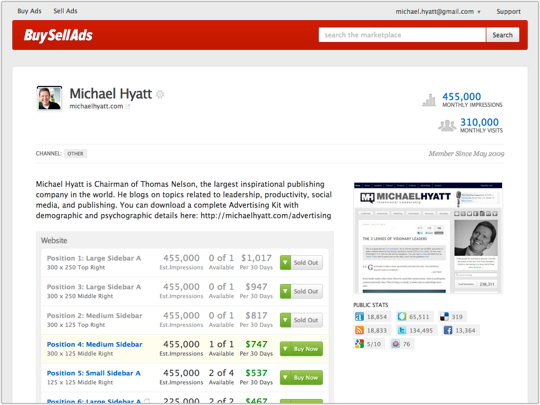
BuySellAds. This is the ad network I currently use. It manages all my ad inventory and the payment processing. It requires you to insert some code into your site, but automates everything from there. Advertisers can check your rates, browse your inventory, and make their purchases without your involvement.
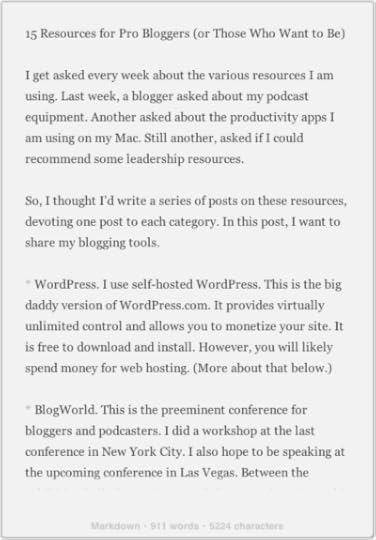
Byword. This is the minimalist word processor I use to write everything. For the record, I am not a fan of Microsoft Word. It is just too bloated and slow for me. It also doesn’t translate well to WordPress. ByWord is simple and fast. It gets out of my way and lets me write. It also uses Markdown language (actually MultiMarkdown), which I use extensively.
Church Analytics. Some analytics packages provide more information than you can possibly use. Some provide less than you really need. Church Analytics strikes the perfect balance and does this within the context of an interface that is simple, elegant, and powerful. Though I use Google Analytics for advertisers, I use Church Analytics for my daily tracking.
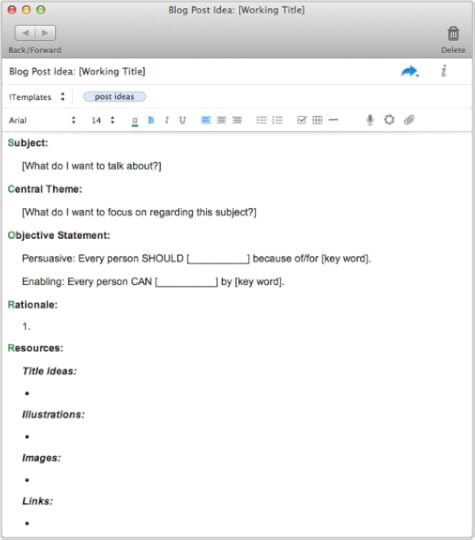
Evernote. I use this to store my blog post ideas, outlines, and other resources. I have a notebook called “Blog.” In conjunction with this, I use tags for affiliate programs, code snippets, design ideas, guest posts, post ideas, and web development. I give individual posts their own note and begin with a template. I have written about it here.
EZ WordPress Setup. This is a screencast I recorded to answer the number one question I get from people who want to start blogging. “How do I setup a WordPress blog if I am not technical?” This walks you step-by-step through the process. It will take you 20 minutes or less. It requires absolutely no technical background.
FeedBurner. This is a free service provided by Google. I use it to manage and promote the RSS feeds on my blog. It also makes it easier for your readers to subscribe to your blog via RSS. If you don’t know what this means, read Feed 101. It will get you started.
iStockPhoto. Just like newspapers and magazines, I use photos in my posts to capture people’s attention and pull them into my posts. Ninety-nine percent of the images I use come from iStockPhoto. It is the largest source of commercial photos on the web. They are not free, but you can use my affiliate link to get a 20 percent discount.
MailChimp. This is the service I use to e-mail my blog to my subscribers. It’s free to start and is the most robust service I have found. It gives me near-total control over the output and also provides a very helpful statistics module, enabling me to monitor every aspect of my e-mail campaigns.
MarsEdit. Once I have my post written in ByWord, I copy and paste the HTML into MarsEdit. I could do this directly into WordPress on the Web, but MarsEdit enables me to do it offline. It also provides a ton of formatting shortcuts, insert images, and schedule posts. Best of all, it connects with ByWord, so I can use them together.
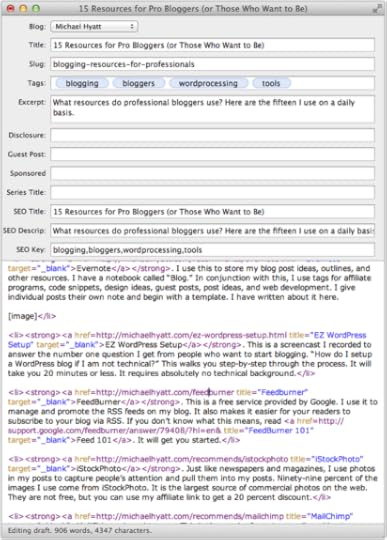
SnagIt. I use this program for all my screen captures. There are lots of programs that will do this for free. However, this one has some great annotation features and other tools. You can also quickly upload screen captures to the screencast.com website. This is handy for sharing screenshots.
StandardTheme. Currently, I use a customized version of this premium WordPress theme. It is excellent for a variety of reasons, not the least of which is it’s built-in SEO optimization. Prior to this I used a theme from WooThemes. I also really like the Genesis Framework from StudioPress. (Chris Brogan uses this.) ElegantThemes is also worth checking out.
W3Schools. This is a reference site where you can find the answer to just about any HTML or CSS question. It provides the syntax and real-world examples. I refer to it almost daily.
I am constantly trying out new tools. This is my list as it stands today.
Questions: What resources have I missed? What other blogging resources do you use? You can leave a comment by clicking here.



July 30, 2012
Special Discount for SCORRE Conference Ends Tomorrow! [Announcement]

Special Discount for SCORRE Conference Ends Tomorrow!
The next SCORRE Conference will be held in Vail, Colorado, October 17–20, 2012. The special “early bird discount” ends tomorrow.
Here’s the deal: If you register any time before the end of the day on July 31st, we will give you $200 off the regular price.
Don’t miss this opportunity. This is your chance to take your speaking and communication skills to the next level. To take advantage of this special offer, register with the coupon code HYATT.
Note: This conference will sell out. If you want in, you need to take action NOW. Our last two conferences have sold out.
By the way, you take ZERO RISK. If you attend the conference and don’t feel the investment was worth every penny you paid, we will happily refund your full registration fee, no questions asked.
Also, Ken Davis and I will both be there. In addition to teaching one of the sessions, I will be present for the whole conference, interacting with the students. So will Ken.
I hope to see you there!



The Practice of Stillness
According to the popular StrengthsFinder assessment, my top strength is “Achiever.” The report that summarized my test results says,
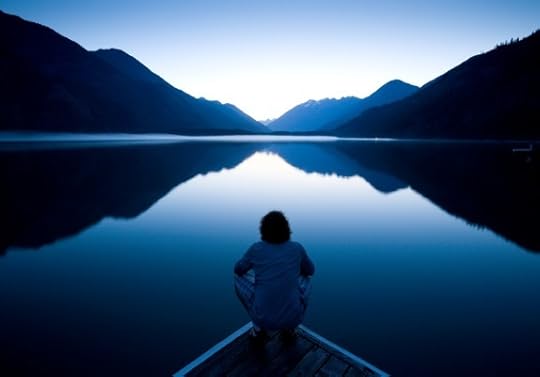
Photo courtesy of ©iStockphoto.com/epicurean
People who are especially talented in the Achiever theme have a great deal of stamina and work hard. They take great satisfaction from being busy and productive.”
This strength has served me well, but it also has a dark side.
It means I have a difficult time turning off my mind and just being still. I seem to be more of a human doing than a human being.
Recently, my wife Gail recommended that I read The Joy Diet by Martha Beck. She said, “You won’t agree with everything in this book, but I think it will really challenge you—especially the first chapter.”
Intrigued, I decided to read the book on my recent vacation.
The first chapter is entitled, “Nothing.” In summarizing the chapter, Beck says, “to begin the Joy Diet, you must do nothing for at least fifteen minutes a day.”
I was so challenged by this chapter, that I haven’t gotten beyond it. I have now read it four times. I have also practiced this discipline for twenty-two days in a row.
Honestly, this has been one of the most transformational things I have ever done.
What Is Stillness?
Beck’s premise is that “doing nothing is the most productive activity you will ever undertake.” By doing nothing, she means literally doing nothing.
This is not prayer (at least not in the sense of talking to God)
It is not problem-solving.
It is not planning.
Doing nothing is being still, quieting your mind (and the cacophony of voices), and simply being.
All the ancient wisdom literature points to the importance of this practice. Psalm 46:10 is representative: “Be still and know that I am God.”
This is tremendously difficult in our media rich, always-on, over-communicated society. Noise crowds into every empty space, leaving us spiritually, mentally, and emotionally exhausted.
Mother Teresa expressed it this way,
We need to find God, and He cannot be found in noise and restlessness. God is the friend of silence. See how nature—trees, flowers, grass—grows in silence; see the stars, the moon and the sun, how they move in silence… .We need silence to be able to touch souls.”
Abba Poeman, one of the ancient desert fathers, taught his disciples, “If you are silent, you will have peace wherever you live.”
Why You Need Stillness
I doubt you need convinced that you need some measure of what I am describing in your life. As I have shared about this topic with others, they inevitably say, “Oh, I so need that in my life! How do I start?”
Nevertheless, here are three of my own reasons for practicing the discipline of stillness:
I want to maintain perspective. If I don’t make time to be still, then I find myself in reactive mode—influenced by hundreds of little voices with big demands.
I want to stay connected to my true self. I don’t want to get confused, thinking that I am the image I present to the world. They are related, of course, but I want to live from the inside out.
I want more internal margin in my life. While I have been pursing external margin in my calendar and finances, I also want internal margin—more room to notice what matters most and be thankful for it.
How to Practice Stillness
This is not something I have enough experience with to write. In fact, I feel pretentious for even attempting it.
But perhaps that is the value I can add to the conversation. I am not so experienced that I have forgotten what it is like to be a beginner.
So in that spirit, let me offer a few suggestions for how you can practice stillness in your own journey and reclaim some interior margin.
Schedule a time. For me, I schedule stillness first thing in the morning. It has become so precious to me, that I won’t want to start the day without it. I practice this first—before prayer, before Bible reading, before journaling, and before exercise.
Find a place. When I was on vacation, I sat on the dock by the lake. This was ideal. But it is not my real world. Now I simply go into my study and shut the door. The main thing is to find a place where you won’t be interrupted.
Set a timer. I am following Beck’s admonition to set aside fifteen minutes a day. In my limited experience this seems about right. It is amazing how my perception of this time changes from day to day. Sometimes it seems like forever. Other times, it goes by very quickly. I use the timer on my iPhone.
Relax your body. I simply sit in a soft chair with my eyes closed. I then systematically relax my body and get quiet. Beck says that if you can’t sit still, then engage in any mindless physical activity, like rocking in a chair or watching some natural motion like fire or running water. I also play a recording I have of the ocean.
Quiet your mind. This is the biggest challenge for me. Just when I get still, I have some random thought or a whole flurry of thoughts. But I am getting better. Beck offers several techniques for practicing “nonjudgmental observation,” a discipline that keeps your allotted time from being hijacked by an overly-active mind.
Be present. Don’t be regretting or celebrating the past. Don’t be worrying or dreaming about the future. Instead, collect your thoughts and be present—in this moment. It is the most important time you have. In fact, it is the only time you have.
Learn to return. This has been the most helpful component. In involves recalling a “place of peace,” where you had a particularly vivid experience of peace and stillness. For me, I go back to a time I stood on the balcony of a monastery in Greece, looking out on the Aegean Sea. I wrote about it here.
Perhaps the most important thing is just to start. It’s easy to blow the discipline of stillness off as something you don’t have time for. Don’t. The busier you are the more important it is.
You need this in your life more than you know. Even if you can only set aside five minutes a day, do it. And if you miss a day or two, don’t beat yourself up. Just start again.
Questions: Have you ever practiced stillness? If so, what was your experience like? If not, what is keeping you from starting? You can leave a comment by clicking here.