Michael Hyatt's Blog, page 187
September 13, 2012
Erik Fisher Interviews Me [Podcast]


“Erik Fisher Interviews Me”
by Erik Fisher
Listen to this podcast on my website…

Beyond the To Do List
September 4, 2012
Erik Fisher just started a new podcast called “Beyond the To Do List” that is already on my short list of must-listen-to shows. In this episode he interviews me about my daily schedule, my personal productivity tools (including favorite software), and how I found time to build my own platform.
You can find Erik’s “show notes” here with links to all the resources we discuss. I would encourage you to subscribe to his show.







Introducing the GetNoticed! Premium WordPress Theme


I am about to launch my own premium WordPress theme. It is called GetNoticed! and is based on the principles I share in my New York Times bestseller, Platform: Get Noticed in a Noisy World.
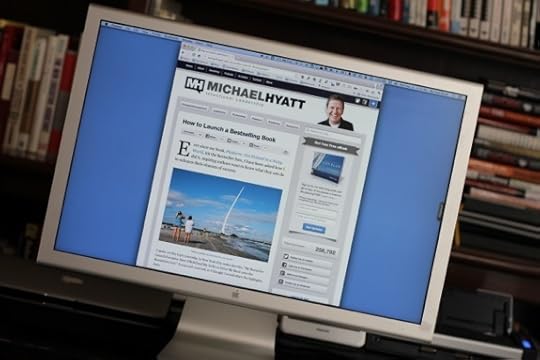
Andrew Buckman, my web developer, and I built this theme from the ground up. Our goal was to create a theme for anyone wanting to build a personal brand. This includes authors, comedians, speakers, pastors, and corporate executives.Here are just a few of the features we’ve baked in:
Fourteen different custom Mini-Posts—announcements, books, events, links, photos, slides, videos, and more. This enables you to share resources without writing a full blog post.
A custom Social Sharebar that not only makes it super-easy for your readers to share your posts on their favorite social networks, but also prominently displays the share counts, providing powerful social authority.

A custom Recruitment Form that enables you to collect e-mail addresses and build your mailing list. This is essential if you are going to build your platform. (Check out the top of the sidebar to see this in action now.)
Several new Sidebar Widgets, so you don’t have to install these as plugins. These include a Social Reach widget, Follow Me widget, Popular Posts, Upcoming Events, and Favorite quotes. (Check out the sidebar to see these in action now.)
A specially designed Landing Page Template, that gives you the option of eliminating the navigation that distracts your prospects from buying. It includes a spot for a Countdown widget (for time-limited offers), Buy Buttons for major retailers, Guarantees, and Testimonials. (Here’s an example.)
A built-in Event Calendar, which is perfect for public speakers, entertainers, and artists. It automatically pulls in the Event mini-posts and lists them in date order. You can place a list in the sidebar or on your speaking page.
A Fat Footer that enables you to redeem this otherwise forgotten real estate to promote your top links, services, products, and resources—or anything else you want. Scroll to the bottom of this page for examples.
And lots more …
We’ve also made use of the latest web technologies, so that the theme is responsive and beautiful, whether your readers access your blog via the web, iPad, iPhone, Android, or any other mobile device.
Though we’ve launched the theme on my site, we still have some work to do, including a couple of features for the sharebar that aren’t quite done and some improvements to the way the site renders on the iPad. As soon as we have the kinks worked out, we will move to a limited beta test and then a public rollout. We hope to launch in the next few months.
If you’d like to be notified when the theme is released, please sign-up below. If you are interested in participating in the GetNoticed! beta test, sign-up here as well. You will get the invitation to apply first. (Note: signing up here does not guarantee a slot in the beta program. We will be limiting the number of participants, so that we can adequately support them.) I won’t use this mailing list for any other purpose.
Finally, I am also planning to recruit a GetNoticed! launch team, similar to what I did with my book.) This will enable us to collect additional feedback and help us get the word out.
Note: If you are viewing this post via RSS or e-mail, you will need to click-through to my site, scroll to the bottom of this post, and sign-up using the form. Thanks.
Questions: What do you think of theme? Any suggestions? You can leave a comment by clicking here.





September 12, 2012
My Healthy Church Lunch [Event]

I am excited to speak at the My Healthy Church Luncheon. It will be held at the same time as the Catalyst Conference.
Date:
October 4, 2012
Time:
12:00-1:00 p.m.
Event:
My Healthy Church Lunch
Topic:
Shift: Leading in Challenging Times
Sponsor:
My Healthy Church Publishers
Venue:
Gwinnett Arena
Location:
Duluth, GA
Public:
Private



September 10, 2012
How to Make Your Intangible Products Easier to Sell
When you are in the business of selling intellectual property—books, courses, speeches—you have to work hard to make the product tangible to your prospect. You have to help them see what they are buying.

Photo courtesy of ©iStockphoto.com/mariusFM77
This is why, for example, publishers produce the book jacket or cover months before the book is manufactured and oftentimes before it is even written. Increasingly, publishers render these in 3-D images to make them look even more real.
Recently, I was thinking about this in regard to speeches. As a professional speaker, that is essentially what I am selling—a public presentation on a specific topic. Historically, booking agents and speakers bureaus have sold speakers on the basis of the speaker’s reputation and perhaps a demo video.
That got me to thinking. What if I packaged my speeches, just like I would package a book, a course, or any other intangible product? My goal was to help event planners envision exactly what they are buying.
To do this, I took seven steps:
Identify my products. In my case, I have six basic speeches that I give. (I learned how to identify my products at the Launch conference. A speech is only one kind of product, but this is where it starts.) I do custom speeches, but these are the presentations that are requested over and over.
Fine-tune the titles. Just like a book title, I needed a strong, catchy title and a subtitle. I came up with the following:
Platform: Get Noticed in a Noisy World
Life Plan: Designing the Life You’ve Always Wanted
Shift: Leading in Turbulent Times
More Margin: How to Shave 10 Hours Off Your Work Week
Authentic Leadership: The 5 Characteristics of Effective Leaders
The Leader’s Heart: Unleashing the Most Important Leadership Tool You Have
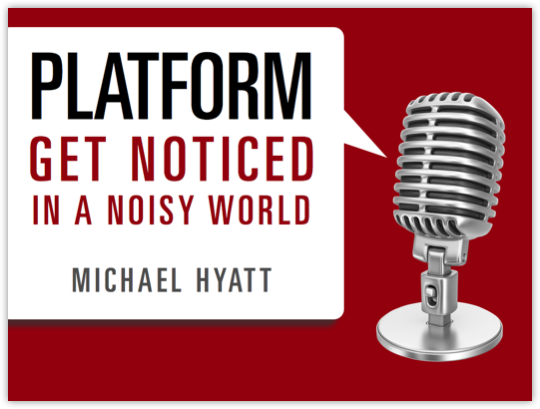
Create packaging for each product. How do you package something as intangible as a speech? I decided that the “cover” was essentially the first slide in deck for each speech. (Professional speakers often refer to a collection of slides as a deck, as in “deck of cards.”) Here’s the cover for my “Platform” presentation:
You can view all six here.
Create a summary of each speech. I basically took what I teach in my book Platform about creating an elevator pitch (Chapter 11) and applied it here. For example, here’s the summary for my “Platform” speech:
In today’s hyper-noisy world, it is hard to get anyone’s attention. You need a platform to be seen and heard. Thankfully, it’s never been easier. In this presentation, I share how to use social media to build your brand, decrease your marketing costs, and increase your impact.
You can view all six here.
Depict the product in its environment. If you are selling a car, you show people driving it. If you are selling an Amazon Kindle, you show people reading it at the beach.
In my case, I had a designer build a “frame” of an audience viewing my title slide, as though I were about to walk onto the stage and make the presentation. Here’s what the “Platform” speech looks like in its frame:
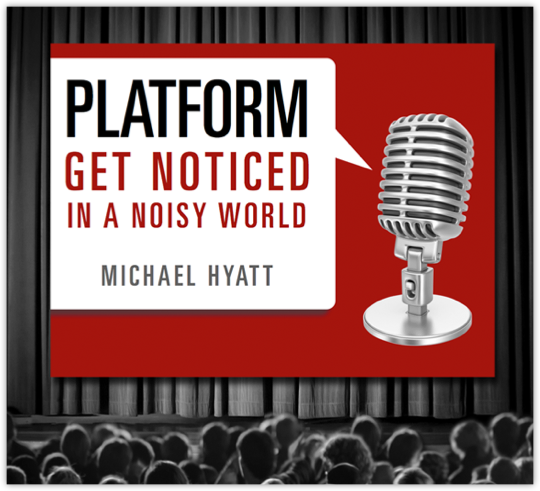
The purpose here is to help the event planner envision the product he is buying.
Write copy describing the product. In the publishing world, this is one of the first things that must happen before the marketing process begins. Why should it be any different in the speaking world?
I decided to write sales copy for each speech, consisting of six sections:
Quick Summary: This is the exact same copy I provided in the summary above.
Presentation Outline: Like a table of contents, I want to explain exactly what I cover in the speech. This gives a sense of the flow and how I develop each talk.
Target Audience: I want to make it clear who this presentation is for. I also provide a list of the types of audiences I have made this presentation to in the past.
Possible Formats: I explain how I can deliver this presentation—keynote, workshop, or seminar. I also talk about the ideal length.
Intended Outcomes: This is really what the event planner is buying. He or she is not buying the content per se, but the impact the content will have on the audience. I explain exactly what audience members will get as a result of my presentation.
Topic Authority: This section is intended to answer the question, “Why are you qualified to speak on this topic?” I list the relevant points from my resume that apply to this topic.
Create a sales page for each product. I always create a landing page for each product. (Here’s one for my Platform book and another one for my e-books.) Why should a speech be any different?
A landing page is something that my booking agents at Premiere Speakers Bureau can use when talking with event planners. It is also something I can use when people ask for the details related to a specific speech. I often refer to it in my pre-event phone call with the sponsor.
I describe the components of effective landing pages in my book, Platform (see Chapter 30). I created a landing page for each speech, using those guidelines. Here are the six finished landing pages:
Platform
Life Plan
Shift
More Margin
Authentic Leadership
The Leader’s Heart
I didn’t include some elements like the offer, because these are typically handled by my booking agents over the phone.
If you are a public speaker—or want to become one—this might provide some ideas for you to make your “product” more tangible. If you are not a public speaker but are in the business of selling intangible property, perhaps this will provide an example that will inspire you in your particular field.
If you want to find out more about booking me for your special event, you can check out my full speaking page.
Question: How can you make your intellectual property or service more tangible to your prospects? You can leave a comment by clicking here.




September 8, 2012
We Are What We Remember
Rabbi Evan Moffic is the senior rabbi of Congregation Solel in Highland Park, Illinois, which serves five hundred families across Chicago and its northern suburbs. You can read his blog or follow him on Twitter.
I have a tendency to rewrite history. For example, my wife Ari and I will talk about a family trip with our two kids, and I’ll say what a wonderful time we had and how fantastic the kids were.

Photo courtesy of ©iStockphoto.com/urbancow
With an incredulous look, she’ll ask me if I remember when Tam (our three-year old) woke up five times during the night. Or if I’ve forgotten when Hannah (our five-year-old daughter) refused for half an hour to get out of the swimming pool. “Really?” I’ll reply, “I don’t remember that part.”
Some might call this naiveté. I prefer to think of it as a way of making the most of the power of memory. We are what we remember.
Memory is always selective. Some of the process of remembering is unconscious. Certain events stick out regardless whether we want them to or not. Yet, we hold a great deal of power in determining what our memories mean.
So long as we do not distort what happened, we can reframe our memories in a positive way. How do we do this?
Talk about the positive. In Jewish tradition we hold an annual meal called the Passover seder. Eating from a variety of symbolic foods, we tell the story of the Exodus from slavery in Egypt. In doing so, we could choose to remember all the bitterness and horrors of slavery. It was four hundred years of oppression.
Yet, recounting the period of slavery takes up just a small part of the ceremony. Most of it focuses on the sweetness of freedom, the imperative to help the oppressed of our time, and the responsibility to tell the story of the Exodus to the next generation.
Write a gratitude journal. Writing about an event shapes the way we remember it. It helps us determine its meaning. We can apply this truth in so many ways.
Every night before bed, for example, I sit with my kids and ask them three things they are grateful for. Even if they had a tough day, focusing on the positive parts of the day reframes it. They often go to sleep with a laugh or smile.
Let time work its magic. Mark Twain famously said that “I’ve had a lot of worries in my life, most of which never happened.” When something bad happens to us, we often feel as if it is the end of the world.
I see this quite frequently among my high school students if they get a low grade on a test. Yet, after a few days or weeks, the test is forgotten.
The same is often true with us. What seems awful now becomes manageable, or even positive, later. Perspective can change the meaning and relative significance of the past.
Write the story of which you want to be a part. A rabbinic mentor once told me to “make up a good story, a noble prevarication, about your congregation and tell it to anyone who will listen. Even if it’s not true, after a few years, people will try to live up to it.”
He captured an essential truth about people. We live up to the narratives we tell ourselves. We make decisions and act in certain ways because it fits into our story. If we change that story, we can change our lives.
A decision once thought of as a failure can become a learning experience. A painful ending to a relationship can become an experience when we learned about ourselves and what we need from a spouse or partner.
“Life,” philosopher Soren Kierkegaard once said, “is lived forward and understood backward.” The power to understand the backward part of lives lies within us. We can’t change what happened, but we can change what it means. What we choose to remember helps shape who we decide to become.
Question: How can your memories positively impact you and your future? You can leave a comment by clicking here.



September 6, 2012
#025: 4 Commitments for Building a Successful, Long-Term Marriage [Podcast]
In this episode, I discuss what you can do to build a successful, long-term marriage. I’ve been married for thirty-four years, and this is something I care about deeply.

Photo courtesy of ©iStockphoto.com/kupicoo
This last week, Gail and I spent four days in the Rocky Mountains with a handful of friends. We have done this every year for the last nine years. All of us have been married a long time. In fact, one couple—Scott and Jill Bolinder—were celebrating their fortieth anniversary. It is obvious they are still in love.
Click to Listen
[image error]
Podcast: Subscribe in iTunes | Play in browser | Download
But then we came back home to learn that another friend’s marriage was crumbling. His wife had just asked for a divorce, catching him totally off guard. It made me very, very sad.
I knew I had to talk about marriage in this episode. There is just so much at stake.
And, by the way, your marriage has everything to do with your effectiveness as a leader. Whether you realize it or not, as people observe your marriage and make several inferences about you and your leadership:
They learn about your priorities and what matters most.
They learn how you treat the people who are closest to you.
They learn whether it’s all about you or you are a team player.
If your marriage is going to survive—and thrive—you will need to be intentional about it. Great marriages don’t just happen. They are created. In order to build a successful, long-term marriage, you need to make four commitments.
Commit to continuing education.
You can do this in four ways:
Become a student of your spouse.
Read marriage books.
Attend marriage conferences.
Get marriage counseling.
Commit to spending time together.
Commit to following a specific set of boundaries.
Here are mine:
I will not go out to eat alone with someone of the opposite sex.
I will not travel alone with someone of the opposite sex.
I will not flirt with someone of the opposite sex.
Commit to speaking well of your spouse.
This is important for at least five reasons.
You get more of what you affirm.
Affirmation shifts your attitude toward your spouse.
Affirmation helps strengthen your spouse’s best qualities.
Affirmation wards off the temptation of adultery.
Affirmation provides a model to those you lead.
Listener Questions
An anonymous female caller asked, “What do you suggest doing when your husband would rather do e-mail and read blogs than talk to his wife?”
Erik Fischer asked, “How did you and your wife make sure that you found time for just talking with each other?”
Imaj asked, “What protective measures are there for single people who are in a serious relationship for the first time?”
Special Announcements
If you are ready to get serious about building your platform and taking your blogging to the next level, you can’t do better than launching a self-hosted WordPress blog. That’s what nearly all professional bloggers use. That’s what I use at MichaelHyatt.com. However, if you are a little technically-challenged and have been afraid to try and install WordPress, I have great news.
A few weeks ago, I produced a free screencast called “How to Setup a Self-Hosted WordPress Blog in 20 Minutes or Less.” This short video will take you through the process step-by-step. Trust me, anyone can do this. In the last ten days, I’ve had almost 200 people use this video to launch their blog.
Episode Resources
In this episode I mentioned several resources, including:
Assessment: StrengthsFinder
Book: Love and Respect by Emerson Eggerichs
Book: Sacred Marriage by Gary Thomas
Book: The 5 Love Languages by Gary Chapman
Conference: Save My Marriage
Conference: Gary Smalley
Conference: Love and Respect
Conference: The SCORRE Conference
Post: What Are You Doing to Protect Your Marriage?
Post: Why Speaking Well of Your Spouse Is So Important
Tool: Annual Time-Block Tool
Show Transcript
The transcript is not quite ready yet. Please check back and I will have it. Thanks for your patience.
Subscription Links
If you have enjoyed this podcast, please subscribe:

iTunes

Zune

RSS
Your Feedback
If you have an idea for a podcast you would like to see or a question about an upcoming episode, e-mail me.
Also, if you enjoyed the show, please rate it on iTunes and write a brief review. That would help tremendously in getting the word out! Thanks.
Question: Think about the couples you know who have been happily married for a long time. What are the habits or practices that you observe in their marriage that have served them well? You can leave a comment by clicking here.



September 4, 2012
Your Power as a Leader
Years ago, I had a very difficult boss. One-on-one he wasn’t a bad guy. He was warm and likable. But in a group—particularly in meetings—he become another person. Dr. Jekyll became Mr. Hyde.

Photo courtesy of ©iStockphoto.com/TommL
He would suddenly become cold and aloof. If I, or someone on my team, reported good news, he either didn’t acknowledge it or quickly dismissed it.
“Okay, we get it. You had a great month. Can we move on?” he would snap.
If we confessed bad news, he would begin his interrogation. He would bludgeon us with questions, one after another. He often asked the same question more than once, wearing us down and sucking the life out of us. We would leave these meetings depleted and discouraged.
I was very much aware of the impact he had on me. I vowed I would never lead this way when I got promoted.
As leaders, we possess more power than we think. But we can only use it for good if we understand it and embrace it. We need to remind ourselves of these four leadership realities:
People are aware of our role. As much as we may want to be “just one of the troops,” our people can’t separate us from our role in the organization. Even if it’s only subconscious, they know we can advance, hold back, or derail their careers. This colors their perception and interactions with us.
People notice our behavior. This is easy to forget. When I was just beginning my career, I noticed how my boss treated his assistant, whether or not he was punctual to meetings, and what he did when he was angry. So did my colleagues. We often spoke of it to one another. We noticed the most trivial details.
People amplify our words and actions. This is the scary part. We may think we are just being firm, but our people see us as angry. “He chewed me out,” she reports to her friends. Or we ask a question, and our people interpret this as a lack of trust. Everything gets dialed up a click or two.
People create stories to explain our behavior. This is just human nature. We inherently try to see the patterns behind the facts and create meaning. Sometimes we get the story right; often we get it wrong. Regardless, we knit together the facts and create narratives to make sense of our world.
As leaders, we don’t need to resist these truths. Instead, we need to be intentional with our words and actions, aware we are constantly modeling what we believe and expect. It’s not unlike parenting. More is caught than taught.
This is a challenge but also a great opportunity.
Questions: What impact do you want to have on others? How do you want them to feel after their interactions with you? You can leave a comment by clicking here.




September 3, 2012
I’m Taking Labor Day Off [Announcement]

I’m Taking Labor Day Off
I am taking Labor Day off. It is a holiday here in the U.S.
According to Wikipedia, Labor Day celebrates the economic and social contribution of workers. The first Labor Day was observed on September 5, 1882. It ultimately became a federal holiday in 1894.
Labor Day is celebrated by most Americans as the symbolic end of the summer. In fact, when I was a boy, school didn’t start until after the holiday. Those were the days!
Enjoy the time with your family and friends.



September 1, 2012
5 Ways to Stop Procrastinating and Get Things Done
This is a guest post by Allen Schowengerdt. He is a writer for YourLocalSecurity.com and is an avid sports fan and marketing enthusiast.
We all do it. We put off that dreaded task for five more minutes, then for thirty minutes, then for another hour, until it doesn’t get done at all. And the worst part is we still weren’t able to enjoy our day. We spend so much time stressing over that looming task that it deprives us from actually being able to focus on other tasks.

Photo courtesy of ©iStockphoto.com/Cimmerian
Why do we do it? We know it never ends well. The problem is that the cycle can feel nearly impossible to break. We get so caught up in the cycle of procrastination that we almost forget how to effectively tackle hard tasks.
Here are five tips for nipping procrastination in the bud and taking back control over your daily life.
Tackle the most difficult task first. You’re probably thinking “Duh, I already knew that.” But you may not have realized that there’s scientific backing for this suggestion. We only have a limited supply of willpower. Once it’s been used up for the day, chances of us tackling hard tasks are pretty slim. Dive into your hardest task when your energy level is at its highest. This will ensure the best results.
When we push the hard tasks to the end of the day, it takes a toll on our energy all day long. In the end, stressing for hours over the task we’re procrastinating negatively affects all the other tasks on our list.
So next time you’re scheduling the items on your list, make sure to start out with worst one. It may not necessarily be the largest, but it should be the one you’re dreading the most. By accomplishing it so early in the day, you will feel energized and productive. You’ll know the rest of the day is all downhill and cruise through the list with remarkable speed.
Divide the task into smaller tasks. We tend to get overwhelmed when a giant project looms ahead of us. We don’t know where to start or what to do first. Keep in mind that forests are made up of individual trees. Though you may not be able to take down a whole forest at once, you could certainly start with one tree (or even a branch).
If you need to organize your entire kitchen, start by working on just one cupboard. Organizing one cupboard is much more feasible than trying to get everything done in one swoop. Make a commitment to complete a small step each day, and you’ll find the task becoming less and less daunting with each new task that you accomplish.
Set a mid-day alarm. There’s nothing more guilt-inducing than ending a day and realizing you haven’t accomplished a single task. We can avoid this rut by setting an alarm on our phone to ring everyday around 1 p.m. When the ringer goes off, assess how many things on your list have been attended to.
Re-plan your schedule for the remainder of the afternoon and shift it around to take care of the most important item first. If necessary, you can indulge in a second cup of coffee to jumpstart your “second morning.” By doing this, you will avoid going to bed at night mulling over all the things you didn’t get done.
Dedicate yourself for a small period of time. To stimulate productivity, there’s an old trick of setting a timer for ten minutes. By frantically racing the clock for that short period, you’ll likely find you become engrossed in yours tasks and continue working.
The feeling of dread that has been on your mind will quickly be replaced with a sense of pride and satisfaction. Seeing what you can accomplish in ten minutes when you put your mind to it is quite motivating.
Schedule your tasks on the calendar. Creating a game plan will help you move past the initial paralysis you feel. Instead of just writing the tasks down in a to-do list, take it a step further and identify when and how you’ll accomplish it.
For example, plan to go to the grocery store at 4:00 p.m. and start cooking dinner promptly at 4:30. By clearing up the anticipatory stress, you’ll avoid a large part of the dread that holds you back. Creating the plan is half the battle!
Though it feels impossible, you have it in you to accomplish everything that you need to every single day. With a fresh perspective, a little prodding, and a detailed plan, you’ll be well on your way to ending the procrastination cycle once and for all.
Questions: Do you struggle with procrastination? How do you deal with it? You can leave a comment by clicking here.



August 30, 2012
#024: How to Become a Happy Person Others Want to Be Around [Podcast]
In this episode, I discuss the seven steps necessary to becoming the kind of happy person others want to be around. This is a topic that has intrigued me for a long time. I’ve noticed that there are at least two kinds of people: those who are positive and attract people and those who are negative and repel people.

Photo courtesy of ©iStockphoto.com/Yuri_Arcurs
Several months ago, my wife, Gail, and I attended an industry mixer at a conference where I was speaking. Almost immediately, I was cornered by an author who proceeded to complain about all the incompetent people in his life.
Click to Listen
[image error]
Podcast: Subscribe in iTunes | Play in browser | Download
He grumbled about his literary agent, his booking agent, and his publisher. No one, it seems, measured up to his standards. I tried to change the subject, but he persisted.
The conversation made me feel very uncomfortable. I finally had enough and excused myself. I felt a little rude, but I didn’t want to steep in his brew of negativity.
As I thought about this, I realized how destructive complaining about others is. My author friend didn’t make me think less of the people he grumbled about; it made me think less of him.
Complaining about others has the potential to hurt you in four specific ways:
It trains your brain. I remember when I bought my first Lexus. I never really noticed Lexus cars before. But suddenly, they seemed to be everywhere. This demonstrates the principle that you see more of what you notice. If you focus on people’s faults, you will find even more of them.
It makes you miserable. My author friend was not happy. His humor was biting and sarcastic. He seemed entitled and discontent. His attitude was highly toxic—which was why I felt the need to get away from him. He was contagious!
People pull away. One of the consequences of complaining is that healthy people don’t want to hang around you. They avoid you. As a result, you miss scores of great opportunities, both social and business ones.
People don’t trust you. This is perhaps the saddest consequence of all. As my friend was complaining about others, I began to wonder, What does he say about me when I am not around. I then instinctively thought, I don’t trust him.
After I left the presence of my negative friend, I bumped into an agent friend, who is one of the most positive, encouraging people I know. He told me about all the great things happening in his life and business.
Whenever he mentioned someone’s name, he raved about them. He exuded gratitude. I didn’t want to leave his presence. It was like balm to my soul.
My second friend was such a contrast to the first, it made me realize these are two entirely different mindsets and approaches to life. The good news is that if you are a negative person, you don’t have to stay that way.
Here are seven steps to reversing this pattern and becoming a happy person others trust and want to be around:
Become self-aware. Are you a negative person? Do you tend to see the glass half empty or half full? If you are in doubt, ask your spouse or a close friend for candid feedback. Negativity is costing you more than you know. Frankly, it’s like having bad breath or b.o.
Assess your needs. What need are you attempting to meet by complaining? Perhaps the need for connection? Maybe a need for significance? Are there better, more healthy ways to meet these needs?
Decide to change. Complaining is a habit. And like all bad habits, change begins when you own your behavior and make a decision to change. It doesn’t have to be a long, drawn out process. It will take conscious effort at first, but it will become automatic over time. You can start today.
Shift your identity. The most powerful change happens when we modify our identity. When I declared myself an athlete, daily exercise suddenly became easier. What if you said to yourself, I am a positive, encouraging person? How would your behavior change?
Greet others with a smile. According to health expert Ron Gutman, “smiling can help reduce the level of stress-enhancing hormones like cortisol, adrenaline, and dopamine, and increase the level of mood-enhancing hormones like endorphins.” While smiling has this impact on you, it also has a similar impact on others. This is one reason they unconsciously want to be around you.
Catch them doing something right. The corollary to the principle “you see more of what you notice” is “you get more of what you notice.” If you catch people doing what is right and complement them for it, guess what happens? They start doing more of it. This is not manipulation; it is influence. It too is contagious.
Speak well of others. I’m not saying you shouldn’t deal with bad behavior by confronting it. I’m saying you should deal directly with the people involved rather than complaining about it to those who are neither part of the problem nor part of the solution. Your mama’s advice was right: “If you don’t have something positive to say, don’t say anything at all.”
While complaining about others may hurt them, ultimately it hurts you the worst. By becoming more aware and more intentional, you can become a person others seek out and want to be around.
Listener Questions
Alex Barker asked, “How can you encourage someone who is very negative but who is also very defensive when you suggest how they can become more positive.”
Dana Byers asked, “What do you do when you find yourself on a team or committee when they are negative on new ideas?”
G.D. Lengacher asked, “How can I help people who have just gone through a divorce and be positive and upbeat and at the same time keep from being drawn into the negativity?”
Lori Lara asked, “As someone who is recovering from depression, I had to process negativity. How do you make the distinction between fake happiness and true joy.”
Mark Riggins asked, “What are some practical ways you refer to a negative events in your past without getting bogged down in negativity?”
Special Announcements
If you are ready to get serious about building your platform and taking your blogging to the next level, you can’t do better than launching a self-hosted WordPress blog. That’s what nearly all professional bloggers use. That’s what I use at MichaelHyatt.com. However, if you are a little technically-challenged and have been afraid to try and install WordPress, I have great news.
A few weeks ago, I produced a free screencast called “How to Setup a Self-Hosted WordPress Blog in 20 Minutes or Less.” This short video will take you through the process step-by-step. Trust me, anyone can do this. In the last ten days, I’ve had almost 200 people use this video to launch their blog.
Episode Resources
In this episode I mentioned several resources, including:
Conference: The SCORRE Conference
Book: Six Thinking Hats
Post: “3 Actions You Can Take Now to Shift Your Emotional State”
Screencast: “How to Launch a Self-Hosted WordPress Blog in 20 Minutes or Less”
Show Transcript
You can download a transcript of this episode here.
Subscription Links
If you have enjoyed this podcast, please subscribe:
iTunes
Zune
RSS
Your Feedback
If you have an idea for a podcast you would like to see or a question about an upcoming episode, e-mail me.
Also, if you enjoyed the show, please rate it on iTunes and write a brief review. That would help tremendously in getting the word out! Thanks.
Question: What can you do today to become a person others want to be around?? You can leave a comment by clicking here.